SepulcraRomana
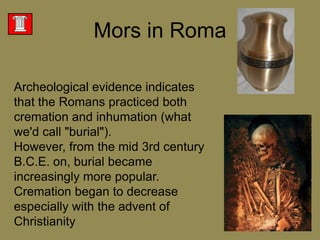
Mors in RomaArcheological evidence indicates that the Romans practiced both cremation and inhumation (what we'd call "burial"). However, from the mid 3rd century B.C.E. on, burial became increasingly more popular. Cremation began to decrease especially with the advent of Christianity
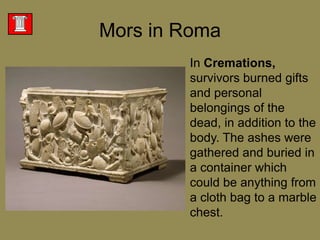
Mors in RomaIn Cremations, survivors burned gifts and personal belongings of the dead, in addition to the body. The ashes were gathered and buried in a container which could be anything from a cloth bag to a marble chest.
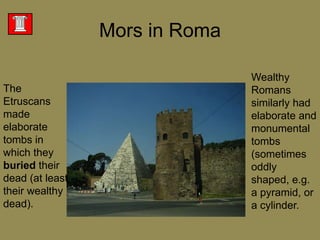
Wealthy Romans similarly had elaborate and monumental tombs (sometimes oddly shaped, e.g. a pyramid, or a cylinder. Mors in RomaThe Etruscans made elaborate tombs in which they buried their dead (at least their wealthy dead).
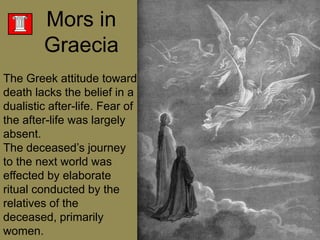
Mors in GraeciaThe Greek attitude toward death lacks the belief in a dualistic after-life. Fear of the after-life was largely absent.The deceased’s journey to the next world was effected by elaborate ritual conducted by the relatives of the deceased, primarily women.
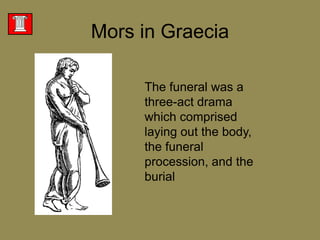
Mors in GraeciaThe funeral was a three-act drama which comprised laying out the body, the funeral procession, and the burial
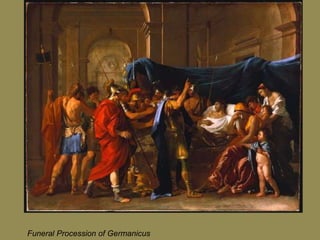
Funeral Procession of Germanicus
Mors in RomaIn Roman tradition, death was thought of as a blemish striking the family of the deceased. For this reason, rituals established a strict separation between the deceased and the living
Mors in RomaRomans believed that life after death could occur in three ways:Di manes: spirits of the dead who remained forever on their burial landLemures: spirits of the unburied dead who haunted inhabited areas and disturbed the livingDeification:elevation of an exceptional individual’s status to that of a god
Mors in RomaRitual was substantially modified for those who died in their prime, the unburied dead, victims of murder, suicides, heroes, etc. Special sympathy was felt towards women who died at a marriageable age but unmarried.
Whether the deceased had been buried or cremated, the grave site was typically marked by a tombstone and/or wooden grave marker. Mors in RomaThe tombstones could contain a sculpture of the dead person, and any demographic or political service information, and a dedicatory inscription by the family member who paid for the tombstone.
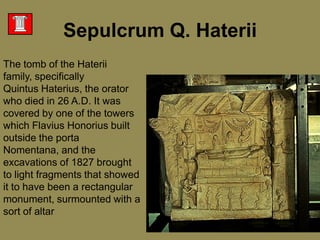
Sepulcrum Q. HateriiThe tomb of the Haterii family, specifically Quintus Haterius, the orator who died in 26 A.D. It was covered by one of the towers which Flavius Honorius built outside the porta Nomentana, and the excavations of 1827 brought to light fragments that showed it to have been a rectangular monument, surmounted with a sort of altar
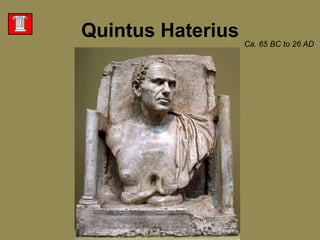
Quintus HateriusCa. 65 BC to 26 AD
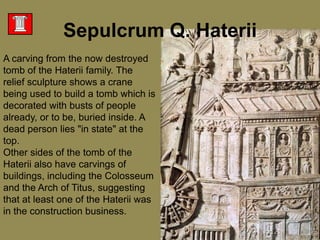
A carving from the now destroyed tomb of the Haterii family. The relief sculpture shows a crane being used to build a tomb which is decorated with busts of people already, or to be, buried inside. A dead person lies "in state" at the top. Other sides of the tomb of the Haterii also have carvings of buildings, including the Colosseum and the Arch of Titus, suggesting that at least one of the Haterii was in the construction business. Sepulcrum Q. Haterii
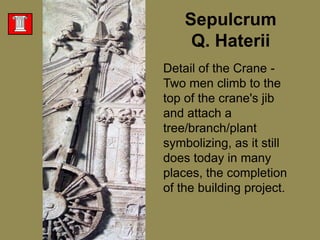
Sepulcrum Q. HateriiDetail of the Crane - Two men climb to the top of the crane's jib and attach a tree/branch/plant symbolizing, as it still does today in many places, the completion of the building project.
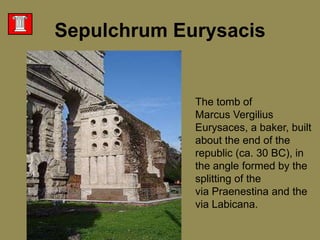
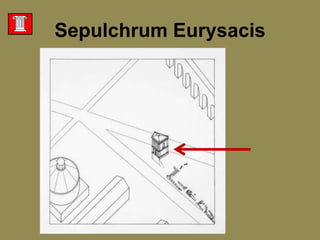
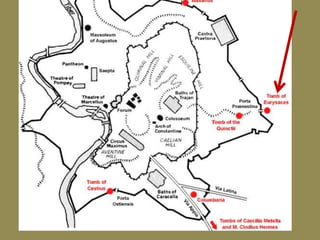
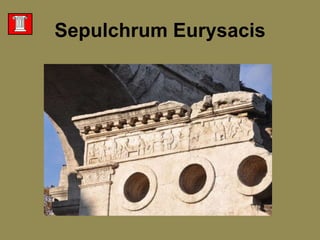
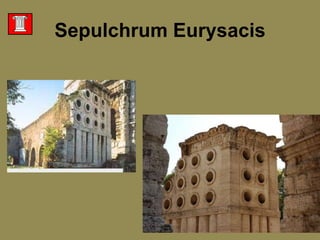
SepulchrumEurysacisThe tomb of Marcus VergiliusEurysaces, a baker, built about the end of the republic (ca. 30 BC), in the angle formed by the splitting of the via Praenestina and the via Labicana.
SepulchrumEurysacis
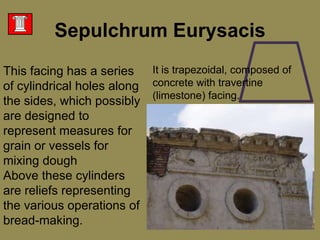
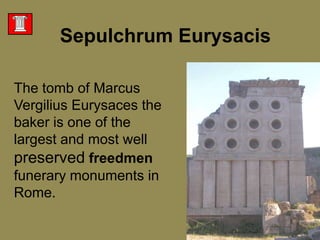
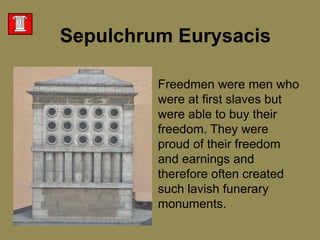
This facing has a series of cylindrical holes along the sides, which possibly are designed to represent measures for grain or vessels for mixing dough Above these cylinders are reliefs representing the various operations of bread-making. SepulchrumEurysacisIt is trapezoidal, composed of concrete with travertine (limestone) facing.
SepulchrumEurysacis
SepulchrumEurysacisThe tomb of Marcus VergiliusEurysaces the baker is one of the largest and most well preservedfreedmen funerary monuments in Rome.
SepulchrumEurysacisFreedmen were men who were at first slaves but were able to buy their freedom. They were proud of their freedom and earnings and therefore often created such lavish funerary monuments.
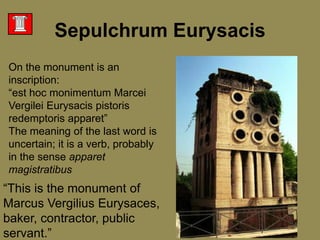
On the monument is an inscription:“est hoc monimentumMarceiVergileiEurysacispistorisredemptorisapparet” The meaning of the last word is uncertain; it is a verb, probably in the sense apparetmagistratibus“This is the monument of Marcus VergiliusEurysaces, baker, contractor, public servant.” SepulchrumEurysacis
SepulchrumEurysacis
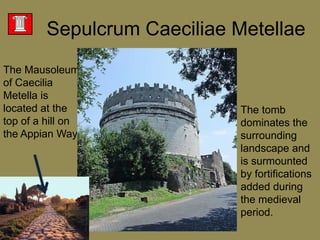
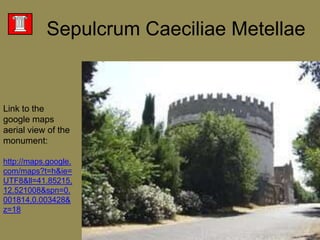
SepulcrumCaeciliaeMetellaeThe Mausoleum of CaeciliaMetella is located at the top of a hill on the Appian Way The tomb dominates the surrounding landscape and is surmounted by fortifications added during the medieval period.
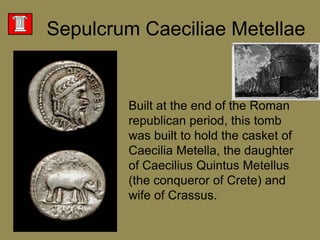
SepulcrumCaeciliaeMetellaeBuilt at the end of the Roman republican period, this tomb was built to hold the casket of CaeciliaMetella, the daughter of Caecilius Quintus Metellus(the conqueror of Crete) and wife of Crassus.
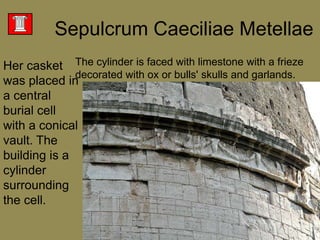
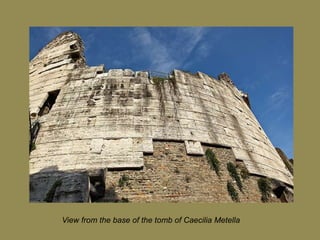
SepulcrumCaeciliaeMetellaeThe cylinder is faced with limestone with a frieze decorated with ox or bulls' skulls and garlands. Her casket was placed in a central burial cell with a conical vault. The building is a cylinder surrounding the cell.
SepulcrumCaeciliaeMetellaeLink to the google maps aerial view of the monument:http://maps.google.com/maps?t=h&ie=UTF8&ll=41.85215,12.521008&spn=0.001814,0.003428&z=18
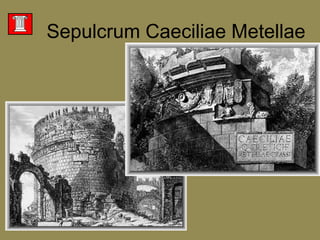
The simple inscription facing the Appian Way reads: CAECILIAE / Q. CRETICI F. / METELLAE CRASSI, or "To CaeciliaMetella, daughter of Quintus Creticus, [and wife] of Crassus".
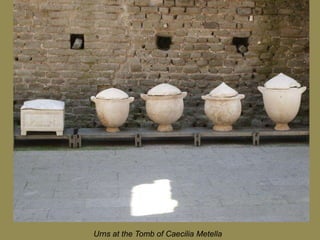
Urns at the Tomb of CaeciliaMetella
View from the base of the tomb of CaeciliaMetella
Kupferstiche von Giovanni Battista Piranesi                                               SepulcrumCaeciliaeMetellae

Architecture lesson #5 sepulcra romana

  • 1.
  • 2.
    Mors in RomaArcheologicalevidence indicates that the Romans practiced both cremation and inhumation (what we'd call "burial"). However, from the mid 3rd century B.C.E. on, burial became increasingly more popular. Cremation began to decrease especially with the advent of Christianity
  • 3.
    Mors in RomaInCremations, survivors burned gifts and personal belongings of the dead, in addition to the body. The ashes were gathered and buried in a container which could be anything from a cloth bag to a marble chest.
  • 4.
    Wealthy Romans similarlyhad elaborate and monumental tombs (sometimes oddly shaped, e.g. a pyramid, or a cylinder. Mors in RomaThe Etruscans made elaborate tombs in which they buried their dead (at least their wealthy dead).
  • 5.
    Mors in GraeciaTheGreek attitude toward death lacks the belief in a dualistic after-life. Fear of the after-life was largely absent.The deceased’s journey to the next world was effected by elaborate ritual conducted by the relatives of the deceased, primarily women.
  • 6.
    Mors in GraeciaThefuneral was a three-act drama which comprised laying out the body, the funeral procession, and the burial
  • 7.
  • 8.
    Mors in RomaInRoman tradition, death was thought of as a blemish striking the family of the deceased. For this reason, rituals established a strict separation between the deceased and the living
  • 9.
    Mors in RomaRomansbelieved that life after death could occur in three ways:Di manes: spirits of the dead who remained forever on their burial landLemures: spirits of the unburied dead who haunted inhabited areas and disturbed the livingDeification:elevation of an exceptional individual’s status to that of a god
  • 10.
    Mors in RomaRitualwas substantially modified for those who died in their prime, the unburied dead, victims of murder, suicides, heroes, etc. Special sympathy was felt towards women who died at a marriageable age but unmarried.
  • 11.
    Whether the deceasedhad been buried or cremated, the grave site was typically marked by a tombstone and/or wooden grave marker. Mors in RomaThe tombstones could contain a sculpture of the dead person, and any demographic or political service information, and a dedicatory inscription by the family member who paid for the tombstone.
  • 12.
    Sepulcrum Q. HateriiThe tombof the Haterii family, specifically Quintus Haterius, the orator who died in 26 A.D. It was covered by one of the towers which Flavius Honorius built outside the porta Nomentana, and the excavations of 1827 brought to light fragments that showed it to have been a rectangular monument, surmounted with a sort of altar
  • 13.
  • 14.
    A carving fromthe now destroyed tomb of the Haterii family. The relief sculpture shows a crane being used to build a tomb which is decorated with busts of people already, or to be, buried inside. A dead person lies "in state" at the top. Other sides of the tomb of the Haterii also have carvings of buildings, including the Colosseum and the Arch of Titus, suggesting that at least one of the Haterii was in the construction business. Sepulcrum Q. Haterii
  • 15.
    Sepulcrum Q. HateriiDetail ofthe Crane - Two men climb to the top of the crane's jib and attach a tree/branch/plant symbolizing, as it still does today in many places, the completion of the building project.
  • 16.
    SepulchrumEurysacisThe tomb ofMarcus VergiliusEurysaces, a baker, built about the end of the republic (ca. 30 BC), in the angle formed by the splitting of the via Praenestina and the via Labicana.
  • 17.
  • 19.
    This facing hasa series of cylindrical holes along the sides, which possibly are designed to represent measures for grain or vessels for mixing dough Above these cylinders are reliefs representing the various operations of bread-making. SepulchrumEurysacisIt is trapezoidal, composed of concrete with travertine (limestone) facing.
  • 20.
  • 21.
    SepulchrumEurysacisThe tomb ofMarcus VergiliusEurysaces the baker is one of the largest and most well preservedfreedmen funerary monuments in Rome.
  • 22.
    SepulchrumEurysacisFreedmen were menwho were at first slaves but were able to buy their freedom. They were proud of their freedom and earnings and therefore often created such lavish funerary monuments.
  • 23.
    On the monumentis an inscription:“est hoc monimentumMarceiVergileiEurysacispistorisredemptorisapparet” The meaning of the last word is uncertain; it is a verb, probably in the sense apparetmagistratibus“This is the monument of Marcus VergiliusEurysaces, baker, contractor, public servant.” SepulchrumEurysacis
  • 24.
  • 25.
    SepulcrumCaeciliaeMetellaeThe Mausoleum ofCaeciliaMetella is located at the top of a hill on the Appian Way The tomb dominates the surrounding landscape and is surmounted by fortifications added during the medieval period.
  • 26.
    SepulcrumCaeciliaeMetellaeBuilt at theend of the Roman republican period, this tomb was built to hold the casket of CaeciliaMetella, the daughter of Caecilius Quintus Metellus(the conqueror of Crete) and wife of Crassus.
  • 27.
    SepulcrumCaeciliaeMetellaeThe cylinder isfaced with limestone with a frieze decorated with ox or bulls' skulls and garlands. Her casket was placed in a central burial cell with a conical vault. The building is a cylinder surrounding the cell.
  • 28.
    SepulcrumCaeciliaeMetellaeLink to thegoogle maps aerial view of the monument:http://maps.google.com/maps?t=h&ie=UTF8&ll=41.85215,12.521008&spn=0.001814,0.003428&z=18
  • 29.
    The simple inscriptionfacing the Appian Way reads: CAECILIAE / Q. CRETICI F. / METELLAE CRASSI, or "To CaeciliaMetella, daughter of Quintus Creticus, [and wife] of Crassus".
  • 30.
    Urns at theTomb of CaeciliaMetella
  • 31.
    View from thebase of the tomb of CaeciliaMetella
  • 32.
    Kupferstiche von GiovanniBattista Piranesi                                               SepulcrumCaeciliaeMetellae