Architectural Acoustics
Contents
• Acoustic and Architectural Acoustic
• Reverberation and Reverberation Time
• Absorption co-efficient
• Live room and Dead room
• Sabines Formula
• Eyring’s Formula
• Eyring’s Formula To Sabine’s Formula
3
Acoustics
• Acoustics is actually a branch of physics that focuses on studying
sound, how it’s produced, transmitted, controlled, and received, and the
effects of this process.
• There are a few sub-discipline of Acoustics
• Architectural acoustics
• Bioacoustics
• Electroacoustics
• Musical acoustics and more.
In next few slide I will discuss about Architectural Acoustics.
4
Architectural Acoustics
• Architectural acoustics (also known as building
acoustics) is the science and engineering of
achieving a good sound within a building and is a
branch of Acoustical Engineering.
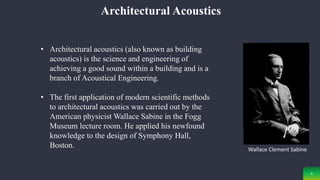
• The first application of modern scientific methods
to architectural acoustics was carried out by the
American physicist Wallace Sabine in the Fogg
Museum lecture room. He applied his newfound
knowledge to the design of Symphony Hall,
Boston. Wallace Clement Sabine
5
Architectural Acoustics
• Architectural acoustics, fundamentally, is the relationship between
a sound produced in a space and its listeners. But it can be so much
more than that!
• Positive architectural acoustics can benefit people’s health,
wellbeing and overall quality of life whereas poor acoustics and
noise disturbance can negatively impact our life.
• For example, The World Health Organisation (WHO) reports that
excessive overnight noise disturbs sleep, raises blood pressure and
can even increase the incidence of heart disease.
6
Reverberation
• Reverberation is when sound waves continue to vibrates after
the original source of the sound has stopped emitting sound.
• Sound produced in a room will repeatedly bounce off
reflective surfaces such as the floor, walls, ceiling, windows or
tables while gradually losing energy. When these reflections
mix with each other, the phenomena known as reverberation is
created. So, that define Reverberation as a collection of
many reflections of sound.
7
Reverberation Time
Reverberation time is a measure of the time required for reflecting
sound to "fade away" in an enclosed area after the source of the
sound has stopped.
Reverberation time T =
0.163 V
Σ S α
sec/m [M.K.S]
Where:
S = Surface area of material
α = Absorption coefficient of the material of the wall
V = Volume of the room
8
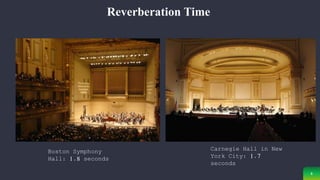
Reverberation Time
Carnegie Hall in New
York City: 1.7
seconds
Boston Symphony
Hall: 1.8 seconds
9
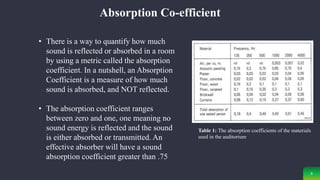
Absorption Co-efficient
s
• There is a way to quantify how much
sound is reflected or absorbed in a room
by using a metric called the absorption
coefficient. In a nutshell, an Absorption
Coefficient is a measure of how much
sound is absorbed, and NOT reflected.
• The absorption coefficient ranges
between zero and one, one meaning no
sound energy is reflected and the sound
is either absorbed or transmitted. An
effective absorber will have a sound
absorption coefficient greater than .75
Table 1: The absorption coefficients of the materials
used in the auditorium
10
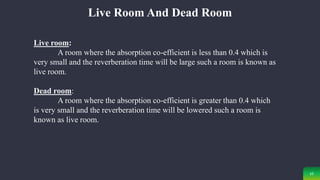
Live Room And Dead Room
Live room:
A room where the absorption co-efficient is less than 0.4 which is
very small and the reverberation time will be large such a room is known as
live room.
Dead room:
A room where the absorption co-efficient is greater than 0.4 which
is very small and the reverberation time will be lowered such a room is
known as live room.
11
11
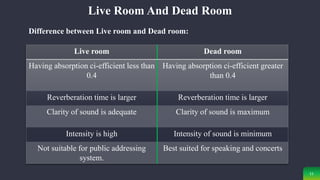
Live Room And Dead Room
Live room Dead room
Having absorption ci-efficient less than
0.4
Having absorption ci-efficient greater
than 0.4
Reverberation time is larger Reverberation time is larger
Clarity of sound is adequate Clarity of sound is maximum
Intensity is high Intensity of sound is minimum
Not suitable for public addressing
system.
Best suited for speaking and concerts
Difference between Live room and Dead room:
12
12
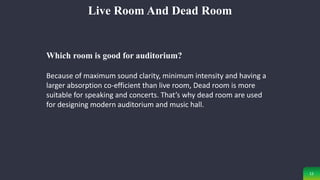
Live Room And Dead Room
Which room is good for auditorium?
Because of maximum sound clarity, minimum intensity and having a
larger absorption co-efficient than live room, Dead room is more
suitable for speaking and concerts. That’s why dead room are used
for designing modern auditorium and music hall.
13
SABINES FORMULA
Sabines Formula:
T =
𝟎.𝟏𝟔𝟑 𝐕
𝐀
[M.K.S]
Where,
V = the volume of the enclosed area
A = the total absorption of the enclosed area
Again, if velocity of sound C = 1116ft, then
Reverberation time t =
𝟎.𝟎𝟓 𝐕
𝐀
[F.P.S]
14
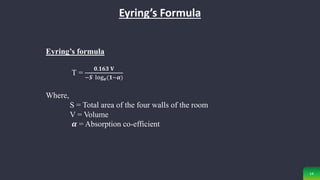
Eyring’s Formula
Eyring’s formula
T =
𝟎.𝟏𝟔𝟑 𝐕
−𝑺 log𝒆(𝟏−𝜶)
Where,
S = Total area of the four walls of the room
V = Volume
𝜶 = Absorption co-efficient
15
Eyring’s Formula To Sabine’s Formula
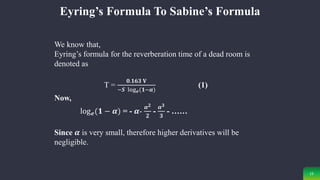
We know that,
Eyring’s formula for the reverberation time of a dead room is
denoted as
T =
𝟎.𝟏𝟔𝟑 𝐕
−𝑺 log𝒆(𝟏−𝜶)
(1)
Now,
log𝒆(𝟏 − 𝜶) = - 𝜶-
𝜶𝟐
𝟐
-
𝜶𝟑
𝟑
- ……
Since 𝜶 is very small, therefore higher derivatives will be
negligible.
16
Eyring’s Formula To Sabine’s Formula
So ,
log𝒆(𝟏 − 𝜶) = - 𝜶
From (1) ,
T =
𝟎.𝟏𝟔𝟑 𝐕
−𝑺 (− 𝜶 )
=
𝟎.𝟏𝟔𝟑 𝐕
𝑺 𝜶
So, Reverberation time,
T =
𝟎.𝟏𝟔𝟑 𝐕
𝐀
where [A = 𝑺 𝜶 ]
THANK YOU
17

Architectural Acoustics

  • 1.
  • 2.
    Contents • Acoustic andArchitectural Acoustic • Reverberation and Reverberation Time • Absorption co-efficient • Live room and Dead room • Sabines Formula • Eyring’s Formula • Eyring’s Formula To Sabine’s Formula
  • 3.
    3 Acoustics • Acoustics isactually a branch of physics that focuses on studying sound, how it’s produced, transmitted, controlled, and received, and the effects of this process. • There are a few sub-discipline of Acoustics • Architectural acoustics • Bioacoustics • Electroacoustics • Musical acoustics and more. In next few slide I will discuss about Architectural Acoustics.
  • 4.
    4 Architectural Acoustics • Architecturalacoustics (also known as building acoustics) is the science and engineering of achieving a good sound within a building and is a branch of Acoustical Engineering. • The first application of modern scientific methods to architectural acoustics was carried out by the American physicist Wallace Sabine in the Fogg Museum lecture room. He applied his newfound knowledge to the design of Symphony Hall, Boston. Wallace Clement Sabine
  • 5.
    5 Architectural Acoustics • Architecturalacoustics, fundamentally, is the relationship between a sound produced in a space and its listeners. But it can be so much more than that! • Positive architectural acoustics can benefit people’s health, wellbeing and overall quality of life whereas poor acoustics and noise disturbance can negatively impact our life. • For example, The World Health Organisation (WHO) reports that excessive overnight noise disturbs sleep, raises blood pressure and can even increase the incidence of heart disease.
  • 6.
    6 Reverberation • Reverberation iswhen sound waves continue to vibrates after the original source of the sound has stopped emitting sound. • Sound produced in a room will repeatedly bounce off reflective surfaces such as the floor, walls, ceiling, windows or tables while gradually losing energy. When these reflections mix with each other, the phenomena known as reverberation is created. So, that define Reverberation as a collection of many reflections of sound.
  • 7.
    7 Reverberation Time Reverberation timeis a measure of the time required for reflecting sound to "fade away" in an enclosed area after the source of the sound has stopped. Reverberation time T = 0.163 V Σ S α sec/m [M.K.S] Where: S = Surface area of material α = Absorption coefficient of the material of the wall V = Volume of the room
  • 8.
    8 Reverberation Time Carnegie Hallin New York City: 1.7 seconds Boston Symphony Hall: 1.8 seconds
  • 9.
    9 Absorption Co-efficient s • Thereis a way to quantify how much sound is reflected or absorbed in a room by using a metric called the absorption coefficient. In a nutshell, an Absorption Coefficient is a measure of how much sound is absorbed, and NOT reflected. • The absorption coefficient ranges between zero and one, one meaning no sound energy is reflected and the sound is either absorbed or transmitted. An effective absorber will have a sound absorption coefficient greater than .75 Table 1: The absorption coefficients of the materials used in the auditorium
  • 10.
    10 Live Room AndDead Room Live room: A room where the absorption co-efficient is less than 0.4 which is very small and the reverberation time will be large such a room is known as live room. Dead room: A room where the absorption co-efficient is greater than 0.4 which is very small and the reverberation time will be lowered such a room is known as live room.
  • 11.
    11 11 Live Room AndDead Room Live room Dead room Having absorption ci-efficient less than 0.4 Having absorption ci-efficient greater than 0.4 Reverberation time is larger Reverberation time is larger Clarity of sound is adequate Clarity of sound is maximum Intensity is high Intensity of sound is minimum Not suitable for public addressing system. Best suited for speaking and concerts Difference between Live room and Dead room:
  • 12.
    12 12 Live Room AndDead Room Which room is good for auditorium? Because of maximum sound clarity, minimum intensity and having a larger absorption co-efficient than live room, Dead room is more suitable for speaking and concerts. That’s why dead room are used for designing modern auditorium and music hall.
  • 13.
    13 SABINES FORMULA Sabines Formula: T= 𝟎.𝟏𝟔𝟑 𝐕 𝐀 [M.K.S] Where, V = the volume of the enclosed area A = the total absorption of the enclosed area Again, if velocity of sound C = 1116ft, then Reverberation time t = 𝟎.𝟎𝟓 𝐕 𝐀 [F.P.S]
  • 14.
    14 Eyring’s Formula Eyring’s formula T= 𝟎.𝟏𝟔𝟑 𝐕 −𝑺 log𝒆(𝟏−𝜶) Where, S = Total area of the four walls of the room V = Volume 𝜶 = Absorption co-efficient
  • 15.
    15 Eyring’s Formula ToSabine’s Formula We know that, Eyring’s formula for the reverberation time of a dead room is denoted as T = 𝟎.𝟏𝟔𝟑 𝐕 −𝑺 log𝒆(𝟏−𝜶) (1) Now, log𝒆(𝟏 − 𝜶) = - 𝜶- 𝜶𝟐 𝟐 - 𝜶𝟑 𝟑 - …… Since 𝜶 is very small, therefore higher derivatives will be negligible.
  • 16.
    16 Eyring’s Formula ToSabine’s Formula So , log𝒆(𝟏 − 𝜶) = - 𝜶 From (1) , T = 𝟎.𝟏𝟔𝟑 𝐕 −𝑺 (− 𝜶 ) = 𝟎.𝟏𝟔𝟑 𝐕 𝑺 𝜶 So, Reverberation time, T = 𝟎.𝟏𝟔𝟑 𝐕 𝐀 where [A = 𝑺 𝜶 ]
  • 17.