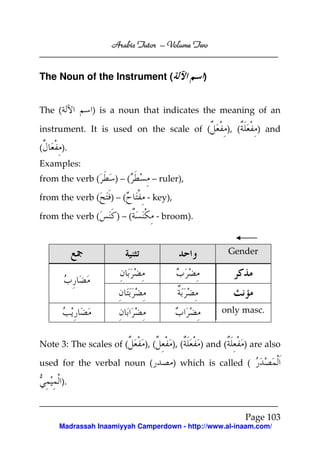
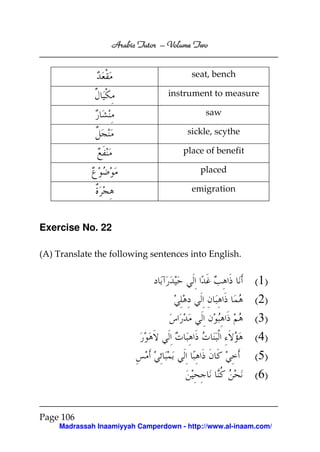
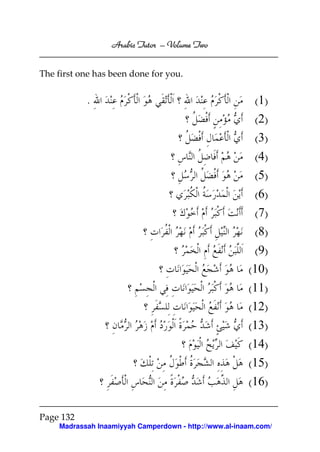
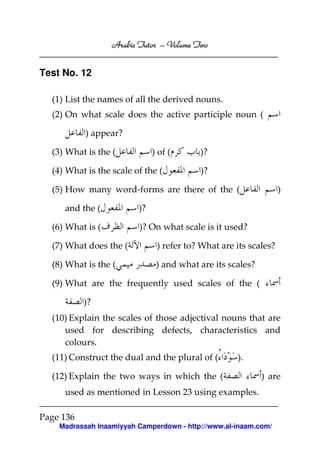
Arabic Tutor Vol. I-IV
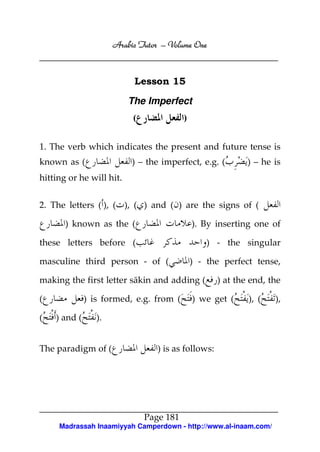
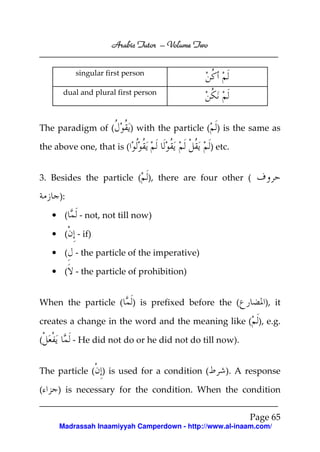
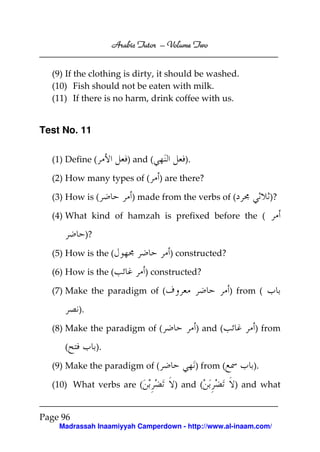
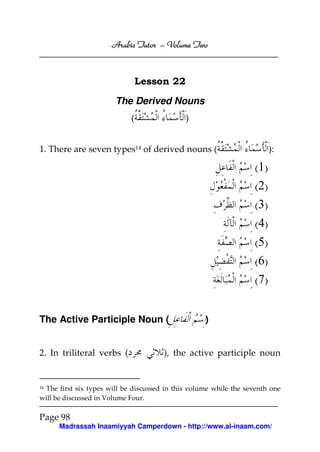
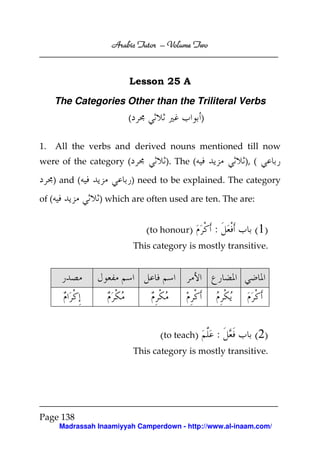
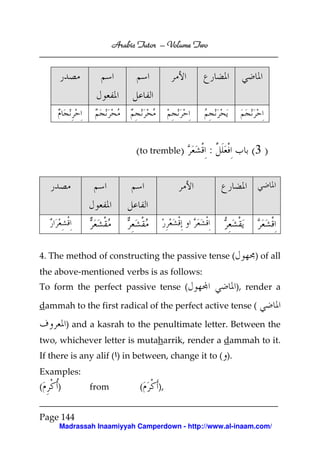
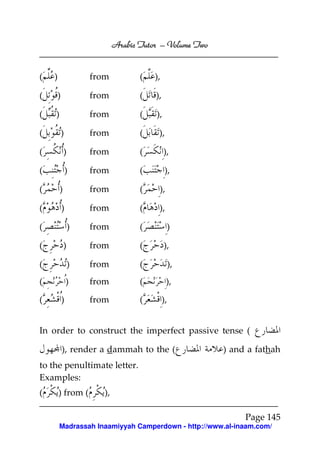
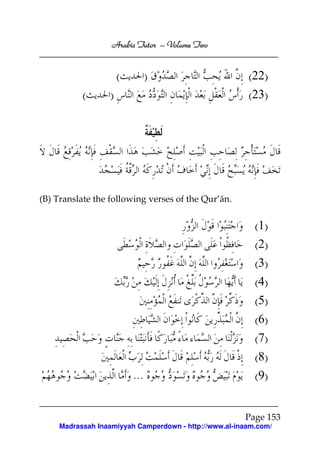
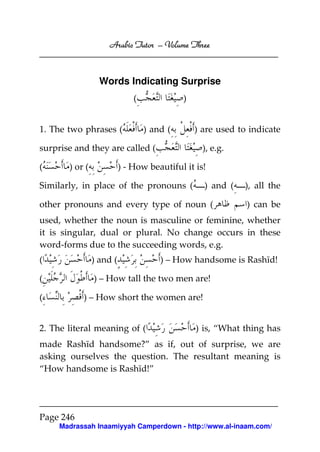
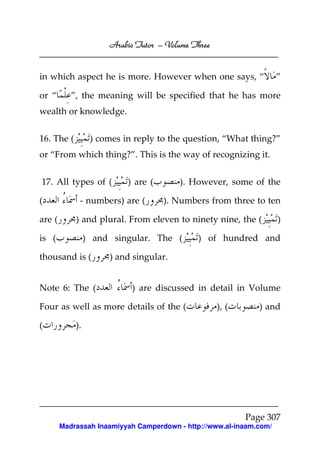
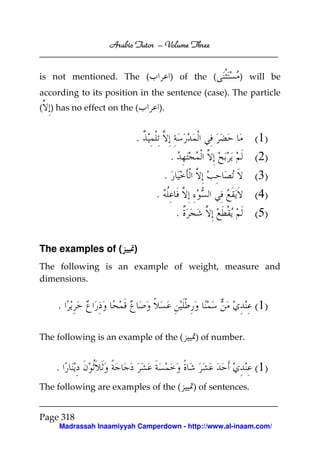
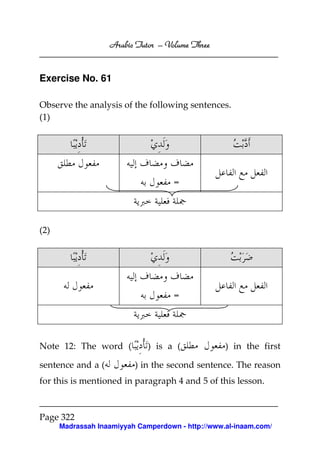
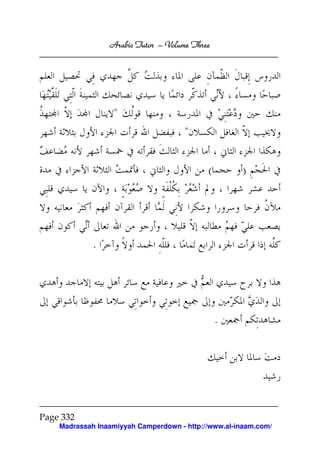
     PDF version
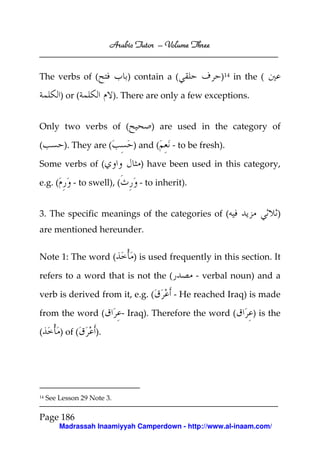
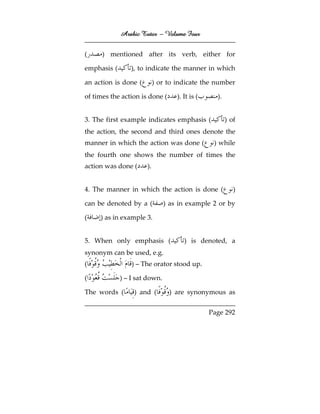
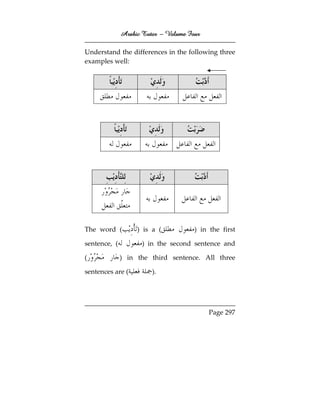
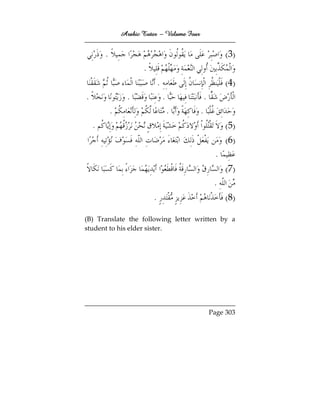
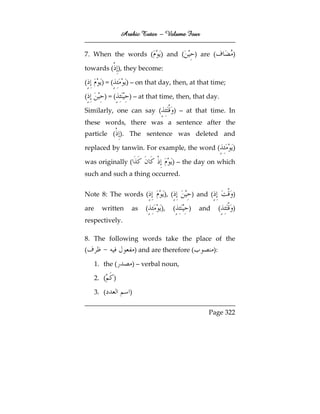
 Find more of Islamic
content at Lasjan online


                           Volume One


                             A Translation of


                           popularly known as


           Madrassah Inaamiyyah Camperdown - http://www.al-inaam.com/
Arabic Tutor – Volume One


                 Copyright © 2004 Madrasah In’āmiyyah


All rights reserved. No part of this book may be reproduced, stored in a
retrieval system, or transmitted in any form, or by any means, electronic,
mechanical, photocopying, or otherwise, without the prior permission of
Madrasah In’āmiyyah, except in the case of brief quotations embodied in
critical articles and reviews.


Typeset on Palatino 13 and Traditional Arabic 18 by Academy for Islamic
Research, Madrasah In’āmiyyah, Camperdown, KwaZulu Natal, South
Africa.


                                Page 2
      Madrassah Inaamiyyah Camperdown - http://www.al-inaam.com/
Arabic Tutor – Volume One


Title              Arabic Tutor - Volume One


Author             Moulānā Àbdus Sattār Khān (          )


Translated by Moulānā Ebrāhīm Muhammad

First Edition      R Awwal 1428 A.H. April 2007

Published by       Madrasah In’aamiyyah
                   P.O. Box 39
                   Camperdown
                   3720
                   South Africa

Tel                +27 31 785 1519

Fax                +27 31 785 1091

email              al_inaam@yahoo.com


                             Page 3
      Madrassah Inaamiyyah Camperdown - http://www.al-inaam.com/
Arabic Tutor – Volume One


Àbdullāh Ibn Àbbās        narrates that Rasūlullāh         said,
“Love the Arabs for three things:

   • because I am an Arab,
   • the Qur’ān is in Arabic and
   • the language of the people of Jannah is Arabic.”


                           Page 4
    Madrassah Inaamiyyah Camperdown - http://www.al-inaam.com/
Arabic Tutor – Volume One


                 Contents of Each Volume


Volume One: Lesson 1 to Lesson 15


Volume Two: Lesson 16 to Lesson 25


Volume Three: Lesson 26 to Lesson 43


Volume Four: Lesson 44 to Lesson 75


                           Page 5
    Madrassah Inaamiyyah Camperdown - http://www.al-inaam.com/
Arabic Tutor – Volume One


                                         Contents

  Transliteration........................................................................10
  Introduction............................................................................13
  Reviews of this Book .............................................................17
  Indications ..............................................................................25
  Notes........................................................................................25
  Request....................................................................................26
  Translator's Note ...................................................................26
  Terminology ...........................................................................28
  Terminology ...........................................................................28
Lesson 1.......................................................................................31
  Words and the Types of Words...........................................31
    The Types of Nouns ..........................................................32
    The Types of Definite Nouns...........................................33
Lesson 2.......................................................................................35
   The Particles of (                  ) and (          ).......................................35
    Vocabulary List No. 1 .......................................................38
    Exercise No. 1.....................................................................40
    Test No. 1 ............................................................................42
Lesson 3.......................................................................................44
  Compounds ............................................................................44
    The Adjectival Phrase .......................................................45
    Vocabulary List No. 2 .......................................................47
    Exercise No. 2.....................................................................49


                                          Page 6
       Madrassah Inaamiyyah Camperdown - http://www.al-inaam.com/
Arabic Tutor – Volume One


Lesson 4.......................................................................................50
  Gender.....................................................................................50
    Vocabulary List No. 3 .......................................................52
    Exercise No. 3.....................................................................53
Lesson 5.......................................................................................55
  Singular and Plural ...............................................................55
    Vocabulary List No. 4 .......................................................59
    Exercise No. 4.....................................................................61
    Test No. 2 ............................................................................62
Lesson 6.......................................................................................64
   Sentences with a Noun -                                  ....................................64
    Vocabulary List No. 5 .......................................................69
    The Nominative Detached Pronouns .............................71
    Exercise No. 5.....................................................................73
Lesson 7.......................................................................................77
  The Genitive of Possession...................................................77
    Vocabulary List No. 6 .......................................................80
    Exercise No. 6.....................................................................84
    Test No. 3 ............................................................................86
Lesson 8.......................................................................................88
  The Scales of Words ..............................................................88
    Exercise No. 7.....................................................................93
Lesson 9.......................................................................................94
  The Broken Plural..................................................................94
    Vocabulary List No. 7 .....................................................101
    Exercise No. 8...................................................................103


                                          Page 7
       Madrassah Inaamiyyah Camperdown - http://www.al-inaam.com/
Arabic Tutor – Volume One


    Test No. 4 ..........................................................................106
Lesson 10...................................................................................108
  The Cases of Nouns.............................................................108
    The Signs of Declension of Different Nouns ...............109
    Vocabulary List No. 8 .....................................................118
    Exercise No. 9...................................................................119
Lesson 11...................................................................................123
  The Genitive of Possession.................................................123
    Vocabulary List No. 9 .....................................................133
    Exercise No. 10.................................................................135
    Test No. 5 ..........................................................................140
Lesson 12...................................................................................142
  Indicative Pronouns ............................................................142
    Vocabulary List No. 10 ...................................................147
    Exercise No. 11.................................................................148
    Test No. 6 ..........................................................................151
Lesson 13...................................................................................152
  Interrogative Pronouns.......................................................152
    Vocabulary List No. 11 ...................................................156
    Exercise No. 12.................................................................157
    Test No. 7 ..........................................................................164
Lesson 14...................................................................................166
  The Verb................................................................................166
    Vocabulary List No. 12 ...................................................173
    Exercise No. 13.................................................................176
Lesson 15...................................................................................181
  The Imperfect .......................................................................181

                                         Page 8
       Madrassah Inaamiyyah Camperdown - http://www.al-inaam.com/
Arabic Tutor – Volume One


Vocabulary List No. 13 ...................................................189
Exercise No. 14.................................................................191
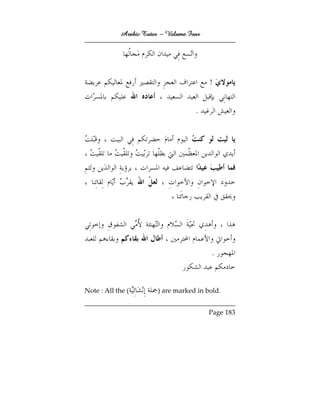
An Arabic Letter ..............................................................195
Test No. 8 ..........................................................................196


                                  Page 9
Madrassah Inaamiyyah Camperdown - http://www.al-inaam.com/
Arabic Tutor – Volume One


                       Transliteration

The following method of transliteration of the Arabic letters
has been used in this book:

                                       ā

                                       b

                                       t

                                      th

                                       j

                                       h

                                      kh

                                       d

                                      dh

                                       r

                                       z

                                       s

                                      sh

                                       s


                            Page 10
     Madrassah Inaamiyyah Camperdown - http://www.al-inaam.com/
Arabic Tutor – Volume One


                                  d

                                  t

                                  z

                                  á

                                  í

                                  ú

                                 gh

                                  f

                                  q

                                  k

                                  l

                                 m

                                  n

                                  ū

                                  h

                                 ī, y


                       Page 11
Madrassah Inaamiyyah Camperdown - http://www.al-inaam.com/
Arabic Tutor – Volume One


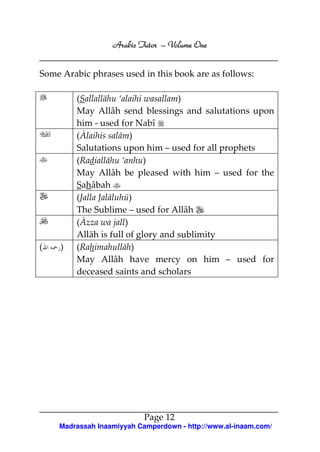
Some Arabic phrases used in this book are as follows:

         (Sallallāhu ‘alaihi wasallam)
         May Allâh send blessings and salutations upon
         him - used for Nabî
         (Àlaihis salām)
         Salutations upon him – used for all prophets
         (Radiallāhu ‘anhu)
         May Allâh be pleased with him – used for the
         Sahâbah
         (Jalla Jalāluhū)
         The Sublime – used for Allâh
         (Àzza wa jall)
         Allāh is full of glory and sublimity
(    )   (Rahimahullāh)
         May Allâh have mercy on him – used for
         deceased saints and scholars


                           Page 12
    Madrassah Inaamiyyah Camperdown - http://www.al-inaam.com/
Arabic Tutor – Volume One


                        Introduction

From the multitudes of letters which this humble writer has
received from every corner of India, there still seems to be a
fervent desire in this age to learn Arabic and to understand
the final message of Allāh , namely the Qur’ān.

However, no primary syllabus that conformed to the times
was presented to the seekers of Arabic – such a syllabus
that could increase the enthusiasm of the learners.

The ancient method of teaching Arabic and its syllabus
from the very outset made one lose courage. Even the
modern books have been deficient in creating an urge in the
student.

Experience shows that only a syllabus which has easy rules
coupled with teaching the language can increase the
enthusiasm of the student. The rules must assist the learner
in mastering the language. While learning the language, the
rules are refreshed.


                            Page 13
     Madrassah Inaamiyyah Camperdown - http://www.al-inaam.com/
Arabic Tutor – Volume One


In reality, choosing such lessons and providing a sequence
for them is no ordinary task. This is merely the grace of the
Almighty Allāh       who made this writer accomplish such
an enormous task.


“That is the grace of Allāh. He grants it to whoever He
desires.”

All thanks are due to Allāh    that this book was found to
be extremely beneficial wherever it was read or taught.
Many seekers of Arabic have written that they had lost
hope after several attempts. If they had not obtained this
book, they would not have learnt Arabic.

This is the fourth edition of this book. Initially, this book
was written in two parts. Now it has been divided into four
parts so that it can serve as a proper syllabus for high
schools from the fourth class till matric.

This is the first part of the book. The lessons have been
decreased when compared to the previous editions.
However, the exercises have been increased to an extent
that they can serve the place of an Arabic reader.


                            Page 14
     Madrassah Inaamiyyah Camperdown - http://www.al-inaam.com/
Arabic Tutor – Volume One


This part contains only fifteen lessons. But you will be
surprised to note how much Arabic is taught with such a
few lessons. The method of analysing sentences and
recognition has been so well explained, that one cannot
achieve this by learning several other prevalent Arabic
Grammar books.

The key to each part has also been published. Due to this,
many learners have learnt Arabic on their own.

A student doing self-study can complete this part in about
six weeks. However, due to the presence of several other
subjects in high schools, it will be appropriate to make it a
one year course in the fourth class. In Arabic seminaries
and Dārul Úlūms, where only Arabic is taught, all four
parts of this book can be easily taught in one year.

Nevertheless, this book is such that every text book
committee and those in charge of the syllabi in the
madrasahs should include it in their syllabus in order to
remove the difficulties of the students. They will be
rewarded by Allāh and thanked by the people.

The summary of the opinions of the Ulamā of every
province of India and the reviews of magazines and
newspapers is that this has been the most successful
attempt to simplify Arabic. This book is worth being

                            Page 15
     Madrassah Inaamiyyah Camperdown - http://www.al-inaam.com/
Arabic Tutor – Volume One


introduced in government and non-govermental schools so
that the teaching of Arabic can be simplified.
This humble servant is grateful to all those who rendered
beneficial opinions. May Allāh        reward them with the
best of rewards.

The following pages contain the valuable opinions of some
scholars. This should serve as a means of encouraging the
seekers of Arabic. Others will not have to waste their time
in looking for the merits of this book.

The servant of the students
(Moulānā) Àbdus Sattār Khān (        )
Bindi Bazaar, Bombay, India

Muharram 1361 A.H.


                           Page 16
    Madrassah Inaamiyyah Camperdown - http://www.al-inaam.com/
Arabic Tutor – Volume One


                   Reviews of this Book
by the Úlamā, professors of Arabic, authentic journals and
                  the lovers of Arabic

Àllāmah Shabbir Ahmad Úthmānī (              )

This book is worth including in the syllabi of the madāris. It
is perhaps the best book written in this subject. The author
has done a tremendous favour to the seekers of Arabic.


Moulānā Manāzir Ahsan Gilānī (             ), teacher at Jāmiah
Uthmāniah, Hyderabad

May Allāh reward you. This is a tremendous task. You have
favoured the Muslims greatly. You have decreased a
burden from my shoulders.

Moulānā Khājah Àbdul Hayy (             ), professor at Jāmi’ah
Millīyah, Delhi

I taught the first part to the students as an experiment. I
have found this book to be the easiest from all the books
written on this subject.

Abul A’lā Maududi, editor of Tarjumanul Qur’ān, Lahore

                            Page 17
     Madrassah Inaamiyyah Camperdown - http://www.al-inaam.com/
Arabic Tutor – Volume One


This is the most successful effort at explaining the language
of Arabic and its rules.


Moulānā Muhammad Nāzim Nadwī (                     ), teacher at
Nadwatul Ulamā, Lucknow

Many books have been written in India to learn the Arabic
language in the shortest period possible. However, I have
not seen any book till now that concisely meets the needs of
the time. Moulānā Àbdus Sattār Khān is entitled to the
gratitude and thanks of the Indian students and teachers for
having written a very beneficial, easy and concise textbook
to fulfil this need…

From my personal experience I know that this book is very
valuable in providing benefit. It is worthy of being included
in Arabic madrasahs and English schools so that the
students can learn the language in a short period.


                            Page 18
     Madrassah Inaamiyyah Camperdown - http://www.al-inaam.com/
Arabic Tutor – Volume One


Moulānā Àbdul Qadīr Siddīqī (             ), teacher at Jāmi’ah
Uthmāniah, Hyderabad

If this book is included in the syllabus, it will be very
suitable. It is better than other books.


Moulānā     Àbdul     Wāsi’ (         ), teacher at Jāmi’ah
Uthmāniah, Hyderabad

I completely agree with the opinion of Moulānā Àbdul
Qadīr Sāhib.


Àllāmah Sheikh Àbdul Qādir (                    ), professor at
Elphinstone College, Bombay

This is a successful endeavour. If this book is included in
the initial Arabic syllabus, it would be more beneficial than
other books.


Moulānā Ghulām Ahmad (             ), head teacher at Madrasah
Àrabīyah, Jāmi’ Musjid Bombay


                            Page 19
     Madrassah Inaamiyyah Camperdown - http://www.al-inaam.com/
Arabic Tutor – Volume One


We have included this textbook in the syllabus of our
madrasah. Experience shows that it is very beneficial.


Moulānā Habībur Rahmān Sherwānī (             ), Hyderabad

I have studied the book, ‘Àrabī kā Mu’allim’. It seems to be
better than the previous books.


Moulānā Lutfur Rahmān (          ), Hyderabad

The success you have achieved in simplifying Arabic has
not been achieved by anyone, not even by the European
Orientalists. This book is not merely ‘dry’ Grammar but is
an excellent textbook of Grammar and an interesting
collection of literature.


Janāb Ghulām Àlī, advocate of the High Court, Bombay

Such an interesting and easy book of Arabic Grammar has
not been seen before. My children study it with great
interest.


                           Page 20
    Madrassah Inaamiyyah Camperdown - http://www.al-inaam.com/
Arabic Tutor – Volume One


Moulānā Sayyid Muhammad Yahyāpūr (                   ), Ilāhabād

There is no doubt that the author will long be remembered
for this book and in the hereafter it will be a means of great
reward for him.


Moulānā Muhammad Sa’īd (              ), Sultānpūr

The books of Punjab and U.P. and the book ‘Kalāme Àrabī’ of
Meerut are non-entities in front of your book.


Moulānā Muhammad Siddīq Kīrānwī (               )

This humble servant has several books of this type e.g.
Raudatul Adab, Kalāme Àrabī etc. However, the excellent
manner in which you have presented the summary from
Mīzān till Kāfiyah cannot be found in the above-mentioned
books.


Moulānā Sa’īduddīn Khān (           ), Indor

Indeed Arabic has been simplified. Your effort is worth
congratulating.


                            Page 21
     Madrassah Inaamiyyah Camperdown - http://www.al-inaam.com/
Arabic Tutor – Volume One


Zamīndār, a newspaper of Lahore

Without exaggeration, we can say that the learned author
has achieved extraordinary success. In our opinion this
book is worth including in the syllabi of all government and
non-government schools where Arabic is taught. We
specifically request the Punjab Text Book Committee to
grant the students the opportunity to benefit from it.


Al-Jam’īat, a newspaper of Delhi

“Arabī Kā Mu’allim” in reality conveys the meaning of its
name – that is, it is an Arabic tutor. My desire is that the
principals of Arabic institutes include it in their syllabi.


The Journal “Adabī Dunyā” of Delhī

Many books have been written till now in the modern trend
in order to simplify Arabic. I have seen practically all of
them. However, the manner in which Moulanā Àbdus
Sattār Khān has simplified a complex language such as
Arabic cannot be found anywhere.


                           Page 22
    Madrassah Inaamiyyah Camperdown - http://www.al-inaam.com/
Arabic Tutor – Volume One


The newspaper “Zamzam” of Lahore

The manner of teaching and understanding adopted in this
book does not create any burden on the mind. Every fact is
thoroughly learnt like a known fact. In our opinion there is
no better series to promote Arabic.

The Journal “Balāgh” of Amritsar

Moulanā Àbdus Sattār Khān is entitled to congratulations
for having converted this stone (Arabic Grammar) into
water. He has explained all the rules from Mīzān till Kāfiyah
in an easy-to-understand manner.


Ilāhī Bakhsh, Malaya

I have ordered many books of Arabic Grammar and
Morphology written in Urdu and English and have spent
much money on them. But by Allāh, these books have no
value in front of your book. I do not have sufficient
powerful words to describe the assistance I have received
from your book in learning Arabic. Even now, if a Muslim
finds Arabic to be difficult, he is unfortunate and lacks
courage.


                            Page 23
     Madrassah Inaamiyyah Camperdown - http://www.al-inaam.com/
Arabic Tutor – Volume One


Janāb Muhammad          Hanīf,    Upper       Primary   School,
Hazārībāgh

I had a desire to study Arabic for a long time. I used many
books but it was futile. When I studied your book, I
mastered Arabic in a very short while. The surprising thing
was that I received no assistance from any teacher. Your
book in reality is a mirror of the Arabic language.


Muhammad Sharafud-dīn, Hyderabad

I thought that Arabic was so difficult that I could not even
imagine learning it. However, as soon as I saw your book,
my courage increased and I began studying it. I completed
the first part in a few days. Now send me the second part. I
do not think there is any book easier than this one.


Dr. Muhammad Àbdul Quddūs, Madras

I read the first part of your book. It helped me
tremendously to the extent that now I am able to write a
few sentences in Arabic. Undoubtedly your book will create
a great revolution.


                           Page 24
    Madrassah Inaamiyyah Camperdown - http://www.al-inaam.com/
Arabic Tutor – Volume One


This amount of recommendation is sufficient for the one
who understands; otherwise so many reviews were
received that a separate book could be compiled for this
purpose.


                         Indications

1) The inverted comma ( ) is used to indicate the plural of a
noun.
2) In order to refer to a particular lesson, the lesson number
and fact number will be mentioned in brackets thus: (5-2)
meaning lesson number 5, fact no. 2.
3) The (   ) of the verb is mentioned in brackets after it.


                            Notes

1) Do not start a new lesson until you have mastered the
previous one.
2) Translate each exercise with particular care.
3) Sometimes you may not understand a point. Remain
steadfast and seek the assistance of someone. Perhaps later
on you will understand the point yourself.


                            Page 25
     Madrassah Inaamiyyah Camperdown - http://www.al-inaam.com/
Arabic Tutor – Volume One


                           Request

A request is made to the teachers to study the book
thoroughly before teaching it. During your teaching stint,
you will be able to refer your students to previous lessons
easily. There is no need to memorize the rules parrot-
fashion. As you continuously repeat the examples, the rules
will become ingrained in your mind. You will also learn the
Arabic terms at the same time. It is appropriate to teach the
book twice. First teach it superfluously and then in detail
the second time.


                     Translator's Note

Translating is indeed a difficult task and I therefore do not
claim to have fulfilled the right of translating this book. I
ask the reader to overlook all shortcomings. Those
attempting to translate any work of this calibre, will realize
the great hurdles one has to overcome, especially where
there are many technical terms involved.

I have made an attempt to clarify the text as much as
possible and simplify the rules so that the beginner can
grasp them quickly. Where there was a need, I have added
explanatory footnotes.


                            Page 26
     Madrassah Inaamiyyah Camperdown - http://www.al-inaam.com/
Arabic Tutor – Volume One


The original Urdu text of the book contains many errors,
especially in the Qur'ānic verses. I have corrected these in
the English version. In many cases, I have used tables to
enlist sentences or examples. This was done for the sake of
greater clarity although the original text does not have such
tables. Many new Arabic words used in the exercises have
not been mentioned in the vocabulary. I have enlisted these
as well. Many singular words did not have their plurals
listed. I have included these also for the benefit of the
students.

I have used the arrow sign (      ) to indicate the direction of
the text. In some cases, the text has to be read from left to
right as in English, while in other instances, it has to be read
from right to left as in Arabic.

I have provided the English equivalents of the Arabic
grammatical terminology for the sake of information. The
student need not learn the English terms. If one learns the
Arabic terms and understands them well, it is sufficient.
May Allāh accept this humble effort from me and make it
a means for my salvation, Āmīn.


                            Page 27
     Madrassah Inaamiyyah Camperdown - http://www.al-inaam.com/
Arabic Tutor – Volume One


                     Terminology

  Terms                    Meanings
             the diacritical points namely fathah
             (     ), kasrah (    ) and dammah (      ).
                       a letter with a harakah

             the diacritical point (       ) also known
                                 as jazm
                             fathah (      )

                            kasrah (       )

                           dammah (            )

             two fathahs (        ), two kasrahs ( ) or

                         two dammas ( )
              the sound of the nūn created when
                     reading the tanwīn
                  a letter having a fathah, eg. ( )

                  a letter having a kasrah, eg. ( )

                 a letter having a dammah, eg. ( )

                  a letter having a sukūn, eg. ( )


                         Page 28
Madrassah Inaamiyyah Camperdown - http://www.al-inaam.com/
Arabic Tutor – Volume One


                 a letter having a tashdīd (     )
                    to make a noun definite

                   to make a noun indefinite

                  the ( ) attached to a noun


                      the noun having ( )


                            singular

                              dual

                             plural

             a collective plural, e.g. (    ) - nation

              masculine – also known as (            )

               feminine – also known as (            )
                   the letters of the alphabet


                         ( ), ( ) and ( )


                       Page 29
Madrassah Inaamiyyah Camperdown - http://www.al-inaam.com/
Arabic Tutor – Volume One


              the letters besides the (                 )


              One hamzah is that of the (

                     ). Another hamzah is an alif

              that is mutaharrik (        ) or an alif

               having jazm like the alif of (       )
             The initial hamzah of a word which
            is not pronounced when joined to the
               preceding word, e.g. (               )


                       Page 30
Madrassah Inaamiyyah Camperdown - http://www.al-inaam.com/
Arabic Tutor – Volume One


                                 Lesson 1

                Words and the Types of Words

1. A word having a meaning is called (                      ). It is of three

types: (       ) – noun, (      ) - verb and (        ) - particle.


An (       ) is independent of other words in indicating its

meaning. It also does not have any tense, e.g. (                   ) – man,

(       ) – specific name, (          ) – to hit, (         ) – good, (   )–

he, ( ) – I.


A(       ) is a word that indicates some action together with

one of the three tenses, e.g. (             ) – he hit, (       ) – he went,

(        ) – he is going or he will go.


A(         ) is a word whose meaning cannot be understood

without an (           ) or (   ), e.g. (   ) – from, (       ) – on, ( ) –

in, (    ) – till, (                          ) – The man went to the

                                  Page 31
        Madrassah Inaamiyyah Camperdown - http://www.al-inaam.com/
Arabic Tutor – Volume One


musjid.


The Types of Nouns

2. Nouns are of two types:
(1) (      ) – definite and

(2) (      ) – indefinite.


An indefinite noun is a word which refers to a general
thing. The word (             ) – a man, does not refer to any

specific person. It can refer to any person. The word (              )
does not refer to any particular good thing. Every good
thing can be called (         ).


A definite noun refers to a specific thing. Zaid (          ) is the

name of a particular person. Makkah (             ) is the name of a

specific city. (       ) – the man - refers to a specific person.


                                   Page 32
        Madrassah Inaamiyyah Camperdown - http://www.al-inaam.com/
Arabic Tutor – Volume One


The Types of Definite Nouns

Definite Nouns are of seven categories:


   1. (           ) – proper nouns, e.g. (      ), (       ).

   2. (             ) - pronouns, e.g. (   ) – he, (     ) – you, ( ) - I.

   3. (                ) - the demonstrative pronoun, e.g. (            ) –

      this, (     ) – that.

   4. (                  ) - the relative pronoun, e.g. (        ) – who,

      (    ) – who (feminine).

   5. (           ) – vocative case, e.g. (            ) – O man, (          )
      – O boy.
   6. (                ) - the noun having ( ), e.g. (                ) the

      horse, (         ) – the man.

   7. (                       ) – a noun which is related to any of

      the above-mentioned definite nouns, e.g. (                        )–

      Zaid’s book, (                ) – this person’s book, (

                ) – the book of the man.


                                 Page 33
    Madrassah Inaamiyyah Camperdown - http://www.al-inaam.com/
Arabic Tutor – Volume One


Note: In these examples, the word (                    ) has become
definite.


Besides the above-mentioned definite nouns, all other
nouns are indefinite. They are also of several types, two of
the main categories being:

(1) (               ) – a word that denotes the being of

something, living or non-living, e.g. (              ) – man, (   )–

horse, (       ) – stone.


(2) (              ) -      a word that indicates the quality of

something, e.g. (           ) – beautiful, (   ) – ugly.


                                 Page 34
        Madrassah Inaamiyyah Camperdown - http://www.al-inaam.com/
Arabic Tutor – Volume One


                                    Lesson 2

                  The Particles of (               ) and (    )

1. The tanwīn1 is generally attached to a word that is
indefinite. In this case, it is regarded as a particle that
renders a noun indefinite (                        ).2 It is translated as ‘a’

or ‘an’ in English, e.g. (                ) – a man, (   ) – an apple, (     )
– water. There is no need to translate it everywhere as in the
example of (         ) – water.


Note 1: Sometimes a proper noun also has tanwīn, e.g.
(       ), (        ), (     ). In such a case, the tanwīn is not

regarded as a (                     ).


2. The definite article of Arabic is ( ).3 It is also called (

         ). When ( ) is prefixed to any indefinite word, it

becomes definite. Now the word is termed as (                              )–


1 See Terminology on page 22.
2 This is similar to the letter ‘a’ in English.
3 It is similar to the word ‘the’ in English.


                                         Page 35
       Madrassah Inaamiyyah Camperdown - http://www.al-inaam.com/
Arabic Tutor – Volume One


a word made definite by ( ). Consequently, (                  ) – a horse,

is indefinite while (           ) – the horse, is definite.


3. When ( ) is prefixed to a word having tanwīn, the
tanwīn falls off. Note the above example.


4. When any word precedes a word having ( ), the first
word is joined to the lām of the second word and
pronounced (by joining). The hamzah of the ( ) is known

as hamzatul wasl.4 It is not pronounced, e.g. (                     ) – the

door of the house. To read (                 ) here is incorrect.


Note 2: If there is a sākin letter before the ( ), the sākin
letter is normally read with a kasrah. However the word
(     ) is read with a fathah. Therefore, (            ) is read as (

        ) and (          ) is read as (        ).


5. When a word having tanwīn precedes the definite article,
the nūn of the tanwīn5 is rendered a kasrah and joined to

4   See under terminology.
5   See under terminology.

                                  Page 36
        Madrassah Inaamiyyah Camperdown - http://www.al-inaam.com/
Arabic Tutor – Volume One


the lām. If after the word (                     =       ), the word (       )

appears, it will be read as (                    ).


Note 3: The alif of (        ), (     ) and (     ) is also hamzatul wasl.
It is not pronounced when joined to the preceding word.


Examples: (          ) is read as (             ) – He is a son;

(         ) is read as (             ) – This is a name;

(        ) is read as (             ) – Zaid is a son;

(           ) is read as (               ) – Hāmid is a name.


When ( ) is prefixed to (              ) and (        ), the lām of the ( ) is

rendered a kasrah and joined to the ( ) and ( ). Therefore

(      ) is read as (        =        ) and (          ) is read as (   =
       ). This rule is overlooked in general conversation.


6. When ( ) is prefixed to a word having one of the letters

of (                    ), the lām of the ( ) is assimilated into the
harf shamsī, that is, at the time of pronunciation, instead of
reading the lām, the harf shamsī is pronounced. No jazm is

                                     Page 37
        Madrassah Inaamiyyah Camperdown - http://www.al-inaam.com/
Arabic Tutor – Volume One


written on the lām in such a case but a tashdīd is written on
the harf shamsī, e.g. (           ) – the sun, (       ) – the man,
etc.


The (                  ) are:


Besides these letters, the other letters are called (

        ), e.g. (   ) – the moon, (       ) – camel.

Vocabulary List No. 1

Note 4: After prefixing the definite article to these words,
pronounce them.

                    Word                   Meaning
                                            man

                                             house

                                             dates

                                              fruit

                                            ignorant


                                Page 38
       Madrassah Inaamiyyah Camperdown - http://www.al-inaam.com/
Arabic Tutor – Volume One


                                    learned

                                 good, beautiful

                                     bread

                                     lesson

                                       sin

                                   messenger

                                     zakāh

                                      easy

                                     thing

                                     prayer

                                      light

                                  good, clean

                                   oppressor

                                      just

                               one who forgives

                                  transgressor

                                      ugly


                       Page 39
Madrassah Inaamiyyah Camperdown - http://www.al-inaam.com/
Arabic Tutor – Volume One


                                      noble, generous

                                           milk

                                          water

                                           day

                                           boy

                                            cat

                                           day

                                           and

                                            or


Exercise No. 1

Note 5: When speaking, pause on the last letter, that is, do
not read any harakah on the final letter. Read the word
(    ) as (    ) and (     ) as (      ). If you are reading one
word, pause on its last letter and if you are reading several
words, pause on the last word, e.g. (             ).
(A) Read these words and translate them:


                            Page 40
     Madrassah Inaamiyyah Camperdown - http://www.al-inaam.com/
Arabic Tutor – Volume One


         ( 5)          ( 4)               (3)      ( 2)          ( 1)
    (9)             (8)             (7)                   ( 6)
      (12)                (11)                  (10)
                                                   (13)

(B) Translate the following words or phrases into Arabic.
Use the definite article ( ) wherever the words are definite.


(1) a horse (2) a man (3) a man and a horse (4) bread and
water (5) a man and a fruit and a house (6) the salāh and the
learned man (7) the pious one and the transgressor (8) the
man or the horse (9) the milk and the bread (10) a man and
a horse (11) the ugly one and the beautiful one (12) a cat
and a boy (13) the moon and the sun (14) the camel or the
horse.


                              Page 41
     Madrassah Inaamiyyah Camperdown - http://www.al-inaam.com/
Arabic Tutor – Volume One


Test No. 1

1. What is the definition of (        )?
2. How many types of words are there? Define each one
with examples.
3. What is the major difference between a noun and a verb?
4. How many tenses are there?
5. From the following words, state whether the words are
(   ), (   ) or (     ).


6. Define what is (         ) and (    ) with examples.

7. How many types of (                ) are there?
8. Say whether the following words are definite or
indefinite.


9. In the above-mentioned words, what type of (                 ) and

(    ) are they?

10. What is the hamzah of ( ) called?

11. Join the word (        ) to the words (    ), (   ) and (   ) and
read them.


                                Page 42
     Madrassah Inaamiyyah Camperdown - http://www.al-inaam.com/
Arabic Tutor – Volume One


12. When ( ) is added to the words (          ) and (   ), how are
they read?
13. What is (           )?
14. How is a word having tanwīn joined to a word having
( )?

15. What are the (                  ) and the (              )?


                              Page 43
       Madrassah Inaamiyyah Camperdown - http://www.al-inaam.com/
Arabic Tutor – Volume One


                          Lesson 3

                        Compounds

1. A combination of two or more words is called (                 ).

The relationship between them is called (           ).

2. Compounds are of two types: (           ) incomplete and ( )
complete.
(a) An incomplete compound (                    ) is a combination
of words from which no information, order or desire is
understood. It is an incomplete statement, e.g. (              )–

a good man; (            ) a man’s book.

(b) A complete compound (                ) is a combination of
words from which some information, command or wish is
understood, e.g. (              ) - The man is good. This
statement provides us with the information that the man is
good.
(           ) – Take the book. The order of taking the book is
understood from this sentence.
(           ) – O my Sustainer, grant me sustenance. A
request is understood from this statement.


                            Page 44
     Madrassah Inaamiyyah Camperdown - http://www.al-inaam.com/
Arabic Tutor – Volume One


A complete sentence is also called (                        ) or (   ).


3. Incomplete compounds are of several kinds, e.g. (

           ), (                   ), (                 ), etc. Here we will

discuss (                         ). The other types will be discussed
later on, as will complete sentences.


The Adjectival Phrase
(                    )


4. A (                         ) is a compound in which the second

word describes the first word, e.g. (                                ) – a pious

man. The word (                   ) describes the word (                  ) with the
quality of piety.


5. The first part of a (                           ) is (            ),6 while the

second part is (                     ). In the above example, the word

(        ) is (           ) while the word (                ) is (           ).


6   See Lesson 1, fact no.4

                                         Page 45
         Madrassah Inaamiyyah Camperdown - http://www.al-inaam.com/
Arabic Tutor – Volume One


6. The first part of (                        ) is called (         )7 while

the second part is called the (                )8. In the above example,

the word (           ) is a (            ) while the word (           ) is a

(    ).


7. If the (            ) is indefinite (           ), the (   ) will also be

(     ), otherwise it will be (              ). In the compound (

      ), both parts are (          ) - indefinite. In the phrase (

       ), both parts are (           ) - definite.


8. The same declension (                 )9 that applies to the (          )

will apply to the (          ).


9. A (                    ) and all other incomplete compounds
form part of a sentence.


7 a word that is being described.
8 adjective.
9 This will be discussed in detail in Lesson 10.


                                   Page 46
      Madrassah Inaamiyyah Camperdown - http://www.al-inaam.com/
Arabic Tutor – Volume One


Vocabulary List No. 2

              Word                      Meaning
                                        garden

                                           sea

                                         melon

                                        big, large

                                          deep

                                           bad

                                          apple

                                     pomegranate

                                          street

                                         palace

                                          place

                                        mosque

                                          king

                                         cheese

                                           pen


                           Page 47
    Madrassah Inaamiyyah Camperdown - http://www.al-inaam.com/
Arabic Tutor – Volume One


                                          rose

                                          good

                                          sweet

                                         broad

                                         strong

                                          clean

                                          wide

                                          great

                                          salty

                                          small

                                           red


The above list contains many (            ) and (          ). By

combining them, you can form many compounds of (

      ) – adjectival phrases.


                           Page 48
    Madrassah Inaamiyyah Camperdown - http://www.al-inaam.com/
Arabic Tutor – Volume One


Exercise No. 2

(A) Translate the following phrases into English:


              ( 4)         (3)          (2)       ( 1)
  (9)            ( 8)        (7)      (6)         ( 5)
             (12)            (11)        (10)
    (16)            (15)         (14)       (13)
                      (18)              (17)
                   (21)          (20)        (19)

(B) Translate these phrases into Arabic:

(1) the strong place (2) the small house (3) a beautiful flower
(4) the ugly man (5) the broad street (6) a pious man (7) the
sweet milk (8) the just king (9) the great palace (10) the easy
lesson (11) a beautiful horse (12) a sweet fruit (13) the small
place (14) the good horse (15) the wide house (16) the good
bread or the good milk (17) a pious boy and a transgressing
boy (18) the large musjid and the small garden.


                            Page 49
     Madrassah Inaamiyyah Camperdown - http://www.al-inaam.com/
Arabic Tutor – Volume One


                                  Lesson 4

                                    Gender

1. Arabic words are of two types with regards to gender: (1)
(        ) – masculine and

(2) (         ) – feminine, e.g. (      ) – son is masculine and (        )–
daughter is feminine.


2. When a tā ta’nīth10 ( ) is appended to the end of a

masculine noun, it becomes feminine, e.g. (                  ) changes to

(      ). Similarly (         ) changes to (           ) and (        - king)

changes to (              - queen) etc. This rule applies more to

adjectives (                ) and sometimes to (                 ).


3. In some words, the alif maqsūrah ( ) or the alif

mamdūdah (               ) is a sign of the word being feminine, e.g.

(         ) – a beautiful lady; (         ) – radiant.


10   The round tā which is a sign of feminine words.

                                    Page 50
         Madrassah Inaamiyyah Camperdown - http://www.al-inaam.com/
Arabic Tutor – Volume One


4. Some nouns are feminine without any sign of being
feminine. They are known as (                       ) – as heard from
the Arabs. The details are as follows:


   (a) any word referring to a woman, e.g. ( ) – mother;

       (         ) – bride; (    ) – a woman’s name, or India.

   (b) the names of countries, e.g. (             ) – Egypt, (    )–

       Syria, (       ) – The Roman Empire.

   (c) parts of the body in pairs, e.g. ( ) – hand, (             )–

       foot, (      ) – ear, (   ) – eye.
   (d) Besides the above-mentioned nouns, there are other
       nouns which are used as feminine by the Arabs.
       Some of them are:

                                            earth

                                            war

                                            wine

                                            house

                                            wind


                                 Page 51
     Madrassah Inaamiyyah Camperdown - http://www.al-inaam.com/
Arabic Tutor – Volume One


                                               market

                                                sun

                                                 fire

                                                soul


       Although some words have a ( ) at the end, they are
       masculine in usage because they refer to males, e.g.
       (      ) – name of a poet, (             ) – the leader of the

       Muslims, (          ) – a very learned scholar.11


6. Just as an adjective corresponds to its noun in being
definite or indefinite, so does it correspond in gender.


Vocabulary List No. 3

                         Word                  Meaning
                                                 city

                                                wise

                                                severe


11   This word is used for females as well.

                                     Page 52
           Madrassah Inaamiyyah Camperdown - http://www.al-inaam.com/
Arabic Tutor – Volume One


                                      truthful

                                       rising

                                     tall, long

                                      setting

                                     obligatory

                                 name of a woman

                                     the Qur’ān

                                       short

                                       heart

                                      peaceful

                                      ignited

                                       river


Exercise No. 3

(A) Translate these phrases into English


          (4)              (3)           (2)                ( 1)

                           Page 53
    Madrassah Inaamiyyah Camperdown - http://www.al-inaam.com/
Arabic Tutor – Volume One


   (8)                (7)                     ( 6)               ( 5)
(12)                    (11)             (10)            ( 9)
        (14)                   (13)
               (17)               (16)                (15)
                                                                (18)

(B) Translate these phrases into Arabic:

(1) a beautiful girl (2) the pious caliph (3) the wise man (4)
the obligatory zakāh (5) an obligatory salāh (6) a short night
(7) the big day (8) the good thing (9) the ugly bride (10) the
setting sun and the rising moon (11) the severe wind (12)
the long river (13) the long war (14) the short hand (15) the
peaceful heart (16) Muhammad, the pious (17) the very
learned Fātimah.


                               Page 54
       Madrassah Inaamiyyah Camperdown - http://www.al-inaam.com/
Arabic Tutor – Volume One


                                  Lesson 5

                           Singular and Plural

1. In Arabic, words are of three categories with regards to
number:
     singular (                    ), indicating one, e.g. (          ) – one
man.
     dual (       ), indicating two, e.g. (           ) – two men.

     plural (        ), indicating more than two, e.g. (             ) – more
than two men.


2. The dual12 is formed by adding (                        ) to (      ) - the

nominative case13 or (                    ) to (                      ) - the
accusative or genitive cases14.
Examples:
(     ) – one king, (           ) or (       ) – two kings


12 Although the author has referred the student to a future lesson, at this
point, it will be sufficient for him to remember that there are two forms of the
dual: one is with alif and nūn and the second with yā and nūn. Lesson 10 will
explain where to use which one.
13        – This will be discussed in Lesson 10.2.
14              – This will be discussed in Lesson 10.2.


                                    Page 55
       Madrassah Inaamiyyah Camperdown - http://www.al-inaam.com/
Arabic Tutor – Volume One


(       ) – one queen, (        ) or (      ) – two queens.


Note 1: In the prevalent books of Arabic Grammar and
Morphology, the terms (            _)    and (    _)   are not written.

Instead, these terms are expressed in detail as (

                       ) and (                                   ). We
have chosen the former method for the sake of brevity.


Note 2: To pronounce (            _) and ( _), one can read the
fathah with the sound of an alif and say ( ) and (              ). Such
signs will come frequently later on. Pronounce them in this
manner wherever one comes across them.

3. Plurals are of two types:
(a) (             ) – the sound plural

(b) (               ) – the broken plural


The sound plural is one in which the singular form of the
word remains intact (sound) with some addition at the end.
It is of two types:


(i) Masculine (            ) – in which (        ) in (         ) - the


                                 Page 56
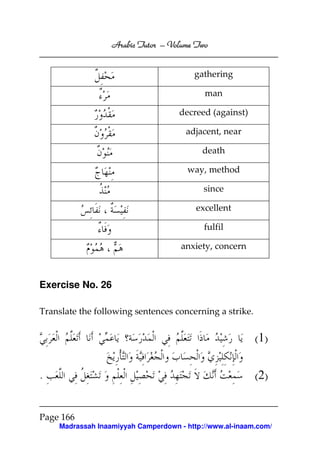
        Madrassah Inaamiyyah Camperdown - http://www.al-inaam.com/
Arabic Tutor – Volume One


nominative case15 or (                   ) in the accusative and genitive

cases are appended, e.g. (                      ) – one Muslim, (         ) or

(               ) – many Muslims.


(ii) Feminine (                   ) – in which (          ) in the nominative

case or (                    ) in the accusative and genitive cases are

appended, e.g. (                    ) – one (female) Muslim, (            ) or

(                   ) – many (female) Muslims.


The broken plural is one in which the form of the singular
word is broken, that is, changed. It has no fixed rule for
making it. Sometimes alphabets are added or deleted and
sometimes there is merely a change in the harakāt16.
Examples:
(      )        (     ), (    )    (     ), (     )   (      ), (   ) (     ),

(           )         (      ). The broken plural will be discussed in
detail in Lesson 12.


Note 3: The (                          ) - sound plural of some feminine


15   This will be discussed in Lesson 10.2.
16   Fathah, dammah, kasrah, etc.

                                        Page 57
           Madrassah Inaamiyyah Camperdown - http://www.al-inaam.com/
Arabic Tutor – Volume One


words is like the masculine plurals, e.g. the plural of (              )–

year, is (        ) or (        ) and sometimes (        ).


Note 4: The (         ) that appears at the end of the (          ) - dual

form and the (                             ) - sound masculine plural is

called (              )17. See Lesson 10.


4. Some nouns are singular in form but refer to a whole
group. There is no singular for them as well because they
are not plurals in reality. Such nouns are called (                    ).
Examples:
(     ) – a nation, (          ) – a group.
These words are generally used like plurals in sentences,
e.g. (               ) – a pious nation.


5. You have learnt in lessons 3 and 4 that the adjective
corresponds with its noun in (                     ), being definite or
indefinite and in gender. Now remember that the adjective
has to correspond with its noun in number as well.


17   Since the word ( ) is feminine in Arabic, the adjective also has to be
feminine, namely (      ).


                                     Page 58
         Madrassah Inaamiyyah Camperdown - http://www.al-inaam.com/
Arabic Tutor – Volume One


However, when the noun being described is (                                  )–
the plural of an unintelligent being18, whether masculine or
feminine, the adjective is generally singular feminine (

      ), although it is sometimes plural. One can say (

        ) as well as (                 ).


Vocabulary List No. 4

                 Word                          Meaning
                                                future

                                     sign, verse of the Qur’ān

                                             clear, manifest

                                            current (present)

                                                   past

                                     quarter, section of a city

                                                servant

                                                  baker


18Intelligent beings are humans, angels and jinn. All other creations fall in the
category of unintelligent beings (    ).


                                   Page 59
      Madrassah Inaamiyyah Camperdown - http://www.al-inaam.com/
Arabic Tutor – Volume One


                            tailor, seamstress

                             tired, exhausted

                                 displeased

                                  month

                                    lazy

                                  playing

                                  shining

                                  cheerful

                                  diligent

                                 supported

                            busy, preoccupied

                                   dark

                                  teacher

                                   bright

                                 carpenter


                       Page 60
Madrassah Inaamiyyah Camperdown - http://www.al-inaam.com/
Arabic Tutor – Volume One


Exercise No. 4

(A) Translate these phrases into English


             (3)                                           (2)                ( 1)
     (7)       (6)                                  ( 5)                      ( 4)
         (10)                                ( 9)                     ( 8)
(14)          (13)                                   (12)                    (11)
(17)             (16)                                   (15)
                (19)                                       (18)
      19
            (21)                                    (20)
                                                       (23)                  (22)

(B) Translate these phrases into Arabic

(1) a shining eye (2) the two diligent men (3) the
preoccupied baker (4) the two tired carpenters (5) the bright
day (6) the beautiful seamstresses (7) the tired servants (8)
the lazy tailor (9) the flowing rivers (10) the large animals
(11) the current year (12) the past month (13) the past years

19   This is the name Àmr. The ( ) differentiates it from (      ).


                                      Page 61
         Madrassah Inaamiyyah Camperdown - http://www.al-inaam.com/
Arabic Tutor – Volume One


(14) the cheerful servant


Test No. 2

(1) What is a (     )?
(2) How many types of compounds are there? Define each
one and provide examples.
(3) What is (               )? What is each part of it called?
(4) In which aspects does the adjective have to correspond
with the noun? What are the exceptions? Explain with
examples.
(5) What are the signs of feminine words?
(6) Which words are regarded as feminine without any
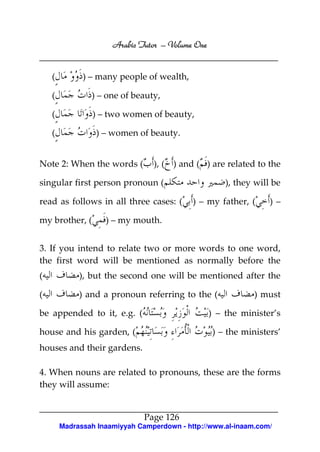
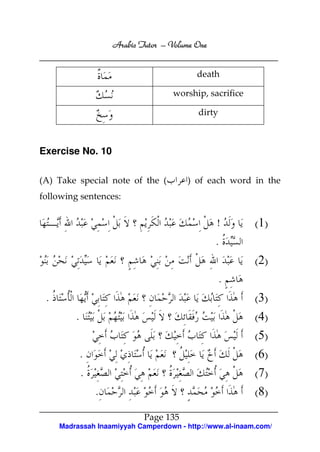
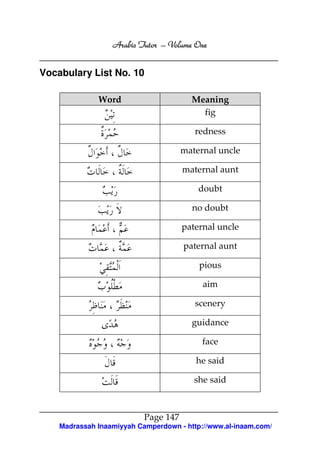
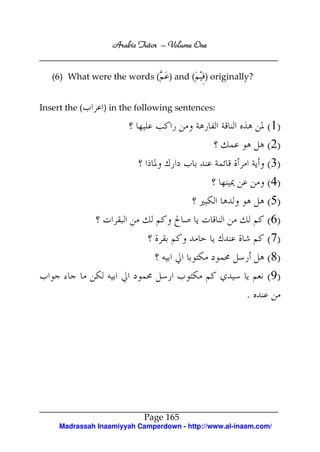
signs?
(7) In spite of having the signs of being feminine, which
words are masculine?
(8) What is the rule for making the dual and sound
masculine plural forms?
(9) What is (            ) and what is the rule for forming it?

(10) What are the broken plurals of (     ), (    ) and (        )?

(11) What is the plural of (    )?

(12) What is the difference between (      ) and (          )?


                             Page 62
     Madrassah Inaamiyyah Camperdown - http://www.al-inaam.com/
Arabic Tutor – Volume One


(13) Form as many (                         ) as possible from the
following nouns and adjectives:


     20              21            22


                                                23


20 honey
21 milk
22 grapes

23 round


                                  Page 63
          Madrassah Inaamiyyah Camperdown - http://www.al-inaam.com/
Arabic Tutor – Volume One


                           Lesson 6

             Sentences with a Noun -             ‫ا‬       ‫ا‬

1. You have read that a complete statement is called a
sentence (     ). See 3.2. Remember that sentences are of two

types: (         ) and (         ).


A(           ) is one in which the first part is a noun (     ), e.g.

(          ) – Zaid is handsome.

A(           ) is one in which the first part is a verb (     ), e.g.

(          ) – Zaid became handsome.


Hereunder follow some rules of (                ) while the (

     ) will be discussed in Lesson 14.


The first part of a (        ) is generally definite (       ) while

the second part is indefinite (        ). In the above example,

the word (     ) is definite while (     ) is indefinite.


                             Page 64
      Madrassah Inaamiyyah Camperdown - http://www.al-inaam.com/
Arabic Tutor – Volume One


Note 1: The difference between (                                  ) and (

            ) is that in the latter, both the parts are the same in
being definite or indefinite while in the former, the first part
is definite and the second part is indefinite. Consequently,
in the above-mentioned example, if an indefinite noun takes
the place of the word (                     ) and you say (              ), or you

render the second word (                          ) definite by adding ( ) to it,

and say (                       ), both these will become adjectival

phrases (                           ).


However, when the second part of a (                              ) is not a word
that can become an adjective of a noun24, it is permissible
for the second part also to be definite, e.g.
(              ) – I am Yūsuf.

It is also permissible to insert a separating pronoun (                          )

between the subject (                     ) and the predicate (     ).
Examples:
(                       ) – The man is pious.

(                           ) – The men are pious.

24   For example, it is (    ), (        ) or (     ).


                                            Page 65
         Madrassah Inaamiyyah Camperdown - http://www.al-inaam.com/
Arabic Tutor – Volume One


If the pronoun is removed from here, these sentences will
become adjectival phrases (                             ).


Note 2: In Arabic, there is no word for ‘is’ as in English.
This word is understood from the sentence. Therefore
(            ) means ‘Zaid is learned’ although the word ‘is’ is
not there.25


3. The first part of a (                 ) is called (        ) - the subject26,

while the second part is called the (                ) - the predicate27.

4. Generally the (            ) and the (        ) are in (            )28 - the
nominative case.

5. The predicate conforms to the subject in number and
gender, as in the case of the adjective. However when the
subject is (                       ) - the plural of a non-intelligent
being, the predicate is generally singular feminine.


25   However, the verb (    ) can provide the meaning of ‘is’.
26 In English, the subject of a sentence is a word or phrase that refers to the
person or thing that performs an action.
27 In English, the predicate refers to the word or words that say something

about the subject but are not part of it.
28 A detailed discussion on cases follows in Lesson 10.


                                     Page 66
         Madrassah Inaamiyyah Camperdown - http://www.al-inaam.com/
Arabic Tutor – Volume One


Examples:

      Sentence             Meaning          Type of Subject
                          The man is            singular,
                           truthful.           masculine,
                                               intelligent
                         The two men        dual, masculine,
                         are truthful.         intelligent
                         The men are              plural,
                           truthful.           masculine,
                                               intelligent
                        The woman is            singular,
                          truthful.             feminine,
                                               intelligent
                       The two women         dual, feminine,
                         are truthful.         intelligent
                       The women are        plural, feminine,
                           truthful.           intelligent
                         The wind is            singular,
                            severe.          feminine, non-
                                               intelligent
                        The two winds        dual, feminine,
                          are severe.        non-intelligent
                        The winds are       plural, feminine,
                            severe.          non-intelligent
Note 3: In these examples, if the definite article ( ) is added


                            Page 67
     Madrassah Inaamiyyah Camperdown - http://www.al-inaam.com/
Arabic Tutor – Volume One


to the second part, or it is removed from the first part, all
these examples will become (                       ) - adjectival
phrases.

6. If there are two subjects and they are of different types,
that is, one is masculine and one feminine, the predicate
will be masculine, e.g. (                  ) – The son and the
daughter are beautiful.

7. The subject and predicate are sometimes singular and
sometimes they are compounds (             ). The examples of
singular have passed. Hereunder follow the examples of
(     ):


       Sentence            Meaning               Analysis
                        The good man is        The subject is
                            present.           (            ).
                          Zaid is a good    The predicate is
                              man.             (            ).


8. By adding ( ) or (       ) to a (        ), it changes from

positive to negative. Most often a ( ) is added to the


                            Page 68
     Madrassah Inaamiyyah Camperdown - http://www.al-inaam.com/
Arabic Tutor – Volume One


predicate which changes the case to the genitive (                ),

e.g. (           ) – Zaid is not learned; (                    )–
Zaid is not a bad person.


9. Very often the word ( ) is prefixed to a (              ). As a

result, the subject changes to (                ) - the accusative
case while the predicate remains unchanged, e.g.
(               ) – Undoubtedly the earth is round.


Note 4: To create the meaning of interrogation in a sentence,
(   ) or ( ) is added to the beginning, e.g.

(         ) – Is Zaid learned?;

(             ) – Is the man learned?


Vocabulary List No. 5

                Word                       Meaning
                                      or (in a question)

                                               cow

                                    certainly, why not


                            Page 69
     Madrassah Inaamiyyah Camperdown - http://www.al-inaam.com/
Arabic Tutor – Volume One


                                      new

                                      very

                                     sitting

                                 guard, sentry

                                     sheep

                                    elephant

                                    standing

                                       old

                                       dog

                                     famous

                                    believer

                                       yes

                                      thick


                       Page 70
Madrassah Inaamiyyah Camperdown - http://www.al-inaam.com/
Arabic Tutor – Volume One


The Nominative Detached Pronouns

(                             )


                            Third Person
                           singular            he , it
              Masculine


                           dual                they

                           plural              they

                           singular            she, it
              Feminine


                           dual                they

                           plural              they


                                    Page 71
    Madrassah Inaamiyyah Camperdown - http://www.al-inaam.com/
Arabic Tutor – Volume One


                            Second Person
                            singular                   you
              Masculine


                            dual                       you

                            plural                     you

                            singular                   you
              Feminine


                            dual                       you

                            plural                     you


                          First Person (Speaker)
                                                   I

                                                   We


Note 5: These pronouns are most often the subject of a
sentence. Hence they are regarded as (                       ) – in the

nominative case. See 6.4. They are called (                   ) because
they are pronounced independently.


                                     Page 72
    Madrassah Inaamiyyah Camperdown - http://www.al-inaam.com/
Arabic Tutor – Volume One


Note 6: Also remember that ( ) is always pronounced ( )
without the alif.


Exercise No. 5

Note 7: When speaking, pause (waqf) at the end of sentences
as mentioned in Exercise No. 1. However, initially, continue
writing all the harakāt.

   (A)       Translate the following into English


(4)                              (3)              (2)           ( 1)
                                   (5)
         (7)                                       (6)
                      ( 8)
                                           ( 9)
      (11)                                               (10)
                         (12)
   (14)                             (13)


                              Page 73
       Madrassah Inaamiyyah Camperdown - http://www.al-inaam.com/
Arabic Tutor – Volume One

                     29
      (16)                                   (15)
                                                    30


(B) Fill in the blanks which represent a subject or predicate
with suitable words that you have studied.


                                                             (1)
                                                             (2)
                                                             (3)
                                                             (4)
                                                             (5)
                                                             (6)
                                                             (7)
                                                             (8)
                                                             (9)
                                                            (10)
                                                            (11)


29   See 5.2.
30   See 5.2.

                                  Page 74
         Madrassah Inaamiyyah Camperdown - http://www.al-inaam.com/
Arabic Tutor – Volume One


                                                   (12)
                                                   (13)
                                                   (14)
                                                   (15)
                                                   (16)
                                                   (17)
                                                   (18)
                                                   (19)
                                                   (20)
                                                   (21)


                       Page 75
Madrassah Inaamiyyah Camperdown - http://www.al-inaam.com/
Arabic Tutor – Volume One


(C) Translate into Arabic

   (1)    Is the boy standing? No, he is sitting.
   (2)    Is the girl sitting? No, she is standing.
   (3)    Are the two boys present? Yes, they are present.
   (4)    Are the two girls honest? Yes, they are honest.
   (5)    Are the women truthful? Yes, they are truthful.
   (6)    Is the teacher absent? No, the teacher is present.
   (7)    Are they carpenters? No, they are tailors.
   (8)    Is that Yūsuf? Yes, that is Yūsuf.
   (9)    Are you Mahmūd? No, I am Hāmid.
   (10)   Is the house old? No, the house is new.
   (11)   Are they (plural feminine) seamstresses? No, they
          are teachers.
   (12)   Are you (pl. m.) learned or ignorant? We are not
          ignorant.
   (13)   Is not the elephant a great animal? Why not, the
          elephant is a great animal.
   (14)   Is the dog standing or sitting? The dog is not
          standing but it is sitting.


                            Page 76
    Madrassah Inaamiyyah Camperdown - http://www.al-inaam.com/
Arabic Tutor – Volume One


                               Lesson 7

                The Genitive of Possession
                           (              )


1. The compound in which both parts are nouns and the
first noun is related to the second noun is called (

     ). Examples:

(          ) – the book of Zaid or Zaid’s book

(          ) – the ring of silver

(       ) – the water of the river.


2. Such a relationship between the two nouns is known as
(     ).


3. The first part of (               ) is called (   ) while the

second part is called (             ).


4. Neither does the definite article ( ) precede the (            )
nor is the tanwīn appended to it. Look at the above
examples.


                                Page 77
     Madrassah Inaamiyyah Camperdown - http://www.al-inaam.com/
Arabic Tutor – Volume One


5. The (             ) is always (        ) - in the genitive case.


6. The (         ) always precedes the (              ).


7. The (                ), like (              )31, is not a complete

sentence but is part of a sentence, e.g. (                     ) – The

water of the river is sweet. In this sentence, (               ) is the

subject while (         ) is the predicate.


8. Sometimes there are several (                           ) in one

construction, e.g. (                    ) – the door of the house of

the leader; (                        ) - the door of the house of the
minister’s son.


The middle (                    ) becomes the (             ) of the

succeeding words. Therefore ( ) cannot precede it nor can
the tanwīn be appended to it.

9. You have learnt in the first lesson that when an indefinite


31   See 3.8.

                                Page 78
         Madrassah Inaamiyyah Camperdown - http://www.al-inaam.com/
Arabic Tutor – Volume One


noun is related to a definite noun, it also becomes definite,
e.g. (            ) – the slave of Zaid;

(               ) the slave of the man. The word (             ) – slave –
has become definite in these sentences.


10. In Arabic, because the (                   ) precedes the (          )
and no word can interpose between them, the adjective of
the (           ) has to succeed the (               ), e.g.

(                        ) – the pious slave of the lady. In this

example, the word (                    ) is the adjective of the word

(       ). Therefore it is (              ),32 singular, masculine and
definite.
Hereunder are more examples. Understand the differences
properly.

                                              The pious son of the
                                                     man
               Adjective of the
                     (       )


32   in the nominative case. See Lesson 10.

                                     Page 79
         Madrassah Inaamiyyah Camperdown - http://www.al-inaam.com/
Arabic Tutor – Volume One


                                    The son of the pious
                                           man
         Adjective of the
            (              )


                                   The pious daughter of
                                          the man
         Adjective of the
                (      )


                                    The daughter of the
                                      pious woman
         Adjective of the
            (              )


Note: More rules of (          ) are discussed in Lesson 11.


Vocabulary List No. 6

                Word                      Meaning
                                           lion

                                          obedience


                               Page 80
    Madrassah Inaamiyyah Camperdown - http://www.al-inaam.com/
Arabic Tutor – Volume One


                                  I seek refuge

                                 listen, beware

                                    wisdom

                                     praise

                                      going

                                      head

                                 very beneficent

                                 very merciful

                                  rejected one

                                    husband

                                      wife

                                      anger

                              king, overpowering

                                       sky

                                     to seek

                                    fragrance

                                    shadow


                       Page 81
Madrassah Inaamiyyah Camperdown - http://www.al-inaam.com/
Arabic Tutor – Volume One


                                 very powerful

                                   every, each

                                   everything

                                      meat

        (      )                    whatever

                                       fear

                                     mirror

                                    salt, salty

                                    to forget

                                     parents

                                      goat

                                    calamity

                                  forgetfulness

                                       just

                                       east

                                      west


                       Page 82
Madrassah Inaamiyyah Camperdown - http://www.al-inaam.com/
Arabic Tutor – Volume One


Hereunder are some (                   ) which appear before

nouns and convert them to (            ) - the genitive case.

   Word   Meaning        Example    Meaning      Example    Meaning
          with,                     with a                   with
           in                        man                   the pen
           in                        in a                   in the
                                    house                  garden

            on                       on a                  on the
                                   mountain                throne

          from                       from                   from
                                     Zaid                    the
                                                           musjid
          to, till                 to a city                 till
                                                           Kufah

          for, to                  for Zaid                 I said
                                                           to Zaid

           like,                    like a                 similar
          similar                    man                    to the
                                                             lion
          from                       from
                                     Zaid

                             Page 83
    Madrassah Inaamiyyah Camperdown - http://www.al-inaam.com/
Arabic Tutor – Volume One


Exercise No. 6

(A) Translate the following into English:


       ( 5)            ( 4)          ( 3)           (2)            ( 1)
(9)                       (8)                ( 7)          (6)
(13)           (12)                 (11)            (10)
(16)                               (15)                (14)
                     (18)                    (17)
                      (20)                            (19)
(23)                     (22)                                    (21)
                                          (24)
              (26)                                               (25)
                                  (28)                    (27)
    (29)
       (31)                               (30)
                      (33)                          (32)
                .                                           (34)


                                Page 84
       Madrassah Inaamiyyah Camperdown - http://www.al-inaam.com/
Arabic Tutor – Volume One


(B) Translate the following into Arabic

   (1) the goat’s milk
   (2) the cow’s head
   (3) the obedience of the mother
   (4) Zaid’s wealth
   (5) the elephant’s ear
   (6) the light of the moon
   (7) in the house
   (8) till the market
   (9) for Allāh and the Messenger
   (10) on the head and the eye
   (11) The boy’s name is Hāmid.
   (12) They are going home.
   (13) We are sitting in the musjid.
   (14) The goat’s milk is for the girl.
   (15) The obedience of Allāh is in the obedience of the
       Messenger.
   (16) Āishah , the daughter of Abū Bakr         is the wife
       of Muhammad, the Messenger of Allāh .
   (17) He is the son of the leader.
   (18) The anger of Allāh is on the oppressive king.
   (19) The ignorant one is not like the learned one.
   (20) The fragrance is not for the boy.
   (21) She is the daughter of Hāmid’s son.


                            Page 85
     Madrassah Inaamiyyah Camperdown - http://www.al-inaam.com/
Arabic Tutor – Volume One


Test No. 3

       (1) What is the difference between (                                ) and (

            )?

       (2) What is the difference between (                               ) and (

                 )?

       (3) How many parts does a (                          ) have? What is each
       part called?
       (4) What is the (             )33 of the subject and the predicate?
       (5) What is the Arabic term for the attaching word?
       (6) In how many factors does the predicate correspond
       to the subject?
       (7) If there are two subjects of different kinds in a
       sentence, which one is considered for the predicate?
       (8) What effect does the word ( ) have on the subject?

       (9) Attach ( ) to a dual word and a sound masculine
       and feminine plural word and read it.
       (10) How is a negative meaning and one of interrogation
       created in a (                )?
       (11) What is the paradigm34 of the detached nominative


33   desinential inflection – that is, inflection of the final radical.

                                          Page 86
          Madrassah Inaamiyyah Camperdown - http://www.al-inaam.com/
Arabic Tutor – Volume One


     pronouns?
     (12) In the paradigm of the pronoun, which words are
     similar?
     (13) How do you pronounce the word ( )?

     (14) Construct ten different kinds of (                    ).

     (15) Define (                 ) and (        ).

     (16) What cannot enter on the (                   )?

     (17) What is the (           ) at the end of (                  )?

     (18) What effect do the (                    ) have on the noun?


 In grammar, a set of all the (especially inflected) forms of a word (e.g. write,
34

writes, wrote, writing, written), especially when used as a model for all other
words of the same type.

                                   Page 87
      Madrassah Inaamiyyah Camperdown - http://www.al-inaam.com/
Arabic Tutor – Volume One


                             Lesson 8

                       The Scales of Words

1. In Arabic, the original letters of nouns and verbs are not
less than three. The maximum number of letters in a noun is
five, and four in a verb. Together with the original letters,
extra letters can also be attached. At such a time, the noun
and the verb can have more than five letters.

Note 1: The original letter or root letter is the one that
remains in all the forms and derivations. Only in some
exceptions is it deleted or changed to another letter.
The extra letter is the one that is found in one word-form
but not in another, e.g. in the word (             ), all three letters

are root letters while in (        ), the alif and in (         ), the

first ( ) and the ( ) are extra letters.


2. Words having three root-letters are called (                 ), e.g.

(    ) and (      ).

If they have four root-letters, they are called (               ), e.g.

(    ) and (      ).


                               Page 88
     Madrassah Inaamiyyah Camperdown - http://www.al-inaam.com/
Arabic Tutor – Volume One


If they have five root-letters, they are called (                           ), e.g.

(            ).


Words made up of only root-letters are called (                         ) while

those having extra letters as well are called (                      ), e.g.

(       ) is (                ) – three root-letters without any extra
letters.
(        ) is (                  ) - three root-letters with extra letters

because the ( ) and ( ) are extra.


Note 2 : To distinguish whether verbs (                    ), derived nouns

(                  )35 and verbal nouns (            )36 are (       ) or (

     ), the (                           ) word-form of the perfect tense

(          ) has to be examined. If that word-form is free of extra
letters, then its derivatives and verbal noun will also be
regarded as (                ), e.g. (      ) is (               ). Hence, the


35   These are nouns that are derived from the verb, e.g. (       ) and (      ) are
derived from the verb ( ).
36   Plural of (   ), the infinitive.


                                        Page 89
         Madrassah Inaamiyyah Camperdown - http://www.al-inaam.com/
Arabic Tutor – Volume One


imperfect tense (            ) which is (      ), the (         )-     ,

the (             )-         and the verbal noun (           ) will also

be regarded as (                ) although these forms have extra
letters.


Similarly, in a paradigm, extra letters appear in a (                  )

word which will still remain (              ). For example, the word

(       ) is (    ). Therefore, (           ) and (       ) will also be

(       ).

However, (        ) and (      ) are (                ). The former has

one extra ( ) while the latter has an extra alif.


3. In order to determine the scales of words and to
distinguish the root letters from the extra letters, the scale
(       ) of (         ) is used. In triliteral words (words with 3

root letters), the (      ) represents the first radical (letter) of

the word, the ( ) represents the second radical of the word

and the ( ) represents the third radical of the word.


                                Page 90
        Madrassah Inaamiyyah Camperdown - http://www.al-inaam.com/
Arabic Tutor – Volume One


Examples:


The letter that corresponds to the (            ) of the (      ) is called

the (ِ           ), like the ( ) of (     ), that which corresponds to

the ( ) is called the (ِ                ), like the ( ) of (   ) while the

letter corresponding to the ( ) is called the (ِ                    ), like

the ( ) of (     ).


When intending to determine the scale of (                             ) -
quadriliteral (four letter) words, add two lāms instead of
one after (      ) and ( ). In words with five root letters, add
three lāms.
Examples:


                                Page 91
         Madrassah Inaamiyyah Camperdown - http://www.al-inaam.com/
Arabic Tutor – Volume One


4. At the time of determining the scale, the alphabets (          ),

( ) and ( ) will take the place of the original letters while
the other extra letters will remain as they are in their places.
Examples:


However, when a letter is increased by repeating the (

ِ    ) or the (ِ         ), the ( ) or the ( ) is repeated in the

scale. For example, in the word (                 =    ), the first

( ) is the (ِ             ) while the second one is extra.

According to the rule, the scale should have been (               ).

Instead its scale is (    ). Similarly, in the word (       ), the

final ( ) is extra. Its scale will be regarded as (   ).


5. A great benefit of recognizing the scales of words is that
by knowing the meaning of the root letters of a word, it
becomes very easy to recognize the meanings of all its
paradigms and derivatives.

                             Page 92
     Madrassah Inaamiyyah Camperdown - http://www.al-inaam.com/
Arabic Tutor – Volume One


Exercise No. 7

What are the scales of the following words:


               (3 )                   (2 )                   (1 )

               (6 )                   (5 )                   (4 )

               (9 )                   (8 )                   (7 )

              (12)                   (11)                  (10)

              (15)                   (14)                  (13)

              (18)                   (17)                  (16)

              (21)                   (20)                  (19)

              (24)                   (23)                  (22)


                           Page 93
    Madrassah Inaamiyyah Camperdown - http://www.al-inaam.com/
Arabic Tutor – Volume One


                         Lesson 9

                    The Broken Plural

1. It was mentioned previously that there is no rule to
construct the broken plural (                 ). It is totally based
on hearing the plural from the people of the language.
Hereunder we list some of the scales of the broken plural
which are used most often:


                                          (        )      :      ()
                                  (               )
                              (               )
                                      (        )
                                  (           )

                                      (           )      :     ( )
                                       (          )
                                      (       )
                                  (            )


                           Page 94
    Madrassah Inaamiyyah Camperdown - http://www.al-inaam.com/
Arabic Tutor – Volume One


                                 (            )
                                  (           )
                                 (            )

                             (            )          :       ( )
                               (               )
                               (              )
                             (                )
                                (               )
                             (                )
                                      (          )

                             (                )          :   ()
                                  (            )
                                 (            )
                         (                )
                             (                 )


                       Page 95
Madrassah Inaamiyyah Camperdown - http://www.al-inaam.com/
Arabic Tutor – Volume One


                            (                 )

                                 (           )          :   ()
                                (            )
                                         (      )
                                    (          )
                                (             )
                                     (         )

                                (             )     :       ()
                                     (         )
                            (                )
                            (                )
                                    (           )
                            (                )
                                (             )


                       Page 96
Madrassah Inaamiyyah Camperdown - http://www.al-inaam.com/
Arabic Tutor – Volume One


                                                                                ()
This scale is generally used for the adjectives of intelligent
beings which are on the scale of (                        ) as in:


                                      (                       )
                                                      (            )
                                      (                      ) 37
                                              (                )
                                                  (            )
                                                  (            )

                                           (                   )       :       ( )
                                                  (                )
                                       (                       )

                                          (                    )       :       ( )

37   The original was (   ). The reason why it has changed into (          ) will be
explained later.

                                  Page 97
        Madrassah Inaamiyyah Camperdown - http://www.al-inaam.com/
Arabic Tutor – Volume One


                                         (       )
                             (               )
                                     (           )

Note 1: The plural of five-letter words also comes on this
scale. However, the final letter has to be deleted, e.g. the
plural of (      ) is (     ). The ( ) has been deleted.


                                     (         )     :       ( )
                              (               )
                                      (         )
                                     (         )
                                     (         )
                                 (           )

                                     (           )    :      ( )
                                     (           )
                                     (           )


                            Page 98
     Madrassah Inaamiyyah Camperdown - http://www.al-inaam.com/
Arabic Tutor – Volume One


This scale is specific with intelligent beings.


                                                            :         ( )
This scale is specific with those words that are on the scale
of (     ), (    ) or (      ).


                                       (         )
                                       (         )
                                           (     )

                                                                      ()

This scale is used for those words that are on the scale of
(      ) or (      ).

                                           (        )
                                   (            )

Note 2: The following plural scales are (                             )38.


38 This is a certain class of nouns that is not fully declined. European
grammarians sometimes refer to them as diptotes. This term is discussed in

                                  Page 99
       Madrassah Inaamiyyah Camperdown - http://www.al-inaam.com/
Arabic Tutor – Volume One


Tanwīn will not be read on them.


2. Remember the plural of the following words in
particular:
The sound plural of (                    ) is (            ) in (         ) - the

nominative case and (                     ) in (                          ) - the

accusative and genitive cases. Its broken plural is (                      ).

The plural of (        ) is (      ).

The plural of ( ) is (              ) or (            ).

The plural of (          ) is (           ).

The plural of (         ) is (       ) or (           ).

The plural of ( ) is (              ).


3. Some words have plurals on several scales. Hence the
plurals of (     ) are (          ), (         ), (        ) and (   ).


4. Some words have different scales of plurals rendering


Volume 4, Lesson 57.

                                     Page 100
      Madrassah Inaamiyyah Camperdown - http://www.al-inaam.com/
Arabic Tutor – Volume One


different meanings. For example, the word (                  ) means
house or verse (of a poem). Regarding the first meaning, the
plural is (          ) while the plural (       ) is related to the
second meaning.
The word (           ) means slave or servant. The respective

plurals are (        ) and (   ).

The word (        ) means eye or spring. The respective plurals

are (      ) and (      ).


Vocabulary List No. 7

The plurals of some words are provided next to them.

                     Word                 Meaning
                                      scowling, frowning

                                           some, part of

                                        fixed, established

                                            neighbour

                                               iron

                                              good


                                Page 101
        Madrassah Inaamiyyah Camperdown - http://www.al-inaam.com/
Arabic Tutor – Volume One


                                  ambassador

                                     sword

                                       tea

                                    condition

                                    difficult

                                    long, tall

                                    Arabian

                                     empty

                                  cutting, sharp

                                   high school

                                      pious

                                    obedient

                                   pure, clean

                                     advice

                                      fresh

                                     looking

                                    precious


                       Page 102
Madrassah Inaamiyyah Camperdown - http://www.al-inaam.com/
Arabic Tutor – Volume One


                                       beneficial

                                         a day

                                         today

                                      on that day

                                        beauty

                                remaining, permanent

                                   the good actions

                                 spear, lance, javelin

                                          cup

                                        quince


Exercise No. 8

(A) In the under-mentioned examples, the adjective or
predicate of unintelligent beings is used mostly as singular
feminine. Translate the following phrases or sentences into
English.


      (4)               ( 3)               ( 2)             ( 1)


                           Page 103
    Madrassah Inaamiyyah Camperdown - http://www.al-inaam.com/
Arabic Tutor – Volume One


(8)              (7)                  (6)                 (5)
(11)                        (10)                   ( 9)
(14)              (13)               (12)
(16)                              (15)
                    (18)               (17)
             (20)                         (19)
      (22)                      (21)
                               (23)
      (25)                                    (24)
   (27)                              (26)
                                    (28)
                                         (29)
                                          .

(B) Reply to these questions in Arabic, e.g.


                                                          ( 1)


                               Page 104
       Madrassah Inaamiyyah Camperdown - http://www.al-inaam.com/
Arabic Tutor – Volume One


                                                            ( 2)
                                                            ( 3)
                                                            ( 4)
                                                            ( 5)
                                                            ( 6)
                                                            ( 7)
                                                            ( 8)
                                                            ( 9)
                                                           (10)
                                                           (11)
                                                           (12)
                                                           (13)
                                                           (14)
                                                           (15)

(C) Translate the following phrases into Arabic

   (1) the Muslim men
   (2) the large ships


                           Page 105
    Madrassah Inaamiyyah Camperdown - http://www.al-inaam.com/
Arabic Tutor – Volume One


  (3) the clean clothes
  (4) the flowing rivers
  (5) The rivers are flowing.
  (6) the past months
  (7) They are truthful witnesses.
  (8) The two tall mountains
  (9) The spears are long and the swords are sharp.
  (10) Are you (pl.) unhappy?
  (11) No, we are cheerful.
  (12) Some kings are just.
  (13) The cups of the tea are empty.
  (14) Are you (pl.) friends?
  (15) Yes, and we are relatives.
  (16) The students and the teachers are in the madrasah.
  (17) Those girls are playing.
  (18) The people of īmān are the friends of Allāh.
  (19) the tall houses.
  (20) the Arabian verses
  (21) The Qur’ān has beneficial advice (plural).


Test No. 4

  (1) What is a (            )?
  (2) How many root letters are there in a noun and in a
      verb?
  (3) Besides the root letters found in a word, what are the

                            Page 106
    Madrassah Inaamiyyah Camperdown - http://www.al-inaam.com/
Arabic Tutor – Volume One


    other letters called?
(4) With regards to the root letters of words, how many
    types of words are there?
(5) What are words which only have root letters called
    and what are those words called which have extra
    letters.
(6) Which of the following words are (          ) and which

   are (        ):


(7) How is the scale of a word determined? In other
   words, how do you use the root letters (                 ) to
    determine which letter is a root letter and which one
    is extra?
(8) What is the benefit of knowing the scales of words?
(9) What are the well-known scales of the broken plural?
(10) Which scales of the plural are (            )?

(11) Make the plurals of (        ), (   ), (   ), ( ), (     ),

   (       ) and (   ).


                          Page 107
 Madrassah Inaamiyyah Camperdown - http://www.al-inaam.com/
Arabic Tutor – Volume One


                          Lesson 10

                  The Cases of Nouns

1. The change in case of a noun due to the change in
vowelling of the final consonant is called (                      ) -
declension.
Declension is of two types: one is (                    ) which is
shown by fathah, dammah and kasrah. The other is
(                 ) which is shown by means of some

(        ) – letters - as will be explained later on.


2. When a noun is:
     (1) the doer of the verb (         ), or the subject (      ) or

         predicate (      ), it is said to be (         ) - in the
         nominative case. The examples of the subject and
         predicate have passed in Lesson no. 6.
     (2) an object (        ) or it indicates the condition (        )
         of the doer or the object, it is regarded to be in
         (             ) - the accusative case.

     (3) (             ) or it comes after a (                ), it is


                             Page 108
    Madrassah Inaamiyyah Camperdown - http://www.al-inaam.com/
Arabic Tutor – Volume One


            regarded to be (              ) - in the genitive case. The
            examples will be mentioned shortly.


The Signs of Declension of Different Nouns

3. If a noun is singular or a broken plural, in (                       ) the

dammatain ( )39 will be read on it, in (                               ) the

fathatain (      ) will be read on it and in (                        ), the

kasratain ( ) will be read on it.


39 If the noun is indefinite, the dammatain will be read on the word. However,
if the noun is definite, only one dammah will be read on it.

                                 Page 109
      Madrassah Inaamiyyah Camperdown - http://www.al-inaam.com/
Arabic Tutor – Volume One


Examples:

Example no. 1


                  Zaid sent a letter to Khālid


This is a (         ). All three nouns are singular.


Example no. 2


              The men sent clothing to the women.


                            Page 110
     Madrassah Inaamiyyah Camperdown - http://www.al-inaam.com/
Arabic Tutor – Volume One


This is a (           ). All three nouns are broken plurals.


Example no. 3


              Zaid came riding on Hāmid’s horse.


This is a (           ). The word (         ) indicates the condition

of the doer. Therefore it is (         ).


Note 1: The adjective will be in the same case as the
preceding noun. If the noun is (                ), the adjective will

also be (      ). If it is (      ), the adjective will also be the

same and if it is (       ), the adjective will follow suit.


                               Page 111
     Madrassah Inaamiyyah Camperdown - http://www.al-inaam.com/
Arabic Tutor – Volume One


Example:


            (                                            )


A learned man sent a long letter to a just king.


The words, (          ), (      ) and (      ) are adjectives and the

case of each one follows its preceding noun, namely (                ),

(       ) and (       ) respectively.


4. If a noun is dual (                ), the suffix (        ) will be

appended in (                  ) - the nominative case and (       ) in

(                    ) - the accusative and genitive cases, e.g.


(                                     )


The two men wrote two letters to the two women.


The (       ) of (      ) and (       ) meaning ‘two’ is the same as
the dual form.


The words (          ) and (     ) meaning ‘both’ will be read (      )

                                  Page 112
     Madrassah Inaamiyyah Camperdown - http://www.al-inaam.com/
Arabic Tutor – Volume One


and (       ) in (                     ) - the accusative and genitive
cases, e.g.


(                      ) – Both men came.

(                      ) – I saw both men.

(                              ) – I sent to both men.


The words (          ) and (     ) are used with a pronoun (               ).


5. If a word is (                               ) – the sound masculine

plural, the suffix (            ) will be appended in (                   ) and

(       ) in (                    ), e.g.

(                                               )


The Muslims despatched the mujāhidīn to the oppressors.


The tens from (              ) – 20 – till (            ) – 90 - have the same

(       ). The form will be (                  ) in (           ) and (         )

in (                    ).


                                   Page 113
       Madrassah Inaamiyyah Camperdown - http://www.al-inaam.com/
Arabic Tutor – Volume One


The word (            – people of) in (                ) and (    ) in (

                ) is like (                     ) - the sound masculine
plural.

Examples:
(                   ) - They are people of intelligence.


(                                             ) - I saw the people of
intelligence by the people of intelligence.


Note 2: The (             ) of the dual and sound masculine plural

is by means of letters (                 ). Therefore the nūn of both

these forms is called (                  ). See 5.4.


6. The sound feminine plural (                                ) will be read

with ( ) in (                 ) and with ( )40 in (                          ).
See 5.2. Example:


(                                              ) - The Muslim women


40   If the word has ( ), only one dammah or kasrah will be read as is apparent
from the example.

                                   Page 114
         Madrassah Inaamiyyah Camperdown - http://www.al-inaam.com/
Arabic Tutor – Volume One


expelled the transgressing women to the deserts.


7. You have learnt that when ( ) is prefixed to a word, the
tanwīn is deleted. See 2.3. Now remember that some words
do not accept the tanwīn from their inception.
Examples: (          ), (      ), (     ), (     ), (        ), (      ), (    ),

(          ).


Such nouns are called (                             ). In (               ), they

are pronounced with a (                ) and in (                        ) with a

(   ), e.g.


(                              ) - Úthmān saw Zaynab in Makkah.


However, when an (                             ) has ( ) prefixed to it, or

it is (         ), then a kasrah will be rendered to it in (                   ).

Examples: (                    ), (                     ).


Note 3: Words which accept tanwīn are called (                                 ).
These nouns will be discussed in detail in Lesson 57.
8. No (           ) can be read on words like (                     ) and (    ).

                                      Page 115
          Madrassah Inaamiyyah Camperdown - http://www.al-inaam.com/
Arabic Tutor – Volume One


They will hence be read as they are in all three cases (

                   ). Such nouns are called (              ).
Examples:
(        ), (           ), (              ).


9. Words with a yā sākin ( ) at the end like (             ), (   ),

(     ) and (        ) are free of external (     ) in (

    ) while in (                ), a (    ) will be rendered to
them.
Examples:


            Sentence             Meaning         Case
                                 The judge
                                    came
                                The slave of
                                 the judge
                                   came.
                                 I saw the
                                   judge.


If these words do not have ( ), they will be read as (            ),


                               Page 116
    Madrassah Inaamiyyah Camperdown - http://www.al-inaam.com/
Arabic Tutor – Volume One


(      ), etc. in (                     ) and (          ), (     ) etc. in (

         ).


Their sound plurals (                         ) are: (           ), (        ) etc. in

(             ) and (        ), (       ) etc. in (                     ).


Their dual forms are like normal words, namely, (                                   ),

(        ) etc. in (                ) and (           ), (        ) etc. in (

                ).


Nouns that can be declined by the changing of the final
vowels or letters are called (                    ) and words whose final

vowels are static are called (                   )41. There are few nouns

that are (           ). The (               ) indicative pronouns, (

           ) relative pronouns, (                                ) interrogative

pronouns, etc. are all (                ). They will be discussed later in
Lesson 57.


41   Because it is incorrect to say (    ), the term (       ) has been used. If one
deletes the ( ), the word becomes ( ).


                                     Page 117
         Madrassah Inaamiyyah Camperdown - http://www.al-inaam.com/
Arabic Tutor – Volume One


Note 4: The (                         ) nominative detached
pronouns were listed in Lesson 6. The remaining pronouns
will be discussed in Lessons 11 and 15 and in detail in
Lesson 41.


Vocabulary List No. 8

            Word                        Meaning
                                       doorkeeper

                                          fruit

                                        mountain

                                          camel

                              zoo (lit. garden of animals)

                                   government office

                                          shop

                                        mounted

                                market, shopping mall

                                       car, vehicle

                                      leader, master


                           Page 118
    Madrassah Inaamiyyah Camperdown - http://www.al-inaam.com/
Arabic Tutor – Volume One


                              queen, noble woman, wife

                                        distance

                                       agile, swift

                                         guava

                                      pomegranate

                                           lion

                                       beautified

                                 place of salāh, ídgāh

                                       she camel

                                       walk, stroll

                                          field

                                  admonition, lesson


Exercise No. 9

(A) Translate into English
Only those verbs which were used in the examples of the
previous lessons have been used in this exercise. Verbs will
be discussed in Lesson 14.

                           Page 119
    Madrassah Inaamiyyah Camperdown - http://www.al-inaam.com/
Arabic Tutor – Volume One


                          (3)                    (2)                      ( 1)
                  ( 5)                             ( 4)
                                ( 6)
                   ( 8)                                     ( 7)
(10)                                                 (9)
(11)
               (12)
   (14)                                       (13)
                                       (15)
                        (17)                                  (16)
                    (19)                                              (18)
                           (20)
                                                 (21)

  (B)      Fill in the blanks where a verb, (              ), (    ), (     ),

           (             ) or (        ) are missing with suitable
           words that you have learnt.


                                  Page 120
       Madrassah Inaamiyyah Camperdown - http://www.al-inaam.com/
Arabic Tutor – Volume One


                                                         ( 1)
                                                         ( 2)
                                                         ( 3)
                                                         ( 4)
                                                         ( 5)
                                                         ( 6)
                                                         ( 7)
                                                         ( 8)
                                                         ( 9)
                                                        (10)
                                                        (11)
                                                        (12)

(C)   Translate into Arabic:

(1) a tall mountain
(2) the past two months
(3) The gardens of the cities are wide.
(4) There is a long distance between Makkah and Egypt.
(5) I saw two flowing rivers today.


                        Page 121
 Madrassah Inaamiyyah Camperdown - http://www.al-inaam.com/
Arabic Tutor – Volume One


(6) Ahmad’s son’s horses are agile.
(7) Úthmān came to Makkah on an agile camel.
(8) The two doorkeepers are standing by the door of the
    leader.
(9) The shops of the markets of the cities are much
    beautified.
(10) A just judge is in the governmental office.


                        Page 122
 Madrassah Inaamiyyah Camperdown - http://www.al-inaam.com/
Arabic Tutor – Volume One


                                    Lesson 11

                      The Genitive of Possession
                                      (            )42


1. When the (                   ) dual and (                              ) sound

masculine plural forms are (                         ), their (           ) at the
end is deleted.
   Examples:


            They are the           I saw the two           the doors of
           two houses of             houses of a             the two
              a man.                   man.                 houses of a
                                                               man.
           originally was          originally was         originally was
                  (     )                  (   )                  (   )


42   This lesson is related to lesson no. 7.

                                          Page 123
         Madrassah Inaamiyyah Camperdown - http://www.al-inaam.com/
Arabic Tutor – Volume One


            They are the                     I saw the     the house of
           teachers of the                teachers of the the teachers of
                boy.                            boy.         the boy..
           originally was                 originally was originally was
                (           )                 (        )                  (        )


2. When the words (                        - father)43, (          - brother)44 and (         -
mouth)45 are related to any other word besides the pronoun
of the singular first person (                                                 ), their forms46
will be as follows:


43   The dual of (   ) is (      ), (       ) and the plural is (    ).
44   The dual of ( ) is (         ), (       ) and the plural is (            ).
45   The dual of ( ) is (       ), (       ) and the plural is (     ).
46   Besides these three words, there are another three words which follow the
same pattern. They are (           ), (    ) and ( ). These six words are known as (

           ).


                                             Page 124
         Madrassah Inaamiyyah Camperdown - http://www.al-inaam.com/
Arabic Tutor – Volume One


Note 1: The word ( ) meaning person, owner, etc. has the
same three forms. However, it is only related to a visible
noun (           ) and not to a pronoun.
   Examples:


   The feminine form of ( ) is (               ).

   The dual of ( ) is (          ), (     ) and the plural is (      ).

   The dual of (        ) is (          ), (        ) and the plural is

   (      ). The (       ) of these words is like other general
   nouns.
   Examples:
   (        ) – two people of wealth,

                              Page 125
       Madrassah Inaamiyyah Camperdown - http://www.al-inaam.com/
Arabic Tutor – Volume One


    (         ) – many people of wealth,

    (           ) – one of beauty,

    (            ) – two women of beauty,

    (             ) – women of beauty.


Note 2: When the words (         ), ( ) and ( ) are related to the

singular first person pronoun (                       ), they will be

read as follows in all three cases: (       ) – my father, (      )–

my brother, (       ) – my mouth.


3. If you intend to relate two or more words to one word,
the first word will be mentioned as normally before the
(            ), but the second one will be mentioned after the

(            ) and a pronoun referring to the (              ) must

be appended to it, e.g. (                         ) – the minister’s

house and his garden, (                           ) – the ministers’
houses and their gardens.

4. When nouns are related to pronouns, these are the forms
they will assume:


                               Page 126
        Madrassah Inaamiyyah Camperdown - http://www.al-inaam.com/
Arabic Tutor – Volume One


Attached Pronouns in the Genitive Case
(                      )

                       Third Person (       )
                                            singular
          Masculine


                                                    dual

                                                plural

                                            singular
          Feminine


                                                    dual

                                                plural


                      Second Person (           )
                                            singular
          Masculine


                                                    dual

                                                plural

                                            singular
          Feminine


                                                    dual

                                                plural


                              Page 127
    Madrassah Inaamiyyah Camperdown - http://www.al-inaam.com/
Arabic Tutor – Volume One


                      First Person (       )
                                        singular

                                       dual, plural


After alif, the (        ) must be read with a fathah and the
third person singular masculine pronoun must be read with
a dammah.
Examples: (         ) – my staff, (     ) – his staff, (     ) – my
two hands.
A pronoun can also be attached to the (                    ). Such a

pronoun is known as (                                      ) – the
pronoun attached to a particle in the genitive case. The
paradigm of these pronouns will be as follows:


                             Page 128
     Madrassah Inaamiyyah Camperdown - http://www.al-inaam.com/
Arabic Tutor – Volume One


                   Third Person (       )
                                        singular
      Masculine


                                                dual

                                            plural

                                        singular
      Feminine


                                                dual

                                            plural


                  Second Person (           )
                                        singular
      Masculine


                                                dual

                                            plural

                                        singular
      Feminine


                                                dual

                                            plural


                          Page 129
Madrassah Inaamiyyah Camperdown - http://www.al-inaam.com/
Arabic Tutor – Volume One


                      First Person (       )
                                        singular

                                       dual, plural


In the same way, one can attach the particle ( ), (      ), (     ),

(   ), etc. and form a similar paradigm.


Hereunder follow examples of the particles ( ), (        ), (     )

and (   ) attached to the pronouns:


                            Page 130
     Madrassah Inaamiyyah Camperdown - http://www.al-inaam.com/
Arabic Tutor – Volume One


Note 1: The particle ( ) which is from the (                ) is

read ( ) with a fathah when attached to the pronouns


                           Page 131
    Madrassah Inaamiyyah Camperdown - http://www.al-inaam.com/
Arabic Tutor – Volume One


except for the singular first person. The word ( ) can be

read as ( ) as in the verse: (                            ).


When the word (          ) is attached to the first person singular

pronoun, it is read as (             ), while (   ), (     ) and ( ) are

read as (   ), (   ) and ( ) respectively.


If there is a word with the definite article ( ) after (            ) and

(   ), a dammah will be read on the ( ) of both these words

and attached to the ( ), e.g. (                                ).


5. When the vocative particle (                          ) is used before

(            ), the (        ) will be read with a fathah, e.g.

(           ), (                ).


Note 2: The (                 ) - vocative particles are several of

which ( ) is the most commonly used one. The word to

which the vocative particle is prefixed, is called (                ).


                                Page 132
     Madrassah Inaamiyyah Camperdown - http://www.al-inaam.com/
Arabic Tutor – Volume One


If the (          ) is singular and not (              ), a dammah will be

read on the final letter, e.g. (                  ) – O Zaid, (        )–O
man.


If the (          ) is (          ), a fathah will be read on the final

letter of the (            ), e.g. (              ).


If the (          ) has ( ), the particle (            ) for masculine and

(       ) for feminine should be attached to it, e.g.

(            ) – O man, (                       ) – O girl.


Sometimes these two words enter (                             ) without the

particle ( ), e.g. (                   ) – O man, (               ) – O noble
lady.


Vocabulary List No. 9

                  Word                            Meaning
                                           Bakr’s father, name of a
                                                    person
                                                   in front


                                       Page 133
     Madrassah Inaamiyyah Camperdown - http://www.al-inaam.com/
Arabic Tutor – Volume One


                               undoubtedly we

                           the children of Hāshim,
                                name of a tribe
                                  son-in-law

                                    behind

                              dirham, silver coin

                                dīnār, gold coin

                                      gold

                                   returning

                                    rational

                            hour, time, Qiyāmah,
                                    watch
                                    tooth

                                    in-laws

                                      tribe

                                       by

                               tongue, language

                                      life


                       Page 134
Madrassah Inaamiyyah Camperdown - http://www.al-inaam.com/
Arabic Tutor – Volume One


                                           death

                                    worship, sacrifice

                                           dirty


Exercise No. 10

(A) Take special note of the (          ) of each word in the
following sentences:


                                                 !        (1)
                                                 .
                                                          (2)
                                                   .
 .                                                        (3)
         .                                                (4)
                                                          (5)
             .                                            (6)
             .                                            (7)
                 .                                        (8)
                             Page 135
     Madrassah Inaamiyyah Camperdown - http://www.al-inaam.com/
Arabic Tutor – Volume One


     .                                                                       (9)
                   .                                                       (10)
               .                                                           (11)
                              .                                            (12)
                       .                                                   (13)
         .                                                                 (14)
                                                       47
     .                                                                     (15)
                                                                           (16)
                                                            .
                                                  .                        (17)
                                  .               (             )          (18)
                                          .                                (19)
                                              .                            (20)
                                                                           (21)
                                                  .
                                      .                                    (22)

47   The phrase, (         ) means “You owe him,” while (       ) means “I owe him.”


                                          Page 136
             Madrassah Inaamiyyah Camperdown - http://www.al-inaam.com/
Arabic Tutor – Volume One


          .                                                   (23)
                                .                             (24)
                                                              (25)
                                .                             (26)
     .                                                        (27)

(B) Insert the correct (       ) in the following sentences and
indicate the reason for doing so:


                                              .                  ( 1)
                                                      .          ( 2)
                                                          .      ( 3)
                                                  .              ( 4)
                      .                                          ( 5)
                  .                                              ( 6)
                                      .                          ( 7)
                                          .                      ( 8)
                                .                                ( 9)


                              Page 137
     Madrassah Inaamiyyah Camperdown - http://www.al-inaam.com/
Arabic Tutor – Volume One


                                   .                        (10)
                                                            (11)
                                                            (12)
                                                            (13)
                                                            (14)
                                   .                        (15)
                               .                            (16)
                                                            (17)

(C) Translate the following sentences into Arabic:

   (1) Is your name Àbdur Rahmān? Yes, my name is
       Àbdur Rahmān.
   (2) O Àbdur Rahmān, is this your book? No, it is
       Àbdullāh’s book.
   (3) Do you have a golden watch (watch of gold)? No, I
       have a silver watch.
   (4) Is that your big brother? Yes, he is my big brother.
   (5) Is this the house of the minister’s son? No, it is the
       king’s son’s house.
   (6) Are the two hands of your small brother clean? Yes,
       but his two feet are dirty.
   (7) Have you seen Hāmid’s brother? Yes, Hāmid’s

                            Page 138
     Madrassah Inaamiyyah Camperdown - http://www.al-inaam.com/
Arabic Tutor – Volume One


    brother is a good boy.
(8) Have you seen Mahmūd’s two sisters? Yes, his two
    sisters are sitting by my mother.
(9) Are your teachers sitting in the madrasah? Yes, our
    teachers are sitting in the madrasah.


                        Page 139
 Madrassah Inaamiyyah Camperdown - http://www.al-inaam.com/
Arabic Tutor – Volume One


Test No. 5

  (1) What is (       )?
  (2) How many cases does a noun have?
  (3) How many types of (             ) are there?

  (4) When will a noun be regarded to be in (                       ),

     (            ) and (            )?

  (5) What is the (         ) of the dual form?

  (6) What is the (            ) of the sound masculine and
     feminine plurals?
  (7) What is the (         ) of (                 )?

  (8) How will words like (                ) etc. be read in all three
      cases?
  (9) If the definite article is removed from words like
     (       ) etc. how will they be read in all three cases.

  (10) Form the dual and plural of (              ).

  (11) What is (              ) and describe some types of it.

  (12) What changes take place in (                    ) and (

         ) when they are (            )?


                              Page 140
    Madrassah Inaamiyyah Camperdown - http://www.al-inaam.com/
Arabic Tutor – Volume One


(13) How will the words (      ), ( ) and ( ) be read in all
   three cases when they are related, that is, they are
   (       ) to a word other than the singular first person

   pronoun (                  )? And if they are related to

   the singular first person pronoun (                        ),
   how will they be read?
(14) If you want to describe the (                ), will the

   adjective be adjacent to the (        ) or will it be at a
   distance from it?
(15) What is the (      ) of ( ) and the (        ) of its dual
   and plural form?
(16) How do you make two nouns (               ) towards one
   word?
(17) What is the (       ) of the (      ) when a vocative

   particle (          ) is inserted before it?

(18) When pronouns are (                    ), what are they
   called?
(19) Add a pronoun to the word (              ) and form its
   paradigm.


                        Page 141
 Madrassah Inaamiyyah Camperdown - http://www.al-inaam.com/
Arabic Tutor – Volume One


                              Lesson 12

                    Indicative Pronouns
                          (               )


1. Words which are used to point out to something are
called (            ). They are of two types:


           (a) words that indicate something nearby. The
               following forms are the most commonly used
               ones:

      Gender   Singular   Dual      Plural       Case
       Masc.

       Masc.

       Fem.

       Fem.


           (b) words that indicate something at a distance.
               The more commonly used forms are the
               following:


                               Page 142
     Madrassah Inaamiyyah Camperdown - http://www.al-inaam.com/
Arabic Tutor – Volume One


           Gender       Singular       Dual          Plural   Case
            Masc.                                48

            Masc.

            Fem.

            Fem.


Note 1: The original Indicative Pronouns are ( ), (                     ) etc.

without the ( ) but these are seldom used.


Note 2: The words (                    - similarly) – and (          – in this
way) – are very often used.


Note 3: The ( ) appended to the end of (                                  ) is

sometimes changed like the (                                  )49 according
to the second person. It has no effect on the meaning. This
change occurs more often in (                   ).

(                                           )


48   Note that the ( ) is not pronounced.
49   The second person pronoun in the genitive case.

                                     Page 143
         Madrassah Inaamiyyah Camperdown - http://www.al-inaam.com/
Arabic Tutor – Volume One


The meaning of all these words is the same.


Example: (                   ) – That is the Lord of you two.


(                 ) – That Allāh is your Lord.


Note 4: Besides the dual form, all the remaining (

        ) are (           ) - indeclinable.


2. The object pointed to is called the (                    ). The (

        ) together with the (                 ) form part of a sentence,

namely the subject, doer or object, just as in (                         )

and (                ).


3. The (           ) will always have ( ) or be (             ).


4. If the (               ) has ( ) attached to it, the (                )

must be mentioned first, e.g. (                    ) – this book.


If it is (        ) towards another noun, the (                     ) will


                                  Page 144
      Madrassah Inaamiyyah Camperdown - http://www.al-inaam.com/
Arabic Tutor – Volume One


succeed the (             ), e.g. (           ) – this book of yours,

(               ) – this son of the king.


In the above-mentioned phrases, if the (                        ) is

brought first, and it is said, (             ), the meaning will be,

‘This is your book.’ In this case, the word (           ) is no more

the (          ) but will become the predicate. It will now be a
complete sentence.


5. If the (              ) occurs as the subject of a sentence

without the (           ), then:

(a) if the predicate has ( ), insert a pronoun (          ) between

the (             ) and the (      ). This pronoun will correspond

in word-form to the (                 ) as you learnt in Lesson 6.

Examples: (                 ) – This is the book.

(                     ) – Those people are the successful ones.


In these examples, the (              ) is implied (    ). The actual

sentences are (                             ) and (


                                Page 145
        Madrassah Inaamiyyah Camperdown - http://www.al-inaam.com/
Arabic Tutor – Volume One


            ).


(b) If the predicate does not have ( ), a pronoun will not be

inserted, e.g. (               ) – this is a book. The (         ) is
implied in this example as well.


(c) If it is (         ), then too there is no need for a pronoun,

e.g. (                 ) – This is the king’s son.

(                ) – This is your book.
However, if you want to create emphasis in your speech,
insert a pronoun, e.g.
(                   ) – This is your book.

(                     ) - That is the king’s son.


Note 5: Understand well the difference between
(                  ) and (            ).


Note 6: The words (             ), - here, (   ) – here, and (    ) –
there, are also indicative pronouns. There are no particular
rules for their usage.


                                 Page 146
         Madrassah Inaamiyyah Camperdown - http://www.al-inaam.com/
Arabic Tutor – Volume One


Vocabulary List No. 10

              Word                      Meaning
                                          fig

                                         redness

                                      maternal uncle

                                      maternal aunt

                                          doubt

                                        no doubt

                                      paternal uncle

                                      paternal aunt

                                          pious

                                           aim

                                         scenery

                                        guidance

                                           face

                                         he said

                                         she said


                           Page 147
    Madrassah Inaamiyyah Camperdown - http://www.al-inaam.com/
Arabic Tutor – Volume One


                                        as if, like

                                          proof

                                         doctor


Exercise No. 11

(A) Translate the following sentences into English:


                                                            ( 1)
                                                            ( 2)
                                                            ( 3)
                                                            ( 4)
                                                            ( 5)
                                                            ( 6)
                                                            ( 7)
                                                            ( 8)
                                                            ( 9)
                                                           (10)
                                                           (11)
                           Page 148
    Madrassah Inaamiyyah Camperdown - http://www.al-inaam.com/
Arabic Tutor – Volume One


                                                            (12)
                                                            (13)
                                                            (14)
                                                            (15)
                                                            (16)
                                                            (17)
                                                            (18)
                                                            (19)
                                                            (20)
                                                            (21)
                                                            (22)
                                                            (23)
                                                            (24)

(B) Translate the following sentences into Arabic:

   (1) This doctor is learned.
   (2) This friend of mine is wealthy.
   (3) Those friends are wealthy.
   (4) This son of the king is generous.

                            Page 149
     Madrassah Inaamiyyah Camperdown - http://www.al-inaam.com/
Arabic Tutor – Volume One


(5) These two are brothers.
(6) That she-camel is beautiful.
(7) This handsome boy is pious.
(8) O Àbdullāh, is this your son?
(9) Those boys are standing in front of their father.
(10) This is a good man and those two are transgressors.
(11) That girl is pious and so is her mother.


                        Page 150
 Madrassah Inaamiyyah Camperdown - http://www.al-inaam.com/
Arabic Tutor – Volume One


Test No. 6

  (1) What are the commonly used forms of the indicative
      pronouns?
  (2) Which of the indicative pronouns are declinable
      (      )?
  (3) What is the object that is pointed to called?
  (4) How is the (             ) always used?

  (5) Where should the (                    ) be placed when the

      (           ) has ( )?

  (6) When the (                 ) is used without the (              )
      in a sentence, what are the ways in which it is used?
  (7) What is the difference in meaning and analysis
      between (                ) and (             )?
  (8) Is there any difference in meaning in the following
      words: (                                          )

  (9) When does the ( ) of (              ) or (        ) change in the
      above-mentioned manner. Explain with examples.


                               Page 151
    Madrassah Inaamiyyah Camperdown - http://www.al-inaam.com/
Arabic Tutor – Volume One


                           Lesson 13

                Interrogative Pronouns
                       (               )


1. Some of the interrogative pronouns are:

              Word                         Meaning
                                            who

                                            what

                                            what

                                            what

                                       which (m)

                                           which (f)

                                how much, how many

                                             how

                                            where

                                            when

                                             why


                            Page 152
    Madrassah Inaamiyyah Camperdown - http://www.al-inaam.com/
Arabic Tutor – Volume One


                                              why

                                       from where, how


Note 1: Besides (      ) and ( ), all the interrogative pronouns

are (         ). See 10.9.


Note 2: You have read in Lesson 6 Note 4 that the particles
(   ) and ( ) create the interrogative meaning in the sentence.

They are both particles (             ) of interrogation. That is,
they cannot form the subject or doer of a sentence. On the
other hand, the interrogative pronouns can become the
subject or doer or object of a sentence.


2. The (                ) - interrogative pronouns – are used at
the beginning of sentences, e.g.
(           ) – Who is your father?

However, when they are (                   ), they will follow the

(        ) according to the normal rule, e.g. (          ) – whose
book.
The particle ( ) can be inserted before the (                 ) and


                               Page 153
        Madrassah Inaamiyyah Camperdown - http://www.al-inaam.com/
Arabic Tutor – Volume One


brought at the beginning of a sentence, e.g. (                      ) –
Whose book is it? (Literally: For whom is this book?)
(                    ) – Whose kingdom is it today?


3. The (                    )50 can be attached to the beginning of the

(                  ).
Examples:
                            Word           Meaning
                                            whose

                                               why

                                           how much

                                           till where

                                          from where

                                            till when

                        (      )           from what

                        (      )          from whom

                        (      )          from what,
                                        regarding what


50   See Vocabulary List No. 6.

                                    Page 154
         Madrassah Inaamiyyah Camperdown - http://www.al-inaam.com/
Arabic Tutor – Volume One


                                            in what


4. Sometimes the word ( ) is joined to the (                         )

without the alif. Therefore (        ) becomes ( ), (      ) becomes

(   ) and (     ) becomes (   ).


5. The words (       ) and ( ) are (             ) to the succeeding

words, e.g. (         ) – which man, (                ) – which of the

men, (           ) - which woman, (                   ) which of the

women. If the word after (              ) is indefinite, it will be
singular and if it is definite, it will be plural.
6. The word succeeding (           ) is (        ) - in the accusative

case and it is singular, e.g. (                       ) – How many
dirhams do you have?
(               ) – What is your age? (Literally: How many
years is your age?”)


7. Sometimes the word (       ) is not used for interrogation but

for providing information. It is called (                       ). Its
meaning in that case will be ‘several’ or ‘many’.

                              Page 155
     Madrassah Inaamiyyah Camperdown - http://www.al-inaam.com/
Arabic Tutor – Volume One


The noun succeeding (              ) is (        ). Sometimes it is

singular and sometimes plural, e.g. (                     ) or (

          ) – I have freed many slaves.


The particle (   ) is sometimes used after (                  ) and

often after (         ).

Examples: (                    ) – How many rupees do you
have?
(                                           ) – I spent many gold
coins on the poor.


Vocabulary List No. 11

                 Word                   Meaning
                                    matter, command

                                            between

                                              ink

                                              five

                                             rupee


                             Page 156
     Madrassah Inaamiyyah Camperdown - http://www.al-inaam.com/
Arabic Tutor – Volume One


                                            fat

                                        necessary

                                         comfort

                                          stick

                                       fountain pen

                                          pencil

                                        ink bottle

                                        powerful

                                           one

                                 right, right-hand side

                                   left, left-hand side

                                       agile, lively


Exercise No. 12

(A) Translate into English:


                                                          (1)


                            Page 157
     Madrassah Inaamiyyah Camperdown - http://www.al-inaam.com/
Arabic Tutor – Volume One


                                                  ( 2)
                                                  ( 3)
                                                  ( 4)
                                                  ( 5)
                                                  ( 6)
                                                  ( 7)
                                                  ( 8)
                                                  ( 9)


                                                (10)
                                                (11)
                                                (12)
                                                (13)
                                                (14)
                                                (15)


                       Page 158
Madrassah Inaamiyyah Camperdown - http://www.al-inaam.com/
Arabic Tutor – Volume One


(B) Note the use of the interrogative pronouns in the
following sentences:


                    .                                     (1
                                                          (2
                                    .                     (3
                .                                         (4
                            .                             (5
                                                          (6
                                                          (7
                                             .
       .                                                  (8
                                                         (9
                                                        (10
                        .                               (11
                    .                                   (12
                            .                           (13
                            .                           (14
(C) Answer these questions in Arabic using the words you

                                Page 159
    Madrassah Inaamiyyah Camperdown - http://www.al-inaam.com/
Arabic Tutor – Volume One


have learnt.
                                                          (1)
                                                          (2)
                                                          (3)
                                                          (4)
                                                          (5)
                                                          (6)
                                                         (7)
                                                         (8)
                                                         (9)
                                                        (10)
                                                        (11)
                                                        (12)
                                                        (13)
                                                        (14)
                                                        (15)
                                                        (16)
                                                        (17)

                            Page 160
     Madrassah Inaamiyyah Camperdown - http://www.al-inaam.com/
Arabic Tutor – Volume One


                                                       (18)
                                                       (19)
                                                       (20)

(D) Translate the following sentences into Arabic:

         (1) Who are you? Sir, I am Hāmid.
         (2) What is your father’s name? My father’s name
             is Hasan Ibn Àlī.
         (3) How many sons and daughters does Àbdur
             Rahmān have? He has one son and two
             daughters.
         (4) Who is the woman standing in front of you?
             She is my brother’s wife.
         (5) What is in her hand? There are clothes in her
             hand.
         (6) How many people are standing there? Five
             people are standing there.
         (7) How many boys are present today? Sir, thirty
             boys are present.
         (8) O Mahmūd, why are you standing here? I am
             standing here for some necessary work.
         (9) How much is this book? It costs five rupees
             (Lit. It is for five rupees).
         (10) O Khālid, how many brothers do you have?


                           Page 161
    Madrassah Inaamiyyah Camperdown - http://www.al-inaam.com/
Arabic Tutor – Volume One


             Sir, I have two brothers.
          (11) To whom does this small dog belong? It is
             my maternal uncle’s dog.
          (12) Where are you going to now? Sir, we are
             going to the madrasah.
          (13) When did your brother go? He went one
             hour ago.

(E) Note how the following sentences have been analysed.
An indication was made in Lesson 6 and 10 to (              ) and

(         ) respectively. Here a simple analysis of some
straightforward sentences is made. If any sentence provides
information of some type, term it (           ) and if there is a

question, term it (          ) or (      ).
(1)


                              Page 162
      Madrassah Inaamiyyah Camperdown - http://www.al-inaam.com/
Arabic Tutor – Volume One


(2)


(3)


                             Page 163
      Madrassah Inaamiyyah Camperdown - http://www.al-inaam.com/
Arabic Tutor – Volume One


(4)


Test No. 7

      (1) Which words constitute the (                  ) and the

         (                 ). What is the difference between the
         two?
      (2) Where should the (                   ) be placed in a
         sentence?
      (3) From the (              ), which word is (      )?

      (4) How many types of (          ) are there? What is the

         (      ) of the noun succeeding each type?

      (5) How are (     ) and ( ) used? Explain with examples.


                               Page 164
       Madrassah Inaamiyyah Camperdown - http://www.al-inaam.com/
Arabic Tutor – Volume One


   (6) What were the words (      ) and (   ) originally?


Insert the (     ) in the following sentences:

                                                             ( 1)
                                                             ( 2)
                                                             ( 3)
                                                             ( 4)
                                                             ( 5)
                                                             ( 6)
                                                             ( 7)
                                                             ( 8)
                                                             ( 9)
                                                        .


                            Page 165
     Madrassah Inaamiyyah Camperdown - http://www.al-inaam.com/
Arabic Tutor – Volume One


                               Lesson 14

                                The Verb

1. Verbs are of two types: (1) one is (               ) which indicates

that an action has been completed, e.g. (              ) – he wrote. (2)

the second is (             ) which indicates that an action has not
been completed but is being done or will be done, e.g.
(         ) – he is writing or he will write.


Some morphologists51 regard the imperative (                 ) as a third
category of verbs.
Generally a verb has three root letters (             ), e.g. (      ) – he

wrote. Some verbs have four root letters (               ), e.g. (      )–
he translated.


Note 1: The root letters of a word are called (              ). In verbs,

the (                         ) third person singular word-form
contains only the root letters to the extent that recognizing


51   Scholars of (   ).


                                  Page 166
         Madrassah Inaamiyyah Camperdown - http://www.al-inaam.com/
Arabic Tutor – Volume One


the root letters of the verbal noun (                 ) and all the

derivatives (            ) are based on this word-form. In order
to indicate the meaning of the verbal noun, it is appropriate
to write this word-form - (                          ) - so that the
student can apprize himself of the root letters. Hence we
can say that (           ) means to write although originally its
meaning is, ‘he wrote’. However, if you want to speak of
the meaning expressed by the verbal noun, you should use
the verbal noun, e.g. (                           ) – Learn writing

and reading. The word (            ) is the (      ) -verbal noun of

(      ) while (     ) is the verbal noun of ( ).


3. The (                     ) third person singular word-form of

(       ) - the past tense (or perfect tense) comes on the scales

of (    ), (   ) and (     ). Examples: (       ) – he hit, (   ) – he

heard and (        ) – he was noble. Details of this will be

provided in Lesson 16 while the quadriliteral verb (                 )
will be discussed in Lesson 25.
All the word forms of the past tense are as follows:


                                Page 167
       Madrassah Inaamiyyah Camperdown - http://www.al-inaam.com/
Arabic Tutor – Volume One


 Meaning       Person   Gender     Word-Form   Verb
 He wrote        3rd     masc.     singular
               person
  They 2                             dual
  wrote
They wrote                          plural

 She wrote               fem.      singular

 They 2 f.                           dual
  wrote
  They f.                           plural
  wrote
You wrote        2nd     masc.     singular
               person
You 2 wrote                          dual

You wrote                           plural

You f. wrote             fem.      singular

  You 2 f.                           dual
   wrote
You f. wrote                        plural

  I wrote        1st      m/f      singular
               person
 We wrote                 m/f       dual/
                                    plural

                        Page 168
Madrassah Inaamiyyah Camperdown - http://www.al-inaam.com/
Arabic Tutor – Volume One


Note 2: The total number of word forms are 18 but only 14
are mentioned because the meanings of all are included in
these 14 forms. Then there is no need to repeat one word
several times. However, among the 14 word-forms, the verb
(         ) is repeated. There was no need for it but due to a
certain expediency, the custom of repeating it has been
formed.

Note 3: Every word-form of the verb has a pronoun of the
(    ) – doer. These pronouns are called

(                     ) – attached pronouns in the nominative
case.


Note 4: When joining the verb (               ) to the succeeding
word, delete the final sukūn (jazm) and replace it with a
kasrah, e.g. (                         ) – The teacher wrote the
letter.
The alif and ( ) of those words which have them at the end
will not be pronounced when joining them to the
succeeding word, e.g. (                           ) – The two men

wrote the letter. (                        ) – The men wrote the
letter.


                               Page 169
        Madrassah Inaamiyyah Camperdown - http://www.al-inaam.com/
Arabic Tutor – Volume One


5. The verbs on the scales of (                  ) and (       ) will also be
conjugated like the above:


                     ...
                     ...

6. The scales of (       ), (    ) and (         ) are of (                 )–

the past active tense. The (               ) passive tense52 of all these

forms appears on the scale of (             ).

Examples: from (           )–(      ), (         )–(          ), (   )–(    ).


No (       ) is mentioned with the (               ) - passive verb. Only

the (         – object) which is now called the (                          ) –

representative of the doer - is mentioned. Like the (                      ), it

is rendered (      ), e.g. (           ) – The milk was drunk. This
sentence does not indicate who drank the milk.


52When one wants to indicate the person/item on which the action is done
without mentioning the doer, the passive verb is used, e.g. The book was
taken.

                                 Page 170
        Madrassah Inaamiyyah Camperdown - http://www.al-inaam.com/
Arabic Tutor – Volume One


7. By inserting ( ) before (                     ) - the perfect tense, it

becomes negative, e.g. (                   ) – He did not write. (                   )
– He did not drink.


8. Very often the word ( ) or (                ) – undoubtedly – is added

to (           ) - the perfect tense to create emphasis in the
meaning. However, there is no need to translate it always,
e.g. (                         ) – Undoubtedly Zaid hit Bakr or Zaid
hit Bakr.

9. You read in the sixth lesson that a sentence beginning
with a verb is called (                      ). In a (             ), the (          )

which is in (                    ) - the nominative case - generally

follows the verb, e.g. (                     ) – Zaid sat. If it is a (

           ) transitive verb53, the third part of the sentence is the

(          ) – the object - which is in (                   ) - the accusative
case. See Lesson 10.
Example: (                      ) – Zaid ate bread.


53   A transitive verb is one that requires an object to form a complete sentence.

                                     Page 171
         Madrassah Inaamiyyah Camperdown - http://www.al-inaam.com/
Arabic Tutor – Volume One


Besides these, the other parts of the sentence are called the
(          ), e.g. (             ) – with the meat, (           ) - in the

house, (       ) – today etc.


Sometimes the (                 ) – object – precedes the (         ) and

sometimes it even precedes the verb. Similarly, the (                    )

can also precede the (             ), the (       ) and the verb, e.g.

(                           )
Today I have perfected your religion for you.


The words (            ) and (      ) are the (        ) in this sentence.
The former preceded the verb while the latter preceded the
(     ).


10. In a (                  ), the verb always remains singular
whether the doer of the action is dual or plural. However
for a masculine doer, the verb will be masculine and for a
feminine doer, the verb will be feminine.
Examples:
(           ) - A boy wrote.

(             ) - Two boys wrote.


                                    Page 172
     Madrassah Inaamiyyah Camperdown - http://www.al-inaam.com/
Arabic Tutor – Volume One


(        ) - Many boys wrote.

(       ) - A girl wrote.

(         ) - Two girls wrote.

(         ) - Many girls wrote.


However, if the (        ) comes first, then the verb must

correspond to the (       ). The details of this rule will be
mentioned in Lesson 18.


Vocabulary List No. 12

Note: In the list below, each verb is written with both the
(    ) - perfect and (       ) - imperfect tenses.
Conjugate each verb according to the previously mentioned
paradigm. Then construct the (         ) passive tense of each
verb and conjugate it. The beloved students of seminaries
should certainly take this much trouble to do this.

               Word                    Meaning
                                        to eat

                                        to send


                            Page 173
    Madrassah Inaamiyyah Camperdown - http://www.al-inaam.com/
Arabic Tutor – Volume One


                                    to leave

                                    to go out

                                    to enter

                                     to seek

                                     to rise

                                      to set

                                  to overcome

                                     to open

                                   to be happy

                                  to understand

                                     to kill

                                   to succeed

                                    relatives

                                   those, who

                                      now

                                    till now

                                    to nurse


                       Page 174
Madrassah Inaamiyyah Camperdown - http://www.al-inaam.com/
Arabic Tutor – Volume One


                                     garden

                                        all

                                       crop

                                       thief

                             evidence, testimony

                                       food

                                  year, this year

                                  boy, servant

                                    happiness

                                      group

                                    statement

                                       as if

                                       like

                                     because

                                     hospital

                                   sick person

                                      except


                       Page 175
Madrassah Inaamiyyah Camperdown - http://www.al-inaam.com/
Arabic Tutor – Volume One


                                              then, because

                                              part, section


Exercise No. 13

(A) Note the use of the active and passive tenses in the
following sentences and translate them:


              (            )                           (       )


             (             )                       (           )
              (                )                       (           )
                     (     )                               (   )
                 (        )                                (       )
                 (            )                            (       )


                                   Page 176
    Madrassah Inaamiyyah Camperdown - http://www.al-inaam.com/
Arabic Tutor – Volume One


(B) Translate the following questions and answers:

             Answer                    Question


                           Page 177
    Madrassah Inaamiyyah Camperdown - http://www.al-inaam.com/
Arabic Tutor – Volume One


             )
              (

(C) Note the use of the verbs in the following verses of the
Qur’ān:


                  .                                      (1)
                                                         (2)
                                                  .

                              Page 178
    Madrassah Inaamiyyah Camperdown - http://www.al-inaam.com/
Arabic Tutor – Volume One


                 .                                                        (3)
                                                                          (4)
                                                .
                                            .                             (5)
                                            .                             (6)
                                                              54
             .                                                            (7)
                              .                        55                 (8)

(D) Translate the following sentences into Arabic:

       (1)       Did Hāmid eat the food? No, he did not eat the
                 food till now.
       (2)       Did you drink the water? Yes, I ate the food and
                 drank the water.
       (3)       What did you eat today? I ate bread and meat.
       (4)       Did your sister go to the madrasah? Yes, she went
                 one hour ago.
       (5)       When did the sun rise? The sun rose now.
       (6)       Who entered the musjid? They are the teachers of
                 the madrasah.
       (7)       Who is that who came out of the house? That is

54   Here the word (        ) means, “to make binding – to make compulsory”.
55   A girl buried alive.

                                        Page 179
         Madrassah Inaamiyyah Camperdown - http://www.al-inaam.com/
Arabic Tutor – Volume One


       my small brother.
(8)    Did you (f) understand my statement? We did not
       understand your speech.
(9)    Why did you (pl. f.) not understand my
       statement? Because your language is Arabic.
(10)   O Khālid, was any lion killed? Yes, a large lion
       was killed.
(11)   Who killed the lion? Sir, I killed the lion.
(12)   Where was your servant sent? He was sent to the
       market.


                         Page 180
  Madrassah Inaamiyyah Camperdown - http://www.al-inaam.com/
Arabic Tutor – Volume One


                           Lesson 15

                          The Imperfect
                           (              )


1. The verb which indicates the present and future tense is
known as (                 ) – the imperfect, e.g. (         ) – he is
hitting or he will hit.


2. The letters ( ), ( ), ( ) and ( ) are the signs of (

       ) known as the (                       ). By inserting one of

these letters before (                            ) - the singular

masculine third person - of (                 ) - the perfect tense,

making the first letter sākin and adding (           ) at the end, the

(             ) is formed, e.g. from (        ) we get (     ), (   ),

(   ) and (      ).


The paradigm of (                 ) is as follows:


                               Page 181
     Madrassah Inaamiyyah Camperdown - http://www.al-inaam.com/
Arabic Tutor – Volume One


     Meaning             Person   Gender    Word-     Verb
                                            Form
 He is opening or he       3rd    masc.    singular
      will open          person
They 2 are opening or                       dual
    they will open
They are opening or                         plural
    they will open
She is opening or she              fem.    singular
      will open
They 2 f. are opening                       dual
     or will open
They f. are opening or                      plural
      will open
 You are are opening       2nd    masc.    singular
     or will open        person
You 2 are opening or                        dual
      will open
You (all) are opening                       plural
     or will open
You f. are opening or              fem.    singular
      will open
 You 2 f. are opening                       dual
     or will open
    You (all f.) are                        plural
opening or will open
 I am are opening or       1st     m/f     singular
      will open          person
We are are opening or              m/f      dual/
      will open                             plural


                          Page 182
Madrassah Inaamiyyah Camperdown - http://www.al-inaam.com/
Arabic Tutor – Volume One


3. Like the (         ) - perfect tense, the (                         ) -

imperfect also comes on three scales: (             ), (     ) and (    ).

The (        ) - imperfect of (      ) is (      ), of (      ) is (     )

and of (    ) is (    ). The details will follow in Lesson 16.


Note 1: The words (        ) and (            ) appear several times in
the paradigm. Understand them well. One has to see the
context to determine the meaning.


Note 2: As in (         ) - the perfect tense, the (                   )-
imperfect also has fourteen word-forms.


4. To construct the (        ) - passive of (                   ), render

a dammah to the (                             ), and a fathah to the

penultimate letter, e.g. (        ) becomes (              ) – he is being

hit or he will be hit, (     ) becomes (         ) – it is being opened

or it will be opened, (         ) becomes (            ) – he is being
honoured or he will be honoured.


5. In order to construct the (                             ) - imperfect


                              Page 183
     Madrassah Inaamiyyah Camperdown - http://www.al-inaam.com/
Arabic Tutor – Volume One


negative, the word ( ) is most often inserted before (

        ) - the imperfect positive. Sometimes ( ) is inserted,

e.g. (          ) – He is not going or he will not go. (         )–
He does not know or he will not know.


Note 4: In order to make (                     ) specific with the

future tense, the particles ( ) or (          ) are prefixed to it,

e.g. (       ) – He will soon open. (                  ) – You will
come to know.


6. You know that (          ) - pronouns are used in place of the

(        ) - object. In Arabic, there are two types of pronouns:

(a) (       ) - those pronouns which are attached to the verb,

(b) (        ) - those pronouns which are independent and
separate from other words.
Because these pronouns are in (                   ) – the accusative

case – they are referred to as (                  ).


7.       The pronouns of (                              - attached


                               Page 184
        Madrassah Inaamiyyah Camperdown - http://www.al-inaam.com/
Arabic Tutor – Volume One


pronouns of the accusative case) are the same as the (

            ) - attached pronouns of the genitive case. See

Lesson 11. The only difference is in the (               ) - first

person word-form where ( ) is used in place of (          ).
The paradigm is as follows:


                            Page 185
     Madrassah Inaamiyyah Camperdown - http://www.al-inaam.com/
Arabic Tutor – Volume One


                   Third Person (       )
                                        singular
      Masculine


                                                dual

                                            plural

                                        singular
      Feminine


                                                dual

                                            plural


                  Second Person (           )
                                        singular
      Masculine


                                                dual

                                            plural

                                        singular
      Feminine


                                                dual

                                            plural


                          Page 186
Madrassah Inaamiyyah Camperdown - http://www.al-inaam.com/
Arabic Tutor – Volume One


                       First Person (             )
                                        singular (m/f)

                                       dual, plural (m/f)


The same pronouns can be attached to the (                             ) -

imperfect tense, e.g. (       ), (         ), (           ) … till (     ).


In a similar manner, the above-mentioned pronouns can be
attached to every word-form of every verb.


However, when attaching a pronoun to the (                                )

- plural masculine second person verb, the ( ) is rendered a

dammah and a ( ) is inserted before the pronoun, e.g.

(          ) – You (all) hit them. (                  ) – You (all) hit the
two of them.


8. The (                             ) – detached pronouns in the
accusative case are as follows:


                             Page 187
     Madrassah Inaamiyyah Camperdown - http://www.al-inaam.com/
Arabic Tutor – Volume One


                   Third Person (       )
                                        singular
      Masculine


                                                dual

                                            plural

                                        singular
      Feminine


                                                dual

                                            plural


                  Second Person (           )
                                        singular
      Masculine


                                                dual

                                            plural

                                        singular
      Feminine


                                                dual

                                            plural


                          Page 188
Madrassah Inaamiyyah Camperdown - http://www.al-inaam.com/
Arabic Tutor – Volume One


                      First Person (      )
                                    singular (m/f)

                                  dual, plural (m/f)


These pronouns are used to create stress or limitation in the
sentence especially when they precede the verb, e.g. (

   ) – We worship You alone.


Vocabulary List No. 13

Take special note of the harakah of the (               ) in the

perfect (     ) and the imperfect (           ).

                Word                    Meaning
                                        to create

                                         to raise

                                          to ask

                                        to oppress

                                        to worship


                            Page 189
     Madrassah Inaamiyyah Camperdown - http://www.al-inaam.com/
Arabic Tutor – Volume One


                                  to work, act

                                    to create

                                      to do

                                     to own

                                     to look

                                     camel

                             more/most important

                                      only

                                    innocent

                                    stomach

                                   newspaper

                                  jāmi’ musjid

                                      radio

                                   yesterday

                                   tomorrow

                                    morning

                                    evening


                       Page 190
Madrassah Inaamiyyah Camperdown - http://www.al-inaam.com/
Arabic Tutor – Volume One


                                             harm

                                          worshipper

                                             coffee

                                     May Allāh grant refuge

                                           By Allāh

                                             pain

                                            orphan

                                           to benefit


Exercise No. 14

(A) Note the use of the (                ) - imperfect tense and
translate the following sentences:


                  .                                           (1)
                 .                                            (2)
             .                                !               (3)
                                 .


                              Page 191
     Madrassah Inaamiyyah Camperdown - http://www.al-inaam.com/
Arabic Tutor – Volume One


                                                         (4)
      .                                                 (5)
.                                                       (6)
  .                                                     (7)
.                                                       (8)
                                                        (9)
                                                       (10)
                                              .
.                                                      (11)
.                                                      (12)
                                                       (13)
                                              .
.                                                      (14)
                                                       (15)
              .


                           Page 192
    Madrassah Inaamiyyah Camperdown - http://www.al-inaam.com/
Arabic Tutor – Volume One


(B) Translate the following verses of the Qur’ān:


     .                                                            (1)
                                                                  (2)
                                                       .
         .                                                        (3)
                                .                                 (4)
 .                                                                (5)
                                      .                           (6)
 .                                                                (7)
                                                                  (8)

                                                       .
                                 .                                (9)


                                     Page 193
             Madrassah Inaamiyyah Camperdown - http://www.al-inaam.com/
Arabic Tutor – Volume One


(C) Translate the following sentences into Arabic:

   (1) What are you reading in the madrasah? I am reading
       Tashīlul Adab.
   (2) Do you recognize my brother? Yes, I recognize him.
   (3) Will the door of the garden be opened today? Today
       the door of the garden will not be opened.
   (4) Where did the doorkeeper go? I do not know where
       he went.
   (5) Will you go for a stroll today? No brother, I will go to
       the madrasah.
   (6) Did Mahmūd eat the food? Till now he has not eaten.
       Now he will eat.
   (7) Who do you worship? We do not worship anyone
       besides Allāh.
   (8) What are you asking of us? We are only asking for a
       book.
   (9) Which book are you seeking from us? We are seeking
       the book ‘Sīratun Nabī’ from you.
   (10) Do you read the Qur’ān every day? We read one
       part from it every day.


                            Page 194
     Madrassah Inaamiyyah Camperdown - http://www.al-inaam.com/
Arabic Tutor – Volume One


An Arabic Letter

Read the following letter and note how a letter is written in
Arabic.


                 :


                        .


.                            .

                                                        .

                             Page 195
     Madrassah Inaamiyyah Camperdown - http://www.al-inaam.com/
Arabic Tutor – Volume One


                                       .              .


Test No. 8

  (1) What is a verb and how many types are there?
  (2) How many root letters are there generally in a verb?
  (3) What is the (    ) of a word?
  (4) From among the verbs, which word-form contains
      only the root letters?
  (5) How do you recognize the root letters of verbs,
      derived nouns and verbal nouns?
  (6) On what scale does the triliteral verb in the perfect
      tense come? What are the scales of the imperfect
      tense?
  (7) How many word-forms are there in the perfect and
      imperfect tenses in reality, how many are
      customarily in vogue and why?


                           Page 196
    Madrassah Inaamiyyah Camperdown - http://www.al-inaam.com/
Arabic Tutor – Volume One


(8) In which part of the sentence does a verb normally
    come in an Arabic sentence? Where do the doer and
    object come?
(9) Due to the number and gender of the doer, what
    changes occur in the verb?
(10) What is the (      ) of the doer and the object?

(11) In the word (      ), what is the pronoun ( ) called?

(12) What word is (      )?
(13) How do you construct the passive of the perfect
    and imperfect tenses and the negative?
(14) What is the noun called towards which a passive
    verb is related?
(15) What are the signs of the imperfect tense?
(16) What meanings can the word (           ) have and how

   many word-forms can (           ) be?
(17) How many tenses are found in the imperfect tense?
(18) What effect takes place on the imperfect by
   introducing the particles ( ) and (        )?


                     End of Part One


                        Page 197
 Madrassah Inaamiyyah Camperdown - http://www.al-inaam.com/
Arabic Tutor – Volume One


                       Page 198
Madrassah Inaamiyyah Camperdown - http://www.al-inaam.com/
Arabic Tutor – Volume One


                       Page 199
Madrassah Inaamiyyah Camperdown - http://www.al-inaam.com/
Arabic Tutor – Volume One


                    3


                       Page 200
Madrassah Inaamiyyah Camperdown - http://www.al-inaam.com/
Volume 2

                  A Translation of


                popularly known as


Madrassah Inaamiyyah Camperdown - http://www.al-inaam.com/
Arabic Tutor – Volume Two
                                     Volume

                 Copyright © 2004 Madrasah In’āmiyyah


All rights reserved. No part of this book may be reproduced, stored in a
retrieval system, or transmitted in any form, or by any means, electronic,
mechanical, photocopying, or otherwise, without the prior permission of
Madrasah In’āmiyyah, except in the case of brief quotations embodied in
critical articles and reviews.


Typeset on Palatino 13 and Traditional Arabic 18 by Academy for Islamic
Research, Madrasah In’āmiyyah, Camperdown, KwaZulu Natal, South
Africa.


Page 2
      Madrassah Inaamiyyah Camperdown - http://www.al-inaam.com/
Arabic Tutor – Volume Two
                                 Volume


                     <<<<<<<<


                                       (                         )
                     <<<<<<<<


Sayyidunā Ibn Úmar         narrates that Rasūlullāh said,
“Whoever can speak Arabic correctly should not speak
Persian because it creates hypocrisy.”

                                       (Mustadrak of Hākim)


                                                         Page 3
    Madrassah Inaamiyyah Camperdown - http://www.al-inaam.com/
Arabic Tutor – Volume Two
                                   Volume


 Title            Arabic Tutor - Volume Two


Author            Moulānā Àbdus Sattār Khān (           )

Translated by Moulānā Ebrāhīm Muhammad

First Edition     R Awwal 1428 A.H. April 2007

Published by      Madrasah In’āmiyyah
                  P.O. Box 39
                  Camperdown
                  3720
                  South Africa

Tel               +27 031 785 1519

Fax               +27 031 785 1091

email             al_inaam@yahoo.com


Page 4
      Madrassah Inaamiyyah Camperdown - http://www.al-inaam.com/
Arabic Tutor – Volume Two
                                             Volume


                                           Contents

The first fifteen lessons were completed in Volume One.
Volume Two begins with Lesson 16.

  Transliteration..........................................................................9
Preface .........................................................................................12
Lesson 16.....................................................................................14
  The Categories of Triliteral Verbs .......................................14
  Vocabulary List No. 14 .........................................................18
Exercise 15 ..................................................................................21
Lesson 17.....................................................................................25
  The Intransitive and Transitive Verbs and the Active and
  Passive Verbs..........................................................................25
  Vocabulary List No. 15 .........................................................29
  Exercise No. 16 .......................................................................30
Lesson 18.....................................................................................35
  Changes in the Verb due to the Doer .................................35
  Vocabulary List No. 16 .........................................................39
  Exercise No. 17 .......................................................................41
  Test No. 9 ................................................................................44
Lesson 19.....................................................................................46
  The Different Types of the Perfect Tense...........................46
   (1) The Recent Past Tense or Past Perfect Tense (

             ).......................................................................................46


                                                                                           Page 5
        Madrassah Inaamiyyah Camperdown - http://www.al-inaam.com/
Arabic Tutor – Volume Two
                                           Volume


   (2) The Far Past Tense or Pluperfect Tense (                                              )..46
   (3) The Past Continuous Tense or Past Habitual Tense
   (                         ) ....................................................................47

   (4) The Doubtful Past Tense (                                       ) ........................51
   (5) The Perfect Desirous Tense or Conditional Perfect
   Tense (                                                )......................................51
  Vocabulary List No. 17 .........................................................54
  Exercise No. 18 .......................................................................56
Lesson 20.....................................................................................61
  The Different Forms of the Imperfect.................................61
  Vocabulary List No. 18 .........................................................68
  Exercise No. 19 .......................................................................70
Lesson 20 B .................................................................................73
  The Emphasized Imperfect Tense.......................................73
  Vocabulary List No. 19 .........................................................76
  Exercise No. 20 .......................................................................77
  Test No. 10 ..............................................................................79
Lesson 21.....................................................................................81
  The Imperative and the Prohibition ...................................81
  Vocabulary List No. 20 .........................................................90
  Exercise No. 21 .......................................................................92
  Test No. 11 ..............................................................................96
Lesson 22.....................................................................................98
  The Derived Nouns ...............................................................98


Page 6
       Madrassah Inaamiyyah Camperdown - http://www.al-inaam.com/
Arabic Tutor – Volume Two
                                              Volume


   The Active Participle Noun (                                 )..............................98

   The Passive Participle Noun (                                    )........................100

   The Adverb (                         ) ......................................................101

   The Noun of the Instrument (                                )..............................103
  Vocabulary List No. 21 .......................................................104
  Exercise No. 22 .....................................................................106
Lesson 23...................................................................................110
  The Adjectival Nouns .........................................................110
  Vocabulary List No. 22 .......................................................119
  Exercise No. 23 .....................................................................120
Lesson 24...................................................................................124
  The Elative ............................................................................124
  Vocabulary List No. 23 .......................................................128
  Exercise No. 24 .....................................................................130
  Test No. 12 ............................................................................136
Lesson 25 A...............................................................................138
  The Categories Other than the Triliteral Verbs...............138
  Vocabulary List No. 24 .......................................................147
  Exercise No. 25 .....................................................................151
Lesson 25 (B).............................................................................156
   The Particles           ,      and      ....................................................156
  Vocabulary List No. 25 .......................................................161
  Exercise No. 26 .....................................................................166
Supplement ..............................................................................174


                                                                                        Page 7
       Madrassah Inaamiyyah Camperdown - http://www.al-inaam.com/
Arabic Tutor – Volume Two
                                     Volume


  Some Beneficial Information..............................................174
  (1) The definitions of (                      ) and (                  )............174

  (2) Analysis (           ).............................................................175


Page 8
     Madrassah Inaamiyyah Camperdown - http://www.al-inaam.com/
Arabic Tutor – Volume Two
                                  Volume


                       Transliteration

The following method of transliteration of the Arabic letters
has been used in this book:

                                       ā

                                       b

                                       t

                                      th

                                       j

                                       h

                                      kh

                                       d

                                      dh

                                       r

                                       z

                                       s

                                      sh

                                       s

                                       d


                                                          Page 9
     Madrassah Inaamiyyah Camperdown - http://www.al-inaam.com/
Arabic Tutor – Volume Two
                                 Volume


                                      t

                                      z

                                      á

                                      í

                                      ú

                                     gh

                                      f

                                      q

                                      k


                                     m

                                      n

                                      ū

                                      h

                                     ī, y


Page 10
    Madrassah Inaamiyyah Camperdown - http://www.al-inaam.com/
Arabic Tutor – Volume Two
                                 Volume


Some Arabic phrases used in this book are as follows:

         (Sallallāhu ‘alaihi wasallam)
         May Allâh send blessings and salutations upon
         him - used for Nabî
         (Àlaihis salām)
         Salutations upon him – used for all prophets
         (Radiallāhu ‘anhu)
         May Allâh be pleased with him – used for the
         Sahâbah
         (Jalla Jalāluhū)
         The Sublime – used for Allâh
         (Àzza wa jall)
         Allāh is full of glory and sublimity
(    )   (Rahimahullāh)
         May Allâh have mercy on him – used for
         deceased saints and scholars


                                                       Page 11
    Madrassah Inaamiyyah Camperdown - http://www.al-inaam.com/
Arabic Tutor – Volume Two
                                  Volume


                           Preface

It is only through the grace of the Almighty Allāh that, in
spite of my ill-health and unsuitable conditions that
prevailed, I have been able to present the second volume of
Arabic Tutor to the students of Arabic with changes and
new additions. All praises are due to Him.

The first volume forms part of the syllabus of the fourth
class in the high schools. Now, the second volume has been
prepared for the fifth class.

Although the previous edition was well accepted by the
scholars and intellectuals of the country, Bombay
University and the Department of Education Sindh and
several seminaries have included it in their syllabi, yet I had
the desire to do whatever I could to simplify Arabic. There
is no guarantee for life. Due to the lack of means, I could
not achieve what I wanted to. Nevertheless, one should be
grateful for whatever has been done. Now the benefit of

Page 12
     Madrassah Inaamiyyah Camperdown - http://www.al-inaam.com/
Arabic Tutor – Volume Two
                                  Volume


this book has increased manifold. All praises are due to
Allāh for that.

Very few additions of grammar rules have been made
because the aim of this book is to learn the language and to
understand the Qur’ān. However, there has been a
considerable increase in the amount of examples, especially
from the Qur’ān, dialogues and exercises, so that this can
serve as an Arabic Reader to an extent.

It is not only a claim but an accepted reality that this series
is the only one which can be called an excellent syllabus
and the most beneficial one for high schools, Arabic
seminaries and the students of Eastern languages.

Nonetheless, whatever I could do, I have done. Now it is
the duty of those elders who have the control of the syllabi
in their hands, to allow the students to benefit from this
book. They can appreciate this service by looking at what
has been said and not who said it. They can afford every
Muslim student the opportunity of benefiting from it and
thus be entitled to immense rewards. Our duty is to merely
convey.

Servant of the best language
(Moulānā) Àbdus Sattār Khān


                                                        Page 13
     Madrassah Inaamiyyah Camperdown - http://www.al-inaam.com/
Arabic Tutor – Volume Two
                                         Volume


                                      Lesson 16

                 The Categories of Triliteral Verbs
                           1   (                          )


1. You have read about the perfect (                          ) and imperfect

(         ) verbs in lessons 14 and 15 of volume one. You have
also learnt many verbs in the vocabulary lists, numbers 12
and 13. From there you may have understood that the
second root letter (                      )2 of the roots of certain triliteral

verbs (           ) of the (            ) perfect and (          ) imperfect is
sometimes similar and sometimes different.


The verbs of the word (                   ) are (      ) and (    ) where the

(            ) is (         )3 in both cases.

In the word (             ), the (          ) - perfect tense is (     ) while

the (            ) is (            ). That is, the (             ) of both are


1   The word (    ) means denuded. It refers to the first stem of the verb that
contains only the root letters and is empty of any extra radicals.
2 See Lesson 3.7.
3 that is, having a fathah.


Page 14
        Madrassah Inaamiyyah Camperdown - http://www.al-inaam.com/
Arabic Tutor – Volume Two
                                       Volume


(         )4 .

In the word (              ), the (      ) - perfect tense is (              )

while the (             ) - imperfect is (        ). Therefore the (

        ) of both are (         )5 .


Now observe the following verbs:
      • in the word (            ), the (       ) is (            ) where the

         (             ) has a fathah, while the (                ) is (    ),

         where the (               ) has a kasrah.


      • in the word (         ), the (       ) is (      ) where the (

                 ) has a fathah, while the (             ) is (       ), where

         the (            ) has a dammah.


      • in the word (         ), the (       ) is (      ) where the (

                 ) has a kasrah, while the (                      ) is (    ),

         where the (               ) has a fathah.


4   having a dammah.
5   having a kasrah.

                                                                      Page 15
        Madrassah Inaamiyyah Camperdown - http://www.al-inaam.com/
Arabic Tutor – Volume Two
                                      Volume


2. With regard to the (                  ) of the (        ) and (          ),

the verbs of (                   ) fall into six categories. In the
terminology of Arabic Morphology, these categories are
called (     ), the plural being (          ).
The six categories are as follows6:


6  Since Arabic is read from right to left, this table must be read in that
direction. The arrow sign will be used as a guide to indicate the direction of
the text.

Page 16
      Madrassah Inaamiyyah Camperdown - http://www.al-inaam.com/
Arabic Tutor – Volume Two
                                       Volume


3. Verbs more often belong to one of the first three
categories. The verbs of the fourth category are slightly less,
the fifth category even lesser and very few verbs belong to
the sixth category.

4. When any word belongs to a particular category, it means
that the harakah of the second radical will correspond to
the (        ) and (            ) of that category. For example, if it is

said that the word (              - to wash) belongs to (              ), it

means the (            ) is (     ) and the (       ) is (    ).


Note: In the Vocabulary Lists No. 14 and 15, the (                    ) and

(         ) tenses have been written. Look at the verbs and
work out which category each verb belongs to.

5. It is essential to know which category every verb of
(             ) belongs to so that the (            ), (      ) and the

imperative (        ) can be correctly pronounced. It is for this

reason that the (          ) of every verb is written next to a verb

in the dictionaries. If the verb is from (                   ), a (    ) is


                                                                   Page 17
        Madrassah Inaamiyyah Camperdown - http://www.al-inaam.com/
Arabic Tutor – Volume Two
                                       Volume


written next to the verb.7 If the verb is from (                     ), a ( )

is written next to the verb, if it is from (                   ), a ( ) is

inserted, if it is from (             ), a (    ) is written, if it is from

(         ), a ( ) is inserted and if it is from (                   ), a ( )
is written. We will follow the same procedure in the future
vocabulary lists.

In some modern dictionaries, a line with a harakah is
inserted after the (               ) to indicate the harakah of the

(       ), e.g.

(_      ), (_         ), (_   ).


Vocabulary List No. 14

                  Word                             Meaning
                ( )                                to obtain

                ( )                                to return

                ( )                            to give, to sustain


7 This applies to some dictionaries only. Others have their own methods of
indicating the category of verbs.

Page 18
      Madrassah Inaamiyyah Camperdown - http://www.al-inaam.com/
Arabic Tutor – Volume Two
                             Volume


        ( )                           to sleep

       ( )                       to live, to reside

        ( )                          to thank

                                   May it be so.

       ( )                      to speak the truth

        ( )                         to be near

       ( )                            to play

       ( )                            to be ill

       ( )                           to defeat

                                  as far as, as for

                                       radio

                                    just before

                                    newspaper

                                      Britain

                                   part, portion


                                                      Page 19
Madrassah Inaamiyyah Camperdown - http://www.al-inaam.com/
Arabic Tutor – Volume Two
                                           Volume


              (         )                     the two worlds

                                                  owner8

                                               bliss, success

                      –                          fortunate

                                                  thought

                                              supper, dinner

                                                   lunch

                                                 breakfast

                                         nowadays, in these days

                                                    lazy

                                                  glorious

                                                destructive

                                          library, bookshop, desk

                                                  towards

                                                    half

                                                   Japan


8   See Lesson 11 in volume 1.

Page 20
         Madrassah Inaamiyyah Camperdown - http://www.al-inaam.com/
Arabic Tutor – Volume Two
                                 Volume


                                          parents

                                       sports field

                                       astonishing

                       Exercise 15

(A) In the following sentences, the harakah of the perfect
(    ) and imperfect tenses (         ) has not been written.
Insert the correct harakah and read the sentences.
Read Note no. 5 of Lesson 2 in Volume One once again.

            Answer                       Question
                                                        ( 1)


                                                        ( 2)


                                                        ( 3)


                                                        (4)

                                                       Page 21
    Madrassah Inaamiyyah Camperdown - http://www.al-inaam.com/
Arabic Tutor – Volume Two
                                 Volume


                                                        ( 5)


                                                        ( 6)


                                                        ( 7)
                                                        ( 8)


                                                        ( 9)


                                                      (10)

Page 22
    Madrassah Inaamiyyah Camperdown - http://www.al-inaam.com/
Arabic Tutor – Volume Two
                             Volume


                                  .               (11)


                                                  (12)


                                                  (13)


                                                  (14)


                                                  (15)
                                                  (16)


                                                  (17)


                                                   Page 23
Madrassah Inaamiyyah Camperdown - http://www.al-inaam.com/
Arabic Tutor – Volume Two
                                 Volume


(B) Translate the following sentences into Arabic

   (1) O boys, how much do you read from the Qur’ān
       every day? We read one part of it daily but today we
       read half a part.
   (2) Did you not learn the madrasah lessons at night? No,
       but we learnt them in the morning.
   (3) O boys, when do you go to the madrasah?
       Nowadays, we go to the madrasah after breakfast.
   (4) Is the madrasah far from your homes? Yes, the
       madrasah is approximately one mile from our
       houses.
   (5) When do you return from the madrasah? We return
       from the madrasah a little before Zuhr.
   (6) Do you obtain the Zuhr Salāh with congregation?
       Yes, all praises are due to Allāh, these days we obtain
       the Zuhr and Àsr Salāhs with congregation.
   (7) How is that? Because the madrasah is only opened
       nowadays in the morning.
   (8) Then what do you do after Zuhr? We sleep for one
       hour.
   (9) O Ahmad, what do you do after Àsr? Sir, I go for a
       walk to the garden.
   (10) Do you read the newspaper every day? By Allāh,
       every day I read the newspapers in the library.


Page 24
    Madrassah Inaamiyyah Camperdown - http://www.al-inaam.com/
Arabic Tutor – Volume Two
                                     Volume


                            Lesson 17

The Intransitive and Transitive Verbs and the Active
                 and Passive Verbs
                (                                        )


1. Verbs are of two types:
         • Intransitive (      ): one which is complete with the

            doer of the action, e.g. (             - Zaid became
            noble.) The intransitive verb does not have an
            object.
         • Transitive (         ): one which requires both the
            doer and the object to complete the statement, e.g.
            (             - Zaid ate bread.)


2. Most transitive verbs require one verb only but there are
some verbs that require two objects, e.g. when it is said,
(                   - Zaid thought that Bakr), the sentence is
incomplete. What did he think of Bakr? When it is said,
(                      - Zaid thought that Bakr was wealthy),
the sentence becomes complete.
    (                       ) – Hāmid knew that Khālid is pious.


                                                             Page 25
        Madrassah Inaamiyyah Camperdown - http://www.al-inaam.com/
Arabic Tutor – Volume Two
                                   Volume


    Such verbs are called (                      ) – transitive to
    two objects.

3. There are two types of transitive verbs:
       • the active verb (         ): a verb that is related to
           the doer of the action and the doer is known, e.g.
           (                   - Hāmid hit Khālid.) In this

           sentence, the doer of the verb (       ) is known.

       • The passive verb (             ): a verb related to the

           object and the doer is not mentioned, e.g. (

               - Khālid was hit.) In this example, the doer is

           not mentioned at all. Therefore the verb (         ) is a
           passive verb.

4. The noun towards which the passive verb is related is
called (             - the representative of the doer). It is

(       - in the nominative case) like the doer. In the

sentence, (           ), the word, (      ) is the object in reality

and should have been (                 - in the accusative case).
However, due to the passive verb, it has taken the place of


Page 26
     Madrassah Inaamiyyah Camperdown - http://www.al-inaam.com/
Arabic Tutor – Volume Two
                                    Volume


the doer of the action and is therefore (        ).


Note 1: The (             ) is also called (                    ).


5. Those verbs that have two objects will also have two
representatives of the doer. But both will not be (          ). The

second object will be (           ), e.g. (                - Khālid
was thought to be pious.)


Note 2: The method of constructing the (              ) passive and
imperfect passive tense was discussed in Lessons 14 and 15
of Volume One.

6. An intransitive verb is generally used in the active tense.
However, by adding a particle to a subsequent noun, it can
become transitive. In such a situation, the intransitive verb
can be used in the passive tense, e.g.
(                 - Khālid took Zaid.)

Here the verb (         ) has become transitive. The passive

form will be: (           - Zaid was taken.)

Similarly, the passive form of the sentence (                        -

Hāmid brought a book) will be (                       - A book was

                                                           Page 27
     Madrassah Inaamiyyah Camperdown - http://www.al-inaam.com/
Arabic Tutor – Volume Two
                                    Volume


brought).


Note 3: Although the verb (         - to come) is intransitive, it is

used like a transitive verb: (                   - A letter reached
me).
(              - A messenger came to you.)

Sometimes the particle (       ) is used after it, e.g. (

         - A letter came to you).


The verb (       - to enter) is intransitive. An adverb succeeds
it, that is, a noun showing place or time. Generally there is
no need to attach the particle ( ) to it, e.g. (

        - Zaid entered the musjid in the morning). The words

(        ) and (         ) are called (              ) which are
normally words denoting place or time and they are
(        ). The details will follow in Volume Four.


Page 28
       Madrassah Inaamiyyah Camperdown - http://www.al-inaam.com/
Arabic Tutor – Volume Two
                                    Volume


Vocabulary List No. 15

             Word                         Meaning
                                           rice

                                             side

                                      the royal garden

           ( )                            to mount

                 –                           fish

                                         chest, heart

                                            table

                                            child

                                      carriage, vehicle

                                     coachman, cabman

                                     soldier, policeman

                                           Persian

                                            when

                                          Singapore

                                            Libya


                                                          Page 29
    Madrassah Inaamiyyah Camperdown - http://www.al-inaam.com/
Arabic Tutor – Volume Two
                                  Volume


                                            war

                                           people

             ( )                           to rise

                                      assignment, task


Exercise No. 16

(A) Change the active verbs into passive ones and vice
versa in the following sentences.

Note 4: When you want to change the active into the
passive, delete the doer and replace it with the object which
will now be (       ).

Example: (                 - Hāmid hit a dog.) will change to

(            - A dog was hit).

(                  - Maryam ate two breads) will change to

(         - Two breads were eaten).


If you want to change the passive into the active, insert a
doer, change the (               ) to the object and render it


Page 30
     Madrassah Inaamiyyah Camperdown - http://www.al-inaam.com/
Arabic Tutor – Volume Two
                                    Volume


(       ).

Example: (             - A thief was killed) will change to (

              - A man killed a thief) or (           – I killed a
thief) etc.


                                                         (1)
                                                         (2)
                                                         (3)
                                                         (4)
                                                         (5)
                                                         (6)
                                                         (7)
                                                         (8)
                                                         (9)
                                                        (10)
                                                        (11)
                                                        (12)
                                                        (13)

                                                        Page 31
     Madrassah Inaamiyyah Camperdown - http://www.al-inaam.com/
Arabic Tutor – Volume Two
                                 Volume


                                                       (14)
                                                       (15)
                                                       (16)

  (B) Translate the following sentences into English.


                                                         (1)

                                                         (2)
                                                         (3)


                                                         (4)


                                                         (5)
                                                         (6)


Page 32
    Madrassah Inaamiyyah Camperdown - http://www.al-inaam.com/
Arabic Tutor – Volume Two
                                      Volume


   (C) Translate into Arabic.

   (1) A man killed a big lion.
   (2) I called Hāmid’s brother.
   (3) My sister ate the fish and the rice.
   (4) Ahmad regarded Mahmūd as being pious.
   (5) This girl’s brother was killed in the war of Japan.
   (6) My father sent me to Hyderabad.
   (7) Is the Arabic language understood in Bombay?
   (8) A letter came to me from my brother.
   (9) I will write its answer tomorrow.

(D) The following sentences are complete. Ponder over each
sentence, determine the active and passive verbs and then
insert the correct (        ) accordingly.


                                                          (1)
                                                          (2)
                                                          (3)
                                                          (4)
                                                          (5)
                                                          (6)
                                                          (7)

                                                        Page 33
     Madrassah Inaamiyyah Camperdown - http://www.al-inaam.com/
Arabic Tutor – Volume Two
                                 Volume


                                                         (8)
                                                        (9)
                                                       (10)
                                                       (11)
                                                       (12)
                                                       (13)
                                                       (14)


Page 34
    Madrassah Inaamiyyah Camperdown - http://www.al-inaam.com/
Arabic Tutor – Volume Two
                                     Volume


                           Lesson 18

         Changes in the Verb due to the Doer

1. When a verb precedes the (              ), it will always be

singular, whether the (          ) is singular, dual or plural.

However, it will correspond to the (        ) in gender.
Examples:

      Plural                Dual             Singular


However, if the (          ) is a broken plural and a non-

intelligent being (          ), whether masculine or feminine,
the verb is generally singular feminine in both cases.
Examples:
(              ) – The (male) camels came.

(           ) – The (female) camels went.


Note 1: The word (          ) is the broken plural of (    ) while


                                                           Page 35
     Madrassah Inaamiyyah Camperdown - http://www.al-inaam.com/
Arabic Tutor – Volume Two
                                        Volume


(      ) is the broken plural of (         ).


If the (          ) is a broken plural of an intelligent being,
whether masculine or feminine, the verb can either be used
masculine or feminine.
Examples:

              Analysis                 Feminine         Masculine
                                         Verb             Verb
     The (      ) is masculine.

     The (       ) is feminine.


Similarly, if the (          ) is a collective noun (          )9 or it is

(                     )10, both forms are permissible.


9   See Terminology in Volume One.
10   A word that does not have a living masculine opposite.

Page 36
         Madrassah Inaamiyyah Camperdown - http://www.al-inaam.com/
Arabic Tutor – Volume Two
                                         Volume


Examples:

            Analysis                Feminine          Masculine
                                      Verb              Verb
    The (       ) is (        )

    The (      ) is (

                     ).


2. If the (      ) is mentioned before the verb, the verb and the

(     ) must correspond.
Examples:

     Feminine                Masculine          Number
                                                Singular

                                                  Dual

                                                  Plural


Similarly, the sentence (                                - The teachers
were present and went away), has two verbs. The first one
is singular and the second is plural. The word (                      ) is

the (         ) of both verbs, succeeding the first verb and


                                                                  Page 37
      Madrassah Inaamiyyah Camperdown - http://www.al-inaam.com/
Arabic Tutor – Volume Two
                                    Volume


preceding the second. Therefore, the first verb is singular
and the second is plural.

Note 2: This rule could be understood in another way.
When the (        ) precedes the verb in a sentence, it is not

called the (      ) in Arabic Grammar but is the subject (              )

while the verb becomes its predicate (              ). The (    ) and

(   ) form a (          ). It will not be a (          ).


The analysis of the sentence (                  ) will be as follows:

The word (         ) is the subject (      ). The verb (       ) has a

hidden pronoun (        ) which is the (         ). The verb with its

(   ) become a (               ) and then forms the (           ). The

(   ) and (      ) constitute a (         ).


You learnt in Lesson 6 that the predicate must correspond
with the subject in number and gender. Accordingly, in
such sentences, the verb which is the predicate corresponds
with the visible (       ) which is the subject. But when the
subject is the plural of a non-intelligent being, the verb will
be singular feminine, according to the normal rule of (


Page 38
     Madrassah Inaamiyyah Camperdown - http://www.al-inaam.com/
Arabic Tutor – Volume Two
                                    Volume


   ), e.g. (             ) – The trees grew.


Hopefully you have understood the corresponding of the
verb and the (         ). Carefully read the exercise that is to
follow.


Vocabulary List No. 16

                Word                      Meaning
               ( )                        to spend

               ( )                             to sow

               ( )                    to ask, to question

               ( )                         to thank

               ( )                             to rise

               ( )                         to come

               ( )                    to narrate a story

               ( )                   to intend, to proceed

               ( )                    to grant, to award

                                               to find


                                                           Page 39
    Madrassah Inaamiyyah Camperdown - http://www.al-inaam.com/
Arabic Tutor – Volume Two
                                 Volume


                                          parents

                                        thousand

                                           help

                                           prize

                                       immediately

                                          income

                                      sight, meeting

                                          winter

                                  testimony, evidence,
                                        certificate
                                         summer

                                     medical science

                                   medical profession

                                      limb, member

                                    superior, first-rate

                                           fruit

                                    to come, to arrive

                                          village


Page 40
    Madrassah Inaamiyyah Camperdown - http://www.al-inaam.com/
Arabic Tutor – Volume Two
                                  Volume


                                      house, dwelling

                                         delegation

Exercise No. 17

Note 3: The important words will be typed in bold. Make a
careful note of these words. The future lessons will also be
done in the same manner.

Note 4: Note in the following exercise that when the verb
precedes the (     ), it will always be singular and when it

succeeds it, the verb and the (     ) will correspond.


                                                          (1)


                                                          (2)
                                                          (3)
                                                          (4)


                                                         Page 41
     Madrassah Inaamiyyah Camperdown - http://www.al-inaam.com/
Arabic Tutor – Volume Two
                                   Volume


                                                          (5)


                                        .

(B) Fill in the blanks:


                                                          (1)
                                                          (2)
                                                          (3)
                                                          (4)
                                                          (5)

Page 42
     Madrassah Inaamiyyah Camperdown - http://www.al-inaam.com/
Arabic Tutor – Volume Two
                                  Volume


                                                          (6)
                                                         (7)
                                                         (8)
                                                         (9)
                                                        (10)
                                                        (11)
                                                        (12)
                                                        (13)
                                                        (14)

(C) Translate into Arabic:

   (1) The boys ate breakfast and then went to the
       madrasah.
   (2) The two boys were successful in the examination of
       medical science and they were awarded a certificate
       and a prize.
   (3) Did your sisters go to the madrasah?
   (4) No sir, they did not go till now. Now they will eat
       lunch and then go to the madrasah.
   (5) Three noble women came to me from a village and
       sought help from me for the girls’ madrasah. I gave


                                                        Page 43
     Madrassah Inaamiyyah Camperdown - http://www.al-inaam.com/
Arabic Tutor – Volume Two
                                       Volume


         them fifty rupees. They thanked me and went away
         to their village.


Test No. 9

  (1) How many categories (                   ) of verbs are there in

     (             )?

  (2) When a verb belongs to a particular (                  ), what does
     it mean?
  (3) What do you obtain by recognizing the (                      ) of a
     verb?
  (4) To which categories (                ) do the following verbs

     belong: (            ), (     ), (    ), (    ), (   ), (   ), (   ),

     (      ), (        ), (     ) and (      )?
  (5) What is a transitive verb and an intransitive verb?
  (6) From the above-mentioned verbs (in no. 4), which
      verbs are intransitive and which ones are transitive?
  (7) Define (                   ) and (           ).
  (8) In a sentence, how can an active verb be converted to
      a passive one and vice versa? Provide an explanation
      with examples.
  (9) Why is the passive tense not formed from an

Page 44
    Madrassah Inaamiyyah Camperdown - http://www.al-inaam.com/
Arabic Tutor – Volume Two
                              Volume


   intransitive verb?
(10) Can the passive tense ever be formed from an
   intransitive verb?
(11) If the doer succeeds the verb in a sentence, what
   effect does the gender and number of the doer have
   on the verb?
(12) If the doer precedes the verb in a sentence, what
   changes occur in the verb due to the differences in
   the doer?


                                                    Page 45
 Madrassah Inaamiyyah Camperdown - http://www.al-inaam.com/
Arabic Tutor – Volume Two
                                    Volume


                             Lesson 19

        The Different Types of the Perfect Tense


(1) The Recent Past Tense or Past Perfect Tense
(              )


By adding the particle ( ), the meaning of the recent past
tense is most often created, e.g.
(                       ) – Zaid just went to the market or Zaid
has gone to the market.


(2) The Far Past Tense or Pluperfect Tense (
    )


The far past tense is formed by inserting the word (              )

before the (       ), e.g.

(         ) – He had gone.


Page 46
     Madrassah Inaamiyyah Camperdown - http://www.al-inaam.com/
Arabic Tutor – Volume Two
                                  Volume


(3) The Past Continuous Tense or Past Habitual
Tense (                    )


The past continuous or habitual tense is formed by inserting
the word (     ) before the imperfect (               ), e.g. (

                  ) – Ahmad was writing his lessons or he
used to write his lessons.


Note 1: The word (       ) is a verb of the perfect tense (       )

from the verbal noun (         - to be). Its paradigm is like other
verbs:


Note 2: Whichever word-form (            ) of the far past or past
continuous you intend to construct, use the same word-
form from the above paradigm and add it to the same
word-form of the (             ) or (        ) tense. You will
understand this well from the following paradigm.


                                                           Page 47
     Madrassah Inaamiyyah Camperdown - http://www.al-inaam.com/
Arabic Tutor – Volume Two
                                      Volume


       Meaning             Person   Gender   Word-Form   Verb
      He had written         3
                             rd     masc.     singular
                           person
    They 2 had written                         dual

     They had written                          plural

      She had written                fem.     singular

   They 2 f. had written                       dual

    They f. had written                        plural

     You had written         2nd    masc.     singular
                           person
    You 2 had written                          dual

     You had written                           plural

    You f. had written               fem.     singular

    You 2 f. had written                       dual

    You f. had written                         plural

       I had written         1st     m/f      singular
                           person
      We had written                           dual/
                                               plural


Page 48
    Madrassah Inaamiyyah Camperdown - http://www.al-inaam.com/
Arabic Tutor – Volume Two
                                       Volume


         Meaning              Person   Gender       Word-     Verb
                                                    Form
       He was writing           3rd    masc.       singular
                              person
     They 2 were writing                             dual

     They were writing                              plural

       She was writing                     fem.    singular

    They 2 f. were writing                           dual

     They f. were writing                           plural

      You were writing          2nd    masc.       singular
                              person
     You 2 were writing                              dual

      You were writing                              plural

     You f. were writing                   fem.    singular

    You 2 f. were writing                            dual

     You f. were writing                            plural

        I was writing           1st        m/f     singular
                              person
      We were writing                               dual/
                                                    plural


Note 3: The (            ) of (   ) is (          ). The paradigm will be
as follows:


                                                                 Page 49
     Madrassah Inaamiyyah Camperdown - http://www.al-inaam.com/
Arabic Tutor – Volume Two
                                         Volume


                                  :

          Meaning               Person   Gender    Word-     Verb
                                                   Form
            He was                3rd    masc.    singular
                                person
          They 2 were                              dual

           They were                               plural

            She was                       fem.    singular

      They 2 f. were                               dual

          They f. were                             plural

           You were               2nd    masc.    singular
                                person
          You 2 were                               dual

           You were                                plural

          You f. were                     fem.    singular

          You 2 f. were                            dual

          You f. were                              plural

             I was                1st     m/f     singular
                                person
            We were                                dual/
                                                   plural


Page 50
    Madrassah Inaamiyyah Camperdown - http://www.al-inaam.com/
Arabic Tutor – Volume Two
                                  Volume


(4) The Doubtful Past Tense (                       )


By inserting the word (       - perhaps) before the (             ) -
perfect tense, the doubtful perfect tense is formed, e.g.
(                        ) – Perhaps Zaid went to the musjid.


The word (        ) can also create the doubtful perfect

meaning, e.g. (               ) – Zaid may have went.


Note 4: The word (      ) does not appear before a verb. It is

succeeded by a noun which is (              ) or by a pronoun

(    ).


(5) The Perfect Desirous Tense or Conditional
Perfect Tense (                                 )


The meaning of the conditional perfect tense is created by
adding the word ( - if, would that) to the (            ), e.g.

(                  ) – Had you sown, you would have


                                                             Page 51
     Madrassah Inaamiyyah Camperdown - http://www.al-inaam.com/
Arabic Tutor – Volume Two
                                  Volume


harvested.


Note 5: The ( ) in the word (            ) has the meaning of

‘certainly’ or ‘surely’. This ( ) is inserted in the response to

the conditional sentence beginning with ( ). Sometimes it is
not inserted.


For the perfect conditional tense, sometimes (       ) or any of

its other word-forms is inserted after ( ). The (        ) or the

(      ) tense can be used after it. There is a slight
difference in meaning.
Examples:
(                      ) – If you had sown, you would have
certainly harvested, or ‘Had you sown, you would have
harvested’.


(                              ) – If you had been learning
your lessons, you would have succeeded, or ‘Had you been
learning your lessons, you would have succeeded’.


By inserting the word (       ) or (    ), the desirous perfect


Page 52
     Madrassah Inaamiyyah Camperdown - http://www.al-inaam.com/
Arabic Tutor – Volume Two
                                   Volume


tense is created, e.g.
(           ) – How I wish I succeeded.

(             ) – Would that Zaid was successful.


Note 6: Like (    ), the word (     ) also appears before a noun

or a pronoun and renders it (         ).


6. Also remember that the word (            ) or its derivatives
most often appear before a nominal sentence. The predicate
will then be in the accusative case (            ).
Examples:


(                ) – Rashīd was sitting.


(                  ) – The boys were standing.


Note 7: You have read the paradigms of (              ) and (     ).

Conjugate the verb (              ) in a similar manner because
you will be able to form more sentences with the aid of this
paradigm.


                                                           Page 53
     Madrassah Inaamiyyah Camperdown - http://www.al-inaam.com/
Arabic Tutor – Volume Two
                                  Volume


Vocabulary List No. 17

                Word                     Meaning
          ( )                     to strive, to take pains

            ( )                       to be ignorant

           ( )                    to overlook, to permit

            ( )                     to speak the truth

            ( )                          to excuse

           ( )                         to reproach

            ( )                       to understand

           ( )                         to be angry

            *                     to succeed, to achieve

            ( )                       to stay, remain

            ( )                         to decrease

                                         to advise

                                  Al-Azhar University

                                           sand

                                           effort


Page 54
    Madrassah Inaamiyyah Camperdown - http://www.al-inaam.com/
Arabic Tutor – Volume Two
                                 Volume


                                           field

                                        seal, final

                                         fire, hell

                                       companion

                                           guest

                                         outskirts

                                         knower

                                       very learned

                                   room, upper storey

                                          unseen

                                        just before

                                     protecting book

                                         no harm

                                        statement

                                        successful


* The paradigm of (        ) is the same as (      ).


                                                        Page 55
    Madrassah Inaamiyyah Camperdown - http://www.al-inaam.com/
Arabic Tutor – Volume Two
                                 Volume


Exercise No. 18

(A) Translate the following sentences into English. The
words in bold are particularly connected to this lesson.

          ANSWER                         QUESTION
                                                           ( 1)
                                                           ( 2)
                                                           ( 3)


                                                   !       ( 4)


                                                           ( 5)


                                                           ( 6)
                                                           ( 7)


Page 56
    Madrassah Inaamiyyah Camperdown - http://www.al-inaam.com/
Arabic Tutor – Volume Two
                                  Volume


                                                            ( 8)


                                                            ( 9)
                                                           (10)


                                                           (11)


                                                           (12)


                                                           (13)
                                                           (14)

(B) Translate the following verses of the Qur’ān:


                                                          (1)

                                                        Page 57
     Madrassah Inaamiyyah Camperdown - http://www.al-inaam.com/
Arabic Tutor – Volume Two
                                 Volume


                                                         (2)
                                                         (3)
                                                         (4)
                                                         (5)

                                                         (6)
                                                         (7)
                                                         (8)
                                                         (9)


(C) Hereunder follow two verses of Khalīl, the celebrated
grammarian. They are extremely enjoyable and worthy to
ponder over.

When Àllāmah Khalīl was inventing the science of verse
and he was engaged in forming the scales of poetry, his son
thought that the father was uttering nonsense. He began
making an uproar about his father’s mental derangement. It
was on this occasion that Khalīl uttered this response.


Page 58
    Madrassah Inaamiyyah Camperdown - http://www.al-inaam.com/
Arabic Tutor – Volume Two
                                  Volume


Note: The word (         ) at the end of the first verse was

originally (      ). Similarly, the word (       ) was (          ).

It is permissible to append an ( ), ( ) or ( ) at the end of a
verse to prolong the sound.

(D) Translate the following sentences into Arabic.

   (1) My brother just went to the garden for a walk.
       Perhaps he may return a little before Maghrib.
   (2) Yesterday I had gone to a village. Were you looking
       at me?
   (3) Yes, I was looking at you from the minaret (          ) of
         the musjid. You were mounted on a horse.
   (4)   We saw your paternal uncle. He was reading the
         newspaper last night.
   (5)   Had you not learnt your lesson yesterday?
   (6)   I had learnt my lesson yesterday.
   (7)   Mahmūd used to learn his lesson everyday but today

                                                        Page 59
     Madrassah Inaamiyyah Camperdown - http://www.al-inaam.com/
Arabic Tutor – Volume Two
                                 Volume


      he was busy in the service of the guests.
  (8) Had we taken pains, we would have certainly
      succeeded in the final examination.
  (9) Were you drinking tea in Hyderabad?
  (10) I used to drink tea in the morning in Bombay but I
      left the tea in Hyderabad.


Page 60
    Madrassah Inaamiyyah Camperdown - http://www.al-inaam.com/
Arabic Tutor – Volume Two
                                          Volume


                                  Lesson 20

             The Different Forms of the Imperfect

1. Only the imperfect (                          ) is declinable (      )

among all the verbs.11 See 10.10. The perfect tense (

      ) and the imperative (              ) are indeclinable (    ).


Note 1: Remember that the (                     ) of a declinable noun

(                ) is (    ), (      ) and (   ) while the (     ) of the

(       ) is (      ), (        ) and (    ). Jazm (   ) does not appear

at the end of a noun while jarr (              ) does not appear at the
end of a verb. Yes, if for some temporary reason it appears,
it is another matter.


2. If the particle ( ) is prefixed to the (               ), jazm will be

read at the end of the verb. Therefore the particle ( ) is

called a (                 ).


11However, the plural feminine word-forms of the second and third person
are not ( ). No changes occur in them.


                                                                 Page 61
     Madrassah Inaamiyyah Camperdown - http://www.al-inaam.com/
Arabic Tutor – Volume Two
                                      Volume


When the particle ( ) is prefixed to the (             ), it renders

(     ) to the verb. Therefore the particle ( ) is called a

(             ).


The seven (               ) are deleted due to the (               ) or

(             ). This is the change that occurs in the word

itself. As for the meaning, due to the particle ( ), the

(       ) changes to the negative perfect (                          ).

Therefore (            - He did not do) is the same as (      ).


The particle ( ) creates the meaning of negative emphasis

in the (           ). The (      ) also becomes specific with the

future tense, e.g. (          ) – He will never do.


Compare the following paradigms and understand well the
differences in words and meanings.


Page 62
     Madrassah Inaamiyyah Camperdown - http://www.al-inaam.com/
Arabic Tutor – Volume Two
                                Volume


 He did not do        He will never do   He is doing or he
                                              will do


                                                       Page 63
Madrassah Inaamiyyah Camperdown - http://www.al-inaam.com/
Arabic Tutor – Volume Two
                                   Volume


Note 2: When the (                  ) are prefixed before (   ), the
paradigm will be as normal without much change.
However, when the (                         ) are prefixed, the
paradigm will be as follows:

            Word-form

     singular masculine 3rd person

      dual masculine 3rd person

      plural masculine 3rd person

     singular feminine 3rd person

       dual feminine 3rd person

      plural feminine 3rd person

    singular masculine 2nd person

      dual masculine 2nd person

     plural masculine 2nd person

     singular feminine 2nd person

       dual feminine 2nd person

      plural feminine 2nd person


Page 64
    Madrassah Inaamiyyah Camperdown - http://www.al-inaam.com/
Arabic Tutor – Volume Two
                                    Volume


          singular first person

      dual and plural first person


The paradigm of (          ) with the particle ( ) is the same as

the above one, that is (                         ) etc.


3. Besides the particle ( ), there are four other (

     ):

    • (    - not, not till now)

    • (    - if)

    • ( - the particle of the imperative)

    • ( - the particle of prohibition)


When the particle (        ) is prefixed before the (         ), it

creates a change in the word and the meaning like ( ), e.g.

(         - He did not do or he did not do till now).


The particle ( ) is used for a condition (           ). A response

(    ) is necessary for the condition. When the condition


                                                          Page 65
     Madrassah Inaamiyyah Camperdown - http://www.al-inaam.com/
Arabic Tutor – Volume Two
                                      Volume


and the response are both the (                 ) tense, both verbs will

be (      ), e.g. (                 ) – If you hit, I will hit.


Note 3: Sometimes the letter ( ) is prefixed before the

particle ( ) and written as (           ). The meaning remains the
same. However, there is more stress created in the meaning.


The     - the particle of the imperative and           - the particle of
prohibition, will be discussed in Lesson 21.


4. Besides the particle ( ), there are other (                    ):

   • (     - that)

   • (       or        - so that)

   • (       - then)

   • ( - so that)- it is called (           )

   • (      =          - so that not)

   • (        - so that, until)


Page 66
       Madrassah Inaamiyyah Camperdown - http://www.al-inaam.com/
Arabic Tutor – Volume Two
                                     Volume


Examples:
(                ) – I commanded him to go.

(              ) – I am reading to understand.

(           ) – then you will be successful.

(                 ) – I gave him a book so that he can read.

(           ) – so that he does not remain ignorant.

(           ) – so that he becomes happy.


Note 4: The particles ( ) and (          ) can be prefixed before

the (        ). However, they cause no change in the word.

Yes, the particle ( ) changes the meaning of the (              ) to
the future tense, e.g.
(                ) – If you read, you will understand.


Note 5: The particles ( ) and (           ) are also (               ).
When they are prefixed before nouns, the nouns are read in
the genitive case (           ), e.g.

(   ) – for Zaid,

(             ) – till the evening.


                                                           Page 67
        Madrassah Inaamiyyah Camperdown - http://www.al-inaam.com/
Arabic Tutor – Volume Two
                                   Volume


Note 6: The particle ( ) is most often used for negation after

the interrogative hamzah ( ) and ( ), e.g.

(         ) – Did you not know?

(          ) – If you did not know.


Vocabulary List No. 18

               Word                       Meaning
              ( )                         to permit

              ( )                       to command

              ( )                      to leave, depart

              ( )                         to spread

              ( )                          to reach

             ( )                          to be sad

              ( )                         to sadden

              ( )                     to order, to decide

              ( )                        to slaughter

              ( )                       to be satiated


Page 68
     Madrassah Inaamiyyah Camperdown - http://www.al-inaam.com/
Arabic Tutor – Volume Two
                             Volume


        ( )                   to knock on the door

       ( )                    to knock on the door

       ( )                          to be lazy

        ( )                           to lick

        ( )                       to be ashamed

        ( )                         to benefit

                                      to fear

                                      hungry

                                     predator

                               patience, aloe- (    )
                                       bird

                                      grape

                                    separation

                                       glory

                                        aim

                                   wild animal

                              unity, corresponding


                                                   Page 69
Madrassah Inaamiyyah Camperdown - http://www.al-inaam.com/
Arabic Tutor – Volume Two
                                 Volume


                                     moment, instant

Exercise No. 19
(A) Translate the following sentences into English.


                                                         (1)
                  (      )                               (2)
                                                         (3)
                                                         (4)
                                                         (5)
                                                         (6)
                                                         (7)
                                                        (8)
                                                        (9)
                                                       (10)

                                                       (11)

                                                       (12)

Page 70
    Madrassah Inaamiyyah Camperdown - http://www.al-inaam.com/
Arabic Tutor – Volume Two
                                  Volume


                                                        (13)
                                                        (14)


(B) Translate the following verses of the Qur’ān.


                                                          (1)
                                                          (2)

                                                          (3)
                                                          (4)
                                                          (5)
                                                         (6)
                                                         (7)
                                                         (8)
                                                         (9)
                                                        (10)
                                                        (11)
(C) Translate the following sentences into Arabic.

                                                        Page 71
     Madrassah Inaamiyyah Camperdown - http://www.al-inaam.com/
Arabic Tutor – Volume Two
                                 Volume


  (1)     Did you not read the Qur’ān?
  (2)     I read the Qur’ān but I did not understand its
          meaning.
  (3)     O Maryam, why don’t you drink milk so that it
          can benefit you?
  (4)     I will never drink tea today.
  (5)     Who is knocking on the door?
  (6)     My sister was knocking on the door, therefore I
          opened the door for her so that she is not
          saddened.
  (7)     I ate the grapes until I was satiated.
  (8)     If you are successful, you will receive a prize.
  (9)     Allāh created man so that he can worship Him.
  (10)    We recite the Qur’ān so that we can understand it
          and practise it.
  (11)    That girl was reading the Qur’ān until the sun set.
  (12)    If you help me, I will help you.
  (13)    Those two will not move from their place until
          you permit them.
  (14)    Were you not present in the madrasah yesterday?
  (15)    Did you not listen to the news on the radio?


Page 72
    Madrassah Inaamiyyah Camperdown - http://www.al-inaam.com/
Arabic Tutor – Volume Two
                                  Volume


                       Lesson 20 B

          The Emphasized Imperfect Tense
               (                                  )


1. Sometimes a ( ) is prefixed to the (               ) tense and

( ) which is called (           ) or ( ) which is called (

       ), is appended to it. This ( ) and ( ) create emphasis

in the meaning. Therefore they are called (

        ), e.g. from the verb (        ), the word (         ) or

(        - He will certainly write) is created.


2. Changes occur in the (            ) due to this ( ) and ( )
which you can observe in the following paradigm. In
order to note the differences, the ordinary (             ) tense
has also been inserted.


                                                         Page 73
    Madrassah Inaamiyyah Camperdown - http://www.al-inaam.com/
Arabic Tutor – Volume Two
                                           Volume


             Changes


   The (           ) is (      ).

   The (            ) is deleted.
   See Lesson 10. Note 2.
   The (           ) and the (

           ) are deleted.

   The (           ) is (      ).

   The (            ) is deleted.
   One alif has been added.

   The (           ) is (      ).

   The (            ) is deleted.

   The (           ) and the (

           ) are deleted.

   The ( ) and the (                )
   are deleted.
   The (            ) is deleted.
   One alif has been added.

   The (           ) is (      ).

   The (           ) is (      ).


Page 74
    Madrassah Inaamiyyah Camperdown - http://www.al-inaam.com/
Arabic Tutor – Volume Two
                                   Volume


Note 1: In the paradigm of (              ), there are six word-
forms where an alif appears before the nūn. These six word-
forms do not appear with (                   ). See the above
paradigm.


Note 2: Sometimes the (             ) is changed to tanwīn, e.g.

(               =        ) – We will certainly drag them by the
hair of the forehead.


Note 3: The (           ) with (                          ) is most

often used after an oath, e.g. (                 ) – By Allāh, I
will drink the milk.


Note 4: The (          ) can have the (          ) only prefixed
to it. No change occurs in the word. However, as far as the
meaning is concerned, the (            ) becomes specific with

the present tense, e.g. (          ) – Zaid is writing.


                                                           Page 75
     Madrassah Inaamiyyah Camperdown - http://www.al-inaam.com/
Arabic Tutor – Volume Two
                                 Volume


Vocabulary List No. 19

             Word                        Meaning
                                         peaceful

                                           gun

                                            loss

                                         our Lord

           ( )                         to imprison

                                      to desire, want

                                     despised, small

                                          to hunt

                                the sanctified musjid (in
                                       Makkah)
                                        this year


Page 76
    Madrassah Inaamiyyah Camperdown - http://www.al-inaam.com/
Arabic Tutor – Volume Two
                                  Volume


Exercise No. 20

(A) Translate the following sentences into English.


                                                          (1)
                                                          (2)
                                                          (3)
                                                          (4)
                                                          (5)
                                                          (6)

(B) Translate the following verses of the Qur’ān.


                                                          (1)
                                                          (2)
                                                          (3)

            (      )                                      (4)


                                                        Page 77
     Madrassah Inaamiyyah Camperdown - http://www.al-inaam.com/
Arabic Tutor – Volume Two
                                  Volume


(C) Translate the following sentences into Arabic.

   (1)    My brother will certainly attend the madrasah
          today.
   (2)    Those two will certainly seek a book from you.
   (3)    If you do not strive, you will certainly be
          disgraced.
   (4)    If you command me, I will certainly go to hunt
          and if any lion came towards us, by Allāh, I will
          kill it with my gun.
   (5)    Those two girls will not come to you but we will
          certainly attend.
   (6)    I shall, if Allāh wills, certainly succeed this year.


Page 78
     Madrassah Inaamiyyah Camperdown - http://www.al-inaam.com/
Arabic Tutor – Volume Two
                                    Volume


Test No. 10

(1) How are the following constructed:
   •

   •

   •

   •

   •
Provide an example for each one.
(2) What is the (        ) of (    )?

(3) Among the verbs, which verb is (           )?

(4) List the (             ).

(5) When ( ) or (      ) are prefixed before the (            ), what
change occurs in the word and meaning?
(6) List the (            ).

(7) When the (                  ) are prefixed before the (          ),

what changes occur in the meaning and (              )?

(8) In how many word-forms of the (                 ) does the   (

       ) appear?


                                                              Page 79
       Madrassah Inaamiyyah Camperdown - http://www.al-inaam.com/
Arabic Tutor – Volume Two
                                    Volume


(9) In which state does the     (         )   of the (     ) fall off
in pronunciation?
(10) In the paradigm of the (          ), how many word-forms

are there where the (                 ) and the (              ) do
not have any effect on the pronunciation?
(11) How many kinds of (              ) are there?

(12) Which word-forms of the paradigm of (                     ) are
not used?
(13) What verb is (        ) and what word-form is it?

(14) What changes occur in the (              ) due to the insertion

of (                       )?

(15) When does the (                ) become specific with the
present tense and the future tense, that is, which particle
makes it specific with the future tense and which particle
makes it specific with the present tense?


Page 80
       Madrassah Inaamiyyah Camperdown - http://www.al-inaam.com/
Arabic Tutor – Volume Two
                                   Volume


                          Lesson 21

             The Imperative and the Prohibition
                           (         )


1. The verb which indicates the command of doing an act is
called (       – the imperative) while the verb indicating a

prohibition is called (        ).


2. The imperative is of two types:
    • (            ) – the second person imperative and this
      is the actual imperative.
    • (            ) – the third person imperative.


The first person imperative has only two word-forms and is
therefore included in the third person category.


3. The method of forming (                            ) is that the

sign of the imperfect (                  ) is firstly deleted after

which a hamzatul wasl is prefixed. If the (                ) of the

(         ) is (    ), the hamzatul wasl is also rendered a


                                                          Page 81
     Madrassah Inaamiyyah Camperdown - http://www.al-inaam.com/
Arabic Tutor – Volume Two
                                   Volume


dammah otherwise a kasrah. The (                    ) is rendered a
jazm.
Examples:
from (    )    (    ) – you help.

from (        ) (    ) – you go.

from (        ) (      ) – you hit.


Note 1: If the letter succeeding the (                     ) is not
sākin, there is no need for a hamzatul wasl, e.g.
From the verb (     ), the imperative is (     - you promise).


The paradigm of (                       )


        Meaning               Gender Number             Verb
    you (one male) hit         masc. singular

     you (2 males) hit         masc.         dual

  you (many males) hit         masc.         plural

   you (one female) hit         fem.        singular

    you (2 females) hit         fem.         dual

 you (many females) hit         fem.         plural


Page 82
     Madrassah Inaamiyyah Camperdown - http://www.al-inaam.com/
Arabic Tutor – Volume Two
                                   Volume


Note 2: The hamzatul wasl inserted before the imperative is
not pronounced when preceded by another word, e.g.
(           ) – O Nūh, descend.

(           ) – O Ādam, live.

The words are originally (       ) and (     ) respectively.


Note 3: There is no hamzatul wasl before the verb (        ). The
paradigm of its imperative is as follows:


The paradigm of (           ) is the same:


4. In order to construct the passive imperative, a ( ) is

prefixed to the (         ) passive and a jazm is appended to

it, e.g. from (     )–(         ) – you should be hit.


                                                         Page 83
     Madrassah Inaamiyyah Camperdown - http://www.al-inaam.com/
Arabic Tutor – Volume Two
                                   Volume


The paradigm of (                        )


          Meaning               Gender Number           Verb
       you should be hit         masc. singular

       you should be hit         masc.        dual

       you should be hit         masc.        plural

       you should be hit          fem.       singular

       you should be hit          fem.        dual

       you should be hit          fem.        plural


5. The method of constructing (               ) and (             ),

whether active or passive, is the same as (

       ), that is, they are formed by prefixing the ( ). The
third person imperative is formed from the third person
(      ), the first person imperative is formed from the first

person (        ), the active imperative is formed from the

active (        ) and the passive imperative is formed from

the passive (         ). You will understand this from the
following paradigm.


Page 84
     Madrassah Inaamiyyah Camperdown - http://www.al-inaam.com/
Arabic Tutor – Volume Two
                                  Volume


    Meaning                       Meaning


   He should be                  He should hit
        hit
   They 2 should                 They 2 should
       be hit                          hit
   They should                    They should
       be hit                          hit
   She should be                 She should hit
        hit
   They 2 should                 They 2 should
       be hit                          hit
   They should                   They should
       be hit                          hit
    I should be                   I should hit
        hit
   We should be                  We should hit
        hit


Note 4: If ( ) or (     ) appear before the (         ), the lām

becomes sākin, e.g. (         – and he should write); (           -
Then the woman should go out).


                                                          Page 85
     Madrassah Inaamiyyah Camperdown - http://www.al-inaam.com/
Arabic Tutor – Volume Two
                                      Volume


Note 5: The (            )12 which renders (       ) to the (         )

does not become sākin, e.g. (             - and so that he writes).


6. There are also two categories of prohibition:
       • (             ) – prohibition of the second person

       • (            )– prohibition of the third person.
The method of forming them is the same, that is, prefixing
( ) and rendering jazm to the last letter. The second person

prohibition is formed from the second person (                        )
while the third person prohibition is formed from the third
person (           ). Observe this in the following paradigms.


12   See 20.3.

Page 86
         Madrassah Inaamiyyah Camperdown - http://www.al-inaam.com/
Arabic Tutor – Volume Two
                             Volume


Meaning                      Meaning


He should                   He should
 not be hit                   not hit
  They 2                      They 2
should not                  should not
   be hit                       hit
 They (m)                    They (m)
should not                  should not
   be hit                       hit
She should                  She should
 not be hit                   not hit
  They 2                      They 2
should not                  should not
   be hit                       hit
  They (f)                   They (f)
should not                  should not
   be hit                       hit


                                                   Page 87
Madrassah Inaamiyyah Camperdown - http://www.al-inaam.com/
Arabic Tutor – Volume Two
                                 Volume


    Meaning                      Meaning


   He should                     He should
    not be hit                     not hit
     They 2                        They 2
   should not                    should not
      be hit                         hit
      They                          They
   should not                    should not
      be hit                         hit
   She should                    She should
    not be hit                     not hit
     They 2                        They 2
   should not                    should not
      be hit                         hit
      They                          They
   should not                    should not
      be hit                         hit
    I should                    I should not
    not be hit                       hit
   We should                     We should
    not be hit                     not hit


Page 88
    Madrassah Inaamiyyah Camperdown - http://www.al-inaam.com/
Arabic Tutor – Volume Two
                                        Volume


Note 6: The (               ) and (           ) can also be appended
to the imperative and the prohibition, e.g.
(     ) – You certainly hit.

(          ) – You certainly do not hit.

(     ) – You all certainly hit.


Note 7: The particle ( ) is of two types:

    • (           ) which does not create any change in word in

         the (         ) and (        ) tenses.

    • (           ) which renders jazm to the end of the (          )
         while creating the meaning of prohibition as you
         have seen in the paradigms of prohibition.

Note 8: You have learnt in Volume One that when the final
letter of any word is sākin, it is rendered a kasrah to join it
to a succeeding word.
Examples:
from (           )–(              ) – Hit the dog.

from (            )–(                             ) – Food should not
be eaten without hunger.


                                                             Page 89
     Madrassah Inaamiyyah Camperdown - http://www.al-inaam.com/
Arabic Tutor – Volume Two
                                        Volume


Vocabulary List No. 20

                   Word                           Meaning
                                              You have excelled

                                            May Allāh bless you

                                                      come

                  ( )                     to kneel, to go into rukū

                  ( )                             to prostrate

                 ( )                                to laugh

                   ( )                             to worship
                   13                    here I am, at your service

                                                 order, matter

                                                 group, nation

                                                   alive, tribe

                                                    ashamed

                                                     always

                                                     relative


13   This word will be explained in Lesson 61 in Volume Four.

Page 90
         Madrassah Inaamiyyah Camperdown - http://www.al-inaam.com/
Arabic Tutor – Volume Two
                             Volume


                               one kneeling down

                                     pleasant

                                   chalkboard

                                   very grateful

                                     thankful

                                       kind

                                       chalk

                             very gladly, just as you
                                      wish
                             immoderate, shameless

                                      justice

                               custodian, guardian

                               perhaps, hopefully

                                      virtue

                                      specific

                                       dead

                                  dirty, impure

                                yes beware, listen


                                                     Page 91
Madrassah Inaamiyyah Camperdown - http://www.al-inaam.com/
Arabic Tutor – Volume Two
                                 Volume


Exercise No. 21

(A) Translate the following sentences and note the usage of
the words in bold.

           Answer                         Question
                                                          ( 1)


                                                          ( 2)


                                                          ( 3)


                                                          ( 4)


                                                          ( 5)


                                                          ( 6)


Page 92
    Madrassah Inaamiyyah Camperdown - http://www.al-inaam.com/
Arabic Tutor – Volume Two
                                 Volume


                                                          ( 7)


                                                          ( 8)
                                                          ( 9)


                                               "        (10)
                                                   "
                                                        (11)


                                                        (12)


(B) Translate the following verses of the Qur’ān into
English.


                                                         (1)
                                                         (2)
                                                         (3)
                                                       Page 93
    Madrassah Inaamiyyah Camperdown - http://www.al-inaam.com/
Arabic Tutor – Volume Two
                                 Volume


                                                         (4)
                                                        (5)
                                                        (6)
                                                        (7)
                                                        (8)
                                                        (9)
                                                       (10)
                                                       (11)

                                                       (12)
                                                       (13)
                                                       (14)
                                                       (15)
                                                       (16)

                                                       (17)
                                                       (18)


Page 94
    Madrassah Inaamiyyah Camperdown - http://www.al-inaam.com/
Arabic Tutor – Volume Two
                                  Volume


(C) Insert the correct (        ) and translate the following
paragraph.


.                                          .
                                       .
       .                               .
                            .
                                               .

(D) Translate the following sentences into Arabic.

    (1) Be thankful in all conditions.
    (2) Do not grieve.
    (3) No person should go out of the musjid until he is
        permitted.
    (4) O my sons, enter the house and sit there.
    (5) O girl, sit on this chair and look at that garden.
    (6) O people, worship Allāh and do not worship anyone
        besides Him.
    (7) O girls, go to the madrasah and read the Qur’ān.
    (8) My paternal uncle said to me, “Do not go to your
        house today.” So I did not go.


                                                        Page 95
     Madrassah Inaamiyyah Camperdown - http://www.al-inaam.com/
Arabic Tutor – Volume Two
                                        Volume


  (9) If the clothing is dirty, it should be washed.
  (10) Fish should not be eaten with milk.
  (11) If there is no harm, drink coffee with us.


Test No. 11

  (1) Define (               ) and (         ).

  (2) How many types of (              ) are there?

  (3) How is (                ) made from the verbs of (                )?

  (4) What kind of hamzah is prefixed before the (

               )?

  (5) How is the (                       ) constructed?

  (6) How is the (               ) constructed?

  (7) Make the paradigm of (                                 ) from (

          ).

  (8) Make the paradigm of (                      ) and (          ) from

     (              ).

  (9) Make the paradigm of (                      ) from (        ).

  (10) What verbs are (                    ) and (            ) and what


Page 96
    Madrassah Inaamiyyah Camperdown - http://www.al-inaam.com/
Arabic Tutor – Volume Two
                                Volume


   word-forms are they?
(11) Make the paradigm of (                      ) from the

   verb (   ).

(12) What verb is (      ) and what word-form is it?

(13) Append the (             ) and (         ) to the verb

   (    ) and conjugate it.

(14) If ( ) or (    ) appears before (       ) and (          ),
   how will you read them?
(15) Read and translate the following sentences:
                                                 •

                                                 •

                                                 •

                                                 •


                                                     Page 97
 Madrassah Inaamiyyah Camperdown - http://www.al-inaam.com/
Arabic Tutor – Volume Two
                                     Volume


                                Lesson 22

                       The Derived Nouns
                            (                )


1. There are seven types14 of derived nouns (                           ):

                                                                  (1)
                                                                  (2)
                                                                  (3)
                                                                  (4)
                                                                  (5)
                                                                  (6)
                                                                  (7)


The Active Participle Noun (                       )


2. In triliteral verbs (              ), the active participle noun


 The first six types will be discussed in this volume while the seventh one
14

will be discussed in Volume Four.

Page 98
      Madrassah Inaamiyyah Camperdown - http://www.al-inaam.com/
Arabic Tutor – Volume Two
                                     Volume


(         ) is used on the scale of (          ).
Examples:
from the verb (        )–(        - hitter),

from the verb (       )–(      - helper),

from the verb (       )–(      - listener),

from the verb (       )–(     - opener),

from the verb (         )–(        –one who regards)


However, the active participle noun of verbs from the (

    ), are used on the scale of (          ) which is actually (

     ), e.g. from (     )–(      - generous, noble);

from (   )–(      - far).


                                                            Page 99
     Madrassah Inaamiyyah Camperdown - http://www.al-inaam.com/
Arabic Tutor – Volume Two
                                   Volume


The paradigm of the (              ) is as follows:


         Meaning

      one male hitter

     two male hitters

    many male hitters

     one female hitter

    two female hitters

    many female hitters


The Passive Participle Noun (                      )


3. In triliteral verbs (          ), the passive participle noun

(           ) is used on the scale of (       ).
Examples:
from the verb (       )–(          – one who is hit),

from the verb (     )–(         – one who is helped).

The verbs of (           ) are intransitive. Therefore the passive


Page 100
      Madrassah Inaamiyyah Camperdown - http://www.al-inaam.com/
Arabic Tutor – Volume Two
                                   Volume


participle nouns are not used in this category.

Note 1: The method of usage of the active and passive
participles is mentioned in detail in Volume Four.


The paradigm of the (              ) is as follows:


               Meaning


        one male who is helped

     two males who are helped

    many males who are helped

        one female who is helped

    two females who are helped

   many females who are helped


The Adverb (               )


The (            ) is a noun that indicates the place or time of

the action. It is used on the scale of (    ). However, in (


                                                       Page 101
Arabic Tutor – Volume Two
                                    Volume


     ), the scale is (     ). The plural of each one is (        ).
Examples:
from the verb (      )–(       – place or time of help),

from the verb (          )–(      - place or time of hitting),

from the verb (      )–(       - place or time of rising).


Note 2: Sometimes the adverb is used on the scale of (                )

although it is from (          ), e.g.

(      - place of prostration),

(    - place of rising),

(     - place of setting).


The paradigm of the (               ) is as follows:


                                               Gender


Page 102
     Madrassah Inaamiyyah Camperdown - http://www.al-inaam.com/
Arabic Tutor – Volume Two
                                  Volume


The Noun of the Instrument (                   )


The (         ) is a noun that indicates the meaning of an

instrument. It is used on the scale of (                 ), (      ) and

(       ).
Examples:
from the verb (     )–(       – ruler),

from the verb (    )–(      - key),

from the verb (     )–(            - broom).


                                                         Gender


                                                    only masc.


Note 3: The scales of (     ), (      ), (     ) and (          ) are also

used for the verbal noun (             ) which is called (

     ).


                                                                Page 103
     Madrassah Inaamiyyah Camperdown - http://www.al-inaam.com/
Arabic Tutor – Volume Two
                                    Volume


Examples:
(   ) - scene,

(   ) - returning,

(    ) - nobility,

(    ) - promise,

(    ) - advice.


Vocabulary List No. 21

                 Word                     Meaning
                                        the hereafter

                                    the munitions of war

                                         moderation

                                            leader

                                            Spain

                                   His Highness, the king

                                             iron

                                         blacksmith


Page 104
    Madrassah Inaamiyyah Camperdown - http://www.al-inaam.com/
Arabic Tutor – Volume Two
                             Volume


                                       wine

                                     to enter

                                       knife

                                    the year 20

        ( )                   to be proper, to be in
                                      order
        ( )                    to knock, to pound

                                     darkness

                                      several

       ( )                             to cut

                                       lock

                                       glass

                                       to eat

                                       farm

                                     to drink

                                   factory, mill

                                     hammer

                                      factory


                                                   Page 105
Madrassah Inaamiyyah Camperdown - http://www.al-inaam.com/
Arabic Tutor – Volume Two
                                 Volume


                                        seat, bench

                                 instrument to measure

                                           saw

                                      sickle, scythe

                                     place of benefit

                                          placed

                                        emigration


Exercise No. 22

(A) Translate the following sentences into English.


                                                         (1)
                                                         (2)
                                                         (3)
                                                         (4)
                                                         (5)
                                                         (6)


Page 106
    Madrassah Inaamiyyah Camperdown - http://www.al-inaam.com/
Arabic Tutor – Volume Two
                             Volume


                                                     (7)
                                                    (8)
                                                    (9)
                                                   (10)
                                                   (11)
                                                   (12)
                                                   (13)

                                                   (14)

                                                   (15)

                                                   (16)


                                                   (17)


                                                  Page 107
Madrassah Inaamiyyah Camperdown - http://www.al-inaam.com/
Arabic Tutor – Volume Two
                                  Volume


                                                        (18)

                                                        (19)

(B) Translate the following verses of the Qur’ān into
English.


                                                         (1)
                                                         (2)
                                                         (3)
                                                         (4)
                                                         (5)
                                                         (6)
                                                         (7)

(C) Translate the following sentences into Arabic.

   (1) I am going to Bombay tomorrow.
   (2) He had gone to Lahore yesterday.
   (3) My sister is going to Hyderabad.
   (4) The door of the madrasah is open.


Page 108
     Madrassah Inaamiyyah Camperdown - http://www.al-inaam.com/
Arabic Tutor – Volume Two
                              Volume


(5) The door of the library was open.
(6) Tāriq was the conqueror of Spain.
(7) Bombay has many mills. Expensive clothing is woven
    in some of them.
(8) The blacksmith pounded the iron with the hammer
    and made a knife with it.
(9) Do you have a saw?
(10) The munitions of war are manufactured in this
    factory.


                                                   Page 109
 Madrassah Inaamiyyah Camperdown - http://www.al-inaam.com/
Arabic Tutor – Volume Two
                                     Volume


                            Lesson 23

                      The Adjectival Nouns
                                (                 )


  1. The most frequently used scales of the (                          ) are:

     • (      ) – e.g. (            - fortunate), (     - little), (        -
           plenty).

  Note 1: This scale is sometimes used for an intensive
  meaning (           ), e.g. (         – all-knowing), (           – all-
  hearing).


     • (       ) - This scale is also used for an intensive

           meaning, e.g. (             – very oppressive), (               –

           very ignorant), (              – very lazy), (           – very
           truthful).
     • (       ) – e.g. (           - tired), (       - angry), (           -

           happy). This scale is most often a diptote (

                  ). See 10.7

     • (      ). This scale is actually for the (                      - the

Page 110
    Madrassah Inaamiyyah Camperdown - http://www.al-inaam.com/
Arabic Tutor – Volume Two
                                  Volume


         active participle noun). However, many adjectival
         nouns are used on this scale, e.g. (         - truthful),

         (     - just), (    - ignorant), (     - learned).


2. The scales of the (              ) which indicate colours,
characteristics or physical defects are as follows:

      Plural      Singular          Meaning        Singular
      (M/F)       Feminine                         Masculine


                                      red

                                     black

                                     white

                                      blue

                                     green

                                    yellow

                                      deaf

                                     blind

                                      deaf

                                     dumb


                                                       Page 111
     Madrassah Inaamiyyah Camperdown - http://www.al-inaam.com/
Arabic Tutor – Volume Two
                                  Volume


                                         dumb

                                        crippled

                                      hunchbacked

                                       black-eyed

                                       one-eyed

                                       big-eyed


Note 2: The plural of (      ) is (      ) and the plural of (   ) is

(   ). These words are most often used to describe the
damsels of jannah, that is, they have large black eyes.

Note 3: The singular masculine and singular feminine forms
are diptotes (            ). See 10.7.


Note 4: The hamzah in the feminine dual form changes to a
( ), e.g. from (    )–(           - two black women).


Note 5: If there are two letters of the same type at the end of
(   ), the first one is rendered sākin and assimilated into
the other. Instead of writing two letters, one letter is written


Page 112
     Madrassah Inaamiyyah Camperdown - http://www.al-inaam.com/
Arabic Tutor – Volume Two
                                     Volume


with a tashdīd, e.g. (       ). Originally it was (      ).


If there is a (           ), that is a ( ) or ( ) at the end of (   ),

it is pronounced as an alif. The word (                ) is actually

(     ).


3. Sometimes the (                   ) are related (    ) to another

word. Together with the (                     ), they either form an

adjective (       ) or predicate (     ) of a preceding noun.
Examples:


                       a handsome faced boy


                                                              Page 113
     Madrassah Inaamiyyah Camperdown - http://www.al-inaam.com/
Arabic Tutor – Volume Two
                                   Volume


                        a wealthy man


                       a pretty-faced girl


                       a wealthy woman

4. It was mentioned in Lesson 7 that when an indefinite
noun is related to a definite noun, the former also becomes
definite. See 7.9. The definite article is not prefixed to the
(     ). See 7.4.


Page 114
     Madrassah Inaamiyyah Camperdown - http://www.al-inaam.com/
Arabic Tutor – Volume Two
                                  Volume


Remember that the (            ) is an exception from both the
above rules. It neither becomes definite due to being related
nor is the prefixing of the definite article prohibited.
Accordingly, when an (                   ) together with its

subsequent noun (               ) forms the adjective of a
definite noun, the definite article should be prefixed to it.
Examples:


                   the handsome-faced boy


                  Khālid, the wealthy man


                                                       Page 115
     Madrassah Inaamiyyah Camperdown - http://www.al-inaam.com/
Arabic Tutor – Volume Two
                                  Volume


               Zaynab, the one with black hair


                     the wealthy woman


5. If the ( ) is removed from the (              ) in the above

examples, they will become nominal sentences (                    )

because the first part (    ) is definite while the second part

(          ) is indefinite. Therefore the sentence (

    ) will mean, “The boy has a handsome face.” The word

(   ) will be the subject (     ) while (            ) will form

the predicate (    ). Understand the other examples in the
same manner.


Page 116
     Madrassah Inaamiyyah Camperdown - http://www.al-inaam.com/
Arabic Tutor – Volume Two
                                        Volume


6. Here are a few more examples:


The (           ) is (        ) – in the nominative case. Therefore

the (      ) is also (        ).


The (           ) is (             ) – in the accusative case. Therefore

the (      ) is also (         ).


The (           ) is (        ) – in the genitive case. Therefore the

(   ) is also (          ).


7. There is another way in which the (                    ) is used very
often.
(                 ) – a boy whose face is handsome.

(                ) - a boy whose eye is good.

(                   ) - a girl whose face is pretty.


                                                               Page 117
        Madrassah Inaamiyyah Camperdown - http://www.al-inaam.com/
Arabic Tutor – Volume Two
                                     Volume


(              ) - a girl whose eye is good.


These are all examples of adjectival phrases (                    ).

If the definite article has to be prefixed to the words (          )

and (      ), these phrases will become nominal sentences

(        ).


8. The distinguishing difference between the previous
examples and these examples is that in the former
examples, the gender of the (                 ) corresponds to the

preceding noun (            ). In the latter examples, the gender

of the (              ) corresponds to the succeeding noun

because it becomes the (         ) of the (          ). Its analysis
will be as follows:


Page 118
     Madrassah Inaamiyyah Camperdown - http://www.al-inaam.com/
Arabic Tutor – Volume Two
                                  Volume


Note 5: The (          ) will be discussed in detail in Lesson
60, Volume 4.


Vocabulary List No. 22

                Word                     Meaning
                                     straw, dry grass

                                     fragrance, smell

                                          flower

                                         easy, soft

                                           hair

                                           east


                                                      Page 119
    Madrassah Inaamiyyah Camperdown - http://www.al-inaam.com/
Arabic Tutor – Volume Two
                                 Volume


                                          smiling

                                       green grass

                                           west

                                       kind, refined

                                          colour

                                           pearl

                                          cheek

                                            cat


Exercise No. 23

(A) Translate the following phrases and sentences into
English.


                                                         (1)
                                                         (2)
                                                         (3)
                                                         (4)
                                                         (5)

Page 120
    Madrassah Inaamiyyah Camperdown - http://www.al-inaam.com/
Arabic Tutor – Volume Two
                                  Volume


                                                          (6)
                                                         (7)
                                                         (8)
                                                         (9)
                                                        (10)
                                                        (11)
                                                        (12)
                                                        (13)
                                                        (14)
                                                        (15)
                                                        (16)
                                                        (17)
                                                        (18)
                                                        (19)
                                                        (20)
                                                        (21)
                                                        (22)
(B) Fill in the blanks with suitable words.

                                                       Page 121
     Madrassah Inaamiyyah Camperdown - http://www.al-inaam.com/
Arabic Tutor – Volume Two
                                 Volume


                                                         (1)
                                                         (2)
                                                         (3)
                                                         (4)
                                                         (5)
                                                         (6)
                                                        (7)
                                                        (8)
                                                        (9)
                                                       (10)
                                                       (11)
                                                       (12)
                                                       (13)
                                                       (14)
                                                       (15)

(C) Translate the following phrases and sentences into
Arabic.

Page 122
    Madrassah Inaamiyyah Camperdown - http://www.al-inaam.com/
Arabic Tutor – Volume Two
                              Volume


(1) the red flower
(2) the white silver
(3) My brother is wealthy.
(4) This flower is yellow.
(5) There are plenty of red flowers in our garden.
(6) This boy is big-eyed and small-headed.
(7) That man is stupid and ugly.
(8) Those people are deaf, dumb and blind.
(9) The dog is black and the cat is white.
(10) The exhausted slave and the angry master.
(11) the black-eyed girl.
(12) the crippled goat.
(13) There are two black cats in the house.
(14) A fortunate boy and a fortunate girl are both in the
    house.


                                                   Page 123
 Madrassah Inaamiyyah Camperdown - http://www.al-inaam.com/
Arabic Tutor – Volume Two
                                      Volume


                              Lesson 24

                              The Elative
                               (              )


1. The elative (                       ) is a noun that expresses the
excess of a quality in a thing in comparison to another
thing, e.g. (         - prettier), (       - bigger).


2. Except for nouns denoting colours and defects, all other
nouns denote the elative on the scale of (              ).
Examples:
(      - difficult)                (       - more difficult),

(    - big)             (     - bigger),

(    - little)          (    - lesser),

(     - harsh)                     (    - harsher),

(      - ruler)                    (      - greater ruler),

(    - high)            (     - higher).


The paradigm of the elative is as follows:


Page 124
     Madrassah Inaamiyyah Camperdown - http://www.al-inaam.com/
Arabic Tutor – Volume Two
                                        Volume


                                                          Gender


3. It was mentioned in the previous lesson that adjectives
having the meaning of colours and defects follow the scale
of (      ).


The method of constructing their elative is that the word
(      ) or (    ) is prefixed to their verbal nouns (      ).
Examples:
from (          - black)        (           - blacker),

from (          - red)          (           - redder).


4. The elative is sometimes used to express the comparative
degree in relation to some parts and sometimes in relation
to the total.

When it is used for showing a comparison to some parts,
the particle (      ) is suffixed to it, e.g.


                                                            Page 125
        Madrassah Inaamiyyah Camperdown - http://www.al-inaam.com/
Arabic Tutor – Volume Two
                                    Volume


(                  - Zaid is more learned than Úmair).


When it is used for showing a comparison to the total,
either the definite article is prefixed to it or it is rendered
(      ), e.g.

(           - Zaid, the most learned) or

(                - Zaid is the most learned among the people).


5. When the elative is used with the particle (         ), it will
always be singular masculine, whether the noun being
described is plural or feminine.
Examples:


(                 ) – Zaid is more learned than Bakr.

(                    ) – Àishah is more learned than Zaynab.

(                        ) – The women are weaker than the
men.

If the elative is prefixed with the definite article, it has to
correspond with the preceding noun.
Examples:


Page 126
     Madrassah Inaamiyyah Camperdown - http://www.al-inaam.com/
Arabic Tutor – Volume Two
                                       Volume


(              ) – the most virtuous man.

(                 ) – the two most virtuous men.

(                 ) – the most virtuous men.

(              ) – the most virtuous woman.

(                     ) – the two most virtuous women.

(                ) – the most virtuous women.


In the case of it being (              ), both forms are permissible,
that is, conformity and non-conformity.
Examples:
(                     ) or (                   ) – The messengers are
the most virtuous men.
(                     ) or (                 ) – Maryam is the most
virtuous woman.


Note 1: Sometimes the words succeeding the elative are              ++
    deleted, e.g. (            ) – Allāh is the greatest. This sentence

was originally (                          ) or (                    ) -
Allāh is greater than everything.


                                                             Page 127
       Madrassah Inaamiyyah Camperdown - http://www.al-inaam.com/
Arabic Tutor – Volume Two
                                     Volume


6. The words (        - better) and (       - worse) are also used for
the elative.
Examples:
(          ) – I am better than him.

(              ) – This is the best of the people.

(                    ) – They are the worst of the creation.


Note 2: The plural of (         - better) is (       ) or (   ) and the

plural of (     - worse) is (      ) or (        ), e.g. (

                       ) – The best among you is the one that is
the best to his family and I am best of you to my family.

The elative will be discussed in more detail in Lesson 60 of
Volume Four.


Vocabulary List No. 23

                Word                          Meaning
                                             more entitled

                                               more pious

                                                   faster


Page 128
     Madrassah Inaamiyyah Camperdown - http://www.al-inaam.com/
Arabic Tutor – Volume Two
                             Volume


                                    the highest

                                     slave girl

                                        sin

                                    yesterday

                                    yesterday

                                     weakest

                                a musjid of Egypt

                               the age of ignorance

                                     wisdom

                                counter, reckoner

                                    wherever

                                character, conduct

                                       brave

                                   missing item

                                    gambling

                                       brass

                                       sleep


                                                  Page 129
Madrassah Inaamiyyah Camperdown - http://www.al-inaam.com/
Arabic Tutor – Volume Two
                                  Volume


                                           benefit

                                    the Euphrates River


Exercise No. 24

(A) Translate the following sentences into English.


                                                         (1)
                                                         (2)
                                                         (3)
                                                         (4)
                   (       )                             (5)
                       (       )                         (6)
                                                         (7)
                                                         (8)
                                                         (9)
                                                        (10)
                                                        (11)
 (      )                                               (12)

Page 130
     Madrassah Inaamiyyah Camperdown - http://www.al-inaam.com/
Arabic Tutor – Volume Two
                                   Volume


         (      )                                       (13)

(B) Translate the following verses of the Qur’ān.


                                                          (1)
                                                          (2)
                                                          (3)
                                                          (4)
                                                          (5)
                                                          (6)
                                                          (7)
                                                          (8)

                                                         (9)
                                                        (10)
                            )                           (11)
                                   (

(C) Answer the following questions using full sentences.

                                                       Page 131
     Madrassah Inaamiyyah Camperdown - http://www.al-inaam.com/
Arabic Tutor – Volume Two
                                 Volume


The first one has been done for you.


           .                                            (1)
                                                        (2)
                                                        (3)
                                                        (4)
                                                        (5)
                                                        (6)
                                                        (7)
                                                        (8)
                                                        (9)
                                                       (10)
                                                       (11)
                                                       (12)
                                                       (13)
                                                       (14)
                                                       (15)
                                                       (16)

Page 132
    Madrassah Inaamiyyah Camperdown - http://www.al-inaam.com/
Arabic Tutor – Volume Two
                                  Volume


(D) Translate the following sentences into Arabic.

    (1) This boy is bigger than that girl.
    (2) The air is more refined than water.
    (3) The Euphrates River is smaller than the Nile.
    (4) The best book is the Qur’ān.
    (5) The most truthful speech is Allāh’s speech.
    (6) The red horses are more beautiful than all the horses.
    (7) The air is purer today than it was yesterday.
    (8) This road is more difficult than that road.
    (9) That tree is taller than this tree.
    (10) This book is very beneficial and easy.


Hereunder follows the brief paradigms of the verbs of
(         ).


                                                       Page 133
     Madrassah Inaamiyyah Camperdown - http://www.al-inaam.com/
Arabic Tutor – Volume Two
                                 Volume


                                                 TENSES


Page 134
    Madrassah Inaamiyyah Camperdown - http://www.al-inaam.com/
Arabic Tutor – Volume Two
                                  Volume


                                                TENSES


                      *

                      *


                      *


* The category (     ) is intransitive and therefore does not
have the passive tense and the passive participle noun.


                                                      Page 135
    Madrassah Inaamiyyah Camperdown - http://www.al-inaam.com/
Arabic Tutor – Volume Two
                                 Volume


Test No. 12

  (1) List the names of all the derived nouns.
  (2) On what scale does the active participle noun (

           ) appear?

  (3) What is the (           ) of (      )?

  (4) What is the scale of the (          )?

  (5) How many word-forms are there of the (                      )

     and the (           )?

  (6) What is (          )? On what scale is it used?

  (7) What does the (          ) refer to? What are its scales?

  (8) What is the (            ) and what are its scales?

  (9) What are the frequently used scales of the (

           )?
  (10) Explain the scales of those adjectival nouns that are
     used for describing defects, characteristics and
     colours.
  (11) Construct the dual and the plural of (       ).

  (12) Explain the two ways in which the (                  ) are
     used as mentioned in Lesson 23 using examples.

Page 136
    Madrassah Inaamiyyah Camperdown - http://www.al-inaam.com/
Arabic Tutor – Volume Two
                               Volume


(13) What is the clear difference between the two ways?
(14) For what meanings is the scale of (       ) used?

(15) What is the (          ) and on what scale is it used?

(16) Conjugate the (           ).

(17) In how many ways is the (                ) used?
(18) In which instances is it necessary for the gender and
   number of the (                  ) to correspond to its
   preceding noun and in which instances is it not
   necessary?
(19) What was the sentence (         ) originally?

(20) Form the brief paradigm of (      ), (    ) and (      ).


                                                        Page 137
 Madrassah Inaamiyyah Camperdown - http://www.al-inaam.com/
Arabic Tutor – Volume Two
                                     Volume


                           Lesson 25 A

       The Categories Other than the Triliteral Verbs
                          (                       )


1. All the verbs and derived nouns mentioned till now
were of the category (                ). The (             ), (

       ) and (                ) need to be explained. The category

of (              ) which are often used are ten. The are:


                                 (to honour)          :       (1)
                              This category is mostly transitive.


                                     (to teach)       :       (2)
                              This category is mostly transitive.


Page 138
        Madrassah Inaamiyyah Camperdown - http://www.al-inaam.com/
Arabic Tutor – Volume Two
                             Volume


                          (to fight)      :          (3)
                    This category is mostly transitive.


                        (to accept)           :      (4)
                  This category is mostly intransitive.


           (to confront, to meet)         :          (5)
             This category is also mostly intransitive.

                                                  Page 139
Madrassah Inaamiyyah Camperdown - http://www.al-inaam.com/
Arabic Tutor – Volume Two
                                 Volume


                           (to break)         :          (6)
                 This category is also mostly intransitive.


                         (to abstain)         :          (7)


                            (to be red)       :          (8)

Page 140
    Madrassah Inaamiyyah Camperdown - http://www.al-inaam.com/
Arabic Tutor – Volume Two
                             Volume


             This category is also mostly intransitive.


                     (to be black)        :          (9)
             This category is also mostly intransitive.


          (to seek help)          :                (10)

                                                  Page 141
Madrassah Inaamiyyah Camperdown - http://www.al-inaam.com/
Arabic Tutor – Volume Two
                                      Volume


Note 1: There are a few other categories of (                           )
which are used less often. These will be discussed in
Volume Three.


Note 2: The imperative (          ) of (            ) and (         ) has
three possibilities:


The (             ) and (              ) of these categories are the
same in pronunciation but their original words are
different. That is, the (                  ) of (     ) is (     ) while

the (            ) is (      ).

The (             ) of (    ) is (           ) while the (           ) is

(         ).


2. There is only one category of verbs of (                    ), namely:

Page 142
        Madrassah Inaamiyyah Camperdown - http://www.al-inaam.com/
Arabic Tutor – Volume Two
                                 Volume


                             (to roll)          :       (1 )


3. There are three categories of verbs in (                      )
namely:


                           (to roll)        :           (1 )


                       (to gather)          :           (2 )


                                                      Page 143
    Madrassah Inaamiyyah Camperdown - http://www.al-inaam.com/
Arabic Tutor – Volume Two
                                    Volume


                           (to tremble)          :          (3 )


4. The method of constructing the passive tense (            ) of all
the above-mentioned verbs is as follows:
To form the perfect passive tense (                      ), render a

dammah to the first radical of the perfect active tense (

         ) and a kasrah to the penultimate letter. Between the
two, whichever letter is mutaharrik, render a dammah to it.
If there is any alif ( ) in between, change it to ( ).
Examples:
(    )        from          (    ),


Page 144
     Madrassah Inaamiyyah Camperdown - http://www.al-inaam.com/
Arabic Tutor – Volume Two
                                           Volume


(   )               from           (   ),

(       )           from           (   ),

(   )               from           (   ),

(           )       from           (    ),

(           )       from           (        ),

(               )   from           (         ),

(       )           from           (    ),

(           )       from           (    ),

(               )   from           (         )

(           )       from           (        ),

(               )   from           (             ),
(               )   from           (         ),

(           )       from           (        ),


In order to construct the imperfect passive tense (

            ), render a dammah to the (                 ) and a fathah
to the penultimate letter.
Examples:
(       ) from (       ),

                                                             Page 145
        Madrassah Inaamiyyah Camperdown - http://www.al-inaam.com/
Arabic Tutor – Volume Two
                                              Volume


(   ) from (         ),

(   ) from (              ),

(   ) from (              ),

(       ) from (           ),

(        ) from (               ),

(        ) from (                ),

(       ) from (           ),

(       ) from (           ),

(         ) from (                   )

(        ) from (                    ),

(         ) from (                       ),
(        ) from (                    ),

(       ) from (               ),


5. The (                        ) of the above-mentioned categories is

made from the imperfect active tense (                          ) while

the (                ) is made from the imperfect passive tense

(                   ). A ( ) replaces the (                ) and tanwīn


Page 146
        Madrassah Inaamiyyah Camperdown - http://www.al-inaam.com/
Arabic Tutor – Volume Two
                                       Volume


is inserted at the end, e.g. from (             ), the (        ) is

(       ) while the (           ) from (      ) is (   ).


6. Besides the categories of (                  ), in the remaining

categories, the (              ) is used to provide the meaning of

the (            ).


Note 3: The passive tense (                ) of an intransitive verb

(   ) and the (                ) will only be used when they are

succeeded by a particle (                  ). In this case, the verb

becomes transitive, e.g. (                    )- The clothing was
made red. See 6.17.


Vocabulary List No. 24
Note 4: The numbers written after the verbs of (                     )
indicate the category to which they belong.

                 Word                          Meaning
                (1)                           to confirm

               (8)                            to be white


                                                            Page 147
        Madrassah Inaamiyyah Camperdown - http://www.al-inaam.com/
Arabic Tutor – Volume Two
                                      Volume


              (1)                            to love

            (7)                              to strive

            (1)                           to go against

              (1)                      to achieve, to reach

              (1)                          to be black

              ( 1)                  to obey, to embrace Islam

           (10)                         to hire, to employ

           (10)                         to regard as good

           (10)                        to seek forgiveness

            (7)                         to be preoccupied

              (8)                          to be yellow

              (1)                           to correct

       (             3)               to be peaceful, at ease

              (1)                         to grow, plant

        (2)          ( 1)              to make something
                                            descend
              (2)                           to waste

              (2)                           to convey


Page 148
    Madrassah Inaamiyyah Camperdown - http://www.al-inaam.com/
Arabic Tutor – Volume Two
                                   Volume


        ( 4)                            to converse

        (5)                              to dispute

        (4)                             to interfere

         ( 4)                             to learn

        ( 4)                          to be surprised

        (4)                               to think

        (4)                             to advance

         (2)                            to complete

        (4)                               to love

        (2)                              to prepare

        (3)                              to protect

        (3)                                to mix

        (3)                              to defend

        (3)                         to advise, to remind

    (           )                         to move

         (2)                      to glorify, to remember
                                            Allāh
        (3)                              to observe


                                                        Page 149
Madrassah Inaamiyyah Camperdown - http://www.al-inaam.com/
Arabic Tutor – Volume Two
                                         Volume


               ( )                             to appear

               (3)                          to live mutually

               (2)                             to search

           (          )                    to burst, explode

               ( 3)                          to correspond

               ( 2)                             to speak

               (3)                         to be gentle, to be
                                             compassionate
                                                  cold

                                                Bedouin

                                                garden

                                              seed, grain

                                            harvested crop

                                                 shame

                                               ashamed

                                         mildness, gentleness

                                                 advice

                                               falsehood


Page 150
    Madrassah Inaamiyyah Camperdown - http://www.al-inaam.com/
Arabic Tutor – Volume Two
                                 Volume


                                           roof

                                         weapon

                                     drink, beverage

                                           thief

                                          future

                                        bathroom

                                appointed time, promise

                                            fear

                                          middle


Exercise No. 25

(A) Translate the following sentences into English.


                                                         (1)
                                                         (2)
                                                         (3)
                                                         (4)


                                                       Page 151
    Madrassah Inaamiyyah Camperdown - http://www.al-inaam.com/
Arabic Tutor – Volume Two
                                 Volume


                                                         (5)
                                                        (6)
                                                        (7)
                                                        (8)
                                                        (9)
                                                       (10)
                                                       (11)
                                                       (12)
                                                       (13)
                                                       (14)
                                                       (15)
                                                       (16)
                                                       (17)
                                                       (18)
                                                       (19)
                                                       (20)
    (      )                                           (21)


Page 152
    Madrassah Inaamiyyah Camperdown - http://www.al-inaam.com/
Arabic Tutor – Volume Two
                                  Volume


                      (         )                       (22)
           (      )                                     (23)


(B) Translate the following verses of the Qur’ān.


                                                          (1)
                                                          (2)
                                                          (3)
                                                          (4)
                                                          (5)
                                                          (6)
                                                          (7)
                                                          (8)
                          ...                             (9)


                                                       Page 153
     Madrassah Inaamiyyah Camperdown - http://www.al-inaam.com/
Arabic Tutor – Volume Two
                                  Volume


                                                        (10)
                                                        (11)
                                                        (12)
                                                        (13)
                                                        (14)

(C) Translate the following sentences into Arabic.

   (1) They honoured their guest.
   (2) Strive to seek knowledge and do not be too
       preoccupied in playing.
   (3) Do not interfere with the strong enemy.
   (4) We do not regard fighting as good.
   (5) Respect your parents and love your brothers and
       sisters.
   (6) We seek forgiveness from Allāh for every sin.
   (7) Did you prepare the weapons for defence?
   (8) Learn when you are small, you will remain ahead
       when you are big.
   (9) We strove in searching for it.
   (10) Are you learning Arabic?
   (11) Yes, we are learning Arabic.


Page 154
     Madrassah Inaamiyyah Camperdown - http://www.al-inaam.com/
Arabic Tutor – Volume Two
                              Volume


(12) The two thieves disputed mutually, so the stolen
   item was revealed.
(13) The face becomes yellow with fear and red with
   shame.
(14) The day became white and the night became black.
(15) We completed the second part of the book,
   ‘Tashīlul Adab’ in three months.
(16) We refrain from falsehood.
(17) My brother and I sat down to talk regarding a
   necessary matter until the light of dawn appeared.
(18) The Indians are preparing weapons for their
   defence.


                                                   Page 155
 Madrassah Inaamiyyah Camperdown - http://www.al-inaam.com/
Arabic Tutor – Volume Two
                                  Volume


                       Lesson 25 (B)

                 The Particles ‫ َن ,إن‬and ْ‫أن‬
                                ِ ‫أ‬         َ

Note 1: You have read about these particles in Volume One
and in this volume as well. They will be mentioned in
Volume Four as well but since there is a need to use them in
most sentences, a few facts about them will be mentioned
here.


1. The particle ( ) is for emphasis. It appears mostly before

a nominal sentence (              ). Due to it, the subject is read

in the accusative case (             ). See 9.6.

Example: (             ) – Undoubtedly Zaid is intelligent.


Sometimes the particle ( ) is prefixed to the predicate
which creates more emphasis in the meaning, e.g.
(            ) – Surely knowledge is certainly beneficial.


The pronouns are also attached to ( ) as they are attached

to the (           ). See 4.11.


Page 156
     Madrassah Inaamiyyah Camperdown - http://www.al-inaam.com/
Arabic Tutor – Volume Two
                                 Volume


                    Third Person (      )
                                        singular
      Masculine


                                                dual

                                            plural

                                        singular
      Feminine


                                                dual

                                            plural


                  Second Person (           )
                                        singular
      Masculine


                                                dual

                                            plural

                                        singular
      Feminine


                                                dual

                                            plural


                                                       Page 157
Madrassah Inaamiyyah Camperdown - http://www.al-inaam.com/
Arabic Tutor – Volume Two
                                    Volume


                        First Person (       )
                                          singular

                                         dual, plural


The particle (     ) can be read as (      ) while ( ) can be read

as (   ).


2. The particle ( ) introduces an explanatory clause to the
sentence. It is also prefixed to a noun which changes to the
accusative case, e.g. (                     ) – I heard that Zaid is
learned.

The pronouns are also attached to it. The paradigm is
similar to the one mentioned above, e.g.
(                              ) – I have received the news that
you succeeded in the examination.


After the verb (     ) or its derivatives, the particle ( ) is used

and not ( ), e.g.

(                                  ) – The teacher said that the


Page 158
       Madrassah Inaamiyyah Camperdown - http://www.al-inaam.com/
Arabic Tutor – Volume Two
                                     Volume


school will not be opened today.


Note 2: The words (            - but), (      - wish) and (       -

perhaps) are also included in the group of ( ) and ( ), that
is, the succeeding noun changes to the accusative case.
However, the word (            ) is not included among these

words. The succeeding noun is not rendered (              ) and it
can also be prefixed to a verb, in contrast to the above-
mentioned particles.


Note 3: The (                 ) are most often prefixed to the

particle ( ). See Lesson 7.

Examples: (         - because), (    - as if), (   - because he),

(    - as if he).


3. The particle ( ) renders the imperfect tense (            ) into

the accusative case (                 ). See 4.20. Like ( ), it

appears in the middle of the sentence. However ( ) does
not appear before a noun or pronoun. It only appears before
a verb, especially the imperfect tense (           ) and due to it,


                                                         Page 159
     Madrassah Inaamiyyah Camperdown - http://www.al-inaam.com/
Arabic Tutor – Volume Two
                                     Volume


the imperfect tense (             ) is rendered into the accusative

case (           ).

Example: (                                  ) – I commanded my
servant to be present in the morning.


Note 4: The (               ) can also be prefixed to the particle

( ), e.g. (   - because, so that), (        - until).


Note 5: If any noun is (            ) because of ( ) or ( ), and it

is succeeded by a noun (                 ) following a conjuction

(               ) such as ( ), (     ), ( ), ( ) etc. the succeeding

noun will also be (          ).

Examples: (                          ) – Verily Zaid and Àmr are
pious.
(                             ) – I heard that Zaid and Àmr are
pious.


Similarly, if due to the particle ( ), a verb is (         ), and it

is succeeded by another verb, it will also be (               ), e.g.


Page 160
     Madrassah Inaamiyyah Camperdown - http://www.al-inaam.com/
Arabic Tutor – Volume Two
                                   Volume


(                                   ) – I was commanded to
worship Allāh and not to ascribe anything to Him.


The (               ) and (       ) will be explained in detail
in Volume Four, Lesson 50.


Vocabulary List No. 25

Note: The numbers written after the verbs or verbal nouns
refer to the category of (            ) which they belong to.


              Word                        Meaning
             (7)                          to unite

             ( 7)                        to conform

             (1)                         to destroy

            (7)                           to gather

           (7)                           to protest

             (1)                         to inform

            (1)                            to burn

             (1)                          to guide


                                                       Page 161
     Madrassah Inaamiyyah Camperdown - http://www.al-inaam.com/
Arabic Tutor – Volume Two
                                         Volume


           (10)                          to be independent, to
                                           find insignificant
           (10)                              to be entitled

               (7)                           to participate

               (1)                      to turn away, to strike

       ( 2)           ( 1)                      to lock

               (7)                     to gather, to be rolled up

               (7)                             to refrain

               ( 1)                          to be possible

               ( 1)                         to recite poetry

                                               to be just

                (2)                             to help

                (2)                       to give glad tidings

           (          )                       to translate

               (4)                             to benefit

                (2)                           to complete

               (4)                              to rebel

               (4)                      to govern, to turn away


Page 162
    Madrassah Inaamiyyah Camperdown - http://www.al-inaam.com/
Arabic Tutor – Volume Two
                             Volume


       (3)                          to separate

       ( )                         to be injured

       ( )                         to imprison

       (2)                         to devastate

       (2)                           to lower

                                 to turn, to rotate

                                to remain forever

        ( )                          to throw

       (2)                       to deem credible

       ( 3)                          to equate

       (2)                     to entrust, to assign

       ( )                           to speak

                                       to die

                              government building

      ( 3)                          to protest

       ( )                           to advise

        ( )                     to rush, to attack


                                                   Page 163
Madrassah Inaamiyyah Camperdown - http://www.al-inaam.com/
Arabic Tutor – Volume Two
                                 Volume


            (2)                      to congratulate

            (2)                    to give s.o. success

                                       to give birth

                                           other

                                     knowledgeable

                                           elder

                                          August

                                   creation, the world

                                         O Allāh

                                          English

                                     capable, family

                                        telegraph

                                           side

                                totality, in general, on the
                                            whole
                                     resident of Hijāz

                                        according

                                         freedom


Page 164
    Madrassah Inaamiyyah Camperdown - http://www.al-inaam.com/
Arabic Tutor – Volume Two
                             Volume


                                      rector

                                       mill

                                    lead, bullet

                                      leader

                                      police

                                   wire, thread

                                    tooth, age

                                   deed, action

                              sound, voice, slogan,
                                     opinion
                                 village, hamlet

                                      leader

                                worker, employee

                                      deceit

                                      youth

                                     reproach

                                     despised

                                   besides that


                                                   Page 165
Madrassah Inaamiyyah Camperdown - http://www.al-inaam.com/
Arabic Tutor – Volume Two
                                 Volume


                                        gathering

                                           man

                                    decreed (against)

                                      adjacent, near

                                           death

                                      way, method

                                           since

                                         excellent

                                           fulfil

                                     anxiety, concern


Exercise No. 26

Translate the following sentences concerning a strike.


                                                         (1)

.                                                        (2)


Page 166
    Madrassah Inaamiyyah Camperdown - http://www.al-inaam.com/
Arabic Tutor – Volume Two
                                 Volume


                                                         (3)
                                              .

            .
                                                         (4)
                                        (Mr. Gandhi)
                                      (      )
                                  .
                                                         (5)


.


.


                                                       Page 167
    Madrassah Inaamiyyah Camperdown - http://www.al-inaam.com/
Arabic Tutor – Volume Two
                                 Volume


                                                         (6)

                                       .
                                                         (7)
   .
                                                         (8)


                                              .
                                                         (9)


                        "
                                           ."
                                                  .


Page 168
    Madrassah Inaamiyyah Camperdown - http://www.al-inaam.com/
Arabic Tutor – Volume Two
                                 Volume


                                    "                "
                                                         (10)

                                              .

                       .
                                                         (11)


                                .
)                                             .
                            (


                                        .


                                                         Page 169
    Madrassah Inaamiyyah Camperdown - http://www.al-inaam.com/
Arabic Tutor – Volume Two
                                  Volume


                                                        (12)
                       .
                           .
                                                        (13)
           .

                                  .

(B) Translate the following narrative into English.


                                                    .
                                               .


                      .
                                                          :


Page 170
     Madrassah Inaamiyyah Camperdown - http://www.al-inaam.com/
Arabic Tutor – Volume Two
                                 Volume


(C) Translate the following poem into English.


                                                      Page 171
    Madrassah Inaamiyyah Camperdown - http://www.al-inaam.com/
Arabic Tutor – Volume Two
                                    Volume


(D) Translate the following letter into English.


                                  .

                                                           .
                                        .

                 .

                                            .

             .

Page 172
     Madrassah Inaamiyyah Camperdown - http://www.al-inaam.com/
Arabic Tutor – Volume Two
                                 Volume


                                              .


                                      .
.


                                                      Page 173
    Madrassah Inaamiyyah Camperdown - http://www.al-inaam.com/
Arabic Tutor – Volume Two
                                  Volume


                        Supplement

              Some Beneficial Information


(1) The definitions of (             ) and (          )


The rules that have been developed for learning to speak
correctly are of two types: (1)           , (2)           .


Arabic Morphology (               ) is that subject in which the
rules of recognizing words and their changes are
mentioned.


Arabic Grammar (            ) is the subject in which the rules
of the mutual relationship of words and the condition of
their declension are indicated.

Note 1: You have learnt some of the rules of Arabic
Morphology and Grammar in this book. The remaining
rules will be explained, if Allāh wills, in the remaining
volumes.


Page 174
     Madrassah Inaamiyyah Camperdown - http://www.al-inaam.com/
Arabic Tutor – Volume Two
                                  Volume


(2) Analysis (        )


Analysis (      ) is to evaluate each word separately in

speech. This is of two types: (1)                 and (2)

      .


Morphologic analyis is evaluation in accordance to the rules
of Arabic Morphology while grammatical analysis is
evaluation in accordance to the rules of Arabic Grammar.


Grammatical analysis is also called (          – to join) because
the words are generally joined after an individual analysis.

As far as Morphologic analyis is concerned, you can now
evaluate the following matters:
   • Firstly, recognize the types of words used in the
       sentence and which one is a noun, which one a verb
       and which one a particle. Then with regards to a
       noun, observe the following factors:
   (1) Is the noun definite or indefinite? If it is indefinite, is
       it a noun or an adjective? If it is definite, to which
       category does it belong, that is, is it a proper noun,
       pronoun, etc?
   (2) Is it derived or non-derived? If it is derived, what


                                                        Page 175
     Madrassah Inaamiyyah Camperdown - http://www.al-inaam.com/
Arabic Tutor – Volume Two
                                    Volume


      type of derived noun is it? Is it (                            ), (

              ), (          ), (            ), (            ), (              )

      or (            )?
   (3) Determine the amount of root letters. Is it triliteral,
      quadrilteral or having five radicals? Is it (                ) or (

         )?
   (4) Is it singular, dual or plural? If it is plural, is it a
       sound plural or a broken plural? If it is a broken
       plural, on what scale is it?
   (5) Is it a masculine word or a feminine word? What is
       the sign of its being feminine?
   (6) Is it fully declinable (        ) or indeclinable (              )?


If it is a verb, consider the following factors:
   (1) What is the tense? Is it the (              ) or (          ) tense?
   (2) What word-form is it? Is is the third person, second
       person or first person? Is it masculine or feminine? Is
       it singular, dual or plural?
   (3) Look at the number of root letters. Is it triliteral or
      quadriliteral? Is it (       ) or (           )?
   (4) Is it active or passive? Is it transitive or intransitive?
   (5) Is it fully declinable (        ) or indeclinable (              )?


Page 176
     Madrassah Inaamiyyah Camperdown - http://www.al-inaam.com/
Arabic Tutor – Volume Two
                                           Volume


If the word is a particle, see what kind of particle it is. Is it
from among the (                          ), (               ), (         ),

(                    ), (                     ), (                      ) or

(                )?


In a grammatical analysis, you can evaluate the following:
   (1) Is it a complete compound or incomplete?
   (2) If it is an incomplete compound, what type is it? Is it
        (                      ) or (                 )?

    (3) If it is (                      ), which word is the (         ) and

        which word the (                 )?

    (4) If it is (                      ), which word is the (         ) and

        which word the (                         )?
    (5) If it is a complete compound, what type is it? Is it
        (             ) or (             )?

    (6) If it is (                  ), which word is the (       ) and which

        word the (             )?

    (7) If it is (              ), which word is the (        ). Which word

        is the (            ) or (                    )? Which word is the


                                                                    Page 177
      Madrassah Inaamiyyah Camperdown - http://www.al-inaam.com/
Arabic Tutor – Volume Two
                                    Volume


      (       )?

   (8) Look at the (           ) of each word. That is, if it is a

      verb, is it in (              ), (               ) or (        )? If it

      is a noun, is it in (                ), (             ) or (         )?

   (9) If a noun is (         ), why is it so? Is it because of being

      the (        ) or (                  ) or is it because it is the
      subject or predicate?
   (10) If a noun is (             ), why is it so? Is it a (        ) or a

      noun succeeding the particle ( ) or a predicate of the

      verb (        )? Or does it indicate the condition of the

      (    ) or (        )?

   (11) If a noun is (         ), why is it so? Does it appear after

      a(            ) or is it (              )?

   (12) Observe the (              ) of each word and see what type

      it is. Does it have (                        ) or (             )?


The analysis of several sentences has been mentioned
before this. Hereunder a few more sentences are analyzed
so that you can in future, analyze simple sentences yourself.


Page 178
     Madrassah Inaamiyyah Camperdown - http://www.al-inaam.com/
Arabic Tutor – Volume Two
                                     Volume


Analysis No.1
The sentence is : (                         )
The morphologic analyis will be as follows:


The grammatical analyis will be as follows:


   The (       ) and the

   (     ) together form

        a(          ).

                                     ( _)


                                                         Page 179
       Madrassah Inaamiyyah Camperdown - http://www.al-inaam.com/
Arabic Tutor – Volume Two
                                     Volume


Analysis No.2
The sentence is : (                               )
The morphologic analyis will be as follows:


                                             =

                                    =

Page 180
     Madrassah Inaamiyyah Camperdown - http://www.al-inaam.com/
Arabic Tutor – Volume Two
                                         Volume


The grammatical analyis will be as follows:


  The (        ), the (        ), the

   (        ) and the (

          ) together form a

           (              ).


                                                      =


                                                          Page 181
       Madrassah Inaamiyyah Camperdown - http://www.al-inaam.com/
Arabic Tutor – Volume Two
                                 Volume


                  The End of Volume Two


Page 182
    Madrassah Inaamiyyah Camperdown - http://www.al-inaam.com/
Arabic Tutor – Volume Two
                             Volume


                                                  Page 183
Madrassah Inaamiyyah Camperdown - http://www.al-inaam.com/
Arabic Tutor – Volume Two
                                 Volume


                        3


Page 184
    Madrassah Inaamiyyah Camperdown - http://www.al-inaam.com/
Volume 3

                  A Translation of


                popularly known as


Madrassah Inaamiyyah Camperdown - http://www.al-inaam.com/
Arabic Tutor – Volume Three

                 Copyright © 2004 Madrasah In’āmiyyah


All rights reserved. No part of this book may be reproduced, stored in a
retrieval system, or transmitted in any form, or by any means, electronic,
mechanical, photocopying, or otherwise, without the prior permission of
Madrasah In’āmiyyah, except in the case of brief quotations embodied in
critical articles and reviews.


Typeset on Palatino 13 and Traditional Arabic 18 by Academy for Islamic
Research, Madrasah In’āmiyyah, Camperdown, KwaZulu Natal, South
Africa.


Page 2
      Madrassah Inaamiyyah Camperdown - http://www.al-inaam.com/
Arabic Tutor – Volume Three


                       <<<<<<<<


      (            )


Àlī Ibnul Ja’d (Rahimahullāh) narrates that he heard
Shu’bah saying,
“The example of a scholar of hadīth who does not know
Arabic is like a donkey that has a nosebag but there is no
fodder in it.”
                                          (Tafsīr Qurtubī)

                       <<<<<<<<


                                                         Page 3
    Madrassah Inaamiyyah Camperdown - http://www.al-inaam.com/
Arabic Tutor – Volume Three


 Title            Arabic Tutor - Volume Three


Author            Moulānā Àbdus Sattār Khān (           )


Translated by Moulānā Ebrāhīm Muhammad

First Edition     R Awwal 1428 A.H. April 2007

Published by      Madrasah In’aamiyyah
                  P.O. Box 39
                  Camperdown
                  3720
                  South Africa

Tel               +27 031 785 1519

Fax               +27 031 785 1091

email             al_inaam@yahoo.com


Page 4
      Madrassah Inaamiyyah Camperdown - http://www.al-inaam.com/
Arabic Tutor – Volume Three


                                          Contents

The first twenty five lessons were completed in Volume
One and Volume Two. Volume Three begins with Lesson
26.

  Transliteration........................................................................12
Preface .........................................................................................15
  Guidelines for Teachers........................................................18
  Indications ..............................................................................19
Lesson 26.....................................................................................20
  The Types of Verbs................................................................20
  Exercise No. 27 .......................................................................28
Lesson 27.....................................................................................29
  The Types of Changes and Some Rules .............................29
   The Rules of (                   ) .............................................................30

   The Rules of (                ).................................................................32

   The Rules of (                ) .................................................................33
  Exceptions...............................................................................37
Lesson 28.....................................................................................40
  Hamzated Verbs ....................................................................40
  Vocabulary List No. 26 .........................................................51
  Exercise No. 28 .......................................................................55
  Test No. 13 ..............................................................................62
Lesson 29.....................................................................................64


                                                                                          Page 5
        Madrassah Inaamiyyah Camperdown - http://www.al-inaam.com/
Arabic Tutor – Volume Three


  The Doubled Verb .................................................................64
  Vocabulary List No. 27 .........................................................72
  Exercise No. 29 .......................................................................77
  Test No. 14 ..............................................................................84
Lesson 30.....................................................................................86
  The Semi-Vowelled Verbs....................................................86
  Vocabulary List No. 28 .........................................................93
  Exercise No. 30 .......................................................................96
Lesson 31...................................................................................104
  The Hollow Verb .................................................................104
  Vocabulary List No. 29 .......................................................118
  Exercise No. 31 .....................................................................121
Lesson 32...................................................................................129
  The Defective Verb ..............................................................129
   The Changes in the Perfect (                         )....................................132

   The Changes in the Imperfect (                              ).............................137
  Vocabulary List No. 30 .......................................................139
  Exercise No. 32 .....................................................................142
Lesson 33...................................................................................148
  The Jussive Mood of the Imperfect...................................148
  Vocabulary List No. 31 .......................................................156
  Exercise No. 33 .....................................................................159
Lesson 34...................................................................................163
   The Doubly Weak Verb and the Verb (                                ).....................163
   Vocabulary List No. 32 .......................................................170


Page 6
       Madrassah Inaamiyyah Camperdown - http://www.al-inaam.com/
Arabic Tutor – Volume Three


  Exercise No. 34 .....................................................................172
Lesson 35...................................................................................178
  The Remaining Triliteral Categories.................................178
  Vocabulary List No. 33 .......................................................179
  Exercise No. 35 .....................................................................180
  Test No. 15 ............................................................................183
Lesson 36...................................................................................185
  The Special Meanings of Each Verb Category ................185
   The Special Meanings of (                             ) ..................................187

   The Special Meanings of (                             ) ..................................188

   The Special Meanings of (                              ).................................189

   The Special Meanings of (                              ) .................................190

   The Special Meanings of (                            ) ...................................191

   The Special Meanings of (                              ) .................................192

   The Special Meanings of (                              ) .................................193

   The Special Meanings of (                              ) and (                    )....193

   The Special Meanings of (                                ) ..............................193

   The Special Meanings of (                               )................................194

   The Special Meanings of (                              ).................................194

   The Categories of (                                       ) ..............................195


                                                                                     Page 7
       Madrassah Inaamiyyah Camperdown - http://www.al-inaam.com/
Arabic Tutor – Volume Three


   The Special Meanings of (                                )..................................196

   The Special Meanings of (                                ) .................................196

   The Special Meanings of (                                  )................................197
  Vocabulary List No. 34 .......................................................197
  Exercise No. 36 .....................................................................199
Lesson 37...................................................................................201
  Vocabulary List No. 35 .......................................................209
  Exercise No. 37 .....................................................................210
  Exercise No. 38 .....................................................................212
  Exercise No. 39 .....................................................................214
  Exercise No. 40 .....................................................................215
Lesson 38...................................................................................216
The (                  ).........................................................................216
  Exercise No. 41 .....................................................................224
  Vocabulary List No. 36 .......................................................227
  Exercise No. 42 .....................................................................229
  Exercise No. 43 .....................................................................232
  Exercise No. 44 .....................................................................233
Lesson 39...................................................................................234
   The (                     )..................................................................234
   Exercise No. 45 .....................................................................236
   Vocabulary List No. 37 .......................................................237
   Exercise No. 46 .....................................................................239
   Exercise No. 47 .....................................................................241


Page 8
       Madrassah Inaamiyyah Camperdown - http://www.al-inaam.com/
Arabic Tutor – Volume Three


Lesson 40...................................................................................243
  The Verbs of Praise and Dispraise ....................................243
  Words Indicating Surprise .................................................246
  Exercise No. 48 .....................................................................248
  Vocabulary List No. 38 .......................................................249
  Exercise No. 49 .....................................................................252
  Exercise No. 50 .....................................................................254
  Exercise No. 51 .....................................................................254
  Test No. 16 ............................................................................258
Lesson 41...................................................................................261
  Pronouns...............................................................................261
  The Visible and Concealed Pronoun ................................264
   The (                 ) ......................................................................266
  The Pronoun of State...........................................................267
  The Distinguishing Pronoun .............................................268
  Exercise No. 52 .....................................................................270
  Exercise No. 53 .....................................................................271
  Vocabulary List No. 39 .......................................................273
  Exercise No. 54 .....................................................................274
Lesson 42...................................................................................276
  Relative Pronouns ...............................................................276
  Exercise No. 55 .....................................................................282
  Vocabulary List No. 40 .......................................................286
  Exercise No. 56 .....................................................................288
  Exercise No. 57 .....................................................................290
  Exercise No. 58 .....................................................................291


                                                                                         Page 9
       Madrassah Inaamiyyah Camperdown - http://www.al-inaam.com/
Arabic Tutor – Volume Three


  Exercise No. 59 .....................................................................294
  Test No. 17 ............................................................................295
Lesson 43...................................................................................298
  The Declension of Nouns ...................................................298
  The Object .............................................................................299
   (                  )..........................................................................299

   (                                    ) .......................................................300

   (                             )...............................................................301

   (               ) .............................................................................301

   (                 )...........................................................................303

   (        ) .....................................................................................304

   (        ).....................................................................................306

   (          ) ..................................................................................308

   (                                    ) .......................................................310
   Vocabulary List No. 41 .......................................................311
   Exercise No. 60 .....................................................................313
   The examples of (                         ) ..................................................314

   The examples of (                           ).................................................314

   The examples of (                            )................................................315

   The examples of (                   ) .........................................................316


Page 10
       Madrassah Inaamiyyah Camperdown - http://www.al-inaam.com/
Arabic Tutor – Volume Three


The examples of (                        ) ..............................................317

The examples of (              )..........................................................318

The examples of (                 ).......................................................319

The examples of (                            ) ..........................................321
Exercise No. 61 .....................................................................322
Exercise No. 62 .....................................................................327
Exercise No. 63 .....................................................................327
Exercise No. 64 .....................................................................330


                                                                                Page 11
    Madrassah Inaamiyyah Camperdown - http://www.al-inaam.com/
Arabic Tutor – Volume Three


                       Transliteration

The following method of transliteration of the Arabic letters
has been used in this book:

                                       ā

                                       b

                                       t

                                      th

                                       j

                                       h

                                      kh

                                       d

                                      dh

                                       r

                                       z

                                       s

                                      sh

                                       s


Page 12
     Madrassah Inaamiyyah Camperdown - http://www.al-inaam.com/
Arabic Tutor – Volume Three


                                  d

                                  t

                                  z

                                  á

                                  í

                                  ú

                                 gh

                                  f

                                  q

                                  k

                                  l

                                 m

                                  n

                                  ū

                                  h

                                 ī, y


                                                   Page 13
Madrassah Inaamiyyah Camperdown - http://www.al-inaam.com/
Arabic Tutor – Volume Three


Some Arabic phrases used in this book are as follows:

          (Sallallāhu ‘alaihi wasallam)
          May Allâh send blessings and salutations upon
          him - used for Nabî
          (Àlaihis salām)
          Salutations upon him – used for all prophets
          (Radiallāhu ‘anhu)
          May Allâh be pleased with him – used for the
          Sahâbah
          (Jalla Jalāluhū)
          The Sublime – used for Allâh
          (Àzza wa jall)
          Allāh is full of glory and sublimity
(    )    (Rahimahullāh)
          May Allâh have mercy on him – used for
          deceased saints and scholars

Note: Please note that the exercise numbers from 55
onwards do not correspond to the original in the Urdu text
as the original has an error in the numbering. Exercise 54
has been numbered as 54 in Lessons 41 and 42 as well. This
has been corrected in the English translation. (Translator)


Page 14
    Madrassah Inaamiyyah Camperdown - http://www.al-inaam.com/
Arabic Tutor – Volume Three


                           Preface

All praises are due to Allāh      that the third volume of the
book, “                          ” has been published.


Two volumes of the above-mentioned book were published
with amendments two years ago. Due to my lengthy illness
and other obstacles, there was an unexpected delay in the
publication of the third volume.

It is only through the grace of Allāh      that the first two
volumes were astoundingly accepted by the readers. Every
person who saw the book, read it or taught it, became fond
of it. I have received and continue receiving countless
letters of praise for the first two volumes from all parts of
India and letters requesting the third and fourth volumes.
May Allāh       reward the people who desire this book and
appreciate its value and grant blessings in their knowledge
and practice because it was due to their forceful,
reproaching, advising and sincere requests that created

                                                        Page 15
     Madrassah Inaamiyyah Camperdown - http://www.al-inaam.com/
Arabic Tutor – Volume Three


strength in my sick heart to be able to do some work. I
cannot say that a very good task has been achieved, yet
whatever has been achieved is worth valuing. I could not
even achieve a fraction of what is required in this era for
any book to be accepted and made part of a syllabus. In
spite of this deficiency, the inclination of scholarly
reviewers and students of Arabic is extraordinary.

The department of education of the province of Sindh has
included this book in the syllabus of the high schools. It is
also being used in some of the seminaries of Bombay,
Hyderabad, U.P., Delhi, Punjab and North West Frontier
Province.

The scholars know that the changes that occur in nouns and
verbs in Arabic Morphology is a difficult subject. According
to the old method of teaching, each rule is memorized like
verses of the Qur’ān. This task is so unpleasant, difficult
and a waste of time that every student cannot endure it.
Accordingly, in the modern method of teaching, a large
portion of it is disregarded. However, the student of Arabic
is deprived of essential information due to which he
perceives an apprehension of losing out at every step. An
attempt has been made in this third volume to make this
difficult stage pleasant and easy with moderation. Due to
details, the subject has been lengthened but the rules can be
learnt without memorizing, by merely reading them.

Page 16
     Madrassah Inaamiyyah Camperdown - http://www.al-inaam.com/
Arabic Tutor – Volume Three


The size of this volume has increased, not due to the rules,
but due to the literary extracts. If you look at the rules, they
do not form even a quarter of the book. More than three
quarters of the book is full of the teaching of the language.

The student will obtain enough ability with this third
volume to be able to read and understand a major part of
the Qur’ān. He will be able to read the ahādīth and Arabic
literature easily. He will be able to write simple Arabic
letters and be able to converse extensively in Arabic.
However, this ability will only develop if the teacher
himself has a good ability or he has the capability of
creating the desire in the student.

The explanation of numbers, the delicate aspects of
particles, the essential rules of Morphology and Grammar
of a higher degree and the basics of Eloquence will form
part of the fourth volume.

Allāh is the One that grants ability and assistance.
The servant of the best language
Àbdus Sattār Khān


                                                        Page 17
     Madrassah Inaamiyyah Camperdown - http://www.al-inaam.com/
Arabic Tutor – Volume Three


                Guidelines for Teachers

  1. Before beginning the lesson, write down all or some
     of the examples or paradigms that appear at the
     beginning of a lesson on the chalkboard. Then
     explain these examples that are on the board by
     means of the rules appearing in the lesson. In this
     manner, hopefully most of the lesson will be
     memorized before the lesson is complete. For this, it
     is highly essential that the teacher must come fully
     prepared for the lesson.

     This method can be easily adopted in the third
     volume. In Volume One and Two, the examples have
     been mentioned at the beginning and end of the
     lesson. The intelligent teacher can select the easy
     examples, write them on the board and begin to teach
     the lesson.

  2. When teaching the lesson, make an attempt to
     question the students about the previous lesson.
     Their answers should form a support for the current
     lesson.

  3. This can only occur if there is a class of students. One
     class should only be taught one lesson even though


Page 18
    Madrassah Inaamiyyah Camperdown - http://www.al-inaam.com/
Arabic Tutor – Volume Three


       some students may have been absent for some of the
       lessons.

    4. Those people who are engaged in self-study, should
       thoroughly understand and learn each lesson and
       then proceed to the next lesson. There are very few
       examples where the i’rāb has been explained in a later
       lesson.


                          Indications

1) The comma ( ) is used to indicate the plural of a noun.

2) The alphabets ( ), (   ), ( ), (   ), ( ) and ( ) indicate the
category of the triliteral verbs. The categories of the verbs of
(        ) are indicated by numbers. The numbers are

mentioned in Lesson 25. A verb that is (                     ) is

indicated by a ( ) and a verb that is (            ) is indicated

by a ( ).
3) When any particle is mentioned after a verb, it refers to
the meaning of the verb when used with that particular
particle.


                                                        Page 19
     Madrassah Inaamiyyah Camperdown - http://www.al-inaam.com/
Arabic Tutor – Volume Three


                            Lesson 26

                      The Types of Verbs
                            (           )


1. Dear students, you have read all the paradigms of (

    ), (             ) and (        ) in Volume One and Two of
this book. Those verbs were such that they corresponded
exactly with their scales. For example, you learnt that the
scales of the perfect tense triliteral verbs are (     ), (   ) and

(   ). The scale of the imperfect is (        ), (    ) and (      ).

The scale of the imperative is (             ), (     ) and (      ).

Accordingly, the verbs (             ), (      ), (      ), (      ),

(     ), (    ), (   ), (    ), (    ) correspond fully with their
scales.

Had all the verbs and derivatives of Arabic been in full
conformity with their scales, Arabic Morphology would
have been very brief and easy. However, this is not the case.
Many verbs and derivatives are different from their fixed
scales in speaking and writing. Some of these words were
mentioned in Volume Two for a specific need, e.g. the


Page 20
      Madrassah Inaamiyyah Camperdown - http://www.al-inaam.com/
Arabic Tutor – Volume Three


paradigms of (      ), (    ) and (    ). None of these verbs
correspond to their scales. We have to therefore accept the
fact that (   ) originally was (    ) on the scale of (   ),

(      ) originally was (     ) on the scale of (     ) and (         )

originally was (      ) on the scale of (    ). These verbs are
not spoken or written in their original forms.

From this preamble, you may have understood that there is
a stage for you to cross where you will learn the changes
that occur in Arabic verbs and derived nouns.

2. Now read the following sentences and ponder over the
verbs.


                                                               ( 1)
                                                               ( 2)
                                                               ( 3)
                                                               ( 4)
                                                               ( 5)

Note 1: It would be better if you could read Lesson 8.3 in
the first volume before you proceed with the following

                                                          Page 21
     Madrassah Inaamiyyah Camperdown - http://www.al-inaam.com/
Arabic Tutor – Volume Three


section.

3. Observe the above examples carefully. With the first
glance you can notice that all the verbs are triliteral (with
three radicals), they are (                 ). The word-form of each

verb is the singular masculine third person (                         )

of the perfect tense (        ).


Now ponder over the verbs of the first line and you will
notice that all the alphabets of each verb are (             ). There

is no (            ), that is ( ), ( ) or ( ). The root letters also do
not contain any hamzah or two letters of the same kind.
Such verbs are called (            ) or (    ).


They are called (            ) because all three alphabets are

(         ). They are (    - intact) because these verbs and their
derivativess are free of any changes.

Note 2: Besides the verbs of the first line, the verbs of the
other examples are not (           - intact).
If you look at the verbs of the second line, you will notice a
hamzah somewhere in the verb. Such verbs which contain a


Page 22
     Madrassah Inaamiyyah Camperdown - http://www.al-inaam.com/
Arabic Tutor – Volume Three


hamzah as one of the root letters are called (               ).


Note 3: You may remember that when an alif is mutaharrik
(            ) or it has a jazm ( ), such an alif is also called
hamzah.1

The verbs of the third line are such that the second and
third radicals are of the same kind because the verb (                   )

was originally (             ). The two ( ) have been merged. Such a

verb in which the (                       ) and (        ) are the same

are called (            ).


The verbs of the fourth line contain a (                     ), either in

the beginning, middle or the end. Verbs containing a (

      ) are called (         ).


There are three types of (                 ). If the (       ) comes in

place of the (                    ), it is called (      ) or (    ), e.g.

(       )

1   See the terminology in Volume One.

                                                                  Page 23
        Madrassah Inaamiyyah Camperdown - http://www.al-inaam.com/
Arabic Tutor – Volume Three


If the (              ) comes in place of the (                 ), it is called

(           ) or (        ), e.g. (    )

If the (              ) comes in place of the (                 ), it is called

(           ) or (      ), e.g. (      ).


Note 4: Remember that the alif is not an original radical in
any Arabic verb or noun. It is either changed from a ( ) or

( ).

Example: The word (                 ) was originally (      ) because the

imperfect is (         ) and the verbal noun is (          ).

The word (           ) was originally (          ) because the imperfect is

(      ) and the verbal noun is (           ).

The word (           ) was originally (            ) because the plural is

(      ).


The verbs of the fifth line contain two (                            ). Such

verbs are called (           ). The first and second verb are called

(               ) because a (                           ) has created a


Page 24
       Madrassah Inaamiyyah Camperdown - http://www.al-inaam.com/
Arabic Tutor – Volume Three


separation between the two (                  ). The third verb is

called (            ) because both the (                   ) are adjacent
to one another.

Note 5: You may have understood that besides the root
letters, if there is a hamzah or a (               ), the verb will not

be called (        ) or (     ). The verb (             ) on the scale of

(   ) will not be called (         ) because the hamzah does not

take the place of the (     ), ( ) or ( ).


The verbs (       ) and (      ) have an alif and a ( ) added on
as signs of the dual and plural respectively. Due to these
letters, these verbs will not be called (          ).


The verb (     ) on the scale of (        ) has one hamzah and an

extra ( ). Due to this addition, it will not be called (                 )

and (         ). All these verbs fall in the category of (          ).


The summary of the above discussion is:
The verb, with regard to the make-up of its original letters,
is of two types: (1) (      ) and (2) (       ).

                                                                 Page 25
     Madrassah Inaamiyyah Camperdown - http://www.al-inaam.com/
Arabic Tutor – Volume Three


A(      ) verb is one in which there is no (                 ), hamzah
or two letters of the same type among its root letters.


A(          ) verb is of six types:

     1. (         ): a verb having a hamzah as one of its root

        letters, e.g. (   ).

     2. (          ): a verb whose second and third radicals are

        the same, e.g. (       ).

     3. (    ): a verb whose first radical is a (                ), e.g.

        (    ).

     4. (         ): one whose second radical is a (             ), e.g.

        (   ).

     5. (        ): one whose third radical is a (               ), e.g.

        (    ).

     6. (        ): a verb having two (              ). If the first and

        third radical have a (             ), it will be (            ),

        e.g. (     ). If the second and third radical have a (

            ), it will be (           ), e.g (    ).


Page 26
      Madrassah Inaamiyyah Camperdown - http://www.al-inaam.com/
Arabic Tutor – Volume Three


There are thus seven categories in total:


They are referred to as (           ) in Persian.


Note 6: It is possible that some verbs have two types
contained in them, e.g. (        - he desired), is (      ) and

(       ).

The verb (    - he came), is (     ) and (      ).


Note 7: Like a verb, the noun, especially the derived noun,
is also of seven types.


                                                        Page 27
     Madrassah Inaamiyyah Camperdown - http://www.al-inaam.com/
Arabic Tutor – Volume Three


Exercise No. 27

What categories do the following verbs and nouns belong
to?


  (7)       (6)     (5)     (4)       (3)      (2) (1)
     (13)      (12)      (11)       (10)     (9)    ( 8)
       (19)      (18) (17)         (16) (15) (14)
(25)      (24)       (23)       (22)      (21)     (20)
    (30) (29)           (28)       (27)      (26)


Page 28
    Madrassah Inaamiyyah Camperdown - http://www.al-inaam.com/
Arabic Tutor – Volume Three


                              Lesson 27

           The Types of Changes and Some Rules

1.   Wherever          the   Arabs     found   some     difficulty   in
pronouncing (                ) words, they made some changes in
the word to reduce the difficulty.

2. There are three types of changes:
     • (        ): to change a hamzah into a (                 ) or to

       delete it, e.g. the word (        ) was changed to (      ), the

       word (          ) was changed to (      ). Such changes occur

       in (       ).

     • (       ): to merge two letters of the same type or of the

       same origin of pronunciation (                 ), e.g. the word

       (      ) was changed to ( ). The change of (           ) occurs

       most often in (            ).

     • (       ): to change one (               ) into another or to

       delete it, e.g. the word (        ) was changed to (      ), the

       word (          ) was changed to (      ). Such changes occur


                                                              Page 29
      Madrassah Inaamiyyah Camperdown - http://www.al-inaam.com/
Arabic Tutor – Volume Three


         in all three categories of (    ), (        ) and (   ).


3. Some of the rules of (         ), (     ) and (       ) will now be
listed so that the future lessons can be easily understood.
Peruse them superficially now as they will be repeated at
certain points in future.


The Rules of (            )


Rule No.1: If two hamzahs come together in a word
whereby the first one is mutaharrik and the second one
sākin, the sākin hamzah is changed into a harful illāh that
corresponds to the preceding harakah, that is, if the
preceding harakah is a fathah, it will be changed to an alif,
if the preceding harakah is a dammah, it will be changed to
a wāw and if the preceding harakah is a kasrah, it will be
changed to a yā.
Examples:
(       ) changes to (   ) because the fathah corresponds to an
alif.
(       ) changes to (    ) because the dammah corresponds to
a wāw.


Page 30
        Madrassah Inaamiyyah Camperdown - http://www.al-inaam.com/
Arabic Tutor – Volume Three


(      ) changes to (       ) because the kasrah corresponds to a
yā.


Rule 2: If there is a hamzah sākin preceded by any
mutaharrik letter besides hamzah, it is permissible to
change the hamzah sākin to a harful illāh that corresponds
with the preceding harakah.
Examples:
(     ) can be read as (       ), (   ) can be read as (      ) and

(      ) can be read as (      ).


Note 1: These two rules are related to (            ). The first rule
is compulsory while the second one is permissible.


Note 2: If a dammah is succeeded by a hamzah, a (                   )
is written below it and if it (hamzah) is preceded by a
kasrah, a ( ) is written. Examples: (        ), (    ).

This ( ) and ( ) are not pronounced at all.


If a fathah is succeeded by a hamzah sākin, it is written
above an alif or the alif can be rendered a jazm, e.g. (         ) or

(     ).

                                                            Page 31
       Madrassah Inaamiyyah Camperdown - http://www.al-inaam.com/
Arabic Tutor – Volume Three


If you want to write an alif after (                 ), a long fathah

is written above the alif, e.g. ( ). Sometimes ( ) or ( ) is also
written.


Note 3: Two more rules of (             ) will be mentioned in
Lesson 28.


The Rules of (        )


Rule No. 1: If there are two letters of the same type, the first
is sākin and the second is mutaharrik, both the letters will
be merged and written as one, e.g. (          ) on the scale of (   )

changes to (   ).


Rule No. 2: If two letters of the same type are mutaharrik,
the first letter will be made sākin and merged into the
second letter, e.g. from (      ), we get (     ).


Note 4: There are some exceptions to this rule, e.g. (              -

cause) otherwise it will resemble the word (                ) which

means to swear. There is also no idghām in the word (               –

Page 32
     Madrassah Inaamiyyah Camperdown - http://www.al-inaam.com/
Arabic Tutor – Volume Three


to help) otherwise it will resemble the word (        ) meaning to
pull.

Rule No. 3: If there are two letters of the same type and the
preceding letter is sākin, the harakah of the first letter will
be transferred to the preceding letter and then (          ) will be

applied, e.g. (       ) changes to (     ) and then to (    ).


Note 5: The quadriliteral verbs (            ) are excepted from

this rule, e.g. (             ).


Note 6: The above rules apply to (             ).


Note 7: A few more rules of (             ) will be mentioned in
Lesson 29.


The Rules of (          )


Rule No. 1: If a (      ) is followed by a ( ) or ( ) (          ), the

( ) or ( ) is changed into an (        ). That is ( ), ( ), ( ), ( ),


                                                            Page 33
        Madrassah Inaamiyyah Camperdown - http://www.al-inaam.com/
Arabic Tutor – Volume Three


(   ), (    ) change to ( ).
Examples:

    original word               changes to             new form
                                changes to

                                changes to

                                changes to

                                changes to

                                changes to

                                changes to

                                changes to

                                changes to


Note 8: This rule mostly applies to the perfect active tense
of (         ) and (     ). The form (       ) is specific with (

       ).


Rule No. 2: The forms ( ) and (          ) change to (     ). Similarly,

(   ) also changes to (        ).


Page 34
Arabic Tutor – Volume Three


Examples:
(   ) changes to (         ).

(   ) changes to (        ).

(    ) changes to (             ).


Note 9: This rule is used in the passive perfect tense (

      ) of (         ). The form of ( ) is specific with (

     ).


Rule No. 3: If a (                        ) appears after a kasrah, the ( ) is

changed into a ( ), that is, ( ) is changed to (                 ), e.g. (   )

changes to (             ) and (            ) changes to (     ), the passive

tense (         ) of (     ).


Rule No. 4: A (                      ) is changed to a ( ) after a kasrah,

that is, ( ) changes to (                 ), e.g. (   ) changes to (     ) and

(         ) changes to (             ).


Rule No. 5: A (                  ) is changed to a ( ) after a dammah,


                                                                       Page 35
     Madrassah Inaamiyyah Camperdown - http://www.al-inaam.com/
Arabic Tutor – Volume Three


that is, (      ) changes to ( ), e.g. (      ) changes to (       ) and

(        ) changes to (       ).


Note 1: Rules four and five are used in (                 ) and (

    ).


Rule No. 6: (        ) and ( ) change to ( ), e.g. (           ) changes

to (       ), (     ) changes to (         ) and (      ) changes to

(          ).


Rule No. 7: (        ) and ( ) change to ( ), e.g. (           ) changes

to (        ), (      ) changes to (          ), (      ) changes to

(         ) and (         ) changes to (      ).


Rule No. 8: If a (                     ) is preceded by a jazm, its

dammah is transferred to the preceding letter, e.g. (                  )

changes to (         ), the imperfect of (     ).


Rule No. 9: If a (                 ) is preceded by a jazm, its kasrah


Page 36
         Madrassah Inaamiyyah Camperdown - http://www.al-inaam.com/
Arabic Tutor – Volume Three


is transferred to the preceding letter, e.g. (           ) changes to

(   ), the imperfect of (      ).


Rule No. 10: If a (                 ) or (        ) is preceded by a
jazm, the fathah is transferred to the preceding letter and
the ( ) or ( ) is changed into an alif, e.g. (           ) changes to

(     ), the imperfect of (             ) and (    ) changes to (      ),

the imperfect of (     ).


Exceptions

    (1) Some verbs that are (                     ) from (          ) are

        excepted from the rules of (              ), number 1 and 10,

        e.g. (          - to be one-eyed).


    (2) In (                ), if there is a ( ) in place of the third
        radical, it will be an exception from the above-
        mentioned rules, e.g. (                   - to be equal).


    (3) The ( ) and ( ) are always maintained in (                     ),


                                                              Page 37
     Madrassah Inaamiyyah Camperdown - http://www.al-inaam.com/
Arabic Tutor – Volume Three


          e.g. (           ), (          ).


    (4) In (                ), the ( ) remains unchanged in some

          verbs, e.g. (                        - to seek an opinion).


    (5) The (             ) and (                     ) are also exceptions

          from any changes, e.g. (             ), (     ) and (       ).


Rule No. 11: If ( ) or ( ) occur in the second radical of

(   ), they are changed to a hamzah, e.g. (                    ) changes to

(   ) and (        ) changes to (   ).


Rule No. 12: If a ( ) occurs in place of the (               ) of (        ), it is

changed to ( ) and merged with the the ( ), e.g. (                                )

changes to (          ) and then to (         ).


Rule No. 13: If an alif is succeeded by a ( ) or ( ) at the end
of a verbal noun or any other noun, it is changed to a
hamzah, e.g. (            ) changes to (              ), (    ) changes to


Page 38
     Madrassah Inaamiyyah Camperdown - http://www.al-inaam.com/
Arabic Tutor – Volume Three


(   ), (   ) changes to (      ) and (     ) changes to (     ).


Note 11: Two more rules of (             ) will be mentioned in
Lesson 30 and two in Lesson 31.


                                                            Page 39
     Madrassah Inaamiyyah Camperdown - http://www.al-inaam.com/
Arabic Tutor – Volume Three


                        Lesson 28

                     Hamzated Verbs
                           (      )


The Brief Paradigm of (               ) of (        )


Note 1: The words in which changes have occurred
compulsorily are denoted with a ( ) meaning (                    -
compulsory) and where the change is optional, it is denoted
with a ( ) meaning (      - permissible).


Page 40
    Madrassah Inaamiyyah Camperdown - http://www.al-inaam.com/
Arabic Tutor – Volume Three


(to hope)
                 ( )                 ( )       ( )       ( )


(to transmit)    ( )                 ( )       ( )      ( )

    (to be
                 ( )                 ( )       ( )      ( )
  familiar)


                  X
   (to be
                                     ( )       ( )      ( )
 cultured)


                                                      Page 41
   Madrassah Inaamiyyah Camperdown - http://www.al-inaam.com/
Arabic Tutor – Volume Three


  (to                                                          1
 harmonize)       ( )       ( )       ( )       ( )      ( )
  (to
                                                               2
  accustom)


 (to love one                                                  3
   another)

   (to                                                     4
  consist of)

                                                           5
   (to be in
     tune)
                                                           7
  ( )
    (to be
                  ( )       ( )       ( )       ( )
   united)                                               ( )


Page 42
    Madrassah Inaamiyyah Camperdown - http://www.al-inaam.com/
Arabic Tutor – Volume Three


                                                            10
    ( )
     (to seek
                    ( )       ( )           ( )   ( )
    intimacy)                                              ( )

1. Ponder over the words of all the above-mentioned
paradigms. Firstly, it should be noted why these paradigms
are classified as (             ). The reason is that where a
hamzah occurs in the first radical of these verbs and nouns,
they are referred to as (               ), where it occurs as the

second radical, they are referred to as (                 ) as in

(     ) and where it occurs as the third radical, they are

referred to as (           ) as in (   ).


2. Now observe which words have changed from the
original and which have not. All the words of the above
paradigms are (               ). Therefore there should be a
hamzah in the first radical of each word. Wherever a
hamzah is not visible as the first radical and a (                 ),

that is ( ), ( ) or ( ) occur, it means a change has occurred.


                                                         Page 43
      Madrassah Inaamiyyah Camperdown - http://www.al-inaam.com/
Arabic Tutor – Volume Three


In the paradigms of (                  ), there is a change only in

the (            ), e.g. in the words, (         ), (     ), (      ) and

(        ), a ( ) or ( ) occurs in place of the hamzah. This

means that these words were originally (                 ), (     ), (      )

and (         ). Two hamzahs were adjacent to one another
where the first one was mutaharrik and the second sākin.
You can therefore immediately say that the first rule of
(         ) was applied and the hamzah was changed to a ( ) or

( ).


Note 1: If any word precedes these words, the (                          ) of
the imperative falls away in pronunciation. See Lesson 21
Note 2. The original hamzah remains in place, e.g. (                       ),

(      ), (   ) and (         ).


3. Now observe the paradigms of (                         ). In the very

first line, changes can be found in (         ), (      ) and (          ) in

the paradigm of (          ). This verb also falls in the category of

(             ). The word (         ) was originally (           ) on the


Page 44
        Madrassah Inaamiyyah Camperdown - http://www.al-inaam.com/
Arabic Tutor – Volume Three


scale of (     ), (      ) was originally (       ) on the scale of

(   ) and (       ) was originally (         ) on the scale of (    ).
By looking at the original words, you can say that here also
the first rule of (          ) was applied whereby it is obligatory

to change the hamzah to ( ) and ( ).


4. There is no change in the second, third, fourth and fifth
categories. The word (            ) in the third category may create
some doubt because it was mentioned previously that a
change occurred in it. So is there no change here? This
doubt merely arises due to the written form of the word. If
it is written as (           ), you will realize that it corresponds

exactly to its scale of (         ). There is no change in it. Here
the alif is extra while the alif in the first category was
changed from an original hamzah.


There is no sixth category. This means that (                 ) is not

used for (              ).


In the seventh category, a ( ) is visible in place of the

hamzah in (           ), (       ) and (      ). These words were


                                                             Page 45
     Madrassah Inaamiyyah Camperdown - http://www.al-inaam.com/
Arabic Tutor – Volume Three


originally (            ), (      ) and (         ). Due to the fact that
two hamzas were adjacent to one another, the hamzah was
changed to a ( ) according to the first rule of (                  ).


Note 2: The hamzah at the beginning of the (                        ), (        )

and (       ) of five categories of (                          ) is a (

     ), e.g. (                          ). From this you can understand

that there will only be a change in (                      ) if it is not
preceded by a word. However, if a word precedes it, the
(          ) will fall away, thus leaving behind only one
hamzah which will be joined to the preceding word and
pronounced, e.g. (                ). It can also be written as (           ).


5. You will see many words in the paradigms where the
second rule of (                ) can be applied although they have
not been written with the changes in the paradigm. You
may pronounce them with the changes as follows: (                           ) as

(   ), (       ) as (          ) and(         ) as (      ).


A ( ) has been written next to such words, indicating that


Page 46
     Madrassah Inaamiyyah Camperdown - http://www.al-inaam.com/
Arabic Tutor – Volume Three


changes are (      – permissible) just as a ( ) indicates (       -
an obligatory change). This indication is made here only. In
future, there will not be a need for this.


6. These two rules of (      ), namely rule no.1 and rule no.2
are commonly in vogue. Besides them, there are two more
rules dealing with specific words. If you read the following
sentences carefully, you will understand these two rules as
well.


                                                           ( 1)

                                                           ( 2)

                                                           ( 3)
                                                           ( 4)
                                                           ( 5)

                                                           ( 6)


                                                        Page 47
     Madrassah Inaamiyyah Camperdown - http://www.al-inaam.com/
Arabic Tutor – Volume Three


By pondering over the first four lines, you will notice that
the (         ) and (          ) are on their original state. There is

only a change in the (         ).


In the first line, the hamzah was changed to a ( ) in the verb

(       ) which originally was (           ). However, in the second

line, the (    ) of (     ) is (    ) and not (    ). The word (   ) is

in actual fact formed from (              ), but since this word is so
frequently used in conversation, there was a need for
making it easier in pronunciation. Therefore, instead of
changing its hamzah to a ( ), it was deleted from the
beginning. When the original hamzah was deleted, the next
letter was mutaharrik, thus dispensing with the need for a
(              ). Therefore the latter was also deleted. See

Lesson 21 Note 1. The same applies to (            ) and ( ).


The paradigm of (          ) will be as follows:


Conjugate (       ) and ( ) in the same way.


Note 3: When joined to a preceding word, only the hamzah

Page 48
        Madrassah Inaamiyyah Camperdown - http://www.al-inaam.com/
Arabic Tutor – Volume Three


of ( ) reverts to its original position according to the

general rule, e.g. (      ) and (      ). The hamzah of (     ) and

(   ) never revert.


Now ponder over the fifth and sixth lines. From the
previous paradigms, you know that (                ) is from the

category (      ). Originally it was (       ). According to rule

no. 1, the hamzah is changed to a ( ). But you may be

wondering from which category (             ) is? It also seems to

be from (      ). Undoubtedly, (        ) is also from the category

(    ) just like (     ) and it is (          ). The verb (     ) is

constructed from (         ) while (       ) is constructed from

(   ). It was originally (       ). The normal rule has not been

applied here. The hamzah has been changed to a ( ) and

merged into the ( ) of (                ). Therefore it changes to

(    ) and not (       ). The paradigm will be as follows:


                                                            Page 49
     Madrassah Inaamiyyah Camperdown - http://www.al-inaam.com/
Arabic Tutor – Volume Three


From the above-mentioned explanation, two new rules
have emerged.


Rule No. 3 of (          ): The imperative of (       ), (   ) and (   )

is (   ), (     ) and ( ) respectively.


Rule No. 4 of (          ): When the verb (       ) is conjugated on

the paradigm of (                ), the hamzah is converted to a

( ) and merged into the ( ) of (                      ). The result is

(             ) etc.


Note 4: This rule is specific with the root letters of (         ). The

general rule of (         ) applies to other verbs.


Note 5: There is no change in (                   ) and (              ).

Page 50
       Madrassah Inaamiyyah Camperdown - http://www.al-inaam.com/
Arabic Tutor – Volume Three


Only in the imperfect (            ) of (            ), the hamzah is

sometimes deleted, while in the imperative (              ), when it is
at the beginning of a sentence, it is most often deleted, e.g.
from (    )–(     ) and from (          )–(     ).


Note 6: The verbs of (            ) in (               ) only appear in

four categories, namely (        ), (         ), (     ) and (     ). In

(             ), besides the categories of (              ), (    ), and

(    ), they appear in the remaining seven categories.


Vocabulary List No. 26

Note 7: The alphabets ( ), (            ), ( ), (      ), ( ) and ( )

indicate the category of the triliteral verbs (                   ). The

categories of the verbs of (                   ) are indicated by

numerals. For example, the word ( ) is listed as follows:


                                                                 Page 51
     Madrassah Inaamiyyah Camperdown - http://www.al-inaam.com/
Arabic Tutor – Volume Three


             Word                Meaning
                             ( ) to transmit
                          (1) to give preference

                           (2) to have an effect

                          (4) to accept the effect


This means that when the verb ( ) is used from the

category of (         ), it means to transmit. When it is

transferred to the categories of (                   ), in the first

category (   ), it means to give preference, in the second

category ( ), it means to have an effect and in the fourth

category (   ), it means to accept the effect.


     Word                           Meaning
                                 ( ) to transmit
                              (1) to give preference
                               (2) to have an effect
                              (4) to accept the effect
                                  ( ) to reward

Page 52
    Madrassah Inaamiyyah Camperdown - http://www.al-inaam.com/
Arabic Tutor – Volume Three


                       (10) to hire, to employ
               ( ) to take, to catch; with (   )- to take
                                 away
                       (3) to censure, to blame
                            ( ) to permit
                       (10) to seek permission
                             ( ) to come
                               to mock

                             to turn away

                              employee

                               maturity

                        poverty, bankruptcy

               to be extravagant, to exceed the limits

                         to search, to request

                             ( ) to hope
                            (4) to ponder

                        (7) to obey, to submit

                              to inform


                                                    Page 53
Madrassah Inaamiyyah Camperdown - http://www.al-inaam.com/
Arabic Tutor – Volume Three


  ( )              to be driven away, to be chased away

                         (        ) to desire, to want
                                 ( ) to forgive
                              ( ) to be pleasant
                              (2) to congratulate
                                   to create

                                     lung

                             pleasant, comfortable


                                   cigarette


                                    basket

                                     child

                             affection, sympathy

                               prevalent custom

                                 forgiveness

                                  forgive me

                                  conference


Page 54
    Madrassah Inaamiyyah Camperdown - http://www.al-inaam.com/
Arabic Tutor – Volume Three


                    object or person of ridicule, laughing
                                    stock
                               mockery, derision

                    enjoyably, may it do you much good

                                     so, because


Exercise No. 28

(A) Translate the following sentences into English.
Note: The important words are in bold. Pay special
attention to them.
The examples of (           ) are actually intended in this
exercise.


                                                        !      ( 1)
                                 .
     .                                              !          ( 2)
            ."                                "
        .                                                      ( 3)
    .


                                                            Page 55
     Madrassah Inaamiyyah Camperdown - http://www.al-inaam.com/
Arabic Tutor – Volume Three


                                                            ( 4)
                                  .
                                                            ( 5)
    .
                                                            ( 6)


                                                            ( 7)
            .
            .                                       !       ( 8)
                              .
                                                            ( 9)
                                      .
    .
                                                           (10)
                                          .
                                                           (11)
            .

Page 56
    Madrassah Inaamiyyah Camperdown - http://www.al-inaam.com/
Arabic Tutor – Volume Three


    .                                                               (12)
        .
                                                                    (13)


                                                                .
                                                                    (14)
                                                                    .


                 .                                                  (15)
                                          .
                                                                    (16)


                                                            .
                                              !                     (17)
.


                                                                Page 57
            Madrassah Inaamiyyah Camperdown - http://www.al-inaam.com/
Arabic Tutor – Volume Three


                                                        .

(B) Translate the following verses of the Qur’ān.


                                               .            (1)
                                       .                    (2)
              .                                             (3)
                                           .                (4)
                                   .                        (5)
                               .                            (6)
          .                                                 (7)
                       .                                    (8)
                                       .                 (9)
              .                                         (10)
                           .                            (11)
                   .                                    (12)
                                                        (13)
                                                   .


Page 58
     Madrassah Inaamiyyah Camperdown - http://www.al-inaam.com/
Arabic Tutor – Volume Three


                 .                                      (14)
(C) Note the analysis of the following sentence:


The morphological analysis will be as follows:

                         Analysis                        Word


According to rule no. 4 of (         ), the hamzah is

changed to a ( ) and merged into the ( ) of

(     ).


                                                        Page 59
     Madrassah Inaamiyyah Camperdown - http://www.al-inaam.com/
Arabic Tutor – Volume Three


The grammatical analysis will be as follows:


                      Analysis                            Word


(D) Translate the following sentences into Arabic.

 (1) Hāmid! Are you in a       I was in a habit but I left it
 habit of having cigarettes?   since the doctor prevented
                               me.
 (2) You have excelled!        Yes sir, therefore I do not
 Cigarettes are harmful for    smoke cigarettes any more.
 the lungs and the eyes.
 (3) Did you hire this         Yes, I hired this house.
 house?
 (4) Did you employ this       No, we did not employ him.
 person?


Page 60
    Madrassah Inaamiyyah Camperdown - http://www.al-inaam.com/
Arabic Tutor – Volume Three


(5) O my sister, command      Fātimah, take the book and
your daughter to read her     read it in front of your
book in front of me.          maternal uncle.
(6) O boys, take your         Yes sir, we will take our
books and read them.          books now.
(7) O noble woman,            Yes brother, I will certainly
command your sons and         command them to perform
daughters to perform          salāh.
salāh.
(8) Ask this boy, “What is    My brothers, my name is
your name and where do        Salīm and I live in Lahore.
you live?”
(9) O girl, take the basket   O my (paternal) uncle, I
of fruit and eat whatever     thank you.
you like from it.
(10) Did these people         Yes, they made this house
make this house into a        into a musjid.
musjid?
(11) You make your house      Good, we will make our
into a madrasah.              house into a madrasah.


                                                      Page 61
   Madrassah Inaamiyyah Camperdown - http://www.al-inaam.com/
Arabic Tutor – Volume Three


Test No. 13

  (1)     How many types of verbs and nouns are there with
           regard to their root letters?
  (2)     What is a (               )?
  (3)     What are the seven types of verbs in relation to
          their letters?
  (4)     What is (        ) and how many types are there?

  (5)     What is the change that occurs in (                    ) in order to
           remove the difficulty in pronunciation called?
  (6)     What are the changes of (                    ) and (        ) called?

  (7)     When does an obligatory change occur in (                               )
           and when is it optional?
  (8)     What is the (            ) of (       ), (    ) and (        )?

  (9)     How will the (        ) of these three verbs be read when
       joined to a preceding word?
  (10) What are the word-forms and original forms of the
       following words? With which rule have changes
       occurred in them? Where are the changes
       obligatory and where are they optional?
                            (               )                     •

             (              )
Page 62
    Madrassah Inaamiyyah Camperdown - http://www.al-inaam.com/
Arabic Tutor – Volume Three


(11)   Select all the verbs and nouns from Exercise No.
       28 which are (       ) and write down their word-
       forms.


                                                    Page 63
 Madrassah Inaamiyyah Camperdown - http://www.al-inaam.com/
Arabic Tutor – Volume Three


                         Lesson 29

                     The Doubled Verb
                          (              )


1. By observing the paradigms of the perfect and imperfect
tense of (       ), you will notice that rule no. 2 and no. 3 of


Page 64
     Madrassah Inaamiyyah Camperdown - http://www.al-inaam.com/
Arabic Tutor – Volume Three


(       ) apply where the third radical (              ) is (        ).

And where the (                   ) is sākin, those words are

pronounced normally without any changes. Merging (                   )
is prohibited in such cases.


2. Merging (        ) and non-merging (            ) is permissible

in those words where, due to a (                   ), the (          )

of the imperfect (           ) becomes sākin or the imperative

(    ) becomes sākin. When applying (          ), there is a need to
render a harakah to the final sākin letter because if there is
no harakah at the end, the word cannot be pronounced.
Most often it is rendered a kasrah. Sometimes a fathah is
also rendered and if the preceding letter is (                    ), a
dammah can also be rendered, e.g.


    example of      example of       example of       example of
    (         )      dammah            fathah           kasrah


Note 1: In the word (            ), after applying (          ), there
remains no need for the hamzatul wasl because the first


                                                              Page 65
        Madrassah Inaamiyyah Camperdown - http://www.al-inaam.com/
Arabic Tutor – Volume Three


letter becomes (        ).


3. You have learnt three rules of (         ) in Lesson 27. From
the above-mentioned explanation, you can derive another
rule which is as follows:


Rule No. 4 of (        ): Those words of (               ) which

become sākin (        ) due to a (            ) and the words of

(   ) which become sākin can be read with (           ) and (

    ).


4. The above-mentioned rules of (           ) apply where there
are two letters of the same type. A few rules will be
mentioned at this point concerning other verbs. This (            )

applies to those words that have letters of the same (            )

or whose (         ) is near to one another. The term (           )
will be explained later.


Rule No. 5 of (       ): If the first radical (        ) of (

     ) is a ( ), ( ) or ( ), the ( ) of (         ) is changed to
these letters and merged into them.

Page 66
     Madrassah Inaamiyyah Camperdown - http://www.al-inaam.com/
Arabic Tutor – Volume Three


Examples:
from (        )–(        ), and then (              ),

from (        )–(        ), and then (               ),

from (        )–(    ), and then (             ),

from (        )–(       ), and then (           ),

from (    )–(       ), and then (         ),

from (      )–(     ), and then (         ).


Note 2: The word (          ) can be read as (                 ) as well. It is

used in the Qur’ān as follows: (                          ).


Rule No. 6 of (         ): If the first radical (                   ) of (

    ) and (          ) is any of the ten letters (

                                  ), it is permissible to change the

( ) of these (       ) into these letters and merge them. It is
not necessary to do so. There is a need to insert a hamzatul
wasl in the perfect (        ) and imperative (                ) tenses.
Examples:
from (        )–(   )(       )(      ),


                                                                       Page 67
     Madrassah Inaamiyyah Camperdown - http://www.al-inaam.com/
Arabic Tutor – Volume Three


from (       )–(      )(          )(   )


Rule No. 7 of (            ): It is obligatory to merge the definite

article ( ) into the (                          ). See 5.2.


Note 3: The (             ) is the place in the mouth where the
letter originates. The letters are categorized as follows with
regards to their (           ):

         (                 ) whose (             ) is the rear part of the

         tongue. They are (            ).

         (                  ) whose (                  ) is the centre of the

         tongue. They are (                ).

         (                 ) whose (               ) is the centre of the
         tongue when it touches the upper incisors. They are
         (           ).

         (                 ) whose (             ) is the tip of the tongue
         when it touches the edge of the lower and upper
         incisors. They are (                     ).

         (                 ) whose (             ) is the lips. They are (


Page 68
     Madrassah Inaamiyyah Camperdown - http://www.al-inaam.com/
Arabic Tutor – Volume Three


                   ).

There are 16 or 17 (           ) which are mentioned in the
detailed books.


The verbs of (                  ) are used most often in (

    ), (          ) and (         ). They are seldom used in

(          ). The verbs of (             ) are used in all the

categories (      ) except the eighth and ninth ones. Observe
the brief paradigms below.


                                                         ( )


                                                          ( )


                                                          ( )

                                                        Page 69
     Madrassah Inaamiyyah Camperdown - http://www.al-inaam.com/
Arabic Tutor – Volume Three


                                                         ( )


                                                               1

                                                               2

                                                             3

                                                           4


                                                               5

                                                           6


Page 70
    Madrassah Inaamiyyah Camperdown - http://www.al-inaam.com/
Arabic Tutor – Volume Three


                                                                7


                                                              10


Note 4: The verb ( ) is not used on the scale of (                 ).
Therefore another example was used in the above table.
Verbs of (          ) do not appear on the category of (            )

and (      ).


Note 5: No change has occurred in category no. 2 and 4.
These verbs are conjugated like the verbs of (         ).


Note 6: The (            ) and (           ) of categories 3, 5, 6

and 7 appear alike because of (           ). The origin of each

word however is different. The penultimate letter is (              )

in the (            ) while in the (              ) it is (        ).

Accordingly, if (      ) is the (          ), the original word


                                                            Page 71
     Madrassah Inaamiyyah Camperdown - http://www.al-inaam.com/
Arabic Tutor – Volume Three


would be (       ) and if it is the (               ), the original

word would be (       ).


Vocabulary List No. 27

          Word                          Meaning
                              to please, to make happy

                                        to follow

                           to regard as light or to disgrace

                                        to admit

                           to be deceived, to be arrogant

                                    to appreciate

     ( )                                 to feel

                               to reveal, to announce

                                    to be opened

                               to delay, to move back

                                        to move

                                        to awake


Page 72
    Madrassah Inaamiyyah Camperdown - http://www.al-inaam.com/
Arabic Tutor – Volume Three


     ( )                                  to strive

 ( )                         to expose, to raise the voice

                                  to argue, to debate

     ( )                        to be proven, to be true
                                      (1) to prove
                                    (2) to determine
                                   (10) to be entitled
                           to ring (        -the bell), to knock
     ( )               (       -on the door), to crush (           -
                                       the medicine)
           ( )                     to show, to point

     ( )                               to be disgraced
                                       (1) to disgrace
     ( )                                  to return
                              (4) to doubt, to be hesitant
                                 to make subservient

     ( )                         to please, to conceal

 (         )                  to be happy, to be pleased

                                        to be heavy


                                                           Page 73
Madrassah Inaamiyyah Camperdown - http://www.al-inaam.com/
Arabic Tutor – Volume Three


      ( )                               to fall
                              (1) & (3) to make s.o. fall
                                   to strive, to run

      ( )                    to tear, to be burdensome
                                     (6) to burst
      ( )                            to prevent

      ( )                        to covet, to desire

          ( )                    to think, to ponder

          ( )                          to count
                                   (1) to prepare
                                  (10) to be ready
      ( )                 to be respected, to be powerful
                                 (1) to grant honour
      ( )                             to lower

      ( )                         to narrate a story

      ( )                             to be less
                             (10) to regard as less, to be
                                     independent
      ( )                          to be satisfied


Page 74
    Madrassah Inaamiyyah Camperdown - http://www.al-inaam.com/
Arabic Tutor – Volume Three


  ( )                          to wear, to don

   ( )                             to pass

  ( )                             to touch

   ( )                to do a favour, to remind of the
                                  favour
  ( )                     to flee, to go out for war

   ( )                            to shake

                                   another

                                 except, but

                           one who does a favour

                                     cold

                                    slow

                                  expensive

                               maid, slave girl

                                     bell

                               trunk of a tree

                            freshly plucked fruit

                                    fever


                                                    Page 75
Madrassah Inaamiyyah Camperdown - http://www.al-inaam.com/
Arabic Tutor – Volume Three


                                         time

                                      any time

                                        horse

                                 crushed item, flour

                                       besides

                                       dream

                                        to tie

                                         evil

                                        wool

                                  time of difficulty

                               leg (of animal or table)

                                       revealer

                                       meeting

                                      had it not

                                     no problem

                                       to come

                                         nail


Page 76
    Madrassah Inaamiyyah Camperdown - http://www.al-inaam.com/
Arabic Tutor – Volume Three


                                      one who meets


Exercise No. 29

Note: The fact that this lesson deals with doubled verbs, has
been taken into consideration in this exercise, although
other words could have been more appropriate for the
occasion to embellish the text.

(A) Translate the following sentences into English.


                   .                                          ( 1)
                              .
                                                              ( 2)
                                                   .

                                  .        (           )
              .                                .
                                       .
                                                              ( 5)


                                                           Page 77
     Madrassah Inaamiyyah Camperdown - http://www.al-inaam.com/
Arabic Tutor – Volume Three


                                                  .
                                              .                            ( 6)
                                .
                                                                           ( 7)
                                                      .
                                                                           ( 8)
                                                              .
                                         .                                 ( 9)
                                              .
                                                                  !       (10)
                .
                                                                          (11)
                        .
                            .                                             (12)
            .
                                         ."               "               (13)
                                    ."                                "


Page 78
    Madrassah Inaamiyyah Camperdown - http://www.al-inaam.com/
Arabic Tutor – Volume Three


                                                           (14)

                                                              .
                              .                            (15)
                                      .
                                                           (16)
       .
                                                           (17)
                                          .
.                     .
                                                           (18)

                          .                                (19)
                                  .
                                                           (20)
                                                       .
              .


                                                       Page 79
    Madrassah Inaamiyyah Camperdown - http://www.al-inaam.com/
Arabic Tutor – Volume Three


.                                                          (21)

                                       .
        .                                                  (22)
            ."                 "
                                                           (23)


                                   .
                                                           (24)
                          .

                      .
                                                           (25)
                                       .
                                                       !
    .


Page 80
    Madrassah Inaamiyyah Camperdown - http://www.al-inaam.com/
Arabic Tutor – Volume Three


                                                            (26)
                                                 .

                                          .

(B) Translate the following verses of the Qur’ān.


                               .                          (1)
                       .                                  (2)
                   .                                      (3)
                       .                                  (4)
                                                          (5)
                                   .
                               .                          (6)
                       .                                  (7)
               .                                          (8)
         .                                                (9)
                           .                            (10)


                                                        Page 81
     Madrassah Inaamiyyah Camperdown - http://www.al-inaam.com/
Arabic Tutor – Volume Three


                                                       (11)
                   .
          .                                            (12)
                                .                      (13)
                                                       (14)
                                    .
                                                       (15)
    .
                                                       (16)
               .

(C) Translate the following conversation into Arabic.

(1) When was the bell of the madrasah rung?
It was rung half an hour ago.
(2) Who rang it?
Perhaps Hāmid rang it.
(3) Knock a nail into the leg of the table.
Sir, I think it will break with the nail.
(4) Look, who is knocking on the door?
Perhaps Hāmid is knocking on the door.

Page 82
    Madrassah Inaamiyyah Camperdown - http://www.al-inaam.com/
Arabic Tutor – Volume Three


(5) O boy, grind this properly.
Yes sir, I will grind it now.
(6) O girls, where are you fleeing to?
Sir, we are running towards the madrasah.
(7) The bell of the madrasah has not rung as yet?
Sir, the bell has rung.
(8) Then run, do not delay.
That is our aim.
(9) Did your father’s letter not please you?
By Allāh, I was very pleased with my father’s letter.
(10) Will you please inform me of a book which can
simplify the understanding of Arabic for me?
Yes, I will certainly inform you of a book that will help you
in understanding Arabic.
(11) Rashīd, are you not feeling cold?
Sir, I am feeling cold.
(12) Àbdul Hamīd, how did you tear your shirt?
Sir, I did not tear it, but this evil boy tore it.
(13) Does your teacher narrate historical incidents to you?
Yes, he narrates an historical incident to us every day.


                                                        Page 83
     Madrassah Inaamiyyah Camperdown - http://www.al-inaam.com/
Arabic Tutor – Volume Three


Test No. 14

    (1)        Define (               ).

    (2)     What is (      )?

    (3)     In which cases are (                  ) and (            )
    permissible?
    (4)     Is the cause of (     ) found in the word (          )? If
    the cause is found, why has it not been applied?
    (5) How many forms are permissible in the singular
    masculine imperative of (                )?
    (6)     In which word-forms of the perfect, imperfect
    and imperative is (         ) prohibited?
    (7) Recognize the following word-forms and
    determine what the origin of each one was. By which
    rule has a change occurred in them?


    (8)        In which categories of (                ) and (

          ) is (        ) not used?

    (9)        Conjugate the (             ) of ( ) with (


Page 84
    Madrassah Inaamiyyah Camperdown - http://www.al-inaam.com/
Arabic Tutor – Volume Three


       ).

(10)        Select the words of (           ) from Exercise No.
29.
(11)        Do   the       morphological     and    grammatical
analysis (                                 ) of the following
sentence:


(12)        Insert the (       ) in the following passage and
translate it:


       "
                                                   ."


                                                        Page 85
Madrassah Inaamiyyah Camperdown - http://www.al-inaam.com/
Arabic Tutor – Volume Three


                              Lesson 30

                  The Semi-Vowelled Verbs
                                  (       )


1. The definition of (                ) and its three categories were
mentioned in Lesson 26. Here the changes that occur in the
first category, namely (                 ) or (    ) will be mentioned.


2. If the (           ) is a ( ), it is called (          ) and if it is a

( ), it is called (          ).

3. Note the changes that occur in (                   ) in the following
sentences:


                                                                    ( 1)
                                                                    ( 2)


                                                                    ( 3)
                                                                    ( 4)


Page 86
      Madrassah Inaamiyyah Camperdown - http://www.al-inaam.com/
Arabic Tutor – Volume Three


First examine each verb and determine what kind of verb it
is. By looking at the column of the perfect tense (          ), you

will see that each verb is (           ). If the perfect is (

    ), then the imperfect and imperative should also be

(         ) even though the ( ) is not visible in some cases.


Look at the fourth line. You have already come across the
word (      ). In Lesson 27 rule no. 11 you learnt that the

word (         ) on the scale of (         ) changes to (         ).

Therefore this verb is also (         ).


Now observe what changes have occurred in the verbs.
There seems to be no change in the perfect tense. Yes, in the
first line, the ( ) is missing from the imperfect (       ) and the

imperative (    ). These words should have been (            ) and

(    ).

In the second line, ( ) is present in the imperfect. What is
the difference between the two? The difference is that the
(         ) is (      ) in (    ) and (          ) in (    ). From
this you can arrive at the conclusion that in the imperfect of


                                                           Page 87
     Madrassah Inaamiyyah Camperdown - http://www.al-inaam.com/
Arabic Tutor – Volume Three


(               ), if the (               ) is (        ), the ( ) is deleted.

Therefore (             ) becomes (           ). Since the imperative is

constructed from the imperfect, the (                    ) can only be (    ).
See Lesson 21 Note 1.


In the second line, in the imperative (                       ), the ( ) was

changed to a ( ) according to rule no. 2 of (                   ).


You may be surprised to see the ( ) missing from the

imperfect in line 3 because (                  ) should have been (         ).

Since the ( ) was not deleted from (                         ), why was it

deleted from (              ). The reason is that (          ) does not have

any (                   )2 while in (          ), there is a (              ),

namely the ( ). It has been said that if the letter preceding

(              ) is (         ), the sound of the (                  ) is not

correct. Therefore the ( ) is deleted. However, if the letter

preceding ( ) is (                  ), it is not deleted. The ( ) is not


2   The letters of the throat, namely (            ).


Page 88
         Madrassah Inaamiyyah Camperdown - http://www.al-inaam.com/
Arabic Tutor – Volume Three


deleted from (            ) which is the passive form of (                ).


In the fourth line, (               ) was originally (               ). Just like

(       ), it should have also changed to (                      ) where the ( )

should have been converted into a ( ). However, it is a

speciality of (            ) that the ( ) is changed to a ( ) and

assimilated into the ( ) of (                   ). See rule no. 11 of (        ).


4. From the above explanations, two new rules of (                                  )

emerge. (Thirteen rules of                       were mentioned in Lesson
27.)


Rule No. 14 of (              ): If in (                  ), the imperfect is

(              ), the ( ) is deleted from the (                      ) and (        ),

e.g. from (         )-(     ) and (        ).


Rule No. 15 of (            ): If, in (               ), the (       ) is (

       ) and there is a (                       ), its ( ) is also deleted, e.g.

from (        )-(         ) and (     ).


                                                                          Page 89
        Madrassah Inaamiyyah Camperdown - http://www.al-inaam.com/
Arabic Tutor – Volume Three


Note 1: In (                  ), the ( ) is deleted against the rule

because it neither has a (             ) that is (        ) nor does

it have a (              ).


Note 2: A deleted ( ) returns in the (                       ). The

passive of (    ) is (        ) and of (    ) is (   ).


Note 3: It is permissible to delete the ( ) from the (          ) of

those verbs of (               ) in which the ( ) was deleted.

However, a ( ) has to be suffixed to the verbal noun, e.g.

from (    )–(     ); from (         )–(     ).


5. Hereunder follows the brief paradigm of (                 ). You
can do the detailed paradigm on your own.


Page 90
     Madrassah Inaamiyyah Camperdown - http://www.al-inaam.com/
Arabic Tutor – Volume Three


                                                     ( )


                                                     ( )


                                                     ( )


                                                     ( )


                                                     ( )


                                                   Page 91
Madrassah Inaamiyyah Camperdown - http://www.al-inaam.com/
Arabic Tutor – Volume Three


                                                                1
                                                                2
                                                                3
                                                                4
                                                                5
                                                                7
                                                            8


Note 4: In categories no.1 and 8 of (                 ), the ( ) is

changed to a ( ) in the (            ) according to rule no. 3 of

(   ). In all the derivatives of (      ), the ( ) was changed to

a ( ). No changes have occurred anywhere else.


Page 92
    Madrassah Inaamiyyah Camperdown - http://www.al-inaam.com/
Arabic Tutor – Volume Three


Note 5: When (                       ) are added to (      ), it will

become (                 ) etc. When the (                          )

are added to (   ), it becomes (                              ).


Vocabulary List No. 28

            Word                            Meaning
                                            to explain

                                   to entrust, to place trust in

           ( )                           to incur a loss
                                          (1) to reduce
                                        to be misguided
                                         (1) to misguide
                                        to help mutually

                                           to increase

                                             to delay

                                         to trust, to rely

                                             to find

                                             to leave


                                                             Page 93
    Madrassah Inaamiyyah Camperdown - http://www.al-inaam.com/
Arabic Tutor – Volume Three


                                      to carry a burden

                                         to describe

                                        ( ) to reach
                                         ( ) to meet
                                   to halt, to understand

                                    to beget, to give birth

                                         to be weak

                                         to lose hope

                                         to wake up

                                       to wake s.o. up

                                       (2) to simplify

                                        (4) to be easy

                                           another

                                       harm, distress

                                           highest

                                           Europe

                                          welcome


Page 94
    Madrassah Inaamiyyah Camperdown - http://www.al-inaam.com/
Arabic Tutor – Volume Three


                                       dweller

                                     mercy, help

                                   bangle, bracelet

                                    independent

                                    transgressor

                                         scale
                            extremely ungrateful, great
                                   disbeliever
                                         table

                                         once

                                weight, approx 4.68g

                                       straight

                                     burden, sin


                                                   Page 95
Madrassah Inaamiyyah Camperdown - http://www.al-inaam.com/
Arabic Tutor – Volume Three


Exercise No. 30

(A) Translate the following sentences into English.


                                                            ( 1)

                                      .                     ( 2)
                           .
                    .                                       ( 3)
                                               .
                                                            ( 4)
                                               .
      .                                                     ( 5)
       .
                                                            ( 6)
           .
                                  .                         ( 7)


Page 96
    Madrassah Inaamiyyah Camperdown - http://www.al-inaam.com/
Arabic Tutor – Volume Three


                                                        ( 8)
                                  .

                                                        ( 9)

                   .
                                                       (10)
                              .
                                                       (11)

                                                       (12)
                              .
                                                       (13)
 .
                                                       (14)
              .
                                                       (15)


                                                   Page 97
Madrassah Inaamiyyah Camperdown - http://www.al-inaam.com/
Arabic Tutor – Volume Three


                                                .
                                                                 (16)
                                                    .
                                    .                            (17)
            .
 .                                                               (18)
                  .
          .                                                      (19)
                                                        .

(B) Translate the following verses of the Qur’ān into
English.


                            .                               .   (1)
                                    .                           (2)
                                .                               (3)
       .                                    .                   (4)
        .                                                       (5)
                                        .                       (6)

Page 98
     Madrassah Inaamiyyah Camperdown - http://www.al-inaam.com/
Arabic Tutor – Volume Three


                                                          (7)
                                               .
         .                                                (8)
(C) Note the analysis of the following sentence.


The morphological analysis will be as follows:

                      Analysis                           Word


According to rule no. 13 of (      ), the ( ) has

been deleted from the imperfect (      ). Therefore
it is also deleted from the imperative. After
deleting the (             ), the word (   )
remains. See Lesson 21 Note 1.


                                                        Page 99
     Madrassah Inaamiyyah Camperdown - http://www.al-inaam.com/
Arabic Tutor – Volume Three


The grammatical analysis will be as follows:


                      Analysis                           Word


                          The object (       ) is

                          (      ) implied because a
                          transitive verb needs an
                          object.


A sentence that has a question, command or prohibition is
called (          ). The details will be mentioned later.


(D) Fill in the blanks in the following sentences using the
list of words provided hereunder. The words are either


Page 100
     Madrassah Inaamiyyah Camperdown - http://www.al-inaam.com/
Arabic Tutor – Volume Three


(    ), (      ) or (                ).


                                 .                     (1)
                        .                             (2)
                                              .       (3)
                                 .                    (4)
                                          .           (5)
                                      .               (6)
                                          .           (7)
                             .                        ( 8)
                            .                         ( 9)
                            .                        (10)
                                                     (11)
                    .                                (12)

                                                      Page 101
    Madrassah Inaamiyyah Camperdown - http://www.al-inaam.com/
Arabic Tutor – Volume Three


                         .                             (13)
                                                       (14)
                     .                                 (15)
                                                       (16)
                         .                             (17)
                             .                          (18)
  .                                                         (19)

(E) Translate the following sentences into English.

(1) O father, will you give me a watch on the day of Eid?
Yes my beloved son, I will certainly give you a silver watch.
(2) Sir, how do you find this book?
We find it to be a beneficial book.
(3) Is it available in the book shops?
No, this book is not found in the book shops nowadays.
(4) O my sister, have you weighed your bangle?
Yes, I weighed my bangle and found it to be 20 mithqāls.
(5) Weigh it in front of me now.
Okay, I will weight it in front of you.
(6) Did you receive my letter?
No, I did not receive your letter.
(7) Will you stay by us in Bombay?


Page 102
      Madrassah Inaamiyyah Camperdown - http://www.al-inaam.com/
Arabic Tutor – Volume Three


Yes, we will stay for one month by you.
(8) I stayed by you in Delhi last year.
This is your favour.
(9) Sir, will you describe the conditions of your journey to
us?
Yes, I will gladly describe the conditions of my journey to
you.
(10) Where should I place my book?
Place your book on the table.
(11) Leave me to place my book in the box.
There is no problem. Place your book in the box.
(12) When do you wake up in the morning?
We wake up in the morning at the time of Fajr.
(13) Who woke you up today?
I did not wake up this morning so my father woke me up.


                                                      Page 103
    Madrassah Inaamiyyah Camperdown - http://www.al-inaam.com/
Arabic Tutor – Volume Three


                        Lesson 31

                     The Hollow Verb
                        (            )


Page 104
    Madrassah Inaamiyyah Camperdown - http://www.al-inaam.com/
Arabic Tutor – Volume Three


1. Ponder over the paradigms of the perfect, imperfect and

                                                      Page 105
    Madrassah Inaamiyyah Camperdown - http://www.al-inaam.com/
Arabic Tutor – Volume Three


imperative of (                      ) and (                ) and note where
the changes have occurred. You will notice that from the
beginning till the end, no word has been spared of changes.
The first change is in the first five words of the perfect tense
(         ) where the ( ) or ( ) has changed to an alif according

to rule no. 1 of (           ).


Rule numbers 4 and 5 of (                  ) have been applied to most of

the word-forms of the imperfect (                       ). See Lesson 27.


Regarding the imperative (                     ), you know that it is

constructed from the imperfect (                      ).


2. In the paradigms of the perfect, imperfect and
imperative, the (                      ) is deleted wherever the third

radical (                ) is sākin. For example, in the perfect, from

(      ) and (      ) till the end, the alif has been deleted. In the
imperfect, only the plural feminine third and second person
forms, namely (              ) and (        ), have the elision3 of a ( ).


3   Elision is the omission of a vowel or syllable in a word.

Page 106
         Madrassah Inaamiyyah Camperdown - http://www.al-inaam.com/
Arabic Tutor – Volume Three


Similarly, the ( ) has been deleted from (                  ) and (    ).
The same change can be observed in the first and last word-
forms of the imperative, namely ( ) and (              ).


From this, you can form a new rule of (               ). Thirteen rules

of (      ) have been mentioned in Lesson 27 and two in
Lesson 30.


Rule No. 16 of (          ): Wherever the third radical (              )
becomes sākin in the perfect, imperfect or imperative of
(        ) due to the paradigm or because of the jussive case

(          ), the middle (             ) is elided.

Examples: (                                           ).


3. You may be wondering how the words (                      ) and (   )

were formed from (           ) and (    ) when they should have

been (     ) and (   ).


It seems to go against the normal rule but the
morphologists have postulated a rule for it as well which is
as follows:

                                                               Page 107
       Madrassah Inaamiyyah Camperdown - http://www.al-inaam.com/
Arabic Tutor – Volume Three


Rule No. 17 of (                ): If the (      ) of (              ) is (

       ) or (                    ), the first radical (               ) will be

rendered a dammah wherever the ( ) has been elided and if

the (           ) is (               ), a kasrah will be rendered to it.

Examples: from (                 =    ) the word (        ) is formed,

from (          =         ) the word (        ) is formed,

from (              =         ) the word (      ) is formed.


In (                    ), a kasrah will always be read, e.g (            ) from

(      =   ).


Note 1: These word-forms are pronounced in the passive
tense (             ) in the same way as the active tense (                   ):

(                        ).


Note 2: These word-forms are the same in three paradigms,
namely the (                           ), (                ) and (            ).
However, they are different in their original forms.
In the (                        ), their original forms will be


Page 108
        Madrassah Inaamiyyah Camperdown - http://www.al-inaam.com/
Arabic Tutor – Volume Three


(                  ).

In the (            ), their original forms will be (

     ).

In the (          ), their original forms will be (

     ).
The meaning will be ascertained from the context in which
the word is used.


4. The paradigm of the (                 ) of (   ), (     ) and

(   ) will be as follows:


                                                         Page 109
     Madrassah Inaamiyyah Camperdown - http://www.al-inaam.com/
Arabic Tutor – Volume Three


Page 110
    Madrassah Inaamiyyah Camperdown - http://www.al-inaam.com/
Arabic Tutor – Volume Three


5. The paradigm of the (                  ) of (   ), (     ) and

(   ) will be as follows:


                                                          Page 111
     Madrassah Inaamiyyah Camperdown - http://www.al-inaam.com/
Arabic Tutor – Volume Three


6. The paradigm of the (                       ) of (   ), (     )

and (   ) will be as follows:


Page 112
    Madrassah Inaamiyyah Camperdown - http://www.al-inaam.com/
Arabic Tutor – Volume Three


6. The paradigm of the (            ) of (   ), (    ) and (      )
will be as follows:


                                                       Page 113
     Madrassah Inaamiyyah Camperdown - http://www.al-inaam.com/
Arabic Tutor – Volume Three


6. The paradigm of the (             ) of (   ), (   ) and (      )
will be as follows:


Note 3: You can do the remaining paradigms by looking at
the paradigms of a (               ). You have read all the
paradigms in Volume 2.


The brief paradigms of (           ) from (                ) are
enumerated hereunder. You can do the detailed paradigms
on your own.


Page 114
     Madrassah Inaamiyyah Camperdown - http://www.al-inaam.com/
Arabic Tutor – Volume Three


                                                     1
                                                     2
                                                     3
                                                     4
                                                     5
                                                     6
                                                     7
                                                     8
                                                     9
                                                    10


                                                  Page 115
Madrassah Inaamiyyah Camperdown - http://www.al-inaam.com/
Arabic Tutor – Volume Three


    Meaning

    turning,
  management
                                                            1
   spinning,
    rotating
                                                            2
    walking
  around with                                               3
    someone
   to be round                                              4
   to circulate
  with someone
                                                            5
     obeying                                                6
     obeying                                                7
   to be black                                              8
   to be black                                              9
     to circle                                              10

Note 4: The (          ) and the (           ) of categories 6, 7,
8 and 9 apparently look the same. However, the origin of
each one is different. For instance, if (    ) is the (           ),


Page 116
     Madrassah Inaamiyyah Camperdown - http://www.al-inaam.com/
Arabic Tutor – Volume Three


its original form will be (          ) and if it is the (                  ), its

original will be (       ).


Note 5: The verbal noun (             ) of (     ) is (      ) and that of

(     ) is (         ). These were originally (             ) and (              )

respectively on the scale of (           ) and (            ). The (             )

of these categories when they are (                ) are constructed in

this manner, e.g. (       ) from (     ) and (            ) from (          ).


Note 6: Outwardly the paradigms of (                            ) are like

(              ). The original words will be different, e.g. (                   )

was originally (       ) and (        ) was originally (              ).


                                                                 Page 117
     Madrassah Inaamiyyah Camperdown - http://www.al-inaam.com/
Arabic Tutor – Volume Three


Vocabulary List No. 29

Note 7: Some verbs have ( ) or ( ) written next to them.

This is an indication towards (                                   ) and (       )
respectively.

                    Word                                     Meaning
                ()                                        (1)4 to intend

             ( )                                           (1) to waste

              ()                                            (1) to obey

           ()                                   (10) to be able, to have the
                                                           power
              ()                                         (1) to lengthen

             ()                                    (1) to be afflicted, to be
                                                            correct

               ( )                                  (1) to grant benefit, to
                                                            inform
            ( )                                      (1) to obtain benefit

               ()                                          (1) to assist


4   This is an indication of the (   ), which in this case is (      ).


Page 118
         Madrassah Inaamiyyah Camperdown - http://www.al-inaam.com/
Arabic Tutor – Volume Three


     ()                               (10) to seek help

    ( )                               to spend the night

   ()                          (1) to roam, wander about

          ( )                    (     ) to incline towards

          ( )                         to turn away from

   ()                                   ( ) to betray

   ( )                                   (     ) to want

   ( )                            (    ) to become public

   ( )                                  (1) to publish

  ()                                         ( ) to look

        ( )                            to feel, to know

  ( )(    )(    )                       to be proper

                                      (1) to put in order

   ()                                    ( ) to save
    ()                                  ( ) to return
    ()                          (1) to make s.t. return, to
                                         repeat
     ()                          ( ) to be successful, to

                                                           Page 119
Madrassah Inaamiyyah Camperdown - http://www.al-inaam.com/
Arabic Tutor – Volume Three


                                            achieve
            ( )                            to be spoilt

            ( 1)                 to spoil, to cause corruption

           ()                       ( ) to stand, to be ready
           ()                              (1) to stay

      ()                             (10) to be steadfast, to
                                        become straight
            ( )                          to be ashamed

           ( )                             to achieve

            ()                      (3) to give, to hand over

           ()                             ( ) to sleep

                                            an oath

                                           instrument
                                       the people of the
                                         government
                                                 life

                                                 heat

                                           good deed

                                         horse, stallion


Page 120
    Madrassah Inaamiyyah Camperdown - http://www.al-inaam.com/
Arabic Tutor – Volume Three


                                          the hereafter

                                        one of importance

                                        power, authority

                                             honour

                                            difficulty

                                         glass, tumbler

                                               lie

                                          wish, desire

                                    measuring instrument

                                               ease


Exercise No. 31

(A) Translate the following sentences into English.


                                                           (1)
                                    .                      (2)
                      .                                    (3)
                             .                             (4)

                                                         Page 121
    Madrassah Inaamiyyah Camperdown - http://www.al-inaam.com/
Arabic Tutor – Volume Three


                                                             (5)
                                           .                (6)
                                   .                        (7)
                                                            (8)
                                                            (9)
                                                           (10)
                           .                               (11)
                                   .                       (12)
                                               .           (13)
                                               .           (14)
                                                       .   (15)
                                               .           (16)
                                       5
.                                                          (17)
                               .                           (18)
                                                   .       (19)
                       .                                   (20)


5   degrees

Page 122
        Madrassah Inaamiyyah Camperdown - http://www.al-inaam.com/
Arabic Tutor – Volume Three

                                             6
                                    .                       (21)
                                                            (22)
           7


                                                       .

(B) Translate the following advice.


                               .


6   editor
7   to appoint as successor

                                                           Page 123
         Madrassah Inaamiyyah Camperdown - http://www.al-inaam.com/
Arabic Tutor – Volume Three


(C) Translate the following verses of the Qur’ān.


                       .                                   (1)
                       .                                   (2)
                                       .                   (3)
                           .                               (4)
  .                                                        (5)
                       .                                   (6)
                                                           (7)
                                                   .
                       .                                  (8)
                                   .                      (9)
                               .                         (10)
                       .                                 (11)
               .                                         (12)
                   .                                     (13)
                                               .         (14)
                                           .             (15)

Page 124
      Madrassah Inaamiyyah Camperdown - http://www.al-inaam.com/
Arabic Tutor – Volume Three


                                                       (16)


(D) Translate the following sentences into Arabic.

   (1) If you roam, you will be successful.
   (2) He is selling his book.
   (3) That girl is turning the ball.
   (4) I want you to tell me the truth.
   (5) Did we not tell you that he will never come today.
   (6) He repeated his question so that I understand
       whatever he says.
   (7) We fear Allāh and do not fear anyone besides Him.
   (8) A Muslim does not fear death.
   (9) When he was told not to corrupt, he said, “I am
       merely putting in order.
   (10) We intend ease for them and they intend difficulty
       for us.
   (11) Did my brother come to you?
   (12) No, your brother did not come to me.
   (13) Save your honour even though your wealth is
       wasted.
   (14) Do not sell this cow of yours because its milk is
       beneficial for you.
   (15) O my sisters, if you want that your children should
       rule over the homeland, then obey Allāh and His

                                                      Page 125
    Madrassah Inaamiyyah Camperdown - http://www.al-inaam.com/
Arabic Tutor – Volume Three


       messenger .
    (16) O women of īmān, be patient at the time of a
       calamity8 and seek assistance with salāh.
    (17) O Muslim girl, why do you say that which you do
       not do.
    (18) Do not obey the ignorant ones.
    (19) We sought the opinion9 of the scholars in this issue.

(E) Fill in the blanks using the words given below:


                            .                             (1)
                                           .              (2)
                                                          (3)
                    .                                     (4)
                .                                         (5)
                        .                                 (6)

8

9


Page 126
     Madrassah Inaamiyyah Camperdown - http://www.al-inaam.com/
Arabic Tutor – Volume Three


                               .                              (7)
                          .                                  (8)
                                    10
                    .                                        (9)
                           .                                (10)

(F) Study the analysis of the following sentence.


                        Analysis                          Word


The ( ) has been elided due to the jazm at
the end.


10   top (toy)

                                                           Page 127
         Madrassah Inaamiyyah Camperdown - http://www.al-inaam.com/
Arabic Tutor – Volume Three


                  Analysis                           Word


                           =


Page 128
    Madrassah Inaamiyyah Camperdown - http://www.al-inaam.com/
Arabic Tutor – Volume Three


                                  Lesson 32

                          The Defective Verb11
                                  (            )


1. You have learnt that a (                   ) is one in which the third

radical (                ) is a (              ). Hereunder follow the
paradigms of the following verbs:


                      (to call)                                         •

                  (to throw)                                            •

               (to be noble)                                            •

                    (to meet)                                           •

                     (to like)                                          •

                     (to face)                                          •


11   This is only the literal meaning of the word (   ). It does not mean that
these verbs have a deficiency in them.

                                                                  Page 129
         Madrassah Inaamiyyah Camperdown - http://www.al-inaam.com/
Arabic Tutor – Volume Three


    ( )                   ( )                    ( )


Page 130
    Madrassah Inaamiyyah Camperdown - http://www.al-inaam.com/
Arabic Tutor – Volume Three


 (7)                  ( 7)                   ( )


                                                   Page 131
Madrassah Inaamiyyah Camperdown - http://www.al-inaam.com/
Arabic Tutor – Volume Three


Note 1: Of the above paradigms, three are of (                           )

and three of (              ). Ponder over the changes that
have occurred in each one by recognizing the original
forms. The word (         ) was originally (         ). In (

  ), the paradigms of (                 ) and (                ) become
similar.


The Changes in the Perfect (               )


2. By observing the above paradigms, you will realize that
changes in the perfect (        ) of (         ) have only occurred
in four word-forms, namely the singular and plural
masculine and the singular and dual feminine.


However, in the paradigms of (           ) and (    ), a change has
occurred in the plural masculine third person form only.
The details are as follows:


   • In the singular masculine third person, the ( ) and

      ( ) have changed to alif according to rule no. 1 of

      (    ). (   ) becomes (     ),(     ) changes to (        ) etc.


Page 132
     Madrassah Inaamiyyah Camperdown - http://www.al-inaam.com/
Arabic Tutor – Volume Three


Note 2: When the ( ) is changed to alif in the perfect tense

(      ) of (        ), it is written in the form of an alif in (

    ), e.g. (     ), (    ) while in (                ) it is written as a

( ), e.g. (         )

When a ( ) is changed to alif, it is written in the form of a

( ) in all cases, e.g. (           ) and (         ). However when an

attached pronoun in the accusative (                     ) is suffixed to
the verb, it will only be written in the form of an alif, e.g.
(    - He threw it.) (             - He liked you.)


    • In the plural masculine third person form, the ( ) and

       ( ) have been deleted, according to rules no. 6 and 7

       of (        ). Examples:

       (         ) changes to (         ),

       (        ) changes to (      ),

       (         ) changes to (          ),

       (        ) changes to (     ),

       (          ) changes to (              ),


                                                                Page 133
     Madrassah Inaamiyyah Camperdown - http://www.al-inaam.com/
Arabic Tutor – Volume Three


      (       ) changes to (           ).
   • The alif is deleted in the singular and dual feminine
      forms, e.g. (          ) and (             ).

   • A kasrah precedes the ( ) in the perfect passive tense

      (                  ). Therefore the ( ) is changed to a ( ).
      Examples:
      (      ) changes to (       ),

      (      ) changes to (       ),

      (       ) changes to (           ),

      (        ) changes to (               ),

      (       ) changes to (           ),

      (       ) changes to (           ),

      (        ) changes to (               ). Similarly the (               )

      of (     ) is (                                 ) etc.

      In the (                   ), (                          ) and (       )
      become similar.


The paradigm of the imperfect (                           ) is as follows:


Page 134
    Madrassah Inaamiyyah Camperdown - http://www.al-inaam.com/
Arabic Tutor – Volume Three


( )                   ( )                    ( )


*                                            *


*                                            *


                                             *
*
                       *


*                      *                     *


                                                   Page 135
Madrassah Inaamiyyah Camperdown - http://www.al-inaam.com/
Arabic Tutor – Volume Three


     (7)                  ( 7)                   ( )


     *                     *                      *


     *                     *                      *


Page 136
    Madrassah Inaamiyyah Camperdown - http://www.al-inaam.com/
Arabic Tutor – Volume Three


Note 3: In the above paradigms, some words are similar to
one another. These have been marked with an asterisk.
Some words have changed while others are on their
original forms. Recognize the changes.


The Changes in the Imperfect (               )


3. Ponder over the changes in the paradigms of the
imperfect (         ). Besides the four dual forms and the two
feminine plural forms, there are changes in all the other
words.


   • Where the imperfect is (                 ), the ( ) and ( )
      have been changed to alif according to rule no. 1 of
      (       ). Where it is (           ) or (          ), they
      have been rendered sākin. Examples:
      (   ) from (       ),

      (       ) from (         ),

      (       ) from (    ),

      (       ) from (    ).


   The same change has occurred in the three word-forms


                                                       Page 137
    Madrassah Inaamiyyah Camperdown - http://www.al-inaam.com/
Arabic Tutor – Volume Three


   that do not have a (                            - a visible pronoun).
   Examples:
   (                       ),

   (                       ),

   (                     ).


Note 4: The paradigm of (                  ) is like (    ).


   • According to rules 6 and 7 of (                     ), the (         ) is
        deleted from the end of the plural masculine third
        person and second person forms. Examples:
        (       ) from (              ),

        (       ) from (              ),

        (     ) from (           ),

        (     ) from (          ).


   • In the singular feminine second person form, (                          )

        and (     ) change to (            ) and (       ) changes to (     ).
        Examples:
        (     ) from (           ),


Page 138
       Madrassah Inaamiyyah Camperdown - http://www.al-inaam.com/
Arabic Tutor – Volume Three


     (     ) from (      ),

     (    ) from (      ),

     (       ) from (         ),

     (     ) from (      ).


  • In the passive tense (         ), (             ) and (

          ) become similar. Examples:

     (                                                  ) etc.

     (                                             ) etc.


Vocabulary List No. 30

           Word                             Meaning
          ( )                                to come

           (1)                                to give

         (1)                          to answer, to accept

         (1)                       to reach, to touch, to afflict

         (7)                                  to buy

          ( 1)                            to give, grant

                                                            Page 139
    Madrassah Inaamiyyah Camperdown - http://www.al-inaam.com/
Arabic Tutor – Volume Three


           ( )                            to remain

           (1)                           to maintain

           ( )                               to cry

           (1)                         to make s.o. cry

            ( )                        to test, to afflict

           ( )                      to build, to construct

           ( )                              to fear

                                          to lighten

           ( )                       to be empty, to pass

                                      to meet in private

           ( )                             to know

           (1)                             to show

            ( )                             to call

                                  to supplicate for someone
                                    to supplicate against
                                          someone
           ( )                           to be pleased

           (1)                           to please s.o.


Page 140
    Madrassah Inaamiyyah Camperdown - http://www.al-inaam.com/
Arabic Tutor – Volume Three


     ( )                           to give to drink

      (2)                              to name

       ( )                           to be erased

                                      to forgive

     ( )                       to be sufficient, to save

                                         bullet

                                           awe

                                     spear, share

                                       different

                                   very pure, clean

                                     stone of ring

                                   bomb, grenade

                                           farm

                                       diamond


                                                    Page 141
Madrassah Inaamiyyah Camperdown - http://www.al-inaam.com/
Arabic Tutor – Volume Three


Exercise No. 32

(A) Translate the following sentences into English.


                                                          (1)
                                                     .
               .                                          (2)
                             .                            (3)
                   .                                      (4)
           .                                              (5)
                                                          (6)
                                                          (7)
                                     .
                                            .             (8)
                                                          (9)
                                 .                       (10)
                                     .                   (11)
                         .                               (12)


Page 142
    Madrassah Inaamiyyah Camperdown - http://www.al-inaam.com/
Arabic Tutor – Volume Three


                                             .         (13)
                                         .             (14)
                                             .         (15)
                           .                           (16)
                       .                               (17)
            .                                          (18)
.                                                      (19)
                                 .                     (20)
                                     .                 (21)
                                                       (22)

       )
                                                 .(
                                                       (23)


                                                      Page 143
    Madrassah Inaamiyyah Camperdown - http://www.al-inaam.com/
Arabic Tutor – Volume Three


(B) Translate the following verses of the Qur’ān into
English.


                                         .                  (1)
              .                                             (2)
                                 .                          (3)
                         .                                  (4)
                                                            (5)
                                         .
                                 .                          (6)
                                     .                      (7)
                             .                              (8)
                                     .                     (9)
                     .                                    (10)
                                                          (11)
                                                  .
   .                                                      (12)


Page 144
       Madrassah Inaamiyyah Camperdown - http://www.al-inaam.com/
Arabic Tutor – Volume Three


(C) Translate the following sentences into Arabic.

   (1) I called Rashīd so he came to me and greeted me and
       I gave him a book.
   (2) We called our friends for meals so they accepted our
       invitation.
   (3) The sheikh supplicated for me.
   (4) His father was not pleased with him so he
       supplicated against him.
   (5) Hāmid aimed a bullet at the wolf so it struck it (the
       wolf) and it died.
   (6) O boy, why are you crying? Who made you cry?
   (7) Now no wealth will remain for this woman.
   (8) What will you allow to remain for your brother?
   (9) Whatever wealth Allāh has given us will be sufficient
       for us.
   (10) His son has been named Mahmūd.
   (11) This madrasah was built with the order of the
       minister.
   (12) Our farms are watered with rain water.

(D) Observe the analysis of the following sentence.


                                                       Page 145
     Madrassah Inaamiyyah Camperdown - http://www.al-inaam.com/
Arabic Tutor – Volume Three


                     Analysis                         Word


The ( ) has been changed to alif according

to rule no. 1 of (      ).


Page 146
     Madrassah Inaamiyyah Camperdown - http://www.al-inaam.com/
Arabic Tutor – Volume Three


              Analysis                           Word


)
                                   (2 11


                   =


                                                  Page 147
Madrassah Inaamiyyah Camperdown - http://www.al-inaam.com/
Arabic Tutor – Volume Three


                            Lesson 33

           The Jussive Mood of the Imperfect
                        (               )


The paradigms of the (                      ) of (            ) are
mentioned below.


Note 1: In (            – the jussive mood), the third radical

(          ) of the imperfect (      ) and the imperative (       )
are elided from five word-forms. In seven word-forms the
(           ) is deleted while the plural feminine forms

remain unchanged because they are indeclinable (         ).


Page 148
    Madrassah Inaamiyyah Camperdown - http://www.al-inaam.com/
Arabic Tutor – Volume Three


                                                  Page 149
Madrassah Inaamiyyah Camperdown - http://www.al-inaam.com/
Arabic Tutor – Volume Three


Page 150
    Madrassah Inaamiyyah Camperdown - http://www.al-inaam.com/
Arabic Tutor – Volume Three


Note 2: The (                    ) of (      ) will be :


The active participle (                   ) of (     ) will be as follows:


            Feminine                                   Masculine


The word (       ) was originally (            ).

The (            ) of (       ) will be (          ) while that of (    ) will

be (     ). However, when the definite article ( ) is prefixed

to it, it becomes (           ) etc. See 10.9.


The passive participle (                    ) of (     ) is:


            Feminine                                   Masculine


From (      ), the (               ) is (                      ) etc. and from

(   ), it will be (      ).


                                                                     Page 151
       Madrassah Inaamiyyah Camperdown - http://www.al-inaam.com/
Arabic Tutor – Volume Three


The paradigm of the (                             ) is:


                                                       (       )
       (           )                               (           )

The (                     ) of (      ) is (      ) etc. and of (             ) is (        ).


The paradigm of the (                          ) is:


   (           )                                           (       )
                                                           (       )
  (           )                                            (       )

The (                  ) of (      ) is (      ) etc. and of (             ) is (      ).


The paradigm of the (                              ) is:


                                                                       (      )


Page 152
           Madrassah Inaamiyyah Camperdown - http://www.al-inaam.com/
Arabic Tutor – Volume Three


The brief paradigms of (             ) are as follows:


                                                             1
  to throw

                                                             2
   to give

                                                             3
  to meet


 to meet, to                                                 4
    learn


 to face one                                                 5
   another

                                                             6
to terminate

                                                             7
 to confront


                                                      Page 153
    Madrassah Inaamiyyah Camperdown - http://www.al-inaam.com/
Arabic Tutor – Volume Three


                                                                            8
     to refrain


      to lie on                                                           10
     one’s back

By pondering over the above-mentioned paradigms, you
can derive the following rules:


Rule No. 18 of (                 ): The suffixes ( ), (      ), ( ) and (       )

change to ( ), e.g (            ) changes to (     ); (      ) on the scale of

(         ) changes to (         ).
However, if there is no tanwīn at the end, it will become
(      ), e.g. (        ); (      ).

Similarly, (              ) changes to (           or         ). This is the

plural of (                     ) from (    ). (        ) changes to (      or

           ).


Note 3: This rule applies to every (                        )12 of (     ) and


12   It also applies to the (     ) and (   ).


Page 154
          Madrassah Inaamiyyah Camperdown - http://www.al-inaam.com/
Arabic Tutor – Volume Three


to the (        ) of categories 4 and 5.


Rule No. 19 of (                ): The suffixes ( ) and (       ) change to

(   ), e.g (      ) changes to (             ). This is the singular (

       ) from (         ). (      ) changes to (      ). This is the (

       ) of (     ).


Note 4: This rule applies to every (                      ) of (     ) from

the categories of (                     ).


Rule No. 20 of (                ): The suffix (    ) changes to (     ), e.g

(          ) changes to (          ). This is the singular (             ) of

(    ). (         ) changes to (             ). This is the (            ) of

(     ).


Rule no. 13 of (           ) has been applied to the verbal nouns of

the above-mentioned paradigms. For example, (                               )

changes to (           ) etc.


                                                                   Page 155
      Madrassah Inaamiyyah Camperdown - http://www.al-inaam.com/
Arabic Tutor – Volume Three


Note 6: In the category (                    ), the (       ) is used on the scale

of (          ) instead of (           ), e.g. (        ) from (        ) and (         )

from (          ).


Note 7: The (                       ) of (              ) is used on the scales of

(      ), (      ) and (      ).

Examples: (                 ), (                  ) and (               ).

The (                  ) is used on the scales of (                          ), (   ) and

(      ).

Examples: (                  ), (                 ) and (          ).


Vocabulary List No. 31

                     Word                                    Meaning
                 ( )                                          to want

                 ( )                                          to rebel

                 ( )                                          to want


Page 156
        Madrassah Inaamiyyah Camperdown - http://www.al-inaam.com/
Arabic Tutor – Volume Three


               ( ) 13                                  to be suitable

               ()                                           to accept

               ( )( )                                        to care

                                                            to convey

                                                     to love mutually

                ( )                                          to wish

                ( )                                  to strive, to run

                                                 to say ‘good morning’

                ( )                                  to perform salāh
                                                to recite salāt álan Nabī
                                                (durūd), to send mercy
                ( )                                 to decree, decide

                ( )                            to meet, to come in front

                ( )                              to say ‘good evening’

                ( )                                          to walk

                ( )                                          to pass

                ( )                                to call, to announce

13   The imperfect (   ) of this verb is frequently used.


                                                                        Page 157
         Madrassah Inaamiyyah Camperdown - http://www.al-inaam.com/
Arabic Tutor – Volume Three


           ( )                      to prevent, to prohibit

           ( )                              to stop

           ( )                   to guide, to show the road

           ( )                        to accept guidance

           ( )                           to give a gift

           ( )                      to mutually give gifts

                                         to be piebald

                                         desire, wish

       (         )                             trade

                                         destruction

                                           forehead

                                            cheap

                                           perhaps

                                          expensive

                                               end

      (           )                    to be misguided

                                    exuberant, arrogantly


Page 158
    Madrassah Inaamiyyah Camperdown - http://www.al-inaam.com/
Arabic Tutor – Volume Three


                                         birth, birthday

                                              why not?

                                     good health, well being


Exercise No. 33

(A) Translate the following sentences into English.


                             .                               ( 1)
              .                  .
       .                                                     ( 2)

                                                         .
                                                             ( 3)
                                          .
                                                             ( 4)
                                                .
                                                    .        ( 5)


                                                         Page 159
    Madrassah Inaamiyyah Camperdown - http://www.al-inaam.com/
Arabic Tutor – Volume Three


                                                    .
                                                                         ( 6)
                                                        .
                                                                         ( 7)
                                        .                       .
                                                                         ( 8)
                                                            .
                                .
             .                                                           ( 9)
       .
       .                                                                (10)
                                            .
                                                                        (11)
                                                    .
   .                                            .           .           (12)
                            .                                       .
                                    .                                   (13)


Page 160
       Madrassah Inaamiyyah Camperdown - http://www.al-inaam.com/
Arabic Tutor – Volume Three


                                                              .
                .                                         .
                                                                  (14)
                          .
                      "                           "               (15)
                              .
                                      .
                                  .                               (16)
                                                      .

                                                          .

(B) Translate the following verses of the Qur’ān.


                                              .               (1)
            .                                                 (2)
                                      .                       (3)
                                          .                   (4)

                                                          Page 161
     Madrassah Inaamiyyah Camperdown - http://www.al-inaam.com/
Arabic Tutor – Volume Three


           .                                              (5)
                            .                            (6)
                                .                        (7)
                                    .                    (8)
               .                                .        (9)
                                                        (10)
                                            .
           .                                            (11)
                       .                                (12)
                                        .               (13)
                                .                       (14)
    .                                   .               (15)

(C) Translate the following poetry into English.


Page 162
     Madrassah Inaamiyyah Camperdown - http://www.al-inaam.com/
Arabic Tutor – Volume Three


( 69                              )

(D) Write down the word-form (                  ), category (        ) and

original form (      ) of each verb mentioned in the following
verse:


              .
                             Lesson 34

         The Doubly Weak Verb and the Verb (                     )

                         (                        )


1. A verb or noun having two (                         ) in place of its

original letters is called (          ). It is of two types:

   • (              ) where the two (                  ) are adjacent to

         one another, e.g (           ). This is like a combination of

         (     ) and (       ).

   • (              ) where the two (                   ) are separated

         by a (                   ), e.g. (        ). This is like a


                                                                Page 163
     Madrassah Inaamiyyah Camperdown - http://www.al-inaam.com/
Arabic Tutor – Volume Three


      combination of (     ) and (      ).


2. Only the changes of (      ) occur in (                 ) while in

(           ), the changes of (           ) and (           ) occur.

Therefore, you can conjugate (       ) like (    ) on your own.


Hereunder we will mention the brief paradigm of (                  ).
You can conjugate the detailed paradigm on your own.


Note 1: The imperative ( ) was originally (         ). The ( ) was

elided according to rule no. 14 of (         ). Due to (           ),

the ( ) was elided.


The whole paradigm of the imperative will be as follows:
(                )


The paradigm of (     ) on the category of (       ) will be:


Page 164
    Madrassah Inaamiyyah Camperdown - http://www.al-inaam.com/
Arabic Tutor – Volume Three


(                         ) – to fear, to abstain.


Note 2: The verb (      ) was originally (           ). The ( ) was

changed to a ( ) according to rule no. 12 and the ( ) was
changed to an alif according to rule no. 1.


                                                          Page 165
     Madrassah Inaamiyyah Camperdown - http://www.al-inaam.com/
Arabic Tutor – Volume Three


3. Analysis of the verb (        )


    (1)    The verb (       ) is (            ) because the (

                ) is a hamzah. Due to the fact that the (

                ) is a ( ), the verb is also (          ).

    (2)    The paradigm of the perfect is like (               ) but the

           hamzah is elided from the (                       ) and (   ).

           Consequently, the paradigm of the (                  ) will be
           as follows:
                                                                        )
(
Note 3: The passive tense of (              ) which is (            ) is
sometimes used in the meaning of thinking and most often
is used on the occasion of surprise, e.g. (                    - Do you

think?). For this purpose, (         ) is also used.

    (3)    The paradigm of the (             ) is as follows:

                  (                                 )


Note 4: The perfect and the imperfect of (              ) are used very


Page 166
      Madrassah Inaamiyyah Camperdown - http://www.al-inaam.com/
Arabic Tutor – Volume Three


often. The (             ) is hardly used. For this meaning, the

verb (        ) is used and in modern spoken Arabic, the verb

(    ) is used.


    (4)       The (          ) is (    ) which is similar to (    ) and

              the (         ) is (      ) which is similar to (     ).

    (5)       Among the categories of (                           ), the

              hamzah is deleted only from (              ):


Note 5: In the final three word-forms, the hamzah has been
moved against the rule from the position of the (                        )

and brought in place of the (                   ). The ( ) has been

made into the (                     ) thus resembling the verbs of

(         ) like (         ) etc.


                                                              Page 167
      Madrassah Inaamiyyah Camperdown - http://www.al-inaam.com/
Arabic Tutor – Volume Three


Note 6: The (                ) is used in the categories of (

    ).


     (6)      The hamzah is not deleted from the remaining
              categories of (                     ). The paradigms

              resemble those of (         ). The paradigms of (         )

              and (        ) are as follows:


    to show off -

    to ponder, to
            doubt


4. The verbs (                   - to be satisfied), (          - to be

strong) and (                   - to be equal) are (            ). Their

paradigms will be like the paradigms of (                   ), e.g. (

         ). Since all these verbs are intransitive, instead of the

(              ), the (           ) is used on the scale of (      ), e.g


Page 168
          Madrassah Inaamiyyah Camperdown - http://www.al-inaam.com/
Arabic Tutor – Volume Three


(        - satisfied), (       - strong) and (           - equal).


5. The verb (              ) was originally (           ) – to be alive. The

imperfect is (                ) and the (                  ) is (     ). The

paradigms of the categories (                    ), (      ) and (       ) of
this verb are as follows:


    to endow with life


    to keep alive, to greet


     to be ashamed, to
      allow one to live


In the verb (                 ), the first ( ) can also be elided and

pronounced as (                             ).


                                                                     Page 169
        Madrassah Inaamiyyah Camperdown - http://www.al-inaam.com/
Arabic Tutor – Volume Three


Vocabulary List No. 32

            Word                           Meaning
           ( )                             to expose

                                       to drink in sips

           ()                          to be an obstacle

           ()                        to find rest, to relax

           ( )                            to narrate

           ( )                          to be satisfied

           ( )                          to be removed

           ( )                    to forget, to be negligent

           ( )                             to throw

           ( )                           to reproach

           ( )                            (2) to give

           ( )                           (4) to obtain

           ( )                               to die

           ( )                        (1) to grant death

           ( )                       to be near, adjacent


Page 170
    Madrassah Inaamiyyah Camperdown - http://www.al-inaam.com/
Arabic Tutor – Volume Three


      ( )                     (2) to appoint as governor,
                                      to turn away

      ( )                    to become a governor, to be
                                 a friend, to turn away
                                       progress

                                           week

                               family, tribe, household
                              part of the day, the whole
                                          day
                                side, direction, cause

                                           sad

                                         when

                                kind, compassionate

                                       straight

                                    journey, speed

                                     stuck morsel

                                        wealth

                                   abuse, swearing

                                       intuition


                                                   Page 171
Madrassah Inaamiyyah Camperdown - http://www.al-inaam.com/
Arabic Tutor – Volume Three


                                             back, nape

                                               never

                                               letter

                                             especially

                                              as if you

                                               sleep

                                             freshness

                                                fuel

                                    calamity, punishment

                                 household item, good deed


Exercise No. 34

(A) Translate the following sentences into English.


                             .                            (1)
                                         .                (2)
                                                          (3)
                                                          (4)

Page 172
    Madrassah Inaamiyyah Camperdown - http://www.al-inaam.com/
Arabic Tutor – Volume Three


                                                   .                 (5)
                    .                                               (6)
                                           .                        (7)
                                                       .            (8)
                                                                    (9)
                               .                                   (10)
                                               .                   (11)
                                                           .       (12)
   (                ).                                             (13)
                    (        ).                                    (14)
        (                )                             (       )   (15)
            .                                                      (16)
                .                                                  (17)
                                   .                               (18)
                                       .                           (19)

(B) Translate the following poetry.


                                                                   Page 173
       Madrassah Inaamiyyah Camperdown - http://www.al-inaam.com/
Arabic Tutor – Volume Three


                                                                   (1

                                                                   (2

(C) Translate the following verses of the Qur’ān.


                                                             (1)
                                                .
               .                                             (2)
                        .                                    (3)
    .                                                        (4)
                         .                                   (5)
           .                               .                 (6)
                                 .                   .
                                                             (7)
                                                         .
                   .                                         (8)


Page 174
     Madrassah Inaamiyyah Camperdown - http://www.al-inaam.com/
Arabic Tutor – Volume Three


(D) Translate the following sentences into Arabic.

   (1)    Protect your face so that your back is not beaten.
   (2)    Why are you not protecting your tongue from
          abuse?
   (3)    O my sister, fear Allāh and refrain from sin.
   (4)    We have not seen a flower like this.
   (5)    Were you looking at us coming towards you?
   (6)    O scholars, what is you opinion in this issue?
   (7)    Our opinion is that it is not correct.
   (8)    Worship Allāh as if you are seeing Him because if
          you cannot see Him, He is undoubtedly seeing
          you.
   (9)    The people of īmān see with the light of Allāh.
          Therefore fear their intuition.
   (10)   Show me your books.
   (11)   The khalīfah of the Muslims appointed me as
          governor of Baghdād.
   (12)   The people of īmān should save themselves and
          their children from the fire.
   (13)   O girls, have shame for Allāh and fear Him alone.


                                                       Page 175
     Madrassah Inaamiyyah Camperdown - http://www.al-inaam.com/
Arabic Tutor – Volume Three


(E) Translate the following letter into English.


             .
                                         .


                                                   .


                                 .                                .
                                  .


Page 176
     Madrassah Inaamiyyah Camperdown - http://www.al-inaam.com/
Arabic Tutor – Volume Three


.

                                       .


                                                      Page 177
    Madrassah Inaamiyyah Camperdown - http://www.al-inaam.com/
Arabic Tutor – Volume Three


                           Lesson 35

            The Remaining Triliteral Categories
                     (                         )


1. Ten categories of (                    ) were mentioned in
Volume One. Those are the categories which are most
frequently used. They are also the ones used in the Qur’ān.

The remaining two categories, that is, category 11 and 12 of
of (             ) are mentioned hereunder.


                              (to be hard)             :     (11)
                               (to run fast)       :       (12)


Note 1: Both these categories are intransitive. Therefore the
(            ) was not mentioned. An intensive meaning is
found in both these categories.


Page 178
       Madrassah Inaamiyyah Camperdown - http://www.al-inaam.com/
Arabic Tutor – Volume Three


2. The books of Arabic Morphology mention other
categories as well. Most of them are on the scale of (            )

which is the scale of (          ). There are a few which fall

on the scales of (                  ) which are the scales of

(             ). The only difference is that they have three
root letters. All these categories are seldom used. It was
therefore not necessary to mention them in this beginner’s
book.


Vocabulary List No. 33

            Word                            Meaning
                                      to be hunch-backed

                                      to be old (clothing)
                                    to move from village to
                                           village
                                       to sharpen a stick
                                 to hold the camel’s neck and
                                           mount it
                                       to be salty (water)

           ( )                             to advance


                                                        Page 179
     Madrassah Inaamiyyah Camperdown - http://www.al-inaam.com/
Arabic Tutor – Volume Three


                                                to be near

                                            embellished chair

                                          swift horse, generous

                                              attire, fashion

                                                   back

                                               sip of water

                                                   room

                                          outstanding, excellent


Exercise No. 35

(A) Translate the following sentences into English.


                         .                                      (1)
                                      .                         (2)
                .                                               (3)
    .                                                           (4)
.                                                               (5)
                             .                                  (6)

Page 180
        Madrassah Inaamiyyah Camperdown - http://www.al-inaam.com/
Arabic Tutor – Volume Three


                                                          (7)


                                            .

(B) Translate the following letter into English.


                                                    .

                                                .


                                                        Page 181
     Madrassah Inaamiyyah Camperdown - http://www.al-inaam.com/
Arabic Tutor – Volume Three


                                                   .


      .
                                .
                                           .
                     .
                                                        .


Page 182
    Madrassah Inaamiyyah Camperdown - http://www.al-inaam.com/
Arabic Tutor – Volume Three


Test No. 15

  (1) What is another name for (            )?

  (2) What happens to the (                ) of a (        ) in (

         )?
  (3) Which word-forms resemble one another in the
      paradigms of the imperfect active and passive of
     (     )?

  (4) On what scale does the (                   ) of (      ) come

     when it is (         )?

  (5) What change occurs in the (                 ) of (       ) and

     (            ) when they are (         )?

  (6) How is the (             ) of (      ) and (           ) when

     they are (           )?

  (7) Define (       ).

  (8) In which type of (            ) do more changes occur?
  (9) What are the word-forms and original forms of the
      following words:


                                                           Page 183
    Madrassah Inaamiyyah Camperdown - http://www.al-inaam.com/
Arabic Tutor – Volume Three


                                      .
  (10) How many categories of (                    ) have you
     learnt in total? Which ones are used frequently and
     which ones are seldom used?


Page 184
    Madrassah Inaamiyyah Camperdown - http://www.al-inaam.com/
Arabic Tutor – Volume Three


                              Lesson 36

    The Special Meanings of Each Verb Category
                          (                   )


1. When a (           ) is transferred to the categories of (

  ), certain specific meanings are created. These meanings

are termed (                      ).


2. The categories of (         ) also have specific meanings but
little attention is paid to them. However, it must be
remembered that (                 ) has the meaning of temporary

effects and factors affecting the self, e.g. (          ) – to become

happy, (       ) – to grieve, (        ) – to fear. Secondly, this (   )
is mostly intransitive as is apparent from the above
examples.


The verbs of (             ) contain the meaning of permanent

characteristics and they are always intransitive., e.g. (              )

– to be handsome, (           ) – to be brave and (         ) – to be a
coward.


                                                              Page 185
     Madrassah Inaamiyyah Camperdown - http://www.al-inaam.com/
Arabic Tutor – Volume Three


The verbs of (                  ) contain a (            )14 in the (

         ) or (              ). There are only a few exceptions.


Only two verbs of (                   ) are used in the category of

(         ). They are (           ) and (   - to be fresh).

Some verbs of (                     ) have been used in this category,

e.g. (       - to swell), (        - to inherit).


3. The specific meanings of the categories of (                           )
are mentioned hereunder.


Note 1: The word (                ) is used frequently in this section. It

refers to a word that is not the (                  - verbal noun) and a

verb is derived from it, e.g. (              - He reached Iraq) is made

from the word (                - Iraq). Therefore the word (       ) is the

(        ) of (     ).


14   See Lesson 29 Note 3.

Page 186
         Madrassah Inaamiyyah Camperdown - http://www.al-inaam.com/
Arabic Tutor – Volume Three


The Special Meanings of (                        )

(1) (      ) – to make an intransitive verb transitive, e.g.

(       - He went) – (          - He took).


(2) (      ) – the doer enters the (          ) or reaches it, e.g. (

    ) – Zaid came in the morning. The (               ) is (      ).

(            ) – Khalid reached Iraq. The (            ) is (      ).


(3) (         ) – to find something to be described with the

(       ), e.g. (        ) – I found him to be a person of honour.

The (        ) is (      ).


(4) (          ) – to become the possessor of the (              ), e.g.

(             ) – The tree bore fruit. The (         ) is ( ).


(5) (       ) -       making a relationship of something to the

(       ), e.g. (        ) – I made a relationship of disbelief to
him.


                                                                   Page 187
        Madrassah Inaamiyyah Camperdown - http://www.al-inaam.com/
Arabic Tutor – Volume Three


(6) (       ) – the verb is used for another meaning other than

the one used in its root form (       ), e.g.

(          ) – Zaid feared.

The root form (        ) means to be compassionate.


The Special Meanings of (                       )

(1) (      ) – Example: (      ) – to be happy; (      ) – to make
someone happy.


(2) (       ) – Example: (            ) – The water reached the
depths.


(3) (         ) – Example: (             ) – The tree blossomed.

The (       ) is (   - blossom).


(4) (      ) – Example: (          ) – I made a relationship of
transgression to him.


(5) (       ) – Example: (      ) – I spoke to him.

The (      ) of the verb which is (    ), means to injure.

Page 188
        Madrassah Inaamiyyah Camperdown - http://www.al-inaam.com/
Arabic Tutor – Volume Three


(6) (        ) – to make something into the (                ) or similar to

the (        ), e.g. (                 ) – Zaid converted a Jew to

Christianity. The (           ) is (         - Christian).


(7) (       ) – to indicate a large amount, e.g.

(       ) – He cut it into (many) pieces.


(8) (      ) – to abbreviate a sentence e.g.

(   ) - to say ‘Allāhu Akbar’.

(       ) - to say ‘Subhānallāh’.


The Special Meanings of (                          )

(1) (          ) – the participation of two people in an act, e.g.

(               ) – Zaid and Àmr fought.


(2) (             ) – to have the same meaning as the (              ) form

of the verb, e.g. (               ) – Hāmid travelled.

It has the same meaning as (            ).

                                                                  Page 189
        Madrassah Inaamiyyah Camperdown - http://www.al-inaam.com/
Arabic Tutor – Volume Three


(3) (                        ) – to have the same meaning as (

       ), e.g. (                   ) – I distanced him.


(4) (                        ) – to have the same meaning as (

        ), e.g. (                   ) – to double something.


The Special Meanings of (                              )


(1) (              )15 – e.g. (                        ) – Khālid and Àbid
fought each other.


(2) (         ) – to simulate a state or status or representing

oneself to have it, e.g. (                        ) – Yūsuf pretended to
be sick.


15   The meaning of (        ) is found in (      ) and (          ). However, the
difference between the two is that in (         ), one is mentioned as the doer
(     ) while the other is mentioned as the object (       ) while in (    ), both
are mentioned as doers (      ).


Page 190
        Madrassah Inaamiyyah Camperdown - http://www.al-inaam.com/
Arabic Tutor – Volume Three


(3) (               ) – to mention a verb after the verb (               ) to
indicate the acceptance of the effect of the first verb, e.g.
(              ) – I gave it to him and he took it.


(4) (        ) – Example: (     ) – Allāh    is most blessed.

The root is (       ) which means ‘the camel sat’.


The Special Meanings of (                    )


(1) (        ) – to simulate having a certain quality or status,

e.g. (        ) – Mahmūd feigned bravery.


(2) (        ) – to refrain from the (       ), e.g. (            ) – Àlī
refrained from sin.


(3) (       ) – to make something into the (          ), e.g.

(              ) – I made Ahmad my son. The (                   ) is (      -
son).


(4) (         ) – to become the (            ) or similar to the


                                                                Page 191
         Madrassah Inaamiyyah Camperdown - http://www.al-inaam.com/
Arabic Tutor – Volume Three


(       ), e.g. (               ) – A Jew became a Christian.


(5) (            ) – Example: (            ) – He became wealthy. The

(       ) is (      ).


(6) (       ) – Example: (          ) – He spoke. (      ) – to injure.


The Special Meanings of (                         )


(1) (        ) – to be intransitive, e.g. (                ) – to break

something. (               ) – It broke.


(2) (                    ) – Example: (               ) – I broke it, so it
broke.


(3) (                    ) – Example: (            ) – I cut it, so it was
cut.


(4) (        ) – Example: (           ) – He went away. (         ) – to be
divorced, or to be cheerful.


Page 192
        Madrassah Inaamiyyah Camperdown - http://www.al-inaam.com/
Arabic Tutor – Volume Three


The Special Meanings of (                    )


(1) (      ) – Example: (            ) – The mouse made a hole.


(2) (             ) – Example: (                 ) – I loaded on it so
it became loaded.


The Special Meanings of (                    ) and (              )


(1) (      ) Both these categories are always intransitive.


(2) (     ) – They provide the meaning of colours, e.g.

(       ) – It became very red.


(3) (      ) – They provide the meaning of defects, e.g.

(       ) – He became one-eyed.


The Special Meanings of (                        )


                                                            Page 193
        Madrassah Inaamiyyah Camperdown - http://www.al-inaam.com/
Arabic Tutor – Volume Three


(1) (       ) – Example: (                       ) – I made India my
homeland.


(2) (       ) – To seek the (             ), e.g. (       ) – I seek
forgiveness from Allāh.


(3) (      ) – to abbreviate a phrase, e.g.

(         ) – to say (                      ).


(4) (        ) – to think of something as being described by

the (       ), e.g. (          ) – I thought him to be good.


The Special Meanings of (                          )


(1) (      ) - Example: (            ) – It became very hard.

(2) (       ) – Example: (            ) – It became very hard.


Page 194
        Madrassah Inaamiyyah Camperdown - http://www.al-inaam.com/
Arabic Tutor – Volume Three


The Special Meanings of (                        )


(1) (      )

(2) (          )

(3) (          ) – An example of all three: (        ) – He ran very
fast.


The Categories of (                          )


(1) (      ) – Example: (        ) - He recited ‘Alhamdulillāh’.

(       ) – He recited ‘Bismillāh…’.


(2) (          ) – To make someone wear the (        ), e.g. (   )–I
made him don a burqa’.


(3) (          ) – Example: (   ) – to make a bridge. The (       ) is

(       - bridge).


                                                             Page 195
        Madrassah Inaamiyyah Camperdown - http://www.al-inaam.com/
Arabic Tutor – Volume Three


The Special Meanings of (                       )


(1) (        ) – Example: (         ) – to become an atheist. The

(       ) is (    - atheist).


(2) (              ) – Example: (                       ) – I rolled
the ball so it began rolling.


(3) (       ) – to wear the (       ), e.g. (           ) – Zaynab
donned the burqa’.


The Special Meanings of (                       )


(1) (       ) – Example: (       ) – He became very alert.

(2) (       ) – Example: (                          ) – I saw a girl
becoming very alert like a deer.


Page 196
        Madrassah Inaamiyyah Camperdown - http://www.al-inaam.com/
Arabic Tutor – Volume Three


The Special Meanings of (                      )


(1) (       ) – Example: (        ) – to gather a lot.


(2) (       ) – Example: (                 ) – The man became
dejected.


Vocabulary List No. 34

               Word                            Meaning
                                                    if, not

                                                    priest

                                                    regret

              ()                              (7) to betray

             ()                         (10) to cry out for help

                                                    food

                                               to spread

                                                   business

                                          to adopt a religion


                                                              Page 197
        Madrassah Inaamiyyah Camperdown - http://www.al-inaam.com/
Arabic Tutor – Volume Three


                                                33

                                               evil

                                             drink

                                           easterner

                                          skill, craft

                                               idol

                                         worshipper

                                    it is necessary for you
                                   nature, natural religion,
                                            Islam
                                    to make s.o. a Magian

                                          Orientalist

                                               sleep

                                     rejected, abrogated

                                               child

                                           calamity

                                          statue, idol

                                    (2) to make s.o. a Jew


Page 198
    Madrassah Inaamiyyah Camperdown - http://www.al-inaam.com/
Arabic Tutor – Volume Three


                                        Indian, Hindu


Exercise No. 36

Translate the following sentences into English.


                                                         (1)
                                .
                                                         (2)
      .
                                                         (3)
                                            .
                                                         (4)


                 .
                                                         (5)
                 .
                     .                                   (6)

                                                      Page 199
    Madrassah Inaamiyyah Camperdown - http://www.al-inaam.com/
Arabic Tutor – Volume Three


            .                                            (7)
    .                                                   (8)
            .                                           (9)
        .                                              (10)


Page 200
    Madrassah Inaamiyyah Camperdown - http://www.al-inaam.com/
Arabic Tutor – Volume Three


                                    Lesson 37

                               (                   )


1. The (                      ) are verbs that constitute a complete

statement by merely having a (                 ) if they are intransitive16

(       ) and if they are transitive (             ), they have a (       )

and a (           ), e.g. (           - Zaid came). (               - Zaid
hit a horse).
Verbs generally fall into this category.


2. The (                ) are intransitive but are incomplete with a

(        ) only. They require some description for the (               ) in

order to become a complete statement, e.g. if you say (

       - Zaid became), it is an incomplete statement. You have

to say what he became. When it is said, (                           - Zaid
became wealthy), the sentence becomes complete.


Note 1: The (                      ) mentioned in the previous lessons,


16   See Lesson 17.1.

                                                                 Page 201
         Madrassah Inaamiyyah Camperdown - http://www.al-inaam.com/
Arabic Tutor – Volume Three


are deficient (           ) as far as the word is concerned, that is,

there is a (               ) at the end of the word (              ). The

(              ) mentioned here are deficient with regard to the
meaning.


3. The (         ) of a (               ) is called its (   ) and the

adjective is called its (       ).


4. The (       ) of a (              ) is in the nominative case (

    ) while the (          ) is in the accusative case (                ),

e.g. (                    ) – Khālid was brave.


5. It can also be said that the (                  ) enter a (          ).

The subject (         ) remains as normally in (                 ) while

the (      ) changes to (               ).


6. The (              ) are also referred to as (                - factors
that cause a change) because they cause a change in the
(         ) of the sentence.


Page 202
         Madrassah Inaamiyyah Camperdown - http://www.al-inaam.com/
Arabic Tutor – Volume Three


7. At this point, remember that the particle ( )17 and its

sisters (        ), namely (                     ) are also (             ).
However, their effect on the words is exactly the opposite of
the (                ), that is, ( ) renders (      ) to the (         ) and

(       ) to the (     ). Observe the undermentioned examples
and understand            the   difference       between        each    one
thoroughly.


     When        is             When        is
        prefixed                 prefixed


17 This particle was discussed briefly in Volume 2 Lesson 25. It will be
discussed in detail in Volume 4.

                                                                 Page 203
        Madrassah Inaamiyyah Camperdown - http://www.al-inaam.com/
Arabic Tutor – Volume Three


8. The (          ) are as follows:


                                       Meaning

                                      was, were, is

                                        became

                         happened in the morning, became

                        happened in the evening, happened

                       happened at mid morning, happened

                          happened in the day, happened

                           happened at night, happened

                              continuously, remained

                              continuously, remained

                                      continuously

     (     )                          continuously

                                      continuously

                                       as long as


Page 204
     Madrassah Inaamiyyah Camperdown - http://www.al-inaam.com/
Arabic Tutor – Volume Three


                                           no, not


Note 2: All the above-mentioned word-forms are of the
perfect tense (         ). It was therefore more appropriate to
write down the meaning of the past tense instead of the
noun. The word (         ) is also a verb of the past tense but it is

mostly used for the present tense, e.g. (                    ) – The
boy is not a liar.


9. Besides (         ) and (    ), the imperfect (       ) of all the

remaining verbs is also used. The (           ) and (   ) of the first
eight verbs are also used.


10. The paradigm of (          ) is as follows:


11. All the verbs of (     ) are used. However only the perfect

tense of (     ) is used. The (          ) is used very seldom.


                                                           Page 205
     Madrassah Inaamiyyah Camperdown - http://www.al-inaam.com/
Arabic Tutor – Volume Three


12. The paradigms of (                     ) are like those of (           )
which you have studied in Volume Two. The paradigms of
(          ) and (                ) are like those of (        ); those of

(            ) are like (           ). The paradigms of (                  )

and (                ) are like those of (                ); those of (

     ) are like (         ). (    ) is like (        ), (          ) is like

(             ). (               ) and (        ) are like (       ) while

(           ) is like (      ).


13. Some important points regarding the above-mentioned
(           ) are mentioned hereunder:


    a) The verb (         ) indicates that a noun is described by a

       quality in the past tense, e.g. (                     ) – Zaid was
       learned, that is, Zaid was described with the quality of
       knowledge in the past tense.

Note 3: However there is no stipulation of the past tense or
any tense with the word Allāh, e.g. (                        ) – Allāh has

tremendous knowledge. In such an instance, the word (                      )
is used merely to beautify the speech or for emphasis.

Page 206
       Madrassah Inaamiyyah Camperdown - http://www.al-inaam.com/
Arabic Tutor – Volume Three


b) The verb (     ) indicates change from one condition to

   another, e.g. (                  ) – The mud became
   pottery, that is, the mud was changed into pottery.
   (                ) – Rashīd became learned, that is, the
   quality of ignorance of Rashīd was changed to one of
   knowledge.
c) From verb no. 3 to no. 7, sometimes the times the verbs
   indicate are taken into consideration, namely morning,
   evening, after sunrise, day or night, e.g. (                 )

   Hāmid became wealthy in the morning. (

       ) Khālid became sad in the evening. Sometimes

   they impart the meaning of ‘becoming’ like (          ), e.g.

   (             ) – Zaid became wealthy. In the same way,

   the verbs (                ) and (    ) impart the same
   meaning.
d) The verb (    ) is most often used on the occasion of a

   supplication (     ), e.g. (                   ) - May your
   enemy always be disgraced.
e) Verbs no. 9 to 12 are used to indicate the continuity of
   their predicates, e.g. (                 ) – Zāhid always

                                                      Page 207
   Madrassah Inaamiyyah Camperdown - http://www.al-inaam.com/
Arabic Tutor – Volume Three


       remained sharp-witted. The particle ( ) in these four

       verbs is (          ) – the particle for negation, because

       there is a negation of not remaining. Hence the (            )
       creates negation upon a negation, thereby imparting
       the meaning of continually remaining. The verb (             )
       means to terminate, that is, not to remain. Thus, the
       meaning of (          ) will be, ‘not to terminate’, that is,

       ‘to remain’. The same applies to (         ) etc.

    f) The particle ( ) in (        ) is (   ) meaning ‘as long as’.
       Therefore, there is always a necessity for a sentence
       before or after (        ), e.g. (                           )
       – The students stood as long as the teacher stood.

Note 4: This meaning (as long as) can be created by merely
prefixing the particle ( ) before a verb, e.g.

(                          ) or (                      )
As long as the teacher stood, the students stood.


    g) The verb (     ) is used for negation, e.g. (                )
       – The boy is not learned.

Page 208
       Madrassah Inaamiyyah Camperdown - http://www.al-inaam.com/
Arabic Tutor – Volume Three


Note 5: The particle ( ) is normally prefixed before the

(   ) of (   ). The (     ) will now be in the genitive case

(     ). However there is no change in the meaning, e.g.

(               ) – The boy is not learned.


Note 6: The (            ) will be further discussed in the next
lesson.


Vocabulary List No. 35

             Word                              Meaning
                                                  sour

                                                 crowd

      (            )                            crippled

                                               torrential

                                                 cloud

                                                  short

                                              shirt, kurtah

                                                  thick


                                                            Page 209
     Madrassah Inaamiyyah Camperdown - http://www.al-inaam.com/
Arabic Tutor – Volume Three


                                             painful

                                           lit, bright

                                                 lamp

                                                 rain

                                      cultured, disciplined

                                         pleased, active

                                            peaceful

                                          atmosphere


Exercise No. 37

(A) Translate the following sentences into English.


Note 7: The right-hand column contains (                   ). The
same sentences are repeated on the left-hand side with a
(          ) showing the (   ) in (         ).


Page 210
    Madrassah Inaamiyyah Camperdown - http://www.al-inaam.com/
Arabic Tutor – Volume Three


                                                        ( 1)
                                                        ( 2)
                                                        ( 3)
                                                        ( 4)
                                                        ( 5)
                                                        ( 6)
                                                        ( 7)
                                                        ( 8)
                                                        ( 9)
                                                      (10)
                                                      (11)
                                                      (12)
                                                      (13)
                                                      (14)
                                                      (15)


                                                  Page 211
Madrassah Inaamiyyah Camperdown - http://www.al-inaam.com/
Arabic Tutor – Volume Three


Note 8: Insert the particle ( ) on the above-mentioned

sentences and pronounce them with the correct (          ).


                                                          (16)
                                                          (17)
                                                          (18)
                                                          (19)

Exercise No. 38

With the aid of the above-mentioned words and sentences,
fill in the blanks to complete the following sentences.


                                                         (1)
                                                         (2)
                                                         (3)
                                                         (4)
                                                         (5)
                                                         (6)


Page 212
    Madrassah Inaamiyyah Camperdown - http://www.al-inaam.com/
Arabic Tutor – Volume Three


                                                     (7)
                                                    (8)
                                                    (9)
                                                   (10)
                                                   (11)
                                                   (12)
                                                   (13)
                                                   (14)
                                                   (15)
                                                   (16)


                                                  Page 213
Madrassah Inaamiyyah Camperdown - http://www.al-inaam.com/
Arabic Tutor – Volume Three


Exercise No. 39

Examine the grammatical analysis of the following
sentences.
(1)


                             :
(2)


                                                    This
                                                    particle
                                                    indicates
                                                    the
                                                    meaning of
       (     )           (       )                  ‘sometimes’
                                                    when used
                                                    with the
                                                    (      )

                             :

Page 214
      Madrassah Inaamiyyah Camperdown - http://www.al-inaam.com/
Arabic Tutor – Volume Three


Exercise No. 40

Translate the following sentences into Arabic.

   (1)    The house was spacious.
   (2)    The servant was agile.
   (3)    The kurtah became long.
   (4)    The crowd became large in the evening.
   (5)    The patient spent the night in comfort.
   (6)    The girls remained disciplined always.
   (7)    Our sons always remain pious.
   (8)    The rain was torrential during the day.
   (9)    The atmosphere was heavy at night.
   (10)   The street lamps were not bright.
   (11)   The girls will be present now.
   (12)   I will stand as long as you remain sitting.


                                                        Page 215
    Madrassah Inaamiyyah Camperdown - http://www.al-inaam.com/
Arabic Tutor – Volume Three


                               Lesson 38
                              The (      )
                    Continued from the previous lesson

1. You have studied 14 verbs in the previous lesson. These
are the actual (                ).

There are certain verbs that are (                )18 but sometimes

they render the meaning of (            ). In this case, they become

(                ). These verbs are:

(              - to return, to be), (            - to turn around, to

become), (                - to turn away, to become) and (

              - to be impossible, to be made).

Besides these, there are other verbs that can be used as (

         ).
Two meanings have been written for each verb. With
reference to the first meaning, the verbs are (                ) and

with reference to the second meaning they are (                  ).
Examples:
(                       ) – Khalīl returned from Makkah.

18   See Lesson 37.1.

Page 216
         Madrassah Inaamiyyah Camperdown - http://www.al-inaam.com/
Arabic Tutor – Volume Three


(                   ) – Khalīl became a pilgrim.

(                                     ) – Zaid turned from the east
to the west.
(                   ) – The milk changed into cheese.

(                   ) – Zaid turned away from his religion.

(                    ) – The blind man regained his sight.

(             ) – The work became difficult.

(                     ) – The wine changed into vinegar.


2. Sometimes the verb (           ) is (     ). In such a case, it means
‘to be present’ or ‘to be found’.
Example: (                                 ) – Allāh was present and
there was no one present besides Him. In this example, only
the (      ) of (     ) and (       ) has been mentioned. Without

the predicate, the sentence is complete. Therefore it is (           ).


3. The verbs (          ) and (       ) can also be (     ) when they
mean ‘to spend the morning’ or ‘to come in the morning’
and ‘to spend the evening’ or ‘to come in the evening’
respectively.


                                                              Page 217
        Madrassah Inaamiyyah Camperdown - http://www.al-inaam.com/
Arabic Tutor – Volume Three


Examples: (                           ) – We spent the morning or
evening well.
(                               ) – The storm came upon them in
the morning or evening.


4. On the occasion of a supplication (          ), the verb (    ) also

becomes (       ), e.g. (           ) – May your glory remain for
ever.

5. In a supplication for or against anyone, the perfect tense
(        ) is used most often but the meaning of the present or

future tense is taken into consideration. Instead of (               ),

the particle ( ) is used.

Examples: (                       ) – May Allāh remain in your
assistance.
(        ) – Remain safe.

(           ) – May he live long.

(                   ) – May Allāh not bless you. This is a
supplication against someone.
Sometimes the (             ) is also used, e.g. (              ) - May
Allāh forgive you.

Page 218
        Madrassah Inaamiyyah Camperdown - http://www.al-inaam.com/
Arabic Tutor – Volume Three


6. The (          ) of a (          ) can precede its (      ), e.g. (

           ) – Zaid was standing. This can be expressed as (

            ) also. Sometimes the (         ) precedes the (                )

itself, e.g. (                      ) – whether it is small or big.


When the (             ) is (     - indefinite) and the (       ) is (

       ) or (        ), the (   ) generally precedes the (      ), e.g.

(                 ) – I had a slave.

(                    ) – There was a slave by me. This rule will be
explained in detail in Volume Four.


When a (                     ) is prefixed to (     ) – the (            ) of

(      ), its (     ) is sometimes deleted, that is, (         ) becomes

(         ), (         ) becomes (        ), (      ) becomes (            ),
e.g.
(                    ) – I was not oppressive and wretched.


But when it has to be joined to the succeeding word, the
(      ) will not be deleted, e.g. (                        ) – The boy


                                                                Page 219
        Madrassah Inaamiyyah Camperdown - http://www.al-inaam.com/
Arabic Tutor – Volume Three


was not a liar. One cannot say (                        ) in this instance.


8. You have learnt in Volume One and Two and you will
learn in more detail in Volume Four that the (                        ) of (

       ) is sometimes (           ) and sometimes (              ). See 6.7.


A complete sentence, whether (                          ) or (            ), or a

(              )19, that is (            ) or (       ) can take the place of

the (        ). Similarly, all this can appear in the (               ) of (

         ) or the (         ) of ( ) and its sisters. Observe the
following examples:


         With ( )                      With (     )


                                Khālid was reading
Indeed Khālid                                               Khālid reads
                                the Qur’ān.
reads the Qur’ān.                                           the Qur’ān.


19   a phrase or part of a sentence.

Page 220
         Madrassah Inaamiyyah Camperdown - http://www.al-inaam.com/
Arabic Tutor – Volume Three


Ponder over the four lines above. You will realize that a
verb forms part of the (          ) in the three examples of the first

line. The pronoun (           ) is hidden in the verb. It refers to the

(   ). This pronoun is the (               ). The word (               ) is the

(     ). The verb together with the (               ) and (           ) form a

(            ). This (           ) is the (    ) of the (           ) which is

(    ). The (       ) and (      ) constitute a (             ).


In the first and third examples, this (             ) will be regarded to

be in (            ) but in the second example, because it is the

(   ) of (      ), it will be considered to be in (                    ).


In the second line, a (                ) constitutes the (            ). It also

contains a pronoun referring to the (               ).


In the third line, a (                    ) forms the (            ) while the

fourth line has a (            ). The (       ) of these predicates is


                                                                     Page 221
     Madrassah Inaamiyyah Camperdown - http://www.al-inaam.com/
Arabic Tutor – Volume Three


the same as the one indicated in the first line.


Note 1: Whether it is the (              ), (     ), (          ) or (        ), there

will always be a case (                         ) for each word, whether it

is (              ) or (                     ). If all the nouns are (              ),

the (        ) can be shown. If the nouns are (                          ) or (     ),

the (        ) will be implied according to the position of the

word in the sentence. Such implied (                            ) is called (

       ), e.g. in the sentence, (                 ), the word (               ) is the

(       ) and the (        ) is (        ). But since it is indeclinable

(      ), no (        ) can be shown on it. Therefore the word

(      ) in this sentence will be regarded as (                                   ) or

(            ).


In the sentence (                    ), the word (               ) is the (         ).

Therefore it is (                   ) or (                 ).


In the sentence (              ), the word (             ) comes after a (

    ). Therefore it is (               ) or (               ).


Page 222
        Madrassah Inaamiyyah Camperdown - http://www.al-inaam.com/
Arabic Tutor – Volume Three


You have learnt in Lesson 10 of Volume One that no (             )

can be read at the end of (             ) while the (       ) of

(          ) cannot be read in (          ) and (         ). The

(    ) that is implied at the end of such words is termed

(     ).


                                                        Page 223
    Madrassah Inaamiyyah Camperdown - http://www.al-inaam.com/
Arabic Tutor – Volume Three


Exercise No. 41

Observe the analysis of the following sentences.
(1)


         The transgressor sometimes becomes pious.


                          :

(2)


             The patients spent the night in pain.


             (     )

                          :


Page 224
      Madrassah Inaamiyyah Camperdown - http://www.al-inaam.com/
Arabic Tutor – Volume Three


(3)


            The cold of the winter became severe.


           =


                          :


                                                        Page 225
      Madrassah Inaamiyyah Camperdown - http://www.al-inaam.com/
Arabic Tutor – Volume Three


(4)


 We continued looking at the wonders of Allāh’s creation.


       =           =


                          :


Page 226
      Madrassah Inaamiyyah Camperdown - http://www.al-inaam.com/
Arabic Tutor – Volume Three


Vocabulary List No. 36

            Word                           Meaning
                                           to invent

                                     to entrust, to advise

                                to make amends, to improve

                                   to be aided, to prosper

                                   to persevere, to persist

            ( )                         to be generous

            ( )                             to cross

        (     )                     to adhere, to be busily
                                          engaged
                                      to prove, to effect

                                     to warn, to threaten

                                           Germany
                                    Edison (an American
                                         inventor)
                                                hope

                                                how


                                                       Page 227
    Madrassah Inaamiyyah Camperdown - http://www.al-inaam.com/
Arabic Tutor – Volume Three


                                        to change position

                                            carpet, rug

                                        prostitute, whore

                                      narrator, phonograph

                                        splendour, flower

                                      generosity, kindness

                                              equal

                                              group

                                                  bird

                                            aeroplane

      (         )                                 to fly

                                                  pilot

                                                  mud

                                          determination

                                        youth, young boy

                                            young girl

                                          extra, left over


Page 228
    Madrassah Inaamiyyah Camperdown - http://www.al-inaam.com/
Arabic Tutor – Volume Three


                                      by, (      - by you)

                                        amount, extent

                                              ocean

                                        Atlantic Ocean

                                              sinner

                                              doubt

                                      difficult, impossible

                                         relaxed, calm

                                           victorious

                                        love, friendship

                                              success

                                          lapse, error


Exercise No. 42

(A) Translate the following sentences into English.


        .                                                  (1)
                                  .                        (2)
                                                         Page 229
    Madrassah Inaamiyyah Camperdown - http://www.al-inaam.com/
Arabic Tutor – Volume Three


                                             .            (3)
                                     .                    (4)
                                         .                (5)
                                                 .        (6)
                                                          (7)
                                                          (8)
                                 .                        (9)
                                         .               (10)
                                             .           (11)
                                         .               (12)
                             .                           (13)
                                 .                       (14)
                         .                               (15)
                                                         (16)
              .                                  (   )
                                                         (17)
                         .                               (18)


Page 230
    Madrassah Inaamiyyah Camperdown - http://www.al-inaam.com/
Arabic Tutor – Volume Three


                                         .                  (19)
                     .                                      (20)
         .                                                  (21)
 .                                                          (22)

(B) Translate the following verses of the Qur’ān.


             .                                                (1)
                                 .                            (2)
                                                              (3)
                                                 .
                 .                                            (4)
                             .                                (5)
                             .                                (6)
                                     .                        (7)
     )               (                       )                (8)
                                         .           (
                         .                                    (9)


                                                           Page 231
         Madrassah Inaamiyyah Camperdown - http://www.al-inaam.com/
Arabic Tutor – Volume Three


                  .                                     (10)

Exercise No. 43

Point out the (            ), their (   ) and (    ) as well as

those of ( ) and its sisters in the following extract. Most of

the predicates are presented in the form of a (        ) or (

    ).


                                                         .


Page 232
     Madrassah Inaamiyyah Camperdown - http://www.al-inaam.com/
Arabic Tutor – Volume Three


                                .

Exercise No. 44

Translate the following sentences into Arabic.

   (1) Sometimes a miser becomes generous.
   (2) Remain truthful; do not lie.
   (3) We were present and they were absent.
   (4) The disbelievers became Muslims.
   (5) How did you spend the morning?
   (6) We spent the morning well.
   (7) Are you (women) not Muslims?
   (8) Did you spend the night in pain?
   (9) No, we spent the night at ease (         ).
   (10) The diligent person is always beloved.
   (11) We continued searching for him until we found
      him.
   (12) Do not leave salāh as long as you are alive.
   (13) May you remain well (du’ā).


                                                      Page 233
    Madrassah Inaamiyyah Camperdown - http://www.al-inaam.com/
Arabic Tutor – Volume Three


                              Lesson 39

                            The (            )


1. The verbs (         – about to), (      - about to), (         - about

to) and (         - perhaps, hopefully) are called (                  ).


Note 1: The verbs (           ) and (      ) have not been used in the
Qur’ān.

2. These verbs are not used on their own. It is essential for a
(            ) to succeed them, e.g. (                      ) – The child
is about to stand.


From this example you will realize that the (                              )

enter a (             ) like the (           ). The difference is that

in the case of (                 ), it is necessary to have a (

       ) as part of the (      ). This (               ) together with its

(    ) which is most often a hidden pronoun, forms a (

    ) and then constitutes the (           ). The (       ) of the (

      ) is in (           ) while the (    ) is in (             ).


Page 234
     Madrassah Inaamiyyah Camperdown - http://www.al-inaam.com/
Arabic Tutor – Volume Three


3. Sometimes the particle ( ) is used with the (                                    )

and sometimes without it. It is better to use ( ) after (                           )

and (             ), e.g. (                      ) – Zaid is about to stand.


After (      ) and (              ) it is better not to use ( ).


After (             ) and (            ), the (        ) can precede the (

         ), e.g. (                             ) – Zaid is about to stand. This is

not permissible in the case of (                 ) etc.


5. The (               ) of (       ) is (      ) like (           ) while that of

(        ) is (          ). The (            ) and (       ) of both these verbs
are used.
Only the (               ) of (       ) is used. Its paradigm is like (        ). The

(         ) of (              ) is not used.


6. The verbs (                                                ) are also used like

the (                    ). However the particle ( ) is not used after

them. All these verbs mean, ‘to begin’, e.g. (                                    )-
The child began walking.

                                                                        Page 235
        Madrassah Inaamiyyah Camperdown - http://www.al-inaam.com/
Arabic Tutor – Volume Three


Exercise No. 45

Analyse the following sentences. The first one has been
done for you. Remember that in the third sentence, the (          )

of the (        ) precedes the (       ).


                                        .                 (1)
                   (Perhaps Allāh may grant you a cure).
                                   .                      (2)
                                 (The sky is about to burst).
                             .                            (3)
    (Very soon the door of the madrasah will be opened).


                         ( )
                  " "


Page 236
     Madrassah Inaamiyyah Camperdown - http://www.al-inaam.com/
Arabic Tutor – Volume Three


      =
                             =
                         =

Vocabulary List No. 37

           Word                            Meaning
                                           to refuse

                                            to burn

                                          to melt s.t.

                                   to catch fire, to flare up

                                        to brighten up

                                   to turn towards, to face

                                           to spend

                                           to hasten


                                                         Page 237
    Madrassah Inaamiyyah Camperdown - http://www.al-inaam.com/
Arabic Tutor – Volume Three


           ( )                              to send, to awaken

                                                  to search

                                                  to burst

           ( )                                 to flow, to run

           ( )                               to mend, to repair

               ( )                                     to fly

               ( )                               to surpass

               ( )                             to understand

           ( )                                    to pluck

               ( )                              to reproach

               ( )                            to fall, to occur

           (         )                          wish, desire

       (             )                            firewood

                                                   horse

                                              without, besides

                                                   mount

                                           to compete, horserace


Page 238
    Madrassah Inaamiyyah Camperdown - http://www.al-inaam.com/
Arabic Tutor – Volume Three


         (    )                                 youth

                                               ordinary

         (    )                          gazelle, buck, deer

                                             ease, comfort

                                                  joy
                                  the place from which Nabī
                                          will intercede
                                                gentle

         (     )                              leaf, page

                                         force, compulsion


Exercise No. 46

(A) Translate the following sentences into English.


                                     .                       (1)
         .                                                   (2)
                                         .                   (3)
                                                             (4)

                                                           Page 239
    Madrassah Inaamiyyah Camperdown - http://www.al-inaam.com/
Arabic Tutor – Volume Three


           .
                .                                         (5)
                                        .                 (6)
                                        .                 (7)
       .                                                  (8)
                            .                             (9)
  .                                                      (10)
                                .                        (11)
                                                         (12)
                                                         (13)


(B) Translate the following verses of the Qur’ān.


                                    .                      (1)
                       .                                   (2)
           .                                (     )        (3)
                        .                                  (4)


Page 240
      Madrassah Inaamiyyah Camperdown - http://www.al-inaam.com/
Arabic Tutor – Volume Three


                               .                          (5)
                           .                              (6)
            .                                             (7)
                                                          (8)
                          .

Exercise No. 47

(A) Insert the (     ) in the following passage and translate
it into English.


                                                  .

                                                       Page 241
     Madrassah Inaamiyyah Camperdown - http://www.al-inaam.com/
Arabic Tutor – Volume Three


                                   .


                     .

(B) Translate the following poetry.


Page 242
     Madrassah Inaamiyyah Camperdown - http://www.al-inaam.com/
Arabic Tutor – Volume Three


                                 Lesson 40

              The Verbs of Praise and Dispraise
                             (                )


1. The verb (      - originally       ) is used for praise while (   -

originally       ) is used for dispraise. The (        ) is most often

(               - have the definite article attached to it) or a

noun that is (        ) towards (                 ).


After the (       ), another noun appears. It is called (

     ) or (             ).

Examples: (                      ) – Khālid is a good man.

(                      ) – Āsim is an evil servant of the man.

In these examples, the words ‘Khālid’ and ‘Āsim’ are (

     ) and (                 ) respectively. When analyzing, these

words are regarded as (                   ) while the verb together

with its (      ) is regarded as (           ).


2. Sometimes the word ( ) takes the place of the (             ). This

                                                             Page 243
     Madrassah Inaamiyyah Camperdown - http://www.al-inaam.com/
Arabic Tutor – Volume Three


is in the meaning of (            ), e.g. (         ). This was originally

(            )– That is a good thing.


Sometimes an indefinite noun in the accusative (

         ) takes the place of the (            ), e.g. (               ) –

Khālid is a good man. In this case, a pronoun (                ) is hidden

in the verb (         ) and this pronoun is the (            ). The word

(       ) is the (     ) and is therefore (            ). The explanation

of (      ) will be rendered in Volume 4. The verb, together

with its (       ) and (        ) form a (            ) and also form the

(           ). The word (         ), which is the (               ), forms

the (                ). The (      ) and (         ) together constitute a

(           ).


3. Sometimes the (                        ) or (             ) are elided,

e.g. (           ), that is (                 ) – Ayyūb         is a good
slave.
([ ]                              ) – Allāh         is a good Master and
Helper.

Page 244
       Madrassah Inaamiyyah Camperdown - http://www.al-inaam.com/
Arabic Tutor – Volume Three


The feminine form of (         ) is (     ) while that of (         ) is

(     ), e.g. (                                      ) – Fātimah is
a good girl and Ghādirah is an evil woman.

4. The remaining word-forms of these two verbs are not
used. The number of the (           ), whether singular, dual or
plural does not have any effect on these verbs.


5. The verb (        ) is used in the meaning of (      ) while (

    ) and (       ) are used in the meaning of (    ), e.g.

(                                       ) – Unity is good and
differences are bad.


Note 1: The word (           ) is a verb of the past tense (

      ), while ( ) is an indicative pronoun (                  ) and it

is the (      ). The succeeding word is the (                  ).


Note 2: The word (         - to be bad, evil, to spoil) is also used

like normal verbs and its paradigm is similar to (                  ).


                                                              Page 245
     Madrassah Inaamiyyah Camperdown - http://www.al-inaam.com/
Arabic Tutor – Volume Three


                  Words Indicating Surprise
                              (             )


1. The two phrases (              ) and (       ) are used to indicate

surprise and they are called (                    ), e.g.

(      ) or (             ) - How beautiful it is!

Similarly, in place of the pronouns (             ) and (   ), all the

other pronouns and every type of noun (                      ) can be
used, whether the noun is masculine or feminine, whether
it is singular, dual or plural. No change occurs in these
word-forms due to the succeeding words, e.g.
(               ) and (               ) – How handsome is Rashīd!

(               ) – How tall the two men are!

(          ) – How short the women are!


2. The literal meaning of (                     ) is, “What thing has
made Rashīd handsome?” as if, out of surprise, we are
asking ourselves the question. The resultant meaning is
“How handsome is Rashīd!”


Page 246
     Madrassah Inaamiyyah Camperdown - http://www.al-inaam.com/
Arabic Tutor – Volume Three


The literal meaning of (              ) is, “Regard Rashīd as
handsome.” That is, Rashīd is so handsome that everyone is
being commanded to admit this fact. The particle ( ) is
extra in this expression. It is perhaps inserted to indicate
this meaning.

Note: The grammarians have differed greatly with regard
to the meanings and analyses of the two above-mentioned
phrases. The author felt this opinion (expressed above) to
be easy and correct. The analysis will be provided in
Exercise No. 48.


3. The verb (   ) is inserted for the past tense while (       ) is
used for the future tense, e.g.
(                        ) – How beautiful the scenery of the
gardens were!
(                        ) – How excellent the scenery of the
sea will be!


4. These word-forms cannot be used for (                      ) or

(     ), nor can they be used for (             ) if the latter has
the meaning of colours and defects.
The meaning of surprise can be created for these categories


                                                         Page 247
     Madrassah Inaamiyyah Camperdown - http://www.al-inaam.com/
Arabic Tutor – Volume Three


by inserted the word (     ), (     ), (         ) or (   ) before the

verbal noun (      ), e.g. (                              ) – How the
people honour the Úlamā!
(                              ) – How rapidly the extravagant
person moves towards poverty!
(                      ) – How red is the girl’s cheek!

(                ) – How blind is the ignorant one!


Exercise No. 48

Observe the analysis of the following sentences.


                                           " "


                     =             =


Page 248
    Madrassah Inaamiyyah Camperdown - http://www.al-inaam.com/
Arabic Tutor – Volume Three


                               =


                                                    " "


         =

Vocabulary List No. 38

             Word                           Meaning
                                            repentant

                                          (1) to conceal

    (           )                           whiteness

                                            cucumber

                                            fourteenth


                                                         Page 249
    Madrassah Inaamiyyah Camperdown - http://www.al-inaam.com/
Arabic Tutor – Volume Three


                                             polytheism

                                               twilight

                                     one who accepts an excuse

                                         one who reproaches

                                             consequence

                                               relative

                                        May he be destroyed

                                      name of camel of Nabi

      (       )                               how sweet

      (           )                           how bad

      (       )                             how excellent

                                             resting place

                                              polytheist

                                                anger

                                                master

                                         love, passion, desire

                                            for a long time


Page 250
    Madrassah Inaamiyyah Camperdown - http://www.al-inaam.com/
Arabic Tutor – Volume Three


      ( )                             to succeed

                                           wish

                                        power

                                  to launch, to effect

                                  to intend, to mean

                                       position

                                     to form lines

                                       towards

    ( )                            to stare, to gaze

      ( )                              to glance

                                        wound

                                     to fail, to fall

                                        to heal

                                     to accustom

                                    to be powerful


                                                    Page 251
Madrassah Inaamiyyah Camperdown - http://www.al-inaam.com/
Arabic Tutor – Volume Three


Exercise No. 49

(A) Translate the following sentences into English.


                           .                             (1)
                                       .                 (2)
 .                                                       (3)
                  .                                      (4)
                           .                             (5)
                               .                         (6)
                           .                             (7)
                  .                                      (8)
 .                                                       (9)
                          .                             (10)
             .                                          (11)
                                   .                    (12)
                               .                        (13)
                                           .            (14)


Page 252
     Madrassah Inaamiyyah Camperdown - http://www.al-inaam.com/
Arabic Tutor – Volume Three


                                 .                       (15)
    .                                                    (16)
                .                                        (17)
                         .                               (18)
                                                         (19)

(B) Translate the following verses of the Qur’ān.


                                         .                (1)
                                                 .        (2)
                             .                            (3)
                                             .            (4)
                                 .                        (5)
                                     .                    (6)
                                                          (7)
                                                     .
                                 .                        (8)


                                                         Page 253
     Madrassah Inaamiyyah Camperdown - http://www.al-inaam.com/
Arabic Tutor – Volume Three


Exercise No. 50

Translate the following sentences into Arabic.

   (1)     How good is this book!
   (2)     That horse is beautiful and how beautiful it is!
   (3)     Mahmūd is learned and how learned he is!
   (4)     Polytheism (shirk) is bad and how bad it is!
   (5)     This melon is useless and how bad it is!
   (6)     How excellent is my camel!
   (7)     Salāh is good and how beloved it is to Allāh!
   (8)     The cow is a good animal and how beneficial is its
           milk!
   (9)     Generosity is good and how good is its result and
           miserliness is bad and how bad is its consequence.
   (10)    Extravagance is bad and how evil is its
           consequence.
   (11)    How pious and understanding is your son!


Exercise No. 51

Translate the following letter and note the application of the
rules that you have learnt thus far.


Page 254
     Madrassah Inaamiyyah Camperdown - http://www.al-inaam.com/
Arabic Tutor – Volume Three


                          .


                                         .


.


                                                      Page 255
    Madrassah Inaamiyyah Camperdown - http://www.al-inaam.com/
Arabic Tutor – Volume Three


                                    .


                                        "

             ".


                        .


                               .


Page 256
    Madrassah Inaamiyyah Camperdown - http://www.al-inaam.com/
Arabic Tutor – Volume Three


.
                                                             –
                                         .

    .


                                                          Page 257
        Madrassah Inaamiyyah Camperdown - http://www.al-inaam.com/
Arabic Tutor – Volume Three


Test No. 16

  (1) Define the (                       ). What kind of (

             ) are there in Lesson 32.

  (2) What is another name for the (                ) and why?

  (3) What are the sisters of ( )?

  (4) What effect do the (                ) have and what effect

     do ( ) and its sisters have? That is, what changes

     occur in the (       ) of (         )?

  (5) What is the difference between the effect of ( ) and

     (     )?

  (6) Construct five such sentences in which (           ) or its
     sisters are used.
  (7) Construct five such sentences in which ( ) or its
     sisters are used.
  (8) What is the difference between the (                   ) and

     the (               )?

  (9) After which verbs of the (                     ) does the


Page 258
    Madrassah Inaamiyyah Camperdown - http://www.al-inaam.com/
Arabic Tutor – Volume Three


   particle ( ) appear?

(10) Construct ten sentences using the (                         ),

   five of them with ( ) and five without ( ).

(11) Name the verbs of the (                         ).

(12) Construct ten sentences using the (

       ).
(13) Analyse the following sentences.
                                 .                         (1)
                                             .             (2)
                             .                             (3)
                                     .                     (4)
                 .                                         (5)
                                             .             (6)
                                     .                     (7)
                                         .                 (8)
                     .                                     (9)
                                                 .        (10)
                         .                                (11)

                                                          Page 259
 Madrassah Inaamiyyah Camperdown - http://www.al-inaam.com/
Arabic Tutor – Volume Three


(14) Insert the (     ) in the following passage.
Note: The meanings of the words not encountered before
have been listed in the footnotes.


                                                         .


Page 260
     Madrassah Inaamiyyah Camperdown - http://www.al-inaam.com/
Arabic Tutor – Volume Three


                            Lesson 41

                             Pronouns
                               (      )


1. A pronoun (         ) is a word that replaces a noun referring
to a name or place. It can either be for the first person, e.g.
(   - I), (    -we), or the second person, (         - you), (      -

you plural) or the third person, e.g. (       - he), (   - they 2),

(   - they plural).


Note 1: The first person (          ) is the one who is speaking,

e.g. (    - I). The second person (           ) is the one who is

being addressed, e.g. (        - you). The third person (        ) is

the person or thing that is being spoken about, e.g. (      - he).


Note 2: Whatever is going to be mentioned hereunder has
already been mentioned in several lessons before. Regard it
as a revision.


2. With regard to the form of the word, every (             ) is of


                                                         Page 261
      Madrassah Inaamiyyah Camperdown - http://www.al-inaam.com/
Arabic Tutor – Volume Three


two types: (        ) and (      ).


   (1) The (          ) pronouns are independent words

      pronounced separately, e.g. (        - I), (      - you), (       -

      he). Similarly, the pronouns (         ), (     ) and (       ) etc
      are also detached pronouns. See 15 and 16.
   (2) The (        ) pronouns are not independent words but
      are attached either to a noun, verb or particle and
      pronounced, e.g. the ( ) in (           - my book), the ( )

      in (        - our book), the ( ) and ( ) in (                ) and

      (      ) and ( ) and ( ) in ( ) and ( ).


3. The (       ) are indeclinable (     ). No (        ) appears on

them. However, with regards to (                     ), they fall into
three categories,
           • (        ) – when they occur as the (        ) or (       ),

           • (         ) - when they occur as the (                 ) or

               they occur in (           ) due to some reason,

           • (       ) – when they occur after a (                  ) or


Page 262
     Madrassah Inaamiyyah Camperdown - http://www.al-inaam.com/
Arabic Tutor – Volume Three


              they occur as the (                   ). The examples
              have passed in the above examples.


The (        ) and (          ) pronouns occur as (          ) and

(       ) but the (      ) pronouns are only (        ).


4. In this way, there are five categories of pronouns:
    1. (                    ) – those pronouns which constitute

        the different word-forms of verbs, e.g. (

                ). See Lesson 14.4. (                        ). See
        Lesson 15.2
    2. (                      ) – (                          ). See
        Lesson 6.
    3. (                     )–(                              ). See
        Lesson 15.6.
    4. (                       ) – (                         ). See
        Lesson 15.6.
    5. (                   )–(                        –           ).
        See Lesson 11.4.


Whereever possible, only the attached pronouns (


                                                           Page 263
     Madrassah Inaamiyyah Camperdown - http://www.al-inaam.com/
Arabic Tutor – Volume Three


     ) should be used. Where it is difficult to use them or
one cannot achieve one’s specific purpose without them,
then one should use the detached pronouns (                       ).

For example, the (                     ) are used most often at

the beginning of sentences where a (                 ) cannot be

used, e.g. (       ), or it is used for emphasis, e.g. (
- You went).


The (                      ) are used most often for emphasis

or specifying, e.g. (            - I gave it to you.) (           -
We worship You alone.)


The (          ) cannot be used in a detached form.


The Visible and Concealed Pronoun
(                    )


The (                    ) which constitute the different verb
forms, are of two types:
    • (    ) – visible – which have a visible word-form, e.g.


Page 264
     Madrassah Inaamiyyah Camperdown - http://www.al-inaam.com/
Arabic Tutor – Volume Three


         the ( ) in (        ) and the ( ) in (              ), the ( ) in (   )

         and the ( ) in (         ) are (               ).


Note 3: The (                ) appears in seven word-forms of the

imperfect (            ). It is neither a (          ) nor part of it because

this nūn is elided in (                  ) and (                  ). See Lesson
20.2.


    • (         - concealed) – they are pronouns which do not
         have any visible external forms. Only their meanings
         are taken into consideration. For example, the
         meaning of (          ) is ‘he wrote’. However there is no

         word for ‘he’. The verb (                 ) means ‘he is writing or
         will write’. Here also, there is no word for ‘he’. It is
         therefore accepted that (           ) is concealed in it. It is (

               ) because it is the (          ).


5. The pronoun is concealed in two word-forms of the
(        ), namely (       ) and (       ), and in five word-forms of

the (          ), namely, (           ), (                             –       ),


                                                                        Page 265
        Madrassah Inaamiyyah Camperdown - http://www.al-inaam.com/
Arabic Tutor – Volume Three


(                    –       ), (   ) and (         ).


The pronoun (            ) is concealed in the first word-form of

the (    ) and (          ), namely (         ) and (           ). The

pronouns of all the remaining paradigms are (               ) – visible.


Note 4: Remember that the ( ) in (             ) is merely a sign of
being feminine. It is not a pronoun. The signs of the
remaining word-forms are for gender as well as for the
pronouns.


The (            )


6. In certain instances before the first person pronoun ( ), a

nūn is inserted. This nūn is called (                    ) – the nūn of
protection because it protects the end of the word from any
change.


Before attaching the pronoun ( ) at the end of (                       ),

(       ) or (   ), a nūn is first inserted, e.g.


Page 266
     Madrassah Inaamiyyah Camperdown - http://www.al-inaam.com/
Arabic Tutor – Volume Three


This protects each word-form from any change at the end.


The (                  ) is also used with some (            ) like (     ) and

(   ) and with ( ) and its sisters, e.g. (                  =           ), (   ),

(       ), (       ), (      ) and sometimes (           ). However, it is

seldom used with (             ). It is most often used as (              ). The

word (         ) is also more often used as (       ).


The Pronoun of State
(              )


Sometimes a pronoun is mentioned at the beginning of a
sentence but it does not have a preceding source, that is,
there is no word mentioned before it to which it can refer. It
is only a pronoun of the singular masculine or feminine
form. Such a pronoun is called (                         ). If it is feminine,

it is called (                ). When translating, there is no need to
provide a meaning for it. If one wants to translate it, one
can say, ‘the matter is’, e.g. (               ) – Allāh is one.

                   (                                                           )
– Because the matter is that the eyes do not become blind

                                                                   Page 267
      Madrassah Inaamiyyah Camperdown - http://www.al-inaam.com/
Arabic Tutor – Volume Three


but the hearts do.


Note 5: In Arabic, the source (              ) is mentioned first after
which the pronoun referring to it is mentioned. The
pronoun (               ) is not included in this rule.


The Distinguishing Pronoun
(            )


9. When the predicate (            ) is definite (    ), and there is a
possibility of the predicate being confused with an adjective
(   ), a (                         ) is inserted between the subject

(    ) and (         ). The word-form of the pronoun will

correspond with the (         ).

Examples: (                          ) – Undoubtedly only Allāh
provides sustenance.
(                     ) – Those are the people who succeed.


If the (         ) is removed from the middle, it will become a

(                  ) – an adjectival clause and the meaning will


Page 268
     Madrassah Inaamiyyah Camperdown - http://www.al-inaam.com/
Arabic Tutor – Volume Three


change. Therefore it is called (               ) – a pronoun that

distinguishes between the (      ) and the (     ).


Similarly, in place of the (    ), if there is the elative - (

      ), there too, a (    ) is inserted, e.g.

(                          ) – Hāmid was better than Khālid.


                                                        Page 269
     Madrassah Inaamiyyah Camperdown - http://www.al-inaam.com/
Arabic Tutor – Volume Three


Exercise No. 52

Observe the analysis of the following sentences.


                              (   )
     =          =


                             =


Page 270
    Madrassah Inaamiyyah Camperdown - http://www.al-inaam.com/
Arabic Tutor – Volume Three


                                            (   )


          =                    =


Exercise No. 53

Change the (        ) to (      ) in the following sentences
and recognize the pronouns.


                                        .                (1)
                                    .                    (2)

                                                      Page 271
    Madrassah Inaamiyyah Camperdown - http://www.al-inaam.com/
Arabic Tutor – Volume Three


                                   .                     (3)
                                  .                      (4)
                                      .                  (5)
                                      .                  (6)

(B) Change the (       ) to (      ) in the following sentences

and write down the (       ) and the pronouns.


                                               .         (1)
                                                .        (2)
                                               .         (3)
                                          .              (4)
                                           .             (5)
                                           .             (6)

(C) What types of (      ) has the particle ( ) assumed in the
following sentence.
           .


Page 272
    Madrassah Inaamiyyah Camperdown - http://www.al-inaam.com/
Arabic Tutor – Volume Three


(D) Change the following sentence by using the pronouns
of (            ), (           ), (         ), (             ) and (

       ).


Vocabulary List No. 39

              Word                             Meaning
                                          to listen attentively

                                                   poverty
                                      to reveal, to inspire in the
                                                  heart
                                               to be new

                                                    sand

                                                     fear

                                           proper, integrity

            ( )                                    to fear
                                       excessive, exceeding the
                                               bounds
            ( )                         to turn, to move away


                                                               Page 273
       Madrassah Inaamiyyah Camperdown - http://www.al-inaam.com/
Arabic Tutor – Volume Three


               ( )                             to lose courage, to become
                                                        cowardly
                                                        group


Exercise No. 54

What type of pronouns have been used in the following
sentences.


     .                                                               (1)
                              .                                      (2)
                                      .                              (3)
 .                                                                   (4)
                                          .                          (5)
                                           .                         (6)
                                                                     (7)
                                  .                             .
                          .                                          (8)
           .                                                         (9)
                     .                                              (10)

Page 274
         Madrassah Inaamiyyah Camperdown - http://www.al-inaam.com/
Arabic Tutor – Volume Three


                  .                               (11)
                               .                  (12)
              .                                   (13)
                                                  (14)


                                                  Page 275
Madrassah Inaamiyyah Camperdown - http://www.al-inaam.com/
Arabic Tutor – Volume Three


                            Lesson 42

                       Relative Pronouns
                             (             )


1. The (               ) is such a noun after which a sentence
specifies the intended aim. Therefore it is counted among
the definite nouns (                 ). The sentence that specifies

the meaning is referred to as the (            ).


The (               ) are as follows:


Note 1: All the (                ) are (       ). Changes only occur in
the dual forms according to the normal rule.
Note 2: One lām ( ) is written in the (                          ) and

(          ) forms. Two lāms are written in the remaining

Page 276
     Madrassah Inaamiyyah Camperdown - http://www.al-inaam.com/
Arabic Tutor – Volume Three


forms. However, (       ) can be written as (    ) as well.


2. Besides the above-mentioned words, the following four
words are also used to express the meaning of the (

       ):

(   ) – who – this word is specifically used for intelligent
beings, whether male or female.
( ) – whatever - this word is specifically used for
unintelligent beings, whether male or female.
(   ) – who or what – for intelligent and unintelligent
beings, masculine.
( ) – who or what – for intelligent and unintelligent beings,
feminine.


Note 3: These four words are also from among the (

        ). See Lesson 12.


Note 4: The meaning of the (                      ) should be
according to the context, e.g. who, which, whose, etc.
Examples: (                 ) – Your Lord is the one who
created you.

                                                       Page 277
     Madrassah Inaamiyyah Camperdown - http://www.al-inaam.com/
Arabic Tutor – Volume Three


(              ) – I love the one who strives.


3. The words (      ), ( ), (    ) and ( ) always occur as the

(   ), (   ) or (       ) in the sentence. The word (                     ) and
its derivatives most often constitute an adjective although
they also form the (      ), (       ) or (         ), e.g.

(              - Whatever has passed has been lost.) – The

word ( ) in this example is the (              ).

(              – The one who strove succeeded.) - In this

example the word (      ) is the (       ).

(                    – I taught the one who was enthusiastic.)

- The word (    ) in this example is the (               ).

(               – The one who strives from amongst you is

honoured.) - In this example the word (               ) is the (     ).

(                      – The one who does not strive from

amongst you will be disgraced.) - The word (                       ) in this

example is the (                          ).


Page 278
     Madrassah Inaamiyyah Camperdown - http://www.al-inaam.com/
Arabic Tutor – Volume Three


4. Due to the vagueness in the (                    ), a phrase has to
be mentioned after it to remove the vagueness. This phrase
is called the (       ). The (      ) together with the (      ) form

part of a sentence. Without the (                ), the (       ) can

neither be the (        ), the (   ), the (   ) nor the (      ). The

(   ) should contain a (              ) that corresponds to the

(         ). This (       ) is called the (          - the one who
returns).


Examples: (


     ).


Note 5: The (         ) in the first, seventh and eighth examples

is concealed (          ) while in the remaining examples, it is

visible (    ).


Note 6: The (         ) can be deleted after (    ) and ( ), if it is a

(     ), e.g. (              ) – He is the one I saw. This can be


                                                            Page 279
     Madrassah Inaamiyyah Camperdown - http://www.al-inaam.com/
Arabic Tutor – Volume Three


expressed as (                  ) also.


Note 7: If you want to mention the (                         ) after (   )

and ( ), use (             ). See Lesson 20.2.

Examples: (                                         ) – Whoever did not
thank the people, did not thank Allāh.
(                                         ) – Whatever Allāh wanted
occurred and what He did not want did not occur.


5. The (           ) of the (                ) must always be definite

because the (                ) is (       ), e.g.

(                                 ) – I met the boy who learnt to
write.
When the (              ) is indefinite, the (               ) is elided,

e.g. (                       ) – I met a boy who learnt to write.

In this example, after the word (             ), the (          ) which

is (       ) was elided.


Similarly, in the following example, after the word (                    ),


Page 280
         Madrassah Inaamiyyah Camperdown - http://www.al-inaam.com/
Arabic Tutor – Volume Three


the (              ) which is (       ) was elided.


(                                     ) – Cairo is a city having many
wonders.

The analysis of such sentences is mentioned in Exercise No.
54.


6. The definite article ( ) is most often used in the meaning

of the (             ).
Examples:
                              (                     )            (           )
                          (                     )        (                   )
                                            (                )        (      )
                              (                     )            (           )
                                  (                  )            (          )


                                                                      Page 281
        Madrassah Inaamiyyah Camperdown - http://www.al-inaam.com/
Arabic Tutor – Volume Three


Exercise No. 55

Observe the analysis of the following sentences.


                                     ( )


   =
                        =
           =
                              =

                                               =
                             =


Page 282
    Madrassah Inaamiyyah Camperdown - http://www.al-inaam.com/
Arabic Tutor – Volume Three


( )
                             ( )


=
                    =            =
      =

                                     =
                             =


                                                      Page 283
    Madrassah Inaamiyyah Camperdown - http://www.al-inaam.com/
Arabic Tutor – Volume Three


                           ( )


     =
                       =
                   =


Page 284
    Madrassah Inaamiyyah Camperdown - http://www.al-inaam.com/
Arabic Tutor – Volume Three


                                               (    )         ( )

                                                        ( )
                                               =
                             =

Analyze the following sentences:


                                           .              (1)
                                   .                      (2)
                                       .                  (3)


                                                        Page 285
    Madrassah Inaamiyyah Camperdown - http://www.al-inaam.com/
Arabic Tutor – Volume Three


Vocabulary List No. 40

            Word                           Meaning
                                         to do properly

                                           to despise

                                            to need

                                            to doubt

                                          to intoxicate

                                     to be equal, to control

                                    to be related, connected

                                         to be doubtful

                                    to assist, to overpower

                                            to spend

           ( )                              to build

           ( )                         to want, to search

                 ( )                to pluck fruit or flowers

           ( )                             to harvest

           ( )                        to carry, to prompt


Page 286
    Madrassah Inaamiyyah Camperdown - http://www.al-inaam.com/
Arabic Tutor – Volume Three


                                      to nurture

     ( )                              to be broad

                                      to beautify

     ( )                             to be narrow

                                     to deal with

       ( )                   to be high, to climb (prices)

       ( )                         to be expensive

      ( )                         to capture, to gain

                                    to gain booty

     ( )                       to pluck fruit or flowers

        ( )                           to measure

      ( )                           to be finished

                                    nation, group

                                        female

                                       courage

                                            body

                                            male


                                                    Page 287
Madrassah Inaamiyyah Camperdown - http://www.al-inaam.com/
Arabic Tutor – Volume Three


                                           note, patch

                                             artisan

                                     weak, poor, despised

               –                   to seek rights, to demand
                                    period of waiting after
                                     which a woman can
                                           remarry
                                         glory, honour

                                         menstruation

                                       battle, battlefield

                                         virtue, famous

                                          evil, strange

                                         rightly-guided


Exercise No. 56

Note 6: In future, the (      ) will not be written in the easy
places. You should be able to read the words correctly
according to their position in the sentence.


Page 288
     Madrassah Inaamiyyah Camperdown - http://www.al-inaam.com/
Arabic Tutor – Volume Three


What is the (              ), (        ) and (   ) in the following
sentences.


                   .                                        (1)
                                                            (2)
        .
                                                            (3)
                   .
                                                            (4)
                                             .
(            )                                              (5)
                                   .
                                                            (6)
             .
                               .                            (7)
                                   .                        (8)
                           .                                (9)
                       :                                   (10)

                                                          Page 289
    Madrassah Inaamiyyah Camperdown - http://www.al-inaam.com/
Arabic Tutor – Volume Three


                             .
                                                       (11)


                                                 .
                                                       (12)
                                                       (13)

Exercise No. 57

Translate the following verses of the Qur’ān.


                   .                                     (1)
               .                                         (2)
                                                         (3)
                                                 .
           .                                             (4)

Page 290
    Madrassah Inaamiyyah Camperdown - http://www.al-inaam.com/
Arabic Tutor – Volume Three


          .                                              (5)
                              .                          (6)
                                                         (7)
               .
                                                         (8)
                                                 .

Exercise No. 58

Translate the following sentences into English.


                                                              ( 1)
                          .
                      .                  .                    ( 2)


                                                              ( 3)
                                                          .


                                                      Page 291
    Madrassah Inaamiyyah Camperdown - http://www.al-inaam.com/
Arabic Tutor – Volume Three


                                                          .
                                                                  ( 4)

      .
                                                                  ( 5)


                                                          .
                                            .                     ( 6)


                   .                    .
                                                                  ( 7)

                                    .
 "
                                                              "


Page 292
     Madrassah Inaamiyyah Camperdown - http://www.al-inaam.com/
Arabic Tutor – Volume Three


                                                        ( 8)
                                                  .

                            .
                                                        ( 9)

                                       .


                   .
                                                       (10)

                                       .

     .


                                                  Page 293
Madrassah Inaamiyyah Camperdown - http://www.al-inaam.com/
Arabic Tutor – Volume Three


Exercise No. 59

Translate the following sentences into Arabic.

   (1)   The Qur’ān is the book which was revealed to
         Muhammad .
   (2)   Are you looking at the two men who are coming
         towards us?
   (3)   Whoever said, “There is no god but Allāh”, has
         entered heaven.
   (4)   Those two girls who are going to the madrasah
         are my sisters.
   (5)   Those women who are going to the madrasah are
         teachers.
   (6)   Show me what is in your hand.
   (7)   This is the thing which I like.
   (8)   He became like the person who is intoxicated by
         wine.
   (9)   When we saw your knowledge, we had to admit
         your greatness.
   (10) Very soon you will receive a letter which will have
         the following written in it:
   “Son, you know that the one who strove, is successful. I
   hope you have prepared for the final examination. Your
   father who nurtured you and similarly your teachers
   who taught you are awaiting your success.”


Page 294
     Madrassah Inaamiyyah Camperdown - http://www.al-inaam.com/
Arabic Tutor – Volume Three


Test No. 17

  (1)   How many types of pronouns are there?
  (2)   What is (                  ) and (             )?

  (3)   In which word-forms of (                 ) and (             ) does

        the (                   ) appear?

  (4)   How many types of (                            ) are there with

        regard to the state of the (             )? What are they?

  (5)   Which words constitute the (                          )?

  (6)   Which words from the (                          ) are (       )?

  (7)   Which words from the (                          ) are also (

                    )?

  (8)   What is (            ) and (        )?
  (9)   In the following sentences, fill in the blanks with
        suitable (                     ):

         .                                                           ( 1)
                .                                                    ( 2)
                            .                                        ( 3)
                    .                                                ( 4)

                                                                   Page 295
    Madrassah Inaamiyyah Camperdown - http://www.al-inaam.com/
Arabic Tutor – Volume Three


               .                                         ( 5)
                     .                                   ( 6)
   .                                                     ( 7)
  (10)     Write an appropriate sentence for the (      ) of the

           (          ) in the following sentences.

                                                        (1)
                                                        (2)
                                                        (3)
                                                        (4)
                                                        (5)
                                                        (6)
                                                        (7)
                                                        (8)
                                                        (9)
                                                       (10)

  (11)     By changing the words in the following sentence,
           construct ten new sentences:


Page 296
    Madrassah Inaamiyyah Camperdown - http://www.al-inaam.com/
Arabic Tutor – Volume Three


                                                  Page 297
Madrassah Inaamiyyah Camperdown - http://www.al-inaam.com/
Arabic Tutor – Volume Three


                                  Lesson 43

                      The Declension of Nouns
                                  (               )


1. You have learnt in Lesson 10 that a noun is (                              ) or in

(             ) when it occurs as the (               ), (      ), (    )20 or (

       )21. When it is a (              ), or it indicates the condition

(    ) of the (         ) or (        )22, or it is the (          ) of ( ) or the

(    ) of (      )23, it is (         ) or in (                   ). When a noun

comes after a (                  ) or it is (                )24, it is (     ) or in

(          ).


2. There are other instances where a noun is (                              ). These
will be mentioned in detail in Volume Four. But since there
is a need to know them in the next few lessons, they will be
mentioned briefly as an introduction here.


20 See Lesson 10.2.
21 See Lesson 14.6.
22 See Lesson 10.2.

23 See Lesson 37.

24 See Lesson 10.2.


Page 298
      Madrassah Inaamiyyah Camperdown - http://www.al-inaam.com/
Arabic Tutor – Volume Three


The Object
(           )


The (                ) is a noun that indicates the object on which

the action was effected, e.g. (                             ) – Mahmūd
helped an oppressed person.

Here the effect of Mahmūd’s help has occurred on the
oppressed victim. Therefore the word (                    ) is the (

    ).


Note 1: In the previous lessons, you have read much about
the (           ). It refers to this very (        ).

(                )


4. The (                  ) is a verbal noun (          ) mentioned after

its verb, either for emphasis (               ), to indicate the manner

in which an action is done (             ) or to indicate the number of
times the action is done.
Example: (                       ) – Be extremely patient.


                                                                Page 299
         Madrassah Inaamiyyah Camperdown - http://www.al-inaam.com/
Arabic Tutor – Volume Three


Here the word (            ) is a (     ) and is the (               ).

(                       ) – The clock struck twice. Here the word

(   ) is a (       ).


(                           )


The verbal noun (                ) that indicates the reason for the

action without the use of a (                     ), is called (

               ). It is also (        ), e.g. (             ) – I hit him to

discipline him. The word (              ) is the (        ) of (   ) in this
sentence. It is mentioned to indicate the reason for the
beating.


If one has to say, (                      ), the meaning will be the
same but when analysing, it will no more be called the
(          ) but will be called (         ).


If the sentence is changed to (                   ), the meaning will be,

“I disciplined him once”. The word (                  ) will now be a


Page 300
      Madrassah Inaamiyyah Camperdown - http://www.al-inaam.com/
Arabic Tutor – Volume Three


(              ) because the root letters of the verb and the
verbal noun are the same.


(                  )


The (           ) is a noun which denotes the time or place in
which the action took place, e.g.
(                                    ) – I learnt the lesson in the
morning in front of the teacher.
The word, (        ) denotes the time while (          ) indicates the

place. The (           ) is also called (        ).


Note 2: The words (         ), (    ), (    ) etc. are words of (

     ) – denoting time. The words (            ), (    ), (   ),(     )

etc. are words of (                ) – denoting place.


(          )


7. The (           ) is a noun that appears after (                 )–a

( ) that denotes togetherness and attachment. The noun

                                                              Page 301
     Madrassah Inaamiyyah Camperdown - http://www.al-inaam.com/
Arabic Tutor – Volume Three


appearing after such a ( ) is (         ), e.g.

(                        ) – I went along the new road. In this

example, the word (            ) is the (          ). Here the ( )

can only have the meaning of (              ). If the ( ) is taken in

the meaning of (                  ), which means “and”, the
sentence will mean, “I went and the new road went,” which
is obviously nonsensical.


Note 3: Only where the meaning of (                    ) cannot be

applied, will (            ) be specified. If both meanings, that

is (           ) and (          ) can be applied, then it will be

permissible to read (          ) after the ( ) and to read the

(       ) of whatever case is applicable, e.g.

(                          ) – The leader came with the army or
the leader and the army both came.
However, in sentences like (                           - Zaid and

Àmr both fought one another), only (                      ) can be

applied because in such instances, both the nouns are (             )
and the action cannot occur without two participants.


Page 302
       Madrassah Inaamiyyah Camperdown - http://www.al-inaam.com/
Arabic Tutor – Volume Three


Note 4: The (             ) has been seldom used in Arabic.


(             )


8. It refers to the noun mentioned after ( ) in order to
exclude it from the previous utterance, e.g.
(                  ) – The people came except Zaid. Here Zaid

has been excluded from the people. The word (               ) is the

(             - the word from which an exception has been
made), while the excepted one, in this case ‘Zaid’, is the
(        ).


If the (            ) is mentioned and the sentence is positive,

the (         ) will always be (         ) after ( ). The example
was mentioned above.


If the sentence is negative, then (        ) is also permissible as

well as reading it according to the (           ) of its position in

the sentence. The sentence (                         ) can also be


                                                          Page 303
        Madrassah Inaamiyyah Camperdown - http://www.al-inaam.com/
Arabic Tutor – Volume Three


read as (                    ) because the word (      ) is the doer
of the action.


If the (            ) is not mentioned, the (            ) will be

according to the case. In this case, the particle ( ) will have
no effect on the sentence.
Examples: (               ) and (                 ).


Note 5: The words (           ) and (      ) are also used for

exclusion. The (        ) is (      ) after them. The words (      )

and (      ) are also used and the (       ) is most often (       )
after them. The details are mentioned in Volume Four.


(    )


9. The (      ) is a noun that describes the condition of the

(    ) or (      ) at the time of the action, e.g. (               )
– The leader came walking.


10. The (      ) can be recognized by answering the question,
“how” or “in what condition”. In the above example, if the

Page 304
     Madrassah Inaamiyyah Camperdown - http://www.al-inaam.com/
Arabic Tutor – Volume Three


question is asked, “In what condition did the leader
arrive?”, the response will be that he arrived walking.

11. The entity being described by the condition is called the
(        ) or (              ). It is essential to have a connector

(    ) that connects the (          ) to the (           ). This connector

is most often a ( ) which is called (                  ), e.g.

(                    ) – Do not eat when the food is hot.


The connector can also be a (              ), e.g. (                    )–

Khalīl came laughing. The pronoun (               ) which is concealed

in the verb, is the (        ) and the (          ). The verb together

with its (      ) constitutes a (            ).


Sometimes a ( ) and a (              ) serve the function of a (         ),

e.g. (                         ) – Rashīd came laughing. The

pronoun (       ) is the (   ) while (            ), being a (           ),

constitutes the (       ). The (       ) and (         ) first constitute a

(            ) and then form the (           ) of the (          ) which is


                                                                  Page 305
     Madrassah Inaamiyyah Camperdown - http://www.al-inaam.com/
Arabic Tutor – Volume Three


(        ). The (      ) is (            ).


(         )


12. The (            ) is a noun that removes the ambiguity or

vagueness from a preceding noun, (                        ) – a weight of

oil. The word (            ) is vague here which can refer to many

commodities. By saying (              ), oil has been specified.


13. The (           ) is also called (        ) and the word from which

the ambiguity is removed is called (                ).


14. The (           ) is generally a word referring to numbers,
weight or measure, e.g.
(                                                  )25 – I bought twenty
books, 6kg of ghee and 3kg of wheat.

15. Some sentences also have ambiguity. If someone has to
say, “                  ”, “I have more than you”, it is not known

25   One ratl is approximately 3kg and one mann is approximately 6kg.

Page 306
         Madrassah Inaamiyyah Camperdown - http://www.al-inaam.com/
Arabic Tutor – Volume Three


in which aspect he is more. However when one says, “                 ”

or “       ”, the meaning will be specified that he has more
wealth or knowledge.


16. The (         ) comes in reply to the question, “What thing?”
or “From which thing?”. This is the way of recognizing it.


17. All types of (         ) are (      ). However, some of the

(            - numbers) are (        ). Numbers from three to ten

are (       ) and plural. From eleven to ninety nine, the (          )

is (             ) and singular. The (       ) of hundred and

thousand is (         ) and singular.


Note 6: The (               ) are discussed in detail in Volume

Four as well as more details of the (               ), (      ) and

(           ).


                                                           Page 307
        Madrassah Inaamiyyah Camperdown - http://www.al-inaam.com/
Arabic Tutor – Volume Three


(          )


18. The (            ) is a noun that occurs after any (                       -
the vocative). The vocative was discussed briefly in Lesson
11 of Volume One.


19. The (           ) is also (         ), but only

       • when it is (             ), e.g. (            ) – O Àbdullāh or O
           the servant of Allāh.
       • or when it is (                       ), e.g. (             ) – O the

           one ascending the mountain. The phrase (                            )
           means the same thing.
       • or when it is (                           )26, for example, if a blind

           man, without specifying, calls out, (                            )–
           O man, hold my hand.


20. If the (            ) is singular, that is, it is not (             ), it is

regarded as (            ) in (           ), whether it is a proper noun


26   A noun that is indefinite and not intended.

Page 308
         Madrassah Inaamiyyah Camperdown - http://www.al-inaam.com/
Arabic Tutor – Volume Three


(             ) or (                 )27 and whether it is singular, dual

or plural, e.g. (             ), (        ), (       ) and (       ).


21. Sometimes the (                      ) is elided, e.g.

(                           ) – O Yūsuf, turn away from this.

(                         ) – O our Lord, forgive us and have mercy
on us.


The phrase (              – O my Lord) is sometimes abbreviated to

(          ), e.g. (                           ) - O my Lord, grant me
kingdom.


Note 7: You have learnt in Lesson One that when a (

        ) precedes an indefinite noun, the latter becomes
definite, on condition it is indefinite and intended.


Note 8: The (               ) is succeeded by a sentence called the

(                ). The (         ) together with the (           ) form


27   A noun that is indefinite but intended.

                                                               Page 309
         Madrassah Inaamiyyah Camperdown - http://www.al-inaam.com/
Arabic Tutor – Volume Three


a(                    ). Sometimes the (            ) precedes the

(      ), e.g. (             ) – Forgive me, O Allāh.

The phrase (        ) is also used in place of (   ).


(                        )


22. When the negating particle ( ) is used to negate a

complete (         ) – type, class or category, an indefinite noun

is indeclinable (       ) on (    ), e.g. (               ) – From
the category of men, there is no one in the house, that is,
there is no man in the house.
(                        ) – There is no power or might except
with Allāh’s help.
However, if the noun is (           ) or resembles it (            ),

the noun will be declinable (          ) and a (    ) will be read

on it, e.g. (                    ) – No student will be deprived.

(                            ) – No person striving for good is
despised.
After such a ( ), the dual and plural forms will also be


Page 310
      Madrassah Inaamiyyah Camperdown - http://www.al-inaam.com/
Arabic Tutor – Volume Three


(      ), e.g. (                 ) – No two united persons can
be overcome.
(                    ) – No people with differences can be
victorious.


Note 9: The (       ) of ( ) and its sisters and the (   ) of (     )

and its sisters are also included in the (          ). These have
been mentioned in Lesson 37.


Note 10: The (            ) and (         ) will be discussed in
detail in Volume Four.


Vocabulary List No. 41

              Word                            Meaning
                                       to rejoice, to be happy

                                             to be proud

                                          to come forward

              ( )                    to be genial, to be sociable

                                           to be nurtured


                                                           Page 311
     Madrassah Inaamiyyah Camperdown - http://www.al-inaam.com/
Arabic Tutor – Volume Three


                                        to remove, to efface

                                               always

                                          one who regrets

                                               below

                                         to repose trust in

                                             cowardice

                                               illness

                                                   time

                                            cubit (0.68m)

                                     merciful, compassionate

                                               to save
                                    to have control over, to be
                                               able
   (                 )                   to call to account

                                          to find, to meet

              ( )                              to live

                                           to bid farewell

          (      )                                 tribe


Page 312
       Madrassah Inaamiyyah Camperdown - http://www.al-inaam.com/
Arabic Tutor – Volume Three


                                           chastity

                                                life

                                            wheat

                                       to care, to heed

                                               place

                                     watering place, well

                                            success

                                           cheetah

                                               full

                                            thirsty


Exercise No. 60

Carefully observe the examples of all the types of (             )
in the following examples:


The examples of (            )

                                       .                  (1)
                                 .                        (2)

                                                       Page 313
    Madrassah Inaamiyyah Camperdown - http://www.al-inaam.com/
Arabic Tutor – Volume Three


                            .                            (3)
                                    .                    (4)
        .                                                (5)

The examples of (           )


                                                         (1)
                                                .
        .                                                (2)

The examples of (               )


                                                         (1)
                                            .
             .                                           (2)
    .                                                    (3)


Page 314
    Madrassah Inaamiyyah Camperdown - http://www.al-inaam.com/
Arabic Tutor – Volume Three


The examples of (               )

In the following examples, the ( ) can only have the

meaning of (        ).

                                            .            (1)
                               .                         (2)
                                            .            (3)
                                    .                    (4)

In these examples, the ( ) cannot have the meaning of (

     ) because if it has the meaning of (              ) in the

sentence (                     ), it would mean, “The rising of
dawn and I travelled.” This is a meaningless statement.


In the following examples, the ( ) can have the meaning of

(      ) and (           ).


                              .(            )            (1)
                          .(            )                (2)
                         .(         )                    (3)

                                                      Page 315
    Madrassah Inaamiyyah Camperdown - http://www.al-inaam.com/
Arabic Tutor – Volume Three


                          .(                )            (4)

The following examples contain a verb which cannot occur
without two participants. Therefore, the ( ) can only have

the meaning of (               ). Accordingly, the succeeding

word cannot be a (             ).


                                            .            (1)
                                    .                    (2)
                      .                                  (3)

The examples of (         )


                                                .        (1)
                                        .                (2)
    .                                                    (3)
                     .                                   (4)
                                    .                    (5)
                                    .                    (6)

Page 316
    Madrassah Inaamiyyah Camperdown - http://www.al-inaam.com/
Arabic Tutor – Volume Three


The examples of (                      )

The (               ) is mentioned in the following sentences

which are positive. Such sentences are referred to as (

         ). The (       ) will be (                ).


                                       .                                  (1)
                                               .                          (2)
                                   .                                      (3)
                                           .                              (4)

The following are examples of negative statements (

    ). It is permissible to read the word (                             ) or the

(       ) according to its case.

                      .(                   )                              (1)
                     .(            )                                      (2)
                      .(               )                                  (3)

The following examples are (                            ) while the (           )


                                                                        Page 317
    Madrassah Inaamiyyah Camperdown - http://www.al-inaam.com/
Arabic Tutor – Volume Three


is not mentioned. The (                ) of the (          ) will be
according to its position in the sentence (case). The particle
( ) has no effect on the (      ).


                         .                                       (1)
                                       .                         (2)
                                   .                             (3)
                               .                                 (4)
                                           .                     (5)

The examples of (        )
The following is an example of weight, measure and
dimensions.


    .                                                            (1)

The following is an example of the (           ) of number.


    .                                                            (1)
The following are examples of the (            ) of sentences.


Page 318
     Madrassah Inaamiyyah Camperdown - http://www.al-inaam.com/
Arabic Tutor – Volume Three


                                                .                   (1)
                                                .                   (2)
                        .                                           (3)
                                    .                               (4)

The examples of (               )

The following are examples of (                         ).


                                        .                           (1)
                            .                                       (2)
  .                                                                 (3)
                                            .                       (4)

The following are examples of (                              ).


                                            .                       (1)
                                                .                   (2)
                                                    .               (3)

                                                                  Page 319
      Madrassah Inaamiyyah Camperdown - http://www.al-inaam.com/
Arabic Tutor – Volume Three


The following are examples of (                                   ).


                                            .                          (1)
                                 .                                     (2)
                             .                                         (3)

The following are examples of (                                 ) which are

(     ).


                                                        .              (1)
                                                    .                  (2)
                                                .                      (3)
                       .                                               (4)

The following are examples of (                             )


           .          ( 4)           ( 3)               ( 2)           (1)


Page 320
    Madrassah Inaamiyyah Camperdown - http://www.al-inaam.com/
Arabic Tutor – Volume Three


The examples of (                )


                                .                        (1)
                                 .                       (2)
       .                                                 (3)
                                     .                   (4)
                                     .                   (5)

Note 11: You have read many examples of (               ), (

 ) and (        ) in the previous lessons. Therefore these
have not been mentioned here.


                                                      Page 321
    Madrassah Inaamiyyah Camperdown - http://www.al-inaam.com/
Arabic Tutor – Volume Three


Exercise No. 61

Observe the analysis of the following sentences.
(1)


                                     =


(2)


                                     =


Note 12: The word (           ) is a (             ) in the first

sentence and a (          ) in the second sentence. The reason
for this is mentioned in paragraph 4 and 5 of this lesson.


Page 322
      Madrassah Inaamiyyah Camperdown - http://www.al-inaam.com/
Arabic Tutor – Volume Three


(3)


(4)


                                                            (      )


(5)


                                                        Page 323
      Madrassah Inaamiyyah Camperdown - http://www.al-inaam.com/
Arabic Tutor – Volume Three


(6)


(7)


                                                           (       )


              =          =


Page 324
      Madrassah Inaamiyyah Camperdown - http://www.al-inaam.com/
Arabic Tutor – Volume Three


(8)


                                                        Page 325
      Madrassah Inaamiyyah Camperdown - http://www.al-inaam.com/
Arabic Tutor – Volume Three


(9)


                        (    )


            =
                        =
                                 =


Page 326
      Madrassah Inaamiyyah Camperdown - http://www.al-inaam.com/
Arabic Tutor – Volume Three


Exercise No. 62

Find the different types of (             ) in the following
paragraph.


                                         .

Exercise No. 63

What type of (        ) are there in the following verses.


                                .                        (1)


                                                      Page 327
    Madrassah Inaamiyyah Camperdown - http://www.al-inaam.com/
Arabic Tutor – Volume Three


                        .                                (2)
                                        .               (3)
                        .                               (4)
                            .                           (5)
                   .                                    (6)
                                    .                   (7)
                                    .                   (8)
                  .                                     (9)
                                                       (10)
                                            .
                                    .                  (11)
                            .                          (12)
                            .                          (13)
                                                       (14)
              .
                                                       (15)
                                .


Page 328
    Madrassah Inaamiyyah Camperdown - http://www.al-inaam.com/
Arabic Tutor – Volume Three


                                                    (16)
                                                .
                                .                   (17)
                            .                       (18)
                                    .               (19)
                    .                               (20)
                .                                   (21)
      .                                             (22)
                                .                   (23)
                                            .       (24)
                        .                           (25)
            .                                       (26)
                                                .   (27)
                                .                   (28)
             .                                      (29)
                                            .       (30)
                                        .           (31)


                                                    Page 329
Madrassah Inaamiyyah Camperdown - http://www.al-inaam.com/
Arabic Tutor – Volume Three


            .                                           (32)
                   .                                    (33)
                                                        (34)
                                                 .
                                      .                 (35)
                           .                            (36)
                       .                                (37)

                               .                        (38)
                       .                                (39)

Exercise No. 64

Translate the following letter.


                  .


Page 330
     Madrassah Inaamiyyah Camperdown - http://www.al-inaam.com/
Arabic Tutor – Volume Three


(                  )


                                                   .


                                                  Page 331
Madrassah Inaamiyyah Camperdown - http://www.al-inaam.com/
Arabic Tutor – Volume Three


                  "
                                      "

                                            (         )


             .


                                                .


Page 332
    Madrassah Inaamiyyah Camperdown - http://www.al-inaam.com/
Arabic Tutor – Volume Three


   1363


         .


                                                  Page 333
Madrassah Inaamiyyah Camperdown - http://www.al-inaam.com/
Arabic Tutor – Volume Three


Page 334
    Madrassah Inaamiyyah Camperdown - http://www.al-inaam.com/
Arabic Tutor – Volume Three


                    3


                                                  Page 335
Madrassah Inaamiyyah Camperdown - http://www.al-inaam.com/
Arabic Tutor

  Volume 4
  A Translation of


 popularly known as
Arabic Tutor – Volume Four

           Copyright © 2007 Madrasah In’āmiyyah


All rights reserved. No part of this book may be reproduced,
stored in a retrieval system, or transmitted in any form, or by
any means, electronic, mechanical, photocopying, or otherwise,
without the prior permission of Madrasah In’āmiyyah, except in
the case of brief quotations embodied in critical articles and
reviews.


Typeset on Palatino 13 and Traditional Arabic 18 by Academy
for Islamic Research, Madrasah In’āmiyyah, Camperdown,
KwaZulu Natal, South Africa.


                                                      Page 2
Arabic Tutor – Volume Four


                     .

                            (           ).

Arabic is more meritorious than other languages.
It is the language of the people of Jannah.
Whoever learns it or teaches it to others will be
rewarded. It is mentioned in a hadīth that you
should love the Arabs for three reasons, namely:

   • because Nabī was an Arab,
   • the Qur’ān is in Arabic and
   • the language of the people of Jannah in
     Jannah is Arabic.
                           (Ad-Durrul Mukhtār)


                                             Page 3
Arabic Tutor – Volume Four


Title           Arabic Tutor - Volume Four


Author          Moulānā Àbdus Sattār Khān
                (   )


Translated      Moulānā Ebrāhīm Muhammad
by

First Edition Dhul Qa’dah 1428 A.H. Nov 2007

Published       Madrasah In’āmiyyah
by              P.O. Box 39
                Camperdown
                3720
                South Africa

Tel             +27 031 785 1519

Fax             +27 031 785 1091

email           alinaam@alinaam.org


                                             Page 4
Arabic Tutor – Volume Four

                                 Contents

The first forty three lessons were completed in
Volumes One, Two and Three. Volume Four
begins with Lesson 44.

Transliteration ......................................................... 15
Preface ...................................................................... 18
Indications ............................................................... 25
Introduction............................................................. 27
Lesson 44 .................................................................. 28
  The Numerals ...................................................... 28
     Exercise No. 64 ................................................ 38
     Exercise No. 65 ................................................ 39
     Exercise No. 66 ................................................ 39
Lesson 45 .................................................................. 40
  Miscellaneous Rules Regarding Numerals..... 40
     Vocabulary List No. 42................................... 49
     Exercise No. 67 ................................................ 50
     Exercise No. 68 ................................................ 53
     Exercise No. 69 ................................................ 54
     Exercise No. 70 ................................................ 55
Lesson 46 .................................................................. 57
  The Ordinal Numbers ........................................ 57
     Vocabulary List No. 43................................... 67
     Exercise No. 71 ................................................ 68
     Exercise No. 72 ................................................ 70


                                                                      Page 5
Arabic Tutor – Volume Four

    Exercise No. 73 ................................................ 72
Lesson 47 .................................................................. 74
  The Date ............................................................... 74
    Vocabulary List No. 44................................... 82
    Exercise No. 74 ................................................ 85
    Exercise No. 75 ................................................ 90
Lesson 48 .................................................................. 94
  Telling the Time .................................................. 94
  The Times of the Day and Night ...................... 96
  Expressing Age ................................................... 98
    Vocabulary List No. 45................................... 98
    Exercise No. 76 .............................................. 101
    Exercise No. 77 .............................................. 103
    Exercise No. 78 .............................................. 105
Lesson 49 ................................................................ 109
  The Particles....................................................... 109
Lesson 50 ................................................................ 131
  The Non–Causative Particles .......................... 131
Lesson 51 ................................................................ 150
  Continuation of Lesson 50............................... 150
Lesson 52 ................................................................ 161
  The Remaining Particles .................................. 161
    The Definte Article ....................................... 161
                                          .................................. 164

                                       ..................................... 166
       Exercise No. 79 .............................................. 168


                                                                     Page 6
Arabic Tutor – Volume Four

    Test No. 18 ..................................................... 171
Lesson 53 ................................................................ 173
  Sentences ............................................................ 173
       The Definitions of (                  ), (         ) and (               )
    ......................................................................... 173
    The Types of Sentences ................................ 175
    Exercise No. 80 .............................................. 178
    Exercise No. 81 .............................................. 181
Lesson 54 ................................................................ 183
  Declension.......................................................... 183
       (                                            ) ........................ 189
    Test No. 18 B.................................................. 191
Lesson 55 ................................................................ 193
  The Declension of a Verb................................. 193
       The Occasions of (                   ) of a Verb .............. 194
    Vocabulary List No. 46................................. 199
    Exercise No. 82 .............................................. 200
    Exercise No. 83 .............................................. 202
Lesson 56 ................................................................ 204
  The Jussive Case................................................ 204
    Exercise No. 84 .............................................. 211
    Vocabulary List No. 47................................. 214
    Exercise No. 85 .............................................. 215
    Exercise No. 86 .............................................. 217
Lesson 57 ................................................................ 218
  The Declension of a Noun ............................... 218

                                                                       Page 7
Arabic Tutor – Volume Four


       (                               )..................................... 221

       The Old Method of Explaining (                                          )
    ......................................................................... 228
    Vocabulary List No. 48................................. 233
    Exercise No. 87 .............................................. 235
Lesson 58 ................................................................ 239
  The Cases of the Noun ..................................... 239
  The Nominative Case....................................... 240
       The (         ) and (                    ) ........................... 240
    Vocabulary List No. 49................................. 249
    Exercise No. 88 .............................................. 251
    Exercise No. 89 .............................................. 253
    Exercise No. 90 .............................................. 254
    Test No. 19 ..................................................... 255
Lesson 59 ................................................................ 257
  The Subject and Predicate................................ 257
    The Occasions Where the Predicate has to
    Precede the Subject ....................................... 261
    Exercise No. 91 .............................................. 264
    Vocabulary List No. 50................................. 265
    Exercise No. 92 .............................................. 267
    Test No. 20 ..................................................... 270
Lesson 60 ................................................................ 272
  The Accusative Case......................................... 272
    The Object ...................................................... 272


                                                                      Page 8
Arabic Tutor – Volume Four


       (                ) .................................................... 278
    Exercise 93...................................................... 281
    Vocabulary List No. 51................................. 283
    Exercise No. 94 .............................................. 284
    Exercise No. 95 .............................................. 286
    Exercise No. 96 .............................................. 287
    Exercise No. 97 .............................................. 288
Lesson 61 ................................................................ 290
   (                    ).................................................... 290
  The Object of Cause.......................................... 295
    Vocabulary List No. 52................................. 297
    Exercise No. 98 .............................................. 300
    Exercise No. 99 .............................................. 301
    Test No. 21 ..................................................... 304
Lesson 62 ................................................................ 306
  The Adverb ........................................................ 306
   The (                 ) ................................................... 323
    Vocabulary List No. 53................................. 326
    Exercise No. 100 ............................................ 328
    Exercise No. 101 ............................................ 330
    Exercise No. 102 ............................................ 331
    Test No. 22 ..................................................... 334
Lesson 63 ................................................................ 336
  The Condition.................................................... 336
    Exercise No. 103 ............................................ 341
    Vocabulary List 54 ........................................ 342

                                                                       Page 9
Arabic Tutor – Volume Four

    Exercise No. 104 ............................................ 343
    Exercise No. 105 ............................................ 344
    Exercise No. 106 ............................................ 346
Lesson 64 ................................................................ 347
  Specification....................................................... 347
  Allusion to Numbers........................................ 352
    Exercise No. 107 ............................................ 355
    Exercise No. 108 ............................................ 356
    Exercise No. 109 ............................................ 357
    Exercise No. 110 ............................................ 358
    Exercise No. 111 ............................................ 360
    Exercise No. 112 ............................................ 361
    Exercise No. 113 ............................................ 361
    Exercise No. 114 ............................................ 362
    Exercise No. 115 ............................................ 363
Lesson 65 ................................................................ 364
  The Exception .................................................... 364
    Vocabulary List No. 55................................. 369
    Exercise No. 116 ............................................ 370
    Exercise No. 117 ............................................ 372
    Exercise No. 118 ............................................ 372
    Exercise No. 119 ............................................ 373
    Exercise No. 120 ............................................ 375
    Exercise No. 121 ............................................ 376
Lesson 66 ................................................................ 377
  The Vocative ...................................................... 377
    Abbreviated Vocative................................... 381


                                                                  Page 10
Arabic Tutor – Volume Four

    Lamenting ...................................................... 382
    The Appositive of the Vocative .................. 382
    Vocabulary List No. 56................................. 384
    Exercise No. 122 ............................................ 386
    Exercise No. 123 ............................................ 388
    Exercise No. 124 ............................................ 389
Lesson 67 ................................................................ 391
  The Genetive...................................................... 391
       The Types of (               )....................................... 391
    Vocabulary List No. 57................................. 396
    Exercise No. 125 ............................................ 399
    Exercise No. 126 ............................................ 401
    Exercise No. 127 ............................................ 402
    Exercise No. 128 ............................................ 403
    Exercise No. 129 ............................................ 404
Lesson 68 ................................................................ 405
  Apposition ......................................................... 405
    The Adjective................................................. 406
    Vocabulary List No. 58................................. 414
    Exercise No. 130 ............................................ 417
    Exercise No. 131 ............................................ 418
    Exercise No. 132 ............................................ 418
    Exercise No. 133 ............................................ 419
    Exercise No. 134 ............................................ 420
    Exercise No. 135 ............................................ 420
    Exercise No. 136 ............................................ 420
    Exercise No. 137 ............................................ 422

                                                                   Page 11
Arabic Tutor – Volume Four

    Exercise No. 138 ............................................ 423
Lesson 69 ................................................................ 425
  Emphasis ............................................................ 425
    Exercise No. 139 ............................................ 431
    Exercise No. 140 ............................................ 433
    Exercise No. 141 ............................................ 434
    Exercise No. 142 ............................................ 435
    Exercise No. 143 ............................................ 436
    Exercise No. 144 ............................................ 436
Lesson 70 ................................................................ 439
   (       ) ................................................................... 439
    Exercise No. 145 ............................................ 444
    Exercise No. 146 ............................................ 446
    Exercise No. 147 ............................................ 446
    Exercise No. 148 ............................................ 447
    Exercise No. 149 ............................................ 448
Lesson 71 ................................................................ 449
   (           ) .............................................................. 449
    Exercise No. 150 ............................................ 454
    Exercise No. 151 ............................................ 454
    Exercise No. 152 ............................................ 455
    Exercise No. 153 ............................................ 456
    Exercise No. 154 ............................................ 456
Lesson 72 ................................................................ 457
  The Verbal Noun .............................................. 457
       (                  ).................................................... 462

                                                                       Page 12
Arabic Tutor – Volume Four


       (                                   ) ................................ 464

       (                                )................................... 465

       The Effect of the (                 )................................ 466
    Vocabulary List No. 59................................. 467
    Exercise No. 155 ............................................ 469
    Exercise No. 156 ............................................ 470
Lesson 73 ................................................................ 472
   (              )........................................................... 472

       (               )...................................................... 475

       (                 ) ................................................... 476

       (                ).................................................... 479

       (                ).................................................... 482

       (                                      ) ............................ 483
    Vocabulary List No. 60................................. 486
    Exercise No. 157 ............................................ 489
    Exercise No. 158 ............................................ 490
Lesson 74 ................................................................ 492
  The Dual, Plural and Diminutive ................... 492
  The Dual............................................................. 492
  The Plural........................................................... 493
    The Sound Masculine Plural ....................... 494
    The Sound Feminine Plural......................... 494


                                                                     Page 13
Arabic Tutor – Volume Four

    The Broken Plural ......................................... 496
    The Diminutive ............................................. 500
    Vocabulary List No. 61................................. 502
    Exercise No. 159 ............................................ 504
    Exercise No. 160 ............................................ 506
Lesson 75 ................................................................ 509
   The (                   ) ................................................. 509
  The Specialities of Some Verbs ....................... 514
    Vocabulary List No. 62................................. 516
    Exercise No. 161 ............................................ 519
Some Specialities of Poetry…………………. 521


                                                                     Page 14
Arabic Tutor – Volume Four

              Transliteration

The following method of transliteration of the
Arabic letters has been used in this book:


                                  ā
                                  b
                                  t
                                 th
                                  j
                                  h
                                 kh
                                  d
                                 dh
                                  r
                                  z
                                  s
                                 sh
                                  s


                                       Page 15
Arabic Tutor – Volume Four


                        d
                        t
                        z
                     à, í, ú
                       gh
                        f
                        q
                        k
                        l
                       m
                        n
                        ū
                        h
                       ī, y


                               Page 16
Arabic Tutor – Volume Four

Some Arabic phrases used in the book are as
follows:

       (Sallallāhu ‘alaihi wasallam)
       May       Allâh     send    blessings and
       salutations upon him - used for Nabî
       (Àlaihis salām)
       Salutations upon him – used for all
       prophets
       (Radiallāhu ‘anhu)
       May Allâh be pleased with him – used
       for the Sahâbah
       (Jalla Jalāluhū)
       The Sublime – used for Allâh
       (Àzza wa jall)
       Allāh is full of glory and sublimity
(    ) (Rahimahullāh)
       May Allâh have mercy on him – used for
       deceased saints and scholars


                                        Page 17
Arabic Tutor – Volume Four


       .

                    Preface

How can I be grateful and why should I not be
grateful to Allāh    who granted me the ability to
compile four volumes of this book. He decreed
that it be so and it has occurred, otherwise I was
not in a position to write such a book by means of
which the Qur’ān could be reached, and the
difficult rules of Arabic could be made brief and
simplified, in such a manner that has pleasantly
astounded students and teachers. It has made the
boring subject of Grammar and Morphology into
an interesting and conclusive one.

This book has removed the fear and
apprehension from the hearts of the students of


                                          Page 18
Arabic Tutor – Volume Four

Arabic, which was caused by the prevailing
books and methods of instruction. It has handed
over the key of the garden of Arabic literature to
the students of the language. In fact, it has even
opened the door for them and told them to enter
this pleasant garden, where they could enjoy the
flowers and fruits.

In short, it has presented the verse of the Qur’ān,
“We have made the Qur’ān easy for
remembrance. Is there anyone who will heed?”
This has been merely due to His grace and
bounty. “It is the grace of Allāh and He grants it
to whoever He wants. Allāh is the One of great
bounty.”

“This is the interpretation of the dream I saw
before this. My Lord has made it come true.” All
praises are due to Him.

The reason why this book has become so
beneficial and interesting is that it does not only
contain boring rules of            Grammar and
Morphology. It is a treasure-house of thousands
of Arabic words, general examples, Qur’ānic
verses, poetry, dialogues, letters and exercises of
translating into Arabic. This has made the book


                                           Page 19
Arabic Tutor – Volume Four

become an extremely interesting collection of
Arabic literature. This aspect is not found in any
other book. This is the reason why a person does
not become tired by studying this book as he
would by merely memorizing paradigms and
learning Grammar rules. One learns the rules as
well as the language simultaneously, that is, the
effort is minimal and the benefit is enormous.

I apologize to all the students and seekers of
Arabic who were distressed in waiting for the
fourth volume for such a long period. I supplicate
to Allāh        to grant them an excellent
compensation for this agony.

The first reason for the delay was my old-age and
lengthy illness. The second major reason was my
extreme desire to make the subject as simple and
beneficial as possible. Due to this enthusiasm, I
would make a plan one day and change it the
next, in order to make an improvement. I did not
care about my personal loss in this engrossment.
If I had any concern for my personal self, I would
have merely divided the first two volumes which
were well accepted and very beneficial, into four
parts and published them in four volumes within
a span of three months. These would have been


                                          Page 20
Arabic Tutor – Volume Four

printed in the thousands and this would have
been probably the better route to take.

However, since more effective plans were
swimming around in my mind, I made a firm
resolution that no matter how much delay there is
and how much harm is caused, the work must be
done in the best possible manner. I cannot decide
whether this attitude of mine was correct or not
but I was compelled to act according to my
resolve. Till now, my heart’s desire has not been
fulfilled but under these unsuitable conditions,
my mind has become exhausted to work any
more. Consequently, the effects of exhaustion are
visible in the latter few lessons. Furthermore,
there were many other pressing needs. The size of
the book had also increased and become bulky. I
therefore felt it appropriate to publish whatever
work had been accomplished. I even postponed
my plan of writing a brief resume on the subjects
of rhyme and eloquence at the end of the fourth
volume. If Allāh grants me the ability, I will
obtain the good fortune of publishing the
remaining subjects in a fifth volume. He is the
only one that grants the ability and assistance.

Nevertheless, I am grateful to Allāh that now this


                                          Page 21
Arabic Tutor – Volume Four

book, in four volumes, is worthy of being used in
high schools from class four till matric. The
teachers can practically learn Arabic. I have firm
conviction that by the time the students reach
matric, they would be able to understand the
Qur’ān, the Ahādīth and the easy books of
Arabic. They will also have the ability to
translate, to converse and write simple letters.
This is such a precious treasure, that no matter
how much one appreciates it, the appreciation
would not be sufficient.

Furthermore, the experienced teachers realize
that when the students understand Arabic
Grammar, it creates a special strength in their
English. By understanding the Qur’ān, their
mental faculties are vastly broadened. Such
students are the ones who can serve the nation
correctly. The nation is in dire need of such
students.

The spirit of reformation can also be infused in
our Arabic seminaries (madāris). Education can
be made easy, interesting and effective. It is a
great boon that those responsible for the madāris
are also beginning to perceive this need. It will
not be surprising if they find the ruby they are


                                          Page 22
Arabic Tutor – Volume Four

searching for in this book.

By means of this book, the desire to understand
the Qur’ān and learn Arabic can also be created in
girls. The previous edition of this book has been
taught for many years in the famous Madrasatul
Banāt of Jālandhar and which has now relocated
to Lahore. The new edition has been made part of
the syllabus.

This book can aid tremendously in the
propagation of Arabic in India and Pakistan1, on
condition the principals of the madāris, the
members of the text book committees, the
department of education and the ministry of
education fulfil their obligation and make this
book reach the hand of every student.

All praises are due to Allāh that the department
of Education of Sindh has included this book in
their syllabus, thereby proving their recognition
of knowledge. In the famous Dārul Úlūm of India
in Dhabel, due to the recommendation of

1 The author has mentioned these two countries because the
original book was written in Urdu. As for the English
translation, it can be used world-wide without any limitation to
any particular country (      ). (Translator)


                                                      Page 23
Arabic Tutor – Volume Four

Àllāmah Shabbīr Ahmad Úthmānī (               ), this
book has been included in the syllabus. It has
been widely accepted in Bihar, Punjab, U.P.,
Delhi etc. All praises are due to Allāh.

My beloved students should not look at the size
of this volume and become perturbed. On the
contrary, it contains the same rules which you
have already understood. However, special
emphasis has been placed on having a command
of the language, which is your actual and
pleasing aim.

The method of explanation in this volume has
been simplified to such an extent that those issues
which seem unsolveable in other books, seem
very ordinary and every seeker of Arabic, who
has a little understanding, can understand them
without the aid of a teacher. The key to the four
volumes has been prepared for those wanting to
learn Arabic by themselves.

We advise the students of colleges and high
schools to study this book during their vacations.
It will not be surprising if you grasp the ability to
understand the Qur’ān within a year. This will
add a precious literary gem to your mental


                                            Page 24
Arabic Tutor – Volume Four

faculties.

I am indebted to the Úlamā, reviewers and the
lovers of the best language, through whose
unseen and sincere efforts, this book has reached
the corners of India and Pakistan without any
advertising. May Allāh          reward them in
abundance. I have hope that the saints will grant
me counsel and inform me of my errors so that
these may be corrected in future.

The servant of the best language
(Moulānā) Àbdus Sattār Khān (           )

15 Sha’bān 1367 A.H.

                    Indications

1) The inverted comma ( ) is used to indicate the
plural of a noun.
2) The alphabets ( ), (    ), ( ), (    ), ( ) and ( )

indicate the category (        ) of the triliteral verbs

(    ). The categories of the verbs of (           ) are
indicated    by     numbers.     The    numbers     are


                                               Page 25
Arabic Tutor – Volume Four


mentioned in Lesson 25. A verb that is (           )

is indicated by a ( ) and a verb that is (       ) is

indicated by a ( ).

3) When any particle (              ) is mentioned
after a verb, it refers to the meaning of the verb
when used with that particular particle.

Guidelines were provided in Volumes One and
Three. Read these once more. No guidelines have
been mentioned in Volume Four. However, the
“Indications” have been repeated.


                                             Page 26
Arabic Tutor – Volume Four

                  Introduction

You have learnt most of the essential rules of
Grammar and Morphology in the previous three
volumes. A few new rules as well as an
explanation of previously-mentioned rules will be
done in this volume.

The beginning lessons of this volume explain the
concept of numbers in great detail, because there
is a great need for them in usage and all the
prevailing text books do not contain these details.

Firstly, remember that the existing forms of the
Arabic numbers are called (               ). They are
written as follows:
              0 9 8 7 6 5 4 3 2 1

You will be surprised to note that the original
forms of the Arabic numbers were the same as the
English numbers, viz. 1, 2, 3, 4, 5, 6, 7, 8, 9, 0.

The Europeans obtained these forms from the
Muslims of Spain. They called them Arabic
numerals (            ). The Arabs of the West still
maintain these forms.

                                             Page 27
Arabic Tutor – Volume Four

                  Lesson 44

                 The Numerals
                   (           )


1. The numerals are as follows:


(a) from one (1) to ten (10)

First learn the numbers only, then the examples.


Note 1: When speaking, pause (      ) at the end of

singular words, e.g. pronounce (    ) as (      ). In

compounds, pause at the last word, e.g. (          ).
See Lesson 1, Note 5 in Volume 1.


                                             Page 28
Arabic Tutor – Volume Four


    Feminine    Feminine Masculine          Masculine
    Examples    Numerals Examples           Numerals
                                                   .1
                    2
                                                   .2


                                                   .3
                                                   .4

                                                   .5

                                                   .6
                                                   .7
        3
                                                   .8
                                                   .9
                                                  .10


2

3


                                               Page 29
Arabic Tutor – Volume Four


Note 2: The alif of (             ) and (      ) is hamzatul
wasl. See Terminology in Volume One.


Note 3: From the numbers (                  ) till (      ), the
feminine is used for the masculine number and
vice versa. In the examples, the numeral
(            ) is read like a (             ) without (        )

while the (           – object being counted) is plural

and (         ).


(b) from 11 (11) till 19 (19)


Note 4: In a compound numeral, (                    ) is used in

place of (         ) and (        ) in place of (        ). Also

remember that the (                  ) from 11 till 19 is

singular and (               ).


                                                        Page 30
Arabic Tutor – Volume Four

Examples:

       Feminine               Masculine

                                                 11
              4
                                                 12
                                                 13
                                                 14
                                                 15
                                                 16
                                                 17
                                                 18
                                                 19

Note 5: The above-mentioned numerals are called
(     ).    All   the   remaining   numerals     are

declinable (       ). Only the (               ) are

indeclinable (     ). A fathah is read on both the

4


                                          Page 31
Arabic Tutor – Volume Four

words constituting the compound. However, the
words (      ) and (       ) are (           ). In (              ), they

are read as (             ) and (               ) while in

(                    ), they are read as (                        ) and

(          ), e.g.

(                    ),

(                         ),

(                              ).

Only the first part is (                   ) in these examples.

The second part remains indeclinable (                       ).


(c) from 20 (20) to 99 (99)


Note 6: The tens from (                         ) till (           ) are

called (        ). They are used for both genders.

Their (        ) is similar to that of (                               ),

that is, in (                       ), they are read as (               )

while in (                             ), they are read as (            )

and (        ) etc. See Lesson 10 in Volume One. The


                                                             Page 32
Arabic Tutor – Volume Four


(    ) is singular and (     ).
Examples:

       Feminine                   Masculine


                                         Page 33
Arabic Tutor – Volume Four


(d) from 100 (100) to ten million (10000000)


Note 7: The (         ) of (      - 100) and (    - 1000)
and of their dual and plural forms is singular and
(     ). No change occurs in them due to
masculine or feminine words. Both these words
are used like the (            ) without (   ). The ( ) is

deleted from the dual (            ).
Examples:


                                                 Page 34
Arabic Tutor – Volume Four


Feminine Masculine     Number
                           (           )         100

                                                 200
                               (           )

                                                 300


                                                 400


                                                 500


                                                 800
             (900)
                                                1000
                       (           )            2000

                                                3000
                           (               )
                                                4000

                                               Page 35
Arabic Tutor – Volume Four


     (10000)
                                11000


                                12000


                                13000
(99000)
                               100000


                              1000000


 (         )


                              1000000
                                    0


                                Page 36
Arabic Tutor – Volume Four


Note 8: Nowadays, the word (               ) is also used for

ten million, e.g. (                   ).


Note 8: The words (          ), (   ) and (       ) are used

like    a    (       )   together    with      the    (       ).

Consequently, the (           ) has been elided from the

singular form as is the (                   ) from the dual
form. See Lessons 7 and 11.


Note 10: The (           ) of a numeral is also referred

to as the (         ) or (      ). By examining all the
examples of the numerals, you will notice that the
(      ) is always indefinite (            ). However, the

definite article ( ) is attached to the (            ) when it

is a plural (      ) or a collective noun (               ). The

particle (       ) has to be used in this case, e.g.

instead of saying (                        ), you can say

(                    ). Similarly, one can say,

(                             - twenty one women) and


                                                      Page 37
Arabic Tutor – Volume Four


(                         - a hundred camels and a
thousand sheep).


Exercise No. 64


Fill in a suitable (          ) next to the following
numbers.
                                ( 2)             ( 1)
                                ( 4)             ( 2)
                                ( 6)             ( 5)
                                ( 8)             ( 7)
                               (10)              ( 9)
                               (12)             (11)
                               (14)             (13)
                               (16)             (15)
                               (18)             (17)
                               (20)             (19)
                       (22)                     (21)


                                             Page 38
Arabic Tutor – Volume Four


                              (24)                 (23)
                                                   (25)
Exercise No. 65

Translate the following phrases into Arabic.

(1) one boy         (2) two boys         (3) two girls
(4) three boys      (5) four girls       (6) five bulls
(7) nine cows       (8) ten women        (9) ten men
(10) twenty rupees         (11) twenty five guineas
(12) forty five books      (13) fifty hens
(14) seventy two roosters (15) one hundred dogs
(16) two hundred horses
(17) three hundred she camels
(18) five hundred male camels
(19) one thousand aeroplanes
(20) one hundred thousand soldiers


Exercise No. 66

(A) Write the following numbers in Arabic.
7, 15, 18, 29, 75, 62, 43, 88, 100, 300, 800, 2 000, 200,
100 000, 1 000, 1 200, 1 000 000.


                                                Page 39
Arabic Tutor – Volume Four


(B) Assume the (      ) is masculine and then
write the above-mentioned numbers in Arabic.


                                        Page 40
Arabic Tutor – Volume Four

                     Lesson 45

Miscellaneous Rules Regarding Numerals

1. We hope you have understood the following
rules after studying all the numbers, examples
and notes of the previous lesson.

(a) The numerals have four groups:
   1. (     ) – singular words. These are from one

      to ten and the words (      ) and (    ) are also
      part of this group. In this way, twelve
      words constitute this category.
   2. (        ) – compounds. These are from 11 to
      19.
   3. (     ) – the tens. These are the tens from 20
      to 90.
   4. (         ) – those having the conjunction ( )
      between them. These are from 21 to 99.

(b) the gender of the numerals:


   1. The numbers (           ) and (       ) always

      conform in gender to the (            ), whether


                                              Page 41
Arabic Tutor – Volume Four

         they are singular words, compounds or
         used with a conjunction. The examples
         were mentioned in the previous lesson.
      2. From 3 to 9, the numerals will always differ
          in gender from the (                ), whether they
          are singular words, compounds or used
          with a conjunction. Observe the previous
          examples carefully.
      3. When the word (                 ) is singular, it will

          have the opposite gender to the (                   ),
          otherwise it will correspond to it, e.g.
          (             ), (            ),

          (                    ), (              ).
      4. There is no differentiation in gender in the
          tens (       ). The same applies to (          ) and

          (    ). See the examples in the previous
          lesson and notes 6 and 7.


(c) The declinable (                  ) and indeclinable (     )
numerals5
Besides the compound numerals (                           ), all

5   See Lesson 10.10 and Lesson 57.

                                                       Page 42
Arabic Tutor – Volume Four


the other numerals are (               ). Their ends will
change according to the case. Only the numbers
from (          ) till (          ) are (     ). A fathah
will be read on both parts of the compound. From
these numbers (11-19), (        ) and (     ) are (      ).
See Lesson 44 note 5.


(d) The (       ) of the (      ) and its number:


   1. When a noun is (           ), it indicates one and

      when it is (            ), it indicates two, e.g.

      (     ) – one man, (                ) – two men.
      Therefore there is no need to add any
      number to these words. However,
      sometimes (            ) and (     ) are used like

      adjectives, e.g. (                  ) – one man,

      (             ) – two men, (                ) – one

      girl, (              ) – two girls. The (          )

      and (      ) correspond in (          ) and gender.

   2. The (        ) of the numbers (         ) till (   )


                                                  Page 43
Arabic Tutor – Volume Four


      is (        ) and plural. See the examples and

      note 3. If the word (         ) is used in place of

      the (         ), it will remain singular, e.g.

      (           ), (           ). See the examples of
      the previous lesson and note 7.

Note 1: The sound masculine plural
(                    - See lesson 5.3.) is not normally

used in place of the (             ). For example, you

cannot say (                 ). On such an occasion, the
definite article will be prefixed to the plural and
used with (     ), e.g. (                 )


    3. The (        ) of the numbers (                ) till

      (                  ) will be singular and (         ).
      The tens also are included in this rule. See
      the examples and notes 4 and 6.
    4. The (        ) of (    ) and (   ) and their dual
      and plural forms will be singular and
      (        ). See the examples and note 7.


                                                    Page 44
Arabic Tutor – Volume Four


The sound feminine plural of (         ) is most often

used, namely (             ). Sometimes the sound

masculine plural is used, that is, (            ) or (   ).

The plural of (   ) is (      ) as already mentioned.

It has another plural (            ) which means
“thousands”. This does not refer to any particular
number, e.g. (                             ) – I have
thousands of books.

Note 2: Learn the following table to remember the
(     ) of numerals:


                                      3 - 10

                                      11 - 19

                                      20-99

                                   100, 1000


Note 3: Sometimes the numerals and their (               )
are used contrary to the rule, e.g.


                                                  Page 45
Arabic Tutor – Volume Four


         (                                     )
“They remained in their cave for 300 years and 9
more, i.e. for 309 years.”
The word (     ) has not been used as a (          ) in

this sentence. Its (   ), instead of being singular,

has been used in the plural form. The (            ) of

(    ) has not been mentioned. The original

sentence was (                      ). Regard this
example as an exception to the rule.


Note 4: The definite article ( ) can be prefixed to
a numeral in order to make it specific or definite,
e.g. (                          ) – The thirty men
for whom we were waiting, came.


If the numeral is a singular (            ), the ( )

should be prefixed to the (         ), e.g.

(                  ) – Give me the five books.

(                       ) – I saw the six thousand
soldiers.


                                              Page 46
Arabic Tutor – Volume Four


If the numeral is not (               ), the ( ) should be
prefixed to the numeral itself, e.g.
(                           ) – The five Muslims came.


If the numeral is a compound (                    ), the ( )
should be prefixed to the first part of the
compound and if it is (               ), then to both parts,

e.g. (                                                 )–I
sold the fifteen books and the forty four sheep.


2. If the (        ) occurs after several numerals, it
will take the effect of the last number, e.g.
(                                 ) – one thousand three
hundred and sixty four years.
The word (         ) was affected by the final number

(        ). Accordingly it is (              ).


In this example, first the larger number is
mentioned followed by the smaller ones in stages.
You can also say it vice versa, e.g.
(                                 )


                                                    Page 47
Arabic Tutor – Volume Four


The word (        ) in this example is (          ) due to

the word (       ).


Note 5: If the context permits, it is permissible to
omit the (            ) and mention the number only,

e.g. (                                  ) – I bought the
horse for a hundred, that is, a hundred rupees.


3. The use of the words (        ), (   ) and (     )


   1. The word (            ) denotes an unspecified

         number from 3 till 9, e.g. (

              ) – a few women and a few men, that

         is, between 3 and 10. The word (               ) or

         (   ) denotes any number between two

         tens, e.g. (                         ) – I have
         twenty and some silver coins, that is, less
         than 30. Similarly, (                          ) –
      twenty and some guineas.
   2. There is no masculine and feminine form of


                                                  Page 48
Arabic Tutor – Volume Four


  (   ). However, the word (         ) has a

  gender. For the masculine form, (          ) is

  used while (    ) is used for the feminine
  form. See the above examples.
3. The word (    ) is only used after a ten,
  hundred or a thousand. However, the word
  (   ) can be used alone as well, e.g. (

                                            ) – I
  have seventy and some silver coins, or I
  have some silver coins.
4. The word (     ) is used after a numeral

  while (    ) is used before a number.

  However, if its (     ) is separate, it can

  succeed the numeral as well, e.g. (

                            ) - We have fifty
  and some silver coins and a few pounds.
5. The word (    ) has not been used in the
  Qur’ān.


                                      Page 49
Arabic Tutor – Volume Four

Vocabulary List No. 42

      Word                     Meaning
                     to burst, for a spring to
                     burst forth
     ( )             to lash

                     to equate

    ( )( )           to be rare

     ( )             to come, to be imported

                     anna (Indian currency)

                     gathering

                     to participate, to subscribe

                     notice, advert

                     para (coin)

                     cow

                     garden, orchard

                     lash

                     guinea, pound

                     price


                                          Page 50
Arabic Tutor – Volume Four


                       Turkish cap, fez

                       number, amount

                       money

                       subscription fee

                       piaster

                       livestock, cattle

                       magazine, journal

                       area, surface extent


Exercise No. 67

Translate the following sentences into English.


                                                  ( 1)
                      .
                                                  ( 2)
                          .
  "                           "                   ( 3)


                                              Page 51
Arabic Tutor – Volume Four


                                                  .
                .                                     ( 4)
          "           "
                              .
                                                      ( 5)


                          .
                                                      ( 6)
                                  .
                                                      ( 7)
                                                  .
                                              6


                          .                           ( 9)
         .


6   See Note 3, Lesson 34 in Volume 3.

                                              Page 52
Arabic Tutor – Volume Four


                                     (10)

 .
                                     (11)
                                 "       "

                                     .
                                     (12)
                      .
                                     (13)


           . (5495)
                                     (14)

                             .
                                     (15)
                .


                             Page 53
Arabic Tutor – Volume Four


                                    .           (16)
                        .

Exercise No. 68

Translate the following verses of the Qur’ān.


                                        .        (1)
           .                                     (2)
                            .                    (3)
                .                                (4)
   .                                             (5)
                                .                (6)
       .                                         (7)
                    .                            (8)
                                                 (9)
            .
                        .                       (10)


                                            Page 54
Arabic Tutor – Volume Four


                                                (11)
               .


Exercise No. 69

Translate the following sentences into Arabic.

(1) How many cattle do you have?
We have 200 cows, fifty plus camels and 25 goats.
(2) Sir, for how much are you selling this book?
Its price is ten rupees.
(3) It is not cheap but is expensive. I will only give
nine rupees, not more.
Brother, it is not expensive. Okay, take it and
hand over the money. May you be blessed.
(4) For how much did you buy this book?
I bought it for twelve rupees and eight annas.
(5) What is the subscription for the magazine,
“Al-Furqān”?
I think its subscription is nine rupees annually,
not more.
(6) How much is that house being sold for?
It will be sold for 15 450 rupees.
(7) What is the area of this house?


                                             Page 55
Arabic Tutor – Volume Four


Its area is approximately 500 square (          ) cubits.
(8) Do you know the number of Muslims in the
world?
The number of Muslims is approximately 700
million.7 From them, 100 million are in India.
(9) How many boys are there in your madrasah?
There are more than 400 students in our
madrasah.

Exercise No. 70

Observe the analysis of the following sentence.


7  This was probably the Muslim population at the time when
this book was written, viz. around 1327 A.H.

                                                 Page 56
Arabic Tutor – Volume Four


      =


                             Page 57
Arabic Tutor – Volume Four

                   Lesson 46

             The Ordinal Numbers
               (                      )


1. In the previous lesson you have learnt the
numerals. Now study the ordinals carefully.

(a) from 1 to 10
Examples:
               (the first lesson) –        .1
            (the second lesson)            .2
             (the third lesson)            .3
            (the fourth lesson)            .4
            (the fifth lesson)             .5
            (the sixth lesson)             .6
          (the seventh lesson)             .7
            (the eighth lesson)            .8
             (the ninth lesson)            .9
           (the tenth lesson)             .10


                                          Page 58
Arabic Tutor – Volume Four


                   (the first story)            .1
                 (the second story)             .2
                   (the third story)            .3
                 (the fourth story)             .4
                 (the fifth story)              .5
                 (the sixth story)              .6
               (the seventh story)              .7
                 (the eighth story)             .8
                 (the ninth story)              .9
               (the tenth story)               .10

Note 1: All these words are (           ). However the

(         ) cannot appear on the word (      ) because

it is (       ). See Lesson 10.8.


Note 2: The plurals of the ordinal numbers are
(     ) – sound.

                                       ...

                                               Page 59
Arabic Tutor – Volume Four


Note 3: The word (           ) or (         ) is also used in

opposition to (      ), e.g. (                      ).


Note 4: Sometimes the word (                 ) refers to the
beginning of something. Then its plural will be
(    ). Similarly, the plural of (           ) is (          ) and

the plural of (     ) is (        ), e.g.

(            ) – the initial days of Ramadān.

The plural of (     ) is (     ) and (         ).


(b) from 11 to 19


    (the eleventh lesson) –                                   .11
       (the twelfth lesson)                                   .12


      (the eleventh story)                                    .11
         (the twelfth story)                                  .12

Similarly till (             ) and (                  ).


                                                           Page 60
Arabic Tutor – Volume Four

Note 5: In the above-mentioned examples, both
the numbers are indeclinable on a fathah (

       ) like (                ). However, some philologers

are of the view that the first part is (                    ) and
this      is      the     general       practice        nowadays.
Accordingly, the (                  ) of the (           ) will be
applied to it, e.g.
(                       ), (                       ),

(                              ).


(c) All the tens from (                 ) till (        ) and (   )

and (          ) are used in their normal forms for the
ordinal numbers. However, the definite article is
generally prefixed to them, e.g.
(          ) – the twentieth, (                            ) – the

twenty first, (                          ) – the thirty first,

(      ) – the hundredth.


2. The ordinal numbers generally occur as
adjectives in a sentence and are used with a
(          ), e.g.


                                                          Page 61
Arabic Tutor – Volume Four


(              ) – the first book,

(                         ) – the twenty first lesson.


Sometimes they are (            ), e.g.

(       ) – the fourth among them, (                       )–
the fifth girl.


3. In ordinal numbers, when the (           ) – singular

numbers and the (           ) – tens are used with (         )

and (     ), the word (     ) is prefixed before the last
number, e.g.
(                                              ) – the one
thousand three hundred and forty second year.
Instead of (           ), one can also say (        ).


Note 6: The smallest number was mentioned first
in this example followed by the larger numbers in
stages. This order cannot be changed.


4. For the fractions (           ), the word (            ) is

used for half while the scales of (        ) or (        ) are


                                                  Page 62
Arabic Tutor – Volume Four


used for the remainder, e.g. ⅓ - (                  ) or (         ). The

plural is (         ).

¼-(     ) or (      ). The plural is (             ).

⅕-(        ) or (           ). The plural is (               ).

⅙-(       ) or (           ). The plural is (            ).

This continues till (           ) or (        ), plural (            ).

⅔(      ), ¾ (               ), ⅝ (                 ).


Note 7: If you want to form a fraction above
(     ), construct it from the original number thus:

four elevenths (                              ),

eleven twentieths (                                 ).

The particle (           ) can be used in place of (               ), e.g.

(                          ) - eleven twentieths.


When whole numbers and fractions are
mentioned together, they will be separated by a
( ), e.g. four and three fifths (                                   ),
five and fifteen over forty
(                                        ).

                                                                  Page 63
Arabic Tutor – Volume Four


Note 8: Sometimes a quarter is written as ( ),
half is written as (<) and three quarter is written
as (≤), e.g.
2¼ is written as (2 ),

2½ is written as (2<),
2¾ is written as (2≤).
These signs are written slightly thinner than the
numbers and are separated from them.

5. The distributive adjectives, 2 by 2, 3 by 3, etc.
are expressed by the forms (          ) and (        ), e.g.

(                                ) – The riders came
in twos, threes and fours. These words occur as
the (     ) in a sentence and are therefore (                  ).
See 10.2.
This can also be expressed by repeating the
number in the accusative case (                     ), e.g.

(                                               )

Note 8. The phrase (          ) and (       ) is seldom

used for 1 by 1. Instead the words (            ), (      ) or

(       ) are most often used, e.g.


                                                     Page 64
Arabic Tutor – Volume Four


(                                ) – They came one by
one.

6. The numerical adjectives expressing the
composition of anything are used on the scale of
(       ), e.g.


         Meaning             Feminine      Masculine
    twofold, biliteral

    threefold, triliteral
        fourfold,
       quadriliteral
          fivefold

          sixfold

        sevenfold

         eightfold

         ninefold

          tenfold


This scale cannot be used for compound numbers
or one with conjunctions (               ). To express


                                               Page 65
Arabic Tutor – Volume Four

something made of eleven parts, one will say
(                 ) for the masculine and

(                    ) for the feminine. In this way,
you can use any other number.

7. The numerical adverbs “the first time”, “the
second time”, etc. may be expressed by the use of
the noun (       ) as the (           ) and the ordinal

number as an adjective (        ).

Examples: (                           ) – the first time,

(                        ) – I recited the Qur’ān the
first time.
(                 ) – I visited you a second time.

Similarly, (            ) – the tenth time,

(                   ) – the eleventh time, (            )–
the hundredth time.

The numerical adverbs may also be expressed by
saying (       ) – firstly, (        ) – secondly etc.

However, after (           ), the above-mentioned
method has to be used.


                                                  Page 66
Arabic Tutor – Volume Four


Note 9: The phrase (                 ) can also be expressed

thus: (         ) while (              ) can be expressed as

(          ) or (            ).


8. The numerical adverbs, “once”, “twice”, may
be expressed by using the noun (                ) in

(            ), e.g. (    ) or (              ) – once, (    )–
twice. For more times, the cardinal number is
used with the noun (              ) as in (            ) – three

times, (                 ) eleven times, etc.


9. The plural of (       ) which is (         ) is used in

(            ) to express the phrase, “several times”
or “many times”, e.g.
(          ) – I saw him many times. For this

meaning, (               ) can also be used. See 13.7.

Example: (                                             ) – How
many times I saw him.

10. To express the phrase, “several” or “many”,


                                                        Page 67
Arabic Tutor – Volume Four


(       ) is used, e.g.

(                                  ) – Several boys are
playing in the garden.


Vocabulary List No. 43

       Word                        Meaning
           )
                       middle
       (
                       Cape Colony

                       large group of people

                       to climb a wall

                       wall

                       part

                       pair, spouse

                       railway line

      ( )              to travel

                       capital

                       train, caravan of camels

                                               Page 68
Arabic Tutor – Volume Four


                    continent

                    castle, fort

                    table

                    to pass

                    to ennoble

                    to be honoured

      ( )           to like, to be good

                    to strengthen, to reinforce

      ( )           to marry

                    cave


Exercise No. 71

Translate the following sentences into English.


                                                  (1)
                                          .
                                                  (2)
              .

                                              Page 69
Arabic Tutor – Volume Four


                                        (3)
.                                       (4)
                                        (5)

                           .
                         (Puna)         (6)
                            .
    .                                   (7)
                                        (8)


                     .
    .                                   (9)
                                       (10)


                                     Page 70
Arabic Tutor – Volume Four


                       .
                                                (11)
                           .
                   .                            (12)
                                                (13)
                                     .
                                                (14)
                       .
                                                (15)
                                     .
                                                (16)
                               .

Exercise No. 72

Translate the following verses of the Qur’ān.


                                                 (1)
                                         .

                                             Page 71
Arabic Tutor – Volume Four


        .                                   (2)
            .                               (3)
                                            (4)
                .
                     .                      (5)
                .                           (6)
                                            (7)
                .
.                                           (8)
    .                                       (9)
                                           (10)
                         .
                                           (11)
                                     .


                                         Page 72
Arabic Tutor – Volume Four


Exercise No. 73

Translate the following sentences into Arabic.


(1) The explanation of the (                 ) was
    written in the forty second lesson of this book.
(2) The second sūrah of the Qur’ān is Sūrah Al-
    Baqarah.
(3) I will go to the madrasah after the fourth hour.
(4) Yesterday I read the first, second and third
    stories of the book, “A Thousand and One
    Nights” and tomorrow I will read the fifth and
    sixth stories.
(5) You take three quarters from this cloth and I
    will take one quarter.
(6) The wealth which my father left has been
    distributed. My mother received one eighth
    while I received seven eighths.
(7) The soldiers climbed the wall of the fort one
    by one.
(8) We entered the madrasah in fours and fives
    and left in twos and threes.
(9) I embarked on the train at Bombay in the first
    hour and I reached Nasik in the fourth hour.
(10) There is a distance of approximately four
    hours between Bombay and Nasik.

                                            Page 73
Arabic Tutor – Volume Four

(11) This is the first time I saw this city.
(12) I read this book several times and found it
   to be very beneficial.
(13) Today we came to Bombay for business the
   tenth time and every time we stayed for a year
   and a few months.
(14) My paternal grandfather performed hajj
   five times and he passed away the sixth time
   in Makkah. May Allāh forgive him.
(15) We toured many cities but have not seen a
   city like Bombay.


                                         Page 74
Arabic Tutor – Volume Four

                   Lesson 47

                    The Date

1. In order to show the date, one needs to know
the names of the days and the months.


    a) The days of the week (                    ):

Friday –     (                               )

Saturday – (              )

Sunday –     (        )

Monday –     (        )

Tuesday –    (            )

Wednesday – (                  )

Thursday – (                  )


Note 1: The word (            ) is used most often while

(   ) is seldom used. Sometimes both these

words are elided, e.g. (           ), etc.


    b) The Islamic months or lunar months


                                                      Page 75
Arabic Tutor – Volume Four


           (                          )

                                       (1
                                       (2
                                       (3
                                       (4
                                       (5
                                       (6
                                       (7
                                       (8
                                       (9
                                     (10
                                     (11
                                     (12

Note 2: The months having the definite article ( )

are triptotes (         ). The remainder of the

months are diptotes (          ). See 10.7.


                                              Page 76
Arabic Tutor – Volume Four

Some of the months are described by specific
adjectives, e.g.


             (the sacred Muharram) –
       (Safar, the month of goodness) –
                    (the unique Rajab) –
      (the the honoured Rajab)) –
                 (the sacred Rajab) –
            (the venerated Sha’bān) –
            (the revered Ramadān) –
        (the sacred Dhul Qa’dah) –
         (the sacred Dhul Hijjah) –

Note 3: The four months: Muharram, Rajab, Dhul
Qa’dah and Dhul Hijjah are the sacred months of
reverence, peace and safety.


The Islamic year is called (             ) – the year

of emigration or (             ) – the lunar year. The

alphabet ( ) is used to denote this.


                                              Page 77
Arabic Tutor – Volume Four

Note 4: There are other words also which are
used for the word, “year”: (        ),

(           ) and (                     ).


The Hijrah calendar began from 16 July 621 C.E.
This is the date on which Rasūlullāh emigrated
from Makkah to Madīnah.

    c) The months of the Gregorian or Solar
       Calendar

             Egyptian          Syrian


                                             Page 78
Arabic Tutor – Volume Four


Note 5: All the English names are diptotes
(             ). The Syrian names that are single

words are sometimes used as (                     ) and

sometimes as (                ). The compound names

are (         ).


The Christian year is referred to as (               )–

the solar year or (                 ) – the year of the
Christian era, that is, the year of the birth of Ísā
  .


The alphabets (        ) are used to indicate B.C.

(             - before the advent of Ísā         ) while

(       ) or only ( ) is used to indicate A.D.

(             - the era after Ísā   ). The alphabet ( )
is used in India to indicate the Christian calendar.


                                                 Page 79
Arabic Tutor – Volume Four


2. Use the ordinal number in the following
manner to indicate the date:
    • make it (         ) to the word (       ) or to the

       name of the month, e.g. (                        )–

       the eighth of Ramadān or (                ),
    • prefix the definite article to it and make it
       the adjective of the word (   ) or (       ), e.g.

       (                                         ) or

       (                                           ).


For the year, write the number with the word
(   ) or without it, e.g.

(                               1944                    )–
1 January 1944.

When you want to say, “on a certain date”, prefix
the particle ( ) or read the ordinal number in

(           ), e.g. (

           1914
1939                        ) – The First World War

                                                Page 80
Arabic Tutor – Volume Four

began on 4 August 1914 C.E. and the Second
World War began at the end of September 1939
C.E.

Together with the date, the day and the time can
be also mentioned, e.g.
(

1916                        ) – Rashīd was born
after Àsr just before Maghrib on Friday 15
January 1916 C.E.
(1925                                          )–
Sa’īd passed away on the morning of the 20
March 1925.
Note 6: The deceased is referred to as (     ). To

say (     ) is incorrect.


The predecessors had a different style of writing
the date, e.g. no.1
(

             ) which literally means, “Husain Ibn
Àlī   was born when five nights had passed in
the month of Sha’bān in the year 4 A.H. This
means he was born on the fifth.


                                           Page 81
Arabic Tutor – Volume Four


Here the word (        ) refers to (            ) – five
nights. It is for this reason that it is used in the
feminine form. The verb (           ) is a perfect tense

verb of (     ). Sometimes the singular feminine

form, (      ), is used because (      ) is the plural of
an unintelligent being.

e.g. no.2.
(

                  ) – Úthmān         was martyred on
Friday 18 Dhul Hijjah 35 A.H.

e.g. no.3.
(

                                     ) – Abū Bakr
passed away on Tuesday when 8 nights remained
of Jumādal Uhkrā 13 A.H., that is, on the 21st or
22nd.
In this example, the date has been specified with
the amount of nights remaining.


                                                Page 82
Arabic Tutor – Volume Four


Vocabulary List No. 44

     Word                         Meaning
                   (7) to trust

                   (2) to discharge

                   (6) to finish

                   (6) to collapse

    ( )            to insert, to follow a school of
                   thought
    ( )            to stab

    ( )            to appear, to overpower

    ( )            to make a firm resolve

                   (3) to emigrate

                   spring

                   young lady, miss

                   (6) relaxation, joy

                   preparation

                   splendour

                   to make noble

                                            Page 83
Arabic Tutor – Volume Four


           small garden

           gathering

           sir, Mr.

           advanced

           wedding, marriage

           politics

           the last day of the month

           peel, skin
           The Year of the Elephant- the
           year when Abraha attacked
           the Ka’bah
           inhabited

           knot, nikāh

(   )      highest

           the first day of the month
           white forelock of a horse, the
           first part of anything
           one who strictly differentiates
           between right and wrong
           delighted, gratified


                                   Page 84
Arabic Tutor – Volume Four


       prized, daughter

       Russia

       Belgium

       France

       Italy

       Poland

       Greece

       Germany

       Hungary

       fire-worshipper

       combatant, fighter

       dated

       mark

       behaviour

       report

       from

       clear


                             Page 85
Arabic Tutor – Volume Four


                  impossible, preposterous

                  compared to

                  lengthy

                  attached

                  discipline

                  not to speak of, let alone

                  regretful, unfortunately

                  to be silent about

                  therefore

                  repute, fame

                  concern, interest

                  to be important


Exercise No. 74

Observe carefully how the dates have been
written in the following sentences and translate
them into English.


                                          Page 86
Arabic Tutor – Volume Four


                                      (1)


        (              )   570


    (                   ) 621


(                   ) 11
.


                                     Page 87
Arabic Tutor – Volume Four


                                              (2)
            )    1361
                 (


                    (                    )
                            )       1362
                                    .(
                                              (3)
10          1363
                         1944


                                . 1362
     ) 43                                     (4)
                                (
.


                                             Page 88
Arabic Tutor – Volume Four


                                   (5)

                   .
                                   (6)


       24
         .
                                   (7)


(                      )   1308


                                  Page 89
Arabic Tutor – Volume Four


                  .
                                               (8)
    . 1913
(     )                                        (9)
              (       )       21
                          (        )     21
                                       .( )
                                              (10)
       1944                   1939


                               (4000000)


          .


                                              Page 90
Arabic Tutor – Volume Four

(11) Translate the following wedding invitation.


              "    "


                                            1363


Exercise No. 75

(A) Translate the following sentences into Arabic.

   (1) I wrote a letter to you dated the 20th
       Muharram Al-Harām 1363 A.H. I hope
       you have received it.
   (2) We received your letter dated Sunday 3
       Safar     Al-Muzaffar        1363     A.H.,
       corresponding to the 30th January 1944.
   (3) The author of Tafsīr Tabsīrur-Rahmān is

                                          Page 91
Arabic Tutor – Volume Four

       Hadrat Makhdūm Àlī Faqīh Mahāimī who
       passed away on 8 Jumādal Ukhrā 835 A.H.
   (4) My elder brother entered the Indian army
       on 10 January 1940 C.E. and he was
       despatched to the war in Africa. Then
       when the English conquered Africa, he
       returned safely on 15 June 1943 C.E. All
       thanks to Allāh.
   (5) If Allāh wills, I will come to you on the
       first.

(6) Translate the following invitation to a
wedding.

               Wedding Invitation

With the grace of Allāh, we convey the glad
tidings to you that our younger brother, Jalīl, has
been engaged to marry Miss Zahrā, the daughter
of Sayyid Badrān Al-Madanī. The nikāh will take
place on 21 Sha’bān Al-Mu’azzam 1365 A.H. at
Beg     Muhammad        Garden,    situated      on
Muhammad Àlī Road.
We hope that you will attend and complete our
joy.
Salāms
Yours sincerely


                                           Page 92
Arabic Tutor – Volume Four

Khalīl


(B)

                                                   ( 1)


                                                   ( 2)


                                                   ( 3)


                                                   ( 4)
.                                                  ( 5)
                                                   ( 6)
                                                   ( 7)


(C) Translate the following letter into English.


                                            Page 93
Arabic Tutor – Volume Four


                             Page 94
Arabic Tutor – Volume Four

                    Lesson 48

                Telling the Time

1. To express the statement, “What is the time”,
one should say, (            ) or (            ). In the

reply, the word (         ) is the (      ) while the

number will form the (      ), as mentioned below.

(                                  ) – Please tell me
what is the time now?


(                ) – It is precisely one o’clock.

(                ) – It is a quarter past one.

(                                                 ) – It is
one forty five or quarter to two.
(                       ) – It is ten past one.

(                   ) – It is half past one.

(                                                   ) – It
is twenty past one.


Note 1: the word (         ) means “watch”, “one


                                               Page 95
Arabic Tutor – Volume Four


hour” and “a moment”, e.g. (               ) – Wait for
a little while. This word has been used for
Qiyāmah as well in the Qur’ān, e.g. (                    )
– Qiyāmah has approached.
The word (       - plural      ) is used for “minute”

while the word (       - plural     or       ) is used
for “second”.
The hand of the watch is called (                    ) or

(        ).


2. There are different ways of saying, “What time
did you go to the madrasah or any other place, or
what time are you going or will go”? For
example, if it is said,
(                     ) or (                        ), the
response will be
(                                            ) or

(                     ) or (                           )–
I went, am going or will go to the madrasah at
half past ten.


                                               Page 96
Arabic Tutor – Volume Four

         The Times of the Day and Night

3. When indicating the time of the day, night or
other times, the words will be read with a (                  ),

e.g. (           ) – I fasted during the day.

(          ) – I broke my fast at night.
Similarly, one may say,
(                                              ), etc.


The particle ( ) can be prefixed to these words

as: (              ).


The words (        ) or (    ) are most often prefixed

to the words (                       ) and (        ), e.g.

(                       ) – Your brother came to me
at the time of Zuhr.


For the word “yesterday”, (              ) or (          ) is

used, while (               ) or (         ) is the day

before yesterday. “Tomorrow” is (                ) and the


                                                     Page 97
Arabic Tutor – Volume Four


“day after tomorrow” is (          ), e.g.

(

    ) – I came to you yesterday and the day before
yesterday and if Allāh wills, I will come to you
tomorrow and the day after tomorrow.


Note 2: The word (            ) is (                 ) –
indeclinable on a kasrah. It is always read with
one kasrah.


4. Sometimes the word (           ) is prefixed to the

words (   ) and (   ), e.g.

(                                            ) – One day
or one night I met your father in the musjid.
The phrases (            ) and (              ) are also
used.

Note 3: The words used to express time are called
(          ). When they are read (                ) in a

sentence, they are referred to as (              ). This
was discussed in Lesson 43. The details will
follow in Lesson 62.

                                                Page 98
Arabic Tutor – Volume Four

                  Expressing Age

5. 5. To say, “What is your age?”, say,
(               ) or (                   ). The response
should be,
(                        ) or (                     )-I

am fifteen years old. Sometimes the word (           ) is
elided, e.g.
(              ) – He is 20 years old;

(                ) – She is fifty years old.


Vocabulary List No. 45

         Word                         Meaning
                              (1) to act well
                              strength, maturity, that
                              is between 18 to 30
                              years

        ( )                   (1) to make flow, to
                              continue

        ( )                   (4) to have supper,
                              dinner


                                                Page 99
Arabic Tutor – Volume Four


        ()                 (4) to have breakfast or
                           lunch

(              )           (4) to be long, to lie
                           down
        ( )                (4) to walk

                           together

                           (2) to establish, to prove

                           protection
                           coming and going (in
                           everything)

        ( )                (2) to make equal,
                           proper, to make, to do
                           childhood

    (          )           to live

                           morning

                           never, beware

                           (2) to create, to make

                           airport

                           to apologise

                           humility


                                            Page 100
Arabic Tutor – Volume Four


( )                    to submit, to propose

                       as soon as

    ( )                to pry open

                       to smell

                       fold, depth

                       reproach

                       sparkle, twinkle

                       within

                       text

(         )            to frighten, to startle

                       terror, fright

                       place, situation

                       dreadful, awful
                       lachrymal canal (source
                       of tears)
                       to anger, to exasperate

                       affectionate, loving

(         )            to blame, to censure


                                          Page 101
Arabic Tutor – Volume Four

                           to clothe, to dress, to
                           drape
                           robe, cloak

                           disgrace, shame

                           slip, lapse

                           here I am


Exercise No. 76

Translate the following sentences into English.


                                                     ( 1)
                             .
                                                     ( 2)
                       .
                                                     ( 3)
                       .
                                                     ( 4)
         .


                                            Page 102
Arabic Tutor – Volume Four


                                 !          ( 5)
                .
                                            ( 6)
                        .
                                            ( 7)
                    .
                                            ( 8)
            .
                                            ( 9)
                                        !
                            .
                            !           (10)
    .
                            !           (11)
.
                                        (12)
        .


                                     Page 103
Arabic Tutor – Volume Four


                                             (13)
         .
                                             (14)
     .
                 .            !              (15)
                .
                                     !       (16)
                .
 .                                           !

Exercise No. 77

Translate the following sentences into English.


                                            (1)


                                          Page 104
Arabic Tutor – Volume Four


                                  .
                                        (2)
     )         50   5
.   56 6                  (
                                        (3)
           .
                                        (4)
                              .
                                        (5)

                                 .


                                      Page 105
Arabic Tutor – Volume Four


                                            (6)
                                 .
                                            (7)
               .
                                            (8)
.
                                            (9)

                                  .
                                          (10)
                                          .

Exercise No. 78

(A) Translate the following sentences into Arabic.

(1) Come Hamīd, where are you going?
I am going to the madrasah.
(2) Do you have a watch?
Yes, I have a watch.


                                         Page 106
Arabic Tutor – Volume Four

(3) What is the time now?
According to my watch, it is quarter past ten.
(4) What time does the madrasah open? (          - is
opened)
Brother, the madrasah opens at half past ten.
(5) What time does it close? (   - is closed)
The madrasah closes at 12.40.
(6) What time did you come out of the house?
I came out at 9.45.
(7) Do you know how many minutes there are in
one hour?
Yes, one hour has sixty minutes.
(8) How do you recognize the hour and minutes
in a watch?
I understand the minutes from the large hand
and the hour from the small hand.
(9) When do you have supper?
We have supper after Maghrib at eight o’clock.
(10) When do you sleep?
I sleep after Íshā at nine o’clock.
(11) Where did your father go the day before
yesterday and when will he return?
He went to Hyderabad and will return tomorrow
or the day after tomorrow, if Allāh wills.
(12) Do you know what is your age?
Yes, I know my age is ten years and three months.


                                          Page 107
Arabic Tutor – Volume Four

(13) How old is your small brother?
He is presently eight years and six months old.
(14) Congratulations! You seem to be a very
clever boy.
May Allāh make it so. Now I seek your
permission.
(15) Good, in the protection of Allāh.
May you also be in His protection.

(B) Translate the following letter into English.


                    1364


                                           Page 108
Arabic Tutor – Volume Four


                   .


                               .


                             Page 109
Arabic Tutor – Volume Four

                    Lesson 49

                   The Particles
                      (        )


1. The particle is such a weak word that it cannot
convey its own meaning without the assistance of
a noun or verb. However, after the support of a
noun or verb, it becomes so strong that it causes
changes in the meanings of many verbs. It is also
so essential that without it, the noun and the verb
remain scattered around. Hence there is a dire
need to focus special attention to it.

2. The particles which have a meaning are
referred to as (              ) while the alphabets

like (         ), etc. are referred to as

(              - the foundational particles). Only
the former will be discussed in this lesson.


3. All the (              ) are indeclinable (    ).
They are not more than 80 in number.


4. Some of the (          ) cause a change in the


                                            Page 110
Arabic Tutor – Volume Four


(           ) of nouns and verbs. They are called the

(                ). Those (        ) that do not cause any

change are called (                        ).


5. The (                       ) comprise the following
categories:
    (a) (             ) or (               )

    These are 17 particles that render (        ) to a noun.
    They are as follows:


    [1] ( ) – in, at, because, with, oath etc.
    It is used for several meanings, e.g.
    (            ) – We wrote with the pen.

    (                    ) – The book was printed in
    Egypt.
    (           ) – I believed in Allāh.

    (                    ) – Allāh caught them because

                                                  Page 111
Arabic Tutor – Volume Four

of their oppression.
(   ) – By Allāh (oath).


It can also be extra (       ), that is, having no

particular meaning, e.g. (                     ) – Is
Allāh not sufficient for His slave?

It is used to render an intransitive verb transitive,
e.g.
(                   ) – Hāmid took my book. The

meaning of (        ) is “he went”. By using the

particle (   ), the meaning of “taking away” is
created.


[2] ( ) – is used for an oath and it is specific

    with the word “Allāh”, e.g. (                 )–
    By Allāh, Allāh has preferred you over us.


[3] ( ) – “like” - is used for a comparison, e.g.

    (           ) – Knowledge is like light.


                                           Page 112
Arabic Tutor – Volume Four


    [4] ( ) or ( ) – for, towards, time, to, possession.
        Examples:
( ) – for Allāh.

(                                                )
I turned my face towards the One who created
the skies and the earth.
(                        ) – Stand for the teacher when he
comes.
(            ) – I said to Zaid.

(                    ) - This book belongs to Khālid.


The ( ) is (              ) when prefixed to a pronoun

(       ), e.g. ( ), (      ).


    [5] ( ) is used for taking an oath, e.g. (        ),

         (               ), (           ).

    Sometimes the ( ) is used in the meaning of

    (   ), that is, “many” or “some”. Such a ( ) is

    called (         ), e.g.

    (                                                ) – There

                                                     Page 113
Arabic Tutor – Volume Four

    are many cities where there is no one who can
    console except for gazelles and breeding camels.


Note 1: The particle of conjunction, ( ), meaning
“and”, is used very frequently but it is from the
(                   ).


    [6] (    ) – some, many.
    It is generally succeeded by a word that is
    (               ) – an indefinite noun that is
    described by an adjective, e.g.
    (                       ) – I have met many a noble
    person.
    Sometimes the succeeding word is
    (                    ), that is, not having an adjective,

    e.g. (                           ) – Some gestures are
    more eloquent than written words.


    [7] & [8] ( ) and (        ) – since. These two words
        are used to indicate a span of time, e.g.
    (                                ) – I did not see him
    since Friday.


                                                   Page 114
Arabic Tutor – Volume Four


[9] (    ) – from, of, some, among, due to, e.g.

(                                ) – I travelled from
Bombay till Calcutta.
(                          ) – Take whatever you want
from the box.
(                            ) – Some of you are
disbelievers and some of you are believers.
(                    ) – They were drowned due to
their sins.
The particle (     ) is also (      ). It is most often

(   ) after (    ) and (         ), e.g. (          )–
We do not have any intercessor.
(                 ) – Do you have a helper?


[10] (    ) – in, regarding, about, due to, e.g.

(                 ) – The book is in the drawer.

(                  ) – Zaid spoke about his brother.

(                          ) – A woman entered the
fire due to a cat.


                                              Page 115
Arabic Tutor – Volume Four


    [11] (   ) – from, on behalf of, e.g.

    (               ) – I went out of the town.

    (                        ) – I gave him the silver
    coins on behalf of Zaid.
    (                                       ) – The hadīth
    was narrated from Anas         .


    [12] (   ) – on, in spite of, e.g.

    (                  ) – Sit on the chair.

(                                      )–
Undoubtedly your Lord forgives the people in
spite of their oppression.


    [13] (   ) – till, towards, e.g.

    (                         ) – I travelled from India
    to Makkah.
    (                 ) – I turned towards the Ka’bah.


    [14] (    ) – till, until, even, e.g.

    (               ) – until the rise of true dawn.


                                                 Page 116
Arabic Tutor – Volume Four


(                       ) – The pilgrims came, even
those who walked.

Note 2: The second and third meanings are used
more often when the particle (              ) is prefixed to

a verb. Then it will not be a (                  ) but will

render (     ) to (              ), e.g.

(                     ) – Wait here until I perform
salāh.


[15] [16] & [17] (      ), (    ) and (       ) – All three
    words mean, “besides” or “except”. They are
    used for (        ). See 43.8. Examples:

(                     ) – The people came besides
Zaid.
(                ) - The people came except Zaid.

(                ) - The people came save Zaid.


(b) (                          ) – The particles which
resemble the verb. They are :
(                                      ).

                                                  Page 117
Arabic Tutor – Volume Four


    These 6 words are also referred to as (                  )
    – Inna and its sisters. See Lesson 37. They are
    called (                           ) because they
    resemble the verb in certain aspects. They are
    triliteral (      ) or quadrilateral (       ) like the
    verbs. The final letter has a fathah as in the
    verbs. The words ( ) and ( ) resemble ( ) and

    ( ) in totality while (     ) resembles (     ).


It was mentioned in Lessons 25 and 37 that these
words appear before a (                      ) and render

(       ) to the (      ).


    [1] ( ) is always used at the beginning of a

        statement, e.g. (                       ) – Indeed
        your Lord is most forgiving and most
        merciful. However, after the verb (        ) or any
        of its derivatives, it appears in the middle of
        the statement as well, e.g.
    (                            ) – He (Mūsā          ) said,
    “He (Allāh) says that the cow should be


                                                 Page 118
Arabic Tutor – Volume Four


    yellow.” It must be remembered that ( ) is

    never used after (   ).

    After the words (    ) and (     ), ( ) is generally

    used but ( ) is used in specific cases, e.g.

(                                                  )
Allāh knows that you, (O Messenger), are His
prophet and Allāh bears testimony that the
hypocrites are liars.

Note 3: No change occurs in the meaning of a
(          ) due to the insertion of ( ). Only some
emphasis is created in the sentence. Accordingly,
(                ) and (            ) mean the same
thing.


    [2] The particle ( ) cannot appear at the
        beginning of a sentence. It only comes in the
        middle, e.g.
    (                    =                         ) – I
    heard that Zaid is brave, that is, I heard of the
    bravery of Zaid. This shows that ( ) changes a


                                              Page 119
Arabic Tutor – Volume Four


(          ) to the meaning of a verbal noun

(     ). Such a verbal noun is called (                 ).

In the analysis, this (          ) is the (       ) of the

verb (         ). In some sentences, it will be the

(   ), e.g. (                    =                     ) –
Your bravery has pleased me. The word
(         ) is the (   ) in this sentence.


Note 4: Here is an interesting grammatical
riddle for you to solve. The sentence is:


You will find several apparent errors in this
sentence. Firstly, the sentence begins with ( ).

Secondly, the noun after ( ) should have been

(        ) but here it has (      ). Thirdly, the word

(    ) has (    ) instead of (       ).


Solution
The particle ( ) here is not a (              ) but a verb


                                                 Page 120
Arabic Tutor – Volume Four


like ( ). Originally it was (          ), meaning to

groan. The word (      ) is the (     ). Therefore it is

(     ). In the word (      ), the ( ) is a (           )

while (      - antelope) is (         ). The sentence
therefore means,       “Zaid        groaned     like   an
antelope.”


Sometimes the particles ( ) and ( ) are

rendered (       ) and read as ( ) and ( ). In

order to differentiate this (             ) from (

     ) and (        ), a ( ) is prefixed to the (      ).

Sometimes the (             ) renders (         ) to the

(   ) and sometimes it has no effect, e.g.

(                    ) – Indeed Zaid is learned.

However, (           ) does not have any effect on
the succeeding word, e.g.
(                    ) – I knew that Zaid was
learned.


The particles ( ) and ( ) always appear before

                                                Page 121
Arabic Tutor – Volume Four


a noun. However when they become (                      ),

they can appear before a verb. The particle ( )

most often appears before (            ) and (      ) and
their derived forms, e.g.
(                 ) – Undoubtedly it was a heavy
thing.
(                       ) – Indeed we regard you as
being from among the liars.
Note that the (       ) has ( ) prefixed to it.


After (            ), the particle ( ) or (           ) is

prefixed to (               ) and ( ) is prefixed to

(           ) in order to distinguish it from

(             ), e.g.

(                             ) – He knew that some
of you will be ill.
(                                ) – so that he knows
that they conveyed the message of their Lord.


                                                  Page 122
Arabic Tutor – Volume Four


    (                                                                  )8
    Know for knowledge benefits a person that
    whatever has been decreed will appear.


    [3] (      ) – “as if” - is used for a comparison, e.g.

        (                          ) As if this dog is a lion.


    Note 5: The word (                     ) can also be made

    (       ). It most often appears before a

    (                    ) – a verb made negative by the

    particle ( ), e.g. (                           ) – As if no one
    saw him.


    [4] (     ) – “perhaps” - is used for expressing

        hope (             ), e.g. (                ) – Perhaps or I
        hope that your son is pious.


8   In this verse, the sentence (                 ) is a (                  ) – a
parenthetical clause. The (       ) of (   ) is a pronoun (     ) concealed
in it. The sentence (                      ) forms the (      ) of (        ). The
alif in (   ) is (   ). This is permitted in poetry.


                                                                Page 123
Arabic Tutor – Volume Four


[5] (   ) – “would that, I wish that”. It is used to
    express a desire or wish, e.g.
(                                              )
Listen, I wish that youth could return one day
so that I could inform it of what old-age has
done.


[6] (   ) “but” – is used for (        ), that is, to
    remove the surmise that was created by the
    first statement in the listener’s mind, e.g.
(                         ) – The pilgrims came
but your father did not come. By saying,
(          ) - the pilgrims came, the listener
surmised that his father also came. By saying
(   ) – but…, that conjecture was removed.


Note 6: The word (       ) can also be (           ) or

(       ). Then it can appear before a verb also

and it becomes (         ), e.g.

(                                       ) – Listen,
they are the mischief makers but they do not
even perceive it.

                                           Page 124
Arabic Tutor – Volume Four


(c) The Particles of Negation (                   ), ( )

    and ( )


The particles ( ) and ( ) sometimes, like (            ),

render (        ) to the (     ) and (    ) to the (   ),

e.g. (             ) – This is not a human.

(                       ) – There is no man more
virtuous than you.
But most often, both these particles are
(          ).


Sometimes a ( ) is suffixed to the particle ( ) to

become (          ). It has the same function as ( ),

e.g. (                   ) – This is not the time for
escape. The original sentence was
(                            ), where (   ) is the (   )

and (      ) the (     ) which is (       ).


Note 7: It was mentioned in Lesson 20,


                                               Page 125
Arabic Tutor – Volume Four


paragraphs 3 and 4 that the particles ( ), (           )

and ( ) also create the meaning of negation. But

they are specific with (             ). In the next

lesson you will learn that ( ) is sometimes also
a particle of negation.


Note 8: The particle ( ) always remains one of

negation. However, the particle ( ) is most often
regarded as a noun. Then it can fall into several
categories:
   1. (           ) – what thing. See Lesson 13.

   2. (         ) – whatever. See Lesson 42.

   3. (        ) – as long as. See Lesson 37.

There is also a (             ) which is counted

among the (           ). See the next lesson,
paragraph 5.


(e) (             ) – the particle that negates a
    whole category or species. It appears before
    an indefinite noun and renders (            ) to it,


                                          Page 126
Arabic Tutor – Volume Four


    e.g. (                 ) – There is no man in the
    house.
    (                             ) There is absolutely
    no benefit in a miser’s wealth for himself.
    (                          ) – There is no power or
    might except with Allāh.


(e) (              ) – the vocative particles. They

    are ( ), ( ), (       ), (   ) and ( ). If a noun

    succeeding these particles is (          ), meaning

    (           ), a (     ) is read on the final letter,

    e.g. (      ), (       ). If the succeeding noun is

    (        ), it will be (         ), e.g. (         ).
    Sometimes a non-specified person is called
    out. Then too, the (           – the word referring
    to the person who is called out) will be
    (        ), e.g. if a blind man calls out,

    (                    - O man, hold my hand.)


The particle ( ) is very commonly used. It can be


                                                 Page 127
Arabic Tutor – Volume Four


 used for (                ) and (               ), that is,
 whether the person you are calling out to is near
 or far. The particles ( ) and (           ) are for (

    ) while (   ) and ( ) are for (                ), e.g.


 O the two mountains of Na’mān, leave the
 eastern morning breeze for Allāh’s sake so that
 it can reach me.


O our neighbour, we are staying here.

Note 9: It would have been appropriate to
mention the particles of response after the
vocative particles. However, since they fall in the
category of (                         ), they will be
mentioned in the next lesson under this category.


 (g) (                         ) – the particles which

     render (     ) to (              ).


                                                  Page 128
Arabic Tutor – Volume Four


These are ( ), ( ), (           ) and (     ). These

particles appear before (               ) and render

(    ) to it, e.g.

(                                 ) – I think you will
go to Lahore tomorrow.
(                          ) – We will not be patient
with one (type of) food.
(                           ) – I learnt the Qur’ān in
order to practise on it.
(      ) – Then, you will be successful.


These particles were mentioned in Lesson 20,
paragraph 4. More details will follow in the
section of (           ).


Note 10: The particle ( ) is called (                )

because it changes the (                    ) to the

meaning of the verbal noun, e.g. (                   )

means (              ) – I love your reading.


                                            Page 129
Arabic Tutor – Volume Four


 (g) (                                   ) – the particles

     which render (            ) to (           ).

 These are ( ), (       ), (            ), (         ) and ( ).

 These particles appear before (                          ) and

 render (      ) to it, e.g. (            ) – He did not go.

 (          ) – He did not go as yet.

 (       ) – He should go.

 (          ) – You do not go.

 (                ) – If you go, I will go.


 These particles were mentioned in Lesson 20.
 They will be discussed again under (                         ).


Note 11: The particle ( ) is a (                          ) – a
particle of condition. It appears before two
sentences where the first one is called the (                   )

and the second one is called the (                   ). If ( ) is
prefixed to it, it means, “even though”. In this
case, there will not be a need for two sentences
after it. One sentence will precede it, e.g.


                                                      Page 130
Arabic Tutor – Volume Four


(                                 ) – I will go to the
madrasah even though you do not go. For this
meaning, the particle (      ) can also be used, but it
is specific for the past tense, e.g.
(                                 ) - I will go to the
madrasah even though you did not go.

Note 12: The above-mentioned seven categories
are (             ). The (                   ) will be
mentioned in the next lesson.


                                             Page 131
Arabic Tutor – Volume Four

                     Lesson 50

           The Non–Causative Particles
                 (                 )


Note 1: Among the (                     ), some are

causative (      ) whereby they have an effect in
one case while in another case, they are non-
causative.


1. The (             ) are ten:


Note 2: The meaning of (           ) is ‘to incline’.

When a (              ) appears between two words
or sentences, it inclines the succeeding word to
the preceding one. It renders both the words or
sentences into the same case (                ). The

preceding word is called (                 ) and the

succeeding word is called (        ).


                                            Page 132
Arabic Tutor – Volume Four


[1] ( ) – “and”. It is used to combine two
        things under one command, e.g.
    (               ) – Zaid and Àmr came. This
    example shows that Zaid and Àmr are
    both included in the act of coming.


[2] (      ) – “then”. It is used for combination

        and sequence, e.g. (                   ) –
        Hamīd came and Rashīd came with.
(       ) – “because”. This indicates the cause. It

is called (            ) and it is most often used

with ( ), e.g.

(                         ) – Read the Qur’ān
because it will be of benefit to you.


[3] ( ) – “then”. It is used for combination

and sequence with a delay, e.g. (

            ) – Qāsim went, then Hāshim. This
will be said when there is the slightest
delay between the going of Qāsim and


                                         Page 133
Arabic Tutor – Volume Four

Hāshim.


[4] ( ) – “or”. It is used for showing one of

two things, e.g. (                  ) – Take this
or that.


[5] ( ) – “or”. This is similar to ( ) but it is

used in a question, e.g. (                   ) – Is
this your brother or that? On such an
occasion, ( ) cannot be used.


[6] ( ) – “either”. It is also used in the

meaning of ( ) but it is always repeated
and it introduces the details that are to
follow, e.g. (                     ) – The fruit is
either sweet or bitter.


[7] (      ) – “but”. It is used for (      ). See
Lesson 49. Example:
(                                        ) – The
students attended but Yūsuf did not attend.


                                         Page 134
Arabic Tutor – Volume Four


Note 3: The particle (      ) is (       ) while (     )

is (       ).


       [8] ( ) – “not”, e.g. (                       ) –
       Honour the pious, not the impious.


       [9] ( ) – “nay, rather”. It is used for

       (         ), that is, to abandon one statement
       and focus towards another, e.g.
       (                       ) - Hāmid did not go,
       rather Khālid went.


       [10] (      ) – “until, even”. It is used to
       indicate the end limit, e.g.
       (                      ) – The caravan came,
       even those who walked.


Note 4: The particle (       ) is used in many ways.

One is a (            ) and this is the one used most

often. The second one is (                   ) as a
conjunction. The third one appears before a


                                             Page 135
Arabic Tutor – Volume Four


(               ) and renders (                 ) to it. It was
discussed in Lesson 20. It will be further
discussed under (                    ).


2.      (                  )     –        the     particles   of
interrogation.
They are ( ) and (       ). The particle ( ) is frequently
used by appearing before nouns, verbs and
particles. The particle (        ) does not appear before
particles.
Examples: (               ), (                  ), (          ) –
Did you see Zaid?
(                ) – Is Zaid present?

(                ) – Did you see Zaid?


3. (                   ) – the particles of response.
They are eight:


(1) (       ) – “yes”. This word is used to indicate an

                                                       Page 136
Arabic Tutor – Volume Four

    agreement with the statement in the question,
    whether the statement is positive or negative,
    e.g. If in response to the question, (

        ) – “Did Zaid come to you?”, one replies,

    (   ), it will mean, “Yes, Zaid came. If the

    question is, (               ) – “Did Zaid not come

    to you?” and one replies, (         ), it will mean,
    “No, Zaid did not come.”
(2) (   ) – “yes, why not”. Its function is to change
    a negative statement to a positive one, e.g.
    (              ) – Am I not your Lord?” The

    response to this question is, (        ), “Why not,
    you are certainly our Lord.”
(3) (   ) – “yes”. This word is always used with an

    oath, e.g. (          ) – “Yes, I take an oath in the

    name of my Sustainer.” The phrase, (                ) is
    used    very       often.   In   today’s   colloquial
    language, this has been abridged to ( ).

(4) [5], [6] & [7] (                              ) – All

    four words have the same meaning as (          ).

                                                Page 137
Arabic Tutor – Volume Four

Examples:


They say, “Describe this woman because you are
well acquainted with her attributes.” Yes, I am
well aware of her attributes.


They said, “You have threaded the gems.” I said,
“Yes.”
“Are you admitting yourself into the mouth of
death?” I replied, “Yes.”


They are saying, “Old-age has come over you and
you have become senile. I replied, “Yes.”


(5) ( ) – “no”. It is used when you intend to reply
   in the negative to a question, e.g. If you reply
   to the question, (         ) – Did Zaid come?,


                                          Page 138
Arabic Tutor – Volume Four


      by saying ( ), you are implying that Zaid did
      not come.


4. The Particles of Negation (                    )

They are ( ), ( ) and ( ), all meaning, “no, not”.

The particles ( ) and ( ) can appear before a
noun, verb or particle, e.g.
(                         ) – Neither is Zaid standing nor
is Àmr sitting.
(                        ) – I neither ate nor drank.

(                           ) – There is neither blame on
him nor on you.


However, the particle ( ) generally appears

before a noun, e.g. (                            ) – This is
nothing but a noble angel.


The particle ( ) appears before the (           ) of

(           ) which distinguishes it from (               )9


9   See Lesson 49 (b).

                                                  Page 139
Arabic Tutor – Volume Four


and (               )10.


Note 5: Sometimes the particles ( ) and ( ) are

causative (             ). See Lesson 49 (c).


Note 6: The Arabs most often, in place of (                ),

say (          ) which is the abbreviated form of

(                ). They simply mean “no” by this

statement, e.g. (                         ) – I do not have a

book. Similarly, in place of (                   ), they say,

(            ) – There is no problem.


5. (                       ) – The particles of the verbal

noun. These are ( ), ( ), ( ) and ( ). The first
three particles create the meaning of the verbal
noun in a verb while the particle ( ) does so in a

(             ). In such an instance, the verb or the

(             ), coupled with these particles, is called a


10   See Lesson 20.3.

                                                   Page 140
Arabic Tutor – Volume Four


(             ) – an interpreted verbal noun, and like

a singular noun, it forms either the (               ), (     ),

(    ) or (            ), e.g.

(                      =                         )    –     Your
truthfulness makes me happy.
(                  =                      ) – I love your
success.
(                  =
     ) – I awoke before his coming and I slept after
his going.
(                 =                     ) – I received the
news of your success.


In the first example, the (                   ) is the (      ),

in the second, it is the (           ), in the third, it is the

(             ) and in the fourth, it forms a (                )

and becomes the (           ).


6.   (                       )   –     the    particles      for

encouragement and spurring on. They are ( ),

                                                     Page 141
Arabic Tutor – Volume Four


(   ), ( ), (      ) and (      ). They all mean, “is (or
does) not, why not”.
All five particles are always used with a verb, e.g.
(      ) – Are you not teaching?

(       ) – Are you not teaching?

(             ) – Are you not teaching your son?

(                                         ) – O my Lord,
why did You not give me respite for a short while
so that I could give charity?
(                      ) – Why do you not bring the
angels to us?


Note 7: After the (                       ), a sentence of

response most often appears. The particle (              )

precedes it and the (                   ) is pronounced

with a (        ) as mentioned in the example above,

(      ). This verb (            ) was originally (      )

from the category (             ). The ( ) is assimilated

into the (      ), that is, (     ) is applied. See Lesson
29, Rule 6.


                                                 Page 142
Arabic Tutor – Volume Four


7. (                   ) – the particles of condition.

They are (         - if), (   – had it not been) and (       -
had it not been). Two sentences appear after these
particles. The first one is called (            ) while the

second one is the (            ). A ( ) is prefixed to the

(      ), e.g. (                              ) – Had you
wanted, you could have taken a payment.
(                                                   ) – Had
Allāh not prevented some from others, the world
would have been corrupted.
(                                                        )
Had it not been for the spying of the tale bearers,
I would have had hope in you being pleased after
your anger.


Note 8: If ( ) is prefixed to ( ), its meaning
changes to “although”, e.g.
(                              ) – Seek knowledge even if
it be in China. There is no statement of response
after (    ), but a sentence precedes it.


                                                   Page 143
Arabic Tutor – Volume Four


Note 9: It was mentioned above that (               ) and

(      ) are also from the (                ). In such a

case, no ( ) is prefixed to its response. On the

contrary, a (    ) is prefixed to it. See Note 7.


8. (              ) – “never”, “certainly”. This is a
particle of reproach or rejection, e.g.
(                   ) – Never, you will soon come to
know of the reality.
Sometimes it has the meaning of (                     ) –

undoubtedly,       e.g.   (                           )   –
Undoubtedly, man is rebellious.


9. (                 ) – particles of close proximity.

These are ( ) and (                 ). They change the

meaning of (           ) to the near future, e.g. (       )
– I will read now.
(           ) – I will read soon.

The particle ( ) is used for a time that is closer.


                                               Page 144
Arabic Tutor – Volume Four


10. (                  ) – the particles of emphasis.

The (                                    ) were discussed

in lesson 20 (b), e.g. (          ) and (          ) – I will
certainly write.


The (              ) is only used with (              ) and

(   ). However, the (                 ) can appear before

(       ),(     ), (      ) and a (      ), e.g.

(              ) – If he strove, he would have
succeeded.
(                           ) – By Allāh, I will certainly
go to Lahore tomorrow.
(             ) – Undoubtedly, it (the Qur’ān) is a
decisive statement.
(                  ) – A messenger certainly came to
you.


11. (              ) – the particles of warning. These

are ( ) , ( ) and ( ). All three of them mean,
“beware, listen, behold”, e.g.


                                                   Page 145
Arabic Tutor – Volume Four


(                  ) – Beware, the help of Allāh is
near.
(             ) – Listen, by Allāh, I will certainly
reproach him.
(                 ) – Behold, your enemy is at the
door.


Note 10: The particle ( ) is also a particle of
encouragement. In such an instance, it is always
followed by a verb. See paragraph 6 of this lesson.


12.     (             )   –   the   two   particles   of

explanation. The particles (        ) and ( ) are used
for explanation and clarification, e.g.
(                   ) – Hasan, that is, your brother
came.
(                 ) – We called him, that is, (We
said), “O Ibrāhīm.”


13. (             ) – extra letters. Although the
following particles have a meaning, sometimes
they are extra, that is, their meanings are not


                                              Page 146
Arabic Tutor – Volume Four

taken into consideration. They are inserted in the
sentence to beautify it. They are the following
particles:


The particle ( ) is extra after (       ), e.g.


I did not praise Muhammad  with my poetry,
but rather I have praised my poetry with
Muhammad .


The particle ( ) is extra after (   ), e.g.

(                 ) – Then when the giver of glad
tidings came.


The particle ( ) is extra after ( ), (        ), (   ), (   )

and ( ) when the latter four words are used for a
condition. It is also extra after some of the


                                                  Page 147
Arabic Tutor – Volume Four


(            ) like (                 ), e.g.

(                  ) – Be patient whenever you are
afflicted by any difficulty.
(                 ) – When you travel, I will travel.

(                       ) – Wherever you turn, there is
the Being of Allāh.
(                         ) – Whoever comes to you,
honour him.
(                       ) – If guidance comes to you
from me…
(                           ) – You are gentle to them
due to the mercy of Allāh.
(                        ) –They will regret in a short
while.


Note 11: The particle ( ) is regarded as extra in
the last seven examples, but if one has to examine
it in depth, there is some meaning attached to it in
each example. In some places it creates stress and
emphasis in the preceding words and in some
places it creates an increase, e.g. the word ( )


                                                Page 148
Arabic Tutor – Volume Four


means “when” while (           ) means “whenever”.

The word (    ) means “where” while (         ) means
“wherever”.


The particle ( ) is extra after (                   ) and

sometimes before (       ), e.g.

(                              ) – O Iblīs, what has
prevented you from prostrating.
(                ) – I take an oath by this city.


Note 12: The meaning of the particle ( ) has not
been applied in both examples.


The particle (    ) is extra after (       ) and (     ),
e.g.
(                             ) – There is no village
except that a warner has passed in it.
(                                      ) – How many
a small group has overpowered many (large)
groups with the command of Allāh.


                                              Page 149
Arabic Tutor – Volume Four


The particle ( ) is extra when attached to the

(   ) of ( ) and (   ), e.g.

(                        ) – Zaid is not a liar.


The particle ( ) is extra in the sentence (            )
- He came after you. Here there was no need for
the ( ) because (       ) itself is transitive. One can

say, “(      )”.


Note 13: There are some extra particles among the
(             ) as well. If they are extra, they still

are causative (      ) and their effect will be visible.


Note 14: Some particles will be discussed later in
the appropriate sections.


                                              Page 150
Arabic Tutor – Volume Four

                                Lesson 51

                   Continuation of Lesson 50

Some of the particles having different names with
differing meanings, which have been mentioned
in the different lessons, will be discussed in detail
now.


1. The particle ( ) is of four types:

(           ), (      ), (      ) and (     ).


    [1] (                   ) means “if’. It is from amongst the

        causative particles (                         ). It renders

        (          ) to (             ), e.g. (               ) – If
        you sit, I will sit. See Lesson 20.3. This is the
        one that is used the most.
    [2] (             ) means “no”. It is non-causative

        (               ), e.g. (                 ) – I am merely a

        warner. The particle ( ) normally appears in

        its (        ) as is apparent from the example.

    [3] (              ) is originally ( ). A (                ) is


                                                          Page 151
Arabic Tutor – Volume Four


        normally attached to its (      ). Sometimes it is
        causative and sometimes not, e.g.
        (           ) or (              ). See Lesson 49,
        (b).
    [4] (        ) does not display any meaning.

        Sometimes it is extra after ( ), e.g.

        (         ) – I did not read. See Lesson 50.13.
        It is seldom used.


2. The particle ( ) is also of four types:

(                 ) or (         ), (       ), (     ) and

(       ).


    [1] (              ) renders (       ) to (           )
        while changing the meaning of the verb to
        that of the verbal noun, e.g.
        (                  =                       ) – Your
        fasting is better for you. See Lessons 20 and
        49.
    [2] (       ) is originally ( ), e.g.

        (                  ) – I knew that you will

                                                   Page 152
Arabic Tutor – Volume Four

            succeed. See Lesson 49, (b).
    [3] (                 ) means “that is” and it is non-

        causative (                 ), e.g. (                             )–I
        called him, that is, I said, “O Yūsuf”. See
        Lesson 50.16.
    [4] (                ) does not display any meaning. It is

        most often extra after (                    ), e.g.

        (                        ) – When your brother came.
        See Lesson 50.13.


3. The particle ( ) is firstly divided into two
types:
1.(         )           and             2. (          ).

The first one, (               ), is of four types:

(                ), (               ), (               ) and (      ).

The second one, (                 ), is of three types:

(               ), (          ) and (          ).


    [1] (                     ) renders (              ) to the (        ), e.g.

        (                  ) – This is not a human. See Lesson


                                                                 Page 153
Arabic Tutor – Volume Four

     49, (c).
 [2] (                   ) is the one that is used most

     frequently, e.g. (               ) – Zaid is not
     standing. See Lesson 50.4
 [3] (             ) creates the meaning of the verbal

     noun in the verb, e.g. (                          )
     – I perform salāh before sunrise. See Lesson
     50.5.
 [4] (          ) does not display any meaning, e.g.

     (                        ) – We will be successful
     in a very short while. See Lesson 50.13.
 [5] (                   ), e.g. (     ) – What do you
     have?
 [6] (                 ), e.g. (          ) – Show me
     what you have?
 [7] (                ), e.g. (               ) – I will
     stand as long as the teacher stands. Here the
     particle ( ) means “as long as”. It is called

     (     ) because it denotes time. See 37.6.


4. The particle ( ) – “no, not, do not” is always

                                              Page 154
Arabic Tutor – Volume Four


used for negation. There are several types of ( )
which you have learnt about in the different
lessons:


 [1] (     ) is non-causative (                 ). This is the
     one that is commonly used. It can be
     prefixed to a noun, verb or particle.
 [2] (      ) is causative (        ). It renders (          ) to

     (           ), e.g. (          ) – Do not go. See
     Lesson 20 and 49.
 [3] (              ) is causative (          ). Like (      ), it

     renders (       ) to the (     ), e.g.

     (                       ) – There is no man more
     virtuous than you. See Lesson 49, (c).
 [4] (                ) is causative (          ). It renders

     (    ) to the (         ), e.g. (                       ) –
     There is no person from the category of men
     in the house. See Lesson 49 (d).
 [5] (           ) is non-causative (                     ), e.g.

     (                       ) – I saw Zaid, not Àmr.

     Here the particle ( ) is a conjunction.

                                                    Page 155
Arabic Tutor – Volume Four

        Accordingly, the succeeding word has the
        same (            ) as the preceding one.

    [6] (                       – the particle of response) is

        non-causative (                ). See Lesson 50.3.

    [7] (             ) does not display any meaning. See
        Lesson 50.13.


5. There are two types of the particle ( ):

(           ) and (          ).


    [1] (              ), e.g. (                             )–
        If the people are just, the judge can relax. See
        Lesson 50.7.
    [2] (               ), e.g.

        (                   =                 ) – I desire your
        success. See Lesson 50.7.


Note 1: By prefixing ( ) to the particle ( ), it
changes the meaning to, “although”, e.g.
(                                          ) – The generous
person is Allāh’s friend, even though he may be a


                                                     Page 156
Arabic Tutor – Volume Four

transgressor.


5. (         ) and (          ) are of two types: (                 ) and

(            ).


     [1] (                  ), e.g. (                  ) – Why don’t
         you walk with us, that is, it will be better if
         you come with us. See Lesson 50.6.
     [2] (           ), e.g. (                                         )–
         Had it not been for the Qur’ān, the world
         would have remained in darkness. See
         Lesson 50.6.


6. The particle ( ), either ( ) or ( ) is of four

types: (                    ), (          ), (       ) and (             ).

The first three types of ( ) are (                        )11 while

(                  ) is (          ).


     [1] (              ) renders (          ) to a noun. It is very
         frequently used. See Lesson 49 (a).

11   However, if the (              ) is preceded by ( ) or ( ), it becomes
(      ), e.g. (      ). See Lesson 20 Note 4.


                                                               Page 157
Arabic Tutor – Volume Four


    [2] (           ) renders (       ) to (              ), e.g.

        (              ) He should read and write. See
        Lesson 49(g).
    [3] (          ) means “so that, in order to”. It

        renders (        ) to (            ), e.g.

        (               ) I embraced Islam in order to
        succeed. See Lesson 20.4.
    [4] (             ) can precede a noun as well as a

        verb or particle, e.g. (                     ) – Indeed
        Zaid is standing.
        (                      ) – Indeed We have made the
        Qur’ān easy.
        (               ) – I will certainly write a letter.
        See Lesson 50.10


7. There are six types of ( ): (                 ), (          ),

(           ), (        ), (        ) and (              ).


    [1] (            ) meaning “and” is very frequently

        used. It is non-causative (              ).


                                                        Page 158
Arabic Tutor – Volume Four


[2] (         ) is causative (      ). It renders (      )

    to a noun, e.g. (               ) – By the oath of
    the fig and the olive. See Lesson 49 (a)5.
[3] (       ) is causative (      ). It renders (     ) to

    a noun, e.g. (             ) – I travelled to many
    cities. See Lesson 49 (a).
[4] (        ) is non-causative (           ), e.g.

    (                   ) – Zaid came riding. See
    Lesson 43.11.
[5] (        ) means ( ) – with. It is causative

    (    ) and it renders (         ) to a noun, e.g.

    (                     ) – I travelled along the
    new street. See Lesson 43.7.
[6] (           ) is used for beginning a new

    statement, e.g. (                                    )
    – so that We explain to you and We maintain
    whatever We want in the womb. The (               ) is

    not (      ) in this example otherwise (             )

    would also have been (               ) like (       ).
    This is now the beginning of a new

                                             Page 159
Arabic Tutor – Volume Four

        statement, having nothing to do with the
        previous sentence. The (                 ) is non-

        causative (           ).


8. There are three types of (         ):

(      ), (               ) and (      ).


    [1] (         ) means “until”, e.g.

        (                           ) – I ate the fish until
        its head, that is, I did not eat the head.
    [2] (                     ) means “so that, in order

        to”, e.g. (                         ) – I learnt so
        that I can understand the Qur’ān. See Lesson
        20.
    [3] (             ) means “till, to the extent” and is

        non-causative, e.g. (                            )–
        I ate the fish to the extent of the head, that is,
        I ate the head as well. The particle (        ) is a

        (               ) in this example. Accordingly,

        the (     ) preceding it has also been applied


                                                  Page 160
Arabic Tutor – Volume Four

to the succeeding word. See Lesson 50.1.
Remember the difference between (           )

and (          ).


                                     Page 161
Arabic Tutor – Volume Four

                           Lesson 52

              The Remaining Particles

The following particles will be discussed in this
lesson:
(                –    ), (                       ) and

(                            )


The Definte Article


1. The definite article ( ) is of three types: (1)

(               ), (2) (                ) and (3) (      ).


2. The (                    ) is also called (                ). It
serves the function of changing an indefinite
word into a definite one.


3. With regards to the meaning, the (                         ) is
of four types:


    [1] (                        ) – the word to which the

        (   ) is prefixed is known to both the speaker

                                                      Page 162
Arabic Tutor – Volume Four


    and the listener, e.g. (             ) – the leader
    came. This will be said when the speaker
    and the listener both know the leader being
    spoken about. This is normally when the
    person in question has already been
    mentioned previously.
[2] (               ) – the word to which the (       )
    is prefixed is known only to the speaker, e.g.
    (         ) – the leader came. This will be said
    only when the speaker knows the leader, not
    the listener.
[3] (         ) – the species of the word to which

    the (   ) is prefixed is intended, e.g.

    (                    ) – The category of men is
    better than the category of women. The
    speaker does not intend any individuals in
    his statement.
[4] (             ) – when the speaker refers to all
    the individuals encompassed by the word to
    which the (    ) is prefixed, e.g.
    (                                               )–
    Indeed all of man is at a loss except those


                                              Page 163
Arabic Tutor – Volume Four


       who believe and do good actions. This (             ) is
       normally translated as “all” or “every”.


Note 1: The difference between (                  ) and

(              ) is that in the (                    ), the
individuals are not taken into consideration, but
in (               ), they are considered. Hence it is

permissible to make an exception (                ) of some
individuals.


4. The ( ) prefixed to the (               ) and the

(           ) is generally (          ). See Lesson 42.6.


5. The ( ) prefixed to the (                      ) is (      )
because the proper noun is already definite.
However, the ( ) cannot be prefixed to every

(         ). It only applies where the people of the
language (the Arabs) have used it, e.g. one can
say (       ), (       ), (    ), (        ), (        ) and

(        ) because the Arabs have been heard to
say these words in this manner. One does not say

                                                   Page 164
Arabic Tutor – Volume Four


(        ) or (       ).


The ( ) is prefixed to the names of most

countries, e.g. (           ), (    ), (    ), (          ),

(      ), (       ) and (          ) etc. However, it is

seldom prefixed to the names of cities, e.g. (            ),

(      ), (       ) etc. The name (           ) has ( )
prefixed to it because any city can be referred to
as (      ). The name (             - Cairo) also has ( )
prefixed to it.


6. Both these hamzas are extra and they appear at
the beginning of a word. The (                      ) is not
pronounced when joined to a preceding word.
However, it is still written. The (                     ) is
always pronounced. Note that an alif that is
(       ) is also a hamzah. The (              ) appears
in the following instances:


                                                   Page 165
Arabic Tutor – Volume Four


     [1] the hamzah of ( ).

     [2] in the words (            ), (   ), (     ), (    ), (        ),

         (     ), (     ), etc.

     [3] in the (           ), (          ) and (         ) of the

         following seven categories of (                          ):


     See Lesson 35. This hamzah also appears in the
     two categories of (                         ), namely, (          )

     and (       ). See Lesson 25.3.

     [4] in the (            ) of (               ).


Besides the above-mentioned places, wherever
else a hamzah appears, it will be a (                                  ),

e.g. the hamzah of the perfect tense (                        ) and

the imperative (            ) of (               ), the hamzah of

the elative (                     )12, the hamzah of

(              )13 and the the hamzah of the


12   See Lesson 24.
13   See Lesson 23.2.

                                                          Page 166
Arabic Tutor – Volume Four


(                   ) of all verbs.


Note 2: Sometimes the learned also err in the
pronunciation of (                    ). One should
therefore practise it thoroughly, that is, when
joined to the preceding word, the hamzah is not
pronounced, e.g. (        ) should be pronounced as

(     =         ) while (                   ) should be

pronounced as (            =            ).


7. The (              ) is most often a pronoun

attached to the end of the (                ) and (    )

word-forms of (                 ), e.g. (      ), (   ),

(   ), (     ), (    ) and (      ). However, the

(          ) of the singular feminine word-form is
not a pronoun but merely a sign that the verb is
feminine. See Lesson 41, Note 4.


                                                Page 167
Arabic Tutor – Volume Four


The (             ) is used like a particle to indicate

the feminine gender, e.g. (                - masculine) and

(       - feminine); (              - masculine) and (         -
feminine).

Sometimes it is used to differentiate between the
(            - generic noun) and the singular form,

e.g. the word (           ) is (          ) while one tree is

called (       ). Such a ( ) is called (            ).


Sometimes it is used for (                 ) - the intensive

form, e.g. (        ) – very learned, (          ) – having
deep understanding. These words are used for
both the genders. Such a ( ) is called (                 ).


Sometimes it is attached to a (                               )–
a final plural after which there is no plural. See
Lesson 57.3.
Examples: (          ) - plural of (        );

(       ) - plural of (        ).


                                                   Page 168
Arabic Tutor – Volume Four

Sometimes it is suffixed to the plural of a relative
adjective (                      ), e.g. (           ) - plural of

(        ); (         )- plural of (          ).


Sometimes it replaces a letter, e.g. (                     ) which

was originally (              ). The ( ) has replaced the

elided      ( ).      Similarly, in       (        ), which    was

originally (          ), the ( ) has replaced the ( ).


Note 3: The (                  ) and the (                 ) become
similar in shape in the middle of a word, e.g.
(     -         ),(       -      ) etc.


Exercise No. 79


Note 4: Look for the (                         ) and the

(                  ) in the following passage and
pronounce them correctly.


                                                           Page 169
Arabic Tutor – Volume Four


              15                            14

                                                         16

19                                     18                17

                22                               21     20


          :

     24                   23

                   25


14 lofty
15 extremely
16 The definite article on this word is (             ) because he
was mentioned previously. Therefore the listener will know who
is being spoken about.
17 Plural of ( ) – affair, matter.
18 close examination, scrutiny
19 increase
20 joy, delight

21 pleased

22 This is a (     ). See Lesson 43.
23 time
24 to make happy
25 to advance


                                                       Page 170
Arabic Tutor – Volume Four

                                     26

                                                27

                        30                29   28

                                               31
            .


26   decoration, embellishment
27   plural of ( ) - vice
28 to loathe, detest
29 to be mutually jealous of
30 to give a derisive or insulting name

31 outrage, transgression


                                               Page 171
Arabic Tutor – Volume Four


Test No. 18


 [1] Approximately how many (             ) are there
    in the Arabic language?
 [2] How many groups of (                 ) are there?
    What is the name of each group?
 [3] How many (                 ) are there and what
    are they?
 [4] Which (       ) render (       ) to a noun and
    which ones to a verb?
 [5] What (      ) are ( ), (    ) and ( ) and what
    is the difference in their usage?
 [6] How many types of ( ) are there? Explain
    with examples.
 [7] Which (      ) render (      ) to a verb?

 [8] How many meanings does the particle ( )
    have? What is the name of each one and
    what function does it serve?
 [9] How many types of ( ) are there? What is
    the work of each type?
 [10] For which meanings is ( ) used and what


                                            Page 172
Arabic Tutor – Volume Four

   are its names?
[11] Which (            ) are sometimes (          ) and

   sometimes (             )?
[12] What is the difference in usage between
   (   ) and (     )?

[13] What are the extra (           ) and when is
   each particle extra?
[14] When a particle is extra, is it (      ) or

   (         )?

[15] How many types of ( ) are there?

[16] Explain the types of (                      ) with
   examples.
[17] Explain the types of (              ) and

   (          ).


                                             Page 173
Arabic Tutor – Volume Four

                         Lesson 53

                         Sentences


The Definitions of (             ), (   ) and (        )


1. The relationship between two or more words
whereby they form a sentence is called (                   ).
That part of the sentence about which something
is said, is called (              ) while whatever is said

is called (          ), e.g. (           ) is a (          ).

There is a concealed relationship between (                )

and (        ) which bonds the two words together.

This bond is the (           ). In this sentence, regarding

(    ), information has been provided that he is

(       ). Therefore (           ) is the (           ) and

(       ) is the (      ).


Similarly, (                 ) is a (         ). Regarding

(    ), the word (                ) has provided some


                                                    Page 174
Arabic Tutor – Volume Four

information about him. Therefore, the first part of
this sentence, which is the verb, is the (                  ) and

the second part is the (                 ).


2. From these examples, you can deduce that in a
(          ), the (              ) is the (        ), while in a

(          ), it is the (        ). In a (          ), the (       )

is the (    ) and in a (                ), it is the (     ). The

(     ) is neither a (              ) nor a (              ) in a
sentence.

3.   From the examples, you will realize that a
noun can be a (             ) and a (            ). In the above

example, the word (               ) is a noun and (            ) is

also a noun. The verb can only be a (                          ). It

cannot be a (                ). A (           ) can neither be a

(    ) nor a (              ).


                                                         Page 175
Arabic Tutor – Volume Four


The Types of Sentences

4. It was mentioned in Lesson 6 of Volume One
that sentences are of two types:
     (           ) in which the first part is a noun
     and
     (           ) in which the first part is a verb.
This distribution was with regards to the
sequence of words.

With regards to the meaning, sentences are also
of two types:
     (            ), the meaning of which can be
     testified     to    be   true   or    false,   e.g.
     (                  ) – The madrasah is open or

     (               ) – The madrasah was opened.

     The first sentence is a (              ) and the

     second, a (              ). It can be understood
     from both the sentences that the madrash
     has been opened. This is information which
     can be regarded as true or false.
     (             ), the meaning of which cannot


                                              Page 176
Arabic Tutor – Volume Four

         be testified to be true or false,
         e.g. (           ) – Read, O boy.

         (                   ) – Do not sit, O girl.
         There is no information been imparted in
         these sentences. On the contrary, there is
         an order to do some act or to refrain from
         something. Such a statement cannot be
         testified to be true or false because this can
         only be done with information.


5. There are 11 types of (                 ):

 [1] (       ) – the imperative, e.g. (                     ) –
     Perform salāh.
 [2] (       ) – prohibition, e.g. (                    ) – Do
     not ascribe partners to Allāh.
 [3] (              ) – interrogation, e.g.

     (                      ) – Are you Yūsuf?

 [4] (        ) – wish, e.g. (                    ) – I wish
     youth could return.
 [5] (            ) - hope, e.g. (                            )
     – Perhaps Allāh may create something
     thereafter.


                                                       Page 177
Arabic Tutor – Volume Four


    [6] (    ) - vocative, e.g. (                            )
        – O students, you will succeed if you strive.
    [7] (     ) - request, that is, when you gently
        request for something, e.g.
        (                             ) – Why don’t you
        alight by us so that we can attain benefit
        from you.
    [8] (    ) - oath, e.g. (                           ) – By
        Allāh, I will plan against your idols.
    [9] (      ) - surprise, e.g. (                ) – How
        beautiful is Fātimah.
    [10] (     ) - contract, e.g. (     ) – I sold, (        )

        – I bought, (                  ) – I have married

        you to so and so, (      ) – I accepted.

    [11] (     ) - condition, e.g. (                    ) – If
        you study, you will progress.


A supplicatory sentence (                 ) is also a

(            ), e.g. (              ) – May peace be upon
you.


                                                   Page 178
Arabic Tutor – Volume Four

Exercise No. 80

Observe the analysis of the following sentences:


                         .                    ( 1)
      Do not forget the favour among yourselves.
This is a (            ) because it contains a
prohibition.


                =


                                         Page 179
Arabic Tutor – Volume Four


                                           .                  ( 2)
                                                 Are you Yūsuf?
This is a (                  ) because of the interrogatory

particle (                      ).


                                                         A
                                                         particle
                                                         has no

                32


                                     =


                                                              ( 3)
                                         He said, “I am Yūsuf.”
This is a (                     ).


32   The discussion of (   ) will follow in Lesson 69.


                                                         Page 180
Arabic Tutor – Volume Four


                                    ( )


          =           =


                  =                   (     )

Remember that the (       ) of (   ) is called (   )
and it is normally a sentence.


                                           Page 181
Arabic Tutor – Volume Four


Exercise No. 81


Look for the (          ) and (          ) in the
following letter.


                                         Page 182
Arabic Tutor – Volume Four


                                         !


                                    .


                                          .


Note : All the (        ) are marked in bold.


                                         Page 183
Arabic Tutor – Volume Four

                    Lesson 54

                    Declension
                         (        )


Note 1: The declension of the noun was discussed
in Lessons 10 and 11 of Volume One while the
declension of the verb was discussed in Lesson 20
of Volume Two. It seems appropriate to discuss
this topic in greater detail here.


1. Declension (         ) refers to the different signs
used to distinguish the different cases of a
declinable word (            ). See Lesson 10.10.


Note 2: The place of the (            ) is the final letter

of the word. The (                ) and (           ) of the
alphabets in the beginning or middle of a word
are not to be termed the (                 ) although this
practice is prevalent.


2. There are two types of (           ):

(             ) and (                      ).


                                                 Page 184
Arabic Tutor – Volume Four


    [1] The (                    ) are:


This is the (            ) of a noun. The (          ) of a verb

is (     ), (          ) and (      ).


Note 3: Tanwīn is specific with an (                 ). Neither
does it appear on a verb nor on a particle. When
an (     ) has ( ) or it is (               ) or (          ), it
does not have tanwīn.


The (           ), (     ), (       ) and (          ) are also

(       ), but these names are used more often for

words that are (             ). Similarly, these names are

also used for the (                      ) and (       ) of the
alphabets in the beginning or middle of a word,


                                                      Page 185
Arabic Tutor – Volume Four


e.g. the ( ) of (      ) is (       ) and not (          ).

The ( ) is (        ) and not (        ). However, the

( ) will be termed (        ).


 [2] The (                  ) are as follows:
for nouns:


for verbs:


    elision of         elision of

    elision of         elision of


Note 4: The method of pronouncing (               ), (   )

and (          ) etc. is that an alif should be

                                                Page 186
Arabic Tutor – Volume Four

temporarily inserted with every harakah, e.g.
(    ) becomes ( ), (          ) becomes ( ) and (          )

becomes (    ). See Lesson 5, Note 1.


(a) The (     ) of ( ), ( ) and (         ) is applied to the

words (     ), ( ), (     ), (    ), ( ) and ( ) when
these words are related to any other word besides
the pronoun of the singular first person
(                  ), e.g. (     ) in (           ), (   ) in

(           ) and (        ) in (              ). However,

when these words, with the exception of ( ), are
related to the singular first person pronoun
(                    ), they will have no (                ),
having the same form in all three cases, e.g.


See Lesson 11.2.
Note 5: The word ( ) can only be (                          )

towards a visible noun (                     ). It is rarely

                                                   Page 187
Arabic Tutor – Volume Four


(            ) towards a pronoun.


Note 6: The ( ) of the word ( ) is elided at the

time of suffixing this (             ), e.g. it is said (              ),

(   ) and (         ). The word ( ) can also have

(                    ) attached to it, e.g (          ), (          ) and

(       ).


Note 7: The (              ) of the above-mentioned six
words only applies when they are not in the
diminutive form (                              ). Accordingly,

they are referred to as (                           ). When they

are (           ) – in the diminutive, their (                  ) is the

same as a normal noun, e.g. (                  ), (          ), (     )–
small brother, etc. The diminutive will be
discussed in Lesson 74.6.


(b) The (            ) of the dual form (              ) is (           )

and (          ), e.g. (      ) and (          ).


                                                             Page 188
Arabic Tutor – Volume Four


(c) The (             ) of the sound masculine plural

(                        ) is (            ) and (         ) , e.g.

(        ) and (           ).


(d) The (            ) of the dual form (              ) of (        )

is ( ), e.g. (         ) and (        ).


(e) The (            ) of the masculine plural of (                  )

and the singular feminine second person is ( ),

e.g. (          )(       ) and (           ).


Note 8: The ( ) and ( ) only appear in the words

of (        ) in (               ). In (                        ), the

( ) is elided, e.g.

(        ), (           ) and (                 ).

Similarly, (              ) etc. See the paradigms of
Lesson 20.


Note 9: The ( ) of (               ) and (           ) is a sign of


                                                          Page 189
Arabic Tutor – Volume Four


(     ). Therefore it is called (              ).


Note 10: The alif of (        ) and the ( ) of (       ) in a

noun is a sign of (           ). Therefore, changes take

place in them. Examine the examples of (               ) and

(   ) above. However, they are not part of the

(     ) in a verb but are pronouns. No change can

occur in them. Similarly, the ( ) of (                ) and

(    ) is not a (                  ) but is a pronoun.
Therefore, no change ever occurs in it. It remains
constant in the (      ), (          ) and (   ).


(                             )


3. Wherever the (                 ) can be pronounced

without any difficulty, there the (             ) is clearly

attached to the word. Such (            ) is called

(            ). However, where the (                    ) is


                                                    Page 190
Arabic Tutor – Volume Four


difficult or heavy to pronounce, there the (            )

is not read, e.g. the words (          ) and (     ) are

(              ) because they have an (                 )
suffixed to them. See Lesson 38, Note 1. The
(       ) of these words is not read in all three
cases, e.g.
(             ), (          ) and (              ) – He
brought Mūsā.


The (         ) is implied in such words, according to

the context. Such implied (           ) is referred to as

(                       ). See Lesson 10.8 and Lesson
38, Note 1.


The words (                  ) and (               ) are

(             ) or (   ). See Lesson 10.9. The (        )

is (      ) in (              ).


                                               Page 191
Arabic Tutor – Volume Four


The (        ) in (       ) only is (      ), e.g.


Test No. 18 B


 (1) Define what is (        ).

 (2) Where does the (         ) occur?
 (3) Can the harakāt of the beginning and
 middle letters of a word be called (         )?

 (4) How many types of (                             ) are
 there?
 (5) What are the names of the harakāt of
 (      )?

 (6) What is the name of the (             ) of a noun
 and a verb?


                                              Page 192
Arabic Tutor – Volume Four


(7) Explain the (             ) of (                     ). When

they are (         ), what are their (              )?

(8) The letters ( ) and ( ) are the (                         ) of
which words?
(9) What is the sign of (                     ) of (         ) and

(        ); (       ) and (            )?

(10) What kind of ( ) is there in (                          ) and

(    )?

(11) How many types of (                     ) are there?

(12) What names are given to nouns like (                        )

and (           ) and what is their (              ) in all three
cases?
(13) What are nouns like (                  ), (   ) and (       )

called and what is their (              ) in all three cases?


                                                         Page 193
Arabic Tutor – Volume Four

                       Lesson 55

            The Declension of a Verb
                       (            )


Note 1: The (          ) of a verb is discussed first,

because the discussion of the (                ) of a noun is
lengthy.


1. The perfect tense (                           ) and the

imperative (     ) are indeclinable (              ). Only the

imperfect (                ), when it is devoid of

(              ), is declinable (         ).


The (       ) of (               ) is (        ), (      ) and

(   ). In five word-forms, namely,

(                                       ), the (      ) is with

(   ), the (         ) with (    ) and the (            ) with

(       ). From the remaining word-forms, the two

feminine plurals, namely (               ) and (         ), are


                                                      Page 194
Arabic Tutor – Volume Four


indeclinable (         ). The (        ) of the remaining

seven word-forms is by means of the (                          ).

The (        ) and (       ) is by eliding the (          ).

The (             ) is originally (         ). Due to some

temporary cause, it becomes either (                     ) or

(       ).


The Occasions of (                ) of a Verb

2. When any of the (                    ), namely,

(                      ), precede the (                 ), the

latter becomes (             ).

You have learnt in Lesson 49 that the particle ( )

creates the meaning of the (              - verbal noun) in

the (            ), e.g.

(                                                  ) – Your
fasting is better for you.


Note 2: The particle ( ) is most often translated


                                                     Page 195
Arabic Tutor – Volume Four


as “to”, e.g. (           ) – I came to see you.

The particle ( ) creates the meaning of negative

emphasis, e.g. (                 ) – We will never
worship anyone besides Allāh.


The particle (    ) indicates the cause of the action,

e.g. (                ) - I embraced Islam in order
to succeed.
The particle (      ) also written as ( ) comes in
response to a sentence. It appears before the
(             ), e.g. if someone says, (           - I
embraced Islām), another person responds by
saying, (         - then you will succeed).


3. In the following five instances, the particle ( )

is (     ) – implied, that is, it is not mentioned in
words but is understood to be there. Due to this
implied ( ), the (             ) will change to the

accusative case (        ).


                                              Page 196
Arabic Tutor – Volume Four


1. (          ) – the (    ) that occurs after (

       ), e.g. (                                    ) –
   Allāh will not punish them while you are
   among them. Here the verb (                  ) is in

   the meaning of (             ).

2. (   ), e.g. (                                   )–I
   will never leave this land until my father
   permits me.
3. ( ) when it means (               ) or (     ), e.g.

   (                          ) – I will certainly
   adhere to you until you give me my right.
   In this instance, (              ) means

   (               ).

4. (       ) – that is, the (        ) which has the

   meaning of (         ), e.g. (                ) – I
   came to you so that I can speak to you. In
   this sentence, (       ) means (                ).

5. (       ), when it is in response to:

   (1) the imperative (        ), e.g. (            ) –
   Learn so that you succeed.

                                              Page 197
Arabic Tutor – Volume Four


        (2) the prohibition (              ), e.g.

        (                   ) – Do not be hasty otherwise
        you will regret.


Note 3: If after the imperative (                    ) or the

prohibition (        ), (         ) does not precede the

(             ), a jazm will read on it, e.g.

(           ) – Learn, you will succeed;

(              ) - Do not be hasty (otherwise) you
will regret.


        (3) the interrogation (                ), e.g.

        (                     ) – Where is your house so
        that I can visit you.
        (4) desire or wish (           ), e.g.

        (                                      ) – I wish I had
        wealth so that I could spend it in the path
        of Allāh.
        (5) a request (          ), e.g.

        (                        ) – Why don’t you come


                                                         Page 198
Arabic Tutor – Volume Four

        to our gathering so that you can be
        honoured.
        (6) negative statement (         ), e.g.

        (                     ) – He did not come to
        us so that we could give him the book.


    6. After (            ) when it appears in the
        following instances:
        (             ) – You embrace Islam and you
        will simultaneously succeed.
        (                          ) - Do not prevent
      (another) from an (evil) trait when you
      yourself perpetrate it.


Note 4: If the particle ( ) appears after the verb

(   ) or any of its derivatives, it will be regarded

as the abbreviated form (               ) of ( ). It will

render (     ) to (           ), e.g.

(                           ) – He knew that there
will be people among you who are ill. See Lesson
49.


                                                   Page 199
Arabic Tutor – Volume Four

Vocabulary List No. 46

            Word                    Meaning
                          to exercise

     (           )        to grieve
                          (1) to make someone
                          succeed
    (        )            to give charity

                          (10) to regard as easy
                          (1) to misguide, to
                          mislead
                          (1) to break, infringe,
                          violate
                          (4) to appear, to become
                          clear
                          (3) to persevere, to
                          persist
                          (4) to be well-
                          mannered, to be
                          cultured
        (     )           to be generous

    (            )        to fail

                          thread


                                            Page 200
Arabic Tutor – Volume Four


         (        )             to go near

                                physical exercise

            ( )                 to be abstinent

        (         )             to become a chief, to
                                govern
                                feeble, faint

    (             )             to disobey

            ( )                 to string (pearls)


Exercise No. 82


(A) Examine the imperfect verbs (                       ) in
the following examples and say whether they are
(       ) or (         ). If they are , state the reason.


              .                                         ( 1)
                      .                                 ( 2)
             .                                          ( 3)
                               .                        ( 4)


                                                  Page 201
Arabic Tutor – Volume Four


                                           ( 5)
            .
.                                          ( 6)
    .                                      ( 7)
                                .          ( 8)
                            .              ( 9)
        .                                 (10)
                    .                     (11)
                                          (12)
                .
                                          (13)

                                      .
                                          (14)
                        .
            .                             (15)
                                          (16)

                                    Page 202
Arabic Tutor – Volume Four


                        .

(B) Translate the following verses of the Qur’ān
into English.


                    .                            ( 1)
                .               .                ( 2)
   .                                             ( 3)
                                                 ( 4)
                            .
            .                                    ( 5)
                                                 ( 6)
                                      .

Exercise No. 83

Translate the following sentences into Arabic.

(1) O our Lord, we seek refuge in You from
disobeying You.
(2) Do not waste your time so that you do not fail
in your aim.

                                          Page 203
Arabic Tutor – Volume Four

(3) Are you being lazy, then you will remain
ignorant.
(4) Strive until you achieve your aim.
(5) Trade in order to obtain benefit.
(6) We will continue striving for the freedom of
our homeland until ( ) we reach our ambition.
(7) Neither was the lazy trader going to make a
profit nor was the diligent one to suffer a loss.
(8) Unite in order to be independent.
(9) I wish I was young so that I could stand in the
row of the mujāhidīn.
(10) You will never be freed from the control of
the westerners until you learn the modern
sciences like them and you become selfless for
your nation.
(11) Why do you not ponder over the glorious
Qur’ān so that the door of guidance is opened for
you.
(12) Do not follow your desires lest they mislead
you from the path of Allāh.


                                          Page 204
Arabic Tutor – Volume Four

                         Lesson 56

                 The Jussive Case
                     (               )


1. You read about the particles
(                             ) that render jazm to the
imperfect in Lessons 20 and 49. Now remember
that there are some nouns as well that render
(   ) to the (               ). Like (         ), they

appear before two sentences, namely the (             )

and (    ). Accordingly, they are called

(           ) or (             ) – words that render a
response.

               Meaning               Word
                     who

            what, whatever

            how, wherever

                  when

               whenever


                                             Page 205
Arabic Tutor – Volume Four


                   wherever

                   whenever

                   whatever

                   wherever

            which (masculine)

                which (feminine)


Note 1: From the above-mentioned words, (                ),

( ), (   ), (     ), (   ) as well as (    ), the following

words: (          ), (   ) and ( ) are (               ) –
interrogative pronouns. See Lesson 13.
The words ( ), (          ) and ( ) are (               ) –
relative pronouns. See Lesson 42. In these two
instances, these words do not have any effect, e.g.
(        ) – Who is reading?

(                 ) – This is the one who is teaching
me.


2. The above-mentioned (                     ) render jazm

to two verbs like (              ) when both the verbs

                                                 Page 206
Arabic Tutor – Volume Four


are (          ).
Examples:

Whoever does any evil,
                                                ( 1)
will be punished for it.

Whatever good action                            ( 2)
you do, Allāh knows it.

Whatever you give, you
will     be    given    a                       ( 3)
recompense.
Whenever      you     two
strive, you will succeed.
                                                ( 4)

Wherever you are, death                         ( 5)
will afflict you.

As you are, so will be                          ( 6)
your companions.

Whichever sūrah you                             ( 7)
read, you will benefit
from it.

Note 2: In the above-mentioned examples, the
first verb or sentence is called the (   ) while the


                                           Page 207
Arabic Tutor – Volume Four


second one is called the (              ). The (          ) and

(       ) together constitute a (               ).


From the above list of words, (                ) is used for
intelligent beings and it is the most frequently
one. The words, ( ) and (             ) are used for non-

intelligent beings. (        ) and (          ) denote time

while (       ) and (       ) denote place. The word

(   ) can denote time as well as place. (            ) and ( )
have the capability of any of the above meanings.


Note 3: Sometimes the word (                   ) is used to

denote the meaning of (             ) and (     ), e.g.

(                               ) – He said, "How will
or when will Allāh bring this back to life?"


4. When a (                ) occurs in the response of

the imperative (        ), it will be in the jussive case

(        ), e.g. (           ) – Be silent, you will be
safe.


                                                     Page 208
Arabic Tutor – Volume Four


This jazm will apply when the meaning of (                  - if)
can be created at the beginning of the sentence.
Consequently, in the above example, one can say
(                         ) - If you remain silent, you will be
safe.


5. It is compulsory to prefix the particle (               )33 to

the response (                    ) of a condition (   ), when
the second sentence does not have the capability
of being a response. This will apply when it is a:
       1) (               )

       2) (     )

       3) (         )

       4) When (               ) is prefixed to the verb

       5) ( )

       6) ( )

       7) ( ) or (            )

       8) (                ) – that is, such a verb in which all


33   Such a particle is called (         ).


                                                       Page 209
Arabic Tutor – Volume Four


       the paradigms are not used, e.g. (             ),

       (          ), etc.


Examples:

       Analysis                        Sentence
The response contains a
                                                    ( 1)
(            ).


The response contains
                                                    ( 2)
the imperative (            ).


The response contains
                                                    ( 3)
(       ).


The response contains
                                                    ( 4)
( ).


The response contains
                                                    ( 5)
( ).


The response contains
(      ).
                                                    ( 6)

                                               Page 210
Arabic Tutor – Volume Four


The response contains a                                              ( 7)
(              ).


The following verse alludes to this:

34


That is, the particle (                 ) will be prefixed to the
second sentence, if the first sentence is a
(              ), (             ) – that is (        ) or (      ), or it

contains a (                     ), (           ), ( ), ( ), ( ) or

(         ).


6. It is permissible to prefix the particle (                    ) or not

to do so if the response is a (                            ) and it is
beyond the              circle     of     the    above-mentioned
examples.


34   To prefix the particle (    ) to a verb is called (   ).


                                                                Page 211
Arabic Tutor – Volume Four

Examples:


(                                ) – If there are a
thousand mujāhids among you, they                will
overpower two thousand (disbelievers).


(                    ) – Whoever returns towards
sin, Allāh will take retribution from him.

Note 4: You have read in Lesson 33 that the final
alphabet of a (             ), that is (         ), is

elided in the jussive case (          ), e.g. the verb

(   ) becomes (      ), (      ) becomes (      ) and

(   ) becomes (      ).


Exercise No. 84

Analyse the following sentences as the one below
has been done.


                                             Page 212
Arabic Tutor – Volume Four


(      )


                                 Page 213
Arabic Tutor – Volume Four


                                            =
                                " "                =


                                        =              =
             =
                 =
                                    =

                                        .                             ( 1)
The verb (            ) is the (      ) from (         ) meaning "to
be sociable and affable".

                           35
                                .                                     ( 2)

35   The particle ( ) in this sentence is (        ) and renders jazm to
the verb. It is (              ) because it is the (   ) of (     ). It has
preceded (       ) the verb.


                                                                Page 214
Arabic Tutor – Volume Four

Vocabulary List No. 47

    Word                     Meaning

  ()            (1) to attain, to do properly, to
                hit the mark, to reach
                to think

   ( )          to be hidden

                (1) to hide, conceal

                characteristic

   ( )          (3) to be sociable, affable

                remembrance, advice

   ( )          to bewitch, to charm

                evil

                pertinent, relevant, correct
                (3) to cooperate, to go along
                with
                (2) to bite firmly

                model, example

   ( )          to be kind, friendly

   ( )          to be fine, delicate, elegant,


                                          Page 215
Arabic Tutor – Volume Four

                     graceful
                     foot sole, padded foot (of
                     animals)
                     canine tooth, tusk, fang

   ( )               to trample

                     to respect, to revere


Exercise No. 85

Note 5: Determine the reason and the sign of the
jazm of (              ) in the following sentences.

Some sentences have the particle (           ) prefixed to
them. What is the reason for this?


                      .(       )                        (1)
                                                       (2)
                                              .(       )
            .(         )                                (3)
                 .                                      (4)
   .                                                    (5)

                                                   Page 216
Arabic Tutor – Volume Four


                                                       (6)
            .
                                                      (7)
                                             .(       )
                   .                                   (8)
                                                       (9)


                                                     (10)


                                                     (11)


                                                     (12)


                                                     (13)
        .

Note 6: The verbs at the end of the latter four
stanzas are (          ), but due to the scale of the


                                                  Page 217
Arabic Tutor – Volume Four

poetry, a long kasrah is read on these words. The
word (      ) has two kasrahs. It will also be read
with a long kasrah. These factors are permissible
in poetry.


Exercise No. 86

Translate the following verses of the Qur’ān.


                     .                          ( 1)
                                                ( 2)
                              .
    .                                           ( 3)
            .                                   ( 4)
                                                ( 5)
                                           .
        .                .                      ( 6)
.                                               ( 7)


                                          Page 218
Arabic Tutor – Volume Four

                        Lesson 57

             The Declension of a Noun
                        (              )


1. With regards to (               ), nouns are of three
types:


         (1) (      ) – Indeclinable Nouns whose final
radicals remain unchanged in the different cases
and they are not affected by any (              ), e.g.


         (2) (                     ) triptotes36 – those
nouns whose ends change due to a change in case
and which accept (             ), (        ) and (        ) with
tanwīn, e.g.


36This is a class of nouns that is fully declined. The Arabs call
declension (    ).


                                                     Page 219
Arabic Tutor – Volume Four


        (3) (                          ) diptotes37 – nouns
which     do     not accept tanwīn             and     in   the
nominative case (                  ), a dammah is used,
while a fathah without tanwīn is used in the
accusative and genitive cases (                                ),
e.g.


2. The indeclinable nouns (                       ) are very
few. They are as follows:


     Pronouns (          ). These are discussed in


37These are certain classes of nouns that are not fully declined.
European grammarians sometimes refer to them as diptotes. (A
New Arabic Grammar by Haywood and Nahmad, p. 34, 1970,
Lund Humphries)

                                                     Page 220
Arabic Tutor – Volume Four

Lessons 6, 11, 14, 15, 17 and 41.
Indicative Pronouns (                          ). See Lesson
12.
Interrogative Pronouns (                              ). See
Lesson 13.
Relative Pronouns (                            ). See Lesson
42.
Conditional Nouns (                       ). See Lesson 56.

Compound Numbers (                           ) – that is, from

(              - 11) till (           - 19). See Lesson 44.

Vague Nouns (                          ), e.g. (    ), (      ),

(     ), (              ). See Lesson 64.

Nouns of Sound (                        ), e.g. (          - the

sound of a crow), (             - the sound used to make a
camel sit), etc.
(                 ) – these are words which are not
verbs but have the meaning of verbs, e.g.
(            - to be far). See Lesson 75.

The scale of (                ) if it is used to denote the
name of a female, or it is an adjective or it


                                                    Page 221
Arabic Tutor – Volume Four


    denotes the meaning of the imperative (                      ), e.g.

    (          - name of woman), (             - a transgressing

    woman), (               - meaning “beware”).


Note 1: The dual forms of the (                                  ) and

(                         ) are declinable, e.g. (        ), (        ),

(        ), (      ), (       ) and (    ).


(                             )

3. These are the types of (                              ) and the
method of recognizing them:


(1) A proper noun (                     ) will be (                    )
when:
  a) it is feminine and it has more than three
           alphabets or its middle alphabet is (                    )–

           having a harakah, e.g. (               ), (       ) and

           (      ).
        b) it is non-Arabic and it has more than three
           alphabets, e.g. (            ), (      ). The name

                                                         Page 222
Arabic Tutor – Volume Four


           (    ) is fully declinable (            ). It will also

           be (                   ) if its middle radical is

           (         ), e.g. (    ) – name of a fort or it is

           feminine, e.g. (          ) – Egypt. However,
           there is a difference of opinion with regard
           to the word (            ). According to some
          scholars, it is masculine while others are of
          the view that it is feminine.
       c) where two words are joined in such a
          manner that they have become one word,
           e.g. (         )38 – name of a city. Such a

           compound is called (                     ) or

           (                 ).
       d) such a noun which has an extra alif and
           nūn at the end, (          ).

       e) it has the same scale as a verb, e.g. (                ),

           (    ).

       f) a proper noun on the scale of (                  ), e.g.


38   The word ( ) is the name of an idol while ( ) is the name of a
king.

                                                       Page 223
Arabic Tutor – Volume Four


        (      ), (     ). Very few words are used on this
        scale.

Note 2: The plural of some adjectival nouns
(               ) also appears on the scale of (        ) and

they are (                    ), e.g. (    ) is the plural of

(       - other). (          ) is the plural of (           – all

together). However, the scale of (              ) used as the

feminine plural of the elative (                            ), is

(           ), e.g. (    ), the plural of (       ) and (      ),

the plural of (            ). See 14.3.


(2) An adjective (                  ) will be (                 )
when:
        it is on the scale of (           ), on condition that
        its feminine form is not on the scale of
        (        ), e.g. (         - intoxicated), (            -

        thirsty). The feminine forms are (                      )

        and (            ) respectively. The word (             )

        is (            ) because its feminine form is

                                                     Page 224
Arabic Tutor – Volume Four


      (        ).

       it is on the scale of (     ), e.g. (   ), (       ),
      etc.
       it is such a numeral whose meaning has
      repetition, e.g. (       ) – one by one, (         )–
      one by one. Each of these words contain the
      meaning of (                ) – one by one. (      )–

      in twos, (        ) – in twos. This continues in a

      similar manner till (          ) and (          ) – in
      tens. See 46.5.


(3) When an extra (                ) appears at the end

of any noun or adjective, it is also (                    ),

whether the word is singular, e.g. (           - name of

a woman), (            - a beautiful woman), (             -

red) etc. or whether it is plural, e.g. (                  -

scholars), (        - messengers), etc.


Note 3: The word (            ) which is the plural of

(   ) is (          ) because its hamzah is not extra

                                               Page 225
Arabic Tutor – Volume Four


and is changed from a ( ). The word (                 ) was

originally (      ).

However, the word (             ), the plural of (        ),
although having an original hamzah, is used as
(              ), e.g. (               ).


(4) the plurals which appear on the following
scales are (               ):


    Plural
               Example     Singular         Meaning
    Scale
                                            silver coin

                                            gold coin

                                              elder

                                                lie

                                             musjid

                                              lamp

                                             statute

                                       circle, calamity


                                                Page 226
Arabic Tutor – Volume Four


If a round tā (           ) is suffixed to these scales,

the word becomes (            ), e.g. (     - teachers),

(        - plural of     ).


All the above-mentioned scales are called
(                      - the final plurals) because a
further broken plural cannot be constructed from
them, although a sound plural may be formed,
e.g. (         - elders). However, this is very rare.


4. You have already learnt that in the genitive
case (          ), a noun that is (            ) cannot
take the kasrah. It accepts only the fathah.
However, when the definite article is prefixed to
such a noun or it is (         ), it accepts the kasrah

in the genitive case (          ), e.g.


Translation: There is a place for the wealthy, the
poor, the white and the black in the madrasahs
and musjids of Egypt.

                                              Page 227
Arabic Tutor – Volume Four


The words in bold are (                 ) but they are

(        ).
Similarly, if any proper noun is regarded as
indefinite, tanwin and kasrah can be read on it,
e.g. (          ) – I saw an Uthmān.


5. The (       ) of the dual and sound plural forms

of a (             ) is the same as (        ) words,
e.g.


Note 4: We have explained the section of
(              ) in an innovative and simplified
manner. In the ancient books of Arabic Grammar,
it is expounded in another style which is slightly
more difficult to grasp. Then too, we will clarify
the old method and explain it here so that you do
not incur any difficulty when you study other
books of Grammar.


                                             Page 228
Arabic Tutor – Volume Four


The Old Method of Explaining (               )
When any two of the following causes are found
in a noun, it will be (          ). These aspects
or causes are:

        Causes
                                Meaning
  (                  )

                               proper noun

          or                     adjective

                                 feminine

                             scale of the verb

                          changed from original

                            extra alif and nūn

                               non-Arabic
                           combination of two
                            words to form one
                          extra alif succeeded by
                                  hamzah
                           the final plural scale


                                          Page 229
Arabic Tutor – Volume Four


(i) Firstly understand that (                 ) refers to a word
that has changed from its original form into a
new form. It is of two types: (                      ) and

(                 ).


If there is an indication or proof that a word has
changed from its original form to adopt the new
one, it is called (                  ) or (            ), e.g. the

word (            ) – three three. One cause is (                )

while the other is (                 ). The meaning of this

word indicates that it was originally (                          )

and then it changed to (                 ). Accordingly, it is

said to have (                  ).


Words which do not have an indication or proof
of change of form are said to have (                            ),

e.g. (     ), (        ), etc. These words are (                 )
because they do not contain any other cause
except (           ). It is therefore assumed that these

words were originally (                ) and (      ) and have


                                                       Page 230
Arabic Tutor – Volume Four


now taken the form of (              ) and (   ). This is

called (              ).


(ii) The cause, (          ), cannot combine with (     ).
If any adjective is made into a proper noun, its
adjectival quality (          ) no more remains, e.g. the

word (         ) is originally an adjective because it is

an (             ). When someone is given the name

of (       ), it only remains a proper noun.

Consequently, it will not be (                 ).


(iii) An Arabic adjective cannot be (           ) nor can

it be (               ).


(iv) The (                      ) and (                 )
are such causes that take the place of two causes.
They are individually sufficient to render a word
(                ), e.g. (           - desert), (       -

scholars), (         - mosques), (        - candles).


                                                Page 231
Arabic Tutor – Volume Four

If any cause from no. 3 till no.8 combines with
(      ) in any word, it will be (                                   ), e.g.

(      ) has (          ) and (        );

(      ) has (          ) and (               );

(    ) has (       ) and (        );

(      ) has (          ) and (                            );

(       ) has (         ) and (         );

(      ) has (          ) and (                     ).


If any cause from no.3 till no.6 combines with
(    ) in any word, it will be (                                               ).

However, the (                    )39 will not be considered

in this case. Only the (                           ) and

(               ) will be considered, e.g.

(       ) and (           ) have (          ) and (             );

(     ) has (      ) and (                   );


39It was mentioned in Lesson 4 of Volume One that there are
three signs for a word to be feminine, namely, ( ) – ( ), (
     ) and (       ).


                                                                     Page 232
Arabic Tutor – Volume Four


(    ) or (      ) has (     ) and (   );

(      ) has (     ) and (                   ).


Examples of nouns that are (                      ):


          Examples                          Causes


                                                       Page 233
Arabic Tutor – Volume Four


   )         (        )
                          (


Vocabulary List No. 48

        Word                    Meaning
                      ever

       ( )            (1) to expose, reveal

                      jug, pitcher

       ()             (7) satisfaction, pleasure

                      orange

                      (4) to be created, formed

       ( )            (4) to adorn oneself, to don
                      jewellery
                      effort, eagerness

       ( )            to be great, exalted

                      most exalted

                      favour, beautiful

                                             Page 234
Arabic Tutor – Volume Four


                clothing
                (2) to make eternal,
                eternalize, immortalize
                pillar, member of a family
                or group
                to be bad, evil, foul, to hurt

                severe, strong
                character, nature, good
                qualities

( )             to please, to be to someone’s
                liking

 ( )            to go about, to
                circumambulate
( )             to seclude oneself

                concern, attention

                bow

                rainbow

                glass

                cup
                no wonder, it is small
                wonder


                                     Page 235
Arabic Tutor – Volume Four


                      glory, splendour

                      extreme, limit, duration

                      spring

                      to appear, to fulfil

                      indigo

                      violet


Exercise No. 87


(A) Which words are (              ) in the following
sentences:


                         :                        ( 1)
                               .
                                                  ( 2)
.
                                                  ( 3)
                                   .
                                                  ( 4)

                                             Page 236
Arabic Tutor – Volume Four


                               .

(B) Translate the following verses of the Qur’ān:


    .                                          ( 1)
                                               ( 2)

                           .
                                   .
                                   .
.                                              ( 3)
            .                                  ( 4)
                .                              ( 5)
                    .                          ( 6)
                                          .


                                          Page 237
Arabic Tutor – Volume Four

(C) Examine the following letter carefully and
translate it into English.


                       .

      .(                           ).

                                                .

                                            .

                                        .
                   .           !   .
           .

           .                       .

                                        Page 238
Arabic Tutor – Volume Four


                             .


                                 Page 239
Arabic Tutor – Volume Four

                        Lesson 58

                  The Cases of the Noun

1. You have learnt in Volume 1, Lesson 10 and in
several other places, the different occasions where
a noun is rendered (           ), (          ) and (    ).
This will now be discussed in certain detail in this
lesson and in the following lessons.

2. As a reminder, we will first note the different
cases of a noun:


         ( 3)                (2)             ( 1)
                                             ( 4)
                                                       Nominative
  ( 3)                 (2)                   ( 1)
           ( 5)              ( 4)
                                      ( 6)
                ( 9)         (8)             ( 7)
                                                       Accusative
                (11)                    (10)
                          (12)

                                                             Page 240
Arabic Tutor – Volume Four


               (2)                 ( 1)
                                                 Genitive


The first category, namely (                           ) is

referred to as the (               ), the second one,

namely (                       ) is called (              )

while the third one, namely (                         ), is

termed as (           ).
Each one will be now discussed in detail.


               The Nominative Case
                       (           )

The (     ) and (          )

3. The position of the (       ) and (                ) in

Arabic is after the verb, e.g. (                 ),

(         ).


4. If the (     ) and (                ) precede the verb,

they will be referred to as the (         ) in the analysis

                                                 Page 241
Arabic Tutor – Volume Four

of the sentence, while the remainder of the
sentence will be the predicate (            ). In this way,
there will actually be two sentences, a smaller one
included in the main sentence. The analysis of the
sentence, (                    ) will be as follows:


           =(        )
                     (         )

5. If the (      ) succeeds the verb, the latter will

always be singular, even if the (              ) is dual or
plural, e.g.

     Plural                Dual               Singular


Such a (       ) is called (           ). See Lesson 18.1.

                                                  Page 242
Arabic Tutor – Volume Four

6. You have learnt in Lesson 18 that when the
(       ) is a broken plural (                    ), whether it is
masculine or feminine, the verb can be either
masculine or feminine. One can say (                                     )

or (                    ). Similarly, one can either say

(                ) or (                      ). One can use a
masculine or feminine verb for the sound
feminine plural (                                 ) but only a
masculine verb can be used for the sound
masculine plural (                               ). Therefore one

can only say (                         ) and not

(                      ). However, the sound plural of

the word (         ), namely (          ) or (    ) is treated like

its broken plural (               ). Hence, one can use the
singular feminine verb for it as well, e.g.
(                       )40.


Note 1: You have learnt that the word (                           ) was


40   The nūn of the word (     ) has been elided due to being (     ).


                                                          Page 243
Arabic Tutor – Volume Four


originally (      ). Therefore its sound plural is

(     ) which was abbreviated to (         ).


7. If the (     ) is a pronoun (      ), it is necessary

for the verb and the (             ) to correspond in
gender, e.g.
(                     ), (                      ).

Such a (       ) is called a (        ).

If the (      ) is the plural of an untelligent being

(          ), its pronoun is normally singular
feminine and sometimes plural feminine, e.g.
(                                      ) – I bought the
dogs and they guarded my house.
If the plural of an intelligent being replaced the
word (           ), the masculine plural would be
used, e.g.
(                                ) – I hired the youth
and they guarded my house.


8. The position of the (         ) is immediately after
the verb without any separation. This is followed

                                                     Page 244
Arabic Tutor – Volume Four


by the object (           ). However, it is not necessary
to maintain this sequence. A separating word can
intervene between the verb and the (               ), e.g.

(                     ). Sometimes the (           ) precedes

the (      ) and even the verb, e.g. (                       ),

(                 ). However, the (      ) cannot precede

the verb. If the (         ) appears before the verb, it

will not be called the (           ) but will now be called

the (      ).


Where is it necessary to make the (                ) precede

the (           ) or succeed it?

9. It is necessary to make the (             ) precede the

(        ) in the following instances:

         (a) when both the (         ) and the (        ) lack

outward (            ), both have the ability of being the

(       ) or the (         ) and there is no way to

distinguish between them, e.g. (                             )–
Yahyā honoured Īsā. If the word ‘Īsā’ has to

                                                    Page 245
Arabic Tutor – Volume Four


precede the (     ), it will be regarded as the (   )
and what the speaker meant will not be achieved.
However, in examples such as (                      -
Yahyā ate a guava), it is permissible to make the
(    ) succeed the (       ) because a guava is not
something that can eat Yahyā.


      (b) when the (       ) occurs after ( ) or any
word with a similar meaning, e.g.
(                            – Zaid did not honour

anyone besides Ālī). If one has to make the (       )

precede the word ( ) by saying,

(                  ) – No one honoured Ālī besides

Zaid, the meaning will change. The word (           )
creates limitation, e.g.
(                  – Zaid only honoured Ālī). This
sentence has the same meaning as the first one. It
is necessary to make the (     ) precede the (      )
otherwise the meaning will change.

10. In the following instances, it is necessary to


                                            Page 246
Arabic Tutor – Volume Four


make the (      ) succeed the (       ):

      (a) when the (         ) has a pronoun referring

to the (       ) attached to it, e.g. (               –
Khālid’s nation honoured him). In this example,
the word (      ) is the (      ). Attached to it is a

pronoun (      ) which reverts to the (      ), namely

Khālid. If one has to say (                   ), it will
necessitate uttering a pronoun before mentioning
the person or thing which it refers to
(                 ). This is generally regarded as
defective in Arabic.

Note 2: You have learnt above that the sequence
in a sentence is first the verb, followed by the
(   ) and then the (            ). Even if the (       )

precedes the (       ), in status it will succeed the

(   ). In the above-mentioned example, if the

word (       ) precedes the (     ), the pronoun (     )
refers to such a noun which comes later in words
and in status. This is not permissible. However, if
a pronoun referring to the (        ) is attached to the


                                              Page 247
Arabic Tutor – Volume Four


(        ), (                  ) will be permissible, e.g.

(                        – Khālid honoured his nation),
because although the word Khālid succeeds the
pronoun in words, it precedes it in status due to it
being the (         ).


         (b) when the (          ) occurs after the word

( ), e.g. (                                     – No one
honoured Ālī besides Zaid). If one has to make the
(    ) precede the word ( ) in this case, the
meaning will be distorted.


         (c) if the (        ) is attached to the verb, one

will be compelled to make the (              ) succeed it,

e.g. (              – Zaid hit you). The pronoun ( ) is

the (           ) in this example and it is attached to
the verb.

11. You have learnt in Lesson 17 that some verbs
have two or three objects. However, the
(               ) of the passive verb, which is (        ),


                                                 Page 248
Arabic Tutor – Volume Four

remains one. The remaining objects will remain
(       ) as normal, e.g. (                           – Zaid
regarded Hāmid to be wealthy). In the passive
tense, this will be changed to (                           –
Hāmid was thought to be wealthy).

Note 3: You have learnt the method of changing
(           ) into (           ) in Lessons 14, 15 and

25. When the need arises, form the (                        )
accordingly.


12. The verbal noun (               ) and some derived

nouns (             ) also have a (        ) and (         ).

See Lesson 22. These words also render (                 ) to

the (     ) and (      ) to the (      ), e.g.

(                             – The one whose horse
surpassed the horse of Zaid came). In this
example, the first (        ) is the (       ) of (         )

while the second one is the (             ). The definite

article ( ) in this case is an (                 ). Therefore


                                                   Page 249
Arabic Tutor – Volume Four


the meaning of (           ) is (         ). See Lesson

42.6. The (      ) and (             ) will be discussed
in detail in the forthcoming lessons.


Vocabulary List No. 49

     Word                           Meaning
    ()             (7) to put to the test, to afflict

                   (10) to drain off, to extract

    ()             (1) to distract, to divert attention

    ( )            to pull, to render a kasrah to any
                   noun

   ( )             to brood, to incubate (an egg),
                   to raise (a child)
                   to seduce, to entice
                   to tempt someone to commit
                   evil
    ( )            to sever relations, to traverse

  ( – )            to reproach

                   (2) to tear, to rip apart

                   to attack, to jump


                                               Page 250
Arabic Tutor – Volume Four


( )        to demolish

           Bedouin

           dung

           egg

           church

           suddenly

           hide, skin

           time, sometimes

           group

           magician

           field, courtyard

           fat

           candle, lamp

           healthy

           monastery


           bird


                                   Page 251
Arabic Tutor – Volume Four


                  fortune teller, diviner

                  mouse


                  chick


                  prey


                  youth

                  clothing

                  to attack suddenly

                  shoe, sandal

                  hair of camel, etc.

                  fuel


Exercise No. 88


Note 4: Recognize the (             ) and (           )
in the following sentences. Ponder over the
occasions   where    the     verb   and     the   (   )
correspond and where they do not correspond.

                                              Page 252
Arabic Tutor – Volume Four


Also note where the (    ) necessarily precedes or
succeeds the object.


                                                  (1
                                              .
             .                                    (2
                                                  (3
                                          .
                                                  (4
                            .
       .                                          (5
                 .                                (6
                                                  (7


                        .


                                         Page 253
Arabic Tutor – Volume Four


                                   .

Exercise No. 89

Translate the following verses of the holy Qur’ān:


 .                                                (1
                      .                           (2
                                                  (3
                              .
                                                  (4
            .
                  .                               (5
                                                  (6
                                              .
                          .                       (7

                                         Page 254
Arabic Tutor – Volume Four


                  .                               (8
                                                  (9
              .
              .                                  (10

Exercise No. 90

Translate the following sentences into Arabic:

It is said that the lion has been given so much
strength that it can kill a large ox with one strike.
Most of the time (         ), it comes out of its den
at night to hunt. It attacks its prey suddenly just
as (      ) a cat jumps onto a mouse. Its two eyes
have been made in such a way that it can see at
night just as it can see during the day. All the
animals fear it. Therefore it is called the king of
the animals. May Allāh save us from its evil.


                                           Page 255
Arabic Tutor – Volume Four


Test No. 19


1) What is the original position of the (         ),

(             ), and the (      )?

2) If the (     ) or the (           ) precede the verb,
what are they termed as?
3) Do the analysis of these two sentences:
(               ) and (              ).

4) If the (        ) or (            ) are (      ), what
changes occur in the verb by the changing of the
(    ). If the (     ) is (     ), what changes occur?
5) What word-form of the verb is used with the
masculine sound plural (                         ) and the

feminine sound plural (                     )?

6) Where is it necessary to make the (                   )

precede the (         ) and succeed it?

7) If a transitive verb (                 ) has two or

three objects (         ), how many representatives of

the doer (                ) will be rendered (     ) when


                                                 Page 256
Arabic Tutor – Volume Four


the passive tense (       ) is used?

8) Change the active tense verbs (                ) to

the passive tense (                ) in the following

sentences, delete the (      ) and make the (        )

the (          ):

         .                                         (1
                                                   (2
                                          .
                                                   (3
         .
                               .                   (4
                                   .               (5
                               .                   (6


                                              Page 257
Arabic Tutor – Volume Four

                         Lesson 59

              The Subject and Predicate
                         (             )


1. You have already learnt that the first part of a
(             ) is called the (            - subject) and the

second part is called the (           - predicate). Both are

in the nominative case (                   ). See Lesson 6.


Note 1: However, if there appears any factor
(       ) in the (           ) that renders (           ) to either

the (       ) or the (    ), then (         ) will be rendered
to it, e.g.
(                    ) – Indeed the earth is round.

(                    ) – Khālid was brave.


2. The (        ) can be singular41 (          ) as well as an

incomplete compound (                         ), e.g.


41 Singular in this context means not being a compound, whether
it is singular ( ), dual (   ) or plural ( ).


                                                        Page 258
Arabic Tutor – Volume Four


(                  ) or (                   ). However, it

cannot be a sentence (           ) or a (                   ), that is

(    ) or (            ).


3. A singular noun (                      ), an incomplete

compound       (                    )   and           a     complete

compound (              ), namely a (                     – sentence)

or a (             ) can occur in the predicate (                   ).
Observe the following examples:

         Sentence                       Analysis
                            Both the (                ) and the

                            (   ) are (          ).

                            The (       ) is a

                            (                    ).

                            The (       ) is a

                            (               ).


                                                            Page 259
Arabic Tutor – Volume Four


    Sentence                     Analysis
                    The (    ) is a (                    ).

                    The (    ) is a (               ).

                    The (      ) is a verb thereby

                    constituting a (               ).

                    The (    ) is a (          ).


                    The (    ) is a (     ).


                    The (    ) is made up of

                    (           ).


4. If the (     ) is a (     ), whether (                     ) or

(         ), it requires a (         ) that refers to the

(    ). Look at the sixth example. The verb (                    )

has a (       ) which is (   ) concealed in it and this

(    ) refers to the (       ). It is also the (         ). The

verb together with its (       ) constitutes a


                                                    Page 260
Arabic Tutor – Volume Four


(          ). This in turn forms the (            ) of the

(   ), which is (         ) in this case.


5. Similarly, the sentence (                ) has a (     )

which refers to the (         ), namely (          ). The

compound (        ) which is made up of a (               )

and a (             ) constitutes the (        ) while the

word (     ) is the (      ). This minor (                )

forms the (      ) of (    ) which is the (       ) of the

major (           ).


6. One (      ) can have several predicates (       ), e.g.

(                                 ).

In this example, the word (        ) is the (       ). The

remaining four nouns form the (           ).


Sometimes there are several (          ) in sequence in

a sentence. The (         ) of each one follows in
sequence, e.g.


                                                 Page 261
Arabic Tutor – Volume Four


(                                                 ) – Hāmid is
sitting, Khālid is standing and Sālih is riding.
Such a sequence is called (                           ).


The Occasions Where the Predicate has to
Precede the Subject


7. Originally, the (                ) precedes the (             ).

However, it is necessary to make the (                            )

precede the (          ) in the following instances:

(a) when the (         ) is an (                 ), e.g. (       ),

(           ). In these examples, the words (                 ) and

(       ) are the (        ) because they contain the

adverbial meaning (                 ). Consequently, they

cannot be the (            ). They cannot succeed any

words because the (                         ) always appear
at the beginning of a sentence, whether they are
the (     ) or the (      ).


Note 2: The words (                ), (   ), (     ), (      ) and

                                                           Page 262
Arabic Tutor – Volume Four


(       ) are adverbs and will consequently always

be the (        ). The remaining (                             ) like

(   ), ( ) etc. will always be the (            ).


(b) if there is such a pronoun (                  ) attached to

the (       ) which refers to the (          ), e.g

(                    - The owner of the house is in it).

The word (               ) is the (            ) while

(           ) is the (           ) because the (             ) has a

(       ) attached to it and this (              ) refers to the

(      ). If the (         ) has to be brought at the

beginning, it will lead to (                          ).


(c) when the (           ) is indefinite (       ) and the (         )

is (        ) or (             ), e.g. (              – I have a

cloth); (                  - There is a man in the house).

The words (              ) and (           ) are (                   )
respectively in both these sentences.
(d) when the (           ) is limited to the (             ), that is,

                                                           Page 263
Arabic Tutor – Volume Four


when the (       ) occurs after the word ( ), e.g.

(                      - No one is at a loss except for

the lazy one). The (        ) is (         ). If you bring it
to the beginning, the meaning will be distorted.


Note 3: The method of recognizing the (                 ) and

the (     ) is that the (        ) is the one about which
some      information       is    imparted      while     the
information itself is the (          ). The verb and the

(       ) cannot become the (         ).


                                                  Page 264
Arabic Tutor – Volume Four


 Exercise No. 91

 Examine the analysis of the following sentences:
                                                 (1)


                          ( )
           =
                         =
                                                 (2)


–(     )


 ( )
                             =


                                            Page 265
Arabic Tutor – Volume Four


                                              (3)


                      =


Vocabulary List No. 50

     Word                      Meaning
                  (1) enrage

                  utensil

                  (1) to hum, to buzz

                  complete month, full moon

                  idleness, inactivity
                  exemplary beauty, name of
                  the daughter of Egyptian
                  poetess, Āishah Taymūrīyah


                                         Page 266
Arabic Tutor – Volume Four


            (2) to move

            (4) to conceal, go into hijāb
            (4) to don the niqāb, to cover
            the face
            (2) calm, tranquillity, peace

            eyelid

            generous

            fragrance

( )         to cover, to conceal

            shine, brilliance, splendour

            rising

            toil, hard work, trouble

            regret, grief, sorrow

            speech

            rebellious

            musk

            creation

            devoid


                                    Page 267
Arabic Tutor – Volume Four


                      shame, disgrace

Exercise No. 92
(A)
Note 4: Recognize the (                 ) and (    ) in the
following sentences. What is the reason for the
(     ) preceding the (    ) in some of the sentences.


                                .                       ( 1)
                            .                           ( 2)
                 .                                      ( 3)
            .                                           ( 4)
                                    .                   ( 5)
                                    .                   ( 6)
                                               .        ( 7)
                                           .            ( 8)
                                           .            ( 9)
                                                      (10)
                                .                     (11)

                                                   Page 268
Arabic Tutor – Volume Four


                                  .                     (12)
                           .                            (13)
                                          .             (14)
                                      .                 (15)
                       .                                (16)
    .                                                   (17)
                                      .                 (18)

(B) Recognize the (            ), (           ), (     ) and

(       ) in the following poems.

                                                          (1)


                                                          (2)


                                                     Page 269
Arabic Tutor – Volume Four


                                 (3)


                                 (4)


                                 (5)


                                 (6)


                                 (7)


                             Page 270
Arabic Tutor – Volume Four


Test No. 20


[1] What is the difference between the (                       ) and

the (       )? [2] What is the difference between the

(       ) and the (                    )?

[3] How can you recognize the (                     ) and the (      )
in a sentence?
[4] In which instances does the (                       ) have to

precede the (           )?

[5] If the (          ) is a visible noun (                ), what
changes occur in the verb due to the changes in
the (       )?

[6] Change the (                     ) and the (               ) to a

(       ) and the (          ) to a (       ) and a (             ) in
the following sentences.
                                 .                      ( 1)
                             .                          ( 2)
             .                                          ( 3)
                  .                                     ( 4)

                                                         Page 271
Arabic Tutor – Volume Four


       .                                              ( 5)
                              .                       ( 6)
                          .                           ( 7)

[7] Change the (              ) in the following sentences to
the plural form and make the necessary changes
in the (       ) in order to conform to the (           ):

                                                      ( 1)
                                                      ( 2)
                          .                           ( 3)
               .                                      ( 4)
           .                                          ( 5)
                      .                               ( 6)

[8] Construct five sentences in which the (                   ) is a

sentence (          ), five sentences in which the (              ) is

a (                ) and five sentences in which it is

necessary to make the (             ) precede the (          ).


                                                      Page 272
Arabic Tutor – Volume Four

                          Lesson 60

                 The Accusative Case
                          (             )

The Object
(          )


1. The (            ) which is generally referred to as

the (          ) is a noun on which the action of the
doer occurs.


2. Most transitive verbs (                        ) have one

(       ), some have two while others have three.
The following verbs have two objects:


     to
               to think       to find       to make   to take
    know


The verb (        ) has three objects.
Examples:


                                                      Page 273
Arabic Tutor – Volume Four

    Hāmid knew that Alī was
    learned.
    Hāmid informed
    Mahmūd that Alī was
    learned.


3. The (           ) causes no change in the verb, e.g.


4. The (           ) can be a visible noun (              ) as
in the above example and it can be a pronoun
(          ) , e.g.


In this sentence, the first (            ) is a

(                                  – attached pronoun)
while the second and third objects are
(                        – detached pronouns).


5. You have learnt that the original position of the
(      )   is    after   the   (    ),   although    it     is

permissible to make it precede the (                        ).
However, when there is a confusion between the

                                                  Page 274
Arabic Tutor – Volume Four


(       ) and the (       ) and there is no indication as

to which one is which, the (             ) should succeed

the (      ). See 58.10


6. It is compulsory to make the (                 ) precede

the (      ) in the following instances:

         (a) when there is such a pronoun (               )

attached to the (         ) which refers to the (        ),

e.g. (                        - The teacher’s student
honoured him).
         (b) when the (           ) of the (           ) is

attached to the verb, e.g. (                 - The leader
honoured me).
         (c) when the (      ) is limited, e.g.

(                                      - From among the
slaves of Allāh, only the learned ones fear Him).
This meaning could also be expressed as follows:
(                                 ).

         (d) when the (          ) is such a word that
needs to be at the beginning of the sentence.

                                                  Page 275
Arabic Tutor – Volume Four


These words are (                     ), (             ) and

(           ), e.g.

(           - Who did you see?)

(      - What do you intend?)

(                          - Whatever good you do, you
will be rewarded for it). See 56.2.
(                     - How many books did you read?).

(                     - I have read many books.) In this

sentence, the word (         ) is (          ).

In this case, the (          ) has to precede the verb as
well in order to be at the beginning of the
sentence.

7. In the following three instances, only the
(     ) is mentioned while the (             ) and the (   )
are implied:


      (i)

(     ) means to warn or to caution, e.g.

(                 ) – Beware of laziness. This was


                                                   Page 276
Arabic Tutor – Volume Four


originally (             ). The word (        ) which is

a(    ) and (      ) is implied here. The (        ) has
to be repeated in this case. Similarly, one can say,
(               ) – This literally means: “Keep
yourself away from laziness and keep laziness
away from you.” It was originally,
(                                    ). Instead of the

word (         ), the words (    ) or (     ) could be
understood to be implied.


      (ii)

(    ) means to spur on, to incite or to urge, e.g.

(                ) - Adopt diligence. This sentence

was originally (              ). Another example is,

(                ) – Adhere to the ideal of manhood
(valour) and courage. Here also, the verb with its
(    ), namely (     ) is implied.


      (iii)

(        ) means to specify or to intend someone


                                               Page 277
Arabic Tutor – Volume Four

in particular, e.g.
(                                  ) – We, that is, the
prophets, neither inherit from anyone nor does
anyone inherit from us. The word (                  - I

specify) or (         - I mean) is implied. The word

(      ) is the (       ) of this verb. Similarly, one

can say, (             ) – We, the Arabs… or,

(               ) – We, the Muslims…


8. The above-mentioned three places are
according to the rule. Many examples can be
made following the rule. Besides these, there are
certain instances which are (           ) – as heard

from the Arabs, where the (          ) and (      ) are

omitted and only the (         ) is mentioned.


When welcoming someone, the host says,
(                     ) which is the abbreviated form

of (                                     ) - You have
come to your own people, you have tread the soft
and easy path and you have obtained an


                                               Page 278
Arabic Tutor – Volume Four

expansive place, that is, welcome to you.
(           ), is the abbreviated form of

(                 ) – Leave the man in his condition.

(           ), is the abbreviated form of

(                   ) – We seek Your forgiveness, O
our Rabb.


(           )

9. In some sentences the (             ) is mentioned

before the verb. In place of the (          ), a (      ) is
mentioned after the verb which refers to the
(     ), e.g. (             ) – I read the book. In such

sentences, the preceding noun is called (
- independent of) because the verb has become
independent of it due to having a (           ).


Note 1: This rule is not about a (                     )- a
preceding       object.    In   the   above-mentioned
example, the (            ) of the verb is the pronoun

(    ) that is attached to it. It is for this reason

                                                   Page 279
Arabic Tutor – Volume Four


that the cases of (            ) of this noun have
changed.


10. The (        ) of a noun that is (         ) is of 3
types:
         (a) It is necessary to render (    ) to such a
noun if it succeeds words that are always
followed by a verb, like the (                   ) and

(                  ), e.g.

(                      ) – If you obtain knowledge, it
will benefit you.
(               ) – Why don't you teach your son?


         (b) If the noun succeeds a (                 ),

namely ( ) or ( ), or a (                   ), namely

(   ) or ( ), it is better to read a (        ) on it,
although it is not necessary to do so, e.g.
(                        ) – I neither met Zaid nor did
I see Ámr.
(                      ) – Do you recognize the two
men?

                                              Page 280
Arabic Tutor – Volume Four


It is permissible to read (            ) on the (          ) in
the above-mentioned examples, but it is not better
to do so.


         (c) when the noun succeeds (                        ),
which means suddenly, it is essential to read a
(   ) on it, e.g.

(                                          ) – I entered the
house when suddenly (I found) my father
rebuking the youth.


Similarly, if it precedes the (                      ),

(              ), (             ), (      ) or the

(                     ), (     ) will be necessary, e.g.

(                            ) – If you serve knowledge, it
will raise you.
(                            ) – The boy whom you saw is
intelligent.

         (d) Besides the above-mentioned situations,
both (     ) and (           ) are permissible, e.g.


                                                       Page 281
Arabic Tutor – Volume Four


(                         ) – I read the beneficial
books always.
11. When (        ) is read on a noun that is

(            ), it is analyzed as the (          ) of an

implied verb (           ) and the verb that succeeds

this noun is regarded as the (        ) of the implied
verb.
If (    ) is read on this noun, it will analyzed as the

subject (     ), while the remainder of the sentence

will be the predicate (      ). You will understand
this from the analysis of the following sentences.


Exercise 93

Analyze the following sentences:


                                                     ( 1)


                                                     ( 2)
In the first example, (       ) is compulsory while


                                                Page 282
Arabic Tutor – Volume Four


(   ) is compulsory in the second one.


                                  (           )

                      =
                  =
     =
                                              .
=


                                          =
                                      =


                                          Page 283
Arabic Tutor – Volume Four


    =                   =
        =


                        =

Vocabulary List No. 51

            Word                     Meaning
                            (1) to advance, to face

        ()                  (1) to light, to illuminate

                            (1) to exceed the limit
                            (2) to be deficient, to
                            squander
                            merchandise

             ( )            to draw, to attract

                            hungry


                                             Page 284
Arabic Tutor – Volume Four


                       companion
                       anthology of poetry,
                       governmental office,
                       account books
                       customer, client, buyer

                       very high

                       naked

       ( )             to overpower, to compel

     ( – )             to don, to wear

                       article or thing found
                       claimant of
                       prophethood, title of a
                       famous poet
     ( – )             to erase

                       storeroom, depot, shop

       ( )             to scold, to reproach


Exercise No. 94


Determine where the (       ) is (       ) in the


                                         Page 285
Arabic Tutor – Volume Four

following examples and the reason for this. Also
determine where this is permissible and where
necessary. In which examples are both the (              )

and the (      ) elided? What is the (          ) that has
been elided?


                                .                     ( 1)
                                 .                    ( 2)
                            .                         ( 3)
                             .                        ( 4)
                                    .                 ( 5)
                                            .         ( 6)
                                    .                 ( 7)
                                            .         ( 8)
                                        .             ( 9)
                                 .                   (10)
                                                     (11)


                                                 Page 286
Arabic Tutor – Volume Four

                                   42
                                                                   (12)
     .                               .                            (13)
             .                                                    (14)
                                              .                   (15)
                                         .                        (16)
                                              .                   (17)
                                               .                  (18)
                           .(                 )                   (19)

Exercise No. 95


Hereunder follow some examples of (                                      ).

Determine where (                       ) is compulsory, where

(        )   is   compulsory            and       where     both       are
permissible.


                                                                       ( 1)
                           .                                           ( 2)
42   The hamzah is for (       ). This is part of a verse of poetry.


                                                              Page 287
Arabic Tutor – Volume Four


                                                  ( 3)
                                          .
                       .                          ( 4)
          .                                       ( 5)
                   .                              ( 6)
.                                                 ( 7)
                       .                          ( 8)
                                                  ( 9)

                                              :
                                              (10)


Exercise No. 96

(1) Which book did you buy?
(2) How many rupees did you give to the worker?
(3) What did you see in Bombay and whom did
you meet?
(4) My father called my brother.
(5) Whatever you do, you will receive its reward.

                                        Page 288
Arabic Tutor – Volume Four

(6) Only knowledge makes a person successful.
(7) Wherever you find Hāmid, send him to me. I
want to give him an excellent watch.
(8) Do not keep on reproaching the children and
do not unncecessarily trouble the animals.


Exercise No. 97


Insert the (         ) in the following passage and
translate it.


                                       .
.
      .
                              .
                          .
                 .                            .
                                  .


                                             Page 289
Arabic Tutor – Volume Four

             43


     .                                            .

                                 .
                   .


43   bunch

                                               Page 290
Arabic Tutor – Volume Four

                        Lesson 61

                    (                           )
                 The General Object

(1) Some examples:


                                    .                       ( 1)
Allāh addressed Mūsā               directly.

                               .                            ( 2)
The thief was severely beaten.
                                            .               ( 3)
 I travelled like a courier (lit. the travelling of a
courier).
                                        .                   ( 4)
The clock struck twice.


(2) In the above-mentioned examples, the words
(     ), (              ), (                ) and (    ) are all

(            ). You have learnt in Lesson 43 of

Volume 3 that the (                          ) is a verbal noun


                                                      Page 291
Arabic Tutor – Volume Four


(     ) mentioned after its verb, either for

emphasis (      ), to indicate the manner in which

an action is done (        ) or to indicate the number

of times the action is done (      ). It is (     ).


3. The first example indicates emphasis (              ) of
the action, the second and third ones denote the
manner in which the action was done (            ) while
the fourth one shows the number of times the
action was done (     ).


4. The manner in which the action is done (               )

can be denoted by a (          ) as in example 2 or by

(    ) as in example 3.


5. When only emphasis (               ) is denoted, a
synonym can be used, e.g.
(                ) – The orator stood up.

(            ) – I sat down.

The words (       ) and (       ) are synonymous as

                                                Page 292
Arabic Tutor – Volume Four


are (        ) and (           ).

6. Sometimes the verbal noun (                  ) occurs as the

(            ) of an adjective (                ). In this case,

(       ) is rendered to the (           ) and this becomes

the (                ), e.g.

(                              ) – He delivered a most
eloquent address.
The word (             ) is the (      ) of (       ).


7. The words (            ), (      ), an adjective together

with the(               ) – a word denoting a number,

are all used as a (                     ) and are therefore

(         ), e.g.

(               ) – He inclined completely.

(                   ) – He was slightly affected.

(                                     ) – Remember Allāh
abundantly.
(                                                 ) – The thief
was lashed ten times.


                                                     Page 293
Arabic Tutor – Volume Four


The word (         ) is the (       ) of (    ) but it is

(       ) because of being the (             ). The word

    is the (       ) and is therefore (         ) instead

of the (         ). You can understand the other
examples in a similar manner.

8. There are many sentences in Arabic where only
the (             ) is mentioned while the rest of the
sentence is elided.
Examples:
(                     ) – May it do you much good or
I hope you enjoy it.
(                               ) – How strange or how
astonishing!
(                               ) – I thank you.

(                      ) – May Allāh protect you.

(                                             ) – Listen
and obey.
(                 ) – also.


                                               Page 294
Arabic Tutor – Volume Four

A junior in response to the call of a senior says
(                ). The word (     ) is thought to be

originally (                  ). The verb was elided

while the word (           ) was made (     ) to ( ) –

the second person pronoun. Due to (            ), the

nūn of the dual (          ) form drops off. The word

(     ) remains. Further decreasing of alphabets

results in the word (        ). The meaning is, “I am
at your service, not once, but numerous times.”


In a similar manner, the word (                ) was

originally (                 ). The meaning is, “I am
present to assist you two times, that is, several
times.” This word was also changed from
(       ) to (        ).

Note: The (                ) is seldom used in Urdu
and not used at all in English. Therefore there is
no need to translate it when translating from
Arabic to English.


                                            Page 295
Arabic Tutor – Volume Four

                The Object of Cause
                        (          )


9. The (          ) or (               ) was explained in
Lesson 43 of Volume 3. It is also a verbal noun
(      ) that is used to indicate the reason for the
action, e.g.
(                     ) – I stood up to honour the
teacher.
(                 ) – I hit the boy to discipline him.

The words (           ) and (      ) are the (       ) in
these sentences.
However, if a (             ) is attached to the (    ), it

will no longer be called the (             ) but will now

be referred to as (              ),e.g.

(                      ) – I hit the boy to discipline
him.


                                                 Page 296
Arabic Tutor – Volume Four

Understand the differences in the following three
examples well:


The word (         ) is a (           ) in the first

sentence, (          ) in the second sentence and

(             ) in the third sentence. All three

sentences are (         ).


                                           Page 297
Arabic Tutor – Volume Four

Vocabulary List No. 52

       Word                       Meaning
                         fodder

                         (7) to desire

                         to catch, to arrest
                         (7) to discover, to find
                         out
                         bankruptcy

                         (4) to sip

                         (2) smoking, to fumigate

                         (2) encouragement

                         (4) to do intentionally

  (           )          to trust, to rely on

                         prize, award

                         impatient

                         fear

                         ray

                         company, partnership


                                           Page 298
Arabic Tutor – Volume Four


            astute, clever, gentleman

            character, nature, habit

            companion, master

            pouring, casting

            gift, bond, relation

            nature

            (3) to punish

            time, period, era

            address, sign

            dense

            reed, tree with branches

            accounting department

            to plot, to conspire

            benefit, necessities

            rebellious

            pleasure

            possessing power, able


                               Page 299
Arabic Tutor – Volume Four


                  (3) to endure, to suffer
                  grazing livestock (sheep,
                  camel, cattle, goats)
                  comfort, prosperity, life
                  of ease
                  punishment, warning

( )               to abandon, to leave

                  experience

                  faithful

                  to accustom, to habituate

( )               to take refuge, to resort

( )               to allow, to permit

                  purchase

                  wealthy

                  necessary work


                                   Page 300
Arabic Tutor – Volume Four


Exercise No. 98


Look for the (                  ) and the (           ) in the
following sentences.
                                                          ( 1)
                                                 .
    .                                                     ( 2)
                                                          ( 3)
                                 .
        .                                                 ( 4)
                .                                         ( 5)
.                                                         ( 6)
                                                          ( 7)
                                       .
            .                                             ( 8)
                                                          ( 9)
                                                 .
                                                        (10)

                                                     Page 301
Arabic Tutor – Volume Four


     .
                                                          (11)
                                                      .
                                                          (12)
                                                  .
            "           "   "                             (13)
            .                                     "
                                                          (14)
                .
                                                          (15)
                        .

Exercise No. 99


(A) Underline the (                 ) and the (               )
in the following verses of the holy Qur’ān.


                            .                              ( 1)
                    .           .                          ( 2)

                                              Page 302
Arabic Tutor – Volume Four


        .                                                  ( 3)
                       .
                               .                           ( 4)
.                 .                .             .
            .                          .     .
    .                                                      ( 5)
                                                           (6)
                                                       .
                                                           ( 7)
                                                      .
                           .                               ( 8)

(B) Translate the following letter written by a
student to his elder sister.


                                                     Page 303
Arabic Tutor – Volume Four


.

                                           .

                         .
                  .            .


Note: The reply to this letter is at the end of the
next lesson.


                                          Page 304
Arabic Tutor – Volume Four


Test No. 21


1. How many types of (                      ) are there?

2. Define the (         ).
3. What changes occur in the verb due to the
(     ).
4. On which occasions is it essential to make the
(    ) precede the (                   )?
5. On which occasions is it essential to make the
(          ) precede the (             )?

6. What is meant by (                       )?

7. Explain the different cases of (                    ) of the

noun that is (               ).

8. Define the (                   ).
9. Which words can take the place of the
(             )?
10. Construct 12 sentences in which four have the
(             ) for emphasis, four denote the type of
action and four denote the number of the action.
11. Analyze the following sentences:


                                                      Page 305
Arabic Tutor – Volume Four


                              .                             •

                  .                                         •


(12) Define the (             ).
(13) Construct nine sentences using the following
verbal nouns (            ) as (            ):


            (4)         (3)             (2)                  ( 1)
     ( 9)         (8)             (7)            ( 6)     ( 5)

(14) Analyze the following sentences:


                                                             ( 1)

                                        .                    ( 2)


                                                        Page 306
Arabic Tutor – Volume Four

                       Lesson 62

                       The Adverb
                       (       )


1. (                           ) – I read the lesson
in the morning in front of the teacher.


You learnt in Lesson 43 that the (                  ) or

(       ) is a noun which denotes the time or place
in which the action took place. In the above
sentence, the word (       ) and (    ) are (          )
because the former denotes the time while the
latter indicates the place of the action. You can
also term the former (               ) and the latter

(            ).


2. You have read most of the words of
(            ) and (               ) in the previous
lessons, scattered in different places and included
secondarily. Hereunder follows a list of most of
the (             ).


                                                Page 307
Arabic Tutor – Volume Four


       (          )
Word            Meaning
                  second

                 minute

                      hour

                      day

                  week

                      year

                 century

              period, always

                      time

              morning, early

                 evening

                 morning

                 evening

                  night

                      day

                  always

                               Page 308
Arabic Tutor – Volume Four


If a (       ) does not precede the (               ), it

will always be (        ). If the word is not (        ),
it will always have tanwīn at the end, e.g.
(                       ) – Remember Allāh in the
morning and evening.


However, only those words of (                    ) will

be (       ) that are unspecified (          ). These
words are as follows:


                   (             )
         Word                 Meaning
                                above

                                below

                               in front

                               in front

                                behind

                                behind

                                before


                                             Page 309
Arabic Tutor – Volume Four


              slightly before

                   after

               slightly after

                 opposite
          opposite, face to face
                  with
           opposite, in front of

            facing, in front of

                   with

                    by

         at, by, in the presence of

             between, among

                in front of

          right, right hand side

            left, left hand side

            left, left hand side

                   east

                   west


                                Page 310
Arabic Tutor – Volume Four


                                   south

                                   north

                           left hand, left side

                                    mile
                      a measure of length (3
                             miles)
                               12 miles, mail


Note 1: The words (       ) and (     ) are synonyms.
The difference between the two is that the word
(   ) is general for all things, real or abstract,

whether present or absent while the word (           ) is
only used for things that are present. For
example, a person can say (                          )–
This statement is true in my view, but he cannot
say (                     ).


Similarly, he can say (              ) even if the book
is not with him but is at home or somewhere else.
However, he can only say (                 ) if the book
is physically with him. The same difference

                                                Page 311
Arabic Tutor – Volume Four


applies to (          ) and (     ).


Note 2: Pronouns (                  ) can be suffixed to the

words (             ) and (     ) as they are suffixed to (       )

and (         ).


 Attachment of the pronouns to the words (                    )

                              and (    )


                       Third Person (        )
                                             singular
        Masculine


                                                 dual

                                              plural

                                             singular
        Feminine


                                                 dual

                                              plural


                                                        Page 312
Arabic Tutor – Volume Four


                     Second Person (          )
                                          singular


       Masculine
                                                  dual

                                              plural

                                          singular
       Feminine


                                                  dual

                                              plural


                      First Person (      )
                                       singular

                                   dual, plural


See Lesson 11.4 of Volume 1.


3. From the above-mentioned (                                        ),
besides the latter 10, all the others are used with
(    ). Sometimes the words (                 ), (       ), (        )

and the four directions are also used with (                    ).

                                                         Page 313
Arabic Tutor – Volume Four

Examples:
(          ) – on top of the mountain,

(              ) – under the tree,

(              ) – I sat on his left-hand side,

(                    ) – I ran a mile, not 3 miles.


4. The definite article ( ) and the (                  ) can

be prefixed to the (                  ). The particle (    )

is most often prefixed to the words (                  ) and

(     ) while the particle (         ) is generally used
with the remainder of the nouns. For the
directions, the particle ( ) is used, e.g.

(                           ) – sitting to the right and
to the left,
(                      ) – The rivers flow beneath it,

(                    ) – The ocean is to the west of
India.


5. Those (                  ) that are specific and

indicate a particular place, e.g. (      ), (   ), (      ),

                                                  Page 314
Arabic Tutor – Volume Four


(         ), (    ) etc. generally succeed the word ( )

and are therefore (               ), e.g.

(                         ) – I performed salāh in the
musjid.
44   (                ) – I lived in Makkah.


However, after the verbs (                  ), (    ) and (         ),

most of the above-mentioned (                                  ) are

used without the particle ( ) and they are

(          ), e.g.

(                    ) – I entered the musjid.

(            ) – I alighted in a village.

(                    ) – I lived in Makkah.


6. Some of the (                            ) are indeclinable

(        ). They are:

(a) The word (             – ever) is used for the perfect


44   The word (   ) is read with a fathah because it is (       ). See
Lesson 57.

                                                            Page 315
Arabic Tutor – Volume Four


(past) tense while (             ) is used for the future

tense. Both these words are (                  ) and they

are (                       ), that is, the final alphabet
always has a dammah, e.g.
(                                       ) – I never drank
wine nor will I ever drink it.


(b) (     – where, wherever, since). It is a

(              ) and it is also used for time. It is

(                 ). It is normally (         ) towards a
sentence, e.g.


           .
Then stream forth from where the people stream
forth.


(c) (   ) and (     ) are originally declinable (        )

but when the (                  ) is elided, they become

(                 ), e.g.

(                                                        )


                                                 Page 316
Arabic Tutor – Volume Four

– To Allāh belongs the command before and after,
that is, before everything and after everything.
When the phrase (          ) is (               ) – that is

the (           ) is elided, it becomes

(                 ) even though it is not a (       ), e.g.

(                                       ) – I eat fruit and
nothing else.


Note 3: Sometimes the word (                  ) has the

meaning of “until now”, e.g. (                         ) –
Till now the matter has not been decided.


(d) (     – here), (     ) and (          – there, at that

time), ( ) or (        – there, that way). These are

indicative pronouns (                     ) having the
meaning      of     adverbs     included      in    them.
Accordingly, they are also called (                   ).
Examples:
(               ) - We will sit here.

(               ) - Who is sitting there?


                                                 Page 317
Arabic Tutor – Volume Four


(                              ) – At this point, Zakarīyā
supplicated to his Lord.


Note 4: The phrase ( ) is used in the meaning of
“hence, therefore, for that reason,” e.g.
(                                                         ) – Wine
destroys the intelligence. Therefore it has been
prohibited in Islam.


(e) The words (                  - where), (        - from where,

how), (         – when), and (               – when), are used for

interrogation (                       )45 as well as for a condition

(        ).46 They also contain the meaning of adverbs
in them, hence they are included among the
(                     ).


The word (                 ) is a (               ), (   ) is both a

(                ) and (                    ) while (    ) and (   )

are (                       ). Sometimes the particle ( ) is


45   See Lesson 13.
46   See Lesson 56.

                                                           Page 318
Arabic Tutor – Volume Four


suffixed to (        ) and (     ), thus forming the words

(     ) and (         ).


Note 5: The words (             ) and (     ) have the same
meaning. However, the difference between the
two is that the word (           ) is used when one asks a
question about something important, e.g.
(                ) – When will the day of reckoning
be?
One cannot say (                          ) – Where are you
going?


(f) The words (              – whenever), (        – as long

as, while, when, until), (                – how long, often,

frequently), (             – seldom, sometimes), are also

(               ).
Examples:
(                                         ) - Whenever they
kindle a fire, Allāh extinguishes it.
(                            ) – The youth stood while we
completed our salāh.

                                                   Page 319
Arabic Tutor – Volume Four


(                ) - How long have we been waiting
for you.
(          ) – We seldom saw him.


(g) The words (            – when) and (   – when)

are (            ). The word ( ) is generally used
for the future tense even though it precedes the
past tense, e.g.
(                  ) – When the sky will split
asunder.


The word ( ) is most often used for the past tense

even though it precedes the (          ) - imperfect
tense, e.g.
(                                          ) – And
when Ibrāhīm       and Ismāīl       were raising the
foundations of the Ka’bah.


Note 5: The (           ) is always succeeded by a

verb while ( ) can be succeeded by a verb or a

noun, e.g. (               ) – when both of them


                                           Page 320
Arabic Tutor – Volume Four

were in the cave.
However, (                  )47 is always succeeded by a

noun, e.g. (                                             ) – I
ascended the mountain and suddenly there was a
lion sleeping in the cave.
The word ( ) is sometimes used for (                    ) – to
provide the meaning of suddenly. It can be
succeeded by a verb, e.g. (                                  )
– While I was sitting, Zaid suddenly appeared.

Note 6: In the holy Qur’ān, wherever the word
( ) is used, the word (              ) or (      ) is implied.

Hence the meaning of (                                  ) is,
“Remember when Ibrāhīm                    was raising…”


Note 7: The word ( ) also has the meaning of

“therefore,” e.g. (                                    ) – I
honoured him because he is a pious man. In this
case, the word ( ) will be regarded among the

particles (            ).


47   The ( ) that has the meaning of suddenly.


                                                    Page 321
Arabic Tutor – Volume Four


7. When the words (               ) and (          ) are (           )

towards ( ), they become:

(       )=(        ) – on that day, then, at that time;

(        )=(        ) – at that time, then, that day.

Similarly, one can say (                  ) – at that time. In
these words, there was a sentence after the
particle ( ). The sentence was deleted and

replaced by tanwīn. For example, the word (                          )

was originally (                       ) – the day on which
such and such a thing occurred.


Note 8: The words (                ), (           ) and (            )

are     written      as      (    ),   (      )     and          (   )
respectively.

8. The following words take the place of the
(                        ) and are therefore (              ):

      1. the (       ) – verbal noun,

      2. (    )

      3. (           )

                                                       Page 322
Arabic Tutor – Volume Four


    4. (          ) and

    5. those words which indicate the whole (        )

       or the part (   ).


Examples:
(                  ) – I came at sunrise.

(                           =        ) – How long did
you stay?
(             ) – I stayed for four days.

(                ) – I stood on this side.

(                                         ) – I walked
the whole day and a quarter of the night.

Note 9: In the second and fourth examples, the
words (      ) and (   ) are (               ) because

they are (      ). The (        ) cannot be written in
words.


                                             Page 323
Arabic Tutor – Volume Four


                         The (          )

The (               ) is a noun that appears after

(             ) – a ( ) that denotes attachment.48 The

noun appearing after such a ( ) is (              ), e.g.

(                  ) – I went along the street.

(                  ) – I travelled with your brother.

(                    ) – We greeted him together with
his father.


10. Only in a sentence where the ( ) cannot be

(               ), will (       ) be rendered to the noun

succeeding the ( ). In the above-mentioned three

examples, the ( ) cannot be (               ).


In the first example, if ( ) is taken as (                  ),
the meaning will be, “I and the street went.” This
will be a nonsensical statement.


48   See Lesson 43.7 and Lesson 51.7.

                                                  Page 324
Arabic Tutor – Volume Four


In the second example, (          ) is not permissible

because one cannot make (            ) on a

(                    ) without any separating word/s
in between. However, if you say,
(                   ), the ( ) will be (             ) and

not (         ).


In the third example, (          ) is only permissible

on a (              ) if the (         ) is repeated on

the (        ), e.g. if you say, (                       ),

the ( ) will be (            ) and not (            ). This
will be discussed in Lesson 71 in the section of
(       ).


In some sentences, both (               ) and (           )
are permissible, e.g.
(                  ) – The leader came and his army
came.
(                  ) – The leader came with his army.


                                                  Page 325
Arabic Tutor – Volume Four

11. Examine the analysis of the following
sentence:


        (                                )
  I entered the madrasah with your brother on
                  Wednesday.


 –


                                             Page 326
Arabic Tutor – Volume Four


Vocabulary List No. 53

      Word                   Meaning
                  (7) to retreat, to renounce
                  (one’s religion)
                  (1) to breastfeed

                  (1) to travel at night

                  to make someone travel
                  to take an oath, to make a
                  vow
                  (3) to bless

                  strength, harm, hurt

                  (4) to branch out, to ramify

                  (2) to make beloved

                  snake


                  map, chart


                  back, buttocks, behind

                  breastfeeding


                                           Page 327
Arabic Tutor – Volume Four


        net, snare, trap

        worker, employee, go

        (2) to perform, to carry out

        cricket
        the sanctified musjid (of
        Makkah)
        the musjid of Baitul
        Muqaddas
        purpose, aim, desire

        while

        fresh

        flower

        news of your good health

        to come

        small brother
        to be fully aware of, to be
        well informed
        (1) to disclose, to reveal

        dated


                               Page 328
Arabic Tutor – Volume Four


                           cash

                           (3) to reward


Exercise No. 10049


(A) Look for the (                  ) or (                ) in the
following sentences. Examine where the
(             ) and (               ) are (          ).


                                                                ( 1)

         .
                                                                ( 2)
                                                            .
                                                                ( 3)
                                          .

49 In the original Urdu book, this exercise has been erroneously
numbered as 95. Accordingly, all the exercises from this one
onwards, will differ from the original. For easy reference, look at
the Lesson number and the exercises that follow it. Translator

                                                          Page 329
Arabic Tutor – Volume Four


                                           ( 4)

                                      .
(       ).                                 ( 5)
    (    ).                                ( 6)
                                           ( 7)
                            .
                       .                   ( 8)
                                           ( 9)
                                          (10)
                                          (11)
                                          (12)


                                     Page 330
Arabic Tutor – Volume Four

(B) Translate the following verses of poetry.


                                                                   ( 1)
                        50


                                                                   ( 2)


Exercise No. 101

Translate the following verses of the Qur’ān.


                        .                                          ( 1)
                                                                   ( 2)
                        .
                .                                                  ( 3)
                 .                                                 ( 4)

50   Due to (    ) at the end of the stanza, an alif is read on the word
(     ).


                                                           Page 331
Arabic Tutor – Volume Four


                                              ( 5)
                                .
                                              ( 6)
             .
                                              ( 7)
         .

Exercise No. 102

(A) Translate the following sentences into Arabic.

(1) When you want to recognize the four
directions on a map, place the map in front. The
side that is on top will be north, the one at the
bottom will be south. The one on the right will be
east and the one on the left will be west.
(2) Calcutta is to the east, Karachi to the west,
Mount Himalaya to the north and Ceylon to the
south in the map of India.
(3) To the north of my house is a market, a
madrasah to the south, a road to the east and a
garden to the west.
(4) Our madrasah is approximately at a distance
of 3 miles to the east.

                                          Page 332
Arabic Tutor – Volume Four

(5) We are occupied in seeking knowledge the
whole day and after Asr we go to play cricket.
(6) Look at this picture. My brother is sitting at
my right and my younger brother is standing on
my left. My servant is standing behind me.
(7) It is necessary for your health to exercise
morning and evening.
(8) My friends, enter the musjid and perform Ishā
Salāh. Then go to your houses and do not go out
of the house at night.
(B) Translate the following letter which a sister
wrote in response to her brother.


                     .


                              .
                                  .
                                      .
           .

                                          Page 333
Arabic Tutor – Volume Four


   .                         .


                             Page 334
Arabic Tutor – Volume Four


Test No. 22


(1) Define the (            ) and explain how many
types there are.
(2) How many types of nouns are (                     )

which have the ability to be (           ) because of

being adverbs (       )?

(3) Which words can take the place of (       )?
(4) Construct ten such sentences which contain
the following words:


                                     .
(5) Analyze the following sentences:
                                 .                 ( 1)
           .                                       ( 2)
(6) Define the (           ).

(7) After the ( ), in which cases is it necessary to

read (     ) on the succeeding word?
(8) In the following sentences, where is it


                                            Page 335
Arabic Tutor – Volume Four


necessary to read (       ) after the ( ) and why?

                                                     ( 1)
                      .                              ( 2)
                                                     ( 3)
                               .                     ( 4)
                               .                     ( 5)
                                                     ( 6)

(9) Analyze sentence number 1 and number 5
from the above-mentioned sentences.


                                            Page 336
Arabic Tutor – Volume Four

                         Lesson 63

                       The Condition
                             (          )


1. Examine the following sentences:
                                    .                        ( 1)
                                            .                ( 2)
                                        .                    ( 3)
                         .                                   ( 4)
                  .                                          ( 5)

The words (           ), (   ), (           ), (   ) and (      )

etc. are (        ) because they occur as the (              ) in
the sentence. You have learnt in Lesson 43.9 that
the noun that describes the condition of the (                  )

or (         ) or both is called the (             ) and it is

(       ).


A new fact here is that the word (                  ) indicates


                                                     Page 337
Arabic Tutor – Volume Four


the condition of the word (                        ) which is a

(       ) while (         ) indicates the condition of

(          ) which is (     ). This shows that a (             )

and (        ) can also have a (     ).


2. The person or thing whose condition is being
described is called (           ) or (                   ).

In the first example, the (               ) is the pronoun

of the (       ), namely the ( );

in the second example, it is (           );

in the third example, it is (                 ),

in the fourth example, it is (                )

and in the fifth example, it is (                  ).


3. In order to recognize the (            ) in the sentence,
one should ask the question, “in what condition?”
or “how?” The answer to these questions will
provide the (         ) as you can see in the above
examples.


                                                        Page 338
Arabic Tutor – Volume Four


4. The (        ) is generally a derived noun

(              ) and indefinite (        ). The (             ) is

definite (          ). Sometimes the (               ) is (      )

because of (          ), e.g.

(                   ) – I believed in Allāh alone.

In this sentence, the word (                ) is the (        ) of

the word ( ). Therefore it is (                  ). The word

(        ) has become (         ) because of (         ).


5. An (                  )51 can also be (             ) in the
following cases:
    • when it indicates a resemblance, e.g.
          (                ) – Álī turned around and
         attacked like a lion.
       • when it indicates sequence, e.g.
          (                     ) – Enter one person at a
          time.
       • it is a number, e.g. (                                )–
          They came in twos, threes and fours.


51   A noun from which no other words are derived.

                                                       Page 339
Arabic Tutor – Volume Four


     • it indicates a price, e.g. (                       )
        – The oil was sold for one dirham per ritl (a
        weight).
     • it is a word being described (              ), e.g.

        (                     ) – We revealed it as an
       Arabic Qur’ān.
     • it indicates a transaction between two
        parties, e.g. (                   ) – I sold the
        wheat from hand to hand (in cash).


6. A sentence, whether (              ) or (        ) can

also be the (        ). This requires a connector (       )

between the (         ) and the (       ). The (    ) can

either be (            ) or a (           - third person
pronoun) or both.

 Type           of
 Examples
                        Sentence           Meaning
                                        Seek
 Example of                             knowledge
 (          )                           when you are
                                        a youth.
 Example of                             Rashīd     came


                                                 Page 340
Arabic Tutor – Volume Four


    (          )                        laughing.

    Example of                          Rashīd came
    both                                laughing.


See Lesson 43.11.


Note 1: If you say (                           ), the word

(         ) being a (          ), will form the (          -

adjective) of (      ). It will not be the (      ) because

(       ) is indefinite and a sentence is also regarded

as indefinite. In this case, the (             ) will not be

definite. Therefore it is referred to as the (            ).
However, although the analysis of the sentence
changes, there is no significant difference in the
meaning.


7. The (      ) can be numerous, e.g.

(                                ) – Mūsā         returned
to his nation in anger and regret.

8. If the context permits, the sentence preceding


                                                  Page 341
Arabic Tutor – Volume Four


the (    ) can be elided, e.g. when a person is
returning from a journey, it is said to him,
(                                     ) – Go safely
and return profitably.


Exercise No. 103

Observe the analysis of the following sentences:


(1)


                                           Page 342
Arabic Tutor – Volume Four


(2)


Vocabulary List 54

      Word                       Meaning
                  to harm, to hurt, to trouble

                  (4) to smile

                  (4) to be ready

                  one who is in need of a bath

                  (2) to shave


                                           Page 343
Arabic Tutor – Volume Four


                         unripe

                         (2) to trim (the hair), to shorten

                         having a saddle

                         (2) to turn upside down


Exercise No. 104


Determine the (             ) and the (            ) in the
following sentences:


                     .                                   ( 1)
                                  .                      ( 2)
                                          .              ( 3)
                 .                                       ( 4)
                                      .                  ( 5)
           .                                             ( 6)
       .                                                 ( 7)
                             .                           ( 8)


                                                  Page 344
Arabic Tutor – Volume Four


                                                     ( 9)
                         .
                             .                     (10)
       )                                           (11)
                                      .(
                                            :      (12)


Exercise No. 105

Translate the following verses of the Qur’ān:


                                                    ( 1)
           .
   .                                                ( 2)


                                                Page 345
Arabic Tutor – Volume Four


                                        ( 3)
                  .
                   .                    ( 4)
  .                                     ( 5)
              .                         ( 6)
                                        ( 7)
                           .
                                        ( 8)
                               .
          .                             ( 9)
                                      (10)
                   .
      .                               (11)
                                      (12)

                       .


                                   Page 346
Arabic Tutor – Volume Four


Exercise No. 106

Translate the following sentences into Arabic.

(1) When children strive in their youth, they
become leaders when they are adults.
(2) Do not drink hot tea because it is harmful for
the teeth.
(3) I entered the madrasah while all the boys in
my class were present.
(4) My father and I came to the musjid when the
khatīb (imām) was delivering the sermon on the
mimbar (pulpit).
(5) The hypocrite stands for salāh while he is lazy
and showing off.
(6) My brothers, do not ever leave the madrasah
except when you are perfect in the knowledge of
Dīn and in the subjects of Logic.
(7) I turned each page of this book and I read each
and every chapter.
(8) O noble woman, why are you distressing me
whereas you know that I intend good for you?
(9) Allāh does not punish any slave when he
seeks forgiveness.


                                          Page 347
Arabic Tutor – Volume Four

                  Lesson 64

                 Specification
                      (    )


Examine the following sentences:

      Translation              Sentences
(1) I purchased a ritl
(a weight) of clarified                     ( 1)
butter.
(2) Sadaqatul fitr is
one sā (a weight) of                        ( 2)
barley.
(3) I sold ten dhirā (an
arm’s length) of silk.
                                            ( 3)
(4) I have twenty
                                            ( 4)
horses.
(5) The date has a
similar amount of                           ( 5)
butter.
(6) There is not a
cloud in the sky that                       ( 6)
is equivalent to a
palm.


                                        Page 348
Arabic Tutor – Volume Four

(7) The utensil was full
                                                   ( 7)
of milk.
(8) The place was good
                                                   ( 8)
with regards to its air.
(9) The best of people                             ( 9)
are those with the best
character.
(10) I have more wealth
                                                 (10)
than you.

1. In the above-mentioned ten examples, the final
word is called (     ) or (    ) in the terminology
of Arabic Grammar.
You have learnt in Lesson 43.12, that the noun
which removes the vagueness in meaning from
any word or sentence is called (           ). The noun
from which the vagueness is removed is called
(    ).


2. In the first group of examples (from 1 to 6), the
(   ) refers to different amounts or measures of

an item, e.g. (    ) ritl is a weight, (      ) sā is a

kind of measure, (       ) dhirā is a measurement


                                             Page 349
Arabic Tutor – Volume Four


and (         ) is a number while (    ) and (     ) are
not any specific weights but together with their
(         ), they indicate an estimate. In short, all
the above-mentioned nouns have some kind of
vagueness in them which cannot be removed
without a (      ).


There is no vague noun in the second group of
four examples. However, there is a vagueness in
the sentences themselves, e.g. when you say,
(         - the utensil was filled), this is a sentence
which is vague because we do not know what the
utensil was filled with. Was it filled with water,
milk, honey or something else? When you say
(   ), the commodity has been specified.


3. Sometimes the (       ) of something that is not a
commodity, is also used if it has vagueness, e.g.
(          ) – a ring of silver.


4. Remember that the (       ) will always be an

(       ), that is, such a noun that either has


                                             Page 350
Arabic Tutor – Volume Four

tanwīn or the nūn of the dual or plural or it is
(     ). A word having the definite article ( ) is

not regarded as an (         ).


5. The (       ) is always (            ) – indefinite.

However, if the particle (        ) precedes it, it can be

(    ) – definite, e.g. (             ) or (           ).


6. The (    ) of weights, measures and distance is

always (         ). Sometimes, due to (              ) or

prefixing the particle (      ), it becomes (           ).
Examine the undermentioned examples:


                                                Page 351
Arabic Tutor – Volume Four


      (     )         (      )     (            )
                                                            ( 1)

                     I drank a ritl of milk.
                                                            ( 2)

                  I bought a sack of wheat.
                                                            ( 3)

                  I have a feddan52 of land.


7. The (          ) of numbers has been explained in
detail in Lessons 44 and 45.
8. The sign of recognizing a (                ) is that it will
occur in answer to the question, “what thing?”, or
“from what thing?”, or “regarding what?”, or
“concerning what?”


52   A square measure equivalent to 4200.330 m2 in Egypt.

                                                      Page 352
Arabic Tutor – Volume Four

                 Allusion to Numbers
                     (               )


9. The following words are used to allude to
unspecified numbers:

         Word                Meaning
                      how much, how many

                      how much, how many

                         so much, so many


Accordingly, they are called (                 ). They are

indeclinable (        ). These words also have
vagueness in their meanings and to remove this
vagueness, a (      ) is required.

The (    ) of (             ) is (          ) and singular

(   ) e.g. (                 - How many books did

you read?) while the (       ) of (           ) is (    ).

Sometimes it is singular (       ) e.g. (                -
How many books I read.) and sometimes it is
plural, e.g. (                 - How many books I

                                                 Page 353
Arabic Tutor – Volume Four

read.) See 13.6 and 13.7.


If (                ) is in (            ), its (     ) will also

be in (             ), e.g. (                       ) – For how
many dirhams did you purchase (it)?
Due to the particle ( ) in this sentence, the

(             ) is in (            ).

One can also say (                  ).

The particle (        ) always precedes the (                    ) of

(      ). Accordingly, it will always be (                    ), e.g.

(                                             ) – There were
many prophets with whom many saints fought
battles.


The (      ) of (     ) is (      ) and (           ), e.g.

(                    ) - I spent so many dirhams.

(                   ) - I have so many dinars.

(                               ) - I bought the book for so
many rupees.


                                                        Page 354
Arabic Tutor – Volume Four


The word (     ) is most often repeated when used,

e.g. (                           ) - I spent so many
dirhams.


The words (        ) and (     ) are always used at the
beginning of a sentence. This is not essential for
the word (    ).


Note 1: The word (            ) does not only denote
allusion to numbers but it can also denote an
allusion to some matter or speech, e.g.
(                            ) – Zaid did such and such
thing or said such and such thing.
For this purpose, the words (                  ) are also
used, e.g.
(                              ) – Zaid did such and
such thing or said such and such thing.


Note 2: The words (                ) and (      ) denote

large amounts while the word (               ) denotes a
small amount.


                                                Page 355
Arabic Tutor – Volume Four

Exercise No. 107


Determine the different types of (                   ) in the
following sentences:


             .                                            ( 1)
            .                                             ( 2)
                                      .                   ( 3)
     .                                                    ( 4)
                             .                            ( 5)
                                                          ( 6)
                                                 .
                                                          ( 7)
                                 .
                        54                           53
                .                                         ( 8)
.                                                         ( 9)


53   earthenware jug
54   family

                                                     Page 356
Arabic Tutor – Volume Four

                                              55
             .                                        (10)
     .                                                (11)
                                              56
                                                      (12)
                                                          .
     .                                                (13)
                           57
         .                                            (14)
                                                      (15)
                           58


Exercise No. 108

Translate the following verses of the Qur’ān:


                    .                                   ( 1)

55 to become clear, to regain consciousness
56 to overflow
57 result

58 joy


                                                   Page 357
Arabic Tutor – Volume Four


                                         .        ( 2)
                         .                        ( 3)
                                                  ( 4)
                                 .
                     .                            ( 5)
           .
          .                                       ( 6)
                 .                                ( 7)
           .                                      ( 8)
                                     .
                             .
                                         .        ( 9)
                                                (10)
                         .

Exercise No. 109

Translate the following sentences into Arabic.


                                             Page 358
Arabic Tutor – Volume Four

(1) We bought one gram of gold for 100 dollars.
(2) Nowadays one kilogram of good wheat is
obtained for 15 rupees.
(3) I drank two cups of coffee now.
(4) Two kilograms of ghee (clarified butter) is
enough for six kilograms of meat.
(5) Mahmūd is younger than Khalid in age but he
has more knowledge.
(6) From all the animals, the camel is the most
well known with regards to its size, obedience
and contentment.
(7) The mango is a very famous fruit in India and
Pakistan for its taste, fragrance and colour.
(8) When I heard about the success of your
younger brother, my heart was filled with joy.
(9) The one who has more knowledge and
intelligence is greater.
(10) This house is 20 metres in length and 15
metres in breadth.


Exercise No. 110

Examine the analysis of the following sentences.


.                       ( 2) .                ( 1)


                                         Page 359
Arabic Tutor – Volume Four


                                         (       )


(   )
               (        )


                    )                        )
                (                    (


                                     Page 360
Arabic Tutor – Volume Four


Exercise No. 111

From now, the instructions for most exercises will
be in Arabic.


                                                 .
(Complete the following sentences by placing
suitable words of tamīz in the empty spaces.)


                         .                           ( 1)
                     .                               ( 2)
                     .                               ( 3)
       .                                             ( 4)
59
                                                     ( 5)
           61                    60


                                             .


59 types
60 giraffe
61 peacock


                                             Page 361
Arabic Tutor – Volume Four

Exercise No. 112


    .
Make each of the following words a tamīz in a
suitable sentence.


.       .        .            .       .   .         .
             .            .       .           .         .
Exercise No. 113


                                              .
(Change the tamīz in the following sentences from
the present form to every other possible form.
Take into consideration the change that this will
cause in the mumayyaz.)


                              .                             ( 1)
                      .                                     ( 2)
                     .(linen)                               ( 3)

                                                  Page 362
Arabic Tutor – Volume Four


                                                     ( 4)
                       .       (a weight)            ( 5)
                                .                    ( 6)

Exercise No. 114


     .
                                                     ( 1)
                           .
                                                     ( 2)
                                            .
                                                     ( 3)
                                            .
                  .                                  ( 4)
                               62
          .                                          ( 5)


62   reception hall.

                                                Page 363
Arabic Tutor – Volume Four


Exercise No. 115


                                               ( 1)
                                      .
                                               ( 2)
                                      .
                                               ( 3)
                                  .
                                               ( 4)
                              .
                                               ( 5)
                        .
                                               ( 6)
                                      .
 .                                             ( 7)


                                          Page 364
Arabic Tutor – Volume Four

                    Lesson 65

                  The Exception
                    (           )


1. You have read the explanation of (                )
in Volume 3, Lesson 43.8. Here additional
information will be provided.


2. The meaning of (        ) is to exclude something
from several things. In the terminology of Arabic
Grammar, it refers to the exclusion of the words
succeeding the particle of exception from the
statement preceding it, whether positive or
negative, that is, to indicate that the succeeding
statement is different from the preceding one, e.g.
(                     ) – I ate the fruits except the
grapes, that is, I did not eat the grapes.
(                       ) – I did not eat the fruits
except the grapes, that is, I only ate the grapes.


3. There are two categories of (      ):

    1) (            ) where the excluded word is


                                             Page 365
Arabic Tutor – Volume Four


        from the same species as the (                 ) –
        the word from which the exclusion is
        made, e.g. (                    ) – The people
        came except Zaid.
    2) (                ) where the excluded word is

        not from the same species as the (               ),

        e.g. (                          ) – The horses
        came except the donkey.


Note 1: The (                ) is used very seldom.


4. You have learnt that (                  ) is counted

among the (              ) but it is not always (        ).

Its (       ) is of three types:

    1) If the (              ) is mentioned and the

        sentence preceding ( ) is (                  ) – a

        positive sentence not having (                ) or

        (    ); or it is (            ), then (      ) will

        be rendered to the (          ) as explained in
        the above examples.

                                                  Page 366
Arabic Tutor – Volume Four


   2) If the (            ) is mentioned and the

      sentence preceding ( ) is (                   ) – a

      negative sentence, then (             ) can be

      rendered to the (        ) or the (      ) of the
      preceding words can be followed, e.g.
      (                                - The flowers
      did not bloom except for one rose).
      (                                            - I did
      not greet those who returned from a
      journey except the first one).
   3) If the (         ) is not mentioned and the

      sentence preceding ( ) is (                  ) – an

      incomplete statement, the (            ) of the

      (      ) will be according to its position in

      the sentence. The particle ( ) will have no
      effect on the sentence, e.g.
      (                                                )

      Such a (      ) is called (             ).


5. Besides ( ), the other words of (        ) are:


                                             Page 367
Arabic Tutor – Volume Four


(                                             ). They all mean
“except” or “besides”.


6. The words (         ) and (          ) are nouns. The word

succeeding them is (                     ) because of being

(        ).

The (     ) of the word (                 ) itself is similar to

(        ). It will therefore be of three types, e.g.

                           .                              (1
                       .                                  (2
                   .                                      (3
               .                                          (4
                               .                          (5
                           .                              (6
                                   .                      (7

7. The words (         ) and (         ) are originally

(         ) but they were found to be (                     ) in
Arabic sentences. Accordingly, the grammarians

                                                      Page 368
Arabic Tutor – Volume Four


counted them amongst the (                      ). The

word (     ) is also counted as a (            ), while

sometimes it is regarded as a (                  ). The

(      ) succeeding it could be read (                ) or

(      ). The words (         ) and (        ) always

remain as verbs. The (          ) succeeding them

will always be a (         ) and hence (         ).


Examine the following examples:
1. (                              ) – I plucked the
flowers except the rose.
2. (                                       ) – I visited
the musjids of the city except one.
3. (                                     ) – I cut the
trees except the date palm.
4. (                                  ) – I recited the
book except one page.


                                              Page 369
Arabic Tutor – Volume Four


Vocabulary List No. 55

     Word                     Meaning
                  (10) to seek medical advice, to
                  consult (a doctor)
                  to tire, to disable

                  to correct, to make amends

                  injured

                  to surround
                  to be empty, to be alone with
                  someone
                  to treat (a patient)

                  illness

                  evil, bad

   ( )            to accompany, to befriend

                  misguidance

  ( )( )          to stray, to wander about

                  love poetry, flirtation

                  certainly


                                            Page 370
Arabic Tutor – Volume Four


                    shining star

                    the sun and the moon

                    to reject


Exercise No. 116


Determine the (            ) and the (     ) in the
following examples:


                                                ( 1)
                       .
     .                                          ( 2)
                                                ( 3)


                                           .
                   .                            ( 4)
                .                               ( 5)
                                                ( 6)
                                           Page 371
Arabic Tutor – Volume Four


                            .
                                          ( 7)
                                .
                    .                     ( 8)
            (           )                 ( 9)

                                     .
.                                        (10)
        .                                 (11)
                                         :
                                         (12)
    .
                                         (13)
                .


                                    Page 372
Arabic Tutor – Volume Four


Exercise No. 117

Translate the following verses of the Qur’ān:


                                                 ( 1)
                                            .
        .                                        ( 2)
                 .                               ( 3)
            .                                    ( 4)
                         .                       ( 5)
                             .                   ( 6)
                     .                           ( 7)

Exercise No. 118

Translate the following sentences into Arabic:

(1) All the boys were successful except the lazy
boy.
(2) The Muslim women go out with hijāb except
Khālidah.
(3) I did not take anything from these fruits

                                         Page 373
Arabic Tutor – Volume Four

except one orange.
(4) A Muslim does not fear anyone except Allāh.
(5) I befriended everyone except the arrogant one.
(6) We do not worship anyone besides Allāh.
(7) All the boys are present in our school today
except Mahmūd.
(8) All the girls succeeded except one lazy girl
who wasted her time in play and amusement.


Exercise No. 119
(A)


               .
Complete the following sentences by placing
(         ) in the blanks, fill in the i’rāb and
explain where two possibilities of i’rāb are
permissible.


                                              ( 1)
                                              ( 2)
                                              ( 3)
                                              ( 4)

                                         Page 374
Arabic Tutor – Volume Four


                                                ( 5)
                                                ( 6)
                                                ( 7)
                                                ( 8)
(B)
.
By using the word (     ), make an exception in the
following sentences and fill in the i’rāb of the
(     ) and the particle of (        ), that is, the

word (   ).


                                                ( 9)
                                              (10)
                                              (11)
                                              (12)
                                              (13)
                                              (14)


                                           Page 375
Arabic Tutor – Volume Four

(C)


                     .                      (15)
                                     .      (16)
                             .              (17)
                                 .          (18)
                         .                  (19)
                                 .          (20)


Exercise No. 120


.


                                         Page 376
Arabic Tutor – Volume Four


Exercise No. 121


                                                  ( 1)
                                         .
Construct 3 sentences in such a manner that the
(         ) must have (        ).


                                                  ( 2)
                           .
Construct 3 sentences with (             ) whereby
two types of i’rāb are permissible.


                                                  ( 3)
                .
Construct 3 sentences using (            ) whereby
the i’rāb of each one corresponds to its
requirement in the sentence.


                                             Page 377
Arabic Tutor – Volume Four

                      Lesson 66

                     The Vocative
                        (        )


1. You have learnt in brief about the vocative in
Lesson 43.9 of Volume 3 that it also falls in the
category of the (            ). It will only be (         )
in the following cases:
(a) when it is (        ), whether it is singular, dual

or plural, e.g. (              – O the citizen of India),

(             – O the two citizens of Makkah),

(               – O the citizens of Madīnah),

(b) when it resembles a (            ), e.g.

(            - O the one climbing the mountain),

(c) it is (                          ) - indefinite and
unintended, e.g.
(                   - O man, hold my hand).


Note 1: The word (          ) is not a (       ) but it has

the meaning of (                ), therefore it is called

                                                 Page 378
Arabic Tutor – Volume Four


(                   ) – resembling a mudāf.

In the phrase, (                  ) no specific person is
intended as in the case of a blind person who calls
out to someone without looking or pondering.
2. If the (         ) is (    ) - singular, that is, it is not

(      ), it is regarded as (                ) in (         ),
whether it is singular, dual or plural, e.g.
(          ), (       ), (         ) and (            ).


Note 2: The word (            ) has 3 meanings:
       (1) singular
       (2) not to be (            ) – a compound and

       (3) not to be (            ).
In the context here, the third meaning is intended.


In a phrase such as (                  ), when it is (      ),
the following factors have to be observed:
   1. One can read fathah or dammah on the
       word (         ), but a fathah is better:

       (                 ) or (              ).

    2. Although the word (             ) is the adjective of


                                                      Page 379
Arabic Tutor – Volume Four


         (   ), only a fathah can be read on it

         because it is (      ).
   3. The hamzatul wasl in such examples is also
         elided in writing from the word (       ).


4. Sometimes the (                 - vocative particle) is
elided, e.g.

         After Elision             Original Word


5. You have learnt in Lesson 11.5. (Volume 1) that
when the (          ) has ( ) – the definite article,

either the particle (       ) for masculine or (         )
for feminine is prefixed to it. Sometimes the
indicative pronoun (                 ) is prefixed to it,

e.g. (                   ) – O messenger, convey;


                                                Page 380
Arabic Tutor – Volume Four


(                           ) – O the peaceful soul;

(                        ) – O man, believe in Allāh.

Sometimes, the particle ( ) is elided, e.g.

(                    )

However, although the word ( ) is definite, it is

used simply as (                 ) without the word (          )

being prefixed to it. The phrase (               ) is generally

used in place of (         ).

6. When the (           ) is (        ) to (         - the first
person pronoun), it can be read in several ways:


The following forms are permitted for the words
(    ) and (       ):


7. When the word (               ) is (        ) to the words


                                                     Page 381
Arabic Tutor – Volume Four


(      ) or (         ), they can be read as (        ) or

(               ). This is not permissible for any other
word.

8.You have read in Lesson 43, Note 8, that the
(        ) is succeeded by a sentence called the

(                ). The (         ) together with the

(                 ) form a (                         ). Look at
Lesson 43, page 319 for an analysis of the
sentences.


Abbreviated Vocative
(        )


9. Sometimes the final alphabet of the (                     ) is
elided for the sake of making the word lighter in
pronunciation, e.g. to say (                ) or (    ) instead

of (            ). Instead of (         ), one can say

(            ) or (        ). This is called (       ) and such

a(           ) is called (             ).


                                                      Page 382
Arabic Tutor – Volume Four

Note 3: It was mentioned in Lesson 49 (e) that the
(               ) – the vocative particles     are ( ), ( ),

(   ), (     ) and ( ). From these, ( ) is used for near

and far; (      ) and ( ) for near; and ( ) and (      ) for
far.


Lamenting
(      )


10. Lamenting or mourning over a deceased is
called (       ). The one who is addressed is called

(          ). The particle ( ) is used most often

instead of ( ) before the (            ). An alif and hā

(      ) are suffixed to the (       ), e.g.

(          ) – O my mother, (       ) – O my daughter.


The Appositive of the Vocative
(               )


11. If the (                     ), which is (        ), is


                                                 Page 383
Arabic Tutor – Volume Four

succeeded by an adjective,
    • if it is (          ) and without the ( ), it is

       necessary to read a (            ) on it, e.g.

       (                         ), (                   ).

    • if it has ( ), whether it is (            ) or (       ), it

       is permissible to read it with a (                    ) or

       (     ), e.g. (                       ) – O Rashīd,
       the one whose father is noble,
       (                  ) - O the charming Rashīd.


If any noun is (            ) on a (         ), it will have

the same i’rāb as the (            ), but if the (              )

has ( ), (       ) or (    ) can be read on it, e.g.

(                        ) – O the bondsman and
bondswoman of Allāh,
(                          ) – O mountains and birds,
hymn the praises (of Allāh) with him.


                                                    Page 384
Arabic Tutor – Volume Four


Vocabulary List No. 56

       Word                      Meaning
                    (1) to announce good news,
                    glad tidings
                    (1) to shine, the brightness of
                    dawn
      ()            (1) to pass a legal verdict

                    prostitute, rebel

                    (4) to flirt

  (        )        to make free from want, to
                    become independent
                    (4) to do in an affected manner,
                    to do reluctantly
                    good fortune, grandfather

                    successor

                    to go close to

      ( )           to observe, to graze

                    obscenity, intercourse

                    fat, obese

                    spike (of grain), ear (of corn)

                                             Page 385
Arabic Tutor – Volume Four


             clarity, purity

             darkness

 ( )         to present itself, to arise


             lean, emaciated


             Sūrah Fātihah

             sin, transgression


             beard


             an evil man

             take it easy, slowly

             to go far, distant

             one who is far

( – )        to be saved, to be delivered

( )          to snatch, to remove, to extract

             affection, love

             loving, affectionate


                                       Page 386
Arabic Tutor – Volume Four


                   dry


Exercise No. 122


Find all the different types of (           ) in the
following sentences, especially the nouns of
(    ) and (                 ).


                                                 (1
                                        .
                                                 (2
                                             .
               .                                 (3
           .                                     (4
       .                                         (5
                         .                       (6
                                                 (7

               .
                                        Page 387
Arabic Tutor – Volume Four


.                                        (8
           .                             (9
               .                        (10
                                        (11
                            .
                                    :
                                        (12


                                        (13


                                        (14

                                        (15


                                 Page 388
Arabic Tutor – Volume Four


Exercise No. 123

Translate the following verses of the holy Qur’ān.


                                                      (1
                                          .
                                                      (2

                       .
   .                                                  (3
                           .                          (4
                                                  .
         .                                            (5
                                                      (6
        .
                                                      (7
                                              .


                                              Page 389
Arabic Tutor – Volume Four


            .                                     (8
                                                  (9
                                             .
                         .                       (10
                                                 (11
                                        .
        .                                        (12

Exercise No. 124

Translate the following sentences into Arabic.

(1) O Abdul Karīm, why are you not striving to
succeed in the final examination.
(2) O my paternal uncle’s son, wake up early
every morning and come with me for salāh.
(3) O the sons of Hājī Ismāīl, follow your pious
father and become his true successors.
(4) O youth, understand the Qur’ān and practice
on its guidance. In it lies your success and the
success of your nation.
(5) O student, if you read this book and
remember it, it will be sufficient for you for the

                                             Page 390
Arabic Tutor – Volume Four


knowledge of Morphology (          ) and Grammar

(    ).
(6) There is no book more beneficial than the holy
Qur’ān.
(7) I have neither any book nor any paper.
(8) There is no means of salvation greater than the
oneness of Allāh.


                                          Page 391
Arabic Tutor – Volume Four

                         Lesson 67

                        The Genetive
                         (            )

(1) (                   ) (2) (                  )


1. A noun will be in (                        ) in only two
instances:
      1) when it succeeds any of the (                   ), e.g

         (              ) – a ring of silver.

      2) when it is (             ), e.g. (          ) – a ring
         of silver.


2. The details of the (                     ) were mentioned

in Lesson 49 while (                 ) was discussed in
Lessons 7 and 11. More details are mentioned
here.

The Types of (           )

3. There are two types of (            ):

(1)          and (2)


                                                     Page 392
Arabic Tutor – Volume Four


The (             ) occurs in a compound where the

(         ) is one of the derived nouns (                     ),

like the (             ), (             ) and (               ),
e.g.
(              ) – one treading the path, (                 )–

one whose hand is cut, (                     ) – one whose
face is handsome.
The (              ) occurs in a compound where the

(         ) is a noun besides the (               ), e.g.

(           ) – the light of the moon, (                    )–

the path of the one who treads it, (                        )–

Hasan’s face. In this example, the word (                   ) is
the name of a person.


4. In (             ), the (        ) is (    ) without the

particle ( ). Therefore, the particle ( ) cannot be

prefixed to the (              ). However, in (               ),

the (         ) is not (        ). Accordingly, when the

need arises, the particle ( ) can be prefixed to it


                                                    Page 393
Arabic Tutor – Volume Four


when it is (   ) or (              ). It can also be

prefixed to a singular word (           ) when the

(     ) has the particle ( ) prefixed to it or it is

(     ) to another word having ( ), e.g.

(                ) – The one following the truth is
assisted.
(                          ) – The one treading the
wrong path is forsaken.
(                                              ) – The
two conquerors of Syria are Khālid            and Abū
Úbaydah .
(

                                        –
                        ) – The citizens of Makkah
and the pilgrims are all safe today in the era of
King Ibn Sa’ūd – May Allāh assist him with his
open help – as long as he follows the sunnah and
safeguards the sanctity of the safe city.

According to the above explanation, one can say
(           ) but not (         ). If the (        ) is


                                              Page 394
Arabic Tutor – Volume Four


(        ), then instead of (                ), one should say

(              ), e.g.

(                        ) – Khālid, the helper of Zaid. In

this case, the word (                ) is not a (            ) but

infact is a (              ). The details of this follow in
Lesson 70.


Note 1: Revise the section on the (                 ) of

(              ) once more in Lesson 23.


5. If a singular word is (                 ) to the first person

pronoun ( ), a jazm and a fathah can be read on

the ( ), e.g. (              ) or (        ). If such a word
occurs at the end of a sentence, it is permissible to
append a (          ) to it, e.g. (       ) – my book; (         )
– my reckoning.


If an (                   )63 or (              ) are (       ) to

the first person pronoun ( ), a fathah will be read

63   See Lesson 10.8 and 10.9. of Volume One.

                                                          Page 395
Arabic Tutor – Volume Four


on the ( ), e.g. (        ) – my staff; (         ) – my
judge.


The same applies to the dual (             ) and sound

masculine plural (               ), e.g.


          original word        changes to


In all these examples, the (               ) falls off due

to (     ).


                                                Page 396
Arabic Tutor – Volume Four


Vocabulary List No. 57

    Word                  Meaning
              to degrade, abuse

              to incinerate, burn

              to be or become poor

              to join, combine, interrelate
              to spread, to be glad, to be
              delighted
              to contract, to be depressed, to be
              dejected
              to withdraw, to segregate, to be
              isolated
              to devote, to apply oneself
              eagerly
              to search
              to enter a monastic life, to
              abandon secular pleasures
              steadfastness

              anxiety, uneasiness

              to be careful, to be wary


                                          Page 397
Arabic Tutor – Volume Four


                talk, speech, thought, new


  ( )           to arrive, to untie (a knot)

                year

                close friend

 ( )            to imagine, to think

                disorder, imbalance
                one who abandons the world,
                monk
                hill

                mercy, help, leisure

 ( )            to pour out, to spill


                power, reign
  (      )
                circuit

                to consult

( )( )          to mold, to create

                to make a picture


                                               Page 398
Arabic Tutor – Volume Four


            consolation, solace

 ( )        to treat harshly

            life

 ( )        to be absent
            to be excessive, to demand a very
            high price
( )( )      to deceive, to betray

   ( )      to comprehend, to understand

            commander


            to talk nonsense


             to give someone something

            despised

            effort

            sunny day

            moonlit night

            a long period

            life, means of subsistence


                                         Page 399
Arabic Tutor – Volume Four


     ( )            to incite to evil
                    incitement to evil, satanic
                    inspiration
     ( )            to postpone, to delay

     ( )            to marry

     ( )            to get up, to rise

                    flower, blossom

     ( )            to direct, to steer

                    direction, course, angle

                    deep pit, gorge


                    child


Exercise No. 125


Determine the (               ), (         ) and (          )
in    the   following       sentences.    Pay      particular
attention to the types of (             ), the (       ) and

(           ).


                                                    Page 400
Arabic Tutor – Volume Four


                                                          (1
                                    .
                                                          (2
                        .

                            .
               .
.
                                                          (3
    .(   )                                   .(       )
                                .
                                                          (4
                    .                        .
                   .(   )                         .
                                        .(        )


                                                  Page 401
Arabic Tutor – Volume Four


                                                       (5
                      .
                                                       (6

                                      .
Exercise No. 126

Translate the following letter of Abū Bakr         :


                                          .
     .

                                               .

         .                                              .

     .                            .


                                              Page 402
Arabic Tutor – Volume Four


                             Page 403
Arabic Tutor – Volume Four


Exercise No. 127

Translate the following poetry of Tughrāī (514
A.H.):


    (    231)


                                       Page 404
Arabic Tutor – Volume Four


Exercise No. 128
Translate the following letter into English:


                           .
     .                                   .

             .


     –

–                              –


.                    –


                                             Page 405
Arabic Tutor – Volume Four

Exercise No. 129

Translate the response to the above letter:


                                              –
                     –
                .

                                                      .


         .


                                                  .
                                              .


                                          Page 406
Arabic Tutor – Volume Four

                             Lesson 68

                             Apposition
                               (    )


Note 1: You have learnt the cases of a noun: (             ),

(      ) and (       ). Now the occasions where a noun
follows its preceding noun in i’rāb will be
indicated.


1. (     ) is the plural of (           ). A (    ) is a word
that adopts the i’rāb of its preceding noun. The
preceding noun is called the (               ).


2. There are four types of (            ):

       (a) (     ) or (        )

       (b) (         )

       (c) (     )

       (d) (             )


                                                    Page 407
Arabic Tutor – Volume Four


The Adjective
      (       )


3. A (       ) or (        ) is a (    ) which describes the

being of the (              ) or something related to the

(     ), e.g. (                 ) – the noble man.

(                     ) – the man whose father is noble.


In the first example, the word (              ) describes the
man while in the second example, it describes the
man’s father. However, when analyzing, it will be
called a (        ) of (       ) in both cases.


The first type of (             ) is called (                 ),

while the second type is called (                      ).


4. The (                   ) corresponds to the (           ) in

(        ), in (                      ) – being definite or
indefinite, in gender and in number as you have
learnt in Lessons 3, 4 and 5. However, the


                                                     Page 408
Arabic Tutor – Volume Four


(          ) only corresponds with the (          ) in

(     ) and (               ). The (         ) always

remains singular even if the (           -        ) is

dual or plural. Secondly, the (   ) corresponds in
gender to the succeeding word and not the
preceding word as you have learnt in Lesson 23.7.
Hereunder follow more examples so that you can
understand the rule more thoroughly.


                                             Page 409
Arabic Tutor – Volume Four


                             Page 410
Arabic Tutor – Volume Four


5. You have learnt in the previous lessons that
there is very little difference between a (      ) and

a (     ). See Lesson 6, Note 1, in Volume One.

Similarly, there is a resemblance between (         ),

(     ) and (     ). Hereunder follow more examples
so that you can distinguish between them easily.


                                              Page 411
Arabic Tutor – Volume Four


Now ponder over the difference between each
one. In the first example, (                ), after

constituting the (           ) and (      ) form the

(   ). (      ) which is (      ) cannot be anything

else except the (    ).


In the second example, the words, (           ) and

(      ) are (       ). Hence they can only be


                                           Page 412
Arabic Tutor – Volume Four


(          ) and (      ).


In the third example, (             ) is (           ), being the

(       ) of (       ). Thereafter, (                ) is (       ).

Therefore it cannot be the (               ). However, it can

be the (       ) because it indicates the condition of

the (      ). Consequently, it is (                 ).


Similarly, in the first example of line 2, (                       )

together with its (                 ), forms a (                   )

and can only be a (           ) because a (              ) is always

(       ). How can it be the (           ) of a (         )? Yes, in

the second example, (              ) is (           ). Therefore,

(         ) can become its (       ).


In the third example, (            ) is the (            ) and it is

(       ). Hence, (          ) which is a (                   ), can

only be the (         ) of the (    ).


                                                           Page 413
Arabic Tutor – Volume Four


In the third and fourth lines, (                            ) and

(                   ) are (        )64 and form the (         ) in

the first case, a (           ) in the second and (           ) in
the third.


6. Remember that an (                    ) is generally used

as a (        ). Only in a few instances is (                  )a

(       ), e.g. (              ) – Zayd, the son of Ámr;

(                    ) – Khalid, the Barmak;

(             ) – this man;

(          ) – this Zayd;

(                   ) – this son of the king;

(               ) – these sons of ours.


In these examples, the second word is technically
the (        ) although it is an (              ).


The (                ) is regarded as a (            ). See Lesson


64   See Lesson 8.23.

                                                         Page 414
Arabic Tutor – Volume Four


2.12. The (             ) itself can be the (            ) of an

(         ) or it can be the (              ) of its (          ).

Examine the third example where (                      ) is the

(        ). It is the (        ) of the (              ). In the

fourth example, the (               ) is the (        ) of

(        ) – a proper noun.


In the fifth and sixth examples, the (                        ) is

the (    ) of the (       ).


Note 2: In the first example (                           ).., the

word (     ) is the (            ) while (              ) is the

(   ). You will find two unique points in this
phrase. The first is that the tanwīn of the word
(   ) has been elided without any reason. In the

second example, the hamzah of the word (                     ) has
not been written. The reason for this is that this
phrase is used extensively and it was regarded as
necessary to lighten the phrase (                ).


                                                      Page 415
Arabic Tutor – Volume Four


Note 3: You are reminded that a (                ) after a

(   ) is regarded as a (        ) and it is regarded as a

(   ) after (       ). Do not forget this point.


Vocabulary List No. 58


     Word                           Meaning
                      to look
                      surface, tanned skin

                      to guide

        )
            (         to crowd

    (           )

                      frame, tyre


                      to extinguish, to stifle

                      to please, to delight

                      to pluck out, to exterminate


                                                 Page 416
Arabic Tutor – Volume Four


                steamship

                pond

                brave, fearless

                mat

                to scatter, to disarrange

                to moisten

                to prevent, to frustrate

                noise

                shoe, boot

      )         sympathizer, one who feels
(               pity

                suburb, tribe, alive

                tourist

( )             to swim

                house, dwelling

                nation, tribe, masses

                to hunt


                                           Page 417
Arabic Tutor – Volume Four


                    to be similar to

                    noise, din, uproar

                    to support, to sustain

(             )     lush (garden), luxurious

                    severe, bitterly cold

                    dome

                    to soil, to stain

        ( )         to loll one’s tongue with thirst
                    or fatigue, to pant
(             )     passer by

                    flower vase

    (     )         raining

    (     )         refreshing, invigorating

    (     )         wealthy, prosperous

    (     )         having a saddle

                    crowded place

                    moderate

        ( )         to be far off, to leave, to depart,
                    to emigrate, to immigrate

                                             Page 418
Arabic Tutor – Volume Four


                    to fear

                    calm, peaceful, tranquil

                    neatness, attire, dress


Exercise No. 130


Determine which phrase is (                        ) and

(            ) in the following paragraph:


.                                             .
         .

     ,                         .
                                               .
                              ,
             .

                                              Page 419
Arabic Tutor – Volume Four

Exercise No. 131


Determine which words are (            ), (   ) or (      )
in the following sentences:


                                                        .1
                .
                                                        .2
                                         .
        ,            ,                                  .3
                              .

Exercise No. 132


                                  .............        ( 1)
                                    .............      ( 2)
                                  .............        ( 3)


                                                  Page 420
Arabic Tutor – Volume Four


                            .............           ( 4)
                   .............                    ( 5)
                               .............        ( 6)
                              .............         ( 7)
                   .............                    ( 8)
                   .............                    ( 9)
            .............                         (10)


Exercise No. 133


                                     .............(1)
                             .............          ( 2)
                                     ............. (3)
                   .............                    ( 4)
                               .............        ( 5)
                     .............                  ( 6)


                                               Page 421
Arabic Tutor – Volume Four

Exercise No. 134


                   :
     ,                 ,       ,          ,
             .             ,       ,               ,

Exercise No. 135


         :


Exercise No. 136


                                                        ()
                                              :


 :                                                     ( )
                                                       ( 1)
                                                       ( 2)

                                                  Page 422
Arabic Tutor – Volume Four


                                      ( 3)
                                      ( 4)
                                      ( 5)
                                      ( 6)

    :                                ( )
                                      ( 1)
                                      ( 2)
                                      ( 3)
                                      ( 4)
                                      ( 5)
                                      ( 6)

:                                     ()
                                      ( 1)
                                      ( 2)
                                      ( 3)
                                      ( 4)

                                 Page 423
Arabic Tutor – Volume Four


                                                 ()
                                             :
                                                 ( 1)
                                                 ( 2)
                                                 ( 3)
                            (clear)              ( 4)

Exercise No. 137


                                                 ( 1)

                                      .
                                                 ( 2)

                                      .
                                                 ( 3)
              .

                                          Page 424
Arabic Tutor – Volume Four


                                                   ( 4)
                     .
                                                   ( 5)
                     .


Exercise No. 138

Translate the following passage into Arabic. Try
to use as many (             ) as possible.


                     My Room
I have a room. My room is not cramped65 but is
spacious and beautiful. Its walls are coloured. Its
ceiling is high. It has four windows that are 2m in
length and 1.5m in breadth. Each window has
clear pieces of glass in it so that when it is closed,
it does not prevent the light from entering. My
room has a broad door whose height is 3m. Both
its doorframes66 are very beautiful.


65


66


                                              Page 425
Arabic Tutor – Volume Four


My room has a very long table, the four sides of
which are engraved67. I place my books on it by
arranging them neatly. I sit at this table to study
my books. There are two extremely beautifully-
made and beautifully woven (         ) chairs. There

is a beautiful bed whose legs (            –      ) are
engraved. There is a clean bed sheet on it which
looks very pleasing. There is a large mirror on
one side whose frame (          ) is gilded (        ).
Besides the above-mentioned items, my room has
a small round table which pleases the onlooker.
There is a very beautiful vase in the middle of it,
whose sides are golden. Every morning, the
garderner (       ) brings fragrant flowers

(      -         ) and arranges (     or        ) them.
Therefore my room is, with the grace of Allah,
like a room from among the rooms of Jannah. I
live comfortably and sleep peacefully in it. All
praises and gratitude are due to Allah.


67


                                               Page 426
Arabic Tutor – Volume Four

                    Lesson 69

                    Emphasis
                      (          )


1. The second kind of (       ) is (   ). Its purpose is
to remove the doubt of the listener regarding the
(    ). Read the following examples:


                                                     .1
(1) The minister himself spoke to me.
                                                     .2
(2) I met the minister himself.
                                                     .3
(3) I wrote to the minister himself.
                                                     .4
(4) The whole pond was filled.
                                                     .5
(5) I read the entire book.
                                                     .6
(6) I completed all the work.


                                              Page 427
Arabic Tutor – Volume Four


                                                  .7
(7) Both the brothers succeeded.
                                                  .8
(8) Honour both the parents.
                                                  .9
(9) We lived in both the houses.
                                                 .10
(10) Both my sisters succeeded.
                                                 .11
(11) I love both my sisters.
                                                 .12
(12) I am pleased with both my sisters.
                                                 .13
(13) I saw the crocodile, the crocodile.
                                                 .14
(14) The crescent appeared, it appeared.
                                                 .15
(15) I will not, I will not betray the pledge.
                                                 .16
(16) You are blamed, you are blamed.


                                             Page 428
Arabic Tutor – Volume Four

2. Since you said, “The minister spoke to me,” the
listener could have a doubt in your statement
because it is no ordinary feat to speak to
ministers. He may think that perhaps the
minister’s deputy or his secretary spoke to you
and you attributed it to the minister
metaphorically. By saying (            ) – himself, you
have removed the listener’s doubt and created
emphasis in the statement. Hence, such words are
referred to as (    ) and the word that is being

emphasized is called the (        ).


Note 1: In place of the word (         ), the word (    )

can also be used. In place of (          ), (   ) can be

used. The words (       ) and (        ) are specific for
the dual case. This is a total of six words. It is
essential to have a (        – pronoun) with these
words. The pronoun will correspond with the
(    ). Examine the previous examples.


3. In the last four examples, the words have been
repeated for the sake of emphasis. In the first


                                                Page 429
Arabic Tutor – Volume Four


example, the (        ) is repeated, in the second, the

(   ), in the third, the (       ) and in the fourth, the
entire sentence is repeated.

4. The emphasis derived by the repetition of
words is called (                  ) and the emphasis
achieved by words that are different from the
(       ) but conform in meaning to them, is called

(                ). Hence the first 12 examples above

are (               ) while the last four examples are

(           ).


5. Like the (        ), the (    ) follows the (     ) in
(i’rāb).


6. The emphasis of a (                         ) is done

with a (                        ), whether the pronouns

are (        ), (          ) or (       ). Observe the
following examples:
                                    .                ( 1)
(1) I myself fulfilled the task.

                                               Page 430
Arabic Tutor – Volume Four


                                   .                  ( 2)
(2) No one saw you, you.
                                       .              ( 3)
(3) I greeted him, him.
                                       .              ( 4)
(4) I myself will saddle the horse.
                                   .                  ( 5)
(5) You, you open the window.
                               .                      ( 6)
(6) Farīd himself read the book.


The first three examples have (                          )

while the second three have (                           ).

Observe the second example: the (          ) is a (

         ) and in the third example, it is (        ), but

for emphasis, only a (                     ) has been
used. This type of emphasis using pronouns is
also (           ).


7. If you want to render the (             ) of a


                                               Page 431
Arabic Tutor – Volume Four


(           ) using the words (                ) or (     ), first

you have to construct the (                ) with a

(                       ) as done above. Thereafter, the

emphasis using (            ) or (          ) can be done.
Observe the following examples:


                              .                                ( 1)
                                       .                       ( 2)
                                       .                       ( 3)
                                   .                           ( 4)
                               .                               ( 5)
                                                               ( 6)

In these examples, the word (               ) can also be used

in place of (      ).


Note 2: If you want to emphasize the dual form
with the words (           ) or (      ), their plural forms

will be used, e.g. (                                       )


                                                        Page 432
Arabic Tutor – Volume Four


It is incorrect to say (    ).


                                          Page 433
Arabic Tutor – Volume Four


Exercise No. 139


                                                      ()


              .                                      ( 1)
                                        .            ( 2)
                           .                         ( 3)
                                                     ( 4)
                                                .
   .                                                 ( 5)
                                 .                   ( 6)
                   .                                 ( 7)
       .                       (boat)                ( 8)
                       .                             ( 9)
                                (console)           (10)
                                            .


                                            Page 434
Arabic Tutor – Volume Four


     .(neglect)               (beware)        (11)
                  .                           (12)
                                              (13)
                          .
                                              (14)
                      .

(B) Translate the following verses of the Qur’ān:


                                               (1)
                                  .
                                               ( 2)
                                          .
                                               ( 3)
                                      .
            .                                  ( 4)


                                          Page 435
Arabic Tutor – Volume Four


Exercise No. 140


                                                                   ()


                                       ...                        ( 1)
                       .                         ...              ( 2)
             .                               ...                  ( 3)
                   .                                   ...        ( 4)
                       .                               ...        ( 5)
                                                 ...              ( 6)

                                                                 ( )
                                   .                          ... (1)
                                             .                ... (2)
                               .                              ... (3)
                           .                                  ... (4)
                                        .                     ... (5)


                                                             Page 436
Arabic Tutor – Volume Four


                                   ...               ( 6)
                         .       ...                 ( 7)
                     .                       ...     ( 8)

                                                    ( )


             (               )                     ( )


Exercise No. 141


                                        . ...        ( 1)
                         .                   ...     ( 2)
                             .         ...           ( 3)

                                                Page 437
Arabic Tutor – Volume Four


                                   .                   ...          ( 4)
                                               .             ...    ( 5)
                                           .                 ...    ( 6)
                               .               ...                  ( 7)
                                                   .          ...   ( 8)

Exercise No. 142


                           .                            ...         ( 1)
                                       .                ...         ( 2)
                                           .            ...         ( 3)
                       .                               ...          ( 4)
                       .                               ...          ( 5)
                                           .            ...         ( 6)
                   .                   ...                          ( 7)

                                                               Page 438
Arabic Tutor – Volume Four


                       .         ...          ( 8)
Exercise No. 143


                                              ( 1)

                                          .
                                              ( 2)

               .
                                              ( 3)

                   .
                                              ( 4)

                                     .
Exercise No. 144


                            ( 1) :

                                         Page 439
Arabic Tutor – Volume Four


                                               ( 2)


        (      )            ( )            (     )


Note 3: Sentences are most often analyzed in this
manner in Arabic.


                                         Page 440
Arabic Tutor – Volume Four


                             Page 441
Arabic Tutor – Volume Four

                     Lesson 70

                            (      )


1. (    ) is a (     ) which is intended in the

sentence. The (         ) or (         ) is merely
mentioned as an introduction. There are 4 types
of (   ):


(1)

(2)

(3)

(4)


Examine the following examples carefully.


(A)


.             ( 1)
.                    ( 2)
.                           ( 3)

                                          Page 442
Arabic Tutor – Volume Four


(B)


.                            ( 1)
.                     ( 2)
. 68                                ( 3)

(C)


. 69                         ( 1)
. 70                         ( 2)
.                              ( 3)

(D)


.                    ( 1)


68       - sail
69   The fragrance of the garden diffused.
70       - recital

                                               Page 443
Arabic Tutor – Volume Four


.                       ( 2)
         71
.                                      ( 3)

2. You will find a common factor in all the above-
mentioned examples where the first noun is not
the intended aim, but in fact, the second one is.
The second noun is called the (          ). In the first

example, if one has to say only (             ), the aim
of the speaker will not be understood. However,
if one has to say (            ), the original aim is

understood. By saying (             ), one benefit is
obtained and that is, before understanding the
original aim, the listener prepares for it.

By pondering over the remaining examples, you
will reach this conclusion. However, in (             ),

the (     ) is not intentionally mentioned first, but
is a slip of the tongue. In order to correct the
mistake, the (    ) is mentioned.


71      – piastre - currency of Turkey

                                              Page 444
Arabic Tutor – Volume Four

3. Now examine the difference in the four types
of examples. First ponder over the examples of
(          ) and you will realize that the (         ) refers

exactly to the (          ), that is, Alī refers to the same
person indicated by Al-Imām. Similarly, Khalīl
refers in total to the trader. The word (                   )
refers to Husain. This is therefore a full
representation by the (            ) of the (    ). Hence it

is called (             ) or (             ).


By pondering over the examples of (                        ),

you will realize that the (           ) is part of the (

    ), not the (           ) in total. In the first example,

(      ) is a part of (          ). Accordingly, it is called

(             ).


In (                  ), the (     ) is neither part of the

(          ) nor the total of it. It is something related

to the (             ). In the sentence,

(                        ) – The garden was fragrant, the

                                                   Page 445
Arabic Tutor – Volume Four

actual aim of the sentence is to indicate that the
fragrance of the flowers of the garden spread
around whereas this fragrance is neither part of
the garden nor a whole of it. The fragrance is
something related to the garden. The land of the
garden is not something that emits a fragrance.
As an introduction, the garden was mentioned.
Such a (        ) is called (           ).


By reading the examples of (                    ), you will
understand that the first word was mentioned by
mistake. By mentioning the (           ), one rectifies the

error, e.g. in the sentence (                         ), the

word (          ) was mentioned by mistake. The aim

was to say (               ). Hence, such a (     ) is called

(          ).


4. The (                 ) and (                ) require a

(    ) that refers to the (          ) as you can see in
the previous examples.


5. The (        ) is sometimes (      ) and the (           )


                                                  Page 446
Arabic Tutor – Volume Four


is (      ) and sometimes vice versa.


6. If the (         ) is (   ) and the (     ) is (     ), a

(      ) is required with the (   ), e.g.

(                                  =         ).
See Lesson 20, Note 2.
In this example, the first (           ) is the (          )

and the second one is the (       ) being

(              ).


Exercise No. 145


                                                        (1
                                                    .
                                                        (2
                                        .

                                                  Page 447
Arabic Tutor – Volume Four


                                          .              (3
       .                                                 (4
           .                                             (5
                                      .                  (6
                      .                                  (7

(B) Translate the following verses of the holy
Qur’ān.


   .                              .                      (1
               .                  .                      (2
                                                         (3


                                                         (4
                                                .
                              .                          (5


                                                    Page 448
Arabic Tutor – Volume Four

Exercise No. 146


                                 .......                 (1
                                 .......                 (2
                                   .....                 (3
                                   ......                (4
                                   .....                 (5
                             .....                       (6
                                 ......                  (7
                                   .....                 (8
Exercise No. 147


                                   .....                 (1
                                   .....                 (2
                          .                 ......       (3
                         .                 ......        (4
                             .             .......       (5
                                                    Page 449
Arabic Tutor – Volume Four


                                   .            ...        (6
                               .                ...        (7
                                   .             ...       (8
                                       .        ...        (9
                               .           .....          (10
     Exercise No. 148


 .

72


                                           73


72   dates
73   cheetah

                                                      Page 450
Arabic Tutor – Volume Four

Exercise No. 149


                                            (1
                              .
                                            (2

                                       –(     )
                                       –(     )
                                       –(     )


                                       Page 451
Arabic Tutor – Volume Four

                          Lesson 71

                           (                )


1. The fourth kind of (                  ) is the (        ) which is

preceded by any of the (                              ). Its (    ) is

called the (                   ).


Note 1: The (                        ) were discussed in detail
in Lesson 50.1. Revise it once more.


2. Like the other (                 ),   the (         ) follows its

(     ) in (         ).


3. The (        ) of one (                ) can occur on another

(   ), one (        ) on another (               ) and one (     ) on

another (      ).
Examples:


(1) The apricots and the grapes ripened.


                                                            Page 452
Arabic Tutor – Volume Four


(2) I ate the apricots and the grapes.


(3) These are apricot and grape trees.


(4) The sky thundered and it gleamed with
lightning.


(5) The children are fearing the thunder and
lightning of the sky.


(6) If the sky thunders and gleams with lightning,
you will never come out.


In the first three examples, the (       ) of one (   )

on another is shown in all three cases (      ), (    )

and (   ). In the second three examples, the (        )


                                             Page 453
Arabic Tutor – Volume Four


of one (     ) on another is shown in all three cases.

The (        ) of one (       ) on another is shown in

these three very examples because a (           ) together

with the (      ) constitutes a (     ).


4. If you want to render (          ) on a

(                  ), first emphasize (         ) it with a

(                   ), e.g.

(                     ) – You and the ones with you
succeeded.
(                                ) – O Adam, you and
your wife live in Jannah.
In the second example, the (                  ) is a

(                   ) which is concealed in the verb

(       ).


Note 2: In such sentences, if one does not
emphasize the (                  ), the (    ) will not be

regarded as (             ) but will be (              ). The


                                                 Page 454
Arabic Tutor – Volume Four


noun succeeding it will have (         ), e.g.

(                   ) – You live with your wife in
Jannah.


5. If you want to make (       ) on a (              ), it
is generally regarded as essential to repeat the
(         ) on the (       ), e.g. (                    )

and not   (             ). However, sometimes the

repetition of the (             ) is overlooked in
poetry. The following stanza of Sa’dī Shīrāzī is
well known:


He reached the heights with his perfection. He
removed the darkness with his beauty.
All his attributes are excellent. Send blessings
upon him and his family.


Note 3: After repeating a (             ) once, if there

are further (       ), it will not be necessary to


                                                 Page 455
Arabic Tutor – Volume Four


repeat the (        ) again, e.g.

(                                     )


Note 4: If (        ) is made on an (               ), it is not

necessary to repeat the (                 ), e.g.

(                             )


6. Most Grammarians have stipulated a fifth (                     ),

namely (                ). In this, the second word

explains the first. The (                    ) are not used
for this purpose, e.g.
(                   ) Alī who is better known by the
name of Zaynul Abidīn;
(              ) – Al Kaleem who is Mūsā (               ).;

(               ) – Abū Hafs who is Úmar ( ).
In such examples, the second word is the
(              ).   However,        according       to         some
Grammarians, these can fall into the category of
(        ).


                                                    Page 456
Arabic Tutor – Volume Four

Exercise No. 150


                                            (1
                                            (2
                                            (3
                                            (4
                                            (5
                                            (6
                                            (7
                                            (8
Exercise No. 151


                              ...           (1
                               ...          (2
                              ...           (3

                                       Page 457
Arabic Tutor – Volume Four


                         ...                           (4
                                          ...          (5
                                            ...        (6
                                          ...          (7
                              ...                      (8
                                    ...                (9
                              ...                     (10

Exercise No. 152


                                ...                    (1
                              ...                      (2
                              ...                      (3
                         ...                           (4
                                    ...                (5
                        ...                            (6

                                                  Page 458
Arabic Tutor – Volume Four


                             ...                        (7
                       ...                              (8
Exercise No. 153


                                                     ... (1
                                   ...                  (2
                                     ...                (3
                                                 ... (4
                                   ...                 59
                                               ...      (6
Exercise No. 154


"     "
                                           "              "


                                               Page 459
Arabic Tutor – Volume Four

                        Lesson 72

                  The Verbal Noun
                   (                   )


Note 1: Most of the basic rules of Morphology
and Grammar have been enumerated in the
previous lessons. In the following lessons, some
remaining essential and miscellaneous rules of
Morphology will be explained.

Note 2: In the terminology of Grammar, any
effect of (       ) on the case of a noun or verb is

called (      ). The words causing the effect are

called (      ) and the words on which the effect

occurs are called (          ). An (        ) is mostly a

verb or (       ). The derived nouns (              ) and

the (       ), like the verb, sometimes render (        )

to the (      ) and (     ) to the (       ).


1. The scales of the verbal nouns of (              ) are

not (       ) that is, there is no fixed rule for them.


                                                Page 460
Arabic Tutor – Volume Four


They are based on (                 ) – as heard from the
people of the language. Nevertheless, by
investigation it is known that with regards to the
meaning, the scales do follow a pattern. The
following occurs most often:


(a) the (         ) of those verbs which indicate an

occupation come on the scale of (             ), e.g.

(       – to weave), (                 – to sew), (         –

agriculture), (           – medicine);

or they indicate a position, e.g. (                         –

successorship),       (         –    leadership),       (   –

deputyship), (             – to deliver a sermon) etc.


(b) the scale of (         ) indicates movement, e.g

(     – to boil), (           – to flow), (         – to move

around), (         – palpitation) etc.


(c) the scale of (        ) indicates colours, e.g.

(     – red), (      – blue), (        – green), etc.


                                                     Page 461
Arabic Tutor – Volume Four


Note 3: However, the verbs of these verbal nouns
(      ) are not used from (               ) but are used

from (                  ), namely the verb (         ), e.g.

(     – to be red), (       – to be green).


(d) the scale of (        ) is used for illnesses, e.g.

(           – headache), (             – colds), (           –
dizziness), etc.

Note 4: The above-mentioned three verbal nouns
are made from the (                ) – the passive tense.

The perfect (past) tense of these verbs is (                 ),

(    ) and (       ). The one who suffers from a

headache is called (              ), the one who has a

cold is (       ) and the one who is dizzy is (         ).


(e) the scales (        ) and (        ) are used for the

intensive form, e.g (         – to indicate properly).

This is derived from (            ).


                                                Page 462
Arabic Tutor – Volume Four


(         – to move around thoroughly). This is

derived from (                  ).

(        – to remember a lot). This is derived from

(           ).


If a verb does not indicate any of the above-
mentioned meanings, then most often the
following will occur:


(f) the scales (         ) or (       ) are used for those

verbs whose (                - perfect tense) is on the scale

of (     ), e.g. (           – to be easy, soft) – derived

from (                ), (       – to be clever) – derived

from (           ).


(g) the scale of (            ) is used for those passive

verbs whose (                - perfect tense) is on the scale

of (     ), e.g. (      – to be happy) – derived from

(          ),

(        – to be thirsty) – derived from (                 ),

                                                   Page 463
Arabic Tutor – Volume Four

etc.


(h) the scale of (                  ) is used for those passive

verbs whose (                     - perfect tense) is on the scale

of (      ), e.g. (        – to sit) – derived from (           ),

(       – to wake up, to stand) – derived from

(           ), etc.


(i) the scale of (               ) is used for those active verbs

whose (                 - perfect tense) is on the scale of

(      ) or (        ), e.g. (       – to wash) – derived from

(               ),

(       – to eat), (        – to command), (           - to speak),

(      – to understand), (               – to listen), etc.


(j) only three verbal nouns are used on the scale
of (        ), e.g. (               – to be clean), (         – to

accept), (             – to covet).


Note 5: The total number of scales for the verbal


                                                         Page 464
Arabic Tutor – Volume Four


nouns of (                  ) is approximately 32 among

which (      ), (      ), (      ) and (      ) are very
common.


(             )


2. The (             ) of all the (          ) is generally

used on the scale of (           ), e.g. (               ),

(                    ), (               ).


Only seven verbal nouns come on the scale of
(    ), namely:


           Meaning

           to return

           to be gentle

           to come

           to take a siesta

           to become old


                                                 Page 465
Arabic Tutor – Volume Four


          to travel

          to return


If a verb is (              – see 26.3), the scale will

always be (         ), e.g. (    – derived from

    ) – to promise,

(       – derived from              ) – to fear.


Sometimes a ( ) is suffixed to the scales of (            )

and (     ), e.g.


            Meaning
         to be
         merciful
         to ask

         to be close by

         to promise

         to advise


                                                   Page 466
Arabic Tutor – Volume Four


Note 6: You may remember that the scales (                  ),

(       ) and (       ) are used for (                 ). See
22.4.


Verbs that are not from (                       ) have their

(               ) on the scale of the (                ), e.g.

(                     ), (                    ), (

       ).


(                               )


3. The verbal nouns of (                  ) and

(                     ) are (        ), that is, they follow a
rule. See 25 (a). Regarding them, remember the
following:


    The (         ) of (            ), although generally on

the scale of (         ), sometimes comes on the scale

of (        ), e.g. from (      – to show) – (        ), from


                                                     Page 467
Arabic Tutor – Volume Four


(       – to remind) – (                ). This scale is

specifically used in (                ) most of the time

and always in (                   ), e.g. from (      – to

congratulate) – (         ), from (         – to make a

bequest) – (        ). See Lesson 33, note 6.


    The scale (      ) is not used in (        ). See 26.3.

For (         ), only (       ) is used, e.g. (       – to

correct), (       - to change).


    The (       ) of (          ) and (       ), instead of

being (       ) and (         ) are (      ) and (       ).
See Lesson 31, Note 5.


(                         )


4. The (          ) of an intransitive verb always

remains active (              ). Without changing the

word-form of a transitive (               ), the active or


                                                  Page 468
Arabic Tutor – Volume Four

passive meaning can be used according to the
need, e.g. (              ) can refer to the killing of Zaid,

that is, Zaid being the killer (             ) or the victim of

being killed (                ). The meaning will be
determined according to the context. It is mostly
used in the active tense.

Note 7: The active tense is also referred to as
(              ) and the passive tense is referred to

as (                 ).


The Effect of the (              )


5. The (         ), like its verb, renders (       ) to the the

(      ) and (        ) to the (            ). It is most often

(       ) to its (        ), e.g. (                         …
- Rashīd’s recitation of the Qur’ān pleased me.)
Sometimes it is (              ) to the (       ). Then it will

be (                      ), e.g. (                     – The
recitation of the Qur’ān pleased me.) There are


                                                     Page 469
Arabic Tutor – Volume Four


very few examples where the (                     ) renders (   )

to the (              ), e.g.

(                                  – Today I saw Zaid hitting
Ámr.)


Vocabulary List No. 59

In the following list of words, similar to verbs,
alphabets or numbers are inserted next to the
(            ) to indicate the (     ).


             Word                         Meaning
    (             )             (1) to guide

                                (1) to render deaf

        (         )             (1) to render blind

    (             )             (2) to clap hands

                                (2) to estimate

            ( )                 to gain power, to
                                consolidate
            ( )                 to enable, to strengthen
Arabic tutor (Full Vol. I-IV) combined pdf

Arabic tutor (Full Vol. I-IV) combined pdf

  • 1.
    Arabic Tutor Vol.I-IV PDF version Find more of Islamic content at Lasjan online Volume One A Translation of popularly known as Madrassah Inaamiyyah Camperdown - http://www.al-inaam.com/
  • 2.
    Arabic Tutor –Volume One Copyright © 2004 Madrasah In’āmiyyah All rights reserved. No part of this book may be reproduced, stored in a retrieval system, or transmitted in any form, or by any means, electronic, mechanical, photocopying, or otherwise, without the prior permission of Madrasah In’āmiyyah, except in the case of brief quotations embodied in critical articles and reviews. Typeset on Palatino 13 and Traditional Arabic 18 by Academy for Islamic Research, Madrasah In’āmiyyah, Camperdown, KwaZulu Natal, South Africa. Page 2 Madrassah Inaamiyyah Camperdown - http://www.al-inaam.com/
  • 3.
    Arabic Tutor –Volume One Title Arabic Tutor - Volume One Author Moulānā Àbdus Sattār Khān ( ) Translated by Moulānā Ebrāhīm Muhammad First Edition R Awwal 1428 A.H. April 2007 Published by Madrasah In’aamiyyah P.O. Box 39 Camperdown 3720 South Africa Tel +27 31 785 1519 Fax +27 31 785 1091 email al_inaam@yahoo.com Page 3 Madrassah Inaamiyyah Camperdown - http://www.al-inaam.com/
  • 4.
    Arabic Tutor –Volume One Àbdullāh Ibn Àbbās narrates that Rasūlullāh said, “Love the Arabs for three things: • because I am an Arab, • the Qur’ān is in Arabic and • the language of the people of Jannah is Arabic.” Page 4 Madrassah Inaamiyyah Camperdown - http://www.al-inaam.com/
  • 5.
    Arabic Tutor –Volume One Contents of Each Volume Volume One: Lesson 1 to Lesson 15 Volume Two: Lesson 16 to Lesson 25 Volume Three: Lesson 26 to Lesson 43 Volume Four: Lesson 44 to Lesson 75 Page 5 Madrassah Inaamiyyah Camperdown - http://www.al-inaam.com/
  • 6.
    Arabic Tutor –Volume One Contents Transliteration........................................................................10 Introduction............................................................................13 Reviews of this Book .............................................................17 Indications ..............................................................................25 Notes........................................................................................25 Request....................................................................................26 Translator's Note ...................................................................26 Terminology ...........................................................................28 Terminology ...........................................................................28 Lesson 1.......................................................................................31 Words and the Types of Words...........................................31 The Types of Nouns ..........................................................32 The Types of Definite Nouns...........................................33 Lesson 2.......................................................................................35 The Particles of ( ) and ( ).......................................35 Vocabulary List No. 1 .......................................................38 Exercise No. 1.....................................................................40 Test No. 1 ............................................................................42 Lesson 3.......................................................................................44 Compounds ............................................................................44 The Adjectival Phrase .......................................................45 Vocabulary List No. 2 .......................................................47 Exercise No. 2.....................................................................49 Page 6 Madrassah Inaamiyyah Camperdown - http://www.al-inaam.com/
  • 7.
    Arabic Tutor –Volume One Lesson 4.......................................................................................50 Gender.....................................................................................50 Vocabulary List No. 3 .......................................................52 Exercise No. 3.....................................................................53 Lesson 5.......................................................................................55 Singular and Plural ...............................................................55 Vocabulary List No. 4 .......................................................59 Exercise No. 4.....................................................................61 Test No. 2 ............................................................................62 Lesson 6.......................................................................................64 Sentences with a Noun - ....................................64 Vocabulary List No. 5 .......................................................69 The Nominative Detached Pronouns .............................71 Exercise No. 5.....................................................................73 Lesson 7.......................................................................................77 The Genitive of Possession...................................................77 Vocabulary List No. 6 .......................................................80 Exercise No. 6.....................................................................84 Test No. 3 ............................................................................86 Lesson 8.......................................................................................88 The Scales of Words ..............................................................88 Exercise No. 7.....................................................................93 Lesson 9.......................................................................................94 The Broken Plural..................................................................94 Vocabulary List No. 7 .....................................................101 Exercise No. 8...................................................................103 Page 7 Madrassah Inaamiyyah Camperdown - http://www.al-inaam.com/
  • 8.
    Arabic Tutor –Volume One Test No. 4 ..........................................................................106 Lesson 10...................................................................................108 The Cases of Nouns.............................................................108 The Signs of Declension of Different Nouns ...............109 Vocabulary List No. 8 .....................................................118 Exercise No. 9...................................................................119 Lesson 11...................................................................................123 The Genitive of Possession.................................................123 Vocabulary List No. 9 .....................................................133 Exercise No. 10.................................................................135 Test No. 5 ..........................................................................140 Lesson 12...................................................................................142 Indicative Pronouns ............................................................142 Vocabulary List No. 10 ...................................................147 Exercise No. 11.................................................................148 Test No. 6 ..........................................................................151 Lesson 13...................................................................................152 Interrogative Pronouns.......................................................152 Vocabulary List No. 11 ...................................................156 Exercise No. 12.................................................................157 Test No. 7 ..........................................................................164 Lesson 14...................................................................................166 The Verb................................................................................166 Vocabulary List No. 12 ...................................................173 Exercise No. 13.................................................................176 Lesson 15...................................................................................181 The Imperfect .......................................................................181 Page 8 Madrassah Inaamiyyah Camperdown - http://www.al-inaam.com/
  • 9.
    Arabic Tutor –Volume One Vocabulary List No. 13 ...................................................189 Exercise No. 14.................................................................191 An Arabic Letter ..............................................................195 Test No. 8 ..........................................................................196 Page 9 Madrassah Inaamiyyah Camperdown - http://www.al-inaam.com/
  • 10.
    Arabic Tutor –Volume One Transliteration The following method of transliteration of the Arabic letters has been used in this book: ā b t th j h kh d dh r z s sh s Page 10 Madrassah Inaamiyyah Camperdown - http://www.al-inaam.com/
  • 11.
    Arabic Tutor –Volume One d t z á í ú gh f q k l m n ū h ī, y Page 11 Madrassah Inaamiyyah Camperdown - http://www.al-inaam.com/
  • 12.
    Arabic Tutor –Volume One Some Arabic phrases used in this book are as follows: (Sallallāhu ‘alaihi wasallam) May Allâh send blessings and salutations upon him - used for Nabî (Àlaihis salām) Salutations upon him – used for all prophets (Radiallāhu ‘anhu) May Allâh be pleased with him – used for the Sahâbah (Jalla Jalāluhū) The Sublime – used for Allâh (Àzza wa jall) Allāh is full of glory and sublimity ( ) (Rahimahullāh) May Allâh have mercy on him – used for deceased saints and scholars Page 12 Madrassah Inaamiyyah Camperdown - http://www.al-inaam.com/
  • 13.
    Arabic Tutor –Volume One Introduction From the multitudes of letters which this humble writer has received from every corner of India, there still seems to be a fervent desire in this age to learn Arabic and to understand the final message of Allāh , namely the Qur’ān. However, no primary syllabus that conformed to the times was presented to the seekers of Arabic – such a syllabus that could increase the enthusiasm of the learners. The ancient method of teaching Arabic and its syllabus from the very outset made one lose courage. Even the modern books have been deficient in creating an urge in the student. Experience shows that only a syllabus which has easy rules coupled with teaching the language can increase the enthusiasm of the student. The rules must assist the learner in mastering the language. While learning the language, the rules are refreshed. Page 13 Madrassah Inaamiyyah Camperdown - http://www.al-inaam.com/
  • 14.
    Arabic Tutor –Volume One In reality, choosing such lessons and providing a sequence for them is no ordinary task. This is merely the grace of the Almighty Allāh who made this writer accomplish such an enormous task. “That is the grace of Allāh. He grants it to whoever He desires.” All thanks are due to Allāh that this book was found to be extremely beneficial wherever it was read or taught. Many seekers of Arabic have written that they had lost hope after several attempts. If they had not obtained this book, they would not have learnt Arabic. This is the fourth edition of this book. Initially, this book was written in two parts. Now it has been divided into four parts so that it can serve as a proper syllabus for high schools from the fourth class till matric. This is the first part of the book. The lessons have been decreased when compared to the previous editions. However, the exercises have been increased to an extent that they can serve the place of an Arabic reader. Page 14 Madrassah Inaamiyyah Camperdown - http://www.al-inaam.com/
  • 15.
    Arabic Tutor –Volume One This part contains only fifteen lessons. But you will be surprised to note how much Arabic is taught with such a few lessons. The method of analysing sentences and recognition has been so well explained, that one cannot achieve this by learning several other prevalent Arabic Grammar books. The key to each part has also been published. Due to this, many learners have learnt Arabic on their own. A student doing self-study can complete this part in about six weeks. However, due to the presence of several other subjects in high schools, it will be appropriate to make it a one year course in the fourth class. In Arabic seminaries and Dārul Úlūms, where only Arabic is taught, all four parts of this book can be easily taught in one year. Nevertheless, this book is such that every text book committee and those in charge of the syllabi in the madrasahs should include it in their syllabus in order to remove the difficulties of the students. They will be rewarded by Allāh and thanked by the people. The summary of the opinions of the Ulamā of every province of India and the reviews of magazines and newspapers is that this has been the most successful attempt to simplify Arabic. This book is worth being Page 15 Madrassah Inaamiyyah Camperdown - http://www.al-inaam.com/
  • 16.
    Arabic Tutor –Volume One introduced in government and non-govermental schools so that the teaching of Arabic can be simplified. This humble servant is grateful to all those who rendered beneficial opinions. May Allāh reward them with the best of rewards. The following pages contain the valuable opinions of some scholars. This should serve as a means of encouraging the seekers of Arabic. Others will not have to waste their time in looking for the merits of this book. The servant of the students (Moulānā) Àbdus Sattār Khān ( ) Bindi Bazaar, Bombay, India Muharram 1361 A.H. Page 16 Madrassah Inaamiyyah Camperdown - http://www.al-inaam.com/
  • 17.
    Arabic Tutor –Volume One Reviews of this Book by the Úlamā, professors of Arabic, authentic journals and the lovers of Arabic Àllāmah Shabbir Ahmad Úthmānī ( ) This book is worth including in the syllabi of the madāris. It is perhaps the best book written in this subject. The author has done a tremendous favour to the seekers of Arabic. Moulānā Manāzir Ahsan Gilānī ( ), teacher at Jāmiah Uthmāniah, Hyderabad May Allāh reward you. This is a tremendous task. You have favoured the Muslims greatly. You have decreased a burden from my shoulders. Moulānā Khājah Àbdul Hayy ( ), professor at Jāmi’ah Millīyah, Delhi I taught the first part to the students as an experiment. I have found this book to be the easiest from all the books written on this subject. Abul A’lā Maududi, editor of Tarjumanul Qur’ān, Lahore Page 17 Madrassah Inaamiyyah Camperdown - http://www.al-inaam.com/
  • 18.
    Arabic Tutor –Volume One This is the most successful effort at explaining the language of Arabic and its rules. Moulānā Muhammad Nāzim Nadwī ( ), teacher at Nadwatul Ulamā, Lucknow Many books have been written in India to learn the Arabic language in the shortest period possible. However, I have not seen any book till now that concisely meets the needs of the time. Moulānā Àbdus Sattār Khān is entitled to the gratitude and thanks of the Indian students and teachers for having written a very beneficial, easy and concise textbook to fulfil this need… From my personal experience I know that this book is very valuable in providing benefit. It is worthy of being included in Arabic madrasahs and English schools so that the students can learn the language in a short period. Page 18 Madrassah Inaamiyyah Camperdown - http://www.al-inaam.com/
  • 19.
    Arabic Tutor –Volume One Moulānā Àbdul Qadīr Siddīqī ( ), teacher at Jāmi’ah Uthmāniah, Hyderabad If this book is included in the syllabus, it will be very suitable. It is better than other books. Moulānā Àbdul Wāsi’ ( ), teacher at Jāmi’ah Uthmāniah, Hyderabad I completely agree with the opinion of Moulānā Àbdul Qadīr Sāhib. Àllāmah Sheikh Àbdul Qādir ( ), professor at Elphinstone College, Bombay This is a successful endeavour. If this book is included in the initial Arabic syllabus, it would be more beneficial than other books. Moulānā Ghulām Ahmad ( ), head teacher at Madrasah Àrabīyah, Jāmi’ Musjid Bombay Page 19 Madrassah Inaamiyyah Camperdown - http://www.al-inaam.com/
  • 20.
    Arabic Tutor –Volume One We have included this textbook in the syllabus of our madrasah. Experience shows that it is very beneficial. Moulānā Habībur Rahmān Sherwānī ( ), Hyderabad I have studied the book, ‘Àrabī kā Mu’allim’. It seems to be better than the previous books. Moulānā Lutfur Rahmān ( ), Hyderabad The success you have achieved in simplifying Arabic has not been achieved by anyone, not even by the European Orientalists. This book is not merely ‘dry’ Grammar but is an excellent textbook of Grammar and an interesting collection of literature. Janāb Ghulām Àlī, advocate of the High Court, Bombay Such an interesting and easy book of Arabic Grammar has not been seen before. My children study it with great interest. Page 20 Madrassah Inaamiyyah Camperdown - http://www.al-inaam.com/
  • 21.
    Arabic Tutor –Volume One Moulānā Sayyid Muhammad Yahyāpūr ( ), Ilāhabād There is no doubt that the author will long be remembered for this book and in the hereafter it will be a means of great reward for him. Moulānā Muhammad Sa’īd ( ), Sultānpūr The books of Punjab and U.P. and the book ‘Kalāme Àrabī’ of Meerut are non-entities in front of your book. Moulānā Muhammad Siddīq Kīrānwī ( ) This humble servant has several books of this type e.g. Raudatul Adab, Kalāme Àrabī etc. However, the excellent manner in which you have presented the summary from Mīzān till Kāfiyah cannot be found in the above-mentioned books. Moulānā Sa’īduddīn Khān ( ), Indor Indeed Arabic has been simplified. Your effort is worth congratulating. Page 21 Madrassah Inaamiyyah Camperdown - http://www.al-inaam.com/
  • 22.
    Arabic Tutor –Volume One Zamīndār, a newspaper of Lahore Without exaggeration, we can say that the learned author has achieved extraordinary success. In our opinion this book is worth including in the syllabi of all government and non-government schools where Arabic is taught. We specifically request the Punjab Text Book Committee to grant the students the opportunity to benefit from it. Al-Jam’īat, a newspaper of Delhi “Arabī Kā Mu’allim” in reality conveys the meaning of its name – that is, it is an Arabic tutor. My desire is that the principals of Arabic institutes include it in their syllabi. The Journal “Adabī Dunyā” of Delhī Many books have been written till now in the modern trend in order to simplify Arabic. I have seen practically all of them. However, the manner in which Moulanā Àbdus Sattār Khān has simplified a complex language such as Arabic cannot be found anywhere. Page 22 Madrassah Inaamiyyah Camperdown - http://www.al-inaam.com/
  • 23.
    Arabic Tutor –Volume One The newspaper “Zamzam” of Lahore The manner of teaching and understanding adopted in this book does not create any burden on the mind. Every fact is thoroughly learnt like a known fact. In our opinion there is no better series to promote Arabic. The Journal “Balāgh” of Amritsar Moulanā Àbdus Sattār Khān is entitled to congratulations for having converted this stone (Arabic Grammar) into water. He has explained all the rules from Mīzān till Kāfiyah in an easy-to-understand manner. Ilāhī Bakhsh, Malaya I have ordered many books of Arabic Grammar and Morphology written in Urdu and English and have spent much money on them. But by Allāh, these books have no value in front of your book. I do not have sufficient powerful words to describe the assistance I have received from your book in learning Arabic. Even now, if a Muslim finds Arabic to be difficult, he is unfortunate and lacks courage. Page 23 Madrassah Inaamiyyah Camperdown - http://www.al-inaam.com/
  • 24.
    Arabic Tutor –Volume One Janāb Muhammad Hanīf, Upper Primary School, Hazārībāgh I had a desire to study Arabic for a long time. I used many books but it was futile. When I studied your book, I mastered Arabic in a very short while. The surprising thing was that I received no assistance from any teacher. Your book in reality is a mirror of the Arabic language. Muhammad Sharafud-dīn, Hyderabad I thought that Arabic was so difficult that I could not even imagine learning it. However, as soon as I saw your book, my courage increased and I began studying it. I completed the first part in a few days. Now send me the second part. I do not think there is any book easier than this one. Dr. Muhammad Àbdul Quddūs, Madras I read the first part of your book. It helped me tremendously to the extent that now I am able to write a few sentences in Arabic. Undoubtedly your book will create a great revolution. Page 24 Madrassah Inaamiyyah Camperdown - http://www.al-inaam.com/
  • 25.
    Arabic Tutor –Volume One This amount of recommendation is sufficient for the one who understands; otherwise so many reviews were received that a separate book could be compiled for this purpose. Indications 1) The inverted comma ( ) is used to indicate the plural of a noun. 2) In order to refer to a particular lesson, the lesson number and fact number will be mentioned in brackets thus: (5-2) meaning lesson number 5, fact no. 2. 3) The ( ) of the verb is mentioned in brackets after it. Notes 1) Do not start a new lesson until you have mastered the previous one. 2) Translate each exercise with particular care. 3) Sometimes you may not understand a point. Remain steadfast and seek the assistance of someone. Perhaps later on you will understand the point yourself. Page 25 Madrassah Inaamiyyah Camperdown - http://www.al-inaam.com/
  • 26.
    Arabic Tutor –Volume One Request A request is made to the teachers to study the book thoroughly before teaching it. During your teaching stint, you will be able to refer your students to previous lessons easily. There is no need to memorize the rules parrot- fashion. As you continuously repeat the examples, the rules will become ingrained in your mind. You will also learn the Arabic terms at the same time. It is appropriate to teach the book twice. First teach it superfluously and then in detail the second time. Translator's Note Translating is indeed a difficult task and I therefore do not claim to have fulfilled the right of translating this book. I ask the reader to overlook all shortcomings. Those attempting to translate any work of this calibre, will realize the great hurdles one has to overcome, especially where there are many technical terms involved. I have made an attempt to clarify the text as much as possible and simplify the rules so that the beginner can grasp them quickly. Where there was a need, I have added explanatory footnotes. Page 26 Madrassah Inaamiyyah Camperdown - http://www.al-inaam.com/
  • 27.
    Arabic Tutor –Volume One The original Urdu text of the book contains many errors, especially in the Qur'ānic verses. I have corrected these in the English version. In many cases, I have used tables to enlist sentences or examples. This was done for the sake of greater clarity although the original text does not have such tables. Many new Arabic words used in the exercises have not been mentioned in the vocabulary. I have enlisted these as well. Many singular words did not have their plurals listed. I have included these also for the benefit of the students. I have used the arrow sign ( ) to indicate the direction of the text. In some cases, the text has to be read from left to right as in English, while in other instances, it has to be read from right to left as in Arabic. I have provided the English equivalents of the Arabic grammatical terminology for the sake of information. The student need not learn the English terms. If one learns the Arabic terms and understands them well, it is sufficient. May Allāh accept this humble effort from me and make it a means for my salvation, Āmīn. Page 27 Madrassah Inaamiyyah Camperdown - http://www.al-inaam.com/
  • 28.
    Arabic Tutor –Volume One Terminology Terms Meanings the diacritical points namely fathah ( ), kasrah ( ) and dammah ( ). a letter with a harakah the diacritical point ( ) also known as jazm fathah ( ) kasrah ( ) dammah ( ) two fathahs ( ), two kasrahs ( ) or two dammas ( ) the sound of the nūn created when reading the tanwīn a letter having a fathah, eg. ( ) a letter having a kasrah, eg. ( ) a letter having a dammah, eg. ( ) a letter having a sukūn, eg. ( ) Page 28 Madrassah Inaamiyyah Camperdown - http://www.al-inaam.com/
  • 29.
    Arabic Tutor –Volume One a letter having a tashdīd ( ) to make a noun definite to make a noun indefinite the ( ) attached to a noun the noun having ( ) singular dual plural a collective plural, e.g. ( ) - nation masculine – also known as ( ) feminine – also known as ( ) the letters of the alphabet ( ), ( ) and ( ) Page 29 Madrassah Inaamiyyah Camperdown - http://www.al-inaam.com/
  • 30.
    Arabic Tutor –Volume One the letters besides the ( ) One hamzah is that of the ( ). Another hamzah is an alif that is mutaharrik ( ) or an alif having jazm like the alif of ( ) The initial hamzah of a word which is not pronounced when joined to the preceding word, e.g. ( ) Page 30 Madrassah Inaamiyyah Camperdown - http://www.al-inaam.com/
  • 31.
    Arabic Tutor –Volume One Lesson 1 Words and the Types of Words 1. A word having a meaning is called ( ). It is of three types: ( ) – noun, ( ) - verb and ( ) - particle. An ( ) is independent of other words in indicating its meaning. It also does not have any tense, e.g. ( ) – man, ( ) – specific name, ( ) – to hit, ( ) – good, ( )– he, ( ) – I. A( ) is a word that indicates some action together with one of the three tenses, e.g. ( ) – he hit, ( ) – he went, ( ) – he is going or he will go. A( ) is a word whose meaning cannot be understood without an ( ) or ( ), e.g. ( ) – from, ( ) – on, ( ) – in, ( ) – till, ( ) – The man went to the Page 31 Madrassah Inaamiyyah Camperdown - http://www.al-inaam.com/
  • 32.
    Arabic Tutor –Volume One musjid. The Types of Nouns 2. Nouns are of two types: (1) ( ) – definite and (2) ( ) – indefinite. An indefinite noun is a word which refers to a general thing. The word ( ) – a man, does not refer to any specific person. It can refer to any person. The word ( ) does not refer to any particular good thing. Every good thing can be called ( ). A definite noun refers to a specific thing. Zaid ( ) is the name of a particular person. Makkah ( ) is the name of a specific city. ( ) – the man - refers to a specific person. Page 32 Madrassah Inaamiyyah Camperdown - http://www.al-inaam.com/
  • 33.
    Arabic Tutor –Volume One The Types of Definite Nouns Definite Nouns are of seven categories: 1. ( ) – proper nouns, e.g. ( ), ( ). 2. ( ) - pronouns, e.g. ( ) – he, ( ) – you, ( ) - I. 3. ( ) - the demonstrative pronoun, e.g. ( ) – this, ( ) – that. 4. ( ) - the relative pronoun, e.g. ( ) – who, ( ) – who (feminine). 5. ( ) – vocative case, e.g. ( ) – O man, ( ) – O boy. 6. ( ) - the noun having ( ), e.g. ( ) the horse, ( ) – the man. 7. ( ) – a noun which is related to any of the above-mentioned definite nouns, e.g. ( )– Zaid’s book, ( ) – this person’s book, ( ) – the book of the man. Page 33 Madrassah Inaamiyyah Camperdown - http://www.al-inaam.com/
  • 34.
    Arabic Tutor –Volume One Note: In these examples, the word ( ) has become definite. Besides the above-mentioned definite nouns, all other nouns are indefinite. They are also of several types, two of the main categories being: (1) ( ) – a word that denotes the being of something, living or non-living, e.g. ( ) – man, ( )– horse, ( ) – stone. (2) ( ) - a word that indicates the quality of something, e.g. ( ) – beautiful, ( ) – ugly. Page 34 Madrassah Inaamiyyah Camperdown - http://www.al-inaam.com/
  • 35.
    Arabic Tutor –Volume One Lesson 2 The Particles of ( ) and ( ) 1. The tanwīn1 is generally attached to a word that is indefinite. In this case, it is regarded as a particle that renders a noun indefinite ( ).2 It is translated as ‘a’ or ‘an’ in English, e.g. ( ) – a man, ( ) – an apple, ( ) – water. There is no need to translate it everywhere as in the example of ( ) – water. Note 1: Sometimes a proper noun also has tanwīn, e.g. ( ), ( ), ( ). In such a case, the tanwīn is not regarded as a ( ). 2. The definite article of Arabic is ( ).3 It is also called ( ). When ( ) is prefixed to any indefinite word, it becomes definite. Now the word is termed as ( )– 1 See Terminology on page 22. 2 This is similar to the letter ‘a’ in English. 3 It is similar to the word ‘the’ in English. Page 35 Madrassah Inaamiyyah Camperdown - http://www.al-inaam.com/
  • 36.
    Arabic Tutor –Volume One a word made definite by ( ). Consequently, ( ) – a horse, is indefinite while ( ) – the horse, is definite. 3. When ( ) is prefixed to a word having tanwīn, the tanwīn falls off. Note the above example. 4. When any word precedes a word having ( ), the first word is joined to the lām of the second word and pronounced (by joining). The hamzah of the ( ) is known as hamzatul wasl.4 It is not pronounced, e.g. ( ) – the door of the house. To read ( ) here is incorrect. Note 2: If there is a sākin letter before the ( ), the sākin letter is normally read with a kasrah. However the word ( ) is read with a fathah. Therefore, ( ) is read as ( ) and ( ) is read as ( ). 5. When a word having tanwīn precedes the definite article, the nūn of the tanwīn5 is rendered a kasrah and joined to 4 See under terminology. 5 See under terminology. Page 36 Madrassah Inaamiyyah Camperdown - http://www.al-inaam.com/
  • 37.
    Arabic Tutor –Volume One the lām. If after the word ( = ), the word ( ) appears, it will be read as ( ). Note 3: The alif of ( ), ( ) and ( ) is also hamzatul wasl. It is not pronounced when joined to the preceding word. Examples: ( ) is read as ( ) – He is a son; ( ) is read as ( ) – This is a name; ( ) is read as ( ) – Zaid is a son; ( ) is read as ( ) – Hāmid is a name. When ( ) is prefixed to ( ) and ( ), the lām of the ( ) is rendered a kasrah and joined to the ( ) and ( ). Therefore ( ) is read as ( = ) and ( ) is read as ( = ). This rule is overlooked in general conversation. 6. When ( ) is prefixed to a word having one of the letters of ( ), the lām of the ( ) is assimilated into the harf shamsī, that is, at the time of pronunciation, instead of reading the lām, the harf shamsī is pronounced. No jazm is Page 37 Madrassah Inaamiyyah Camperdown - http://www.al-inaam.com/
  • 38.
    Arabic Tutor –Volume One written on the lām in such a case but a tashdīd is written on the harf shamsī, e.g. ( ) – the sun, ( ) – the man, etc. The ( ) are: Besides these letters, the other letters are called ( ), e.g. ( ) – the moon, ( ) – camel. Vocabulary List No. 1 Note 4: After prefixing the definite article to these words, pronounce them. Word Meaning man house dates fruit ignorant Page 38 Madrassah Inaamiyyah Camperdown - http://www.al-inaam.com/
  • 39.
    Arabic Tutor –Volume One learned good, beautiful bread lesson sin messenger zakāh easy thing prayer light good, clean oppressor just one who forgives transgressor ugly Page 39 Madrassah Inaamiyyah Camperdown - http://www.al-inaam.com/
  • 40.
    Arabic Tutor –Volume One noble, generous milk water day boy cat day and or Exercise No. 1 Note 5: When speaking, pause on the last letter, that is, do not read any harakah on the final letter. Read the word ( ) as ( ) and ( ) as ( ). If you are reading one word, pause on its last letter and if you are reading several words, pause on the last word, e.g. ( ). (A) Read these words and translate them: Page 40 Madrassah Inaamiyyah Camperdown - http://www.al-inaam.com/
  • 41.
    Arabic Tutor –Volume One ( 5) ( 4) (3) ( 2) ( 1) (9) (8) (7) ( 6) (12) (11) (10) (13) (B) Translate the following words or phrases into Arabic. Use the definite article ( ) wherever the words are definite. (1) a horse (2) a man (3) a man and a horse (4) bread and water (5) a man and a fruit and a house (6) the salāh and the learned man (7) the pious one and the transgressor (8) the man or the horse (9) the milk and the bread (10) a man and a horse (11) the ugly one and the beautiful one (12) a cat and a boy (13) the moon and the sun (14) the camel or the horse. Page 41 Madrassah Inaamiyyah Camperdown - http://www.al-inaam.com/
  • 42.
    Arabic Tutor –Volume One Test No. 1 1. What is the definition of ( )? 2. How many types of words are there? Define each one with examples. 3. What is the major difference between a noun and a verb? 4. How many tenses are there? 5. From the following words, state whether the words are ( ), ( ) or ( ). 6. Define what is ( ) and ( ) with examples. 7. How many types of ( ) are there? 8. Say whether the following words are definite or indefinite. 9. In the above-mentioned words, what type of ( ) and ( ) are they? 10. What is the hamzah of ( ) called? 11. Join the word ( ) to the words ( ), ( ) and ( ) and read them. Page 42 Madrassah Inaamiyyah Camperdown - http://www.al-inaam.com/
  • 43.
    Arabic Tutor –Volume One 12. When ( ) is added to the words ( ) and ( ), how are they read? 13. What is ( )? 14. How is a word having tanwīn joined to a word having ( )? 15. What are the ( ) and the ( )? Page 43 Madrassah Inaamiyyah Camperdown - http://www.al-inaam.com/
  • 44.
    Arabic Tutor –Volume One Lesson 3 Compounds 1. A combination of two or more words is called ( ). The relationship between them is called ( ). 2. Compounds are of two types: ( ) incomplete and ( ) complete. (a) An incomplete compound ( ) is a combination of words from which no information, order or desire is understood. It is an incomplete statement, e.g. ( )– a good man; ( ) a man’s book. (b) A complete compound ( ) is a combination of words from which some information, command or wish is understood, e.g. ( ) - The man is good. This statement provides us with the information that the man is good. ( ) – Take the book. The order of taking the book is understood from this sentence. ( ) – O my Sustainer, grant me sustenance. A request is understood from this statement. Page 44 Madrassah Inaamiyyah Camperdown - http://www.al-inaam.com/
  • 45.
    Arabic Tutor –Volume One A complete sentence is also called ( ) or ( ). 3. Incomplete compounds are of several kinds, e.g. ( ), ( ), ( ), etc. Here we will discuss ( ). The other types will be discussed later on, as will complete sentences. The Adjectival Phrase ( ) 4. A ( ) is a compound in which the second word describes the first word, e.g. ( ) – a pious man. The word ( ) describes the word ( ) with the quality of piety. 5. The first part of a ( ) is ( ),6 while the second part is ( ). In the above example, the word ( ) is ( ) while the word ( ) is ( ). 6 See Lesson 1, fact no.4 Page 45 Madrassah Inaamiyyah Camperdown - http://www.al-inaam.com/
  • 46.
    Arabic Tutor –Volume One 6. The first part of ( ) is called ( )7 while the second part is called the ( )8. In the above example, the word ( ) is a ( ) while the word ( ) is a ( ). 7. If the ( ) is indefinite ( ), the ( ) will also be ( ), otherwise it will be ( ). In the compound ( ), both parts are ( ) - indefinite. In the phrase ( ), both parts are ( ) - definite. 8. The same declension ( )9 that applies to the ( ) will apply to the ( ). 9. A ( ) and all other incomplete compounds form part of a sentence. 7 a word that is being described. 8 adjective. 9 This will be discussed in detail in Lesson 10. Page 46 Madrassah Inaamiyyah Camperdown - http://www.al-inaam.com/
  • 47.
    Arabic Tutor –Volume One Vocabulary List No. 2 Word Meaning garden sea melon big, large deep bad apple pomegranate street palace place mosque king cheese pen Page 47 Madrassah Inaamiyyah Camperdown - http://www.al-inaam.com/
  • 48.
    Arabic Tutor –Volume One rose good sweet broad strong clean wide great salty small red The above list contains many ( ) and ( ). By combining them, you can form many compounds of ( ) – adjectival phrases. Page 48 Madrassah Inaamiyyah Camperdown - http://www.al-inaam.com/
  • 49.
    Arabic Tutor –Volume One Exercise No. 2 (A) Translate the following phrases into English: ( 4) (3) (2) ( 1) (9) ( 8) (7) (6) ( 5) (12) (11) (10) (16) (15) (14) (13) (18) (17) (21) (20) (19) (B) Translate these phrases into Arabic: (1) the strong place (2) the small house (3) a beautiful flower (4) the ugly man (5) the broad street (6) a pious man (7) the sweet milk (8) the just king (9) the great palace (10) the easy lesson (11) a beautiful horse (12) a sweet fruit (13) the small place (14) the good horse (15) the wide house (16) the good bread or the good milk (17) a pious boy and a transgressing boy (18) the large musjid and the small garden. Page 49 Madrassah Inaamiyyah Camperdown - http://www.al-inaam.com/
  • 50.
    Arabic Tutor –Volume One Lesson 4 Gender 1. Arabic words are of two types with regards to gender: (1) ( ) – masculine and (2) ( ) – feminine, e.g. ( ) – son is masculine and ( )– daughter is feminine. 2. When a tā ta’nīth10 ( ) is appended to the end of a masculine noun, it becomes feminine, e.g. ( ) changes to ( ). Similarly ( ) changes to ( ) and ( - king) changes to ( - queen) etc. This rule applies more to adjectives ( ) and sometimes to ( ). 3. In some words, the alif maqsūrah ( ) or the alif mamdūdah ( ) is a sign of the word being feminine, e.g. ( ) – a beautiful lady; ( ) – radiant. 10 The round tā which is a sign of feminine words. Page 50 Madrassah Inaamiyyah Camperdown - http://www.al-inaam.com/
  • 51.
    Arabic Tutor –Volume One 4. Some nouns are feminine without any sign of being feminine. They are known as ( ) – as heard from the Arabs. The details are as follows: (a) any word referring to a woman, e.g. ( ) – mother; ( ) – bride; ( ) – a woman’s name, or India. (b) the names of countries, e.g. ( ) – Egypt, ( )– Syria, ( ) – The Roman Empire. (c) parts of the body in pairs, e.g. ( ) – hand, ( )– foot, ( ) – ear, ( ) – eye. (d) Besides the above-mentioned nouns, there are other nouns which are used as feminine by the Arabs. Some of them are: earth war wine house wind Page 51 Madrassah Inaamiyyah Camperdown - http://www.al-inaam.com/
  • 52.
    Arabic Tutor –Volume One market sun fire soul Although some words have a ( ) at the end, they are masculine in usage because they refer to males, e.g. ( ) – name of a poet, ( ) – the leader of the Muslims, ( ) – a very learned scholar.11 6. Just as an adjective corresponds to its noun in being definite or indefinite, so does it correspond in gender. Vocabulary List No. 3 Word Meaning city wise severe 11 This word is used for females as well. Page 52 Madrassah Inaamiyyah Camperdown - http://www.al-inaam.com/
  • 53.
    Arabic Tutor –Volume One truthful rising tall, long setting obligatory name of a woman the Qur’ān short heart peaceful ignited river Exercise No. 3 (A) Translate these phrases into English (4) (3) (2) ( 1) Page 53 Madrassah Inaamiyyah Camperdown - http://www.al-inaam.com/
  • 54.
    Arabic Tutor –Volume One (8) (7) ( 6) ( 5) (12) (11) (10) ( 9) (14) (13) (17) (16) (15) (18) (B) Translate these phrases into Arabic: (1) a beautiful girl (2) the pious caliph (3) the wise man (4) the obligatory zakāh (5) an obligatory salāh (6) a short night (7) the big day (8) the good thing (9) the ugly bride (10) the setting sun and the rising moon (11) the severe wind (12) the long river (13) the long war (14) the short hand (15) the peaceful heart (16) Muhammad, the pious (17) the very learned Fātimah. Page 54 Madrassah Inaamiyyah Camperdown - http://www.al-inaam.com/
  • 55.
    Arabic Tutor –Volume One Lesson 5 Singular and Plural 1. In Arabic, words are of three categories with regards to number: singular ( ), indicating one, e.g. ( ) – one man. dual ( ), indicating two, e.g. ( ) – two men. plural ( ), indicating more than two, e.g. ( ) – more than two men. 2. The dual12 is formed by adding ( ) to ( ) - the nominative case13 or ( ) to ( ) - the accusative or genitive cases14. Examples: ( ) – one king, ( ) or ( ) – two kings 12 Although the author has referred the student to a future lesson, at this point, it will be sufficient for him to remember that there are two forms of the dual: one is with alif and nūn and the second with yā and nūn. Lesson 10 will explain where to use which one. 13 – This will be discussed in Lesson 10.2. 14 – This will be discussed in Lesson 10.2. Page 55 Madrassah Inaamiyyah Camperdown - http://www.al-inaam.com/
  • 56.
    Arabic Tutor –Volume One ( ) – one queen, ( ) or ( ) – two queens. Note 1: In the prevalent books of Arabic Grammar and Morphology, the terms ( _) and ( _) are not written. Instead, these terms are expressed in detail as ( ) and ( ). We have chosen the former method for the sake of brevity. Note 2: To pronounce ( _) and ( _), one can read the fathah with the sound of an alif and say ( ) and ( ). Such signs will come frequently later on. Pronounce them in this manner wherever one comes across them. 3. Plurals are of two types: (a) ( ) – the sound plural (b) ( ) – the broken plural The sound plural is one in which the singular form of the word remains intact (sound) with some addition at the end. It is of two types: (i) Masculine ( ) – in which ( ) in ( ) - the Page 56 Madrassah Inaamiyyah Camperdown - http://www.al-inaam.com/
  • 57.
    Arabic Tutor –Volume One nominative case15 or ( ) in the accusative and genitive cases are appended, e.g. ( ) – one Muslim, ( ) or ( ) – many Muslims. (ii) Feminine ( ) – in which ( ) in the nominative case or ( ) in the accusative and genitive cases are appended, e.g. ( ) – one (female) Muslim, ( ) or ( ) – many (female) Muslims. The broken plural is one in which the form of the singular word is broken, that is, changed. It has no fixed rule for making it. Sometimes alphabets are added or deleted and sometimes there is merely a change in the harakāt16. Examples: ( ) ( ), ( ) ( ), ( ) ( ), ( ) ( ), ( ) ( ). The broken plural will be discussed in detail in Lesson 12. Note 3: The ( ) - sound plural of some feminine 15 This will be discussed in Lesson 10.2. 16 Fathah, dammah, kasrah, etc. Page 57 Madrassah Inaamiyyah Camperdown - http://www.al-inaam.com/
  • 58.
    Arabic Tutor –Volume One words is like the masculine plurals, e.g. the plural of ( )– year, is ( ) or ( ) and sometimes ( ). Note 4: The ( ) that appears at the end of the ( ) - dual form and the ( ) - sound masculine plural is called ( )17. See Lesson 10. 4. Some nouns are singular in form but refer to a whole group. There is no singular for them as well because they are not plurals in reality. Such nouns are called ( ). Examples: ( ) – a nation, ( ) – a group. These words are generally used like plurals in sentences, e.g. ( ) – a pious nation. 5. You have learnt in lessons 3 and 4 that the adjective corresponds with its noun in ( ), being definite or indefinite and in gender. Now remember that the adjective has to correspond with its noun in number as well. 17 Since the word ( ) is feminine in Arabic, the adjective also has to be feminine, namely ( ). Page 58 Madrassah Inaamiyyah Camperdown - http://www.al-inaam.com/
  • 59.
    Arabic Tutor –Volume One However, when the noun being described is ( )– the plural of an unintelligent being18, whether masculine or feminine, the adjective is generally singular feminine ( ), although it is sometimes plural. One can say ( ) as well as ( ). Vocabulary List No. 4 Word Meaning future sign, verse of the Qur’ān clear, manifest current (present) past quarter, section of a city servant baker 18Intelligent beings are humans, angels and jinn. All other creations fall in the category of unintelligent beings ( ). Page 59 Madrassah Inaamiyyah Camperdown - http://www.al-inaam.com/
  • 60.
    Arabic Tutor –Volume One tailor, seamstress tired, exhausted displeased month lazy playing shining cheerful diligent supported busy, preoccupied dark teacher bright carpenter Page 60 Madrassah Inaamiyyah Camperdown - http://www.al-inaam.com/
  • 61.
    Arabic Tutor –Volume One Exercise No. 4 (A) Translate these phrases into English (3) (2) ( 1) (7) (6) ( 5) ( 4) (10) ( 9) ( 8) (14) (13) (12) (11) (17) (16) (15) (19) (18) 19 (21) (20) (23) (22) (B) Translate these phrases into Arabic (1) a shining eye (2) the two diligent men (3) the preoccupied baker (4) the two tired carpenters (5) the bright day (6) the beautiful seamstresses (7) the tired servants (8) the lazy tailor (9) the flowing rivers (10) the large animals (11) the current year (12) the past month (13) the past years 19 This is the name Àmr. The ( ) differentiates it from ( ). Page 61 Madrassah Inaamiyyah Camperdown - http://www.al-inaam.com/
  • 62.
    Arabic Tutor –Volume One (14) the cheerful servant Test No. 2 (1) What is a ( )? (2) How many types of compounds are there? Define each one and provide examples. (3) What is ( )? What is each part of it called? (4) In which aspects does the adjective have to correspond with the noun? What are the exceptions? Explain with examples. (5) What are the signs of feminine words? (6) Which words are regarded as feminine without any signs? (7) In spite of having the signs of being feminine, which words are masculine? (8) What is the rule for making the dual and sound masculine plural forms? (9) What is ( ) and what is the rule for forming it? (10) What are the broken plurals of ( ), ( ) and ( )? (11) What is the plural of ( )? (12) What is the difference between ( ) and ( )? Page 62 Madrassah Inaamiyyah Camperdown - http://www.al-inaam.com/
  • 63.
    Arabic Tutor –Volume One (13) Form as many ( ) as possible from the following nouns and adjectives: 20 21 22 23 20 honey 21 milk 22 grapes 23 round Page 63 Madrassah Inaamiyyah Camperdown - http://www.al-inaam.com/
  • 64.
    Arabic Tutor –Volume One Lesson 6 Sentences with a Noun - ‫ا‬ ‫ا‬ 1. You have read that a complete statement is called a sentence ( ). See 3.2. Remember that sentences are of two types: ( ) and ( ). A( ) is one in which the first part is a noun ( ), e.g. ( ) – Zaid is handsome. A( ) is one in which the first part is a verb ( ), e.g. ( ) – Zaid became handsome. Hereunder follow some rules of ( ) while the ( ) will be discussed in Lesson 14. The first part of a ( ) is generally definite ( ) while the second part is indefinite ( ). In the above example, the word ( ) is definite while ( ) is indefinite. Page 64 Madrassah Inaamiyyah Camperdown - http://www.al-inaam.com/
  • 65.
    Arabic Tutor –Volume One Note 1: The difference between ( ) and ( ) is that in the latter, both the parts are the same in being definite or indefinite while in the former, the first part is definite and the second part is indefinite. Consequently, in the above-mentioned example, if an indefinite noun takes the place of the word ( ) and you say ( ), or you render the second word ( ) definite by adding ( ) to it, and say ( ), both these will become adjectival phrases ( ). However, when the second part of a ( ) is not a word that can become an adjective of a noun24, it is permissible for the second part also to be definite, e.g. ( ) – I am Yūsuf. It is also permissible to insert a separating pronoun ( ) between the subject ( ) and the predicate ( ). Examples: ( ) – The man is pious. ( ) – The men are pious. 24 For example, it is ( ), ( ) or ( ). Page 65 Madrassah Inaamiyyah Camperdown - http://www.al-inaam.com/
  • 66.
    Arabic Tutor –Volume One If the pronoun is removed from here, these sentences will become adjectival phrases ( ). Note 2: In Arabic, there is no word for ‘is’ as in English. This word is understood from the sentence. Therefore ( ) means ‘Zaid is learned’ although the word ‘is’ is not there.25 3. The first part of a ( ) is called ( ) - the subject26, while the second part is called the ( ) - the predicate27. 4. Generally the ( ) and the ( ) are in ( )28 - the nominative case. 5. The predicate conforms to the subject in number and gender, as in the case of the adjective. However when the subject is ( ) - the plural of a non-intelligent being, the predicate is generally singular feminine. 25 However, the verb ( ) can provide the meaning of ‘is’. 26 In English, the subject of a sentence is a word or phrase that refers to the person or thing that performs an action. 27 In English, the predicate refers to the word or words that say something about the subject but are not part of it. 28 A detailed discussion on cases follows in Lesson 10. Page 66 Madrassah Inaamiyyah Camperdown - http://www.al-inaam.com/
  • 67.
    Arabic Tutor –Volume One Examples: Sentence Meaning Type of Subject The man is singular, truthful. masculine, intelligent The two men dual, masculine, are truthful. intelligent The men are plural, truthful. masculine, intelligent The woman is singular, truthful. feminine, intelligent The two women dual, feminine, are truthful. intelligent The women are plural, feminine, truthful. intelligent The wind is singular, severe. feminine, non- intelligent The two winds dual, feminine, are severe. non-intelligent The winds are plural, feminine, severe. non-intelligent Note 3: In these examples, if the definite article ( ) is added Page 67 Madrassah Inaamiyyah Camperdown - http://www.al-inaam.com/
  • 68.
    Arabic Tutor –Volume One to the second part, or it is removed from the first part, all these examples will become ( ) - adjectival phrases. 6. If there are two subjects and they are of different types, that is, one is masculine and one feminine, the predicate will be masculine, e.g. ( ) – The son and the daughter are beautiful. 7. The subject and predicate are sometimes singular and sometimes they are compounds ( ). The examples of singular have passed. Hereunder follow the examples of ( ): Sentence Meaning Analysis The good man is The subject is present. ( ). Zaid is a good The predicate is man. ( ). 8. By adding ( ) or ( ) to a ( ), it changes from positive to negative. Most often a ( ) is added to the Page 68 Madrassah Inaamiyyah Camperdown - http://www.al-inaam.com/
  • 69.
    Arabic Tutor –Volume One predicate which changes the case to the genitive ( ), e.g. ( ) – Zaid is not learned; ( )– Zaid is not a bad person. 9. Very often the word ( ) is prefixed to a ( ). As a result, the subject changes to ( ) - the accusative case while the predicate remains unchanged, e.g. ( ) – Undoubtedly the earth is round. Note 4: To create the meaning of interrogation in a sentence, ( ) or ( ) is added to the beginning, e.g. ( ) – Is Zaid learned?; ( ) – Is the man learned? Vocabulary List No. 5 Word Meaning or (in a question) cow certainly, why not Page 69 Madrassah Inaamiyyah Camperdown - http://www.al-inaam.com/
  • 70.
    Arabic Tutor –Volume One new very sitting guard, sentry sheep elephant standing old dog famous believer yes thick Page 70 Madrassah Inaamiyyah Camperdown - http://www.al-inaam.com/
  • 71.
    Arabic Tutor –Volume One The Nominative Detached Pronouns ( ) Third Person singular he , it Masculine dual they plural they singular she, it Feminine dual they plural they Page 71 Madrassah Inaamiyyah Camperdown - http://www.al-inaam.com/
  • 72.
    Arabic Tutor –Volume One Second Person singular you Masculine dual you plural you singular you Feminine dual you plural you First Person (Speaker) I We Note 5: These pronouns are most often the subject of a sentence. Hence they are regarded as ( ) – in the nominative case. See 6.4. They are called ( ) because they are pronounced independently. Page 72 Madrassah Inaamiyyah Camperdown - http://www.al-inaam.com/
  • 73.
    Arabic Tutor –Volume One Note 6: Also remember that ( ) is always pronounced ( ) without the alif. Exercise No. 5 Note 7: When speaking, pause (waqf) at the end of sentences as mentioned in Exercise No. 1. However, initially, continue writing all the harakāt. (A) Translate the following into English (4) (3) (2) ( 1) (5) (7) (6) ( 8) ( 9) (11) (10) (12) (14) (13) Page 73 Madrassah Inaamiyyah Camperdown - http://www.al-inaam.com/
  • 74.
    Arabic Tutor –Volume One 29 (16) (15) 30 (B) Fill in the blanks which represent a subject or predicate with suitable words that you have studied. (1) (2) (3) (4) (5) (6) (7) (8) (9) (10) (11) 29 See 5.2. 30 See 5.2. Page 74 Madrassah Inaamiyyah Camperdown - http://www.al-inaam.com/
  • 75.
    Arabic Tutor –Volume One (12) (13) (14) (15) (16) (17) (18) (19) (20) (21) Page 75 Madrassah Inaamiyyah Camperdown - http://www.al-inaam.com/
  • 76.
    Arabic Tutor –Volume One (C) Translate into Arabic (1) Is the boy standing? No, he is sitting. (2) Is the girl sitting? No, she is standing. (3) Are the two boys present? Yes, they are present. (4) Are the two girls honest? Yes, they are honest. (5) Are the women truthful? Yes, they are truthful. (6) Is the teacher absent? No, the teacher is present. (7) Are they carpenters? No, they are tailors. (8) Is that Yūsuf? Yes, that is Yūsuf. (9) Are you Mahmūd? No, I am Hāmid. (10) Is the house old? No, the house is new. (11) Are they (plural feminine) seamstresses? No, they are teachers. (12) Are you (pl. m.) learned or ignorant? We are not ignorant. (13) Is not the elephant a great animal? Why not, the elephant is a great animal. (14) Is the dog standing or sitting? The dog is not standing but it is sitting. Page 76 Madrassah Inaamiyyah Camperdown - http://www.al-inaam.com/
  • 77.
    Arabic Tutor –Volume One Lesson 7 The Genitive of Possession ( ) 1. The compound in which both parts are nouns and the first noun is related to the second noun is called ( ). Examples: ( ) – the book of Zaid or Zaid’s book ( ) – the ring of silver ( ) – the water of the river. 2. Such a relationship between the two nouns is known as ( ). 3. The first part of ( ) is called ( ) while the second part is called ( ). 4. Neither does the definite article ( ) precede the ( ) nor is the tanwīn appended to it. Look at the above examples. Page 77 Madrassah Inaamiyyah Camperdown - http://www.al-inaam.com/
  • 78.
    Arabic Tutor –Volume One 5. The ( ) is always ( ) - in the genitive case. 6. The ( ) always precedes the ( ). 7. The ( ), like ( )31, is not a complete sentence but is part of a sentence, e.g. ( ) – The water of the river is sweet. In this sentence, ( ) is the subject while ( ) is the predicate. 8. Sometimes there are several ( ) in one construction, e.g. ( ) – the door of the house of the leader; ( ) - the door of the house of the minister’s son. The middle ( ) becomes the ( ) of the succeeding words. Therefore ( ) cannot precede it nor can the tanwīn be appended to it. 9. You have learnt in the first lesson that when an indefinite 31 See 3.8. Page 78 Madrassah Inaamiyyah Camperdown - http://www.al-inaam.com/
  • 79.
    Arabic Tutor –Volume One noun is related to a definite noun, it also becomes definite, e.g. ( ) – the slave of Zaid; ( ) the slave of the man. The word ( ) – slave – has become definite in these sentences. 10. In Arabic, because the ( ) precedes the ( ) and no word can interpose between them, the adjective of the ( ) has to succeed the ( ), e.g. ( ) – the pious slave of the lady. In this example, the word ( ) is the adjective of the word ( ). Therefore it is ( ),32 singular, masculine and definite. Hereunder are more examples. Understand the differences properly. The pious son of the man Adjective of the ( ) 32 in the nominative case. See Lesson 10. Page 79 Madrassah Inaamiyyah Camperdown - http://www.al-inaam.com/
  • 80.
    Arabic Tutor –Volume One The son of the pious man Adjective of the ( ) The pious daughter of the man Adjective of the ( ) The daughter of the pious woman Adjective of the ( ) Note: More rules of ( ) are discussed in Lesson 11. Vocabulary List No. 6 Word Meaning lion obedience Page 80 Madrassah Inaamiyyah Camperdown - http://www.al-inaam.com/
  • 81.
    Arabic Tutor –Volume One I seek refuge listen, beware wisdom praise going head very beneficent very merciful rejected one husband wife anger king, overpowering sky to seek fragrance shadow Page 81 Madrassah Inaamiyyah Camperdown - http://www.al-inaam.com/
  • 82.
    Arabic Tutor –Volume One very powerful every, each everything meat ( ) whatever fear mirror salt, salty to forget parents goat calamity forgetfulness just east west Page 82 Madrassah Inaamiyyah Camperdown - http://www.al-inaam.com/
  • 83.
    Arabic Tutor –Volume One Hereunder are some ( ) which appear before nouns and convert them to ( ) - the genitive case. Word Meaning Example Meaning Example Meaning with, with a with in man the pen in in a in the house garden on on a on the mountain throne from from from Zaid the musjid to, till to a city till Kufah for, to for Zaid I said to Zaid like, like a similar similar man to the lion from from Zaid Page 83 Madrassah Inaamiyyah Camperdown - http://www.al-inaam.com/
  • 84.
    Arabic Tutor –Volume One Exercise No. 6 (A) Translate the following into English: ( 5) ( 4) ( 3) (2) ( 1) (9) (8) ( 7) (6) (13) (12) (11) (10) (16) (15) (14) (18) (17) (20) (19) (23) (22) (21) (24) (26) (25) (28) (27) (29) (31) (30) (33) (32) . (34) Page 84 Madrassah Inaamiyyah Camperdown - http://www.al-inaam.com/
  • 85.
    Arabic Tutor –Volume One (B) Translate the following into Arabic (1) the goat’s milk (2) the cow’s head (3) the obedience of the mother (4) Zaid’s wealth (5) the elephant’s ear (6) the light of the moon (7) in the house (8) till the market (9) for Allāh and the Messenger (10) on the head and the eye (11) The boy’s name is Hāmid. (12) They are going home. (13) We are sitting in the musjid. (14) The goat’s milk is for the girl. (15) The obedience of Allāh is in the obedience of the Messenger. (16) Āishah , the daughter of Abū Bakr is the wife of Muhammad, the Messenger of Allāh . (17) He is the son of the leader. (18) The anger of Allāh is on the oppressive king. (19) The ignorant one is not like the learned one. (20) The fragrance is not for the boy. (21) She is the daughter of Hāmid’s son. Page 85 Madrassah Inaamiyyah Camperdown - http://www.al-inaam.com/
  • 86.
    Arabic Tutor –Volume One Test No. 3 (1) What is the difference between ( ) and ( )? (2) What is the difference between ( ) and ( )? (3) How many parts does a ( ) have? What is each part called? (4) What is the ( )33 of the subject and the predicate? (5) What is the Arabic term for the attaching word? (6) In how many factors does the predicate correspond to the subject? (7) If there are two subjects of different kinds in a sentence, which one is considered for the predicate? (8) What effect does the word ( ) have on the subject? (9) Attach ( ) to a dual word and a sound masculine and feminine plural word and read it. (10) How is a negative meaning and one of interrogation created in a ( )? (11) What is the paradigm34 of the detached nominative 33 desinential inflection – that is, inflection of the final radical. Page 86 Madrassah Inaamiyyah Camperdown - http://www.al-inaam.com/
  • 87.
    Arabic Tutor –Volume One pronouns? (12) In the paradigm of the pronoun, which words are similar? (13) How do you pronounce the word ( )? (14) Construct ten different kinds of ( ). (15) Define ( ) and ( ). (16) What cannot enter on the ( )? (17) What is the ( ) at the end of ( )? (18) What effect do the ( ) have on the noun? In grammar, a set of all the (especially inflected) forms of a word (e.g. write, 34 writes, wrote, writing, written), especially when used as a model for all other words of the same type. Page 87 Madrassah Inaamiyyah Camperdown - http://www.al-inaam.com/
  • 88.
    Arabic Tutor –Volume One Lesson 8 The Scales of Words 1. In Arabic, the original letters of nouns and verbs are not less than three. The maximum number of letters in a noun is five, and four in a verb. Together with the original letters, extra letters can also be attached. At such a time, the noun and the verb can have more than five letters. Note 1: The original letter or root letter is the one that remains in all the forms and derivations. Only in some exceptions is it deleted or changed to another letter. The extra letter is the one that is found in one word-form but not in another, e.g. in the word ( ), all three letters are root letters while in ( ), the alif and in ( ), the first ( ) and the ( ) are extra letters. 2. Words having three root-letters are called ( ), e.g. ( ) and ( ). If they have four root-letters, they are called ( ), e.g. ( ) and ( ). Page 88 Madrassah Inaamiyyah Camperdown - http://www.al-inaam.com/
  • 89.
    Arabic Tutor –Volume One If they have five root-letters, they are called ( ), e.g. ( ). Words made up of only root-letters are called ( ) while those having extra letters as well are called ( ), e.g. ( ) is ( ) – three root-letters without any extra letters. ( ) is ( ) - three root-letters with extra letters because the ( ) and ( ) are extra. Note 2 : To distinguish whether verbs ( ), derived nouns ( )35 and verbal nouns ( )36 are ( ) or ( ), the ( ) word-form of the perfect tense ( ) has to be examined. If that word-form is free of extra letters, then its derivatives and verbal noun will also be regarded as ( ), e.g. ( ) is ( ). Hence, the 35 These are nouns that are derived from the verb, e.g. ( ) and ( ) are derived from the verb ( ). 36 Plural of ( ), the infinitive. Page 89 Madrassah Inaamiyyah Camperdown - http://www.al-inaam.com/
  • 90.
    Arabic Tutor –Volume One imperfect tense ( ) which is ( ), the ( )- , the ( )- and the verbal noun ( ) will also be regarded as ( ) although these forms have extra letters. Similarly, in a paradigm, extra letters appear in a ( ) word which will still remain ( ). For example, the word ( ) is ( ). Therefore, ( ) and ( ) will also be ( ). However, ( ) and ( ) are ( ). The former has one extra ( ) while the latter has an extra alif. 3. In order to determine the scales of words and to distinguish the root letters from the extra letters, the scale ( ) of ( ) is used. In triliteral words (words with 3 root letters), the ( ) represents the first radical (letter) of the word, the ( ) represents the second radical of the word and the ( ) represents the third radical of the word. Page 90 Madrassah Inaamiyyah Camperdown - http://www.al-inaam.com/
  • 91.
    Arabic Tutor –Volume One Examples: The letter that corresponds to the ( ) of the ( ) is called the (ِ ), like the ( ) of ( ), that which corresponds to the ( ) is called the (ِ ), like the ( ) of ( ) while the letter corresponding to the ( ) is called the (ِ ), like the ( ) of ( ). When intending to determine the scale of ( ) - quadriliteral (four letter) words, add two lāms instead of one after ( ) and ( ). In words with five root letters, add three lāms. Examples: Page 91 Madrassah Inaamiyyah Camperdown - http://www.al-inaam.com/
  • 92.
    Arabic Tutor –Volume One 4. At the time of determining the scale, the alphabets ( ), ( ) and ( ) will take the place of the original letters while the other extra letters will remain as they are in their places. Examples: However, when a letter is increased by repeating the ( ِ ) or the (ِ ), the ( ) or the ( ) is repeated in the scale. For example, in the word ( = ), the first ( ) is the (ِ ) while the second one is extra. According to the rule, the scale should have been ( ). Instead its scale is ( ). Similarly, in the word ( ), the final ( ) is extra. Its scale will be regarded as ( ). 5. A great benefit of recognizing the scales of words is that by knowing the meaning of the root letters of a word, it becomes very easy to recognize the meanings of all its paradigms and derivatives. Page 92 Madrassah Inaamiyyah Camperdown - http://www.al-inaam.com/
  • 93.
    Arabic Tutor –Volume One Exercise No. 7 What are the scales of the following words: (3 ) (2 ) (1 ) (6 ) (5 ) (4 ) (9 ) (8 ) (7 ) (12) (11) (10) (15) (14) (13) (18) (17) (16) (21) (20) (19) (24) (23) (22) Page 93 Madrassah Inaamiyyah Camperdown - http://www.al-inaam.com/
  • 94.
    Arabic Tutor –Volume One Lesson 9 The Broken Plural 1. It was mentioned previously that there is no rule to construct the broken plural ( ). It is totally based on hearing the plural from the people of the language. Hereunder we list some of the scales of the broken plural which are used most often: ( ) : () ( ) ( ) ( ) ( ) ( ) : ( ) ( ) ( ) ( ) Page 94 Madrassah Inaamiyyah Camperdown - http://www.al-inaam.com/
  • 95.
    Arabic Tutor –Volume One ( ) ( ) ( ) ( ) : ( ) ( ) ( ) ( ) ( ) ( ) ( ) ( ) : () ( ) ( ) ( ) ( ) Page 95 Madrassah Inaamiyyah Camperdown - http://www.al-inaam.com/
  • 96.
    Arabic Tutor –Volume One ( ) ( ) : () ( ) ( ) ( ) ( ) ( ) ( ) : () ( ) ( ) ( ) ( ) ( ) ( ) Page 96 Madrassah Inaamiyyah Camperdown - http://www.al-inaam.com/
  • 97.
    Arabic Tutor –Volume One () This scale is generally used for the adjectives of intelligent beings which are on the scale of ( ) as in: ( ) ( ) ( ) 37 ( ) ( ) ( ) ( ) : ( ) ( ) ( ) ( ) : ( ) 37 The original was ( ). The reason why it has changed into ( ) will be explained later. Page 97 Madrassah Inaamiyyah Camperdown - http://www.al-inaam.com/
  • 98.
    Arabic Tutor –Volume One ( ) ( ) ( ) Note 1: The plural of five-letter words also comes on this scale. However, the final letter has to be deleted, e.g. the plural of ( ) is ( ). The ( ) has been deleted. ( ) : ( ) ( ) ( ) ( ) ( ) ( ) ( ) : ( ) ( ) ( ) Page 98 Madrassah Inaamiyyah Camperdown - http://www.al-inaam.com/
  • 99.
    Arabic Tutor –Volume One This scale is specific with intelligent beings. : ( ) This scale is specific with those words that are on the scale of ( ), ( ) or ( ). ( ) ( ) ( ) () This scale is used for those words that are on the scale of ( ) or ( ). ( ) ( ) Note 2: The following plural scales are ( )38. 38 This is a certain class of nouns that is not fully declined. European grammarians sometimes refer to them as diptotes. This term is discussed in Page 99 Madrassah Inaamiyyah Camperdown - http://www.al-inaam.com/
  • 100.
    Arabic Tutor –Volume One Tanwīn will not be read on them. 2. Remember the plural of the following words in particular: The sound plural of ( ) is ( ) in ( ) - the nominative case and ( ) in ( ) - the accusative and genitive cases. Its broken plural is ( ). The plural of ( ) is ( ). The plural of ( ) is ( ) or ( ). The plural of ( ) is ( ). The plural of ( ) is ( ) or ( ). The plural of ( ) is ( ). 3. Some words have plurals on several scales. Hence the plurals of ( ) are ( ), ( ), ( ) and ( ). 4. Some words have different scales of plurals rendering Volume 4, Lesson 57. Page 100 Madrassah Inaamiyyah Camperdown - http://www.al-inaam.com/
  • 101.
    Arabic Tutor –Volume One different meanings. For example, the word ( ) means house or verse (of a poem). Regarding the first meaning, the plural is ( ) while the plural ( ) is related to the second meaning. The word ( ) means slave or servant. The respective plurals are ( ) and ( ). The word ( ) means eye or spring. The respective plurals are ( ) and ( ). Vocabulary List No. 7 The plurals of some words are provided next to them. Word Meaning scowling, frowning some, part of fixed, established neighbour iron good Page 101 Madrassah Inaamiyyah Camperdown - http://www.al-inaam.com/
  • 102.
    Arabic Tutor –Volume One ambassador sword tea condition difficult long, tall Arabian empty cutting, sharp high school pious obedient pure, clean advice fresh looking precious Page 102 Madrassah Inaamiyyah Camperdown - http://www.al-inaam.com/
  • 103.
    Arabic Tutor –Volume One beneficial a day today on that day beauty remaining, permanent the good actions spear, lance, javelin cup quince Exercise No. 8 (A) In the under-mentioned examples, the adjective or predicate of unintelligent beings is used mostly as singular feminine. Translate the following phrases or sentences into English. (4) ( 3) ( 2) ( 1) Page 103 Madrassah Inaamiyyah Camperdown - http://www.al-inaam.com/
  • 104.
    Arabic Tutor –Volume One (8) (7) (6) (5) (11) (10) ( 9) (14) (13) (12) (16) (15) (18) (17) (20) (19) (22) (21) (23) (25) (24) (27) (26) (28) (29) . (B) Reply to these questions in Arabic, e.g. ( 1) Page 104 Madrassah Inaamiyyah Camperdown - http://www.al-inaam.com/
  • 105.
    Arabic Tutor –Volume One ( 2) ( 3) ( 4) ( 5) ( 6) ( 7) ( 8) ( 9) (10) (11) (12) (13) (14) (15) (C) Translate the following phrases into Arabic (1) the Muslim men (2) the large ships Page 105 Madrassah Inaamiyyah Camperdown - http://www.al-inaam.com/
  • 106.
    Arabic Tutor –Volume One (3) the clean clothes (4) the flowing rivers (5) The rivers are flowing. (6) the past months (7) They are truthful witnesses. (8) The two tall mountains (9) The spears are long and the swords are sharp. (10) Are you (pl.) unhappy? (11) No, we are cheerful. (12) Some kings are just. (13) The cups of the tea are empty. (14) Are you (pl.) friends? (15) Yes, and we are relatives. (16) The students and the teachers are in the madrasah. (17) Those girls are playing. (18) The people of īmān are the friends of Allāh. (19) the tall houses. (20) the Arabian verses (21) The Qur’ān has beneficial advice (plural). Test No. 4 (1) What is a ( )? (2) How many root letters are there in a noun and in a verb? (3) Besides the root letters found in a word, what are the Page 106 Madrassah Inaamiyyah Camperdown - http://www.al-inaam.com/
  • 107.
    Arabic Tutor –Volume One other letters called? (4) With regards to the root letters of words, how many types of words are there? (5) What are words which only have root letters called and what are those words called which have extra letters. (6) Which of the following words are ( ) and which are ( ): (7) How is the scale of a word determined? In other words, how do you use the root letters ( ) to determine which letter is a root letter and which one is extra? (8) What is the benefit of knowing the scales of words? (9) What are the well-known scales of the broken plural? (10) Which scales of the plural are ( )? (11) Make the plurals of ( ), ( ), ( ), ( ), ( ), ( ) and ( ). Page 107 Madrassah Inaamiyyah Camperdown - http://www.al-inaam.com/
  • 108.
    Arabic Tutor –Volume One Lesson 10 The Cases of Nouns 1. The change in case of a noun due to the change in vowelling of the final consonant is called ( ) - declension. Declension is of two types: one is ( ) which is shown by fathah, dammah and kasrah. The other is ( ) which is shown by means of some ( ) – letters - as will be explained later on. 2. When a noun is: (1) the doer of the verb ( ), or the subject ( ) or predicate ( ), it is said to be ( ) - in the nominative case. The examples of the subject and predicate have passed in Lesson no. 6. (2) an object ( ) or it indicates the condition ( ) of the doer or the object, it is regarded to be in ( ) - the accusative case. (3) ( ) or it comes after a ( ), it is Page 108 Madrassah Inaamiyyah Camperdown - http://www.al-inaam.com/
  • 109.
    Arabic Tutor –Volume One regarded to be ( ) - in the genitive case. The examples will be mentioned shortly. The Signs of Declension of Different Nouns 3. If a noun is singular or a broken plural, in ( ) the dammatain ( )39 will be read on it, in ( ) the fathatain ( ) will be read on it and in ( ), the kasratain ( ) will be read on it. 39 If the noun is indefinite, the dammatain will be read on the word. However, if the noun is definite, only one dammah will be read on it. Page 109 Madrassah Inaamiyyah Camperdown - http://www.al-inaam.com/
  • 110.
    Arabic Tutor –Volume One Examples: Example no. 1 Zaid sent a letter to Khālid This is a ( ). All three nouns are singular. Example no. 2 The men sent clothing to the women. Page 110 Madrassah Inaamiyyah Camperdown - http://www.al-inaam.com/
  • 111.
    Arabic Tutor –Volume One This is a ( ). All three nouns are broken plurals. Example no. 3 Zaid came riding on Hāmid’s horse. This is a ( ). The word ( ) indicates the condition of the doer. Therefore it is ( ). Note 1: The adjective will be in the same case as the preceding noun. If the noun is ( ), the adjective will also be ( ). If it is ( ), the adjective will also be the same and if it is ( ), the adjective will follow suit. Page 111 Madrassah Inaamiyyah Camperdown - http://www.al-inaam.com/
  • 112.
    Arabic Tutor –Volume One Example: ( ) A learned man sent a long letter to a just king. The words, ( ), ( ) and ( ) are adjectives and the case of each one follows its preceding noun, namely ( ), ( ) and ( ) respectively. 4. If a noun is dual ( ), the suffix ( ) will be appended in ( ) - the nominative case and ( ) in ( ) - the accusative and genitive cases, e.g. ( ) The two men wrote two letters to the two women. The ( ) of ( ) and ( ) meaning ‘two’ is the same as the dual form. The words ( ) and ( ) meaning ‘both’ will be read ( ) Page 112 Madrassah Inaamiyyah Camperdown - http://www.al-inaam.com/
  • 113.
    Arabic Tutor –Volume One and ( ) in ( ) - the accusative and genitive cases, e.g. ( ) – Both men came. ( ) – I saw both men. ( ) – I sent to both men. The words ( ) and ( ) are used with a pronoun ( ). 5. If a word is ( ) – the sound masculine plural, the suffix ( ) will be appended in ( ) and ( ) in ( ), e.g. ( ) The Muslims despatched the mujāhidīn to the oppressors. The tens from ( ) – 20 – till ( ) – 90 - have the same ( ). The form will be ( ) in ( ) and ( ) in ( ). Page 113 Madrassah Inaamiyyah Camperdown - http://www.al-inaam.com/
  • 114.
    Arabic Tutor –Volume One The word ( – people of) in ( ) and ( ) in ( ) is like ( ) - the sound masculine plural. Examples: ( ) - They are people of intelligence. ( ) - I saw the people of intelligence by the people of intelligence. Note 2: The ( ) of the dual and sound masculine plural is by means of letters ( ). Therefore the nūn of both these forms is called ( ). See 5.4. 6. The sound feminine plural ( ) will be read with ( ) in ( ) and with ( )40 in ( ). See 5.2. Example: ( ) - The Muslim women 40 If the word has ( ), only one dammah or kasrah will be read as is apparent from the example. Page 114 Madrassah Inaamiyyah Camperdown - http://www.al-inaam.com/
  • 115.
    Arabic Tutor –Volume One expelled the transgressing women to the deserts. 7. You have learnt that when ( ) is prefixed to a word, the tanwīn is deleted. See 2.3. Now remember that some words do not accept the tanwīn from their inception. Examples: ( ), ( ), ( ), ( ), ( ), ( ), ( ), ( ). Such nouns are called ( ). In ( ), they are pronounced with a ( ) and in ( ) with a ( ), e.g. ( ) - Úthmān saw Zaynab in Makkah. However, when an ( ) has ( ) prefixed to it, or it is ( ), then a kasrah will be rendered to it in ( ). Examples: ( ), ( ). Note 3: Words which accept tanwīn are called ( ). These nouns will be discussed in detail in Lesson 57. 8. No ( ) can be read on words like ( ) and ( ). Page 115 Madrassah Inaamiyyah Camperdown - http://www.al-inaam.com/
  • 116.
    Arabic Tutor –Volume One They will hence be read as they are in all three cases ( ). Such nouns are called ( ). Examples: ( ), ( ), ( ). 9. Words with a yā sākin ( ) at the end like ( ), ( ), ( ) and ( ) are free of external ( ) in ( ) while in ( ), a ( ) will be rendered to them. Examples: Sentence Meaning Case The judge came The slave of the judge came. I saw the judge. If these words do not have ( ), they will be read as ( ), Page 116 Madrassah Inaamiyyah Camperdown - http://www.al-inaam.com/
  • 117.
    Arabic Tutor –Volume One ( ), etc. in ( ) and ( ), ( ) etc. in ( ). Their sound plurals ( ) are: ( ), ( ) etc. in ( ) and ( ), ( ) etc. in ( ). Their dual forms are like normal words, namely, ( ), ( ) etc. in ( ) and ( ), ( ) etc. in ( ). Nouns that can be declined by the changing of the final vowels or letters are called ( ) and words whose final vowels are static are called ( )41. There are few nouns that are ( ). The ( ) indicative pronouns, ( ) relative pronouns, ( ) interrogative pronouns, etc. are all ( ). They will be discussed later in Lesson 57. 41 Because it is incorrect to say ( ), the term ( ) has been used. If one deletes the ( ), the word becomes ( ). Page 117 Madrassah Inaamiyyah Camperdown - http://www.al-inaam.com/
  • 118.
    Arabic Tutor –Volume One Note 4: The ( ) nominative detached pronouns were listed in Lesson 6. The remaining pronouns will be discussed in Lessons 11 and 15 and in detail in Lesson 41. Vocabulary List No. 8 Word Meaning doorkeeper fruit mountain camel zoo (lit. garden of animals) government office shop mounted market, shopping mall car, vehicle leader, master Page 118 Madrassah Inaamiyyah Camperdown - http://www.al-inaam.com/
  • 119.
    Arabic Tutor –Volume One queen, noble woman, wife distance agile, swift guava pomegranate lion beautified place of salāh, ídgāh she camel walk, stroll field admonition, lesson Exercise No. 9 (A) Translate into English Only those verbs which were used in the examples of the previous lessons have been used in this exercise. Verbs will be discussed in Lesson 14. Page 119 Madrassah Inaamiyyah Camperdown - http://www.al-inaam.com/
  • 120.
    Arabic Tutor –Volume One (3) (2) ( 1) ( 5) ( 4) ( 6) ( 8) ( 7) (10) (9) (11) (12) (14) (13) (15) (17) (16) (19) (18) (20) (21) (B) Fill in the blanks where a verb, ( ), ( ), ( ), ( ) or ( ) are missing with suitable words that you have learnt. Page 120 Madrassah Inaamiyyah Camperdown - http://www.al-inaam.com/
  • 121.
    Arabic Tutor –Volume One ( 1) ( 2) ( 3) ( 4) ( 5) ( 6) ( 7) ( 8) ( 9) (10) (11) (12) (C) Translate into Arabic: (1) a tall mountain (2) the past two months (3) The gardens of the cities are wide. (4) There is a long distance between Makkah and Egypt. (5) I saw two flowing rivers today. Page 121 Madrassah Inaamiyyah Camperdown - http://www.al-inaam.com/
  • 122.
    Arabic Tutor –Volume One (6) Ahmad’s son’s horses are agile. (7) Úthmān came to Makkah on an agile camel. (8) The two doorkeepers are standing by the door of the leader. (9) The shops of the markets of the cities are much beautified. (10) A just judge is in the governmental office. Page 122 Madrassah Inaamiyyah Camperdown - http://www.al-inaam.com/
  • 123.
    Arabic Tutor –Volume One Lesson 11 The Genitive of Possession ( )42 1. When the ( ) dual and ( ) sound masculine plural forms are ( ), their ( ) at the end is deleted. Examples: They are the I saw the two the doors of two houses of houses of a the two a man. man. houses of a man. originally was originally was originally was ( ) ( ) ( ) 42 This lesson is related to lesson no. 7. Page 123 Madrassah Inaamiyyah Camperdown - http://www.al-inaam.com/
  • 124.
    Arabic Tutor –Volume One They are the I saw the the house of teachers of the teachers of the the teachers of boy. boy. the boy.. originally was originally was originally was ( ) ( ) ( ) 2. When the words ( - father)43, ( - brother)44 and ( - mouth)45 are related to any other word besides the pronoun of the singular first person ( ), their forms46 will be as follows: 43 The dual of ( ) is ( ), ( ) and the plural is ( ). 44 The dual of ( ) is ( ), ( ) and the plural is ( ). 45 The dual of ( ) is ( ), ( ) and the plural is ( ). 46 Besides these three words, there are another three words which follow the same pattern. They are ( ), ( ) and ( ). These six words are known as ( ). Page 124 Madrassah Inaamiyyah Camperdown - http://www.al-inaam.com/
  • 125.
    Arabic Tutor –Volume One Note 1: The word ( ) meaning person, owner, etc. has the same three forms. However, it is only related to a visible noun ( ) and not to a pronoun. Examples: The feminine form of ( ) is ( ). The dual of ( ) is ( ), ( ) and the plural is ( ). The dual of ( ) is ( ), ( ) and the plural is ( ). The ( ) of these words is like other general nouns. Examples: ( ) – two people of wealth, Page 125 Madrassah Inaamiyyah Camperdown - http://www.al-inaam.com/
  • 126.
    Arabic Tutor –Volume One ( ) – many people of wealth, ( ) – one of beauty, ( ) – two women of beauty, ( ) – women of beauty. Note 2: When the words ( ), ( ) and ( ) are related to the singular first person pronoun ( ), they will be read as follows in all three cases: ( ) – my father, ( )– my brother, ( ) – my mouth. 3. If you intend to relate two or more words to one word, the first word will be mentioned as normally before the ( ), but the second one will be mentioned after the ( ) and a pronoun referring to the ( ) must be appended to it, e.g. ( ) – the minister’s house and his garden, ( ) – the ministers’ houses and their gardens. 4. When nouns are related to pronouns, these are the forms they will assume: Page 126 Madrassah Inaamiyyah Camperdown - http://www.al-inaam.com/
  • 127.
    Arabic Tutor –Volume One Attached Pronouns in the Genitive Case ( ) Third Person ( ) singular Masculine dual plural singular Feminine dual plural Second Person ( ) singular Masculine dual plural singular Feminine dual plural Page 127 Madrassah Inaamiyyah Camperdown - http://www.al-inaam.com/
  • 128.
    Arabic Tutor –Volume One First Person ( ) singular dual, plural After alif, the ( ) must be read with a fathah and the third person singular masculine pronoun must be read with a dammah. Examples: ( ) – my staff, ( ) – his staff, ( ) – my two hands. A pronoun can also be attached to the ( ). Such a pronoun is known as ( ) – the pronoun attached to a particle in the genitive case. The paradigm of these pronouns will be as follows: Page 128 Madrassah Inaamiyyah Camperdown - http://www.al-inaam.com/
  • 129.
    Arabic Tutor –Volume One Third Person ( ) singular Masculine dual plural singular Feminine dual plural Second Person ( ) singular Masculine dual plural singular Feminine dual plural Page 129 Madrassah Inaamiyyah Camperdown - http://www.al-inaam.com/
  • 130.
    Arabic Tutor –Volume One First Person ( ) singular dual, plural In the same way, one can attach the particle ( ), ( ), ( ), ( ), etc. and form a similar paradigm. Hereunder follow examples of the particles ( ), ( ), ( ) and ( ) attached to the pronouns: Page 130 Madrassah Inaamiyyah Camperdown - http://www.al-inaam.com/
  • 131.
    Arabic Tutor –Volume One Note 1: The particle ( ) which is from the ( ) is read ( ) with a fathah when attached to the pronouns Page 131 Madrassah Inaamiyyah Camperdown - http://www.al-inaam.com/
  • 132.
    Arabic Tutor –Volume One except for the singular first person. The word ( ) can be read as ( ) as in the verse: ( ). When the word ( ) is attached to the first person singular pronoun, it is read as ( ), while ( ), ( ) and ( ) are read as ( ), ( ) and ( ) respectively. If there is a word with the definite article ( ) after ( ) and ( ), a dammah will be read on the ( ) of both these words and attached to the ( ), e.g. ( ). 5. When the vocative particle ( ) is used before ( ), the ( ) will be read with a fathah, e.g. ( ), ( ). Note 2: The ( ) - vocative particles are several of which ( ) is the most commonly used one. The word to which the vocative particle is prefixed, is called ( ). Page 132 Madrassah Inaamiyyah Camperdown - http://www.al-inaam.com/
  • 133.
    Arabic Tutor –Volume One If the ( ) is singular and not ( ), a dammah will be read on the final letter, e.g. ( ) – O Zaid, ( )–O man. If the ( ) is ( ), a fathah will be read on the final letter of the ( ), e.g. ( ). If the ( ) has ( ), the particle ( ) for masculine and ( ) for feminine should be attached to it, e.g. ( ) – O man, ( ) – O girl. Sometimes these two words enter ( ) without the particle ( ), e.g. ( ) – O man, ( ) – O noble lady. Vocabulary List No. 9 Word Meaning Bakr’s father, name of a person in front Page 133 Madrassah Inaamiyyah Camperdown - http://www.al-inaam.com/
  • 134.
    Arabic Tutor –Volume One undoubtedly we the children of Hāshim, name of a tribe son-in-law behind dirham, silver coin dīnār, gold coin gold returning rational hour, time, Qiyāmah, watch tooth in-laws tribe by tongue, language life Page 134 Madrassah Inaamiyyah Camperdown - http://www.al-inaam.com/
  • 135.
    Arabic Tutor –Volume One death worship, sacrifice dirty Exercise No. 10 (A) Take special note of the ( ) of each word in the following sentences: ! (1) . (2) . . (3) . (4) (5) . (6) . (7) . (8) Page 135 Madrassah Inaamiyyah Camperdown - http://www.al-inaam.com/
  • 136.
    Arabic Tutor –Volume One . (9) . (10) . (11) . (12) . (13) . (14) 47 . (15) (16) . . (17) . ( ) (18) . (19) . (20) (21) . . (22) 47 The phrase, ( ) means “You owe him,” while ( ) means “I owe him.” Page 136 Madrassah Inaamiyyah Camperdown - http://www.al-inaam.com/
  • 137.
    Arabic Tutor –Volume One . (23) . (24) (25) . (26) . (27) (B) Insert the correct ( ) in the following sentences and indicate the reason for doing so: . ( 1) . ( 2) . ( 3) . ( 4) . ( 5) . ( 6) . ( 7) . ( 8) . ( 9) Page 137 Madrassah Inaamiyyah Camperdown - http://www.al-inaam.com/
  • 138.
    Arabic Tutor –Volume One . (10) (11) (12) (13) (14) . (15) . (16) (17) (C) Translate the following sentences into Arabic: (1) Is your name Àbdur Rahmān? Yes, my name is Àbdur Rahmān. (2) O Àbdur Rahmān, is this your book? No, it is Àbdullāh’s book. (3) Do you have a golden watch (watch of gold)? No, I have a silver watch. (4) Is that your big brother? Yes, he is my big brother. (5) Is this the house of the minister’s son? No, it is the king’s son’s house. (6) Are the two hands of your small brother clean? Yes, but his two feet are dirty. (7) Have you seen Hāmid’s brother? Yes, Hāmid’s Page 138 Madrassah Inaamiyyah Camperdown - http://www.al-inaam.com/
  • 139.
    Arabic Tutor –Volume One brother is a good boy. (8) Have you seen Mahmūd’s two sisters? Yes, his two sisters are sitting by my mother. (9) Are your teachers sitting in the madrasah? Yes, our teachers are sitting in the madrasah. Page 139 Madrassah Inaamiyyah Camperdown - http://www.al-inaam.com/
  • 140.
    Arabic Tutor –Volume One Test No. 5 (1) What is ( )? (2) How many cases does a noun have? (3) How many types of ( ) are there? (4) When will a noun be regarded to be in ( ), ( ) and ( )? (5) What is the ( ) of the dual form? (6) What is the ( ) of the sound masculine and feminine plurals? (7) What is the ( ) of ( )? (8) How will words like ( ) etc. be read in all three cases? (9) If the definite article is removed from words like ( ) etc. how will they be read in all three cases. (10) Form the dual and plural of ( ). (11) What is ( ) and describe some types of it. (12) What changes take place in ( ) and ( ) when they are ( )? Page 140 Madrassah Inaamiyyah Camperdown - http://www.al-inaam.com/
  • 141.
    Arabic Tutor –Volume One (13) How will the words ( ), ( ) and ( ) be read in all three cases when they are related, that is, they are ( ) to a word other than the singular first person pronoun ( )? And if they are related to the singular first person pronoun ( ), how will they be read? (14) If you want to describe the ( ), will the adjective be adjacent to the ( ) or will it be at a distance from it? (15) What is the ( ) of ( ) and the ( ) of its dual and plural form? (16) How do you make two nouns ( ) towards one word? (17) What is the ( ) of the ( ) when a vocative particle ( ) is inserted before it? (18) When pronouns are ( ), what are they called? (19) Add a pronoun to the word ( ) and form its paradigm. Page 141 Madrassah Inaamiyyah Camperdown - http://www.al-inaam.com/
  • 142.
    Arabic Tutor –Volume One Lesson 12 Indicative Pronouns ( ) 1. Words which are used to point out to something are called ( ). They are of two types: (a) words that indicate something nearby. The following forms are the most commonly used ones: Gender Singular Dual Plural Case Masc. Masc. Fem. Fem. (b) words that indicate something at a distance. The more commonly used forms are the following: Page 142 Madrassah Inaamiyyah Camperdown - http://www.al-inaam.com/
  • 143.
    Arabic Tutor –Volume One Gender Singular Dual Plural Case Masc. 48 Masc. Fem. Fem. Note 1: The original Indicative Pronouns are ( ), ( ) etc. without the ( ) but these are seldom used. Note 2: The words ( - similarly) – and ( – in this way) – are very often used. Note 3: The ( ) appended to the end of ( ) is sometimes changed like the ( )49 according to the second person. It has no effect on the meaning. This change occurs more often in ( ). ( ) 48 Note that the ( ) is not pronounced. 49 The second person pronoun in the genitive case. Page 143 Madrassah Inaamiyyah Camperdown - http://www.al-inaam.com/
  • 144.
    Arabic Tutor –Volume One The meaning of all these words is the same. Example: ( ) – That is the Lord of you two. ( ) – That Allāh is your Lord. Note 4: Besides the dual form, all the remaining ( ) are ( ) - indeclinable. 2. The object pointed to is called the ( ). The ( ) together with the ( ) form part of a sentence, namely the subject, doer or object, just as in ( ) and ( ). 3. The ( ) will always have ( ) or be ( ). 4. If the ( ) has ( ) attached to it, the ( ) must be mentioned first, e.g. ( ) – this book. If it is ( ) towards another noun, the ( ) will Page 144 Madrassah Inaamiyyah Camperdown - http://www.al-inaam.com/
  • 145.
    Arabic Tutor –Volume One succeed the ( ), e.g. ( ) – this book of yours, ( ) – this son of the king. In the above-mentioned phrases, if the ( ) is brought first, and it is said, ( ), the meaning will be, ‘This is your book.’ In this case, the word ( ) is no more the ( ) but will become the predicate. It will now be a complete sentence. 5. If the ( ) occurs as the subject of a sentence without the ( ), then: (a) if the predicate has ( ), insert a pronoun ( ) between the ( ) and the ( ). This pronoun will correspond in word-form to the ( ) as you learnt in Lesson 6. Examples: ( ) – This is the book. ( ) – Those people are the successful ones. In these examples, the ( ) is implied ( ). The actual sentences are ( ) and ( Page 145 Madrassah Inaamiyyah Camperdown - http://www.al-inaam.com/
  • 146.
    Arabic Tutor –Volume One ). (b) If the predicate does not have ( ), a pronoun will not be inserted, e.g. ( ) – this is a book. The ( ) is implied in this example as well. (c) If it is ( ), then too there is no need for a pronoun, e.g. ( ) – This is the king’s son. ( ) – This is your book. However, if you want to create emphasis in your speech, insert a pronoun, e.g. ( ) – This is your book. ( ) - That is the king’s son. Note 5: Understand well the difference between ( ) and ( ). Note 6: The words ( ), - here, ( ) – here, and ( ) – there, are also indicative pronouns. There are no particular rules for their usage. Page 146 Madrassah Inaamiyyah Camperdown - http://www.al-inaam.com/
  • 147.
    Arabic Tutor –Volume One Vocabulary List No. 10 Word Meaning fig redness maternal uncle maternal aunt doubt no doubt paternal uncle paternal aunt pious aim scenery guidance face he said she said Page 147 Madrassah Inaamiyyah Camperdown - http://www.al-inaam.com/
  • 148.
    Arabic Tutor –Volume One as if, like proof doctor Exercise No. 11 (A) Translate the following sentences into English: ( 1) ( 2) ( 3) ( 4) ( 5) ( 6) ( 7) ( 8) ( 9) (10) (11) Page 148 Madrassah Inaamiyyah Camperdown - http://www.al-inaam.com/
  • 149.
    Arabic Tutor –Volume One (12) (13) (14) (15) (16) (17) (18) (19) (20) (21) (22) (23) (24) (B) Translate the following sentences into Arabic: (1) This doctor is learned. (2) This friend of mine is wealthy. (3) Those friends are wealthy. (4) This son of the king is generous. Page 149 Madrassah Inaamiyyah Camperdown - http://www.al-inaam.com/
  • 150.
    Arabic Tutor –Volume One (5) These two are brothers. (6) That she-camel is beautiful. (7) This handsome boy is pious. (8) O Àbdullāh, is this your son? (9) Those boys are standing in front of their father. (10) This is a good man and those two are transgressors. (11) That girl is pious and so is her mother. Page 150 Madrassah Inaamiyyah Camperdown - http://www.al-inaam.com/
  • 151.
    Arabic Tutor –Volume One Test No. 6 (1) What are the commonly used forms of the indicative pronouns? (2) Which of the indicative pronouns are declinable ( )? (3) What is the object that is pointed to called? (4) How is the ( ) always used? (5) Where should the ( ) be placed when the ( ) has ( )? (6) When the ( ) is used without the ( ) in a sentence, what are the ways in which it is used? (7) What is the difference in meaning and analysis between ( ) and ( )? (8) Is there any difference in meaning in the following words: ( ) (9) When does the ( ) of ( ) or ( ) change in the above-mentioned manner. Explain with examples. Page 151 Madrassah Inaamiyyah Camperdown - http://www.al-inaam.com/
  • 152.
    Arabic Tutor –Volume One Lesson 13 Interrogative Pronouns ( ) 1. Some of the interrogative pronouns are: Word Meaning who what what what which (m) which (f) how much, how many how where when why Page 152 Madrassah Inaamiyyah Camperdown - http://www.al-inaam.com/
  • 153.
    Arabic Tutor –Volume One why from where, how Note 1: Besides ( ) and ( ), all the interrogative pronouns are ( ). See 10.9. Note 2: You have read in Lesson 6 Note 4 that the particles ( ) and ( ) create the interrogative meaning in the sentence. They are both particles ( ) of interrogation. That is, they cannot form the subject or doer of a sentence. On the other hand, the interrogative pronouns can become the subject or doer or object of a sentence. 2. The ( ) - interrogative pronouns – are used at the beginning of sentences, e.g. ( ) – Who is your father? However, when they are ( ), they will follow the ( ) according to the normal rule, e.g. ( ) – whose book. The particle ( ) can be inserted before the ( ) and Page 153 Madrassah Inaamiyyah Camperdown - http://www.al-inaam.com/
  • 154.
    Arabic Tutor –Volume One brought at the beginning of a sentence, e.g. ( ) – Whose book is it? (Literally: For whom is this book?) ( ) – Whose kingdom is it today? 3. The ( )50 can be attached to the beginning of the ( ). Examples: Word Meaning whose why how much till where from where till when ( ) from what ( ) from whom ( ) from what, regarding what 50 See Vocabulary List No. 6. Page 154 Madrassah Inaamiyyah Camperdown - http://www.al-inaam.com/
  • 155.
    Arabic Tutor –Volume One in what 4. Sometimes the word ( ) is joined to the ( ) without the alif. Therefore ( ) becomes ( ), ( ) becomes ( ) and ( ) becomes ( ). 5. The words ( ) and ( ) are ( ) to the succeeding words, e.g. ( ) – which man, ( ) – which of the men, ( ) - which woman, ( ) which of the women. If the word after ( ) is indefinite, it will be singular and if it is definite, it will be plural. 6. The word succeeding ( ) is ( ) - in the accusative case and it is singular, e.g. ( ) – How many dirhams do you have? ( ) – What is your age? (Literally: How many years is your age?”) 7. Sometimes the word ( ) is not used for interrogation but for providing information. It is called ( ). Its meaning in that case will be ‘several’ or ‘many’. Page 155 Madrassah Inaamiyyah Camperdown - http://www.al-inaam.com/
  • 156.
    Arabic Tutor –Volume One The noun succeeding ( ) is ( ). Sometimes it is singular and sometimes plural, e.g. ( ) or ( ) – I have freed many slaves. The particle ( ) is sometimes used after ( ) and often after ( ). Examples: ( ) – How many rupees do you have? ( ) – I spent many gold coins on the poor. Vocabulary List No. 11 Word Meaning matter, command between ink five rupee Page 156 Madrassah Inaamiyyah Camperdown - http://www.al-inaam.com/
  • 157.
    Arabic Tutor –Volume One fat necessary comfort stick fountain pen pencil ink bottle powerful one right, right-hand side left, left-hand side agile, lively Exercise No. 12 (A) Translate into English: (1) Page 157 Madrassah Inaamiyyah Camperdown - http://www.al-inaam.com/
  • 158.
    Arabic Tutor –Volume One ( 2) ( 3) ( 4) ( 5) ( 6) ( 7) ( 8) ( 9) (10) (11) (12) (13) (14) (15) Page 158 Madrassah Inaamiyyah Camperdown - http://www.al-inaam.com/
  • 159.
    Arabic Tutor –Volume One (B) Note the use of the interrogative pronouns in the following sentences: . (1 (2 . (3 . (4 . (5 (6 (7 . . (8 (9 (10 . (11 . (12 . (13 . (14 (C) Answer these questions in Arabic using the words you Page 159 Madrassah Inaamiyyah Camperdown - http://www.al-inaam.com/
  • 160.
    Arabic Tutor –Volume One have learnt. (1) (2) (3) (4) (5) (6) (7) (8) (9) (10) (11) (12) (13) (14) (15) (16) (17) Page 160 Madrassah Inaamiyyah Camperdown - http://www.al-inaam.com/
  • 161.
    Arabic Tutor –Volume One (18) (19) (20) (D) Translate the following sentences into Arabic: (1) Who are you? Sir, I am Hāmid. (2) What is your father’s name? My father’s name is Hasan Ibn Àlī. (3) How many sons and daughters does Àbdur Rahmān have? He has one son and two daughters. (4) Who is the woman standing in front of you? She is my brother’s wife. (5) What is in her hand? There are clothes in her hand. (6) How many people are standing there? Five people are standing there. (7) How many boys are present today? Sir, thirty boys are present. (8) O Mahmūd, why are you standing here? I am standing here for some necessary work. (9) How much is this book? It costs five rupees (Lit. It is for five rupees). (10) O Khālid, how many brothers do you have? Page 161 Madrassah Inaamiyyah Camperdown - http://www.al-inaam.com/
  • 162.
    Arabic Tutor –Volume One Sir, I have two brothers. (11) To whom does this small dog belong? It is my maternal uncle’s dog. (12) Where are you going to now? Sir, we are going to the madrasah. (13) When did your brother go? He went one hour ago. (E) Note how the following sentences have been analysed. An indication was made in Lesson 6 and 10 to ( ) and ( ) respectively. Here a simple analysis of some straightforward sentences is made. If any sentence provides information of some type, term it ( ) and if there is a question, term it ( ) or ( ). (1) Page 162 Madrassah Inaamiyyah Camperdown - http://www.al-inaam.com/
  • 163.
    Arabic Tutor –Volume One (2) (3) Page 163 Madrassah Inaamiyyah Camperdown - http://www.al-inaam.com/
  • 164.
    Arabic Tutor –Volume One (4) Test No. 7 (1) Which words constitute the ( ) and the ( ). What is the difference between the two? (2) Where should the ( ) be placed in a sentence? (3) From the ( ), which word is ( )? (4) How many types of ( ) are there? What is the ( ) of the noun succeeding each type? (5) How are ( ) and ( ) used? Explain with examples. Page 164 Madrassah Inaamiyyah Camperdown - http://www.al-inaam.com/
  • 165.
    Arabic Tutor –Volume One (6) What were the words ( ) and ( ) originally? Insert the ( ) in the following sentences: ( 1) ( 2) ( 3) ( 4) ( 5) ( 6) ( 7) ( 8) ( 9) . Page 165 Madrassah Inaamiyyah Camperdown - http://www.al-inaam.com/
  • 166.
    Arabic Tutor –Volume One Lesson 14 The Verb 1. Verbs are of two types: (1) one is ( ) which indicates that an action has been completed, e.g. ( ) – he wrote. (2) the second is ( ) which indicates that an action has not been completed but is being done or will be done, e.g. ( ) – he is writing or he will write. Some morphologists51 regard the imperative ( ) as a third category of verbs. Generally a verb has three root letters ( ), e.g. ( ) – he wrote. Some verbs have four root letters ( ), e.g. ( )– he translated. Note 1: The root letters of a word are called ( ). In verbs, the ( ) third person singular word-form contains only the root letters to the extent that recognizing 51 Scholars of ( ). Page 166 Madrassah Inaamiyyah Camperdown - http://www.al-inaam.com/
  • 167.
    Arabic Tutor –Volume One the root letters of the verbal noun ( ) and all the derivatives ( ) are based on this word-form. In order to indicate the meaning of the verbal noun, it is appropriate to write this word-form - ( ) - so that the student can apprize himself of the root letters. Hence we can say that ( ) means to write although originally its meaning is, ‘he wrote’. However, if you want to speak of the meaning expressed by the verbal noun, you should use the verbal noun, e.g. ( ) – Learn writing and reading. The word ( ) is the ( ) -verbal noun of ( ) while ( ) is the verbal noun of ( ). 3. The ( ) third person singular word-form of ( ) - the past tense (or perfect tense) comes on the scales of ( ), ( ) and ( ). Examples: ( ) – he hit, ( ) – he heard and ( ) – he was noble. Details of this will be provided in Lesson 16 while the quadriliteral verb ( ) will be discussed in Lesson 25. All the word forms of the past tense are as follows: Page 167 Madrassah Inaamiyyah Camperdown - http://www.al-inaam.com/
  • 168.
    Arabic Tutor –Volume One Meaning Person Gender Word-Form Verb He wrote 3rd masc. singular person They 2 dual wrote They wrote plural She wrote fem. singular They 2 f. dual wrote They f. plural wrote You wrote 2nd masc. singular person You 2 wrote dual You wrote plural You f. wrote fem. singular You 2 f. dual wrote You f. wrote plural I wrote 1st m/f singular person We wrote m/f dual/ plural Page 168 Madrassah Inaamiyyah Camperdown - http://www.al-inaam.com/
  • 169.
    Arabic Tutor –Volume One Note 2: The total number of word forms are 18 but only 14 are mentioned because the meanings of all are included in these 14 forms. Then there is no need to repeat one word several times. However, among the 14 word-forms, the verb ( ) is repeated. There was no need for it but due to a certain expediency, the custom of repeating it has been formed. Note 3: Every word-form of the verb has a pronoun of the ( ) – doer. These pronouns are called ( ) – attached pronouns in the nominative case. Note 4: When joining the verb ( ) to the succeeding word, delete the final sukūn (jazm) and replace it with a kasrah, e.g. ( ) – The teacher wrote the letter. The alif and ( ) of those words which have them at the end will not be pronounced when joining them to the succeeding word, e.g. ( ) – The two men wrote the letter. ( ) – The men wrote the letter. Page 169 Madrassah Inaamiyyah Camperdown - http://www.al-inaam.com/
  • 170.
    Arabic Tutor –Volume One 5. The verbs on the scales of ( ) and ( ) will also be conjugated like the above: ... ... 6. The scales of ( ), ( ) and ( ) are of ( )– the past active tense. The ( ) passive tense52 of all these forms appears on the scale of ( ). Examples: from ( )–( ), ( )–( ), ( )–( ). No ( ) is mentioned with the ( ) - passive verb. Only the ( – object) which is now called the ( ) – representative of the doer - is mentioned. Like the ( ), it is rendered ( ), e.g. ( ) – The milk was drunk. This sentence does not indicate who drank the milk. 52When one wants to indicate the person/item on which the action is done without mentioning the doer, the passive verb is used, e.g. The book was taken. Page 170 Madrassah Inaamiyyah Camperdown - http://www.al-inaam.com/
  • 171.
    Arabic Tutor –Volume One 7. By inserting ( ) before ( ) - the perfect tense, it becomes negative, e.g. ( ) – He did not write. ( ) – He did not drink. 8. Very often the word ( ) or ( ) – undoubtedly – is added to ( ) - the perfect tense to create emphasis in the meaning. However, there is no need to translate it always, e.g. ( ) – Undoubtedly Zaid hit Bakr or Zaid hit Bakr. 9. You read in the sixth lesson that a sentence beginning with a verb is called ( ). In a ( ), the ( ) which is in ( ) - the nominative case - generally follows the verb, e.g. ( ) – Zaid sat. If it is a ( ) transitive verb53, the third part of the sentence is the ( ) – the object - which is in ( ) - the accusative case. See Lesson 10. Example: ( ) – Zaid ate bread. 53 A transitive verb is one that requires an object to form a complete sentence. Page 171 Madrassah Inaamiyyah Camperdown - http://www.al-inaam.com/
  • 172.
    Arabic Tutor –Volume One Besides these, the other parts of the sentence are called the ( ), e.g. ( ) – with the meat, ( ) - in the house, ( ) – today etc. Sometimes the ( ) – object – precedes the ( ) and sometimes it even precedes the verb. Similarly, the ( ) can also precede the ( ), the ( ) and the verb, e.g. ( ) Today I have perfected your religion for you. The words ( ) and ( ) are the ( ) in this sentence. The former preceded the verb while the latter preceded the ( ). 10. In a ( ), the verb always remains singular whether the doer of the action is dual or plural. However for a masculine doer, the verb will be masculine and for a feminine doer, the verb will be feminine. Examples: ( ) - A boy wrote. ( ) - Two boys wrote. Page 172 Madrassah Inaamiyyah Camperdown - http://www.al-inaam.com/
  • 173.
    Arabic Tutor –Volume One ( ) - Many boys wrote. ( ) - A girl wrote. ( ) - Two girls wrote. ( ) - Many girls wrote. However, if the ( ) comes first, then the verb must correspond to the ( ). The details of this rule will be mentioned in Lesson 18. Vocabulary List No. 12 Note: In the list below, each verb is written with both the ( ) - perfect and ( ) - imperfect tenses. Conjugate each verb according to the previously mentioned paradigm. Then construct the ( ) passive tense of each verb and conjugate it. The beloved students of seminaries should certainly take this much trouble to do this. Word Meaning to eat to send Page 173 Madrassah Inaamiyyah Camperdown - http://www.al-inaam.com/
  • 174.
    Arabic Tutor –Volume One to leave to go out to enter to seek to rise to set to overcome to open to be happy to understand to kill to succeed relatives those, who now till now to nurse Page 174 Madrassah Inaamiyyah Camperdown - http://www.al-inaam.com/
  • 175.
    Arabic Tutor –Volume One garden all crop thief evidence, testimony food year, this year boy, servant happiness group statement as if like because hospital sick person except Page 175 Madrassah Inaamiyyah Camperdown - http://www.al-inaam.com/
  • 176.
    Arabic Tutor –Volume One then, because part, section Exercise No. 13 (A) Note the use of the active and passive tenses in the following sentences and translate them: ( ) ( ) ( ) ( ) ( ) ( ) ( ) ( ) ( ) ( ) ( ) ( ) Page 176 Madrassah Inaamiyyah Camperdown - http://www.al-inaam.com/
  • 177.
    Arabic Tutor –Volume One (B) Translate the following questions and answers: Answer Question Page 177 Madrassah Inaamiyyah Camperdown - http://www.al-inaam.com/
  • 178.
    Arabic Tutor –Volume One ) ( (C) Note the use of the verbs in the following verses of the Qur’ān: . (1) (2) . Page 178 Madrassah Inaamiyyah Camperdown - http://www.al-inaam.com/
  • 179.
    Arabic Tutor –Volume One . (3) (4) . . (5) . (6) 54 . (7) . 55 (8) (D) Translate the following sentences into Arabic: (1) Did Hāmid eat the food? No, he did not eat the food till now. (2) Did you drink the water? Yes, I ate the food and drank the water. (3) What did you eat today? I ate bread and meat. (4) Did your sister go to the madrasah? Yes, she went one hour ago. (5) When did the sun rise? The sun rose now. (6) Who entered the musjid? They are the teachers of the madrasah. (7) Who is that who came out of the house? That is 54 Here the word ( ) means, “to make binding – to make compulsory”. 55 A girl buried alive. Page 179 Madrassah Inaamiyyah Camperdown - http://www.al-inaam.com/
  • 180.
    Arabic Tutor –Volume One my small brother. (8) Did you (f) understand my statement? We did not understand your speech. (9) Why did you (pl. f.) not understand my statement? Because your language is Arabic. (10) O Khālid, was any lion killed? Yes, a large lion was killed. (11) Who killed the lion? Sir, I killed the lion. (12) Where was your servant sent? He was sent to the market. Page 180 Madrassah Inaamiyyah Camperdown - http://www.al-inaam.com/
  • 181.
    Arabic Tutor –Volume One Lesson 15 The Imperfect ( ) 1. The verb which indicates the present and future tense is known as ( ) – the imperfect, e.g. ( ) – he is hitting or he will hit. 2. The letters ( ), ( ), ( ) and ( ) are the signs of ( ) known as the ( ). By inserting one of these letters before ( ) - the singular masculine third person - of ( ) - the perfect tense, making the first letter sākin and adding ( ) at the end, the ( ) is formed, e.g. from ( ) we get ( ), ( ), ( ) and ( ). The paradigm of ( ) is as follows: Page 181 Madrassah Inaamiyyah Camperdown - http://www.al-inaam.com/
  • 182.
    Arabic Tutor –Volume One Meaning Person Gender Word- Verb Form He is opening or he 3rd masc. singular will open person They 2 are opening or dual they will open They are opening or plural they will open She is opening or she fem. singular will open They 2 f. are opening dual or will open They f. are opening or plural will open You are are opening 2nd masc. singular or will open person You 2 are opening or dual will open You (all) are opening plural or will open You f. are opening or fem. singular will open You 2 f. are opening dual or will open You (all f.) are plural opening or will open I am are opening or 1st m/f singular will open person We are are opening or m/f dual/ will open plural Page 182 Madrassah Inaamiyyah Camperdown - http://www.al-inaam.com/
  • 183.
    Arabic Tutor –Volume One 3. Like the ( ) - perfect tense, the ( ) - imperfect also comes on three scales: ( ), ( ) and ( ). The ( ) - imperfect of ( ) is ( ), of ( ) is ( ) and of ( ) is ( ). The details will follow in Lesson 16. Note 1: The words ( ) and ( ) appear several times in the paradigm. Understand them well. One has to see the context to determine the meaning. Note 2: As in ( ) - the perfect tense, the ( )- imperfect also has fourteen word-forms. 4. To construct the ( ) - passive of ( ), render a dammah to the ( ), and a fathah to the penultimate letter, e.g. ( ) becomes ( ) – he is being hit or he will be hit, ( ) becomes ( ) – it is being opened or it will be opened, ( ) becomes ( ) – he is being honoured or he will be honoured. 5. In order to construct the ( ) - imperfect Page 183 Madrassah Inaamiyyah Camperdown - http://www.al-inaam.com/
  • 184.
    Arabic Tutor –Volume One negative, the word ( ) is most often inserted before ( ) - the imperfect positive. Sometimes ( ) is inserted, e.g. ( ) – He is not going or he will not go. ( )– He does not know or he will not know. Note 4: In order to make ( ) specific with the future tense, the particles ( ) or ( ) are prefixed to it, e.g. ( ) – He will soon open. ( ) – You will come to know. 6. You know that ( ) - pronouns are used in place of the ( ) - object. In Arabic, there are two types of pronouns: (a) ( ) - those pronouns which are attached to the verb, (b) ( ) - those pronouns which are independent and separate from other words. Because these pronouns are in ( ) – the accusative case – they are referred to as ( ). 7. The pronouns of ( - attached Page 184 Madrassah Inaamiyyah Camperdown - http://www.al-inaam.com/
  • 185.
    Arabic Tutor –Volume One pronouns of the accusative case) are the same as the ( ) - attached pronouns of the genitive case. See Lesson 11. The only difference is in the ( ) - first person word-form where ( ) is used in place of ( ). The paradigm is as follows: Page 185 Madrassah Inaamiyyah Camperdown - http://www.al-inaam.com/
  • 186.
    Arabic Tutor –Volume One Third Person ( ) singular Masculine dual plural singular Feminine dual plural Second Person ( ) singular Masculine dual plural singular Feminine dual plural Page 186 Madrassah Inaamiyyah Camperdown - http://www.al-inaam.com/
  • 187.
    Arabic Tutor –Volume One First Person ( ) singular (m/f) dual, plural (m/f) The same pronouns can be attached to the ( ) - imperfect tense, e.g. ( ), ( ), ( ) … till ( ). In a similar manner, the above-mentioned pronouns can be attached to every word-form of every verb. However, when attaching a pronoun to the ( ) - plural masculine second person verb, the ( ) is rendered a dammah and a ( ) is inserted before the pronoun, e.g. ( ) – You (all) hit them. ( ) – You (all) hit the two of them. 8. The ( ) – detached pronouns in the accusative case are as follows: Page 187 Madrassah Inaamiyyah Camperdown - http://www.al-inaam.com/
  • 188.
    Arabic Tutor –Volume One Third Person ( ) singular Masculine dual plural singular Feminine dual plural Second Person ( ) singular Masculine dual plural singular Feminine dual plural Page 188 Madrassah Inaamiyyah Camperdown - http://www.al-inaam.com/
  • 189.
    Arabic Tutor –Volume One First Person ( ) singular (m/f) dual, plural (m/f) These pronouns are used to create stress or limitation in the sentence especially when they precede the verb, e.g. ( ) – We worship You alone. Vocabulary List No. 13 Take special note of the harakah of the ( ) in the perfect ( ) and the imperfect ( ). Word Meaning to create to raise to ask to oppress to worship Page 189 Madrassah Inaamiyyah Camperdown - http://www.al-inaam.com/
  • 190.
    Arabic Tutor –Volume One to work, act to create to do to own to look camel more/most important only innocent stomach newspaper jāmi’ musjid radio yesterday tomorrow morning evening Page 190 Madrassah Inaamiyyah Camperdown - http://www.al-inaam.com/
  • 191.
    Arabic Tutor –Volume One harm worshipper coffee May Allāh grant refuge By Allāh pain orphan to benefit Exercise No. 14 (A) Note the use of the ( ) - imperfect tense and translate the following sentences: . (1) . (2) . ! (3) . Page 191 Madrassah Inaamiyyah Camperdown - http://www.al-inaam.com/
  • 192.
    Arabic Tutor –Volume One (4) . (5) . (6) . (7) . (8) (9) (10) . . (11) . (12) (13) . . (14) (15) . Page 192 Madrassah Inaamiyyah Camperdown - http://www.al-inaam.com/
  • 193.
    Arabic Tutor –Volume One (B) Translate the following verses of the Qur’ān: . (1) (2) . . (3) . (4) . (5) . (6) . (7) (8) . . (9) Page 193 Madrassah Inaamiyyah Camperdown - http://www.al-inaam.com/
  • 194.
    Arabic Tutor –Volume One (C) Translate the following sentences into Arabic: (1) What are you reading in the madrasah? I am reading Tashīlul Adab. (2) Do you recognize my brother? Yes, I recognize him. (3) Will the door of the garden be opened today? Today the door of the garden will not be opened. (4) Where did the doorkeeper go? I do not know where he went. (5) Will you go for a stroll today? No brother, I will go to the madrasah. (6) Did Mahmūd eat the food? Till now he has not eaten. Now he will eat. (7) Who do you worship? We do not worship anyone besides Allāh. (8) What are you asking of us? We are only asking for a book. (9) Which book are you seeking from us? We are seeking the book ‘Sīratun Nabī’ from you. (10) Do you read the Qur’ān every day? We read one part from it every day. Page 194 Madrassah Inaamiyyah Camperdown - http://www.al-inaam.com/
  • 195.
    Arabic Tutor –Volume One An Arabic Letter Read the following letter and note how a letter is written in Arabic. : . . . . Page 195 Madrassah Inaamiyyah Camperdown - http://www.al-inaam.com/
  • 196.
    Arabic Tutor –Volume One . . Test No. 8 (1) What is a verb and how many types are there? (2) How many root letters are there generally in a verb? (3) What is the ( ) of a word? (4) From among the verbs, which word-form contains only the root letters? (5) How do you recognize the root letters of verbs, derived nouns and verbal nouns? (6) On what scale does the triliteral verb in the perfect tense come? What are the scales of the imperfect tense? (7) How many word-forms are there in the perfect and imperfect tenses in reality, how many are customarily in vogue and why? Page 196 Madrassah Inaamiyyah Camperdown - http://www.al-inaam.com/
  • 197.
    Arabic Tutor –Volume One (8) In which part of the sentence does a verb normally come in an Arabic sentence? Where do the doer and object come? (9) Due to the number and gender of the doer, what changes occur in the verb? (10) What is the ( ) of the doer and the object? (11) In the word ( ), what is the pronoun ( ) called? (12) What word is ( )? (13) How do you construct the passive of the perfect and imperfect tenses and the negative? (14) What is the noun called towards which a passive verb is related? (15) What are the signs of the imperfect tense? (16) What meanings can the word ( ) have and how many word-forms can ( ) be? (17) How many tenses are found in the imperfect tense? (18) What effect takes place on the imperfect by introducing the particles ( ) and ( )? End of Part One Page 197 Madrassah Inaamiyyah Camperdown - http://www.al-inaam.com/
  • 198.
    Arabic Tutor –Volume One Page 198 Madrassah Inaamiyyah Camperdown - http://www.al-inaam.com/
  • 199.
    Arabic Tutor –Volume One Page 199 Madrassah Inaamiyyah Camperdown - http://www.al-inaam.com/
  • 200.
    Arabic Tutor –Volume One 3 Page 200 Madrassah Inaamiyyah Camperdown - http://www.al-inaam.com/
  • 201.
    Volume 2 A Translation of popularly known as Madrassah Inaamiyyah Camperdown - http://www.al-inaam.com/
  • 202.
    Arabic Tutor –Volume Two Volume Copyright © 2004 Madrasah In’āmiyyah All rights reserved. No part of this book may be reproduced, stored in a retrieval system, or transmitted in any form, or by any means, electronic, mechanical, photocopying, or otherwise, without the prior permission of Madrasah In’āmiyyah, except in the case of brief quotations embodied in critical articles and reviews. Typeset on Palatino 13 and Traditional Arabic 18 by Academy for Islamic Research, Madrasah In’āmiyyah, Camperdown, KwaZulu Natal, South Africa. Page 2 Madrassah Inaamiyyah Camperdown - http://www.al-inaam.com/
  • 203.
    Arabic Tutor –Volume Two Volume <<<<<<<< ( ) <<<<<<<< Sayyidunā Ibn Úmar narrates that Rasūlullāh said, “Whoever can speak Arabic correctly should not speak Persian because it creates hypocrisy.” (Mustadrak of Hākim) Page 3 Madrassah Inaamiyyah Camperdown - http://www.al-inaam.com/
  • 204.
    Arabic Tutor –Volume Two Volume Title Arabic Tutor - Volume Two Author Moulānā Àbdus Sattār Khān ( ) Translated by Moulānā Ebrāhīm Muhammad First Edition R Awwal 1428 A.H. April 2007 Published by Madrasah In’āmiyyah P.O. Box 39 Camperdown 3720 South Africa Tel +27 031 785 1519 Fax +27 031 785 1091 email al_inaam@yahoo.com Page 4 Madrassah Inaamiyyah Camperdown - http://www.al-inaam.com/
  • 205.
    Arabic Tutor –Volume Two Volume Contents The first fifteen lessons were completed in Volume One. Volume Two begins with Lesson 16. Transliteration..........................................................................9 Preface .........................................................................................12 Lesson 16.....................................................................................14 The Categories of Triliteral Verbs .......................................14 Vocabulary List No. 14 .........................................................18 Exercise 15 ..................................................................................21 Lesson 17.....................................................................................25 The Intransitive and Transitive Verbs and the Active and Passive Verbs..........................................................................25 Vocabulary List No. 15 .........................................................29 Exercise No. 16 .......................................................................30 Lesson 18.....................................................................................35 Changes in the Verb due to the Doer .................................35 Vocabulary List No. 16 .........................................................39 Exercise No. 17 .......................................................................41 Test No. 9 ................................................................................44 Lesson 19.....................................................................................46 The Different Types of the Perfect Tense...........................46 (1) The Recent Past Tense or Past Perfect Tense ( ).......................................................................................46 Page 5 Madrassah Inaamiyyah Camperdown - http://www.al-inaam.com/
  • 206.
    Arabic Tutor –Volume Two Volume (2) The Far Past Tense or Pluperfect Tense ( )..46 (3) The Past Continuous Tense or Past Habitual Tense ( ) ....................................................................47 (4) The Doubtful Past Tense ( ) ........................51 (5) The Perfect Desirous Tense or Conditional Perfect Tense ( )......................................51 Vocabulary List No. 17 .........................................................54 Exercise No. 18 .......................................................................56 Lesson 20.....................................................................................61 The Different Forms of the Imperfect.................................61 Vocabulary List No. 18 .........................................................68 Exercise No. 19 .......................................................................70 Lesson 20 B .................................................................................73 The Emphasized Imperfect Tense.......................................73 Vocabulary List No. 19 .........................................................76 Exercise No. 20 .......................................................................77 Test No. 10 ..............................................................................79 Lesson 21.....................................................................................81 The Imperative and the Prohibition ...................................81 Vocabulary List No. 20 .........................................................90 Exercise No. 21 .......................................................................92 Test No. 11 ..............................................................................96 Lesson 22.....................................................................................98 The Derived Nouns ...............................................................98 Page 6 Madrassah Inaamiyyah Camperdown - http://www.al-inaam.com/
  • 207.
    Arabic Tutor –Volume Two Volume The Active Participle Noun ( )..............................98 The Passive Participle Noun ( )........................100 The Adverb ( ) ......................................................101 The Noun of the Instrument ( )..............................103 Vocabulary List No. 21 .......................................................104 Exercise No. 22 .....................................................................106 Lesson 23...................................................................................110 The Adjectival Nouns .........................................................110 Vocabulary List No. 22 .......................................................119 Exercise No. 23 .....................................................................120 Lesson 24...................................................................................124 The Elative ............................................................................124 Vocabulary List No. 23 .......................................................128 Exercise No. 24 .....................................................................130 Test No. 12 ............................................................................136 Lesson 25 A...............................................................................138 The Categories Other than the Triliteral Verbs...............138 Vocabulary List No. 24 .......................................................147 Exercise No. 25 .....................................................................151 Lesson 25 (B).............................................................................156 The Particles , and ....................................................156 Vocabulary List No. 25 .......................................................161 Exercise No. 26 .....................................................................166 Supplement ..............................................................................174 Page 7 Madrassah Inaamiyyah Camperdown - http://www.al-inaam.com/
  • 208.
    Arabic Tutor –Volume Two Volume Some Beneficial Information..............................................174 (1) The definitions of ( ) and ( )............174 (2) Analysis ( ).............................................................175 Page 8 Madrassah Inaamiyyah Camperdown - http://www.al-inaam.com/
  • 209.
    Arabic Tutor –Volume Two Volume Transliteration The following method of transliteration of the Arabic letters has been used in this book: ā b t th j h kh d dh r z s sh s d Page 9 Madrassah Inaamiyyah Camperdown - http://www.al-inaam.com/
  • 210.
    Arabic Tutor –Volume Two Volume t z á í ú gh f q k m n ū h ī, y Page 10 Madrassah Inaamiyyah Camperdown - http://www.al-inaam.com/
  • 211.
    Arabic Tutor –Volume Two Volume Some Arabic phrases used in this book are as follows: (Sallallāhu ‘alaihi wasallam) May Allâh send blessings and salutations upon him - used for Nabî (Àlaihis salām) Salutations upon him – used for all prophets (Radiallāhu ‘anhu) May Allâh be pleased with him – used for the Sahâbah (Jalla Jalāluhū) The Sublime – used for Allâh (Àzza wa jall) Allāh is full of glory and sublimity ( ) (Rahimahullāh) May Allâh have mercy on him – used for deceased saints and scholars Page 11 Madrassah Inaamiyyah Camperdown - http://www.al-inaam.com/
  • 212.
    Arabic Tutor –Volume Two Volume Preface It is only through the grace of the Almighty Allāh that, in spite of my ill-health and unsuitable conditions that prevailed, I have been able to present the second volume of Arabic Tutor to the students of Arabic with changes and new additions. All praises are due to Him. The first volume forms part of the syllabus of the fourth class in the high schools. Now, the second volume has been prepared for the fifth class. Although the previous edition was well accepted by the scholars and intellectuals of the country, Bombay University and the Department of Education Sindh and several seminaries have included it in their syllabi, yet I had the desire to do whatever I could to simplify Arabic. There is no guarantee for life. Due to the lack of means, I could not achieve what I wanted to. Nevertheless, one should be grateful for whatever has been done. Now the benefit of Page 12 Madrassah Inaamiyyah Camperdown - http://www.al-inaam.com/
  • 213.
    Arabic Tutor –Volume Two Volume this book has increased manifold. All praises are due to Allāh for that. Very few additions of grammar rules have been made because the aim of this book is to learn the language and to understand the Qur’ān. However, there has been a considerable increase in the amount of examples, especially from the Qur’ān, dialogues and exercises, so that this can serve as an Arabic Reader to an extent. It is not only a claim but an accepted reality that this series is the only one which can be called an excellent syllabus and the most beneficial one for high schools, Arabic seminaries and the students of Eastern languages. Nonetheless, whatever I could do, I have done. Now it is the duty of those elders who have the control of the syllabi in their hands, to allow the students to benefit from this book. They can appreciate this service by looking at what has been said and not who said it. They can afford every Muslim student the opportunity of benefiting from it and thus be entitled to immense rewards. Our duty is to merely convey. Servant of the best language (Moulānā) Àbdus Sattār Khān Page 13 Madrassah Inaamiyyah Camperdown - http://www.al-inaam.com/
  • 214.
    Arabic Tutor –Volume Two Volume Lesson 16 The Categories of Triliteral Verbs 1 ( ) 1. You have read about the perfect ( ) and imperfect ( ) verbs in lessons 14 and 15 of volume one. You have also learnt many verbs in the vocabulary lists, numbers 12 and 13. From there you may have understood that the second root letter ( )2 of the roots of certain triliteral verbs ( ) of the ( ) perfect and ( ) imperfect is sometimes similar and sometimes different. The verbs of the word ( ) are ( ) and ( ) where the ( ) is ( )3 in both cases. In the word ( ), the ( ) - perfect tense is ( ) while the ( ) is ( ). That is, the ( ) of both are 1 The word ( ) means denuded. It refers to the first stem of the verb that contains only the root letters and is empty of any extra radicals. 2 See Lesson 3.7. 3 that is, having a fathah. Page 14 Madrassah Inaamiyyah Camperdown - http://www.al-inaam.com/
  • 215.
    Arabic Tutor –Volume Two Volume ( )4 . In the word ( ), the ( ) - perfect tense is ( ) while the ( ) - imperfect is ( ). Therefore the ( ) of both are ( )5 . Now observe the following verbs: • in the word ( ), the ( ) is ( ) where the ( ) has a fathah, while the ( ) is ( ), where the ( ) has a kasrah. • in the word ( ), the ( ) is ( ) where the ( ) has a fathah, while the ( ) is ( ), where the ( ) has a dammah. • in the word ( ), the ( ) is ( ) where the ( ) has a kasrah, while the ( ) is ( ), where the ( ) has a fathah. 4 having a dammah. 5 having a kasrah. Page 15 Madrassah Inaamiyyah Camperdown - http://www.al-inaam.com/
  • 216.
    Arabic Tutor –Volume Two Volume 2. With regard to the ( ) of the ( ) and ( ), the verbs of ( ) fall into six categories. In the terminology of Arabic Morphology, these categories are called ( ), the plural being ( ). The six categories are as follows6: 6 Since Arabic is read from right to left, this table must be read in that direction. The arrow sign will be used as a guide to indicate the direction of the text. Page 16 Madrassah Inaamiyyah Camperdown - http://www.al-inaam.com/
  • 217.
    Arabic Tutor –Volume Two Volume 3. Verbs more often belong to one of the first three categories. The verbs of the fourth category are slightly less, the fifth category even lesser and very few verbs belong to the sixth category. 4. When any word belongs to a particular category, it means that the harakah of the second radical will correspond to the ( ) and ( ) of that category. For example, if it is said that the word ( - to wash) belongs to ( ), it means the ( ) is ( ) and the ( ) is ( ). Note: In the Vocabulary Lists No. 14 and 15, the ( ) and ( ) tenses have been written. Look at the verbs and work out which category each verb belongs to. 5. It is essential to know which category every verb of ( ) belongs to so that the ( ), ( ) and the imperative ( ) can be correctly pronounced. It is for this reason that the ( ) of every verb is written next to a verb in the dictionaries. If the verb is from ( ), a ( ) is Page 17 Madrassah Inaamiyyah Camperdown - http://www.al-inaam.com/
  • 218.
    Arabic Tutor –Volume Two Volume written next to the verb.7 If the verb is from ( ), a ( ) is written next to the verb, if it is from ( ), a ( ) is inserted, if it is from ( ), a ( ) is written, if it is from ( ), a ( ) is inserted and if it is from ( ), a ( ) is written. We will follow the same procedure in the future vocabulary lists. In some modern dictionaries, a line with a harakah is inserted after the ( ) to indicate the harakah of the ( ), e.g. (_ ), (_ ), (_ ). Vocabulary List No. 14 Word Meaning ( ) to obtain ( ) to return ( ) to give, to sustain 7 This applies to some dictionaries only. Others have their own methods of indicating the category of verbs. Page 18 Madrassah Inaamiyyah Camperdown - http://www.al-inaam.com/
  • 219.
    Arabic Tutor –Volume Two Volume ( ) to sleep ( ) to live, to reside ( ) to thank May it be so. ( ) to speak the truth ( ) to be near ( ) to play ( ) to be ill ( ) to defeat as far as, as for radio just before newspaper Britain part, portion Page 19 Madrassah Inaamiyyah Camperdown - http://www.al-inaam.com/
  • 220.
    Arabic Tutor –Volume Two Volume ( ) the two worlds owner8 bliss, success – fortunate thought supper, dinner lunch breakfast nowadays, in these days lazy glorious destructive library, bookshop, desk towards half Japan 8 See Lesson 11 in volume 1. Page 20 Madrassah Inaamiyyah Camperdown - http://www.al-inaam.com/
  • 221.
    Arabic Tutor –Volume Two Volume parents sports field astonishing Exercise 15 (A) In the following sentences, the harakah of the perfect ( ) and imperfect tenses ( ) has not been written. Insert the correct harakah and read the sentences. Read Note no. 5 of Lesson 2 in Volume One once again. Answer Question ( 1) ( 2) ( 3) (4) Page 21 Madrassah Inaamiyyah Camperdown - http://www.al-inaam.com/
  • 222.
    Arabic Tutor –Volume Two Volume ( 5) ( 6) ( 7) ( 8) ( 9) (10) Page 22 Madrassah Inaamiyyah Camperdown - http://www.al-inaam.com/
  • 223.
    Arabic Tutor –Volume Two Volume . (11) (12) (13) (14) (15) (16) (17) Page 23 Madrassah Inaamiyyah Camperdown - http://www.al-inaam.com/
  • 224.
    Arabic Tutor –Volume Two Volume (B) Translate the following sentences into Arabic (1) O boys, how much do you read from the Qur’ān every day? We read one part of it daily but today we read half a part. (2) Did you not learn the madrasah lessons at night? No, but we learnt them in the morning. (3) O boys, when do you go to the madrasah? Nowadays, we go to the madrasah after breakfast. (4) Is the madrasah far from your homes? Yes, the madrasah is approximately one mile from our houses. (5) When do you return from the madrasah? We return from the madrasah a little before Zuhr. (6) Do you obtain the Zuhr Salāh with congregation? Yes, all praises are due to Allāh, these days we obtain the Zuhr and Àsr Salāhs with congregation. (7) How is that? Because the madrasah is only opened nowadays in the morning. (8) Then what do you do after Zuhr? We sleep for one hour. (9) O Ahmad, what do you do after Àsr? Sir, I go for a walk to the garden. (10) Do you read the newspaper every day? By Allāh, every day I read the newspapers in the library. Page 24 Madrassah Inaamiyyah Camperdown - http://www.al-inaam.com/
  • 225.
    Arabic Tutor –Volume Two Volume Lesson 17 The Intransitive and Transitive Verbs and the Active and Passive Verbs ( ) 1. Verbs are of two types: • Intransitive ( ): one which is complete with the doer of the action, e.g. ( - Zaid became noble.) The intransitive verb does not have an object. • Transitive ( ): one which requires both the doer and the object to complete the statement, e.g. ( - Zaid ate bread.) 2. Most transitive verbs require one verb only but there are some verbs that require two objects, e.g. when it is said, ( - Zaid thought that Bakr), the sentence is incomplete. What did he think of Bakr? When it is said, ( - Zaid thought that Bakr was wealthy), the sentence becomes complete. ( ) – Hāmid knew that Khālid is pious. Page 25 Madrassah Inaamiyyah Camperdown - http://www.al-inaam.com/
  • 226.
    Arabic Tutor –Volume Two Volume Such verbs are called ( ) – transitive to two objects. 3. There are two types of transitive verbs: • the active verb ( ): a verb that is related to the doer of the action and the doer is known, e.g. ( - Hāmid hit Khālid.) In this sentence, the doer of the verb ( ) is known. • The passive verb ( ): a verb related to the object and the doer is not mentioned, e.g. ( - Khālid was hit.) In this example, the doer is not mentioned at all. Therefore the verb ( ) is a passive verb. 4. The noun towards which the passive verb is related is called ( - the representative of the doer). It is ( - in the nominative case) like the doer. In the sentence, ( ), the word, ( ) is the object in reality and should have been ( - in the accusative case). However, due to the passive verb, it has taken the place of Page 26 Madrassah Inaamiyyah Camperdown - http://www.al-inaam.com/
  • 227.
    Arabic Tutor –Volume Two Volume the doer of the action and is therefore ( ). Note 1: The ( ) is also called ( ). 5. Those verbs that have two objects will also have two representatives of the doer. But both will not be ( ). The second object will be ( ), e.g. ( - Khālid was thought to be pious.) Note 2: The method of constructing the ( ) passive and imperfect passive tense was discussed in Lessons 14 and 15 of Volume One. 6. An intransitive verb is generally used in the active tense. However, by adding a particle to a subsequent noun, it can become transitive. In such a situation, the intransitive verb can be used in the passive tense, e.g. ( - Khālid took Zaid.) Here the verb ( ) has become transitive. The passive form will be: ( - Zaid was taken.) Similarly, the passive form of the sentence ( - Hāmid brought a book) will be ( - A book was Page 27 Madrassah Inaamiyyah Camperdown - http://www.al-inaam.com/
  • 228.
    Arabic Tutor –Volume Two Volume brought). Note 3: Although the verb ( - to come) is intransitive, it is used like a transitive verb: ( - A letter reached me). ( - A messenger came to you.) Sometimes the particle ( ) is used after it, e.g. ( - A letter came to you). The verb ( - to enter) is intransitive. An adverb succeeds it, that is, a noun showing place or time. Generally there is no need to attach the particle ( ) to it, e.g. ( - Zaid entered the musjid in the morning). The words ( ) and ( ) are called ( ) which are normally words denoting place or time and they are ( ). The details will follow in Volume Four. Page 28 Madrassah Inaamiyyah Camperdown - http://www.al-inaam.com/
  • 229.
    Arabic Tutor –Volume Two Volume Vocabulary List No. 15 Word Meaning rice side the royal garden ( ) to mount – fish chest, heart table child carriage, vehicle coachman, cabman soldier, policeman Persian when Singapore Libya Page 29 Madrassah Inaamiyyah Camperdown - http://www.al-inaam.com/
  • 230.
    Arabic Tutor –Volume Two Volume war people ( ) to rise assignment, task Exercise No. 16 (A) Change the active verbs into passive ones and vice versa in the following sentences. Note 4: When you want to change the active into the passive, delete the doer and replace it with the object which will now be ( ). Example: ( - Hāmid hit a dog.) will change to ( - A dog was hit). ( - Maryam ate two breads) will change to ( - Two breads were eaten). If you want to change the passive into the active, insert a doer, change the ( ) to the object and render it Page 30 Madrassah Inaamiyyah Camperdown - http://www.al-inaam.com/
  • 231.
    Arabic Tutor –Volume Two Volume ( ). Example: ( - A thief was killed) will change to ( - A man killed a thief) or ( – I killed a thief) etc. (1) (2) (3) (4) (5) (6) (7) (8) (9) (10) (11) (12) (13) Page 31 Madrassah Inaamiyyah Camperdown - http://www.al-inaam.com/
  • 232.
    Arabic Tutor –Volume Two Volume (14) (15) (16) (B) Translate the following sentences into English. (1) (2) (3) (4) (5) (6) Page 32 Madrassah Inaamiyyah Camperdown - http://www.al-inaam.com/
  • 233.
    Arabic Tutor –Volume Two Volume (C) Translate into Arabic. (1) A man killed a big lion. (2) I called Hāmid’s brother. (3) My sister ate the fish and the rice. (4) Ahmad regarded Mahmūd as being pious. (5) This girl’s brother was killed in the war of Japan. (6) My father sent me to Hyderabad. (7) Is the Arabic language understood in Bombay? (8) A letter came to me from my brother. (9) I will write its answer tomorrow. (D) The following sentences are complete. Ponder over each sentence, determine the active and passive verbs and then insert the correct ( ) accordingly. (1) (2) (3) (4) (5) (6) (7) Page 33 Madrassah Inaamiyyah Camperdown - http://www.al-inaam.com/
  • 234.
    Arabic Tutor –Volume Two Volume (8) (9) (10) (11) (12) (13) (14) Page 34 Madrassah Inaamiyyah Camperdown - http://www.al-inaam.com/
  • 235.
    Arabic Tutor –Volume Two Volume Lesson 18 Changes in the Verb due to the Doer 1. When a verb precedes the ( ), it will always be singular, whether the ( ) is singular, dual or plural. However, it will correspond to the ( ) in gender. Examples: Plural Dual Singular However, if the ( ) is a broken plural and a non- intelligent being ( ), whether masculine or feminine, the verb is generally singular feminine in both cases. Examples: ( ) – The (male) camels came. ( ) – The (female) camels went. Note 1: The word ( ) is the broken plural of ( ) while Page 35 Madrassah Inaamiyyah Camperdown - http://www.al-inaam.com/
  • 236.
    Arabic Tutor –Volume Two Volume ( ) is the broken plural of ( ). If the ( ) is a broken plural of an intelligent being, whether masculine or feminine, the verb can either be used masculine or feminine. Examples: Analysis Feminine Masculine Verb Verb The ( ) is masculine. The ( ) is feminine. Similarly, if the ( ) is a collective noun ( )9 or it is ( )10, both forms are permissible. 9 See Terminology in Volume One. 10 A word that does not have a living masculine opposite. Page 36 Madrassah Inaamiyyah Camperdown - http://www.al-inaam.com/
  • 237.
    Arabic Tutor –Volume Two Volume Examples: Analysis Feminine Masculine Verb Verb The ( ) is ( ) The ( ) is ( ). 2. If the ( ) is mentioned before the verb, the verb and the ( ) must correspond. Examples: Feminine Masculine Number Singular Dual Plural Similarly, the sentence ( - The teachers were present and went away), has two verbs. The first one is singular and the second is plural. The word ( ) is the ( ) of both verbs, succeeding the first verb and Page 37 Madrassah Inaamiyyah Camperdown - http://www.al-inaam.com/
  • 238.
    Arabic Tutor –Volume Two Volume preceding the second. Therefore, the first verb is singular and the second is plural. Note 2: This rule could be understood in another way. When the ( ) precedes the verb in a sentence, it is not called the ( ) in Arabic Grammar but is the subject ( ) while the verb becomes its predicate ( ). The ( ) and ( ) form a ( ). It will not be a ( ). The analysis of the sentence ( ) will be as follows: The word ( ) is the subject ( ). The verb ( ) has a hidden pronoun ( ) which is the ( ). The verb with its ( ) become a ( ) and then forms the ( ). The ( ) and ( ) constitute a ( ). You learnt in Lesson 6 that the predicate must correspond with the subject in number and gender. Accordingly, in such sentences, the verb which is the predicate corresponds with the visible ( ) which is the subject. But when the subject is the plural of a non-intelligent being, the verb will be singular feminine, according to the normal rule of ( Page 38 Madrassah Inaamiyyah Camperdown - http://www.al-inaam.com/
  • 239.
    Arabic Tutor –Volume Two Volume ), e.g. ( ) – The trees grew. Hopefully you have understood the corresponding of the verb and the ( ). Carefully read the exercise that is to follow. Vocabulary List No. 16 Word Meaning ( ) to spend ( ) to sow ( ) to ask, to question ( ) to thank ( ) to rise ( ) to come ( ) to narrate a story ( ) to intend, to proceed ( ) to grant, to award to find Page 39 Madrassah Inaamiyyah Camperdown - http://www.al-inaam.com/
  • 240.
    Arabic Tutor –Volume Two Volume parents thousand help prize immediately income sight, meeting winter testimony, evidence, certificate summer medical science medical profession limb, member superior, first-rate fruit to come, to arrive village Page 40 Madrassah Inaamiyyah Camperdown - http://www.al-inaam.com/
  • 241.
    Arabic Tutor –Volume Two Volume house, dwelling delegation Exercise No. 17 Note 3: The important words will be typed in bold. Make a careful note of these words. The future lessons will also be done in the same manner. Note 4: Note in the following exercise that when the verb precedes the ( ), it will always be singular and when it succeeds it, the verb and the ( ) will correspond. (1) (2) (3) (4) Page 41 Madrassah Inaamiyyah Camperdown - http://www.al-inaam.com/
  • 242.
    Arabic Tutor –Volume Two Volume (5) . (B) Fill in the blanks: (1) (2) (3) (4) (5) Page 42 Madrassah Inaamiyyah Camperdown - http://www.al-inaam.com/
  • 243.
    Arabic Tutor –Volume Two Volume (6) (7) (8) (9) (10) (11) (12) (13) (14) (C) Translate into Arabic: (1) The boys ate breakfast and then went to the madrasah. (2) The two boys were successful in the examination of medical science and they were awarded a certificate and a prize. (3) Did your sisters go to the madrasah? (4) No sir, they did not go till now. Now they will eat lunch and then go to the madrasah. (5) Three noble women came to me from a village and sought help from me for the girls’ madrasah. I gave Page 43 Madrassah Inaamiyyah Camperdown - http://www.al-inaam.com/
  • 244.
    Arabic Tutor –Volume Two Volume them fifty rupees. They thanked me and went away to their village. Test No. 9 (1) How many categories ( ) of verbs are there in ( )? (2) When a verb belongs to a particular ( ), what does it mean? (3) What do you obtain by recognizing the ( ) of a verb? (4) To which categories ( ) do the following verbs belong: ( ), ( ), ( ), ( ), ( ), ( ), ( ), ( ), ( ), ( ) and ( )? (5) What is a transitive verb and an intransitive verb? (6) From the above-mentioned verbs (in no. 4), which verbs are intransitive and which ones are transitive? (7) Define ( ) and ( ). (8) In a sentence, how can an active verb be converted to a passive one and vice versa? Provide an explanation with examples. (9) Why is the passive tense not formed from an Page 44 Madrassah Inaamiyyah Camperdown - http://www.al-inaam.com/
  • 245.
    Arabic Tutor –Volume Two Volume intransitive verb? (10) Can the passive tense ever be formed from an intransitive verb? (11) If the doer succeeds the verb in a sentence, what effect does the gender and number of the doer have on the verb? (12) If the doer precedes the verb in a sentence, what changes occur in the verb due to the differences in the doer? Page 45 Madrassah Inaamiyyah Camperdown - http://www.al-inaam.com/
  • 246.
    Arabic Tutor –Volume Two Volume Lesson 19 The Different Types of the Perfect Tense (1) The Recent Past Tense or Past Perfect Tense ( ) By adding the particle ( ), the meaning of the recent past tense is most often created, e.g. ( ) – Zaid just went to the market or Zaid has gone to the market. (2) The Far Past Tense or Pluperfect Tense ( ) The far past tense is formed by inserting the word ( ) before the ( ), e.g. ( ) – He had gone. Page 46 Madrassah Inaamiyyah Camperdown - http://www.al-inaam.com/
  • 247.
    Arabic Tutor –Volume Two Volume (3) The Past Continuous Tense or Past Habitual Tense ( ) The past continuous or habitual tense is formed by inserting the word ( ) before the imperfect ( ), e.g. ( ) – Ahmad was writing his lessons or he used to write his lessons. Note 1: The word ( ) is a verb of the perfect tense ( ) from the verbal noun ( - to be). Its paradigm is like other verbs: Note 2: Whichever word-form ( ) of the far past or past continuous you intend to construct, use the same word- form from the above paradigm and add it to the same word-form of the ( ) or ( ) tense. You will understand this well from the following paradigm. Page 47 Madrassah Inaamiyyah Camperdown - http://www.al-inaam.com/
  • 248.
    Arabic Tutor –Volume Two Volume Meaning Person Gender Word-Form Verb He had written 3 rd masc. singular person They 2 had written dual They had written plural She had written fem. singular They 2 f. had written dual They f. had written plural You had written 2nd masc. singular person You 2 had written dual You had written plural You f. had written fem. singular You 2 f. had written dual You f. had written plural I had written 1st m/f singular person We had written dual/ plural Page 48 Madrassah Inaamiyyah Camperdown - http://www.al-inaam.com/
  • 249.
    Arabic Tutor –Volume Two Volume Meaning Person Gender Word- Verb Form He was writing 3rd masc. singular person They 2 were writing dual They were writing plural She was writing fem. singular They 2 f. were writing dual They f. were writing plural You were writing 2nd masc. singular person You 2 were writing dual You were writing plural You f. were writing fem. singular You 2 f. were writing dual You f. were writing plural I was writing 1st m/f singular person We were writing dual/ plural Note 3: The ( ) of ( ) is ( ). The paradigm will be as follows: Page 49 Madrassah Inaamiyyah Camperdown - http://www.al-inaam.com/
  • 250.
    Arabic Tutor –Volume Two Volume : Meaning Person Gender Word- Verb Form He was 3rd masc. singular person They 2 were dual They were plural She was fem. singular They 2 f. were dual They f. were plural You were 2nd masc. singular person You 2 were dual You were plural You f. were fem. singular You 2 f. were dual You f. were plural I was 1st m/f singular person We were dual/ plural Page 50 Madrassah Inaamiyyah Camperdown - http://www.al-inaam.com/
  • 251.
    Arabic Tutor –Volume Two Volume (4) The Doubtful Past Tense ( ) By inserting the word ( - perhaps) before the ( ) - perfect tense, the doubtful perfect tense is formed, e.g. ( ) – Perhaps Zaid went to the musjid. The word ( ) can also create the doubtful perfect meaning, e.g. ( ) – Zaid may have went. Note 4: The word ( ) does not appear before a verb. It is succeeded by a noun which is ( ) or by a pronoun ( ). (5) The Perfect Desirous Tense or Conditional Perfect Tense ( ) The meaning of the conditional perfect tense is created by adding the word ( - if, would that) to the ( ), e.g. ( ) – Had you sown, you would have Page 51 Madrassah Inaamiyyah Camperdown - http://www.al-inaam.com/
  • 252.
    Arabic Tutor –Volume Two Volume harvested. Note 5: The ( ) in the word ( ) has the meaning of ‘certainly’ or ‘surely’. This ( ) is inserted in the response to the conditional sentence beginning with ( ). Sometimes it is not inserted. For the perfect conditional tense, sometimes ( ) or any of its other word-forms is inserted after ( ). The ( ) or the ( ) tense can be used after it. There is a slight difference in meaning. Examples: ( ) – If you had sown, you would have certainly harvested, or ‘Had you sown, you would have harvested’. ( ) – If you had been learning your lessons, you would have succeeded, or ‘Had you been learning your lessons, you would have succeeded’. By inserting the word ( ) or ( ), the desirous perfect Page 52 Madrassah Inaamiyyah Camperdown - http://www.al-inaam.com/
  • 253.
    Arabic Tutor –Volume Two Volume tense is created, e.g. ( ) – How I wish I succeeded. ( ) – Would that Zaid was successful. Note 6: Like ( ), the word ( ) also appears before a noun or a pronoun and renders it ( ). 6. Also remember that the word ( ) or its derivatives most often appear before a nominal sentence. The predicate will then be in the accusative case ( ). Examples: ( ) – Rashīd was sitting. ( ) – The boys were standing. Note 7: You have read the paradigms of ( ) and ( ). Conjugate the verb ( ) in a similar manner because you will be able to form more sentences with the aid of this paradigm. Page 53 Madrassah Inaamiyyah Camperdown - http://www.al-inaam.com/
  • 254.
    Arabic Tutor –Volume Two Volume Vocabulary List No. 17 Word Meaning ( ) to strive, to take pains ( ) to be ignorant ( ) to overlook, to permit ( ) to speak the truth ( ) to excuse ( ) to reproach ( ) to understand ( ) to be angry * to succeed, to achieve ( ) to stay, remain ( ) to decrease to advise Al-Azhar University sand effort Page 54 Madrassah Inaamiyyah Camperdown - http://www.al-inaam.com/
  • 255.
    Arabic Tutor –Volume Two Volume field seal, final fire, hell companion guest outskirts knower very learned room, upper storey unseen just before protecting book no harm statement successful * The paradigm of ( ) is the same as ( ). Page 55 Madrassah Inaamiyyah Camperdown - http://www.al-inaam.com/
  • 256.
    Arabic Tutor –Volume Two Volume Exercise No. 18 (A) Translate the following sentences into English. The words in bold are particularly connected to this lesson. ANSWER QUESTION ( 1) ( 2) ( 3) ! ( 4) ( 5) ( 6) ( 7) Page 56 Madrassah Inaamiyyah Camperdown - http://www.al-inaam.com/
  • 257.
    Arabic Tutor –Volume Two Volume ( 8) ( 9) (10) (11) (12) (13) (14) (B) Translate the following verses of the Qur’ān: (1) Page 57 Madrassah Inaamiyyah Camperdown - http://www.al-inaam.com/
  • 258.
    Arabic Tutor –Volume Two Volume (2) (3) (4) (5) (6) (7) (8) (9) (C) Hereunder follow two verses of Khalīl, the celebrated grammarian. They are extremely enjoyable and worthy to ponder over. When Àllāmah Khalīl was inventing the science of verse and he was engaged in forming the scales of poetry, his son thought that the father was uttering nonsense. He began making an uproar about his father’s mental derangement. It was on this occasion that Khalīl uttered this response. Page 58 Madrassah Inaamiyyah Camperdown - http://www.al-inaam.com/
  • 259.
    Arabic Tutor –Volume Two Volume Note: The word ( ) at the end of the first verse was originally ( ). Similarly, the word ( ) was ( ). It is permissible to append an ( ), ( ) or ( ) at the end of a verse to prolong the sound. (D) Translate the following sentences into Arabic. (1) My brother just went to the garden for a walk. Perhaps he may return a little before Maghrib. (2) Yesterday I had gone to a village. Were you looking at me? (3) Yes, I was looking at you from the minaret ( ) of the musjid. You were mounted on a horse. (4) We saw your paternal uncle. He was reading the newspaper last night. (5) Had you not learnt your lesson yesterday? (6) I had learnt my lesson yesterday. (7) Mahmūd used to learn his lesson everyday but today Page 59 Madrassah Inaamiyyah Camperdown - http://www.al-inaam.com/
  • 260.
    Arabic Tutor –Volume Two Volume he was busy in the service of the guests. (8) Had we taken pains, we would have certainly succeeded in the final examination. (9) Were you drinking tea in Hyderabad? (10) I used to drink tea in the morning in Bombay but I left the tea in Hyderabad. Page 60 Madrassah Inaamiyyah Camperdown - http://www.al-inaam.com/
  • 261.
    Arabic Tutor –Volume Two Volume Lesson 20 The Different Forms of the Imperfect 1. Only the imperfect ( ) is declinable ( ) among all the verbs.11 See 10.10. The perfect tense ( ) and the imperative ( ) are indeclinable ( ). Note 1: Remember that the ( ) of a declinable noun ( ) is ( ), ( ) and ( ) while the ( ) of the ( ) is ( ), ( ) and ( ). Jazm ( ) does not appear at the end of a noun while jarr ( ) does not appear at the end of a verb. Yes, if for some temporary reason it appears, it is another matter. 2. If the particle ( ) is prefixed to the ( ), jazm will be read at the end of the verb. Therefore the particle ( ) is called a ( ). 11However, the plural feminine word-forms of the second and third person are not ( ). No changes occur in them. Page 61 Madrassah Inaamiyyah Camperdown - http://www.al-inaam.com/
  • 262.
    Arabic Tutor –Volume Two Volume When the particle ( ) is prefixed to the ( ), it renders ( ) to the verb. Therefore the particle ( ) is called a ( ). The seven ( ) are deleted due to the ( ) or ( ). This is the change that occurs in the word itself. As for the meaning, due to the particle ( ), the ( ) changes to the negative perfect ( ). Therefore ( - He did not do) is the same as ( ). The particle ( ) creates the meaning of negative emphasis in the ( ). The ( ) also becomes specific with the future tense, e.g. ( ) – He will never do. Compare the following paradigms and understand well the differences in words and meanings. Page 62 Madrassah Inaamiyyah Camperdown - http://www.al-inaam.com/
  • 263.
    Arabic Tutor –Volume Two Volume He did not do He will never do He is doing or he will do Page 63 Madrassah Inaamiyyah Camperdown - http://www.al-inaam.com/
  • 264.
    Arabic Tutor –Volume Two Volume Note 2: When the ( ) are prefixed before ( ), the paradigm will be as normal without much change. However, when the ( ) are prefixed, the paradigm will be as follows: Word-form singular masculine 3rd person dual masculine 3rd person plural masculine 3rd person singular feminine 3rd person dual feminine 3rd person plural feminine 3rd person singular masculine 2nd person dual masculine 2nd person plural masculine 2nd person singular feminine 2nd person dual feminine 2nd person plural feminine 2nd person Page 64 Madrassah Inaamiyyah Camperdown - http://www.al-inaam.com/
  • 265.
    Arabic Tutor –Volume Two Volume singular first person dual and plural first person The paradigm of ( ) with the particle ( ) is the same as the above one, that is ( ) etc. 3. Besides the particle ( ), there are four other ( ): • ( - not, not till now) • ( - if) • ( - the particle of the imperative) • ( - the particle of prohibition) When the particle ( ) is prefixed before the ( ), it creates a change in the word and the meaning like ( ), e.g. ( - He did not do or he did not do till now). The particle ( ) is used for a condition ( ). A response ( ) is necessary for the condition. When the condition Page 65 Madrassah Inaamiyyah Camperdown - http://www.al-inaam.com/
  • 266.
    Arabic Tutor –Volume Two Volume and the response are both the ( ) tense, both verbs will be ( ), e.g. ( ) – If you hit, I will hit. Note 3: Sometimes the letter ( ) is prefixed before the particle ( ) and written as ( ). The meaning remains the same. However, there is more stress created in the meaning. The - the particle of the imperative and - the particle of prohibition, will be discussed in Lesson 21. 4. Besides the particle ( ), there are other ( ): • ( - that) • ( or - so that) • ( - then) • ( - so that)- it is called ( ) • ( = - so that not) • ( - so that, until) Page 66 Madrassah Inaamiyyah Camperdown - http://www.al-inaam.com/
  • 267.
    Arabic Tutor –Volume Two Volume Examples: ( ) – I commanded him to go. ( ) – I am reading to understand. ( ) – then you will be successful. ( ) – I gave him a book so that he can read. ( ) – so that he does not remain ignorant. ( ) – so that he becomes happy. Note 4: The particles ( ) and ( ) can be prefixed before the ( ). However, they cause no change in the word. Yes, the particle ( ) changes the meaning of the ( ) to the future tense, e.g. ( ) – If you read, you will understand. Note 5: The particles ( ) and ( ) are also ( ). When they are prefixed before nouns, the nouns are read in the genitive case ( ), e.g. ( ) – for Zaid, ( ) – till the evening. Page 67 Madrassah Inaamiyyah Camperdown - http://www.al-inaam.com/
  • 268.
    Arabic Tutor –Volume Two Volume Note 6: The particle ( ) is most often used for negation after the interrogative hamzah ( ) and ( ), e.g. ( ) – Did you not know? ( ) – If you did not know. Vocabulary List No. 18 Word Meaning ( ) to permit ( ) to command ( ) to leave, depart ( ) to spread ( ) to reach ( ) to be sad ( ) to sadden ( ) to order, to decide ( ) to slaughter ( ) to be satiated Page 68 Madrassah Inaamiyyah Camperdown - http://www.al-inaam.com/
  • 269.
    Arabic Tutor –Volume Two Volume ( ) to knock on the door ( ) to knock on the door ( ) to be lazy ( ) to lick ( ) to be ashamed ( ) to benefit to fear hungry predator patience, aloe- ( ) bird grape separation glory aim wild animal unity, corresponding Page 69 Madrassah Inaamiyyah Camperdown - http://www.al-inaam.com/
  • 270.
    Arabic Tutor –Volume Two Volume moment, instant Exercise No. 19 (A) Translate the following sentences into English. (1) ( ) (2) (3) (4) (5) (6) (7) (8) (9) (10) (11) (12) Page 70 Madrassah Inaamiyyah Camperdown - http://www.al-inaam.com/
  • 271.
    Arabic Tutor –Volume Two Volume (13) (14) (B) Translate the following verses of the Qur’ān. (1) (2) (3) (4) (5) (6) (7) (8) (9) (10) (11) (C) Translate the following sentences into Arabic. Page 71 Madrassah Inaamiyyah Camperdown - http://www.al-inaam.com/
  • 272.
    Arabic Tutor –Volume Two Volume (1) Did you not read the Qur’ān? (2) I read the Qur’ān but I did not understand its meaning. (3) O Maryam, why don’t you drink milk so that it can benefit you? (4) I will never drink tea today. (5) Who is knocking on the door? (6) My sister was knocking on the door, therefore I opened the door for her so that she is not saddened. (7) I ate the grapes until I was satiated. (8) If you are successful, you will receive a prize. (9) Allāh created man so that he can worship Him. (10) We recite the Qur’ān so that we can understand it and practise it. (11) That girl was reading the Qur’ān until the sun set. (12) If you help me, I will help you. (13) Those two will not move from their place until you permit them. (14) Were you not present in the madrasah yesterday? (15) Did you not listen to the news on the radio? Page 72 Madrassah Inaamiyyah Camperdown - http://www.al-inaam.com/
  • 273.
    Arabic Tutor –Volume Two Volume Lesson 20 B The Emphasized Imperfect Tense ( ) 1. Sometimes a ( ) is prefixed to the ( ) tense and ( ) which is called ( ) or ( ) which is called ( ), is appended to it. This ( ) and ( ) create emphasis in the meaning. Therefore they are called ( ), e.g. from the verb ( ), the word ( ) or ( - He will certainly write) is created. 2. Changes occur in the ( ) due to this ( ) and ( ) which you can observe in the following paradigm. In order to note the differences, the ordinary ( ) tense has also been inserted. Page 73 Madrassah Inaamiyyah Camperdown - http://www.al-inaam.com/
  • 274.
    Arabic Tutor –Volume Two Volume Changes The ( ) is ( ). The ( ) is deleted. See Lesson 10. Note 2. The ( ) and the ( ) are deleted. The ( ) is ( ). The ( ) is deleted. One alif has been added. The ( ) is ( ). The ( ) is deleted. The ( ) and the ( ) are deleted. The ( ) and the ( ) are deleted. The ( ) is deleted. One alif has been added. The ( ) is ( ). The ( ) is ( ). Page 74 Madrassah Inaamiyyah Camperdown - http://www.al-inaam.com/
  • 275.
    Arabic Tutor –Volume Two Volume Note 1: In the paradigm of ( ), there are six word- forms where an alif appears before the nūn. These six word- forms do not appear with ( ). See the above paradigm. Note 2: Sometimes the ( ) is changed to tanwīn, e.g. ( = ) – We will certainly drag them by the hair of the forehead. Note 3: The ( ) with ( ) is most often used after an oath, e.g. ( ) – By Allāh, I will drink the milk. Note 4: The ( ) can have the ( ) only prefixed to it. No change occurs in the word. However, as far as the meaning is concerned, the ( ) becomes specific with the present tense, e.g. ( ) – Zaid is writing. Page 75 Madrassah Inaamiyyah Camperdown - http://www.al-inaam.com/
  • 276.
    Arabic Tutor –Volume Two Volume Vocabulary List No. 19 Word Meaning peaceful gun loss our Lord ( ) to imprison to desire, want despised, small to hunt the sanctified musjid (in Makkah) this year Page 76 Madrassah Inaamiyyah Camperdown - http://www.al-inaam.com/
  • 277.
    Arabic Tutor –Volume Two Volume Exercise No. 20 (A) Translate the following sentences into English. (1) (2) (3) (4) (5) (6) (B) Translate the following verses of the Qur’ān. (1) (2) (3) ( ) (4) Page 77 Madrassah Inaamiyyah Camperdown - http://www.al-inaam.com/
  • 278.
    Arabic Tutor –Volume Two Volume (C) Translate the following sentences into Arabic. (1) My brother will certainly attend the madrasah today. (2) Those two will certainly seek a book from you. (3) If you do not strive, you will certainly be disgraced. (4) If you command me, I will certainly go to hunt and if any lion came towards us, by Allāh, I will kill it with my gun. (5) Those two girls will not come to you but we will certainly attend. (6) I shall, if Allāh wills, certainly succeed this year. Page 78 Madrassah Inaamiyyah Camperdown - http://www.al-inaam.com/
  • 279.
    Arabic Tutor –Volume Two Volume Test No. 10 (1) How are the following constructed: • • • • • Provide an example for each one. (2) What is the ( ) of ( )? (3) Among the verbs, which verb is ( )? (4) List the ( ). (5) When ( ) or ( ) are prefixed before the ( ), what change occurs in the word and meaning? (6) List the ( ). (7) When the ( ) are prefixed before the ( ), what changes occur in the meaning and ( )? (8) In how many word-forms of the ( ) does the ( ) appear? Page 79 Madrassah Inaamiyyah Camperdown - http://www.al-inaam.com/
  • 280.
    Arabic Tutor –Volume Two Volume (9) In which state does the ( ) of the ( ) fall off in pronunciation? (10) In the paradigm of the ( ), how many word-forms are there where the ( ) and the ( ) do not have any effect on the pronunciation? (11) How many kinds of ( ) are there? (12) Which word-forms of the paradigm of ( ) are not used? (13) What verb is ( ) and what word-form is it? (14) What changes occur in the ( ) due to the insertion of ( )? (15) When does the ( ) become specific with the present tense and the future tense, that is, which particle makes it specific with the future tense and which particle makes it specific with the present tense? Page 80 Madrassah Inaamiyyah Camperdown - http://www.al-inaam.com/
  • 281.
    Arabic Tutor –Volume Two Volume Lesson 21 The Imperative and the Prohibition ( ) 1. The verb which indicates the command of doing an act is called ( – the imperative) while the verb indicating a prohibition is called ( ). 2. The imperative is of two types: • ( ) – the second person imperative and this is the actual imperative. • ( ) – the third person imperative. The first person imperative has only two word-forms and is therefore included in the third person category. 3. The method of forming ( ) is that the sign of the imperfect ( ) is firstly deleted after which a hamzatul wasl is prefixed. If the ( ) of the ( ) is ( ), the hamzatul wasl is also rendered a Page 81 Madrassah Inaamiyyah Camperdown - http://www.al-inaam.com/
  • 282.
    Arabic Tutor –Volume Two Volume dammah otherwise a kasrah. The ( ) is rendered a jazm. Examples: from ( ) ( ) – you help. from ( ) ( ) – you go. from ( ) ( ) – you hit. Note 1: If the letter succeeding the ( ) is not sākin, there is no need for a hamzatul wasl, e.g. From the verb ( ), the imperative is ( - you promise). The paradigm of ( ) Meaning Gender Number Verb you (one male) hit masc. singular you (2 males) hit masc. dual you (many males) hit masc. plural you (one female) hit fem. singular you (2 females) hit fem. dual you (many females) hit fem. plural Page 82 Madrassah Inaamiyyah Camperdown - http://www.al-inaam.com/
  • 283.
    Arabic Tutor –Volume Two Volume Note 2: The hamzatul wasl inserted before the imperative is not pronounced when preceded by another word, e.g. ( ) – O Nūh, descend. ( ) – O Ādam, live. The words are originally ( ) and ( ) respectively. Note 3: There is no hamzatul wasl before the verb ( ). The paradigm of its imperative is as follows: The paradigm of ( ) is the same: 4. In order to construct the passive imperative, a ( ) is prefixed to the ( ) passive and a jazm is appended to it, e.g. from ( )–( ) – you should be hit. Page 83 Madrassah Inaamiyyah Camperdown - http://www.al-inaam.com/
  • 284.
    Arabic Tutor –Volume Two Volume The paradigm of ( ) Meaning Gender Number Verb you should be hit masc. singular you should be hit masc. dual you should be hit masc. plural you should be hit fem. singular you should be hit fem. dual you should be hit fem. plural 5. The method of constructing ( ) and ( ), whether active or passive, is the same as ( ), that is, they are formed by prefixing the ( ). The third person imperative is formed from the third person ( ), the first person imperative is formed from the first person ( ), the active imperative is formed from the active ( ) and the passive imperative is formed from the passive ( ). You will understand this from the following paradigm. Page 84 Madrassah Inaamiyyah Camperdown - http://www.al-inaam.com/
  • 285.
    Arabic Tutor –Volume Two Volume Meaning Meaning He should be He should hit hit They 2 should They 2 should be hit hit They should They should be hit hit She should be She should hit hit They 2 should They 2 should be hit hit They should They should be hit hit I should be I should hit hit We should be We should hit hit Note 4: If ( ) or ( ) appear before the ( ), the lām becomes sākin, e.g. ( – and he should write); ( - Then the woman should go out). Page 85 Madrassah Inaamiyyah Camperdown - http://www.al-inaam.com/
  • 286.
    Arabic Tutor –Volume Two Volume Note 5: The ( )12 which renders ( ) to the ( ) does not become sākin, e.g. ( - and so that he writes). 6. There are also two categories of prohibition: • ( ) – prohibition of the second person • ( )– prohibition of the third person. The method of forming them is the same, that is, prefixing ( ) and rendering jazm to the last letter. The second person prohibition is formed from the second person ( ) while the third person prohibition is formed from the third person ( ). Observe this in the following paradigms. 12 See 20.3. Page 86 Madrassah Inaamiyyah Camperdown - http://www.al-inaam.com/
  • 287.
    Arabic Tutor –Volume Two Volume Meaning Meaning He should He should not be hit not hit They 2 They 2 should not should not be hit hit They (m) They (m) should not should not be hit hit She should She should not be hit not hit They 2 They 2 should not should not be hit hit They (f) They (f) should not should not be hit hit Page 87 Madrassah Inaamiyyah Camperdown - http://www.al-inaam.com/
  • 288.
    Arabic Tutor –Volume Two Volume Meaning Meaning He should He should not be hit not hit They 2 They 2 should not should not be hit hit They They should not should not be hit hit She should She should not be hit not hit They 2 They 2 should not should not be hit hit They They should not should not be hit hit I should I should not not be hit hit We should We should not be hit not hit Page 88 Madrassah Inaamiyyah Camperdown - http://www.al-inaam.com/
  • 289.
    Arabic Tutor –Volume Two Volume Note 6: The ( ) and ( ) can also be appended to the imperative and the prohibition, e.g. ( ) – You certainly hit. ( ) – You certainly do not hit. ( ) – You all certainly hit. Note 7: The particle ( ) is of two types: • ( ) which does not create any change in word in the ( ) and ( ) tenses. • ( ) which renders jazm to the end of the ( ) while creating the meaning of prohibition as you have seen in the paradigms of prohibition. Note 8: You have learnt in Volume One that when the final letter of any word is sākin, it is rendered a kasrah to join it to a succeeding word. Examples: from ( )–( ) – Hit the dog. from ( )–( ) – Food should not be eaten without hunger. Page 89 Madrassah Inaamiyyah Camperdown - http://www.al-inaam.com/
  • 290.
    Arabic Tutor –Volume Two Volume Vocabulary List No. 20 Word Meaning You have excelled May Allāh bless you come ( ) to kneel, to go into rukū ( ) to prostrate ( ) to laugh ( ) to worship 13 here I am, at your service order, matter group, nation alive, tribe ashamed always relative 13 This word will be explained in Lesson 61 in Volume Four. Page 90 Madrassah Inaamiyyah Camperdown - http://www.al-inaam.com/
  • 291.
    Arabic Tutor –Volume Two Volume one kneeling down pleasant chalkboard very grateful thankful kind chalk very gladly, just as you wish immoderate, shameless justice custodian, guardian perhaps, hopefully virtue specific dead dirty, impure yes beware, listen Page 91 Madrassah Inaamiyyah Camperdown - http://www.al-inaam.com/
  • 292.
    Arabic Tutor –Volume Two Volume Exercise No. 21 (A) Translate the following sentences and note the usage of the words in bold. Answer Question ( 1) ( 2) ( 3) ( 4) ( 5) ( 6) Page 92 Madrassah Inaamiyyah Camperdown - http://www.al-inaam.com/
  • 293.
    Arabic Tutor –Volume Two Volume ( 7) ( 8) ( 9) " (10) " (11) (12) (B) Translate the following verses of the Qur’ān into English. (1) (2) (3) Page 93 Madrassah Inaamiyyah Camperdown - http://www.al-inaam.com/
  • 294.
    Arabic Tutor –Volume Two Volume (4) (5) (6) (7) (8) (9) (10) (11) (12) (13) (14) (15) (16) (17) (18) Page 94 Madrassah Inaamiyyah Camperdown - http://www.al-inaam.com/
  • 295.
    Arabic Tutor –Volume Two Volume (C) Insert the correct ( ) and translate the following paragraph. . . . . . . . (D) Translate the following sentences into Arabic. (1) Be thankful in all conditions. (2) Do not grieve. (3) No person should go out of the musjid until he is permitted. (4) O my sons, enter the house and sit there. (5) O girl, sit on this chair and look at that garden. (6) O people, worship Allāh and do not worship anyone besides Him. (7) O girls, go to the madrasah and read the Qur’ān. (8) My paternal uncle said to me, “Do not go to your house today.” So I did not go. Page 95 Madrassah Inaamiyyah Camperdown - http://www.al-inaam.com/
  • 296.
    Arabic Tutor –Volume Two Volume (9) If the clothing is dirty, it should be washed. (10) Fish should not be eaten with milk. (11) If there is no harm, drink coffee with us. Test No. 11 (1) Define ( ) and ( ). (2) How many types of ( ) are there? (3) How is ( ) made from the verbs of ( )? (4) What kind of hamzah is prefixed before the ( )? (5) How is the ( ) constructed? (6) How is the ( ) constructed? (7) Make the paradigm of ( ) from ( ). (8) Make the paradigm of ( ) and ( ) from ( ). (9) Make the paradigm of ( ) from ( ). (10) What verbs are ( ) and ( ) and what Page 96 Madrassah Inaamiyyah Camperdown - http://www.al-inaam.com/
  • 297.
    Arabic Tutor –Volume Two Volume word-forms are they? (11) Make the paradigm of ( ) from the verb ( ). (12) What verb is ( ) and what word-form is it? (13) Append the ( ) and ( ) to the verb ( ) and conjugate it. (14) If ( ) or ( ) appears before ( ) and ( ), how will you read them? (15) Read and translate the following sentences: • • • • Page 97 Madrassah Inaamiyyah Camperdown - http://www.al-inaam.com/
  • 298.
    Arabic Tutor –Volume Two Volume Lesson 22 The Derived Nouns ( ) 1. There are seven types14 of derived nouns ( ): (1) (2) (3) (4) (5) (6) (7) The Active Participle Noun ( ) 2. In triliteral verbs ( ), the active participle noun The first six types will be discussed in this volume while the seventh one 14 will be discussed in Volume Four. Page 98 Madrassah Inaamiyyah Camperdown - http://www.al-inaam.com/
  • 299.
    Arabic Tutor –Volume Two Volume ( ) is used on the scale of ( ). Examples: from the verb ( )–( - hitter), from the verb ( )–( - helper), from the verb ( )–( - listener), from the verb ( )–( - opener), from the verb ( )–( –one who regards) However, the active participle noun of verbs from the ( ), are used on the scale of ( ) which is actually ( ), e.g. from ( )–( - generous, noble); from ( )–( - far). Page 99 Madrassah Inaamiyyah Camperdown - http://www.al-inaam.com/
  • 300.
    Arabic Tutor –Volume Two Volume The paradigm of the ( ) is as follows: Meaning one male hitter two male hitters many male hitters one female hitter two female hitters many female hitters The Passive Participle Noun ( ) 3. In triliteral verbs ( ), the passive participle noun ( ) is used on the scale of ( ). Examples: from the verb ( )–( – one who is hit), from the verb ( )–( – one who is helped). The verbs of ( ) are intransitive. Therefore the passive Page 100 Madrassah Inaamiyyah Camperdown - http://www.al-inaam.com/
  • 301.
    Arabic Tutor –Volume Two Volume participle nouns are not used in this category. Note 1: The method of usage of the active and passive participles is mentioned in detail in Volume Four. The paradigm of the ( ) is as follows: Meaning one male who is helped two males who are helped many males who are helped one female who is helped two females who are helped many females who are helped The Adverb ( ) The ( ) is a noun that indicates the place or time of the action. It is used on the scale of ( ). However, in ( Page 101
  • 302.
    Arabic Tutor –Volume Two Volume ), the scale is ( ). The plural of each one is ( ). Examples: from the verb ( )–( – place or time of help), from the verb ( )–( - place or time of hitting), from the verb ( )–( - place or time of rising). Note 2: Sometimes the adverb is used on the scale of ( ) although it is from ( ), e.g. ( - place of prostration), ( - place of rising), ( - place of setting). The paradigm of the ( ) is as follows: Gender Page 102 Madrassah Inaamiyyah Camperdown - http://www.al-inaam.com/
  • 303.
    Arabic Tutor –Volume Two Volume The Noun of the Instrument ( ) The ( ) is a noun that indicates the meaning of an instrument. It is used on the scale of ( ), ( ) and ( ). Examples: from the verb ( )–( – ruler), from the verb ( )–( - key), from the verb ( )–( - broom). Gender only masc. Note 3: The scales of ( ), ( ), ( ) and ( ) are also used for the verbal noun ( ) which is called ( ). Page 103 Madrassah Inaamiyyah Camperdown - http://www.al-inaam.com/
  • 304.
    Arabic Tutor –Volume Two Volume Examples: ( ) - scene, ( ) - returning, ( ) - nobility, ( ) - promise, ( ) - advice. Vocabulary List No. 21 Word Meaning the hereafter the munitions of war moderation leader Spain His Highness, the king iron blacksmith Page 104 Madrassah Inaamiyyah Camperdown - http://www.al-inaam.com/
  • 305.
    Arabic Tutor –Volume Two Volume wine to enter knife the year 20 ( ) to be proper, to be in order ( ) to knock, to pound darkness several ( ) to cut lock glass to eat farm to drink factory, mill hammer factory Page 105 Madrassah Inaamiyyah Camperdown - http://www.al-inaam.com/
  • 306.
    Arabic Tutor –Volume Two Volume seat, bench instrument to measure saw sickle, scythe place of benefit placed emigration Exercise No. 22 (A) Translate the following sentences into English. (1) (2) (3) (4) (5) (6) Page 106 Madrassah Inaamiyyah Camperdown - http://www.al-inaam.com/
  • 307.
    Arabic Tutor –Volume Two Volume (7) (8) (9) (10) (11) (12) (13) (14) (15) (16) (17) Page 107 Madrassah Inaamiyyah Camperdown - http://www.al-inaam.com/
  • 308.
    Arabic Tutor –Volume Two Volume (18) (19) (B) Translate the following verses of the Qur’ān into English. (1) (2) (3) (4) (5) (6) (7) (C) Translate the following sentences into Arabic. (1) I am going to Bombay tomorrow. (2) He had gone to Lahore yesterday. (3) My sister is going to Hyderabad. (4) The door of the madrasah is open. Page 108 Madrassah Inaamiyyah Camperdown - http://www.al-inaam.com/
  • 309.
    Arabic Tutor –Volume Two Volume (5) The door of the library was open. (6) Tāriq was the conqueror of Spain. (7) Bombay has many mills. Expensive clothing is woven in some of them. (8) The blacksmith pounded the iron with the hammer and made a knife with it. (9) Do you have a saw? (10) The munitions of war are manufactured in this factory. Page 109 Madrassah Inaamiyyah Camperdown - http://www.al-inaam.com/
  • 310.
    Arabic Tutor –Volume Two Volume Lesson 23 The Adjectival Nouns ( ) 1. The most frequently used scales of the ( ) are: • ( ) – e.g. ( - fortunate), ( - little), ( - plenty). Note 1: This scale is sometimes used for an intensive meaning ( ), e.g. ( – all-knowing), ( – all- hearing). • ( ) - This scale is also used for an intensive meaning, e.g. ( – very oppressive), ( – very ignorant), ( – very lazy), ( – very truthful). • ( ) – e.g. ( - tired), ( - angry), ( - happy). This scale is most often a diptote ( ). See 10.7 • ( ). This scale is actually for the ( - the Page 110 Madrassah Inaamiyyah Camperdown - http://www.al-inaam.com/
  • 311.
    Arabic Tutor –Volume Two Volume active participle noun). However, many adjectival nouns are used on this scale, e.g. ( - truthful), ( - just), ( - ignorant), ( - learned). 2. The scales of the ( ) which indicate colours, characteristics or physical defects are as follows: Plural Singular Meaning Singular (M/F) Feminine Masculine red black white blue green yellow deaf blind deaf dumb Page 111 Madrassah Inaamiyyah Camperdown - http://www.al-inaam.com/
  • 312.
    Arabic Tutor –Volume Two Volume dumb crippled hunchbacked black-eyed one-eyed big-eyed Note 2: The plural of ( ) is ( ) and the plural of ( ) is ( ). These words are most often used to describe the damsels of jannah, that is, they have large black eyes. Note 3: The singular masculine and singular feminine forms are diptotes ( ). See 10.7. Note 4: The hamzah in the feminine dual form changes to a ( ), e.g. from ( )–( - two black women). Note 5: If there are two letters of the same type at the end of ( ), the first one is rendered sākin and assimilated into the other. Instead of writing two letters, one letter is written Page 112 Madrassah Inaamiyyah Camperdown - http://www.al-inaam.com/
  • 313.
    Arabic Tutor –Volume Two Volume with a tashdīd, e.g. ( ). Originally it was ( ). If there is a ( ), that is a ( ) or ( ) at the end of ( ), it is pronounced as an alif. The word ( ) is actually ( ). 3. Sometimes the ( ) are related ( ) to another word. Together with the ( ), they either form an adjective ( ) or predicate ( ) of a preceding noun. Examples: a handsome faced boy Page 113 Madrassah Inaamiyyah Camperdown - http://www.al-inaam.com/
  • 314.
    Arabic Tutor –Volume Two Volume a wealthy man a pretty-faced girl a wealthy woman 4. It was mentioned in Lesson 7 that when an indefinite noun is related to a definite noun, the former also becomes definite. See 7.9. The definite article is not prefixed to the ( ). See 7.4. Page 114 Madrassah Inaamiyyah Camperdown - http://www.al-inaam.com/
  • 315.
    Arabic Tutor –Volume Two Volume Remember that the ( ) is an exception from both the above rules. It neither becomes definite due to being related nor is the prefixing of the definite article prohibited. Accordingly, when an ( ) together with its subsequent noun ( ) forms the adjective of a definite noun, the definite article should be prefixed to it. Examples: the handsome-faced boy Khālid, the wealthy man Page 115 Madrassah Inaamiyyah Camperdown - http://www.al-inaam.com/
  • 316.
    Arabic Tutor –Volume Two Volume Zaynab, the one with black hair the wealthy woman 5. If the ( ) is removed from the ( ) in the above examples, they will become nominal sentences ( ) because the first part ( ) is definite while the second part ( ) is indefinite. Therefore the sentence ( ) will mean, “The boy has a handsome face.” The word ( ) will be the subject ( ) while ( ) will form the predicate ( ). Understand the other examples in the same manner. Page 116 Madrassah Inaamiyyah Camperdown - http://www.al-inaam.com/
  • 317.
    Arabic Tutor –Volume Two Volume 6. Here are a few more examples: The ( ) is ( ) – in the nominative case. Therefore the ( ) is also ( ). The ( ) is ( ) – in the accusative case. Therefore the ( ) is also ( ). The ( ) is ( ) – in the genitive case. Therefore the ( ) is also ( ). 7. There is another way in which the ( ) is used very often. ( ) – a boy whose face is handsome. ( ) - a boy whose eye is good. ( ) - a girl whose face is pretty. Page 117 Madrassah Inaamiyyah Camperdown - http://www.al-inaam.com/
  • 318.
    Arabic Tutor –Volume Two Volume ( ) - a girl whose eye is good. These are all examples of adjectival phrases ( ). If the definite article has to be prefixed to the words ( ) and ( ), these phrases will become nominal sentences ( ). 8. The distinguishing difference between the previous examples and these examples is that in the former examples, the gender of the ( ) corresponds to the preceding noun ( ). In the latter examples, the gender of the ( ) corresponds to the succeeding noun because it becomes the ( ) of the ( ). Its analysis will be as follows: Page 118 Madrassah Inaamiyyah Camperdown - http://www.al-inaam.com/
  • 319.
    Arabic Tutor –Volume Two Volume Note 5: The ( ) will be discussed in detail in Lesson 60, Volume 4. Vocabulary List No. 22 Word Meaning straw, dry grass fragrance, smell flower easy, soft hair east Page 119 Madrassah Inaamiyyah Camperdown - http://www.al-inaam.com/
  • 320.
    Arabic Tutor –Volume Two Volume smiling green grass west kind, refined colour pearl cheek cat Exercise No. 23 (A) Translate the following phrases and sentences into English. (1) (2) (3) (4) (5) Page 120 Madrassah Inaamiyyah Camperdown - http://www.al-inaam.com/
  • 321.
    Arabic Tutor –Volume Two Volume (6) (7) (8) (9) (10) (11) (12) (13) (14) (15) (16) (17) (18) (19) (20) (21) (22) (B) Fill in the blanks with suitable words. Page 121 Madrassah Inaamiyyah Camperdown - http://www.al-inaam.com/
  • 322.
    Arabic Tutor –Volume Two Volume (1) (2) (3) (4) (5) (6) (7) (8) (9) (10) (11) (12) (13) (14) (15) (C) Translate the following phrases and sentences into Arabic. Page 122 Madrassah Inaamiyyah Camperdown - http://www.al-inaam.com/
  • 323.
    Arabic Tutor –Volume Two Volume (1) the red flower (2) the white silver (3) My brother is wealthy. (4) This flower is yellow. (5) There are plenty of red flowers in our garden. (6) This boy is big-eyed and small-headed. (7) That man is stupid and ugly. (8) Those people are deaf, dumb and blind. (9) The dog is black and the cat is white. (10) The exhausted slave and the angry master. (11) the black-eyed girl. (12) the crippled goat. (13) There are two black cats in the house. (14) A fortunate boy and a fortunate girl are both in the house. Page 123 Madrassah Inaamiyyah Camperdown - http://www.al-inaam.com/
  • 324.
    Arabic Tutor –Volume Two Volume Lesson 24 The Elative ( ) 1. The elative ( ) is a noun that expresses the excess of a quality in a thing in comparison to another thing, e.g. ( - prettier), ( - bigger). 2. Except for nouns denoting colours and defects, all other nouns denote the elative on the scale of ( ). Examples: ( - difficult) ( - more difficult), ( - big) ( - bigger), ( - little) ( - lesser), ( - harsh) ( - harsher), ( - ruler) ( - greater ruler), ( - high) ( - higher). The paradigm of the elative is as follows: Page 124 Madrassah Inaamiyyah Camperdown - http://www.al-inaam.com/
  • 325.
    Arabic Tutor –Volume Two Volume Gender 3. It was mentioned in the previous lesson that adjectives having the meaning of colours and defects follow the scale of ( ). The method of constructing their elative is that the word ( ) or ( ) is prefixed to their verbal nouns ( ). Examples: from ( - black) ( - blacker), from ( - red) ( - redder). 4. The elative is sometimes used to express the comparative degree in relation to some parts and sometimes in relation to the total. When it is used for showing a comparison to some parts, the particle ( ) is suffixed to it, e.g. Page 125 Madrassah Inaamiyyah Camperdown - http://www.al-inaam.com/
  • 326.
    Arabic Tutor –Volume Two Volume ( - Zaid is more learned than Úmair). When it is used for showing a comparison to the total, either the definite article is prefixed to it or it is rendered ( ), e.g. ( - Zaid, the most learned) or ( - Zaid is the most learned among the people). 5. When the elative is used with the particle ( ), it will always be singular masculine, whether the noun being described is plural or feminine. Examples: ( ) – Zaid is more learned than Bakr. ( ) – Àishah is more learned than Zaynab. ( ) – The women are weaker than the men. If the elative is prefixed with the definite article, it has to correspond with the preceding noun. Examples: Page 126 Madrassah Inaamiyyah Camperdown - http://www.al-inaam.com/
  • 327.
    Arabic Tutor –Volume Two Volume ( ) – the most virtuous man. ( ) – the two most virtuous men. ( ) – the most virtuous men. ( ) – the most virtuous woman. ( ) – the two most virtuous women. ( ) – the most virtuous women. In the case of it being ( ), both forms are permissible, that is, conformity and non-conformity. Examples: ( ) or ( ) – The messengers are the most virtuous men. ( ) or ( ) – Maryam is the most virtuous woman. Note 1: Sometimes the words succeeding the elative are ++ deleted, e.g. ( ) – Allāh is the greatest. This sentence was originally ( ) or ( ) - Allāh is greater than everything. Page 127 Madrassah Inaamiyyah Camperdown - http://www.al-inaam.com/
  • 328.
    Arabic Tutor –Volume Two Volume 6. The words ( - better) and ( - worse) are also used for the elative. Examples: ( ) – I am better than him. ( ) – This is the best of the people. ( ) – They are the worst of the creation. Note 2: The plural of ( - better) is ( ) or ( ) and the plural of ( - worse) is ( ) or ( ), e.g. ( ) – The best among you is the one that is the best to his family and I am best of you to my family. The elative will be discussed in more detail in Lesson 60 of Volume Four. Vocabulary List No. 23 Word Meaning more entitled more pious faster Page 128 Madrassah Inaamiyyah Camperdown - http://www.al-inaam.com/
  • 329.
    Arabic Tutor –Volume Two Volume the highest slave girl sin yesterday yesterday weakest a musjid of Egypt the age of ignorance wisdom counter, reckoner wherever character, conduct brave missing item gambling brass sleep Page 129 Madrassah Inaamiyyah Camperdown - http://www.al-inaam.com/
  • 330.
    Arabic Tutor –Volume Two Volume benefit the Euphrates River Exercise No. 24 (A) Translate the following sentences into English. (1) (2) (3) (4) ( ) (5) ( ) (6) (7) (8) (9) (10) (11) ( ) (12) Page 130 Madrassah Inaamiyyah Camperdown - http://www.al-inaam.com/
  • 331.
    Arabic Tutor –Volume Two Volume ( ) (13) (B) Translate the following verses of the Qur’ān. (1) (2) (3) (4) (5) (6) (7) (8) (9) (10) ) (11) ( (C) Answer the following questions using full sentences. Page 131 Madrassah Inaamiyyah Camperdown - http://www.al-inaam.com/
  • 332.
    Arabic Tutor –Volume Two Volume The first one has been done for you. . (1) (2) (3) (4) (5) (6) (7) (8) (9) (10) (11) (12) (13) (14) (15) (16) Page 132 Madrassah Inaamiyyah Camperdown - http://www.al-inaam.com/
  • 333.
    Arabic Tutor –Volume Two Volume (D) Translate the following sentences into Arabic. (1) This boy is bigger than that girl. (2) The air is more refined than water. (3) The Euphrates River is smaller than the Nile. (4) The best book is the Qur’ān. (5) The most truthful speech is Allāh’s speech. (6) The red horses are more beautiful than all the horses. (7) The air is purer today than it was yesterday. (8) This road is more difficult than that road. (9) That tree is taller than this tree. (10) This book is very beneficial and easy. Hereunder follows the brief paradigms of the verbs of ( ). Page 133 Madrassah Inaamiyyah Camperdown - http://www.al-inaam.com/
  • 334.
    Arabic Tutor –Volume Two Volume TENSES Page 134 Madrassah Inaamiyyah Camperdown - http://www.al-inaam.com/
  • 335.
    Arabic Tutor –Volume Two Volume TENSES * * * * The category ( ) is intransitive and therefore does not have the passive tense and the passive participle noun. Page 135 Madrassah Inaamiyyah Camperdown - http://www.al-inaam.com/
  • 336.
    Arabic Tutor –Volume Two Volume Test No. 12 (1) List the names of all the derived nouns. (2) On what scale does the active participle noun ( ) appear? (3) What is the ( ) of ( )? (4) What is the scale of the ( )? (5) How many word-forms are there of the ( ) and the ( )? (6) What is ( )? On what scale is it used? (7) What does the ( ) refer to? What are its scales? (8) What is the ( ) and what are its scales? (9) What are the frequently used scales of the ( )? (10) Explain the scales of those adjectival nouns that are used for describing defects, characteristics and colours. (11) Construct the dual and the plural of ( ). (12) Explain the two ways in which the ( ) are used as mentioned in Lesson 23 using examples. Page 136 Madrassah Inaamiyyah Camperdown - http://www.al-inaam.com/
  • 337.
    Arabic Tutor –Volume Two Volume (13) What is the clear difference between the two ways? (14) For what meanings is the scale of ( ) used? (15) What is the ( ) and on what scale is it used? (16) Conjugate the ( ). (17) In how many ways is the ( ) used? (18) In which instances is it necessary for the gender and number of the ( ) to correspond to its preceding noun and in which instances is it not necessary? (19) What was the sentence ( ) originally? (20) Form the brief paradigm of ( ), ( ) and ( ). Page 137 Madrassah Inaamiyyah Camperdown - http://www.al-inaam.com/
  • 338.
    Arabic Tutor –Volume Two Volume Lesson 25 A The Categories Other than the Triliteral Verbs ( ) 1. All the verbs and derived nouns mentioned till now were of the category ( ). The ( ), ( ) and ( ) need to be explained. The category of ( ) which are often used are ten. The are: (to honour) : (1) This category is mostly transitive. (to teach) : (2) This category is mostly transitive. Page 138 Madrassah Inaamiyyah Camperdown - http://www.al-inaam.com/
  • 339.
    Arabic Tutor –Volume Two Volume (to fight) : (3) This category is mostly transitive. (to accept) : (4) This category is mostly intransitive. (to confront, to meet) : (5) This category is also mostly intransitive. Page 139 Madrassah Inaamiyyah Camperdown - http://www.al-inaam.com/
  • 340.
    Arabic Tutor –Volume Two Volume (to break) : (6) This category is also mostly intransitive. (to abstain) : (7) (to be red) : (8) Page 140 Madrassah Inaamiyyah Camperdown - http://www.al-inaam.com/
  • 341.
    Arabic Tutor –Volume Two Volume This category is also mostly intransitive. (to be black) : (9) This category is also mostly intransitive. (to seek help) : (10) Page 141 Madrassah Inaamiyyah Camperdown - http://www.al-inaam.com/
  • 342.
    Arabic Tutor –Volume Two Volume Note 1: There are a few other categories of ( ) which are used less often. These will be discussed in Volume Three. Note 2: The imperative ( ) of ( ) and ( ) has three possibilities: The ( ) and ( ) of these categories are the same in pronunciation but their original words are different. That is, the ( ) of ( ) is ( ) while the ( ) is ( ). The ( ) of ( ) is ( ) while the ( ) is ( ). 2. There is only one category of verbs of ( ), namely: Page 142 Madrassah Inaamiyyah Camperdown - http://www.al-inaam.com/
  • 343.
    Arabic Tutor –Volume Two Volume (to roll) : (1 ) 3. There are three categories of verbs in ( ) namely: (to roll) : (1 ) (to gather) : (2 ) Page 143 Madrassah Inaamiyyah Camperdown - http://www.al-inaam.com/
  • 344.
    Arabic Tutor –Volume Two Volume (to tremble) : (3 ) 4. The method of constructing the passive tense ( ) of all the above-mentioned verbs is as follows: To form the perfect passive tense ( ), render a dammah to the first radical of the perfect active tense ( ) and a kasrah to the penultimate letter. Between the two, whichever letter is mutaharrik, render a dammah to it. If there is any alif ( ) in between, change it to ( ). Examples: ( ) from ( ), Page 144 Madrassah Inaamiyyah Camperdown - http://www.al-inaam.com/
  • 345.
    Arabic Tutor –Volume Two Volume ( ) from ( ), ( ) from ( ), ( ) from ( ), ( ) from ( ), ( ) from ( ), ( ) from ( ), ( ) from ( ), ( ) from ( ), ( ) from ( ) ( ) from ( ), ( ) from ( ), ( ) from ( ), ( ) from ( ), In order to construct the imperfect passive tense ( ), render a dammah to the ( ) and a fathah to the penultimate letter. Examples: ( ) from ( ), Page 145 Madrassah Inaamiyyah Camperdown - http://www.al-inaam.com/
  • 346.
    Arabic Tutor –Volume Two Volume ( ) from ( ), ( ) from ( ), ( ) from ( ), ( ) from ( ), ( ) from ( ), ( ) from ( ), ( ) from ( ), ( ) from ( ), ( ) from ( ) ( ) from ( ), ( ) from ( ), ( ) from ( ), ( ) from ( ), 5. The ( ) of the above-mentioned categories is made from the imperfect active tense ( ) while the ( ) is made from the imperfect passive tense ( ). A ( ) replaces the ( ) and tanwīn Page 146 Madrassah Inaamiyyah Camperdown - http://www.al-inaam.com/
  • 347.
    Arabic Tutor –Volume Two Volume is inserted at the end, e.g. from ( ), the ( ) is ( ) while the ( ) from ( ) is ( ). 6. Besides the categories of ( ), in the remaining categories, the ( ) is used to provide the meaning of the ( ). Note 3: The passive tense ( ) of an intransitive verb ( ) and the ( ) will only be used when they are succeeded by a particle ( ). In this case, the verb becomes transitive, e.g. ( )- The clothing was made red. See 6.17. Vocabulary List No. 24 Note 4: The numbers written after the verbs of ( ) indicate the category to which they belong. Word Meaning (1) to confirm (8) to be white Page 147 Madrassah Inaamiyyah Camperdown - http://www.al-inaam.com/
  • 348.
    Arabic Tutor –Volume Two Volume (1) to love (7) to strive (1) to go against (1) to achieve, to reach (1) to be black ( 1) to obey, to embrace Islam (10) to hire, to employ (10) to regard as good (10) to seek forgiveness (7) to be preoccupied (8) to be yellow (1) to correct ( 3) to be peaceful, at ease (1) to grow, plant (2) ( 1) to make something descend (2) to waste (2) to convey Page 148 Madrassah Inaamiyyah Camperdown - http://www.al-inaam.com/
  • 349.
    Arabic Tutor –Volume Two Volume ( 4) to converse (5) to dispute (4) to interfere ( 4) to learn ( 4) to be surprised (4) to think (4) to advance (2) to complete (4) to love (2) to prepare (3) to protect (3) to mix (3) to defend (3) to advise, to remind ( ) to move (2) to glorify, to remember Allāh (3) to observe Page 149 Madrassah Inaamiyyah Camperdown - http://www.al-inaam.com/
  • 350.
    Arabic Tutor –Volume Two Volume ( ) to appear (3) to live mutually (2) to search ( ) to burst, explode ( 3) to correspond ( 2) to speak (3) to be gentle, to be compassionate cold Bedouin garden seed, grain harvested crop shame ashamed mildness, gentleness advice falsehood Page 150 Madrassah Inaamiyyah Camperdown - http://www.al-inaam.com/
  • 351.
    Arabic Tutor –Volume Two Volume roof weapon drink, beverage thief future bathroom appointed time, promise fear middle Exercise No. 25 (A) Translate the following sentences into English. (1) (2) (3) (4) Page 151 Madrassah Inaamiyyah Camperdown - http://www.al-inaam.com/
  • 352.
    Arabic Tutor –Volume Two Volume (5) (6) (7) (8) (9) (10) (11) (12) (13) (14) (15) (16) (17) (18) (19) (20) ( ) (21) Page 152 Madrassah Inaamiyyah Camperdown - http://www.al-inaam.com/
  • 353.
    Arabic Tutor –Volume Two Volume ( ) (22) ( ) (23) (B) Translate the following verses of the Qur’ān. (1) (2) (3) (4) (5) (6) (7) (8) ... (9) Page 153 Madrassah Inaamiyyah Camperdown - http://www.al-inaam.com/
  • 354.
    Arabic Tutor –Volume Two Volume (10) (11) (12) (13) (14) (C) Translate the following sentences into Arabic. (1) They honoured their guest. (2) Strive to seek knowledge and do not be too preoccupied in playing. (3) Do not interfere with the strong enemy. (4) We do not regard fighting as good. (5) Respect your parents and love your brothers and sisters. (6) We seek forgiveness from Allāh for every sin. (7) Did you prepare the weapons for defence? (8) Learn when you are small, you will remain ahead when you are big. (9) We strove in searching for it. (10) Are you learning Arabic? (11) Yes, we are learning Arabic. Page 154 Madrassah Inaamiyyah Camperdown - http://www.al-inaam.com/
  • 355.
    Arabic Tutor –Volume Two Volume (12) The two thieves disputed mutually, so the stolen item was revealed. (13) The face becomes yellow with fear and red with shame. (14) The day became white and the night became black. (15) We completed the second part of the book, ‘Tashīlul Adab’ in three months. (16) We refrain from falsehood. (17) My brother and I sat down to talk regarding a necessary matter until the light of dawn appeared. (18) The Indians are preparing weapons for their defence. Page 155 Madrassah Inaamiyyah Camperdown - http://www.al-inaam.com/
  • 356.
    Arabic Tutor –Volume Two Volume Lesson 25 (B) The Particles ‫ َن ,إن‬and ْ‫أن‬ ِ ‫أ‬ َ Note 1: You have read about these particles in Volume One and in this volume as well. They will be mentioned in Volume Four as well but since there is a need to use them in most sentences, a few facts about them will be mentioned here. 1. The particle ( ) is for emphasis. It appears mostly before a nominal sentence ( ). Due to it, the subject is read in the accusative case ( ). See 9.6. Example: ( ) – Undoubtedly Zaid is intelligent. Sometimes the particle ( ) is prefixed to the predicate which creates more emphasis in the meaning, e.g. ( ) – Surely knowledge is certainly beneficial. The pronouns are also attached to ( ) as they are attached to the ( ). See 4.11. Page 156 Madrassah Inaamiyyah Camperdown - http://www.al-inaam.com/
  • 357.
    Arabic Tutor –Volume Two Volume Third Person ( ) singular Masculine dual plural singular Feminine dual plural Second Person ( ) singular Masculine dual plural singular Feminine dual plural Page 157 Madrassah Inaamiyyah Camperdown - http://www.al-inaam.com/
  • 358.
    Arabic Tutor –Volume Two Volume First Person ( ) singular dual, plural The particle ( ) can be read as ( ) while ( ) can be read as ( ). 2. The particle ( ) introduces an explanatory clause to the sentence. It is also prefixed to a noun which changes to the accusative case, e.g. ( ) – I heard that Zaid is learned. The pronouns are also attached to it. The paradigm is similar to the one mentioned above, e.g. ( ) – I have received the news that you succeeded in the examination. After the verb ( ) or its derivatives, the particle ( ) is used and not ( ), e.g. ( ) – The teacher said that the Page 158 Madrassah Inaamiyyah Camperdown - http://www.al-inaam.com/
  • 359.
    Arabic Tutor –Volume Two Volume school will not be opened today. Note 2: The words ( - but), ( - wish) and ( - perhaps) are also included in the group of ( ) and ( ), that is, the succeeding noun changes to the accusative case. However, the word ( ) is not included among these words. The succeeding noun is not rendered ( ) and it can also be prefixed to a verb, in contrast to the above- mentioned particles. Note 3: The ( ) are most often prefixed to the particle ( ). See Lesson 7. Examples: ( - because), ( - as if), ( - because he), ( - as if he). 3. The particle ( ) renders the imperfect tense ( ) into the accusative case ( ). See 4.20. Like ( ), it appears in the middle of the sentence. However ( ) does not appear before a noun or pronoun. It only appears before a verb, especially the imperfect tense ( ) and due to it, Page 159 Madrassah Inaamiyyah Camperdown - http://www.al-inaam.com/
  • 360.
    Arabic Tutor –Volume Two Volume the imperfect tense ( ) is rendered into the accusative case ( ). Example: ( ) – I commanded my servant to be present in the morning. Note 4: The ( ) can also be prefixed to the particle ( ), e.g. ( - because, so that), ( - until). Note 5: If any noun is ( ) because of ( ) or ( ), and it is succeeded by a noun ( ) following a conjuction ( ) such as ( ), ( ), ( ), ( ) etc. the succeeding noun will also be ( ). Examples: ( ) – Verily Zaid and Àmr are pious. ( ) – I heard that Zaid and Àmr are pious. Similarly, if due to the particle ( ), a verb is ( ), and it is succeeded by another verb, it will also be ( ), e.g. Page 160 Madrassah Inaamiyyah Camperdown - http://www.al-inaam.com/
  • 361.
    Arabic Tutor –Volume Two Volume ( ) – I was commanded to worship Allāh and not to ascribe anything to Him. The ( ) and ( ) will be explained in detail in Volume Four, Lesson 50. Vocabulary List No. 25 Note: The numbers written after the verbs or verbal nouns refer to the category of ( ) which they belong to. Word Meaning (7) to unite ( 7) to conform (1) to destroy (7) to gather (7) to protest (1) to inform (1) to burn (1) to guide Page 161 Madrassah Inaamiyyah Camperdown - http://www.al-inaam.com/
  • 362.
    Arabic Tutor –Volume Two Volume (10) to be independent, to find insignificant (10) to be entitled (7) to participate (1) to turn away, to strike ( 2) ( 1) to lock (7) to gather, to be rolled up (7) to refrain ( 1) to be possible ( 1) to recite poetry to be just (2) to help (2) to give glad tidings ( ) to translate (4) to benefit (2) to complete (4) to rebel (4) to govern, to turn away Page 162 Madrassah Inaamiyyah Camperdown - http://www.al-inaam.com/
  • 363.
    Arabic Tutor –Volume Two Volume (3) to separate ( ) to be injured ( ) to imprison (2) to devastate (2) to lower to turn, to rotate to remain forever ( ) to throw (2) to deem credible ( 3) to equate (2) to entrust, to assign ( ) to speak to die government building ( 3) to protest ( ) to advise ( ) to rush, to attack Page 163 Madrassah Inaamiyyah Camperdown - http://www.al-inaam.com/
  • 364.
    Arabic Tutor –Volume Two Volume (2) to congratulate (2) to give s.o. success to give birth other knowledgeable elder August creation, the world O Allāh English capable, family telegraph side totality, in general, on the whole resident of Hijāz according freedom Page 164 Madrassah Inaamiyyah Camperdown - http://www.al-inaam.com/
  • 365.
    Arabic Tutor –Volume Two Volume rector mill lead, bullet leader police wire, thread tooth, age deed, action sound, voice, slogan, opinion village, hamlet leader worker, employee deceit youth reproach despised besides that Page 165 Madrassah Inaamiyyah Camperdown - http://www.al-inaam.com/
  • 366.
    Arabic Tutor –Volume Two Volume gathering man decreed (against) adjacent, near death way, method since excellent fulfil anxiety, concern Exercise No. 26 Translate the following sentences concerning a strike. (1) . (2) Page 166 Madrassah Inaamiyyah Camperdown - http://www.al-inaam.com/
  • 367.
    Arabic Tutor –Volume Two Volume (3) . . (4) (Mr. Gandhi) ( ) . (5) . . Page 167 Madrassah Inaamiyyah Camperdown - http://www.al-inaam.com/
  • 368.
    Arabic Tutor –Volume Two Volume (6) . (7) . (8) . (9) " ." . Page 168 Madrassah Inaamiyyah Camperdown - http://www.al-inaam.com/
  • 369.
    Arabic Tutor –Volume Two Volume " " (10) . . (11) . ) . ( . Page 169 Madrassah Inaamiyyah Camperdown - http://www.al-inaam.com/
  • 370.
    Arabic Tutor –Volume Two Volume (12) . . (13) . . (B) Translate the following narrative into English. . . . : Page 170 Madrassah Inaamiyyah Camperdown - http://www.al-inaam.com/
  • 371.
    Arabic Tutor –Volume Two Volume (C) Translate the following poem into English. Page 171 Madrassah Inaamiyyah Camperdown - http://www.al-inaam.com/
  • 372.
    Arabic Tutor –Volume Two Volume (D) Translate the following letter into English. . . . . . . Page 172 Madrassah Inaamiyyah Camperdown - http://www.al-inaam.com/
  • 373.
    Arabic Tutor –Volume Two Volume . . . Page 173 Madrassah Inaamiyyah Camperdown - http://www.al-inaam.com/
  • 374.
    Arabic Tutor –Volume Two Volume Supplement Some Beneficial Information (1) The definitions of ( ) and ( ) The rules that have been developed for learning to speak correctly are of two types: (1) , (2) . Arabic Morphology ( ) is that subject in which the rules of recognizing words and their changes are mentioned. Arabic Grammar ( ) is the subject in which the rules of the mutual relationship of words and the condition of their declension are indicated. Note 1: You have learnt some of the rules of Arabic Morphology and Grammar in this book. The remaining rules will be explained, if Allāh wills, in the remaining volumes. Page 174 Madrassah Inaamiyyah Camperdown - http://www.al-inaam.com/
  • 375.
    Arabic Tutor –Volume Two Volume (2) Analysis ( ) Analysis ( ) is to evaluate each word separately in speech. This is of two types: (1) and (2) . Morphologic analyis is evaluation in accordance to the rules of Arabic Morphology while grammatical analysis is evaluation in accordance to the rules of Arabic Grammar. Grammatical analysis is also called ( – to join) because the words are generally joined after an individual analysis. As far as Morphologic analyis is concerned, you can now evaluate the following matters: • Firstly, recognize the types of words used in the sentence and which one is a noun, which one a verb and which one a particle. Then with regards to a noun, observe the following factors: (1) Is the noun definite or indefinite? If it is indefinite, is it a noun or an adjective? If it is definite, to which category does it belong, that is, is it a proper noun, pronoun, etc? (2) Is it derived or non-derived? If it is derived, what Page 175 Madrassah Inaamiyyah Camperdown - http://www.al-inaam.com/
  • 376.
    Arabic Tutor –Volume Two Volume type of derived noun is it? Is it ( ), ( ), ( ), ( ), ( ), ( ) or ( )? (3) Determine the amount of root letters. Is it triliteral, quadrilteral or having five radicals? Is it ( ) or ( )? (4) Is it singular, dual or plural? If it is plural, is it a sound plural or a broken plural? If it is a broken plural, on what scale is it? (5) Is it a masculine word or a feminine word? What is the sign of its being feminine? (6) Is it fully declinable ( ) or indeclinable ( )? If it is a verb, consider the following factors: (1) What is the tense? Is it the ( ) or ( ) tense? (2) What word-form is it? Is is the third person, second person or first person? Is it masculine or feminine? Is it singular, dual or plural? (3) Look at the number of root letters. Is it triliteral or quadriliteral? Is it ( ) or ( )? (4) Is it active or passive? Is it transitive or intransitive? (5) Is it fully declinable ( ) or indeclinable ( )? Page 176 Madrassah Inaamiyyah Camperdown - http://www.al-inaam.com/
  • 377.
    Arabic Tutor –Volume Two Volume If the word is a particle, see what kind of particle it is. Is it from among the ( ), ( ), ( ), ( ), ( ), ( ) or ( )? In a grammatical analysis, you can evaluate the following: (1) Is it a complete compound or incomplete? (2) If it is an incomplete compound, what type is it? Is it ( ) or ( )? (3) If it is ( ), which word is the ( ) and which word the ( )? (4) If it is ( ), which word is the ( ) and which word the ( )? (5) If it is a complete compound, what type is it? Is it ( ) or ( )? (6) If it is ( ), which word is the ( ) and which word the ( )? (7) If it is ( ), which word is the ( ). Which word is the ( ) or ( )? Which word is the Page 177 Madrassah Inaamiyyah Camperdown - http://www.al-inaam.com/
  • 378.
    Arabic Tutor –Volume Two Volume ( )? (8) Look at the ( ) of each word. That is, if it is a verb, is it in ( ), ( ) or ( )? If it is a noun, is it in ( ), ( ) or ( )? (9) If a noun is ( ), why is it so? Is it because of being the ( ) or ( ) or is it because it is the subject or predicate? (10) If a noun is ( ), why is it so? Is it a ( ) or a noun succeeding the particle ( ) or a predicate of the verb ( )? Or does it indicate the condition of the ( ) or ( )? (11) If a noun is ( ), why is it so? Does it appear after a( ) or is it ( )? (12) Observe the ( ) of each word and see what type it is. Does it have ( ) or ( )? The analysis of several sentences has been mentioned before this. Hereunder a few more sentences are analyzed so that you can in future, analyze simple sentences yourself. Page 178 Madrassah Inaamiyyah Camperdown - http://www.al-inaam.com/
  • 379.
    Arabic Tutor –Volume Two Volume Analysis No.1 The sentence is : ( ) The morphologic analyis will be as follows: The grammatical analyis will be as follows: The ( ) and the ( ) together form a( ). ( _) Page 179 Madrassah Inaamiyyah Camperdown - http://www.al-inaam.com/
  • 380.
    Arabic Tutor –Volume Two Volume Analysis No.2 The sentence is : ( ) The morphologic analyis will be as follows: = = Page 180 Madrassah Inaamiyyah Camperdown - http://www.al-inaam.com/
  • 381.
    Arabic Tutor –Volume Two Volume The grammatical analyis will be as follows: The ( ), the ( ), the ( ) and the ( ) together form a ( ). = Page 181 Madrassah Inaamiyyah Camperdown - http://www.al-inaam.com/
  • 382.
    Arabic Tutor –Volume Two Volume The End of Volume Two Page 182 Madrassah Inaamiyyah Camperdown - http://www.al-inaam.com/
  • 383.
    Arabic Tutor –Volume Two Volume Page 183 Madrassah Inaamiyyah Camperdown - http://www.al-inaam.com/
  • 384.
    Arabic Tutor –Volume Two Volume 3 Page 184 Madrassah Inaamiyyah Camperdown - http://www.al-inaam.com/
  • 385.
    Volume 3 A Translation of popularly known as Madrassah Inaamiyyah Camperdown - http://www.al-inaam.com/
  • 386.
    Arabic Tutor –Volume Three Copyright © 2004 Madrasah In’āmiyyah All rights reserved. No part of this book may be reproduced, stored in a retrieval system, or transmitted in any form, or by any means, electronic, mechanical, photocopying, or otherwise, without the prior permission of Madrasah In’āmiyyah, except in the case of brief quotations embodied in critical articles and reviews. Typeset on Palatino 13 and Traditional Arabic 18 by Academy for Islamic Research, Madrasah In’āmiyyah, Camperdown, KwaZulu Natal, South Africa. Page 2 Madrassah Inaamiyyah Camperdown - http://www.al-inaam.com/
  • 387.
    Arabic Tutor –Volume Three <<<<<<<< ( ) Àlī Ibnul Ja’d (Rahimahullāh) narrates that he heard Shu’bah saying, “The example of a scholar of hadīth who does not know Arabic is like a donkey that has a nosebag but there is no fodder in it.” (Tafsīr Qurtubī) <<<<<<<< Page 3 Madrassah Inaamiyyah Camperdown - http://www.al-inaam.com/
  • 388.
    Arabic Tutor –Volume Three Title Arabic Tutor - Volume Three Author Moulānā Àbdus Sattār Khān ( ) Translated by Moulānā Ebrāhīm Muhammad First Edition R Awwal 1428 A.H. April 2007 Published by Madrasah In’aamiyyah P.O. Box 39 Camperdown 3720 South Africa Tel +27 031 785 1519 Fax +27 031 785 1091 email al_inaam@yahoo.com Page 4 Madrassah Inaamiyyah Camperdown - http://www.al-inaam.com/
  • 389.
    Arabic Tutor –Volume Three Contents The first twenty five lessons were completed in Volume One and Volume Two. Volume Three begins with Lesson 26. Transliteration........................................................................12 Preface .........................................................................................15 Guidelines for Teachers........................................................18 Indications ..............................................................................19 Lesson 26.....................................................................................20 The Types of Verbs................................................................20 Exercise No. 27 .......................................................................28 Lesson 27.....................................................................................29 The Types of Changes and Some Rules .............................29 The Rules of ( ) .............................................................30 The Rules of ( ).................................................................32 The Rules of ( ) .................................................................33 Exceptions...............................................................................37 Lesson 28.....................................................................................40 Hamzated Verbs ....................................................................40 Vocabulary List No. 26 .........................................................51 Exercise No. 28 .......................................................................55 Test No. 13 ..............................................................................62 Lesson 29.....................................................................................64 Page 5 Madrassah Inaamiyyah Camperdown - http://www.al-inaam.com/
  • 390.
    Arabic Tutor –Volume Three The Doubled Verb .................................................................64 Vocabulary List No. 27 .........................................................72 Exercise No. 29 .......................................................................77 Test No. 14 ..............................................................................84 Lesson 30.....................................................................................86 The Semi-Vowelled Verbs....................................................86 Vocabulary List No. 28 .........................................................93 Exercise No. 30 .......................................................................96 Lesson 31...................................................................................104 The Hollow Verb .................................................................104 Vocabulary List No. 29 .......................................................118 Exercise No. 31 .....................................................................121 Lesson 32...................................................................................129 The Defective Verb ..............................................................129 The Changes in the Perfect ( )....................................132 The Changes in the Imperfect ( ).............................137 Vocabulary List No. 30 .......................................................139 Exercise No. 32 .....................................................................142 Lesson 33...................................................................................148 The Jussive Mood of the Imperfect...................................148 Vocabulary List No. 31 .......................................................156 Exercise No. 33 .....................................................................159 Lesson 34...................................................................................163 The Doubly Weak Verb and the Verb ( ).....................163 Vocabulary List No. 32 .......................................................170 Page 6 Madrassah Inaamiyyah Camperdown - http://www.al-inaam.com/
  • 391.
    Arabic Tutor –Volume Three Exercise No. 34 .....................................................................172 Lesson 35...................................................................................178 The Remaining Triliteral Categories.................................178 Vocabulary List No. 33 .......................................................179 Exercise No. 35 .....................................................................180 Test No. 15 ............................................................................183 Lesson 36...................................................................................185 The Special Meanings of Each Verb Category ................185 The Special Meanings of ( ) ..................................187 The Special Meanings of ( ) ..................................188 The Special Meanings of ( ).................................189 The Special Meanings of ( ) .................................190 The Special Meanings of ( ) ...................................191 The Special Meanings of ( ) .................................192 The Special Meanings of ( ) .................................193 The Special Meanings of ( ) and ( )....193 The Special Meanings of ( ) ..............................193 The Special Meanings of ( )................................194 The Special Meanings of ( ).................................194 The Categories of ( ) ..............................195 Page 7 Madrassah Inaamiyyah Camperdown - http://www.al-inaam.com/
  • 392.
    Arabic Tutor –Volume Three The Special Meanings of ( )..................................196 The Special Meanings of ( ) .................................196 The Special Meanings of ( )................................197 Vocabulary List No. 34 .......................................................197 Exercise No. 36 .....................................................................199 Lesson 37...................................................................................201 Vocabulary List No. 35 .......................................................209 Exercise No. 37 .....................................................................210 Exercise No. 38 .....................................................................212 Exercise No. 39 .....................................................................214 Exercise No. 40 .....................................................................215 Lesson 38...................................................................................216 The ( ).........................................................................216 Exercise No. 41 .....................................................................224 Vocabulary List No. 36 .......................................................227 Exercise No. 42 .....................................................................229 Exercise No. 43 .....................................................................232 Exercise No. 44 .....................................................................233 Lesson 39...................................................................................234 The ( )..................................................................234 Exercise No. 45 .....................................................................236 Vocabulary List No. 37 .......................................................237 Exercise No. 46 .....................................................................239 Exercise No. 47 .....................................................................241 Page 8 Madrassah Inaamiyyah Camperdown - http://www.al-inaam.com/
  • 393.
    Arabic Tutor –Volume Three Lesson 40...................................................................................243 The Verbs of Praise and Dispraise ....................................243 Words Indicating Surprise .................................................246 Exercise No. 48 .....................................................................248 Vocabulary List No. 38 .......................................................249 Exercise No. 49 .....................................................................252 Exercise No. 50 .....................................................................254 Exercise No. 51 .....................................................................254 Test No. 16 ............................................................................258 Lesson 41...................................................................................261 Pronouns...............................................................................261 The Visible and Concealed Pronoun ................................264 The ( ) ......................................................................266 The Pronoun of State...........................................................267 The Distinguishing Pronoun .............................................268 Exercise No. 52 .....................................................................270 Exercise No. 53 .....................................................................271 Vocabulary List No. 39 .......................................................273 Exercise No. 54 .....................................................................274 Lesson 42...................................................................................276 Relative Pronouns ...............................................................276 Exercise No. 55 .....................................................................282 Vocabulary List No. 40 .......................................................286 Exercise No. 56 .....................................................................288 Exercise No. 57 .....................................................................290 Exercise No. 58 .....................................................................291 Page 9 Madrassah Inaamiyyah Camperdown - http://www.al-inaam.com/
  • 394.
    Arabic Tutor –Volume Three Exercise No. 59 .....................................................................294 Test No. 17 ............................................................................295 Lesson 43...................................................................................298 The Declension of Nouns ...................................................298 The Object .............................................................................299 ( )..........................................................................299 ( ) .......................................................300 ( )...............................................................301 ( ) .............................................................................301 ( )...........................................................................303 ( ) .....................................................................................304 ( ).....................................................................................306 ( ) ..................................................................................308 ( ) .......................................................310 Vocabulary List No. 41 .......................................................311 Exercise No. 60 .....................................................................313 The examples of ( ) ..................................................314 The examples of ( ).................................................314 The examples of ( )................................................315 The examples of ( ) .........................................................316 Page 10 Madrassah Inaamiyyah Camperdown - http://www.al-inaam.com/
  • 395.
    Arabic Tutor –Volume Three The examples of ( ) ..............................................317 The examples of ( )..........................................................318 The examples of ( ).......................................................319 The examples of ( ) ..........................................321 Exercise No. 61 .....................................................................322 Exercise No. 62 .....................................................................327 Exercise No. 63 .....................................................................327 Exercise No. 64 .....................................................................330 Page 11 Madrassah Inaamiyyah Camperdown - http://www.al-inaam.com/
  • 396.
    Arabic Tutor –Volume Three Transliteration The following method of transliteration of the Arabic letters has been used in this book: ā b t th j h kh d dh r z s sh s Page 12 Madrassah Inaamiyyah Camperdown - http://www.al-inaam.com/
  • 397.
    Arabic Tutor –Volume Three d t z á í ú gh f q k l m n ū h ī, y Page 13 Madrassah Inaamiyyah Camperdown - http://www.al-inaam.com/
  • 398.
    Arabic Tutor –Volume Three Some Arabic phrases used in this book are as follows: (Sallallāhu ‘alaihi wasallam) May Allâh send blessings and salutations upon him - used for Nabî (Àlaihis salām) Salutations upon him – used for all prophets (Radiallāhu ‘anhu) May Allâh be pleased with him – used for the Sahâbah (Jalla Jalāluhū) The Sublime – used for Allâh (Àzza wa jall) Allāh is full of glory and sublimity ( ) (Rahimahullāh) May Allâh have mercy on him – used for deceased saints and scholars Note: Please note that the exercise numbers from 55 onwards do not correspond to the original in the Urdu text as the original has an error in the numbering. Exercise 54 has been numbered as 54 in Lessons 41 and 42 as well. This has been corrected in the English translation. (Translator) Page 14 Madrassah Inaamiyyah Camperdown - http://www.al-inaam.com/
  • 399.
    Arabic Tutor –Volume Three Preface All praises are due to Allāh that the third volume of the book, “ ” has been published. Two volumes of the above-mentioned book were published with amendments two years ago. Due to my lengthy illness and other obstacles, there was an unexpected delay in the publication of the third volume. It is only through the grace of Allāh that the first two volumes were astoundingly accepted by the readers. Every person who saw the book, read it or taught it, became fond of it. I have received and continue receiving countless letters of praise for the first two volumes from all parts of India and letters requesting the third and fourth volumes. May Allāh reward the people who desire this book and appreciate its value and grant blessings in their knowledge and practice because it was due to their forceful, reproaching, advising and sincere requests that created Page 15 Madrassah Inaamiyyah Camperdown - http://www.al-inaam.com/
  • 400.
    Arabic Tutor –Volume Three strength in my sick heart to be able to do some work. I cannot say that a very good task has been achieved, yet whatever has been achieved is worth valuing. I could not even achieve a fraction of what is required in this era for any book to be accepted and made part of a syllabus. In spite of this deficiency, the inclination of scholarly reviewers and students of Arabic is extraordinary. The department of education of the province of Sindh has included this book in the syllabus of the high schools. It is also being used in some of the seminaries of Bombay, Hyderabad, U.P., Delhi, Punjab and North West Frontier Province. The scholars know that the changes that occur in nouns and verbs in Arabic Morphology is a difficult subject. According to the old method of teaching, each rule is memorized like verses of the Qur’ān. This task is so unpleasant, difficult and a waste of time that every student cannot endure it. Accordingly, in the modern method of teaching, a large portion of it is disregarded. However, the student of Arabic is deprived of essential information due to which he perceives an apprehension of losing out at every step. An attempt has been made in this third volume to make this difficult stage pleasant and easy with moderation. Due to details, the subject has been lengthened but the rules can be learnt without memorizing, by merely reading them. Page 16 Madrassah Inaamiyyah Camperdown - http://www.al-inaam.com/
  • 401.
    Arabic Tutor –Volume Three The size of this volume has increased, not due to the rules, but due to the literary extracts. If you look at the rules, they do not form even a quarter of the book. More than three quarters of the book is full of the teaching of the language. The student will obtain enough ability with this third volume to be able to read and understand a major part of the Qur’ān. He will be able to read the ahādīth and Arabic literature easily. He will be able to write simple Arabic letters and be able to converse extensively in Arabic. However, this ability will only develop if the teacher himself has a good ability or he has the capability of creating the desire in the student. The explanation of numbers, the delicate aspects of particles, the essential rules of Morphology and Grammar of a higher degree and the basics of Eloquence will form part of the fourth volume. Allāh is the One that grants ability and assistance. The servant of the best language Àbdus Sattār Khān Page 17 Madrassah Inaamiyyah Camperdown - http://www.al-inaam.com/
  • 402.
    Arabic Tutor –Volume Three Guidelines for Teachers 1. Before beginning the lesson, write down all or some of the examples or paradigms that appear at the beginning of a lesson on the chalkboard. Then explain these examples that are on the board by means of the rules appearing in the lesson. In this manner, hopefully most of the lesson will be memorized before the lesson is complete. For this, it is highly essential that the teacher must come fully prepared for the lesson. This method can be easily adopted in the third volume. In Volume One and Two, the examples have been mentioned at the beginning and end of the lesson. The intelligent teacher can select the easy examples, write them on the board and begin to teach the lesson. 2. When teaching the lesson, make an attempt to question the students about the previous lesson. Their answers should form a support for the current lesson. 3. This can only occur if there is a class of students. One class should only be taught one lesson even though Page 18 Madrassah Inaamiyyah Camperdown - http://www.al-inaam.com/
  • 403.
    Arabic Tutor –Volume Three some students may have been absent for some of the lessons. 4. Those people who are engaged in self-study, should thoroughly understand and learn each lesson and then proceed to the next lesson. There are very few examples where the i’rāb has been explained in a later lesson. Indications 1) The comma ( ) is used to indicate the plural of a noun. 2) The alphabets ( ), ( ), ( ), ( ), ( ) and ( ) indicate the category of the triliteral verbs. The categories of the verbs of ( ) are indicated by numbers. The numbers are mentioned in Lesson 25. A verb that is ( ) is indicated by a ( ) and a verb that is ( ) is indicated by a ( ). 3) When any particle is mentioned after a verb, it refers to the meaning of the verb when used with that particular particle. Page 19 Madrassah Inaamiyyah Camperdown - http://www.al-inaam.com/
  • 404.
    Arabic Tutor –Volume Three Lesson 26 The Types of Verbs ( ) 1. Dear students, you have read all the paradigms of ( ), ( ) and ( ) in Volume One and Two of this book. Those verbs were such that they corresponded exactly with their scales. For example, you learnt that the scales of the perfect tense triliteral verbs are ( ), ( ) and ( ). The scale of the imperfect is ( ), ( ) and ( ). The scale of the imperative is ( ), ( ) and ( ). Accordingly, the verbs ( ), ( ), ( ), ( ), ( ), ( ), ( ), ( ), ( ) correspond fully with their scales. Had all the verbs and derivatives of Arabic been in full conformity with their scales, Arabic Morphology would have been very brief and easy. However, this is not the case. Many verbs and derivatives are different from their fixed scales in speaking and writing. Some of these words were mentioned in Volume Two for a specific need, e.g. the Page 20 Madrassah Inaamiyyah Camperdown - http://www.al-inaam.com/
  • 405.
    Arabic Tutor –Volume Three paradigms of ( ), ( ) and ( ). None of these verbs correspond to their scales. We have to therefore accept the fact that ( ) originally was ( ) on the scale of ( ), ( ) originally was ( ) on the scale of ( ) and ( ) originally was ( ) on the scale of ( ). These verbs are not spoken or written in their original forms. From this preamble, you may have understood that there is a stage for you to cross where you will learn the changes that occur in Arabic verbs and derived nouns. 2. Now read the following sentences and ponder over the verbs. ( 1) ( 2) ( 3) ( 4) ( 5) Note 1: It would be better if you could read Lesson 8.3 in the first volume before you proceed with the following Page 21 Madrassah Inaamiyyah Camperdown - http://www.al-inaam.com/
  • 406.
    Arabic Tutor –Volume Three section. 3. Observe the above examples carefully. With the first glance you can notice that all the verbs are triliteral (with three radicals), they are ( ). The word-form of each verb is the singular masculine third person ( ) of the perfect tense ( ). Now ponder over the verbs of the first line and you will notice that all the alphabets of each verb are ( ). There is no ( ), that is ( ), ( ) or ( ). The root letters also do not contain any hamzah or two letters of the same kind. Such verbs are called ( ) or ( ). They are called ( ) because all three alphabets are ( ). They are ( - intact) because these verbs and their derivativess are free of any changes. Note 2: Besides the verbs of the first line, the verbs of the other examples are not ( - intact). If you look at the verbs of the second line, you will notice a hamzah somewhere in the verb. Such verbs which contain a Page 22 Madrassah Inaamiyyah Camperdown - http://www.al-inaam.com/
  • 407.
    Arabic Tutor –Volume Three hamzah as one of the root letters are called ( ). Note 3: You may remember that when an alif is mutaharrik ( ) or it has a jazm ( ), such an alif is also called hamzah.1 The verbs of the third line are such that the second and third radicals are of the same kind because the verb ( ) was originally ( ). The two ( ) have been merged. Such a verb in which the ( ) and ( ) are the same are called ( ). The verbs of the fourth line contain a ( ), either in the beginning, middle or the end. Verbs containing a ( ) are called ( ). There are three types of ( ). If the ( ) comes in place of the ( ), it is called ( ) or ( ), e.g. ( ) 1 See the terminology in Volume One. Page 23 Madrassah Inaamiyyah Camperdown - http://www.al-inaam.com/
  • 408.
    Arabic Tutor –Volume Three If the ( ) comes in place of the ( ), it is called ( ) or ( ), e.g. ( ) If the ( ) comes in place of the ( ), it is called ( ) or ( ), e.g. ( ). Note 4: Remember that the alif is not an original radical in any Arabic verb or noun. It is either changed from a ( ) or ( ). Example: The word ( ) was originally ( ) because the imperfect is ( ) and the verbal noun is ( ). The word ( ) was originally ( ) because the imperfect is ( ) and the verbal noun is ( ). The word ( ) was originally ( ) because the plural is ( ). The verbs of the fifth line contain two ( ). Such verbs are called ( ). The first and second verb are called ( ) because a ( ) has created a Page 24 Madrassah Inaamiyyah Camperdown - http://www.al-inaam.com/
  • 409.
    Arabic Tutor –Volume Three separation between the two ( ). The third verb is called ( ) because both the ( ) are adjacent to one another. Note 5: You may have understood that besides the root letters, if there is a hamzah or a ( ), the verb will not be called ( ) or ( ). The verb ( ) on the scale of ( ) will not be called ( ) because the hamzah does not take the place of the ( ), ( ) or ( ). The verbs ( ) and ( ) have an alif and a ( ) added on as signs of the dual and plural respectively. Due to these letters, these verbs will not be called ( ). The verb ( ) on the scale of ( ) has one hamzah and an extra ( ). Due to this addition, it will not be called ( ) and ( ). All these verbs fall in the category of ( ). The summary of the above discussion is: The verb, with regard to the make-up of its original letters, is of two types: (1) ( ) and (2) ( ). Page 25 Madrassah Inaamiyyah Camperdown - http://www.al-inaam.com/
  • 410.
    Arabic Tutor –Volume Three A( ) verb is one in which there is no ( ), hamzah or two letters of the same type among its root letters. A( ) verb is of six types: 1. ( ): a verb having a hamzah as one of its root letters, e.g. ( ). 2. ( ): a verb whose second and third radicals are the same, e.g. ( ). 3. ( ): a verb whose first radical is a ( ), e.g. ( ). 4. ( ): one whose second radical is a ( ), e.g. ( ). 5. ( ): one whose third radical is a ( ), e.g. ( ). 6. ( ): a verb having two ( ). If the first and third radical have a ( ), it will be ( ), e.g. ( ). If the second and third radical have a ( ), it will be ( ), e.g ( ). Page 26 Madrassah Inaamiyyah Camperdown - http://www.al-inaam.com/
  • 411.
    Arabic Tutor –Volume Three There are thus seven categories in total: They are referred to as ( ) in Persian. Note 6: It is possible that some verbs have two types contained in them, e.g. ( - he desired), is ( ) and ( ). The verb ( - he came), is ( ) and ( ). Note 7: Like a verb, the noun, especially the derived noun, is also of seven types. Page 27 Madrassah Inaamiyyah Camperdown - http://www.al-inaam.com/
  • 412.
    Arabic Tutor –Volume Three Exercise No. 27 What categories do the following verbs and nouns belong to? (7) (6) (5) (4) (3) (2) (1) (13) (12) (11) (10) (9) ( 8) (19) (18) (17) (16) (15) (14) (25) (24) (23) (22) (21) (20) (30) (29) (28) (27) (26) Page 28 Madrassah Inaamiyyah Camperdown - http://www.al-inaam.com/
  • 413.
    Arabic Tutor –Volume Three Lesson 27 The Types of Changes and Some Rules 1. Wherever the Arabs found some difficulty in pronouncing ( ) words, they made some changes in the word to reduce the difficulty. 2. There are three types of changes: • ( ): to change a hamzah into a ( ) or to delete it, e.g. the word ( ) was changed to ( ), the word ( ) was changed to ( ). Such changes occur in ( ). • ( ): to merge two letters of the same type or of the same origin of pronunciation ( ), e.g. the word ( ) was changed to ( ). The change of ( ) occurs most often in ( ). • ( ): to change one ( ) into another or to delete it, e.g. the word ( ) was changed to ( ), the word ( ) was changed to ( ). Such changes occur Page 29 Madrassah Inaamiyyah Camperdown - http://www.al-inaam.com/
  • 414.
    Arabic Tutor –Volume Three in all three categories of ( ), ( ) and ( ). 3. Some of the rules of ( ), ( ) and ( ) will now be listed so that the future lessons can be easily understood. Peruse them superficially now as they will be repeated at certain points in future. The Rules of ( ) Rule No.1: If two hamzahs come together in a word whereby the first one is mutaharrik and the second one sākin, the sākin hamzah is changed into a harful illāh that corresponds to the preceding harakah, that is, if the preceding harakah is a fathah, it will be changed to an alif, if the preceding harakah is a dammah, it will be changed to a wāw and if the preceding harakah is a kasrah, it will be changed to a yā. Examples: ( ) changes to ( ) because the fathah corresponds to an alif. ( ) changes to ( ) because the dammah corresponds to a wāw. Page 30 Madrassah Inaamiyyah Camperdown - http://www.al-inaam.com/
  • 415.
    Arabic Tutor –Volume Three ( ) changes to ( ) because the kasrah corresponds to a yā. Rule 2: If there is a hamzah sākin preceded by any mutaharrik letter besides hamzah, it is permissible to change the hamzah sākin to a harful illāh that corresponds with the preceding harakah. Examples: ( ) can be read as ( ), ( ) can be read as ( ) and ( ) can be read as ( ). Note 1: These two rules are related to ( ). The first rule is compulsory while the second one is permissible. Note 2: If a dammah is succeeded by a hamzah, a ( ) is written below it and if it (hamzah) is preceded by a kasrah, a ( ) is written. Examples: ( ), ( ). This ( ) and ( ) are not pronounced at all. If a fathah is succeeded by a hamzah sākin, it is written above an alif or the alif can be rendered a jazm, e.g. ( ) or ( ). Page 31 Madrassah Inaamiyyah Camperdown - http://www.al-inaam.com/
  • 416.
    Arabic Tutor –Volume Three If you want to write an alif after ( ), a long fathah is written above the alif, e.g. ( ). Sometimes ( ) or ( ) is also written. Note 3: Two more rules of ( ) will be mentioned in Lesson 28. The Rules of ( ) Rule No. 1: If there are two letters of the same type, the first is sākin and the second is mutaharrik, both the letters will be merged and written as one, e.g. ( ) on the scale of ( ) changes to ( ). Rule No. 2: If two letters of the same type are mutaharrik, the first letter will be made sākin and merged into the second letter, e.g. from ( ), we get ( ). Note 4: There are some exceptions to this rule, e.g. ( - cause) otherwise it will resemble the word ( ) which means to swear. There is also no idghām in the word ( – Page 32 Madrassah Inaamiyyah Camperdown - http://www.al-inaam.com/
  • 417.
    Arabic Tutor –Volume Three to help) otherwise it will resemble the word ( ) meaning to pull. Rule No. 3: If there are two letters of the same type and the preceding letter is sākin, the harakah of the first letter will be transferred to the preceding letter and then ( ) will be applied, e.g. ( ) changes to ( ) and then to ( ). Note 5: The quadriliteral verbs ( ) are excepted from this rule, e.g. ( ). Note 6: The above rules apply to ( ). Note 7: A few more rules of ( ) will be mentioned in Lesson 29. The Rules of ( ) Rule No. 1: If a ( ) is followed by a ( ) or ( ) ( ), the ( ) or ( ) is changed into an ( ). That is ( ), ( ), ( ), ( ), Page 33 Madrassah Inaamiyyah Camperdown - http://www.al-inaam.com/
  • 418.
    Arabic Tutor –Volume Three ( ), ( ) change to ( ). Examples: original word changes to new form changes to changes to changes to changes to changes to changes to changes to changes to Note 8: This rule mostly applies to the perfect active tense of ( ) and ( ). The form ( ) is specific with ( ). Rule No. 2: The forms ( ) and ( ) change to ( ). Similarly, ( ) also changes to ( ). Page 34
  • 419.
    Arabic Tutor –Volume Three Examples: ( ) changes to ( ). ( ) changes to ( ). ( ) changes to ( ). Note 9: This rule is used in the passive perfect tense ( ) of ( ). The form of ( ) is specific with ( ). Rule No. 3: If a ( ) appears after a kasrah, the ( ) is changed into a ( ), that is, ( ) is changed to ( ), e.g. ( ) changes to ( ) and ( ) changes to ( ), the passive tense ( ) of ( ). Rule No. 4: A ( ) is changed to a ( ) after a kasrah, that is, ( ) changes to ( ), e.g. ( ) changes to ( ) and ( ) changes to ( ). Rule No. 5: A ( ) is changed to a ( ) after a dammah, Page 35 Madrassah Inaamiyyah Camperdown - http://www.al-inaam.com/
  • 420.
    Arabic Tutor –Volume Three that is, ( ) changes to ( ), e.g. ( ) changes to ( ) and ( ) changes to ( ). Note 1: Rules four and five are used in ( ) and ( ). Rule No. 6: ( ) and ( ) change to ( ), e.g. ( ) changes to ( ), ( ) changes to ( ) and ( ) changes to ( ). Rule No. 7: ( ) and ( ) change to ( ), e.g. ( ) changes to ( ), ( ) changes to ( ), ( ) changes to ( ) and ( ) changes to ( ). Rule No. 8: If a ( ) is preceded by a jazm, its dammah is transferred to the preceding letter, e.g. ( ) changes to ( ), the imperfect of ( ). Rule No. 9: If a ( ) is preceded by a jazm, its kasrah Page 36 Madrassah Inaamiyyah Camperdown - http://www.al-inaam.com/
  • 421.
    Arabic Tutor –Volume Three is transferred to the preceding letter, e.g. ( ) changes to ( ), the imperfect of ( ). Rule No. 10: If a ( ) or ( ) is preceded by a jazm, the fathah is transferred to the preceding letter and the ( ) or ( ) is changed into an alif, e.g. ( ) changes to ( ), the imperfect of ( ) and ( ) changes to ( ), the imperfect of ( ). Exceptions (1) Some verbs that are ( ) from ( ) are excepted from the rules of ( ), number 1 and 10, e.g. ( - to be one-eyed). (2) In ( ), if there is a ( ) in place of the third radical, it will be an exception from the above- mentioned rules, e.g. ( - to be equal). (3) The ( ) and ( ) are always maintained in ( ), Page 37 Madrassah Inaamiyyah Camperdown - http://www.al-inaam.com/
  • 422.
    Arabic Tutor –Volume Three e.g. ( ), ( ). (4) In ( ), the ( ) remains unchanged in some verbs, e.g. ( - to seek an opinion). (5) The ( ) and ( ) are also exceptions from any changes, e.g. ( ), ( ) and ( ). Rule No. 11: If ( ) or ( ) occur in the second radical of ( ), they are changed to a hamzah, e.g. ( ) changes to ( ) and ( ) changes to ( ). Rule No. 12: If a ( ) occurs in place of the ( ) of ( ), it is changed to ( ) and merged with the the ( ), e.g. ( ) changes to ( ) and then to ( ). Rule No. 13: If an alif is succeeded by a ( ) or ( ) at the end of a verbal noun or any other noun, it is changed to a hamzah, e.g. ( ) changes to ( ), ( ) changes to Page 38 Madrassah Inaamiyyah Camperdown - http://www.al-inaam.com/
  • 423.
    Arabic Tutor –Volume Three ( ), ( ) changes to ( ) and ( ) changes to ( ). Note 11: Two more rules of ( ) will be mentioned in Lesson 30 and two in Lesson 31. Page 39 Madrassah Inaamiyyah Camperdown - http://www.al-inaam.com/
  • 424.
    Arabic Tutor –Volume Three Lesson 28 Hamzated Verbs ( ) The Brief Paradigm of ( ) of ( ) Note 1: The words in which changes have occurred compulsorily are denoted with a ( ) meaning ( - compulsory) and where the change is optional, it is denoted with a ( ) meaning ( - permissible). Page 40 Madrassah Inaamiyyah Camperdown - http://www.al-inaam.com/
  • 425.
    Arabic Tutor –Volume Three (to hope) ( ) ( ) ( ) ( ) (to transmit) ( ) ( ) ( ) ( ) (to be ( ) ( ) ( ) ( ) familiar) X (to be ( ) ( ) ( ) cultured) Page 41 Madrassah Inaamiyyah Camperdown - http://www.al-inaam.com/
  • 426.
    Arabic Tutor –Volume Three (to 1 harmonize) ( ) ( ) ( ) ( ) ( ) (to 2 accustom) (to love one 3 another) (to 4 consist of) 5 (to be in tune) 7 ( ) (to be ( ) ( ) ( ) ( ) united) ( ) Page 42 Madrassah Inaamiyyah Camperdown - http://www.al-inaam.com/
  • 427.
    Arabic Tutor –Volume Three 10 ( ) (to seek ( ) ( ) ( ) ( ) intimacy) ( ) 1. Ponder over the words of all the above-mentioned paradigms. Firstly, it should be noted why these paradigms are classified as ( ). The reason is that where a hamzah occurs in the first radical of these verbs and nouns, they are referred to as ( ), where it occurs as the second radical, they are referred to as ( ) as in ( ) and where it occurs as the third radical, they are referred to as ( ) as in ( ). 2. Now observe which words have changed from the original and which have not. All the words of the above paradigms are ( ). Therefore there should be a hamzah in the first radical of each word. Wherever a hamzah is not visible as the first radical and a ( ), that is ( ), ( ) or ( ) occur, it means a change has occurred. Page 43 Madrassah Inaamiyyah Camperdown - http://www.al-inaam.com/
  • 428.
    Arabic Tutor –Volume Three In the paradigms of ( ), there is a change only in the ( ), e.g. in the words, ( ), ( ), ( ) and ( ), a ( ) or ( ) occurs in place of the hamzah. This means that these words were originally ( ), ( ), ( ) and ( ). Two hamzahs were adjacent to one another where the first one was mutaharrik and the second sākin. You can therefore immediately say that the first rule of ( ) was applied and the hamzah was changed to a ( ) or ( ). Note 1: If any word precedes these words, the ( ) of the imperative falls away in pronunciation. See Lesson 21 Note 2. The original hamzah remains in place, e.g. ( ), ( ), ( ) and ( ). 3. Now observe the paradigms of ( ). In the very first line, changes can be found in ( ), ( ) and ( ) in the paradigm of ( ). This verb also falls in the category of ( ). The word ( ) was originally ( ) on the Page 44 Madrassah Inaamiyyah Camperdown - http://www.al-inaam.com/
  • 429.
    Arabic Tutor –Volume Three scale of ( ), ( ) was originally ( ) on the scale of ( ) and ( ) was originally ( ) on the scale of ( ). By looking at the original words, you can say that here also the first rule of ( ) was applied whereby it is obligatory to change the hamzah to ( ) and ( ). 4. There is no change in the second, third, fourth and fifth categories. The word ( ) in the third category may create some doubt because it was mentioned previously that a change occurred in it. So is there no change here? This doubt merely arises due to the written form of the word. If it is written as ( ), you will realize that it corresponds exactly to its scale of ( ). There is no change in it. Here the alif is extra while the alif in the first category was changed from an original hamzah. There is no sixth category. This means that ( ) is not used for ( ). In the seventh category, a ( ) is visible in place of the hamzah in ( ), ( ) and ( ). These words were Page 45 Madrassah Inaamiyyah Camperdown - http://www.al-inaam.com/
  • 430.
    Arabic Tutor –Volume Three originally ( ), ( ) and ( ). Due to the fact that two hamzas were adjacent to one another, the hamzah was changed to a ( ) according to the first rule of ( ). Note 2: The hamzah at the beginning of the ( ), ( ) and ( ) of five categories of ( ) is a ( ), e.g. ( ). From this you can understand that there will only be a change in ( ) if it is not preceded by a word. However, if a word precedes it, the ( ) will fall away, thus leaving behind only one hamzah which will be joined to the preceding word and pronounced, e.g. ( ). It can also be written as ( ). 5. You will see many words in the paradigms where the second rule of ( ) can be applied although they have not been written with the changes in the paradigm. You may pronounce them with the changes as follows: ( ) as ( ), ( ) as ( ) and( ) as ( ). A ( ) has been written next to such words, indicating that Page 46 Madrassah Inaamiyyah Camperdown - http://www.al-inaam.com/
  • 431.
    Arabic Tutor –Volume Three changes are ( – permissible) just as a ( ) indicates ( - an obligatory change). This indication is made here only. In future, there will not be a need for this. 6. These two rules of ( ), namely rule no.1 and rule no.2 are commonly in vogue. Besides them, there are two more rules dealing with specific words. If you read the following sentences carefully, you will understand these two rules as well. ( 1) ( 2) ( 3) ( 4) ( 5) ( 6) Page 47 Madrassah Inaamiyyah Camperdown - http://www.al-inaam.com/
  • 432.
    Arabic Tutor –Volume Three By pondering over the first four lines, you will notice that the ( ) and ( ) are on their original state. There is only a change in the ( ). In the first line, the hamzah was changed to a ( ) in the verb ( ) which originally was ( ). However, in the second line, the ( ) of ( ) is ( ) and not ( ). The word ( ) is in actual fact formed from ( ), but since this word is so frequently used in conversation, there was a need for making it easier in pronunciation. Therefore, instead of changing its hamzah to a ( ), it was deleted from the beginning. When the original hamzah was deleted, the next letter was mutaharrik, thus dispensing with the need for a ( ). Therefore the latter was also deleted. See Lesson 21 Note 1. The same applies to ( ) and ( ). The paradigm of ( ) will be as follows: Conjugate ( ) and ( ) in the same way. Note 3: When joined to a preceding word, only the hamzah Page 48 Madrassah Inaamiyyah Camperdown - http://www.al-inaam.com/
  • 433.
    Arabic Tutor –Volume Three of ( ) reverts to its original position according to the general rule, e.g. ( ) and ( ). The hamzah of ( ) and ( ) never revert. Now ponder over the fifth and sixth lines. From the previous paradigms, you know that ( ) is from the category ( ). Originally it was ( ). According to rule no. 1, the hamzah is changed to a ( ). But you may be wondering from which category ( ) is? It also seems to be from ( ). Undoubtedly, ( ) is also from the category ( ) just like ( ) and it is ( ). The verb ( ) is constructed from ( ) while ( ) is constructed from ( ). It was originally ( ). The normal rule has not been applied here. The hamzah has been changed to a ( ) and merged into the ( ) of ( ). Therefore it changes to ( ) and not ( ). The paradigm will be as follows: Page 49 Madrassah Inaamiyyah Camperdown - http://www.al-inaam.com/
  • 434.
    Arabic Tutor –Volume Three From the above-mentioned explanation, two new rules have emerged. Rule No. 3 of ( ): The imperative of ( ), ( ) and ( ) is ( ), ( ) and ( ) respectively. Rule No. 4 of ( ): When the verb ( ) is conjugated on the paradigm of ( ), the hamzah is converted to a ( ) and merged into the ( ) of ( ). The result is ( ) etc. Note 4: This rule is specific with the root letters of ( ). The general rule of ( ) applies to other verbs. Note 5: There is no change in ( ) and ( ). Page 50 Madrassah Inaamiyyah Camperdown - http://www.al-inaam.com/
  • 435.
    Arabic Tutor –Volume Three Only in the imperfect ( ) of ( ), the hamzah is sometimes deleted, while in the imperative ( ), when it is at the beginning of a sentence, it is most often deleted, e.g. from ( )–( ) and from ( )–( ). Note 6: The verbs of ( ) in ( ) only appear in four categories, namely ( ), ( ), ( ) and ( ). In ( ), besides the categories of ( ), ( ), and ( ), they appear in the remaining seven categories. Vocabulary List No. 26 Note 7: The alphabets ( ), ( ), ( ), ( ), ( ) and ( ) indicate the category of the triliteral verbs ( ). The categories of the verbs of ( ) are indicated by numerals. For example, the word ( ) is listed as follows: Page 51 Madrassah Inaamiyyah Camperdown - http://www.al-inaam.com/
  • 436.
    Arabic Tutor –Volume Three Word Meaning ( ) to transmit (1) to give preference (2) to have an effect (4) to accept the effect This means that when the verb ( ) is used from the category of ( ), it means to transmit. When it is transferred to the categories of ( ), in the first category ( ), it means to give preference, in the second category ( ), it means to have an effect and in the fourth category ( ), it means to accept the effect. Word Meaning ( ) to transmit (1) to give preference (2) to have an effect (4) to accept the effect ( ) to reward Page 52 Madrassah Inaamiyyah Camperdown - http://www.al-inaam.com/
  • 437.
    Arabic Tutor –Volume Three (10) to hire, to employ ( ) to take, to catch; with ( )- to take away (3) to censure, to blame ( ) to permit (10) to seek permission ( ) to come to mock to turn away employee maturity poverty, bankruptcy to be extravagant, to exceed the limits to search, to request ( ) to hope (4) to ponder (7) to obey, to submit to inform Page 53 Madrassah Inaamiyyah Camperdown - http://www.al-inaam.com/
  • 438.
    Arabic Tutor –Volume Three ( ) to be driven away, to be chased away ( ) to desire, to want ( ) to forgive ( ) to be pleasant (2) to congratulate to create lung pleasant, comfortable cigarette basket child affection, sympathy prevalent custom forgiveness forgive me conference Page 54 Madrassah Inaamiyyah Camperdown - http://www.al-inaam.com/
  • 439.
    Arabic Tutor –Volume Three object or person of ridicule, laughing stock mockery, derision enjoyably, may it do you much good so, because Exercise No. 28 (A) Translate the following sentences into English. Note: The important words are in bold. Pay special attention to them. The examples of ( ) are actually intended in this exercise. ! ( 1) . . ! ( 2) ." " . ( 3) . Page 55 Madrassah Inaamiyyah Camperdown - http://www.al-inaam.com/
  • 440.
    Arabic Tutor –Volume Three ( 4) . ( 5) . ( 6) ( 7) . . ! ( 8) . ( 9) . . (10) . (11) . Page 56 Madrassah Inaamiyyah Camperdown - http://www.al-inaam.com/
  • 441.
    Arabic Tutor –Volume Three . (12) . (13) . (14) . . (15) . (16) . ! (17) . Page 57 Madrassah Inaamiyyah Camperdown - http://www.al-inaam.com/
  • 442.
    Arabic Tutor –Volume Three . (B) Translate the following verses of the Qur’ān. . (1) . (2) . (3) . (4) . (5) . (6) . (7) . (8) . (9) . (10) . (11) . (12) (13) . Page 58 Madrassah Inaamiyyah Camperdown - http://www.al-inaam.com/
  • 443.
    Arabic Tutor –Volume Three . (14) (C) Note the analysis of the following sentence: The morphological analysis will be as follows: Analysis Word According to rule no. 4 of ( ), the hamzah is changed to a ( ) and merged into the ( ) of ( ). Page 59 Madrassah Inaamiyyah Camperdown - http://www.al-inaam.com/
  • 444.
    Arabic Tutor –Volume Three The grammatical analysis will be as follows: Analysis Word (D) Translate the following sentences into Arabic. (1) Hāmid! Are you in a I was in a habit but I left it habit of having cigarettes? since the doctor prevented me. (2) You have excelled! Yes sir, therefore I do not Cigarettes are harmful for smoke cigarettes any more. the lungs and the eyes. (3) Did you hire this Yes, I hired this house. house? (4) Did you employ this No, we did not employ him. person? Page 60 Madrassah Inaamiyyah Camperdown - http://www.al-inaam.com/
  • 445.
    Arabic Tutor –Volume Three (5) O my sister, command Fātimah, take the book and your daughter to read her read it in front of your book in front of me. maternal uncle. (6) O boys, take your Yes sir, we will take our books and read them. books now. (7) O noble woman, Yes brother, I will certainly command your sons and command them to perform daughters to perform salāh. salāh. (8) Ask this boy, “What is My brothers, my name is your name and where do Salīm and I live in Lahore. you live?” (9) O girl, take the basket O my (paternal) uncle, I of fruit and eat whatever thank you. you like from it. (10) Did these people Yes, they made this house make this house into a into a musjid. musjid? (11) You make your house Good, we will make our into a madrasah. house into a madrasah. Page 61 Madrassah Inaamiyyah Camperdown - http://www.al-inaam.com/
  • 446.
    Arabic Tutor –Volume Three Test No. 13 (1) How many types of verbs and nouns are there with regard to their root letters? (2) What is a ( )? (3) What are the seven types of verbs in relation to their letters? (4) What is ( ) and how many types are there? (5) What is the change that occurs in ( ) in order to remove the difficulty in pronunciation called? (6) What are the changes of ( ) and ( ) called? (7) When does an obligatory change occur in ( ) and when is it optional? (8) What is the ( ) of ( ), ( ) and ( )? (9) How will the ( ) of these three verbs be read when joined to a preceding word? (10) What are the word-forms and original forms of the following words? With which rule have changes occurred in them? Where are the changes obligatory and where are they optional? ( ) • ( ) Page 62 Madrassah Inaamiyyah Camperdown - http://www.al-inaam.com/
  • 447.
    Arabic Tutor –Volume Three (11) Select all the verbs and nouns from Exercise No. 28 which are ( ) and write down their word- forms. Page 63 Madrassah Inaamiyyah Camperdown - http://www.al-inaam.com/
  • 448.
    Arabic Tutor –Volume Three Lesson 29 The Doubled Verb ( ) 1. By observing the paradigms of the perfect and imperfect tense of ( ), you will notice that rule no. 2 and no. 3 of Page 64 Madrassah Inaamiyyah Camperdown - http://www.al-inaam.com/
  • 449.
    Arabic Tutor –Volume Three ( ) apply where the third radical ( ) is ( ). And where the ( ) is sākin, those words are pronounced normally without any changes. Merging ( ) is prohibited in such cases. 2. Merging ( ) and non-merging ( ) is permissible in those words where, due to a ( ), the ( ) of the imperfect ( ) becomes sākin or the imperative ( ) becomes sākin. When applying ( ), there is a need to render a harakah to the final sākin letter because if there is no harakah at the end, the word cannot be pronounced. Most often it is rendered a kasrah. Sometimes a fathah is also rendered and if the preceding letter is ( ), a dammah can also be rendered, e.g. example of example of example of example of ( ) dammah fathah kasrah Note 1: In the word ( ), after applying ( ), there remains no need for the hamzatul wasl because the first Page 65 Madrassah Inaamiyyah Camperdown - http://www.al-inaam.com/
  • 450.
    Arabic Tutor –Volume Three letter becomes ( ). 3. You have learnt three rules of ( ) in Lesson 27. From the above-mentioned explanation, you can derive another rule which is as follows: Rule No. 4 of ( ): Those words of ( ) which become sākin ( ) due to a ( ) and the words of ( ) which become sākin can be read with ( ) and ( ). 4. The above-mentioned rules of ( ) apply where there are two letters of the same type. A few rules will be mentioned at this point concerning other verbs. This ( ) applies to those words that have letters of the same ( ) or whose ( ) is near to one another. The term ( ) will be explained later. Rule No. 5 of ( ): If the first radical ( ) of ( ) is a ( ), ( ) or ( ), the ( ) of ( ) is changed to these letters and merged into them. Page 66 Madrassah Inaamiyyah Camperdown - http://www.al-inaam.com/
  • 451.
    Arabic Tutor –Volume Three Examples: from ( )–( ), and then ( ), from ( )–( ), and then ( ), from ( )–( ), and then ( ), from ( )–( ), and then ( ), from ( )–( ), and then ( ), from ( )–( ), and then ( ). Note 2: The word ( ) can be read as ( ) as well. It is used in the Qur’ān as follows: ( ). Rule No. 6 of ( ): If the first radical ( ) of ( ) and ( ) is any of the ten letters ( ), it is permissible to change the ( ) of these ( ) into these letters and merge them. It is not necessary to do so. There is a need to insert a hamzatul wasl in the perfect ( ) and imperative ( ) tenses. Examples: from ( )–( )( )( ), Page 67 Madrassah Inaamiyyah Camperdown - http://www.al-inaam.com/
  • 452.
    Arabic Tutor –Volume Three from ( )–( )( )( ) Rule No. 7 of ( ): It is obligatory to merge the definite article ( ) into the ( ). See 5.2. Note 3: The ( ) is the place in the mouth where the letter originates. The letters are categorized as follows with regards to their ( ): ( ) whose ( ) is the rear part of the tongue. They are ( ). ( ) whose ( ) is the centre of the tongue. They are ( ). ( ) whose ( ) is the centre of the tongue when it touches the upper incisors. They are ( ). ( ) whose ( ) is the tip of the tongue when it touches the edge of the lower and upper incisors. They are ( ). ( ) whose ( ) is the lips. They are ( Page 68 Madrassah Inaamiyyah Camperdown - http://www.al-inaam.com/
  • 453.
    Arabic Tutor –Volume Three ). There are 16 or 17 ( ) which are mentioned in the detailed books. The verbs of ( ) are used most often in ( ), ( ) and ( ). They are seldom used in ( ). The verbs of ( ) are used in all the categories ( ) except the eighth and ninth ones. Observe the brief paradigms below. ( ) ( ) ( ) Page 69 Madrassah Inaamiyyah Camperdown - http://www.al-inaam.com/
  • 454.
    Arabic Tutor –Volume Three ( ) 1 2 3 4 5 6 Page 70 Madrassah Inaamiyyah Camperdown - http://www.al-inaam.com/
  • 455.
    Arabic Tutor –Volume Three 7 10 Note 4: The verb ( ) is not used on the scale of ( ). Therefore another example was used in the above table. Verbs of ( ) do not appear on the category of ( ) and ( ). Note 5: No change has occurred in category no. 2 and 4. These verbs are conjugated like the verbs of ( ). Note 6: The ( ) and ( ) of categories 3, 5, 6 and 7 appear alike because of ( ). The origin of each word however is different. The penultimate letter is ( ) in the ( ) while in the ( ) it is ( ). Accordingly, if ( ) is the ( ), the original word Page 71 Madrassah Inaamiyyah Camperdown - http://www.al-inaam.com/
  • 456.
    Arabic Tutor –Volume Three would be ( ) and if it is the ( ), the original word would be ( ). Vocabulary List No. 27 Word Meaning to please, to make happy to follow to regard as light or to disgrace to admit to be deceived, to be arrogant to appreciate ( ) to feel to reveal, to announce to be opened to delay, to move back to move to awake Page 72 Madrassah Inaamiyyah Camperdown - http://www.al-inaam.com/
  • 457.
    Arabic Tutor –Volume Three ( ) to strive ( ) to expose, to raise the voice to argue, to debate ( ) to be proven, to be true (1) to prove (2) to determine (10) to be entitled to ring ( -the bell), to knock ( ) ( -on the door), to crush ( - the medicine) ( ) to show, to point ( ) to be disgraced (1) to disgrace ( ) to return (4) to doubt, to be hesitant to make subservient ( ) to please, to conceal ( ) to be happy, to be pleased to be heavy Page 73 Madrassah Inaamiyyah Camperdown - http://www.al-inaam.com/
  • 458.
    Arabic Tutor –Volume Three ( ) to fall (1) & (3) to make s.o. fall to strive, to run ( ) to tear, to be burdensome (6) to burst ( ) to prevent ( ) to covet, to desire ( ) to think, to ponder ( ) to count (1) to prepare (10) to be ready ( ) to be respected, to be powerful (1) to grant honour ( ) to lower ( ) to narrate a story ( ) to be less (10) to regard as less, to be independent ( ) to be satisfied Page 74 Madrassah Inaamiyyah Camperdown - http://www.al-inaam.com/
  • 459.
    Arabic Tutor –Volume Three ( ) to wear, to don ( ) to pass ( ) to touch ( ) to do a favour, to remind of the favour ( ) to flee, to go out for war ( ) to shake another except, but one who does a favour cold slow expensive maid, slave girl bell trunk of a tree freshly plucked fruit fever Page 75 Madrassah Inaamiyyah Camperdown - http://www.al-inaam.com/
  • 460.
    Arabic Tutor –Volume Three time any time horse crushed item, flour besides dream to tie evil wool time of difficulty leg (of animal or table) revealer meeting had it not no problem to come nail Page 76 Madrassah Inaamiyyah Camperdown - http://www.al-inaam.com/
  • 461.
    Arabic Tutor –Volume Three one who meets Exercise No. 29 Note: The fact that this lesson deals with doubled verbs, has been taken into consideration in this exercise, although other words could have been more appropriate for the occasion to embellish the text. (A) Translate the following sentences into English. . ( 1) . ( 2) . . ( ) . . . ( 5) Page 77 Madrassah Inaamiyyah Camperdown - http://www.al-inaam.com/
  • 462.
    Arabic Tutor –Volume Three . . ( 6) . ( 7) . ( 8) . . ( 9) . ! (10) . (11) . . (12) . ." " (13) ." " Page 78 Madrassah Inaamiyyah Camperdown - http://www.al-inaam.com/
  • 463.
    Arabic Tutor –Volume Three (14) . . (15) . (16) . (17) . . . (18) . (19) . (20) . . Page 79 Madrassah Inaamiyyah Camperdown - http://www.al-inaam.com/
  • 464.
    Arabic Tutor –Volume Three . (21) . . (22) ." " (23) . (24) . . (25) . ! . Page 80 Madrassah Inaamiyyah Camperdown - http://www.al-inaam.com/
  • 465.
    Arabic Tutor –Volume Three (26) . . (B) Translate the following verses of the Qur’ān. . (1) . (2) . (3) . (4) (5) . . (6) . (7) . (8) . (9) . (10) Page 81 Madrassah Inaamiyyah Camperdown - http://www.al-inaam.com/
  • 466.
    Arabic Tutor –Volume Three (11) . . (12) . (13) (14) . (15) . (16) . (C) Translate the following conversation into Arabic. (1) When was the bell of the madrasah rung? It was rung half an hour ago. (2) Who rang it? Perhaps Hāmid rang it. (3) Knock a nail into the leg of the table. Sir, I think it will break with the nail. (4) Look, who is knocking on the door? Perhaps Hāmid is knocking on the door. Page 82 Madrassah Inaamiyyah Camperdown - http://www.al-inaam.com/
  • 467.
    Arabic Tutor –Volume Three (5) O boy, grind this properly. Yes sir, I will grind it now. (6) O girls, where are you fleeing to? Sir, we are running towards the madrasah. (7) The bell of the madrasah has not rung as yet? Sir, the bell has rung. (8) Then run, do not delay. That is our aim. (9) Did your father’s letter not please you? By Allāh, I was very pleased with my father’s letter. (10) Will you please inform me of a book which can simplify the understanding of Arabic for me? Yes, I will certainly inform you of a book that will help you in understanding Arabic. (11) Rashīd, are you not feeling cold? Sir, I am feeling cold. (12) Àbdul Hamīd, how did you tear your shirt? Sir, I did not tear it, but this evil boy tore it. (13) Does your teacher narrate historical incidents to you? Yes, he narrates an historical incident to us every day. Page 83 Madrassah Inaamiyyah Camperdown - http://www.al-inaam.com/
  • 468.
    Arabic Tutor –Volume Three Test No. 14 (1) Define ( ). (2) What is ( )? (3) In which cases are ( ) and ( ) permissible? (4) Is the cause of ( ) found in the word ( )? If the cause is found, why has it not been applied? (5) How many forms are permissible in the singular masculine imperative of ( )? (6) In which word-forms of the perfect, imperfect and imperative is ( ) prohibited? (7) Recognize the following word-forms and determine what the origin of each one was. By which rule has a change occurred in them? (8) In which categories of ( ) and ( ) is ( ) not used? (9) Conjugate the ( ) of ( ) with ( Page 84 Madrassah Inaamiyyah Camperdown - http://www.al-inaam.com/
  • 469.
    Arabic Tutor –Volume Three ). (10) Select the words of ( ) from Exercise No. 29. (11) Do the morphological and grammatical analysis ( ) of the following sentence: (12) Insert the ( ) in the following passage and translate it: " ." Page 85 Madrassah Inaamiyyah Camperdown - http://www.al-inaam.com/
  • 470.
    Arabic Tutor –Volume Three Lesson 30 The Semi-Vowelled Verbs ( ) 1. The definition of ( ) and its three categories were mentioned in Lesson 26. Here the changes that occur in the first category, namely ( ) or ( ) will be mentioned. 2. If the ( ) is a ( ), it is called ( ) and if it is a ( ), it is called ( ). 3. Note the changes that occur in ( ) in the following sentences: ( 1) ( 2) ( 3) ( 4) Page 86 Madrassah Inaamiyyah Camperdown - http://www.al-inaam.com/
  • 471.
    Arabic Tutor –Volume Three First examine each verb and determine what kind of verb it is. By looking at the column of the perfect tense ( ), you will see that each verb is ( ). If the perfect is ( ), then the imperfect and imperative should also be ( ) even though the ( ) is not visible in some cases. Look at the fourth line. You have already come across the word ( ). In Lesson 27 rule no. 11 you learnt that the word ( ) on the scale of ( ) changes to ( ). Therefore this verb is also ( ). Now observe what changes have occurred in the verbs. There seems to be no change in the perfect tense. Yes, in the first line, the ( ) is missing from the imperfect ( ) and the imperative ( ). These words should have been ( ) and ( ). In the second line, ( ) is present in the imperfect. What is the difference between the two? The difference is that the ( ) is ( ) in ( ) and ( ) in ( ). From this you can arrive at the conclusion that in the imperfect of Page 87 Madrassah Inaamiyyah Camperdown - http://www.al-inaam.com/
  • 472.
    Arabic Tutor –Volume Three ( ), if the ( ) is ( ), the ( ) is deleted. Therefore ( ) becomes ( ). Since the imperative is constructed from the imperfect, the ( ) can only be ( ). See Lesson 21 Note 1. In the second line, in the imperative ( ), the ( ) was changed to a ( ) according to rule no. 2 of ( ). You may be surprised to see the ( ) missing from the imperfect in line 3 because ( ) should have been ( ). Since the ( ) was not deleted from ( ), why was it deleted from ( ). The reason is that ( ) does not have any ( )2 while in ( ), there is a ( ), namely the ( ). It has been said that if the letter preceding ( ) is ( ), the sound of the ( ) is not correct. Therefore the ( ) is deleted. However, if the letter preceding ( ) is ( ), it is not deleted. The ( ) is not 2 The letters of the throat, namely ( ). Page 88 Madrassah Inaamiyyah Camperdown - http://www.al-inaam.com/
  • 473.
    Arabic Tutor –Volume Three deleted from ( ) which is the passive form of ( ). In the fourth line, ( ) was originally ( ). Just like ( ), it should have also changed to ( ) where the ( ) should have been converted into a ( ). However, it is a speciality of ( ) that the ( ) is changed to a ( ) and assimilated into the ( ) of ( ). See rule no. 11 of ( ). 4. From the above explanations, two new rules of ( ) emerge. (Thirteen rules of were mentioned in Lesson 27.) Rule No. 14 of ( ): If in ( ), the imperfect is ( ), the ( ) is deleted from the ( ) and ( ), e.g. from ( )-( ) and ( ). Rule No. 15 of ( ): If, in ( ), the ( ) is ( ) and there is a ( ), its ( ) is also deleted, e.g. from ( )-( ) and ( ). Page 89 Madrassah Inaamiyyah Camperdown - http://www.al-inaam.com/
  • 474.
    Arabic Tutor –Volume Three Note 1: In ( ), the ( ) is deleted against the rule because it neither has a ( ) that is ( ) nor does it have a ( ). Note 2: A deleted ( ) returns in the ( ). The passive of ( ) is ( ) and of ( ) is ( ). Note 3: It is permissible to delete the ( ) from the ( ) of those verbs of ( ) in which the ( ) was deleted. However, a ( ) has to be suffixed to the verbal noun, e.g. from ( )–( ); from ( )–( ). 5. Hereunder follows the brief paradigm of ( ). You can do the detailed paradigm on your own. Page 90 Madrassah Inaamiyyah Camperdown - http://www.al-inaam.com/
  • 475.
    Arabic Tutor –Volume Three ( ) ( ) ( ) ( ) ( ) Page 91 Madrassah Inaamiyyah Camperdown - http://www.al-inaam.com/
  • 476.
    Arabic Tutor –Volume Three 1 2 3 4 5 7 8 Note 4: In categories no.1 and 8 of ( ), the ( ) is changed to a ( ) in the ( ) according to rule no. 3 of ( ). In all the derivatives of ( ), the ( ) was changed to a ( ). No changes have occurred anywhere else. Page 92 Madrassah Inaamiyyah Camperdown - http://www.al-inaam.com/
  • 477.
    Arabic Tutor –Volume Three Note 5: When ( ) are added to ( ), it will become ( ) etc. When the ( ) are added to ( ), it becomes ( ). Vocabulary List No. 28 Word Meaning to explain to entrust, to place trust in ( ) to incur a loss (1) to reduce to be misguided (1) to misguide to help mutually to increase to delay to trust, to rely to find to leave Page 93 Madrassah Inaamiyyah Camperdown - http://www.al-inaam.com/
  • 478.
    Arabic Tutor –Volume Three to carry a burden to describe ( ) to reach ( ) to meet to halt, to understand to beget, to give birth to be weak to lose hope to wake up to wake s.o. up (2) to simplify (4) to be easy another harm, distress highest Europe welcome Page 94 Madrassah Inaamiyyah Camperdown - http://www.al-inaam.com/
  • 479.
    Arabic Tutor –Volume Three dweller mercy, help bangle, bracelet independent transgressor scale extremely ungrateful, great disbeliever table once weight, approx 4.68g straight burden, sin Page 95 Madrassah Inaamiyyah Camperdown - http://www.al-inaam.com/
  • 480.
    Arabic Tutor –Volume Three Exercise No. 30 (A) Translate the following sentences into English. ( 1) . ( 2) . . ( 3) . ( 4) . . ( 5) . ( 6) . . ( 7) Page 96 Madrassah Inaamiyyah Camperdown - http://www.al-inaam.com/
  • 481.
    Arabic Tutor –Volume Three ( 8) . ( 9) . (10) . (11) (12) . (13) . (14) . (15) Page 97 Madrassah Inaamiyyah Camperdown - http://www.al-inaam.com/
  • 482.
    Arabic Tutor –Volume Three . (16) . . (17) . . (18) . . (19) . (B) Translate the following verses of the Qur’ān into English. . . (1) . (2) . (3) . . (4) . (5) . (6) Page 98 Madrassah Inaamiyyah Camperdown - http://www.al-inaam.com/
  • 483.
    Arabic Tutor –Volume Three (7) . . (8) (C) Note the analysis of the following sentence. The morphological analysis will be as follows: Analysis Word According to rule no. 13 of ( ), the ( ) has been deleted from the imperfect ( ). Therefore it is also deleted from the imperative. After deleting the ( ), the word ( ) remains. See Lesson 21 Note 1. Page 99 Madrassah Inaamiyyah Camperdown - http://www.al-inaam.com/
  • 484.
    Arabic Tutor –Volume Three The grammatical analysis will be as follows: Analysis Word The object ( ) is ( ) implied because a transitive verb needs an object. A sentence that has a question, command or prohibition is called ( ). The details will be mentioned later. (D) Fill in the blanks in the following sentences using the list of words provided hereunder. The words are either Page 100 Madrassah Inaamiyyah Camperdown - http://www.al-inaam.com/
  • 485.
    Arabic Tutor –Volume Three ( ), ( ) or ( ). . (1) . (2) . (3) . (4) . (5) . (6) . (7) . ( 8) . ( 9) . (10) (11) . (12) Page 101 Madrassah Inaamiyyah Camperdown - http://www.al-inaam.com/
  • 486.
    Arabic Tutor –Volume Three . (13) (14) . (15) (16) . (17) . (18) . (19) (E) Translate the following sentences into English. (1) O father, will you give me a watch on the day of Eid? Yes my beloved son, I will certainly give you a silver watch. (2) Sir, how do you find this book? We find it to be a beneficial book. (3) Is it available in the book shops? No, this book is not found in the book shops nowadays. (4) O my sister, have you weighed your bangle? Yes, I weighed my bangle and found it to be 20 mithqāls. (5) Weigh it in front of me now. Okay, I will weight it in front of you. (6) Did you receive my letter? No, I did not receive your letter. (7) Will you stay by us in Bombay? Page 102 Madrassah Inaamiyyah Camperdown - http://www.al-inaam.com/
  • 487.
    Arabic Tutor –Volume Three Yes, we will stay for one month by you. (8) I stayed by you in Delhi last year. This is your favour. (9) Sir, will you describe the conditions of your journey to us? Yes, I will gladly describe the conditions of my journey to you. (10) Where should I place my book? Place your book on the table. (11) Leave me to place my book in the box. There is no problem. Place your book in the box. (12) When do you wake up in the morning? We wake up in the morning at the time of Fajr. (13) Who woke you up today? I did not wake up this morning so my father woke me up. Page 103 Madrassah Inaamiyyah Camperdown - http://www.al-inaam.com/
  • 488.
    Arabic Tutor –Volume Three Lesson 31 The Hollow Verb ( ) Page 104 Madrassah Inaamiyyah Camperdown - http://www.al-inaam.com/
  • 489.
    Arabic Tutor –Volume Three 1. Ponder over the paradigms of the perfect, imperfect and Page 105 Madrassah Inaamiyyah Camperdown - http://www.al-inaam.com/
  • 490.
    Arabic Tutor –Volume Three imperative of ( ) and ( ) and note where the changes have occurred. You will notice that from the beginning till the end, no word has been spared of changes. The first change is in the first five words of the perfect tense ( ) where the ( ) or ( ) has changed to an alif according to rule no. 1 of ( ). Rule numbers 4 and 5 of ( ) have been applied to most of the word-forms of the imperfect ( ). See Lesson 27. Regarding the imperative ( ), you know that it is constructed from the imperfect ( ). 2. In the paradigms of the perfect, imperfect and imperative, the ( ) is deleted wherever the third radical ( ) is sākin. For example, in the perfect, from ( ) and ( ) till the end, the alif has been deleted. In the imperfect, only the plural feminine third and second person forms, namely ( ) and ( ), have the elision3 of a ( ). 3 Elision is the omission of a vowel or syllable in a word. Page 106 Madrassah Inaamiyyah Camperdown - http://www.al-inaam.com/
  • 491.
    Arabic Tutor –Volume Three Similarly, the ( ) has been deleted from ( ) and ( ). The same change can be observed in the first and last word- forms of the imperative, namely ( ) and ( ). From this, you can form a new rule of ( ). Thirteen rules of ( ) have been mentioned in Lesson 27 and two in Lesson 30. Rule No. 16 of ( ): Wherever the third radical ( ) becomes sākin in the perfect, imperfect or imperative of ( ) due to the paradigm or because of the jussive case ( ), the middle ( ) is elided. Examples: ( ). 3. You may be wondering how the words ( ) and ( ) were formed from ( ) and ( ) when they should have been ( ) and ( ). It seems to go against the normal rule but the morphologists have postulated a rule for it as well which is as follows: Page 107 Madrassah Inaamiyyah Camperdown - http://www.al-inaam.com/
  • 492.
    Arabic Tutor –Volume Three Rule No. 17 of ( ): If the ( ) of ( ) is ( ) or ( ), the first radical ( ) will be rendered a dammah wherever the ( ) has been elided and if the ( ) is ( ), a kasrah will be rendered to it. Examples: from ( = ) the word ( ) is formed, from ( = ) the word ( ) is formed, from ( = ) the word ( ) is formed. In ( ), a kasrah will always be read, e.g ( ) from ( = ). Note 1: These word-forms are pronounced in the passive tense ( ) in the same way as the active tense ( ): ( ). Note 2: These word-forms are the same in three paradigms, namely the ( ), ( ) and ( ). However, they are different in their original forms. In the ( ), their original forms will be Page 108 Madrassah Inaamiyyah Camperdown - http://www.al-inaam.com/
  • 493.
    Arabic Tutor –Volume Three ( ). In the ( ), their original forms will be ( ). In the ( ), their original forms will be ( ). The meaning will be ascertained from the context in which the word is used. 4. The paradigm of the ( ) of ( ), ( ) and ( ) will be as follows: Page 109 Madrassah Inaamiyyah Camperdown - http://www.al-inaam.com/
  • 494.
    Arabic Tutor –Volume Three Page 110 Madrassah Inaamiyyah Camperdown - http://www.al-inaam.com/
  • 495.
    Arabic Tutor –Volume Three 5. The paradigm of the ( ) of ( ), ( ) and ( ) will be as follows: Page 111 Madrassah Inaamiyyah Camperdown - http://www.al-inaam.com/
  • 496.
    Arabic Tutor –Volume Three 6. The paradigm of the ( ) of ( ), ( ) and ( ) will be as follows: Page 112 Madrassah Inaamiyyah Camperdown - http://www.al-inaam.com/
  • 497.
    Arabic Tutor –Volume Three 6. The paradigm of the ( ) of ( ), ( ) and ( ) will be as follows: Page 113 Madrassah Inaamiyyah Camperdown - http://www.al-inaam.com/
  • 498.
    Arabic Tutor –Volume Three 6. The paradigm of the ( ) of ( ), ( ) and ( ) will be as follows: Note 3: You can do the remaining paradigms by looking at the paradigms of a ( ). You have read all the paradigms in Volume 2. The brief paradigms of ( ) from ( ) are enumerated hereunder. You can do the detailed paradigms on your own. Page 114 Madrassah Inaamiyyah Camperdown - http://www.al-inaam.com/
  • 499.
    Arabic Tutor –Volume Three 1 2 3 4 5 6 7 8 9 10 Page 115 Madrassah Inaamiyyah Camperdown - http://www.al-inaam.com/
  • 500.
    Arabic Tutor –Volume Three Meaning turning, management 1 spinning, rotating 2 walking around with 3 someone to be round 4 to circulate with someone 5 obeying 6 obeying 7 to be black 8 to be black 9 to circle 10 Note 4: The ( ) and the ( ) of categories 6, 7, 8 and 9 apparently look the same. However, the origin of each one is different. For instance, if ( ) is the ( ), Page 116 Madrassah Inaamiyyah Camperdown - http://www.al-inaam.com/
  • 501.
    Arabic Tutor –Volume Three its original form will be ( ) and if it is the ( ), its original will be ( ). Note 5: The verbal noun ( ) of ( ) is ( ) and that of ( ) is ( ). These were originally ( ) and ( ) respectively on the scale of ( ) and ( ). The ( ) of these categories when they are ( ) are constructed in this manner, e.g. ( ) from ( ) and ( ) from ( ). Note 6: Outwardly the paradigms of ( ) are like ( ). The original words will be different, e.g. ( ) was originally ( ) and ( ) was originally ( ). Page 117 Madrassah Inaamiyyah Camperdown - http://www.al-inaam.com/
  • 502.
    Arabic Tutor –Volume Three Vocabulary List No. 29 Note 7: Some verbs have ( ) or ( ) written next to them. This is an indication towards ( ) and ( ) respectively. Word Meaning () (1)4 to intend ( ) (1) to waste () (1) to obey () (10) to be able, to have the power () (1) to lengthen () (1) to be afflicted, to be correct ( ) (1) to grant benefit, to inform ( ) (1) to obtain benefit () (1) to assist 4 This is an indication of the ( ), which in this case is ( ). Page 118 Madrassah Inaamiyyah Camperdown - http://www.al-inaam.com/
  • 503.
    Arabic Tutor –Volume Three () (10) to seek help ( ) to spend the night () (1) to roam, wander about ( ) ( ) to incline towards ( ) to turn away from () ( ) to betray ( ) ( ) to want ( ) ( ) to become public ( ) (1) to publish () ( ) to look ( ) to feel, to know ( )( )( ) to be proper (1) to put in order () ( ) to save () ( ) to return () (1) to make s.t. return, to repeat () ( ) to be successful, to Page 119 Madrassah Inaamiyyah Camperdown - http://www.al-inaam.com/
  • 504.
    Arabic Tutor –Volume Three achieve ( ) to be spoilt ( 1) to spoil, to cause corruption () ( ) to stand, to be ready () (1) to stay () (10) to be steadfast, to become straight ( ) to be ashamed ( ) to achieve () (3) to give, to hand over () ( ) to sleep an oath instrument the people of the government life heat good deed horse, stallion Page 120 Madrassah Inaamiyyah Camperdown - http://www.al-inaam.com/
  • 505.
    Arabic Tutor –Volume Three the hereafter one of importance power, authority honour difficulty glass, tumbler lie wish, desire measuring instrument ease Exercise No. 31 (A) Translate the following sentences into English. (1) . (2) . (3) . (4) Page 121 Madrassah Inaamiyyah Camperdown - http://www.al-inaam.com/
  • 506.
    Arabic Tutor –Volume Three (5) . (6) . (7) (8) (9) (10) . (11) . (12) . (13) . (14) . (15) . (16) 5 . (17) . (18) . (19) . (20) 5 degrees Page 122 Madrassah Inaamiyyah Camperdown - http://www.al-inaam.com/
  • 507.
    Arabic Tutor –Volume Three 6 . (21) (22) 7 . (B) Translate the following advice. . 6 editor 7 to appoint as successor Page 123 Madrassah Inaamiyyah Camperdown - http://www.al-inaam.com/
  • 508.
    Arabic Tutor –Volume Three (C) Translate the following verses of the Qur’ān. . (1) . (2) . (3) . (4) . (5) . (6) (7) . . (8) . (9) . (10) . (11) . (12) . (13) . (14) . (15) Page 124 Madrassah Inaamiyyah Camperdown - http://www.al-inaam.com/
  • 509.
    Arabic Tutor –Volume Three (16) (D) Translate the following sentences into Arabic. (1) If you roam, you will be successful. (2) He is selling his book. (3) That girl is turning the ball. (4) I want you to tell me the truth. (5) Did we not tell you that he will never come today. (6) He repeated his question so that I understand whatever he says. (7) We fear Allāh and do not fear anyone besides Him. (8) A Muslim does not fear death. (9) When he was told not to corrupt, he said, “I am merely putting in order. (10) We intend ease for them and they intend difficulty for us. (11) Did my brother come to you? (12) No, your brother did not come to me. (13) Save your honour even though your wealth is wasted. (14) Do not sell this cow of yours because its milk is beneficial for you. (15) O my sisters, if you want that your children should rule over the homeland, then obey Allāh and His Page 125 Madrassah Inaamiyyah Camperdown - http://www.al-inaam.com/
  • 510.
    Arabic Tutor –Volume Three messenger . (16) O women of īmān, be patient at the time of a calamity8 and seek assistance with salāh. (17) O Muslim girl, why do you say that which you do not do. (18) Do not obey the ignorant ones. (19) We sought the opinion9 of the scholars in this issue. (E) Fill in the blanks using the words given below: . (1) . (2) (3) . (4) . (5) . (6) 8 9 Page 126 Madrassah Inaamiyyah Camperdown - http://www.al-inaam.com/
  • 511.
    Arabic Tutor –Volume Three . (7) . (8) 10 . (9) . (10) (F) Study the analysis of the following sentence. Analysis Word The ( ) has been elided due to the jazm at the end. 10 top (toy) Page 127 Madrassah Inaamiyyah Camperdown - http://www.al-inaam.com/
  • 512.
    Arabic Tutor –Volume Three Analysis Word = Page 128 Madrassah Inaamiyyah Camperdown - http://www.al-inaam.com/
  • 513.
    Arabic Tutor –Volume Three Lesson 32 The Defective Verb11 ( ) 1. You have learnt that a ( ) is one in which the third radical ( ) is a ( ). Hereunder follow the paradigms of the following verbs: (to call) • (to throw) • (to be noble) • (to meet) • (to like) • (to face) • 11 This is only the literal meaning of the word ( ). It does not mean that these verbs have a deficiency in them. Page 129 Madrassah Inaamiyyah Camperdown - http://www.al-inaam.com/
  • 514.
    Arabic Tutor –Volume Three ( ) ( ) ( ) Page 130 Madrassah Inaamiyyah Camperdown - http://www.al-inaam.com/
  • 515.
    Arabic Tutor –Volume Three (7) ( 7) ( ) Page 131 Madrassah Inaamiyyah Camperdown - http://www.al-inaam.com/
  • 516.
    Arabic Tutor –Volume Three Note 1: Of the above paradigms, three are of ( ) and three of ( ). Ponder over the changes that have occurred in each one by recognizing the original forms. The word ( ) was originally ( ). In ( ), the paradigms of ( ) and ( ) become similar. The Changes in the Perfect ( ) 2. By observing the above paradigms, you will realize that changes in the perfect ( ) of ( ) have only occurred in four word-forms, namely the singular and plural masculine and the singular and dual feminine. However, in the paradigms of ( ) and ( ), a change has occurred in the plural masculine third person form only. The details are as follows: • In the singular masculine third person, the ( ) and ( ) have changed to alif according to rule no. 1 of ( ). ( ) becomes ( ),( ) changes to ( ) etc. Page 132 Madrassah Inaamiyyah Camperdown - http://www.al-inaam.com/
  • 517.
    Arabic Tutor –Volume Three Note 2: When the ( ) is changed to alif in the perfect tense ( ) of ( ), it is written in the form of an alif in ( ), e.g. ( ), ( ) while in ( ) it is written as a ( ), e.g. ( ) When a ( ) is changed to alif, it is written in the form of a ( ) in all cases, e.g. ( ) and ( ). However when an attached pronoun in the accusative ( ) is suffixed to the verb, it will only be written in the form of an alif, e.g. ( - He threw it.) ( - He liked you.) • In the plural masculine third person form, the ( ) and ( ) have been deleted, according to rules no. 6 and 7 of ( ). Examples: ( ) changes to ( ), ( ) changes to ( ), ( ) changes to ( ), ( ) changes to ( ), ( ) changes to ( ), Page 133 Madrassah Inaamiyyah Camperdown - http://www.al-inaam.com/
  • 518.
    Arabic Tutor –Volume Three ( ) changes to ( ). • The alif is deleted in the singular and dual feminine forms, e.g. ( ) and ( ). • A kasrah precedes the ( ) in the perfect passive tense ( ). Therefore the ( ) is changed to a ( ). Examples: ( ) changes to ( ), ( ) changes to ( ), ( ) changes to ( ), ( ) changes to ( ), ( ) changes to ( ), ( ) changes to ( ), ( ) changes to ( ). Similarly the ( ) of ( ) is ( ) etc. In the ( ), ( ) and ( ) become similar. The paradigm of the imperfect ( ) is as follows: Page 134 Madrassah Inaamiyyah Camperdown - http://www.al-inaam.com/
  • 519.
    Arabic Tutor –Volume Three ( ) ( ) ( ) * * * * * * * * * * Page 135 Madrassah Inaamiyyah Camperdown - http://www.al-inaam.com/
  • 520.
    Arabic Tutor –Volume Three (7) ( 7) ( ) * * * * * * Page 136 Madrassah Inaamiyyah Camperdown - http://www.al-inaam.com/
  • 521.
    Arabic Tutor –Volume Three Note 3: In the above paradigms, some words are similar to one another. These have been marked with an asterisk. Some words have changed while others are on their original forms. Recognize the changes. The Changes in the Imperfect ( ) 3. Ponder over the changes in the paradigms of the imperfect ( ). Besides the four dual forms and the two feminine plural forms, there are changes in all the other words. • Where the imperfect is ( ), the ( ) and ( ) have been changed to alif according to rule no. 1 of ( ). Where it is ( ) or ( ), they have been rendered sākin. Examples: ( ) from ( ), ( ) from ( ), ( ) from ( ), ( ) from ( ). The same change has occurred in the three word-forms Page 137 Madrassah Inaamiyyah Camperdown - http://www.al-inaam.com/
  • 522.
    Arabic Tutor –Volume Three that do not have a ( - a visible pronoun). Examples: ( ), ( ), ( ). Note 4: The paradigm of ( ) is like ( ). • According to rules 6 and 7 of ( ), the ( ) is deleted from the end of the plural masculine third person and second person forms. Examples: ( ) from ( ), ( ) from ( ), ( ) from ( ), ( ) from ( ). • In the singular feminine second person form, ( ) and ( ) change to ( ) and ( ) changes to ( ). Examples: ( ) from ( ), Page 138 Madrassah Inaamiyyah Camperdown - http://www.al-inaam.com/
  • 523.
    Arabic Tutor –Volume Three ( ) from ( ), ( ) from ( ), ( ) from ( ), ( ) from ( ). • In the passive tense ( ), ( ) and ( ) become similar. Examples: ( ) etc. ( ) etc. Vocabulary List No. 30 Word Meaning ( ) to come (1) to give (1) to answer, to accept (1) to reach, to touch, to afflict (7) to buy ( 1) to give, grant Page 139 Madrassah Inaamiyyah Camperdown - http://www.al-inaam.com/
  • 524.
    Arabic Tutor –Volume Three ( ) to remain (1) to maintain ( ) to cry (1) to make s.o. cry ( ) to test, to afflict ( ) to build, to construct ( ) to fear to lighten ( ) to be empty, to pass to meet in private ( ) to know (1) to show ( ) to call to supplicate for someone to supplicate against someone ( ) to be pleased (1) to please s.o. Page 140 Madrassah Inaamiyyah Camperdown - http://www.al-inaam.com/
  • 525.
    Arabic Tutor –Volume Three ( ) to give to drink (2) to name ( ) to be erased to forgive ( ) to be sufficient, to save bullet awe spear, share different very pure, clean stone of ring bomb, grenade farm diamond Page 141 Madrassah Inaamiyyah Camperdown - http://www.al-inaam.com/
  • 526.
    Arabic Tutor –Volume Three Exercise No. 32 (A) Translate the following sentences into English. (1) . . (2) . (3) . (4) . (5) (6) (7) . . (8) (9) . (10) . (11) . (12) Page 142 Madrassah Inaamiyyah Camperdown - http://www.al-inaam.com/
  • 527.
    Arabic Tutor –Volume Three . (13) . (14) . (15) . (16) . (17) . (18) . (19) . (20) . (21) (22) ) .( (23) Page 143 Madrassah Inaamiyyah Camperdown - http://www.al-inaam.com/
  • 528.
    Arabic Tutor –Volume Three (B) Translate the following verses of the Qur’ān into English. . (1) . (2) . (3) . (4) (5) . . (6) . (7) . (8) . (9) . (10) (11) . . (12) Page 144 Madrassah Inaamiyyah Camperdown - http://www.al-inaam.com/
  • 529.
    Arabic Tutor –Volume Three (C) Translate the following sentences into Arabic. (1) I called Rashīd so he came to me and greeted me and I gave him a book. (2) We called our friends for meals so they accepted our invitation. (3) The sheikh supplicated for me. (4) His father was not pleased with him so he supplicated against him. (5) Hāmid aimed a bullet at the wolf so it struck it (the wolf) and it died. (6) O boy, why are you crying? Who made you cry? (7) Now no wealth will remain for this woman. (8) What will you allow to remain for your brother? (9) Whatever wealth Allāh has given us will be sufficient for us. (10) His son has been named Mahmūd. (11) This madrasah was built with the order of the minister. (12) Our farms are watered with rain water. (D) Observe the analysis of the following sentence. Page 145 Madrassah Inaamiyyah Camperdown - http://www.al-inaam.com/
  • 530.
    Arabic Tutor –Volume Three Analysis Word The ( ) has been changed to alif according to rule no. 1 of ( ). Page 146 Madrassah Inaamiyyah Camperdown - http://www.al-inaam.com/
  • 531.
    Arabic Tutor –Volume Three Analysis Word ) (2 11 = Page 147 Madrassah Inaamiyyah Camperdown - http://www.al-inaam.com/
  • 532.
    Arabic Tutor –Volume Three Lesson 33 The Jussive Mood of the Imperfect ( ) The paradigms of the ( ) of ( ) are mentioned below. Note 1: In ( – the jussive mood), the third radical ( ) of the imperfect ( ) and the imperative ( ) are elided from five word-forms. In seven word-forms the ( ) is deleted while the plural feminine forms remain unchanged because they are indeclinable ( ). Page 148 Madrassah Inaamiyyah Camperdown - http://www.al-inaam.com/
  • 533.
    Arabic Tutor –Volume Three Page 149 Madrassah Inaamiyyah Camperdown - http://www.al-inaam.com/
  • 534.
    Arabic Tutor –Volume Three Page 150 Madrassah Inaamiyyah Camperdown - http://www.al-inaam.com/
  • 535.
    Arabic Tutor –Volume Three Note 2: The ( ) of ( ) will be : The active participle ( ) of ( ) will be as follows: Feminine Masculine The word ( ) was originally ( ). The ( ) of ( ) will be ( ) while that of ( ) will be ( ). However, when the definite article ( ) is prefixed to it, it becomes ( ) etc. See 10.9. The passive participle ( ) of ( ) is: Feminine Masculine From ( ), the ( ) is ( ) etc. and from ( ), it will be ( ). Page 151 Madrassah Inaamiyyah Camperdown - http://www.al-inaam.com/
  • 536.
    Arabic Tutor –Volume Three The paradigm of the ( ) is: ( ) ( ) ( ) The ( ) of ( ) is ( ) etc. and of ( ) is ( ). The paradigm of the ( ) is: ( ) ( ) ( ) ( ) ( ) The ( ) of ( ) is ( ) etc. and of ( ) is ( ). The paradigm of the ( ) is: ( ) Page 152 Madrassah Inaamiyyah Camperdown - http://www.al-inaam.com/
  • 537.
    Arabic Tutor –Volume Three The brief paradigms of ( ) are as follows: 1 to throw 2 to give 3 to meet to meet, to 4 learn to face one 5 another 6 to terminate 7 to confront Page 153 Madrassah Inaamiyyah Camperdown - http://www.al-inaam.com/
  • 538.
    Arabic Tutor –Volume Three 8 to refrain to lie on 10 one’s back By pondering over the above-mentioned paradigms, you can derive the following rules: Rule No. 18 of ( ): The suffixes ( ), ( ), ( ) and ( ) change to ( ), e.g ( ) changes to ( ); ( ) on the scale of ( ) changes to ( ). However, if there is no tanwīn at the end, it will become ( ), e.g. ( ); ( ). Similarly, ( ) changes to ( or ). This is the plural of ( ) from ( ). ( ) changes to ( or ). Note 3: This rule applies to every ( )12 of ( ) and 12 It also applies to the ( ) and ( ). Page 154 Madrassah Inaamiyyah Camperdown - http://www.al-inaam.com/
  • 539.
    Arabic Tutor –Volume Three to the ( ) of categories 4 and 5. Rule No. 19 of ( ): The suffixes ( ) and ( ) change to ( ), e.g ( ) changes to ( ). This is the singular ( ) from ( ). ( ) changes to ( ). This is the ( ) of ( ). Note 4: This rule applies to every ( ) of ( ) from the categories of ( ). Rule No. 20 of ( ): The suffix ( ) changes to ( ), e.g ( ) changes to ( ). This is the singular ( ) of ( ). ( ) changes to ( ). This is the ( ) of ( ). Rule no. 13 of ( ) has been applied to the verbal nouns of the above-mentioned paradigms. For example, ( ) changes to ( ) etc. Page 155 Madrassah Inaamiyyah Camperdown - http://www.al-inaam.com/
  • 540.
    Arabic Tutor –Volume Three Note 6: In the category ( ), the ( ) is used on the scale of ( ) instead of ( ), e.g. ( ) from ( ) and ( ) from ( ). Note 7: The ( ) of ( ) is used on the scales of ( ), ( ) and ( ). Examples: ( ), ( ) and ( ). The ( ) is used on the scales of ( ), ( ) and ( ). Examples: ( ), ( ) and ( ). Vocabulary List No. 31 Word Meaning ( ) to want ( ) to rebel ( ) to want Page 156 Madrassah Inaamiyyah Camperdown - http://www.al-inaam.com/
  • 541.
    Arabic Tutor –Volume Three ( ) 13 to be suitable () to accept ( )( ) to care to convey to love mutually ( ) to wish ( ) to strive, to run to say ‘good morning’ ( ) to perform salāh to recite salāt álan Nabī (durūd), to send mercy ( ) to decree, decide ( ) to meet, to come in front ( ) to say ‘good evening’ ( ) to walk ( ) to pass ( ) to call, to announce 13 The imperfect ( ) of this verb is frequently used. Page 157 Madrassah Inaamiyyah Camperdown - http://www.al-inaam.com/
  • 542.
    Arabic Tutor –Volume Three ( ) to prevent, to prohibit ( ) to stop ( ) to guide, to show the road ( ) to accept guidance ( ) to give a gift ( ) to mutually give gifts to be piebald desire, wish ( ) trade destruction forehead cheap perhaps expensive end ( ) to be misguided exuberant, arrogantly Page 158 Madrassah Inaamiyyah Camperdown - http://www.al-inaam.com/
  • 543.
    Arabic Tutor –Volume Three birth, birthday why not? good health, well being Exercise No. 33 (A) Translate the following sentences into English. . ( 1) . . . ( 2) . ( 3) . ( 4) . . ( 5) Page 159 Madrassah Inaamiyyah Camperdown - http://www.al-inaam.com/
  • 544.
    Arabic Tutor –Volume Three . ( 6) . ( 7) . . ( 8) . . . ( 9) . . (10) . (11) . . . . (12) . . . (13) Page 160 Madrassah Inaamiyyah Camperdown - http://www.al-inaam.com/
  • 545.
    Arabic Tutor –Volume Three . . . (14) . " " (15) . . . (16) . . (B) Translate the following verses of the Qur’ān. . (1) . (2) . (3) . (4) Page 161 Madrassah Inaamiyyah Camperdown - http://www.al-inaam.com/
  • 546.
    Arabic Tutor –Volume Three . (5) . (6) . (7) . (8) . . (9) (10) . . (11) . (12) . (13) . (14) . . (15) (C) Translate the following poetry into English. Page 162 Madrassah Inaamiyyah Camperdown - http://www.al-inaam.com/
  • 547.
    Arabic Tutor –Volume Three ( 69 ) (D) Write down the word-form ( ), category ( ) and original form ( ) of each verb mentioned in the following verse: . Lesson 34 The Doubly Weak Verb and the Verb ( ) ( ) 1. A verb or noun having two ( ) in place of its original letters is called ( ). It is of two types: • ( ) where the two ( ) are adjacent to one another, e.g ( ). This is like a combination of ( ) and ( ). • ( ) where the two ( ) are separated by a ( ), e.g. ( ). This is like a Page 163 Madrassah Inaamiyyah Camperdown - http://www.al-inaam.com/
  • 548.
    Arabic Tutor –Volume Three combination of ( ) and ( ). 2. Only the changes of ( ) occur in ( ) while in ( ), the changes of ( ) and ( ) occur. Therefore, you can conjugate ( ) like ( ) on your own. Hereunder we will mention the brief paradigm of ( ). You can conjugate the detailed paradigm on your own. Note 1: The imperative ( ) was originally ( ). The ( ) was elided according to rule no. 14 of ( ). Due to ( ), the ( ) was elided. The whole paradigm of the imperative will be as follows: ( ) The paradigm of ( ) on the category of ( ) will be: Page 164 Madrassah Inaamiyyah Camperdown - http://www.al-inaam.com/
  • 549.
    Arabic Tutor –Volume Three ( ) – to fear, to abstain. Note 2: The verb ( ) was originally ( ). The ( ) was changed to a ( ) according to rule no. 12 and the ( ) was changed to an alif according to rule no. 1. Page 165 Madrassah Inaamiyyah Camperdown - http://www.al-inaam.com/
  • 550.
    Arabic Tutor –Volume Three 3. Analysis of the verb ( ) (1) The verb ( ) is ( ) because the ( ) is a hamzah. Due to the fact that the ( ) is a ( ), the verb is also ( ). (2) The paradigm of the perfect is like ( ) but the hamzah is elided from the ( ) and ( ). Consequently, the paradigm of the ( ) will be as follows: ) ( Note 3: The passive tense of ( ) which is ( ) is sometimes used in the meaning of thinking and most often is used on the occasion of surprise, e.g. ( - Do you think?). For this purpose, ( ) is also used. (3) The paradigm of the ( ) is as follows: ( ) Note 4: The perfect and the imperfect of ( ) are used very Page 166 Madrassah Inaamiyyah Camperdown - http://www.al-inaam.com/
  • 551.
    Arabic Tutor –Volume Three often. The ( ) is hardly used. For this meaning, the verb ( ) is used and in modern spoken Arabic, the verb ( ) is used. (4) The ( ) is ( ) which is similar to ( ) and the ( ) is ( ) which is similar to ( ). (5) Among the categories of ( ), the hamzah is deleted only from ( ): Note 5: In the final three word-forms, the hamzah has been moved against the rule from the position of the ( ) and brought in place of the ( ). The ( ) has been made into the ( ) thus resembling the verbs of ( ) like ( ) etc. Page 167 Madrassah Inaamiyyah Camperdown - http://www.al-inaam.com/
  • 552.
    Arabic Tutor –Volume Three Note 6: The ( ) is used in the categories of ( ). (6) The hamzah is not deleted from the remaining categories of ( ). The paradigms resemble those of ( ). The paradigms of ( ) and ( ) are as follows: to show off - to ponder, to doubt 4. The verbs ( - to be satisfied), ( - to be strong) and ( - to be equal) are ( ). Their paradigms will be like the paradigms of ( ), e.g. ( ). Since all these verbs are intransitive, instead of the ( ), the ( ) is used on the scale of ( ), e.g Page 168 Madrassah Inaamiyyah Camperdown - http://www.al-inaam.com/
  • 553.
    Arabic Tutor –Volume Three ( - satisfied), ( - strong) and ( - equal). 5. The verb ( ) was originally ( ) – to be alive. The imperfect is ( ) and the ( ) is ( ). The paradigms of the categories ( ), ( ) and ( ) of this verb are as follows: to endow with life to keep alive, to greet to be ashamed, to allow one to live In the verb ( ), the first ( ) can also be elided and pronounced as ( ). Page 169 Madrassah Inaamiyyah Camperdown - http://www.al-inaam.com/
  • 554.
    Arabic Tutor –Volume Three Vocabulary List No. 32 Word Meaning ( ) to expose to drink in sips () to be an obstacle () to find rest, to relax ( ) to narrate ( ) to be satisfied ( ) to be removed ( ) to forget, to be negligent ( ) to throw ( ) to reproach ( ) (2) to give ( ) (4) to obtain ( ) to die ( ) (1) to grant death ( ) to be near, adjacent Page 170 Madrassah Inaamiyyah Camperdown - http://www.al-inaam.com/
  • 555.
    Arabic Tutor –Volume Three ( ) (2) to appoint as governor, to turn away ( ) to become a governor, to be a friend, to turn away progress week family, tribe, household part of the day, the whole day side, direction, cause sad when kind, compassionate straight journey, speed stuck morsel wealth abuse, swearing intuition Page 171 Madrassah Inaamiyyah Camperdown - http://www.al-inaam.com/
  • 556.
    Arabic Tutor –Volume Three back, nape never letter especially as if you sleep freshness fuel calamity, punishment household item, good deed Exercise No. 34 (A) Translate the following sentences into English. . (1) . (2) (3) (4) Page 172 Madrassah Inaamiyyah Camperdown - http://www.al-inaam.com/
  • 557.
    Arabic Tutor –Volume Three . (5) . (6) . (7) . (8) (9) . (10) . (11) . (12) ( ). (13) ( ). (14) ( ) ( ) (15) . (16) . (17) . (18) . (19) (B) Translate the following poetry. Page 173 Madrassah Inaamiyyah Camperdown - http://www.al-inaam.com/
  • 558.
    Arabic Tutor –Volume Three (1 (2 (C) Translate the following verses of the Qur’ān. (1) . . (2) . (3) . (4) . (5) . . (6) . . (7) . . (8) Page 174 Madrassah Inaamiyyah Camperdown - http://www.al-inaam.com/
  • 559.
    Arabic Tutor –Volume Three (D) Translate the following sentences into Arabic. (1) Protect your face so that your back is not beaten. (2) Why are you not protecting your tongue from abuse? (3) O my sister, fear Allāh and refrain from sin. (4) We have not seen a flower like this. (5) Were you looking at us coming towards you? (6) O scholars, what is you opinion in this issue? (7) Our opinion is that it is not correct. (8) Worship Allāh as if you are seeing Him because if you cannot see Him, He is undoubtedly seeing you. (9) The people of īmān see with the light of Allāh. Therefore fear their intuition. (10) Show me your books. (11) The khalīfah of the Muslims appointed me as governor of Baghdād. (12) The people of īmān should save themselves and their children from the fire. (13) O girls, have shame for Allāh and fear Him alone. Page 175 Madrassah Inaamiyyah Camperdown - http://www.al-inaam.com/
  • 560.
    Arabic Tutor –Volume Three (E) Translate the following letter into English. . . . . . . Page 176 Madrassah Inaamiyyah Camperdown - http://www.al-inaam.com/
  • 561.
    Arabic Tutor –Volume Three . . Page 177 Madrassah Inaamiyyah Camperdown - http://www.al-inaam.com/
  • 562.
    Arabic Tutor –Volume Three Lesson 35 The Remaining Triliteral Categories ( ) 1. Ten categories of ( ) were mentioned in Volume One. Those are the categories which are most frequently used. They are also the ones used in the Qur’ān. The remaining two categories, that is, category 11 and 12 of of ( ) are mentioned hereunder. (to be hard) : (11) (to run fast) : (12) Note 1: Both these categories are intransitive. Therefore the ( ) was not mentioned. An intensive meaning is found in both these categories. Page 178 Madrassah Inaamiyyah Camperdown - http://www.al-inaam.com/
  • 563.
    Arabic Tutor –Volume Three 2. The books of Arabic Morphology mention other categories as well. Most of them are on the scale of ( ) which is the scale of ( ). There are a few which fall on the scales of ( ) which are the scales of ( ). The only difference is that they have three root letters. All these categories are seldom used. It was therefore not necessary to mention them in this beginner’s book. Vocabulary List No. 33 Word Meaning to be hunch-backed to be old (clothing) to move from village to village to sharpen a stick to hold the camel’s neck and mount it to be salty (water) ( ) to advance Page 179 Madrassah Inaamiyyah Camperdown - http://www.al-inaam.com/
  • 564.
    Arabic Tutor –Volume Three to be near embellished chair swift horse, generous attire, fashion back sip of water room outstanding, excellent Exercise No. 35 (A) Translate the following sentences into English. . (1) . (2) . (3) . (4) . (5) . (6) Page 180 Madrassah Inaamiyyah Camperdown - http://www.al-inaam.com/
  • 565.
    Arabic Tutor –Volume Three (7) . (B) Translate the following letter into English. . . Page 181 Madrassah Inaamiyyah Camperdown - http://www.al-inaam.com/
  • 566.
    Arabic Tutor –Volume Three . . . . . . Page 182 Madrassah Inaamiyyah Camperdown - http://www.al-inaam.com/
  • 567.
    Arabic Tutor –Volume Three Test No. 15 (1) What is another name for ( )? (2) What happens to the ( ) of a ( ) in ( )? (3) Which word-forms resemble one another in the paradigms of the imperfect active and passive of ( )? (4) On what scale does the ( ) of ( ) come when it is ( )? (5) What change occurs in the ( ) of ( ) and ( ) when they are ( )? (6) How is the ( ) of ( ) and ( ) when they are ( )? (7) Define ( ). (8) In which type of ( ) do more changes occur? (9) What are the word-forms and original forms of the following words: Page 183 Madrassah Inaamiyyah Camperdown - http://www.al-inaam.com/
  • 568.
    Arabic Tutor –Volume Three . (10) How many categories of ( ) have you learnt in total? Which ones are used frequently and which ones are seldom used? Page 184 Madrassah Inaamiyyah Camperdown - http://www.al-inaam.com/
  • 569.
    Arabic Tutor –Volume Three Lesson 36 The Special Meanings of Each Verb Category ( ) 1. When a ( ) is transferred to the categories of ( ), certain specific meanings are created. These meanings are termed ( ). 2. The categories of ( ) also have specific meanings but little attention is paid to them. However, it must be remembered that ( ) has the meaning of temporary effects and factors affecting the self, e.g. ( ) – to become happy, ( ) – to grieve, ( ) – to fear. Secondly, this ( ) is mostly intransitive as is apparent from the above examples. The verbs of ( ) contain the meaning of permanent characteristics and they are always intransitive., e.g. ( ) – to be handsome, ( ) – to be brave and ( ) – to be a coward. Page 185 Madrassah Inaamiyyah Camperdown - http://www.al-inaam.com/
  • 570.
    Arabic Tutor –Volume Three The verbs of ( ) contain a ( )14 in the ( ) or ( ). There are only a few exceptions. Only two verbs of ( ) are used in the category of ( ). They are ( ) and ( - to be fresh). Some verbs of ( ) have been used in this category, e.g. ( - to swell), ( - to inherit). 3. The specific meanings of the categories of ( ) are mentioned hereunder. Note 1: The word ( ) is used frequently in this section. It refers to a word that is not the ( - verbal noun) and a verb is derived from it, e.g. ( - He reached Iraq) is made from the word ( - Iraq). Therefore the word ( ) is the ( ) of ( ). 14 See Lesson 29 Note 3. Page 186 Madrassah Inaamiyyah Camperdown - http://www.al-inaam.com/
  • 571.
    Arabic Tutor –Volume Three The Special Meanings of ( ) (1) ( ) – to make an intransitive verb transitive, e.g. ( - He went) – ( - He took). (2) ( ) – the doer enters the ( ) or reaches it, e.g. ( ) – Zaid came in the morning. The ( ) is ( ). ( ) – Khalid reached Iraq. The ( ) is ( ). (3) ( ) – to find something to be described with the ( ), e.g. ( ) – I found him to be a person of honour. The ( ) is ( ). (4) ( ) – to become the possessor of the ( ), e.g. ( ) – The tree bore fruit. The ( ) is ( ). (5) ( ) - making a relationship of something to the ( ), e.g. ( ) – I made a relationship of disbelief to him. Page 187 Madrassah Inaamiyyah Camperdown - http://www.al-inaam.com/
  • 572.
    Arabic Tutor –Volume Three (6) ( ) – the verb is used for another meaning other than the one used in its root form ( ), e.g. ( ) – Zaid feared. The root form ( ) means to be compassionate. The Special Meanings of ( ) (1) ( ) – Example: ( ) – to be happy; ( ) – to make someone happy. (2) ( ) – Example: ( ) – The water reached the depths. (3) ( ) – Example: ( ) – The tree blossomed. The ( ) is ( - blossom). (4) ( ) – Example: ( ) – I made a relationship of transgression to him. (5) ( ) – Example: ( ) – I spoke to him. The ( ) of the verb which is ( ), means to injure. Page 188 Madrassah Inaamiyyah Camperdown - http://www.al-inaam.com/
  • 573.
    Arabic Tutor –Volume Three (6) ( ) – to make something into the ( ) or similar to the ( ), e.g. ( ) – Zaid converted a Jew to Christianity. The ( ) is ( - Christian). (7) ( ) – to indicate a large amount, e.g. ( ) – He cut it into (many) pieces. (8) ( ) – to abbreviate a sentence e.g. ( ) - to say ‘Allāhu Akbar’. ( ) - to say ‘Subhānallāh’. The Special Meanings of ( ) (1) ( ) – the participation of two people in an act, e.g. ( ) – Zaid and Àmr fought. (2) ( ) – to have the same meaning as the ( ) form of the verb, e.g. ( ) – Hāmid travelled. It has the same meaning as ( ). Page 189 Madrassah Inaamiyyah Camperdown - http://www.al-inaam.com/
  • 574.
    Arabic Tutor –Volume Three (3) ( ) – to have the same meaning as ( ), e.g. ( ) – I distanced him. (4) ( ) – to have the same meaning as ( ), e.g. ( ) – to double something. The Special Meanings of ( ) (1) ( )15 – e.g. ( ) – Khālid and Àbid fought each other. (2) ( ) – to simulate a state or status or representing oneself to have it, e.g. ( ) – Yūsuf pretended to be sick. 15 The meaning of ( ) is found in ( ) and ( ). However, the difference between the two is that in ( ), one is mentioned as the doer ( ) while the other is mentioned as the object ( ) while in ( ), both are mentioned as doers ( ). Page 190 Madrassah Inaamiyyah Camperdown - http://www.al-inaam.com/
  • 575.
    Arabic Tutor –Volume Three (3) ( ) – to mention a verb after the verb ( ) to indicate the acceptance of the effect of the first verb, e.g. ( ) – I gave it to him and he took it. (4) ( ) – Example: ( ) – Allāh is most blessed. The root is ( ) which means ‘the camel sat’. The Special Meanings of ( ) (1) ( ) – to simulate having a certain quality or status, e.g. ( ) – Mahmūd feigned bravery. (2) ( ) – to refrain from the ( ), e.g. ( ) – Àlī refrained from sin. (3) ( ) – to make something into the ( ), e.g. ( ) – I made Ahmad my son. The ( ) is ( - son). (4) ( ) – to become the ( ) or similar to the Page 191 Madrassah Inaamiyyah Camperdown - http://www.al-inaam.com/
  • 576.
    Arabic Tutor –Volume Three ( ), e.g. ( ) – A Jew became a Christian. (5) ( ) – Example: ( ) – He became wealthy. The ( ) is ( ). (6) ( ) – Example: ( ) – He spoke. ( ) – to injure. The Special Meanings of ( ) (1) ( ) – to be intransitive, e.g. ( ) – to break something. ( ) – It broke. (2) ( ) – Example: ( ) – I broke it, so it broke. (3) ( ) – Example: ( ) – I cut it, so it was cut. (4) ( ) – Example: ( ) – He went away. ( ) – to be divorced, or to be cheerful. Page 192 Madrassah Inaamiyyah Camperdown - http://www.al-inaam.com/
  • 577.
    Arabic Tutor –Volume Three The Special Meanings of ( ) (1) ( ) – Example: ( ) – The mouse made a hole. (2) ( ) – Example: ( ) – I loaded on it so it became loaded. The Special Meanings of ( ) and ( ) (1) ( ) Both these categories are always intransitive. (2) ( ) – They provide the meaning of colours, e.g. ( ) – It became very red. (3) ( ) – They provide the meaning of defects, e.g. ( ) – He became one-eyed. The Special Meanings of ( ) Page 193 Madrassah Inaamiyyah Camperdown - http://www.al-inaam.com/
  • 578.
    Arabic Tutor –Volume Three (1) ( ) – Example: ( ) – I made India my homeland. (2) ( ) – To seek the ( ), e.g. ( ) – I seek forgiveness from Allāh. (3) ( ) – to abbreviate a phrase, e.g. ( ) – to say ( ). (4) ( ) – to think of something as being described by the ( ), e.g. ( ) – I thought him to be good. The Special Meanings of ( ) (1) ( ) - Example: ( ) – It became very hard. (2) ( ) – Example: ( ) – It became very hard. Page 194 Madrassah Inaamiyyah Camperdown - http://www.al-inaam.com/
  • 579.
    Arabic Tutor –Volume Three The Special Meanings of ( ) (1) ( ) (2) ( ) (3) ( ) – An example of all three: ( ) – He ran very fast. The Categories of ( ) (1) ( ) – Example: ( ) - He recited ‘Alhamdulillāh’. ( ) – He recited ‘Bismillāh…’. (2) ( ) – To make someone wear the ( ), e.g. ( )–I made him don a burqa’. (3) ( ) – Example: ( ) – to make a bridge. The ( ) is ( - bridge). Page 195 Madrassah Inaamiyyah Camperdown - http://www.al-inaam.com/
  • 580.
    Arabic Tutor –Volume Three The Special Meanings of ( ) (1) ( ) – Example: ( ) – to become an atheist. The ( ) is ( - atheist). (2) ( ) – Example: ( ) – I rolled the ball so it began rolling. (3) ( ) – to wear the ( ), e.g. ( ) – Zaynab donned the burqa’. The Special Meanings of ( ) (1) ( ) – Example: ( ) – He became very alert. (2) ( ) – Example: ( ) – I saw a girl becoming very alert like a deer. Page 196 Madrassah Inaamiyyah Camperdown - http://www.al-inaam.com/
  • 581.
    Arabic Tutor –Volume Three The Special Meanings of ( ) (1) ( ) – Example: ( ) – to gather a lot. (2) ( ) – Example: ( ) – The man became dejected. Vocabulary List No. 34 Word Meaning if, not priest regret () (7) to betray () (10) to cry out for help food to spread business to adopt a religion Page 197 Madrassah Inaamiyyah Camperdown - http://www.al-inaam.com/
  • 582.
    Arabic Tutor –Volume Three 33 evil drink easterner skill, craft idol worshipper it is necessary for you nature, natural religion, Islam to make s.o. a Magian Orientalist sleep rejected, abrogated child calamity statue, idol (2) to make s.o. a Jew Page 198 Madrassah Inaamiyyah Camperdown - http://www.al-inaam.com/
  • 583.
    Arabic Tutor –Volume Three Indian, Hindu Exercise No. 36 Translate the following sentences into English. (1) . (2) . (3) . (4) . (5) . . (6) Page 199 Madrassah Inaamiyyah Camperdown - http://www.al-inaam.com/
  • 584.
    Arabic Tutor –Volume Three . (7) . (8) . (9) . (10) Page 200 Madrassah Inaamiyyah Camperdown - http://www.al-inaam.com/
  • 585.
    Arabic Tutor –Volume Three Lesson 37 ( ) 1. The ( ) are verbs that constitute a complete statement by merely having a ( ) if they are intransitive16 ( ) and if they are transitive ( ), they have a ( ) and a ( ), e.g. ( - Zaid came). ( - Zaid hit a horse). Verbs generally fall into this category. 2. The ( ) are intransitive but are incomplete with a ( ) only. They require some description for the ( ) in order to become a complete statement, e.g. if you say ( - Zaid became), it is an incomplete statement. You have to say what he became. When it is said, ( - Zaid became wealthy), the sentence becomes complete. Note 1: The ( ) mentioned in the previous lessons, 16 See Lesson 17.1. Page 201 Madrassah Inaamiyyah Camperdown - http://www.al-inaam.com/
  • 586.
    Arabic Tutor –Volume Three are deficient ( ) as far as the word is concerned, that is, there is a ( ) at the end of the word ( ). The ( ) mentioned here are deficient with regard to the meaning. 3. The ( ) of a ( ) is called its ( ) and the adjective is called its ( ). 4. The ( ) of a ( ) is in the nominative case ( ) while the ( ) is in the accusative case ( ), e.g. ( ) – Khālid was brave. 5. It can also be said that the ( ) enter a ( ). The subject ( ) remains as normally in ( ) while the ( ) changes to ( ). 6. The ( ) are also referred to as ( - factors that cause a change) because they cause a change in the ( ) of the sentence. Page 202 Madrassah Inaamiyyah Camperdown - http://www.al-inaam.com/
  • 587.
    Arabic Tutor –Volume Three 7. At this point, remember that the particle ( )17 and its sisters ( ), namely ( ) are also ( ). However, their effect on the words is exactly the opposite of the ( ), that is, ( ) renders ( ) to the ( ) and ( ) to the ( ). Observe the undermentioned examples and understand the difference between each one thoroughly. When is When is prefixed prefixed 17 This particle was discussed briefly in Volume 2 Lesson 25. It will be discussed in detail in Volume 4. Page 203 Madrassah Inaamiyyah Camperdown - http://www.al-inaam.com/
  • 588.
    Arabic Tutor –Volume Three 8. The ( ) are as follows: Meaning was, were, is became happened in the morning, became happened in the evening, happened happened at mid morning, happened happened in the day, happened happened at night, happened continuously, remained continuously, remained continuously ( ) continuously continuously as long as Page 204 Madrassah Inaamiyyah Camperdown - http://www.al-inaam.com/
  • 589.
    Arabic Tutor –Volume Three no, not Note 2: All the above-mentioned word-forms are of the perfect tense ( ). It was therefore more appropriate to write down the meaning of the past tense instead of the noun. The word ( ) is also a verb of the past tense but it is mostly used for the present tense, e.g. ( ) – The boy is not a liar. 9. Besides ( ) and ( ), the imperfect ( ) of all the remaining verbs is also used. The ( ) and ( ) of the first eight verbs are also used. 10. The paradigm of ( ) is as follows: 11. All the verbs of ( ) are used. However only the perfect tense of ( ) is used. The ( ) is used very seldom. Page 205 Madrassah Inaamiyyah Camperdown - http://www.al-inaam.com/
  • 590.
    Arabic Tutor –Volume Three 12. The paradigms of ( ) are like those of ( ) which you have studied in Volume Two. The paradigms of ( ) and ( ) are like those of ( ); those of ( ) are like ( ). The paradigms of ( ) and ( ) are like those of ( ); those of ( ) are like ( ). ( ) is like ( ), ( ) is like ( ). ( ) and ( ) are like ( ) while ( ) is like ( ). 13. Some important points regarding the above-mentioned ( ) are mentioned hereunder: a) The verb ( ) indicates that a noun is described by a quality in the past tense, e.g. ( ) – Zaid was learned, that is, Zaid was described with the quality of knowledge in the past tense. Note 3: However there is no stipulation of the past tense or any tense with the word Allāh, e.g. ( ) – Allāh has tremendous knowledge. In such an instance, the word ( ) is used merely to beautify the speech or for emphasis. Page 206 Madrassah Inaamiyyah Camperdown - http://www.al-inaam.com/
  • 591.
    Arabic Tutor –Volume Three b) The verb ( ) indicates change from one condition to another, e.g. ( ) – The mud became pottery, that is, the mud was changed into pottery. ( ) – Rashīd became learned, that is, the quality of ignorance of Rashīd was changed to one of knowledge. c) From verb no. 3 to no. 7, sometimes the times the verbs indicate are taken into consideration, namely morning, evening, after sunrise, day or night, e.g. ( ) Hāmid became wealthy in the morning. ( ) Khālid became sad in the evening. Sometimes they impart the meaning of ‘becoming’ like ( ), e.g. ( ) – Zaid became wealthy. In the same way, the verbs ( ) and ( ) impart the same meaning. d) The verb ( ) is most often used on the occasion of a supplication ( ), e.g. ( ) - May your enemy always be disgraced. e) Verbs no. 9 to 12 are used to indicate the continuity of their predicates, e.g. ( ) – Zāhid always Page 207 Madrassah Inaamiyyah Camperdown - http://www.al-inaam.com/
  • 592.
    Arabic Tutor –Volume Three remained sharp-witted. The particle ( ) in these four verbs is ( ) – the particle for negation, because there is a negation of not remaining. Hence the ( ) creates negation upon a negation, thereby imparting the meaning of continually remaining. The verb ( ) means to terminate, that is, not to remain. Thus, the meaning of ( ) will be, ‘not to terminate’, that is, ‘to remain’. The same applies to ( ) etc. f) The particle ( ) in ( ) is ( ) meaning ‘as long as’. Therefore, there is always a necessity for a sentence before or after ( ), e.g. ( ) – The students stood as long as the teacher stood. Note 4: This meaning (as long as) can be created by merely prefixing the particle ( ) before a verb, e.g. ( ) or ( ) As long as the teacher stood, the students stood. g) The verb ( ) is used for negation, e.g. ( ) – The boy is not learned. Page 208 Madrassah Inaamiyyah Camperdown - http://www.al-inaam.com/
  • 593.
    Arabic Tutor –Volume Three Note 5: The particle ( ) is normally prefixed before the ( ) of ( ). The ( ) will now be in the genitive case ( ). However there is no change in the meaning, e.g. ( ) – The boy is not learned. Note 6: The ( ) will be further discussed in the next lesson. Vocabulary List No. 35 Word Meaning sour crowd ( ) crippled torrential cloud short shirt, kurtah thick Page 209 Madrassah Inaamiyyah Camperdown - http://www.al-inaam.com/
  • 594.
    Arabic Tutor –Volume Three painful lit, bright lamp rain cultured, disciplined pleased, active peaceful atmosphere Exercise No. 37 (A) Translate the following sentences into English. Note 7: The right-hand column contains ( ). The same sentences are repeated on the left-hand side with a ( ) showing the ( ) in ( ). Page 210 Madrassah Inaamiyyah Camperdown - http://www.al-inaam.com/
  • 595.
    Arabic Tutor –Volume Three ( 1) ( 2) ( 3) ( 4) ( 5) ( 6) ( 7) ( 8) ( 9) (10) (11) (12) (13) (14) (15) Page 211 Madrassah Inaamiyyah Camperdown - http://www.al-inaam.com/
  • 596.
    Arabic Tutor –Volume Three Note 8: Insert the particle ( ) on the above-mentioned sentences and pronounce them with the correct ( ). (16) (17) (18) (19) Exercise No. 38 With the aid of the above-mentioned words and sentences, fill in the blanks to complete the following sentences. (1) (2) (3) (4) (5) (6) Page 212 Madrassah Inaamiyyah Camperdown - http://www.al-inaam.com/
  • 597.
    Arabic Tutor –Volume Three (7) (8) (9) (10) (11) (12) (13) (14) (15) (16) Page 213 Madrassah Inaamiyyah Camperdown - http://www.al-inaam.com/
  • 598.
    Arabic Tutor –Volume Three Exercise No. 39 Examine the grammatical analysis of the following sentences. (1) : (2) This particle indicates the meaning of ( ) ( ) ‘sometimes’ when used with the ( ) : Page 214 Madrassah Inaamiyyah Camperdown - http://www.al-inaam.com/
  • 599.
    Arabic Tutor –Volume Three Exercise No. 40 Translate the following sentences into Arabic. (1) The house was spacious. (2) The servant was agile. (3) The kurtah became long. (4) The crowd became large in the evening. (5) The patient spent the night in comfort. (6) The girls remained disciplined always. (7) Our sons always remain pious. (8) The rain was torrential during the day. (9) The atmosphere was heavy at night. (10) The street lamps were not bright. (11) The girls will be present now. (12) I will stand as long as you remain sitting. Page 215 Madrassah Inaamiyyah Camperdown - http://www.al-inaam.com/
  • 600.
    Arabic Tutor –Volume Three Lesson 38 The ( ) Continued from the previous lesson 1. You have studied 14 verbs in the previous lesson. These are the actual ( ). There are certain verbs that are ( )18 but sometimes they render the meaning of ( ). In this case, they become ( ). These verbs are: ( - to return, to be), ( - to turn around, to become), ( - to turn away, to become) and ( - to be impossible, to be made). Besides these, there are other verbs that can be used as ( ). Two meanings have been written for each verb. With reference to the first meaning, the verbs are ( ) and with reference to the second meaning they are ( ). Examples: ( ) – Khalīl returned from Makkah. 18 See Lesson 37.1. Page 216 Madrassah Inaamiyyah Camperdown - http://www.al-inaam.com/
  • 601.
    Arabic Tutor –Volume Three ( ) – Khalīl became a pilgrim. ( ) – Zaid turned from the east to the west. ( ) – The milk changed into cheese. ( ) – Zaid turned away from his religion. ( ) – The blind man regained his sight. ( ) – The work became difficult. ( ) – The wine changed into vinegar. 2. Sometimes the verb ( ) is ( ). In such a case, it means ‘to be present’ or ‘to be found’. Example: ( ) – Allāh was present and there was no one present besides Him. In this example, only the ( ) of ( ) and ( ) has been mentioned. Without the predicate, the sentence is complete. Therefore it is ( ). 3. The verbs ( ) and ( ) can also be ( ) when they mean ‘to spend the morning’ or ‘to come in the morning’ and ‘to spend the evening’ or ‘to come in the evening’ respectively. Page 217 Madrassah Inaamiyyah Camperdown - http://www.al-inaam.com/
  • 602.
    Arabic Tutor –Volume Three Examples: ( ) – We spent the morning or evening well. ( ) – The storm came upon them in the morning or evening. 4. On the occasion of a supplication ( ), the verb ( ) also becomes ( ), e.g. ( ) – May your glory remain for ever. 5. In a supplication for or against anyone, the perfect tense ( ) is used most often but the meaning of the present or future tense is taken into consideration. Instead of ( ), the particle ( ) is used. Examples: ( ) – May Allāh remain in your assistance. ( ) – Remain safe. ( ) – May he live long. ( ) – May Allāh not bless you. This is a supplication against someone. Sometimes the ( ) is also used, e.g. ( ) - May Allāh forgive you. Page 218 Madrassah Inaamiyyah Camperdown - http://www.al-inaam.com/
  • 603.
    Arabic Tutor –Volume Three 6. The ( ) of a ( ) can precede its ( ), e.g. ( ) – Zaid was standing. This can be expressed as ( ) also. Sometimes the ( ) precedes the ( ) itself, e.g. ( ) – whether it is small or big. When the ( ) is ( - indefinite) and the ( ) is ( ) or ( ), the ( ) generally precedes the ( ), e.g. ( ) – I had a slave. ( ) – There was a slave by me. This rule will be explained in detail in Volume Four. When a ( ) is prefixed to ( ) – the ( ) of ( ), its ( ) is sometimes deleted, that is, ( ) becomes ( ), ( ) becomes ( ), ( ) becomes ( ), e.g. ( ) – I was not oppressive and wretched. But when it has to be joined to the succeeding word, the ( ) will not be deleted, e.g. ( ) – The boy Page 219 Madrassah Inaamiyyah Camperdown - http://www.al-inaam.com/
  • 604.
    Arabic Tutor –Volume Three was not a liar. One cannot say ( ) in this instance. 8. You have learnt in Volume One and Two and you will learn in more detail in Volume Four that the ( ) of ( ) is sometimes ( ) and sometimes ( ). See 6.7. A complete sentence, whether ( ) or ( ), or a ( )19, that is ( ) or ( ) can take the place of the ( ). Similarly, all this can appear in the ( ) of ( ) or the ( ) of ( ) and its sisters. Observe the following examples: With ( ) With ( ) Khālid was reading Indeed Khālid Khālid reads the Qur’ān. reads the Qur’ān. the Qur’ān. 19 a phrase or part of a sentence. Page 220 Madrassah Inaamiyyah Camperdown - http://www.al-inaam.com/
  • 605.
    Arabic Tutor –Volume Three Ponder over the four lines above. You will realize that a verb forms part of the ( ) in the three examples of the first line. The pronoun ( ) is hidden in the verb. It refers to the ( ). This pronoun is the ( ). The word ( ) is the ( ). The verb together with the ( ) and ( ) form a ( ). This ( ) is the ( ) of the ( ) which is ( ). The ( ) and ( ) constitute a ( ). In the first and third examples, this ( ) will be regarded to be in ( ) but in the second example, because it is the ( ) of ( ), it will be considered to be in ( ). In the second line, a ( ) constitutes the ( ). It also contains a pronoun referring to the ( ). In the third line, a ( ) forms the ( ) while the fourth line has a ( ). The ( ) of these predicates is Page 221 Madrassah Inaamiyyah Camperdown - http://www.al-inaam.com/
  • 606.
    Arabic Tutor –Volume Three the same as the one indicated in the first line. Note 1: Whether it is the ( ), ( ), ( ) or ( ), there will always be a case ( ) for each word, whether it is ( ) or ( ). If all the nouns are ( ), the ( ) can be shown. If the nouns are ( ) or ( ), the ( ) will be implied according to the position of the word in the sentence. Such implied ( ) is called ( ), e.g. in the sentence, ( ), the word ( ) is the ( ) and the ( ) is ( ). But since it is indeclinable ( ), no ( ) can be shown on it. Therefore the word ( ) in this sentence will be regarded as ( ) or ( ). In the sentence ( ), the word ( ) is the ( ). Therefore it is ( ) or ( ). In the sentence ( ), the word ( ) comes after a ( ). Therefore it is ( ) or ( ). Page 222 Madrassah Inaamiyyah Camperdown - http://www.al-inaam.com/
  • 607.
    Arabic Tutor –Volume Three You have learnt in Lesson 10 of Volume One that no ( ) can be read at the end of ( ) while the ( ) of ( ) cannot be read in ( ) and ( ). The ( ) that is implied at the end of such words is termed ( ). Page 223 Madrassah Inaamiyyah Camperdown - http://www.al-inaam.com/
  • 608.
    Arabic Tutor –Volume Three Exercise No. 41 Observe the analysis of the following sentences. (1) The transgressor sometimes becomes pious. : (2) The patients spent the night in pain. ( ) : Page 224 Madrassah Inaamiyyah Camperdown - http://www.al-inaam.com/
  • 609.
    Arabic Tutor –Volume Three (3) The cold of the winter became severe. = : Page 225 Madrassah Inaamiyyah Camperdown - http://www.al-inaam.com/
  • 610.
    Arabic Tutor –Volume Three (4) We continued looking at the wonders of Allāh’s creation. = = : Page 226 Madrassah Inaamiyyah Camperdown - http://www.al-inaam.com/
  • 611.
    Arabic Tutor –Volume Three Vocabulary List No. 36 Word Meaning to invent to entrust, to advise to make amends, to improve to be aided, to prosper to persevere, to persist ( ) to be generous ( ) to cross ( ) to adhere, to be busily engaged to prove, to effect to warn, to threaten Germany Edison (an American inventor) hope how Page 227 Madrassah Inaamiyyah Camperdown - http://www.al-inaam.com/
  • 612.
    Arabic Tutor –Volume Three to change position carpet, rug prostitute, whore narrator, phonograph splendour, flower generosity, kindness equal group bird aeroplane ( ) to fly pilot mud determination youth, young boy young girl extra, left over Page 228 Madrassah Inaamiyyah Camperdown - http://www.al-inaam.com/
  • 613.
    Arabic Tutor –Volume Three by, ( - by you) amount, extent ocean Atlantic Ocean sinner doubt difficult, impossible relaxed, calm victorious love, friendship success lapse, error Exercise No. 42 (A) Translate the following sentences into English. . (1) . (2) Page 229 Madrassah Inaamiyyah Camperdown - http://www.al-inaam.com/
  • 614.
    Arabic Tutor –Volume Three . (3) . (4) . (5) . (6) (7) (8) . (9) . (10) . (11) . (12) . (13) . (14) . (15) (16) . ( ) (17) . (18) Page 230 Madrassah Inaamiyyah Camperdown - http://www.al-inaam.com/
  • 615.
    Arabic Tutor –Volume Three . (19) . (20) . (21) . (22) (B) Translate the following verses of the Qur’ān. . (1) . (2) (3) . . (4) . (5) . (6) . (7) ) ( ) (8) . ( . (9) Page 231 Madrassah Inaamiyyah Camperdown - http://www.al-inaam.com/
  • 616.
    Arabic Tutor –Volume Three . (10) Exercise No. 43 Point out the ( ), their ( ) and ( ) as well as those of ( ) and its sisters in the following extract. Most of the predicates are presented in the form of a ( ) or ( ). . Page 232 Madrassah Inaamiyyah Camperdown - http://www.al-inaam.com/
  • 617.
    Arabic Tutor –Volume Three . Exercise No. 44 Translate the following sentences into Arabic. (1) Sometimes a miser becomes generous. (2) Remain truthful; do not lie. (3) We were present and they were absent. (4) The disbelievers became Muslims. (5) How did you spend the morning? (6) We spent the morning well. (7) Are you (women) not Muslims? (8) Did you spend the night in pain? (9) No, we spent the night at ease ( ). (10) The diligent person is always beloved. (11) We continued searching for him until we found him. (12) Do not leave salāh as long as you are alive. (13) May you remain well (du’ā). Page 233 Madrassah Inaamiyyah Camperdown - http://www.al-inaam.com/
  • 618.
    Arabic Tutor –Volume Three Lesson 39 The ( ) 1. The verbs ( – about to), ( - about to), ( - about to) and ( - perhaps, hopefully) are called ( ). Note 1: The verbs ( ) and ( ) have not been used in the Qur’ān. 2. These verbs are not used on their own. It is essential for a ( ) to succeed them, e.g. ( ) – The child is about to stand. From this example you will realize that the ( ) enter a ( ) like the ( ). The difference is that in the case of ( ), it is necessary to have a ( ) as part of the ( ). This ( ) together with its ( ) which is most often a hidden pronoun, forms a ( ) and then constitutes the ( ). The ( ) of the ( ) is in ( ) while the ( ) is in ( ). Page 234 Madrassah Inaamiyyah Camperdown - http://www.al-inaam.com/
  • 619.
    Arabic Tutor –Volume Three 3. Sometimes the particle ( ) is used with the ( ) and sometimes without it. It is better to use ( ) after ( ) and ( ), e.g. ( ) – Zaid is about to stand. After ( ) and ( ) it is better not to use ( ). After ( ) and ( ), the ( ) can precede the ( ), e.g. ( ) – Zaid is about to stand. This is not permissible in the case of ( ) etc. 5. The ( ) of ( ) is ( ) like ( ) while that of ( ) is ( ). The ( ) and ( ) of both these verbs are used. Only the ( ) of ( ) is used. Its paradigm is like ( ). The ( ) of ( ) is not used. 6. The verbs ( ) are also used like the ( ). However the particle ( ) is not used after them. All these verbs mean, ‘to begin’, e.g. ( )- The child began walking. Page 235 Madrassah Inaamiyyah Camperdown - http://www.al-inaam.com/
  • 620.
    Arabic Tutor –Volume Three Exercise No. 45 Analyse the following sentences. The first one has been done for you. Remember that in the third sentence, the ( ) of the ( ) precedes the ( ). . (1) (Perhaps Allāh may grant you a cure). . (2) (The sky is about to burst). . (3) (Very soon the door of the madrasah will be opened). ( ) " " Page 236 Madrassah Inaamiyyah Camperdown - http://www.al-inaam.com/
  • 621.
    Arabic Tutor –Volume Three = = = Vocabulary List No. 37 Word Meaning to refuse to burn to melt s.t. to catch fire, to flare up to brighten up to turn towards, to face to spend to hasten Page 237 Madrassah Inaamiyyah Camperdown - http://www.al-inaam.com/
  • 622.
    Arabic Tutor –Volume Three ( ) to send, to awaken to search to burst ( ) to flow, to run ( ) to mend, to repair ( ) to fly ( ) to surpass ( ) to understand ( ) to pluck ( ) to reproach ( ) to fall, to occur ( ) wish, desire ( ) firewood horse without, besides mount to compete, horserace Page 238 Madrassah Inaamiyyah Camperdown - http://www.al-inaam.com/
  • 623.
    Arabic Tutor –Volume Three ( ) youth ordinary ( ) gazelle, buck, deer ease, comfort joy the place from which Nabī will intercede gentle ( ) leaf, page force, compulsion Exercise No. 46 (A) Translate the following sentences into English. . (1) . (2) . (3) (4) Page 239 Madrassah Inaamiyyah Camperdown - http://www.al-inaam.com/
  • 624.
    Arabic Tutor –Volume Three . . (5) . (6) . (7) . (8) . (9) . (10) . (11) (12) (13) (B) Translate the following verses of the Qur’ān. . (1) . (2) . ( ) (3) . (4) Page 240 Madrassah Inaamiyyah Camperdown - http://www.al-inaam.com/
  • 625.
    Arabic Tutor –Volume Three . (5) . (6) . (7) (8) . Exercise No. 47 (A) Insert the ( ) in the following passage and translate it into English. . Page 241 Madrassah Inaamiyyah Camperdown - http://www.al-inaam.com/
  • 626.
    Arabic Tutor –Volume Three . . (B) Translate the following poetry. Page 242 Madrassah Inaamiyyah Camperdown - http://www.al-inaam.com/
  • 627.
    Arabic Tutor –Volume Three Lesson 40 The Verbs of Praise and Dispraise ( ) 1. The verb ( - originally ) is used for praise while ( - originally ) is used for dispraise. The ( ) is most often ( - have the definite article attached to it) or a noun that is ( ) towards ( ). After the ( ), another noun appears. It is called ( ) or ( ). Examples: ( ) – Khālid is a good man. ( ) – Āsim is an evil servant of the man. In these examples, the words ‘Khālid’ and ‘Āsim’ are ( ) and ( ) respectively. When analyzing, these words are regarded as ( ) while the verb together with its ( ) is regarded as ( ). 2. Sometimes the word ( ) takes the place of the ( ). This Page 243 Madrassah Inaamiyyah Camperdown - http://www.al-inaam.com/
  • 628.
    Arabic Tutor –Volume Three is in the meaning of ( ), e.g. ( ). This was originally ( )– That is a good thing. Sometimes an indefinite noun in the accusative ( ) takes the place of the ( ), e.g. ( ) – Khālid is a good man. In this case, a pronoun ( ) is hidden in the verb ( ) and this pronoun is the ( ). The word ( ) is the ( ) and is therefore ( ). The explanation of ( ) will be rendered in Volume 4. The verb, together with its ( ) and ( ) form a ( ) and also form the ( ). The word ( ), which is the ( ), forms the ( ). The ( ) and ( ) together constitute a ( ). 3. Sometimes the ( ) or ( ) are elided, e.g. ( ), that is ( ) – Ayyūb is a good slave. ([ ] ) – Allāh is a good Master and Helper. Page 244 Madrassah Inaamiyyah Camperdown - http://www.al-inaam.com/
  • 629.
    Arabic Tutor –Volume Three The feminine form of ( ) is ( ) while that of ( ) is ( ), e.g. ( ) – Fātimah is a good girl and Ghādirah is an evil woman. 4. The remaining word-forms of these two verbs are not used. The number of the ( ), whether singular, dual or plural does not have any effect on these verbs. 5. The verb ( ) is used in the meaning of ( ) while ( ) and ( ) are used in the meaning of ( ), e.g. ( ) – Unity is good and differences are bad. Note 1: The word ( ) is a verb of the past tense ( ), while ( ) is an indicative pronoun ( ) and it is the ( ). The succeeding word is the ( ). Note 2: The word ( - to be bad, evil, to spoil) is also used like normal verbs and its paradigm is similar to ( ). Page 245 Madrassah Inaamiyyah Camperdown - http://www.al-inaam.com/
  • 630.
    Arabic Tutor –Volume Three Words Indicating Surprise ( ) 1. The two phrases ( ) and ( ) are used to indicate surprise and they are called ( ), e.g. ( ) or ( ) - How beautiful it is! Similarly, in place of the pronouns ( ) and ( ), all the other pronouns and every type of noun ( ) can be used, whether the noun is masculine or feminine, whether it is singular, dual or plural. No change occurs in these word-forms due to the succeeding words, e.g. ( ) and ( ) – How handsome is Rashīd! ( ) – How tall the two men are! ( ) – How short the women are! 2. The literal meaning of ( ) is, “What thing has made Rashīd handsome?” as if, out of surprise, we are asking ourselves the question. The resultant meaning is “How handsome is Rashīd!” Page 246 Madrassah Inaamiyyah Camperdown - http://www.al-inaam.com/
  • 631.
    Arabic Tutor –Volume Three The literal meaning of ( ) is, “Regard Rashīd as handsome.” That is, Rashīd is so handsome that everyone is being commanded to admit this fact. The particle ( ) is extra in this expression. It is perhaps inserted to indicate this meaning. Note: The grammarians have differed greatly with regard to the meanings and analyses of the two above-mentioned phrases. The author felt this opinion (expressed above) to be easy and correct. The analysis will be provided in Exercise No. 48. 3. The verb ( ) is inserted for the past tense while ( ) is used for the future tense, e.g. ( ) – How beautiful the scenery of the gardens were! ( ) – How excellent the scenery of the sea will be! 4. These word-forms cannot be used for ( ) or ( ), nor can they be used for ( ) if the latter has the meaning of colours and defects. The meaning of surprise can be created for these categories Page 247 Madrassah Inaamiyyah Camperdown - http://www.al-inaam.com/
  • 632.
    Arabic Tutor –Volume Three by inserted the word ( ), ( ), ( ) or ( ) before the verbal noun ( ), e.g. ( ) – How the people honour the Úlamā! ( ) – How rapidly the extravagant person moves towards poverty! ( ) – How red is the girl’s cheek! ( ) – How blind is the ignorant one! Exercise No. 48 Observe the analysis of the following sentences. " " = = Page 248 Madrassah Inaamiyyah Camperdown - http://www.al-inaam.com/
  • 633.
    Arabic Tutor –Volume Three = " " = Vocabulary List No. 38 Word Meaning repentant (1) to conceal ( ) whiteness cucumber fourteenth Page 249 Madrassah Inaamiyyah Camperdown - http://www.al-inaam.com/
  • 634.
    Arabic Tutor –Volume Three polytheism twilight one who accepts an excuse one who reproaches consequence relative May he be destroyed name of camel of Nabi ( ) how sweet ( ) how bad ( ) how excellent resting place polytheist anger master love, passion, desire for a long time Page 250 Madrassah Inaamiyyah Camperdown - http://www.al-inaam.com/
  • 635.
    Arabic Tutor –Volume Three ( ) to succeed wish power to launch, to effect to intend, to mean position to form lines towards ( ) to stare, to gaze ( ) to glance wound to fail, to fall to heal to accustom to be powerful Page 251 Madrassah Inaamiyyah Camperdown - http://www.al-inaam.com/
  • 636.
    Arabic Tutor –Volume Three Exercise No. 49 (A) Translate the following sentences into English. . (1) . (2) . (3) . (4) . (5) . (6) . (7) . (8) . (9) . (10) . (11) . (12) . (13) . (14) Page 252 Madrassah Inaamiyyah Camperdown - http://www.al-inaam.com/
  • 637.
    Arabic Tutor –Volume Three . (15) . (16) . (17) . (18) (19) (B) Translate the following verses of the Qur’ān. . (1) . (2) . (3) . (4) . (5) . (6) (7) . . (8) Page 253 Madrassah Inaamiyyah Camperdown - http://www.al-inaam.com/
  • 638.
    Arabic Tutor –Volume Three Exercise No. 50 Translate the following sentences into Arabic. (1) How good is this book! (2) That horse is beautiful and how beautiful it is! (3) Mahmūd is learned and how learned he is! (4) Polytheism (shirk) is bad and how bad it is! (5) This melon is useless and how bad it is! (6) How excellent is my camel! (7) Salāh is good and how beloved it is to Allāh! (8) The cow is a good animal and how beneficial is its milk! (9) Generosity is good and how good is its result and miserliness is bad and how bad is its consequence. (10) Extravagance is bad and how evil is its consequence. (11) How pious and understanding is your son! Exercise No. 51 Translate the following letter and note the application of the rules that you have learnt thus far. Page 254 Madrassah Inaamiyyah Camperdown - http://www.al-inaam.com/
  • 639.
    Arabic Tutor –Volume Three . . . Page 255 Madrassah Inaamiyyah Camperdown - http://www.al-inaam.com/
  • 640.
    Arabic Tutor –Volume Three . " ". . . Page 256 Madrassah Inaamiyyah Camperdown - http://www.al-inaam.com/
  • 641.
    Arabic Tutor –Volume Three . – . . Page 257 Madrassah Inaamiyyah Camperdown - http://www.al-inaam.com/
  • 642.
    Arabic Tutor –Volume Three Test No. 16 (1) Define the ( ). What kind of ( ) are there in Lesson 32. (2) What is another name for the ( ) and why? (3) What are the sisters of ( )? (4) What effect do the ( ) have and what effect do ( ) and its sisters have? That is, what changes occur in the ( ) of ( )? (5) What is the difference between the effect of ( ) and ( )? (6) Construct five such sentences in which ( ) or its sisters are used. (7) Construct five such sentences in which ( ) or its sisters are used. (8) What is the difference between the ( ) and the ( )? (9) After which verbs of the ( ) does the Page 258 Madrassah Inaamiyyah Camperdown - http://www.al-inaam.com/
  • 643.
    Arabic Tutor –Volume Three particle ( ) appear? (10) Construct ten sentences using the ( ), five of them with ( ) and five without ( ). (11) Name the verbs of the ( ). (12) Construct ten sentences using the ( ). (13) Analyse the following sentences. . (1) . (2) . (3) . (4) . (5) . (6) . (7) . (8) . (9) . (10) . (11) Page 259 Madrassah Inaamiyyah Camperdown - http://www.al-inaam.com/
  • 644.
    Arabic Tutor –Volume Three (14) Insert the ( ) in the following passage. Note: The meanings of the words not encountered before have been listed in the footnotes. . Page 260 Madrassah Inaamiyyah Camperdown - http://www.al-inaam.com/
  • 645.
    Arabic Tutor –Volume Three Lesson 41 Pronouns ( ) 1. A pronoun ( ) is a word that replaces a noun referring to a name or place. It can either be for the first person, e.g. ( - I), ( -we), or the second person, ( - you), ( - you plural) or the third person, e.g. ( - he), ( - they 2), ( - they plural). Note 1: The first person ( ) is the one who is speaking, e.g. ( - I). The second person ( ) is the one who is being addressed, e.g. ( - you). The third person ( ) is the person or thing that is being spoken about, e.g. ( - he). Note 2: Whatever is going to be mentioned hereunder has already been mentioned in several lessons before. Regard it as a revision. 2. With regard to the form of the word, every ( ) is of Page 261 Madrassah Inaamiyyah Camperdown - http://www.al-inaam.com/
  • 646.
    Arabic Tutor –Volume Three two types: ( ) and ( ). (1) The ( ) pronouns are independent words pronounced separately, e.g. ( - I), ( - you), ( - he). Similarly, the pronouns ( ), ( ) and ( ) etc are also detached pronouns. See 15 and 16. (2) The ( ) pronouns are not independent words but are attached either to a noun, verb or particle and pronounced, e.g. the ( ) in ( - my book), the ( ) in ( - our book), the ( ) and ( ) in ( ) and ( ) and ( ) and ( ) in ( ) and ( ). 3. The ( ) are indeclinable ( ). No ( ) appears on them. However, with regards to ( ), they fall into three categories, • ( ) – when they occur as the ( ) or ( ), • ( ) - when they occur as the ( ) or they occur in ( ) due to some reason, • ( ) – when they occur after a ( ) or Page 262 Madrassah Inaamiyyah Camperdown - http://www.al-inaam.com/
  • 647.
    Arabic Tutor –Volume Three they occur as the ( ). The examples have passed in the above examples. The ( ) and ( ) pronouns occur as ( ) and ( ) but the ( ) pronouns are only ( ). 4. In this way, there are five categories of pronouns: 1. ( ) – those pronouns which constitute the different word-forms of verbs, e.g. ( ). See Lesson 14.4. ( ). See Lesson 15.2 2. ( ) – ( ). See Lesson 6. 3. ( )–( ). See Lesson 15.6. 4. ( ) – ( ). See Lesson 15.6. 5. ( )–( – ). See Lesson 11.4. Whereever possible, only the attached pronouns ( Page 263 Madrassah Inaamiyyah Camperdown - http://www.al-inaam.com/
  • 648.
    Arabic Tutor –Volume Three ) should be used. Where it is difficult to use them or one cannot achieve one’s specific purpose without them, then one should use the detached pronouns ( ). For example, the ( ) are used most often at the beginning of sentences where a ( ) cannot be used, e.g. ( ), or it is used for emphasis, e.g. ( - You went). The ( ) are used most often for emphasis or specifying, e.g. ( - I gave it to you.) ( - We worship You alone.) The ( ) cannot be used in a detached form. The Visible and Concealed Pronoun ( ) The ( ) which constitute the different verb forms, are of two types: • ( ) – visible – which have a visible word-form, e.g. Page 264 Madrassah Inaamiyyah Camperdown - http://www.al-inaam.com/
  • 649.
    Arabic Tutor –Volume Three the ( ) in ( ) and the ( ) in ( ), the ( ) in ( ) and the ( ) in ( ) are ( ). Note 3: The ( ) appears in seven word-forms of the imperfect ( ). It is neither a ( ) nor part of it because this nūn is elided in ( ) and ( ). See Lesson 20.2. • ( - concealed) – they are pronouns which do not have any visible external forms. Only their meanings are taken into consideration. For example, the meaning of ( ) is ‘he wrote’. However there is no word for ‘he’. The verb ( ) means ‘he is writing or will write’. Here also, there is no word for ‘he’. It is therefore accepted that ( ) is concealed in it. It is ( ) because it is the ( ). 5. The pronoun is concealed in two word-forms of the ( ), namely ( ) and ( ), and in five word-forms of the ( ), namely, ( ), ( – ), Page 265 Madrassah Inaamiyyah Camperdown - http://www.al-inaam.com/
  • 650.
    Arabic Tutor –Volume Three ( – ), ( ) and ( ). The pronoun ( ) is concealed in the first word-form of the ( ) and ( ), namely ( ) and ( ). The pronouns of all the remaining paradigms are ( ) – visible. Note 4: Remember that the ( ) in ( ) is merely a sign of being feminine. It is not a pronoun. The signs of the remaining word-forms are for gender as well as for the pronouns. The ( ) 6. In certain instances before the first person pronoun ( ), a nūn is inserted. This nūn is called ( ) – the nūn of protection because it protects the end of the word from any change. Before attaching the pronoun ( ) at the end of ( ), ( ) or ( ), a nūn is first inserted, e.g. Page 266 Madrassah Inaamiyyah Camperdown - http://www.al-inaam.com/
  • 651.
    Arabic Tutor –Volume Three This protects each word-form from any change at the end. The ( ) is also used with some ( ) like ( ) and ( ) and with ( ) and its sisters, e.g. ( = ), ( ), ( ), ( ), ( ) and sometimes ( ). However, it is seldom used with ( ). It is most often used as ( ). The word ( ) is also more often used as ( ). The Pronoun of State ( ) Sometimes a pronoun is mentioned at the beginning of a sentence but it does not have a preceding source, that is, there is no word mentioned before it to which it can refer. It is only a pronoun of the singular masculine or feminine form. Such a pronoun is called ( ). If it is feminine, it is called ( ). When translating, there is no need to provide a meaning for it. If one wants to translate it, one can say, ‘the matter is’, e.g. ( ) – Allāh is one. ( ) – Because the matter is that the eyes do not become blind Page 267 Madrassah Inaamiyyah Camperdown - http://www.al-inaam.com/
  • 652.
    Arabic Tutor –Volume Three but the hearts do. Note 5: In Arabic, the source ( ) is mentioned first after which the pronoun referring to it is mentioned. The pronoun ( ) is not included in this rule. The Distinguishing Pronoun ( ) 9. When the predicate ( ) is definite ( ), and there is a possibility of the predicate being confused with an adjective ( ), a ( ) is inserted between the subject ( ) and ( ). The word-form of the pronoun will correspond with the ( ). Examples: ( ) – Undoubtedly only Allāh provides sustenance. ( ) – Those are the people who succeed. If the ( ) is removed from the middle, it will become a ( ) – an adjectival clause and the meaning will Page 268 Madrassah Inaamiyyah Camperdown - http://www.al-inaam.com/
  • 653.
    Arabic Tutor –Volume Three change. Therefore it is called ( ) – a pronoun that distinguishes between the ( ) and the ( ). Similarly, in place of the ( ), if there is the elative - ( ), there too, a ( ) is inserted, e.g. ( ) – Hāmid was better than Khālid. Page 269 Madrassah Inaamiyyah Camperdown - http://www.al-inaam.com/
  • 654.
    Arabic Tutor –Volume Three Exercise No. 52 Observe the analysis of the following sentences. ( ) = = = Page 270 Madrassah Inaamiyyah Camperdown - http://www.al-inaam.com/
  • 655.
    Arabic Tutor –Volume Three ( ) = = Exercise No. 53 Change the ( ) to ( ) in the following sentences and recognize the pronouns. . (1) . (2) Page 271 Madrassah Inaamiyyah Camperdown - http://www.al-inaam.com/
  • 656.
    Arabic Tutor –Volume Three . (3) . (4) . (5) . (6) (B) Change the ( ) to ( ) in the following sentences and write down the ( ) and the pronouns. . (1) . (2) . (3) . (4) . (5) . (6) (C) What types of ( ) has the particle ( ) assumed in the following sentence. . Page 272 Madrassah Inaamiyyah Camperdown - http://www.al-inaam.com/
  • 657.
    Arabic Tutor –Volume Three (D) Change the following sentence by using the pronouns of ( ), ( ), ( ), ( ) and ( ). Vocabulary List No. 39 Word Meaning to listen attentively poverty to reveal, to inspire in the heart to be new sand fear proper, integrity ( ) to fear excessive, exceeding the bounds ( ) to turn, to move away Page 273 Madrassah Inaamiyyah Camperdown - http://www.al-inaam.com/
  • 658.
    Arabic Tutor –Volume Three ( ) to lose courage, to become cowardly group Exercise No. 54 What type of pronouns have been used in the following sentences. . (1) . (2) . (3) . (4) . (5) . (6) (7) . . . (8) . (9) . (10) Page 274 Madrassah Inaamiyyah Camperdown - http://www.al-inaam.com/
  • 659.
    Arabic Tutor –Volume Three . (11) . (12) . (13) (14) Page 275 Madrassah Inaamiyyah Camperdown - http://www.al-inaam.com/
  • 660.
    Arabic Tutor –Volume Three Lesson 42 Relative Pronouns ( ) 1. The ( ) is such a noun after which a sentence specifies the intended aim. Therefore it is counted among the definite nouns ( ). The sentence that specifies the meaning is referred to as the ( ). The ( ) are as follows: Note 1: All the ( ) are ( ). Changes only occur in the dual forms according to the normal rule. Note 2: One lām ( ) is written in the ( ) and ( ) forms. Two lāms are written in the remaining Page 276 Madrassah Inaamiyyah Camperdown - http://www.al-inaam.com/
  • 661.
    Arabic Tutor –Volume Three forms. However, ( ) can be written as ( ) as well. 2. Besides the above-mentioned words, the following four words are also used to express the meaning of the ( ): ( ) – who – this word is specifically used for intelligent beings, whether male or female. ( ) – whatever - this word is specifically used for unintelligent beings, whether male or female. ( ) – who or what – for intelligent and unintelligent beings, masculine. ( ) – who or what – for intelligent and unintelligent beings, feminine. Note 3: These four words are also from among the ( ). See Lesson 12. Note 4: The meaning of the ( ) should be according to the context, e.g. who, which, whose, etc. Examples: ( ) – Your Lord is the one who created you. Page 277 Madrassah Inaamiyyah Camperdown - http://www.al-inaam.com/
  • 662.
    Arabic Tutor –Volume Three ( ) – I love the one who strives. 3. The words ( ), ( ), ( ) and ( ) always occur as the ( ), ( ) or ( ) in the sentence. The word ( ) and its derivatives most often constitute an adjective although they also form the ( ), ( ) or ( ), e.g. ( - Whatever has passed has been lost.) – The word ( ) in this example is the ( ). ( – The one who strove succeeded.) - In this example the word ( ) is the ( ). ( – I taught the one who was enthusiastic.) - The word ( ) in this example is the ( ). ( – The one who strives from amongst you is honoured.) - In this example the word ( ) is the ( ). ( – The one who does not strive from amongst you will be disgraced.) - The word ( ) in this example is the ( ). Page 278 Madrassah Inaamiyyah Camperdown - http://www.al-inaam.com/
  • 663.
    Arabic Tutor –Volume Three 4. Due to the vagueness in the ( ), a phrase has to be mentioned after it to remove the vagueness. This phrase is called the ( ). The ( ) together with the ( ) form part of a sentence. Without the ( ), the ( ) can neither be the ( ), the ( ), the ( ) nor the ( ). The ( ) should contain a ( ) that corresponds to the ( ). This ( ) is called the ( - the one who returns). Examples: ( ). Note 5: The ( ) in the first, seventh and eighth examples is concealed ( ) while in the remaining examples, it is visible ( ). Note 6: The ( ) can be deleted after ( ) and ( ), if it is a ( ), e.g. ( ) – He is the one I saw. This can be Page 279 Madrassah Inaamiyyah Camperdown - http://www.al-inaam.com/
  • 664.
    Arabic Tutor –Volume Three expressed as ( ) also. Note 7: If you want to mention the ( ) after ( ) and ( ), use ( ). See Lesson 20.2. Examples: ( ) – Whoever did not thank the people, did not thank Allāh. ( ) – Whatever Allāh wanted occurred and what He did not want did not occur. 5. The ( ) of the ( ) must always be definite because the ( ) is ( ), e.g. ( ) – I met the boy who learnt to write. When the ( ) is indefinite, the ( ) is elided, e.g. ( ) – I met a boy who learnt to write. In this example, after the word ( ), the ( ) which is ( ) was elided. Similarly, in the following example, after the word ( ), Page 280 Madrassah Inaamiyyah Camperdown - http://www.al-inaam.com/
  • 665.
    Arabic Tutor –Volume Three the ( ) which is ( ) was elided. ( ) – Cairo is a city having many wonders. The analysis of such sentences is mentioned in Exercise No. 54. 6. The definite article ( ) is most often used in the meaning of the ( ). Examples: ( ) ( ) ( ) ( ) ( ) ( ) ( ) ( ) ( ) ( ) Page 281 Madrassah Inaamiyyah Camperdown - http://www.al-inaam.com/
  • 666.
    Arabic Tutor –Volume Three Exercise No. 55 Observe the analysis of the following sentences. ( ) = = = = = = Page 282 Madrassah Inaamiyyah Camperdown - http://www.al-inaam.com/
  • 667.
    Arabic Tutor –Volume Three ( ) ( ) = = = = = = Page 283 Madrassah Inaamiyyah Camperdown - http://www.al-inaam.com/
  • 668.
    Arabic Tutor –Volume Three ( ) = = = Page 284 Madrassah Inaamiyyah Camperdown - http://www.al-inaam.com/
  • 669.
    Arabic Tutor –Volume Three ( ) ( ) ( ) = = Analyze the following sentences: . (1) . (2) . (3) Page 285 Madrassah Inaamiyyah Camperdown - http://www.al-inaam.com/
  • 670.
    Arabic Tutor –Volume Three Vocabulary List No. 40 Word Meaning to do properly to despise to need to doubt to intoxicate to be equal, to control to be related, connected to be doubtful to assist, to overpower to spend ( ) to build ( ) to want, to search ( ) to pluck fruit or flowers ( ) to harvest ( ) to carry, to prompt Page 286 Madrassah Inaamiyyah Camperdown - http://www.al-inaam.com/
  • 671.
    Arabic Tutor –Volume Three to nurture ( ) to be broad to beautify ( ) to be narrow to deal with ( ) to be high, to climb (prices) ( ) to be expensive ( ) to capture, to gain to gain booty ( ) to pluck fruit or flowers ( ) to measure ( ) to be finished nation, group female courage body male Page 287 Madrassah Inaamiyyah Camperdown - http://www.al-inaam.com/
  • 672.
    Arabic Tutor –Volume Three note, patch artisan weak, poor, despised – to seek rights, to demand period of waiting after which a woman can remarry glory, honour menstruation battle, battlefield virtue, famous evil, strange rightly-guided Exercise No. 56 Note 6: In future, the ( ) will not be written in the easy places. You should be able to read the words correctly according to their position in the sentence. Page 288 Madrassah Inaamiyyah Camperdown - http://www.al-inaam.com/
  • 673.
    Arabic Tutor –Volume Three What is the ( ), ( ) and ( ) in the following sentences. . (1) (2) . (3) . (4) . ( ) (5) . (6) . . (7) . (8) . (9) : (10) Page 289 Madrassah Inaamiyyah Camperdown - http://www.al-inaam.com/
  • 674.
    Arabic Tutor –Volume Three . (11) . (12) (13) Exercise No. 57 Translate the following verses of the Qur’ān. . (1) . (2) (3) . . (4) Page 290 Madrassah Inaamiyyah Camperdown - http://www.al-inaam.com/
  • 675.
    Arabic Tutor –Volume Three . (5) . (6) (7) . (8) . Exercise No. 58 Translate the following sentences into English. ( 1) . . . ( 2) ( 3) . Page 291 Madrassah Inaamiyyah Camperdown - http://www.al-inaam.com/
  • 676.
    Arabic Tutor –Volume Three . ( 4) . ( 5) . . ( 6) . . ( 7) . " " Page 292 Madrassah Inaamiyyah Camperdown - http://www.al-inaam.com/
  • 677.
    Arabic Tutor –Volume Three ( 8) . . ( 9) . . (10) . . Page 293 Madrassah Inaamiyyah Camperdown - http://www.al-inaam.com/
  • 678.
    Arabic Tutor –Volume Three Exercise No. 59 Translate the following sentences into Arabic. (1) The Qur’ān is the book which was revealed to Muhammad . (2) Are you looking at the two men who are coming towards us? (3) Whoever said, “There is no god but Allāh”, has entered heaven. (4) Those two girls who are going to the madrasah are my sisters. (5) Those women who are going to the madrasah are teachers. (6) Show me what is in your hand. (7) This is the thing which I like. (8) He became like the person who is intoxicated by wine. (9) When we saw your knowledge, we had to admit your greatness. (10) Very soon you will receive a letter which will have the following written in it: “Son, you know that the one who strove, is successful. I hope you have prepared for the final examination. Your father who nurtured you and similarly your teachers who taught you are awaiting your success.” Page 294 Madrassah Inaamiyyah Camperdown - http://www.al-inaam.com/
  • 679.
    Arabic Tutor –Volume Three Test No. 17 (1) How many types of pronouns are there? (2) What is ( ) and ( )? (3) In which word-forms of ( ) and ( ) does the ( ) appear? (4) How many types of ( ) are there with regard to the state of the ( )? What are they? (5) Which words constitute the ( )? (6) Which words from the ( ) are ( )? (7) Which words from the ( ) are also ( )? (8) What is ( ) and ( )? (9) In the following sentences, fill in the blanks with suitable ( ): . ( 1) . ( 2) . ( 3) . ( 4) Page 295 Madrassah Inaamiyyah Camperdown - http://www.al-inaam.com/
  • 680.
    Arabic Tutor –Volume Three . ( 5) . ( 6) . ( 7) (10) Write an appropriate sentence for the ( ) of the ( ) in the following sentences. (1) (2) (3) (4) (5) (6) (7) (8) (9) (10) (11) By changing the words in the following sentence, construct ten new sentences: Page 296 Madrassah Inaamiyyah Camperdown - http://www.al-inaam.com/
  • 681.
    Arabic Tutor –Volume Three Page 297 Madrassah Inaamiyyah Camperdown - http://www.al-inaam.com/
  • 682.
    Arabic Tutor –Volume Three Lesson 43 The Declension of Nouns ( ) 1. You have learnt in Lesson 10 that a noun is ( ) or in ( ) when it occurs as the ( ), ( ), ( )20 or ( )21. When it is a ( ), or it indicates the condition ( ) of the ( ) or ( )22, or it is the ( ) of ( ) or the ( ) of ( )23, it is ( ) or in ( ). When a noun comes after a ( ) or it is ( )24, it is ( ) or in ( ). 2. There are other instances where a noun is ( ). These will be mentioned in detail in Volume Four. But since there is a need to know them in the next few lessons, they will be mentioned briefly as an introduction here. 20 See Lesson 10.2. 21 See Lesson 14.6. 22 See Lesson 10.2. 23 See Lesson 37. 24 See Lesson 10.2. Page 298 Madrassah Inaamiyyah Camperdown - http://www.al-inaam.com/
  • 683.
    Arabic Tutor –Volume Three The Object ( ) The ( ) is a noun that indicates the object on which the action was effected, e.g. ( ) – Mahmūd helped an oppressed person. Here the effect of Mahmūd’s help has occurred on the oppressed victim. Therefore the word ( ) is the ( ). Note 1: In the previous lessons, you have read much about the ( ). It refers to this very ( ). ( ) 4. The ( ) is a verbal noun ( ) mentioned after its verb, either for emphasis ( ), to indicate the manner in which an action is done ( ) or to indicate the number of times the action is done. Example: ( ) – Be extremely patient. Page 299 Madrassah Inaamiyyah Camperdown - http://www.al-inaam.com/
  • 684.
    Arabic Tutor –Volume Three Here the word ( ) is a ( ) and is the ( ). ( ) – The clock struck twice. Here the word ( ) is a ( ). ( ) The verbal noun ( ) that indicates the reason for the action without the use of a ( ), is called ( ). It is also ( ), e.g. ( ) – I hit him to discipline him. The word ( ) is the ( ) of ( ) in this sentence. It is mentioned to indicate the reason for the beating. If one has to say, ( ), the meaning will be the same but when analysing, it will no more be called the ( ) but will be called ( ). If the sentence is changed to ( ), the meaning will be, “I disciplined him once”. The word ( ) will now be a Page 300 Madrassah Inaamiyyah Camperdown - http://www.al-inaam.com/
  • 685.
    Arabic Tutor –Volume Three ( ) because the root letters of the verb and the verbal noun are the same. ( ) The ( ) is a noun which denotes the time or place in which the action took place, e.g. ( ) – I learnt the lesson in the morning in front of the teacher. The word, ( ) denotes the time while ( ) indicates the place. The ( ) is also called ( ). Note 2: The words ( ), ( ), ( ) etc. are words of ( ) – denoting time. The words ( ), ( ), ( ),( ) etc. are words of ( ) – denoting place. ( ) 7. The ( ) is a noun that appears after ( )–a ( ) that denotes togetherness and attachment. The noun Page 301 Madrassah Inaamiyyah Camperdown - http://www.al-inaam.com/
  • 686.
    Arabic Tutor –Volume Three appearing after such a ( ) is ( ), e.g. ( ) – I went along the new road. In this example, the word ( ) is the ( ). Here the ( ) can only have the meaning of ( ). If the ( ) is taken in the meaning of ( ), which means “and”, the sentence will mean, “I went and the new road went,” which is obviously nonsensical. Note 3: Only where the meaning of ( ) cannot be applied, will ( ) be specified. If both meanings, that is ( ) and ( ) can be applied, then it will be permissible to read ( ) after the ( ) and to read the ( ) of whatever case is applicable, e.g. ( ) – The leader came with the army or the leader and the army both came. However, in sentences like ( - Zaid and Àmr both fought one another), only ( ) can be applied because in such instances, both the nouns are ( ) and the action cannot occur without two participants. Page 302 Madrassah Inaamiyyah Camperdown - http://www.al-inaam.com/
  • 687.
    Arabic Tutor –Volume Three Note 4: The ( ) has been seldom used in Arabic. ( ) 8. It refers to the noun mentioned after ( ) in order to exclude it from the previous utterance, e.g. ( ) – The people came except Zaid. Here Zaid has been excluded from the people. The word ( ) is the ( - the word from which an exception has been made), while the excepted one, in this case ‘Zaid’, is the ( ). If the ( ) is mentioned and the sentence is positive, the ( ) will always be ( ) after ( ). The example was mentioned above. If the sentence is negative, then ( ) is also permissible as well as reading it according to the ( ) of its position in the sentence. The sentence ( ) can also be Page 303 Madrassah Inaamiyyah Camperdown - http://www.al-inaam.com/
  • 688.
    Arabic Tutor –Volume Three read as ( ) because the word ( ) is the doer of the action. If the ( ) is not mentioned, the ( ) will be according to the case. In this case, the particle ( ) will have no effect on the sentence. Examples: ( ) and ( ). Note 5: The words ( ) and ( ) are also used for exclusion. The ( ) is ( ) after them. The words ( ) and ( ) are also used and the ( ) is most often ( ) after them. The details are mentioned in Volume Four. ( ) 9. The ( ) is a noun that describes the condition of the ( ) or ( ) at the time of the action, e.g. ( ) – The leader came walking. 10. The ( ) can be recognized by answering the question, “how” or “in what condition”. In the above example, if the Page 304 Madrassah Inaamiyyah Camperdown - http://www.al-inaam.com/
  • 689.
    Arabic Tutor –Volume Three question is asked, “In what condition did the leader arrive?”, the response will be that he arrived walking. 11. The entity being described by the condition is called the ( ) or ( ). It is essential to have a connector ( ) that connects the ( ) to the ( ). This connector is most often a ( ) which is called ( ), e.g. ( ) – Do not eat when the food is hot. The connector can also be a ( ), e.g. ( )– Khalīl came laughing. The pronoun ( ) which is concealed in the verb, is the ( ) and the ( ). The verb together with its ( ) constitutes a ( ). Sometimes a ( ) and a ( ) serve the function of a ( ), e.g. ( ) – Rashīd came laughing. The pronoun ( ) is the ( ) while ( ), being a ( ), constitutes the ( ). The ( ) and ( ) first constitute a ( ) and then form the ( ) of the ( ) which is Page 305 Madrassah Inaamiyyah Camperdown - http://www.al-inaam.com/
  • 690.
    Arabic Tutor –Volume Three ( ). The ( ) is ( ). ( ) 12. The ( ) is a noun that removes the ambiguity or vagueness from a preceding noun, ( ) – a weight of oil. The word ( ) is vague here which can refer to many commodities. By saying ( ), oil has been specified. 13. The ( ) is also called ( ) and the word from which the ambiguity is removed is called ( ). 14. The ( ) is generally a word referring to numbers, weight or measure, e.g. ( )25 – I bought twenty books, 6kg of ghee and 3kg of wheat. 15. Some sentences also have ambiguity. If someone has to say, “ ”, “I have more than you”, it is not known 25 One ratl is approximately 3kg and one mann is approximately 6kg. Page 306 Madrassah Inaamiyyah Camperdown - http://www.al-inaam.com/
  • 691.
    Arabic Tutor –Volume Three in which aspect he is more. However when one says, “ ” or “ ”, the meaning will be specified that he has more wealth or knowledge. 16. The ( ) comes in reply to the question, “What thing?” or “From which thing?”. This is the way of recognizing it. 17. All types of ( ) are ( ). However, some of the ( - numbers) are ( ). Numbers from three to ten are ( ) and plural. From eleven to ninety nine, the ( ) is ( ) and singular. The ( ) of hundred and thousand is ( ) and singular. Note 6: The ( ) are discussed in detail in Volume Four as well as more details of the ( ), ( ) and ( ). Page 307 Madrassah Inaamiyyah Camperdown - http://www.al-inaam.com/
  • 692.
    Arabic Tutor –Volume Three ( ) 18. The ( ) is a noun that occurs after any ( - the vocative). The vocative was discussed briefly in Lesson 11 of Volume One. 19. The ( ) is also ( ), but only • when it is ( ), e.g. ( ) – O Àbdullāh or O the servant of Allāh. • or when it is ( ), e.g. ( ) – O the one ascending the mountain. The phrase ( ) means the same thing. • or when it is ( )26, for example, if a blind man, without specifying, calls out, ( )– O man, hold my hand. 20. If the ( ) is singular, that is, it is not ( ), it is regarded as ( ) in ( ), whether it is a proper noun 26 A noun that is indefinite and not intended. Page 308 Madrassah Inaamiyyah Camperdown - http://www.al-inaam.com/
  • 693.
    Arabic Tutor –Volume Three ( ) or ( )27 and whether it is singular, dual or plural, e.g. ( ), ( ), ( ) and ( ). 21. Sometimes the ( ) is elided, e.g. ( ) – O Yūsuf, turn away from this. ( ) – O our Lord, forgive us and have mercy on us. The phrase ( – O my Lord) is sometimes abbreviated to ( ), e.g. ( ) - O my Lord, grant me kingdom. Note 7: You have learnt in Lesson One that when a ( ) precedes an indefinite noun, the latter becomes definite, on condition it is indefinite and intended. Note 8: The ( ) is succeeded by a sentence called the ( ). The ( ) together with the ( ) form 27 A noun that is indefinite but intended. Page 309 Madrassah Inaamiyyah Camperdown - http://www.al-inaam.com/
  • 694.
    Arabic Tutor –Volume Three a( ). Sometimes the ( ) precedes the ( ), e.g. ( ) – Forgive me, O Allāh. The phrase ( ) is also used in place of ( ). ( ) 22. When the negating particle ( ) is used to negate a complete ( ) – type, class or category, an indefinite noun is indeclinable ( ) on ( ), e.g. ( ) – From the category of men, there is no one in the house, that is, there is no man in the house. ( ) – There is no power or might except with Allāh’s help. However, if the noun is ( ) or resembles it ( ), the noun will be declinable ( ) and a ( ) will be read on it, e.g. ( ) – No student will be deprived. ( ) – No person striving for good is despised. After such a ( ), the dual and plural forms will also be Page 310 Madrassah Inaamiyyah Camperdown - http://www.al-inaam.com/
  • 695.
    Arabic Tutor –Volume Three ( ), e.g. ( ) – No two united persons can be overcome. ( ) – No people with differences can be victorious. Note 9: The ( ) of ( ) and its sisters and the ( ) of ( ) and its sisters are also included in the ( ). These have been mentioned in Lesson 37. Note 10: The ( ) and ( ) will be discussed in detail in Volume Four. Vocabulary List No. 41 Word Meaning to rejoice, to be happy to be proud to come forward ( ) to be genial, to be sociable to be nurtured Page 311 Madrassah Inaamiyyah Camperdown - http://www.al-inaam.com/
  • 696.
    Arabic Tutor –Volume Three to remove, to efface always one who regrets below to repose trust in cowardice illness time cubit (0.68m) merciful, compassionate to save to have control over, to be able ( ) to call to account to find, to meet ( ) to live to bid farewell ( ) tribe Page 312 Madrassah Inaamiyyah Camperdown - http://www.al-inaam.com/
  • 697.
    Arabic Tutor –Volume Three chastity life wheat to care, to heed place watering place, well success cheetah full thirsty Exercise No. 60 Carefully observe the examples of all the types of ( ) in the following examples: The examples of ( ) . (1) . (2) Page 313 Madrassah Inaamiyyah Camperdown - http://www.al-inaam.com/
  • 698.
    Arabic Tutor –Volume Three . (3) . (4) . (5) The examples of ( ) (1) . . (2) The examples of ( ) (1) . . (2) . (3) Page 314 Madrassah Inaamiyyah Camperdown - http://www.al-inaam.com/
  • 699.
    Arabic Tutor –Volume Three The examples of ( ) In the following examples, the ( ) can only have the meaning of ( ). . (1) . (2) . (3) . (4) In these examples, the ( ) cannot have the meaning of ( ) because if it has the meaning of ( ) in the sentence ( ), it would mean, “The rising of dawn and I travelled.” This is a meaningless statement. In the following examples, the ( ) can have the meaning of ( ) and ( ). .( ) (1) .( ) (2) .( ) (3) Page 315 Madrassah Inaamiyyah Camperdown - http://www.al-inaam.com/
  • 700.
    Arabic Tutor –Volume Three .( ) (4) The following examples contain a verb which cannot occur without two participants. Therefore, the ( ) can only have the meaning of ( ). Accordingly, the succeeding word cannot be a ( ). . (1) . (2) . (3) The examples of ( ) . (1) . (2) . (3) . (4) . (5) . (6) Page 316 Madrassah Inaamiyyah Camperdown - http://www.al-inaam.com/
  • 701.
    Arabic Tutor –Volume Three The examples of ( ) The ( ) is mentioned in the following sentences which are positive. Such sentences are referred to as ( ). The ( ) will be ( ). . (1) . (2) . (3) . (4) The following are examples of negative statements ( ). It is permissible to read the word ( ) or the ( ) according to its case. .( ) (1) .( ) (2) .( ) (3) The following examples are ( ) while the ( ) Page 317 Madrassah Inaamiyyah Camperdown - http://www.al-inaam.com/
  • 702.
    Arabic Tutor –Volume Three is not mentioned. The ( ) of the ( ) will be according to its position in the sentence (case). The particle ( ) has no effect on the ( ). . (1) . (2) . (3) . (4) . (5) The examples of ( ) The following is an example of weight, measure and dimensions. . (1) The following is an example of the ( ) of number. . (1) The following are examples of the ( ) of sentences. Page 318 Madrassah Inaamiyyah Camperdown - http://www.al-inaam.com/
  • 703.
    Arabic Tutor –Volume Three . (1) . (2) . (3) . (4) The examples of ( ) The following are examples of ( ). . (1) . (2) . (3) . (4) The following are examples of ( ). . (1) . (2) . (3) Page 319 Madrassah Inaamiyyah Camperdown - http://www.al-inaam.com/
  • 704.
    Arabic Tutor –Volume Three The following are examples of ( ). . (1) . (2) . (3) The following are examples of ( ) which are ( ). . (1) . (2) . (3) . (4) The following are examples of ( ) . ( 4) ( 3) ( 2) (1) Page 320 Madrassah Inaamiyyah Camperdown - http://www.al-inaam.com/
  • 705.
    Arabic Tutor –Volume Three The examples of ( ) . (1) . (2) . (3) . (4) . (5) Note 11: You have read many examples of ( ), ( ) and ( ) in the previous lessons. Therefore these have not been mentioned here. Page 321 Madrassah Inaamiyyah Camperdown - http://www.al-inaam.com/
  • 706.
    Arabic Tutor –Volume Three Exercise No. 61 Observe the analysis of the following sentences. (1) = (2) = Note 12: The word ( ) is a ( ) in the first sentence and a ( ) in the second sentence. The reason for this is mentioned in paragraph 4 and 5 of this lesson. Page 322 Madrassah Inaamiyyah Camperdown - http://www.al-inaam.com/
  • 707.
    Arabic Tutor –Volume Three (3) (4) ( ) (5) Page 323 Madrassah Inaamiyyah Camperdown - http://www.al-inaam.com/
  • 708.
    Arabic Tutor –Volume Three (6) (7) ( ) = = Page 324 Madrassah Inaamiyyah Camperdown - http://www.al-inaam.com/
  • 709.
    Arabic Tutor –Volume Three (8) Page 325 Madrassah Inaamiyyah Camperdown - http://www.al-inaam.com/
  • 710.
    Arabic Tutor –Volume Three (9) ( ) = = = Page 326 Madrassah Inaamiyyah Camperdown - http://www.al-inaam.com/
  • 711.
    Arabic Tutor –Volume Three Exercise No. 62 Find the different types of ( ) in the following paragraph. . Exercise No. 63 What type of ( ) are there in the following verses. . (1) Page 327 Madrassah Inaamiyyah Camperdown - http://www.al-inaam.com/
  • 712.
    Arabic Tutor –Volume Three . (2) . (3) . (4) . (5) . (6) . (7) . (8) . (9) (10) . . (11) . (12) . (13) (14) . (15) . Page 328 Madrassah Inaamiyyah Camperdown - http://www.al-inaam.com/
  • 713.
    Arabic Tutor –Volume Three (16) . . (17) . (18) . (19) . (20) . (21) . (22) . (23) . (24) . (25) . (26) . (27) . (28) . (29) . (30) . (31) Page 329 Madrassah Inaamiyyah Camperdown - http://www.al-inaam.com/
  • 714.
    Arabic Tutor –Volume Three . (32) . (33) (34) . . (35) . (36) . (37) . (38) . (39) Exercise No. 64 Translate the following letter. . Page 330 Madrassah Inaamiyyah Camperdown - http://www.al-inaam.com/
  • 715.
    Arabic Tutor –Volume Three ( ) . Page 331 Madrassah Inaamiyyah Camperdown - http://www.al-inaam.com/
  • 716.
    Arabic Tutor –Volume Three " " ( ) . . Page 332 Madrassah Inaamiyyah Camperdown - http://www.al-inaam.com/
  • 717.
    Arabic Tutor –Volume Three 1363 . Page 333 Madrassah Inaamiyyah Camperdown - http://www.al-inaam.com/
  • 718.
    Arabic Tutor –Volume Three Page 334 Madrassah Inaamiyyah Camperdown - http://www.al-inaam.com/
  • 719.
    Arabic Tutor –Volume Three 3 Page 335 Madrassah Inaamiyyah Camperdown - http://www.al-inaam.com/
  • 720.
    Arabic Tutor Volume 4 A Translation of popularly known as
  • 721.
    Arabic Tutor –Volume Four Copyright © 2007 Madrasah In’āmiyyah All rights reserved. No part of this book may be reproduced, stored in a retrieval system, or transmitted in any form, or by any means, electronic, mechanical, photocopying, or otherwise, without the prior permission of Madrasah In’āmiyyah, except in the case of brief quotations embodied in critical articles and reviews. Typeset on Palatino 13 and Traditional Arabic 18 by Academy for Islamic Research, Madrasah In’āmiyyah, Camperdown, KwaZulu Natal, South Africa. Page 2
  • 722.
    Arabic Tutor –Volume Four . ( ). Arabic is more meritorious than other languages. It is the language of the people of Jannah. Whoever learns it or teaches it to others will be rewarded. It is mentioned in a hadīth that you should love the Arabs for three reasons, namely: • because Nabī was an Arab, • the Qur’ān is in Arabic and • the language of the people of Jannah in Jannah is Arabic. (Ad-Durrul Mukhtār) Page 3
  • 723.
    Arabic Tutor –Volume Four Title Arabic Tutor - Volume Four Author Moulānā Àbdus Sattār Khān ( ) Translated Moulānā Ebrāhīm Muhammad by First Edition Dhul Qa’dah 1428 A.H. Nov 2007 Published Madrasah In’āmiyyah by P.O. Box 39 Camperdown 3720 South Africa Tel +27 031 785 1519 Fax +27 031 785 1091 email alinaam@alinaam.org Page 4
  • 724.
    Arabic Tutor –Volume Four Contents The first forty three lessons were completed in Volumes One, Two and Three. Volume Four begins with Lesson 44. Transliteration ......................................................... 15 Preface ...................................................................... 18 Indications ............................................................... 25 Introduction............................................................. 27 Lesson 44 .................................................................. 28 The Numerals ...................................................... 28 Exercise No. 64 ................................................ 38 Exercise No. 65 ................................................ 39 Exercise No. 66 ................................................ 39 Lesson 45 .................................................................. 40 Miscellaneous Rules Regarding Numerals..... 40 Vocabulary List No. 42................................... 49 Exercise No. 67 ................................................ 50 Exercise No. 68 ................................................ 53 Exercise No. 69 ................................................ 54 Exercise No. 70 ................................................ 55 Lesson 46 .................................................................. 57 The Ordinal Numbers ........................................ 57 Vocabulary List No. 43................................... 67 Exercise No. 71 ................................................ 68 Exercise No. 72 ................................................ 70 Page 5
  • 725.
    Arabic Tutor –Volume Four Exercise No. 73 ................................................ 72 Lesson 47 .................................................................. 74 The Date ............................................................... 74 Vocabulary List No. 44................................... 82 Exercise No. 74 ................................................ 85 Exercise No. 75 ................................................ 90 Lesson 48 .................................................................. 94 Telling the Time .................................................. 94 The Times of the Day and Night ...................... 96 Expressing Age ................................................... 98 Vocabulary List No. 45................................... 98 Exercise No. 76 .............................................. 101 Exercise No. 77 .............................................. 103 Exercise No. 78 .............................................. 105 Lesson 49 ................................................................ 109 The Particles....................................................... 109 Lesson 50 ................................................................ 131 The Non–Causative Particles .......................... 131 Lesson 51 ................................................................ 150 Continuation of Lesson 50............................... 150 Lesson 52 ................................................................ 161 The Remaining Particles .................................. 161 The Definte Article ....................................... 161 .................................. 164 ..................................... 166 Exercise No. 79 .............................................. 168 Page 6
  • 726.
    Arabic Tutor –Volume Four Test No. 18 ..................................................... 171 Lesson 53 ................................................................ 173 Sentences ............................................................ 173 The Definitions of ( ), ( ) and ( ) ......................................................................... 173 The Types of Sentences ................................ 175 Exercise No. 80 .............................................. 178 Exercise No. 81 .............................................. 181 Lesson 54 ................................................................ 183 Declension.......................................................... 183 ( ) ........................ 189 Test No. 18 B.................................................. 191 Lesson 55 ................................................................ 193 The Declension of a Verb................................. 193 The Occasions of ( ) of a Verb .............. 194 Vocabulary List No. 46................................. 199 Exercise No. 82 .............................................. 200 Exercise No. 83 .............................................. 202 Lesson 56 ................................................................ 204 The Jussive Case................................................ 204 Exercise No. 84 .............................................. 211 Vocabulary List No. 47................................. 214 Exercise No. 85 .............................................. 215 Exercise No. 86 .............................................. 217 Lesson 57 ................................................................ 218 The Declension of a Noun ............................... 218 Page 7
  • 727.
    Arabic Tutor –Volume Four ( )..................................... 221 The Old Method of Explaining ( ) ......................................................................... 228 Vocabulary List No. 48................................. 233 Exercise No. 87 .............................................. 235 Lesson 58 ................................................................ 239 The Cases of the Noun ..................................... 239 The Nominative Case....................................... 240 The ( ) and ( ) ........................... 240 Vocabulary List No. 49................................. 249 Exercise No. 88 .............................................. 251 Exercise No. 89 .............................................. 253 Exercise No. 90 .............................................. 254 Test No. 19 ..................................................... 255 Lesson 59 ................................................................ 257 The Subject and Predicate................................ 257 The Occasions Where the Predicate has to Precede the Subject ....................................... 261 Exercise No. 91 .............................................. 264 Vocabulary List No. 50................................. 265 Exercise No. 92 .............................................. 267 Test No. 20 ..................................................... 270 Lesson 60 ................................................................ 272 The Accusative Case......................................... 272 The Object ...................................................... 272 Page 8
  • 728.
    Arabic Tutor –Volume Four ( ) .................................................... 278 Exercise 93...................................................... 281 Vocabulary List No. 51................................. 283 Exercise No. 94 .............................................. 284 Exercise No. 95 .............................................. 286 Exercise No. 96 .............................................. 287 Exercise No. 97 .............................................. 288 Lesson 61 ................................................................ 290 ( ).................................................... 290 The Object of Cause.......................................... 295 Vocabulary List No. 52................................. 297 Exercise No. 98 .............................................. 300 Exercise No. 99 .............................................. 301 Test No. 21 ..................................................... 304 Lesson 62 ................................................................ 306 The Adverb ........................................................ 306 The ( ) ................................................... 323 Vocabulary List No. 53................................. 326 Exercise No. 100 ............................................ 328 Exercise No. 101 ............................................ 330 Exercise No. 102 ............................................ 331 Test No. 22 ..................................................... 334 Lesson 63 ................................................................ 336 The Condition.................................................... 336 Exercise No. 103 ............................................ 341 Vocabulary List 54 ........................................ 342 Page 9
  • 729.
    Arabic Tutor –Volume Four Exercise No. 104 ............................................ 343 Exercise No. 105 ............................................ 344 Exercise No. 106 ............................................ 346 Lesson 64 ................................................................ 347 Specification....................................................... 347 Allusion to Numbers........................................ 352 Exercise No. 107 ............................................ 355 Exercise No. 108 ............................................ 356 Exercise No. 109 ............................................ 357 Exercise No. 110 ............................................ 358 Exercise No. 111 ............................................ 360 Exercise No. 112 ............................................ 361 Exercise No. 113 ............................................ 361 Exercise No. 114 ............................................ 362 Exercise No. 115 ............................................ 363 Lesson 65 ................................................................ 364 The Exception .................................................... 364 Vocabulary List No. 55................................. 369 Exercise No. 116 ............................................ 370 Exercise No. 117 ............................................ 372 Exercise No. 118 ............................................ 372 Exercise No. 119 ............................................ 373 Exercise No. 120 ............................................ 375 Exercise No. 121 ............................................ 376 Lesson 66 ................................................................ 377 The Vocative ...................................................... 377 Abbreviated Vocative................................... 381 Page 10
  • 730.
    Arabic Tutor –Volume Four Lamenting ...................................................... 382 The Appositive of the Vocative .................. 382 Vocabulary List No. 56................................. 384 Exercise No. 122 ............................................ 386 Exercise No. 123 ............................................ 388 Exercise No. 124 ............................................ 389 Lesson 67 ................................................................ 391 The Genetive...................................................... 391 The Types of ( )....................................... 391 Vocabulary List No. 57................................. 396 Exercise No. 125 ............................................ 399 Exercise No. 126 ............................................ 401 Exercise No. 127 ............................................ 402 Exercise No. 128 ............................................ 403 Exercise No. 129 ............................................ 404 Lesson 68 ................................................................ 405 Apposition ......................................................... 405 The Adjective................................................. 406 Vocabulary List No. 58................................. 414 Exercise No. 130 ............................................ 417 Exercise No. 131 ............................................ 418 Exercise No. 132 ............................................ 418 Exercise No. 133 ............................................ 419 Exercise No. 134 ............................................ 420 Exercise No. 135 ............................................ 420 Exercise No. 136 ............................................ 420 Exercise No. 137 ............................................ 422 Page 11
  • 731.
    Arabic Tutor –Volume Four Exercise No. 138 ............................................ 423 Lesson 69 ................................................................ 425 Emphasis ............................................................ 425 Exercise No. 139 ............................................ 431 Exercise No. 140 ............................................ 433 Exercise No. 141 ............................................ 434 Exercise No. 142 ............................................ 435 Exercise No. 143 ............................................ 436 Exercise No. 144 ............................................ 436 Lesson 70 ................................................................ 439 ( ) ................................................................... 439 Exercise No. 145 ............................................ 444 Exercise No. 146 ............................................ 446 Exercise No. 147 ............................................ 446 Exercise No. 148 ............................................ 447 Exercise No. 149 ............................................ 448 Lesson 71 ................................................................ 449 ( ) .............................................................. 449 Exercise No. 150 ............................................ 454 Exercise No. 151 ............................................ 454 Exercise No. 152 ............................................ 455 Exercise No. 153 ............................................ 456 Exercise No. 154 ............................................ 456 Lesson 72 ................................................................ 457 The Verbal Noun .............................................. 457 ( ).................................................... 462 Page 12
  • 732.
    Arabic Tutor –Volume Four ( ) ................................ 464 ( )................................... 465 The Effect of the ( )................................ 466 Vocabulary List No. 59................................. 467 Exercise No. 155 ............................................ 469 Exercise No. 156 ............................................ 470 Lesson 73 ................................................................ 472 ( )........................................................... 472 ( )...................................................... 475 ( ) ................................................... 476 ( ).................................................... 479 ( ).................................................... 482 ( ) ............................ 483 Vocabulary List No. 60................................. 486 Exercise No. 157 ............................................ 489 Exercise No. 158 ............................................ 490 Lesson 74 ................................................................ 492 The Dual, Plural and Diminutive ................... 492 The Dual............................................................. 492 The Plural........................................................... 493 The Sound Masculine Plural ....................... 494 The Sound Feminine Plural......................... 494 Page 13
  • 733.
    Arabic Tutor –Volume Four The Broken Plural ......................................... 496 The Diminutive ............................................. 500 Vocabulary List No. 61................................. 502 Exercise No. 159 ............................................ 504 Exercise No. 160 ............................................ 506 Lesson 75 ................................................................ 509 The ( ) ................................................. 509 The Specialities of Some Verbs ....................... 514 Vocabulary List No. 62................................. 516 Exercise No. 161 ............................................ 519 Some Specialities of Poetry…………………. 521 Page 14
  • 734.
    Arabic Tutor –Volume Four Transliteration The following method of transliteration of the Arabic letters has been used in this book: ā b t th j h kh d dh r z s sh s Page 15
  • 735.
    Arabic Tutor –Volume Four d t z à, í, ú gh f q k l m n ū h ī, y Page 16
  • 736.
    Arabic Tutor –Volume Four Some Arabic phrases used in the book are as follows: (Sallallāhu ‘alaihi wasallam) May Allâh send blessings and salutations upon him - used for Nabî (Àlaihis salām) Salutations upon him – used for all prophets (Radiallāhu ‘anhu) May Allâh be pleased with him – used for the Sahâbah (Jalla Jalāluhū) The Sublime – used for Allâh (Àzza wa jall) Allāh is full of glory and sublimity ( ) (Rahimahullāh) May Allâh have mercy on him – used for deceased saints and scholars Page 17
  • 737.
    Arabic Tutor –Volume Four . Preface How can I be grateful and why should I not be grateful to Allāh who granted me the ability to compile four volumes of this book. He decreed that it be so and it has occurred, otherwise I was not in a position to write such a book by means of which the Qur’ān could be reached, and the difficult rules of Arabic could be made brief and simplified, in such a manner that has pleasantly astounded students and teachers. It has made the boring subject of Grammar and Morphology into an interesting and conclusive one. This book has removed the fear and apprehension from the hearts of the students of Page 18
  • 738.
    Arabic Tutor –Volume Four Arabic, which was caused by the prevailing books and methods of instruction. It has handed over the key of the garden of Arabic literature to the students of the language. In fact, it has even opened the door for them and told them to enter this pleasant garden, where they could enjoy the flowers and fruits. In short, it has presented the verse of the Qur’ān, “We have made the Qur’ān easy for remembrance. Is there anyone who will heed?” This has been merely due to His grace and bounty. “It is the grace of Allāh and He grants it to whoever He wants. Allāh is the One of great bounty.” “This is the interpretation of the dream I saw before this. My Lord has made it come true.” All praises are due to Him. The reason why this book has become so beneficial and interesting is that it does not only contain boring rules of Grammar and Morphology. It is a treasure-house of thousands of Arabic words, general examples, Qur’ānic verses, poetry, dialogues, letters and exercises of translating into Arabic. This has made the book Page 19
  • 739.
    Arabic Tutor –Volume Four become an extremely interesting collection of Arabic literature. This aspect is not found in any other book. This is the reason why a person does not become tired by studying this book as he would by merely memorizing paradigms and learning Grammar rules. One learns the rules as well as the language simultaneously, that is, the effort is minimal and the benefit is enormous. I apologize to all the students and seekers of Arabic who were distressed in waiting for the fourth volume for such a long period. I supplicate to Allāh to grant them an excellent compensation for this agony. The first reason for the delay was my old-age and lengthy illness. The second major reason was my extreme desire to make the subject as simple and beneficial as possible. Due to this enthusiasm, I would make a plan one day and change it the next, in order to make an improvement. I did not care about my personal loss in this engrossment. If I had any concern for my personal self, I would have merely divided the first two volumes which were well accepted and very beneficial, into four parts and published them in four volumes within a span of three months. These would have been Page 20
  • 740.
    Arabic Tutor –Volume Four printed in the thousands and this would have been probably the better route to take. However, since more effective plans were swimming around in my mind, I made a firm resolution that no matter how much delay there is and how much harm is caused, the work must be done in the best possible manner. I cannot decide whether this attitude of mine was correct or not but I was compelled to act according to my resolve. Till now, my heart’s desire has not been fulfilled but under these unsuitable conditions, my mind has become exhausted to work any more. Consequently, the effects of exhaustion are visible in the latter few lessons. Furthermore, there were many other pressing needs. The size of the book had also increased and become bulky. I therefore felt it appropriate to publish whatever work had been accomplished. I even postponed my plan of writing a brief resume on the subjects of rhyme and eloquence at the end of the fourth volume. If Allāh grants me the ability, I will obtain the good fortune of publishing the remaining subjects in a fifth volume. He is the only one that grants the ability and assistance. Nevertheless, I am grateful to Allāh that now this Page 21
  • 741.
    Arabic Tutor –Volume Four book, in four volumes, is worthy of being used in high schools from class four till matric. The teachers can practically learn Arabic. I have firm conviction that by the time the students reach matric, they would be able to understand the Qur’ān, the Ahādīth and the easy books of Arabic. They will also have the ability to translate, to converse and write simple letters. This is such a precious treasure, that no matter how much one appreciates it, the appreciation would not be sufficient. Furthermore, the experienced teachers realize that when the students understand Arabic Grammar, it creates a special strength in their English. By understanding the Qur’ān, their mental faculties are vastly broadened. Such students are the ones who can serve the nation correctly. The nation is in dire need of such students. The spirit of reformation can also be infused in our Arabic seminaries (madāris). Education can be made easy, interesting and effective. It is a great boon that those responsible for the madāris are also beginning to perceive this need. It will not be surprising if they find the ruby they are Page 22
  • 742.
    Arabic Tutor –Volume Four searching for in this book. By means of this book, the desire to understand the Qur’ān and learn Arabic can also be created in girls. The previous edition of this book has been taught for many years in the famous Madrasatul Banāt of Jālandhar and which has now relocated to Lahore. The new edition has been made part of the syllabus. This book can aid tremendously in the propagation of Arabic in India and Pakistan1, on condition the principals of the madāris, the members of the text book committees, the department of education and the ministry of education fulfil their obligation and make this book reach the hand of every student. All praises are due to Allāh that the department of Education of Sindh has included this book in their syllabus, thereby proving their recognition of knowledge. In the famous Dārul Úlūm of India in Dhabel, due to the recommendation of 1 The author has mentioned these two countries because the original book was written in Urdu. As for the English translation, it can be used world-wide without any limitation to any particular country ( ). (Translator) Page 23
  • 743.
    Arabic Tutor –Volume Four Àllāmah Shabbīr Ahmad Úthmānī ( ), this book has been included in the syllabus. It has been widely accepted in Bihar, Punjab, U.P., Delhi etc. All praises are due to Allāh. My beloved students should not look at the size of this volume and become perturbed. On the contrary, it contains the same rules which you have already understood. However, special emphasis has been placed on having a command of the language, which is your actual and pleasing aim. The method of explanation in this volume has been simplified to such an extent that those issues which seem unsolveable in other books, seem very ordinary and every seeker of Arabic, who has a little understanding, can understand them without the aid of a teacher. The key to the four volumes has been prepared for those wanting to learn Arabic by themselves. We advise the students of colleges and high schools to study this book during their vacations. It will not be surprising if you grasp the ability to understand the Qur’ān within a year. This will add a precious literary gem to your mental Page 24
  • 744.
    Arabic Tutor –Volume Four faculties. I am indebted to the Úlamā, reviewers and the lovers of the best language, through whose unseen and sincere efforts, this book has reached the corners of India and Pakistan without any advertising. May Allāh reward them in abundance. I have hope that the saints will grant me counsel and inform me of my errors so that these may be corrected in future. The servant of the best language (Moulānā) Àbdus Sattār Khān ( ) 15 Sha’bān 1367 A.H. Indications 1) The inverted comma ( ) is used to indicate the plural of a noun. 2) The alphabets ( ), ( ), ( ), ( ), ( ) and ( ) indicate the category ( ) of the triliteral verbs ( ). The categories of the verbs of ( ) are indicated by numbers. The numbers are Page 25
  • 745.
    Arabic Tutor –Volume Four mentioned in Lesson 25. A verb that is ( ) is indicated by a ( ) and a verb that is ( ) is indicated by a ( ). 3) When any particle ( ) is mentioned after a verb, it refers to the meaning of the verb when used with that particular particle. Guidelines were provided in Volumes One and Three. Read these once more. No guidelines have been mentioned in Volume Four. However, the “Indications” have been repeated. Page 26
  • 746.
    Arabic Tutor –Volume Four Introduction You have learnt most of the essential rules of Grammar and Morphology in the previous three volumes. A few new rules as well as an explanation of previously-mentioned rules will be done in this volume. The beginning lessons of this volume explain the concept of numbers in great detail, because there is a great need for them in usage and all the prevailing text books do not contain these details. Firstly, remember that the existing forms of the Arabic numbers are called ( ). They are written as follows: 0 9 8 7 6 5 4 3 2 1 You will be surprised to note that the original forms of the Arabic numbers were the same as the English numbers, viz. 1, 2, 3, 4, 5, 6, 7, 8, 9, 0. The Europeans obtained these forms from the Muslims of Spain. They called them Arabic numerals ( ). The Arabs of the West still maintain these forms. Page 27
  • 747.
    Arabic Tutor –Volume Four Lesson 44 The Numerals ( ) 1. The numerals are as follows: (a) from one (1) to ten (10) First learn the numbers only, then the examples. Note 1: When speaking, pause ( ) at the end of singular words, e.g. pronounce ( ) as ( ). In compounds, pause at the last word, e.g. ( ). See Lesson 1, Note 5 in Volume 1. Page 28
  • 748.
    Arabic Tutor –Volume Four Feminine Feminine Masculine Masculine Examples Numerals Examples Numerals .1 2 .2 .3 .4 .5 .6 .7 3 .8 .9 .10 2 3 Page 29
  • 749.
    Arabic Tutor –Volume Four Note 2: The alif of ( ) and ( ) is hamzatul wasl. See Terminology in Volume One. Note 3: From the numbers ( ) till ( ), the feminine is used for the masculine number and vice versa. In the examples, the numeral ( ) is read like a ( ) without ( ) while the ( – object being counted) is plural and ( ). (b) from 11 (11) till 19 (19) Note 4: In a compound numeral, ( ) is used in place of ( ) and ( ) in place of ( ). Also remember that the ( ) from 11 till 19 is singular and ( ). Page 30
  • 750.
    Arabic Tutor –Volume Four Examples: Feminine Masculine 11 4 12 13 14 15 16 17 18 19 Note 5: The above-mentioned numerals are called ( ). All the remaining numerals are declinable ( ). Only the ( ) are indeclinable ( ). A fathah is read on both the 4 Page 31
  • 751.
    Arabic Tutor –Volume Four words constituting the compound. However, the words ( ) and ( ) are ( ). In ( ), they are read as ( ) and ( ) while in ( ), they are read as ( ) and ( ), e.g. ( ), ( ), ( ). Only the first part is ( ) in these examples. The second part remains indeclinable ( ). (c) from 20 (20) to 99 (99) Note 6: The tens from ( ) till ( ) are called ( ). They are used for both genders. Their ( ) is similar to that of ( ), that is, in ( ), they are read as ( ) while in ( ), they are read as ( ) and ( ) etc. See Lesson 10 in Volume One. The Page 32
  • 752.
    Arabic Tutor –Volume Four ( ) is singular and ( ). Examples: Feminine Masculine Page 33
  • 753.
    Arabic Tutor –Volume Four (d) from 100 (100) to ten million (10000000) Note 7: The ( ) of ( - 100) and ( - 1000) and of their dual and plural forms is singular and ( ). No change occurs in them due to masculine or feminine words. Both these words are used like the ( ) without ( ). The ( ) is deleted from the dual ( ). Examples: Page 34
  • 754.
    Arabic Tutor –Volume Four Feminine Masculine Number ( ) 100 200 ( ) 300 400 500 800 (900) 1000 ( ) 2000 3000 ( ) 4000 Page 35
  • 755.
    Arabic Tutor –Volume Four (10000) 11000 12000 13000 (99000) 100000 1000000 ( ) 1000000 0 Page 36
  • 756.
    Arabic Tutor –Volume Four Note 8: Nowadays, the word ( ) is also used for ten million, e.g. ( ). Note 8: The words ( ), ( ) and ( ) are used like a ( ) together with the ( ). Consequently, the ( ) has been elided from the singular form as is the ( ) from the dual form. See Lessons 7 and 11. Note 10: The ( ) of a numeral is also referred to as the ( ) or ( ). By examining all the examples of the numerals, you will notice that the ( ) is always indefinite ( ). However, the definite article ( ) is attached to the ( ) when it is a plural ( ) or a collective noun ( ). The particle ( ) has to be used in this case, e.g. instead of saying ( ), you can say ( ). Similarly, one can say, ( - twenty one women) and Page 37
  • 757.
    Arabic Tutor –Volume Four ( - a hundred camels and a thousand sheep). Exercise No. 64 Fill in a suitable ( ) next to the following numbers. ( 2) ( 1) ( 4) ( 2) ( 6) ( 5) ( 8) ( 7) (10) ( 9) (12) (11) (14) (13) (16) (15) (18) (17) (20) (19) (22) (21) Page 38
  • 758.
    Arabic Tutor –Volume Four (24) (23) (25) Exercise No. 65 Translate the following phrases into Arabic. (1) one boy (2) two boys (3) two girls (4) three boys (5) four girls (6) five bulls (7) nine cows (8) ten women (9) ten men (10) twenty rupees (11) twenty five guineas (12) forty five books (13) fifty hens (14) seventy two roosters (15) one hundred dogs (16) two hundred horses (17) three hundred she camels (18) five hundred male camels (19) one thousand aeroplanes (20) one hundred thousand soldiers Exercise No. 66 (A) Write the following numbers in Arabic. 7, 15, 18, 29, 75, 62, 43, 88, 100, 300, 800, 2 000, 200, 100 000, 1 000, 1 200, 1 000 000. Page 39
  • 759.
    Arabic Tutor –Volume Four (B) Assume the ( ) is masculine and then write the above-mentioned numbers in Arabic. Page 40
  • 760.
    Arabic Tutor –Volume Four Lesson 45 Miscellaneous Rules Regarding Numerals 1. We hope you have understood the following rules after studying all the numbers, examples and notes of the previous lesson. (a) The numerals have four groups: 1. ( ) – singular words. These are from one to ten and the words ( ) and ( ) are also part of this group. In this way, twelve words constitute this category. 2. ( ) – compounds. These are from 11 to 19. 3. ( ) – the tens. These are the tens from 20 to 90. 4. ( ) – those having the conjunction ( ) between them. These are from 21 to 99. (b) the gender of the numerals: 1. The numbers ( ) and ( ) always conform in gender to the ( ), whether Page 41
  • 761.
    Arabic Tutor –Volume Four they are singular words, compounds or used with a conjunction. The examples were mentioned in the previous lesson. 2. From 3 to 9, the numerals will always differ in gender from the ( ), whether they are singular words, compounds or used with a conjunction. Observe the previous examples carefully. 3. When the word ( ) is singular, it will have the opposite gender to the ( ), otherwise it will correspond to it, e.g. ( ), ( ), ( ), ( ). 4. There is no differentiation in gender in the tens ( ). The same applies to ( ) and ( ). See the examples in the previous lesson and notes 6 and 7. (c) The declinable ( ) and indeclinable ( ) numerals5 Besides the compound numerals ( ), all 5 See Lesson 10.10 and Lesson 57. Page 42
  • 762.
    Arabic Tutor –Volume Four the other numerals are ( ). Their ends will change according to the case. Only the numbers from ( ) till ( ) are ( ). A fathah will be read on both parts of the compound. From these numbers (11-19), ( ) and ( ) are ( ). See Lesson 44 note 5. (d) The ( ) of the ( ) and its number: 1. When a noun is ( ), it indicates one and when it is ( ), it indicates two, e.g. ( ) – one man, ( ) – two men. Therefore there is no need to add any number to these words. However, sometimes ( ) and ( ) are used like adjectives, e.g. ( ) – one man, ( ) – two men, ( ) – one girl, ( ) – two girls. The ( ) and ( ) correspond in ( ) and gender. 2. The ( ) of the numbers ( ) till ( ) Page 43
  • 763.
    Arabic Tutor –Volume Four is ( ) and plural. See the examples and note 3. If the word ( ) is used in place of the ( ), it will remain singular, e.g. ( ), ( ). See the examples of the previous lesson and note 7. Note 1: The sound masculine plural ( - See lesson 5.3.) is not normally used in place of the ( ). For example, you cannot say ( ). On such an occasion, the definite article will be prefixed to the plural and used with ( ), e.g. ( ) 3. The ( ) of the numbers ( ) till ( ) will be singular and ( ). The tens also are included in this rule. See the examples and notes 4 and 6. 4. The ( ) of ( ) and ( ) and their dual and plural forms will be singular and ( ). See the examples and note 7. Page 44
  • 764.
    Arabic Tutor –Volume Four The sound feminine plural of ( ) is most often used, namely ( ). Sometimes the sound masculine plural is used, that is, ( ) or ( ). The plural of ( ) is ( ) as already mentioned. It has another plural ( ) which means “thousands”. This does not refer to any particular number, e.g. ( ) – I have thousands of books. Note 2: Learn the following table to remember the ( ) of numerals: 3 - 10 11 - 19 20-99 100, 1000 Note 3: Sometimes the numerals and their ( ) are used contrary to the rule, e.g. Page 45
  • 765.
    Arabic Tutor –Volume Four ( ) “They remained in their cave for 300 years and 9 more, i.e. for 309 years.” The word ( ) has not been used as a ( ) in this sentence. Its ( ), instead of being singular, has been used in the plural form. The ( ) of ( ) has not been mentioned. The original sentence was ( ). Regard this example as an exception to the rule. Note 4: The definite article ( ) can be prefixed to a numeral in order to make it specific or definite, e.g. ( ) – The thirty men for whom we were waiting, came. If the numeral is a singular ( ), the ( ) should be prefixed to the ( ), e.g. ( ) – Give me the five books. ( ) – I saw the six thousand soldiers. Page 46
  • 766.
    Arabic Tutor –Volume Four If the numeral is not ( ), the ( ) should be prefixed to the numeral itself, e.g. ( ) – The five Muslims came. If the numeral is a compound ( ), the ( ) should be prefixed to the first part of the compound and if it is ( ), then to both parts, e.g. ( )–I sold the fifteen books and the forty four sheep. 2. If the ( ) occurs after several numerals, it will take the effect of the last number, e.g. ( ) – one thousand three hundred and sixty four years. The word ( ) was affected by the final number ( ). Accordingly it is ( ). In this example, first the larger number is mentioned followed by the smaller ones in stages. You can also say it vice versa, e.g. ( ) Page 47
  • 767.
    Arabic Tutor –Volume Four The word ( ) in this example is ( ) due to the word ( ). Note 5: If the context permits, it is permissible to omit the ( ) and mention the number only, e.g. ( ) – I bought the horse for a hundred, that is, a hundred rupees. 3. The use of the words ( ), ( ) and ( ) 1. The word ( ) denotes an unspecified number from 3 till 9, e.g. ( ) – a few women and a few men, that is, between 3 and 10. The word ( ) or ( ) denotes any number between two tens, e.g. ( ) – I have twenty and some silver coins, that is, less than 30. Similarly, ( ) – twenty and some guineas. 2. There is no masculine and feminine form of Page 48
  • 768.
    Arabic Tutor –Volume Four ( ). However, the word ( ) has a gender. For the masculine form, ( ) is used while ( ) is used for the feminine form. See the above examples. 3. The word ( ) is only used after a ten, hundred or a thousand. However, the word ( ) can be used alone as well, e.g. ( ) – I have seventy and some silver coins, or I have some silver coins. 4. The word ( ) is used after a numeral while ( ) is used before a number. However, if its ( ) is separate, it can succeed the numeral as well, e.g. ( ) - We have fifty and some silver coins and a few pounds. 5. The word ( ) has not been used in the Qur’ān. Page 49
  • 769.
    Arabic Tutor –Volume Four Vocabulary List No. 42 Word Meaning to burst, for a spring to burst forth ( ) to lash to equate ( )( ) to be rare ( ) to come, to be imported anna (Indian currency) gathering to participate, to subscribe notice, advert para (coin) cow garden, orchard lash guinea, pound price Page 50
  • 770.
    Arabic Tutor –Volume Four Turkish cap, fez number, amount money subscription fee piaster livestock, cattle magazine, journal area, surface extent Exercise No. 67 Translate the following sentences into English. ( 1) . ( 2) . " " ( 3) Page 51
  • 771.
    Arabic Tutor –Volume Four . . ( 4) " " . ( 5) . ( 6) . ( 7) . 6 . ( 9) . 6 See Note 3, Lesson 34 in Volume 3. Page 52
  • 772.
    Arabic Tutor –Volume Four (10) . (11) " " . (12) . (13) . (5495) (14) . (15) . Page 53
  • 773.
    Arabic Tutor –Volume Four . (16) . Exercise No. 68 Translate the following verses of the Qur’ān. . (1) . (2) . (3) . (4) . (5) . (6) . (7) . (8) (9) . . (10) Page 54
  • 774.
    Arabic Tutor –Volume Four (11) . Exercise No. 69 Translate the following sentences into Arabic. (1) How many cattle do you have? We have 200 cows, fifty plus camels and 25 goats. (2) Sir, for how much are you selling this book? Its price is ten rupees. (3) It is not cheap but is expensive. I will only give nine rupees, not more. Brother, it is not expensive. Okay, take it and hand over the money. May you be blessed. (4) For how much did you buy this book? I bought it for twelve rupees and eight annas. (5) What is the subscription for the magazine, “Al-Furqān”? I think its subscription is nine rupees annually, not more. (6) How much is that house being sold for? It will be sold for 15 450 rupees. (7) What is the area of this house? Page 55
  • 775.
    Arabic Tutor –Volume Four Its area is approximately 500 square ( ) cubits. (8) Do you know the number of Muslims in the world? The number of Muslims is approximately 700 million.7 From them, 100 million are in India. (9) How many boys are there in your madrasah? There are more than 400 students in our madrasah. Exercise No. 70 Observe the analysis of the following sentence. 7 This was probably the Muslim population at the time when this book was written, viz. around 1327 A.H. Page 56
  • 776.
    Arabic Tutor –Volume Four = Page 57
  • 777.
    Arabic Tutor –Volume Four Lesson 46 The Ordinal Numbers ( ) 1. In the previous lesson you have learnt the numerals. Now study the ordinals carefully. (a) from 1 to 10 Examples: (the first lesson) – .1 (the second lesson) .2 (the third lesson) .3 (the fourth lesson) .4 (the fifth lesson) .5 (the sixth lesson) .6 (the seventh lesson) .7 (the eighth lesson) .8 (the ninth lesson) .9 (the tenth lesson) .10 Page 58
  • 778.
    Arabic Tutor –Volume Four (the first story) .1 (the second story) .2 (the third story) .3 (the fourth story) .4 (the fifth story) .5 (the sixth story) .6 (the seventh story) .7 (the eighth story) .8 (the ninth story) .9 (the tenth story) .10 Note 1: All these words are ( ). However the ( ) cannot appear on the word ( ) because it is ( ). See Lesson 10.8. Note 2: The plurals of the ordinal numbers are ( ) – sound. ... Page 59
  • 779.
    Arabic Tutor –Volume Four Note 3: The word ( ) or ( ) is also used in opposition to ( ), e.g. ( ). Note 4: Sometimes the word ( ) refers to the beginning of something. Then its plural will be ( ). Similarly, the plural of ( ) is ( ) and the plural of ( ) is ( ), e.g. ( ) – the initial days of Ramadān. The plural of ( ) is ( ) and ( ). (b) from 11 to 19 (the eleventh lesson) – .11 (the twelfth lesson) .12 (the eleventh story) .11 (the twelfth story) .12 Similarly till ( ) and ( ). Page 60
  • 780.
    Arabic Tutor –Volume Four Note 5: In the above-mentioned examples, both the numbers are indeclinable on a fathah ( ) like ( ). However, some philologers are of the view that the first part is ( ) and this is the general practice nowadays. Accordingly, the ( ) of the ( ) will be applied to it, e.g. ( ), ( ), ( ). (c) All the tens from ( ) till ( ) and ( ) and ( ) are used in their normal forms for the ordinal numbers. However, the definite article is generally prefixed to them, e.g. ( ) – the twentieth, ( ) – the twenty first, ( ) – the thirty first, ( ) – the hundredth. 2. The ordinal numbers generally occur as adjectives in a sentence and are used with a ( ), e.g. Page 61
  • 781.
    Arabic Tutor –Volume Four ( ) – the first book, ( ) – the twenty first lesson. Sometimes they are ( ), e.g. ( ) – the fourth among them, ( )– the fifth girl. 3. In ordinal numbers, when the ( ) – singular numbers and the ( ) – tens are used with ( ) and ( ), the word ( ) is prefixed before the last number, e.g. ( ) – the one thousand three hundred and forty second year. Instead of ( ), one can also say ( ). Note 6: The smallest number was mentioned first in this example followed by the larger numbers in stages. This order cannot be changed. 4. For the fractions ( ), the word ( ) is used for half while the scales of ( ) or ( ) are Page 62
  • 782.
    Arabic Tutor –Volume Four used for the remainder, e.g. ⅓ - ( ) or ( ). The plural is ( ). ¼-( ) or ( ). The plural is ( ). ⅕-( ) or ( ). The plural is ( ). ⅙-( ) or ( ). The plural is ( ). This continues till ( ) or ( ), plural ( ). ⅔( ), ¾ ( ), ⅝ ( ). Note 7: If you want to form a fraction above ( ), construct it from the original number thus: four elevenths ( ), eleven twentieths ( ). The particle ( ) can be used in place of ( ), e.g. ( ) - eleven twentieths. When whole numbers and fractions are mentioned together, they will be separated by a ( ), e.g. four and three fifths ( ), five and fifteen over forty ( ). Page 63
  • 783.
    Arabic Tutor –Volume Four Note 8: Sometimes a quarter is written as ( ), half is written as (<) and three quarter is written as (≤), e.g. 2¼ is written as (2 ), 2½ is written as (2<), 2¾ is written as (2≤). These signs are written slightly thinner than the numbers and are separated from them. 5. The distributive adjectives, 2 by 2, 3 by 3, etc. are expressed by the forms ( ) and ( ), e.g. ( ) – The riders came in twos, threes and fours. These words occur as the ( ) in a sentence and are therefore ( ). See 10.2. This can also be expressed by repeating the number in the accusative case ( ), e.g. ( ) Note 8. The phrase ( ) and ( ) is seldom used for 1 by 1. Instead the words ( ), ( ) or ( ) are most often used, e.g. Page 64
  • 784.
    Arabic Tutor –Volume Four ( ) – They came one by one. 6. The numerical adjectives expressing the composition of anything are used on the scale of ( ), e.g. Meaning Feminine Masculine twofold, biliteral threefold, triliteral fourfold, quadriliteral fivefold sixfold sevenfold eightfold ninefold tenfold This scale cannot be used for compound numbers or one with conjunctions ( ). To express Page 65
  • 785.
    Arabic Tutor –Volume Four something made of eleven parts, one will say ( ) for the masculine and ( ) for the feminine. In this way, you can use any other number. 7. The numerical adverbs “the first time”, “the second time”, etc. may be expressed by the use of the noun ( ) as the ( ) and the ordinal number as an adjective ( ). Examples: ( ) – the first time, ( ) – I recited the Qur’ān the first time. ( ) – I visited you a second time. Similarly, ( ) – the tenth time, ( ) – the eleventh time, ( )– the hundredth time. The numerical adverbs may also be expressed by saying ( ) – firstly, ( ) – secondly etc. However, after ( ), the above-mentioned method has to be used. Page 66
  • 786.
    Arabic Tutor –Volume Four Note 9: The phrase ( ) can also be expressed thus: ( ) while ( ) can be expressed as ( ) or ( ). 8. The numerical adverbs, “once”, “twice”, may be expressed by using the noun ( ) in ( ), e.g. ( ) or ( ) – once, ( )– twice. For more times, the cardinal number is used with the noun ( ) as in ( ) – three times, ( ) eleven times, etc. 9. The plural of ( ) which is ( ) is used in ( ) to express the phrase, “several times” or “many times”, e.g. ( ) – I saw him many times. For this meaning, ( ) can also be used. See 13.7. Example: ( ) – How many times I saw him. 10. To express the phrase, “several” or “many”, Page 67
  • 787.
    Arabic Tutor –Volume Four ( ) is used, e.g. ( ) – Several boys are playing in the garden. Vocabulary List No. 43 Word Meaning ) middle ( Cape Colony large group of people to climb a wall wall part pair, spouse railway line ( ) to travel capital train, caravan of camels Page 68
  • 788.
    Arabic Tutor –Volume Four continent castle, fort table to pass to ennoble to be honoured ( ) to like, to be good to strengthen, to reinforce ( ) to marry cave Exercise No. 71 Translate the following sentences into English. (1) . (2) . Page 69
  • 789.
    Arabic Tutor –Volume Four (3) . (4) (5) . (Puna) (6) . . (7) (8) . . (9) (10) Page 70
  • 790.
    Arabic Tutor –Volume Four . (11) . . (12) (13) . (14) . (15) . (16) . Exercise No. 72 Translate the following verses of the Qur’ān. (1) . Page 71
  • 791.
    Arabic Tutor –Volume Four . (2) . (3) (4) . . (5) . (6) (7) . . (8) . (9) (10) . (11) . Page 72
  • 792.
    Arabic Tutor –Volume Four Exercise No. 73 Translate the following sentences into Arabic. (1) The explanation of the ( ) was written in the forty second lesson of this book. (2) The second sūrah of the Qur’ān is Sūrah Al- Baqarah. (3) I will go to the madrasah after the fourth hour. (4) Yesterday I read the first, second and third stories of the book, “A Thousand and One Nights” and tomorrow I will read the fifth and sixth stories. (5) You take three quarters from this cloth and I will take one quarter. (6) The wealth which my father left has been distributed. My mother received one eighth while I received seven eighths. (7) The soldiers climbed the wall of the fort one by one. (8) We entered the madrasah in fours and fives and left in twos and threes. (9) I embarked on the train at Bombay in the first hour and I reached Nasik in the fourth hour. (10) There is a distance of approximately four hours between Bombay and Nasik. Page 73
  • 793.
    Arabic Tutor –Volume Four (11) This is the first time I saw this city. (12) I read this book several times and found it to be very beneficial. (13) Today we came to Bombay for business the tenth time and every time we stayed for a year and a few months. (14) My paternal grandfather performed hajj five times and he passed away the sixth time in Makkah. May Allāh forgive him. (15) We toured many cities but have not seen a city like Bombay. Page 74
  • 794.
    Arabic Tutor –Volume Four Lesson 47 The Date 1. In order to show the date, one needs to know the names of the days and the months. a) The days of the week ( ): Friday – ( ) Saturday – ( ) Sunday – ( ) Monday – ( ) Tuesday – ( ) Wednesday – ( ) Thursday – ( ) Note 1: The word ( ) is used most often while ( ) is seldom used. Sometimes both these words are elided, e.g. ( ), etc. b) The Islamic months or lunar months Page 75
  • 795.
    Arabic Tutor –Volume Four ( ) (1 (2 (3 (4 (5 (6 (7 (8 (9 (10 (11 (12 Note 2: The months having the definite article ( ) are triptotes ( ). The remainder of the months are diptotes ( ). See 10.7. Page 76
  • 796.
    Arabic Tutor –Volume Four Some of the months are described by specific adjectives, e.g. (the sacred Muharram) – (Safar, the month of goodness) – (the unique Rajab) – (the the honoured Rajab)) – (the sacred Rajab) – (the venerated Sha’bān) – (the revered Ramadān) – (the sacred Dhul Qa’dah) – (the sacred Dhul Hijjah) – Note 3: The four months: Muharram, Rajab, Dhul Qa’dah and Dhul Hijjah are the sacred months of reverence, peace and safety. The Islamic year is called ( ) – the year of emigration or ( ) – the lunar year. The alphabet ( ) is used to denote this. Page 77
  • 797.
    Arabic Tutor –Volume Four Note 4: There are other words also which are used for the word, “year”: ( ), ( ) and ( ). The Hijrah calendar began from 16 July 621 C.E. This is the date on which Rasūlullāh emigrated from Makkah to Madīnah. c) The months of the Gregorian or Solar Calendar Egyptian Syrian Page 78
  • 798.
    Arabic Tutor –Volume Four Note 5: All the English names are diptotes ( ). The Syrian names that are single words are sometimes used as ( ) and sometimes as ( ). The compound names are ( ). The Christian year is referred to as ( )– the solar year or ( ) – the year of the Christian era, that is, the year of the birth of Ísā . The alphabets ( ) are used to indicate B.C. ( - before the advent of Ísā ) while ( ) or only ( ) is used to indicate A.D. ( - the era after Ísā ). The alphabet ( ) is used in India to indicate the Christian calendar. Page 79
  • 799.
    Arabic Tutor –Volume Four 2. Use the ordinal number in the following manner to indicate the date: • make it ( ) to the word ( ) or to the name of the month, e.g. ( )– the eighth of Ramadān or ( ), • prefix the definite article to it and make it the adjective of the word ( ) or ( ), e.g. ( ) or ( ). For the year, write the number with the word ( ) or without it, e.g. ( 1944 )– 1 January 1944. When you want to say, “on a certain date”, prefix the particle ( ) or read the ordinal number in ( ), e.g. ( 1914 1939 ) – The First World War Page 80
  • 800.
    Arabic Tutor –Volume Four began on 4 August 1914 C.E. and the Second World War began at the end of September 1939 C.E. Together with the date, the day and the time can be also mentioned, e.g. ( 1916 ) – Rashīd was born after Àsr just before Maghrib on Friday 15 January 1916 C.E. (1925 )– Sa’īd passed away on the morning of the 20 March 1925. Note 6: The deceased is referred to as ( ). To say ( ) is incorrect. The predecessors had a different style of writing the date, e.g. no.1 ( ) which literally means, “Husain Ibn Àlī was born when five nights had passed in the month of Sha’bān in the year 4 A.H. This means he was born on the fifth. Page 81
  • 801.
    Arabic Tutor –Volume Four Here the word ( ) refers to ( ) – five nights. It is for this reason that it is used in the feminine form. The verb ( ) is a perfect tense verb of ( ). Sometimes the singular feminine form, ( ), is used because ( ) is the plural of an unintelligent being. e.g. no.2. ( ) – Úthmān was martyred on Friday 18 Dhul Hijjah 35 A.H. e.g. no.3. ( ) – Abū Bakr passed away on Tuesday when 8 nights remained of Jumādal Uhkrā 13 A.H., that is, on the 21st or 22nd. In this example, the date has been specified with the amount of nights remaining. Page 82
  • 802.
    Arabic Tutor –Volume Four Vocabulary List No. 44 Word Meaning (7) to trust (2) to discharge (6) to finish (6) to collapse ( ) to insert, to follow a school of thought ( ) to stab ( ) to appear, to overpower ( ) to make a firm resolve (3) to emigrate spring young lady, miss (6) relaxation, joy preparation splendour to make noble Page 83
  • 803.
    Arabic Tutor –Volume Four small garden gathering sir, Mr. advanced wedding, marriage politics the last day of the month peel, skin The Year of the Elephant- the year when Abraha attacked the Ka’bah inhabited knot, nikāh ( ) highest the first day of the month white forelock of a horse, the first part of anything one who strictly differentiates between right and wrong delighted, gratified Page 84
  • 804.
    Arabic Tutor –Volume Four prized, daughter Russia Belgium France Italy Poland Greece Germany Hungary fire-worshipper combatant, fighter dated mark behaviour report from clear Page 85
  • 805.
    Arabic Tutor –Volume Four impossible, preposterous compared to lengthy attached discipline not to speak of, let alone regretful, unfortunately to be silent about therefore repute, fame concern, interest to be important Exercise No. 74 Observe carefully how the dates have been written in the following sentences and translate them into English. Page 86
  • 806.
    Arabic Tutor –Volume Four (1) ( ) 570 ( ) 621 ( ) 11 . Page 87
  • 807.
    Arabic Tutor –Volume Four (2) ) 1361 ( ( ) ) 1362 .( (3) 10 1363 1944 . 1362 ) 43 (4) ( . Page 88
  • 808.
    Arabic Tutor –Volume Four (5) . (6) 24 . (7) ( ) 1308 Page 89
  • 809.
    Arabic Tutor –Volume Four . (8) . 1913 ( ) (9) ( ) 21 ( ) 21 .( ) (10) 1944 1939 (4000000) . Page 90
  • 810.
    Arabic Tutor –Volume Four (11) Translate the following wedding invitation. " " 1363 Exercise No. 75 (A) Translate the following sentences into Arabic. (1) I wrote a letter to you dated the 20th Muharram Al-Harām 1363 A.H. I hope you have received it. (2) We received your letter dated Sunday 3 Safar Al-Muzaffar 1363 A.H., corresponding to the 30th January 1944. (3) The author of Tafsīr Tabsīrur-Rahmān is Page 91
  • 811.
    Arabic Tutor –Volume Four Hadrat Makhdūm Àlī Faqīh Mahāimī who passed away on 8 Jumādal Ukhrā 835 A.H. (4) My elder brother entered the Indian army on 10 January 1940 C.E. and he was despatched to the war in Africa. Then when the English conquered Africa, he returned safely on 15 June 1943 C.E. All thanks to Allāh. (5) If Allāh wills, I will come to you on the first. (6) Translate the following invitation to a wedding. Wedding Invitation With the grace of Allāh, we convey the glad tidings to you that our younger brother, Jalīl, has been engaged to marry Miss Zahrā, the daughter of Sayyid Badrān Al-Madanī. The nikāh will take place on 21 Sha’bān Al-Mu’azzam 1365 A.H. at Beg Muhammad Garden, situated on Muhammad Àlī Road. We hope that you will attend and complete our joy. Salāms Yours sincerely Page 92
  • 812.
    Arabic Tutor –Volume Four Khalīl (B) ( 1) ( 2) ( 3) ( 4) . ( 5) ( 6) ( 7) (C) Translate the following letter into English. Page 93
  • 813.
    Arabic Tutor –Volume Four Page 94
  • 814.
    Arabic Tutor –Volume Four Lesson 48 Telling the Time 1. To express the statement, “What is the time”, one should say, ( ) or ( ). In the reply, the word ( ) is the ( ) while the number will form the ( ), as mentioned below. ( ) – Please tell me what is the time now? ( ) – It is precisely one o’clock. ( ) – It is a quarter past one. ( ) – It is one forty five or quarter to two. ( ) – It is ten past one. ( ) – It is half past one. ( ) – It is twenty past one. Note 1: the word ( ) means “watch”, “one Page 95
  • 815.
    Arabic Tutor –Volume Four hour” and “a moment”, e.g. ( ) – Wait for a little while. This word has been used for Qiyāmah as well in the Qur’ān, e.g. ( ) – Qiyāmah has approached. The word ( - plural ) is used for “minute” while the word ( - plural or ) is used for “second”. The hand of the watch is called ( ) or ( ). 2. There are different ways of saying, “What time did you go to the madrasah or any other place, or what time are you going or will go”? For example, if it is said, ( ) or ( ), the response will be ( ) or ( ) or ( )– I went, am going or will go to the madrasah at half past ten. Page 96
  • 816.
    Arabic Tutor –Volume Four The Times of the Day and Night 3. When indicating the time of the day, night or other times, the words will be read with a ( ), e.g. ( ) – I fasted during the day. ( ) – I broke my fast at night. Similarly, one may say, ( ), etc. The particle ( ) can be prefixed to these words as: ( ). The words ( ) or ( ) are most often prefixed to the words ( ) and ( ), e.g. ( ) – Your brother came to me at the time of Zuhr. For the word “yesterday”, ( ) or ( ) is used, while ( ) or ( ) is the day before yesterday. “Tomorrow” is ( ) and the Page 97
  • 817.
    Arabic Tutor –Volume Four “day after tomorrow” is ( ), e.g. ( ) – I came to you yesterday and the day before yesterday and if Allāh wills, I will come to you tomorrow and the day after tomorrow. Note 2: The word ( ) is ( ) – indeclinable on a kasrah. It is always read with one kasrah. 4. Sometimes the word ( ) is prefixed to the words ( ) and ( ), e.g. ( ) – One day or one night I met your father in the musjid. The phrases ( ) and ( ) are also used. Note 3: The words used to express time are called ( ). When they are read ( ) in a sentence, they are referred to as ( ). This was discussed in Lesson 43. The details will follow in Lesson 62. Page 98
  • 818.
    Arabic Tutor –Volume Four Expressing Age 5. 5. To say, “What is your age?”, say, ( ) or ( ). The response should be, ( ) or ( )-I am fifteen years old. Sometimes the word ( ) is elided, e.g. ( ) – He is 20 years old; ( ) – She is fifty years old. Vocabulary List No. 45 Word Meaning (1) to act well strength, maturity, that is between 18 to 30 years ( ) (1) to make flow, to continue ( ) (4) to have supper, dinner Page 99
  • 819.
    Arabic Tutor –Volume Four () (4) to have breakfast or lunch ( ) (4) to be long, to lie down ( ) (4) to walk together (2) to establish, to prove protection coming and going (in everything) ( ) (2) to make equal, proper, to make, to do childhood ( ) to live morning never, beware (2) to create, to make airport to apologise humility Page 100
  • 820.
    Arabic Tutor –Volume Four ( ) to submit, to propose as soon as ( ) to pry open to smell fold, depth reproach sparkle, twinkle within text ( ) to frighten, to startle terror, fright place, situation dreadful, awful lachrymal canal (source of tears) to anger, to exasperate affectionate, loving ( ) to blame, to censure Page 101
  • 821.
    Arabic Tutor –Volume Four to clothe, to dress, to drape robe, cloak disgrace, shame slip, lapse here I am Exercise No. 76 Translate the following sentences into English. ( 1) . ( 2) . ( 3) . ( 4) . Page 102
  • 822.
    Arabic Tutor –Volume Four ! ( 5) . ( 6) . ( 7) . ( 8) . ( 9) ! . ! (10) . ! (11) . (12) . Page 103
  • 823.
    Arabic Tutor –Volume Four (13) . (14) . . ! (15) . ! (16) . . ! Exercise No. 77 Translate the following sentences into English. (1) Page 104
  • 824.
    Arabic Tutor –Volume Four . (2) ) 50 5 . 56 6 ( (3) . (4) . (5) . Page 105
  • 825.
    Arabic Tutor –Volume Four (6) . (7) . (8) . (9) . (10) . Exercise No. 78 (A) Translate the following sentences into Arabic. (1) Come Hamīd, where are you going? I am going to the madrasah. (2) Do you have a watch? Yes, I have a watch. Page 106
  • 826.
    Arabic Tutor –Volume Four (3) What is the time now? According to my watch, it is quarter past ten. (4) What time does the madrasah open? ( - is opened) Brother, the madrasah opens at half past ten. (5) What time does it close? ( - is closed) The madrasah closes at 12.40. (6) What time did you come out of the house? I came out at 9.45. (7) Do you know how many minutes there are in one hour? Yes, one hour has sixty minutes. (8) How do you recognize the hour and minutes in a watch? I understand the minutes from the large hand and the hour from the small hand. (9) When do you have supper? We have supper after Maghrib at eight o’clock. (10) When do you sleep? I sleep after Íshā at nine o’clock. (11) Where did your father go the day before yesterday and when will he return? He went to Hyderabad and will return tomorrow or the day after tomorrow, if Allāh wills. (12) Do you know what is your age? Yes, I know my age is ten years and three months. Page 107
  • 827.
    Arabic Tutor –Volume Four (13) How old is your small brother? He is presently eight years and six months old. (14) Congratulations! You seem to be a very clever boy. May Allāh make it so. Now I seek your permission. (15) Good, in the protection of Allāh. May you also be in His protection. (B) Translate the following letter into English. 1364 Page 108
  • 828.
    Arabic Tutor –Volume Four . . Page 109
  • 829.
    Arabic Tutor –Volume Four Lesson 49 The Particles ( ) 1. The particle is such a weak word that it cannot convey its own meaning without the assistance of a noun or verb. However, after the support of a noun or verb, it becomes so strong that it causes changes in the meanings of many verbs. It is also so essential that without it, the noun and the verb remain scattered around. Hence there is a dire need to focus special attention to it. 2. The particles which have a meaning are referred to as ( ) while the alphabets like ( ), etc. are referred to as ( - the foundational particles). Only the former will be discussed in this lesson. 3. All the ( ) are indeclinable ( ). They are not more than 80 in number. 4. Some of the ( ) cause a change in the Page 110
  • 830.
    Arabic Tutor –Volume Four ( ) of nouns and verbs. They are called the ( ). Those ( ) that do not cause any change are called ( ). 5. The ( ) comprise the following categories: (a) ( ) or ( ) These are 17 particles that render ( ) to a noun. They are as follows: [1] ( ) – in, at, because, with, oath etc. It is used for several meanings, e.g. ( ) – We wrote with the pen. ( ) – The book was printed in Egypt. ( ) – I believed in Allāh. ( ) – Allāh caught them because Page 111
  • 831.
    Arabic Tutor –Volume Four of their oppression. ( ) – By Allāh (oath). It can also be extra ( ), that is, having no particular meaning, e.g. ( ) – Is Allāh not sufficient for His slave? It is used to render an intransitive verb transitive, e.g. ( ) – Hāmid took my book. The meaning of ( ) is “he went”. By using the particle ( ), the meaning of “taking away” is created. [2] ( ) – is used for an oath and it is specific with the word “Allāh”, e.g. ( )– By Allāh, Allāh has preferred you over us. [3] ( ) – “like” - is used for a comparison, e.g. ( ) – Knowledge is like light. Page 112
  • 832.
    Arabic Tutor –Volume Four [4] ( ) or ( ) – for, towards, time, to, possession. Examples: ( ) – for Allāh. ( ) I turned my face towards the One who created the skies and the earth. ( ) – Stand for the teacher when he comes. ( ) – I said to Zaid. ( ) - This book belongs to Khālid. The ( ) is ( ) when prefixed to a pronoun ( ), e.g. ( ), ( ). [5] ( ) is used for taking an oath, e.g. ( ), ( ), ( ). Sometimes the ( ) is used in the meaning of ( ), that is, “many” or “some”. Such a ( ) is called ( ), e.g. ( ) – There Page 113
  • 833.
    Arabic Tutor –Volume Four are many cities where there is no one who can console except for gazelles and breeding camels. Note 1: The particle of conjunction, ( ), meaning “and”, is used very frequently but it is from the ( ). [6] ( ) – some, many. It is generally succeeded by a word that is ( ) – an indefinite noun that is described by an adjective, e.g. ( ) – I have met many a noble person. Sometimes the succeeding word is ( ), that is, not having an adjective, e.g. ( ) – Some gestures are more eloquent than written words. [7] & [8] ( ) and ( ) – since. These two words are used to indicate a span of time, e.g. ( ) – I did not see him since Friday. Page 114
  • 834.
    Arabic Tutor –Volume Four [9] ( ) – from, of, some, among, due to, e.g. ( ) – I travelled from Bombay till Calcutta. ( ) – Take whatever you want from the box. ( ) – Some of you are disbelievers and some of you are believers. ( ) – They were drowned due to their sins. The particle ( ) is also ( ). It is most often ( ) after ( ) and ( ), e.g. ( )– We do not have any intercessor. ( ) – Do you have a helper? [10] ( ) – in, regarding, about, due to, e.g. ( ) – The book is in the drawer. ( ) – Zaid spoke about his brother. ( ) – A woman entered the fire due to a cat. Page 115
  • 835.
    Arabic Tutor –Volume Four [11] ( ) – from, on behalf of, e.g. ( ) – I went out of the town. ( ) – I gave him the silver coins on behalf of Zaid. ( ) – The hadīth was narrated from Anas . [12] ( ) – on, in spite of, e.g. ( ) – Sit on the chair. ( )– Undoubtedly your Lord forgives the people in spite of their oppression. [13] ( ) – till, towards, e.g. ( ) – I travelled from India to Makkah. ( ) – I turned towards the Ka’bah. [14] ( ) – till, until, even, e.g. ( ) – until the rise of true dawn. Page 116
  • 836.
    Arabic Tutor –Volume Four ( ) – The pilgrims came, even those who walked. Note 2: The second and third meanings are used more often when the particle ( ) is prefixed to a verb. Then it will not be a ( ) but will render ( ) to ( ), e.g. ( ) – Wait here until I perform salāh. [15] [16] & [17] ( ), ( ) and ( ) – All three words mean, “besides” or “except”. They are used for ( ). See 43.8. Examples: ( ) – The people came besides Zaid. ( ) - The people came except Zaid. ( ) - The people came save Zaid. (b) ( ) – The particles which resemble the verb. They are : ( ). Page 117
  • 837.
    Arabic Tutor –Volume Four These 6 words are also referred to as ( ) – Inna and its sisters. See Lesson 37. They are called ( ) because they resemble the verb in certain aspects. They are triliteral ( ) or quadrilateral ( ) like the verbs. The final letter has a fathah as in the verbs. The words ( ) and ( ) resemble ( ) and ( ) in totality while ( ) resembles ( ). It was mentioned in Lessons 25 and 37 that these words appear before a ( ) and render ( ) to the ( ). [1] ( ) is always used at the beginning of a statement, e.g. ( ) – Indeed your Lord is most forgiving and most merciful. However, after the verb ( ) or any of its derivatives, it appears in the middle of the statement as well, e.g. ( ) – He (Mūsā ) said, “He (Allāh) says that the cow should be Page 118
  • 838.
    Arabic Tutor –Volume Four yellow.” It must be remembered that ( ) is never used after ( ). After the words ( ) and ( ), ( ) is generally used but ( ) is used in specific cases, e.g. ( ) Allāh knows that you, (O Messenger), are His prophet and Allāh bears testimony that the hypocrites are liars. Note 3: No change occurs in the meaning of a ( ) due to the insertion of ( ). Only some emphasis is created in the sentence. Accordingly, ( ) and ( ) mean the same thing. [2] The particle ( ) cannot appear at the beginning of a sentence. It only comes in the middle, e.g. ( = ) – I heard that Zaid is brave, that is, I heard of the bravery of Zaid. This shows that ( ) changes a Page 119
  • 839.
    Arabic Tutor –Volume Four ( ) to the meaning of a verbal noun ( ). Such a verbal noun is called ( ). In the analysis, this ( ) is the ( ) of the verb ( ). In some sentences, it will be the ( ), e.g. ( = ) – Your bravery has pleased me. The word ( ) is the ( ) in this sentence. Note 4: Here is an interesting grammatical riddle for you to solve. The sentence is: You will find several apparent errors in this sentence. Firstly, the sentence begins with ( ). Secondly, the noun after ( ) should have been ( ) but here it has ( ). Thirdly, the word ( ) has ( ) instead of ( ). Solution The particle ( ) here is not a ( ) but a verb Page 120
  • 840.
    Arabic Tutor –Volume Four like ( ). Originally it was ( ), meaning to groan. The word ( ) is the ( ). Therefore it is ( ). In the word ( ), the ( ) is a ( ) while ( - antelope) is ( ). The sentence therefore means, “Zaid groaned like an antelope.” Sometimes the particles ( ) and ( ) are rendered ( ) and read as ( ) and ( ). In order to differentiate this ( ) from ( ) and ( ), a ( ) is prefixed to the ( ). Sometimes the ( ) renders ( ) to the ( ) and sometimes it has no effect, e.g. ( ) – Indeed Zaid is learned. However, ( ) does not have any effect on the succeeding word, e.g. ( ) – I knew that Zaid was learned. The particles ( ) and ( ) always appear before Page 121
  • 841.
    Arabic Tutor –Volume Four a noun. However when they become ( ), they can appear before a verb. The particle ( ) most often appears before ( ) and ( ) and their derived forms, e.g. ( ) – Undoubtedly it was a heavy thing. ( ) – Indeed we regard you as being from among the liars. Note that the ( ) has ( ) prefixed to it. After ( ), the particle ( ) or ( ) is prefixed to ( ) and ( ) is prefixed to ( ) in order to distinguish it from ( ), e.g. ( ) – He knew that some of you will be ill. ( ) – so that he knows that they conveyed the message of their Lord. Page 122
  • 842.
    Arabic Tutor –Volume Four ( )8 Know for knowledge benefits a person that whatever has been decreed will appear. [3] ( ) – “as if” - is used for a comparison, e.g. ( ) As if this dog is a lion. Note 5: The word ( ) can also be made ( ). It most often appears before a ( ) – a verb made negative by the particle ( ), e.g. ( ) – As if no one saw him. [4] ( ) – “perhaps” - is used for expressing hope ( ), e.g. ( ) – Perhaps or I hope that your son is pious. 8 In this verse, the sentence ( ) is a ( ) – a parenthetical clause. The ( ) of ( ) is a pronoun ( ) concealed in it. The sentence ( ) forms the ( ) of ( ). The alif in ( ) is ( ). This is permitted in poetry. Page 123
  • 843.
    Arabic Tutor –Volume Four [5] ( ) – “would that, I wish that”. It is used to express a desire or wish, e.g. ( ) Listen, I wish that youth could return one day so that I could inform it of what old-age has done. [6] ( ) “but” – is used for ( ), that is, to remove the surmise that was created by the first statement in the listener’s mind, e.g. ( ) – The pilgrims came but your father did not come. By saying, ( ) - the pilgrims came, the listener surmised that his father also came. By saying ( ) – but…, that conjecture was removed. Note 6: The word ( ) can also be ( ) or ( ). Then it can appear before a verb also and it becomes ( ), e.g. ( ) – Listen, they are the mischief makers but they do not even perceive it. Page 124
  • 844.
    Arabic Tutor –Volume Four (c) The Particles of Negation ( ), ( ) and ( ) The particles ( ) and ( ) sometimes, like ( ), render ( ) to the ( ) and ( ) to the ( ), e.g. ( ) – This is not a human. ( ) – There is no man more virtuous than you. But most often, both these particles are ( ). Sometimes a ( ) is suffixed to the particle ( ) to become ( ). It has the same function as ( ), e.g. ( ) – This is not the time for escape. The original sentence was ( ), where ( ) is the ( ) and ( ) the ( ) which is ( ). Note 7: It was mentioned in Lesson 20, Page 125
  • 845.
    Arabic Tutor –Volume Four paragraphs 3 and 4 that the particles ( ), ( ) and ( ) also create the meaning of negation. But they are specific with ( ). In the next lesson you will learn that ( ) is sometimes also a particle of negation. Note 8: The particle ( ) always remains one of negation. However, the particle ( ) is most often regarded as a noun. Then it can fall into several categories: 1. ( ) – what thing. See Lesson 13. 2. ( ) – whatever. See Lesson 42. 3. ( ) – as long as. See Lesson 37. There is also a ( ) which is counted among the ( ). See the next lesson, paragraph 5. (e) ( ) – the particle that negates a whole category or species. It appears before an indefinite noun and renders ( ) to it, Page 126
  • 846.
    Arabic Tutor –Volume Four e.g. ( ) – There is no man in the house. ( ) There is absolutely no benefit in a miser’s wealth for himself. ( ) – There is no power or might except with Allāh. (e) ( ) – the vocative particles. They are ( ), ( ), ( ), ( ) and ( ). If a noun succeeding these particles is ( ), meaning ( ), a ( ) is read on the final letter, e.g. ( ), ( ). If the succeeding noun is ( ), it will be ( ), e.g. ( ). Sometimes a non-specified person is called out. Then too, the ( – the word referring to the person who is called out) will be ( ), e.g. if a blind man calls out, ( - O man, hold my hand.) The particle ( ) is very commonly used. It can be Page 127
  • 847.
    Arabic Tutor –Volume Four used for ( ) and ( ), that is, whether the person you are calling out to is near or far. The particles ( ) and ( ) are for ( ) while ( ) and ( ) are for ( ), e.g. O the two mountains of Na’mān, leave the eastern morning breeze for Allāh’s sake so that it can reach me. O our neighbour, we are staying here. Note 9: It would have been appropriate to mention the particles of response after the vocative particles. However, since they fall in the category of ( ), they will be mentioned in the next lesson under this category. (g) ( ) – the particles which render ( ) to ( ). Page 128
  • 848.
    Arabic Tutor –Volume Four These are ( ), ( ), ( ) and ( ). These particles appear before ( ) and render ( ) to it, e.g. ( ) – I think you will go to Lahore tomorrow. ( ) – We will not be patient with one (type of) food. ( ) – I learnt the Qur’ān in order to practise on it. ( ) – Then, you will be successful. These particles were mentioned in Lesson 20, paragraph 4. More details will follow in the section of ( ). Note 10: The particle ( ) is called ( ) because it changes the ( ) to the meaning of the verbal noun, e.g. ( ) means ( ) – I love your reading. Page 129
  • 849.
    Arabic Tutor –Volume Four (g) ( ) – the particles which render ( ) to ( ). These are ( ), ( ), ( ), ( ) and ( ). These particles appear before ( ) and render ( ) to it, e.g. ( ) – He did not go. ( ) – He did not go as yet. ( ) – He should go. ( ) – You do not go. ( ) – If you go, I will go. These particles were mentioned in Lesson 20. They will be discussed again under ( ). Note 11: The particle ( ) is a ( ) – a particle of condition. It appears before two sentences where the first one is called the ( ) and the second one is called the ( ). If ( ) is prefixed to it, it means, “even though”. In this case, there will not be a need for two sentences after it. One sentence will precede it, e.g. Page 130
  • 850.
    Arabic Tutor –Volume Four ( ) – I will go to the madrasah even though you do not go. For this meaning, the particle ( ) can also be used, but it is specific for the past tense, e.g. ( ) - I will go to the madrasah even though you did not go. Note 12: The above-mentioned seven categories are ( ). The ( ) will be mentioned in the next lesson. Page 131
  • 851.
    Arabic Tutor –Volume Four Lesson 50 The Non–Causative Particles ( ) Note 1: Among the ( ), some are causative ( ) whereby they have an effect in one case while in another case, they are non- causative. 1. The ( ) are ten: Note 2: The meaning of ( ) is ‘to incline’. When a ( ) appears between two words or sentences, it inclines the succeeding word to the preceding one. It renders both the words or sentences into the same case ( ). The preceding word is called ( ) and the succeeding word is called ( ). Page 132
  • 852.
    Arabic Tutor –Volume Four [1] ( ) – “and”. It is used to combine two things under one command, e.g. ( ) – Zaid and Àmr came. This example shows that Zaid and Àmr are both included in the act of coming. [2] ( ) – “then”. It is used for combination and sequence, e.g. ( ) – Hamīd came and Rashīd came with. ( ) – “because”. This indicates the cause. It is called ( ) and it is most often used with ( ), e.g. ( ) – Read the Qur’ān because it will be of benefit to you. [3] ( ) – “then”. It is used for combination and sequence with a delay, e.g. ( ) – Qāsim went, then Hāshim. This will be said when there is the slightest delay between the going of Qāsim and Page 133
  • 853.
    Arabic Tutor –Volume Four Hāshim. [4] ( ) – “or”. It is used for showing one of two things, e.g. ( ) – Take this or that. [5] ( ) – “or”. This is similar to ( ) but it is used in a question, e.g. ( ) – Is this your brother or that? On such an occasion, ( ) cannot be used. [6] ( ) – “either”. It is also used in the meaning of ( ) but it is always repeated and it introduces the details that are to follow, e.g. ( ) – The fruit is either sweet or bitter. [7] ( ) – “but”. It is used for ( ). See Lesson 49. Example: ( ) – The students attended but Yūsuf did not attend. Page 134
  • 854.
    Arabic Tutor –Volume Four Note 3: The particle ( ) is ( ) while ( ) is ( ). [8] ( ) – “not”, e.g. ( ) – Honour the pious, not the impious. [9] ( ) – “nay, rather”. It is used for ( ), that is, to abandon one statement and focus towards another, e.g. ( ) - Hāmid did not go, rather Khālid went. [10] ( ) – “until, even”. It is used to indicate the end limit, e.g. ( ) – The caravan came, even those who walked. Note 4: The particle ( ) is used in many ways. One is a ( ) and this is the one used most often. The second one is ( ) as a conjunction. The third one appears before a Page 135
  • 855.
    Arabic Tutor –Volume Four ( ) and renders ( ) to it. It was discussed in Lesson 20. It will be further discussed under ( ). 2. ( ) – the particles of interrogation. They are ( ) and ( ). The particle ( ) is frequently used by appearing before nouns, verbs and particles. The particle ( ) does not appear before particles. Examples: ( ), ( ), ( ) – Did you see Zaid? ( ) – Is Zaid present? ( ) – Did you see Zaid? 3. ( ) – the particles of response. They are eight: (1) ( ) – “yes”. This word is used to indicate an Page 136
  • 856.
    Arabic Tutor –Volume Four agreement with the statement in the question, whether the statement is positive or negative, e.g. If in response to the question, ( ) – “Did Zaid come to you?”, one replies, ( ), it will mean, “Yes, Zaid came. If the question is, ( ) – “Did Zaid not come to you?” and one replies, ( ), it will mean, “No, Zaid did not come.” (2) ( ) – “yes, why not”. Its function is to change a negative statement to a positive one, e.g. ( ) – Am I not your Lord?” The response to this question is, ( ), “Why not, you are certainly our Lord.” (3) ( ) – “yes”. This word is always used with an oath, e.g. ( ) – “Yes, I take an oath in the name of my Sustainer.” The phrase, ( ) is used very often. In today’s colloquial language, this has been abridged to ( ). (4) [5], [6] & [7] ( ) – All four words have the same meaning as ( ). Page 137
  • 857.
    Arabic Tutor –Volume Four Examples: They say, “Describe this woman because you are well acquainted with her attributes.” Yes, I am well aware of her attributes. They said, “You have threaded the gems.” I said, “Yes.” “Are you admitting yourself into the mouth of death?” I replied, “Yes.” They are saying, “Old-age has come over you and you have become senile. I replied, “Yes.” (5) ( ) – “no”. It is used when you intend to reply in the negative to a question, e.g. If you reply to the question, ( ) – Did Zaid come?, Page 138
  • 858.
    Arabic Tutor –Volume Four by saying ( ), you are implying that Zaid did not come. 4. The Particles of Negation ( ) They are ( ), ( ) and ( ), all meaning, “no, not”. The particles ( ) and ( ) can appear before a noun, verb or particle, e.g. ( ) – Neither is Zaid standing nor is Àmr sitting. ( ) – I neither ate nor drank. ( ) – There is neither blame on him nor on you. However, the particle ( ) generally appears before a noun, e.g. ( ) – This is nothing but a noble angel. The particle ( ) appears before the ( ) of ( ) which distinguishes it from ( )9 9 See Lesson 49 (b). Page 139
  • 859.
    Arabic Tutor –Volume Four and ( )10. Note 5: Sometimes the particles ( ) and ( ) are causative ( ). See Lesson 49 (c). Note 6: The Arabs most often, in place of ( ), say ( ) which is the abbreviated form of ( ). They simply mean “no” by this statement, e.g. ( ) – I do not have a book. Similarly, in place of ( ), they say, ( ) – There is no problem. 5. ( ) – The particles of the verbal noun. These are ( ), ( ), ( ) and ( ). The first three particles create the meaning of the verbal noun in a verb while the particle ( ) does so in a ( ). In such an instance, the verb or the ( ), coupled with these particles, is called a 10 See Lesson 20.3. Page 140
  • 860.
    Arabic Tutor –Volume Four ( ) – an interpreted verbal noun, and like a singular noun, it forms either the ( ), ( ), ( ) or ( ), e.g. ( = ) – Your truthfulness makes me happy. ( = ) – I love your success. ( = ) – I awoke before his coming and I slept after his going. ( = ) – I received the news of your success. In the first example, the ( ) is the ( ), in the second, it is the ( ), in the third, it is the ( ) and in the fourth, it forms a ( ) and becomes the ( ). 6. ( ) – the particles for encouragement and spurring on. They are ( ), Page 141
  • 861.
    Arabic Tutor –Volume Four ( ), ( ), ( ) and ( ). They all mean, “is (or does) not, why not”. All five particles are always used with a verb, e.g. ( ) – Are you not teaching? ( ) – Are you not teaching? ( ) – Are you not teaching your son? ( ) – O my Lord, why did You not give me respite for a short while so that I could give charity? ( ) – Why do you not bring the angels to us? Note 7: After the ( ), a sentence of response most often appears. The particle ( ) precedes it and the ( ) is pronounced with a ( ) as mentioned in the example above, ( ). This verb ( ) was originally ( ) from the category ( ). The ( ) is assimilated into the ( ), that is, ( ) is applied. See Lesson 29, Rule 6. Page 142
  • 862.
    Arabic Tutor –Volume Four 7. ( ) – the particles of condition. They are ( - if), ( – had it not been) and ( - had it not been). Two sentences appear after these particles. The first one is called ( ) while the second one is the ( ). A ( ) is prefixed to the ( ), e.g. ( ) – Had you wanted, you could have taken a payment. ( ) – Had Allāh not prevented some from others, the world would have been corrupted. ( ) Had it not been for the spying of the tale bearers, I would have had hope in you being pleased after your anger. Note 8: If ( ) is prefixed to ( ), its meaning changes to “although”, e.g. ( ) – Seek knowledge even if it be in China. There is no statement of response after ( ), but a sentence precedes it. Page 143
  • 863.
    Arabic Tutor –Volume Four Note 9: It was mentioned above that ( ) and ( ) are also from the ( ). In such a case, no ( ) is prefixed to its response. On the contrary, a ( ) is prefixed to it. See Note 7. 8. ( ) – “never”, “certainly”. This is a particle of reproach or rejection, e.g. ( ) – Never, you will soon come to know of the reality. Sometimes it has the meaning of ( ) – undoubtedly, e.g. ( ) – Undoubtedly, man is rebellious. 9. ( ) – particles of close proximity. These are ( ) and ( ). They change the meaning of ( ) to the near future, e.g. ( ) – I will read now. ( ) – I will read soon. The particle ( ) is used for a time that is closer. Page 144
  • 864.
    Arabic Tutor –Volume Four 10. ( ) – the particles of emphasis. The ( ) were discussed in lesson 20 (b), e.g. ( ) and ( ) – I will certainly write. The ( ) is only used with ( ) and ( ). However, the ( ) can appear before ( ),( ), ( ) and a ( ), e.g. ( ) – If he strove, he would have succeeded. ( ) – By Allāh, I will certainly go to Lahore tomorrow. ( ) – Undoubtedly, it (the Qur’ān) is a decisive statement. ( ) – A messenger certainly came to you. 11. ( ) – the particles of warning. These are ( ) , ( ) and ( ). All three of them mean, “beware, listen, behold”, e.g. Page 145
  • 865.
    Arabic Tutor –Volume Four ( ) – Beware, the help of Allāh is near. ( ) – Listen, by Allāh, I will certainly reproach him. ( ) – Behold, your enemy is at the door. Note 10: The particle ( ) is also a particle of encouragement. In such an instance, it is always followed by a verb. See paragraph 6 of this lesson. 12. ( ) – the two particles of explanation. The particles ( ) and ( ) are used for explanation and clarification, e.g. ( ) – Hasan, that is, your brother came. ( ) – We called him, that is, (We said), “O Ibrāhīm.” 13. ( ) – extra letters. Although the following particles have a meaning, sometimes they are extra, that is, their meanings are not Page 146
  • 866.
    Arabic Tutor –Volume Four taken into consideration. They are inserted in the sentence to beautify it. They are the following particles: The particle ( ) is extra after ( ), e.g. I did not praise Muhammad with my poetry, but rather I have praised my poetry with Muhammad . The particle ( ) is extra after ( ), e.g. ( ) – Then when the giver of glad tidings came. The particle ( ) is extra after ( ), ( ), ( ), ( ) and ( ) when the latter four words are used for a condition. It is also extra after some of the Page 147
  • 867.
    Arabic Tutor –Volume Four ( ) like ( ), e.g. ( ) – Be patient whenever you are afflicted by any difficulty. ( ) – When you travel, I will travel. ( ) – Wherever you turn, there is the Being of Allāh. ( ) – Whoever comes to you, honour him. ( ) – If guidance comes to you from me… ( ) – You are gentle to them due to the mercy of Allāh. ( ) –They will regret in a short while. Note 11: The particle ( ) is regarded as extra in the last seven examples, but if one has to examine it in depth, there is some meaning attached to it in each example. In some places it creates stress and emphasis in the preceding words and in some places it creates an increase, e.g. the word ( ) Page 148
  • 868.
    Arabic Tutor –Volume Four means “when” while ( ) means “whenever”. The word ( ) means “where” while ( ) means “wherever”. The particle ( ) is extra after ( ) and sometimes before ( ), e.g. ( ) – O Iblīs, what has prevented you from prostrating. ( ) – I take an oath by this city. Note 12: The meaning of the particle ( ) has not been applied in both examples. The particle ( ) is extra after ( ) and ( ), e.g. ( ) – There is no village except that a warner has passed in it. ( ) – How many a small group has overpowered many (large) groups with the command of Allāh. Page 149
  • 869.
    Arabic Tutor –Volume Four The particle ( ) is extra when attached to the ( ) of ( ) and ( ), e.g. ( ) – Zaid is not a liar. The particle ( ) is extra in the sentence ( ) - He came after you. Here there was no need for the ( ) because ( ) itself is transitive. One can say, “( )”. Note 13: There are some extra particles among the ( ) as well. If they are extra, they still are causative ( ) and their effect will be visible. Note 14: Some particles will be discussed later in the appropriate sections. Page 150
  • 870.
    Arabic Tutor –Volume Four Lesson 51 Continuation of Lesson 50 Some of the particles having different names with differing meanings, which have been mentioned in the different lessons, will be discussed in detail now. 1. The particle ( ) is of four types: ( ), ( ), ( ) and ( ). [1] ( ) means “if’. It is from amongst the causative particles ( ). It renders ( ) to ( ), e.g. ( ) – If you sit, I will sit. See Lesson 20.3. This is the one that is used the most. [2] ( ) means “no”. It is non-causative ( ), e.g. ( ) – I am merely a warner. The particle ( ) normally appears in its ( ) as is apparent from the example. [3] ( ) is originally ( ). A ( ) is Page 151
  • 871.
    Arabic Tutor –Volume Four normally attached to its ( ). Sometimes it is causative and sometimes not, e.g. ( ) or ( ). See Lesson 49, (b). [4] ( ) does not display any meaning. Sometimes it is extra after ( ), e.g. ( ) – I did not read. See Lesson 50.13. It is seldom used. 2. The particle ( ) is also of four types: ( ) or ( ), ( ), ( ) and ( ). [1] ( ) renders ( ) to ( ) while changing the meaning of the verb to that of the verbal noun, e.g. ( = ) – Your fasting is better for you. See Lessons 20 and 49. [2] ( ) is originally ( ), e.g. ( ) – I knew that you will Page 152
  • 872.
    Arabic Tutor –Volume Four succeed. See Lesson 49, (b). [3] ( ) means “that is” and it is non- causative ( ), e.g. ( )–I called him, that is, I said, “O Yūsuf”. See Lesson 50.16. [4] ( ) does not display any meaning. It is most often extra after ( ), e.g. ( ) – When your brother came. See Lesson 50.13. 3. The particle ( ) is firstly divided into two types: 1.( ) and 2. ( ). The first one, ( ), is of four types: ( ), ( ), ( ) and ( ). The second one, ( ), is of three types: ( ), ( ) and ( ). [1] ( ) renders ( ) to the ( ), e.g. ( ) – This is not a human. See Lesson Page 153
  • 873.
    Arabic Tutor –Volume Four 49, (c). [2] ( ) is the one that is used most frequently, e.g. ( ) – Zaid is not standing. See Lesson 50.4 [3] ( ) creates the meaning of the verbal noun in the verb, e.g. ( ) – I perform salāh before sunrise. See Lesson 50.5. [4] ( ) does not display any meaning, e.g. ( ) – We will be successful in a very short while. See Lesson 50.13. [5] ( ), e.g. ( ) – What do you have? [6] ( ), e.g. ( ) – Show me what you have? [7] ( ), e.g. ( ) – I will stand as long as the teacher stands. Here the particle ( ) means “as long as”. It is called ( ) because it denotes time. See 37.6. 4. The particle ( ) – “no, not, do not” is always Page 154
  • 874.
    Arabic Tutor –Volume Four used for negation. There are several types of ( ) which you have learnt about in the different lessons: [1] ( ) is non-causative ( ). This is the one that is commonly used. It can be prefixed to a noun, verb or particle. [2] ( ) is causative ( ). It renders ( ) to ( ), e.g. ( ) – Do not go. See Lesson 20 and 49. [3] ( ) is causative ( ). Like ( ), it renders ( ) to the ( ), e.g. ( ) – There is no man more virtuous than you. See Lesson 49, (c). [4] ( ) is causative ( ). It renders ( ) to the ( ), e.g. ( ) – There is no person from the category of men in the house. See Lesson 49 (d). [5] ( ) is non-causative ( ), e.g. ( ) – I saw Zaid, not Àmr. Here the particle ( ) is a conjunction. Page 155
  • 875.
    Arabic Tutor –Volume Four Accordingly, the succeeding word has the same ( ) as the preceding one. [6] ( – the particle of response) is non-causative ( ). See Lesson 50.3. [7] ( ) does not display any meaning. See Lesson 50.13. 5. There are two types of the particle ( ): ( ) and ( ). [1] ( ), e.g. ( )– If the people are just, the judge can relax. See Lesson 50.7. [2] ( ), e.g. ( = ) – I desire your success. See Lesson 50.7. Note 1: By prefixing ( ) to the particle ( ), it changes the meaning to, “although”, e.g. ( ) – The generous person is Allāh’s friend, even though he may be a Page 156
  • 876.
    Arabic Tutor –Volume Four transgressor. 5. ( ) and ( ) are of two types: ( ) and ( ). [1] ( ), e.g. ( ) – Why don’t you walk with us, that is, it will be better if you come with us. See Lesson 50.6. [2] ( ), e.g. ( )– Had it not been for the Qur’ān, the world would have remained in darkness. See Lesson 50.6. 6. The particle ( ), either ( ) or ( ) is of four types: ( ), ( ), ( ) and ( ). The first three types of ( ) are ( )11 while ( ) is ( ). [1] ( ) renders ( ) to a noun. It is very frequently used. See Lesson 49 (a). 11 However, if the ( ) is preceded by ( ) or ( ), it becomes ( ), e.g. ( ). See Lesson 20 Note 4. Page 157
  • 877.
    Arabic Tutor –Volume Four [2] ( ) renders ( ) to ( ), e.g. ( ) He should read and write. See Lesson 49(g). [3] ( ) means “so that, in order to”. It renders ( ) to ( ), e.g. ( ) I embraced Islam in order to succeed. See Lesson 20.4. [4] ( ) can precede a noun as well as a verb or particle, e.g. ( ) – Indeed Zaid is standing. ( ) – Indeed We have made the Qur’ān easy. ( ) – I will certainly write a letter. See Lesson 50.10 7. There are six types of ( ): ( ), ( ), ( ), ( ), ( ) and ( ). [1] ( ) meaning “and” is very frequently used. It is non-causative ( ). Page 158
  • 878.
    Arabic Tutor –Volume Four [2] ( ) is causative ( ). It renders ( ) to a noun, e.g. ( ) – By the oath of the fig and the olive. See Lesson 49 (a)5. [3] ( ) is causative ( ). It renders ( ) to a noun, e.g. ( ) – I travelled to many cities. See Lesson 49 (a). [4] ( ) is non-causative ( ), e.g. ( ) – Zaid came riding. See Lesson 43.11. [5] ( ) means ( ) – with. It is causative ( ) and it renders ( ) to a noun, e.g. ( ) – I travelled along the new street. See Lesson 43.7. [6] ( ) is used for beginning a new statement, e.g. ( ) – so that We explain to you and We maintain whatever We want in the womb. The ( ) is not ( ) in this example otherwise ( ) would also have been ( ) like ( ). This is now the beginning of a new Page 159
  • 879.
    Arabic Tutor –Volume Four statement, having nothing to do with the previous sentence. The ( ) is non- causative ( ). 8. There are three types of ( ): ( ), ( ) and ( ). [1] ( ) means “until”, e.g. ( ) – I ate the fish until its head, that is, I did not eat the head. [2] ( ) means “so that, in order to”, e.g. ( ) – I learnt so that I can understand the Qur’ān. See Lesson 20. [3] ( ) means “till, to the extent” and is non-causative, e.g. ( )– I ate the fish to the extent of the head, that is, I ate the head as well. The particle ( ) is a ( ) in this example. Accordingly, the ( ) preceding it has also been applied Page 160
  • 880.
    Arabic Tutor –Volume Four to the succeeding word. See Lesson 50.1. Remember the difference between ( ) and ( ). Page 161
  • 881.
    Arabic Tutor –Volume Four Lesson 52 The Remaining Particles The following particles will be discussed in this lesson: ( – ), ( ) and ( ) The Definte Article 1. The definite article ( ) is of three types: (1) ( ), (2) ( ) and (3) ( ). 2. The ( ) is also called ( ). It serves the function of changing an indefinite word into a definite one. 3. With regards to the meaning, the ( ) is of four types: [1] ( ) – the word to which the ( ) is prefixed is known to both the speaker Page 162
  • 882.
    Arabic Tutor –Volume Four and the listener, e.g. ( ) – the leader came. This will be said when the speaker and the listener both know the leader being spoken about. This is normally when the person in question has already been mentioned previously. [2] ( ) – the word to which the ( ) is prefixed is known only to the speaker, e.g. ( ) – the leader came. This will be said only when the speaker knows the leader, not the listener. [3] ( ) – the species of the word to which the ( ) is prefixed is intended, e.g. ( ) – The category of men is better than the category of women. The speaker does not intend any individuals in his statement. [4] ( ) – when the speaker refers to all the individuals encompassed by the word to which the ( ) is prefixed, e.g. ( )– Indeed all of man is at a loss except those Page 163
  • 883.
    Arabic Tutor –Volume Four who believe and do good actions. This ( ) is normally translated as “all” or “every”. Note 1: The difference between ( ) and ( ) is that in the ( ), the individuals are not taken into consideration, but in ( ), they are considered. Hence it is permissible to make an exception ( ) of some individuals. 4. The ( ) prefixed to the ( ) and the ( ) is generally ( ). See Lesson 42.6. 5. The ( ) prefixed to the ( ) is ( ) because the proper noun is already definite. However, the ( ) cannot be prefixed to every ( ). It only applies where the people of the language (the Arabs) have used it, e.g. one can say ( ), ( ), ( ), ( ), ( ) and ( ) because the Arabs have been heard to say these words in this manner. One does not say Page 164
  • 884.
    Arabic Tutor –Volume Four ( ) or ( ). The ( ) is prefixed to the names of most countries, e.g. ( ), ( ), ( ), ( ), ( ), ( ) and ( ) etc. However, it is seldom prefixed to the names of cities, e.g. ( ), ( ), ( ) etc. The name ( ) has ( ) prefixed to it because any city can be referred to as ( ). The name ( - Cairo) also has ( ) prefixed to it. 6. Both these hamzas are extra and they appear at the beginning of a word. The ( ) is not pronounced when joined to a preceding word. However, it is still written. The ( ) is always pronounced. Note that an alif that is ( ) is also a hamzah. The ( ) appears in the following instances: Page 165
  • 885.
    Arabic Tutor –Volume Four [1] the hamzah of ( ). [2] in the words ( ), ( ), ( ), ( ), ( ), ( ), ( ), etc. [3] in the ( ), ( ) and ( ) of the following seven categories of ( ): See Lesson 35. This hamzah also appears in the two categories of ( ), namely, ( ) and ( ). See Lesson 25.3. [4] in the ( ) of ( ). Besides the above-mentioned places, wherever else a hamzah appears, it will be a ( ), e.g. the hamzah of the perfect tense ( ) and the imperative ( ) of ( ), the hamzah of the elative ( )12, the hamzah of ( )13 and the the hamzah of the 12 See Lesson 24. 13 See Lesson 23.2. Page 166
  • 886.
    Arabic Tutor –Volume Four ( ) of all verbs. Note 2: Sometimes the learned also err in the pronunciation of ( ). One should therefore practise it thoroughly, that is, when joined to the preceding word, the hamzah is not pronounced, e.g. ( ) should be pronounced as ( = ) while ( ) should be pronounced as ( = ). 7. The ( ) is most often a pronoun attached to the end of the ( ) and ( ) word-forms of ( ), e.g. ( ), ( ), ( ), ( ), ( ) and ( ). However, the ( ) of the singular feminine word-form is not a pronoun but merely a sign that the verb is feminine. See Lesson 41, Note 4. Page 167
  • 887.
    Arabic Tutor –Volume Four The ( ) is used like a particle to indicate the feminine gender, e.g. ( - masculine) and ( - feminine); ( - masculine) and ( - feminine). Sometimes it is used to differentiate between the ( - generic noun) and the singular form, e.g. the word ( ) is ( ) while one tree is called ( ). Such a ( ) is called ( ). Sometimes it is used for ( ) - the intensive form, e.g. ( ) – very learned, ( ) – having deep understanding. These words are used for both the genders. Such a ( ) is called ( ). Sometimes it is attached to a ( )– a final plural after which there is no plural. See Lesson 57.3. Examples: ( ) - plural of ( ); ( ) - plural of ( ). Page 168
  • 888.
    Arabic Tutor –Volume Four Sometimes it is suffixed to the plural of a relative adjective ( ), e.g. ( ) - plural of ( ); ( )- plural of ( ). Sometimes it replaces a letter, e.g. ( ) which was originally ( ). The ( ) has replaced the elided ( ). Similarly, in ( ), which was originally ( ), the ( ) has replaced the ( ). Note 3: The ( ) and the ( ) become similar in shape in the middle of a word, e.g. ( - ),( - ) etc. Exercise No. 79 Note 4: Look for the ( ) and the ( ) in the following passage and pronounce them correctly. Page 169
  • 889.
    Arabic Tutor –Volume Four 15 14 16 19 18 17 22 21 20 : 24 23 25 14 lofty 15 extremely 16 The definite article on this word is ( ) because he was mentioned previously. Therefore the listener will know who is being spoken about. 17 Plural of ( ) – affair, matter. 18 close examination, scrutiny 19 increase 20 joy, delight 21 pleased 22 This is a ( ). See Lesson 43. 23 time 24 to make happy 25 to advance Page 170
  • 890.
    Arabic Tutor –Volume Four 26 27 30 29 28 31 . 26 decoration, embellishment 27 plural of ( ) - vice 28 to loathe, detest 29 to be mutually jealous of 30 to give a derisive or insulting name 31 outrage, transgression Page 171
  • 891.
    Arabic Tutor –Volume Four Test No. 18 [1] Approximately how many ( ) are there in the Arabic language? [2] How many groups of ( ) are there? What is the name of each group? [3] How many ( ) are there and what are they? [4] Which ( ) render ( ) to a noun and which ones to a verb? [5] What ( ) are ( ), ( ) and ( ) and what is the difference in their usage? [6] How many types of ( ) are there? Explain with examples. [7] Which ( ) render ( ) to a verb? [8] How many meanings does the particle ( ) have? What is the name of each one and what function does it serve? [9] How many types of ( ) are there? What is the work of each type? [10] For which meanings is ( ) used and what Page 172
  • 892.
    Arabic Tutor –Volume Four are its names? [11] Which ( ) are sometimes ( ) and sometimes ( )? [12] What is the difference in usage between ( ) and ( )? [13] What are the extra ( ) and when is each particle extra? [14] When a particle is extra, is it ( ) or ( )? [15] How many types of ( ) are there? [16] Explain the types of ( ) with examples. [17] Explain the types of ( ) and ( ). Page 173
  • 893.
    Arabic Tutor –Volume Four Lesson 53 Sentences The Definitions of ( ), ( ) and ( ) 1. The relationship between two or more words whereby they form a sentence is called ( ). That part of the sentence about which something is said, is called ( ) while whatever is said is called ( ), e.g. ( ) is a ( ). There is a concealed relationship between ( ) and ( ) which bonds the two words together. This bond is the ( ). In this sentence, regarding ( ), information has been provided that he is ( ). Therefore ( ) is the ( ) and ( ) is the ( ). Similarly, ( ) is a ( ). Regarding ( ), the word ( ) has provided some Page 174
  • 894.
    Arabic Tutor –Volume Four information about him. Therefore, the first part of this sentence, which is the verb, is the ( ) and the second part is the ( ). 2. From these examples, you can deduce that in a ( ), the ( ) is the ( ), while in a ( ), it is the ( ). In a ( ), the ( ) is the ( ) and in a ( ), it is the ( ). The ( ) is neither a ( ) nor a ( ) in a sentence. 3. From the examples, you will realize that a noun can be a ( ) and a ( ). In the above example, the word ( ) is a noun and ( ) is also a noun. The verb can only be a ( ). It cannot be a ( ). A ( ) can neither be a ( ) nor a ( ). Page 175
  • 895.
    Arabic Tutor –Volume Four The Types of Sentences 4. It was mentioned in Lesson 6 of Volume One that sentences are of two types: ( ) in which the first part is a noun and ( ) in which the first part is a verb. This distribution was with regards to the sequence of words. With regards to the meaning, sentences are also of two types: ( ), the meaning of which can be testified to be true or false, e.g. ( ) – The madrasah is open or ( ) – The madrasah was opened. The first sentence is a ( ) and the second, a ( ). It can be understood from both the sentences that the madrash has been opened. This is information which can be regarded as true or false. ( ), the meaning of which cannot Page 176
  • 896.
    Arabic Tutor –Volume Four be testified to be true or false, e.g. ( ) – Read, O boy. ( ) – Do not sit, O girl. There is no information been imparted in these sentences. On the contrary, there is an order to do some act or to refrain from something. Such a statement cannot be testified to be true or false because this can only be done with information. 5. There are 11 types of ( ): [1] ( ) – the imperative, e.g. ( ) – Perform salāh. [2] ( ) – prohibition, e.g. ( ) – Do not ascribe partners to Allāh. [3] ( ) – interrogation, e.g. ( ) – Are you Yūsuf? [4] ( ) – wish, e.g. ( ) – I wish youth could return. [5] ( ) - hope, e.g. ( ) – Perhaps Allāh may create something thereafter. Page 177
  • 897.
    Arabic Tutor –Volume Four [6] ( ) - vocative, e.g. ( ) – O students, you will succeed if you strive. [7] ( ) - request, that is, when you gently request for something, e.g. ( ) – Why don’t you alight by us so that we can attain benefit from you. [8] ( ) - oath, e.g. ( ) – By Allāh, I will plan against your idols. [9] ( ) - surprise, e.g. ( ) – How beautiful is Fātimah. [10] ( ) - contract, e.g. ( ) – I sold, ( ) – I bought, ( ) – I have married you to so and so, ( ) – I accepted. [11] ( ) - condition, e.g. ( ) – If you study, you will progress. A supplicatory sentence ( ) is also a ( ), e.g. ( ) – May peace be upon you. Page 178
  • 898.
    Arabic Tutor –Volume Four Exercise No. 80 Observe the analysis of the following sentences: . ( 1) Do not forget the favour among yourselves. This is a ( ) because it contains a prohibition. = Page 179
  • 899.
    Arabic Tutor –Volume Four . ( 2) Are you Yūsuf? This is a ( ) because of the interrogatory particle ( ). A particle has no 32 = ( 3) He said, “I am Yūsuf.” This is a ( ). 32 The discussion of ( ) will follow in Lesson 69. Page 180
  • 900.
    Arabic Tutor –Volume Four ( ) = = = ( ) Remember that the ( ) of ( ) is called ( ) and it is normally a sentence. Page 181
  • 901.
    Arabic Tutor –Volume Four Exercise No. 81 Look for the ( ) and ( ) in the following letter. Page 182
  • 902.
    Arabic Tutor –Volume Four ! . . Note : All the ( ) are marked in bold. Page 183
  • 903.
    Arabic Tutor –Volume Four Lesson 54 Declension ( ) Note 1: The declension of the noun was discussed in Lessons 10 and 11 of Volume One while the declension of the verb was discussed in Lesson 20 of Volume Two. It seems appropriate to discuss this topic in greater detail here. 1. Declension ( ) refers to the different signs used to distinguish the different cases of a declinable word ( ). See Lesson 10.10. Note 2: The place of the ( ) is the final letter of the word. The ( ) and ( ) of the alphabets in the beginning or middle of a word are not to be termed the ( ) although this practice is prevalent. 2. There are two types of ( ): ( ) and ( ). Page 184
  • 904.
    Arabic Tutor –Volume Four [1] The ( ) are: This is the ( ) of a noun. The ( ) of a verb is ( ), ( ) and ( ). Note 3: Tanwīn is specific with an ( ). Neither does it appear on a verb nor on a particle. When an ( ) has ( ) or it is ( ) or ( ), it does not have tanwīn. The ( ), ( ), ( ) and ( ) are also ( ), but these names are used more often for words that are ( ). Similarly, these names are also used for the ( ) and ( ) of the alphabets in the beginning or middle of a word, Page 185
  • 905.
    Arabic Tutor –Volume Four e.g. the ( ) of ( ) is ( ) and not ( ). The ( ) is ( ) and not ( ). However, the ( ) will be termed ( ). [2] The ( ) are as follows: for nouns: for verbs: elision of elision of elision of elision of Note 4: The method of pronouncing ( ), ( ) and ( ) etc. is that an alif should be Page 186
  • 906.
    Arabic Tutor –Volume Four temporarily inserted with every harakah, e.g. ( ) becomes ( ), ( ) becomes ( ) and ( ) becomes ( ). See Lesson 5, Note 1. (a) The ( ) of ( ), ( ) and ( ) is applied to the words ( ), ( ), ( ), ( ), ( ) and ( ) when these words are related to any other word besides the pronoun of the singular first person ( ), e.g. ( ) in ( ), ( ) in ( ) and ( ) in ( ). However, when these words, with the exception of ( ), are related to the singular first person pronoun ( ), they will have no ( ), having the same form in all three cases, e.g. See Lesson 11.2. Note 5: The word ( ) can only be ( ) towards a visible noun ( ). It is rarely Page 187
  • 907.
    Arabic Tutor –Volume Four ( ) towards a pronoun. Note 6: The ( ) of the word ( ) is elided at the time of suffixing this ( ), e.g. it is said ( ), ( ) and ( ). The word ( ) can also have ( ) attached to it, e.g ( ), ( ) and ( ). Note 7: The ( ) of the above-mentioned six words only applies when they are not in the diminutive form ( ). Accordingly, they are referred to as ( ). When they are ( ) – in the diminutive, their ( ) is the same as a normal noun, e.g. ( ), ( ), ( )– small brother, etc. The diminutive will be discussed in Lesson 74.6. (b) The ( ) of the dual form ( ) is ( ) and ( ), e.g. ( ) and ( ). Page 188
  • 908.
    Arabic Tutor –Volume Four (c) The ( ) of the sound masculine plural ( ) is ( ) and ( ) , e.g. ( ) and ( ). (d) The ( ) of the dual form ( ) of ( ) is ( ), e.g. ( ) and ( ). (e) The ( ) of the masculine plural of ( ) and the singular feminine second person is ( ), e.g. ( )( ) and ( ). Note 8: The ( ) and ( ) only appear in the words of ( ) in ( ). In ( ), the ( ) is elided, e.g. ( ), ( ) and ( ). Similarly, ( ) etc. See the paradigms of Lesson 20. Note 9: The ( ) of ( ) and ( ) is a sign of Page 189
  • 909.
    Arabic Tutor –Volume Four ( ). Therefore it is called ( ). Note 10: The alif of ( ) and the ( ) of ( ) in a noun is a sign of ( ). Therefore, changes take place in them. Examine the examples of ( ) and ( ) above. However, they are not part of the ( ) in a verb but are pronouns. No change can occur in them. Similarly, the ( ) of ( ) and ( ) is not a ( ) but is a pronoun. Therefore, no change ever occurs in it. It remains constant in the ( ), ( ) and ( ). ( ) 3. Wherever the ( ) can be pronounced without any difficulty, there the ( ) is clearly attached to the word. Such ( ) is called ( ). However, where the ( ) is Page 190
  • 910.
    Arabic Tutor –Volume Four difficult or heavy to pronounce, there the ( ) is not read, e.g. the words ( ) and ( ) are ( ) because they have an ( ) suffixed to them. See Lesson 38, Note 1. The ( ) of these words is not read in all three cases, e.g. ( ), ( ) and ( ) – He brought Mūsā. The ( ) is implied in such words, according to the context. Such implied ( ) is referred to as ( ). See Lesson 10.8 and Lesson 38, Note 1. The words ( ) and ( ) are ( ) or ( ). See Lesson 10.9. The ( ) is ( ) in ( ). Page 191
  • 911.
    Arabic Tutor –Volume Four The ( ) in ( ) only is ( ), e.g. Test No. 18 B (1) Define what is ( ). (2) Where does the ( ) occur? (3) Can the harakāt of the beginning and middle letters of a word be called ( )? (4) How many types of ( ) are there? (5) What are the names of the harakāt of ( )? (6) What is the name of the ( ) of a noun and a verb? Page 192
  • 912.
    Arabic Tutor –Volume Four (7) Explain the ( ) of ( ). When they are ( ), what are their ( )? (8) The letters ( ) and ( ) are the ( ) of which words? (9) What is the sign of ( ) of ( ) and ( ); ( ) and ( )? (10) What kind of ( ) is there in ( ) and ( )? (11) How many types of ( ) are there? (12) What names are given to nouns like ( ) and ( ) and what is their ( ) in all three cases? (13) What are nouns like ( ), ( ) and ( ) called and what is their ( ) in all three cases? Page 193
  • 913.
    Arabic Tutor –Volume Four Lesson 55 The Declension of a Verb ( ) Note 1: The ( ) of a verb is discussed first, because the discussion of the ( ) of a noun is lengthy. 1. The perfect tense ( ) and the imperative ( ) are indeclinable ( ). Only the imperfect ( ), when it is devoid of ( ), is declinable ( ). The ( ) of ( ) is ( ), ( ) and ( ). In five word-forms, namely, ( ), the ( ) is with ( ), the ( ) with ( ) and the ( ) with ( ). From the remaining word-forms, the two feminine plurals, namely ( ) and ( ), are Page 194
  • 914.
    Arabic Tutor –Volume Four indeclinable ( ). The ( ) of the remaining seven word-forms is by means of the ( ). The ( ) and ( ) is by eliding the ( ). The ( ) is originally ( ). Due to some temporary cause, it becomes either ( ) or ( ). The Occasions of ( ) of a Verb 2. When any of the ( ), namely, ( ), precede the ( ), the latter becomes ( ). You have learnt in Lesson 49 that the particle ( ) creates the meaning of the ( - verbal noun) in the ( ), e.g. ( ) – Your fasting is better for you. Note 2: The particle ( ) is most often translated Page 195
  • 915.
    Arabic Tutor –Volume Four as “to”, e.g. ( ) – I came to see you. The particle ( ) creates the meaning of negative emphasis, e.g. ( ) – We will never worship anyone besides Allāh. The particle ( ) indicates the cause of the action, e.g. ( ) - I embraced Islam in order to succeed. The particle ( ) also written as ( ) comes in response to a sentence. It appears before the ( ), e.g. if someone says, ( - I embraced Islām), another person responds by saying, ( - then you will succeed). 3. In the following five instances, the particle ( ) is ( ) – implied, that is, it is not mentioned in words but is understood to be there. Due to this implied ( ), the ( ) will change to the accusative case ( ). Page 196
  • 916.
    Arabic Tutor –Volume Four 1. ( ) – the ( ) that occurs after ( ), e.g. ( ) – Allāh will not punish them while you are among them. Here the verb ( ) is in the meaning of ( ). 2. ( ), e.g. ( )–I will never leave this land until my father permits me. 3. ( ) when it means ( ) or ( ), e.g. ( ) – I will certainly adhere to you until you give me my right. In this instance, ( ) means ( ). 4. ( ) – that is, the ( ) which has the meaning of ( ), e.g. ( ) – I came to you so that I can speak to you. In this sentence, ( ) means ( ). 5. ( ), when it is in response to: (1) the imperative ( ), e.g. ( ) – Learn so that you succeed. Page 197
  • 917.
    Arabic Tutor –Volume Four (2) the prohibition ( ), e.g. ( ) – Do not be hasty otherwise you will regret. Note 3: If after the imperative ( ) or the prohibition ( ), ( ) does not precede the ( ), a jazm will read on it, e.g. ( ) – Learn, you will succeed; ( ) - Do not be hasty (otherwise) you will regret. (3) the interrogation ( ), e.g. ( ) – Where is your house so that I can visit you. (4) desire or wish ( ), e.g. ( ) – I wish I had wealth so that I could spend it in the path of Allāh. (5) a request ( ), e.g. ( ) – Why don’t you come Page 198
  • 918.
    Arabic Tutor –Volume Four to our gathering so that you can be honoured. (6) negative statement ( ), e.g. ( ) – He did not come to us so that we could give him the book. 6. After ( ) when it appears in the following instances: ( ) – You embrace Islam and you will simultaneously succeed. ( ) - Do not prevent (another) from an (evil) trait when you yourself perpetrate it. Note 4: If the particle ( ) appears after the verb ( ) or any of its derivatives, it will be regarded as the abbreviated form ( ) of ( ). It will render ( ) to ( ), e.g. ( ) – He knew that there will be people among you who are ill. See Lesson 49. Page 199
  • 919.
    Arabic Tutor –Volume Four Vocabulary List No. 46 Word Meaning to exercise ( ) to grieve (1) to make someone succeed ( ) to give charity (10) to regard as easy (1) to misguide, to mislead (1) to break, infringe, violate (4) to appear, to become clear (3) to persevere, to persist (4) to be well- mannered, to be cultured ( ) to be generous ( ) to fail thread Page 200
  • 920.
    Arabic Tutor –Volume Four ( ) to go near physical exercise ( ) to be abstinent ( ) to become a chief, to govern feeble, faint ( ) to disobey ( ) to string (pearls) Exercise No. 82 (A) Examine the imperfect verbs ( ) in the following examples and say whether they are ( ) or ( ). If they are , state the reason. . ( 1) . ( 2) . ( 3) . ( 4) Page 201
  • 921.
    Arabic Tutor –Volume Four ( 5) . . ( 6) . ( 7) . ( 8) . ( 9) . (10) . (11) (12) . (13) . (14) . . (15) (16) Page 202
  • 922.
    Arabic Tutor –Volume Four . (B) Translate the following verses of the Qur’ān into English. . ( 1) . . ( 2) . ( 3) ( 4) . . ( 5) ( 6) . Exercise No. 83 Translate the following sentences into Arabic. (1) O our Lord, we seek refuge in You from disobeying You. (2) Do not waste your time so that you do not fail in your aim. Page 203
  • 923.
    Arabic Tutor –Volume Four (3) Are you being lazy, then you will remain ignorant. (4) Strive until you achieve your aim. (5) Trade in order to obtain benefit. (6) We will continue striving for the freedom of our homeland until ( ) we reach our ambition. (7) Neither was the lazy trader going to make a profit nor was the diligent one to suffer a loss. (8) Unite in order to be independent. (9) I wish I was young so that I could stand in the row of the mujāhidīn. (10) You will never be freed from the control of the westerners until you learn the modern sciences like them and you become selfless for your nation. (11) Why do you not ponder over the glorious Qur’ān so that the door of guidance is opened for you. (12) Do not follow your desires lest they mislead you from the path of Allāh. Page 204
  • 924.
    Arabic Tutor –Volume Four Lesson 56 The Jussive Case ( ) 1. You read about the particles ( ) that render jazm to the imperfect in Lessons 20 and 49. Now remember that there are some nouns as well that render ( ) to the ( ). Like ( ), they appear before two sentences, namely the ( ) and ( ). Accordingly, they are called ( ) or ( ) – words that render a response. Meaning Word who what, whatever how, wherever when whenever Page 205
  • 925.
    Arabic Tutor –Volume Four wherever whenever whatever wherever which (masculine) which (feminine) Note 1: From the above-mentioned words, ( ), ( ), ( ), ( ), ( ) as well as ( ), the following words: ( ), ( ) and ( ) are ( ) – interrogative pronouns. See Lesson 13. The words ( ), ( ) and ( ) are ( ) – relative pronouns. See Lesson 42. In these two instances, these words do not have any effect, e.g. ( ) – Who is reading? ( ) – This is the one who is teaching me. 2. The above-mentioned ( ) render jazm to two verbs like ( ) when both the verbs Page 206
  • 926.
    Arabic Tutor –Volume Four are ( ). Examples: Whoever does any evil, ( 1) will be punished for it. Whatever good action ( 2) you do, Allāh knows it. Whatever you give, you will be given a ( 3) recompense. Whenever you two strive, you will succeed. ( 4) Wherever you are, death ( 5) will afflict you. As you are, so will be ( 6) your companions. Whichever sūrah you ( 7) read, you will benefit from it. Note 2: In the above-mentioned examples, the first verb or sentence is called the ( ) while the Page 207
  • 927.
    Arabic Tutor –Volume Four second one is called the ( ). The ( ) and ( ) together constitute a ( ). From the above list of words, ( ) is used for intelligent beings and it is the most frequently one. The words, ( ) and ( ) are used for non- intelligent beings. ( ) and ( ) denote time while ( ) and ( ) denote place. The word ( ) can denote time as well as place. ( ) and ( ) have the capability of any of the above meanings. Note 3: Sometimes the word ( ) is used to denote the meaning of ( ) and ( ), e.g. ( ) – He said, "How will or when will Allāh bring this back to life?" 4. When a ( ) occurs in the response of the imperative ( ), it will be in the jussive case ( ), e.g. ( ) – Be silent, you will be safe. Page 208
  • 928.
    Arabic Tutor –Volume Four This jazm will apply when the meaning of ( - if) can be created at the beginning of the sentence. Consequently, in the above example, one can say ( ) - If you remain silent, you will be safe. 5. It is compulsory to prefix the particle ( )33 to the response ( ) of a condition ( ), when the second sentence does not have the capability of being a response. This will apply when it is a: 1) ( ) 2) ( ) 3) ( ) 4) When ( ) is prefixed to the verb 5) ( ) 6) ( ) 7) ( ) or ( ) 8) ( ) – that is, such a verb in which all 33 Such a particle is called ( ). Page 209
  • 929.
    Arabic Tutor –Volume Four the paradigms are not used, e.g. ( ), ( ), etc. Examples: Analysis Sentence The response contains a ( 1) ( ). The response contains ( 2) the imperative ( ). The response contains ( 3) ( ). The response contains ( 4) ( ). The response contains ( 5) ( ). The response contains ( ). ( 6) Page 210
  • 930.
    Arabic Tutor –Volume Four The response contains a ( 7) ( ). The following verse alludes to this: 34 That is, the particle ( ) will be prefixed to the second sentence, if the first sentence is a ( ), ( ) – that is ( ) or ( ), or it contains a ( ), ( ), ( ), ( ), ( ) or ( ). 6. It is permissible to prefix the particle ( ) or not to do so if the response is a ( ) and it is beyond the circle of the above-mentioned examples. 34 To prefix the particle ( ) to a verb is called ( ). Page 211
  • 931.
    Arabic Tutor –Volume Four Examples: ( ) – If there are a thousand mujāhids among you, they will overpower two thousand (disbelievers). ( ) – Whoever returns towards sin, Allāh will take retribution from him. Note 4: You have read in Lesson 33 that the final alphabet of a ( ), that is ( ), is elided in the jussive case ( ), e.g. the verb ( ) becomes ( ), ( ) becomes ( ) and ( ) becomes ( ). Exercise No. 84 Analyse the following sentences as the one below has been done. Page 212
  • 932.
    Arabic Tutor –Volume Four ( ) Page 213
  • 933.
    Arabic Tutor –Volume Four = " " = = = = = = . ( 1) The verb ( ) is the ( ) from ( ) meaning "to be sociable and affable". 35 . ( 2) 35 The particle ( ) in this sentence is ( ) and renders jazm to the verb. It is ( ) because it is the ( ) of ( ). It has preceded ( ) the verb. Page 214
  • 934.
    Arabic Tutor –Volume Four Vocabulary List No. 47 Word Meaning () (1) to attain, to do properly, to hit the mark, to reach to think ( ) to be hidden (1) to hide, conceal characteristic ( ) (3) to be sociable, affable remembrance, advice ( ) to bewitch, to charm evil pertinent, relevant, correct (3) to cooperate, to go along with (2) to bite firmly model, example ( ) to be kind, friendly ( ) to be fine, delicate, elegant, Page 215
  • 935.
    Arabic Tutor –Volume Four graceful foot sole, padded foot (of animals) canine tooth, tusk, fang ( ) to trample to respect, to revere Exercise No. 85 Note 5: Determine the reason and the sign of the jazm of ( ) in the following sentences. Some sentences have the particle ( ) prefixed to them. What is the reason for this? .( ) (1) (2) .( ) .( ) (3) . (4) . (5) Page 216
  • 936.
    Arabic Tutor –Volume Four (6) . (7) .( ) . (8) (9) (10) (11) (12) (13) . Note 6: The verbs at the end of the latter four stanzas are ( ), but due to the scale of the Page 217
  • 937.
    Arabic Tutor –Volume Four poetry, a long kasrah is read on these words. The word ( ) has two kasrahs. It will also be read with a long kasrah. These factors are permissible in poetry. Exercise No. 86 Translate the following verses of the Qur’ān. . ( 1) ( 2) . . ( 3) . ( 4) ( 5) . . . ( 6) . ( 7) Page 218
  • 938.
    Arabic Tutor –Volume Four Lesson 57 The Declension of a Noun ( ) 1. With regards to ( ), nouns are of three types: (1) ( ) – Indeclinable Nouns whose final radicals remain unchanged in the different cases and they are not affected by any ( ), e.g. (2) ( ) triptotes36 – those nouns whose ends change due to a change in case and which accept ( ), ( ) and ( ) with tanwīn, e.g. 36This is a class of nouns that is fully declined. The Arabs call declension ( ). Page 219
  • 939.
    Arabic Tutor –Volume Four (3) ( ) diptotes37 – nouns which do not accept tanwīn and in the nominative case ( ), a dammah is used, while a fathah without tanwīn is used in the accusative and genitive cases ( ), e.g. 2. The indeclinable nouns ( ) are very few. They are as follows: Pronouns ( ). These are discussed in 37These are certain classes of nouns that are not fully declined. European grammarians sometimes refer to them as diptotes. (A New Arabic Grammar by Haywood and Nahmad, p. 34, 1970, Lund Humphries) Page 220
  • 940.
    Arabic Tutor –Volume Four Lessons 6, 11, 14, 15, 17 and 41. Indicative Pronouns ( ). See Lesson 12. Interrogative Pronouns ( ). See Lesson 13. Relative Pronouns ( ). See Lesson 42. Conditional Nouns ( ). See Lesson 56. Compound Numbers ( ) – that is, from ( - 11) till ( - 19). See Lesson 44. Vague Nouns ( ), e.g. ( ), ( ), ( ), ( ). See Lesson 64. Nouns of Sound ( ), e.g. ( - the sound of a crow), ( - the sound used to make a camel sit), etc. ( ) – these are words which are not verbs but have the meaning of verbs, e.g. ( - to be far). See Lesson 75. The scale of ( ) if it is used to denote the name of a female, or it is an adjective or it Page 221
  • 941.
    Arabic Tutor –Volume Four denotes the meaning of the imperative ( ), e.g. ( - name of woman), ( - a transgressing woman), ( - meaning “beware”). Note 1: The dual forms of the ( ) and ( ) are declinable, e.g. ( ), ( ), ( ), ( ), ( ) and ( ). ( ) 3. These are the types of ( ) and the method of recognizing them: (1) A proper noun ( ) will be ( ) when: a) it is feminine and it has more than three alphabets or its middle alphabet is ( )– having a harakah, e.g. ( ), ( ) and ( ). b) it is non-Arabic and it has more than three alphabets, e.g. ( ), ( ). The name Page 222
  • 942.
    Arabic Tutor –Volume Four ( ) is fully declinable ( ). It will also be ( ) if its middle radical is ( ), e.g. ( ) – name of a fort or it is feminine, e.g. ( ) – Egypt. However, there is a difference of opinion with regard to the word ( ). According to some scholars, it is masculine while others are of the view that it is feminine. c) where two words are joined in such a manner that they have become one word, e.g. ( )38 – name of a city. Such a compound is called ( ) or ( ). d) such a noun which has an extra alif and nūn at the end, ( ). e) it has the same scale as a verb, e.g. ( ), ( ). f) a proper noun on the scale of ( ), e.g. 38 The word ( ) is the name of an idol while ( ) is the name of a king. Page 223
  • 943.
    Arabic Tutor –Volume Four ( ), ( ). Very few words are used on this scale. Note 2: The plural of some adjectival nouns ( ) also appears on the scale of ( ) and they are ( ), e.g. ( ) is the plural of ( - other). ( ) is the plural of ( – all together). However, the scale of ( ) used as the feminine plural of the elative ( ), is ( ), e.g. ( ), the plural of ( ) and ( ), the plural of ( ). See 14.3. (2) An adjective ( ) will be ( ) when: it is on the scale of ( ), on condition that its feminine form is not on the scale of ( ), e.g. ( - intoxicated), ( - thirsty). The feminine forms are ( ) and ( ) respectively. The word ( ) is ( ) because its feminine form is Page 224
  • 944.
    Arabic Tutor –Volume Four ( ). it is on the scale of ( ), e.g. ( ), ( ), etc. it is such a numeral whose meaning has repetition, e.g. ( ) – one by one, ( )– one by one. Each of these words contain the meaning of ( ) – one by one. ( )– in twos, ( ) – in twos. This continues in a similar manner till ( ) and ( ) – in tens. See 46.5. (3) When an extra ( ) appears at the end of any noun or adjective, it is also ( ), whether the word is singular, e.g. ( - name of a woman), ( - a beautiful woman), ( - red) etc. or whether it is plural, e.g. ( - scholars), ( - messengers), etc. Note 3: The word ( ) which is the plural of ( ) is ( ) because its hamzah is not extra Page 225
  • 945.
    Arabic Tutor –Volume Four and is changed from a ( ). The word ( ) was originally ( ). However, the word ( ), the plural of ( ), although having an original hamzah, is used as ( ), e.g. ( ). (4) the plurals which appear on the following scales are ( ): Plural Example Singular Meaning Scale silver coin gold coin elder lie musjid lamp statute circle, calamity Page 226
  • 946.
    Arabic Tutor –Volume Four If a round tā ( ) is suffixed to these scales, the word becomes ( ), e.g. ( - teachers), ( - plural of ). All the above-mentioned scales are called ( - the final plurals) because a further broken plural cannot be constructed from them, although a sound plural may be formed, e.g. ( - elders). However, this is very rare. 4. You have already learnt that in the genitive case ( ), a noun that is ( ) cannot take the kasrah. It accepts only the fathah. However, when the definite article is prefixed to such a noun or it is ( ), it accepts the kasrah in the genitive case ( ), e.g. Translation: There is a place for the wealthy, the poor, the white and the black in the madrasahs and musjids of Egypt. Page 227
  • 947.
    Arabic Tutor –Volume Four The words in bold are ( ) but they are ( ). Similarly, if any proper noun is regarded as indefinite, tanwin and kasrah can be read on it, e.g. ( ) – I saw an Uthmān. 5. The ( ) of the dual and sound plural forms of a ( ) is the same as ( ) words, e.g. Note 4: We have explained the section of ( ) in an innovative and simplified manner. In the ancient books of Arabic Grammar, it is expounded in another style which is slightly more difficult to grasp. Then too, we will clarify the old method and explain it here so that you do not incur any difficulty when you study other books of Grammar. Page 228
  • 948.
    Arabic Tutor –Volume Four The Old Method of Explaining ( ) When any two of the following causes are found in a noun, it will be ( ). These aspects or causes are: Causes Meaning ( ) proper noun or adjective feminine scale of the verb changed from original extra alif and nūn non-Arabic combination of two words to form one extra alif succeeded by hamzah the final plural scale Page 229
  • 949.
    Arabic Tutor –Volume Four (i) Firstly understand that ( ) refers to a word that has changed from its original form into a new form. It is of two types: ( ) and ( ). If there is an indication or proof that a word has changed from its original form to adopt the new one, it is called ( ) or ( ), e.g. the word ( ) – three three. One cause is ( ) while the other is ( ). The meaning of this word indicates that it was originally ( ) and then it changed to ( ). Accordingly, it is said to have ( ). Words which do not have an indication or proof of change of form are said to have ( ), e.g. ( ), ( ), etc. These words are ( ) because they do not contain any other cause except ( ). It is therefore assumed that these words were originally ( ) and ( ) and have Page 230
  • 950.
    Arabic Tutor –Volume Four now taken the form of ( ) and ( ). This is called ( ). (ii) The cause, ( ), cannot combine with ( ). If any adjective is made into a proper noun, its adjectival quality ( ) no more remains, e.g. the word ( ) is originally an adjective because it is an ( ). When someone is given the name of ( ), it only remains a proper noun. Consequently, it will not be ( ). (iii) An Arabic adjective cannot be ( ) nor can it be ( ). (iv) The ( ) and ( ) are such causes that take the place of two causes. They are individually sufficient to render a word ( ), e.g. ( - desert), ( - scholars), ( - mosques), ( - candles). Page 231
  • 951.
    Arabic Tutor –Volume Four If any cause from no. 3 till no.8 combines with ( ) in any word, it will be ( ), e.g. ( ) has ( ) and ( ); ( ) has ( ) and ( ); ( ) has ( ) and ( ); ( ) has ( ) and ( ); ( ) has ( ) and ( ); ( ) has ( ) and ( ). If any cause from no.3 till no.6 combines with ( ) in any word, it will be ( ). However, the ( )39 will not be considered in this case. Only the ( ) and ( ) will be considered, e.g. ( ) and ( ) have ( ) and ( ); ( ) has ( ) and ( ); 39It was mentioned in Lesson 4 of Volume One that there are three signs for a word to be feminine, namely, ( ) – ( ), ( ) and ( ). Page 232
  • 952.
    Arabic Tutor –Volume Four ( ) or ( ) has ( ) and ( ); ( ) has ( ) and ( ). Examples of nouns that are ( ): Examples Causes Page 233
  • 953.
    Arabic Tutor –Volume Four ) ( ) ( Vocabulary List No. 48 Word Meaning ever ( ) (1) to expose, reveal jug, pitcher () (7) satisfaction, pleasure orange (4) to be created, formed ( ) (4) to adorn oneself, to don jewellery effort, eagerness ( ) to be great, exalted most exalted favour, beautiful Page 234
  • 954.
    Arabic Tutor –Volume Four clothing (2) to make eternal, eternalize, immortalize pillar, member of a family or group to be bad, evil, foul, to hurt severe, strong character, nature, good qualities ( ) to please, to be to someone’s liking ( ) to go about, to circumambulate ( ) to seclude oneself concern, attention bow rainbow glass cup no wonder, it is small wonder Page 235
  • 955.
    Arabic Tutor –Volume Four glory, splendour extreme, limit, duration spring to appear, to fulfil indigo violet Exercise No. 87 (A) Which words are ( ) in the following sentences: : ( 1) . ( 2) . ( 3) . ( 4) Page 236
  • 956.
    Arabic Tutor –Volume Four . (B) Translate the following verses of the Qur’ān: . ( 1) ( 2) . . . . ( 3) . ( 4) . ( 5) . ( 6) . Page 237
  • 957.
    Arabic Tutor –Volume Four (C) Examine the following letter carefully and translate it into English. . .( ). . . . . ! . . . . Page 238
  • 958.
    Arabic Tutor –Volume Four . Page 239
  • 959.
    Arabic Tutor –Volume Four Lesson 58 The Cases of the Noun 1. You have learnt in Volume 1, Lesson 10 and in several other places, the different occasions where a noun is rendered ( ), ( ) and ( ). This will now be discussed in certain detail in this lesson and in the following lessons. 2. As a reminder, we will first note the different cases of a noun: ( 3) (2) ( 1) ( 4) Nominative ( 3) (2) ( 1) ( 5) ( 4) ( 6) ( 9) (8) ( 7) Accusative (11) (10) (12) Page 240
  • 960.
    Arabic Tutor –Volume Four (2) ( 1) Genitive The first category, namely ( ) is referred to as the ( ), the second one, namely ( ) is called ( ) while the third one, namely ( ), is termed as ( ). Each one will be now discussed in detail. The Nominative Case ( ) The ( ) and ( ) 3. The position of the ( ) and ( ) in Arabic is after the verb, e.g. ( ), ( ). 4. If the ( ) and ( ) precede the verb, they will be referred to as the ( ) in the analysis Page 241
  • 961.
    Arabic Tutor –Volume Four of the sentence, while the remainder of the sentence will be the predicate ( ). In this way, there will actually be two sentences, a smaller one included in the main sentence. The analysis of the sentence, ( ) will be as follows: =( ) ( ) 5. If the ( ) succeeds the verb, the latter will always be singular, even if the ( ) is dual or plural, e.g. Plural Dual Singular Such a ( ) is called ( ). See Lesson 18.1. Page 242
  • 962.
    Arabic Tutor –Volume Four 6. You have learnt in Lesson 18 that when the ( ) is a broken plural ( ), whether it is masculine or feminine, the verb can be either masculine or feminine. One can say ( ) or ( ). Similarly, one can either say ( ) or ( ). One can use a masculine or feminine verb for the sound feminine plural ( ) but only a masculine verb can be used for the sound masculine plural ( ). Therefore one can only say ( ) and not ( ). However, the sound plural of the word ( ), namely ( ) or ( ) is treated like its broken plural ( ). Hence, one can use the singular feminine verb for it as well, e.g. ( )40. Note 1: You have learnt that the word ( ) was 40 The nūn of the word ( ) has been elided due to being ( ). Page 243
  • 963.
    Arabic Tutor –Volume Four originally ( ). Therefore its sound plural is ( ) which was abbreviated to ( ). 7. If the ( ) is a pronoun ( ), it is necessary for the verb and the ( ) to correspond in gender, e.g. ( ), ( ). Such a ( ) is called a ( ). If the ( ) is the plural of an untelligent being ( ), its pronoun is normally singular feminine and sometimes plural feminine, e.g. ( ) – I bought the dogs and they guarded my house. If the plural of an intelligent being replaced the word ( ), the masculine plural would be used, e.g. ( ) – I hired the youth and they guarded my house. 8. The position of the ( ) is immediately after the verb without any separation. This is followed Page 244
  • 964.
    Arabic Tutor –Volume Four by the object ( ). However, it is not necessary to maintain this sequence. A separating word can intervene between the verb and the ( ), e.g. ( ). Sometimes the ( ) precedes the ( ) and even the verb, e.g. ( ), ( ). However, the ( ) cannot precede the verb. If the ( ) appears before the verb, it will not be called the ( ) but will now be called the ( ). Where is it necessary to make the ( ) precede the ( ) or succeed it? 9. It is necessary to make the ( ) precede the ( ) in the following instances: (a) when both the ( ) and the ( ) lack outward ( ), both have the ability of being the ( ) or the ( ) and there is no way to distinguish between them, e.g. ( )– Yahyā honoured Īsā. If the word ‘Īsā’ has to Page 245
  • 965.
    Arabic Tutor –Volume Four precede the ( ), it will be regarded as the ( ) and what the speaker meant will not be achieved. However, in examples such as ( - Yahyā ate a guava), it is permissible to make the ( ) succeed the ( ) because a guava is not something that can eat Yahyā. (b) when the ( ) occurs after ( ) or any word with a similar meaning, e.g. ( – Zaid did not honour anyone besides Ālī). If one has to make the ( ) precede the word ( ) by saying, ( ) – No one honoured Ālī besides Zaid, the meaning will change. The word ( ) creates limitation, e.g. ( – Zaid only honoured Ālī). This sentence has the same meaning as the first one. It is necessary to make the ( ) precede the ( ) otherwise the meaning will change. 10. In the following instances, it is necessary to Page 246
  • 966.
    Arabic Tutor –Volume Four make the ( ) succeed the ( ): (a) when the ( ) has a pronoun referring to the ( ) attached to it, e.g. ( – Khālid’s nation honoured him). In this example, the word ( ) is the ( ). Attached to it is a pronoun ( ) which reverts to the ( ), namely Khālid. If one has to say ( ), it will necessitate uttering a pronoun before mentioning the person or thing which it refers to ( ). This is generally regarded as defective in Arabic. Note 2: You have learnt above that the sequence in a sentence is first the verb, followed by the ( ) and then the ( ). Even if the ( ) precedes the ( ), in status it will succeed the ( ). In the above-mentioned example, if the word ( ) precedes the ( ), the pronoun ( ) refers to such a noun which comes later in words and in status. This is not permissible. However, if a pronoun referring to the ( ) is attached to the Page 247
  • 967.
    Arabic Tutor –Volume Four ( ), ( ) will be permissible, e.g. ( – Khālid honoured his nation), because although the word Khālid succeeds the pronoun in words, it precedes it in status due to it being the ( ). (b) when the ( ) occurs after the word ( ), e.g. ( – No one honoured Ālī besides Zaid). If one has to make the ( ) precede the word ( ) in this case, the meaning will be distorted. (c) if the ( ) is attached to the verb, one will be compelled to make the ( ) succeed it, e.g. ( – Zaid hit you). The pronoun ( ) is the ( ) in this example and it is attached to the verb. 11. You have learnt in Lesson 17 that some verbs have two or three objects. However, the ( ) of the passive verb, which is ( ), Page 248
  • 968.
    Arabic Tutor –Volume Four remains one. The remaining objects will remain ( ) as normal, e.g. ( – Zaid regarded Hāmid to be wealthy). In the passive tense, this will be changed to ( – Hāmid was thought to be wealthy). Note 3: You have learnt the method of changing ( ) into ( ) in Lessons 14, 15 and 25. When the need arises, form the ( ) accordingly. 12. The verbal noun ( ) and some derived nouns ( ) also have a ( ) and ( ). See Lesson 22. These words also render ( ) to the ( ) and ( ) to the ( ), e.g. ( – The one whose horse surpassed the horse of Zaid came). In this example, the first ( ) is the ( ) of ( ) while the second one is the ( ). The definite article ( ) in this case is an ( ). Therefore Page 249
  • 969.
    Arabic Tutor –Volume Four the meaning of ( ) is ( ). See Lesson 42.6. The ( ) and ( ) will be discussed in detail in the forthcoming lessons. Vocabulary List No. 49 Word Meaning () (7) to put to the test, to afflict (10) to drain off, to extract () (1) to distract, to divert attention ( ) to pull, to render a kasrah to any noun ( ) to brood, to incubate (an egg), to raise (a child) to seduce, to entice to tempt someone to commit evil ( ) to sever relations, to traverse ( – ) to reproach (2) to tear, to rip apart to attack, to jump Page 250
  • 970.
    Arabic Tutor –Volume Four ( ) to demolish Bedouin dung egg church suddenly hide, skin time, sometimes group magician field, courtyard fat candle, lamp healthy monastery bird Page 251
  • 971.
    Arabic Tutor –Volume Four fortune teller, diviner mouse chick prey youth clothing to attack suddenly shoe, sandal hair of camel, etc. fuel Exercise No. 88 Note 4: Recognize the ( ) and ( ) in the following sentences. Ponder over the occasions where the verb and the ( ) correspond and where they do not correspond. Page 252
  • 972.
    Arabic Tutor –Volume Four Also note where the ( ) necessarily precedes or succeeds the object. (1 . . (2 (3 . (4 . . (5 . (6 (7 . Page 253
  • 973.
    Arabic Tutor –Volume Four . Exercise No. 89 Translate the following verses of the holy Qur’ān: . (1 . (2 (3 . (4 . . (5 (6 . . (7 Page 254
  • 974.
    Arabic Tutor –Volume Four . (8 (9 . . (10 Exercise No. 90 Translate the following sentences into Arabic: It is said that the lion has been given so much strength that it can kill a large ox with one strike. Most of the time ( ), it comes out of its den at night to hunt. It attacks its prey suddenly just as ( ) a cat jumps onto a mouse. Its two eyes have been made in such a way that it can see at night just as it can see during the day. All the animals fear it. Therefore it is called the king of the animals. May Allāh save us from its evil. Page 255
  • 975.
    Arabic Tutor –Volume Four Test No. 19 1) What is the original position of the ( ), ( ), and the ( )? 2) If the ( ) or the ( ) precede the verb, what are they termed as? 3) Do the analysis of these two sentences: ( ) and ( ). 4) If the ( ) or ( ) are ( ), what changes occur in the verb by the changing of the ( ). If the ( ) is ( ), what changes occur? 5) What word-form of the verb is used with the masculine sound plural ( ) and the feminine sound plural ( )? 6) Where is it necessary to make the ( ) precede the ( ) and succeed it? 7) If a transitive verb ( ) has two or three objects ( ), how many representatives of the doer ( ) will be rendered ( ) when Page 256
  • 976.
    Arabic Tutor –Volume Four the passive tense ( ) is used? 8) Change the active tense verbs ( ) to the passive tense ( ) in the following sentences, delete the ( ) and make the ( ) the ( ): . (1 (2 . (3 . . (4 . (5 . (6 Page 257
  • 977.
    Arabic Tutor –Volume Four Lesson 59 The Subject and Predicate ( ) 1. You have already learnt that the first part of a ( ) is called the ( - subject) and the second part is called the ( - predicate). Both are in the nominative case ( ). See Lesson 6. Note 1: However, if there appears any factor ( ) in the ( ) that renders ( ) to either the ( ) or the ( ), then ( ) will be rendered to it, e.g. ( ) – Indeed the earth is round. ( ) – Khālid was brave. 2. The ( ) can be singular41 ( ) as well as an incomplete compound ( ), e.g. 41 Singular in this context means not being a compound, whether it is singular ( ), dual ( ) or plural ( ). Page 258
  • 978.
    Arabic Tutor –Volume Four ( ) or ( ). However, it cannot be a sentence ( ) or a ( ), that is ( ) or ( ). 3. A singular noun ( ), an incomplete compound ( ) and a complete compound ( ), namely a ( – sentence) or a ( ) can occur in the predicate ( ). Observe the following examples: Sentence Analysis Both the ( ) and the ( ) are ( ). The ( ) is a ( ). The ( ) is a ( ). Page 259
  • 979.
    Arabic Tutor –Volume Four Sentence Analysis The ( ) is a ( ). The ( ) is a ( ). The ( ) is a verb thereby constituting a ( ). The ( ) is a ( ). The ( ) is a ( ). The ( ) is made up of ( ). 4. If the ( ) is a ( ), whether ( ) or ( ), it requires a ( ) that refers to the ( ). Look at the sixth example. The verb ( ) has a ( ) which is ( ) concealed in it and this ( ) refers to the ( ). It is also the ( ). The verb together with its ( ) constitutes a Page 260
  • 980.
    Arabic Tutor –Volume Four ( ). This in turn forms the ( ) of the ( ), which is ( ) in this case. 5. Similarly, the sentence ( ) has a ( ) which refers to the ( ), namely ( ). The compound ( ) which is made up of a ( ) and a ( ) constitutes the ( ) while the word ( ) is the ( ). This minor ( ) forms the ( ) of ( ) which is the ( ) of the major ( ). 6. One ( ) can have several predicates ( ), e.g. ( ). In this example, the word ( ) is the ( ). The remaining four nouns form the ( ). Sometimes there are several ( ) in sequence in a sentence. The ( ) of each one follows in sequence, e.g. Page 261
  • 981.
    Arabic Tutor –Volume Four ( ) – Hāmid is sitting, Khālid is standing and Sālih is riding. Such a sequence is called ( ). The Occasions Where the Predicate has to Precede the Subject 7. Originally, the ( ) precedes the ( ). However, it is necessary to make the ( ) precede the ( ) in the following instances: (a) when the ( ) is an ( ), e.g. ( ), ( ). In these examples, the words ( ) and ( ) are the ( ) because they contain the adverbial meaning ( ). Consequently, they cannot be the ( ). They cannot succeed any words because the ( ) always appear at the beginning of a sentence, whether they are the ( ) or the ( ). Note 2: The words ( ), ( ), ( ), ( ) and Page 262
  • 982.
    Arabic Tutor –Volume Four ( ) are adverbs and will consequently always be the ( ). The remaining ( ) like ( ), ( ) etc. will always be the ( ). (b) if there is such a pronoun ( ) attached to the ( ) which refers to the ( ), e.g ( - The owner of the house is in it). The word ( ) is the ( ) while ( ) is the ( ) because the ( ) has a ( ) attached to it and this ( ) refers to the ( ). If the ( ) has to be brought at the beginning, it will lead to ( ). (c) when the ( ) is indefinite ( ) and the ( ) is ( ) or ( ), e.g. ( – I have a cloth); ( - There is a man in the house). The words ( ) and ( ) are ( ) respectively in both these sentences. (d) when the ( ) is limited to the ( ), that is, Page 263
  • 983.
    Arabic Tutor –Volume Four when the ( ) occurs after the word ( ), e.g. ( - No one is at a loss except for the lazy one). The ( ) is ( ). If you bring it to the beginning, the meaning will be distorted. Note 3: The method of recognizing the ( ) and the ( ) is that the ( ) is the one about which some information is imparted while the information itself is the ( ). The verb and the ( ) cannot become the ( ). Page 264
  • 984.
    Arabic Tutor –Volume Four Exercise No. 91 Examine the analysis of the following sentences: (1) ( ) = = (2) –( ) ( ) = Page 265
  • 985.
    Arabic Tutor –Volume Four (3) = Vocabulary List No. 50 Word Meaning (1) enrage utensil (1) to hum, to buzz complete month, full moon idleness, inactivity exemplary beauty, name of the daughter of Egyptian poetess, Āishah Taymūrīyah Page 266
  • 986.
    Arabic Tutor –Volume Four (2) to move (4) to conceal, go into hijāb (4) to don the niqāb, to cover the face (2) calm, tranquillity, peace eyelid generous fragrance ( ) to cover, to conceal shine, brilliance, splendour rising toil, hard work, trouble regret, grief, sorrow speech rebellious musk creation devoid Page 267
  • 987.
    Arabic Tutor –Volume Four shame, disgrace Exercise No. 92 (A) Note 4: Recognize the ( ) and ( ) in the following sentences. What is the reason for the ( ) preceding the ( ) in some of the sentences. . ( 1) . ( 2) . ( 3) . ( 4) . ( 5) . ( 6) . ( 7) . ( 8) . ( 9) (10) . (11) Page 268
  • 988.
    Arabic Tutor –Volume Four . (12) . (13) . (14) . (15) . (16) . (17) . (18) (B) Recognize the ( ), ( ), ( ) and ( ) in the following poems. (1) (2) Page 269
  • 989.
    Arabic Tutor –Volume Four (3) (4) (5) (6) (7) Page 270
  • 990.
    Arabic Tutor –Volume Four Test No. 20 [1] What is the difference between the ( ) and the ( )? [2] What is the difference between the ( ) and the ( )? [3] How can you recognize the ( ) and the ( ) in a sentence? [4] In which instances does the ( ) have to precede the ( )? [5] If the ( ) is a visible noun ( ), what changes occur in the verb due to the changes in the ( )? [6] Change the ( ) and the ( ) to a ( ) and the ( ) to a ( ) and a ( ) in the following sentences. . ( 1) . ( 2) . ( 3) . ( 4) Page 271
  • 991.
    Arabic Tutor –Volume Four . ( 5) . ( 6) . ( 7) [7] Change the ( ) in the following sentences to the plural form and make the necessary changes in the ( ) in order to conform to the ( ): ( 1) ( 2) . ( 3) . ( 4) . ( 5) . ( 6) [8] Construct five sentences in which the ( ) is a sentence ( ), five sentences in which the ( ) is a ( ) and five sentences in which it is necessary to make the ( ) precede the ( ). Page 272
  • 992.
    Arabic Tutor –Volume Four Lesson 60 The Accusative Case ( ) The Object ( ) 1. The ( ) which is generally referred to as the ( ) is a noun on which the action of the doer occurs. 2. Most transitive verbs ( ) have one ( ), some have two while others have three. The following verbs have two objects: to to think to find to make to take know The verb ( ) has three objects. Examples: Page 273
  • 993.
    Arabic Tutor –Volume Four Hāmid knew that Alī was learned. Hāmid informed Mahmūd that Alī was learned. 3. The ( ) causes no change in the verb, e.g. 4. The ( ) can be a visible noun ( ) as in the above example and it can be a pronoun ( ) , e.g. In this sentence, the first ( ) is a ( – attached pronoun) while the second and third objects are ( – detached pronouns). 5. You have learnt that the original position of the ( ) is after the ( ), although it is permissible to make it precede the ( ). However, when there is a confusion between the Page 274
  • 994.
    Arabic Tutor –Volume Four ( ) and the ( ) and there is no indication as to which one is which, the ( ) should succeed the ( ). See 58.10 6. It is compulsory to make the ( ) precede the ( ) in the following instances: (a) when there is such a pronoun ( ) attached to the ( ) which refers to the ( ), e.g. ( - The teacher’s student honoured him). (b) when the ( ) of the ( ) is attached to the verb, e.g. ( - The leader honoured me). (c) when the ( ) is limited, e.g. ( - From among the slaves of Allāh, only the learned ones fear Him). This meaning could also be expressed as follows: ( ). (d) when the ( ) is such a word that needs to be at the beginning of the sentence. Page 275
  • 995.
    Arabic Tutor –Volume Four These words are ( ), ( ) and ( ), e.g. ( - Who did you see?) ( - What do you intend?) ( - Whatever good you do, you will be rewarded for it). See 56.2. ( - How many books did you read?). ( - I have read many books.) In this sentence, the word ( ) is ( ). In this case, the ( ) has to precede the verb as well in order to be at the beginning of the sentence. 7. In the following three instances, only the ( ) is mentioned while the ( ) and the ( ) are implied: (i) ( ) means to warn or to caution, e.g. ( ) – Beware of laziness. This was Page 276
  • 996.
    Arabic Tutor –Volume Four originally ( ). The word ( ) which is a( ) and ( ) is implied here. The ( ) has to be repeated in this case. Similarly, one can say, ( ) – This literally means: “Keep yourself away from laziness and keep laziness away from you.” It was originally, ( ). Instead of the word ( ), the words ( ) or ( ) could be understood to be implied. (ii) ( ) means to spur on, to incite or to urge, e.g. ( ) - Adopt diligence. This sentence was originally ( ). Another example is, ( ) – Adhere to the ideal of manhood (valour) and courage. Here also, the verb with its ( ), namely ( ) is implied. (iii) ( ) means to specify or to intend someone Page 277
  • 997.
    Arabic Tutor –Volume Four in particular, e.g. ( ) – We, that is, the prophets, neither inherit from anyone nor does anyone inherit from us. The word ( - I specify) or ( - I mean) is implied. The word ( ) is the ( ) of this verb. Similarly, one can say, ( ) – We, the Arabs… or, ( ) – We, the Muslims… 8. The above-mentioned three places are according to the rule. Many examples can be made following the rule. Besides these, there are certain instances which are ( ) – as heard from the Arabs, where the ( ) and ( ) are omitted and only the ( ) is mentioned. When welcoming someone, the host says, ( ) which is the abbreviated form of ( ) - You have come to your own people, you have tread the soft and easy path and you have obtained an Page 278
  • 998.
    Arabic Tutor –Volume Four expansive place, that is, welcome to you. ( ), is the abbreviated form of ( ) – Leave the man in his condition. ( ), is the abbreviated form of ( ) – We seek Your forgiveness, O our Rabb. ( ) 9. In some sentences the ( ) is mentioned before the verb. In place of the ( ), a ( ) is mentioned after the verb which refers to the ( ), e.g. ( ) – I read the book. In such sentences, the preceding noun is called ( - independent of) because the verb has become independent of it due to having a ( ). Note 1: This rule is not about a ( )- a preceding object. In the above-mentioned example, the ( ) of the verb is the pronoun ( ) that is attached to it. It is for this reason Page 279
  • 999.
    Arabic Tutor –Volume Four that the cases of ( ) of this noun have changed. 10. The ( ) of a noun that is ( ) is of 3 types: (a) It is necessary to render ( ) to such a noun if it succeeds words that are always followed by a verb, like the ( ) and ( ), e.g. ( ) – If you obtain knowledge, it will benefit you. ( ) – Why don't you teach your son? (b) If the noun succeeds a ( ), namely ( ) or ( ), or a ( ), namely ( ) or ( ), it is better to read a ( ) on it, although it is not necessary to do so, e.g. ( ) – I neither met Zaid nor did I see Ámr. ( ) – Do you recognize the two men? Page 280
  • 1000.
    Arabic Tutor –Volume Four It is permissible to read ( ) on the ( ) in the above-mentioned examples, but it is not better to do so. (c) when the noun succeeds ( ), which means suddenly, it is essential to read a ( ) on it, e.g. ( ) – I entered the house when suddenly (I found) my father rebuking the youth. Similarly, if it precedes the ( ), ( ), ( ), ( ) or the ( ), ( ) will be necessary, e.g. ( ) – If you serve knowledge, it will raise you. ( ) – The boy whom you saw is intelligent. (d) Besides the above-mentioned situations, both ( ) and ( ) are permissible, e.g. Page 281
  • 1001.
    Arabic Tutor –Volume Four ( ) – I read the beneficial books always. 11. When ( ) is read on a noun that is ( ), it is analyzed as the ( ) of an implied verb ( ) and the verb that succeeds this noun is regarded as the ( ) of the implied verb. If ( ) is read on this noun, it will analyzed as the subject ( ), while the remainder of the sentence will be the predicate ( ). You will understand this from the analysis of the following sentences. Exercise 93 Analyze the following sentences: ( 1) ( 2) In the first example, ( ) is compulsory while Page 282
  • 1002.
    Arabic Tutor –Volume Four ( ) is compulsory in the second one. ( ) = = = . = = = Page 283
  • 1003.
    Arabic Tutor –Volume Four = = = = Vocabulary List No. 51 Word Meaning (1) to advance, to face () (1) to light, to illuminate (1) to exceed the limit (2) to be deficient, to squander merchandise ( ) to draw, to attract hungry Page 284
  • 1004.
    Arabic Tutor –Volume Four companion anthology of poetry, governmental office, account books customer, client, buyer very high naked ( ) to overpower, to compel ( – ) to don, to wear article or thing found claimant of prophethood, title of a famous poet ( – ) to erase storeroom, depot, shop ( ) to scold, to reproach Exercise No. 94 Determine where the ( ) is ( ) in the Page 285
  • 1005.
    Arabic Tutor –Volume Four following examples and the reason for this. Also determine where this is permissible and where necessary. In which examples are both the ( ) and the ( ) elided? What is the ( ) that has been elided? . ( 1) . ( 2) . ( 3) . ( 4) . ( 5) . ( 6) . ( 7) . ( 8) . ( 9) . (10) (11) Page 286
  • 1006.
    Arabic Tutor –Volume Four 42 (12) . . (13) . (14) . (15) . (16) . (17) . (18) .( ) (19) Exercise No. 95 Hereunder follow some examples of ( ). Determine where ( ) is compulsory, where ( ) is compulsory and where both are permissible. ( 1) . ( 2) 42 The hamzah is for ( ). This is part of a verse of poetry. Page 287
  • 1007.
    Arabic Tutor –Volume Four ( 3) . . ( 4) . ( 5) . ( 6) . ( 7) . ( 8) ( 9) : (10) Exercise No. 96 (1) Which book did you buy? (2) How many rupees did you give to the worker? (3) What did you see in Bombay and whom did you meet? (4) My father called my brother. (5) Whatever you do, you will receive its reward. Page 288
  • 1008.
    Arabic Tutor –Volume Four (6) Only knowledge makes a person successful. (7) Wherever you find Hāmid, send him to me. I want to give him an excellent watch. (8) Do not keep on reproaching the children and do not unncecessarily trouble the animals. Exercise No. 97 Insert the ( ) in the following passage and translate it. . . . . . . . . Page 289
  • 1009.
    Arabic Tutor –Volume Four 43 . . . . 43 bunch Page 290
  • 1010.
    Arabic Tutor –Volume Four Lesson 61 ( ) The General Object (1) Some examples: . ( 1) Allāh addressed Mūsā directly. . ( 2) The thief was severely beaten. . ( 3) I travelled like a courier (lit. the travelling of a courier). . ( 4) The clock struck twice. (2) In the above-mentioned examples, the words ( ), ( ), ( ) and ( ) are all ( ). You have learnt in Lesson 43 of Volume 3 that the ( ) is a verbal noun Page 291
  • 1011.
    Arabic Tutor –Volume Four ( ) mentioned after its verb, either for emphasis ( ), to indicate the manner in which an action is done ( ) or to indicate the number of times the action is done ( ). It is ( ). 3. The first example indicates emphasis ( ) of the action, the second and third ones denote the manner in which the action was done ( ) while the fourth one shows the number of times the action was done ( ). 4. The manner in which the action is done ( ) can be denoted by a ( ) as in example 2 or by ( ) as in example 3. 5. When only emphasis ( ) is denoted, a synonym can be used, e.g. ( ) – The orator stood up. ( ) – I sat down. The words ( ) and ( ) are synonymous as Page 292
  • 1012.
    Arabic Tutor –Volume Four are ( ) and ( ). 6. Sometimes the verbal noun ( ) occurs as the ( ) of an adjective ( ). In this case, ( ) is rendered to the ( ) and this becomes the ( ), e.g. ( ) – He delivered a most eloquent address. The word ( ) is the ( ) of ( ). 7. The words ( ), ( ), an adjective together with the( ) – a word denoting a number, are all used as a ( ) and are therefore ( ), e.g. ( ) – He inclined completely. ( ) – He was slightly affected. ( ) – Remember Allāh abundantly. ( ) – The thief was lashed ten times. Page 293
  • 1013.
    Arabic Tutor –Volume Four The word ( ) is the ( ) of ( ) but it is ( ) because of being the ( ). The word is the ( ) and is therefore ( ) instead of the ( ). You can understand the other examples in a similar manner. 8. There are many sentences in Arabic where only the ( ) is mentioned while the rest of the sentence is elided. Examples: ( ) – May it do you much good or I hope you enjoy it. ( ) – How strange or how astonishing! ( ) – I thank you. ( ) – May Allāh protect you. ( ) – Listen and obey. ( ) – also. Page 294
  • 1014.
    Arabic Tutor –Volume Four A junior in response to the call of a senior says ( ). The word ( ) is thought to be originally ( ). The verb was elided while the word ( ) was made ( ) to ( ) – the second person pronoun. Due to ( ), the nūn of the dual ( ) form drops off. The word ( ) remains. Further decreasing of alphabets results in the word ( ). The meaning is, “I am at your service, not once, but numerous times.” In a similar manner, the word ( ) was originally ( ). The meaning is, “I am present to assist you two times, that is, several times.” This word was also changed from ( ) to ( ). Note: The ( ) is seldom used in Urdu and not used at all in English. Therefore there is no need to translate it when translating from Arabic to English. Page 295
  • 1015.
    Arabic Tutor –Volume Four The Object of Cause ( ) 9. The ( ) or ( ) was explained in Lesson 43 of Volume 3. It is also a verbal noun ( ) that is used to indicate the reason for the action, e.g. ( ) – I stood up to honour the teacher. ( ) – I hit the boy to discipline him. The words ( ) and ( ) are the ( ) in these sentences. However, if a ( ) is attached to the ( ), it will no longer be called the ( ) but will now be referred to as ( ),e.g. ( ) – I hit the boy to discipline him. Page 296
  • 1016.
    Arabic Tutor –Volume Four Understand the differences in the following three examples well: The word ( ) is a ( ) in the first sentence, ( ) in the second sentence and ( ) in the third sentence. All three sentences are ( ). Page 297
  • 1017.
    Arabic Tutor –Volume Four Vocabulary List No. 52 Word Meaning fodder (7) to desire to catch, to arrest (7) to discover, to find out bankruptcy (4) to sip (2) smoking, to fumigate (2) encouragement (4) to do intentionally ( ) to trust, to rely on prize, award impatient fear ray company, partnership Page 298
  • 1018.
    Arabic Tutor –Volume Four astute, clever, gentleman character, nature, habit companion, master pouring, casting gift, bond, relation nature (3) to punish time, period, era address, sign dense reed, tree with branches accounting department to plot, to conspire benefit, necessities rebellious pleasure possessing power, able Page 299
  • 1019.
    Arabic Tutor –Volume Four (3) to endure, to suffer grazing livestock (sheep, camel, cattle, goats) comfort, prosperity, life of ease punishment, warning ( ) to abandon, to leave experience faithful to accustom, to habituate ( ) to take refuge, to resort ( ) to allow, to permit purchase wealthy necessary work Page 300
  • 1020.
    Arabic Tutor –Volume Four Exercise No. 98 Look for the ( ) and the ( ) in the following sentences. ( 1) . . ( 2) ( 3) . . ( 4) . ( 5) . ( 6) ( 7) . . ( 8) ( 9) . (10) Page 301
  • 1021.
    Arabic Tutor –Volume Four . (11) . (12) . " " " (13) . " (14) . (15) . Exercise No. 99 (A) Underline the ( ) and the ( ) in the following verses of the holy Qur’ān. . ( 1) . . ( 2) Page 302
  • 1022.
    Arabic Tutor –Volume Four . ( 3) . . ( 4) . . . . . . . . ( 5) (6) . ( 7) . . ( 8) (B) Translate the following letter written by a student to his elder sister. Page 303
  • 1023.
    Arabic Tutor –Volume Four . . . . . Note: The reply to this letter is at the end of the next lesson. Page 304
  • 1024.
    Arabic Tutor –Volume Four Test No. 21 1. How many types of ( ) are there? 2. Define the ( ). 3. What changes occur in the verb due to the ( ). 4. On which occasions is it essential to make the ( ) precede the ( )? 5. On which occasions is it essential to make the ( ) precede the ( )? 6. What is meant by ( )? 7. Explain the different cases of ( ) of the noun that is ( ). 8. Define the ( ). 9. Which words can take the place of the ( )? 10. Construct 12 sentences in which four have the ( ) for emphasis, four denote the type of action and four denote the number of the action. 11. Analyze the following sentences: Page 305
  • 1025.
    Arabic Tutor –Volume Four . • . • (12) Define the ( ). (13) Construct nine sentences using the following verbal nouns ( ) as ( ): (4) (3) (2) ( 1) ( 9) (8) (7) ( 6) ( 5) (14) Analyze the following sentences: ( 1) . ( 2) Page 306
  • 1026.
    Arabic Tutor –Volume Four Lesson 62 The Adverb ( ) 1. ( ) – I read the lesson in the morning in front of the teacher. You learnt in Lesson 43 that the ( ) or ( ) is a noun which denotes the time or place in which the action took place. In the above sentence, the word ( ) and ( ) are ( ) because the former denotes the time while the latter indicates the place of the action. You can also term the former ( ) and the latter ( ). 2. You have read most of the words of ( ) and ( ) in the previous lessons, scattered in different places and included secondarily. Hereunder follows a list of most of the ( ). Page 307
  • 1027.
    Arabic Tutor –Volume Four ( ) Word Meaning second minute hour day week year century period, always time morning, early evening morning evening night day always Page 308
  • 1028.
    Arabic Tutor –Volume Four If a ( ) does not precede the ( ), it will always be ( ). If the word is not ( ), it will always have tanwīn at the end, e.g. ( ) – Remember Allāh in the morning and evening. However, only those words of ( ) will be ( ) that are unspecified ( ). These words are as follows: ( ) Word Meaning above below in front in front behind behind before Page 309
  • 1029.
    Arabic Tutor –Volume Four slightly before after slightly after opposite opposite, face to face with opposite, in front of facing, in front of with by at, by, in the presence of between, among in front of right, right hand side left, left hand side left, left hand side east west Page 310
  • 1030.
    Arabic Tutor –Volume Four south north left hand, left side mile a measure of length (3 miles) 12 miles, mail Note 1: The words ( ) and ( ) are synonyms. The difference between the two is that the word ( ) is general for all things, real or abstract, whether present or absent while the word ( ) is only used for things that are present. For example, a person can say ( )– This statement is true in my view, but he cannot say ( ). Similarly, he can say ( ) even if the book is not with him but is at home or somewhere else. However, he can only say ( ) if the book is physically with him. The same difference Page 311
  • 1031.
    Arabic Tutor –Volume Four applies to ( ) and ( ). Note 2: Pronouns ( ) can be suffixed to the words ( ) and ( ) as they are suffixed to ( ) and ( ). Attachment of the pronouns to the words ( ) and ( ) Third Person ( ) singular Masculine dual plural singular Feminine dual plural Page 312
  • 1032.
    Arabic Tutor –Volume Four Second Person ( ) singular Masculine dual plural singular Feminine dual plural First Person ( ) singular dual, plural See Lesson 11.4 of Volume 1. 3. From the above-mentioned ( ), besides the latter 10, all the others are used with ( ). Sometimes the words ( ), ( ), ( ) and the four directions are also used with ( ). Page 313
  • 1033.
    Arabic Tutor –Volume Four Examples: ( ) – on top of the mountain, ( ) – under the tree, ( ) – I sat on his left-hand side, ( ) – I ran a mile, not 3 miles. 4. The definite article ( ) and the ( ) can be prefixed to the ( ). The particle ( ) is most often prefixed to the words ( ) and ( ) while the particle ( ) is generally used with the remainder of the nouns. For the directions, the particle ( ) is used, e.g. ( ) – sitting to the right and to the left, ( ) – The rivers flow beneath it, ( ) – The ocean is to the west of India. 5. Those ( ) that are specific and indicate a particular place, e.g. ( ), ( ), ( ), Page 314
  • 1034.
    Arabic Tutor –Volume Four ( ), ( ) etc. generally succeed the word ( ) and are therefore ( ), e.g. ( ) – I performed salāh in the musjid. 44 ( ) – I lived in Makkah. However, after the verbs ( ), ( ) and ( ), most of the above-mentioned ( ) are used without the particle ( ) and they are ( ), e.g. ( ) – I entered the musjid. ( ) – I alighted in a village. ( ) – I lived in Makkah. 6. Some of the ( ) are indeclinable ( ). They are: (a) The word ( – ever) is used for the perfect 44 The word ( ) is read with a fathah because it is ( ). See Lesson 57. Page 315
  • 1035.
    Arabic Tutor –Volume Four (past) tense while ( ) is used for the future tense. Both these words are ( ) and they are ( ), that is, the final alphabet always has a dammah, e.g. ( ) – I never drank wine nor will I ever drink it. (b) ( – where, wherever, since). It is a ( ) and it is also used for time. It is ( ). It is normally ( ) towards a sentence, e.g. . Then stream forth from where the people stream forth. (c) ( ) and ( ) are originally declinable ( ) but when the ( ) is elided, they become ( ), e.g. ( ) Page 316
  • 1036.
    Arabic Tutor –Volume Four – To Allāh belongs the command before and after, that is, before everything and after everything. When the phrase ( ) is ( ) – that is the ( ) is elided, it becomes ( ) even though it is not a ( ), e.g. ( ) – I eat fruit and nothing else. Note 3: Sometimes the word ( ) has the meaning of “until now”, e.g. ( ) – Till now the matter has not been decided. (d) ( – here), ( ) and ( – there, at that time), ( ) or ( – there, that way). These are indicative pronouns ( ) having the meaning of adverbs included in them. Accordingly, they are also called ( ). Examples: ( ) - We will sit here. ( ) - Who is sitting there? Page 317
  • 1037.
    Arabic Tutor –Volume Four ( ) – At this point, Zakarīyā supplicated to his Lord. Note 4: The phrase ( ) is used in the meaning of “hence, therefore, for that reason,” e.g. ( ) – Wine destroys the intelligence. Therefore it has been prohibited in Islam. (e) The words ( - where), ( - from where, how), ( – when), and ( – when), are used for interrogation ( )45 as well as for a condition ( ).46 They also contain the meaning of adverbs in them, hence they are included among the ( ). The word ( ) is a ( ), ( ) is both a ( ) and ( ) while ( ) and ( ) are ( ). Sometimes the particle ( ) is 45 See Lesson 13. 46 See Lesson 56. Page 318
  • 1038.
    Arabic Tutor –Volume Four suffixed to ( ) and ( ), thus forming the words ( ) and ( ). Note 5: The words ( ) and ( ) have the same meaning. However, the difference between the two is that the word ( ) is used when one asks a question about something important, e.g. ( ) – When will the day of reckoning be? One cannot say ( ) – Where are you going? (f) The words ( – whenever), ( – as long as, while, when, until), ( – how long, often, frequently), ( – seldom, sometimes), are also ( ). Examples: ( ) - Whenever they kindle a fire, Allāh extinguishes it. ( ) – The youth stood while we completed our salāh. Page 319
  • 1039.
    Arabic Tutor –Volume Four ( ) - How long have we been waiting for you. ( ) – We seldom saw him. (g) The words ( – when) and ( – when) are ( ). The word ( ) is generally used for the future tense even though it precedes the past tense, e.g. ( ) – When the sky will split asunder. The word ( ) is most often used for the past tense even though it precedes the ( ) - imperfect tense, e.g. ( ) – And when Ibrāhīm and Ismāīl were raising the foundations of the Ka’bah. Note 5: The ( ) is always succeeded by a verb while ( ) can be succeeded by a verb or a noun, e.g. ( ) – when both of them Page 320
  • 1040.
    Arabic Tutor –Volume Four were in the cave. However, ( )47 is always succeeded by a noun, e.g. ( ) – I ascended the mountain and suddenly there was a lion sleeping in the cave. The word ( ) is sometimes used for ( ) – to provide the meaning of suddenly. It can be succeeded by a verb, e.g. ( ) – While I was sitting, Zaid suddenly appeared. Note 6: In the holy Qur’ān, wherever the word ( ) is used, the word ( ) or ( ) is implied. Hence the meaning of ( ) is, “Remember when Ibrāhīm was raising…” Note 7: The word ( ) also has the meaning of “therefore,” e.g. ( ) – I honoured him because he is a pious man. In this case, the word ( ) will be regarded among the particles ( ). 47 The ( ) that has the meaning of suddenly. Page 321
  • 1041.
    Arabic Tutor –Volume Four 7. When the words ( ) and ( ) are ( ) towards ( ), they become: ( )=( ) – on that day, then, at that time; ( )=( ) – at that time, then, that day. Similarly, one can say ( ) – at that time. In these words, there was a sentence after the particle ( ). The sentence was deleted and replaced by tanwīn. For example, the word ( ) was originally ( ) – the day on which such and such a thing occurred. Note 8: The words ( ), ( ) and ( ) are written as ( ), ( ) and ( ) respectively. 8. The following words take the place of the ( ) and are therefore ( ): 1. the ( ) – verbal noun, 2. ( ) 3. ( ) Page 322
  • 1042.
    Arabic Tutor –Volume Four 4. ( ) and 5. those words which indicate the whole ( ) or the part ( ). Examples: ( ) – I came at sunrise. ( = ) – How long did you stay? ( ) – I stayed for four days. ( ) – I stood on this side. ( ) – I walked the whole day and a quarter of the night. Note 9: In the second and fourth examples, the words ( ) and ( ) are ( ) because they are ( ). The ( ) cannot be written in words. Page 323
  • 1043.
    Arabic Tutor –Volume Four The ( ) The ( ) is a noun that appears after ( ) – a ( ) that denotes attachment.48 The noun appearing after such a ( ) is ( ), e.g. ( ) – I went along the street. ( ) – I travelled with your brother. ( ) – We greeted him together with his father. 10. Only in a sentence where the ( ) cannot be ( ), will ( ) be rendered to the noun succeeding the ( ). In the above-mentioned three examples, the ( ) cannot be ( ). In the first example, if ( ) is taken as ( ), the meaning will be, “I and the street went.” This will be a nonsensical statement. 48 See Lesson 43.7 and Lesson 51.7. Page 324
  • 1044.
    Arabic Tutor –Volume Four In the second example, ( ) is not permissible because one cannot make ( ) on a ( ) without any separating word/s in between. However, if you say, ( ), the ( ) will be ( ) and not ( ). In the third example, ( ) is only permissible on a ( ) if the ( ) is repeated on the ( ), e.g. if you say, ( ), the ( ) will be ( ) and not ( ). This will be discussed in Lesson 71 in the section of ( ). In some sentences, both ( ) and ( ) are permissible, e.g. ( ) – The leader came and his army came. ( ) – The leader came with his army. Page 325
  • 1045.
    Arabic Tutor –Volume Four 11. Examine the analysis of the following sentence: ( ) I entered the madrasah with your brother on Wednesday. – Page 326
  • 1046.
    Arabic Tutor –Volume Four Vocabulary List No. 53 Word Meaning (7) to retreat, to renounce (one’s religion) (1) to breastfeed (1) to travel at night to make someone travel to take an oath, to make a vow (3) to bless strength, harm, hurt (4) to branch out, to ramify (2) to make beloved snake map, chart back, buttocks, behind breastfeeding Page 327
  • 1047.
    Arabic Tutor –Volume Four net, snare, trap worker, employee, go (2) to perform, to carry out cricket the sanctified musjid (of Makkah) the musjid of Baitul Muqaddas purpose, aim, desire while fresh flower news of your good health to come small brother to be fully aware of, to be well informed (1) to disclose, to reveal dated Page 328
  • 1048.
    Arabic Tutor –Volume Four cash (3) to reward Exercise No. 10049 (A) Look for the ( ) or ( ) in the following sentences. Examine where the ( ) and ( ) are ( ). ( 1) . ( 2) . ( 3) . 49 In the original Urdu book, this exercise has been erroneously numbered as 95. Accordingly, all the exercises from this one onwards, will differ from the original. For easy reference, look at the Lesson number and the exercises that follow it. Translator Page 329
  • 1049.
    Arabic Tutor –Volume Four ( 4) . ( ). ( 5) ( ). ( 6) ( 7) . . ( 8) ( 9) (10) (11) (12) Page 330
  • 1050.
    Arabic Tutor –Volume Four (B) Translate the following verses of poetry. ( 1) 50 ( 2) Exercise No. 101 Translate the following verses of the Qur’ān. . ( 1) ( 2) . . ( 3) . ( 4) 50 Due to ( ) at the end of the stanza, an alif is read on the word ( ). Page 331
  • 1051.
    Arabic Tutor –Volume Four ( 5) . ( 6) . ( 7) . Exercise No. 102 (A) Translate the following sentences into Arabic. (1) When you want to recognize the four directions on a map, place the map in front. The side that is on top will be north, the one at the bottom will be south. The one on the right will be east and the one on the left will be west. (2) Calcutta is to the east, Karachi to the west, Mount Himalaya to the north and Ceylon to the south in the map of India. (3) To the north of my house is a market, a madrasah to the south, a road to the east and a garden to the west. (4) Our madrasah is approximately at a distance of 3 miles to the east. Page 332
  • 1052.
    Arabic Tutor –Volume Four (5) We are occupied in seeking knowledge the whole day and after Asr we go to play cricket. (6) Look at this picture. My brother is sitting at my right and my younger brother is standing on my left. My servant is standing behind me. (7) It is necessary for your health to exercise morning and evening. (8) My friends, enter the musjid and perform Ishā Salāh. Then go to your houses and do not go out of the house at night. (B) Translate the following letter which a sister wrote in response to her brother. . . . . . Page 333
  • 1053.
    Arabic Tutor –Volume Four . . Page 334
  • 1054.
    Arabic Tutor –Volume Four Test No. 22 (1) Define the ( ) and explain how many types there are. (2) How many types of nouns are ( ) which have the ability to be ( ) because of being adverbs ( )? (3) Which words can take the place of ( )? (4) Construct ten such sentences which contain the following words: . (5) Analyze the following sentences: . ( 1) . ( 2) (6) Define the ( ). (7) After the ( ), in which cases is it necessary to read ( ) on the succeeding word? (8) In the following sentences, where is it Page 335
  • 1055.
    Arabic Tutor –Volume Four necessary to read ( ) after the ( ) and why? ( 1) . ( 2) ( 3) . ( 4) . ( 5) ( 6) (9) Analyze sentence number 1 and number 5 from the above-mentioned sentences. Page 336
  • 1056.
    Arabic Tutor –Volume Four Lesson 63 The Condition ( ) 1. Examine the following sentences: . ( 1) . ( 2) . ( 3) . ( 4) . ( 5) The words ( ), ( ), ( ), ( ) and ( ) etc. are ( ) because they occur as the ( ) in the sentence. You have learnt in Lesson 43.9 that the noun that describes the condition of the ( ) or ( ) or both is called the ( ) and it is ( ). A new fact here is that the word ( ) indicates Page 337
  • 1057.
    Arabic Tutor –Volume Four the condition of the word ( ) which is a ( ) while ( ) indicates the condition of ( ) which is ( ). This shows that a ( ) and ( ) can also have a ( ). 2. The person or thing whose condition is being described is called ( ) or ( ). In the first example, the ( ) is the pronoun of the ( ), namely the ( ); in the second example, it is ( ); in the third example, it is ( ), in the fourth example, it is ( ) and in the fifth example, it is ( ). 3. In order to recognize the ( ) in the sentence, one should ask the question, “in what condition?” or “how?” The answer to these questions will provide the ( ) as you can see in the above examples. Page 338
  • 1058.
    Arabic Tutor –Volume Four 4. The ( ) is generally a derived noun ( ) and indefinite ( ). The ( ) is definite ( ). Sometimes the ( ) is ( ) because of ( ), e.g. ( ) – I believed in Allāh alone. In this sentence, the word ( ) is the ( ) of the word ( ). Therefore it is ( ). The word ( ) has become ( ) because of ( ). 5. An ( )51 can also be ( ) in the following cases: • when it indicates a resemblance, e.g. ( ) – Álī turned around and attacked like a lion. • when it indicates sequence, e.g. ( ) – Enter one person at a time. • it is a number, e.g. ( )– They came in twos, threes and fours. 51 A noun from which no other words are derived. Page 339
  • 1059.
    Arabic Tutor –Volume Four • it indicates a price, e.g. ( ) – The oil was sold for one dirham per ritl (a weight). • it is a word being described ( ), e.g. ( ) – We revealed it as an Arabic Qur’ān. • it indicates a transaction between two parties, e.g. ( ) – I sold the wheat from hand to hand (in cash). 6. A sentence, whether ( ) or ( ) can also be the ( ). This requires a connector ( ) between the ( ) and the ( ). The ( ) can either be ( ) or a ( - third person pronoun) or both. Type of Examples Sentence Meaning Seek Example of knowledge ( ) when you are a youth. Example of Rashīd came Page 340
  • 1060.
    Arabic Tutor –Volume Four ( ) laughing. Example of Rashīd came both laughing. See Lesson 43.11. Note 1: If you say ( ), the word ( ) being a ( ), will form the ( - adjective) of ( ). It will not be the ( ) because ( ) is indefinite and a sentence is also regarded as indefinite. In this case, the ( ) will not be definite. Therefore it is referred to as the ( ). However, although the analysis of the sentence changes, there is no significant difference in the meaning. 7. The ( ) can be numerous, e.g. ( ) – Mūsā returned to his nation in anger and regret. 8. If the context permits, the sentence preceding Page 341
  • 1061.
    Arabic Tutor –Volume Four the ( ) can be elided, e.g. when a person is returning from a journey, it is said to him, ( ) – Go safely and return profitably. Exercise No. 103 Observe the analysis of the following sentences: (1) Page 342
  • 1062.
    Arabic Tutor –Volume Four (2) Vocabulary List 54 Word Meaning to harm, to hurt, to trouble (4) to smile (4) to be ready one who is in need of a bath (2) to shave Page 343
  • 1063.
    Arabic Tutor –Volume Four unripe (2) to trim (the hair), to shorten having a saddle (2) to turn upside down Exercise No. 104 Determine the ( ) and the ( ) in the following sentences: . ( 1) . ( 2) . ( 3) . ( 4) . ( 5) . ( 6) . ( 7) . ( 8) Page 344
  • 1064.
    Arabic Tutor –Volume Four ( 9) . . (10) ) (11) .( : (12) Exercise No. 105 Translate the following verses of the Qur’ān: ( 1) . . ( 2) Page 345
  • 1065.
    Arabic Tutor –Volume Four ( 3) . . ( 4) . ( 5) . ( 6) ( 7) . ( 8) . . ( 9) (10) . . (11) (12) . Page 346
  • 1066.
    Arabic Tutor –Volume Four Exercise No. 106 Translate the following sentences into Arabic. (1) When children strive in their youth, they become leaders when they are adults. (2) Do not drink hot tea because it is harmful for the teeth. (3) I entered the madrasah while all the boys in my class were present. (4) My father and I came to the musjid when the khatīb (imām) was delivering the sermon on the mimbar (pulpit). (5) The hypocrite stands for salāh while he is lazy and showing off. (6) My brothers, do not ever leave the madrasah except when you are perfect in the knowledge of Dīn and in the subjects of Logic. (7) I turned each page of this book and I read each and every chapter. (8) O noble woman, why are you distressing me whereas you know that I intend good for you? (9) Allāh does not punish any slave when he seeks forgiveness. Page 347
  • 1067.
    Arabic Tutor –Volume Four Lesson 64 Specification ( ) Examine the following sentences: Translation Sentences (1) I purchased a ritl (a weight) of clarified ( 1) butter. (2) Sadaqatul fitr is one sā (a weight) of ( 2) barley. (3) I sold ten dhirā (an arm’s length) of silk. ( 3) (4) I have twenty ( 4) horses. (5) The date has a similar amount of ( 5) butter. (6) There is not a cloud in the sky that ( 6) is equivalent to a palm. Page 348
  • 1068.
    Arabic Tutor –Volume Four (7) The utensil was full ( 7) of milk. (8) The place was good ( 8) with regards to its air. (9) The best of people ( 9) are those with the best character. (10) I have more wealth (10) than you. 1. In the above-mentioned ten examples, the final word is called ( ) or ( ) in the terminology of Arabic Grammar. You have learnt in Lesson 43.12, that the noun which removes the vagueness in meaning from any word or sentence is called ( ). The noun from which the vagueness is removed is called ( ). 2. In the first group of examples (from 1 to 6), the ( ) refers to different amounts or measures of an item, e.g. ( ) ritl is a weight, ( ) sā is a kind of measure, ( ) dhirā is a measurement Page 349
  • 1069.
    Arabic Tutor –Volume Four and ( ) is a number while ( ) and ( ) are not any specific weights but together with their ( ), they indicate an estimate. In short, all the above-mentioned nouns have some kind of vagueness in them which cannot be removed without a ( ). There is no vague noun in the second group of four examples. However, there is a vagueness in the sentences themselves, e.g. when you say, ( - the utensil was filled), this is a sentence which is vague because we do not know what the utensil was filled with. Was it filled with water, milk, honey or something else? When you say ( ), the commodity has been specified. 3. Sometimes the ( ) of something that is not a commodity, is also used if it has vagueness, e.g. ( ) – a ring of silver. 4. Remember that the ( ) will always be an ( ), that is, such a noun that either has Page 350
  • 1070.
    Arabic Tutor –Volume Four tanwīn or the nūn of the dual or plural or it is ( ). A word having the definite article ( ) is not regarded as an ( ). 5. The ( ) is always ( ) – indefinite. However, if the particle ( ) precedes it, it can be ( ) – definite, e.g. ( ) or ( ). 6. The ( ) of weights, measures and distance is always ( ). Sometimes, due to ( ) or prefixing the particle ( ), it becomes ( ). Examine the undermentioned examples: Page 351
  • 1071.
    Arabic Tutor –Volume Four ( ) ( ) ( ) ( 1) I drank a ritl of milk. ( 2) I bought a sack of wheat. ( 3) I have a feddan52 of land. 7. The ( ) of numbers has been explained in detail in Lessons 44 and 45. 8. The sign of recognizing a ( ) is that it will occur in answer to the question, “what thing?”, or “from what thing?”, or “regarding what?”, or “concerning what?” 52 A square measure equivalent to 4200.330 m2 in Egypt. Page 352
  • 1072.
    Arabic Tutor –Volume Four Allusion to Numbers ( ) 9. The following words are used to allude to unspecified numbers: Word Meaning how much, how many how much, how many so much, so many Accordingly, they are called ( ). They are indeclinable ( ). These words also have vagueness in their meanings and to remove this vagueness, a ( ) is required. The ( ) of ( ) is ( ) and singular ( ) e.g. ( - How many books did you read?) while the ( ) of ( ) is ( ). Sometimes it is singular ( ) e.g. ( - How many books I read.) and sometimes it is plural, e.g. ( - How many books I Page 353
  • 1073.
    Arabic Tutor –Volume Four read.) See 13.6 and 13.7. If ( ) is in ( ), its ( ) will also be in ( ), e.g. ( ) – For how many dirhams did you purchase (it)? Due to the particle ( ) in this sentence, the ( ) is in ( ). One can also say ( ). The particle ( ) always precedes the ( ) of ( ). Accordingly, it will always be ( ), e.g. ( ) – There were many prophets with whom many saints fought battles. The ( ) of ( ) is ( ) and ( ), e.g. ( ) - I spent so many dirhams. ( ) - I have so many dinars. ( ) - I bought the book for so many rupees. Page 354
  • 1074.
    Arabic Tutor –Volume Four The word ( ) is most often repeated when used, e.g. ( ) - I spent so many dirhams. The words ( ) and ( ) are always used at the beginning of a sentence. This is not essential for the word ( ). Note 1: The word ( ) does not only denote allusion to numbers but it can also denote an allusion to some matter or speech, e.g. ( ) – Zaid did such and such thing or said such and such thing. For this purpose, the words ( ) are also used, e.g. ( ) – Zaid did such and such thing or said such and such thing. Note 2: The words ( ) and ( ) denote large amounts while the word ( ) denotes a small amount. Page 355
  • 1075.
    Arabic Tutor –Volume Four Exercise No. 107 Determine the different types of ( ) in the following sentences: . ( 1) . ( 2) . ( 3) . ( 4) . ( 5) ( 6) . ( 7) . 54 53 . ( 8) . ( 9) 53 earthenware jug 54 family Page 356
  • 1076.
    Arabic Tutor –Volume Four 55 . (10) . (11) 56 (12) . . (13) 57 . (14) (15) 58 Exercise No. 108 Translate the following verses of the Qur’ān: . ( 1) 55 to become clear, to regain consciousness 56 to overflow 57 result 58 joy Page 357
  • 1077.
    Arabic Tutor –Volume Four . ( 2) . ( 3) ( 4) . . ( 5) . . ( 6) . ( 7) . ( 8) . . . ( 9) (10) . Exercise No. 109 Translate the following sentences into Arabic. Page 358
  • 1078.
    Arabic Tutor –Volume Four (1) We bought one gram of gold for 100 dollars. (2) Nowadays one kilogram of good wheat is obtained for 15 rupees. (3) I drank two cups of coffee now. (4) Two kilograms of ghee (clarified butter) is enough for six kilograms of meat. (5) Mahmūd is younger than Khalid in age but he has more knowledge. (6) From all the animals, the camel is the most well known with regards to its size, obedience and contentment. (7) The mango is a very famous fruit in India and Pakistan for its taste, fragrance and colour. (8) When I heard about the success of your younger brother, my heart was filled with joy. (9) The one who has more knowledge and intelligence is greater. (10) This house is 20 metres in length and 15 metres in breadth. Exercise No. 110 Examine the analysis of the following sentences. . ( 2) . ( 1) Page 359
  • 1079.
    Arabic Tutor –Volume Four ( ) ( ) ( ) ) ) ( ( Page 360
  • 1080.
    Arabic Tutor –Volume Four Exercise No. 111 From now, the instructions for most exercises will be in Arabic. . (Complete the following sentences by placing suitable words of tamīz in the empty spaces.) . ( 1) . ( 2) . ( 3) . ( 4) 59 ( 5) 61 60 . 59 types 60 giraffe 61 peacock Page 361
  • 1081.
    Arabic Tutor –Volume Four Exercise No. 112 . Make each of the following words a tamīz in a suitable sentence. . . . . . . . . . . . . Exercise No. 113 . (Change the tamīz in the following sentences from the present form to every other possible form. Take into consideration the change that this will cause in the mumayyaz.) . ( 1) . ( 2) .(linen) ( 3) Page 362
  • 1082.
    Arabic Tutor –Volume Four ( 4) . (a weight) ( 5) . ( 6) Exercise No. 114 . ( 1) . ( 2) . ( 3) . . ( 4) 62 . ( 5) 62 reception hall. Page 363
  • 1083.
    Arabic Tutor –Volume Four Exercise No. 115 ( 1) . ( 2) . ( 3) . ( 4) . ( 5) . ( 6) . . ( 7) Page 364
  • 1084.
    Arabic Tutor –Volume Four Lesson 65 The Exception ( ) 1. You have read the explanation of ( ) in Volume 3, Lesson 43.8. Here additional information will be provided. 2. The meaning of ( ) is to exclude something from several things. In the terminology of Arabic Grammar, it refers to the exclusion of the words succeeding the particle of exception from the statement preceding it, whether positive or negative, that is, to indicate that the succeeding statement is different from the preceding one, e.g. ( ) – I ate the fruits except the grapes, that is, I did not eat the grapes. ( ) – I did not eat the fruits except the grapes, that is, I only ate the grapes. 3. There are two categories of ( ): 1) ( ) where the excluded word is Page 365
  • 1085.
    Arabic Tutor –Volume Four from the same species as the ( ) – the word from which the exclusion is made, e.g. ( ) – The people came except Zaid. 2) ( ) where the excluded word is not from the same species as the ( ), e.g. ( ) – The horses came except the donkey. Note 1: The ( ) is used very seldom. 4. You have learnt that ( ) is counted among the ( ) but it is not always ( ). Its ( ) is of three types: 1) If the ( ) is mentioned and the sentence preceding ( ) is ( ) – a positive sentence not having ( ) or ( ); or it is ( ), then ( ) will be rendered to the ( ) as explained in the above examples. Page 366
  • 1086.
    Arabic Tutor –Volume Four 2) If the ( ) is mentioned and the sentence preceding ( ) is ( ) – a negative sentence, then ( ) can be rendered to the ( ) or the ( ) of the preceding words can be followed, e.g. ( - The flowers did not bloom except for one rose). ( - I did not greet those who returned from a journey except the first one). 3) If the ( ) is not mentioned and the sentence preceding ( ) is ( ) – an incomplete statement, the ( ) of the ( ) will be according to its position in the sentence. The particle ( ) will have no effect on the sentence, e.g. ( ) Such a ( ) is called ( ). 5. Besides ( ), the other words of ( ) are: Page 367
  • 1087.
    Arabic Tutor –Volume Four ( ). They all mean “except” or “besides”. 6. The words ( ) and ( ) are nouns. The word succeeding them is ( ) because of being ( ). The ( ) of the word ( ) itself is similar to ( ). It will therefore be of three types, e.g. . (1 . (2 . (3 . (4 . (5 . (6 . (7 7. The words ( ) and ( ) are originally ( ) but they were found to be ( ) in Arabic sentences. Accordingly, the grammarians Page 368
  • 1088.
    Arabic Tutor –Volume Four counted them amongst the ( ). The word ( ) is also counted as a ( ), while sometimes it is regarded as a ( ). The ( ) succeeding it could be read ( ) or ( ). The words ( ) and ( ) always remain as verbs. The ( ) succeeding them will always be a ( ) and hence ( ). Examine the following examples: 1. ( ) – I plucked the flowers except the rose. 2. ( ) – I visited the musjids of the city except one. 3. ( ) – I cut the trees except the date palm. 4. ( ) – I recited the book except one page. Page 369
  • 1089.
    Arabic Tutor –Volume Four Vocabulary List No. 55 Word Meaning (10) to seek medical advice, to consult (a doctor) to tire, to disable to correct, to make amends injured to surround to be empty, to be alone with someone to treat (a patient) illness evil, bad ( ) to accompany, to befriend misguidance ( )( ) to stray, to wander about love poetry, flirtation certainly Page 370
  • 1090.
    Arabic Tutor –Volume Four shining star the sun and the moon to reject Exercise No. 116 Determine the ( ) and the ( ) in the following examples: ( 1) . . ( 2) ( 3) . . ( 4) . ( 5) ( 6) Page 371
  • 1091.
    Arabic Tutor –Volume Four . ( 7) . . ( 8) ( ) ( 9) . . (10) . (11) : (12) . (13) . Page 372
  • 1092.
    Arabic Tutor –Volume Four Exercise No. 117 Translate the following verses of the Qur’ān: ( 1) . . ( 2) . ( 3) . ( 4) . ( 5) . ( 6) . ( 7) Exercise No. 118 Translate the following sentences into Arabic: (1) All the boys were successful except the lazy boy. (2) The Muslim women go out with hijāb except Khālidah. (3) I did not take anything from these fruits Page 373
  • 1093.
    Arabic Tutor –Volume Four except one orange. (4) A Muslim does not fear anyone except Allāh. (5) I befriended everyone except the arrogant one. (6) We do not worship anyone besides Allāh. (7) All the boys are present in our school today except Mahmūd. (8) All the girls succeeded except one lazy girl who wasted her time in play and amusement. Exercise No. 119 (A) . Complete the following sentences by placing ( ) in the blanks, fill in the i’rāb and explain where two possibilities of i’rāb are permissible. ( 1) ( 2) ( 3) ( 4) Page 374
  • 1094.
    Arabic Tutor –Volume Four ( 5) ( 6) ( 7) ( 8) (B) . By using the word ( ), make an exception in the following sentences and fill in the i’rāb of the ( ) and the particle of ( ), that is, the word ( ). ( 9) (10) (11) (12) (13) (14) Page 375
  • 1095.
    Arabic Tutor –Volume Four (C) . (15) . (16) . (17) . (18) . (19) . (20) Exercise No. 120 . Page 376
  • 1096.
    Arabic Tutor –Volume Four Exercise No. 121 ( 1) . Construct 3 sentences in such a manner that the ( ) must have ( ). ( 2) . Construct 3 sentences with ( ) whereby two types of i’rāb are permissible. ( 3) . Construct 3 sentences using ( ) whereby the i’rāb of each one corresponds to its requirement in the sentence. Page 377
  • 1097.
    Arabic Tutor –Volume Four Lesson 66 The Vocative ( ) 1. You have learnt in brief about the vocative in Lesson 43.9 of Volume 3 that it also falls in the category of the ( ). It will only be ( ) in the following cases: (a) when it is ( ), whether it is singular, dual or plural, e.g. ( – O the citizen of India), ( – O the two citizens of Makkah), ( – O the citizens of Madīnah), (b) when it resembles a ( ), e.g. ( - O the one climbing the mountain), (c) it is ( ) - indefinite and unintended, e.g. ( - O man, hold my hand). Note 1: The word ( ) is not a ( ) but it has the meaning of ( ), therefore it is called Page 378
  • 1098.
    Arabic Tutor –Volume Four ( ) – resembling a mudāf. In the phrase, ( ) no specific person is intended as in the case of a blind person who calls out to someone without looking or pondering. 2. If the ( ) is ( ) - singular, that is, it is not ( ), it is regarded as ( ) in ( ), whether it is singular, dual or plural, e.g. ( ), ( ), ( ) and ( ). Note 2: The word ( ) has 3 meanings: (1) singular (2) not to be ( ) – a compound and (3) not to be ( ). In the context here, the third meaning is intended. In a phrase such as ( ), when it is ( ), the following factors have to be observed: 1. One can read fathah or dammah on the word ( ), but a fathah is better: ( ) or ( ). 2. Although the word ( ) is the adjective of Page 379
  • 1099.
    Arabic Tutor –Volume Four ( ), only a fathah can be read on it because it is ( ). 3. The hamzatul wasl in such examples is also elided in writing from the word ( ). 4. Sometimes the ( - vocative particle) is elided, e.g. After Elision Original Word 5. You have learnt in Lesson 11.5. (Volume 1) that when the ( ) has ( ) – the definite article, either the particle ( ) for masculine or ( ) for feminine is prefixed to it. Sometimes the indicative pronoun ( ) is prefixed to it, e.g. ( ) – O messenger, convey; Page 380
  • 1100.
    Arabic Tutor –Volume Four ( ) – O the peaceful soul; ( ) – O man, believe in Allāh. Sometimes, the particle ( ) is elided, e.g. ( ) However, although the word ( ) is definite, it is used simply as ( ) without the word ( ) being prefixed to it. The phrase ( ) is generally used in place of ( ). 6. When the ( ) is ( ) to ( - the first person pronoun), it can be read in several ways: The following forms are permitted for the words ( ) and ( ): 7. When the word ( ) is ( ) to the words Page 381
  • 1101.
    Arabic Tutor –Volume Four ( ) or ( ), they can be read as ( ) or ( ). This is not permissible for any other word. 8.You have read in Lesson 43, Note 8, that the ( ) is succeeded by a sentence called the ( ). The ( ) together with the ( ) form a ( ). Look at Lesson 43, page 319 for an analysis of the sentences. Abbreviated Vocative ( ) 9. Sometimes the final alphabet of the ( ) is elided for the sake of making the word lighter in pronunciation, e.g. to say ( ) or ( ) instead of ( ). Instead of ( ), one can say ( ) or ( ). This is called ( ) and such a( ) is called ( ). Page 382
  • 1102.
    Arabic Tutor –Volume Four Note 3: It was mentioned in Lesson 49 (e) that the ( ) – the vocative particles are ( ), ( ), ( ), ( ) and ( ). From these, ( ) is used for near and far; ( ) and ( ) for near; and ( ) and ( ) for far. Lamenting ( ) 10. Lamenting or mourning over a deceased is called ( ). The one who is addressed is called ( ). The particle ( ) is used most often instead of ( ) before the ( ). An alif and hā ( ) are suffixed to the ( ), e.g. ( ) – O my mother, ( ) – O my daughter. The Appositive of the Vocative ( ) 11. If the ( ), which is ( ), is Page 383
  • 1103.
    Arabic Tutor –Volume Four succeeded by an adjective, • if it is ( ) and without the ( ), it is necessary to read a ( ) on it, e.g. ( ), ( ). • if it has ( ), whether it is ( ) or ( ), it is permissible to read it with a ( ) or ( ), e.g. ( ) – O Rashīd, the one whose father is noble, ( ) - O the charming Rashīd. If any noun is ( ) on a ( ), it will have the same i’rāb as the ( ), but if the ( ) has ( ), ( ) or ( ) can be read on it, e.g. ( ) – O the bondsman and bondswoman of Allāh, ( ) – O mountains and birds, hymn the praises (of Allāh) with him. Page 384
  • 1104.
    Arabic Tutor –Volume Four Vocabulary List No. 56 Word Meaning (1) to announce good news, glad tidings (1) to shine, the brightness of dawn () (1) to pass a legal verdict prostitute, rebel (4) to flirt ( ) to make free from want, to become independent (4) to do in an affected manner, to do reluctantly good fortune, grandfather successor to go close to ( ) to observe, to graze obscenity, intercourse fat, obese spike (of grain), ear (of corn) Page 385
  • 1105.
    Arabic Tutor –Volume Four clarity, purity darkness ( ) to present itself, to arise lean, emaciated Sūrah Fātihah sin, transgression beard an evil man take it easy, slowly to go far, distant one who is far ( – ) to be saved, to be delivered ( ) to snatch, to remove, to extract affection, love loving, affectionate Page 386
  • 1106.
    Arabic Tutor –Volume Four dry Exercise No. 122 Find all the different types of ( ) in the following sentences, especially the nouns of ( ) and ( ). (1 . (2 . . (3 . (4 . (5 . (6 (7 . Page 387
  • 1107.
    Arabic Tutor –Volume Four . (8 . (9 . (10 (11 . : (12 (13 (14 (15 Page 388
  • 1108.
    Arabic Tutor –Volume Four Exercise No. 123 Translate the following verses of the holy Qur’ān. (1 . (2 . . (3 . (4 . . (5 (6 . (7 . Page 389
  • 1109.
    Arabic Tutor –Volume Four . (8 (9 . . (10 (11 . . (12 Exercise No. 124 Translate the following sentences into Arabic. (1) O Abdul Karīm, why are you not striving to succeed in the final examination. (2) O my paternal uncle’s son, wake up early every morning and come with me for salāh. (3) O the sons of Hājī Ismāīl, follow your pious father and become his true successors. (4) O youth, understand the Qur’ān and practice on its guidance. In it lies your success and the success of your nation. (5) O student, if you read this book and remember it, it will be sufficient for you for the Page 390
  • 1110.
    Arabic Tutor –Volume Four knowledge of Morphology ( ) and Grammar ( ). (6) There is no book more beneficial than the holy Qur’ān. (7) I have neither any book nor any paper. (8) There is no means of salvation greater than the oneness of Allāh. Page 391
  • 1111.
    Arabic Tutor –Volume Four Lesson 67 The Genetive ( ) (1) ( ) (2) ( ) 1. A noun will be in ( ) in only two instances: 1) when it succeeds any of the ( ), e.g ( ) – a ring of silver. 2) when it is ( ), e.g. ( ) – a ring of silver. 2. The details of the ( ) were mentioned in Lesson 49 while ( ) was discussed in Lessons 7 and 11. More details are mentioned here. The Types of ( ) 3. There are two types of ( ): (1) and (2) Page 392
  • 1112.
    Arabic Tutor –Volume Four The ( ) occurs in a compound where the ( ) is one of the derived nouns ( ), like the ( ), ( ) and ( ), e.g. ( ) – one treading the path, ( )– one whose hand is cut, ( ) – one whose face is handsome. The ( ) occurs in a compound where the ( ) is a noun besides the ( ), e.g. ( ) – the light of the moon, ( )– the path of the one who treads it, ( )– Hasan’s face. In this example, the word ( ) is the name of a person. 4. In ( ), the ( ) is ( ) without the particle ( ). Therefore, the particle ( ) cannot be prefixed to the ( ). However, in ( ), the ( ) is not ( ). Accordingly, when the need arises, the particle ( ) can be prefixed to it Page 393
  • 1113.
    Arabic Tutor –Volume Four when it is ( ) or ( ). It can also be prefixed to a singular word ( ) when the ( ) has the particle ( ) prefixed to it or it is ( ) to another word having ( ), e.g. ( ) – The one following the truth is assisted. ( ) – The one treading the wrong path is forsaken. ( ) – The two conquerors of Syria are Khālid and Abū Úbaydah . ( – ) – The citizens of Makkah and the pilgrims are all safe today in the era of King Ibn Sa’ūd – May Allāh assist him with his open help – as long as he follows the sunnah and safeguards the sanctity of the safe city. According to the above explanation, one can say ( ) but not ( ). If the ( ) is Page 394
  • 1114.
    Arabic Tutor –Volume Four ( ), then instead of ( ), one should say ( ), e.g. ( ) – Khālid, the helper of Zaid. In this case, the word ( ) is not a ( ) but infact is a ( ). The details of this follow in Lesson 70. Note 1: Revise the section on the ( ) of ( ) once more in Lesson 23. 5. If a singular word is ( ) to the first person pronoun ( ), a jazm and a fathah can be read on the ( ), e.g. ( ) or ( ). If such a word occurs at the end of a sentence, it is permissible to append a ( ) to it, e.g. ( ) – my book; ( ) – my reckoning. If an ( )63 or ( ) are ( ) to the first person pronoun ( ), a fathah will be read 63 See Lesson 10.8 and 10.9. of Volume One. Page 395
  • 1115.
    Arabic Tutor –Volume Four on the ( ), e.g. ( ) – my staff; ( ) – my judge. The same applies to the dual ( ) and sound masculine plural ( ), e.g. original word changes to In all these examples, the ( ) falls off due to ( ). Page 396
  • 1116.
    Arabic Tutor –Volume Four Vocabulary List No. 57 Word Meaning to degrade, abuse to incinerate, burn to be or become poor to join, combine, interrelate to spread, to be glad, to be delighted to contract, to be depressed, to be dejected to withdraw, to segregate, to be isolated to devote, to apply oneself eagerly to search to enter a monastic life, to abandon secular pleasures steadfastness anxiety, uneasiness to be careful, to be wary Page 397
  • 1117.
    Arabic Tutor –Volume Four talk, speech, thought, new ( ) to arrive, to untie (a knot) year close friend ( ) to imagine, to think disorder, imbalance one who abandons the world, monk hill mercy, help, leisure ( ) to pour out, to spill power, reign ( ) circuit to consult ( )( ) to mold, to create to make a picture Page 398
  • 1118.
    Arabic Tutor –Volume Four consolation, solace ( ) to treat harshly life ( ) to be absent to be excessive, to demand a very high price ( )( ) to deceive, to betray ( ) to comprehend, to understand commander to talk nonsense to give someone something despised effort sunny day moonlit night a long period life, means of subsistence Page 399
  • 1119.
    Arabic Tutor –Volume Four ( ) to incite to evil incitement to evil, satanic inspiration ( ) to postpone, to delay ( ) to marry ( ) to get up, to rise flower, blossom ( ) to direct, to steer direction, course, angle deep pit, gorge child Exercise No. 125 Determine the ( ), ( ) and ( ) in the following sentences. Pay particular attention to the types of ( ), the ( ) and ( ). Page 400
  • 1120.
    Arabic Tutor –Volume Four (1 . (2 . . . . (3 .( ) .( ) . (4 . . .( ) . .( ) Page 401
  • 1121.
    Arabic Tutor –Volume Four (5 . (6 . Exercise No. 126 Translate the following letter of Abū Bakr : . . . . . . . Page 402
  • 1122.
    Arabic Tutor –Volume Four Page 403
  • 1123.
    Arabic Tutor –Volume Four Exercise No. 127 Translate the following poetry of Tughrāī (514 A.H.): ( 231) Page 404
  • 1124.
    Arabic Tutor –Volume Four Exercise No. 128 Translate the following letter into English: . . . . – – – . – Page 405
  • 1125.
    Arabic Tutor –Volume Four Exercise No. 129 Translate the response to the above letter: – – . . . . . Page 406
  • 1126.
    Arabic Tutor –Volume Four Lesson 68 Apposition ( ) Note 1: You have learnt the cases of a noun: ( ), ( ) and ( ). Now the occasions where a noun follows its preceding noun in i’rāb will be indicated. 1. ( ) is the plural of ( ). A ( ) is a word that adopts the i’rāb of its preceding noun. The preceding noun is called the ( ). 2. There are four types of ( ): (a) ( ) or ( ) (b) ( ) (c) ( ) (d) ( ) Page 407
  • 1127.
    Arabic Tutor –Volume Four The Adjective ( ) 3. A ( ) or ( ) is a ( ) which describes the being of the ( ) or something related to the ( ), e.g. ( ) – the noble man. ( ) – the man whose father is noble. In the first example, the word ( ) describes the man while in the second example, it describes the man’s father. However, when analyzing, it will be called a ( ) of ( ) in both cases. The first type of ( ) is called ( ), while the second type is called ( ). 4. The ( ) corresponds to the ( ) in ( ), in ( ) – being definite or indefinite, in gender and in number as you have learnt in Lessons 3, 4 and 5. However, the Page 408
  • 1128.
    Arabic Tutor –Volume Four ( ) only corresponds with the ( ) in ( ) and ( ). The ( ) always remains singular even if the ( - ) is dual or plural. Secondly, the ( ) corresponds in gender to the succeeding word and not the preceding word as you have learnt in Lesson 23.7. Hereunder follow more examples so that you can understand the rule more thoroughly. Page 409
  • 1129.
    Arabic Tutor –Volume Four Page 410
  • 1130.
    Arabic Tutor –Volume Four 5. You have learnt in the previous lessons that there is very little difference between a ( ) and a ( ). See Lesson 6, Note 1, in Volume One. Similarly, there is a resemblance between ( ), ( ) and ( ). Hereunder follow more examples so that you can distinguish between them easily. Page 411
  • 1131.
    Arabic Tutor –Volume Four Now ponder over the difference between each one. In the first example, ( ), after constituting the ( ) and ( ) form the ( ). ( ) which is ( ) cannot be anything else except the ( ). In the second example, the words, ( ) and ( ) are ( ). Hence they can only be Page 412
  • 1132.
    Arabic Tutor –Volume Four ( ) and ( ). In the third example, ( ) is ( ), being the ( ) of ( ). Thereafter, ( ) is ( ). Therefore it cannot be the ( ). However, it can be the ( ) because it indicates the condition of the ( ). Consequently, it is ( ). Similarly, in the first example of line 2, ( ) together with its ( ), forms a ( ) and can only be a ( ) because a ( ) is always ( ). How can it be the ( ) of a ( )? Yes, in the second example, ( ) is ( ). Therefore, ( ) can become its ( ). In the third example, ( ) is the ( ) and it is ( ). Hence, ( ) which is a ( ), can only be the ( ) of the ( ). Page 413
  • 1133.
    Arabic Tutor –Volume Four In the third and fourth lines, ( ) and ( ) are ( )64 and form the ( ) in the first case, a ( ) in the second and ( ) in the third. 6. Remember that an ( ) is generally used as a ( ). Only in a few instances is ( )a ( ), e.g. ( ) – Zayd, the son of Ámr; ( ) – Khalid, the Barmak; ( ) – this man; ( ) – this Zayd; ( ) – this son of the king; ( ) – these sons of ours. In these examples, the second word is technically the ( ) although it is an ( ). The ( ) is regarded as a ( ). See Lesson 64 See Lesson 8.23. Page 414
  • 1134.
    Arabic Tutor –Volume Four 2.12. The ( ) itself can be the ( ) of an ( ) or it can be the ( ) of its ( ). Examine the third example where ( ) is the ( ). It is the ( ) of the ( ). In the fourth example, the ( ) is the ( ) of ( ) – a proper noun. In the fifth and sixth examples, the ( ) is the ( ) of the ( ). Note 2: In the first example ( ).., the word ( ) is the ( ) while ( ) is the ( ). You will find two unique points in this phrase. The first is that the tanwīn of the word ( ) has been elided without any reason. In the second example, the hamzah of the word ( ) has not been written. The reason for this is that this phrase is used extensively and it was regarded as necessary to lighten the phrase ( ). Page 415
  • 1135.
    Arabic Tutor –Volume Four Note 3: You are reminded that a ( ) after a ( ) is regarded as a ( ) and it is regarded as a ( ) after ( ). Do not forget this point. Vocabulary List No. 58 Word Meaning to look surface, tanned skin to guide ) ( to crowd ( ) frame, tyre to extinguish, to stifle to please, to delight to pluck out, to exterminate Page 416
  • 1136.
    Arabic Tutor –Volume Four steamship pond brave, fearless mat to scatter, to disarrange to moisten to prevent, to frustrate noise shoe, boot ) sympathizer, one who feels ( pity suburb, tribe, alive tourist ( ) to swim house, dwelling nation, tribe, masses to hunt Page 417
  • 1137.
    Arabic Tutor –Volume Four to be similar to noise, din, uproar to support, to sustain ( ) lush (garden), luxurious severe, bitterly cold dome to soil, to stain ( ) to loll one’s tongue with thirst or fatigue, to pant ( ) passer by flower vase ( ) raining ( ) refreshing, invigorating ( ) wealthy, prosperous ( ) having a saddle crowded place moderate ( ) to be far off, to leave, to depart, to emigrate, to immigrate Page 418
  • 1138.
    Arabic Tutor –Volume Four to fear calm, peaceful, tranquil neatness, attire, dress Exercise No. 130 Determine which phrase is ( ) and ( ) in the following paragraph: . . . , . . , . Page 419
  • 1139.
    Arabic Tutor –Volume Four Exercise No. 131 Determine which words are ( ), ( ) or ( ) in the following sentences: .1 . .2 . , , .3 . Exercise No. 132 ............. ( 1) ............. ( 2) ............. ( 3) Page 420
  • 1140.
    Arabic Tutor –Volume Four ............. ( 4) ............. ( 5) ............. ( 6) ............. ( 7) ............. ( 8) ............. ( 9) ............. (10) Exercise No. 133 .............(1) ............. ( 2) ............. (3) ............. ( 4) ............. ( 5) ............. ( 6) Page 421
  • 1141.
    Arabic Tutor –Volume Four Exercise No. 134 : , , , , . , , , Exercise No. 135 : Exercise No. 136 () : : ( ) ( 1) ( 2) Page 422
  • 1142.
    Arabic Tutor –Volume Four ( 3) ( 4) ( 5) ( 6) : ( ) ( 1) ( 2) ( 3) ( 4) ( 5) ( 6) : () ( 1) ( 2) ( 3) ( 4) Page 423
  • 1143.
    Arabic Tutor –Volume Four () : ( 1) ( 2) ( 3) (clear) ( 4) Exercise No. 137 ( 1) . ( 2) . ( 3) . Page 424
  • 1144.
    Arabic Tutor –Volume Four ( 4) . ( 5) . Exercise No. 138 Translate the following passage into Arabic. Try to use as many ( ) as possible. My Room I have a room. My room is not cramped65 but is spacious and beautiful. Its walls are coloured. Its ceiling is high. It has four windows that are 2m in length and 1.5m in breadth. Each window has clear pieces of glass in it so that when it is closed, it does not prevent the light from entering. My room has a broad door whose height is 3m. Both its doorframes66 are very beautiful. 65 66 Page 425
  • 1145.
    Arabic Tutor –Volume Four My room has a very long table, the four sides of which are engraved67. I place my books on it by arranging them neatly. I sit at this table to study my books. There are two extremely beautifully- made and beautifully woven ( ) chairs. There is a beautiful bed whose legs ( – ) are engraved. There is a clean bed sheet on it which looks very pleasing. There is a large mirror on one side whose frame ( ) is gilded ( ). Besides the above-mentioned items, my room has a small round table which pleases the onlooker. There is a very beautiful vase in the middle of it, whose sides are golden. Every morning, the garderner ( ) brings fragrant flowers ( - ) and arranges ( or ) them. Therefore my room is, with the grace of Allah, like a room from among the rooms of Jannah. I live comfortably and sleep peacefully in it. All praises and gratitude are due to Allah. 67 Page 426
  • 1146.
    Arabic Tutor –Volume Four Lesson 69 Emphasis ( ) 1. The second kind of ( ) is ( ). Its purpose is to remove the doubt of the listener regarding the ( ). Read the following examples: .1 (1) The minister himself spoke to me. .2 (2) I met the minister himself. .3 (3) I wrote to the minister himself. .4 (4) The whole pond was filled. .5 (5) I read the entire book. .6 (6) I completed all the work. Page 427
  • 1147.
    Arabic Tutor –Volume Four .7 (7) Both the brothers succeeded. .8 (8) Honour both the parents. .9 (9) We lived in both the houses. .10 (10) Both my sisters succeeded. .11 (11) I love both my sisters. .12 (12) I am pleased with both my sisters. .13 (13) I saw the crocodile, the crocodile. .14 (14) The crescent appeared, it appeared. .15 (15) I will not, I will not betray the pledge. .16 (16) You are blamed, you are blamed. Page 428
  • 1148.
    Arabic Tutor –Volume Four 2. Since you said, “The minister spoke to me,” the listener could have a doubt in your statement because it is no ordinary feat to speak to ministers. He may think that perhaps the minister’s deputy or his secretary spoke to you and you attributed it to the minister metaphorically. By saying ( ) – himself, you have removed the listener’s doubt and created emphasis in the statement. Hence, such words are referred to as ( ) and the word that is being emphasized is called the ( ). Note 1: In place of the word ( ), the word ( ) can also be used. In place of ( ), ( ) can be used. The words ( ) and ( ) are specific for the dual case. This is a total of six words. It is essential to have a ( – pronoun) with these words. The pronoun will correspond with the ( ). Examine the previous examples. 3. In the last four examples, the words have been repeated for the sake of emphasis. In the first Page 429
  • 1149.
    Arabic Tutor –Volume Four example, the ( ) is repeated, in the second, the ( ), in the third, the ( ) and in the fourth, the entire sentence is repeated. 4. The emphasis derived by the repetition of words is called ( ) and the emphasis achieved by words that are different from the ( ) but conform in meaning to them, is called ( ). Hence the first 12 examples above are ( ) while the last four examples are ( ). 5. Like the ( ), the ( ) follows the ( ) in (i’rāb). 6. The emphasis of a ( ) is done with a ( ), whether the pronouns are ( ), ( ) or ( ). Observe the following examples: . ( 1) (1) I myself fulfilled the task. Page 430
  • 1150.
    Arabic Tutor –Volume Four . ( 2) (2) No one saw you, you. . ( 3) (3) I greeted him, him. . ( 4) (4) I myself will saddle the horse. . ( 5) (5) You, you open the window. . ( 6) (6) Farīd himself read the book. The first three examples have ( ) while the second three have ( ). Observe the second example: the ( ) is a ( ) and in the third example, it is ( ), but for emphasis, only a ( ) has been used. This type of emphasis using pronouns is also ( ). 7. If you want to render the ( ) of a Page 431
  • 1151.
    Arabic Tutor –Volume Four ( ) using the words ( ) or ( ), first you have to construct the ( ) with a ( ) as done above. Thereafter, the emphasis using ( ) or ( ) can be done. Observe the following examples: . ( 1) . ( 2) . ( 3) . ( 4) . ( 5) ( 6) In these examples, the word ( ) can also be used in place of ( ). Note 2: If you want to emphasize the dual form with the words ( ) or ( ), their plural forms will be used, e.g. ( ) Page 432
  • 1152.
    Arabic Tutor –Volume Four It is incorrect to say ( ). Page 433
  • 1153.
    Arabic Tutor –Volume Four Exercise No. 139 () . ( 1) . ( 2) . ( 3) ( 4) . . ( 5) . ( 6) . ( 7) . (boat) ( 8) . ( 9) (console) (10) . Page 434
  • 1154.
    Arabic Tutor –Volume Four .(neglect) (beware) (11) . (12) (13) . (14) . (B) Translate the following verses of the Qur’ān: (1) . ( 2) . ( 3) . . ( 4) Page 435
  • 1155.
    Arabic Tutor –Volume Four Exercise No. 140 () ... ( 1) . ... ( 2) . ... ( 3) . ... ( 4) . ... ( 5) ... ( 6) ( ) . ... (1) . ... (2) . ... (3) . ... (4) . ... (5) Page 436
  • 1156.
    Arabic Tutor –Volume Four ... ( 6) . ... ( 7) . ... ( 8) ( ) ( ) ( ) Exercise No. 141 . ... ( 1) . ... ( 2) . ... ( 3) Page 437
  • 1157.
    Arabic Tutor –Volume Four . ... ( 4) . ... ( 5) . ... ( 6) . ... ( 7) . ... ( 8) Exercise No. 142 . ... ( 1) . ... ( 2) . ... ( 3) . ... ( 4) . ... ( 5) . ... ( 6) . ... ( 7) Page 438
  • 1158.
    Arabic Tutor –Volume Four . ... ( 8) Exercise No. 143 ( 1) . ( 2) . ( 3) . ( 4) . Exercise No. 144 ( 1) : Page 439
  • 1159.
    Arabic Tutor –Volume Four ( 2) ( ) ( ) ( ) Note 3: Sentences are most often analyzed in this manner in Arabic. Page 440
  • 1160.
    Arabic Tutor –Volume Four Page 441
  • 1161.
    Arabic Tutor –Volume Four Lesson 70 ( ) 1. ( ) is a ( ) which is intended in the sentence. The ( ) or ( ) is merely mentioned as an introduction. There are 4 types of ( ): (1) (2) (3) (4) Examine the following examples carefully. (A) . ( 1) . ( 2) . ( 3) Page 442
  • 1162.
    Arabic Tutor –Volume Four (B) . ( 1) . ( 2) . 68 ( 3) (C) . 69 ( 1) . 70 ( 2) . ( 3) (D) . ( 1) 68 - sail 69 The fragrance of the garden diffused. 70 - recital Page 443
  • 1163.
    Arabic Tutor –Volume Four . ( 2) 71 . ( 3) 2. You will find a common factor in all the above- mentioned examples where the first noun is not the intended aim, but in fact, the second one is. The second noun is called the ( ). In the first example, if one has to say only ( ), the aim of the speaker will not be understood. However, if one has to say ( ), the original aim is understood. By saying ( ), one benefit is obtained and that is, before understanding the original aim, the listener prepares for it. By pondering over the remaining examples, you will reach this conclusion. However, in ( ), the ( ) is not intentionally mentioned first, but is a slip of the tongue. In order to correct the mistake, the ( ) is mentioned. 71 – piastre - currency of Turkey Page 444
  • 1164.
    Arabic Tutor –Volume Four 3. Now examine the difference in the four types of examples. First ponder over the examples of ( ) and you will realize that the ( ) refers exactly to the ( ), that is, Alī refers to the same person indicated by Al-Imām. Similarly, Khalīl refers in total to the trader. The word ( ) refers to Husain. This is therefore a full representation by the ( ) of the ( ). Hence it is called ( ) or ( ). By pondering over the examples of ( ), you will realize that the ( ) is part of the ( ), not the ( ) in total. In the first example, ( ) is a part of ( ). Accordingly, it is called ( ). In ( ), the ( ) is neither part of the ( ) nor the total of it. It is something related to the ( ). In the sentence, ( ) – The garden was fragrant, the Page 445
  • 1165.
    Arabic Tutor –Volume Four actual aim of the sentence is to indicate that the fragrance of the flowers of the garden spread around whereas this fragrance is neither part of the garden nor a whole of it. The fragrance is something related to the garden. The land of the garden is not something that emits a fragrance. As an introduction, the garden was mentioned. Such a ( ) is called ( ). By reading the examples of ( ), you will understand that the first word was mentioned by mistake. By mentioning the ( ), one rectifies the error, e.g. in the sentence ( ), the word ( ) was mentioned by mistake. The aim was to say ( ). Hence, such a ( ) is called ( ). 4. The ( ) and ( ) require a ( ) that refers to the ( ) as you can see in the previous examples. 5. The ( ) is sometimes ( ) and the ( ) Page 446
  • 1166.
    Arabic Tutor –Volume Four is ( ) and sometimes vice versa. 6. If the ( ) is ( ) and the ( ) is ( ), a ( ) is required with the ( ), e.g. ( = ). See Lesson 20, Note 2. In this example, the first ( ) is the ( ) and the second one is the ( ) being ( ). Exercise No. 145 (1 . (2 . Page 447
  • 1167.
    Arabic Tutor –Volume Four . (3 . (4 . (5 . (6 . (7 (B) Translate the following verses of the holy Qur’ān. . . (1 . . (2 (3 (4 . . (5 Page 448
  • 1168.
    Arabic Tutor –Volume Four Exercise No. 146 ....... (1 ....... (2 ..... (3 ...... (4 ..... (5 ..... (6 ...... (7 ..... (8 Exercise No. 147 ..... (1 ..... (2 . ...... (3 . ...... (4 . ....... (5 Page 449
  • 1169.
    Arabic Tutor –Volume Four . ... (6 . ... (7 . ... (8 . ... (9 . ..... (10 Exercise No. 148 . 72 73 72 dates 73 cheetah Page 450
  • 1170.
    Arabic Tutor –Volume Four Exercise No. 149 (1 . (2 –( ) –( ) –( ) Page 451
  • 1171.
    Arabic Tutor –Volume Four Lesson 71 ( ) 1. The fourth kind of ( ) is the ( ) which is preceded by any of the ( ). Its ( ) is called the ( ). Note 1: The ( ) were discussed in detail in Lesson 50.1. Revise it once more. 2. Like the other ( ), the ( ) follows its ( ) in ( ). 3. The ( ) of one ( ) can occur on another ( ), one ( ) on another ( ) and one ( ) on another ( ). Examples: (1) The apricots and the grapes ripened. Page 452
  • 1172.
    Arabic Tutor –Volume Four (2) I ate the apricots and the grapes. (3) These are apricot and grape trees. (4) The sky thundered and it gleamed with lightning. (5) The children are fearing the thunder and lightning of the sky. (6) If the sky thunders and gleams with lightning, you will never come out. In the first three examples, the ( ) of one ( ) on another is shown in all three cases ( ), ( ) and ( ). In the second three examples, the ( ) Page 453
  • 1173.
    Arabic Tutor –Volume Four of one ( ) on another is shown in all three cases. The ( ) of one ( ) on another is shown in these three very examples because a ( ) together with the ( ) constitutes a ( ). 4. If you want to render ( ) on a ( ), first emphasize ( ) it with a ( ), e.g. ( ) – You and the ones with you succeeded. ( ) – O Adam, you and your wife live in Jannah. In the second example, the ( ) is a ( ) which is concealed in the verb ( ). Note 2: In such sentences, if one does not emphasize the ( ), the ( ) will not be regarded as ( ) but will be ( ). The Page 454
  • 1174.
    Arabic Tutor –Volume Four noun succeeding it will have ( ), e.g. ( ) – You live with your wife in Jannah. 5. If you want to make ( ) on a ( ), it is generally regarded as essential to repeat the ( ) on the ( ), e.g. ( ) and not ( ). However, sometimes the repetition of the ( ) is overlooked in poetry. The following stanza of Sa’dī Shīrāzī is well known: He reached the heights with his perfection. He removed the darkness with his beauty. All his attributes are excellent. Send blessings upon him and his family. Note 3: After repeating a ( ) once, if there are further ( ), it will not be necessary to Page 455
  • 1175.
    Arabic Tutor –Volume Four repeat the ( ) again, e.g. ( ) Note 4: If ( ) is made on an ( ), it is not necessary to repeat the ( ), e.g. ( ) 6. Most Grammarians have stipulated a fifth ( ), namely ( ). In this, the second word explains the first. The ( ) are not used for this purpose, e.g. ( ) Alī who is better known by the name of Zaynul Abidīn; ( ) – Al Kaleem who is Mūsā ( ).; ( ) – Abū Hafs who is Úmar ( ). In such examples, the second word is the ( ). However, according to some Grammarians, these can fall into the category of ( ). Page 456
  • 1176.
    Arabic Tutor –Volume Four Exercise No. 150 (1 (2 (3 (4 (5 (6 (7 (8 Exercise No. 151 ... (1 ... (2 ... (3 Page 457
  • 1177.
    Arabic Tutor –Volume Four ... (4 ... (5 ... (6 ... (7 ... (8 ... (9 ... (10 Exercise No. 152 ... (1 ... (2 ... (3 ... (4 ... (5 ... (6 Page 458
  • 1178.
    Arabic Tutor –Volume Four ... (7 ... (8 Exercise No. 153 ... (1 ... (2 ... (3 ... (4 ... 59 ... (6 Exercise No. 154 " " " " Page 459
  • 1179.
    Arabic Tutor –Volume Four Lesson 72 The Verbal Noun ( ) Note 1: Most of the basic rules of Morphology and Grammar have been enumerated in the previous lessons. In the following lessons, some remaining essential and miscellaneous rules of Morphology will be explained. Note 2: In the terminology of Grammar, any effect of ( ) on the case of a noun or verb is called ( ). The words causing the effect are called ( ) and the words on which the effect occurs are called ( ). An ( ) is mostly a verb or ( ). The derived nouns ( ) and the ( ), like the verb, sometimes render ( ) to the ( ) and ( ) to the ( ). 1. The scales of the verbal nouns of ( ) are not ( ) that is, there is no fixed rule for them. Page 460
  • 1180.
    Arabic Tutor –Volume Four They are based on ( ) – as heard from the people of the language. Nevertheless, by investigation it is known that with regards to the meaning, the scales do follow a pattern. The following occurs most often: (a) the ( ) of those verbs which indicate an occupation come on the scale of ( ), e.g. ( – to weave), ( – to sew), ( – agriculture), ( – medicine); or they indicate a position, e.g. ( – successorship), ( – leadership), ( – deputyship), ( – to deliver a sermon) etc. (b) the scale of ( ) indicates movement, e.g ( – to boil), ( – to flow), ( – to move around), ( – palpitation) etc. (c) the scale of ( ) indicates colours, e.g. ( – red), ( – blue), ( – green), etc. Page 461
  • 1181.
    Arabic Tutor –Volume Four Note 3: However, the verbs of these verbal nouns ( ) are not used from ( ) but are used from ( ), namely the verb ( ), e.g. ( – to be red), ( – to be green). (d) the scale of ( ) is used for illnesses, e.g. ( – headache), ( – colds), ( – dizziness), etc. Note 4: The above-mentioned three verbal nouns are made from the ( ) – the passive tense. The perfect (past) tense of these verbs is ( ), ( ) and ( ). The one who suffers from a headache is called ( ), the one who has a cold is ( ) and the one who is dizzy is ( ). (e) the scales ( ) and ( ) are used for the intensive form, e.g ( – to indicate properly). This is derived from ( ). Page 462
  • 1182.
    Arabic Tutor –Volume Four ( – to move around thoroughly). This is derived from ( ). ( – to remember a lot). This is derived from ( ). If a verb does not indicate any of the above- mentioned meanings, then most often the following will occur: (f) the scales ( ) or ( ) are used for those verbs whose ( - perfect tense) is on the scale of ( ), e.g. ( – to be easy, soft) – derived from ( ), ( – to be clever) – derived from ( ). (g) the scale of ( ) is used for those passive verbs whose ( - perfect tense) is on the scale of ( ), e.g. ( – to be happy) – derived from ( ), ( – to be thirsty) – derived from ( ), Page 463
  • 1183.
    Arabic Tutor –Volume Four etc. (h) the scale of ( ) is used for those passive verbs whose ( - perfect tense) is on the scale of ( ), e.g. ( – to sit) – derived from ( ), ( – to wake up, to stand) – derived from ( ), etc. (i) the scale of ( ) is used for those active verbs whose ( - perfect tense) is on the scale of ( ) or ( ), e.g. ( – to wash) – derived from ( ), ( – to eat), ( – to command), ( - to speak), ( – to understand), ( – to listen), etc. (j) only three verbal nouns are used on the scale of ( ), e.g. ( – to be clean), ( – to accept), ( – to covet). Note 5: The total number of scales for the verbal Page 464
  • 1184.
    Arabic Tutor –Volume Four nouns of ( ) is approximately 32 among which ( ), ( ), ( ) and ( ) are very common. ( ) 2. The ( ) of all the ( ) is generally used on the scale of ( ), e.g. ( ), ( ), ( ). Only seven verbal nouns come on the scale of ( ), namely: Meaning to return to be gentle to come to take a siesta to become old Page 465
  • 1185.
    Arabic Tutor –Volume Four to travel to return If a verb is ( – see 26.3), the scale will always be ( ), e.g. ( – derived from ) – to promise, ( – derived from ) – to fear. Sometimes a ( ) is suffixed to the scales of ( ) and ( ), e.g. Meaning to be merciful to ask to be close by to promise to advise Page 466
  • 1186.
    Arabic Tutor –Volume Four Note 6: You may remember that the scales ( ), ( ) and ( ) are used for ( ). See 22.4. Verbs that are not from ( ) have their ( ) on the scale of the ( ), e.g. ( ), ( ), ( ). ( ) 3. The verbal nouns of ( ) and ( ) are ( ), that is, they follow a rule. See 25 (a). Regarding them, remember the following: The ( ) of ( ), although generally on the scale of ( ), sometimes comes on the scale of ( ), e.g. from ( – to show) – ( ), from Page 467
  • 1187.
    Arabic Tutor –Volume Four ( – to remind) – ( ). This scale is specifically used in ( ) most of the time and always in ( ), e.g. from ( – to congratulate) – ( ), from ( – to make a bequest) – ( ). See Lesson 33, note 6. The scale ( ) is not used in ( ). See 26.3. For ( ), only ( ) is used, e.g. ( – to correct), ( - to change). The ( ) of ( ) and ( ), instead of being ( ) and ( ) are ( ) and ( ). See Lesson 31, Note 5. ( ) 4. The ( ) of an intransitive verb always remains active ( ). Without changing the word-form of a transitive ( ), the active or Page 468
  • 1188.
    Arabic Tutor –Volume Four passive meaning can be used according to the need, e.g. ( ) can refer to the killing of Zaid, that is, Zaid being the killer ( ) or the victim of being killed ( ). The meaning will be determined according to the context. It is mostly used in the active tense. Note 7: The active tense is also referred to as ( ) and the passive tense is referred to as ( ). The Effect of the ( ) 5. The ( ), like its verb, renders ( ) to the the ( ) and ( ) to the ( ). It is most often ( ) to its ( ), e.g. ( … - Rashīd’s recitation of the Qur’ān pleased me.) Sometimes it is ( ) to the ( ). Then it will be ( ), e.g. ( – The recitation of the Qur’ān pleased me.) There are Page 469
  • 1189.
    Arabic Tutor –Volume Four very few examples where the ( ) renders ( ) to the ( ), e.g. ( – Today I saw Zaid hitting Ámr.) Vocabulary List No. 59 In the following list of words, similar to verbs, alphabets or numbers are inserted next to the ( ) to indicate the ( ). Word Meaning ( ) (1) to guide (1) to render deaf ( ) (1) to render blind ( ) (2) to clap hands (2) to estimate ( ) to gain power, to consolidate ( ) to enable, to strengthen