‫إ أ ْ َ ْ َ ُ ُ ْ ً َ َ ِ َ َ ُ ْ َ ْ ُِ ن‬
            َ                                      َ ِ


    Essentials of Arabic Grammar
                  for
     Learning Quranic Language


                   Brig.(R) Zahoor Ahmed
                             (M.A, M.Sc)


This material may be freely used by any one for learning the Holy Qur’an.
“This material may be used freely by any
                one for learning the Holy Qur’an.”


           Name of Book : Essentials of Arabic Grammar for
                          Learning Quranic Language
                          By : Brig. (R) Zahoor Ahmed
                               593 – Chaklala-III, Rawalpindi, Pakistan.
                               Tel:+92-51-5766197, Cell:+92-334-5380322
                               E-mail: zahoorahmad50@yahoo.com

           Composed by : Muhammad Irshad
                               Tel:+92-51-2875371, Cell:+92-333-5252533

                First-Edition : 2008
                       ISBN : 978-969-9221-00-1


Available at:
ISLAMABAD          DARUSSALAM Publishers & Distributors
                   Shawaiz Center, F-8 Markaz, Islamabad, Pakistan.
                   Tel/Fax:+92-51-2281513, Cell:+92-321-5370378
                   E-mail: Islamabad@darussalampk.com
                   DAR-UL-ILM Publishers, Booksellers & Translators
                   699 – Aabpara Market, Islamabad, Pakistan.
                   Tel/Fax:+92-51-2875371, Cell:+92-321-5175371
                   E-mail: dar-ul-ilm@hotmail.com
RAWALPINDI         STUDENT BOOKS
                   Shop M-44/F, Bank Road, Saddar, Rawalpindi,Pakistan
                   Tel:+92-51-5516918, Cell:+92-321-5161772
                   E-mail: studentbooks@gmail.com
                   Mr. MOHSIN MANZOOR BHATTI
                   148 – Chaklala-III, Rawalpindi, Pakistan.
                   Tel:+92-51-5598658, Cell:+92-321-5181937
                   E-mail: mohsin8189@hotmail.com
LAHORE             DARUSSALAM Publishers & Distributors
                   36 – Lower Mall, Secretariat Stop, Lahore, Pakistan.
                   Tel:+92-42-7240024, Fax:+92-42-7354072
                   E-mail: info@darussalampk.com
KARACHI            DARUSSALAM Publishers & Distributors
                   Z110 (DCHS), Main Tariq Road, Karachi, Pakistan.
                   Tel:+92-21-4393936, Fax:+92-21-4393937
                   E-mail: info@darussalampk.com
                                                                    edition:
                                                   Price of printed edition:
                                                     200/-              10/-
                                     In Pakistan Rs. 200/- Abroad US$ 10/-
Official website of the author, Brig. (R) Zahoor Ahmed
where some more free Arabic learning resources are
available is:

www.sautulquran.org

Important Abbreviations:

SWT = Subhaanahu Wa Ta’aala

SAW = SallAllaahu `alaihi wa sallam

RA    = RadiyAllaahu `anhu

Note:
Some pages in the original hard copy were blank,
since new chapters started from the right page and if
the previous chapter ended in a right page, the next
left page was omitted and the next chapter was started
from the right page.

                  (Left Page)   (Right page)


So these blank pages which have been omitted from
the online version to save file size and allow quicker
download include pages numbered: 6, 28, 38, 44, 52,
74, 86, 94, 128, 140, 144, 148, 158 and 176.

Insha’Allah!, soon, even more additional supplements
for this book will be available at the official website of
the author.
Spread this book as much as possible!
Acknowledgement


              ACKNOWLEDGEMENT

All the praises and thanks be to Allah (SWT) with Whose
help, guidance and blessings have I been able to
accomplish this work. My sincere thanks and prayers for
my parents who afforded me the understanding of true
Islamic values. ﴾‫א‬                       ‫ א‬ª ﴿ I whole-
heartedly thank Muhammad Irshad for the laborious
work of typesetting, and extend my sincere thanks to
Ubaid-ur-Rahman for carrying out the strenuous work
of vetting the book. I am grateful to Zeenat Ullah Khan
for proof reading of the book, as also Mohsin Manzoor
Bhatti for his forthcoming assistance.

I acknowledge with appreciation and thanks the
contribution made by my wife, Tahira Ahmed, in her
own domain. And finally I am most grateful to my
Arabic teachers, including Dr. Idrees Zubair (Al-Huda
International), Professor Abu Masood Hassan Alvi
(Islamic Research Academy), Ubaid-ur-Rahman (Vice
Principal, Institute of Arabic Language), Professor
Abdus-Sattar (Allama Iqbal Open University), and
Professor Asma Nadeem (National University of
Modern Languages), who taught me the language of
the Glorious Quran. May Allah (SWT) reward them all
with the highest reward.  ‫ א‬ª         ‫و د א نא‬

                         

                                                    I
Contents


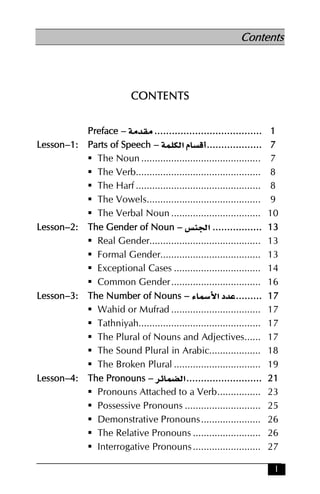
                          CONTENTS


            Preface –         .....................................
                              ................................ .....    1
Lesson–
Lesson–1:   Parts of Speech –           ‫................... م א‬         7
              The Noun ............................................      7
              The Verb..............................................     8
              The Harf ..............................................    8
              The Vowels..........................................       9
              The Verbal Noun .................................         10
Lesson–
Lesson–2:   The Gender of Noun –                  ‫................. א‬   13
              Real Gender.........................................      13
              Formal Gender.....................................        13
              Exceptional Cases ................................        14
              Common Gender .................................           16
Lesson–
Lesson–3:   The Number of Nouns – Ú ‫......... د א‬                       17
              Wahid or Mufrad .................................         17
              Tathniyah.............................................    17
              The Plural of Nouns and Adjectives......                  17
              The Sound Plural in Arabic...................             18
              The Broken Plural ................................        19
Lesson–4:
Lesson–     The Pronouns –               ‫.......................... א‬   21
              Pronouns Attached to a Verb................               23
              Possessive Pronouns ............................          25
              Demonstrative Pronouns......................              26
              The Relative Pronouns .........................           26
              Interrogative Pronouns .........................          27

                                                                         I
Contents

Lesson–5: The Irab of Nouns – ª‫א‬
Lesson–                                      ‫92 ..................... א‬
                     ª‫03 ..................................... א א‬
             ú‫ א و‬ª‫23 ....................................... א א‬
             Declinable ........................................... 34
             Indeclinable......................................... 36
Lesson–
Lesson–6: The Adjective Phrase –                                ...... 39
                          .......................................... 39
             ‫م‬        .............................................. 39
Lesson–
Lesson–7: The Relative Phrase –                            .......... 45
Lesson–
Lesson–8: The Demonstrative Phrase–
                                  Phrase–                          ... 49
Lesson–
Lesson–9: The Genitive Phrase –                           ........... 53
             Inseparable Prepositions....................... 53
             Separable Prepositions ......................... 55
Lesson 10:
Lesson–10: The Sentence –            ‫95 ............................ א‬
             The Nominal Sentence......................... 59
             The Verbal Sentence ............................ 59
             Types of the Mubtada........................... 61
             The Omission of the Mubtada/ the
             Khabar................................................. 65
             Types of the Khabar ............................. 65
Lesson–11:
Lesson–11: Some Particles of Various Origin ............. 69
Lesson–12:
Lesson–12: The Verb – Perfect Tense –
                                  Tense              ‫א‬         ‫57 .... א‬
             The Active and Passive of Madi............ 82
Lesson–13:
Lesson–13: The Verbal Sentence –                 ‫א‬          ‫78 ........ א‬
             The Nominal Sentence......................... 87
             The Verbal Sentence ............................ 87
             The Object .......................................... 88
Lesson–14: The Imperfect Tense - ‫א ع‬
Lesson–14:                                              ‫59 ........... א‬
             Six Groups of Triliteral Verbs ............... 101
             Moods of Verb..................................... 104

 II
Contents

Lesson–15:
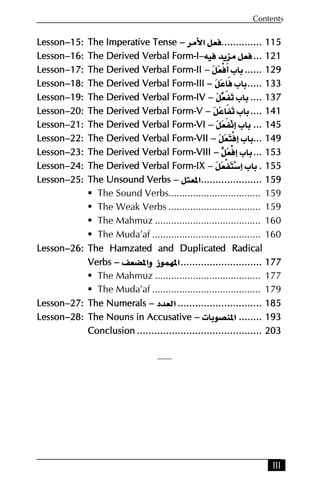
Lesson–15: The Imperative Tense –             ‫511 .............. א‬
Lesson–16:
Lesson–16:                        Form-
           The Derived Verbal Form-I–                          ... 121
Lesson–17:
Lesson–17: The Derived Verbal Form-II – ْ ª ...... 129
                                  Form-
Lesson–18:
Lesson–18:                        Form-
           The Derived Verbal Form-III –                 ª ..... 133
Lesson 19:
   son–
Lesson–19:                        Form-
           The Derived Verbal Form-IV –                   ª .... 137
Lesson–20:
Lesson–20:                        Form-
           The Derived Verbal Form-V –                    ª .... 141
Lesson–21:
Lesson–21:                        Form-
           The Derived Verbal Form-VI –                  ‫ א‬ª ... 145
Lesson–22:
Lesson–22:                        Form-
           The Derived Verbal Form-VII –                ْ ‫ א‬ª ... 149
Lesson–23:
Lesson–23: The Derived Verbal Form-VIII – ْ ‫ א‬ª ... 153
               Derived            Form-
Lesson–24:
Lesson–24: The Derived Verbal Form-IX – ْ ‫ א‬ª . 155
                                  Form-
Lesson–25:
Lesson–25: The Unsound Verbs –            ‫951 ..................... א‬
             The Sound Verbs.................................. 159
             The Weak Verbs .................................. 159
             The Mahmuz ....................................... 160
             The Muda’af ........................................ 160
Lesson–26:                           Duplicated
Lesson–26: The Hamzated and Duplicated Radical
           Verbs –      ‫771 ............................ א ز وא‬
             The Mahmuz ....................................... 177
             The Muda’af ........................................ 179
Lesson–27: The Numerals – ‫581 ............................. א د‬
Lesson–27:
Lesson–28: The Nouns in Accusative – ª
Lesson–28:                                             ‫391 ........ א‬
                      ...........................................
           Conclusion ................................ ........... 203


                                 


                                                                   III
Preface


                                    ‫א‬     ‫א א‬
         (In the name of Allah, the Most Gracious,
                    the Most Merciful)
Islam is the divine system of guidance for all human being
on the earth, and the Prophet, Muhammad (SAW) is the
universal messenger of Allah (SWT), as revealed in chapter
34,verse 28 of the Holy Quran.
                     ‫س‬     ً     ¯ ْ    ‫﴿و‬
            ﴾‫ن‬             ‫ْ א س‬     ‫אو אو‬
                                      ً    ً
 “And We (Allah) have not sent you (O Muhammad (SAW))
 except as a giver of glad tidings and a warner (against sin)
      to all mankind. But most of people know not”
Likewise, the book of guidance, al-Quran is a divine
treasure of knowledge and a universal code of conduct in
Arabic for salvation of the entire humanity, as revealed in
the following two verses of the Holy Quran:
               ﴾‫ن‬                        ً      ْ       ﴿
 “Verily, We (Allah) have sent it down as an Arabic Quran
        in order that you may learn wisdom”. [12/1]
                           ‫ل‬             ‫نא‬         ﴿
          ﴾‫ن‬        ْ ‫وא‬       ْ‫א‬       ª ‫سو‬            ‫אْ ن‬
   “Ramadan is the month in which was sent down the
     Quran, a guidance for mankind and clear proofs
                                                                    1
Preface

       for the guidance and the criterion (between right
                     and wrong)”. [2/185]

We can derive benefits from this divine source of
knowledge and guidance only if we learn the Quranic
language. It must be clearly understood that reading of
translation of the Book is, at best, a poor substitute to
learning the Quranic language. One cannot understand the
exact meaning and the spirit of the divine revelation
without understanding the text of the Book. Infact, Allah
(SWT) has repeatedly stressed on the ponderability of His
message, which is not possible without having an insight
knowledge of the language. The following two verses
necessitate the understanding of the divine message
directly from the Arabic text.
  ﴾ª ْ ‫و א‬             ‫و‬     ‫وא‬        ¯          ْ   ª    ﴿
  “(This is) a Book (the Quran) which we have sent down
     to you, full of blessings that they may ponder over its
          message, and that men of understanding may
                 receive admonition.” [38/29]
             ﴾     ْ ª            ‫ون א ْ ن م‬      ﴿
 “Do they not then think deeply in the Quran, or are their
      hearts locked up (from understanding it).” [47/24]

In truth, it is the ‘Haq’ (right) of the divine message to be
recited in the best possible manner, and be understood in
the right perspective, as has been highlighted in the
following verse:

 2
Preface

                 ‫و‬           ª ْ‫א‬               ‫﴿א‬
      ﴾‫ون‬        ْ‫א‬        ‫و‬   ْ        ‫و‬   ‫ن‬         ‫و‬
 “Those to whom we have sent the Book recite it (obey its
orders and follow its teachings) as it should be recited they
    are the ones who believe therein. And those who
        disbelieve in it (the Quran) those are they
               who are the loosers.” [2/121]
In this verse the Arabic verb ‘yatlu’, in fact, cannot be
translated in one word in any other language, which
implies ‘recitation, understanding and obeying’. This verse
has emphasized the understanding of the text of the Book
by the believers, and further added that     ‫ن‬            ‫و‬
‘they are the ones who (really) believe therein’, implying
thereby that, those who do not recite it as it deserves to be
recited, they do not have sincere faith in the Holy Quran.
Unfortunately, most of the non-Arab believers, particularly
the Pakistanis, do not understand the Arabic text of the
Book.
It is important for the learner to know that the Arabic is
very easy to learn as it is a highly sophisticated language
based on very refined and systematic set of rules and
patterns. This fact is confirmed by Allah (SWT) in the
following verse:

            ﴾                ْ     ‫אْ ن‬          ‫﴿و‬
“And we have indeed made the Quran easy to understand
   and remember, then is there any that will remember
                (and receive admonition)”. [54/17]

                                                              3
Preface


It is an open challenge for all those who are in search of
truth. Nevertheless, it does require consistent effort, with a
sense of purpose and commitment, to attain this most
important treasure of knowledge for the mankind, and the
following tradition of the prophet (SAW) rightly accords a
very high status to the learner of the Holy Quran.

                    W‫ن ل‬        ‫ن‬        FF
          EE?    ‫אْ ن و‬                ?W ‫لא‬      ‫ل‬
 Uthman ibn ‘Affan (RA) relates that the messenger (SAW) of
                Allah said: “The best among you
      are those who have learnt the Quran and teach it
                   (to others)“. [Al-Bukhari]

The aim of this book is to enable the learner to acquire an
insight knowledge of the Quranic language with a view to
understanding the text of the Holy Quran.

In all, this book has 28 lessons. I have tried to make it as
simple as I could. During the course of study the learner
should acquire the vocabulary right from the start of the
book. All the words and phrases used in the lessons should
be understood and remembered so that he or she can
muster sufficient vocabulary to enable him or her to
construct simple phrases and sentences from an early stage
of the study. Besides, the learner should recite a page or
two from the Holy Quran regularly, and try to apply the
grammatical aspects of the language to the verses of the
Quran as an exercise.

 4
Preface

The verbal forms and pronouns of Arabic grammar are
generally considered difficult to understand or remember.
The learners are advised to concentrate in the beginning
only on the third person masculine singular and plural
forms, the second person masculine singular and plural
forms and both the first person forms in the given tables,
and skip over the verbal forms and pronouns of the
feminine gender (except the singular forms) and the dual
forms E      F, as these forms are not frequently used in the
Holy Quran. In the given tables of conjugation I have
included all the forms of the verbs and the pronouns,
essentially as ready reckoners for the learners.
And finally the most important advice to the learner is that
he or she should seek the guidance and help of Almighty
Allah through supplications such as:
              ﴾           ‫و‬K          ª ‫א‬ª ﴿
   “O my Lord! Expand for me my chest (grant me self-
     confidence, contentment, and boldness). And
           ease my task for me”. [20/25-26]


                            


                                                          5
‫س א ول‬   ‫ א‬Lesson 1


                                 ْ‫ْ م א‬
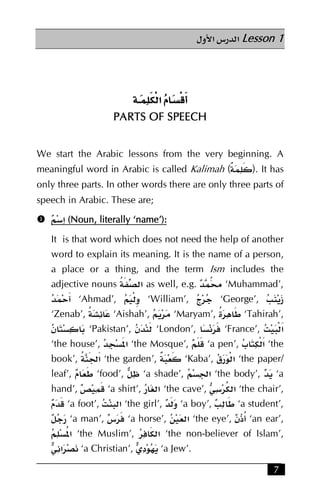
                    PARTS OF SPEECH


We start the Arabic lessons from the very beginning. A
meaningful word in Arabic is called Kalimah (                  ). It has
only three parts. In other words there are only three parts of
speech in Arabic. These are;
       ‫( א‬Noun, literally ‘name’):
   It is that word which does not need the help of another
   word to explain its meaning. It is the name of a person,
   a place or a thing, and the term Ism includes the
   adjective nouns            ‫ א‬as well, e.g.
                                           ‘Muhammad’,
            ‘Ahmad’,     ْ ‫‘ و‬William’, ‫ج‬  ‘George’,  ‫ز‬
   ‘Zenab’,         ‘Aishah’,         ‘Maryam’,           ‘Tahirah’,
   ‫ن‬          ‘Pakistan’, ‫ن‬       ‘London’,           ‘France’,       ْ‫א‬
   ‘the house’,        ‫‘ א‬the Mosque’,           ‘a pen’, ª    ْ ‫‘ א‬the
   book’,       ‫‘ א‬the garden’,            ‘Kaba’, ‫‘ א ْ ق‬the paper/
   leaf’, ‫م‬    ‘food’,        ‘a shade’,      ‫‘ א‬the body’, ‘a
   hand’,         ‘a shirt’,    ‫‘ א‬the cave’,        ‫‘ א‬the chair’,
   ‫‘ م‬a foot’,       ‫‘ א‬the girl’, ‫‘ و‬a boy’,          ‘a student’,
        ‘a man’, ‫‘ س‬a horse’,           ‫‘ א‬the eye’, ‫‘ ذن‬an ear’,
       ‫‘ א‬the Muslim’,         ‫‘ א‬the non-believer of Islam’,
     ‫א‬     ‘a Christian’, ‫د‬      ‘a Jew’.

                                                                     7
Parts of Speech


             ‫א‬   ‘the     pious/      righteous    person’,               ‘a
     disobedient’,            ‘a helper’,          ‘a poet’,           ‫‘ א‬the
     Knowledgeable’,                 ‫‘ א‬the Ignorant’,        ‫‘ א‬the new’,
             ‫‘ א‬the old’,          ‫‘ א‬The All Hearing’,          ‫‘ א‬The All
     Knowing’, etc.

            (Verb):

     It is that word by which we understand some work or
     action being done. It is of three kinds/ tenses:

     1 The perfect tense, the Madi E                 ‫א‬F is used for an
         action which is completed, e.g.                   ‘he did’,
         ‘he wrote’,        ‫‘ د‬he entered’.
     2 The imperfect tenses the Madari E‫ع‬                  ‫א‬F used when
         an action is not completed, e.g.                ْ ‘he does or he
         is doing or he will do’,             ْ ‘he writes/is writing/
         will write’,          ‘he enters/is entering/will enter’.

     3 The imperative tense or the Amr E            ‫א‬F which
         signifies command, request or supplication, e.g. ْ ‫א‬
         ‘do’, ْ ‫‘ א‬write’,   ‫‘ אد‬enter’.
     ú       (Harf):

     The particle, preposition and conjunction are called
     harf. It is that word which is used with noun or verb to
     complete the meaning of the sentence; its meaning will
     depend on the word with which it is used, e.g.                    ‘on’,
         ‘in’,        ‘regarding’,       ‘yes’,    ‘no’,     ‘that/ what’,
     etc.
 8
Parts of Speech


                          (Meaningful Word)


         ú                                                   ‫א‬
 Particle, Preposition,          (Verb)                 (Noun)
     Conjunction

 Further explanation and information about the Ism, the
 Fail and the Harf will follow in the subsequent lessons.
Vowels (ª         –Harkaat):
                   Harkaat):
The vowels used in Arabic are called ª               ‫ א‬which
are explained below:
1          (Fathah): Signed as ‫ ﹷ‬on top of a letter and
    pronounced as ‘a’ in ‘above’.
2            (Kasrah): Signed as ‫ﹻ‬        under a letter and
    pronounced as ‘i' in ‘if’.
3         (Dammah): Signed as ‫ ﹹ‬on top of a letter and
    pronounced as ‘u’ in “put”.
4 ‫ن‬    (Sukun): Signed as ‫ ﹿ‬on top of a letter as ‘stop’
  or ‘stress’; it indicates that the consonant is
  vowelless, e.g,    (kun), ª (abb),    (mun).
5          (‘N’ sound): Signed as double vowel ‫– ,– ,ﹱ‬
                                                     ٍ ٌ
    as indicated is called tanwin, e.g. ً       (kitaban),
    ª       (kitabin), ª    (kitabun). Remember that a
    word with tanwin is always a noun E ‫א‬F, also a
    word having (al) ‫ אل‬in the beginning is an indication
    of its being a noun, however, it does not necessarily

                                                            9
Parts of Speech


         mean that a word without ‘al’ or tanwin will not be
         a noun      ‫ .א‬This is evident from the examples of
         nouns mentioned above where certain words have
         neither tanwin nor ‘al’, yet they are nouns. It should
         be noted that the tanwin and ‘al’ never come
         together on a noun. If ‘al’ comes in the beginning of
         a noun then its case-ending will be single vowel,
         not tanwin, e.g.. it may be ª        (a book) or ª ْ ‫א‬
         (the book). It is incorrect to say ª ‫.א‬

      The Verbal Noun E        ‫א‬F
                               ‫א‬F:
      The verbal noun or noun of action may also be used as
          ‫ ,א‬e.g.       ‘help’ (literally helping), ª      ‘a blow’
      (literally striking), ‫د‬      ‘prayer’ (literally praying),
      ‘order’ (literally ordering).

The Arabic definite article ‘‫( ’אل‬al) corresponds to the
English definite article ‘the’. The Arabic indefinite article
tanwin is dropped when the definite article ‘al’ is prefixed
to a noun, e.g.       (baitun) ‘a house’ becomes       ‫( א‬al-
baitu) ‘the house’,          (jamalun) ‘a camel’ to         ‫א‬
(aljamalu) ‘the ‘camel’.

Arabic has 28 alphabets or letters; of these, 14 are called
the Sun Letters E       ‫ א‬ú‫א و‬F and the other 14 are called
the Moon Letters E        ‫ א‬ú‫א و‬F. In the moon letters the
lam E‫ل‬F of al is pronounced, e.g.     ‫( א‬al-qamaru’). While
in the sun letters the lam of al is assimilated to the first
letter of the noun, e.g.             ‫( א‬ash-shamsu). The
assimilation is indicated by   (shadda, –) on the first letter
                                         ّ
 10
Parts of Speech

of the noun. A table showing the moon letters and the sun
letters is given below.

                Lunar Letters -        ‫ א‬ú‫و‬          ‫א‬
   The mother           al-ummu – ‫א م‬                               J    1
   The door            al-baabu – ª ْ ‫א‬              ª              J    2
   The garden         al-Jannatu –      ‫א‬            ‫ج‬              J    3
   The donkey         al-himaru –        ‫א‬           ª              J    4
   The bread          al-khubzu –        ‫א‬                          J    5
   The eye               al-ainu –   ‫א‬               ‫ع‬              J    6
   The lunch          al-ghadau – ‫א א‬                ‫غ‬              J    7
   The mouth             al-famu –   ‫א‬               ú              J    8
   The moon           al-qamaru –        ‫א‬           ‫ق‬              J    9
   The dog              al-kalbu – ْ ‫א‬               ¯          J       10
   The water             al-maau – ‫א‬                ‫م‬          J       11
   The boy            al-waladu –       ‫א‬            ‫و‬          J       12
   The air             al-hawau – ‫א א‬                          J       13
   The hand              al-yadu – ‫א‬                            J       14

                Solar Letters -        ‫ א‬ú‫و‬          ‫א‬
   The trader         at-taajiru –       ‫א‬               ª          J    1
   The clothing       ath-thoubu – ª         ‫א‬                      J    2
   The house           ad-daaru – ‫א א‬                    ‫د‬          J    3
   The gold           ad-dahbu –            ‫א‬            ‫ذ‬          J    4
   The man             ar-rajulu –      ‫א‬                           J    5
   The flower         az-zahratu –           ‫א‬       ‫ز‬              J    6
   The fish          as-samaku –                 ‫א‬   ‫س‬              J    7
                                                                             11
Parts of Speech


      The sun         ash-shamsu –        ‫א‬   ‫ش‬    J 8
      The chest         as-sadru –  ‫א‬         ‫ص‬    J 9
      The guest        ad-daifu –    ‫א‬        ‫ض‬   J 10
      The student      at-talibu –   ‫א‬        ‫ط‬   J 11
      The injustice    az-zulmu – ْ ‫א‬             J 12
      The meat         al-lahmu –   ‫א‬         ‫ل‬   J 13
      The star         an-najmu –     ‫א‬       ‫ن‬   J 14


                              


 12
‫سא‬    ‫ א‬Lesson 2


                                 ْ‫א‬
              THE GENDER OF NOUNS


This lesson explains the different categories of gender used
for Arabic nouns. According to the Arabic grammar the
gender is classified into the following four categories:

         ْ‫א‬      ‫( א‬Real Gender):
   The words related to the male sex are                       (♂)
   masculine, and those related to the female sex are
   (female ♀), e.g.         ‘man’ is a real masculine and        ‫א‬
   ‘woman’ is a real feminine,         ‫‘ د‬cock’,    ‫‘ د‬hen’,     ‫و‬
   ‘boy’,       ‘girl’, ª ‘father’, ‫‘ م‬mother’, ‘brother’,
   ‘sister’, etc.

     ‫ز‬   ْ‫א‬      ‫( א‬Formal Gender):
   The nouns which do not have the ‘concept of pair’ are
   termed as feminine or masculine by form                ‫א‬F
   E ‫ ز‬Ó‫ .א‬The identification of gender for such noun is
   that the words ending with ‘round-ta’ E            F are
   generally feminine, and those ending with some other
   letter are assumed as masculine gender, e.g.
   ‘watch’,    ‫و‬    ‘fan’,         ‘tree’,     ‘car’,
   ‘garden’,     ‘sign’,       ‘life’,     ‘window’ are

                                                           13
The Gender of Nouns


     feminine gender by form, and ‫א‬     ‘wall’, ª     ‘book’,
         ‘pen’, ‫אط‬    ‘path’,       ‘mosque’,        ‘house’,
            ‘chair’,  ‘canal’, ª ‘door’, etc. are considered
     masculine gender by form.

     It may also be understood that feminine gender is often
     formed from the masculine by suffixing ‘ ’, e.g.
     ‘Muslim’ (♂),              ‘Muslim’ (♀),           ‘disbeliever’
     (♂),         ‘disbeliever’ (♀), ‫دق‬       ‘truthful’ (♂),       ‫د‬
     ‘truthful’ (♀),           ‘pious’ (♂),          ‘pious’ (♀),       ‫א‬
     ‘son’ (♂),       ‫‘ א‬daughter’ (♀),         ‘student’ (♂),
     ‘student’ (♀),         ‘new’ (♂),        ‘new’ (♀),         ‘old’
     (♂),         ‘old’ (♀),          ‘long’ (♂),         ‘long’ (♀),
            ‘many’ (♂),           ‘many’ (♀), etc.

         ْ ‫א‬      ْ ‫( א‬Exceptional Cases):
     The nouns which do not fall under the above-
     mentioned two categories are termed as exceptional
     cases. The following nouns are feminine by usage even
     though they have no ‘ ’ (ta) ending nor have they ‘pair-
     concept’.
     1           ‘sky’, ª    ‘war, battle’,         ‘sun’,     ‘fire’,
                  ‘hell’,      ‘wind’,        ‘wine’,      ْ ‘soul,
         person, self’, ‫‘ دא‬house’,        ‘well’, ‫‘ ْس‬cup’, ً
         ‘staff’, ª       ‘an idol, a tyrant, devil’,       ‘dream’,
         ‫‘ ض‬earth’,          ‘path’, ْ ‫‘ د‬bucket’.
     2 Proper names of countries and towns are feminine
       by signification, e.g.         ‘Egypt’, ‫ن‬

14
The Gender of Nouns

   ‘Pakistan’,        ‘Lahore city’,                 ‘America’,
         ‫‘ وא‬Washington’, ‫‘ א אق‬Iraq’, etc.
3 Many parts of the body, especially those that are in
  pair, are termed as feminine, e.g.      ‘hand’,
  ‘eye’, ‫‘ م‬foot’,     ‘leg’, ‫‘ ق‬shin’, ‫‘ ذن‬ear’,
  ‘cheek’.

4 The nouns ending            in ‘ ’, ‘ ’ called         ْ
   (short alif) or ‫ _א‬called ‫ود‬               (lengthened alif)
   are also feminine, e.g.             ‘good, beautiful’,
   ‘great’,           ‘small’,            ‘good news’,       ‫א‬
   ‘desert’, ‫א‬     ‘harm’, ‫‘ ز א‬blooming’,               ‘white’,
    ‫א‬     ‘green’,       ‫‘ ز‬blue’, etc.
5 All Arabic letters of alphabet are considered as
  feminine.
6 Some broken plurals, e.g. ‫د‬  ‫‘ א‬the Jews’,      ‫‘ א‬the
  messengers’,       ‫‘ א‬the Christians’ are treated as
  feminine.
7 Some collective nouns, e.g. ‫‘ م‬people’,       ‘tribe’
  are used as feminine. However,          ‘family’, ‫ل‬
  ‘progeny’ are masculine.

8 Exceptional Masculine: Some nouns have ta ‘ ’
   ending but they are used as masculine, e.g.
   ‘caliph’,         ‘learned’,         ‘a male name’,            ‘a
   male name’. Some parts of body (single), e.g. ‫ْس‬
   ‘head’,       ‘tooth’, ْ       ‘belly’,     ‘chest’, etc. are
   also considered exceptional masculine.
                                                                 15
The Gender of Nouns


         ْ‫א‬   ‫( א‬Common Gender):
                        Gender):
     Some nouns are used as masculine as well as feminine.
     These are termed as      ْ ‫ ,א א‬e.g. ª      ‘clouds’,
     ‘cattle’, ‫‘ אد‬locust’, ‫‘ ذ‬gold’,     ‘bees’,      ‘trees’.
     These are masculine by form, feminine by signification.

An Explanation Regarding Exceptional Cases:
Here, I would like to clarify an important point regarding
the exceptional cases in the grammatical rules. The learner
should be mindful of the fact that the languages have not
come into being through an academic process based on
some predetermined sets of grammatical rules and forms
but, on the contrary, the languages are spoken by the
natives of the region long before the grammarians form the
grammatical rules applicable to them. And the object of
framing grammatical rules is essentially to facilitate the
learning and better understanding of the languages by the
non-natives or the foreigners. But, where they fail to apply
uniform sets of grammatical rules, they categorize that as
exceptional case. Hence, the exception-rule is a common
feature to all the languages. Having said that, I must hasten
to emphasis that the grammarians of Arabic language have
contributed tremendously in facilitating the learning
process of the language. In fact, they have developed an
easy and effective method of learning the classic Arabic of
the Holy Quran. Hence, their efforts cannot be undermined
in any way.


                              

16
‫سא‬   ‫ א‬Lesson 3


                                Ú ‫دא‬
                THE NUMBER OF NOUNS


Unlike English, Arabic has three numbers: singular is
termed wahid E      ‫وא‬F or Mufrad E‫ ْ د‬F, the dual or two of
anything is termed tathniyah E      F, and more than two is
plural called Jam E     F.
   Wahid E        ‫وא‬F
                  ‫وא‬F or Mufrad E‫ ْ د‬F:
                   ‫و‬
   Examples of Wahid E             ‫وא‬F or Mufrad E‫ ْ د‬F are: ª ‫,א‬
           ‫,א‬    ‫,א‬         ,     , ,       ,     ‫,א‬    ‫,א‬    ‫,א‬
        ‫, د ق ,و‬       ‫,א‬       ,       ‫,א‬   ‫ ,א‬etc.
   Tathniyah E        F:
   The dual form ends in aani E‫ ن‬F, e.g. ‫ن‬              ‫ن ,א‬    ‫,א‬
   ‫ن‬         ‫ن ,א‬    , ‫ن , אن , ن‬            , ‫ن‬     ‫ن ,א‬       ‫,א‬
   ‫ن‬          ‫ن , د ن ,و אن ,א‬               ‫ن ,א‬      , ‫ن‬     ‫,א‬
   ‫אن‬       ‫ ,א‬etc.
   The Plurals of Nouns and Adjectives:

   In English, adjectives have no plural form. We say
   “good man” and “good men”. But in Arabic even
   adjectives have dual and plural form. In English we
   have two kinds of plural form:

                                                               17
The Number of Nouns


     1 Sound Plural: In sound plural the word retains its
        original form, e.g. book                 books, pen                  pens.

     2 Broken Plural: The original form of the word is
        changed to a great extent, e.g. Man                                 men, woman
             women.

     In Arabic too, we have these two kinds of plural forms;
     Sound and Broken.

     The Sound Plural in Arabic E                      ‫א‬             ‫א‬F
                                                                   ْ ‫א‬F:
     1 The masculine plural of nouns are formed by adding
        ‫ _ون‬to the singular form e.g.           ‫ن‬       ,   ‫א‬
           ‫‘ ق ,א ن‬thief’ ‫ن‬              ,      ‘ignorant’
        ‫ن‬      ,     ‘wise’     ‫ن‬    ,         ‫ن‬      ,      ‫א‬
        ‘patient’ ‫ون‬        ‫‘ א دق ,א‬truthful’ ‫ ,א د ن‬etc.
     2 The feminine plural of nouns which end in                                  _, are
        formed by changing ‘ ’ (ta) into ‘ª ’ (aat) as,
        ‘♀ thief’        ª           (plural),                      ª         ,
        ª‫א‬       ,           ‘watch’             ª             ,               ª     ,
               ‘protector’             ª           ,                ‘word’      ª    ,
                     ª       ,          ‘window’                   ª‫‘ و , א‬fan’
          ª ‫, و‬                  ‘evil’      ª             ,         ‫‘ د‬step/status’
        ª ‫.د‬
        The ♀ plural of nouns which do not end in _ are
        also formed by adding ‘ª‫ ’א‬to the singular as in
        (name)           ª       ,         ‘sky’           ª‫وא‬          .

18
The Number of Nouns


The Broken Plural E        ْ ‫א‬         F:
Unlike English, the broken plural is very widely used in
Arabic. It is formed from the singular by the addition or
elision of consonants, e.g. from ‫ل‬                       , from
   ‫ل‬    , or by the change of vowels, e.g.                          .
There are many patterns of the broken plural. The
following are commonly used patterns:

 No     Bab                      Singular           Broken Plural
         ª                        ‫د‬                  Ù        ‫ א‬
  1     ‫ل‬        as from               ‘star’            ‫م‬
  2              as from    ª          ‘book’
  3     ‫ل‬        as from              ‘man’              ‫ل‬
  4     ‫ْ ل‬      as from              ‘pen’              ‫ْ م‬
  5       ْ      as from               ‘eye’
  6              as from              ‘poor’              ‫א‬
  7          ْ   as from              ‘rich’                  ْ
  8              as from    ‫ن‬          ‘Satan’
  9              as from           ‘building’            ‫زل‬
 10     ‫ن‬        as from          ‘country’              ‫ْ אن‬
 11              as from         ‘brother’
 12     ‫ل‬        as from              ‘trader’

Note:
It is quite common for a noun in Arabic to have more
than one broken plurals, e.g. the plural of  ‘brother’
are ‫, אن‬       , ‫, אن‬     , or in some cases to have

                                                                  19
The Number of Nouns


     both the sound plural and broken plural e.g. in the case
     of  (prophet), its sound plural is ‫ن‬      and broken
     plural is    .


                             


20
‫سא א‬    ‫ א‬Lesson 4


                                              ‫א‬
                           THE PRONOUNS


The pronoun is a word used in place of a noun, e.g.
‘he’,         ‘they’,     ‘she’,       ‘you’,       ‘we’, ‘his’,   ‘her’,
¯ ‘your’,         ‘my’, etc. They are of two kinds; the Detached
Pronouns, called                          , e.g.     ‘he’              ‘he
is a student’ and the Attached Pronouns, called
        , e.g. ‘his’                 ‘his book’, etc.

For detailed conjugation of the detached pronouns see
Table-1. The attached pronouns are either attached to a
noun or a verb, as shown in tables 2  3.

                                    Table – 1
                        Detached Personal Pronouns

                        SINGULAR              DUAL          PLURAL
                                          ‫ن‬                  ª
 3rd Person
     Person
                         he is a              they are      they are
        (♂)
          )
                         student           students         students
                                          ‫ن‬                 ª
 3rd Person
     Person
                         she is a             they are      they are
        (♀)
          )
                         student           students         students

                                                                       21
The Pronouns


                                  ‫ن‬                  ª
 2nd Person
     Person
                  you are a          you are         you are
     (♂)
       )
                   student           students        students
                                 ‫ن‬                  ª
 2nd Person
     Person
                  you are a          you are         you are
     (♀)
       )
                   student           students        students
                   L             L‫ن‬                 Lª
 1st Person
     Person
                                      ‫ن‬               ª
  (♂♀)
       )
                I am a student   we are students   we are students


Note:
Concentrate on the underlined forms only in the beginning,
and skip over the remaining forms as these are not
frequently used in the Holy Quran.

                           Table – 2
               Pronouns attached to a noun with
                 E     ‫א‬FPossessive Relations

                 SINGULAR             DUAL           PLURAL
 3rd Person
     Person
     (♂)
       )          his book        their book        their book
 3rd Person
     Person
     (♀)
       )          her book        their book        their book
  nd
   Person
 2 Person                  ¯
   (♂)
     )           your book        your book         your book
  nd
   Person
 2 Person                  ¯
   (♀)
     )           your book        your book         your book
   st
   Person
 1 Person
  (♂♀)
     )           my book            our book        our book
22
The Pronouns


Note:
Concentrate on the underlined forms only in the beginning,
and skip over the remaining forms as these are not
frequently used in the Holy Quran.
   Pronouns Attached to a Verb:
   Pronouns attached to a verb become its Direct Object,
   e.g. ª    means ‘he struck’, ‘he’ is a subject and ‘struck’
   is a verb; with the addition of an attached pronoun
   ‘him’ would become the object of the verb ª . For
   usage of Attached Pronouns to a verb see Table 3.
                         Table – 3
                                               Object.
     Pronouns Attached to a Verb as its Direct Object.

               SINGULAR           DUAL           PLURAL

 3rd Person
     Person
                He struck       He struck        He struck
     (♂)
       )
                 him/it.         them.            them.

 3rd Person
     Person
                He struck       He struck        He struck
     (♀)
       )
                 her/it.         them.            them.
                        ¯
 2nd Person
     Person
                He struck       He struck        He struck
     (♂)
       )
                 you..            you.             you.
                        ¯
 2nd Person
     Person
                He struck       He struck        He struck
     (♀)
       )
                  you.            you.             you.

 1st Person
     Person
                He struck       He struck        He struck
  (♂♀)
       )
                  me               us.              us.
                                                          23
The Pronouns


Note:
Concentrate on the underlined forms only in the beginning,
and skip over the remaining forms as these are not
frequently used in the Holy Quran.
     Some other examples of frequently used Attached
     pronouns are given below:
     –     ‘my hand’, e.g.           ª ‫‘ א‬the book is in my
       hand’.
     –  ‫‘ א‬my two hands’, e.g. ْ ْ ‫א‬                ‫‘ א‬my two
       hands are on the table’.
     –         literally ‘between my hands’ i.e. ‘in front of
       me’, e.g.              ‫‘ א‬the tree is in front of me’.
     –     ‘on me or my responsibility’, e.g.                ‘his
         account is on me’.
     –            ‘with them/by them’, e.g.                  ‫‘ א‬the
         books are with them’.
     –       ‘to me or for me’, e.g.            ‘my action is for
         me’ i.e. I am responsible for my action.
     –         ‘to you or for your’, e.g.             ‫‘ و‬and your
         action is for you’ i.e. you are responsible for your
         action.
     –      ‘to him, for him’, e.g.       ْ ‫‘ א ْ ْ و א‬to Him
         (Allah) belongs the universe and for Him is all the
         Praise’,     ْ ‫‘ א‬he is right or he has the right’.
     –         ‘with’, e.g.             ‘we have books’,
                ‘I have a car’.
     Note that in Tables 1, 2  3 the second persons ♂♀
     dual and the third persons ♂♀ dual are identical.
24
The Pronouns


  Important Note:
  Concentrate in the beginning only on the 3rd Person
  masculine singular  plural forms, the 2nd Person
  masculine singular  plural forms, and both the 1st
  person forms, and skip over the verbal forms and
  pronouns of the feminine gender (except the singular
  forms) and the dual forms as these are not frequently
  used in the Holy Quran.

  Possessive Pronouns:
  The word ‫ א‬is prefixed to the Attached Pronouns. The
  word ‫ א‬confines the meaning to ‘only/alone’, e.g. ¯ ﴿
  ﴾       ¯ ‫و‬       “You (Alone) we worship, and You
  (Alone) we ask for help”[1/4]. For usage of Possessive
  Pronouns with     see Table 4.

                         Table – 4
                   Possessive Pronouns

             SINGULAR           DUAL        PLURAL
 rd
  Person
3 Person
  (♂)
    )         He alone       Both of them   They alone
3rd Person
    Person
    (♀)
      )      She alone       Both of them   They only
2nd Person
    Person     ¯     ¯
    (♂)
      )      You alone        Both of you   All of you
2nd Person
    Person     ¯     ¯
    (♀)
      )      You alone        Both of you   All of you
 st
  Person
1 Person
 (♂♀)
    )         I alone         We alone     We alone

                                                     25
The Pronouns


Note:
Concentrate on the underlined forms only in the beginning,
and skip over the remaining forms as these are not
frequently used in the Holy Quran.

     Demonstrative Pronouns                 ‫א‬        ‫:א‬
     The demonstrative pronouns are listed below:

        ‫א‬       ‫א‬       Singular           Dual                Plural
     Near           ‫א‬     ♂ this    ‫אن‬    ♂ these two
            ْ              ♀ this   ‫ن‬     ♀ these two (♂♀) these
  Distant                ‫ ♂ ذ‬that        ‫ ♂ ذא‬those two               ‫و‬
            ْ            ْ ♀that           ♀ those two (♂♀) these

Note:
Concentrate on the underlined forms.

     The Relative Pronouns ‫ل‬                ‫א‬             ‫:א‬
     The relative pronouns         ‫,א‬   ‫ ,א‬etc. are used as
     conjunction, meaning ‘that, which, who, whom’. They
     serve the purpose of joining nouns/pronouns or verbs to
     other nouns or verbs. They have a definite form as
     given below:

                        SINGULAR            DUAL               PLURAL
For Male                       ‫א‬                ‫אن‬         ‫א‬          ‫א‬
For Female                     ‫א‬                ‫ن‬         ‫א‬      ‫א‬L       ‫א‬

Note:
Concentrate on the underlined forms.
26
The Pronouns

Examples:

–                 ْ‫א‬       ‫ج‬        ‫א‬     ْ ‫‘ א‬The boy who went out
    of the Mosque is a student’.

– ‫ن‬          ْ ْ‫א‬    ‫א‬                    ‫لא‬    ‫‘ א‬The men who left
  the office are teachers’.

–            ْ‫א‬                      ‫א‬     ْ ‫‘ א‬The girl who left the
    house is a student’.

– ﴾          ‫א‬         ‫א‬       ‫א‬   ﴿ “He is Allah, beside Whom la
    Ilaha illa Howa (none has the right to be worshipped
    but He)”. [59/293]

– ﴾‫ن‬                             ‫ن א‬       ْ‫א‬   ْ    ﴿
  “Successful indeed are the believers, those who offer
  their Salah (prayers) with all solemnity and full of
  submission”. [23/182]

    Interrogative Pronouns ‫ْ م‬
    Interrogative                          ‫א‬     :
    These are given below:
       ‘who’       ‘what’     ‘where’      ‘how’     ‘when’
        ‘how much, how many’,         ‘which, from where’
    ‘why’, ‫‘  ذא‬for what’ ‫‘ ذא‬what’


                                    


                                                                 27
‫سא‬    ‫ א‬Lesson 5


                                ‫ א‬ª‫א‬
                  THE IRAB OF NOUN


The Irab of words is a peculiar characteristic of Arabic
language, which does not have an equivalent in English.
Therefore, it requires particular attention to grasp the
subject. The Arabic noun changes its original form or the
case ending under different grammatical conditions, e.g.

   ‫ א‬being the original form in nominative case, called
 ْ ‫ ,א‬may change to ‫ ,א‬the accusative case, called
      ‫ א‬or ‫ ,א‬the genitive case, called ْ ‫א‬      . Likewise,
      , being the original form, may change to ‫א‬   ً      or
     , e.g.

in the Shahadah E ‫د‬    ‫א‬F ‘declaration of faith’ the first part
is ‫א‬       ‫ א‬where ‫ א‬is the original form in nominative
case and the second part is ‫ل א‬               where ‫ א‬is in
the genitive case, while in the verse ٍ                   ‫﴿ن א‬
﴾ , the noun ‫ א‬is in the accusative. Similarly, in the
first part of the Shahadah the noun             is in the original
form, but in                             ‫ א‬the noun         is in
genitive form and in      ‫ل א‬          ‫א‬
                                       ً      ‫ن‬     it is in the
accusative.
                                                              29
The Irab of Noun


Similarly, we use ª         ْ ‫ ,א‬ª ْ ‫ ,א‬ª ْ ‫ א‬as also we read in the
Holy Quran: ª             ‫ ,א‬ª ‫,א‬            ْ ‫,א ْ ون ,א‬       ‫,א‬
‫ن‬     ‫ .א‬These changes in the case-endings of the noun are
called      ‫ א‬ª‫( א‬Irab of noun).

It is important to remember that the literal meaning of the
words/nouns remain the same in all the different
conditions; however, their function in a sentence changes
according to the different grammatical considerations,
which are explained later in the book.

This change/declension in Irab is effected in two ways as
explained below:

            ْ ª‫א‬     ‫:א‬
      Case-ending with vowel marks, e.g.                ‘a man’ is the
      original form in nominative E ْ        ‫א‬      F and with the
      change of vowels it may become ً                  in accusative
      E     ‫א‬    F or ٍ in genitive case E          ‫א‬        F or       ‫,א‬
           ‫,א‬    ‫ ; א‬and from         ‘books’,     which is in the
      original nominative form E ْ ‫א‬          F,   it may become
      ً    ,      or      ْ ‫,א‬   ْ ‫,א‬  ْ ‫ ,א‬and    from             ‫‘ א‬the
      women’           ‫,א‬      ‫ ;א‬from ª                 ª          (only
      one change is used in this case which represents both
      the accusative as well as genitive form). In all these
      cases the vowel of the last consonant is changed.

      Note that the original form of a noun in all such cases is
      always indicated with dammah E                    _F or tanwin

 30
The Irab of Noun


E       _F, and is called                        ‫א‬          (halatur-rafha), i.e.
nominative case. And the declined form of                                         ª‫א‬
        ْ(Irab bil harkah) is fathha E      _F, i.e. single
short vowel or tanwin E             _F above the last
consonant, which is called        ‫א‬     (halatul nasb) i.e.
accusative case, and kasrah F       _F or tanwin (       –)
below the last consonant, which is called                                    ْ‫א‬
(halatul-Jarr).

The declension by Irab bil hakah is effected in the
following three categories of noun.

1 All singular nouns, both masculine and feminine,
    e.g.

                ْ‫א‬          ْ‫א‬         ْ‫א‬            or ٍ      ً
                 ْ‫א‬              ْ‫א‬         ْ‫א‬       or            ً
2 All broken plural nouns, both masculine and
    feminine, e.g.

    ‫ل‬
    ٍ       ,ً             ‘men’ ‫ل‬                   or ‫ل‬      ‫ل ,א‬      ‫ل ,א‬            ‫א‬
            ,           ‘women’                      or       ‫,א‬        ‫,א‬           ‫א‬
3 All feminine sound plural nouns, e.g.

    ª                , ª              ‘Muslim women’ or ª                         ْ ‫,א‬
    ª                ْ ‫( א‬There is only one change in this category
    which represents both the accusative and the
    genitive case.)


                                                                                         31
The Irab of Noun


      ú‫ ْ و‬ª‫א‬       ‫:א‬
      Change of Irab with letter. The change of Irab with
      letter is effected in the following two categories of
      nouns:
      1 All dual E      F, both masculine and feminine are
        changed with letter, e.g. ‫ن‬       ‘two Muslim men’,
        which is the original/nominative case, is changed to
                , representing both the accusative and the
        genitive forms. In this case ‫( _ ن‬aani) is changed to
           _ (aini).
         In case of feminine gender, the dual of     ‘a
         Muslim woman’ is ‫ن‬         ‘two Muslin women’,
         which is the original/nominative case, can be
         changed to             , representing both the
         accusative and genitive forms. Here ‫ _ ن‬is changed
         to   .
      2 All sound masculine plural nouns EÍ                  F
        are also changed with letter, e.g. ‫ن‬         (Muslin
        men) is the nominative/original form, and it is
        changed to         , representing both the conditions
        of accusative and genitive forms. Here ‫( _ ون‬u’-na) is
        changed to - (i’-na).
         Note that ‫( ن‬ni) (nu’n at the end with kasra) is
         indicative of a dual noun while ‫( ن‬na) (nun with
         fatha) is indicative of a sound plural noun.

The different conditions of Irab are summed up in Table 5.

 32
The Irab of Noun

                                 Table – 5
                  Different Conditions of Irab E                                ‫ א‬ª‫א‬     F

           ْ‫א‬                            ‫א‬              ْ ‫א‬


                                                                                              Number


                                                                                                                 Gender
                                                                                  No.
 (Genitive case) (Accusative Case) (Nominative case)


                                                                                        ‫د‬
Changed Form II Changed Form I Original Form

 *          ْ ‫א‬Lٍ           *           ْ ‫א‬Lً                   ْ ‫א‬L                          ‫وא‬
                                                                                   1
                                                                                        Singular


                                                                                                       ♂ Masc.
           ‫א‬L                         ‫ א‬L             L‫ن‬
                                                                                   2
    Same as CF-I                Muslemaine              ‫ن‬               ْ‫א‬               Dual

           ‫ א‬L                        ‫ א‬L             L‫ن‬
                                                        ‫ن‬              ‫א‬
                                                                                   3      Í
    Same as CF-I                Muslemeena
                                                                                        Plural

*           ْ‫ א‬L            *           ْ ‫ א‬Lً                  ْ ‫א‬L                          ‫وא‬
                                                                                   4
                                                                                        Singular


                                                                                                       ♀ Fem.
           ‫א‬L                          ‫א‬L             L‫ن‬
                                                                                   5
    same as CF-I                Muslemataine            ‫ن‬              ‫א‬                Dual

      Lª                          Lª                    Lª
     *ª                ْ‫א‬        *ª                ْ‫א‬   ª                  ْ‫א‬
                                                                                   6     Í
                                                                                        Plural
       L                           Lً                    L                               ♂
                                                                                                                 Broken Plural


      *           ْ‫א‬               *          ْ‫א‬                   ْ‫א‬                   Masc.
                                                                                   7
       L                           L                        L                             ♀
                                                                                                       Ù


                  ‫א‬                           ‫א‬                        ‫א‬                 Fem.


Notes
Notes:
    te
(1) * — In serial (1, 4, 6, 7) the declension of Irab is
     effected by the vowel marks ª     ْ ª‫.א א‬
(2) — In serial (2, 3, 5) the declension of Irab is effected
     by the letters ú‫ ْ و‬ª‫א‬    ‫.א‬

                                                                                                         33
The Irab of Noun


(3) — In serial (2, 3, 5, 6) the Changed Form I  II are the
    same.
(4) — The accusative ending with tanwin (e.g. ً       ً    )
    contains an alif. Exception to this rule being the ً and
      , i.e. alif maqsurah E    ْ    F.

According to Irab the noun is of two kinds; Declinable
Eª F and Indeclinable E F Nouns.
      Declinable Eª       F:
      It is further divided into two kinds;

      1 ú           - First declension or triptote: The Irab at its
         ends change under all the different conditions as
         shown in Table 5 above.

      2 ú               - Second declension or diptote: In this
         category the noun does not accept tanwin (             --)
         and, in the genitive case-ending, it does not accept
            - i.e. it has only two case-endings namely,
         nominative/ original form (represented with            _)
         and accusative (represented with       _), which is
         also representative of genitive case. Diptotes    F
         Eú      include the following categories:

         – Names of women, e.g.                  ْ                ,
             etc.

         – Names of Prophets and Angels (peace be upon
           them), e.g. ‫ون‬      ‫א‬            ª‫و‬    ª‫و‬
              ‫א‬       , etc.

 34
The Irab of Noun


– Nouns on      ْ pattern, e.g.        ْ ,          ,      ْ ,
     ,       , ‫د‬     ‘black’,          ‘red’, ‫‘ ز ق‬blue’,
       ‘white’, etc.
– The broken plurals nouns on                     
  patterns, e.g.     ‘bed’,   ,                   ‘graves’,
    ‫‘ د א‬Dirhams’, ‫‘ א‬glass’
– Names of men on the pattern of ‫ن‬                      , e.g.
  ‫ن‬  ,‫ن, ْ ن‬    ,‫ن‬   , etc.
– Names of men ending with        ? ? (closed ta),
  e.g.  ْ ,    , ‫, و‬       , etc.
– Names of most of the countries and cities, e.g.
     ,‫ن‬      ,‫, ن‬       ,   ,    , etc.

– Nouns ending with ‫ א‬or           ْ          (short        ),
  e.g. ‫‘ د‬world’, ‫‘ אد‬near’,           ْ ‘distant’,          ,
       , etc.
– Nouns ending with ‫ _א‬E ‫ود‬              F ‘prolonged
  vowel’, e.g.        ‘merciful’,       ‘nobles’, ‫א‬
  ‘poor’, ‫دא‬     ‘black ♀’,          ‘white ♀’, ‫א‬
  ‘red ♀’,    ‫‘ ز‬blue ♀’, ‫א‬       ‘green ♀’.
– Some additional nouns, e.g.                 ‘hell’,
  ‘Satin’, ‫ن‬     ‘Pharaoh’, ‫ج‬           ْ     ‫ْ ج‬       ‘Gog
  Magog’, etc.

Note 1:
With the definite article ‘‫ ’אل‬or with annexed noun
Eú F the diptote Eú                F accepts    - in
genitive case-ending, e.g.          ‫א א‬      ‘In the
                                                          35
The Irab of Noun


           name of Allah, the Most Gracious’,            ْ‫א‬
           ‘from the beds’, ‫א‬            ‘among the Signs of
           Allah’,   ْ        ‘in the best stature/mould’.

           Note 2:
           The occasions as to when and why a noun changes
           its form from nominative to accusative or genitive
           case will be studied later.
      Indeclinable E    F:
      Most of the Arabic nouns (about 90%) are declinable
      Eª   F. However, some nouns/ pronouns called
      indeclinable E F, remain static or stationary on their
      original form under all the varied conditions. These
      include the following:
      – Personal pronouns, e.g.      ,       ,   ,         ,   , etc.
      – Demonstrative pronouns, e.g.      ,                    ‫,و‬       ْ ,
        ‫ , א‬etc. except the dual     , e.g.                     L         ,
        ‫ אن‬L     .
      – Relative pronouns E‫ل‬     ْ ‫א א‬F, e.g.                  ‫,א‬     ‫,א‬
            ‫,א‬    ‫ ,א‬etc. except the dual E                      F, e.g.
        ‫א ن‬L      ‫,)♀( א‬   ‫.)♂( א אن ,א‬
      – Interrogative pronouns E‫ْ م‬          ‫א‬           F, e.g.    ,     ,
           ,     ,    , L‫ , ذא‬etc.
      – Possessive pronouns, e.g.        ,           ,     , etc.
      – Nouns with alif E        F or     ْ                  (short alif)
        ending, e.g. ‫,د‬         , ‫‘ د‬near’,              ْ ‘distant’.

 36
The Irab of Noun


– Nouns with personal pronouns, e.g.              ,      ,
      , etc.
– Cardinal numbers from eleven to nineteen, e.g.
     ,       ‫,א‬        ,        .

Important Note:
The learners should not get discouraged if he or she
does not understand this lesson fully at this stage. He or
she should continue with the subsequent lessons,
which would definitely help in better understanding of
the subject of Irab, Insha Allah.


                         


                                                      37
‫دس‬       ‫سא‬    ‫ א‬Lesson 6


                                             ‫א‬         ْ‫א‬
                           THE ADJECTIVE PHRASE


So far we have learnt the characteristics of a single word/
noun, called ‫ . ْ د‬We now come to the compounds
Eª        ‫א‬F i.e. the phrases/ sentences. If two or more words
are joined together, it constitutes a phrase or a sentence
E        F, e.g.                  ‫ א‬and
                              ْ ‫ א‬are two mufrad E‫ ْ د‬F
words. But if they are joined as        ْ‫א‬    ‫‘ א‬the hard
working student’ or                   ‫‘ א‬the student is
hardworking’, then they became a phrase/sentence. The
murakkabat are of two kinds;
                                – Phrase or incomplete sentence.

     ‫م‬                     – Sentence E          F which conveys complete
     sense.

     The murakkabun naqis E                                 F is further divided
     into the following four types:

     1                      ‫א‬       ‫ – א‬the adjective phrase.
     2                 ‫א‬           ‫ – א‬the relative phrase.
     3                 ‫א‬          ‫ – א‬the demonstrative phrase.
     4             ‫א‬              ‫ – א‬the genitive phrase.
                                                                             39
The Adjective Phrase

It is very important to clearly grasp the above mentioned
four phrases, which would go a long way in the
construction and understanding of sentences E         ْ ‫א‬F. In
this lesson we shall learn about the Adjective Phrase, while
the remaining three Phrases and the subject of sentences
will be studied in the subsequent four lessons.

                                ª        ْ‫א‬
                            (The Compounds)


               ‫م‬
           (Sentence -      )                 (Incomplete Sentence/ Phrase)


(Genitive Phrase) (Demonstrative Phrase) (Relative Phrase) (Adjective Phrase)


The Adjective Phrase E             ‫א‬       ‫א‬F has two nouns in it
where one noun describes the quality of another noun. The
noun that describes the quality is called the adjective
E    ْ ‫א‬F and the noun qualified is called ú ‫( א‬al-mausuf),
e.g. ﴾      ْ ‫ א‬ª ْ ‫“ ﴿א‬the illuminating Book” [13/184]. Here
ª ْ ‫‘ א‬the Book’ is the noun qualified Eú ‫א‬F, and              ْ‫א‬
‘the illuminating’ is its adjective E         ‫א‬F, ﴾         ﴿ “a
noble Angel” [12/31], here               ‘Angel’ is ú     ‫ א‬and
       ‘noble’ is its adjective E      ‫א‬F. Unlike English ú ‫א‬
comes before          ‫( א‬the adjective).

The important point to remember about
(adjective phrase) is that the adjective E                       ‫א‬F is to
 40
The Adjective Phrase

correspond to the noun being qualified Eú    ‫א‬F in all the
four aspects of a noun, i.e. ‫‘ א ْ د‬number’,        ْ ‫‘ א‬the
gender’,     ْ ‫‘ א‬the capacity – definite/indefinite’ and
ª‫‘ א א‬the case-ending’. These are explained below:
1 The number E‫د‬        ‫א‬F of the adjective E      ‫א‬F is to be in
   coordination with ú           ‫ ,א‬i.e. if ú ‫ א‬is singular
   E ‫وא‬F then         ‫ א‬is to be singular E ‫وא‬F, if ú ‫ א‬is
   dual E      F then        ‫ א‬is to be dual, and if ú ‫ א‬is
   plural E     F then        ‫ א‬is to be plural E F, e.g. ‫و‬
         (a pious boy), ‫ن‬           ‫( و אن‬two pious boys), ‫و د‬
   ‫ن‬        (three or more pious boys).

2 The gender E       ْ ‫א‬F of    ‫ א‬is also to correspond to
   ú ‫ א‬i.e., if ú ‫ א‬is          then      ‫ א‬is to be    ;
   if ú  ‫ א‬is      then      ‫ א‬is to be        too, e.g.
        (pious girl), ‫ن‬        ‫( ن‬two pious girls), ª
   ª     (pious girls, more than two).

3 The Capacity E         ‫א‬F of     ‫ א‬is also to correspond to
   that of ú    ‫ א‬i.e., if ú ‫ א‬is definite E          F,     ‫א‬
   will be definite E        F, and if ú       ْ ‫ א‬is indefinite
   E F,      ‫ א‬will be indefinite E F, e.g.
   –          ‫و‬            ‫א‬   ْ‫א‬
   – ‫ن‬         ‫و אن‬    ‫ن‬            ‫אن א‬   ْ‫א‬
   – ‫ن‬         ‫و د‬     ‫ن‬            ‫א و دא‬
4 The Irab / case-ending Eª‫א‬     ‫א‬F: The Irab of        ‫ א‬are to
   be in coordination with that of the ú     ‫ א‬i.e. if ú ‫א‬
                                                                 41
The Adjective Phrase


      is in nominative case E ْ                ‫א‬         F,          ‫ א‬is to be in
      nominative case E ْ               ‫א‬         F, if ú            ‫ א‬is in the
      accusative case E                 ‫א‬         F then               ‫ א‬too is in
      accusative case E             ‫א‬         F, if ú ‫ א‬is in the genitive
      case E         ْ‫א‬    F then             ‫ א‬is to be in genitive      F
      E ْ ‫ ,א‬e.g.

                                                   ‫وא‬
      (Plural)            (Dual)              (Single)
                                                                      ْ ‫א‬
 ‫ن‬            ‫ن و د‬           ‫و אن‬                       ‫و‬
                                                                Nominative Case
                                                                                ‫א‬
              ‫و دא‬
              ً                         ‫ً و‬         ‫و א‬
                                                    ً
                                                                Accusative Case
                                                                           ْ‫א‬
              ‫و د‬                       ‫ٍ و‬              ‫و‬
                                                                  Genitive Case

An exception to this rule is that the adjective to the broken
plural Eٍ        ْ
                 F of inanimate objects is almost always
feminine singular, e.g. ﴾       ª‫ و ْ א‬K               ﴿
“in it there will be couches raised on high, and goblets
placed ready” [88/13-14]. Here                                 ‘raised on high’ is
       ‫ א‬of          ‘couches’ which is a broken plural Eٍ                           ْ      F
of        ‘couch’ and an inanimate object Eٍ                               F.

Similarly,                ‘placed ready’ is                    ‫ א‬of ª‫ْ א‬            ‘goblets’
which is a broken plural Eٍ                     ْ             F of ª                ‘goblet’,
which is an inanimate object Eٍ                              F; therefore, both the
adjectives are in the feminine singular form.

 42
The Adjective Phrase

Some more examples of the adjective phrases from the
Holy Quran:

    ‫א‬     ْ ‫,]01/53[ א‬             [24/35],    ‫,]791/3[ ع‬
          [3/172],       ْ‫א‬     ‫,]3/93[ א‬          [33/21],
    ‫,]38/82[ א א א‬             [14/24], ‫د ْ ن‬      [21/26],
ª           [48/25],     ‫א‬    ‫,]3/68[ א‬     ª [34/15], ْ
     [34/15],               [18/82], ‫ن‬       ‫ن‬     [55/66],
ª    ª [2/99],              [88/10],            [80/13]


                           


                                                          43
‫سא‬     ‫ א‬Lesson 7


                THE RELATIVE PHRASE


The Relative Phrase E               F is a co-relation between
two nouns. In a relative phrase the idea of one noun is very
often more closely determined or defined by that of
another. In this phrase, the determined noun is called ú ‫א‬
‘the annexed’ and the determining noun is called          ú
‘that to which the annexation is made or to which another
noun is annexed’. The relation subsisting between them is
known as          ‫‘ א‬the annexation’, e.g. ‫ א‬ª       ‘Allah’s
Book’. In this phrase, ª     is ú      and ‫ א‬is       ú .
Similarly, in the phrase ‫ل א‬      ‘Allah’s Prophet’, ‫ل‬     is
ú      and ‫ א‬is         ú . The following rules apply to
     ‘annexation’:
   ‘‫ ’אل‬is never placed on ú   nor has it tanwin (    -
   nunnation). In the above mentioned examples, it will
   be incorrect to say ‫ א‬ª   or ‫ א‬ª ْ ‫ א‬and ‫ل א‬     or
     ‫لא‬     ‫.א‬
        ú    ْ ‫ א‬is always ‫و‬       i.e., in a genitive case-
   ending, e.g.       ْ‫, م א‬        ْ ‫ א‬ª and         ْ ‫ א‬ª . In
   these examples the nouns,         ْ ‫,א‬     ْ ‫ א‬and          ْ‫א‬
   are the mudaf ilai, which are in genitive case.

                                                              45
The Relative Phrase


      If ú      ْ ‫ א‬is a dual E   F or sound plural masculine
      E        Í F then its ‫ ن א‬is dropped, e.g.
            ْ ‫‘ א‬two doors of the Mosque’ (for        ْ ‫,) ن א‬
      and ª ْ ‫א‬            ‘Muslims of the Arab’ (for ‫ن‬
      ª ْ ‫ .)א‬Similarly, ﴾         ‫‘ ﴿ א‬the two hands of Abu
      Lahab” [111/1] (for         ‫) אن‬
      ú     ْ ‫ א‬may be ‫ع‬       (nominative) original form of a
      noun, ª         (accusative) ‘changed form I’ or ‫و‬
      (genitive) ‘changed form II’, e.g. ‫ א‬ª      , ‫א‬ª      ‫,ن‬
        ‫א‬ª         .

      ú ‫ א‬always comes before            ú     , e.g.     ْ‫א‬       ‫ز‬
      ‘allurement of the life’, here    ‫ ز‬is ú ‫ א‬and           ْ ‫ א‬is
          ú ‫.א‬
      There may be more than one            ú ‫ א‬in one             ,
      e.g. ﴾    ‫مא‬         ﴿ “owner of the Day of Judgment”
      [1/3], ‫ل א‬         ‘daughter of the Prophet of Allah’.

      If ‫ א א‬ú (Interjection) comes before ú ‫ א‬then it is
      read as ª         , e.g. ‫א‬       ‘Allah’s slave’, with ú
        ‫( א א‬interjection) it becomes ‫א‬                 ‘O Allah’s
      slave!’.     ْ ْ‫א‬             ‫‘ א‬O Allah! Owner of the
      kingdom’. But if that noun is not ú ‫ א‬then it is called
      ‫ د ْ د‬and is ‫ع‬           , but has no tanwin E      F, e.g.
            ‘O man!’, ‫‘ ز‬O Zaid!’. If ‫ א ْ د‬is with ‘‫ ’אل‬then
            for masculine and         for feminine is placed after
         , e.g. ‫א س‬          ‘O people!, O mankind! ♂’,
          ْ ‫‘ א‬O self!, O soul! ♀’.

 46
The Relative Phrase


      The mudaf Eú    ‫א‬F is often attached with a personal
      pronoun, i.e. ,     ,    ,   , etc, as     ú , e.g.
            ‘their deeds’, in that ‫ل‬     is ú ‫ א‬and     is
         ú ‫.א‬
      ﴾‫א‬                    ْ‫א‬       ‫“ ﴿ م‬the Day when men will
      see what his two hands have sent forth” [78/40], here
      ‫א‬    (for ‫ ) אن‬is ú        ‫ א‬and    the pronoun is         ú ‫.א‬
      When a noun is annexed to a Personal Pronoun, it will
      be in the following pattern. (Table 6)

                               Table – 6
                Pronouns Attached to Mudaf as Mudaf ilai

                      SINGULAR                DUAL          PLURAL
    3rd Person
        Person                            *
          (♂)
            )          his book           their book       their book
    3rd Person
        Person                            *
          (♀)
            )          her book           their book       their book
     nd                                   #
      Person
    2 Person
          (♂)
            )         your book           your book        your book
                                          #
    2nd Person
        Person
          (♀)
            )         your book           your book        your book
    1st Person
        Person
      (♂♀)
         )            my book            our book         our book

Note:
#
    — the 2nd Person ♂ and ♀ dual are identical.
*— the 3rd Person ♂ and ♀ dual are identical.

                                                                      47
The Relative Phrase


Since the pronouns are indeclinable E    F, they remain in
their original form even as      ú ‫ ;א‬however, they are
considered in genitive place E ‫و‬      F.

The suffix of the first person singular is ‘ ’ (ya) and not
(ni), e.g.        , not         (as attached to verbs). If the
final letter of the word is a     E F then it can be absorbed,
e.g.          for          ‘my wrong action’; ‫( א‬for ‫) א‬
‘my love/wish’.

The nominal suffix ‘ ’ is sometimes shortened into –(i)
particularly when the noun to which it is attached is in
vocative, e.g. ª (for    ) which has the meaning ‘O my
Lord!’ as opposed to    ‘my Lord’, similarly, ‫م‬  ‘O my
people!’ as opposed to       ‘my people’.

The dammah in ,       , ,      is changed into kasra after –,
  or _, e.g.             ‘in his book’,             ‘in their
books’,            ‘in the two books of the two of them’.
However, if no ambiguity of meaning can arise, the dual
before a dual suffix is replaced by a singular mudaf, i.e.
        ‘the book of them both’ or the plural            ‘the
books of them both’.


                             


 48
‫سא‬   ‫ א‬Lesson 8


           THE DEMONSTRATIVE PHRASE

The Demonstrative Phrase has two parts: (i)       ‫( א א‬the
demonstrating pronoun) and (ii)           (the demonstrated
noun), e.g.   ْ ‫‘ א א‬this pen’,     ‫‘ ْ א‬that watch’,
‫ل‬    ‫‘ א‬these men’. In these examples ‫, ْ , א‬           are
the demonstrating pronouns E       ‫א‬      F and ْ ‫,א‬      ‫,א‬
‫ل‬    ‫ א‬are the demonstrated nouns E                F. In a
demonstrative phrase there is always a coordination
between       ‫ א א‬and            in the Number E‫א ْ د‬F, the
Gender E      ‫א‬F, the Capacity E     ‫א‬F and the case-ending
Eª‫ א‬F.

The demonstrative pronoun E    ‫א א‬F has two forms, one
for near distance E   ْ     ‫א א‬F and another for far
distance E    ْ     ‫א א‬F. These forms are given in the
following tables.
         Demonstrative Pronouns for Near Distance
                       E     ْ        ‫א‬   F
                             Masculine ♂ Feminine ♀
                             Masculine
Singular - All Cases              ‫א‬                   this
Dual Nominative                  ‫אن‬           ‫ن‬       these (2)
Dual - Accusative/Genitive                            these (2)
Plural - All Cases                                    these all
                                                             49
The Demonstrative Phrase


Note:
– ‫ א‬L      are not written with full alif after , instead it is
  written with a short vowel _        as ‫ א‬L      or with
       ْ (short alif) as ‫ א‬L ; and in both the cases it is
  pronounced as ‫ ذא‬L ‫. ذ‬
– The plural form is common to both the genders i.e.
       , but it is used only for rational being E        F
  otherwise     , singular form of the feminine is used to
  refer to the collective or plural inanimate nouns
  E       F.
          Demonstrative Pronouns for Far Distance
                       E     ْ           ‫א‬            F

                             Masculine ♂ Feminine ♀
Singular - All Cases             ¯‫ ذא‬L            ‫ذ‬           ْ       that/this
Dual Nominative                          ‫ذא‬               *           those (2)
Dual - Accusative/Genitive        *           ‫ذ‬           *           those (2)
Plural - All Cases                       ‫و‬                        ‫و‬   those all

Note:
*– These forms have neither occurred in the Holy Quran
   nor are these in the modern use.

Some examples of the demonstrative compounds:

–   ْ ‫‘ א א‬this boy or this is the boy’
–        ‫א‬     ‘this car’
– ‫ن‬        ‫‘ אن א‬these two students (male)’
 50
The Demonstrative Phrase

–   ‫ن‬       ‫نא‬             ‘these two students (female)’
–   ‫ل‬        ‫א‬          ‘these men (more than two)’
–          ‫א‬           ‘these women (more than two)’
–       ْ ‫‘ ْ א‬that girl’
–          ‫א‬        ‫ ذ‬L¯‫‘ ذא‬that man’
–   ‫ن‬          ‫א‬      ‫‘ ذא‬those two men’
–   ‫ن‬        ‫א‬          ‘those two girls’
–   ‫ن‬            ْ‫א‬       ‫‘ و‬those Muslim men (more than two)’
–   ª            ْ‫א‬       ‫‘ و‬those Muslim women (more than two)’
–        ْ‫א‬         ‘these books (inanimate noun)’
–              ‫א‬       ‘these trees (inanimate noun)’


                               


                                                              51
‫سא‬   ‫ א‬Lesson 9


                THE GENITIVE PHRASE


We have learnt earlier in the lessons that an Arabic noun is,
in its original form, in the nominative case E ْ ‫א‬       F. We
have also learnt that in the relative compound the noun is
in the genitive case E   ْ‫א‬    F when it is     ú ‫ .א‬We will
now study some more frequently used prepositions which,
when present before a noun, make its ending Jarr or the
genitive case. These prepositions can be divided into two
groups, Inseparable and Separable Prepositions.
   Inseparable Prepositions:
   Consisting of one letter, these are always attached to
   the following word. The Inseparable Prepositions are:
   1 ‘ª’ (bi): – ‘in, with, by, etc.’, e.g.     ْ‫א‬      ْ ‘with
     the pen’. When attached to pronouns, it is ‘with it
     or with him’,         ‘with you’,        ‘with them’, etc.
     The verbs denoting “to begin, adhere, seize, attach”
     are also constructed with ‘ª’, e.g.            ‫‘ א‬he got in
     contact with him’,          ‘he began with him/it’, ‫א‬
       ‫א‬       ‘I start with the name of Allah’; often the
     verb is omitted as in ‫א‬                ‘with the name of
     Allah’.

                                                            53
The Genitive Phrase

         To believe in, is ª      , e.g.            ‘he believed in
         Allah’.
         To swear by, is ª   ْ , e.g.          ‫مא‬       ْ ‘I swear
         by the Day of Judgment’.
      2 ‘ª’ (ta): – for oath only; by the name of the
        Almighty Allah, e.g. ‫א‬     ‘by Allah’.
      3 ‘‫( ’و‬waw): – for oath, e.g. ﴾‫ א ْ وج‬ª‫ذא‬         ‫“ ﴿وא‬by
        the Heaven full of the starts” [the Quran],      ْ ‫“ وא‬by
        the Time”,         ‫“ وא‬by he Sun”,          ‫“ وא‬by the
        Night”.
      4 ‘‫( ’ل‬lam): – ‘for, to, belongs to, because of’, e.g. ‫א‬
               ْ ‫‘ א‬this pen is mine’,     ª ْ ‫‘ א א‬this book
         belongs to Zaid’,             ‫م‬   ‘he rose for his help’;
         ‫א‬    L       L    ‫ذ‬         L‫א‬         these expressions
         denote ‘for this reason’.
            ‘for Allah, belongs to Allah’     is for E ‫ א‬F, alif is
         dropped when ‘‫ ’ل‬comes before ‫ ,אل‬e.g. ‫ن‬           ْ‫א‬
                 ْ ‘for Muslims’, ‫א ْ ذ ن‬         ‫‘ ْ ذ‬for liars’,
         ª      ْ‫ א‬ª        ْ ‘for the believing women’, etc.
         Note that ‘‫( ’ل‬li) is changed to ‘‫( ’ل‬la) before
         pronominal suffixes, except with the first person ,
         e.g. ‘for him’,       ‘for her’,   ‘for all of you/ you
         all have’,     ‘for both of them/ they both have’,
         ‘for us/ we have’, etc.
      5 ‘¯’ (ka): – ‘as, like’, e.g.      ْ‫א‬      ْ         ‘as the
        moon’, ª‫א‬         ª‫א‬         ‘like a mirage’,         ْ‫א‬
           ْ ‘like the garden’.
 54
The Genitive Phrase


Separable Prepositions:
The following prepositions are in common use:
1      (fi): – ‘in’, e.g. ‫א ض‬     ‫א ض‬      ‘in the earth’,
         ‫א‬          ‫‘ א‬in the sky’; and with suffixes:
    ‘in him/in it’,   ‘in me’,        ‘in you or among
    you’, ﴾             ‫لא‬             ‫ن‬       ﴿ “Surely,
    you have in the Messenger of Allah excellent
    exemplar” [the Quran].
2      (un): – ‘away from, about, concerning, with’, e.g.
                   ‘from Ali’. Some examples from the
    Holy Quran: ª‫א و‬               ‫“ و‬and they ask thee
    about the soul”, ‫א‬          ‫ون‬         ‫“ א‬those who
    hinder (people) from the path of Allah”,       ‫א‬
        ‫“ و א‬Allah is well pleased with them and they
    are well pleased with Him”, and with suffixes it is
         ‘from me’,    ‘from him’,      ‘from them’.
3      (min):– ‘from’, e.g.        ْ‫א‬          ْ‫א‬   ‘from
    the Mosque’,        ‫א‬        ‫א‬    ‘from the sky’. It is
    often interchangeable with           and used with
    suffixes such as      ‘from him’,      ‘from me’,
    ‘from us’, etc. An example from the Quran:
        ‫א‬     ª      ‫א‬     “He brings them out of the
    darkness into the light”.
        is sometime used to complete the sense of
    ‘before’ and     ‘after’. In that case the words
    and      become indeclinable        ‫א‬     i.e.
               ,                  . According to some
                                                        55
The Genitive Phrase

          grammarians this kind of      is called an ‘additional’
             , e.g. from the Quran        ‫و‬            ‫“ א‬with
          Allah is the decision in the Past and in the Future”.
          However, if        and       come in a sentence as
          ú       (annexed) then they are ‫و‬         (in genitive
          case), e.g.                ‫“ وא‬and those who come
          before you”,                “after ye have believed”.
      4       (ala): – ‘on, at, over, upon, against’, e.g. ‫א ْ ش‬
             ‫אْ ش‬       ‘on the throne’,      ‫א‬           ‫א‬
          ‘on the way’, from the Quran         ‫“ م‬peace be
          on you”,                       ‫“ ن א‬Surely, Allah is
          Possessor over all things”. Sometimes it is used in a
          hostile sense, e.g.       ‫‘ ج‬he went out against
          him’.       is used with suffixes as shown in table 7.

                               Table – 7
           The Preposition ‫ ﻋﻠﹶﻰ‬and Attached Pronouns
                              

                  SINGULAR            DUAL           PLURAL
                                      #
 3rd Person
     Person
     (♂)
       )              on him         On them         on them
   rd                                 #
   Person
 3 Person
   (♀)
     )                on her         On them         on them
   nd
   Person
 2 Person                             *
   (♂)
     )                on you          On you          on you
   nd
   Person
 2 Person                             *
   (♀)
     )                on you          On you          on you
   st
    Person
  1 Person
   (♂♀)
      )              on me               on us        on us
 56
The Genitive Phrase

Note:
Note:
(1) *— the 2nd Person ♂ and ♀ dual are identical.
    #
      — the 3rd Person ♂ and ♀ dual are identical.
(2) Prepositions like       ‘from’,     ‘away from’), ª ‘by’,
    ‘in’, ‫‘ ل‬for’,   ‘to’ are similarly attached to the personal
    pronouns on the same pattern as shown above for           .
   5       (ila): – ‘to, unto, towards’, e.g.              ْ‫א‬
              ْ ‫‘ א‬towards the Mosque’,      ‫א ْ אم‬   ْ‫﴿ א‬
       ﴾     ْ ‫א‬        ْ ‫“ א‬from the sacred Mosque unto the
       Distant (Al-Aqsa) Mosque” [the Quran]. With the
       suffixes, it is    ‘to him, towards him’, ‘to me’,
            ‘unto us’, etc.
   6 There are some nouns which, though not pre-
       positions, change the following nouns in the
       genitive case:
       – ‫( ذو‬possessor), e.g. ٍ      ‫‘ ذو‬Gracious or Possessor
         of bounty’.
       – ‫א‬     (possessor), e.g. ‫م‬      ‫א‬   ‘relations’.
       –         (companion), e.g. ٍ ْ              ‘companion
           of knowledge/man of learning’.
       –      (with), e.g. ﴾       ‫א‬        ‫“ ﴿ ن א‬Allah is with
           the patients” [the Quran].
       –       (with, at, beside): Adverb ú     ‫ א‬used for
           place/time, e.g.             ‘I sat with/beside
           him’, ﴾‫א ْ אم‬      ْ‫א‬              ‫“ ﴿و‬and fight
           not with them at the sacred Mosque” [the

                                                                57
The Genitive Phrase

             Quran],          ‫ع א‬             ‘he came at sun
             rise’. It is often used to denote the meaning of
             ‘for, to, near, presence, etc.’, e.g.         ‫﴿אذ‬
             ﴾        “remember me in presence of thy lord
             master” [the Quran],      ‫א‬       ‫و‬             ﴿
             ﴾‫“ ق‬what-ever you possess will pass away and
               ٍ
             what Allah has, will remain” [the Quran].
      7 There are some nouns used in Quran as
        prepositions, e.g.    L‫ ن‬L      ‘with’. These are
        used with suffixes as      ‘with them’,      ‘with
        me’,      ‘with him’,   ‘with me, to me’.
         Examples from the Holy Quran:              ú      ﴿
         ﴾‫ن‬     ْ ‫“ א‬the Messengers fear not in My presence”,
         ﴾      ª ْ‫م א‬       ‫“ ﴿و‬and it is in the original of
         the Book with us”, ﴾     ْ ‫ذ ْ ن‬                  ‫﴿و‬
         “and you were not with them when they cast (their
         pens) lots with arrows”.


                              


 58
‫سא‬    ‫ א‬Lesson 10


                                   ْ‫א‬
                      THE SENTENCE


In Arabic there are two types of sentences:

   The Nominal Sentence E               ‫א‬          ‫א‬F
                                                 ْ ‫א‬F:
   The nominal sentence E Ú ‫א‬                        ‫א‬F wherein the first
   word is a noun, e.g.       ª ْ ‫‘ א‬the book is new’.
   The Verbal Sentence E          ْ‫א‬           ‫א‬F
                                             ْ ‫א‬F:
   The verbal sentence E          ْ‫א‬          ْ ‫א‬F where in the first
   word is a verb, e.g.       ‫ج‬        ‘Hamid went out’.

In this lesson we shall learn about the nominal sentences.
The nominal sentence consists of the mubtada E ‫א‬                       ْ ‫א‬F
‘the subject’ and the khabar E              ْ ‫א‬F ‘the predicate’. The
mubtada/subject is the noun about which you want to say
something, and the khabar/predicate is what you have to
say about the subject, e.g.                          ‘Hamid is sick’. In
this sentence you want to speak about Hamid E                     F, so it
is the mubtada/subject and the information you give about
him is that he is sick EF so that is the khabar/predicate.
Some more examples of simple nominal sentences         ْ ‫א‬F
E    ‫ א‬are given below:

                                                                      59
The Sentence


           ‫–א‬            ‫א‬
–              ‘Khalid is a wise man’.
–               ‘Bashir is a kind man’.
–        ْ ‫‘ و‬William is a poet’.
–     ‫د‬          ‘Mahmud is a learned man’.
–           ‫‘ ز‬Zainab is a learned woman’.
– ‫ل‬              ‘Mohammad (SAW) is a messenger’.
–                  ‫‘ א‬The student is hardworking’.
–                ‫‘ א‬The man is weak/old’.
– ª     ‫‘ א ْ ن‬The Quran is a Book’.
–   ‫مد‬       ‫‘ א‬Islam is a region/way of life’.
–             ‘Ali is a writer’.

There should be an agreement in the number and the
gender between the subject and the predicate, i.e. if a
subject is masculine/feminine singular, dual or plural the
predicate should be likewise.

Examples:

      ‫–א‬        ‫א‬
                              Singular ♂ ‘Saeed is a learned man’.
                 ‫א‬            Singular ♂ ‘The student is a hardworking’.
                              Singular ♀ ‘Saeeda is a learned woman’.
                     ‫א‬        Singular ♀ ‘The student is a hardworking’.
‫ن‬      ‫ن‬             ‫א‬
                Dual ♂                   ‘Both the students are believers
‫ن‬       ‫ن‬    ‫ א‬Dual ♀                    ‘Both the students are believers
‫ن‬      ª   ‫ א‬Plural ♂                    ‘The students are believers’.
ª‫א‬       ª    ‫ א‬Plural ♀                 ‘The students are hardworking’

 60
The Sentence

In a nominal sentence if the subject E       ْ ‫א‬F is a noun
alone then both the subject and the predicate E ْ ‫א‬F are in
the nominative case.

    Types of the Mubtada E       ‫א‬F
                               ْ ‫א‬F :
    The beginning of a nominal sentence is one of the
    following:
    1 A noun or a pronoun, e.g.      ‫‘ א‬Allah is forgiver’,
               ‘I am a hardworking’,             ‘this is a
      school’.
    2 A masdar muawwal E‫א ول‬          ‫א‬F i.e. a clause
      functioning as a masdar, e.g. ﴾      ‫א‬    ‫“ ﴿و ن‬and
      that you fast is better for you” [2/184]. Here the
       clause ‫א‬      ‫ ن‬functions as a masdar (infinitive)
       which means          ‘your fasting’. Another example
       ﴾ ْ ªْ ‫א‬        ‫“ ﴿وאن‬and that you should forgive is
       nearer to piety” [2/237]. Here ‫א‬      ‫ ن‬is E‫א ول‬ ‫א‬F
       which means       ْ ‘your forgiving’.
    3 A particle resembling the verb, e.g.             ‫﴿ن א‬
      ﴾      “indeed Allah is forgiving, merciful” [the
      Quran]. The particles resembling the verb ú‫א و‬F
      E ْ        ‫ א‬are ‫ ن‬and its sisters, like ‫, ن , ن‬    ,
        , and     .

The Mubtada E ‫א‬F is normally a definite E             F as
indicated in the following examples:
–     ‫لא‬           ‘Muhammad (SAW) is the messenger of
    Allah’. Here      is ‘definite’ E  F because it is a
                                                         61
The Sentence


      proper noun E               ‫א‬F, and the predicate              ‫لא‬     is an
      annexation E                ‫א‬F.
– ‫س‬                      ‘he is a teacher’.      is definite because it is a
      pronoun E         ‫א‬F and the predicate ‫س‬                             is an
      indefinite noun E    F.
–                ‫א‬       ‘this is a Mosque’. ‫א‬     is definite because it is
      a demonstrative pronoun E                   ‫א‬     ‫א‬F and the predicate
                 is an indefinite noun E          F.
– ¯                  ‫א‬         ‫‘ א‬he who worships other than
      Allah is mushrik (one who rejects faith)’.  ‫ א‬is definite
      because it is a relative pronoun E‫ل‬     ْ‫א‬   ‫א‬F, and the
      predicate is a sentence E      ‫א‬F.
–       ‫א‬ª      ‫‘ א ْ ن‬the Quran is the book of Allah’. ‫ א ْ ن‬is
      definite as it has the definite article ‫ ,אل‬and the predicate
      is an annexation E        ‫א‬F.
–            ‫א‬           ْ‫ א‬ª ْ   ‘the key to Paradise is Salah’. ª ْ           is
      definite as it’s mudaf ilaihi E               ú
                                                F is definite, and
      the predicate in this case is a definite noun E       F.

However, the subject E ‫א‬               ‫א‬F may be indefinite E            F in the
following circumstances.

– If the khabar E                   ‫א‬F is a shibhu jumlah E                      F
      (literally, that which resembles a sentence), which is
      one of he following two terms:

      1 A prepositional phrase, like                     ْ ْ‫א‬             ‘on the
         table’,              ْ    ‘like the water’,            ْ‫א‬        ‘in the
 62
The Sentence


            house’. The phrase is also called ‫و‬           ‫و‬         (genitive
            phrase).

  2 A zarf Eú                 ‫א‬F ‘adverb’, like      ‘with, by, beside’,
            ‫ق‬    ‘above’,               ‘under’, ‫א‬
                                                 ً    ‘tomorrow’, ‫א ْ م‬
            ‘today’. ú        ‫ א‬is related to time or place.
  In these cases the khabar should precede the mubtada,
  e.g.                   ْ‫א‬          ‘there is a man in the room’.
  (Remember that                 ْ‫א‬         is not a sentence). Here the
  indefinite noun                    is the mubtada and the phrase
            ْ ‫ א‬is the khabar. Here is another example                       ‘I
  have a sister’ literally ‘there is sister for me’. Here the
  indefinite noun                is the mubtada and the phrase               is
  the khabar,                 ْ ْ‫א‬       ‘there is a pen under the table’
  ( ْ ْ‫א‬                 is not a sentence). Here        is the mubtada
  and the zarf                is the khabar. Another example is,
             ‘we have a car’ literally ‘there is a car with us’.

  Note, words like                        , ‫, ق‬          are ú              not
  prepositions in Arabic. The prepositions, like                       ,      ,
        ,       , ª, ¯ are particles, but words like                ,‫, ق‬
  are nouns which are declinable, e.g.                          ,             ,
    ‫א‬              ‫ , א‬and a majrur E ‫و‬
                                     F noun following one
  of these words is a mudaf ilaihi E     ú F, e.g.
       ‫‘ א‬under the bed’.
– The mubtada may also be indefinite if it is an
  interrogative noun, like                  ‘who’,     ‘what’,             ‘how
  many’. These nouns are indefinite, e.g.                            ‘what is

                                                                            63
The Sentence


      wrong with you?’; here                 is the mubtada and the
      prepositional phrase          is the khabar.

                  ‘who is sick?’, here                 is the mubtada and
              is the khabar.            ْ‫א‬         ً           ‘how many
      students are there in the classroom?’, here                     is the
      mubtada and the prepositional phrase                      ْ‫א‬    is the
      khabar.

There are some more situations where the mubtada can be
indefinite, e.g. ﴾¯                                       ‫“ ﴿و‬and surely a
believing slave is better than a man who associates
(partners with Allah)” [2/21].

Note, the personal pronouns ,                 ,          become ,          ,
when preceded with                 J or , e.g.                 ,               ,
             . Also note that the dammah of                  is pronounced
long if it is preceded by a short vowels, e.g.                 (la-hu’),
(ra’aitu-hu’). And it is short when preceded by a consonant
or a long vowels, e.g.            , ‫و‬    . This rule also applies to
(hi), e.g.     (bi-hi), but        (fi-hi); this change is for vocalic
harmony.

Also note that in case of the verb with the pronoun of the
2nd person masculine plural, like                      ‘you saw’, a waw E‫و‬F
has to be added between the verb and the pronoun, e.g.
         ‘you saw him’,                 ‘you saw them’,                    ‘you
saw her’,        H ْ    becomes                ْ         ‘you asked them’,
  H ْ        becomes          ْ    ‘you killed them’.

 64
The Sentence


The Omission of the Mubtada/the Khabar:
                                 habar:
The mubtada or the khabar may be omitting, e.g. in
reply to the question       ‫ א‬one may say         . This
is the khabar and the mubtada has been omitted. The
full sentence is         ‫ .א‬Similarly, in answer to the
question ú         ‘who knows?’ one may say , which
is the mubtada; and the khabar has been omitted. The
complete sentence is ú       ‘I know’.

Types of the Khabar E      ‫א‬F
                         ْ ‫א‬F :
There are three types of the predicate/khabar E ْ ‫א‬F:
mufrad E‫ ْ د‬F, jumla E F and shibhu jumla E     F:
1 The mufrad khabar is a word, not a sentence, e.g.
      ‫وא‬   ‫‘ א‬Allah is one’, EE      ْ‫א‬          ْ ‫א‬FF “the
   believer is the mirror of the believer” [the Hadith].
2 The jumla E      F is a sentence. It may be a nominal
  or a verbal sentence, e.g.                   ‘Hashim’s
  father is a trader’ literally, Hashim, his father is a
  trader. Here           is the mubtada and nominal
  sentence           is the khabar, and this sentence in
  turn, is made up of the mubtada E F and the
  khabar E      F. Here is another example;             ‫א‬
       ‫‘ א‬what is the name of the doctor?’ literally it
  means, the doctor, what is his name? Here          ‫ א‬is
  the mubtada, and the nominal sentence           ‫ א‬is
  the khabar. Another example, ‫ د א‬ª              ‫‘ א‬the
  students entered’. Here ª       ‫ א‬is the mubtada and
  the verbal sentence ‫‘ د א‬they entered’ is the
                                                       65
The Sentence


          khabar. Another example,                     ‫‘ وא‬and Allah
          created you’. Here          ‫ א‬is the mubtada, and the
          verbal sentence               ‘He created you’ is the
          khabar.
      3 The shibhu jumlah E                F, as we have already
        learnt, is either a prepositional phrase or zarf, e.g.
                 ْ ‫‘ א‬the praise belongs to Allah’. Here          ْ ‫ א‬is
        the mubtada and the prepositional phrase                E ‫א‬H F
        is the khabar, and it is in the place of raf                   F
        Eٍ ْ . Another example,           ْ‫ْ א‬         ْ ‫‘ א‬the house
        is behind the mosque’. Here            ْ ‫ א‬is the mubtada,
        and the zarf ْ is the khabar. As a zarf, it is
        mansub, and as a khabar it is in the place of raf              F
          Eٍ ْ      .

As stated earlier, in a nominal sentence, the subject is
usually a definite noun E        F and the predicate is usually
an indefinite E    F, but if the subject is a pronoun, e.g.
       ‘I am Yousaf’, ª ْ ‫א‬       ‫‘ ذ‬that is the book’, then the
predicate maybe a definite noun like              and ª ْ ‫ .א‬In
these cases if the predicate is indefinite the meaning is
different, e.g. ª        ‫‘ ذ‬that is a book’.

When both the subject E     ‫א‬F and the predicate E    ‫א‬F are
definite then an appropriate pronoun is frequently inserted
between them. This insertion gives the benefit of emphasis
on the mubtada and it brings the mubtada into focus, e.g.
        ‫‘ א‬Allah is forgiving’ being a simple nominal
sentence is changed to ﴾        ْ‫א‬      ‫“ ﴿א‬Allah is indeed
 66
The Sentence

forgiving” [42/5], ‫ن‬        ‫‘ א ْ ون‬those who reject faith-
they are the wrong doers’ to ﴾‫ن‬           ‫א‬    ‫“ ﴿א ْ ون‬those
who reject faith-they are the wrong doers” [2/254]. ª
‫ون‬        ْ ‫‘ א‬the dwellers of paradise will be successful’ to
﴾‫א ْ ون‬           ْ‫ א‬ª    ﴿ “It is the dwellers of paradise that
will be successful”. [59/20].       ‫‘ א‬this is a truth’ to ‫﴿ א‬
﴾ ْ ‫“ א‬this is indeed the truth” [8/32].              ‫‘ א‬Allah is
Ghani/Rich, free of all needs’ to ﴾ ْ ‫א‬         ‫“ ﴿א‬Allah, He is
al-Ghani/the Rich, free of all needs”. [the Quran]              ‫א‬
     to ﴾      ْ‫א‬      ‫א‬        ‫“ ﴿א‬Indeed You, You alone, is
the All Hear All Knowing”. [the Quran]

The 3rd person pronoun is inserted when the predicate is
comparative, e.g. ﴾ً             ْ    ‫ون‬      ‫“ ﴿و‬and my
brother Haroon, he is far better in speech than I am” [the
Quran]. This added pronoun is called the Pronoun of
Separation E    ْ‫א‬    F.

    : It means ‘is not’. It is used in a nominal sentence to
negate a statement, e.g.             ْ‫א‬   ‫א‬
                                          ً        ْ‫א‬     or
          ْ‫א‬     ‘the house is not new’. Note that is often
prefixed to khabar and it is therefore majrur E ‫و‬  F.

After the introduction of          the mubtada is called “ismu
laisa” E         ‫א‬F, and the khabar is called “khabaru laisa”
E        F. The predicate of          is in accusative case. The
feminine of         is      , e.g.              ً
or                     ‘Amina is not sick’,            ‫א‬
             ‫‘ א‬the car is not old’. Note that in this example
the sukun of            has changed to kasrah because of the

                                                             67
The Sentence

following ‫( אل‬al) (laisat al sayaratu    laisa tissayaratu).
Another example, ‫س‬  ٍ             ‘I am not an engineer’.
Here, the pronoun ‘ª’ (tu) is the ismu laisa E       ‫א‬F and
‫س‬
ٍ       is the khabru laisa E       F.

Examples from the Holy Quran:

– ﴾ٍ                        K              ﴿ “O Muhammad
      (SAW) you are only one who reminds. You are not a
      dictator over them” [88/21-22]

– ﴾ª        ْ ‫ق وא‬   ْ‫א‬           ‫אو‬    ‫א ْ× ن‬    ﴿ “It is not
      al-Birr (piety, righteousness and every act of obedience
      to Allah) that you turn your faces towards east and (or)
      west (in prayers)” [the Quran].


                                


 68
‫د‬   ‫سא‬       ‫ א‬Lesson 11


               SOME PARTICLES OF
                VARIOUS ORIGIN

‫א –ل‬        ‫: مא‬

It is a lam E‫ل‬F with fathah prefixed to the mubtada
E     ‫א‬F for the sake of emphasis , e.g. ﴾ ْ       ‫ْ א‬       ‫﴿و‬
“and indeed the remembrance of Allah is the greatest
(thing in life)”. [29/43] This lam is not to be confused
with the preposition       which has a kasra, but takes a
fathah when prefixed to a pronoun, e.g. ,           ,     ,    .

The     ‫א‬    ‫م א‬   does not change the ending of the
mubtada, e.g.                 ‘indeed your house is more
beautiful’. Now if we want to use ‫ ن‬also in this
sentence then the lam E‫ل‬F has to be shifted to the
khabar, as two particles of emphasis cannot come
together in one place. So the sentence becomes                ‫ن‬
        (indeed your house is more beautiful). After its
removal from its original position the lam is no longer
called lam al-ibtida E ‫א‬    ‫ م א‬F. It is now called ‫א م‬
     ‫( א‬the displaced lam). A sentence with both ‫ ن‬and
‫( ل‬the lam) is more emphatic than with ‫ ن‬or ‫ ل‬alone.
Here are some examples: ﴾ ‫א‬               ‫“ ﴿ ن‬verily your
Ilah (God) is indeed one (i.e. Allah)”. [37/4]
                                                              69
Some Particles of Various Origin


      ﴾ª        ْ‫א‬         ª ْ‫א‬    ‫“ ﴿و ن אو‬Indeed the frailest
      (weakest) of the houses is the Spider’s house”. [29/41].
      ﴾ٍ       ْ‫ א‬ª   ª‫א‬      ‫א‬    ‫“ ﴿ ن‬Verily/surely/indeed, the
      harshest of all voices is the braying of the asses”.
      [31/19]
           (But):
           (But):
      It is one of the sisters of ‫ ن‬and it acts like ‫ , ن‬e.g.
      ‫ن‬       ‫و ز א‬
              ً                ‘Hashim is hardworking but Zaid
      is lazy’.      is also used without the shaddah i.e.
      (lakin) and, in this case it loses two of its characteristics:
      1 It does not render the noun following it mansub, e.g.
         ﴾ٍ     ‫ل‬
                ٍ        ‫ن אْ م‬       ‫א‬     ﴿ “But the wrong
         doers are today in manifest error”. [19/38]
      2 It may also be used in verbal sentence, e.g.      ‫﴿و‬
         ﴾‫ون‬      “But they do not perceive”. [2/12] Both
         and     are said to be used to rectify or amend the
         previous statement.

      ‫ن‬    :
      It is one of the sisters of ‫ , ن‬and so the noun following it
      is mansub. ‫ن‬         means, ‘it looks as if’, e.g.    ‫نא‬
                ‘it looks as if the student is sick’ and
          ْ ‫( א‬you seem to be from India).
      ‫:ن‬
      The particle ‫ אن‬is used at the beginning of a nominal
      sentence, e.g.       ‫א‬         ‫ ن א‬and     ª ْ‫א‬    ‫ن‬
          ª ْ ‫.א‬
 70
Some Particles of Various Origin

Note that the noun after ‫ ن‬is mansub i.e. in the
accusation case. After the introduction of ‫ ن‬the
mubtada is no longer called mubtada, but is, instead,
called ismu-inna E‫ن‬        ‫א‬F and the khabr is called
khabaru-inna E‫ن‬       F. ‫ ن‬signifies emphasis. It can be
translated as certainly ‘indeed’, ‘surely’, ‘no doubt’,
‘truly’ and ‘verily’.
Remember the following:
1 If the mubtada has one dammah, it changes to one
  fathah after ‫ , ن‬e.g.  ‫א س‬         ‫ ن א ْ س‬and
                          ‫.ن‬
2 If the mubtada has two dammah E            F they change
   to two fathah, e.g.                        ‫א‬
                                              ً     ‫ن‬
3 If the mubtada is a pronoun, it changes to its
  corresponding mansub form, e.g.
      ,                 L    and ª          L
  ª      .
‫ ن‬is frequently used with the attached pronouns, e.g.
  ,     ,    ,   ,    ‫ ن‬L , etc. The above mentioned
rules of ‫ ن‬are equally applicable to ‫ ن‬ª‫א‬ – its sisters,
which are ‫, ن , ن‬      ,   ,    .

   :
This is also a particle like ‫ . ن‬It is called one of the
sisters of ‫ . ن‬Grammatically it acts like ‫ . ن‬It signifies
hope or fear, e.g.           ْ ‫‘ א‬the weather is fine’
         ْ ‫‘ א‬I hope the weather is fine/the weather maybe

                                                          71
Some Particles of Various Origin


      fine’ and        ‫‘ א ْ س‬the teacher is sick’   ‫س‬     ْ‫א‬
             ‘I am afraid the teacher is sick’.

            :
      It is the most important particle of restriction, e.g.  ﴿
      ﴾‫ون‬              “we are only mocking”. [2/14] and      ﴿
      ﴾‫ ْ א‬ª            ‫“ א‬the obligatory alms are only for the
      poor”. [9/60].
      ‫س‬                means, ‘I am only a teacher’ i.e. I am a
      teacher and nothing else.      is H‫ . ن‬This is called
          ْ ‫ ,א‬i.e. the preventive ma, as it prevents ‫ ن‬from
      rendering the following noun mansub, e.g.
      EEª       ‫ل‬    ‫א‬    FF “actions are judged only by the
      intentions”. Unlike ‫ ن‬the word         is used in verbal
      sentences as well, e.g. ª ْ     ‘he is only telling a lie’.

      ‫( ن‬That):
        (T
      It is used always in the middle of the sentence
      preceding a noun in accusative case Eª F, e.g.
      ﴾                       ‫نא‬        ﴿ “Did you not know
      that Allah has power over all things”. [2/106] ‫ ن‬is also
      attached to pronouns, e.g. ﴾‫ن‬      ‫א‬       ‫“ ﴿و‬and that
      they are to return to Him”. [2/46] ‫ ن‬and ‫ ن‬in a nominal
      sentence give it the meaning of the infinitive or the
      verbal noun E    ‫א‬F.
            (From Where ow,
            (From Where, How, When):
                   here,

            means ‘where? how? when?’, e.g.                 ‫﴿ ل‬

 72
Some Particles of Various Origin

﴾‫א‬        “He said, O Maryam! Whence comes this to
you”. [3/37]

     :
It denotes: ‘nay, nay rather, not so, on the contrary,
but’, e.g. ﴾     ‫א‬     ْ ‫ون א‬     ﴿ “Nay (behold) you
prefer the life of this word” [87/16].     is opposed to
either a preceding affirmative or negative proposition, a
command or a prohibition, e.g.              ْ      ‫﴿ א‬
﴾ ‫“ א‬They say, our hearts are impermeably wrapped;
not so! Allah has cursed them for their unbelief”. [the
Quran]

         :
It means ‘hypothetical or optative’, e.g.                   ﴿
﴾ ‫“ א‬O would that I were mere dust”. [78/40]


                        


                                                           73
‫سא‬     ‫ א‬Lesson 12


                               ْ‫א‬     ْ‫א‬
             THE VERB – PERFECT TENSE


The Arabic verb has only three forms:
   The perfect called madi E        ‫א‬F. It denotes an action
   which was completed and finished at the indicated
   time, and is often referred to the past.
   The imperfect called mudare E‫ع‬          ْ‫א‬     ‫א‬F. It refers to
   both the present and the future time for an incomplete
   action that is either in progress or to be completed in
   the future.
   The imperative called amr E     ‫א‬        ْ ‫א‬F. It implies to an
   order/desire/wish/supplication.

The Arabic verb is mostly triliteral E‫د‬    ْ‫א‬      ‫א‬F, i.e. it is
based on roots of three consonants, called radicals. Thus
the root meaning of a simple triliteral verb            ‫א‬      ‫א‬F
E‫.א ْ د‬        (kataba) is ‘to write/writing’, and the literal
meaning of        is ‘he wrote’. This meaning is given by the
three consonants i.e. ªHªH¯ – ktb, and it is a past perfect
tense, third person masculine singular (abbreviate as III M1)
               ‫وא‬       . Similarly,    = H‫ص‬H‫–ن‬nsr, its root
meaning is ‘to help/helping’ and literally ‘he helped’,
   =ªHªHú – fth is ‘opening’ and literally ‘he opened’.

                                                              75
The Verb – Perfect Tense


To indicate the pattern of a verb, the grammarians use three
consonants of the verb          (fa’ala) ‘to do or doing’ literally
‘he did’. In this the letter ‘ú’ represents the first radical, the
‘‫ ’ع‬represents the second radical and ‘‫ ’ل‬the third radical.
Thus in the verb         , ¯ is in place of ú radical, called
    ْ ‫ , א‬ª is in place of the middle radical ‫ ع‬called       ْ‫א‬
and ª is in place of ‫ ل‬called         ْ ‫ . م א‬Follow the examples
below:


                                      ‫مא‬          ‫א‬         ‫א‬
       ‘he wrote’                    ª           ª         ¯
ª      ‘he struck’                   ª                     ‫ض‬
      ‘he helped’                                ‫ص‬         ‫ن‬
      ‘he opened’                    ª           ª         ú
      ‘he heard’                     ‫ع‬           ‫م‬         ‫س‬
‫م‬     ‘he was noble’                 ‫م‬                     ¯
       ‘he thought’                  ª           ‫س‬         ª
       ‘he was/became weak’          ú           ‫ع‬         ‫ض‬

In a simple triliteral verb E‫א د‬         ‫א‬     ‫א‬F the first and
the third (last) radicals are always ª ْ i.e. vowelled with
     , but the second or the middle radical is not constant.
It may be ª ْ (vowelled with fathah                 ) or      ْ
(vowelled with kasra            ) or ‫م‬         (vowelled with
dammah          ). Thus a simple triliteral verb E‫ د‬Ó‫א‬          ‫א‬F
may be symbolized as follows:

          –fa’ala (i.e. a-a-a) as          (he helped),         ‘he

 76
The Verb – Perfect Tense

   wrote’,      ‘he opened’,        ‘he sat’, ‫ج‬        ‘he went
   out’,   ‫‘ د‬he came in or entered’.
        –fa’ila (i.e. a-i-a) as    ‘he heard’, ‘he knew’,
   ª ‘he became happy/was glad’, ª ‘he drank’, ‫و‬
   ‘he inherited’,           ‘he was pleased’,   ‘he was
   afraid’.
        –fa’ula (i.e. a-u-a) as ú       ‘he was/has been
   honored’,      ‘he was ugly’,      ‘he was/became good
   or beautiful’,     ‘he was/became far away’,        ‘he
   was/became great’,       ‘he became/was noble’,
   ‘he became/was weak’, ‫م‬       ‘he was noble’.

Note that in all the three patterns of triliteral verbs         ‫א‬F
E‫ א د‬mentioned above, the first and the last radicals
remained unchanged. They are always maftuh ª ْ .

Apart from the triliteral E‫ د‬Ó‫א‬         ‫א‬F, four radical verbs
called          (quadriliteral) are also in use. However,
quadriliteral verbs are less common. The pattern for a four
radical verbs is      – fa’lala, e.g.      ‘he translated’, ‫ز ْ ل‬
‘he/it shook’, ‫‘ د ج‬he rolled’, ª ‫‘ ز‬he/it was removed’.

It is a well known fact that a verb E     ‫א‬F without a subject
E       ‫א‬F conveys no sense, e.g. ‘wrote’ in English, conveys
no sense unless a personal pronoun/noun is added to it,
e.g. ‘he wrote’, ‘I wrote’, ‘you wrote’, ‘she wrote’, ‘we
wrote’, ‘they wrote’, ‘William wrote’, ‘Bilal wrote’, etc. In
Arabic the relevant pronoun is a part of the verb, i.e. it has
a built-in pronoun which becomes the subject of the verb,
                                                              77
The Verb – Perfect Tense


e.g. in    ‫‘ ذ‬he went’ and      ‫‘ ذ‬she went’; the subject is
said to be ‘damir mustatir’            (hidden pronoun). In
this way, to the basic form of madi E         F, suffixes are
added to indicate different pronouns.

All simple verbs have three persons, i.e., the first person
called       (mutakallim), e.g.       ‘I wrote’, the second
person called       (hadir), e.g.      ‘you wrote’, and the
third person called     (ghaib), e.g.      ‘he wrote’, each
of which may be masculine gender E           F or feminine
E    F. Each gender, in turn may be either singular E ‫وא‬F,
dual E     F or plural E     F. When a simple verb is
conjugated into three persons, two genders and three
numbers in the form of a table it is called conjugation
Eú        F; this process is also called Isnad E‫د‬   F. In all, there
are fourteen categories in a table, and each category is
called sighah           (form) as explained below;

1.      ‫ – ذ‬he went: The subject ‘he’ is a hidden pronoun
      E         F. This tense (III M1) forms the basis, and
      contains the root letters, called radicals.

2.       ‫ – ذ‬two (♂) went: It is a masculine dual. The subject
      is alif E F

3. ‫א‬       ‫ – ذ‬they went (♂): The subject is waw ‘‫ .’و‬The alif
      after the waw is not pronounced (dahab-u).

4.         ‫ – ذ‬She went: The subject is dhamir mustatir            F
      E       . The ta ‘ª’ is the sign of its being feminine.

 78
The Verb – Perfect Tense


5.       ‫ – ذ‬two (♀) went: The subject is alif denoting dual.

6.       ‫ – ذ‬they went (♀): The subject is the nun ‘‫’ن‬
      (dahab-na).

7.        ‫ – ذ‬you went (singular ♂): The subject is the ta ‘ª’
      (dahab-ta).

8.         ‫– ذ‬you (dual ♂) went: The subject is tuma ‘ ’
      (dahab-tuma).

9.        ‫ – ذ‬you went (plural ♂): The subject is tum ‘ ’
      (daheb-tum).

10.       ‫ – ذ‬you went (singular ♀): The subject is ti ‘ª’
      (daheb-ti).

11.        ‫ – ذ‬you (dual ♀) went: It is the same as for
      masculine dual.

12.       ‫ – ذ‬you went (plural ♀): The subject is tunna ‘ ’
      (daheb-tunna).

13.       ‫ – ذ‬I went (singular ♂or♀): The subject is tu ‘ª’
      (daheb-tu).

14.      ‫ – ذ‬we went (plural/dual ♂or♀): The subject is na
      ‘ ’ (daheb-na) and is applicable to both the genders.

For the method of conjugating a trilateral perfect simple
verb Madi Maruf Eú‫و‬       ْ‫א‬    ‫א‬F, see Table 8 below:

                                                              79
The Verb – Perfect Tense


                                Table – 8
             Conjugation of Madi Maruf – ú‫و‬            ْ‫א‬     ْ‫א‬
                          (Triliteral
                          (Triliteral Verb)

                    SINGULAR           DUAL                 PLURAL
 3rd Person
     Person                                                   ‫א‬
     (♂)
       )              he did          they did              they did
 3rd Person
     Person                                                       ْ
     (♀)
       )              she did         they did              they did
 2nd Person
     Perso               ْ             *        ْ                  ْ
     (♂)
       )              you did          you did              you did
 2nd Person
     Person              ْ             *        ْ                     ْ
     (♀)
       )              you did          you did              you did
                                        #                    #
  1st Person
      Person             ْ                  ْ                         ْ
   (♂♀)
        )             I did           we did               we did

Note:

(1) *— 2nd Person masc. dual and fem. dual are identical.
      #
          — 1st Person dual ♂♀ and plural ♂♀ are identical.

(2) The second and third person masculine plural of any
      verb cover any group of men and women even though
      in a group of 100 women there is only one man,
      whereas the second and third person feminine plural
      only cover groups of women exclusively.

A quadrilateral perfect simple verb E               ‫א‬F is conjugated on
the same pattern, as shown in Table 9.

 80
The Verb – Perfect Tense

                             Table – 9
                  Madi Maruf – ú‫و‬        ْ‫א‬       ْ‫א‬
                       (Quadriliteral Verb)
                        Quadrili      Verb)

                 SINGULAR           DUAL                 PLURAL
                                                          ‫א‬
 3rd Person
     Person
                he translated         they                 they
     (♂)
       )
                                   translated           translated

 3rd Person
     Person
                     she              they                 they
     (♀)
       )
                  translated       translated           translated
                                   *
 2nd Person
     Person
                       you               you                  you
     (♂)
       )
                  translated       translated           translated
                                   *
 2nd Person
     Person
                     you              you                  you
     (♀)
       )
                  translated       translated           translated
                   #                #                    #
  st
   Person
 1 Person
                 I translated         we                    we
  (♂♀)
     )
                                   translated           translated

Note:
   *— the 2nd Person ♂ and ♀ are identical.
   #
       — applicable to both the genders.


                                                                    81
The Verb – Perfect Tense


         THE ACTIVE AND PASSIVE FORMS
                    OF MADI

The Active Form is called Maruf (ú‫و‬         - literally ‘known’)
in which the subject E     F is known, e.g.         ‘He created’
or ‫א‬       ‘Allah created’, ‫‘ زא‬he visited’, ً         ‫‘ زא ز‬Zaid
visited the patient’. In these examples, ‘He’, ‘Allah’ and
‘Zaid’ are subjects of the verbs. The subject may be in the
form of              (hidden pronoun) as ‘he’ in          and ‫,زא‬
or it may be mentioned as an apparent noun as ‘Allah’ in
  ‫א‬     and ‘Zaid’ in ‫.زא ز‬

The Passive Form is called Majhul (‫ل‬                   literally
‘unknown’) in which the subject E         F is not known. It is
formed on the pattern of           ‘it was done’ by placing a
Dammeh E       F on the first letter and kasrah E     F on the
middle letter or on the second last letter in a verb having
more than three letters, as exemplified below:

 Active Verb E F             Passive Verb E F
         ‘he wrote’                 ‘It was written/prescribed’
 ª ‘he drank’                ª ‘It was drunk’
        ‘he translated’             ‘It was translated’
      ‘he killed’                 ‘he was killed’
     ‫‘ د‬he entered’              ‫‘ د‬he was entered’
 ‫‘ ل‬he descended’            ‫‘ ل‬he/it was descended’
 ‫‘ ز ْ ل‬it/he shook’         ‫‘ ز ْ ل‬he/it was shaken’
 82
The Verb – Perfect Tense

   ‘he read’                              ‘it was read’
 ª ‫‘ ز‬he removed’                 ª       ‫‘ ز‬he/it was removed’
   ‘he informed’                          ‘he was informed’

The passive of the perfect i.e. Madi Majhul is formed
according to the pattern                  and            and conjugated in
exactly the same manners as the Active of the perfect Madi
Maruf described in the tables 8 and 9, e.g.                     ,       ,‫א‬    ,
    ,       , ْ , ْ , etc.

Negative of Perfect: To render a verb in the madi negative
the particle    (ma) is used, e.g.                  ْ‫א‬          ‫‘ ذ‬I went to
the University’              ْ‫א‬                 ‫ذ‬       ‘I did not go to the
University’,      ْ‫א‬    ª             ‫جא‬            ‘the students did not
leave the class’, ‫ج‬               ‫و‬                 ‫‘ د‬Hamid entered but
he did not come out’, ‫س‬               ‫א‬                 ‘the lesson was not
written’.

All forms E       F of the perfect can be converted into the
negative form by prefixing            . However, a question is to be
negated with      (la), e.g. ‫ل‬               ‫س‬      ‫א‬          ‘O Bilal! did
you write the lesson?’ the answer in negative is;
‫س‬    ‫‘ א‬No, I did not write the lesson’.                       ‫س‬    ‫א‬
‘O Hamid! did you understand the lesson?’                                ‘No,
I did not understand it?’.

The Difference between                and     :     is used in reply to
a positive question, and               is used in reply to a negative
question, e.g. ‫ل‬                         ‘O Bilal! are you a student?’
                                                                             83
The Verb – Perfect Tense


the answer is            ‘yes, I am a student’. ٍ
‘are you not a Muslim?’ the answer is                     ‘Yes/of
course, I am a Muslim’.

The Near Perfect E      ْ‫א‬    ْ ‫א‬F: The particle (qad) is
prefixed to any sigha of the perfect tense to give it the
meaning of near perfect E    ْ‫א‬      ‫א‬F, e.g.    (he has
done),         (these two ♂ have done), ‫א‬        (they ♂
have done), etc.

The particle       or      when prefixed to a sigha of the
perfect tense it also gives an emphasis and denotes
certainty E     ْ ‫א‬F to the meaning of the verb, e.g.     ‫د‬
     ْ ‫‘ א ْ س א‬the teacher has already entered the class’,
      ‫א‬     ‘the prayer has started/established’ ْ          ﴿
﴾ٍ ْ              ‫ن‬    ‫“ א‬Indeed, we (Allah) created man in
the best state/mould”. [94/4],       ‫ذ א‬       ‘certainly the
man has gone’, ﴾‫ن‬          ْ‫ْ א‬    ﴿ “successful indeed are
the believers”. [23/1]

The Distant Perfect E       ْ‫א‬      ْ ‫א‬F: The word ‫ن‬       is
prefixed to the perfect tense in order to change it into the
distant perfect, e.g.    ‫‘ ذ‬he went’         ‫ن ذ‬    ‘he had
gone’,           ‘I am sick’          ً          ‘I was sick
yesterday’.

The word ‫ن‬          is also conjugated to correspond with the
sigha (form) concerned. The conjugation of ‫ن‬       called
          (incomplete verb) is shown in Table 10 below:

 84
The Verb – Perfect Tense

                     Table – 10
           The Distant Perfect – ْ‫א‬    ْ‫א‬
    (‫ن‬   ‘he was or had’    ‫‘ ن‬he had observed’)
                                      observed’

             SINGULAR             DUAL          PLURAL
                 ‫ن‬            ‫א‬               ‫وא‬     ‫א‬
3rd Person
    Person
              he had          they had         they had
    (♂)
      )
             observed         observed         observed
             ª                                 ‫ن‬
3rd Person
    Person
              she had         they had         they had
    (♀)
      )
             observed         observed         observed
             ª
2nd Person
    Person
              you had         you had           you had
    (♂)
      )
             observed         observed         observed
             ª
2nd Person
    Person
             you had          you had          you had
    (♀)
      )
             observed         observed         observed
             ª
1st Person
    Person
               I had           we had           we had
 (♂♀)
      )
             observed         observed         observed


                        


                                                          85
‫سא‬   ‫ א‬Lesson 13


                                ْ‫א‬            ْ‫א‬
                THE VERBAL SENTENCE


We have already learnt that according to the construction,
a sentence is of two kinds;

   The Nominal Sentence E                 ‫א‬          ‫א‬F
                                                   ْ ‫א‬F:
   The nominal sentence consists of two parts, a subject
   and a predicate. The subject is either a noun or a
   pronoun, and the predicate is a noun, a verb or a
   sentence. The subject of a nominal sentence is called
    ‫א‬   ْ ‫ א‬and its predicate is called ْ ‫.א‬
   The Verbal Sentence E             ْ‫א‬          ‫א‬F
                                               ْ ‫א‬F:
   The verbal sentence commences with a verb. The
   subject of a verbal sentence is called fa’il E               ْ ‫א‬F, e.g.
       ‫ز‬ ‫( د‬Zaid entered). It is a simple verbal sentence
   wherein    ‫ د‬is a verb and ‫ ز‬is the subject E      ‫א‬F of
   the verb. The fa’il is always in the nominative case
   (marfu – ‫ع‬       ). The fa’il can be a pronoun also, e.g.
   ‫א‬   ‫‘ د‬they entered’. The fa’il, in this case, is waw, ْ ‫د‬
   ‘you entered’, the fa’il is ta and in ْ ‫‘ د‬we entered’,
   the fa’il is na and so on.
   Note that in ª      ‫א‬   ‫‘ د‬the students entered’, the verb

                                                                      87
The Verbal Sentence


         ‫ د‬has no waw at the end because ‫ د א‬means ‘they
      entered’; and if we say ª   ‫ د א א‬it means ‘they the
      students entered’. This is not correct because there
      cannot be two fa’ils for a verb. But we can say ª             ‫א‬
      ‫א‬    ‫ د‬which becomes a nominal sentence. Here ª               ‫א‬
      is the mubtada and the sentence ‫ د א‬is the khabar.

      The same rule applies to the third person feminine, e.g.
      ª ْ‫א‬      ‫‘ د‬the girls entered’ or           ْ ‫ د‬ª ْ ‫ .א‬So
      remember this rule.

                                    ×               ×
      The nominal sentence:     ‫א‬       ‫ د‬ª    ‫א‬    ْ ‫ د‬ª           ‫א‬


      The verbal sentence:     ª        ‫א‬     ‫ د‬ª       ‫א‬       ‫د‬

                   ‫א‬F
The Object E ‫א ْ ْ ل‬F:

A verbal sentence may be complete only with a verb and a
subject E      ْ ‫א‬H ْ ‫א‬F when the verb is intransitive E ‫ زم‬F
which does not require a direct object, e.g. ‫ل‬       ‫‘ ذ‬Bilal
went’,      ‫א‬     ‫‘ ذ‬the women went’, ْ ‫א‬                ‘the
child laughed’, ª       ‫א‬    ‘the students sat down’. But if
the verb pertains to the category of transitive form then the
verb requires an object to convey complete sense of the
verbal sentence. So in this case, the normal sequence of a
verbal sentence is, verb + subject + object H               H       F
E‫. ْ ل‬

 88
The Verbal Sentence

Examples:
                                  ‫ل‬
                                  (object)            (subject) (verb)
                                                                (verb)
Allah created the human being.    ‫ن‬          ‫א‬            ‫א‬
“Allah sets forth the parable”.      ً                    ‫א‬                 ª
“And David slew Goliath”.           ª                  ‫دאوود‬                      ‫و‬
“They (both) found there a wall” ‫א א‬
                                 ً                     E F                  ‫א‬     ‫و‬
“They (both) met a young man”. ً                       E F
“They bewitched the eyes of the ‫א س‬                    E F                  ‫وא‬
people”.
“He (Allah) created man”.         ‫ن‬          ‫א‬             E F
“Indeed lost are those who have       ‫و د‬         ‫א‬                     ‫א‬
killed their children”.
“And Soleman inherited             ‫دאوود‬               ‫ن‬                         ‫وو‬
David”.
The child broke the pen.                 ‫א‬                 ْ        ‫א‬
The boy asked his mother.                                      ْ‫א‬            ‫ل‬
Note that the fa’il (subject) is in nominative case E‫ع‬    F
and the maful (object) is in accusative case Eª     F. Also
note that in the last example the maful bihi E ‫ ْ ل‬F is
umm E F, and so it takes the a-ending, and the pronoun hu
‘ ’ is not part of it (umma-hu). Here are some more
examples of this kind:

–                ‘I saw your horse’ E¯H‫ س‬F. Here         is
    verb+ subject ‘I saw’ and ‫ س‬is the object E‫ل‬     F and
    ¯ is a possessive pronoun E     F ‘your horse’ which is
    a relative phrase E  ú     Lú F.
                                                                                 89
The Verbal Sentence


–                 ‫א א‬   ‘the student read his book’ E Hª    F.
      Also remember that the maful bihi E ‫ ْ ل‬F can be a
      pronoun, e.g. ْ ‫א و‬  ً          ‘I met Hamid and asked
      him’, here         is verb+ subject and ‫א‬  ً     is the
      object, and in the second sentence ْ          is verb+
      subject and the pronoun ‘ ’ is the object.

The nun E‫ ن‬F of tanwin is followed by a kasra E     F if the
next word commences with hamzat al-wasl E        ْ‫א‬        F,
e.g.     ْ‫א‬      ª is read as       ْ‫ن א‬      ª (shariba
Hamid-u-nil-maa). Here if kasra is not added it becomes
difficult to pronounce the letter combinational. This is
called          ‫א‬    ْ ‫( א‬combination of two vowelless
letters). Whenever such a combination occurs, it is
removed by inserting kasrah between them. Here are some
more examples;

–    ‫ل لא‬         is read as, sa’ala Bilal-u-n-i-bna-hu ‫لن‬   ‫ل‬
     ‫.א‬
– ‫ز א ذאن‬             is read as, sami-a Zaid-u-n-i-ladhan
  ‫.ز ن א ذאن‬

The         (vowelless) word is also changed by a kasra if
the next word commences with al E‫אل‬F, e.g. ª ْ ‫א‬    ‫‘ ذ‬the
girls went’ becomes ª ْ ‫א‬    ‫.ذ‬

As stated earlier, the usual sequence of a verbal sentence is
      (verb) +       (subject) + ‫ل‬     (object), e.g.   ‫א‬
   ْ ‫‘ א‬Allah has helped the slave’. Similarly        ‘I saw
him’.
 90
The Verbal Sentence

The subject E     F in its original form is always in the
nominative case E ْ F and the object E‫ ْ ل‬F is in the
accusative case E     F. However, this sequence is altered
when the subject or the object needs emphasis or it is to be
focused. Such changes can be as follows:
– Sometimes the object follows the verb in the form of a
  pronoun and the subject comes after the object, e.g.
  ﴾      ‫א‬          ‫“ ﴿ א‬they said: if a wolf devours him
  (Yaqub υ)” [12/14]. In this verse,      is a verb E     ‫א‬F,
  ‘ ’ is the object E‫א ْ ل‬F which followed the verb in the
  form of an attached pronoun and           ‫ א‬is the subject
  E      ‫א‬F which has followed the object E ‫ ْ ل‬F. So,
  here the sequence is: verb+object+subject and the
   stress is on the object ‘ ’ (referring to Yaqub υ).

– Another example: ﴾ª ْ ‫ א‬ª                ‫“ ﴿ ذ‬When death
  approached Yaqub (υ)” [2/133]. The sequence in this
  verse is: verb E F + object E‫ل‬        F + subject E    F.
  In this verse the object followed the verb in the form of
  a proper noun        ‫ ,א‬and the subject came afterwards.
  Here again the stress is on the object i.e. Yaqub (υ).

– Sometimes the object precedes both the verb and the
  subject, e.g.        ¯ “You (alone) we worship” [the
  Quran] (¯ is the object and          is verb + subject). In
  this verse also the stress and focus is on the ‘object’ that
  we worship no other but Thee (Allah) and Thee alone.
  Similarly,         ¯ ‫“ و‬and You (Allah alone) we ask
  for help (for each and everything)”. [the Quran].
                                                           91
The Verbal Sentence


      Ordinarily, the usual sentence would be ¯     ‘we
      worship Thee (Allah)’ and        ‫‘ و‬and we ask for
      Thy (Allah’s) help’.

The difference between the verbal and the nominal
sentences is that the verbal sentence relates to an act or
event whereas the nominal sentence gives a description of
a person or a thing, and it brings the subject E ‫א‬F into
focus, and often lays emphasis on the subject. A verbal
sentence can be changed into a nominal one, e.g.

‫אْ ن‬          ‫א‬‘Allah created the universe’. This is a verbal
sentence narrating a simple fact. However, if the emphasis
is to be laid on the subject that no one else but Allah alone
has created the universe, then a nominal sentence is used,
e.g.

‫אْ ن‬                     ‫‘ א‬literally, ‘Allah, He created the Universe’.
More examples of the verbal sentence and nominal
sentence are given below for comparison.
–         ‫אن م א‬            ْ‫א‬             ‘the two boys sat before the teacher’
            ْ‫م א‬                  ‫אن‬   ْ‫א‬
–         ‫א‬         ‫ن‬           ْ‫א‬      ‘the Muslims helped their brothers’
          ‫א‬         ‫وא‬      ‫ن‬          ْ‫א‬

–             ‫ א و د א‬ª ‘the boys drank the milk’
              ‫אא‬     ‫א و د‬

– ‫م‬               ‫ون א‬       ْ‫א‬         ‘the travelers ate the food’
      ‫م‬           ‫אא‬       ‫ون‬          ْ‫א‬
 92
The Verbal Sentence

–       ‫ن א‬            ْ‫א‬              ‘the two girls returned from the school’
          ْ‫א‬                 ‫ن‬       ْ‫א‬

– ª      ‫א‬         ْ‫א‬
    ª    ‫א‬                   ْ ‫‘ א‬the Principal called the students’

–              ً
               ً                        ‘I wrote a letter to my brother’

– ‫א‬
  ً
    ‫א‬
    ً                              ‘Did you beat Hamid’

– ª       ْ‫א‬                  ْ‫א‬          ª         ‫א‬
    ª     ْ‫א‬                       ْ‫א‬           ‫א‬       ª     ‫‘ א‬the students
    returned to the school after the vacation’

–         ْ‫م א‬          ‫א س‬
          ْ‫م א‬           ‫א‬              ‫‘ א س‬the people listened to the
    speaker’s address’


                                              


                                                                              93
‫سא א‬     ‫ א‬Lesson 14


                          ‫ع‬      ْ‫א‬     ْ‫א‬
                    THE IMPERFECT TENSE

The Arabic verb has only three forms. These are:
    The Past Tense which is called the madi E             ْ ‫א‬F.
    The Present-Future Tense, which is called the mudare
    E‫ع‬   ْ ‫א‬F.
    The Imperative, which is called the amr E           ‫א‬F.
We have already learnt about the madi. In this lesson we
shall learn the mudare E‫ع‬         ْ ‫א‬F, and the amr E         ‫א‬F will be
learnt later.

The mudare is an imperfect verb which denotes an action
which is still incomplete or was incomplete at the stated or
implied time. It includes both the present and the future
tenses, e.g.      ْ may mean any of the following; ‘he writes,
he is writing or he will write’. The mudare also has Active
Eú‫ع א و‬         ْ ‫א‬F and Passive forms E‫ل‬     ْ‫ع א‬      ْ ‫א‬F.
ú‫ع א و‬         ‫ א‬is derived from the trilateral verb               ْ ‫א‬F
E‫د‬   ú‫و‬          ْ ‫ א‬by the following methods:
    For the mudare one of the four indicative letters, called
    ‫ع‬     ْ‫ א‬ª     , is prefixed with fathah to the simple verb
         ْ ‫ .א‬These indicators are ‫ن‬K‫א‬KªK E‫ ن‬F.
                                                                    95
The Imperfect Tense


      The first letter (radical fa) of all the forms E       F is made
      sakin, e.g. the madi          means ‘he wrote’ and the
      radical fa in this verb is ¯ which is to become ¯ (sakin).
                                                      ْ
      The last radical i.e. radical lam is to be given a
      dammah. In this example, the radical lam is ª, which is
      to become ª.

      As for the middle radical E        ْ‫א‬  F the vowel can be
      fath E    F, kasrah E          F or dammah E     F. As a
      general rule if the middle radical of the madi has
      kasrah, its corresponding middle letter                ْ‫א‬      of
      mudare is with fath E F, e.g.
      – The mudare of ª          ‘he drank’ is ª         ‘he drinks, he
          is drinking or he will drink’,                  , and
               , and ª              ª ْ . However,                is an
          exception; its mudare is              . This exceptional
          pattern is rarely used.

      If the middle letter in the madi has dammah on it, the
      corresponding middle radical in the mudare is also with
      dammah, e.g.                      ‘he becomes weak/old or
      he will become weak/old’, ‫م‬              ‫ ْ م‬and
      and                 . But if the second radical in the madi
      has fath then the corresponding           ‫א‬        in the mudare
      may be fatha, kasrah or dammah. There is no definite
      pattern to determine this vowel. It comes through
      practice or with consultation of dictionary, e.g.
        ْ and ª          ª      and                 .

 96
The Imperfect Tense


   To sum up; if the middle letter of the perfect has
   dammah the middle letter of the imperfect is likewise. If
   the middle letter of the perfect has a kasrah then the
   middle radical of the imperfect is fathah. However,
           is an exception; its imperfect is          . But if the
   middle letter of the perfect has a fathah then vowel of
   the middle radical of the imperfect can only be
   determined        through   practice   or     by   consulting
   dictionary.

As for the indicatives of imperfect E‫ع‬     ْ‫ א‬ª       F – ‫ن‬K‫א‬KªK
these are prefixed as follows:

   ‘ ’ is prefixed to the third person form of imperfect
   tense E     ‫ع‬    F, e.g. ْ ‘he writes, he is writing or
   he will write’.

   ‘ª’ precedes the second person form of imperfect tense
   E      ‫ع‬    F, e.g. ْ ‘you write, you are writing or
   you will write’.

   ‘‫’א‬precedes the first person singular form of the
   imperfect tense E       ‫ع وא‬  F, e.g. ْ ‘I write, I
   am writing or I shall write’.

   ‘‫ ’ن‬precedes the first person plural form of the
   imperfect tense E     ‫ع‬     F, e.g. ْ ‘we write,
   we are writing or we shall write’.

The pattern of dual and plural form of imperfect is as
follows:
                                                               97
The Imperfect Tense


      For the dual ‫ אن‬is added to the imperfect singular ‫ع‬ F
      E ‫ ,وא‬e.g. the dual of ْ is ‫‘ ْ ن‬the two ♂ write/are
      writing/will write). The ‘‫ ’ن‬at the end is called ‫ن‬
        ‫. א‬
      For the plural, ‫ ون‬is added to imperfect singular ♂, e.g.
      the plural of ْ is ‫‘ ْ ن‬they ♂ write/are writing/will
      write’. The ‘‫ ’ن‬at the end is called ‫. ن א‬
      For the second person feminine singular      is added to
      the second person imperfect masculine singular, e.g.
        ْ ‘you ♂ write/are writing/will write’ to      ْ ‘you
      ♀ singular write/are writing/will write’. The ‘‫ ’ن‬at the
      end is called ‫. ن א‬

      For the second and third person feminine plural ‘‫ ’ن‬is
      added at the end, e.g.     ْ ‘they ♀ write/are writing/
      will write’, and     ْ ‘you ♀ plural write/are writing/
      will write’. The ‘‫ ’ن‬in both the cases is called    ‫ن‬
      (feminine noon) or ٍ     ‫( ن‬pronoun noon).

For the method of conjugating mudare maruf, see Tables
11 and 12 below:

                       Table – 11
  Basic form of Conjugating Mudare Maruf Eú‫و‬
                                   Mar                ‫ع‬       F
                 SINGULAR           DUAL           PLURAL
   rd
   Person
 3 Person
                   ‫ل‬K ‫ع‬KúK        ‫אن‬K‫ل‬K ‫ع‬KúK     ‫ون‬K‫ل‬K ‫ع‬KúK
   (♂)
     )
 3rd Person
     Person
                  *‫ل‬K ‫ع‬KúKª       ‫אن‬K‫ل‬K ‫ع‬KúKª     ‫ن‬K‫ل‬K ‫ع‬KúK
     (♀)
       )
 98
The Imperfect Tense


 2nd Person
     Person
               *‫ل‬K ‫ع‬KúKª       ‫אن‬K‫ل‬K ‫ع‬KúKª        ‫ون‬K‫ل‬K ‫ع‬KúKª
     (♂)
       )
 2nd Person
     Person
                K‫ل‬K ‫ع‬KúKª      ‫אن‬K‫ل‬K ‫ع‬KúKª         ‫ن‬K‫ل‬K ‫ع‬KúKª
     (♀)
       )
 1st Person
     Person                    #                      #
                ‫ل‬K ‫ع‬KúK            ‫ل‬K ‫ع‬KúK‫ن‬               ‫ل‬K ‫ع‬KúK‫ن‬
  (♂♀)
       )

Note:
   *— they are identical.
   #
     — they are identical.
   ‫ — ن‬the seven underlined noon are ‫. ن א‬
   ‫ — ن‬the two double underlined noon are         ‫ ن‬or ‫ن‬
   ٍ     . (In certain conditions ‫א‬   ‫ ن‬is dropped while
        ‫ ن‬always stays. This you will learn later).

                       Table – 12
       Conjugation of Mudare Maruf – ú‫و‬           ‫ع‬
                  (to help –             )

              SINGULAR             DUAL               PLURAL
  rd
   Person
 3 Person                          ‫אن‬                     ‫ون‬
   (♂)
     )         He helps        they help           they help
 3rd Person
     Person                        ‫אن‬                     ‫ن‬
     (♀)
       )      She helps        they help           they help
 2nd Person
     Person                        ‫אن‬                     ‫ون‬
     (♂)
       )       you help        you help               you help
  nd
   Person
 2 Person                          ‫אن‬                     ‫ن‬
   (♀)
     )         you help        you help               you help
  st
   Person
 1 Person
  (♂♀)
     )         I help          we help               We help
                                                                     99
The Imperfect Tense


Note:
   Remember that the middle radical            ‫א‬   maintains
   it vowel mark in all the forms, e.g. in          the ‘‫’ص‬
   E      ‫ א‬F has dammah and it stays as such in all the
   form (sighas). In                 the middle radical ‘‫ ’م‬is
   with       which holds its mark in all the forms. And in
   ª         ª     the middle radical is ‘ ’ which maintains
   its jarr mark in all the forms of conjugation.

Exercise:
   Conjugate the following verbs:
            ْ root meaning: ‘to write’
      ‫ذ‬       ‘to go’
   ª      ª    ‘to strike’
             ْ ‘to open’


100
The Imperfect Tense


                  ‫ د‬Ó‫א‬        ‫א‬      ‫ א‬ª‫א‬
          SIX GROUPS OF TRILITERAL VERBS

According to the vowel of the second radical, verbs are
classified in six groups. Each of these groups is called bab
(gateway) in Arabic, and its plural is abwab – ª‫א א‬
(gateways). These groups are as follows:
   a-a group:          ْ referred to in Arabic dictionary as
   ‘ú’ or ‘_’ fathah E    F. Any verb indicating ‘ú’ or ‘_’
   in front of it indicates that the verb belongs to the
   category of           ْ or its second radical is with fath
   ‘_’, e.g. E_FEúF ‫ ذ‬means that its mudare is          , i.e.
   the second radical is ª ْ .
   a-i group: ª       ª   , referred to as ‘‫ ’ض‬or ‘–’, e.g.
   ‘‫ ’ض‬or ‘–’       means                .
   i-a group:              , referred to as ‘‫ ’س‬or ‘_’, e.g.
   ‘‫ ’س‬or ‘_’       means the mudare of        is from bab
   Eª F             , i.e.          ْ .
   a-u group:               , referred to as ‘‫ ’ن‬or ‘_’, e.g.
         with ‘‫ ’ن‬or ‘_’ in front of it in a dictionary means
   that the mudare of       is       .
   u-u group: ‫م‬    → ‫ , ْ م‬referred to as ‘¯’ or ‘_’, e.g.
   ª ‘to approach, come near’ with ‘¯’ or ‘_’ indicates
   that the mudare of ª is ª ْ .
                                                           101
The Imperfect Tense


   i-i group:                is referred to as ‘ª’ or ‘–’, e.g.
      ‫ و‬with ‘ª’ or ‘–’ indicates that the mudare of ‫ و‬is
        ‘to inherit’.

   Note: That the verbs related to the first four groups are
   commonly used, the fifth group ‫م‬              ‫ ْ م‬is less
   common, and the sixth group                      is rarely
   used.

Imperfect Passive E‫ل‬       ‫ع‬     F: It is made on the pattern
of ْ – ‘yufalu’, e.g.

          Verb
   Active Verb            Passive Verb
        ‘he hears’             ‘he is heard’
    ْ ‘he kills’           ْ ‘he is killed’
        ْ ‘he/it opens’     ْ ‘it is opened’
       ْ ‘he reads’        ْ ‘it is read’
        ْ ‘he accepts’      ْ ‘he/it is accepted’
      ‫‘ و‬he visits’       ‫‘ א‬it is visited’

Negative of the Imperfect: The negative particle used with
the mudare is ‘ ’, e.g.

   – ‫‘ ْ א س‬I don’t understand the lesson’.
   –   ْ‫ א‬ª ‘he doesn’t drink coffee’.
   –‫ن א ق‬       ‘they don’t go to the market’.

Mudare–the Present/Future Tense: As explained earlier that
            resent/F
the imperfect ‫ א ع‬denotes both the present and the future
tenses, e.g.      can mean ‘he goes’ or ‘he will go’.
However, if the meaning is required to be confined to the
102
The Imperfect Tense

present or the future tense only then the following change
is effected:
– For confining the meaning of mudare to the present
  tense only ‘‫ ’ل‬is prefixed to it, e.g.   means ‘he
  goes’,   ْ means ‘he does’,            ª means ‘he
  drinks water’.
– For confining the meaning of mudare to the future tense
  only ‘‫ ’س‬or ‘ú ’ is prefixed to mudare. ‘‫ ’س‬is
  prefixed for near future and ú is prefixed for distant
  future. However, the term ‘near’ or ‘distant’ future is not
  added in translation for both the terms pertain to the
  future tense, e.g.     ‘he knows or will know’           or
       ú means ‘he will know’, ْ ‘he writes or will
   write’       ْ    or   ْ ú means ‘he will write’,
   ‫ل‬      means ‘he will say’ and ‫ن‬ ú means ‘’you
   (plural) will know.


                                                          103
The Imperfect Tense


                            ْ‫א‬
                      MOODS OF VERB

It has been mentioned earlier that Arabic verbs have three
forms i.e. the madi, the mudare and the amr. The madi and
the amr are mabni E      F, hence they do not undergo any
change. But the mudare is murab Eª F, and it undergoes
changes to indicate its functions in the sentences. Just as
the noun has three cases i.e. marfu (nominative), mansub
(accusative) and majrur (genitive), the mudare also has
three case endings, which are called ‘moods’ in English.
These are marfu, mansub and majzum ‘jussive’ (vowelless
or sakun). However, the mudare is mabni to the pronoun
of second and third person feminine plural. Remember that
the noun never has ‫ ’_‘ م‬and the verb never has     ‘J ’
as its case-ending.

The following particles are some of the important
‫ع‬    ْ ‫( א‬nasibatul mudare), which change the mood and
application of a mudare:
   Mudare with     (lan): When lan E F is prefixed to a
   mudare it brings about the following four changes in
   the meaning and structure of the ‫ع‬    :
   1 It changes its meaning into the negative form with
     emphasis, i.e. instead of no/not, it becomes ‘never’.

104
The Imperfect Tense

   2 The meaning of the ‫ع‬            changes into futuristic
     tense, e.g. ª          ‘he will never strike’, ª
         ْ ‫‘ א‬I shall never drink wine’,           ‘you will
     never believe’, ﴾ ‫م وא‬   ٍ         ×       ﴿ “we shall
     never endure one kind of food”. [2/61]
   3 It brings fathah ‘_’ on the last consonant         of ‫ع‬     ,
     i.e. makes it mansub Eª      F, e.g. ª             ª
     and                    and ª      → ª               . Lan is
     called ‫ع‬      ْ‫א‬     . All particles of ‫ع‬           ‫א‬
     change the imperfect into accusative case.
   4 The nun of Irab is removed/elided in all the cases of
     ‫ع‬    ْ‫א‬      , e.g. ‫ن‬       ‫א‬         and ‫ن‬
     ‫א‬       and ‫×ون‬        ‫×وא‬      .

For the noon irabi E ‫א‬    ‫ ن‬F refer back to the note at the
end of Table 11.

For conjugation of ‫ع‬     with         see Table 13 below. The
mudare with other particles of            also follow the same
pattern.

                       Table – 13
              Conjugation of Mudare with

              SINGULAR            DUAL             PLURAL
 3rd Person
     Person
                                 *‫א‬               *‫وא‬
     (♂)
       )
 3rd Person
     Person
                                 *‫א‬                ‫ن‬
     (♀)
       )

                                                               105
The Imperfect Tense


 2nd Person
     Person
                                     *‫א‬            *‫وא‬
     (♂)
       )
 2nd Person
     Person
                 *                    ‫א‬                ‫ن‬
     (♀)
       )
 1st Person
     Person
  (♂♀)
       )

Note:
   *— In these forms the sign of the verb being marfu is
        the presence of the nun and that of being mansub is
        the omission of this nun.

   Mudare with ‫( אن‬an): It means ‘that’, e.g.              ‫ ن‬ª   ﴿
     ﴾ ‫“ א‬I have been ordered that I worship Allah”.
   [13/36], ª  ‫ن‬     ‫‘ ذא‬what do you want to drink?’,
             ‫ن‬   ‘we want to sit here’ literally, ‘we want
   that we sit here’.

   Mudare with          (alla):                H‫ .) ن‬It means
                                   , (made up of
   ‘may not/shall not/lest/etc.’, e.g.    ‫א‬ ْ          ْ ‫﴿و ن‬
   ‫ن‬     ‫و‬      ‫و‬            ‫א‬          ª     ‫א‬             ْ‫א‬
   ﴾‫א‬         ‫د‬     ‫ذ‬                  ‫א א ً و‬            ْ
   “And if you fear that you shall not be able to deal justly
   with the orphan girls then marry (other). Women of
   your choice, two or three or four; but if you fear that
   you shall not be able to deal justly (with them), then
   only one or (slaves) that your right hands possess. That
   will be more suitable to prevent you from doing
   injustice”. [4/3], ﴾       ْ‫א‬      ‫א‬    ‫ل‬       ‫ن‬             ﴿

106
The Imperfect Tense


    “proper it is for me that I say nothing concerning Allah
    but the truth”. [7/105].

    Mudare with ‘‫:’ل‬          ‫ . م א‬It means ‘so that, in order
    to/ that’, e.g. ْ       ْ     - ‫ْ אْ ن‬         ْ‫א‬     ‫دسא‬
    ‘I study Arabic in order to understand Quran’, ‫א‬
                    ‘Allah has created us so that we may
    worship Him’.

    Mudare with          : It has the same meaning as ‘‫ ’ل‬i.e.
    ‘so that, in order to’, e.g.     ‫א‬              ْ‫א‬         ‫‘ ذ‬I
    went to the mosque in order to worship Allah’.
    Mudare with ‫ : ذא‬It means ‘then’, e.g.
                ً                                        ‫ذא‬
                                                         ً          ‫א‬
    ‘work hard then you will succeed’.

    Mudare with          : It means ‘until’, e.g.                   ‫א‬
            ‘you sit here till I return’, another example;         ﴿
    ﴾         ‫א‬          ْ‫א‬         “until He distinguishes the
    wicked from the good” [3/179], another example from
    the Quran ﴾‫ط‬          ْ‫א‬              ْ‫א‬        ﴿ “until the
    camel goes through the eye of the needle (which is
    impossible)” [7/40].

The Jussive Mood of the Mudare E‫وم‬
    Jussive             Mud                    ْ‫ع א‬   ‫א‬F
                                                    ْ ‫א‬F: There
are certain particles, called ‫ع‬           ْ‫א‬   ‫ ز‬which when
prefixed to a mudare they change the final radical of
mudare from dammah to Sukun, i.e. make the mudare
vowelless; otherwise, the pattern of conjugation remains
the same as for ‫ع‬        ْ‫א‬        . Some of the important     ‫ز‬
‫ع‬       ْ ‫ א‬are:

                                                              107
The Imperfect Tense


       (lam): When lam is prefixed to a mudare it brings the
   following changes:
   1 The meaning of mudare is changed into a negative
     past tense form with emphasis.      and   are the
     most common particles of the negative command.
   2 The mudare marfu E‫ع‬                  ‫ع‬    F becomes mudare
       majzum E‫وم‬      ‫ع‬    F, i.e. the dammah at the end
       of mudare is replaced by a jazm E‫ م‬F which makes
       it sakin.
   3 The nun Irabi E ‫א‬   ‫ ن‬F is removed or elided from
     the ‫ع‬   , examples:
       –                ‘he does not go’                 ‘he did not
           go or he never went’.
       –      ‫ز‬              ‫א‬        ‘Did you write on the
           board, O Zaid?’      ْ      ‘I did not write’. A
           simple answer to this question may be          ‘I
           did not write’ but      ْ        is an emphatic
           answer.
       – ‫ن‬        ‘they do not believe’              ‫א‬         ‘they
         did not believe’.
       –          ْ‫ن א‬           ‘they do not/will not drink coffee’
                      ْ‫א א‬          ‘they did not drink coffee’.
       – ﴾                      ﴿ “We have given that
         name to none before (him)”. [19/7]

For conjugation of ‫ع‬             with   see Table 14.

108
The Imperfect Tense

                                  Table – 14
                                 Mudare with

                      SINGULAR                DUAL             PLURAL
  rd
   Person
 3 Person
                        ª                                      ‫א‬
   (♂)
     )
 3rd Person
     Person                                                    #
                       *ª                 o

     (♀)
       )
 2nd Person
     Person
                       *ª                 o
                                                               ‫א‬
     (♂)
       )
 2nd Person
     Person                               o                    #
     (♀)
       )
 1st Person
     Person
                        ª                 ª                    ª
  (♂♀)
       )

Note:

   *— They are always the same.
   o
       — These are always the same.
   #
       —        ‫ ن א‬or             ‫ ن‬stays without change in all the
           conditions and all the seven nun Irabi are elided.

           ‘Not yet’:, e.g.ْ‫א‬                            ‘he has not yet
   gone to the university’, ﴾                        ‫ن‬    ْ‫א‬            ‫﴿و‬
   “and faith has not yet entered your hearts”. [49/14],
           ْ‫א‬         ‘the train has not yet arrived’.

   Note: A sakin (vowelless) letter is changed to kasra
   when followed by a definite article ‘‫ ,’אل‬as in
   ‫ن‬        ْ ‫ א‬and         ْ‫א‬        .

                                                                    109
The Imperfect Tense


       ‘do not’:      means ‘do not’ i.e. with prohibition, e.g.
                 ‘do not sit here’, ‫א‬
                                    ً      ª ْ    ‘do not ever tell
   lie’,       ْ‫א א‬           ‘do not drink wine’, ª      ‫א‬        ﴿
   ﴾       ‫“ وא‬do not enter by one gate”. [the Quran]
   ‫–ل‬
   ٍ        ‫ : م א‬Lam of command means ‘should/ought to’,
   e.g. ً            ْ‫א‬                   ‘every student
   should sit in the class quietly),          ْ      ْ ‫﴿و‬
   ﴾      “and let every person look to what he has sent
   forth for the morrow”. [59/18]

   Note:    ‫ م א‬becomes sakin when joined with an other
   consonant as in the case    ْ              ْ      ْ‫و‬
   another examples: ‫ج‬           ْ‫א‬    ‫وא‬    ‫‘ ْ ج‬so
   let everyone leave the room, or everyone should leave
   the room’.

   In addition there are a number of ‘conditional particles’
   E‫وط‬    ‫ א‬ú‫ و‬F which make the mudare majzum. In a
   conditional sentence, both the ‫ א ط‬ú   and ‫א‬
   ‫ א ط‬or ‫ א ط‬ª‫( א‬answer of the condition) are
   majzum. Some of the conditional particles are
   mentioned below:

   1 ‫( ن‬if), e.g.         ‫ذ‬         ‫‘ ن‬if you go I will go’, ª     ‫ن‬
        ª               ‘if you drink juice I will drink’. For
        emphasis, ‫ ل‬is also prefixed to ‫ , ن‬e.g.                   ﴿
        ﴾        ‫“ ز‬If you give thanks (by accepting Faith and
        worshiping none but Allah) I will give you more (of
        my blessing)”. [14/7]
110
The Imperfect Tense

   2       (who, whom, whoever), e.g.
       ‘whoever works hard/struggles succeeds’,          ﴿
       ﴾        ‫א‬
                ً     “whosoever works evil, will have the
       recompense thereof”. [4/123], ‫م‬      ْ     ‘he who
       turns lazy will regret’.
   3      (whatever), e.g.   ْ    ْ     ‘whatever you do I
       will do’.
   4       or     (where, wherever), e.g.  ‫ذ‬
       ‘where you go I go’, ﴾ª ْ ‫א‬    ْ   ‫א‬        ﴿
       “wherever you maybe, death will overtake you”.
       [4/78]

The Energetic Mood of ‫ع‬               ‫’ن‬     ‫’ن‬
                             ‫ א‬with ‘‫ ن‬and ‘‫ ن‬at the End:
                                      ‫ن‬      ‫ن‬        End:
The energetic nun, called        ‫( ن א‬the nun of emphasis)
is of two kinds:
   One with a single nun, e.g.      ْ ‘I will write’. This is
   called        ْ‫א‬       ‫( ن א‬light nun of emphasis). This
   is less frequently used than nun thaqilah E‫ن‬F.
   One with a double nun, e.g.         ْ ‘I will definitely
   write’. This is called     ‫א‬        ‫( ن א‬weighty nun of
   emphasis). This nun signifies emphasis and convert the
   mudare into the future tense only. It is used only with
   the mudare and the amr, not with the madi. This nun is
   suffixed to the mudare marfu as follows:
   1 In the four forms     ْ , ْ , ْ , ْ the final
     dammah is replaced with a fathah. So ْ becomes
        ْ (yaktub-a-nna). The same pattern is formed
     with the other three forms.
                                                         111
The Imperfect Tense


   2 In the following three forms, ‫, ْ ن , ْ ن‬       ْ
     the final nun along with the waw E‫و‬F or ya E F are
     dropped. After omitting ‫ ن‬from ‫ ْ ن‬and adding ‫,ن‬
     we get     ْ . In the same way ‫ ْ ن‬becomes ْ .
       As a rule, long vowel is not followed by a vowelless
       letter in Arabic, the long u’ is therefore shortened.
       So ‫ ْ ن‬and ‫ ْ ن‬become              ْ and ْ . Note
       that the difference between the singular      ْ and
       plural    ْ is the –a– in the first case and the –u–
       in the second. The second person feminine singular
            ْ becomes ْ . Here also the long vowel
       is followed by a vowelless letter, which is
       shortened. The result is ْ .

   3 The two dual forms ‫ ْ ن , ْ ن‬become ‫, ْ ن‬
     ‫ . ْ ن‬Note that the nun in dual form takes kasra
     instead of fatha.
   4 The two feminine plural forms     ْ , ْ become
     ‫ . ْ ن , ْ ن‬Note that an alif is added between
     the nun of the pronoun and the nun of emphasis.

For mudare majzum and the amr, the process is the same
as in mudare marfu except that the nun in the five forms is
already omitted in these forms, e.g.

1.                      2. ‫א‬
3.   ْ ‫א‬      ْ ‫א‬       4.   ْ ‫א‬    ‫א ْ ن‬
5. ‫ْ א‬         ْ ‫א‬      6.  ْ ‫א‬      ْ ‫א‬
7.    ْ ‫א‬    ‫א ْ ن‬

112
The Imperfect Tense

When           ‫( ل א‬lam of emphasis) is prefixed and ‫ن‬
       ‫ א‬is suffixed to a mudare, it strengthens the emphasis
in the meaning of the mudare and confines the meaning to
future tense only, e.g.        ‘indeed he will definitely go’.
The use of lam is compulsory in the mudare if it is a Jawab
al Qasam E      ْ ‫ א‬ª‫ א‬F, e.g. ‫א س‬             ‫‘ وא‬By Allah! I
will memorize the lesson’. Here the mudare          ‫ א‬is jawab
al-qasam as it is preceded by the qasam E ‫وא‬F. There are,
however, three conditions for its use in the jawab al-qasam,
these are:
   The verb should be affirmative as in the above example.
   Neither the ‘‫( ’ل‬lam) nor the ‘‫( ’ن‬nun) is used with a
   negative verb, e.g.  ‫אذ‬     ‫‘ وא‬By Allah! I will not go’.
   The verb should be in future tense. If it is a present
   tense then only lam is used, not the nun, e.g.      ‫وא‬
   ً ‫د‬         ‘By Allah! I consider you truthful’.
   Note that                  ‫ وא‬means ‘By Allah! I will help
   you’ and ¯             ‫ وא‬means ‘I am helping you’.
   The lam should be attached to the verb. If it is attached
   to a word other than the verb, the nun cannot be used,
   e.g.     ‫ذ‬       ْ‫א‬       ‫‘ وא‬By Allah! to the mosque I will
   go’. Here the lam is attached to       . But if it is attached
   to the verb, then the nun has to be used, e.g.          ‫ذ‬      ‫وא‬
         ْ ‫ . א‬Here is another example, ¯ ‫ زو‬ú               ‫‘ وא‬By
   Allah! I will visit you’.

For conjugation of the mudare with ‘‫ ’ن‬suffixed and ‘‫’ل‬
prefixed, see Table 15.
                                                                113
The Imperfect Tense

                            Table – 15
                          Mudare with ‫ن‬H‫ل‬

                SINGULAR                    DUAL   PLURAL
   rd
   Person
 3 Person
                          ْ             ‫ْ ن‬           ْ
   (♂)
     )
 3rd Person
     Person                             #
                      *       ْ             ‫ْ ن‬    ‫ْ ْ ن‬
     (♀)
       )
 2nd Person
     Person                             #
                  *           ْ             ‫ْ ن‬       ْ
     (♂)
       )
 2nd Person
     Person
                          ْ             ‫ْ ن‬        ‫ْ ْ ن‬
     (♀)
       )
 1st Person
     Person
                          ْ                   ْ       ْ
  (♂♀)
       )

Note:
   The verbs marked * are identical and the verbs marked
   #
     are identical.

Mudare with ‫ن‬      : When ‫ن‬     is prefixed to a mudare it
converts its meaning into the past continuous, e.g. ‫ن‬
   ْ ‘he used to write’, ‫ْ ن‬          ‘two ♂ used to write’,
‫א ْ ن‬        ‘they ♂ used to write’, ْ          ‘she used to
write’, ‫ْ ن‬         ‘two ♀ used to write’,    ْ      ‘they ♀
used to write’, ْ         ‘you ♂ used to write’,     ْ
‘you ♀ used to write’, ْ ‫א‬        ‘I used to write’, ْ
‘we used to write’.


                                  

114
‫سא‬     ‫ א‬Lesson 15


                              ‫א‬
               THE IMPERATIVE TENSE


The imperative E     ‫א‬F is the third form of the verb which
signifies a command, request or supplication like ‘do, sit,
write, go, get up, get out, etc.’. The amr is formed from the
mudare as explained below:
   In some cases the amr is formed simply by omitting the
   pronominal prefix E‫ع‬       ْ‫א‬    F and the final ‘-u’, e.g.
   the mudare           is changed to the amr by dropping
   the ya E F which is the pronominal prefix E‫א ع‬          F,
   and changing the final dammah on dal to sukun i.e.
   making it vowelless. So from            the amr is
   ‘ja’hid’ means ‘struggle hard’. Similarly, the amr from
         is      ‘convey’,                  ‘fight’,      ‘he
   promises’        ‘promise’, and the imperative from
   ‘he sells’ is ‘sell’ (the weak ya as the middle radical is
   dropped in this case).

   In some cases, after dropping the ‫ع‬      ‫א‬     , the verb
   commences with a sakin letter i.e. vowelless, which
   cannot be pronounced in Arabic. To overcome this
   limitation, a     ْ‫א‬       is prefixed to the verb. This
   hamzah takes dammah if the second radical of the

                                                          115
The Imperative Tense


    mudare has a dammah, otherwise it takes a kasrah, e.g.
    in     ْ the first radical ‘¯’ becomes sakin after
                                 ْ
    dropping ya. Therefore, in this case hamzat ul wasl is
    prefixed to amr with dammah as the middle radical ta
    of the imperfect has a dammah. So the amr from ْ is
      ْ    ‘write ♂’,                        ‘help’,                     ‫א‬
    ‘prostrate in prayer’, ‫ج‬         ‫ج‬       ‘get out’,                ‫אد‬
    ‘enter/get in’,    ْ       ْ ‫‘ א‬kill’,      ْ             ‘eat’,   ْ
           ‘hold/ take’. In the last two examples, the hamzah
    sakin, which is the first radical of the imperfect verb, is
    also dropped.

    The amr from the imperfect verb ª                  is ª
                                                         ‫‘ א‬beat’,
                 ‫‘ א‬sit’,              ْ ‫‘ א‬wash’, ْ            ْ‫א‬
    ‘do’,             ‫‘ א‬listen’, ْ          ْ ‫‘ א‬open’, ª
    ª ‫‘ א‬drink’, ْ             ْ ‫‘ א‬understand’,                 ‫א‬
    ‘work/ perform’,                  ‫‘ א‬ride’,             ْ    ‫א‬
    ‘re-member/retain’.

In case of the weak verb E          F no alif is prefixed to the
imperative, e.g. the imperfect from ‫( ل‬for ‫‘ ) ل‬he said’, is
‫ ل‬and the imperative is (say). The weak letter waw is
dropped because of the last two letters being sakin             ْ ‫א‬F
E          ‫ .א‬Similarly, the imperfect from ‫( ع‬for           ) ‘he
sold’ is       ‘he sells’, and its imperative is     ‘sell’. Here
again the two sakin letters have come together; so the weak
letter ya is dropped.         is a mudare which means ‘you ♂
offer your salah’        is the amr ‘offer your salah’ or
‘you ♀ offer you salah’.

116
The Imperative Tense

As for the conjugation of imperative verb, it has only six
forms as shown in Table 16 below:

                          Table 16
             The Imperative – ú‫و‬

      2nd Person ♀           2nd Person ♂
                 ‫א‬                         ‫א‬               ‫وא‬
      Sit (to one ♀)         Sit (to one ♂)           Singular
                 ‫א‬                         ‫א‬
    Sit (two of you ♀)     Sit (two of you ♂)           Dual
                 ‫א‬               ‫א‬         ‫א‬
     Sit (all of you ♀)     Sit (all of you ♂)         Plural
          ْ ‫א‬                           ْ ‫א‬               ‫وא‬
     Write (to one ♀)      Write (to one ♂)           Singular
             ْ ‫א‬                         ْ ‫א‬
    Write (2 of you ♀)     Write (2 of you ♂)           Dual
              ْ ‫א‬                ‫א ْ א‬
   Write (all of you ♀)   Write (all of you ♂)         Plural
                                                           ‫وא‬
      Say (to one ♀)         Say (to one ♂)           Singular


    Say (two of you ♀)    Say (two of you ♂)            Dual
             ْ                       ‫א‬
    Say (all of you ♀)     Say (all of you ♂)          Plural

Although in a classic sense of the term a command or an
order is given to the second person, however, an order or a
command for the third person and first person is also

                                                                 117
The Imperative Tense


termed as        ‫و‬         (Imperative 3rd and 1st person). For
this, ‘‫( ’ل‬li) is prefixed to the active or passive form of
mudare, e.g.

–      ‘he goes/will go’           ‘he should go’
–   ْ ‘he writes/will write’      ْ ‘he should write’
–   ْ ‫‘ א‬I write/will write’   ‫א‬
                               ً       ْ    ‘I should write
  immediately’
–     ‘he is helped’         ‘he should be helped’

This lam E‫ل‬F is called     ‫( م א‬lam ul amr), which becomes
sakin when prefixed to a letter, e.g. ْ ‘he should write’
      ْ ْ ‫‘ و‬and he should write’, ﴾             ْ       ْ ‫﴿و‬
“and let every person look to what he has sent forth for the
morrow”. [59/18]

The negative imperative E      ‫ א‬F is formed by the second
person, preceded by ‘ ’, e.g.       ‫‘ אذ‬go’             ‘don’t
go’,      ‫‘ א‬sit’              ‘don’t sit here’, ‫‘ א ج‬get out’
        ْ‫ج א‬        ‘don’t go out of the class’. This la E F is
called         ‫( א‬the prohibitive ), which should not be
confused with          ‫א‬     (the negative ). Note the
differences mentioned below:

–   ْ ‘you write, you are writing, you will write’
–   ْ     ‘you are not writing, you will not be writing’.
  This is         ‫( א‬negative).
–       ‫א‬       ْ      ‘don’t write on the board’. This is
       ‫( א‬prohibitive).
–       ‫א‬    ‫א‬          ‘don’t sit on the way’ (prohibitive).
118
The Imperative Tense

– ‫ن‬     ‫א‬          ‘don’t worship the Satin’ (prohibitive).
  Note that in this example the 3rd radical has kasrah due
  to         ‫א‬     ‫.א‬

The conjugation of       ‫ א‬to the other pronouns of the
second person are given below:

–                            ‘O Hamid! Don’t sit here’.
–         ‫و‬                        ‘O Ahmad and Aisha! Don’t
    sit here’.
– ª                ‫א‬      ‘O students! Don’t sit here’.
–                        ‘O Amina! Don’t sit here’.
– ª                      ‘O girls! Don’t sit here’.

Examples from the Quran:
– ﴾     ْ‫¯ א‬     ª ‫“ ﴿ ْ א‬so, We said: strike the stone
  with your stick”. [2/60]
–      ‫אא‬        ْ ‫وא‬   ‫وא‬     ‫وא وא‬   ‫א وא‬   ‫אא‬          ‫א‬     ﴿
    ﴾‫ْ ن‬           “O you who have believed! Bow down,
    and prostrate yourselves, and worship your Lord and do
    good that you may be successful”. [22/77]
– ﴾       ‫א א‬          ‫وא‬     ‫وא‬         ْ‫א‬       ﴿ “O
  Mary! Submit yourself with obedience to your Lord
  (Allah, by worshiping none but Him Alone) and
  prostrate yourself, and bow down along with Ar-Rakiun
  (those who bow down)”. [3/43]
– ﴾‫ن‬       ‫א‬                    ﴿ “O my father! Worship not
  Satan”. [19/44]

                                                              119
The Imperative Tense


– ﴾       ْ‫ن א‬           ً ‫ع א‬          ﴿ “So invoke not
  with Allah another ilah (god) lest you should be among
  those who receive punishment”. [26/213]

– ﴾ª‫א‬      ‫א‬         ْ      ‫א‬     ‫“ ﴿و‬And say not of
  those who are killed in the way of Allah, they are
  dead”. [2/154]

– ﴾              ‫ א و‬ª
                   ً                           ﴿ “And
  never (O Muhammad ε) pray (funeral prayer) for any of
  them (hypocrites) who dies, nor stand at his grave”.
  [9/84]


                          


120
‫دس‬     ‫سא‬     ‫ א‬Lesson 16


                              FORM-
           THE DERIVED VERBAL FORM-I

We have learnt in lesson 12 that most of the Arabic verbs
are made up of three letters which are called radicals, e.g.
     ª        . These are termed as thulathi verbs        ‫א‬F
E     ‫ ,א‬and form the roots of most of the other verbs.
However, there are certain verbs of four radicals, called
rubai verbs E     ‫א‬     ‫א‬F, e.g. ‫‘ ز ْ ل‬he shook (it) violently’
      ‘he said:       ‫א‬       ‫א א‬       ’,     ‘he translated’
which are less common. As for the mujarrad verbs (thalathi
and rubai) no extra letters can be added to them to modify
the meanings of these verbs. So the thalathi mujarrad,
found on ‫ل‬K‫ع‬Kú and rubai mujarrad based on ‫ل‬K‫ل‬K‫ع‬Kú, are
the original forms of verb. Apart from the original form,
there is a Derived Verbal Form which is called
(mazid fihi). In this lesson we will learn about the Derived
Forms of the Verbs.

The derived verbs are made up from the triliteral and
quadrilateral verbal form by the addition of prefixes,
suffixes and infixes. Through these modifications the vari-
ation in the shade of meaning is determined. Each of these
modified forms is called a bab (ª ‫ א‬the plural of bab is

                                                            121
The Derived Verbal Form-I


abwab). In all, there are about fifteen abwab of mazid
verbs, of which we will learn here some of the important
ones used in the Quran. And the first bab of the mazid verb
that we are going to learn in some detail is, fa’’la E         ª F,
which is referred to as Form I of the mazid verbs.

Derived Verbal Form I         ª (bab fa’’la): In this bab the
second radical of the thalathi mujarrad verb           is doubled,
e.g. from ‫‘ د س‬he studied’ to ‫‘ د س‬he taught’, ª         ‘he beat’
    ª     ‘he beat violently’. It is conjugated the same way as
a simple four-letter verb i.e. ‫,د س‬      ‫א ,د‬     ‫,د‬      ‫,د‬      ‫,د‬
    ‫.…د‬

As for the meaning and application of the Form-I                , it
often indicates the act being intensive or extensive, e.g. the
simple form          means ‘he killed’, but            means ‘he
massacred’, and the simple verbal sentence ً
means ‘he broke a glass’, but ً                        means ‘he
smashed a glass’, and ú         means ‘he went round’, but
ú       means ‘he went round often or many times’.

Another meaning and application of the Form I is doing
something to another, i.e. the intransitive verb E‫زم‬            F is
changed to the transitive E             F, e.g.        means ‘he
reached’ it is an intransitive verb;                    ‘your talk
reached me’ i.e. I am impressed by your talk. But          means
‘he delivered/conveyed’, e.g.                            ‘did you
deliver my message’.

122
The Derived Verbal Form-I

This particular form of verb is also often used in an action
requiring/involving special arrangements, emphasis and
graduality, e.g. from a simple trilateral verb     ‘he knew’
to      ‘he taught’ i.e. teaching is a gradual process over a
period of time, involving a teacher and class management.
Similarly, ‫‘ ل‬he descended (himself)’ is an intransitive
verb involving ones own self, i.e., it does not have a direct
object. But ‫‘ ل‬he made it/him to descend’, has a direct
object,       ‫א א‬  ً       ‫‘ ل א‬Allah descended rain (water)
from the sky’. Since descending of rain entails an elaborate
process, hence the verb used for it is                 which
encompasses all the process involved in falling of rain.
Similarly ‫‘ ل א א ْ ن‬Allah descended the Quran’.

It may be born in mind that it is just not possible to
translate many such forms of Arabic words in one word in
any other language. This is the reason that understanding of
Arabic language is inevitable for understanding the Quran
and the Hadith, for such like fine variations in the
meanings and application of Arabic words do not exist in
any of the other living languages. Hence, reading of
translation of the Quran in any other language can never
convey the true spirit, meaning and connotations of the
Quranic verses.
   The Mudare E‫ع‬       ْ ‫א‬F:
   Unlike the thalathi verbs where the pattern of the
   mudare varies in six different groups i.e.         ْ        –
              –ª       ª       –   ْ     –‫م ْ م‬      –        ‫,و‬
                                                            123
The Derived Verbal Form-I


   the pattern of mudare in mazid verbs is specific to each
   bab, e.g. the mudare of ‫ د س‬is ‫س‬             and ª         ª       –
                  –                        –              ‘recording’,
            × ‘to say ْ               ‫“ א‬Allah (SWT) is the Greatest”.
   As a rule the ‫ع‬     ْ ‫ א‬ú takes dammah if the verb is
   composed of four letters, and if it has three, five or six
   letters, the ‫ א ع‬ú      has fathah. As the verb in this
   particular case is made up of four letters, the ‫ א ع‬ú
   takes dammah. The first radical takes fathah, the second
   takes sukun, the third takes kasrah and the fourth takes
   the case-ending, i.e. _u. So from                × , × ,
   × , × . Remember that the mudare of this bab is
   fixed on the pattern of     (yufa’’ilu).
   The Amr E          ‫א‬F:
   The amr (imperative) from this bab is formed by
   dropping the ‫ع‬           ‫ א‬ú     and the case-ending, e.g. from
   ×       ×     –                         –         –ª           ª
   –               ‫ .ذ‬la E F is prefixed for abstention, e.g.
   ª     ‘don’t lie’, ª       ‘don’t beat violently’.

   The Verbal Noun E               ْ ‫א‬F:
   We have learnt earlier that the ‫د‬                (thalathi
   mujarrad) verbs do not have any one particular pattern
   for the masdar. It comes on different patterns, e.g. ª
   ª        ª ‘beating’, ‫ج‬       ‫ج‬        ‫‘ وج‬exit’,
      ْ          ‘writing’,     ª       ª ‘to be absent’,
   ª     ª      ª ‘drinking’,             ‫ ذ‬ª ‫‘ ذ‬going’,

124
The Derived Verbal Form-I

etc. But in case of mazid verbs, each bab has its own
specific pattern for masdar. The masdar pattern of bab
    is    ْ (taf-il-un), e.g.

        ‫א‬   ‫ع‬       ‫א‬                    ‫א‬    Meaning
ª            ª                                   ‘to beat violently’
‫م‬            ‫م‬                     ْ             ‘to extend respect’
                                   ْ             ‘kissing’
ª            ª                         ْ         ‘to be near’
                                                 ‘acceptance’
    ‫ذ‬                                            ‘reminding’
                                                 ‘recording’
The masdar of a naqis verb, and that of a verb wherein
the third radical is hamza E   F, is on the pattern of
   ْ (taf ila-tun), e.g.

        ‫א‬   ‫ع‬       ‫א‬                    ‫א‬    Meaning
                                                 ‘to name’
                                                 ‘to bring up, to educate’
                                                 ‘to congratulate’
                               ً                 ‘to offer prayer’

The Ismul-fail E
    Ismul-                ْ‫א‬       ‫א‬F:
We have learnt the formation of                          ْ‫א‬     ‫ א‬from the
‫د‬       which is on the pattern of                          , e.g.

        ‫א‬   ‫ع‬       ‫א‬                    ْ‫א‬   ‫ א‬Meaning
                 ْ                               ‘wrong doer’
                 ْ                               ‘murderer’
    ‫ذ‬                              ‫ذא‬            ‘one who goes’
                                                                       125
The Derived Verbal Form-I


                           ْ                       ‘writer’
      ‫א‬                ْ                           ‘one who recites’
                                                   ‘helper’

   The formation of ismul-fail E                    ْ‫א‬       ‫א‬F from bab       is
   on the pattern of            (mu fail-un). It is formed by
   replacing the ‫ א ع‬ú          with ‘ ’ (mu). As the      ‫א‬
        ‫ א‬is a noun, it takes the tanwin, e.g.

               ‫א‬     ‫א ع‬              ْ‫א‬    ‫ א‬Meaning
   ‫دس‬                 ‫س‬             ‫س‬              ‘teacher’
                                                   ‘a tape recorder’
               ‫ذ‬                                   ‘an admonisher’
          ‫د‬                                        ‘one who is wraps up’
           ‫ز‬                                       one who folds in garments
                                                   ‘a teacher’
                                                   ‘one who kisses’

   The Ismul-mafu’l E‫א ْ ْ ل‬
       Ismul-                                ‫א‬F:
   In all the abwab of the mazid verbs the ism-al-maful is
   just like the ismal-fail except that the second radical
   takes fathah instead of kasrah, e.g.

               ‫ع א‬   ‫א‬       ْ‫א‬   ‫אْ ْ ل א‬             ‫א‬    Meaning
                                                         ‘on who is taught’
                                                         ‘one who is kissed’
                                                         ‘bound’
                                                         ‘one who has been-
                                                         -praised much’

126
The Derived Verbal Form-I


   The Noun of Place and Time E‫ن‬       ‫ن وא‬   ْ‫א‬   ‫א‬F:
   In all the abwab of the mazid verbs, where applicable,
   the noun of place and time is the same as the ism-ul-
   maful, e.g.        ‘he prays’            ‘place of prayer’,
         ‘he slaughters’        ‘place of slaughter’.

Some examples of bab fa’’ala E     F from the Holy Quran:
– ﴾‫א ْ ن‬    K    ‫“ ﴿א‬The Most Gracious (Allah), He has
  taught (you mankind) the Quran (by His mercy)”.
  [55/1-2]
– ﴾         ً       ْ ª ْ‫א‬          ‫“ ﴿ ل‬it is He
  Who sent down the Book (the Quran) to you
  (Muhammad ε) with truth, confirming what came
   before it”. [3/3]
– ﴾              ْ    ‫אْ ن‬       ‫“ ﴿و‬And we have
  indeed made the Quran easy to understand and
  remember; then is there anyone that will receive
  admonition/ remember”. [54/17]
– ﴾‫א زق‬     ٍ                       ‫“ ﴿وא‬And Allah has
  bestowed His gifts of sustenance more freely on some
  of you than on others”. [16/71]
– ﴾‫א ض‬       ‫ و‬ª‫وא‬  ‫א‬             ﴿ “whatever is in the
  heavens and whatever is on the earth glorifies Allah”.
  [59/1]


                            

                                                          127
‫سא‬     ‫ א‬Lesson 17


                                ْ ª
                              FORM-
           THE DERIVED VERBAL FORM-II


This is another form of the mazid verbs. In this bab hamza
‘ ’ with fathah is prefixed to the first radical       which
loses its vowel, e.g. from ‫ج‬       ‘he went out’ to ‫ج‬     ‘he
brought out’, from ‫‘ ل‬he came down’ to ‫‘ ل‬he brought
down’,      ‫‘ ذ‬he went’      ‫‘ ذ‬he took it/him’. The meaning
of thalathai verb in this bab changes from intransitive E‫ زم‬F
to transitive verb E       F. If the thalathi verb is already
transitive in form then this bab adds emphasis to the
meaning, e.g. ª     ‘he beat’ is a transitive thalathai verb,
but when changed to ª                 it would mean ‘he beat
extensively’.

   The Mudare E‫ع‬         ‫א‬F
                       ْ ‫א‬F :
   The mudare is on the pattern of ْ . In this case, the E F
        along with its vowel is omitted, e.g. from ‫ل‬
   ‫ل‬    –‫ج‬      ‫ج‬     –   ‫ذ‬         .

   The Amr/Nahi E       ‫وא‬      ‫א‬F:
   The amr is on the pattern of         ْ , e.g. from ‫ل‬    ‫ل‬
   ‘bring down’ and nahi is ‫ل‬             ‘do not bring down’,
                                                            129
The Derived Verbal Form-II


   from ‫ج‬          ‫ج‬            ‘bring out’ and nahi is ‫ج‬                    ‘do not
   bring out’.

   The Masdar E                 ْ ‫א‬F:
   The masdar of this bab is on the pattern of ‫( ْ ل‬if al-
   lun), e.g. ‫ج‬            , ‫ج‬   ‫אج‬                    –           ,           ‫م‬
   ‘religion, faith, belief’, ‫ل , ل‬                        ‫. אل‬

   The Ismul-fail E
       Ismul-                    ْ‫א‬     ‫א‬F:
   It is on the pattern of              ْ , e.g.              ,                ‘it is
   possible’,          ,                       ‘Muslim’.

   The Ismul-maful E‫א ْ ْ ل‬
       Ismul-                                  ‫א‬F:
   It is on the pattern of                    ْ , e.g. from              ,         ‘to
   send’               ‘one who has been sent’. It is just like ism
   al-fail except that the second radical has fathah i.e.
                   .

   The Noun of Place  Time E‫ن‬                         ‫ن وא‬       ْ‫א‬   ‫א‬F
                                                                       ‫א‬F:
   It is based on the same pattern as ism al-maful, i.e.
      ْ , e.g.              ,                                     ‘place of sitting/
   session’,           ,                             ‘museum’.

   The Weak Verbs:

   The conjugation of some of the weak verbs transferred
   to this bab is in Table 17 below:


130
The Derived Verbal Form-II

                                       Table – 17

               ‫א‬       ‫ع‬       ‫א‬                ‫א‬                ‫א‬          ْ‫א‬   ‫א ْ ل א‬        ‫א‬
       ‫م‬
                                                                                         ‫م‬
    (for ‫) ْ م‬
                                       ‫ن‬
    (for        ْ)                   (for ‫ن‬             )
                                       ª
           ‫و‬
                                     (for Eª ‫و‬

                                        ‫م‬                           ‫א‬
    (for            )
           ْ                ْ                 ْ                            ٍْ                ًْ
                                                            ْ
    (for        ْ ) (for         ْ ) (for              ْ)               (for    ْ ْ ‫( )א‬for ْ ْ ‫)א‬
                                                                                          ً
    ‘to give’

Examples from the Holy Quran:

–               ‫א‬           ْ           ْ‫א‬             ‫ود‬       ْ                             ‫א‬    ﴿
      ﴾        “It is He who has sent His Messenger
      (Muhammad ε) with guidance and the religion of truth
      (Islam), to make it superior over all religions”. [9/33]

–                       ‫و‬                    ‫و‬     ‫د‬      ْ ْ ‫﴿א ْ م‬
      ﴾ً ‫م د‬            ‫“ א‬This day, I have perfected your religion for
      you, completed My favour upon you, and have chosen
      for you Islam as your religion”. [5/3]

– ﴾       ‫ن ضو‬        ‫א‬         ‫“ ﴿و ذא‬And when We
  bestow Our Grace on man (the disbeliever), he turns

                                                                                                  131
The Derived Verbal Form-II

   away and becomes arrogant (far away from the right
   Path)”. [17/83]

– ﴾ ْ‫א‬            ْ    ﴿ “Verily, We have sent it (this
  Quran) down in the Night of Al-Qadr (Decree)”. [97/1]

– ﴾   ª               ‫“ ﴿و‬I (Shoaib υ said) have indeed
  conveyed my Lord’s Message unto you”. [7/93]

– ﴾‫ن‬     ْ‫א‬      ْ    ﴿ “Successful indeed are the believers”.
  [23/1]


                              


132
‫سא‬     ‫ א‬Lesson 18


                                            ª
            THE DERIVED VERBAL FORM-III
                               FORM-III


In this bab an alif is added after the first radical of               , e.g.
from                    ‘he fought’,                    ‘he struggled’,
       ‫‘ א‬he corresponded’,                              ‘he helped’. This
bab denotes reciprocity or interaction with some one else
E       ‫א‬F, e.g.            ‘he killed’                 ‘he fought (with
someone)’,               ‘he wrote’                   ‘he wrote to/ corres-
ponded with’,                ‘he was good’                      ‘he treated
kindly’.

    The Mudare E‫ع‬             ْ ‫א‬F:
    The ‫ع‬       ‫ א‬ú       takes dammah as the verb is made up of
    four letters, e.g.                          –                 –
            –       ‫א‬            ‫א‬      –           ‘he met’              ‘he
    meets/he will meet’. It is on the pattern of                      . The
    active/ passive participles from                  are:

    – Perfect Active                  ‘he fought’–on the pattern of

    – Perfect Passive                    – on the pattern of

    – Imperfect Active                      – on the pattern of

    – Imperfect Passive                     – on the pattern of

                                                                          133
The Derived Verbal Form-III


    The Amr E             ‫א‬F:
    The amr is formed simply by omitting the ‫ع‬
                                             ٍ                                                 ‫ א‬ú
    and the case-ending, e.g.                                             –                            –
    ‫ول‬         ‘to try’         ‫ول‬              –                 ‫( ق‬the ‘ ’ at the end is
    omitted from the naqis verbs).

    The Masdar E                        ْ ‫א‬F:
    This bab has two patterns of masdar:
    1               , e.g.                  ‘to help’,                                 – ‫ول‬           ‘to
         try’, ‫ول‬                       ‫و‬           –        ‘to meet’,                                –
                ,                                   (in naqis verbs ‘ ’ at the end is
         changed to alif).

    2 ‫ل‬         , e.g.              ,                     ‫ ل‬L                 –        ,
         ‫ ق‬L                  ‘hypocrisy’,                        ,                ‫د‬       L
         ‘striving’, ‫د , د‬                               ‫‘ א‬calling’.
    The Ism al-fail  Ism al-maful:
            al-           al-

           ‫א‬             ‫ع‬         ‫א‬                       ْ‫א‬       ‫א‬           ‫א ْ ل‬         ‫א‬
                                                                                       ‫א‬
           ‫א‬                                                 ‫א‬
                                ‫א‬                                             ‘corresponded
‘to correspond’                                 ‘correspondent’
                                                                                   to/with’


         ‘to
                                                        ‘viewer’                   ‘viewed’
 watch/view’
                                                                                       ‫ق‬
                                                         ‫ق‬
                                                         ٍ
                                                                                  ‘one who is
   ‘to meet’                                    ‘one who meets’
                                                                                       met’

134
The Derived Verbal Form-III


                                      ‘one who                 ‘one who is
 ‘to address’
                                      addresses’               addressed’
                                                                      ‫د‬
       ‫د‬                                  ‫د‬
                        ‫د‬                                      ‘one who is
   ‘to call’                            ‘caller’
                                                                 called’
                                                                          ‫א‬
               ‫א‬                              ‫א‬
                            ‫א‬                                  ‘one who is
 ‘to observe’                         ‘observer’
                                                               observed’
                                         ¯
       ¯                                                          ¯
                       ¯           ‘one who offers
   ‘to bless’                                                   ‘blessed’
                                       blessing’

   The Noun of Place  Time E‫ن‬                    ‫ن وא‬    ْ‫א‬    ‫א‬F
                                                                ‫א‬F:
   Its pattern         is the same as for ism al-maful, where
   applicable, e.g.                ‘to migrate’,                              ‘place
   of migration’.

Examples of bab                 from the Holy Quran:

– ﴾        ْ                             ‫“ ﴿و‬And whosoever strives,
   he strives only for himself”. [29/6]

   ‫א‬
– ﴾ً               ً                  ﴿ “and we called it (the
   population) to a severe account”. [65/8]

– ﴾                                ‫“ ﴿وא‬And Allah gives manifold
   increase to whom He will”. [2/261]

                                                                                135
The Derived Verbal Form-III


– ﴾‫ن‬      ْ ‫ْ ن و‬             ‫א‬         ‫ن‬   ﴿ “They fight in
    Allah’s cause, so they kill (others) and are killed”.
    [9/111]


                                  


136
‫سא‬    ‫ א‬Lesson 19


                                   ª
                                FORM-
             THE DERIVED VERBAL FORM-IV


       ª     is formed by prefixing ‘ ’ (ta) to bab              . It
expresses, apart from specific measures, the passive state of
bab        , i.e. intransitive, e.g. from       ‘he taught’
‘he learned/taught himself’. Other examples from this bab
are;       ‘he spoke’, ú       ‘he became afraid’, ú          ‘he has
the honour’, ‫دد‬      ‘he hesitated’,        ‘he received’,       ‘he
had lunch’.

The mudare of bab           is on the pattern of        . The ú
‫ع‬    ‫ ,א‬in this case, takes fatha as the verb is made up of
five letters, e.g.       ,      ,     , ú     , ú    ,     ,
‫ . دد‬It is important to note that when ‫ א ع‬ú is ‘ ’ (ta),
e.g.         then in literally writings one of the ta’s may be
omitted to simplify pronunciation of the verb, e.g. ‫ل‬              ﴿
﴾      ª‫وא و‬      ْ ‫ .]4/79[ א‬Here ‫ ل‬is for ‫ل‬           . Similarly
﴾‫א‬         ‫ ,]21/94[ ﴿و‬here ‫א‬       is for ‫א‬            .

The amr from this bab is formed by omitting the ú
       ْ ‫ א‬and the case-ending, e.g. from               ,
       ,ú          ú     ‘be afraid’, and the negative/ denial
is ú         ‘don’t be afraid’.

                                                                 137
The Derived Verbal Form-IV


The naqis verb drops the final alif (which is written ‘ ’),
e.g.           ‘have lunch’,        (don’t have lunch).

The masdar from this bab is on the pattern of             , e.g.

         ‫א‬       ‫ع‬    ‫א‬         ‫א‬     Meaning
                                         ‘talking’
    ‫ل‬             ‫ل‬          ‫ل‬           ‘descending’
                                         ‘remembering’
                                         ‘speaking’
                                  (for   ) ‘receiving ‘
    ‫ْل‬            ‫ْل‬         ‫ْل‬          ‘shaking’

The Ism al-fail from this bab is formed by replacing the
        ‫ א‬ú     with ‘‫( ’م‬mu). The second radical has kasra in
the ism al-fail and fathah in Ism al-maful, e.g. from              the
ism al-fail is         ‘one who speaks’ and the ism al-maful is
        ‘one who is spoken to’.

The noun of place and time Eú            ‫א‬     ‫א‬F is the same as Ism
al-maful, e.g.     ‘to breath’                    ‘breathing place’,
     ‘to do wadu/ablution’                   ‘place of wadu’.

Some examples of bab              from the Holy Quran:

– ﴾                              ‫“ ﴿و‬And none remembers but
    those who turn (to Allah in obedience and) in
    repentance (by begging His pardon and by worshipping
    and obeying Him Alone)”. [40/13]

138
The Derived Verbal Form-IV

–    ‫ل‬        ْ‫א‬           ‫و‬         ‫א‬                          ‫﴿ذ‬
    ﴾    ‫א‬        ‫א‬           ‫ل‬          ْ
                                          “When both (Habil
    and Qabil) offered a sacrifice (to Allah), it was accepted
    from the one but not from the other. The latter said to
    the former: ‘I will surely kill you’. The former said:
    ‘Verily, Allah accepts only from those who are Al-
    Muttaqin (the pious believers of Islamic Monotheism
    who fear Allah much, i.e. abstain from all kinds of sins
    and evil deeds which He has forbidden, and love Allah
    much, i.e. perform all kinds of good deeds which He
    has ordained)”. [5/27]

– ﴾     ْ ª        ‫ون א ْ ن م‬         ﴿ “Do they not then
  think deeply in the Quran, or are their hearts locked up
    (from understanding it)”. [47/24]

– ﴾     ْ‫א‬       ‫א‬                    ﴿ “Our Lord! Accept
  (this service) from us, verily you are the All-Hearer, the
  All-knower”. [2/127]

– ﴾ª       ‫א‬          ‫“ ﴿و‬Then all their relations will be
  cut off from them”. [2/166]

– EE    ‫אْ ن و‬               FF “The best amongst you is
    he who learns Quran and teaches it”. [Al-Hadith]


                               


                                                               139
‫ون‬      ‫سא‬      ‫ א‬Lesson 20


                                     ª
                                  FORM-
               THE DERIVED VERBAL FORM-V


This bab is formed by prefixing ‘ ’ (ta) to bab                . Bab
        mainly denotes the following three aspects:

   Reciprocal action E               ْ ‫א‬F, e.g. ‫ون‬      ‘to help one
   another’, ú       ‘to introduce/know one another’,
   ‘to fight each other’,        ‫‘ א‬to agree together’,              ‘to
   ask one another’,            ‘to confront each other’,            ‘to
   meet each other’.

   Pretended action E           ْ‫א‬               ْ F, e.g. ‫ض‬      ‘he
   pretended to be sick’,             ‘he pretended to be blind’,
   ‫وم‬     ‘he pretended to be asleep’,                 ‘he pretended
   to cry’.

   Reflexive signification, i.e. indicating that the action
   turns back upon the subject, e.g. ¯               ‘He (Allah) made
   Himself Blessed above all’,                   ‘He (Allah) made
   Himself Exalted above all’.

In the mudare            ْ‫ א‬ú        takes fathah as the verb is
made up of five letters, e.g.                         – ‫ون‬      ‫ون‬
–‫ض‬             ‫ض‬     –                        – ‫وم‬       ‫وم‬    –¯
  ¯        –                .

                                                                 141
The Derived Verbal Form-V


The amr from this bab is formed by omitting the ‫ א ع‬ú
and the case-ending, e.g. ‫ون‬        ‫– ون‬                  –
               – ‫ول‬        ‫ . و ل‬In the naqis verb the final
alif (written –yaF is omitted, e.g.           ¯ ‘pretend
to cry’.

The masdar of this bab is on the pattern of        , e.g.
          ‘asking’, ‫ون‬      ‫‘ ون‬cooperation’, ú           ú
‘introduction’, ‫ول‬          ‫‘ ول‬taking’, ‫ض‬               ‫ض‬
‘pretending sick’, ¯          ¯ ‘blessing’, ‫م , م‬
‫م‬      ‘to be pessimistic’. In the naqis verb the dammah of
the second radical changes to kasrah and final alif (written
ya) is omitted, e.g.           ¯ (for        ).

The pattern of Ism al-fail is the same as for other mazid
verbs i.e. from ‫ ول‬ism al-fail is ‫ول‬        ‘one who takes’,
and Ism al-maful is ‫ول‬       ‘that which is taken’, and the
noun of place and time Eú         ‫א‬F is also ‫ول‬    ‘place of
taking or place within reach’, e.g. ‫ول‬           ‫¯ א دو‬
‫א ْ ل‬        ‘do not leave the medicines within the reach of
children’s hands’.

Some examples of bab              from the Holy Quran:

– ﴾‫ن‬           ﴿ “What are they asking (one another)
  about?”. [78/1]

– ﴾‫وא ْ وאن‬       ‫א‬         ‫و א‬     ‫و‬    ْ ‫א ْ× وא‬       ‫﴿و و א‬
   “And help you one another in Al-Birr and At-taqwa
   (virtue, righteousness and piety); but do not help one

142
The Derived Verbal Form-V


   another in sin and transgression”. [5/2]. Here, in this
   verse, ‫و א‬    is for ‫و א‬         ; one ta has been omitted.

– ﴾‫א‬            ‫ًو‬          ْ ‫“ ﴿و‬And We have made
  you into nations and tribes, that you may know one
  another”. [49/13]. Here ‫א‬      is for ‫א‬   ; one ta is
  omitted.

– ﴾                       ‫אْ ْ و‬     ‫“ ﴿ ¯ א‬Blessed
  be He in whose Hand is the dominion, and He is Able
  to do all things”. [67/1]

– ﴾      ‫و א א‬     ْ ‫“ ﴿و א א‬And (join together) in
  the mutual teaching of Truth, and of patience and
   constancy”. [103/3]


                              


                                                            143
‫ون‬        ‫د وא‬   ‫سא‬      ‫ א‬Lesson 21


                                    ‫א‬ª
                              FORM-
           THE DERIVED VERBAL FORM-VI


This bab is formed by prefixing ‘‫( ’אن‬in) to              , e.g.
‘he broke it’          ‫‘ א‬it broke’,      ‘he turned over’           ‫א‬
‘he/ it became overturned’,       ‫‘ א‬it was split’,    ‫‘ א‬it was
cut off, it ended’. The hamza E        F of ‫ ن‬is hamzat al-wasl
E    ْ‫א‬      F i.e. it becomes vowelless when prefixed to ‘‫’و‬
or ‘ú’, e.g.       ‫ א‬becomes     ‫ وא‬or        .

The verbs of this bab are mostly intransitive. Besides, this
bab denotes        ‫( א و‬mutawah) which means that the
object of a verb becomes the subject, e.g. ‫ن‬        ْ‫ א‬ª     ‘I
broke the teacup’, ‫ن‬         ْ‫א‬    ‫‘ א‬the tea cup broke’. Note
that ‫ن‬     ْ ‫ א‬in the first sentence is the object of the verb
E ‫ل‬      F and in the second it is the subject E    F.

Here are some more examples: ª ْ ‫א‬                     ‘I opened the
door’, ª ‫א‬         ‫‘ א‬the door opened’,         ْ‫ن א‬        ْ ‫‘ م א‬the
Muslims defeated the unbelievers’,                     ْ ‫‘ א م א‬the
unbelievers got defeated’.

Remember that           ‫ א‬is the ‫وع‬      of    , and       is the
‫وع‬    of        , e.g. ª ْ ‫ א‬ª      ‘I broke the tumbler’,      ‫א‬
                                                                   145
The Derived Verbal Form-VI


ª ْ ‫‘ א‬the tumbler broke’. And ª ْ ‫ א‬ª       ‘I smashed the
tumbler’, ª ْ ‫א‬     ‘the glass broke to pieces’.

The ‫ع‬          ْ‫ א‬ú       in this bab takes fathah, e.g.                ‫א‬
–          ‫א‬              –‫م‬    ‫א‬   ‫م‬          –         ‫א‬              –       ‫א‬
        –        ‫א‬              –       ‫א‬            .

The amr from this bab is formed by replacing the ú
‫ع‬      ْ ‫ א‬with hamzat al-wasl E       ْ‫א‬     F because, after
omitted the ‫ א ع‬ú          the verb commences with a sakin
letter which cannot be pronounced, e.g.                        ‫א‬
‘break’,                ‫‘ א‬turn over’,               ‫‘ א‬cut it’,
     ‫‘ א‬wait’. To negate ‘ ’ is prefixed to the second person
form of verb, e.g.                      ‘do not wait’,                       ‘don’t
break’,               ‘do not cut/break’.

The masdar from this bab is on the pattern of ‫ل‬                              ‫ ,א‬e.g.
      ‫:א‬              ª        ‫–א‬       ‫:א‬                        ‫‘ א‬blast’,       ‫:א‬
                 ‫–א‬       ‫:א‬         ú                        ‫‘ א‬to differ’,       ‫:א‬
               ‫ق‬  ‫‘ א‬splitting’ (the assimilated letters get
separated in the masdar.)

In the naqis verb the final ya changes to hamza, e.g.                               ‫א‬
‘to be exposed’,                             ‫ א‬for           ‫‘ א‬exposure’.

The Ism al-fail is formed as in other cases of the derived
verbs, e.g.                          –                             . The Ism al-
maful is not formed from this bab as it is an intransitive
verb.
146
The Derived Verbal Form-VI

Some examples of bab           ‫ א‬from the Holy Quran:

– ﴾ª     ‫א‬           ‫“ ﴿ ذא א‬When the heaven is left asunder”.
  [82/1]

– ﴾ª    ‫א‬     ‫“ ﴿و ذא א ْ א‬And when the stars have fallen
  and scattered”. [82/2]

– ﴾      ‫א‬       ‫“ ﴿ ذא א‬When the heaven is split asunder”.
  [84/1]

– ﴾‫ن‬                      ‫א‬     ‫“ ﴿א‬depart you to that
  which you used to deny”. [77/29]

– ﴾          ‫א‬   ‫א‬              ‫א‬    ‫“ ﴿و ذא א‬And when they
   return to their own people, they would return jesting”.
   [83/31]

– ﴾              ‫א‬             ﴿ “and then gushed forth out
  of it twelve springs”. [7/160]

– ﴾         ‫ًو‬         ْ‫א‬                       ْ‫א‬    ‫﴿ א‬
  “Then look again and yet again, your sight will return to
  you in a state of humiliation and worn out”. [67/4]


                               


                                                            147
‫ون‬     ‫وא‬      ‫سא‬     ‫ א‬Lesson 22


                                 ْ‫א‬ª
                              FORM-
           THE DERIVED VERBAL FORM-VII


This bab is formed by adding alif with kasra ‘‫ ’א‬before the
first radical of     , and ‘ ’ (ta) after it, e.g.     ‘he collected
(something)’              ‫‘ א‬it collected or gathered together,
assembled’,            ‘to acquire’           ْ ‫‘ א‬to gain’,      ‘to
hear’           ‫‘ א‬to listen’,      ‘to occupy or keep busy’
     ‫‘ א‬to be busy or to work’.

The bab          ْ ‫ א‬is reflexive of       but has a reciprocal
signification like bab          . As in bab     ‫ א‬the      ْ‫א‬     is
omitted in this bab also when ‫ْ م‬             ‫א‬         (hamzat al-
istifham) is prefixed to the verb, e.g.             ‫‘ א‬you wait for
me’, and to say ‘did you wait for me?’ it is                   ‫ א‬for
         ‫ . א‬In the Holy Quran ﴾ ْ ‫א‬          ª ْ‫א‬           ﴿ “Has
He (then) chosen daughters, rather than sons?”. [37/153].
Here            is for       ‫.א‬

The extra ‘ª’ (ta) in this bab undergoes certain changes as
mentioned below:

    If the first radical is ‫ز‬L‫ذ‬L‫ د‬the extra ‘ª’ changes to ‘‫’د‬
    (dal), e.g. ‫‘ د‬to call’      ‫‘ אد‬he claimed/alleged’ for
       ‫ , د‬from   ‫‘ ذ‬to mention’       ‫ ذد‬E ‫ د‬F ‘he remem-
                                                                 149
The Derived Verbal Form-VII


   bered’ for     ‫ . ذ‬With the assimilation of ‘‫ ’ذ‬to ‘‫ ’د‬the
   form     ‫ ذد‬becomes       ‫ , د‬and from ‫‘ زאد‬to add’    ‫زدאد‬
   ‘to increase’ for ‫. ز د‬

   If the first radical is         L‫ط‬L‫ض‬L‫ ص‬the extra ‘ª’ changes to
   ‘‫ ,’ط‬e.g.                       ‫‘ א‬to have patience’, for            ‫ ,א‬and
   from                             ‫ א‬for              ‫‘ א‬to chose’.           ‘to
   harm/hurt’                  ‫ א‬for        ‫– .א‬         ‘to know/come into
   view’               ‫ א‬for       ْ ‫ א‬and         ‘to oppress’         ْ ‫ א‬for
          ْ ‫.א‬

   If the first radical is ‘‫( ’و‬waw), it gets assimilated to the
   extra ‘ª’, e.g.  ‫‘ و‬to arrive’         ‫‘ א‬to contact’ for
      ‫ אو‬and ‫‘ و‬to fear’        ‫‘ א‬he feared, he protected
   himself’ for ‫.אو‬

The mudare from this bab is on the pattern of                          ْ , e.g.
      ‫א‬                ‘he listens/will listen’,               ‫א‬               ‘to
bear’,           ‫א‬             –       ‫א‬           –       ‫א‬       –       ‫א‬
          (for       ) ‘to select’.

The amr from bab         ْ ‫ א‬is formed by prefixing         with
       ‘‫ ’א‬because after omitting the ‫ א ع‬ú the first
radical of the verb cannot be read, being sakin. This case-
ending becomes vowelless with ‫ ,’_‘ م‬e.g.                       ‫א‬
‘wait’             ‘don’t wait’,                 ‫‘ א‬listen’
       ‘don’t listen’,                ‫‘ א‬assemble’
‘don’t assemble’,         ‘to smile’        ‫‘ א‬smile’
‘don’t smile’.

150
The Derived Verbal Form-VII


The masdar from this bab is on the patter of ‫ل‬                         ْ ‫ ,א‬e.g.
       ‫,א‬                    ‫– א‬      ْ ‫,א‬             ْ     ª   ْ ‫– א‬         ‫,א‬
           ‫ن‬       ‫‘ א‬examination’,       ‫,א‬                              ‫ع‬     ‫א‬
‘assembly’, ‫ْ م ,א ْ م‬    ‫‘ א ْ אم‬embracing’.

The Ism al-fail from this bab is on the pattern of                      ْ   and
Ism al-maful          ْ , e.g.                ‫,א‬                   ‘examiner’
and             ‘examinee’.

The noun of place and time is the same as Ism al-maful,
e.g.            ‘place of gathering/society’, ‫‘ א ْ ْ م‬the place of
embracing’ (It is the name given to the part of kaba that lies
between ‫د‬                 ‘Black Stone’ and its door. It is Sunnah to
embrace this part of kaba).

Some examples of bab                ْ from the Holy Quran:

– ﴾         ‫ق‬
            ٍ              ª ْ‫א‬           ‫א‬        ‫א‬       ‫“ ﴿وאن א‬And verily,
   those who dispute as regards the Book are far away in
   opposition”. [2/176]

– ﴾             ‫א‬     ‫ون א‬        ‫“ ﴿و‬And (there are) others who have
   acknowledged their sins”. [9/102]

– ﴾ً ‫ز א א‬
       ً              ‫א‬             ﴿ “but the flood bears away the
   foam that mounts up to the surface”. [13/17]

– ﴾‫א‬             ‫ًو‬           ‫א‬       ‫א‬            ‫“ ﴿وא‬And hold fast, all of
   you together, to the Rope of Allah (i.e. this Quran), and
   be not divided among yourselves”. [3/103]

                                                                            151
The Derived Verbal Form-VII


– ﴾     ً             ‫א‬         ْ‫א‬          ‫א‬           ‫﴿ و‬
  “Say (O Mohammad ε) it has been revealed to me that a
  group of Jinn listen (to this Quran). They said: verily, we
  have heard a wonderful recitation (this Quran)”. [72/1]

– ﴾ ‫د‬    × ‫وא‬         ﴿ “So worship Him (Alone) and be
  constant and patient in His worship”. [19/65]

– ﴾             ‫א‬     ﴿ “except      under compulsion of
  necessity”. [6/119]

– ﴾ ْ‫א‬        ‫وא‬    ‫א‬    ْ ‫“ ﴿א‬The Hour has drawn near,
  and the moon has been cleft asunder (regarding the
  splitting of the moon as a miracle)”. [54/1]

– ﴾      ْ ‫א‬      ‫و‬             ﴿ “He gets reward for that
  (good) which he has earned, and he is punished for that
  (evil) which he has earned”. [2/286]


                              


152
‫ون‬    ‫وא‬        ‫سא‬     ‫ א‬Lesson 23


                                   ْ‫א‬ª
            THE DERIVED VERBAL FORM-VIII
                               FORM-


This bab is formed by prefixing ‘‫ ’א‬to the first radical of
and by doubling the third radical, e.g.                   ‫‘ א‬it was or
became red/he blushed’, ‫‘ א ج‬it became crooked/bent’.

The mudare from this bab is on the pattern of                 ْ , e.g.
    ‫א‬           –‫א ج‬     ‫ج‬     .

The masdar is on the pattern of ‫ل‬             ْ ‫ ,א‬e.g.         ‫א‬    ‫,א‬
‫ج‬          ‫ج‬     ‫ .א‬The double letter at the end is split in
masdar.

The Ism al-fail from this bab is on the pattern of            ْ , e.g.
        . This bab has no Ism al-maful.

This bab is used only for colors and defects; examples:

–         ‫‘ א‬yellow’         ‫‘ א‬it was or became yellow/ pale’.
–         ‫‘ א‬white’       ‫‘ א‬it was or became white’.
– ‫د‬ ‫‘ א‬black’ ‫‘ א د‬it was or became black’.
–    ‫‘ א‬red’    ‫‘ א‬he blushed/ it became red’.
–     ‫‘ א‬green’      ‫‘ א‬it was or became green’.
– ‫‘ ج‬bent/crooked’ ‫‘ א ج‬it became bent/ crooked’.
                                                                    153
The Derived Verbal Form-VIII


Some examples of this bab from the Holy Quran:

– ﴾‫دא‬        ‫و‬                       ‫“ ﴿و ذא‬And when the
  news of (the birth of) a female (child) is brought to any
  of them, his face becomes dark”. [16/58]

–                  ‫ و‬ª‫א د‬      ‫א‬      ‫دو‬    ‫و‬    ‫و‬      ‫﴿ م‬
    ﴾‫ْ ون‬              ª‫و א א ْ א‬                 “on the Day
    (i.e. the Day of Resurrection) when some faces will
    become white and some faces will become black; as for
    those faces will become black (to them will be said):
    Did you reject faith after accepting it? Then taste the
    torment (in Hell) for rejecting faith”. [3/106]

– ﴾‫ون‬                 ‫א‬               ‫و‬       ‫א‬    ‫﴿و א‬
  “And for those whose faces will become white, they
  will be in Allah’s Mercy (paradise), there in they shall
  dwell forever”. [3/107]

– ﴾           ‫אْ ن‬               ‫“ ﴿وא‬And he lost his sight
  because of the sorrow that he was suppressing” [12/84]

– ﴾ً       ‫א ض‬                 ‫ل א‬        ‫نא‬      ‫“ ﴿א‬see
  you not that Allah sends down water (rain) from the sky
  and the earth becomes green”. [22/63]


                               


154
‫ون‬           ‫س א א وא‬           ‫ א‬Lesson 24


                                         ْ        ‫א‬ª
                                     FORM-
                  THE DERIVED VERBAL FORM-IX


Bab           ْ
            ‫ א‬is formed by prefixing     ‫( א‬Ista) to the first
radical of       , e.g.      ‫‘ א‬he sought help’, ‫‘ א زق‬he
asked for rizq (gifts of sustenance)’, ْ      ‫‘ א‬he asked for
food’,        ‫‘ א‬he asked forgiveness’,     ‫‘ א‬he got ready’,
       ‫‘ א‬he woke up’.

The mudare from this bab is on the pattern of                                  ْ   , e.g.
          ‫א‬                   – ‫زق‬   ‫א‬           ‫زق‬            –         ‫א‬         .

The amr is on the pattern of                          ْ        ‫ ,א‬e.g.         ‫ א‬and the
negation E             F is                  –             ‫א‬                    – ْ    ‫א‬
      ْ            .

The masdar is on the pattern of ‫ْ ل‬                                      ‫ ,א‬e.g.        ‫,א‬
          ‫ א‬and ‫زאق‬           ‫.א‬

The ism al-fail and ism al-maful are formed on the standard
given pattern, e.g.        ‘one who seeks forgiveness’ and
       ‘one whose forgiveness is sought’.
The noun of place and time is the same as for the ism
al-maful, e.g. ْ    ‘to receive’      ْ   ‘future’,
‘to seek treatment’           ‘hospital’.

                                                                                       155
The Derived Verbal Form-IX


This bab essentially signifies the meaning of seeking, as is
also evident from the above examples, e.g.                       ‘he ate’
  ْ     ‫‘ א‬he asked for food’,                   ‘he helped’           ‫‘ א‬he
asked for help’,             ‘he forgave’                      ‫‘ א‬he sought
forgiveness’,        ‘he came’               ْ
                                      ‫‘ א‬he sought reception’,
     ‘he guided’             ‫‘ א‬he sought guidance’,        ‫‘ א‬to
inform’            ‫‘ א‬made known’,        ‫‘ א‬to give up or to
deliver’          ‫‘ א‬to give oneself up/to surrender’, ‫‘ ذن‬to
permit’      ‫‘ א ْذن‬to ask permission’,        ‘to succeed’
       ‫‘ א‬to appoint one as successor or Caliph E       F’.

Some examples of the bab               ْ        ‫ א‬from the Holy Quran:

– ﴾              ْ   ‫א‬             ‫א‬        ‫ذא‬                 ﴿ “then they
      both proceeded, till, when they came to the people of a
      town, they asked them for food”. [18/77]

– ﴾                           ‫“ ﴿و ذ א‬And (remember) when Musa
      (Moses) asked for water for his people”. [2/60]

– ﴾                      ‫د‬                 ‫نא‬           ‫“ ﴿ ل‬He (Moses)
      said: would you exchange that which is better for that
      which is lower?”. [2/61]

– ﴾                           ‫وא‬           ‫“ ﴿وא‬And get two witnesses
      out of your own men”. [2/282]

– ﴾          ª               ‫א و د‬                 ‫ن‬   ‫“ ﴿و ن د‬And if you
      decide on a foster sucking-mother for your children,
      there is no sin on you”. [2/233]
156
The Derived Verbal Form-IX

– ﴾                 ‫א‬         ‫وא‬      ﴿ “Then rejoice
  (imperative) in the bargain which you have concluded”.
  [9/111]

– ﴾            ‫א‬    ‫و‬      ‫א‬           ﴿ “And he (Satan)
  turned them away from the (Right) path, though they
  were intelligent/keen observers (ism al-fail)”. [29/38]


                          


                                                       157
‫ون‬         ‫وא‬      ‫سא‬   ‫ א‬Lesson 25


                                      ْ‫א‬
                THE UNSOUND VERBS


In the study of verbs we have learnt that most of the Arabic
verbs have only three letters which are called radicals. The
first radical is called ‘ú’ (fa), the second is called ‘‫( ’ع‬ain),
and the third letter is called ‘‫( ’ل‬lam). These names are
taken from the verb            which is used as a reference-
pattern for all the verbs. We should now understand that
from the classification point of view, the Arabic verb is
divided into the following four categories:

   The Sound Verbs E          ‫א‬F
                              ‫א‬F :
   A verb which does not have ‘ ’ (hamza), ‘‫( ’و‬waw) or
   ‘ ’ (ya) as one of the radicals, and its second and the
   third radicals are not identical i.e. of the same kind, is
   called a sound verb E             ‫א‬F or E
                                           ‫א ْ ل א‬F. Most
   of the Arabic verbs belong to this category, e.g.    ‫ذ‬
      ‫د‬     .

   The Weak Verbs E           ‫א‬F
                            ْ ‫א‬F :
   If any of the three radicals is ‘‫( ’و‬waw) or ‘ ’ (ya) the
   verb is called the mutall E ‫א‬F, i.e. weak or unsound
   verb, e.g.    ‫‘ و‬to arrive’,     ‘to be pleased/ satisfied’,
                                                             159
The Unsound Verbs


       ‘easy’,      ‫‘ د‬to call/ invite’,     ‘to iron’,    ‫‘ و‬to
   save’.

   The Mahmuz E‫ز‬              ‫א‬F
                            ْ ‫א‬F:
   A verb, which has hamza as one of the radicals, is
   called mahmuz, e.g.    ‘to eat’, ‫‘ ل‬to ask’,   ‘to
   read’.

   The Muda’af E              ‫א‬F
                            ْ ‫א‬F :
   A verb in which the second and the third radicals are
   identical is called mudaaf E     ‫א‬F, e.g. ‘to smell’,
       ‘to touch’,    ‘to think’, ‘to pass’.

We now take these categories one by one for some further
elaboration.

   The Sound Verbs E                 ‫א‬F
                                     ‫א‬F :
   The verbs that we have learnt so far mainly belong to
   this category. Hence it does not require further
   elaboration.

   Weak Verbs E           ‫א‬F
                        ْ ‫א‬F :
   A verb having ‘‫ ’و‬or ‘ ’ as one of the three radicals is
   Mutall, i.e. weak or sick verb, and the consonant ‘‫’و‬
   and ‘ ’ are called weak letters E ْ ‫ א‬ú‫ و‬F. The weak
   verbs are further divided into the following categories:

   1      ‫א‬       (the mutal fa): If the first radical is ‘‫ ’و‬or
       ‘ ’, the verb is called mutall al-fa E ‫א‬           F, i.e.
       weak of fa. It is also referred to as mithal E‫א ْ ل‬F,
       e.g.    ‫‘ و‬he arrived’, ‫‘ و‬he promised’,            ‫‘ و‬he
160
The Unsound Verbs

    placed’, ‫‘ وزن‬he weighed’,      ‫‘ و‬he stopped/stood’,
       ‫‘ و‬he granted’,   ‘he facilitated/made easy’.
    Unlike the sound verbs, there is an abnormality in
    the mudare of the mithal verbs. In this case the first
    radical waw in the mithal perfect verb is lost in the
    mudare, e.g. the mudare of        ‫ و‬is     , which is
    originally         like ª            ª , and after
    omission of the waw it becomes         . The amr from
         is      which is based on two letters only. No
    hamzat al-wasl is needed at the beginning as the
    verb already commences with a consonant with
    vowel. By making the last radical sakin, the amr
    from       is formed as    ‘arrive’.

    Some more examples of the mudare and the amr
    are:

    Perfect            Imperfect        Imperative
       ‫‘ و‬to promise’                       ‘promise’
        ‫‘ و‬to place’                         ‘place it’
    ‫‘ وزن‬to weigh’        ‫ن‬             ‫‘ زن‬weigh’
       ‫‘ و‬to stop/stand’                     stop/stand up
        ‫‘ و‬to grant’                         ‘grant’

2       ‫א‬       (the mutal ain): If the second radical is
    waw or ya the verb is called       ‫א‬    , i.e. weak of
    ain. It is also referred to as ajwaf verbs Eú       ‫א‬F.
    Examples of perfect and imperfect are:
    Group (a-u):
    ‫ل‬    ‫‘ ل‬to say, to tell’       ‫ن‬     ‫ن‬    ‘to be’
                                                        161
The Unsound Verbs


       ‫م‬         ‫م‬  ‘to fast’        ‫زא‬        ‫‘ و‬to visit’
       ‫م‬        ‫‘ م‬to get up’       ‫ذאق‬        ‫‘ وق‬to taste’
       ú         ú    ‘to go round’

       Group (a-i):
                   ‘to walk’            ‫ع‬           ‘to sell’
                     ‘to come’          ‫ش‬              ‘to live’
       ‫ل‬             ‘to measure’

       Group (i-a):
       ‫م‬   ‫‘ م‬to sleep’      ‫‘ אل زאل‬to cease to do’
       ‫د‬    ‫‘ د‬to be about to do’
       ú      ú ‘to fear, to be afraid’

       These verbs have undergone certain changes in
       relation to the second radicals, e.g.

       (i) ‫ل‬         ‫ل‬   (a-u): ‫ل‬     is originally ‫ل‬     in which
       waw has been replaced with alif, thus making it ‫ل‬
       ‘he said’, and ‫ل‬           the origin of ‫ل‬        is ‫ْ ل‬     in
       which the vowel ‘u’ on waw has been shifted to the
       preceding consonant, thus making it ‫ل‬              . All the
       other changes in the (a-u) group will be on the same
       pattern.

       (ii)              (a-i):     is originally       in which ya
       has been replaced with alif, thus making it                 ‘he
       walked or went for a walk’, and the origin of                is
               in which the vowel ‘i' on ya has been shifted to
       the preceding consonant, rendering the ya vowel-
162
The Unsound Verbs


       less, thus making it            . All the other changes in
       this group, i.e. (a-i) will be on the same pattern.

       (iii) ‫م‬     ‫م‬       (i-a): ‫ م‬is originally ‫م‬         in which waw
       has been replaced with alif, thus making it ‫م‬                     ‘he
       slept’, and the origin of ‫م‬                 is ‫م‬      in which the
       vowel ‘a’ is shifted to the preceding consonant and
       waw is replaced with alif, thus making it ‫ . م‬All
       other ajwaf verbs in (i-a) group follow the same
       pattern.

       The method of conjugation as shown, at Tables 18
       and 19.

                     Table – 18
Method of Conjugation E‫א د‬F - al-Muhtal ain E
                              al-                                    ‫א‬    F
                 (Madi (a-u) — ‫ل‬
                       (a-              ‫‘ ل‬to say’)

                  SINGULAR              DUAL                   PLURAL
 rd
  Person
3 Person
                       ‫ل‬                                         ‫א‬
      (♂)
        )
3rd Person
    Person
                                                                     ْ
      (♀)
        )
2nd Person
    Person
                           ْ                   ْ                     ْ
      (♂)
        )
2nd Person
    Person
                           ْ                   ْ                     ْ
      (♀)
        )
1st Person
    Person
                           ْ               ْ                         ْ
 (♂♀)
    )

                                                                         163
The Unsound Verbs

                          Table – 19
  Conjugation E‫ل‬        ‫א‬      F - al-Muhtal ain E
                                   al-                 ‫א‬   F
            (Madi (a-i  i-a) —
                  (a-    i-              ‘to walk’)

               SINGULAR            DUAL              PLURAL
 3rd Person
     Person
                                     ‫א‬                ‫وא‬
     (♂)
       )
 3rd Person
     Person
                    ª                                 ‫ن‬
     (♀)
       )
 2nd Person
     Person
                    ª
     (♂)
       )
 2nd Person
     Person
                    ª
     (♀)
       )
 1st Person
     Person
                    ª
  (♂♀)
       )

Notes:
1. In the ajwaf verb of a-u group, the first radical takes
   dammah at the time of its isnad E‫א د‬F to mutaharrek
   E¯      F pronoun, and if it is of a-i or i-a group it takes
   kasrah. (A mutaharrek pronoun is a pronoun which is
   followed by a vowel ª, ‫ ن‬and a sakin pronoun is
   vowelless like the ‫ و‬in ‫).د א‬
2. All the pronouns in the madi are mutaharrek E ¯            F
   except those in      ‫د א د‬       ‫ .د‬Also note that in these
   cases the second radical is omitted. In the mudare only
   the ‫ ن‬is ¯     , and it is in ْ       ْ .
       In the mudare marfu the second radical is omitted
       while conjugating the mutaharrek pronouns, e.g.
164
The Unsound Verbs


    ْ ْ :         ‘they ♀ sleep’, ‫ن‬       ‘they ♀ walk’,     ْ
‘they ♀ say/will say’

    ْ ْ :         ‘you ♀ sleep’, ‫ن‬         ‘you ♀ walk’,     ْ
‘you ♀ say/will say’

In the mudare majzum the second radical is also
omitted in the following four forms in addition to
the two mentioned under the mudare marfu:

     ْ :           ‘he didn’t say’,          ‘he didn’t walk’,
            ‘he didn’t sleep’

     ْ :            ‘you didn’t say’,                ‘you didn’t
walk’,            ‘you didn’t sleep’

     ْ :          ‘I did not say’,           ‘I did not walk’,
           ‘I didn’t sleep’

     ْ :          ‘we didn’t say’,           ‘we didn’t walk’,
            ‘we didn’t sleep’

This omission is due to iltika-assakenain                        ْ ‫א‬F
E              ‫ א‬as explained below:
             is originally ‫ل‬          in which both the waw
and the lam are sakin (vowelless), hence cannot be
vocalized, resulting into the omission of waw, being
a weak letter.

Similarly              is originally          , the ya sakin is
omitted, and in                 originally being ‫م‬       the alif
is omitted, being the weak letter as it is in place of
waw.
                                                             165
The Unsound Verbs


       For conjugation of the mudare majzum, see Table
       20 below:

                           Table – 20
  Conjugation E‫ل‬     ‫א‬         F of Mudare Majzum – ajwaf
                (        – ‘he did not say/tell’)

                SINGULAR            DUAL                 PLURAL
                                                         PLURAL
 3rd Person
     Person
                                                         ‫א‬
     (♂)
       )
 3rd Person
     Person
                                                                 ْ
     (♀)
       )
 2nd Person
     Person
                                                             ‫א‬
     (♂)
       )
 2nd Person
     Person
                                                                 ْ
     (♀)
       )
 1st Person
     Person
  (♂♀)
       )

       The amr from ‫ل‬        is   , and from            is            and ‫م‬
       is     . After dropping the ‫ع‬           ‫ א‬ú                  and the
       dammah on the last radical the verb becomes ‫, ل‬
            and ‫ ْم‬respectively, rendering the second and
       the third radical sakin, i.e.                ‫א‬                ‫ א‬occurs.
       Consequently, the weak letter, i.e. waw, ya and alif
       respectively are omitted resulting in             ‘say or tell’,
            ‘walk’ and      ‘sleep’ as amr (imperatives) from
       the ajwaf verbs. The method of conjugation of the
       amr from the ajwaf verbs is given at Table 21 below:

166
The Unsound Verbs

                        Table – 21
            The Amr from Ajwaf verb E           ‫א‬        F

             Feminine                     Masculine
   Plural     Dual Singular Plural          Dual Singular
        ْ                             ‫א‬
    ‫ن‬         ‫א‬                      ‫وא‬     ‫א‬
                                      ‫א‬
3 ‫א م‬         (the mutal lam): If the third radical is waw
  or ya the verb is called ‫م‬         ‫א‬    , i.e. weak of lam,
  which is also referred to as naqis E              F, e.g.
  Group (a-u):
    ‫د‬             ‘to call/invite’
               ‘to follow, to recite’
                  ‘to forgive’              ‘to complain’

  Group (a-i):
                    ‘to walk’               ْ ‘to come’
                    ‘to run/flow’                   ‘to throw’
                  ‘to cry/weep’                      ‘to guide’

  Group (i-a):
                   ‘to forget’                         ‘to fear’
                  ‘to remain’

  In madi the naqis verbs undergo the following
  changes:

  – Both the waw and the ya become alif in
        pronunciation. In writing ‘‫( ’و‬waw) is written ‘ ’
                                                               167
The Unsound Verbs


          (alif) while ‘ ’ (ya) is written ‘ ’ (ya without
          dots), e.g.       ‫ د‬is originally         ‫ د‬and             is
          originally

       – The ‘ ’ remains unchanged if the second radical
          has kasrah, e.g.       ,    ,         .

       – While conjugating, the third radical is omitted in
          the third person masculine plural form, e.g. ‫د א‬
          ‘they invited’ is originally ‫ د وא‬and ‫א‬                ‘they
          wept’ is originally ‫א‬       , and ‫א‬       ‘they forgot’ is
          originally, ‫א‬        (Here, note that in ‫א‬                 the
          second radical has dammah which has been
          changed from kasrah, because in Arabic a kasrah
          cannot be followed by waw).

       – The third radical is also omitted in the third
          person feminine singular due to                    ‫א‬        ‫,א‬
          e.g.       ‫‘ د‬she invited’ for ª ‫ د‬and          ‘she wept’
          is for ª     .

       – The third radical, waw and ya, is restored to its
          original form with the mutaharrek pronouns, e.g.
          restoration of waw in: ‫‘ د ن‬they ♀ invited’,
          ª ‫د‬       ‘you invited’,   ª ‫د‬   ‘I invited’,          ‫د‬   ‘we
          invited’. And restoration of ya in:
                                            .

       For the conjugation of the naqis verbs see tables 22
       and 23.

168
The Unsound Verbs

                          Table – 22
       Conjugation E‫ل‬     ‫א‬       Fof Naqis Verb
           ( ‫‘ – د‬he called/invited’ for ‫)د‬
                     called/invited’
                 SINGULAR         DUAL               PLURAL
3rd Person
    Person
                     ‫د‬             ‫د א‬                ‫د א‬
    (♂)
      )
3rd Person
    Person
                      ‫د‬                ‫د‬              ‫د ن‬
    (♀)
      )
 nd
    Person
2 Person
                   ª ‫د‬                     ‫د‬              ‫د‬
    (♂)
      )
 nd
    Person
2 Person
                   ª ‫د‬                     ‫د‬              ‫د‬
    (♀)
      )
 st
1 Person
    Person
                   ª ‫د‬                 ‫د‬                  ‫د‬
  (♂♀)
      )

                        Table – 23
                 Conjugation of Naqis Verb
             (               pleased’
                   – ‘he was pleased’ for        )
                 SINGULAR         DUAL               PLURAL
3rd Person
    Person
                                                      ‫א‬
    (♂)
      )
3rd Person
    Person
    (♀)
      )
 nd
    Person
2 Person
    (♂)
      )
 nd
    Person
2 Person
    (♀)
      )
 st
    Person
1 Person
  (♂♀)
      )

                                                              169
The Unsound Verbs


For conjugation of mudare marfu from naqis verb, see
tables 24 and 25.
                      Table – 24
   Conjugation Method of Mudare Marfu in Naqis Verbs
        (    – ‘he calls/invites, he will call/invite’ for          )

                   SINGULAR                  DUAL          PLURAL
   rd
   Person
 3 Person                                                    ‫ن‬
                                             ‫אن‬
   (♂)
     )               for                                   for ‫ون‬
   rd
   Person
 3 Person
                                             ‫אن‬              ‫ن‬
   (♀)
     )
 2nd Person
     Person                                                  ‫ن‬
                                             ‫אن‬
     (♂)
       )                                                   for ‫ون‬
 2nd Person
     Person
                                             ‫אن‬              ‫ن‬
     (♀)
       )            for
 1st Person
     Person
                              ‫د‬
  (♂♀)
       )

                            Table – 25
            Conjugation of Mudare Marfu in Naqis Verb
                          (                   weep’
                                        – ‘to weep’)

                          SINGULAR            DUAL         PLURAL
  3rd Person( )
      Person(
          on(♂)                   for         ‫ن‬        ‫ن‬    for ‫ن‬
   rd
 3 Person (♀)
   Person )                       for         ‫ن‬             ‫ن‬
  nd
 2 Person (♂)
   Person )                       for         ‫ن‬        ‫ن‬    for ‫ن‬
 2nd Person (♀)
     Person )                     for         ‫ن‬
    1st Person
        Person
     (♂♀)
          )

170
The Unsound Verbs

             24 25
Notes Table 24  25:
1. In the mudare marfu the dammah of the 3rd radical is
   omitted, e.g.      is originally as ْ or       and
        is originally     as ‫ ل‬or    .
2. The 3rd radical is dropped in the 3rd person ♂ plural
     form, e.g. ‫ن‬       ‘they ♂ invite/call’ is originally ‫ون‬
     like ‫ون‬        or ‫ , ْ ن‬thus both the masculine and
     feminine plural in the 3rd person form becomes the
     same, i.e. ‫ن‬        ‫ א ل‬and ‫ن‬               ‫ .א‬However, in
     the first case the verb ‫ن‬     is changed from ‫ون‬         but
     in the second case the verb ‫ن‬       is in the original form
     on the pattern of ْ ْ like      ْ .
3. ‫ن‬      ‘they weep’ is originally ‫ن‬      , the third radical ya
     has been dropped, and the kasrah of the second radical
     is changed to dammah, as a kasrah is never followed by
     waw in Arabic.
4. The third radical is also dropped in the 2nd person
     feminine singular, e.g.       ‘you ♀ invite/call’ which is
     originally       . After the omission of waw along with
     its vowel, the verb becomes         . The dammah of ‘‫’ع‬
     (ain) is changed to kasrah as the dammah is not
     followed by ya in Arabic.
5.            ‘you ♀ weep’ has the same form as
     ‘you (♀ plural) weep’ because the verb in the singular
     was originally         like         or        . After the
     omission of the third radical ya the verb becomes        ,
     while the plural form of the verb is in its original form
     as       and the ya is the third radical in     .
                                                             171
The Unsound Verbs


       Some more examples of the naqis verb in useable
       form:                  ‘to give water’,             ‘to build’,
         ْ            ‘to fold’,           ‘to erase’.

       As for the mudare mansub in naqis verb the fathah
       of the third radical is pronounced in verbs ending in
       waw and ya but not in verbs ending in alif, e.g.
                     ‘he will not invite’,               ‘he will not
       weep’ but in                ‘he will not forget’ the fathah is
       not pronounced.

       As for the mudare majzum (Jussive) the third radical
       is omitted in the naqis verbs, e.g. ‫ع‬              ‘he did not
       invite’ (here the third radical waw has been
       omitted),               ‘he did not weep’ (here the third
       radical ya has been omitted).

       As in the amr in naqis verbs, here also the 3rd radical
       is omitted, e.g.

                    ‫‘ دع‬invite/call’,             ‫‘ א‬weep’,
             ‫‘ א‬forget’.
   4            ‫( א‬Attachment): If there are two weak letters in
       a verb it is called lafif. The lafif verbs are of two
       kinds, as explained below:

       – ‫א ْ ْ ون‬             ‫( א‬Lafif Maqrun): If a verb has its
             second and third radicals as weak letters, it is
             called lafif maqrun, i.e. attached weak letters,
             e.g.              ْ ‘to iron’.
172
The Unsound Verbs

      – ‫א ْ ْ وق‬     ‫( א‬Lafif Mafruq): If a verb has its first
        and third radicals as weak letters, it is called lafif
        mafruq, i.e. detached weak letters, e.g. ‫و‬
             ‘to save’,     ‫و‬           ‘to understand, to
        remember by heart’.
      In lafif mafruq only the middle radical remains in
      the amr as the first radical is omitted in the mudare,
      and the third is omitted in the amr. Thus the amr
      from           ‫ و‬is ‫‘ ق‬save’ as ﴾ ‫ א‬ª‫א‬    ‫“ ﴿و‬and save
      us from the punishment of the Fire”. [3/16] and from
              ‫ و‬is ‫‘ ع‬understand’.

Some examples of unsound verbs from the Holy Quran:

– ﴾‫אم‬    ‫ل و א‬     ‫ א‬ª ْ‫א‬         ْ          ‫א‬      ‫﴿و‬
  “And say not concerning that which your tongues put
  forth falsely: This is lawful and this is forbidden”.
  [16/116]

– ﴾        ْ‫א‬      ْ ‫ْ ْ وא‬                    ‫“ ﴿אدع‬Invite
  (mankind O! Muhammad ε) to the way of your Lord
  (i.e. Islam) with wisdom (i.e. with the Divine Revelation
  and the Quran) and fair preaching”. [16/125]

– ﴾       ‫و א א‬       ْ ‫“ ﴿و א א‬And (join together) in
  the mutual teaching of Truth, and of patience and
  constancy”. [103/3]

– ﴾ ْ‫ א‬ª                         ﴿ “Have you (O!
  Muhammad ε) not seen how your Lord dealt with the
                                                          173
The Unsound Verbs


   owners of the elephant (the Elephant Army which came
   from Yemen under the command of Abrahah Al-Ashram
   intending to destroy the Kabah at Makkah)”. [105/1]

– ﴾     ‫א‬    ﴿ “Say (O! Muhammad ε) He is Allah The
  One and Only”. [112/1]

– ﴾       ‫و‬          ﴿ “He begetteth not, Nor is He
  begotten”. [112/2]

– ﴾               ‫ن‬      ‫אא‬
                         ً      ‫א‬     ﴿ “Then they (both)
  found therein a wall about to collapse, so he (Khidr) set
  it up straight”. [18/77]

   ‫א‬
– ﴾ً                                      ‫“ ﴿ ل‬he (Khidr)
   said: Did I not tell you that you can have no patience
   with me”. [18/75]

   ‫א‬
– ﴾ً       ‫א‬    ‫ن‬          ‫“ ﴿ ل‬He (Moses) said: If Allah
  Wills you will find me patient”. [18/69]

– ﴾       ْ‫س א‬       ْ ‫ذא ْ وز א‬     ْ ‫“ ﴿و و א א‬And give
  full measure when you measure, and weigh with a
  balance that is straight”. [17/35]

– ﴾ً     ‫א ض‬             ‫“ ﴿و‬and walk not on the earth
  with conceit and arrogance”. [17/377]

– ﴾ً                  ‫א‬     ﴿ “Glorified (and Exalted) be
  He (Allah) Who took His slave (Muhammad ε) for
  journey by night”. [17/1]

174
The Unsound Verbs

– ﴾ً    ‫و‬          ‫א و‬             ‫“ ﴿ودع ذא و‬And heed
  not their annoyances, but put thy trust in Allah, and
  enough is Allah as a Disposer of Affairs”. [33/48]


                         


                                                    175
‫ون‬        ‫دس وא‬    ‫سא‬   ‫ א‬Lesson 26


                                ْ ‫ز وא‬       ْ‫א‬
                THE HAMZATED AND
              DUPLICATED RADICAL VERBS


The Mahmuz E‫ز‬            ‫א‬F
                       ْ ‫א‬F:

If a verb has hamza E     F as one of its radicals it is called
Mahmuz. According to the        pattern, the mahmuz verb is
sub-divided into the following three categories:

      ْ‫ز א‬     :
   A verb which has hamza as its first radical is called
   Mahmuzal fa, e.g.   ‘he ate’,      ‘he ordered’,
   ‘he took’.

       ْ‫ز א‬        :
   A verb which has hamza as its second radical is called
   Mahmuzal ain, e.g. ‫‘ ل‬he asked’,     ‘to be disgusted
   at’.

   ‫زא م‬        :
   A verb which has hamza as its third radical is called
   Mahmuzal lam, e.g.  ‘he read’,     ‘to err’.

The mudare from the mahmuz verbs is formed the same
way as has been explained in the case of sound verbs, e.g.
                                                               177
The Hamzated  Duplicated Radical Verbs


                    ْ –                          ْ – ‫ل‬             ‫ل‬        –                ْ .
However, in the amr (imperative) the mehmuz verb in
some cases is reduced to only two radicals as indicated
below:

                                                                 Active         Passive
    Perfect        Imperfect               Imperative
                                                                Par
                                                                Part (AP)       Part
                                                                                Part (PP)
                                 ْ                                               ‫ل‬       ْ
                                ْ                                                    ْ
                                 ْ                                               ‫ْ ذ‬
        ‫ل‬               ‫ل‬                          L‫א ل‬                          ‫ل‬
                            ْ                     ْ ْ‫א‬             L               ‫ْو‬
                                                 ْ ‫א‬

The format of conjugation for perfect and imperfect
mahmuz is the same as for the sound verbs, e.g.
–           , ‫وא‬    ,ª           ,‫ن‬        , ª     ,
–           ْ,     ْ ,‫, ْ ن‬                 ْ,         ,   ْ

                                            Table – 26
                 Conjugation – Imperative of Mahmuz Verb

    Root         Singular             Dual             Plural      Singular          Plural
    Form            ♂                 ♂♀
                                                          ♂           ♀               ♀
                                       ‫א‬              ‫وא‬                           ‫ن‬
                                      ‫א‬              ‫وא‬                            ‫ن‬
                                                    ‫א‬                                ْ
    ‫ل‬               L‫א ل‬                ‫א‬L        ‫א‬     ‫א‬L‫א‬            ‫א‬L         ْ ‫א‬L ْ
                   ْ ْ‫א‬               ‫אْ א‬          ‫א ْ وא‬               ْ‫א‬        ‫א ْ ْن‬
178
The Hamzated  Duplicated Radical Verbs


The Muda’af E             ‫א‬F
                        ْ ‫א‬F :

If a verb has two identical consonants as its second and
third radicals, it is called the Muda’af (duplicate), e.g.
(originally ‫‘ ) د‬to extend’,         (for   ) ‘to pass’,   (for
    ) ‘to smell’,      (for      ) ‘to perform Haj/pilgrimage’.
Unlike English where double letters are written separately,
as is ‘n’ in ‘connect’ and ‘r’ in irregular, in Arabic double
consonants can be assimilated with a shaddah sign E_F
above it, e.g. in ‫( د‬madada), the two dals are assimilated
and written as       (madda). Similarly,      (marara) becomes
   (marra),       (shamama) becomes         (shamma) and
(hajaja) becomes        (hajja).

In muda’af verbs, the second radical loses its vowel when
the verb is isnaded (conjugated) to the sakin pronouns,
such as      ,‫א‬    ,     . But it retains its vowel when the
verb is conjugated to the mutaharrik pronouns as;          ,
       ,       ,       ,          ,       .

In the mudare the ‫ א ع‬ú takes fathah as is the case in
all the thalathi verbs, e.g.              –           –
      ‘to think’,          ‘to pass’, ‫د‬     ‫‘ د‬to reply’,
     ‘to drag, to pull’,             ‘to abuse’,          ‘to
touch’,            ‘to smell’.

In the mudare maruf, the second radical loses its vowel
when the verb is conjugated to the sakin pronouns, e.g.
(for ‫د‬      ),   (for            ),   (for      ),      (for       ),
         (for    ). But it retains its vowel in case of
                                                                179
The Hamzated  Duplicated Radical Verbs


conjugation to the mutaharrik pronouns, e.g.                        ,
         .

In mudare majzum the muda’af verb undergoes a change
in the vowel of the last radical in respect of the following
four forms:           ,        ,          ,         . In these forms
             ‫א‬    ‫ א‬occurs in the last two radicals making it
unreadable because both the second and the third radical
have no vowel (lam ya-hujj), and none of the two can be
omitted being strong letters. Therefore, the third radical
takes a fathah to remove              ‫א‬          ‫ .א‬Thus the mudare
majzum in these four forms is read as follows:

         ‘you didn’t perform Hajj’,               ‘he didn’t perform
Hajj’,            ‘I didn’t perform Hajj’,               ‘we didn’t
perform Hajj’.

There is no                ‫א‬   ‫ א‬involved in other form of the
muda’af, hence the remaining forms are read on the
standard pattern of mudare majzum, e.g. ‫א‬   ‘you (♂
all) did not perform Hajj’, ‫א‬                 ‘they did not perform
Hajj’,             ‘you (♀ sing.) did not perform Hajj’

However,               ‫א‬‫ א‬also occurs in the formation of
the amr (imperative). After removing the ‫ א ع‬ú      and
the final dammah from              what remains is            (hajj),
therefore, the third radical takes fathah to remove                 ‫א‬
             ‫ .א‬So the amr becomes            (hujja) without hamzat
al-wasl.

180
The Hamzated  Duplicated Radical Verbs

If the verb is of i-a group like   (for      ) and     (for
      ) the kasrah of the second radical appears and the
assimilation is removed when the verb is conjugated to the
mutaharrik pronouns, e.g.              because        ‘we
smelled’,        ‘you smelled’,     ‘I smelled’.

The important point to note is that the amr of muda’af verb
is identical with the madi mudaf. A consolidated chart
showing different kinds of the verbs E    ‫ م א‬F is given at
table 27.

                                                               Table – 27
         Categories of Verbs (Consolidated) –                                                            ‫مא‬
                                           ‫א‬
                     ‫א‬


                                                                       ‫א‬
        Imperative


                                   Imperfect


                                                           Imperfect


                                                                              Imperfect


                                                                                               Perfect

                                                                                                                      ‫א‬
                                                                               (Nom)
                                                                                          ‫א‬
                                                             (Acc)
                                     (Juss)
 ‫א‬


                                           ‫ع א‬
                     ‫ وم‬Ó‫ع א‬


                                                                       ‫ع א‬


                                                                                                              Verb
                                                                       ‫ع‬
                                           ª


    ْ                          ْ                       ْ                          ْ                           Í        ‫א‬
                                   ْ                       ْ                          ْ
                                                                                                              ‫ز‬       ‫א‬
   L‫א ل‬                ‫ل‬                       ‫ل‬                         ‫ل‬                ‫ل‬
                                                                                                         (hamzated)
   ْ ْ‫א‬                 ْْ                         ْ                          ْ

                                                                                                                      ‫א‬
                                                                                                         (duplicated)

                                                                                                                  ‫א‬        ‫א‬
                                                                                               ‫و‬              E‫א ل‬F
                                                                                                         (weak of fa)

                                                                                                                           181
The Hamzated  Duplicated Radical Verbs


                             ‫ل‬            ‫ل‬            ‫ل‬               ‫א‬   ‫א‬
                                                        ‫ع‬         Eú    ‫א‬F
                             ‫م‬            ‫م‬             ‫م‬       (Weak of ain)
           ‫א‬                                                      ‫א م‬      ‫א‬
           ‫א‬                                                      E        ‫א‬F
       ‫א‬                                                          (Weak of
    ‫אدع‬         ‫ع‬                                           ‫د‬       lam)
      ْ ‫א‬           ْ            ْ            ْ                 ‫א ون‬            ‫א‬
      ‫ق‬                                                     ‫و‬   ‫א وق‬            ‫א‬

Important Explanation:

The different categories of verbs used in Arabic language
are consolidated in table 26. it may be noted by the learner
that the forms of verbs that are mentioned in this table are
in actual usable forms. The changes that these verbs have
undergone may not be of importance to every learner. As
far as a common learner of Arabic is concerned, it may be
sufficient for him/her to know the usable forms of these
verbs, i.e.:

‫ل‬     ‘he said’ is perfect, ‫ل‬                 ‘he says’ is imperfect in
nominative case,            ‘say, tell’ is imperative, ‫ل‬                ‘he will
never say’ is imperfect in accusative case,                       ‘he did not
say’ is imperfect in jussive form. Similarly,                                   ‘he
walked’,                ‘he will walk’,           ‫‘ א‬walk’ (command),
          ‘he will never walk’,                   ‘he did not walk’, and so
on and so forth.

182
The Hamzated  Duplicated Radical Verbs


In fact, the process of changes mentioned in chapters 25
and 26 are essentially of academic interest, hence the
learner should not be discouraged if he/she finds the
process rather complicated or incomprehensible. In reality,
Arabic is highly sophisticated language encompassing
almost unlimited scope and tremendous precision. By and
large, it follows a very scientific and systematic patterns
which makes it easy to learn and understand. Most of the
verbs belong to the category of sound verbs, i.e.            ‫ل‬   ‫א‬
       , and it is only about 10 percent verbs which are
termed unsound, i.e.         ‫.א‬

Examples of mahmuz and madaf from the Holy Quran:

– ﴾          ‫وא‬             ﴿ “He (Allah) has commanded that
   you worship none but Him (i.e. His Monotheism)”.
   [12/40]

– ﴾     ‫و‬         ‫وא א‬     ‫نא‬                       ْ    ﴿ “(Said
   Jesus to Allah) Never did I say to them aught except
   what You (Allah) did command me to say; worship
   Allah, my Lord and your Lord”. [5/117]

– ﴾‫ن‬         ‫ْ ل وא‬         ْ      ‫“ ﴿ ن א‬Verily, Allah enjoins
   Al-Adl (Justice) and Al-Ihsan (to be patient in performing
   your duties to Allah, totally for Allah’s sake and in
   accordance with the Sunnah)”. [16/90]

– ﴾ٍ ‫ وא‬ª‫א‬               ‫“ ﴿ ل‬A questioner asked concerning a
   torment about to fall”. [70/1]

                                                              183
The Hamzated  Duplicated Radical Verbs


– ﴾        ‫א‬         ‫“ ﴿ و‬it is they who have no hope of
  My Mercy”. [29/23]
– ﴾‫ط‬      ‫س‬        ‫א‬      ‫ون‬      ْ‫د א‬       ‫ن‬     ‫א‬     ﴿
  “Man (the disbeliever) does not get tired of asking good
  (things from Allah) but if an evil touches him, then he
  gives up all hope and is lost in despair”. [41/49]
– ﴾      ‫نא‬      ‫א‬                ‫ א ْ ن‬ªْ ‫“ ﴿ ذא‬So when
  you want to recite the Quran, seek refuge with Allah
  from Satan, the out cast, the cursed one”. [16/98]
– ﴾       ‫א‬          ْ ْ ‫“ ﴿א‬Read! In the Name of your
  Lord Who has created (all that exists)”. [95/1]
– ﴾                                       ‫“ ﴿ ن‬Truly, your Lord
   knows best who has gone astray from His path”.
   [16/125]
– ﴾       ‫א א‬       ‫و‬    ‫א‬            ‫ ذ د‬ª ‫“ ﴿و‬And
  (remember) Ayub when he cried to his Lord, verily,
  disease has seized me, and You are the Most Merciful
  of all those show mercy”. [21/83]
– ﴾‫د‬                ‫א‬          ‫“ ﴿و‬and whom Allah sends
  astray, for him there is no guide”. [13/33]
– ﴾                ‫و‬            ﴿ “on each these as
  well as those We bestow from the Bounties of your
  Lord”. [17/20]


                              


184
‫ون‬       ‫وא‬      ‫سא‬     ‫ א‬Lesson 27


                           ‫אْ د‬
                          NUMERALS
                             ERAL
                      THE NUMERALS


The cardinal numbers, in Arabic, are governed by a set of
rules. In general terms they are treated as the declinable
nouns, as their ending vowels are changed according to
their case-endings. The cardinal numbers from one to ten
are listed below both for masculine (♂)and feminine (♀).


                   (♂)
         Masculine ( )     Figure                 (♀)
                                         Feminine ( )
             ‫ وא‬and    ‫א‬     1                ‫وא‬
               ‫א ن‬           2              ‫א ن‬
                             3
                             4
                             5
                             6
                             7
              ‫ن‬              8
                             9
                            10

                      ‫وא‬L ‫وא‬F and Two E‫א ن‬L‫א ن‬F:
The Rules for One E ‫وא‬L    ‫وא‬F             ‫א‬L      ‫א‬F
The numbers E‫א ْ د‬F agree with the madud E‫ود‬   ْ ‫א‬F i.e. the
noun counted, and follow the madud as adjectives, e.g. for
                                                           185
The Numerals


masculine singular noun is     ‫وא‬      ‘one pen’, and for
feminine singular noun is  ‫وא‬       ‘one watch’. Similarly,
‫نא ن‬      ‘two pens’ and ‫ن א ن‬       ‘two watches’.

It may be noted that the madud    L      in itself means
‘one pen/one watch’, and ‫ن‬    L‫ن‬      means ‘two pens/
two watches’ even if the adad  ‫وא‬L ‫ وא‬and ‫א ن‬L‫ א ن‬is
not mentioned. However, for emphasis these numbers can
be added.

    Rules     3-
The Rules for 3-10:
These numbers do not agree with the madud, i.e. if the
madud is masculine the adad (number) is feminine, and
vice versa. Secondly, the madud of 3-10 is genitive plural
as listed below:


            (♂)
  Masculine ( ) Madud     Figure             (♀)
                                    Feminine ( ) Madud
     ‫ل‬
     ٍ         ‘3 men’      3                ‘3 women’
     ‫ل‬
     ٍ         ‘4 men’      4                ‘4 women’
   ‫ل‬
   ٍ           ‘5 men’      5                 ‘5 women’
      ‫ل‬
      ٍ        ‘6 men’      6                ‘6 women’
     ‫ل‬
     ٍ         ‘7 men’      7                ‘7 women’
   ‫ل‬
   ٍ           ‘8 men’      8                ’8 women’
     ‫ل‬
     ٍ         ‘9 men’      9                ‘9 women’
   ‫ل‬
   ٍ           ’10 men’    10               ’10 women’

The Rule for 11 and 12:
Both parts of the adad agree with the madud and the
madud is accusative singular, e.g.
186
The Numerals

– ً             ’11 students (♂)’ and
   ً               ’11 students (♀)’

– ً            ‫ 21’ א‬students (♂)’ and
   ً              ‫ 21’ א‬students (♀)’

Note: All the numbers from 11-99 are followed by a
singular noun in the accusative.

The Rule for 13-19:
             13-
In these cases the second part of the adad agrees with the
madud, and the first part is opposite gender. Secondly, the
madud of 13-19 is accusative singular as mentioned below:


             Students
        Male Students    Figure    Female Students
        ً                  13          ً
         ً                 14           ً
       ً                   15      ً
          ً                16          ً
        ً                  17          ً
       ً                   18      ً
         ً                 19          ً

The Rule for the Uqud E‫د‬    ‫א‬F
                            ‫א‬F:
The multiples of ten from 20-90 E‫ن‬  KKK‫ ون‬F are called
the uqud. They have the form and the Irab of the sound
masculine plural, e.g.

– ً       ‫ون‬         ْ ْ‫א‬      ‘there are 20 books on the
  table’. It is in nominative case E‫ع‬    F.
                                                       187
The Numerals


– ً                ªْ ‘I read 20 books’. It is in accusative
  case Eª        F.
– ‫دو א‬
  ً                ª ْ‫א‬         ‫‘ א‬I bought the book for 20
  dollars’. It is in genitive case E ‫و‬   F.

                 21-
The Numbers of 21-22:
For 21, the first part of the number with the masculine
madud is ‫ وא‬and with the feminine      , e.g.
– ً           ‫ون‬       ‫و‬         ‫ 12’ وא‬students (♂)’ and
   ً          ‫ون‬       ‫و‬            ’21 students (♀)’

For 22 the first part of the number with masculine is ‫ن‬                   ‫א‬
and with feminine is ‫ ,א ن‬e.g.

– ً           ‫ون‬       ‫ 22’ א ن و‬students (♂)’ and
   ً          ‫ون‬       ‫ 22’ א ن و‬students (♀)’

             23-
For Numbers 23-29:
For 23-29, the first part of the numbers with the masculine
madud is feminine, and with the feminine it is masculine,
as mentioned below:

              Male Students              Figure        Female Students
        ً        ‫ون‬         ‫و‬              23          ً    ‫ون‬     ‫و‬
         ً        ‫ون‬        ‫و‬              24           ً    ‫ون‬     ‫و‬
       ً         ‫ون‬        ‫و‬               25      ً        ‫ون‬    ‫و‬
          ً       ‫ون‬         ‫و‬             26       ً        ‫ون‬     ‫و‬
        ً        ‫ون‬         ‫و‬              27      ً         ‫ون‬    ‫و‬
       ً         ‫ون‬        ‫و‬               28      ً        ‫ون‬     ‫نو‬ ٍ
         ً       ‫ون‬         ‫و‬              29       ً        ‫ون‬    ‫و‬
188
The Numerals


The Uqud from 20-90:
                20-
The uqud have the same form with the masculine as well
as the feminine madud as given below:

          Male Students       Figure   Female Students
            ً     ‫ون‬            20        ً     ‫ون‬
            ً     ‫ن‬             30        ً     ‫ن‬
             ً     ‫ن‬            40         ً     ‫ن‬
           ً      ‫ن‬             50       ً      ‫ن‬
              ً    ‫ن‬            60          ً    ‫ن‬
            ً     ‫ن‬             70        ً     ‫ن‬
            ً     ‫ن‬             80        ً     ‫ن‬
            ً     ‫ن‬             90        ً     ‫ن‬
                               100
                       ْ      1000                   ْ

From 100 upward counts are listed below:
100 –       (alif is not pronounced) also written
200 – ‫ن‬                1,000 – ْ       100,000 – ْ
300 –                  2,000 – ‫ْ ن‬     10,00,000 – ‫ْ ن‬
400 –                  3,000 – ú
500 –                  4,000 – ú
600 –                  5,000 – ú
700 –
800 –
900 –

For reading the number it is better to start with the units,
then go to tens, to hundreds, and then to thousands, e.g.
                                                                 189
The Numerals


– If the madud is masculine:
  7,654 Dollars: ٍ ‫ دو‬ú      ‫و‬                ‫نو‬     ‫و‬

– If the madud is feminine:
  7,654 Rupees: ‫ و‬ú                ‫و‬           ‫نو‬        ‫و‬

The Ordinal Numeral:
The ordinal numbers from first to tenth are derived from
the cardinals on the pattern of the active participle,    ,
except “the first” which is ‫ א ول‬for masculine, and ‫ א و‬for
feminine.

  Cardinal Number                  Masculine         Feminine
  the first                                 ‫א ول‬             ‫א و‬
  the second (‫ ن‬without ‫)אل‬
              ٍ                                 ‫א‬              ‫א‬
  the third                                     ‫א‬              ‫א‬
  the fourth                                 ‫א א‬             ‫א א‬
  the fifth                                 ‫א‬                    ‫א‬
  the sixth                            ‫א دس‬                  ‫א د‬
  the seventh                             ‫א‬                    ‫א‬
  the eighth                              ‫א‬                    ‫א‬
  the ninth                               ‫א‬                     ‫א‬
  the tenth                               ‫א‬                    ‫א‬

After tenth the cardinal numbers are used along with the
ordinals as follow:

  Cardinal Number        Masculine
                         Masculine                  Feminine
 the eleventh                  ‫د‬        ‫א‬                    ‫د‬    ‫א‬
 the twelveth                          ‫א‬                         ‫א‬
190
The Numerals


 the thirteenth                            ‫א‬                    ‫א‬
 the 20th                   ‫ون‬         ‫א‬               ‫ون‬      ‫א‬
 the 21   st
                       ‫ون‬     ْ ‫وא‬     ‫د‬      ‫א‬   ‫ون‬     ْ ‫א د وא‬
 the 22   nd
                       ‫ون‬       ْ ‫وא‬         ‫א‬    ‫ون‬      ْ ‫وא‬   ‫א‬
 the 23rd              ‫ون‬      ْ ‫وא‬          ‫א‬    ‫ون‬        ‫وא‬
                                                            ْ    ‫א‬
 the 24th              ‫ون‬       ْ ‫وא‬       ‫א א‬    ‫ون‬      ْ ‫א א وא‬
 the 29th              ‫ون‬      ْ ‫وא‬           ‫א‬   ‫ون‬     ْ ‫وא‬     ‫א‬
 the 30th                   ‫ن‬          ‫א‬               ‫ن‬       ‫א‬

Examples from the Holy Quran:

– ﴾ ‫وא‬            ‫“ ﴿و‬And your Ilah (God) is one Illah (God
  i.e. Allah)” [2/163]

– ﴾   ‫وא‬     ‫ز‬           ﴿ “Then it will be a single
  (compelling) cry” [37/19]

– ﴾       ‫א‬       ﴿ “Say: He is Allah, the one and only”
  [112/1]

– ﴾      ‫(“ ﴿א ن ذوא ل‬then take) the testimony of two
         ٍ
  just men of your own folk” [5/106]

– ﴾ª    ª                      ‫“ ﴿و‬And indeed We gave
  Moses nine clear signs” [17/10]

– ﴾                ْ ﴿ “This makes ten days in all” [2/196]
– ﴾ً                                       ﴿ “O my father! Verily, I
  saw eleven starts” [12/4]

– ﴾‫א‬
   ً   ‫ن‬          ‫“ ﴿و‬and the weaning of him is thirty
  months” [46/15]
                                                                    191
The Numerals


– ﴾       ً ‫نذא‬       ‫ْ ذ‬         ﴿ “then fasten him
  with a chain whereof the length is seventy cubits”
  [69/32]

– ﴾‫א‬
   ً         ‫ٍ و‬                                     ﴿ “(the widows) they
    shall wait concerning themselves four months and ten
    days” [2/234]

–                                      ‫א‬              ‫א‬   ‫ن‬           ‫א‬   ﴿
    ﴾                            “The likeness of those who
    spend their wealth in the way of Allah is as the likeness
    of a grain (of corn); it grows seven ears, and each ear
    has a hundred grains” [2/261]

– ﴾ú               ‫و‬       ‫د‬       ‫א‬             ‫א‬            ﴿ “Did you not
    turn your vision to those who abandoned their homes,
    and they were thousands (in number)” [2/243]

– ﴾    ‫“ ﴿ א ول وא‬He (Allah) is the First (nothing is
  before Him) and the Last (nothing is after Him)” [57/3]

– ﴾     ْ‫א‬             ‫ذ‬       ‫א‬           ﴿ “The second of the two; when
    they were in the cave” [9/40]

– ﴾ ْ         ‫د‬         ‫ن‬   ‫ْ و‬        ‫א‬      ‫ن‬       ﴿
  “(some) say they were three, the dog being the fourth
  among them and (others) say they were five, the dog
  being the sixth” [18/22]


                                           


192
‫ون‬   ‫وא‬     ‫سא‬   ‫ א‬Lesson 28


                                ª        ‫א‬
              THE NOUNS IN ACCUSATIVE


There are some nouns which are used in accusative case in
order to convey certain specific meanings and expressions.
These are briefly explained under the following paragraphs.

   The Hal E‫ل‬        ‫א‬F
                     ‫א‬F:
   It is a grammatical term used for a noun in accusative to
   express the state of another noun which is called sahib
   al-hal E‫א ْ ل‬         F, e.g. ً         ْ‫א‬      ‫‘ د א‬the
   student entered the classroom while he was laughing or
   in a state of laughing’. Here        ‫ א‬is sahib al-hal, and
   ً        is hal in accusative, which explains the state of
   the student when he entered the class, i.e. he was
   laughing.
   ً      ْ    ‫ א‬ª ‘the child spent the night crying’. Here
   ً     is the hal in accusative and    ‫ א‬is sahib al-hal.
   ً            ْ‫א‬         ْ‫א‬        ‫‘ د‬the girl entered the class
   silently’ i.e. in a state of quietness. Here          is
   mansub which is ‫ א ل‬expressing the state of sahib al-
   hal in the given action and    ‫ א‬is the sahib al-hal.
   Some other examples: ً ‫ً و وא‬                  ْ ْ ‫‘ א‬read while
   sitting or standing’, ْ ‫ْ وא‬                  ‫وא‬           ‫א‬
                                                               193
The Nouns in Accusative

    ً      ‘I like the meat grilled, the fish fried and the egg
    boiled’.
    The hal is usually an answer to the question
    (how?), and it may be a word ‫ א ل א ْ د‬or a sentence
        ‫ .א ل א‬And the hal agrees with the sahib al-hal in
    number and gender, e.g.
    – ً         ْ‫א‬    ‘the boy came smiling’
    –          ‫א ْ אن‬     ‘the two boys came smiling’
    –          ‫א و د‬     ‘the boys came smiling’
    – ً          ْ ‫ א‬ª ‘the girl came smiling’
    –           ‫ א ْ ن‬ª ‘the two girls came smiling’
    – ª        ª ْ ‫ א‬ª ‘the girls came smiling’
    The sahib al-hal is mostly definite and it may be the
       ,     ْ‫א‬    , ‫,א ْ ل‬    ‫ א‬or     ‫.א‬

Examples from the Holy Quran:

– ﴾        ً        ‫“ ﴿ ج‬So he (Moses) escaped from
  there, looking about in a state of fear”. [28/21]

–        ‫و‬                      ‫א‬     ‫א ْ אم ن‬        ْ‫א‬       ﴿
    ﴾‫ن‬                    ‫“ و‬Certainly, you shall enter Al-Masjid
    Al-Haram, if Allah Wills secure (in a state of security),
    (some) having your heads shaved, and (some) having
    your head hair cut short, having no fear”. [48/27]

– ﴾             ‫ً و دא و‬
                  ً       ‫ون א‬          ‫“ ﴿א‬those who
  remember Allah standing, sitting and lying down on
  their sides”. [3/191]

194
The Nouns in Accusative


    The Tamiz E          ‫א‬F
                         ‫א‬F Distinction:
    It is a noun in accusative which is used to define and
    distinguish an undetermined idea contained in the
    previous word or in the entire sentence, e.g. ‫א‬
                                                  ً
    ‫א‬
    ً      ‘I drank a liter of juice’. In this sentence ‫א‬Ù           the
    noun in accusative, is the tamiz, which specifies the
    action of the subject and completes the meaning
    without any ambiguity , i.e. I drank a liter of ‘juice’, not
    water or milk, etc. Sometimes the tamiz may be
    translated as “with regard to”, e.g. ‫א‬
                                         ً                   ْ
    ً ْ            ْ       ‫‘ و‬I am elder to you with regard to
    age, but you are superior to me with regard to
    knowledge’. ً           ْ‫א א‬           ‘this boy is good with
    regard to manners’.

    The numerals from 11 to 99 also take the following
    noun as at-tamiz in singular accusative, e.g.
    ً     ’14 pens’, ً      ‫ن‬       ’50 (♂)students’, ً          ‫ن‬
    ’60 (♀) students’.

Examples from the Holy Quran:

– ﴾ً        ‫ل‬     ْ‫א‬        ﴿ “and you can never reach the
    mountain in height”. [17/37]

–               ‫ًو ل‬           ‫א و‬        ‫د‬     ً          ‫﴿و‬
    ﴾           ْ ‫“ א‬And who is better in speech than one who
    calls (mankind) to Allah, and works righteousness, and
    says: I am of those who bow in Islam”. [41/33]

                                                                     195
The Nouns in Accusative


   The Absolute Object E         ‫ل א‬     ‫א‬F
                                          ‫א‬F:
   It is a verbal noun E          ْ ‫א‬F in accusative occurring in
   the sentence, used along with the verb of the same
   kind. The absolute object is used to express emphasis
   or intensity of the action, e.g. ً            ‫ل‬      ‘Bilal beat
   him violently or Bilal gave him thrashing’. Here              is
   the absolute object in accusative, which follows the
   verb of its own kind, i.e. ª         to express the intensity of
   beating.
                  ‫א نא‬     ‘He likes red color intensely or
   he loves red color’. Here the emphasis or the intensity
   is doubled. Some more examples:

   – ً            ª ‘Hamid became very happy’
   – ً     ْ ª ْ ‫‘ ْ א‬close the door completely’
   – ‫א‬
     ً        × ‫‘ א‬have sound patience’
   – ‫ْ א‬
     ً        ¯     ‘I thank you very much’
   – ‫ْ א‬
     ً                    ‘I beg your pardon’
   The maful mutlaq is also used as a substitute for the
   verb. In case of the preceding three examples one can
   simply say ‫א‬ً , ‫ ْ א , ْ א‬which conveys the same
                      ً    ً
   meanings.

Examples from the Holy Quran:

– ﴾ً ْ             ‫א‬          ‫“ ﴿و‬And to Moses Allah spoke
  directly”. [4/164]

196
The Nouns in Accusative

– ﴾      ‫ْ א ض‬                ْ‫א‬       ﴿ “We (Allah)
  pour forth water in abundance. And we split the earth
  in cleft”. [80/25-26]

– ﴾ً‫א‬     ً ‫אא אא و א‬                ‫א‬ ﴿ “O you who
  believe! Keep your duty to Allah and fear Him, and
  speak (always) the truth”. [33/70]

     ‫ل‬    ‫ א‬or      ‫ل‬     ‫:א‬
   It is the object in the form of the masdar E        ْ ‫א‬F which
   expresses the reason for doing an action,          e.g. ª
   ً ‫ْد‬         ‫‘ א ْ س א‬the teacher beat the          student to
   teach him manners’. Here the masdar ‫د‬              tells us the
   reason for beating. This masdar mostly              denotes a
   mental action like fear, love, desire, respect, etc. It is
   mansub.
   The masdar in maful lahu is mostly with the tanwin.
   However, it may also be fathah when mentioned as
   mudaf, e.g. the Quran says               ‫ْ א و د‬     ‫﴿و‬
   ﴾ٍ‫ق‬    “And kill not your children for fear of poverty”.
   [17/31]

   Exception E       ‫א‬F
                     ‫א‬F:
   The particle ‘ ’ is used as one of the tools for
   exception, and the noun following ‘ ’ is mostly
   accusative, e.g. ‫א‬ً              ª   ‫א‬ ‫‘ و‬all the
   students have arrived except Hamid’.
   The exception E           ‫א‬F has three elements:

                                                              197
The Nouns in Accusative


   1             ْ ‫ :א‬It is the thing that is excepted. In the above
       example it is           .

   2             ْ ‫ :א‬It is the thing from which exception is
       made. In the above example it is ª      ‫.א‬
   3          ‫ : دא א‬It is the tool of exception which is in
       the given example,        is a particle Eú F. (there are
       some other tools of exception like                  ,      which
       are nouns and               , ‫א‬           which are verbs. These
       words of exception take the Irab they deserve in the
       sentence).

   Examples:

   – ً                    ‘I saw none but Bilal’

   – ª ْ‫א‬           ‫دא دوא‬         ‘Every sickness has a medicine
       except death’

   – ¯       ‫א‬             ª       ‫א‬     ‫א‬        ‘Allah forgives all the
       sins except Shirk’

   If the mastathna minhu E                        F is not mentioned in
   a sentence, then it takes the Irab it deserves in the
   sentence, e.g.                            ‫و‬    ‘No one has arrived
   except Hamid’. Here Hamid, the mustathna, is a fail
   E     F, hence in nominative. ‫א‬
                                 ً                             ‘I saw no
   one except Hamid’. Here the mustathna ‫א‬                      is maful
   bihi, hence in accusative.
   In the above examples, if you omit ‘ ’ it becomes
   clear, i.e. in the first case                       ‫و‬   , and in the

198
The Nouns in Accusative


   second ‫א‬
          ً               . This situation of Irab occurs in the
   negative, prohibitive or interrogative sentences.

Examples from the Holy Quran:

– ﴾ً           ‫ون א‬        ‫“ ﴿و‬and they do not remember
  Allah but little”. [4/142]

– ﴾    ‫و‬                      ﴿ “Everyone will perish save His
  Face”. [28/88]

– ﴾‫ن‬     ‫ن א‬        ‫א א‬       ﴿ “Is there any reward for
  good other than good”. [55/60]

   The Maful Fihi E       ‫ل‬    ‫א‬F
                               ‫א‬F- The Adverb:
   It is also called the zarf Eú        ‫א‬F. The zarf is a noun
   which denotes the time or place of an action, e.g.
   ً           ‫‘ א‬I waited for you one hour’, ً         ‘I
   returned at night’,    ‫א‬     ‫م א ن‬
                                   ً         ‘I shall fast
   tomorrow’. This is called ‫ن‬       ‫א‬ú    (zarf al-zaman), i.e.
   adverb of time.

   The zarf al-makan E‫ن‬        ْ ‫ א‬ú F relates to the place of
   action, i.e. adverb of place, e.g.                      ‘I sat
   under a tree’,        ْ‫א‬     ‫س‬    ْ ‫‘ א‬the teacher is with the
   principal’, ً              ‘I walked a mile’,
       ْ ْ ‫‘ א‬where did you stay in the holidays’.
   The zarf is mansub (in accusative). However, a few
   zuruf (ú‫و‬       ‫ א‬plural of ú    ‫ )א‬are mabni. Some of them
   include:
                                                             199
The Nouns in Accusative


   1       (where): It is zarf al-makan, ending in fathah, and
       is considered in place of nasab, e.g.                      ‫א‬
              ْ ‫‘ א‬where did you learn the Arabic language?’.
   2          (yesterday): It is zarf al-zaman which is mabni
       ending in kasrah, and is considered as in place of
       nasab, e.g.            ‫ق‬         ‫א‬            ‫‘ ذ‬I went to the market
       yesterday’.

   3          (where)              (never): Both are mabni, ending
       in dammah, and considered in place of nasab                            F
       E             , e.g.         ª ْ    ‘never tell lie or don’t tell
       lie ever’,                  ‫א‬    ‫‘ א‬sit where ever you like’.
   4       (here)             (when): Both end in sukun, and are
       considered                               . Both these words end in
       alif which is sakin,                 is originally ْ    and     is ْ   ,
       e.g.         ْ‫א‬                          ‘when did you return from
       the university’,             ‫א‬                       ‫‘ א‬sit here till I
       return’.

   Apart from the zuruf, there are certain words which are
   like the zarf and may take nasab ending even though
   they are not originally words denoting time or place.
   These are words like                     ,    ,      ,     . This happens
   when any of these words is mudaf and its mudaf ilaihi
   is a zarf denoting place or time, e.g.

– ‫م‬
  ٍ                 ْ‫א‬            ‫‘ ذ‬I go to the university every day’.

– ‫م‬
  ٍ           ª          ‘I traveled for part of a day’.

200
The Nouns in Accusative


–                 ‫ א ْ ن‬ªْ        ‘I recited the Quran for quarter of an
    hour’.

– ٍ                      ‘I walked for half a mile’.

   ‫م‬
– ﴾ٍ               ‫ً و‬              ‫“ ﴿ ل‬He said: I remained (dead) a
    day or part of a day”. [2/259]

   ‫א‬
– ﴾ً     ‫ًو‬                  ª ‫د‬        ª ‫“ ﴿ ل‬He said: O my Lord!
    Verily, I have called to my people night and day”.[71/5]

– ﴾          ‫א‬                               ْ     ‫“ ﴿و‬and we left Yusuf
    by our belongings and a wolf devoured him”. [12/17]

– ﴾ª ْ ‫א א‬                        ْ ‫“ ﴿و‬and they both found her lord
    (husband) at the door”. [12/25]

– ﴾          ٍْ      ‫ذ‬        ‫“ ﴿و ق‬And over all those endowed
    with knowledge is the All-Knowing”. [12/76]

– ﴾‫ن‬                         ‫وא‬      ‫“ ﴿و‬And they came to their father
    in the early part of the night weeping”. [12/16]

    Absolute Negative E                          ‫ א‬F:
    The la nafiyatu lilgins negates absolutely the entire kind
    or genus, e.g.                      ‘I don’t have any kind of pen’.
    In this example the la negates anything which can be
    called a pen or any kind of writing material. In the
    given example,                is ism (subject) of la and         is its
    khabar (predicate). Both the ism and the khabar of la

                                                                      201
The Nouns in Accusative


    should be indefinite, and its ism is mabni with ‘a’
    ending. Some more examples are given below:

–        ‫א‬   ‫א‬  ‘there is no god but Allah’. Here la negates
    absolutely any kind or sort of ilaha (god), worthy of
    worship, may he be a kind of human being, an angel, a
    jin or any kind of material or unnatural object, except
    the Lord, Allah.

– ﴾             ª ْ‫א‬     ‫“ ﴿ذ‬This is the Book (the Quran),
  whereof there is no doubt”. [2/2]. Here        has been
  negated absolutely that there cannot be any doubt what
  so ever that the Book, al-Quran is an absolute truth and
  that it is from Allah Almighty.

– ﴾ ْ‫א‬         ‫א‬              ‫א‬    ‫ْא‬    ﴿ “There is no
  compulsion (whatsoever) in religion, verily the right
  path has become distinct from the wrong path”. [2/256]

–             ْ‫א‬           ‫و‬         ‫ْ א‬       ‫אْ א‬             FF
    EE       ‫א‬ª     “There is no Salah after the Fajr (Salah) till
    the sun rise, and there is no Salah after the Asr (Salah)
    till the sun set”.


                               


202
‫ א‬Conclusion


                    CONCLUSION


In conclusion, this book covers the essential aspects of the
Quranic grammar, which should enable the learner to
follow the Arabic text of the Holy Quran. However, he
would require assistance of an authentic Quranic
dictionary to learn the meanings and application of
unfamiliar words and phrases. The book should also form a
sound base for those who desire to pursue higher studies in
Arabic.

This book is an extension of my lectures on the subject in
Urdu language (www.sautulquran.org/CD). It is written
essentially on the request of some persons who desired to
learn the Quranic language, but they did not find the study
material in English language. I was fully conscious of my
own limitations to undertake such a sensitive and complex
task, but I ventured to do so primarily in the background of
the saying of our beloved Prophet (SAW) EEً     ‫و‬    ‫ א‬FF. I
have tried to convey to others whatever little knowledge of
the subject that I had with a view to contributing, in a
humble way, towards the promotion of the Quranic
learning. Any views, comments or suggestions for improve-
ment of the next addition would be welcomed and highly
appreciated.
                                                        203
Conclusion


May Allah Almighty forgive me for the shortcomings in the
book, and May He help and guide the learners in under-
standing and practicing the Quranic teachings (Amin).

My sincere thanks to all those who assisted me in the
accomplishment of this work. May Allah (SWT) bless them
and May He reward them for their contribution (Amin).

‫ن‬     ‫א‬         ‫و‬        ‫¯א‬    Kª           ‫א‬           ‫א‬     ‫א‬
       ‫אد‬                         ‫א‬         ‫ وא‬ª        ‫و و‬       ‫א‬
                                                   K     ú‫و‬

            ‫م‬       ‫وא‬        ‫وא‬      ‫א‬ª             ‫و د א نא‬
                                                        K   ‫وא‬    ‫א‬


                                      


204

Arabic grammar essentials

  • 1.
    ‫إ أ َْ ْ َ ُ ُ ْ ً َ َ ِ َ َ ُ ْ َ ْ ُِ ن‬ َ َ ِ Essentials of Arabic Grammar for Learning Quranic Language Brig.(R) Zahoor Ahmed (M.A, M.Sc) This material may be freely used by any one for learning the Holy Qur’an.
  • 2.
    “This material maybe used freely by any one for learning the Holy Qur’an.” Name of Book : Essentials of Arabic Grammar for Learning Quranic Language By : Brig. (R) Zahoor Ahmed 593 – Chaklala-III, Rawalpindi, Pakistan. Tel:+92-51-5766197, Cell:+92-334-5380322 E-mail: zahoorahmad50@yahoo.com Composed by : Muhammad Irshad Tel:+92-51-2875371, Cell:+92-333-5252533 First-Edition : 2008 ISBN : 978-969-9221-00-1 Available at: ISLAMABAD DARUSSALAM Publishers & Distributors Shawaiz Center, F-8 Markaz, Islamabad, Pakistan. Tel/Fax:+92-51-2281513, Cell:+92-321-5370378 E-mail: Islamabad@darussalampk.com DAR-UL-ILM Publishers, Booksellers & Translators 699 – Aabpara Market, Islamabad, Pakistan. Tel/Fax:+92-51-2875371, Cell:+92-321-5175371 E-mail: dar-ul-ilm@hotmail.com RAWALPINDI STUDENT BOOKS Shop M-44/F, Bank Road, Saddar, Rawalpindi,Pakistan Tel:+92-51-5516918, Cell:+92-321-5161772 E-mail: studentbooks@gmail.com Mr. MOHSIN MANZOOR BHATTI 148 – Chaklala-III, Rawalpindi, Pakistan. Tel:+92-51-5598658, Cell:+92-321-5181937 E-mail: mohsin8189@hotmail.com LAHORE DARUSSALAM Publishers & Distributors 36 – Lower Mall, Secretariat Stop, Lahore, Pakistan. Tel:+92-42-7240024, Fax:+92-42-7354072 E-mail: info@darussalampk.com KARACHI DARUSSALAM Publishers & Distributors Z110 (DCHS), Main Tariq Road, Karachi, Pakistan. Tel:+92-21-4393936, Fax:+92-21-4393937 E-mail: info@darussalampk.com edition: Price of printed edition: 200/- 10/- In Pakistan Rs. 200/- Abroad US$ 10/-
  • 3.
    Official website ofthe author, Brig. (R) Zahoor Ahmed where some more free Arabic learning resources are available is: www.sautulquran.org Important Abbreviations: SWT = Subhaanahu Wa Ta’aala SAW = SallAllaahu `alaihi wa sallam RA = RadiyAllaahu `anhu Note: Some pages in the original hard copy were blank, since new chapters started from the right page and if the previous chapter ended in a right page, the next left page was omitted and the next chapter was started from the right page. (Left Page) (Right page) So these blank pages which have been omitted from the online version to save file size and allow quicker download include pages numbered: 6, 28, 38, 44, 52, 74, 86, 94, 128, 140, 144, 148, 158 and 176. Insha’Allah!, soon, even more additional supplements for this book will be available at the official website of the author. Spread this book as much as possible!
  • 4.
    Acknowledgement ACKNOWLEDGEMENT All the praises and thanks be to Allah (SWT) with Whose help, guidance and blessings have I been able to accomplish this work. My sincere thanks and prayers for my parents who afforded me the understanding of true Islamic values. ﴾‫א‬ ‫ א‬ª ﴿ I whole- heartedly thank Muhammad Irshad for the laborious work of typesetting, and extend my sincere thanks to Ubaid-ur-Rahman for carrying out the strenuous work of vetting the book. I am grateful to Zeenat Ullah Khan for proof reading of the book, as also Mohsin Manzoor Bhatti for his forthcoming assistance. I acknowledge with appreciation and thanks the contribution made by my wife, Tahira Ahmed, in her own domain. And finally I am most grateful to my Arabic teachers, including Dr. Idrees Zubair (Al-Huda International), Professor Abu Masood Hassan Alvi (Islamic Research Academy), Ubaid-ur-Rahman (Vice Principal, Institute of Arabic Language), Professor Abdus-Sattar (Allama Iqbal Open University), and Professor Asma Nadeem (National University of Modern Languages), who taught me the language of the Glorious Quran. May Allah (SWT) reward them all with the highest reward. ‫ א‬ª ‫و د א نא‬  I
  • 5.
    Contents CONTENTS Preface – ..................................... ................................ ..... 1 Lesson– Lesson–1: Parts of Speech – ‫................... م א‬ 7 The Noun ............................................ 7 The Verb.............................................. 8 The Harf .............................................. 8 The Vowels.......................................... 9 The Verbal Noun ................................. 10 Lesson– Lesson–2: The Gender of Noun – ‫................. א‬ 13 Real Gender......................................... 13 Formal Gender..................................... 13 Exceptional Cases ................................ 14 Common Gender ................................. 16 Lesson– Lesson–3: The Number of Nouns – Ú ‫......... د א‬ 17 Wahid or Mufrad ................................. 17 Tathniyah............................................. 17 The Plural of Nouns and Adjectives...... 17 The Sound Plural in Arabic................... 18 The Broken Plural ................................ 19 Lesson–4: Lesson– The Pronouns – ‫.......................... א‬ 21 Pronouns Attached to a Verb................ 23 Possessive Pronouns ............................ 25 Demonstrative Pronouns...................... 26 The Relative Pronouns ......................... 26 Interrogative Pronouns ......................... 27 I
  • 6.
    Contents Lesson–5: The Irabof Nouns – ª‫א‬ Lesson– ‫92 ..................... א‬ ª‫03 ..................................... א א‬ ú‫ א و‬ª‫23 ....................................... א א‬ Declinable ........................................... 34 Indeclinable......................................... 36 Lesson– Lesson–6: The Adjective Phrase – ...... 39 .......................................... 39 ‫م‬ .............................................. 39 Lesson– Lesson–7: The Relative Phrase – .......... 45 Lesson– Lesson–8: The Demonstrative Phrase– Phrase– ... 49 Lesson– Lesson–9: The Genitive Phrase – ........... 53 Inseparable Prepositions....................... 53 Separable Prepositions ......................... 55 Lesson 10: Lesson–10: The Sentence – ‫95 ............................ א‬ The Nominal Sentence......................... 59 The Verbal Sentence ............................ 59 Types of the Mubtada........................... 61 The Omission of the Mubtada/ the Khabar................................................. 65 Types of the Khabar ............................. 65 Lesson–11: Lesson–11: Some Particles of Various Origin ............. 69 Lesson–12: Lesson–12: The Verb – Perfect Tense – Tense ‫א‬ ‫57 .... א‬ The Active and Passive of Madi............ 82 Lesson–13: Lesson–13: The Verbal Sentence – ‫א‬ ‫78 ........ א‬ The Nominal Sentence......................... 87 The Verbal Sentence ............................ 87 The Object .......................................... 88 Lesson–14: The Imperfect Tense - ‫א ع‬ Lesson–14: ‫59 ........... א‬ Six Groups of Triliteral Verbs ............... 101 Moods of Verb..................................... 104 II
  • 7.
    Contents Lesson–15: Lesson–15: The ImperativeTense – ‫511 .............. א‬ Lesson–16: Lesson–16: Form- The Derived Verbal Form-I– ... 121 Lesson–17: Lesson–17: The Derived Verbal Form-II – ْ ª ...... 129 Form- Lesson–18: Lesson–18: Form- The Derived Verbal Form-III – ª ..... 133 Lesson 19: son– Lesson–19: Form- The Derived Verbal Form-IV – ª .... 137 Lesson–20: Lesson–20: Form- The Derived Verbal Form-V – ª .... 141 Lesson–21: Lesson–21: Form- The Derived Verbal Form-VI – ‫ א‬ª ... 145 Lesson–22: Lesson–22: Form- The Derived Verbal Form-VII – ْ ‫ א‬ª ... 149 Lesson–23: Lesson–23: The Derived Verbal Form-VIII – ْ ‫ א‬ª ... 153 Derived Form- Lesson–24: Lesson–24: The Derived Verbal Form-IX – ْ ‫ א‬ª . 155 Form- Lesson–25: Lesson–25: The Unsound Verbs – ‫951 ..................... א‬ The Sound Verbs.................................. 159 The Weak Verbs .................................. 159 The Mahmuz ....................................... 160 The Muda’af ........................................ 160 Lesson–26: Duplicated Lesson–26: The Hamzated and Duplicated Radical Verbs – ‫771 ............................ א ز وא‬ The Mahmuz ....................................... 177 The Muda’af ........................................ 179 Lesson–27: The Numerals – ‫581 ............................. א د‬ Lesson–27: Lesson–28: The Nouns in Accusative – ª Lesson–28: ‫391 ........ א‬ ........................................... Conclusion ................................ ........... 203  III
  • 8.
    Preface ‫א‬ ‫א א‬ (In the name of Allah, the Most Gracious, the Most Merciful) Islam is the divine system of guidance for all human being on the earth, and the Prophet, Muhammad (SAW) is the universal messenger of Allah (SWT), as revealed in chapter 34,verse 28 of the Holy Quran. ‫س‬ ً ¯ ْ ‫﴿و‬ ﴾‫ن‬ ‫ْ א س‬ ‫אو אو‬ ً ً “And We (Allah) have not sent you (O Muhammad (SAW)) except as a giver of glad tidings and a warner (against sin) to all mankind. But most of people know not” Likewise, the book of guidance, al-Quran is a divine treasure of knowledge and a universal code of conduct in Arabic for salvation of the entire humanity, as revealed in the following two verses of the Holy Quran: ﴾‫ن‬ ً ْ ﴿ “Verily, We (Allah) have sent it down as an Arabic Quran in order that you may learn wisdom”. [12/1] ‫ل‬ ‫نא‬ ﴿ ﴾‫ن‬ ْ ‫وא‬ ْ‫א‬ ª ‫سو‬ ‫אْ ن‬ “Ramadan is the month in which was sent down the Quran, a guidance for mankind and clear proofs 1
  • 9.
    Preface for the guidance and the criterion (between right and wrong)”. [2/185] We can derive benefits from this divine source of knowledge and guidance only if we learn the Quranic language. It must be clearly understood that reading of translation of the Book is, at best, a poor substitute to learning the Quranic language. One cannot understand the exact meaning and the spirit of the divine revelation without understanding the text of the Book. Infact, Allah (SWT) has repeatedly stressed on the ponderability of His message, which is not possible without having an insight knowledge of the language. The following two verses necessitate the understanding of the divine message directly from the Arabic text. ﴾ª ْ ‫و א‬ ‫و‬ ‫وא‬ ¯ ْ ª ﴿ “(This is) a Book (the Quran) which we have sent down to you, full of blessings that they may ponder over its message, and that men of understanding may receive admonition.” [38/29] ﴾ ْ ª ‫ون א ْ ن م‬ ﴿ “Do they not then think deeply in the Quran, or are their hearts locked up (from understanding it).” [47/24] In truth, it is the ‘Haq’ (right) of the divine message to be recited in the best possible manner, and be understood in the right perspective, as has been highlighted in the following verse: 2
  • 10.
    Preface ‫و‬ ª ْ‫א‬ ‫﴿א‬ ﴾‫ون‬ ْ‫א‬ ‫و‬ ْ ‫و‬ ‫ن‬ ‫و‬ “Those to whom we have sent the Book recite it (obey its orders and follow its teachings) as it should be recited they are the ones who believe therein. And those who disbelieve in it (the Quran) those are they who are the loosers.” [2/121] In this verse the Arabic verb ‘yatlu’, in fact, cannot be translated in one word in any other language, which implies ‘recitation, understanding and obeying’. This verse has emphasized the understanding of the text of the Book by the believers, and further added that ‫ن‬ ‫و‬ ‘they are the ones who (really) believe therein’, implying thereby that, those who do not recite it as it deserves to be recited, they do not have sincere faith in the Holy Quran. Unfortunately, most of the non-Arab believers, particularly the Pakistanis, do not understand the Arabic text of the Book. It is important for the learner to know that the Arabic is very easy to learn as it is a highly sophisticated language based on very refined and systematic set of rules and patterns. This fact is confirmed by Allah (SWT) in the following verse: ﴾ ْ ‫אْ ن‬ ‫﴿و‬ “And we have indeed made the Quran easy to understand and remember, then is there any that will remember (and receive admonition)”. [54/17] 3
  • 11.
    Preface It is anopen challenge for all those who are in search of truth. Nevertheless, it does require consistent effort, with a sense of purpose and commitment, to attain this most important treasure of knowledge for the mankind, and the following tradition of the prophet (SAW) rightly accords a very high status to the learner of the Holy Quran. W‫ن ل‬ ‫ن‬ FF EE? ‫אْ ن و‬ ?W ‫لא‬ ‫ل‬ Uthman ibn ‘Affan (RA) relates that the messenger (SAW) of Allah said: “The best among you are those who have learnt the Quran and teach it (to others)“. [Al-Bukhari] The aim of this book is to enable the learner to acquire an insight knowledge of the Quranic language with a view to understanding the text of the Holy Quran. In all, this book has 28 lessons. I have tried to make it as simple as I could. During the course of study the learner should acquire the vocabulary right from the start of the book. All the words and phrases used in the lessons should be understood and remembered so that he or she can muster sufficient vocabulary to enable him or her to construct simple phrases and sentences from an early stage of the study. Besides, the learner should recite a page or two from the Holy Quran regularly, and try to apply the grammatical aspects of the language to the verses of the Quran as an exercise. 4
  • 12.
    Preface The verbal formsand pronouns of Arabic grammar are generally considered difficult to understand or remember. The learners are advised to concentrate in the beginning only on the third person masculine singular and plural forms, the second person masculine singular and plural forms and both the first person forms in the given tables, and skip over the verbal forms and pronouns of the feminine gender (except the singular forms) and the dual forms E F, as these forms are not frequently used in the Holy Quran. In the given tables of conjugation I have included all the forms of the verbs and the pronouns, essentially as ready reckoners for the learners. And finally the most important advice to the learner is that he or she should seek the guidance and help of Almighty Allah through supplications such as: ﴾ ‫و‬K ª ‫א‬ª ﴿ “O my Lord! Expand for me my chest (grant me self- confidence, contentment, and boldness). And ease my task for me”. [20/25-26]  5
  • 13.
    ‫س א ول‬ ‫ א‬Lesson 1 ْ‫ْ م א‬ PARTS OF SPEECH We start the Arabic lessons from the very beginning. A meaningful word in Arabic is called Kalimah ( ). It has only three parts. In other words there are only three parts of speech in Arabic. These are; ‫( א‬Noun, literally ‘name’): It is that word which does not need the help of another word to explain its meaning. It is the name of a person, a place or a thing, and the term Ism includes the adjective nouns ‫ א‬as well, e.g. ‘Muhammad’, ‘Ahmad’, ْ ‫‘ و‬William’, ‫ج‬ ‘George’, ‫ز‬ ‘Zenab’, ‘Aishah’, ‘Maryam’, ‘Tahirah’, ‫ن‬ ‘Pakistan’, ‫ن‬ ‘London’, ‘France’, ْ‫א‬ ‘the house’, ‫‘ א‬the Mosque’, ‘a pen’, ª ْ ‫‘ א‬the book’, ‫‘ א‬the garden’, ‘Kaba’, ‫‘ א ْ ق‬the paper/ leaf’, ‫م‬ ‘food’, ‘a shade’, ‫‘ א‬the body’, ‘a hand’, ‘a shirt’, ‫‘ א‬the cave’, ‫‘ א‬the chair’, ‫‘ م‬a foot’, ‫‘ א‬the girl’, ‫‘ و‬a boy’, ‘a student’, ‘a man’, ‫‘ س‬a horse’, ‫‘ א‬the eye’, ‫‘ ذن‬an ear’, ‫‘ א‬the Muslim’, ‫‘ א‬the non-believer of Islam’, ‫א‬ ‘a Christian’, ‫د‬ ‘a Jew’. 7
  • 14.
    Parts of Speech ‫א‬ ‘the pious/ righteous person’, ‘a disobedient’, ‘a helper’, ‘a poet’, ‫‘ א‬the Knowledgeable’, ‫‘ א‬the Ignorant’, ‫‘ א‬the new’, ‫‘ א‬the old’, ‫‘ א‬The All Hearing’, ‫‘ א‬The All Knowing’, etc. (Verb): It is that word by which we understand some work or action being done. It is of three kinds/ tenses: 1 The perfect tense, the Madi E ‫א‬F is used for an action which is completed, e.g. ‘he did’, ‘he wrote’, ‫‘ د‬he entered’. 2 The imperfect tenses the Madari E‫ع‬ ‫א‬F used when an action is not completed, e.g. ْ ‘he does or he is doing or he will do’, ْ ‘he writes/is writing/ will write’, ‘he enters/is entering/will enter’. 3 The imperative tense or the Amr E ‫א‬F which signifies command, request or supplication, e.g. ْ ‫א‬ ‘do’, ْ ‫‘ א‬write’, ‫‘ אد‬enter’. ú (Harf): The particle, preposition and conjunction are called harf. It is that word which is used with noun or verb to complete the meaning of the sentence; its meaning will depend on the word with which it is used, e.g. ‘on’, ‘in’, ‘regarding’, ‘yes’, ‘no’, ‘that/ what’, etc. 8
  • 15.
    Parts of Speech (Meaningful Word) ú ‫א‬ Particle, Preposition, (Verb) (Noun) Conjunction Further explanation and information about the Ism, the Fail and the Harf will follow in the subsequent lessons. Vowels (ª –Harkaat): Harkaat): The vowels used in Arabic are called ª ‫ א‬which are explained below: 1 (Fathah): Signed as ‫ ﹷ‬on top of a letter and pronounced as ‘a’ in ‘above’. 2 (Kasrah): Signed as ‫ﹻ‬ under a letter and pronounced as ‘i' in ‘if’. 3 (Dammah): Signed as ‫ ﹹ‬on top of a letter and pronounced as ‘u’ in “put”. 4 ‫ن‬ (Sukun): Signed as ‫ ﹿ‬on top of a letter as ‘stop’ or ‘stress’; it indicates that the consonant is vowelless, e.g, (kun), ª (abb), (mun). 5 (‘N’ sound): Signed as double vowel ‫– ,– ,ﹱ‬ ٍ ٌ as indicated is called tanwin, e.g. ً (kitaban), ª (kitabin), ª (kitabun). Remember that a word with tanwin is always a noun E ‫א‬F, also a word having (al) ‫ אل‬in the beginning is an indication of its being a noun, however, it does not necessarily 9
  • 16.
    Parts of Speech mean that a word without ‘al’ or tanwin will not be a noun ‫ .א‬This is evident from the examples of nouns mentioned above where certain words have neither tanwin nor ‘al’, yet they are nouns. It should be noted that the tanwin and ‘al’ never come together on a noun. If ‘al’ comes in the beginning of a noun then its case-ending will be single vowel, not tanwin, e.g.. it may be ª (a book) or ª ْ ‫א‬ (the book). It is incorrect to say ª ‫.א‬ The Verbal Noun E ‫א‬F ‫א‬F: The verbal noun or noun of action may also be used as ‫ ,א‬e.g. ‘help’ (literally helping), ª ‘a blow’ (literally striking), ‫د‬ ‘prayer’ (literally praying), ‘order’ (literally ordering). The Arabic definite article ‘‫( ’אل‬al) corresponds to the English definite article ‘the’. The Arabic indefinite article tanwin is dropped when the definite article ‘al’ is prefixed to a noun, e.g. (baitun) ‘a house’ becomes ‫( א‬al- baitu) ‘the house’, (jamalun) ‘a camel’ to ‫א‬ (aljamalu) ‘the ‘camel’. Arabic has 28 alphabets or letters; of these, 14 are called the Sun Letters E ‫ א‬ú‫א و‬F and the other 14 are called the Moon Letters E ‫ א‬ú‫א و‬F. In the moon letters the lam E‫ل‬F of al is pronounced, e.g. ‫( א‬al-qamaru’). While in the sun letters the lam of al is assimilated to the first letter of the noun, e.g. ‫( א‬ash-shamsu). The assimilation is indicated by (shadda, –) on the first letter ّ 10
  • 17.
    Parts of Speech ofthe noun. A table showing the moon letters and the sun letters is given below. Lunar Letters - ‫ א‬ú‫و‬ ‫א‬ The mother al-ummu – ‫א م‬ J 1 The door al-baabu – ª ْ ‫א‬ ª J 2 The garden al-Jannatu – ‫א‬ ‫ج‬ J 3 The donkey al-himaru – ‫א‬ ª J 4 The bread al-khubzu – ‫א‬ J 5 The eye al-ainu – ‫א‬ ‫ع‬ J 6 The lunch al-ghadau – ‫א א‬ ‫غ‬ J 7 The mouth al-famu – ‫א‬ ú J 8 The moon al-qamaru – ‫א‬ ‫ق‬ J 9 The dog al-kalbu – ْ ‫א‬ ¯ J 10 The water al-maau – ‫א‬ ‫م‬ J 11 The boy al-waladu – ‫א‬ ‫و‬ J 12 The air al-hawau – ‫א א‬ J 13 The hand al-yadu – ‫א‬ J 14 Solar Letters - ‫ א‬ú‫و‬ ‫א‬ The trader at-taajiru – ‫א‬ ª J 1 The clothing ath-thoubu – ª ‫א‬ J 2 The house ad-daaru – ‫א א‬ ‫د‬ J 3 The gold ad-dahbu – ‫א‬ ‫ذ‬ J 4 The man ar-rajulu – ‫א‬ J 5 The flower az-zahratu – ‫א‬ ‫ز‬ J 6 The fish as-samaku – ‫א‬ ‫س‬ J 7 11
  • 18.
    Parts of Speech The sun ash-shamsu – ‫א‬ ‫ش‬ J 8 The chest as-sadru – ‫א‬ ‫ص‬ J 9 The guest ad-daifu – ‫א‬ ‫ض‬ J 10 The student at-talibu – ‫א‬ ‫ط‬ J 11 The injustice az-zulmu – ْ ‫א‬ J 12 The meat al-lahmu – ‫א‬ ‫ل‬ J 13 The star an-najmu – ‫א‬ ‫ن‬ J 14  12
  • 19.
    ‫سא‬ ‫ א‬Lesson 2 ْ‫א‬ THE GENDER OF NOUNS This lesson explains the different categories of gender used for Arabic nouns. According to the Arabic grammar the gender is classified into the following four categories: ْ‫א‬ ‫( א‬Real Gender): The words related to the male sex are (♂) masculine, and those related to the female sex are (female ♀), e.g. ‘man’ is a real masculine and ‫א‬ ‘woman’ is a real feminine, ‫‘ د‬cock’, ‫‘ د‬hen’, ‫و‬ ‘boy’, ‘girl’, ª ‘father’, ‫‘ م‬mother’, ‘brother’, ‘sister’, etc. ‫ز‬ ْ‫א‬ ‫( א‬Formal Gender): The nouns which do not have the ‘concept of pair’ are termed as feminine or masculine by form ‫א‬F E ‫ ز‬Ó‫ .א‬The identification of gender for such noun is that the words ending with ‘round-ta’ E F are generally feminine, and those ending with some other letter are assumed as masculine gender, e.g. ‘watch’, ‫و‬ ‘fan’, ‘tree’, ‘car’, ‘garden’, ‘sign’, ‘life’, ‘window’ are 13
  • 20.
    The Gender ofNouns feminine gender by form, and ‫א‬ ‘wall’, ª ‘book’, ‘pen’, ‫אط‬ ‘path’, ‘mosque’, ‘house’, ‘chair’, ‘canal’, ª ‘door’, etc. are considered masculine gender by form. It may also be understood that feminine gender is often formed from the masculine by suffixing ‘ ’, e.g. ‘Muslim’ (♂), ‘Muslim’ (♀), ‘disbeliever’ (♂), ‘disbeliever’ (♀), ‫دق‬ ‘truthful’ (♂), ‫د‬ ‘truthful’ (♀), ‘pious’ (♂), ‘pious’ (♀), ‫א‬ ‘son’ (♂), ‫‘ א‬daughter’ (♀), ‘student’ (♂), ‘student’ (♀), ‘new’ (♂), ‘new’ (♀), ‘old’ (♂), ‘old’ (♀), ‘long’ (♂), ‘long’ (♀), ‘many’ (♂), ‘many’ (♀), etc. ْ ‫א‬ ْ ‫( א‬Exceptional Cases): The nouns which do not fall under the above- mentioned two categories are termed as exceptional cases. The following nouns are feminine by usage even though they have no ‘ ’ (ta) ending nor have they ‘pair- concept’. 1 ‘sky’, ª ‘war, battle’, ‘sun’, ‘fire’, ‘hell’, ‘wind’, ‘wine’, ْ ‘soul, person, self’, ‫‘ دא‬house’, ‘well’, ‫‘ ْس‬cup’, ً ‘staff’, ª ‘an idol, a tyrant, devil’, ‘dream’, ‫‘ ض‬earth’, ‘path’, ْ ‫‘ د‬bucket’. 2 Proper names of countries and towns are feminine by signification, e.g. ‘Egypt’, ‫ن‬ 14
  • 21.
    The Gender ofNouns ‘Pakistan’, ‘Lahore city’, ‘America’, ‫‘ وא‬Washington’, ‫‘ א אق‬Iraq’, etc. 3 Many parts of the body, especially those that are in pair, are termed as feminine, e.g. ‘hand’, ‘eye’, ‫‘ م‬foot’, ‘leg’, ‫‘ ق‬shin’, ‫‘ ذن‬ear’, ‘cheek’. 4 The nouns ending in ‘ ’, ‘ ’ called ْ (short alif) or ‫ _א‬called ‫ود‬ (lengthened alif) are also feminine, e.g. ‘good, beautiful’, ‘great’, ‘small’, ‘good news’, ‫א‬ ‘desert’, ‫א‬ ‘harm’, ‫‘ ز א‬blooming’, ‘white’, ‫א‬ ‘green’, ‫‘ ز‬blue’, etc. 5 All Arabic letters of alphabet are considered as feminine. 6 Some broken plurals, e.g. ‫د‬ ‫‘ א‬the Jews’, ‫‘ א‬the messengers’, ‫‘ א‬the Christians’ are treated as feminine. 7 Some collective nouns, e.g. ‫‘ م‬people’, ‘tribe’ are used as feminine. However, ‘family’, ‫ل‬ ‘progeny’ are masculine. 8 Exceptional Masculine: Some nouns have ta ‘ ’ ending but they are used as masculine, e.g. ‘caliph’, ‘learned’, ‘a male name’, ‘a male name’. Some parts of body (single), e.g. ‫ْس‬ ‘head’, ‘tooth’, ْ ‘belly’, ‘chest’, etc. are also considered exceptional masculine. 15
  • 22.
    The Gender ofNouns ْ‫א‬ ‫( א‬Common Gender): Gender): Some nouns are used as masculine as well as feminine. These are termed as ْ ‫ ,א א‬e.g. ª ‘clouds’, ‘cattle’, ‫‘ אد‬locust’, ‫‘ ذ‬gold’, ‘bees’, ‘trees’. These are masculine by form, feminine by signification. An Explanation Regarding Exceptional Cases: Here, I would like to clarify an important point regarding the exceptional cases in the grammatical rules. The learner should be mindful of the fact that the languages have not come into being through an academic process based on some predetermined sets of grammatical rules and forms but, on the contrary, the languages are spoken by the natives of the region long before the grammarians form the grammatical rules applicable to them. And the object of framing grammatical rules is essentially to facilitate the learning and better understanding of the languages by the non-natives or the foreigners. But, where they fail to apply uniform sets of grammatical rules, they categorize that as exceptional case. Hence, the exception-rule is a common feature to all the languages. Having said that, I must hasten to emphasis that the grammarians of Arabic language have contributed tremendously in facilitating the learning process of the language. In fact, they have developed an easy and effective method of learning the classic Arabic of the Holy Quran. Hence, their efforts cannot be undermined in any way.  16
  • 23.
    ‫سא‬ ‫ א‬Lesson 3 Ú ‫دא‬ THE NUMBER OF NOUNS Unlike English, Arabic has three numbers: singular is termed wahid E ‫وא‬F or Mufrad E‫ ْ د‬F, the dual or two of anything is termed tathniyah E F, and more than two is plural called Jam E F. Wahid E ‫وא‬F ‫وא‬F or Mufrad E‫ ْ د‬F: ‫و‬ Examples of Wahid E ‫وא‬F or Mufrad E‫ ْ د‬F are: ª ‫,א‬ ‫,א‬ ‫,א‬ , , , , ‫,א‬ ‫,א‬ ‫,א‬ ‫, د ق ,و‬ ‫,א‬ , ‫,א‬ ‫ ,א‬etc. Tathniyah E F: The dual form ends in aani E‫ ن‬F, e.g. ‫ن‬ ‫ن ,א‬ ‫,א‬ ‫ن‬ ‫ن ,א‬ , ‫ن , אن , ن‬ , ‫ن‬ ‫ن ,א‬ ‫,א‬ ‫ن‬ ‫ن , د ن ,و אن ,א‬ ‫ن ,א‬ , ‫ن‬ ‫,א‬ ‫אن‬ ‫ ,א‬etc. The Plurals of Nouns and Adjectives: In English, adjectives have no plural form. We say “good man” and “good men”. But in Arabic even adjectives have dual and plural form. In English we have two kinds of plural form: 17
  • 24.
    The Number ofNouns 1 Sound Plural: In sound plural the word retains its original form, e.g. book books, pen pens. 2 Broken Plural: The original form of the word is changed to a great extent, e.g. Man men, woman women. In Arabic too, we have these two kinds of plural forms; Sound and Broken. The Sound Plural in Arabic E ‫א‬ ‫א‬F ْ ‫א‬F: 1 The masculine plural of nouns are formed by adding ‫ _ون‬to the singular form e.g. ‫ن‬ , ‫א‬ ‫‘ ق ,א ن‬thief’ ‫ن‬ , ‘ignorant’ ‫ن‬ , ‘wise’ ‫ن‬ , ‫ن‬ , ‫א‬ ‘patient’ ‫ون‬ ‫‘ א دق ,א‬truthful’ ‫ ,א د ن‬etc. 2 The feminine plural of nouns which end in _, are formed by changing ‘ ’ (ta) into ‘ª ’ (aat) as, ‘♀ thief’ ª (plural), ª , ª‫א‬ , ‘watch’ ª , ª , ‘protector’ ª , ‘word’ ª , ª , ‘window’ ª‫‘ و , א‬fan’ ª ‫, و‬ ‘evil’ ª , ‫‘ د‬step/status’ ª ‫.د‬ The ♀ plural of nouns which do not end in _ are also formed by adding ‘ª‫ ’א‬to the singular as in (name) ª , ‘sky’ ª‫وא‬ . 18
  • 25.
    The Number ofNouns The Broken Plural E ْ ‫א‬ F: Unlike English, the broken plural is very widely used in Arabic. It is formed from the singular by the addition or elision of consonants, e.g. from ‫ل‬ , from ‫ل‬ , or by the change of vowels, e.g. . There are many patterns of the broken plural. The following are commonly used patterns: No Bab Singular Broken Plural ª ‫د‬ Ù ‫ א‬ 1 ‫ل‬ as from ‘star’ ‫م‬ 2 as from ª ‘book’ 3 ‫ل‬ as from ‘man’ ‫ل‬ 4 ‫ْ ل‬ as from ‘pen’ ‫ْ م‬ 5 ْ as from ‘eye’ 6 as from ‘poor’ ‫א‬ 7 ْ as from ‘rich’ ْ 8 as from ‫ن‬ ‘Satan’ 9 as from ‘building’ ‫زل‬ 10 ‫ن‬ as from ‘country’ ‫ْ אن‬ 11 as from ‘brother’ 12 ‫ل‬ as from ‘trader’ Note: It is quite common for a noun in Arabic to have more than one broken plurals, e.g. the plural of ‘brother’ are ‫, אن‬ , ‫, אن‬ , or in some cases to have 19
  • 26.
    The Number ofNouns both the sound plural and broken plural e.g. in the case of (prophet), its sound plural is ‫ن‬ and broken plural is .  20
  • 27.
    ‫سא א‬ ‫ א‬Lesson 4 ‫א‬ THE PRONOUNS The pronoun is a word used in place of a noun, e.g. ‘he’, ‘they’, ‘she’, ‘you’, ‘we’, ‘his’, ‘her’, ¯ ‘your’, ‘my’, etc. They are of two kinds; the Detached Pronouns, called , e.g. ‘he’ ‘he is a student’ and the Attached Pronouns, called , e.g. ‘his’ ‘his book’, etc. For detailed conjugation of the detached pronouns see Table-1. The attached pronouns are either attached to a noun or a verb, as shown in tables 2 3. Table – 1 Detached Personal Pronouns SINGULAR DUAL PLURAL ‫ن‬ ª 3rd Person Person he is a they are they are (♂) ) student students students ‫ن‬ ª 3rd Person Person she is a they are they are (♀) ) student students students 21
  • 28.
    The Pronouns ‫ن‬ ª 2nd Person Person you are a you are you are (♂) ) student students students ‫ن‬ ª 2nd Person Person you are a you are you are (♀) ) student students students L L‫ن‬ Lª 1st Person Person ‫ن‬ ª (♂♀) ) I am a student we are students we are students Note: Concentrate on the underlined forms only in the beginning, and skip over the remaining forms as these are not frequently used in the Holy Quran. Table – 2 Pronouns attached to a noun with E ‫א‬FPossessive Relations SINGULAR DUAL PLURAL 3rd Person Person (♂) ) his book their book their book 3rd Person Person (♀) ) her book their book their book nd Person 2 Person ¯ (♂) ) your book your book your book nd Person 2 Person ¯ (♀) ) your book your book your book st Person 1 Person (♂♀) ) my book our book our book 22
  • 29.
    The Pronouns Note: Concentrate onthe underlined forms only in the beginning, and skip over the remaining forms as these are not frequently used in the Holy Quran. Pronouns Attached to a Verb: Pronouns attached to a verb become its Direct Object, e.g. ª means ‘he struck’, ‘he’ is a subject and ‘struck’ is a verb; with the addition of an attached pronoun ‘him’ would become the object of the verb ª . For usage of Attached Pronouns to a verb see Table 3. Table – 3 Object. Pronouns Attached to a Verb as its Direct Object. SINGULAR DUAL PLURAL 3rd Person Person He struck He struck He struck (♂) ) him/it. them. them. 3rd Person Person He struck He struck He struck (♀) ) her/it. them. them. ¯ 2nd Person Person He struck He struck He struck (♂) ) you.. you. you. ¯ 2nd Person Person He struck He struck He struck (♀) ) you. you. you. 1st Person Person He struck He struck He struck (♂♀) ) me us. us. 23
  • 30.
    The Pronouns Note: Concentrate onthe underlined forms only in the beginning, and skip over the remaining forms as these are not frequently used in the Holy Quran. Some other examples of frequently used Attached pronouns are given below: – ‘my hand’, e.g. ª ‫‘ א‬the book is in my hand’. – ‫‘ א‬my two hands’, e.g. ْ ْ ‫א‬ ‫‘ א‬my two hands are on the table’. – literally ‘between my hands’ i.e. ‘in front of me’, e.g. ‫‘ א‬the tree is in front of me’. – ‘on me or my responsibility’, e.g. ‘his account is on me’. – ‘with them/by them’, e.g. ‫‘ א‬the books are with them’. – ‘to me or for me’, e.g. ‘my action is for me’ i.e. I am responsible for my action. – ‘to you or for your’, e.g. ‫‘ و‬and your action is for you’ i.e. you are responsible for your action. – ‘to him, for him’, e.g. ْ ‫‘ א ْ ْ و א‬to Him (Allah) belongs the universe and for Him is all the Praise’, ْ ‫‘ א‬he is right or he has the right’. – ‘with’, e.g. ‘we have books’, ‘I have a car’. Note that in Tables 1, 2 3 the second persons ♂♀ dual and the third persons ♂♀ dual are identical. 24
  • 31.
    The Pronouns Important Note: Concentrate in the beginning only on the 3rd Person masculine singular plural forms, the 2nd Person masculine singular plural forms, and both the 1st person forms, and skip over the verbal forms and pronouns of the feminine gender (except the singular forms) and the dual forms as these are not frequently used in the Holy Quran. Possessive Pronouns: The word ‫ א‬is prefixed to the Attached Pronouns. The word ‫ א‬confines the meaning to ‘only/alone’, e.g. ¯ ﴿ ﴾ ¯ ‫و‬ “You (Alone) we worship, and You (Alone) we ask for help”[1/4]. For usage of Possessive Pronouns with see Table 4. Table – 4 Possessive Pronouns SINGULAR DUAL PLURAL rd Person 3 Person (♂) ) He alone Both of them They alone 3rd Person Person (♀) ) She alone Both of them They only 2nd Person Person ¯ ¯ (♂) ) You alone Both of you All of you 2nd Person Person ¯ ¯ (♀) ) You alone Both of you All of you st Person 1 Person (♂♀) ) I alone We alone We alone 25
  • 32.
    The Pronouns Note: Concentrate onthe underlined forms only in the beginning, and skip over the remaining forms as these are not frequently used in the Holy Quran. Demonstrative Pronouns ‫א‬ ‫:א‬ The demonstrative pronouns are listed below: ‫א‬ ‫א‬ Singular Dual Plural Near ‫א‬ ♂ this ‫אن‬ ♂ these two ْ ♀ this ‫ن‬ ♀ these two (♂♀) these Distant ‫ ♂ ذ‬that ‫ ♂ ذא‬those two ‫و‬ ْ ْ ♀that ♀ those two (♂♀) these Note: Concentrate on the underlined forms. The Relative Pronouns ‫ل‬ ‫א‬ ‫:א‬ The relative pronouns ‫,א‬ ‫ ,א‬etc. are used as conjunction, meaning ‘that, which, who, whom’. They serve the purpose of joining nouns/pronouns or verbs to other nouns or verbs. They have a definite form as given below: SINGULAR DUAL PLURAL For Male ‫א‬ ‫אن‬ ‫א‬ ‫א‬ For Female ‫א‬ ‫ن‬ ‫א‬ ‫א‬L ‫א‬ Note: Concentrate on the underlined forms. 26
  • 33.
    The Pronouns Examples: – ْ‫א‬ ‫ج‬ ‫א‬ ْ ‫‘ א‬The boy who went out of the Mosque is a student’. – ‫ن‬ ْ ْ‫א‬ ‫א‬ ‫لא‬ ‫‘ א‬The men who left the office are teachers’. – ْ‫א‬ ‫א‬ ْ ‫‘ א‬The girl who left the house is a student’. – ﴾ ‫א‬ ‫א‬ ‫א‬ ﴿ “He is Allah, beside Whom la Ilaha illa Howa (none has the right to be worshipped but He)”. [59/293] – ﴾‫ن‬ ‫ن א‬ ْ‫א‬ ْ ﴿ “Successful indeed are the believers, those who offer their Salah (prayers) with all solemnity and full of submission”. [23/182] Interrogative Pronouns ‫ْ م‬ Interrogative ‫א‬ : These are given below: ‘who’ ‘what’ ‘where’ ‘how’ ‘when’ ‘how much, how many’, ‘which, from where’ ‘why’, ‫‘ ذא‬for what’ ‫‘ ذא‬what’  27
  • 34.
    ‫سא‬ ‫ א‬Lesson 5 ‫ א‬ª‫א‬ THE IRAB OF NOUN The Irab of words is a peculiar characteristic of Arabic language, which does not have an equivalent in English. Therefore, it requires particular attention to grasp the subject. The Arabic noun changes its original form or the case ending under different grammatical conditions, e.g. ‫ א‬being the original form in nominative case, called ْ ‫ ,א‬may change to ‫ ,א‬the accusative case, called ‫ א‬or ‫ ,א‬the genitive case, called ْ ‫א‬ . Likewise, , being the original form, may change to ‫א‬ ً or , e.g. in the Shahadah E ‫د‬ ‫א‬F ‘declaration of faith’ the first part is ‫א‬ ‫ א‬where ‫ א‬is the original form in nominative case and the second part is ‫ل א‬ where ‫ א‬is in the genitive case, while in the verse ٍ ‫﴿ن א‬ ﴾ , the noun ‫ א‬is in the accusative. Similarly, in the first part of the Shahadah the noun is in the original form, but in ‫ א‬the noun is in genitive form and in ‫ل א‬ ‫א‬ ً ‫ن‬ it is in the accusative. 29
  • 35.
    The Irab ofNoun Similarly, we use ª ْ ‫ ,א‬ª ْ ‫ ,א‬ª ْ ‫ א‬as also we read in the Holy Quran: ª ‫ ,א‬ª ‫,א‬ ْ ‫,א ْ ون ,א‬ ‫,א‬ ‫ن‬ ‫ .א‬These changes in the case-endings of the noun are called ‫ א‬ª‫( א‬Irab of noun). It is important to remember that the literal meaning of the words/nouns remain the same in all the different conditions; however, their function in a sentence changes according to the different grammatical considerations, which are explained later in the book. This change/declension in Irab is effected in two ways as explained below: ْ ª‫א‬ ‫:א‬ Case-ending with vowel marks, e.g. ‘a man’ is the original form in nominative E ْ ‫א‬ F and with the change of vowels it may become ً in accusative E ‫א‬ F or ٍ in genitive case E ‫א‬ F or ‫,א‬ ‫,א‬ ‫ ; א‬and from ‘books’, which is in the original nominative form E ْ ‫א‬ F, it may become ً , or ْ ‫,א‬ ْ ‫,א‬ ْ ‫ ,א‬and from ‫‘ א‬the women’ ‫,א‬ ‫ ;א‬from ª ª (only one change is used in this case which represents both the accusative as well as genitive form). In all these cases the vowel of the last consonant is changed. Note that the original form of a noun in all such cases is always indicated with dammah E _F or tanwin 30
  • 36.
    The Irab ofNoun E _F, and is called ‫א‬ (halatur-rafha), i.e. nominative case. And the declined form of ª‫א‬ ْ(Irab bil harkah) is fathha E _F, i.e. single short vowel or tanwin E _F above the last consonant, which is called ‫א‬ (halatul nasb) i.e. accusative case, and kasrah F _F or tanwin ( –) below the last consonant, which is called ْ‫א‬ (halatul-Jarr). The declension by Irab bil hakah is effected in the following three categories of noun. 1 All singular nouns, both masculine and feminine, e.g. ْ‫א‬ ْ‫א‬ ْ‫א‬ or ٍ ً ْ‫א‬ ْ‫א‬ ْ‫א‬ or ً 2 All broken plural nouns, both masculine and feminine, e.g. ‫ل‬ ٍ ,ً ‘men’ ‫ل‬ or ‫ل‬ ‫ل ,א‬ ‫ل ,א‬ ‫א‬ , ‘women’ or ‫,א‬ ‫,א‬ ‫א‬ 3 All feminine sound plural nouns, e.g. ª , ª ‘Muslim women’ or ª ْ ‫,א‬ ª ْ ‫( א‬There is only one change in this category which represents both the accusative and the genitive case.) 31
  • 37.
    The Irab ofNoun ú‫ ْ و‬ª‫א‬ ‫:א‬ Change of Irab with letter. The change of Irab with letter is effected in the following two categories of nouns: 1 All dual E F, both masculine and feminine are changed with letter, e.g. ‫ن‬ ‘two Muslim men’, which is the original/nominative case, is changed to , representing both the accusative and the genitive forms. In this case ‫( _ ن‬aani) is changed to _ (aini). In case of feminine gender, the dual of ‘a Muslim woman’ is ‫ن‬ ‘two Muslin women’, which is the original/nominative case, can be changed to , representing both the accusative and genitive forms. Here ‫ _ ن‬is changed to . 2 All sound masculine plural nouns EÍ F are also changed with letter, e.g. ‫ن‬ (Muslin men) is the nominative/original form, and it is changed to , representing both the conditions of accusative and genitive forms. Here ‫( _ ون‬u’-na) is changed to - (i’-na). Note that ‫( ن‬ni) (nu’n at the end with kasra) is indicative of a dual noun while ‫( ن‬na) (nun with fatha) is indicative of a sound plural noun. The different conditions of Irab are summed up in Table 5. 32
  • 38.
    The Irab ofNoun Table – 5 Different Conditions of Irab E ‫ א‬ª‫א‬ F ْ‫א‬ ‫א‬ ْ ‫א‬ Number Gender No. (Genitive case) (Accusative Case) (Nominative case) ‫د‬ Changed Form II Changed Form I Original Form * ْ ‫א‬Lٍ * ْ ‫א‬Lً ْ ‫א‬L ‫وא‬ 1 Singular ♂ Masc. ‫א‬L ‫ א‬L L‫ن‬ 2 Same as CF-I Muslemaine ‫ن‬ ْ‫א‬ Dual ‫ א‬L ‫ א‬L L‫ن‬ ‫ن‬ ‫א‬ 3 Í Same as CF-I Muslemeena Plural * ْ‫ א‬L * ْ ‫ א‬Lً ْ ‫א‬L ‫وא‬ 4 Singular ♀ Fem. ‫א‬L ‫א‬L L‫ن‬ 5 same as CF-I Muslemataine ‫ن‬ ‫א‬ Dual Lª Lª Lª *ª ْ‫א‬ *ª ْ‫א‬ ª ْ‫א‬ 6 Í Plural L Lً L ♂ Broken Plural * ْ‫א‬ * ْ‫א‬ ْ‫א‬ Masc. 7 L L L ♀ Ù ‫א‬ ‫א‬ ‫א‬ Fem. Notes Notes: te (1) * — In serial (1, 4, 6, 7) the declension of Irab is effected by the vowel marks ª ْ ª‫.א א‬ (2) — In serial (2, 3, 5) the declension of Irab is effected by the letters ú‫ ْ و‬ª‫א‬ ‫.א‬ 33
  • 39.
    The Irab ofNoun (3) — In serial (2, 3, 5, 6) the Changed Form I II are the same. (4) — The accusative ending with tanwin (e.g. ً ً ) contains an alif. Exception to this rule being the ً and , i.e. alif maqsurah E ْ F. According to Irab the noun is of two kinds; Declinable Eª F and Indeclinable E F Nouns. Declinable Eª F: It is further divided into two kinds; 1 ú - First declension or triptote: The Irab at its ends change under all the different conditions as shown in Table 5 above. 2 ú - Second declension or diptote: In this category the noun does not accept tanwin ( --) and, in the genitive case-ending, it does not accept - i.e. it has only two case-endings namely, nominative/ original form (represented with _) and accusative (represented with _), which is also representative of genitive case. Diptotes F Eú include the following categories: – Names of women, e.g. ْ , etc. – Names of Prophets and Angels (peace be upon them), e.g. ‫ون‬ ‫א‬ ª‫و‬ ª‫و‬ ‫א‬ , etc. 34
  • 40.
    The Irab ofNoun – Nouns on ْ pattern, e.g. ْ , , ْ , , , ‫د‬ ‘black’, ‘red’, ‫‘ ز ق‬blue’, ‘white’, etc. – The broken plurals nouns on patterns, e.g. ‘bed’, , ‘graves’, ‫‘ د א‬Dirhams’, ‫‘ א‬glass’ – Names of men on the pattern of ‫ن‬ , e.g. ‫ن‬ ,‫ن, ْ ن‬ ,‫ن‬ , etc. – Names of men ending with ? ? (closed ta), e.g. ْ , , ‫, و‬ , etc. – Names of most of the countries and cities, e.g. ,‫ن‬ ,‫, ن‬ , , , etc. – Nouns ending with ‫ א‬or ْ (short ), e.g. ‫‘ د‬world’, ‫‘ אد‬near’, ْ ‘distant’, , , etc. – Nouns ending with ‫ _א‬E ‫ود‬ F ‘prolonged vowel’, e.g. ‘merciful’, ‘nobles’, ‫א‬ ‘poor’, ‫دא‬ ‘black ♀’, ‘white ♀’, ‫א‬ ‘red ♀’, ‫‘ ز‬blue ♀’, ‫א‬ ‘green ♀’. – Some additional nouns, e.g. ‘hell’, ‘Satin’, ‫ن‬ ‘Pharaoh’, ‫ج‬ ْ ‫ْ ج‬ ‘Gog Magog’, etc. Note 1: With the definite article ‘‫ ’אل‬or with annexed noun Eú F the diptote Eú F accepts - in genitive case-ending, e.g. ‫א א‬ ‘In the 35
  • 41.
    The Irab ofNoun name of Allah, the Most Gracious’, ْ‫א‬ ‘from the beds’, ‫א‬ ‘among the Signs of Allah’, ْ ‘in the best stature/mould’. Note 2: The occasions as to when and why a noun changes its form from nominative to accusative or genitive case will be studied later. Indeclinable E F: Most of the Arabic nouns (about 90%) are declinable Eª F. However, some nouns/ pronouns called indeclinable E F, remain static or stationary on their original form under all the varied conditions. These include the following: – Personal pronouns, e.g. , , , , , etc. – Demonstrative pronouns, e.g. , ‫,و‬ ْ , ‫ , א‬etc. except the dual , e.g. L , ‫ אن‬L . – Relative pronouns E‫ل‬ ْ ‫א א‬F, e.g. ‫,א‬ ‫,א‬ ‫,א‬ ‫ ,א‬etc. except the dual E F, e.g. ‫א ن‬L ‫,)♀( א‬ ‫.)♂( א אن ,א‬ – Interrogative pronouns E‫ْ م‬ ‫א‬ F, e.g. , , , , , L‫ , ذא‬etc. – Possessive pronouns, e.g. , , , etc. – Nouns with alif E F or ْ (short alif) ending, e.g. ‫,د‬ , ‫‘ د‬near’, ْ ‘distant’. 36
  • 42.
    The Irab ofNoun – Nouns with personal pronouns, e.g. , , , etc. – Cardinal numbers from eleven to nineteen, e.g. , ‫,א‬ , . Important Note: The learners should not get discouraged if he or she does not understand this lesson fully at this stage. He or she should continue with the subsequent lessons, which would definitely help in better understanding of the subject of Irab, Insha Allah.  37
  • 43.
    ‫دس‬ ‫سא‬ ‫ א‬Lesson 6 ‫א‬ ْ‫א‬ THE ADJECTIVE PHRASE So far we have learnt the characteristics of a single word/ noun, called ‫ . ْ د‬We now come to the compounds Eª ‫א‬F i.e. the phrases/ sentences. If two or more words are joined together, it constitutes a phrase or a sentence E F, e.g. ‫ א‬and ْ ‫ א‬are two mufrad E‫ ْ د‬F words. But if they are joined as ْ‫א‬ ‫‘ א‬the hard working student’ or ‫‘ א‬the student is hardworking’, then they became a phrase/sentence. The murakkabat are of two kinds; – Phrase or incomplete sentence. ‫م‬ – Sentence E F which conveys complete sense. The murakkabun naqis E F is further divided into the following four types: 1 ‫א‬ ‫ – א‬the adjective phrase. 2 ‫א‬ ‫ – א‬the relative phrase. 3 ‫א‬ ‫ – א‬the demonstrative phrase. 4 ‫א‬ ‫ – א‬the genitive phrase. 39
  • 44.
    The Adjective Phrase Itis very important to clearly grasp the above mentioned four phrases, which would go a long way in the construction and understanding of sentences E ْ ‫א‬F. In this lesson we shall learn about the Adjective Phrase, while the remaining three Phrases and the subject of sentences will be studied in the subsequent four lessons. ª ْ‫א‬ (The Compounds) ‫م‬ (Sentence - ) (Incomplete Sentence/ Phrase) (Genitive Phrase) (Demonstrative Phrase) (Relative Phrase) (Adjective Phrase) The Adjective Phrase E ‫א‬ ‫א‬F has two nouns in it where one noun describes the quality of another noun. The noun that describes the quality is called the adjective E ْ ‫א‬F and the noun qualified is called ú ‫( א‬al-mausuf), e.g. ﴾ ْ ‫ א‬ª ْ ‫“ ﴿א‬the illuminating Book” [13/184]. Here ª ْ ‫‘ א‬the Book’ is the noun qualified Eú ‫א‬F, and ْ‫א‬ ‘the illuminating’ is its adjective E ‫א‬F, ﴾ ﴿ “a noble Angel” [12/31], here ‘Angel’ is ú ‫ א‬and ‘noble’ is its adjective E ‫א‬F. Unlike English ú ‫א‬ comes before ‫( א‬the adjective). The important point to remember about (adjective phrase) is that the adjective E ‫א‬F is to 40
  • 45.
    The Adjective Phrase correspondto the noun being qualified Eú ‫א‬F in all the four aspects of a noun, i.e. ‫‘ א ْ د‬number’, ْ ‫‘ א‬the gender’, ْ ‫‘ א‬the capacity – definite/indefinite’ and ª‫‘ א א‬the case-ending’. These are explained below: 1 The number E‫د‬ ‫א‬F of the adjective E ‫א‬F is to be in coordination with ú ‫ ,א‬i.e. if ú ‫ א‬is singular E ‫وא‬F then ‫ א‬is to be singular E ‫وא‬F, if ú ‫ א‬is dual E F then ‫ א‬is to be dual, and if ú ‫ א‬is plural E F then ‫ א‬is to be plural E F, e.g. ‫و‬ (a pious boy), ‫ن‬ ‫( و אن‬two pious boys), ‫و د‬ ‫ن‬ (three or more pious boys). 2 The gender E ْ ‫א‬F of ‫ א‬is also to correspond to ú ‫ א‬i.e., if ú ‫ א‬is then ‫ א‬is to be ; if ú ‫ א‬is then ‫ א‬is to be too, e.g. (pious girl), ‫ن‬ ‫( ن‬two pious girls), ª ª (pious girls, more than two). 3 The Capacity E ‫א‬F of ‫ א‬is also to correspond to that of ú ‫ א‬i.e., if ú ‫ א‬is definite E F, ‫א‬ will be definite E F, and if ú ْ ‫ א‬is indefinite E F, ‫ א‬will be indefinite E F, e.g. – ‫و‬ ‫א‬ ْ‫א‬ – ‫ن‬ ‫و אن‬ ‫ن‬ ‫אن א‬ ْ‫א‬ – ‫ن‬ ‫و د‬ ‫ن‬ ‫א و دא‬ 4 The Irab / case-ending Eª‫א‬ ‫א‬F: The Irab of ‫ א‬are to be in coordination with that of the ú ‫ א‬i.e. if ú ‫א‬ 41
  • 46.
    The Adjective Phrase is in nominative case E ْ ‫א‬ F, ‫ א‬is to be in nominative case E ْ ‫א‬ F, if ú ‫ א‬is in the accusative case E ‫א‬ F then ‫ א‬too is in accusative case E ‫א‬ F, if ú ‫ א‬is in the genitive case E ْ‫א‬ F then ‫ א‬is to be in genitive F E ْ ‫ ,א‬e.g. ‫وא‬ (Plural) (Dual) (Single) ْ ‫א‬ ‫ن‬ ‫ن و د‬ ‫و אن‬ ‫و‬ Nominative Case ‫א‬ ‫و دא‬ ً ‫ً و‬ ‫و א‬ ً Accusative Case ْ‫א‬ ‫و د‬ ‫ٍ و‬ ‫و‬ Genitive Case An exception to this rule is that the adjective to the broken plural Eٍ ْ F of inanimate objects is almost always feminine singular, e.g. ﴾ ª‫ و ْ א‬K ﴿ “in it there will be couches raised on high, and goblets placed ready” [88/13-14]. Here ‘raised on high’ is ‫ א‬of ‘couches’ which is a broken plural Eٍ ْ F of ‘couch’ and an inanimate object Eٍ F. Similarly, ‘placed ready’ is ‫ א‬of ª‫ْ א‬ ‘goblets’ which is a broken plural Eٍ ْ F of ª ‘goblet’, which is an inanimate object Eٍ F; therefore, both the adjectives are in the feminine singular form. 42
  • 47.
    The Adjective Phrase Somemore examples of the adjective phrases from the Holy Quran: ‫א‬ ْ ‫,]01/53[ א‬ [24/35], ‫,]791/3[ ع‬ [3/172], ْ‫א‬ ‫,]3/93[ א‬ [33/21], ‫,]38/82[ א א א‬ [14/24], ‫د ْ ن‬ [21/26], ª [48/25], ‫א‬ ‫,]3/68[ א‬ ª [34/15], ْ [34/15], [18/82], ‫ن‬ ‫ن‬ [55/66], ª ª [2/99], [88/10], [80/13]  43
  • 48.
    ‫سא‬ ‫ א‬Lesson 7 THE RELATIVE PHRASE The Relative Phrase E F is a co-relation between two nouns. In a relative phrase the idea of one noun is very often more closely determined or defined by that of another. In this phrase, the determined noun is called ú ‫א‬ ‘the annexed’ and the determining noun is called ú ‘that to which the annexation is made or to which another noun is annexed’. The relation subsisting between them is known as ‫‘ א‬the annexation’, e.g. ‫ א‬ª ‘Allah’s Book’. In this phrase, ª is ú and ‫ א‬is ú . Similarly, in the phrase ‫ل א‬ ‘Allah’s Prophet’, ‫ل‬ is ú and ‫ א‬is ú . The following rules apply to ‘annexation’: ‘‫ ’אل‬is never placed on ú nor has it tanwin ( - nunnation). In the above mentioned examples, it will be incorrect to say ‫ א‬ª or ‫ א‬ª ْ ‫ א‬and ‫ل א‬ or ‫لא‬ ‫.א‬ ú ْ ‫ א‬is always ‫و‬ i.e., in a genitive case- ending, e.g. ْ‫, م א‬ ْ ‫ א‬ª and ْ ‫ א‬ª . In these examples the nouns, ْ ‫,א‬ ْ ‫ א‬and ْ‫א‬ are the mudaf ilai, which are in genitive case. 45
  • 49.
    The Relative Phrase If ú ْ ‫ א‬is a dual E F or sound plural masculine E Í F then its ‫ ن א‬is dropped, e.g. ْ ‫‘ א‬two doors of the Mosque’ (for ْ ‫,) ن א‬ and ª ْ ‫א‬ ‘Muslims of the Arab’ (for ‫ن‬ ª ْ ‫ .)א‬Similarly, ﴾ ‫‘ ﴿ א‬the two hands of Abu Lahab” [111/1] (for ‫) אن‬ ú ْ ‫ א‬may be ‫ع‬ (nominative) original form of a noun, ª (accusative) ‘changed form I’ or ‫و‬ (genitive) ‘changed form II’, e.g. ‫ א‬ª , ‫א‬ª ‫,ن‬ ‫א‬ª . ú ‫ א‬always comes before ú , e.g. ْ‫א‬ ‫ز‬ ‘allurement of the life’, here ‫ ز‬is ú ‫ א‬and ْ ‫ א‬is ú ‫.א‬ There may be more than one ú ‫ א‬in one , e.g. ﴾ ‫مא‬ ﴿ “owner of the Day of Judgment” [1/3], ‫ل א‬ ‘daughter of the Prophet of Allah’. If ‫ א א‬ú (Interjection) comes before ú ‫ א‬then it is read as ª , e.g. ‫א‬ ‘Allah’s slave’, with ú ‫( א א‬interjection) it becomes ‫א‬ ‘O Allah’s slave!’. ْ ْ‫א‬ ‫‘ א‬O Allah! Owner of the kingdom’. But if that noun is not ú ‫ א‬then it is called ‫ د ْ د‬and is ‫ع‬ , but has no tanwin E F, e.g. ‘O man!’, ‫‘ ز‬O Zaid!’. If ‫ א ْ د‬is with ‘‫ ’אل‬then for masculine and for feminine is placed after , e.g. ‫א س‬ ‘O people!, O mankind! ♂’, ْ ‫‘ א‬O self!, O soul! ♀’. 46
  • 50.
    The Relative Phrase The mudaf Eú ‫א‬F is often attached with a personal pronoun, i.e. , , , , etc, as ú , e.g. ‘their deeds’, in that ‫ل‬ is ú ‫ א‬and is ú ‫.א‬ ﴾‫א‬ ْ‫א‬ ‫“ ﴿ م‬the Day when men will see what his two hands have sent forth” [78/40], here ‫א‬ (for ‫ ) אن‬is ú ‫ א‬and the pronoun is ú ‫.א‬ When a noun is annexed to a Personal Pronoun, it will be in the following pattern. (Table 6) Table – 6 Pronouns Attached to Mudaf as Mudaf ilai SINGULAR DUAL PLURAL 3rd Person Person * (♂) ) his book their book their book 3rd Person Person * (♀) ) her book their book their book nd # Person 2 Person (♂) ) your book your book your book # 2nd Person Person (♀) ) your book your book your book 1st Person Person (♂♀) ) my book our book our book Note: # — the 2nd Person ♂ and ♀ dual are identical. *— the 3rd Person ♂ and ♀ dual are identical. 47
  • 51.
    The Relative Phrase Sincethe pronouns are indeclinable E F, they remain in their original form even as ú ‫ ;א‬however, they are considered in genitive place E ‫و‬ F. The suffix of the first person singular is ‘ ’ (ya) and not (ni), e.g. , not (as attached to verbs). If the final letter of the word is a E F then it can be absorbed, e.g. for ‘my wrong action’; ‫( א‬for ‫) א‬ ‘my love/wish’. The nominal suffix ‘ ’ is sometimes shortened into –(i) particularly when the noun to which it is attached is in vocative, e.g. ª (for ) which has the meaning ‘O my Lord!’ as opposed to ‘my Lord’, similarly, ‫م‬ ‘O my people!’ as opposed to ‘my people’. The dammah in , , , is changed into kasra after –, or _, e.g. ‘in his book’, ‘in their books’, ‘in the two books of the two of them’. However, if no ambiguity of meaning can arise, the dual before a dual suffix is replaced by a singular mudaf, i.e. ‘the book of them both’ or the plural ‘the books of them both’.  48
  • 52.
    ‫سא‬ ‫ א‬Lesson 8 THE DEMONSTRATIVE PHRASE The Demonstrative Phrase has two parts: (i) ‫( א א‬the demonstrating pronoun) and (ii) (the demonstrated noun), e.g. ْ ‫‘ א א‬this pen’, ‫‘ ْ א‬that watch’, ‫ل‬ ‫‘ א‬these men’. In these examples ‫, ْ , א‬ are the demonstrating pronouns E ‫א‬ F and ْ ‫,א‬ ‫,א‬ ‫ل‬ ‫ א‬are the demonstrated nouns E F. In a demonstrative phrase there is always a coordination between ‫ א א‬and in the Number E‫א ْ د‬F, the Gender E ‫א‬F, the Capacity E ‫א‬F and the case-ending Eª‫ א‬F. The demonstrative pronoun E ‫א א‬F has two forms, one for near distance E ْ ‫א א‬F and another for far distance E ْ ‫א א‬F. These forms are given in the following tables. Demonstrative Pronouns for Near Distance E ْ ‫א‬ F Masculine ♂ Feminine ♀ Masculine Singular - All Cases ‫א‬ this Dual Nominative ‫אن‬ ‫ن‬ these (2) Dual - Accusative/Genitive these (2) Plural - All Cases these all 49
  • 53.
    The Demonstrative Phrase Note: –‫ א‬L are not written with full alif after , instead it is written with a short vowel _ as ‫ א‬L or with ْ (short alif) as ‫ א‬L ; and in both the cases it is pronounced as ‫ ذא‬L ‫. ذ‬ – The plural form is common to both the genders i.e. , but it is used only for rational being E F otherwise , singular form of the feminine is used to refer to the collective or plural inanimate nouns E F. Demonstrative Pronouns for Far Distance E ْ ‫א‬ F Masculine ♂ Feminine ♀ Singular - All Cases ¯‫ ذא‬L ‫ذ‬ ْ that/this Dual Nominative ‫ذא‬ * those (2) Dual - Accusative/Genitive * ‫ذ‬ * those (2) Plural - All Cases ‫و‬ ‫و‬ those all Note: *– These forms have neither occurred in the Holy Quran nor are these in the modern use. Some examples of the demonstrative compounds: – ْ ‫‘ א א‬this boy or this is the boy’ – ‫א‬ ‘this car’ – ‫ن‬ ‫‘ אن א‬these two students (male)’ 50
  • 54.
    The Demonstrative Phrase – ‫ن‬ ‫نא‬ ‘these two students (female)’ – ‫ل‬ ‫א‬ ‘these men (more than two)’ – ‫א‬ ‘these women (more than two)’ – ْ ‫‘ ْ א‬that girl’ – ‫א‬ ‫ ذ‬L¯‫‘ ذא‬that man’ – ‫ن‬ ‫א‬ ‫‘ ذא‬those two men’ – ‫ن‬ ‫א‬ ‘those two girls’ – ‫ن‬ ْ‫א‬ ‫‘ و‬those Muslim men (more than two)’ – ª ْ‫א‬ ‫‘ و‬those Muslim women (more than two)’ – ْ‫א‬ ‘these books (inanimate noun)’ – ‫א‬ ‘these trees (inanimate noun)’  51
  • 55.
    ‫سא‬ ‫ א‬Lesson 9 THE GENITIVE PHRASE We have learnt earlier in the lessons that an Arabic noun is, in its original form, in the nominative case E ْ ‫א‬ F. We have also learnt that in the relative compound the noun is in the genitive case E ْ‫א‬ F when it is ú ‫ .א‬We will now study some more frequently used prepositions which, when present before a noun, make its ending Jarr or the genitive case. These prepositions can be divided into two groups, Inseparable and Separable Prepositions. Inseparable Prepositions: Consisting of one letter, these are always attached to the following word. The Inseparable Prepositions are: 1 ‘ª’ (bi): – ‘in, with, by, etc.’, e.g. ْ‫א‬ ْ ‘with the pen’. When attached to pronouns, it is ‘with it or with him’, ‘with you’, ‘with them’, etc. The verbs denoting “to begin, adhere, seize, attach” are also constructed with ‘ª’, e.g. ‫‘ א‬he got in contact with him’, ‘he began with him/it’, ‫א‬ ‫א‬ ‘I start with the name of Allah’; often the verb is omitted as in ‫א‬ ‘with the name of Allah’. 53
  • 56.
    The Genitive Phrase To believe in, is ª , e.g. ‘he believed in Allah’. To swear by, is ª ْ , e.g. ‫مא‬ ْ ‘I swear by the Day of Judgment’. 2 ‘ª’ (ta): – for oath only; by the name of the Almighty Allah, e.g. ‫א‬ ‘by Allah’. 3 ‘‫( ’و‬waw): – for oath, e.g. ﴾‫ א ْ وج‬ª‫ذא‬ ‫“ ﴿وא‬by the Heaven full of the starts” [the Quran], ْ ‫“ وא‬by the Time”, ‫“ وא‬by he Sun”, ‫“ وא‬by the Night”. 4 ‘‫( ’ل‬lam): – ‘for, to, belongs to, because of’, e.g. ‫א‬ ْ ‫‘ א‬this pen is mine’, ª ْ ‫‘ א א‬this book belongs to Zaid’, ‫م‬ ‘he rose for his help’; ‫א‬ L L ‫ذ‬ L‫א‬ these expressions denote ‘for this reason’. ‘for Allah, belongs to Allah’ is for E ‫ א‬F, alif is dropped when ‘‫ ’ل‬comes before ‫ ,אل‬e.g. ‫ن‬ ْ‫א‬ ْ ‘for Muslims’, ‫א ْ ذ ن‬ ‫‘ ْ ذ‬for liars’, ª ْ‫ א‬ª ْ ‘for the believing women’, etc. Note that ‘‫( ’ل‬li) is changed to ‘‫( ’ل‬la) before pronominal suffixes, except with the first person , e.g. ‘for him’, ‘for her’, ‘for all of you/ you all have’, ‘for both of them/ they both have’, ‘for us/ we have’, etc. 5 ‘¯’ (ka): – ‘as, like’, e.g. ْ‫א‬ ْ ‘as the moon’, ª‫א‬ ª‫א‬ ‘like a mirage’, ْ‫א‬ ْ ‘like the garden’. 54
  • 57.
    The Genitive Phrase SeparablePrepositions: The following prepositions are in common use: 1 (fi): – ‘in’, e.g. ‫א ض‬ ‫א ض‬ ‘in the earth’, ‫א‬ ‫‘ א‬in the sky’; and with suffixes: ‘in him/in it’, ‘in me’, ‘in you or among you’, ﴾ ‫لא‬ ‫ن‬ ﴿ “Surely, you have in the Messenger of Allah excellent exemplar” [the Quran]. 2 (un): – ‘away from, about, concerning, with’, e.g. ‘from Ali’. Some examples from the Holy Quran: ª‫א و‬ ‫“ و‬and they ask thee about the soul”, ‫א‬ ‫ون‬ ‫“ א‬those who hinder (people) from the path of Allah”, ‫א‬ ‫“ و א‬Allah is well pleased with them and they are well pleased with Him”, and with suffixes it is ‘from me’, ‘from him’, ‘from them’. 3 (min):– ‘from’, e.g. ْ‫א‬ ْ‫א‬ ‘from the Mosque’, ‫א‬ ‫א‬ ‘from the sky’. It is often interchangeable with and used with suffixes such as ‘from him’, ‘from me’, ‘from us’, etc. An example from the Quran: ‫א‬ ª ‫א‬ “He brings them out of the darkness into the light”. is sometime used to complete the sense of ‘before’ and ‘after’. In that case the words and become indeclinable ‫א‬ i.e. , . According to some 55
  • 58.
    The Genitive Phrase grammarians this kind of is called an ‘additional’ , e.g. from the Quran ‫و‬ ‫“ א‬with Allah is the decision in the Past and in the Future”. However, if and come in a sentence as ú (annexed) then they are ‫و‬ (in genitive case), e.g. ‫“ وא‬and those who come before you”, “after ye have believed”. 4 (ala): – ‘on, at, over, upon, against’, e.g. ‫א ْ ش‬ ‫אْ ش‬ ‘on the throne’, ‫א‬ ‫א‬ ‘on the way’, from the Quran ‫“ م‬peace be on you”, ‫“ ن א‬Surely, Allah is Possessor over all things”. Sometimes it is used in a hostile sense, e.g. ‫‘ ج‬he went out against him’. is used with suffixes as shown in table 7. Table – 7 The Preposition ‫ ﻋﻠﹶﻰ‬and Attached Pronouns  SINGULAR DUAL PLURAL # 3rd Person Person (♂) ) on him On them on them rd # Person 3 Person (♀) ) on her On them on them nd Person 2 Person * (♂) ) on you On you on you nd Person 2 Person * (♀) ) on you On you on you st Person 1 Person (♂♀) ) on me on us on us 56
  • 59.
    The Genitive Phrase Note: Note: (1)*— the 2nd Person ♂ and ♀ dual are identical. # — the 3rd Person ♂ and ♀ dual are identical. (2) Prepositions like ‘from’, ‘away from’), ª ‘by’, ‘in’, ‫‘ ل‬for’, ‘to’ are similarly attached to the personal pronouns on the same pattern as shown above for . 5 (ila): – ‘to, unto, towards’, e.g. ْ‫א‬ ْ ‫‘ א‬towards the Mosque’, ‫א ْ אم‬ ْ‫﴿ א‬ ﴾ ْ ‫א‬ ْ ‫“ א‬from the sacred Mosque unto the Distant (Al-Aqsa) Mosque” [the Quran]. With the suffixes, it is ‘to him, towards him’, ‘to me’, ‘unto us’, etc. 6 There are some nouns which, though not pre- positions, change the following nouns in the genitive case: – ‫( ذو‬possessor), e.g. ٍ ‫‘ ذو‬Gracious or Possessor of bounty’. – ‫א‬ (possessor), e.g. ‫م‬ ‫א‬ ‘relations’. – (companion), e.g. ٍ ْ ‘companion of knowledge/man of learning’. – (with), e.g. ﴾ ‫א‬ ‫“ ﴿ ن א‬Allah is with the patients” [the Quran]. – (with, at, beside): Adverb ú ‫ א‬used for place/time, e.g. ‘I sat with/beside him’, ﴾‫א ْ אم‬ ْ‫א‬ ‫“ ﴿و‬and fight not with them at the sacred Mosque” [the 57
  • 60.
    The Genitive Phrase Quran], ‫ع א‬ ‘he came at sun rise’. It is often used to denote the meaning of ‘for, to, near, presence, etc.’, e.g. ‫﴿אذ‬ ﴾ “remember me in presence of thy lord master” [the Quran], ‫א‬ ‫و‬ ﴿ ﴾‫“ ق‬what-ever you possess will pass away and ٍ what Allah has, will remain” [the Quran]. 7 There are some nouns used in Quran as prepositions, e.g. L‫ ن‬L ‘with’. These are used with suffixes as ‘with them’, ‘with me’, ‘with him’, ‘with me, to me’. Examples from the Holy Quran: ú ﴿ ﴾‫ن‬ ْ ‫“ א‬the Messengers fear not in My presence”, ﴾ ª ْ‫م א‬ ‫“ ﴿و‬and it is in the original of the Book with us”, ﴾ ْ ‫ذ ْ ن‬ ‫﴿و‬ “and you were not with them when they cast (their pens) lots with arrows”.  58
  • 61.
    ‫سא‬ ‫ א‬Lesson 10 ْ‫א‬ THE SENTENCE In Arabic there are two types of sentences: The Nominal Sentence E ‫א‬ ‫א‬F ْ ‫א‬F: The nominal sentence E Ú ‫א‬ ‫א‬F wherein the first word is a noun, e.g. ª ْ ‫‘ א‬the book is new’. The Verbal Sentence E ْ‫א‬ ‫א‬F ْ ‫א‬F: The verbal sentence E ْ‫א‬ ْ ‫א‬F where in the first word is a verb, e.g. ‫ج‬ ‘Hamid went out’. In this lesson we shall learn about the nominal sentences. The nominal sentence consists of the mubtada E ‫א‬ ْ ‫א‬F ‘the subject’ and the khabar E ْ ‫א‬F ‘the predicate’. The mubtada/subject is the noun about which you want to say something, and the khabar/predicate is what you have to say about the subject, e.g. ‘Hamid is sick’. In this sentence you want to speak about Hamid E F, so it is the mubtada/subject and the information you give about him is that he is sick EF so that is the khabar/predicate. Some more examples of simple nominal sentences ْ ‫א‬F E ‫ א‬are given below: 59
  • 62.
    The Sentence ‫–א‬ ‫א‬ – ‘Khalid is a wise man’. – ‘Bashir is a kind man’. – ْ ‫‘ و‬William is a poet’. – ‫د‬ ‘Mahmud is a learned man’. – ‫‘ ز‬Zainab is a learned woman’. – ‫ل‬ ‘Mohammad (SAW) is a messenger’. – ‫‘ א‬The student is hardworking’. – ‫‘ א‬The man is weak/old’. – ª ‫‘ א ْ ن‬The Quran is a Book’. – ‫مد‬ ‫‘ א‬Islam is a region/way of life’. – ‘Ali is a writer’. There should be an agreement in the number and the gender between the subject and the predicate, i.e. if a subject is masculine/feminine singular, dual or plural the predicate should be likewise. Examples: ‫–א‬ ‫א‬ Singular ♂ ‘Saeed is a learned man’. ‫א‬ Singular ♂ ‘The student is a hardworking’. Singular ♀ ‘Saeeda is a learned woman’. ‫א‬ Singular ♀ ‘The student is a hardworking’. ‫ن‬ ‫ن‬ ‫א‬ Dual ♂ ‘Both the students are believers ‫ن‬ ‫ن‬ ‫ א‬Dual ♀ ‘Both the students are believers ‫ن‬ ª ‫ א‬Plural ♂ ‘The students are believers’. ª‫א‬ ª ‫ א‬Plural ♀ ‘The students are hardworking’ 60
  • 63.
    The Sentence In anominal sentence if the subject E ْ ‫א‬F is a noun alone then both the subject and the predicate E ْ ‫א‬F are in the nominative case. Types of the Mubtada E ‫א‬F ْ ‫א‬F : The beginning of a nominal sentence is one of the following: 1 A noun or a pronoun, e.g. ‫‘ א‬Allah is forgiver’, ‘I am a hardworking’, ‘this is a school’. 2 A masdar muawwal E‫א ول‬ ‫א‬F i.e. a clause functioning as a masdar, e.g. ﴾ ‫א‬ ‫“ ﴿و ن‬and that you fast is better for you” [2/184]. Here the clause ‫א‬ ‫ ن‬functions as a masdar (infinitive) which means ‘your fasting’. Another example ﴾ ْ ªْ ‫א‬ ‫“ ﴿وאن‬and that you should forgive is nearer to piety” [2/237]. Here ‫א‬ ‫ ن‬is E‫א ول‬ ‫א‬F which means ْ ‘your forgiving’. 3 A particle resembling the verb, e.g. ‫﴿ن א‬ ﴾ “indeed Allah is forgiving, merciful” [the Quran]. The particles resembling the verb ú‫א و‬F E ْ ‫ א‬are ‫ ن‬and its sisters, like ‫, ن , ن‬ , , and . The Mubtada E ‫א‬F is normally a definite E F as indicated in the following examples: – ‫لא‬ ‘Muhammad (SAW) is the messenger of Allah’. Here is ‘definite’ E F because it is a 61
  • 64.
    The Sentence proper noun E ‫א‬F, and the predicate ‫لא‬ is an annexation E ‫א‬F. – ‫س‬ ‘he is a teacher’. is definite because it is a pronoun E ‫א‬F and the predicate ‫س‬ is an indefinite noun E F. – ‫א‬ ‘this is a Mosque’. ‫א‬ is definite because it is a demonstrative pronoun E ‫א‬ ‫א‬F and the predicate is an indefinite noun E F. – ¯ ‫א‬ ‫‘ א‬he who worships other than Allah is mushrik (one who rejects faith)’. ‫ א‬is definite because it is a relative pronoun E‫ل‬ ْ‫א‬ ‫א‬F, and the predicate is a sentence E ‫א‬F. – ‫א‬ª ‫‘ א ْ ن‬the Quran is the book of Allah’. ‫ א ْ ن‬is definite as it has the definite article ‫ ,אل‬and the predicate is an annexation E ‫א‬F. – ‫א‬ ْ‫ א‬ª ْ ‘the key to Paradise is Salah’. ª ْ is definite as it’s mudaf ilaihi E ú F is definite, and the predicate in this case is a definite noun E F. However, the subject E ‫א‬ ‫א‬F may be indefinite E F in the following circumstances. – If the khabar E ‫א‬F is a shibhu jumlah E F (literally, that which resembles a sentence), which is one of he following two terms: 1 A prepositional phrase, like ْ ْ‫א‬ ‘on the table’, ْ ‘like the water’, ْ‫א‬ ‘in the 62
  • 65.
    The Sentence house’. The phrase is also called ‫و‬ ‫و‬ (genitive phrase). 2 A zarf Eú ‫א‬F ‘adverb’, like ‘with, by, beside’, ‫ق‬ ‘above’, ‘under’, ‫א‬ ً ‘tomorrow’, ‫א ْ م‬ ‘today’. ú ‫ א‬is related to time or place. In these cases the khabar should precede the mubtada, e.g. ْ‫א‬ ‘there is a man in the room’. (Remember that ْ‫א‬ is not a sentence). Here the indefinite noun is the mubtada and the phrase ْ ‫ א‬is the khabar. Here is another example ‘I have a sister’ literally ‘there is sister for me’. Here the indefinite noun is the mubtada and the phrase is the khabar, ْ ْ‫א‬ ‘there is a pen under the table’ ( ْ ْ‫א‬ is not a sentence). Here is the mubtada and the zarf is the khabar. Another example is, ‘we have a car’ literally ‘there is a car with us’. Note, words like , ‫, ق‬ are ú not prepositions in Arabic. The prepositions, like , , , , ª, ¯ are particles, but words like ,‫, ق‬ are nouns which are declinable, e.g. , , ‫א‬ ‫ , א‬and a majrur E ‫و‬ F noun following one of these words is a mudaf ilaihi E ú F, e.g. ‫‘ א‬under the bed’. – The mubtada may also be indefinite if it is an interrogative noun, like ‘who’, ‘what’, ‘how many’. These nouns are indefinite, e.g. ‘what is 63
  • 66.
    The Sentence wrong with you?’; here is the mubtada and the prepositional phrase is the khabar. ‘who is sick?’, here is the mubtada and is the khabar. ْ‫א‬ ً ‘how many students are there in the classroom?’, here is the mubtada and the prepositional phrase ْ‫א‬ is the khabar. There are some more situations where the mubtada can be indefinite, e.g. ﴾¯ ‫“ ﴿و‬and surely a believing slave is better than a man who associates (partners with Allah)” [2/21]. Note, the personal pronouns , , become , , when preceded with J or , e.g. , , . Also note that the dammah of is pronounced long if it is preceded by a short vowels, e.g. (la-hu’), (ra’aitu-hu’). And it is short when preceded by a consonant or a long vowels, e.g. , ‫و‬ . This rule also applies to (hi), e.g. (bi-hi), but (fi-hi); this change is for vocalic harmony. Also note that in case of the verb with the pronoun of the 2nd person masculine plural, like ‘you saw’, a waw E‫و‬F has to be added between the verb and the pronoun, e.g. ‘you saw him’, ‘you saw them’, ‘you saw her’, H ْ becomes ْ ‘you asked them’, H ْ becomes ْ ‘you killed them’. 64
  • 67.
    The Sentence The Omissionof the Mubtada/the Khabar: habar: The mubtada or the khabar may be omitting, e.g. in reply to the question ‫ א‬one may say . This is the khabar and the mubtada has been omitted. The full sentence is ‫ .א‬Similarly, in answer to the question ú ‘who knows?’ one may say , which is the mubtada; and the khabar has been omitted. The complete sentence is ú ‘I know’. Types of the Khabar E ‫א‬F ْ ‫א‬F : There are three types of the predicate/khabar E ْ ‫א‬F: mufrad E‫ ْ د‬F, jumla E F and shibhu jumla E F: 1 The mufrad khabar is a word, not a sentence, e.g. ‫وא‬ ‫‘ א‬Allah is one’, EE ْ‫א‬ ْ ‫א‬FF “the believer is the mirror of the believer” [the Hadith]. 2 The jumla E F is a sentence. It may be a nominal or a verbal sentence, e.g. ‘Hashim’s father is a trader’ literally, Hashim, his father is a trader. Here is the mubtada and nominal sentence is the khabar, and this sentence in turn, is made up of the mubtada E F and the khabar E F. Here is another example; ‫א‬ ‫‘ א‬what is the name of the doctor?’ literally it means, the doctor, what is his name? Here ‫ א‬is the mubtada, and the nominal sentence ‫ א‬is the khabar. Another example, ‫ د א‬ª ‫‘ א‬the students entered’. Here ª ‫ א‬is the mubtada and the verbal sentence ‫‘ د א‬they entered’ is the 65
  • 68.
    The Sentence khabar. Another example, ‫‘ وא‬and Allah created you’. Here ‫ א‬is the mubtada, and the verbal sentence ‘He created you’ is the khabar. 3 The shibhu jumlah E F, as we have already learnt, is either a prepositional phrase or zarf, e.g. ْ ‫‘ א‬the praise belongs to Allah’. Here ْ ‫ א‬is the mubtada and the prepositional phrase E ‫א‬H F is the khabar, and it is in the place of raf F Eٍ ْ . Another example, ْ‫ْ א‬ ْ ‫‘ א‬the house is behind the mosque’. Here ْ ‫ א‬is the mubtada, and the zarf ْ is the khabar. As a zarf, it is mansub, and as a khabar it is in the place of raf F Eٍ ْ . As stated earlier, in a nominal sentence, the subject is usually a definite noun E F and the predicate is usually an indefinite E F, but if the subject is a pronoun, e.g. ‘I am Yousaf’, ª ْ ‫א‬ ‫‘ ذ‬that is the book’, then the predicate maybe a definite noun like and ª ْ ‫ .א‬In these cases if the predicate is indefinite the meaning is different, e.g. ª ‫‘ ذ‬that is a book’. When both the subject E ‫א‬F and the predicate E ‫א‬F are definite then an appropriate pronoun is frequently inserted between them. This insertion gives the benefit of emphasis on the mubtada and it brings the mubtada into focus, e.g. ‫‘ א‬Allah is forgiving’ being a simple nominal sentence is changed to ﴾ ْ‫א‬ ‫“ ﴿א‬Allah is indeed 66
  • 69.
    The Sentence forgiving” [42/5],‫ن‬ ‫‘ א ْ ون‬those who reject faith- they are the wrong doers’ to ﴾‫ن‬ ‫א‬ ‫“ ﴿א ْ ون‬those who reject faith-they are the wrong doers” [2/254]. ª ‫ون‬ ْ ‫‘ א‬the dwellers of paradise will be successful’ to ﴾‫א ْ ون‬ ْ‫ א‬ª ﴿ “It is the dwellers of paradise that will be successful”. [59/20]. ‫‘ א‬this is a truth’ to ‫﴿ א‬ ﴾ ْ ‫“ א‬this is indeed the truth” [8/32]. ‫‘ א‬Allah is Ghani/Rich, free of all needs’ to ﴾ ْ ‫א‬ ‫“ ﴿א‬Allah, He is al-Ghani/the Rich, free of all needs”. [the Quran] ‫א‬ to ﴾ ْ‫א‬ ‫א‬ ‫“ ﴿א‬Indeed You, You alone, is the All Hear All Knowing”. [the Quran] The 3rd person pronoun is inserted when the predicate is comparative, e.g. ﴾ً ْ ‫ون‬ ‫“ ﴿و‬and my brother Haroon, he is far better in speech than I am” [the Quran]. This added pronoun is called the Pronoun of Separation E ْ‫א‬ F. : It means ‘is not’. It is used in a nominal sentence to negate a statement, e.g. ْ‫א‬ ‫א‬ ً ْ‫א‬ or ْ‫א‬ ‘the house is not new’. Note that is often prefixed to khabar and it is therefore majrur E ‫و‬ F. After the introduction of the mubtada is called “ismu laisa” E ‫א‬F, and the khabar is called “khabaru laisa” E F. The predicate of is in accusative case. The feminine of is , e.g. ً or ‘Amina is not sick’, ‫א‬ ‫‘ א‬the car is not old’. Note that in this example the sukun of has changed to kasrah because of the 67
  • 70.
    The Sentence following ‫(אل‬al) (laisat al sayaratu laisa tissayaratu). Another example, ‫س‬ ٍ ‘I am not an engineer’. Here, the pronoun ‘ª’ (tu) is the ismu laisa E ‫א‬F and ‫س‬ ٍ is the khabru laisa E F. Examples from the Holy Quran: – ﴾ٍ K ﴿ “O Muhammad (SAW) you are only one who reminds. You are not a dictator over them” [88/21-22] – ﴾ª ْ ‫ق وא‬ ْ‫א‬ ‫אو‬ ‫א ْ× ن‬ ﴿ “It is not al-Birr (piety, righteousness and every act of obedience to Allah) that you turn your faces towards east and (or) west (in prayers)” [the Quran].  68
  • 71.
    ‫د‬ ‫سא‬ ‫ א‬Lesson 11 SOME PARTICLES OF VARIOUS ORIGIN ‫א –ل‬ ‫: مא‬ It is a lam E‫ل‬F with fathah prefixed to the mubtada E ‫א‬F for the sake of emphasis , e.g. ﴾ ْ ‫ْ א‬ ‫﴿و‬ “and indeed the remembrance of Allah is the greatest (thing in life)”. [29/43] This lam is not to be confused with the preposition which has a kasra, but takes a fathah when prefixed to a pronoun, e.g. , , , . The ‫א‬ ‫م א‬ does not change the ending of the mubtada, e.g. ‘indeed your house is more beautiful’. Now if we want to use ‫ ن‬also in this sentence then the lam E‫ل‬F has to be shifted to the khabar, as two particles of emphasis cannot come together in one place. So the sentence becomes ‫ن‬ (indeed your house is more beautiful). After its removal from its original position the lam is no longer called lam al-ibtida E ‫א‬ ‫ م א‬F. It is now called ‫א م‬ ‫( א‬the displaced lam). A sentence with both ‫ ن‬and ‫( ل‬the lam) is more emphatic than with ‫ ن‬or ‫ ل‬alone. Here are some examples: ﴾ ‫א‬ ‫“ ﴿ ن‬verily your Ilah (God) is indeed one (i.e. Allah)”. [37/4] 69
  • 72.
    Some Particles ofVarious Origin ﴾ª ْ‫א‬ ª ْ‫א‬ ‫“ ﴿و ن אو‬Indeed the frailest (weakest) of the houses is the Spider’s house”. [29/41]. ﴾ٍ ْ‫ א‬ª ª‫א‬ ‫א‬ ‫“ ﴿ ن‬Verily/surely/indeed, the harshest of all voices is the braying of the asses”. [31/19] (But): (But): It is one of the sisters of ‫ ن‬and it acts like ‫ , ن‬e.g. ‫ن‬ ‫و ز א‬ ً ‘Hashim is hardworking but Zaid is lazy’. is also used without the shaddah i.e. (lakin) and, in this case it loses two of its characteristics: 1 It does not render the noun following it mansub, e.g. ﴾ٍ ‫ل‬ ٍ ‫ن אْ م‬ ‫א‬ ﴿ “But the wrong doers are today in manifest error”. [19/38] 2 It may also be used in verbal sentence, e.g. ‫﴿و‬ ﴾‫ون‬ “But they do not perceive”. [2/12] Both and are said to be used to rectify or amend the previous statement. ‫ن‬ : It is one of the sisters of ‫ , ن‬and so the noun following it is mansub. ‫ن‬ means, ‘it looks as if’, e.g. ‫نא‬ ‘it looks as if the student is sick’ and ْ ‫( א‬you seem to be from India). ‫:ن‬ The particle ‫ אن‬is used at the beginning of a nominal sentence, e.g. ‫א‬ ‫ ن א‬and ª ْ‫א‬ ‫ن‬ ª ْ ‫.א‬ 70
  • 73.
    Some Particles ofVarious Origin Note that the noun after ‫ ن‬is mansub i.e. in the accusation case. After the introduction of ‫ ن‬the mubtada is no longer called mubtada, but is, instead, called ismu-inna E‫ن‬ ‫א‬F and the khabr is called khabaru-inna E‫ن‬ F. ‫ ن‬signifies emphasis. It can be translated as certainly ‘indeed’, ‘surely’, ‘no doubt’, ‘truly’ and ‘verily’. Remember the following: 1 If the mubtada has one dammah, it changes to one fathah after ‫ , ن‬e.g. ‫א س‬ ‫ ن א ْ س‬and ‫.ن‬ 2 If the mubtada has two dammah E F they change to two fathah, e.g. ‫א‬ ً ‫ن‬ 3 If the mubtada is a pronoun, it changes to its corresponding mansub form, e.g. , L and ª L ª . ‫ ن‬is frequently used with the attached pronouns, e.g. , , , , ‫ ن‬L , etc. The above mentioned rules of ‫ ن‬are equally applicable to ‫ ن‬ª‫א‬ – its sisters, which are ‫, ن , ن‬ , , . : This is also a particle like ‫ . ن‬It is called one of the sisters of ‫ . ن‬Grammatically it acts like ‫ . ن‬It signifies hope or fear, e.g. ْ ‫‘ א‬the weather is fine’ ْ ‫‘ א‬I hope the weather is fine/the weather maybe 71
  • 74.
    Some Particles ofVarious Origin fine’ and ‫‘ א ْ س‬the teacher is sick’ ‫س‬ ْ‫א‬ ‘I am afraid the teacher is sick’. : It is the most important particle of restriction, e.g. ﴿ ﴾‫ون‬ “we are only mocking”. [2/14] and ﴿ ﴾‫ ْ א‬ª ‫“ א‬the obligatory alms are only for the poor”. [9/60]. ‫س‬ means, ‘I am only a teacher’ i.e. I am a teacher and nothing else. is H‫ . ن‬This is called ْ ‫ ,א‬i.e. the preventive ma, as it prevents ‫ ن‬from rendering the following noun mansub, e.g. EEª ‫ل‬ ‫א‬ FF “actions are judged only by the intentions”. Unlike ‫ ن‬the word is used in verbal sentences as well, e.g. ª ْ ‘he is only telling a lie’. ‫( ن‬That): (T It is used always in the middle of the sentence preceding a noun in accusative case Eª F, e.g. ﴾ ‫نא‬ ﴿ “Did you not know that Allah has power over all things”. [2/106] ‫ ن‬is also attached to pronouns, e.g. ﴾‫ن‬ ‫א‬ ‫“ ﴿و‬and that they are to return to Him”. [2/46] ‫ ن‬and ‫ ن‬in a nominal sentence give it the meaning of the infinitive or the verbal noun E ‫א‬F. (From Where ow, (From Where, How, When): here, means ‘where? how? when?’, e.g. ‫﴿ ل‬ 72
  • 75.
    Some Particles ofVarious Origin ﴾‫א‬ “He said, O Maryam! Whence comes this to you”. [3/37] : It denotes: ‘nay, nay rather, not so, on the contrary, but’, e.g. ﴾ ‫א‬ ْ ‫ون א‬ ﴿ “Nay (behold) you prefer the life of this word” [87/16]. is opposed to either a preceding affirmative or negative proposition, a command or a prohibition, e.g. ْ ‫﴿ א‬ ﴾ ‫“ א‬They say, our hearts are impermeably wrapped; not so! Allah has cursed them for their unbelief”. [the Quran] : It means ‘hypothetical or optative’, e.g. ﴿ ﴾ ‫“ א‬O would that I were mere dust”. [78/40]  73
  • 76.
    ‫سא‬ ‫ א‬Lesson 12 ْ‫א‬ ْ‫א‬ THE VERB – PERFECT TENSE The Arabic verb has only three forms: The perfect called madi E ‫א‬F. It denotes an action which was completed and finished at the indicated time, and is often referred to the past. The imperfect called mudare E‫ع‬ ْ‫א‬ ‫א‬F. It refers to both the present and the future time for an incomplete action that is either in progress or to be completed in the future. The imperative called amr E ‫א‬ ْ ‫א‬F. It implies to an order/desire/wish/supplication. The Arabic verb is mostly triliteral E‫د‬ ْ‫א‬ ‫א‬F, i.e. it is based on roots of three consonants, called radicals. Thus the root meaning of a simple triliteral verb ‫א‬ ‫א‬F E‫.א ْ د‬ (kataba) is ‘to write/writing’, and the literal meaning of is ‘he wrote’. This meaning is given by the three consonants i.e. ªHªH¯ – ktb, and it is a past perfect tense, third person masculine singular (abbreviate as III M1) ‫وא‬ . Similarly, = H‫ص‬H‫–ن‬nsr, its root meaning is ‘to help/helping’ and literally ‘he helped’, =ªHªHú – fth is ‘opening’ and literally ‘he opened’. 75
  • 77.
    The Verb –Perfect Tense To indicate the pattern of a verb, the grammarians use three consonants of the verb (fa’ala) ‘to do or doing’ literally ‘he did’. In this the letter ‘ú’ represents the first radical, the ‘‫ ’ع‬represents the second radical and ‘‫ ’ل‬the third radical. Thus in the verb , ¯ is in place of ú radical, called ْ ‫ , א‬ª is in place of the middle radical ‫ ع‬called ْ‫א‬ and ª is in place of ‫ ل‬called ْ ‫ . م א‬Follow the examples below: ‫مא‬ ‫א‬ ‫א‬ ‘he wrote’ ª ª ¯ ª ‘he struck’ ª ‫ض‬ ‘he helped’ ‫ص‬ ‫ن‬ ‘he opened’ ª ª ú ‘he heard’ ‫ع‬ ‫م‬ ‫س‬ ‫م‬ ‘he was noble’ ‫م‬ ¯ ‘he thought’ ª ‫س‬ ª ‘he was/became weak’ ú ‫ع‬ ‫ض‬ In a simple triliteral verb E‫א د‬ ‫א‬ ‫א‬F the first and the third (last) radicals are always ª ْ i.e. vowelled with , but the second or the middle radical is not constant. It may be ª ْ (vowelled with fathah ) or ْ (vowelled with kasra ) or ‫م‬ (vowelled with dammah ). Thus a simple triliteral verb E‫ د‬Ó‫א‬ ‫א‬F may be symbolized as follows: –fa’ala (i.e. a-a-a) as (he helped), ‘he 76
  • 78.
    The Verb –Perfect Tense wrote’, ‘he opened’, ‘he sat’, ‫ج‬ ‘he went out’, ‫‘ د‬he came in or entered’. –fa’ila (i.e. a-i-a) as ‘he heard’, ‘he knew’, ª ‘he became happy/was glad’, ª ‘he drank’, ‫و‬ ‘he inherited’, ‘he was pleased’, ‘he was afraid’. –fa’ula (i.e. a-u-a) as ú ‘he was/has been honored’, ‘he was ugly’, ‘he was/became good or beautiful’, ‘he was/became far away’, ‘he was/became great’, ‘he became/was noble’, ‘he became/was weak’, ‫م‬ ‘he was noble’. Note that in all the three patterns of triliteral verbs ‫א‬F E‫ א د‬mentioned above, the first and the last radicals remained unchanged. They are always maftuh ª ْ . Apart from the triliteral E‫ د‬Ó‫א‬ ‫א‬F, four radical verbs called (quadriliteral) are also in use. However, quadriliteral verbs are less common. The pattern for a four radical verbs is – fa’lala, e.g. ‘he translated’, ‫ز ْ ل‬ ‘he/it shook’, ‫‘ د ج‬he rolled’, ª ‫‘ ز‬he/it was removed’. It is a well known fact that a verb E ‫א‬F without a subject E ‫א‬F conveys no sense, e.g. ‘wrote’ in English, conveys no sense unless a personal pronoun/noun is added to it, e.g. ‘he wrote’, ‘I wrote’, ‘you wrote’, ‘she wrote’, ‘we wrote’, ‘they wrote’, ‘William wrote’, ‘Bilal wrote’, etc. In Arabic the relevant pronoun is a part of the verb, i.e. it has a built-in pronoun which becomes the subject of the verb, 77
  • 79.
    The Verb –Perfect Tense e.g. in ‫‘ ذ‬he went’ and ‫‘ ذ‬she went’; the subject is said to be ‘damir mustatir’ (hidden pronoun). In this way, to the basic form of madi E F, suffixes are added to indicate different pronouns. All simple verbs have three persons, i.e., the first person called (mutakallim), e.g. ‘I wrote’, the second person called (hadir), e.g. ‘you wrote’, and the third person called (ghaib), e.g. ‘he wrote’, each of which may be masculine gender E F or feminine E F. Each gender, in turn may be either singular E ‫وא‬F, dual E F or plural E F. When a simple verb is conjugated into three persons, two genders and three numbers in the form of a table it is called conjugation Eú F; this process is also called Isnad E‫د‬ F. In all, there are fourteen categories in a table, and each category is called sighah (form) as explained below; 1. ‫ – ذ‬he went: The subject ‘he’ is a hidden pronoun E F. This tense (III M1) forms the basis, and contains the root letters, called radicals. 2. ‫ – ذ‬two (♂) went: It is a masculine dual. The subject is alif E F 3. ‫א‬ ‫ – ذ‬they went (♂): The subject is waw ‘‫ .’و‬The alif after the waw is not pronounced (dahab-u). 4. ‫ – ذ‬She went: The subject is dhamir mustatir F E . The ta ‘ª’ is the sign of its being feminine. 78
  • 80.
    The Verb –Perfect Tense 5. ‫ – ذ‬two (♀) went: The subject is alif denoting dual. 6. ‫ – ذ‬they went (♀): The subject is the nun ‘‫’ن‬ (dahab-na). 7. ‫ – ذ‬you went (singular ♂): The subject is the ta ‘ª’ (dahab-ta). 8. ‫– ذ‬you (dual ♂) went: The subject is tuma ‘ ’ (dahab-tuma). 9. ‫ – ذ‬you went (plural ♂): The subject is tum ‘ ’ (daheb-tum). 10. ‫ – ذ‬you went (singular ♀): The subject is ti ‘ª’ (daheb-ti). 11. ‫ – ذ‬you (dual ♀) went: It is the same as for masculine dual. 12. ‫ – ذ‬you went (plural ♀): The subject is tunna ‘ ’ (daheb-tunna). 13. ‫ – ذ‬I went (singular ♂or♀): The subject is tu ‘ª’ (daheb-tu). 14. ‫ – ذ‬we went (plural/dual ♂or♀): The subject is na ‘ ’ (daheb-na) and is applicable to both the genders. For the method of conjugating a trilateral perfect simple verb Madi Maruf Eú‫و‬ ْ‫א‬ ‫א‬F, see Table 8 below: 79
  • 81.
    The Verb –Perfect Tense Table – 8 Conjugation of Madi Maruf – ú‫و‬ ْ‫א‬ ْ‫א‬ (Triliteral (Triliteral Verb) SINGULAR DUAL PLURAL 3rd Person Person ‫א‬ (♂) ) he did they did they did 3rd Person Person ْ (♀) ) she did they did they did 2nd Person Perso ْ * ْ ْ (♂) ) you did you did you did 2nd Person Person ْ * ْ ْ (♀) ) you did you did you did # # 1st Person Person ْ ْ ْ (♂♀) ) I did we did we did Note: (1) *— 2nd Person masc. dual and fem. dual are identical. # — 1st Person dual ♂♀ and plural ♂♀ are identical. (2) The second and third person masculine plural of any verb cover any group of men and women even though in a group of 100 women there is only one man, whereas the second and third person feminine plural only cover groups of women exclusively. A quadrilateral perfect simple verb E ‫א‬F is conjugated on the same pattern, as shown in Table 9. 80
  • 82.
    The Verb –Perfect Tense Table – 9 Madi Maruf – ú‫و‬ ْ‫א‬ ْ‫א‬ (Quadriliteral Verb) Quadrili Verb) SINGULAR DUAL PLURAL ‫א‬ 3rd Person Person he translated they they (♂) ) translated translated 3rd Person Person she they they (♀) ) translated translated translated * 2nd Person Person you you you (♂) ) translated translated translated * 2nd Person Person you you you (♀) ) translated translated translated # # # st Person 1 Person I translated we we (♂♀) ) translated translated Note: *— the 2nd Person ♂ and ♀ are identical. # — applicable to both the genders. 81
  • 83.
    The Verb –Perfect Tense THE ACTIVE AND PASSIVE FORMS OF MADI The Active Form is called Maruf (ú‫و‬ - literally ‘known’) in which the subject E F is known, e.g. ‘He created’ or ‫א‬ ‘Allah created’, ‫‘ زא‬he visited’, ً ‫‘ زא ز‬Zaid visited the patient’. In these examples, ‘He’, ‘Allah’ and ‘Zaid’ are subjects of the verbs. The subject may be in the form of (hidden pronoun) as ‘he’ in and ‫,زא‬ or it may be mentioned as an apparent noun as ‘Allah’ in ‫א‬ and ‘Zaid’ in ‫.زא ز‬ The Passive Form is called Majhul (‫ل‬ literally ‘unknown’) in which the subject E F is not known. It is formed on the pattern of ‘it was done’ by placing a Dammeh E F on the first letter and kasrah E F on the middle letter or on the second last letter in a verb having more than three letters, as exemplified below: Active Verb E F Passive Verb E F ‘he wrote’ ‘It was written/prescribed’ ª ‘he drank’ ª ‘It was drunk’ ‘he translated’ ‘It was translated’ ‘he killed’ ‘he was killed’ ‫‘ د‬he entered’ ‫‘ د‬he was entered’ ‫‘ ل‬he descended’ ‫‘ ل‬he/it was descended’ ‫‘ ز ْ ل‬it/he shook’ ‫‘ ز ْ ل‬he/it was shaken’ 82
  • 84.
    The Verb –Perfect Tense ‘he read’ ‘it was read’ ª ‫‘ ز‬he removed’ ª ‫‘ ز‬he/it was removed’ ‘he informed’ ‘he was informed’ The passive of the perfect i.e. Madi Majhul is formed according to the pattern and and conjugated in exactly the same manners as the Active of the perfect Madi Maruf described in the tables 8 and 9, e.g. , ,‫א‬ , , , ْ , ْ , etc. Negative of Perfect: To render a verb in the madi negative the particle (ma) is used, e.g. ْ‫א‬ ‫‘ ذ‬I went to the University’ ْ‫א‬ ‫ذ‬ ‘I did not go to the University’, ْ‫א‬ ª ‫جא‬ ‘the students did not leave the class’, ‫ج‬ ‫و‬ ‫‘ د‬Hamid entered but he did not come out’, ‫س‬ ‫א‬ ‘the lesson was not written’. All forms E F of the perfect can be converted into the negative form by prefixing . However, a question is to be negated with (la), e.g. ‫ل‬ ‫س‬ ‫א‬ ‘O Bilal! did you write the lesson?’ the answer in negative is; ‫س‬ ‫‘ א‬No, I did not write the lesson’. ‫س‬ ‫א‬ ‘O Hamid! did you understand the lesson?’ ‘No, I did not understand it?’. The Difference between and : is used in reply to a positive question, and is used in reply to a negative question, e.g. ‫ل‬ ‘O Bilal! are you a student?’ 83
  • 85.
    The Verb –Perfect Tense the answer is ‘yes, I am a student’. ٍ ‘are you not a Muslim?’ the answer is ‘Yes/of course, I am a Muslim’. The Near Perfect E ْ‫א‬ ْ ‫א‬F: The particle (qad) is prefixed to any sigha of the perfect tense to give it the meaning of near perfect E ْ‫א‬ ‫א‬F, e.g. (he has done), (these two ♂ have done), ‫א‬ (they ♂ have done), etc. The particle or when prefixed to a sigha of the perfect tense it also gives an emphasis and denotes certainty E ْ ‫א‬F to the meaning of the verb, e.g. ‫د‬ ْ ‫‘ א ْ س א‬the teacher has already entered the class’, ‫א‬ ‘the prayer has started/established’ ْ ﴿ ﴾ٍ ْ ‫ن‬ ‫“ א‬Indeed, we (Allah) created man in the best state/mould”. [94/4], ‫ذ א‬ ‘certainly the man has gone’, ﴾‫ن‬ ْ‫ْ א‬ ﴿ “successful indeed are the believers”. [23/1] The Distant Perfect E ْ‫א‬ ْ ‫א‬F: The word ‫ن‬ is prefixed to the perfect tense in order to change it into the distant perfect, e.g. ‫‘ ذ‬he went’ ‫ن ذ‬ ‘he had gone’, ‘I am sick’ ً ‘I was sick yesterday’. The word ‫ن‬ is also conjugated to correspond with the sigha (form) concerned. The conjugation of ‫ن‬ called (incomplete verb) is shown in Table 10 below: 84
  • 86.
    The Verb –Perfect Tense Table – 10 The Distant Perfect – ْ‫א‬ ْ‫א‬ (‫ن‬ ‘he was or had’ ‫‘ ن‬he had observed’) observed’ SINGULAR DUAL PLURAL ‫ن‬ ‫א‬ ‫وא‬ ‫א‬ 3rd Person Person he had they had they had (♂) ) observed observed observed ª ‫ن‬ 3rd Person Person she had they had they had (♀) ) observed observed observed ª 2nd Person Person you had you had you had (♂) ) observed observed observed ª 2nd Person Person you had you had you had (♀) ) observed observed observed ª 1st Person Person I had we had we had (♂♀) ) observed observed observed  85
  • 87.
    ‫سא‬ ‫ א‬Lesson 13 ْ‫א‬ ْ‫א‬ THE VERBAL SENTENCE We have already learnt that according to the construction, a sentence is of two kinds; The Nominal Sentence E ‫א‬ ‫א‬F ْ ‫א‬F: The nominal sentence consists of two parts, a subject and a predicate. The subject is either a noun or a pronoun, and the predicate is a noun, a verb or a sentence. The subject of a nominal sentence is called ‫א‬ ْ ‫ א‬and its predicate is called ْ ‫.א‬ The Verbal Sentence E ْ‫א‬ ‫א‬F ْ ‫א‬F: The verbal sentence commences with a verb. The subject of a verbal sentence is called fa’il E ْ ‫א‬F, e.g. ‫ز‬ ‫( د‬Zaid entered). It is a simple verbal sentence wherein ‫ د‬is a verb and ‫ ز‬is the subject E ‫א‬F of the verb. The fa’il is always in the nominative case (marfu – ‫ع‬ ). The fa’il can be a pronoun also, e.g. ‫א‬ ‫‘ د‬they entered’. The fa’il, in this case, is waw, ْ ‫د‬ ‘you entered’, the fa’il is ta and in ْ ‫‘ د‬we entered’, the fa’il is na and so on. Note that in ª ‫א‬ ‫‘ د‬the students entered’, the verb 87
  • 88.
    The Verbal Sentence ‫ د‬has no waw at the end because ‫ د א‬means ‘they entered’; and if we say ª ‫ د א א‬it means ‘they the students entered’. This is not correct because there cannot be two fa’ils for a verb. But we can say ª ‫א‬ ‫א‬ ‫ د‬which becomes a nominal sentence. Here ª ‫א‬ is the mubtada and the sentence ‫ د א‬is the khabar. The same rule applies to the third person feminine, e.g. ª ْ‫א‬ ‫‘ د‬the girls entered’ or ْ ‫ د‬ª ْ ‫ .א‬So remember this rule. × × The nominal sentence: ‫א‬ ‫ د‬ª ‫א‬ ْ ‫ د‬ª ‫א‬ The verbal sentence: ª ‫א‬ ‫ د‬ª ‫א‬ ‫د‬ ‫א‬F The Object E ‫א ْ ْ ل‬F: A verbal sentence may be complete only with a verb and a subject E ْ ‫א‬H ْ ‫א‬F when the verb is intransitive E ‫ زم‬F which does not require a direct object, e.g. ‫ل‬ ‫‘ ذ‬Bilal went’, ‫א‬ ‫‘ ذ‬the women went’, ْ ‫א‬ ‘the child laughed’, ª ‫א‬ ‘the students sat down’. But if the verb pertains to the category of transitive form then the verb requires an object to convey complete sense of the verbal sentence. So in this case, the normal sequence of a verbal sentence is, verb + subject + object H H F E‫. ْ ل‬ 88
  • 89.
    The Verbal Sentence Examples: ‫ل‬ (object) (subject) (verb) (verb) Allah created the human being. ‫ن‬ ‫א‬ ‫א‬ “Allah sets forth the parable”. ً ‫א‬ ª “And David slew Goliath”. ª ‫دאوود‬ ‫و‬ “They (both) found there a wall” ‫א א‬ ً E F ‫א‬ ‫و‬ “They (both) met a young man”. ً E F “They bewitched the eyes of the ‫א س‬ E F ‫وא‬ people”. “He (Allah) created man”. ‫ن‬ ‫א‬ E F “Indeed lost are those who have ‫و د‬ ‫א‬ ‫א‬ killed their children”. “And Soleman inherited ‫دאوود‬ ‫ن‬ ‫وو‬ David”. The child broke the pen. ‫א‬ ْ ‫א‬ The boy asked his mother. ْ‫א‬ ‫ل‬ Note that the fa’il (subject) is in nominative case E‫ع‬ F and the maful (object) is in accusative case Eª F. Also note that in the last example the maful bihi E ‫ ْ ل‬F is umm E F, and so it takes the a-ending, and the pronoun hu ‘ ’ is not part of it (umma-hu). Here are some more examples of this kind: – ‘I saw your horse’ E¯H‫ س‬F. Here is verb+ subject ‘I saw’ and ‫ س‬is the object E‫ل‬ F and ¯ is a possessive pronoun E F ‘your horse’ which is a relative phrase E ú Lú F. 89
  • 90.
    The Verbal Sentence – ‫א א‬ ‘the student read his book’ E Hª F. Also remember that the maful bihi E ‫ ْ ل‬F can be a pronoun, e.g. ْ ‫א و‬ ً ‘I met Hamid and asked him’, here is verb+ subject and ‫א‬ ً is the object, and in the second sentence ْ is verb+ subject and the pronoun ‘ ’ is the object. The nun E‫ ن‬F of tanwin is followed by a kasra E F if the next word commences with hamzat al-wasl E ْ‫א‬ F, e.g. ْ‫א‬ ª is read as ْ‫ن א‬ ª (shariba Hamid-u-nil-maa). Here if kasra is not added it becomes difficult to pronounce the letter combinational. This is called ‫א‬ ْ ‫( א‬combination of two vowelless letters). Whenever such a combination occurs, it is removed by inserting kasrah between them. Here are some more examples; – ‫ل لא‬ is read as, sa’ala Bilal-u-n-i-bna-hu ‫لن‬ ‫ل‬ ‫.א‬ – ‫ز א ذאن‬ is read as, sami-a Zaid-u-n-i-ladhan ‫.ز ن א ذאن‬ The (vowelless) word is also changed by a kasra if the next word commences with al E‫אل‬F, e.g. ª ْ ‫א‬ ‫‘ ذ‬the girls went’ becomes ª ْ ‫א‬ ‫.ذ‬ As stated earlier, the usual sequence of a verbal sentence is (verb) + (subject) + ‫ل‬ (object), e.g. ‫א‬ ْ ‫‘ א‬Allah has helped the slave’. Similarly ‘I saw him’. 90
  • 91.
    The Verbal Sentence Thesubject E F in its original form is always in the nominative case E ْ F and the object E‫ ْ ل‬F is in the accusative case E F. However, this sequence is altered when the subject or the object needs emphasis or it is to be focused. Such changes can be as follows: – Sometimes the object follows the verb in the form of a pronoun and the subject comes after the object, e.g. ﴾ ‫א‬ ‫“ ﴿ א‬they said: if a wolf devours him (Yaqub υ)” [12/14]. In this verse, is a verb E ‫א‬F, ‘ ’ is the object E‫א ْ ل‬F which followed the verb in the form of an attached pronoun and ‫ א‬is the subject E ‫א‬F which has followed the object E ‫ ْ ل‬F. So, here the sequence is: verb+object+subject and the stress is on the object ‘ ’ (referring to Yaqub υ). – Another example: ﴾ª ْ ‫ א‬ª ‫“ ﴿ ذ‬When death approached Yaqub (υ)” [2/133]. The sequence in this verse is: verb E F + object E‫ل‬ F + subject E F. In this verse the object followed the verb in the form of a proper noun ‫ ,א‬and the subject came afterwards. Here again the stress is on the object i.e. Yaqub (υ). – Sometimes the object precedes both the verb and the subject, e.g. ¯ “You (alone) we worship” [the Quran] (¯ is the object and is verb + subject). In this verse also the stress and focus is on the ‘object’ that we worship no other but Thee (Allah) and Thee alone. Similarly, ¯ ‫“ و‬and You (Allah alone) we ask for help (for each and everything)”. [the Quran]. 91
  • 92.
    The Verbal Sentence Ordinarily, the usual sentence would be ¯ ‘we worship Thee (Allah)’ and ‫‘ و‬and we ask for Thy (Allah’s) help’. The difference between the verbal and the nominal sentences is that the verbal sentence relates to an act or event whereas the nominal sentence gives a description of a person or a thing, and it brings the subject E ‫א‬F into focus, and often lays emphasis on the subject. A verbal sentence can be changed into a nominal one, e.g. ‫אْ ن‬ ‫א‬‘Allah created the universe’. This is a verbal sentence narrating a simple fact. However, if the emphasis is to be laid on the subject that no one else but Allah alone has created the universe, then a nominal sentence is used, e.g. ‫אْ ن‬ ‫‘ א‬literally, ‘Allah, He created the Universe’. More examples of the verbal sentence and nominal sentence are given below for comparison. – ‫אن م א‬ ْ‫א‬ ‘the two boys sat before the teacher’ ْ‫م א‬ ‫אن‬ ْ‫א‬ – ‫א‬ ‫ن‬ ْ‫א‬ ‘the Muslims helped their brothers’ ‫א‬ ‫وא‬ ‫ن‬ ْ‫א‬ – ‫ א و د א‬ª ‘the boys drank the milk’ ‫אא‬ ‫א و د‬ – ‫م‬ ‫ون א‬ ْ‫א‬ ‘the travelers ate the food’ ‫م‬ ‫אא‬ ‫ون‬ ْ‫א‬ 92
  • 93.
    The Verbal Sentence – ‫ن א‬ ْ‫א‬ ‘the two girls returned from the school’ ْ‫א‬ ‫ن‬ ْ‫א‬ – ª ‫א‬ ْ‫א‬ ª ‫א‬ ْ ‫‘ א‬the Principal called the students’ – ً ً ‘I wrote a letter to my brother’ – ‫א‬ ً ‫א‬ ً ‘Did you beat Hamid’ – ª ْ‫א‬ ْ‫א‬ ª ‫א‬ ª ْ‫א‬ ْ‫א‬ ‫א‬ ª ‫‘ א‬the students returned to the school after the vacation’ – ْ‫م א‬ ‫א س‬ ْ‫م א‬ ‫א‬ ‫‘ א س‬the people listened to the speaker’s address’  93
  • 94.
    ‫سא א‬ ‫ א‬Lesson 14 ‫ع‬ ْ‫א‬ ْ‫א‬ THE IMPERFECT TENSE The Arabic verb has only three forms. These are: The Past Tense which is called the madi E ْ ‫א‬F. The Present-Future Tense, which is called the mudare E‫ع‬ ْ ‫א‬F. The Imperative, which is called the amr E ‫א‬F. We have already learnt about the madi. In this lesson we shall learn the mudare E‫ع‬ ْ ‫א‬F, and the amr E ‫א‬F will be learnt later. The mudare is an imperfect verb which denotes an action which is still incomplete or was incomplete at the stated or implied time. It includes both the present and the future tenses, e.g. ْ may mean any of the following; ‘he writes, he is writing or he will write’. The mudare also has Active Eú‫ع א و‬ ْ ‫א‬F and Passive forms E‫ل‬ ْ‫ع א‬ ْ ‫א‬F. ú‫ع א و‬ ‫ א‬is derived from the trilateral verb ْ ‫א‬F E‫د‬ ú‫و‬ ْ ‫ א‬by the following methods: For the mudare one of the four indicative letters, called ‫ع‬ ْ‫ א‬ª , is prefixed with fathah to the simple verb ْ ‫ .א‬These indicators are ‫ن‬K‫א‬KªK E‫ ن‬F. 95
  • 95.
    The Imperfect Tense The first letter (radical fa) of all the forms E F is made sakin, e.g. the madi means ‘he wrote’ and the radical fa in this verb is ¯ which is to become ¯ (sakin). ْ The last radical i.e. radical lam is to be given a dammah. In this example, the radical lam is ª, which is to become ª. As for the middle radical E ْ‫א‬ F the vowel can be fath E F, kasrah E F or dammah E F. As a general rule if the middle radical of the madi has kasrah, its corresponding middle letter ْ‫א‬ of mudare is with fath E F, e.g. – The mudare of ª ‘he drank’ is ª ‘he drinks, he is drinking or he will drink’, , and , and ª ª ْ . However, is an exception; its mudare is . This exceptional pattern is rarely used. If the middle letter in the madi has dammah on it, the corresponding middle radical in the mudare is also with dammah, e.g. ‘he becomes weak/old or he will become weak/old’, ‫م‬ ‫ ْ م‬and and . But if the second radical in the madi has fath then the corresponding ‫א‬ in the mudare may be fatha, kasrah or dammah. There is no definite pattern to determine this vowel. It comes through practice or with consultation of dictionary, e.g. ْ and ª ª and . 96
  • 96.
    The Imperfect Tense To sum up; if the middle letter of the perfect has dammah the middle letter of the imperfect is likewise. If the middle letter of the perfect has a kasrah then the middle radical of the imperfect is fathah. However, is an exception; its imperfect is . But if the middle letter of the perfect has a fathah then vowel of the middle radical of the imperfect can only be determined through practice or by consulting dictionary. As for the indicatives of imperfect E‫ع‬ ْ‫ א‬ª F – ‫ن‬K‫א‬KªK these are prefixed as follows: ‘ ’ is prefixed to the third person form of imperfect tense E ‫ع‬ F, e.g. ْ ‘he writes, he is writing or he will write’. ‘ª’ precedes the second person form of imperfect tense E ‫ع‬ F, e.g. ْ ‘you write, you are writing or you will write’. ‘‫’א‬precedes the first person singular form of the imperfect tense E ‫ع وא‬ F, e.g. ْ ‘I write, I am writing or I shall write’. ‘‫ ’ن‬precedes the first person plural form of the imperfect tense E ‫ع‬ F, e.g. ْ ‘we write, we are writing or we shall write’. The pattern of dual and plural form of imperfect is as follows: 97
  • 97.
    The Imperfect Tense For the dual ‫ אن‬is added to the imperfect singular ‫ع‬ F E ‫ ,وא‬e.g. the dual of ْ is ‫‘ ْ ن‬the two ♂ write/are writing/will write). The ‘‫ ’ن‬at the end is called ‫ن‬ ‫. א‬ For the plural, ‫ ون‬is added to imperfect singular ♂, e.g. the plural of ْ is ‫‘ ْ ن‬they ♂ write/are writing/will write’. The ‘‫ ’ن‬at the end is called ‫. ن א‬ For the second person feminine singular is added to the second person imperfect masculine singular, e.g. ْ ‘you ♂ write/are writing/will write’ to ْ ‘you ♀ singular write/are writing/will write’. The ‘‫ ’ن‬at the end is called ‫. ن א‬ For the second and third person feminine plural ‘‫ ’ن‬is added at the end, e.g. ْ ‘they ♀ write/are writing/ will write’, and ْ ‘you ♀ plural write/are writing/ will write’. The ‘‫ ’ن‬in both the cases is called ‫ن‬ (feminine noon) or ٍ ‫( ن‬pronoun noon). For the method of conjugating mudare maruf, see Tables 11 and 12 below: Table – 11 Basic form of Conjugating Mudare Maruf Eú‫و‬ Mar ‫ع‬ F SINGULAR DUAL PLURAL rd Person 3 Person ‫ل‬K ‫ع‬KúK ‫אن‬K‫ل‬K ‫ع‬KúK ‫ون‬K‫ل‬K ‫ع‬KúK (♂) ) 3rd Person Person *‫ل‬K ‫ع‬KúKª ‫אن‬K‫ل‬K ‫ع‬KúKª ‫ن‬K‫ل‬K ‫ع‬KúK (♀) ) 98
  • 98.
    The Imperfect Tense 2nd Person Person *‫ل‬K ‫ع‬KúKª ‫אن‬K‫ل‬K ‫ع‬KúKª ‫ون‬K‫ل‬K ‫ع‬KúKª (♂) ) 2nd Person Person K‫ل‬K ‫ع‬KúKª ‫אن‬K‫ل‬K ‫ع‬KúKª ‫ن‬K‫ل‬K ‫ع‬KúKª (♀) ) 1st Person Person # # ‫ل‬K ‫ع‬KúK ‫ل‬K ‫ع‬KúK‫ن‬ ‫ل‬K ‫ع‬KúK‫ن‬ (♂♀) ) Note: *— they are identical. # — they are identical. ‫ — ن‬the seven underlined noon are ‫. ن א‬ ‫ — ن‬the two double underlined noon are ‫ ن‬or ‫ن‬ ٍ . (In certain conditions ‫א‬ ‫ ن‬is dropped while ‫ ن‬always stays. This you will learn later). Table – 12 Conjugation of Mudare Maruf – ú‫و‬ ‫ع‬ (to help – ) SINGULAR DUAL PLURAL rd Person 3 Person ‫אن‬ ‫ون‬ (♂) ) He helps they help they help 3rd Person Person ‫אن‬ ‫ن‬ (♀) ) She helps they help they help 2nd Person Person ‫אن‬ ‫ون‬ (♂) ) you help you help you help nd Person 2 Person ‫אن‬ ‫ن‬ (♀) ) you help you help you help st Person 1 Person (♂♀) ) I help we help We help 99
  • 99.
    The Imperfect Tense Note: Remember that the middle radical ‫א‬ maintains it vowel mark in all the forms, e.g. in the ‘‫’ص‬ E ‫ א‬F has dammah and it stays as such in all the form (sighas). In the middle radical ‘‫ ’م‬is with which holds its mark in all the forms. And in ª ª the middle radical is ‘ ’ which maintains its jarr mark in all the forms of conjugation. Exercise: Conjugate the following verbs: ْ root meaning: ‘to write’ ‫ذ‬ ‘to go’ ª ª ‘to strike’ ْ ‘to open’ 100
  • 100.
    The Imperfect Tense ‫ د‬Ó‫א‬ ‫א‬ ‫ א‬ª‫א‬ SIX GROUPS OF TRILITERAL VERBS According to the vowel of the second radical, verbs are classified in six groups. Each of these groups is called bab (gateway) in Arabic, and its plural is abwab – ª‫א א‬ (gateways). These groups are as follows: a-a group: ْ referred to in Arabic dictionary as ‘ú’ or ‘_’ fathah E F. Any verb indicating ‘ú’ or ‘_’ in front of it indicates that the verb belongs to the category of ْ or its second radical is with fath ‘_’, e.g. E_FEúF ‫ ذ‬means that its mudare is , i.e. the second radical is ª ْ . a-i group: ª ª , referred to as ‘‫ ’ض‬or ‘–’, e.g. ‘‫ ’ض‬or ‘–’ means . i-a group: , referred to as ‘‫ ’س‬or ‘_’, e.g. ‘‫ ’س‬or ‘_’ means the mudare of is from bab Eª F , i.e. ْ . a-u group: , referred to as ‘‫ ’ن‬or ‘_’, e.g. with ‘‫ ’ن‬or ‘_’ in front of it in a dictionary means that the mudare of is . u-u group: ‫م‬ → ‫ , ْ م‬referred to as ‘¯’ or ‘_’, e.g. ª ‘to approach, come near’ with ‘¯’ or ‘_’ indicates that the mudare of ª is ª ْ . 101
  • 101.
    The Imperfect Tense i-i group: is referred to as ‘ª’ or ‘–’, e.g. ‫ و‬with ‘ª’ or ‘–’ indicates that the mudare of ‫ و‬is ‘to inherit’. Note: That the verbs related to the first four groups are commonly used, the fifth group ‫م‬ ‫ ْ م‬is less common, and the sixth group is rarely used. Imperfect Passive E‫ل‬ ‫ع‬ F: It is made on the pattern of ْ – ‘yufalu’, e.g. Verb Active Verb Passive Verb ‘he hears’ ‘he is heard’ ْ ‘he kills’ ْ ‘he is killed’ ْ ‘he/it opens’ ْ ‘it is opened’ ْ ‘he reads’ ْ ‘it is read’ ْ ‘he accepts’ ْ ‘he/it is accepted’ ‫‘ و‬he visits’ ‫‘ א‬it is visited’ Negative of the Imperfect: The negative particle used with the mudare is ‘ ’, e.g. – ‫‘ ْ א س‬I don’t understand the lesson’. – ْ‫ א‬ª ‘he doesn’t drink coffee’. –‫ن א ق‬ ‘they don’t go to the market’. Mudare–the Present/Future Tense: As explained earlier that resent/F the imperfect ‫ א ع‬denotes both the present and the future tenses, e.g. can mean ‘he goes’ or ‘he will go’. However, if the meaning is required to be confined to the 102
  • 102.
    The Imperfect Tense presentor the future tense only then the following change is effected: – For confining the meaning of mudare to the present tense only ‘‫ ’ل‬is prefixed to it, e.g. means ‘he goes’, ْ means ‘he does’, ª means ‘he drinks water’. – For confining the meaning of mudare to the future tense only ‘‫ ’س‬or ‘ú ’ is prefixed to mudare. ‘‫ ’س‬is prefixed for near future and ú is prefixed for distant future. However, the term ‘near’ or ‘distant’ future is not added in translation for both the terms pertain to the future tense, e.g. ‘he knows or will know’ or ú means ‘he will know’, ْ ‘he writes or will write’ ْ or ْ ú means ‘he will write’, ‫ل‬ means ‘he will say’ and ‫ن‬ ú means ‘’you (plural) will know. 103
  • 103.
    The Imperfect Tense ْ‫א‬ MOODS OF VERB It has been mentioned earlier that Arabic verbs have three forms i.e. the madi, the mudare and the amr. The madi and the amr are mabni E F, hence they do not undergo any change. But the mudare is murab Eª F, and it undergoes changes to indicate its functions in the sentences. Just as the noun has three cases i.e. marfu (nominative), mansub (accusative) and majrur (genitive), the mudare also has three case endings, which are called ‘moods’ in English. These are marfu, mansub and majzum ‘jussive’ (vowelless or sakun). However, the mudare is mabni to the pronoun of second and third person feminine plural. Remember that the noun never has ‫ ’_‘ م‬and the verb never has ‘J ’ as its case-ending. The following particles are some of the important ‫ع‬ ْ ‫( א‬nasibatul mudare), which change the mood and application of a mudare: Mudare with (lan): When lan E F is prefixed to a mudare it brings about the following four changes in the meaning and structure of the ‫ع‬ : 1 It changes its meaning into the negative form with emphasis, i.e. instead of no/not, it becomes ‘never’. 104
  • 104.
    The Imperfect Tense 2 The meaning of the ‫ع‬ changes into futuristic tense, e.g. ª ‘he will never strike’, ª ْ ‫‘ א‬I shall never drink wine’, ‘you will never believe’, ﴾ ‫م وא‬ ٍ × ﴿ “we shall never endure one kind of food”. [2/61] 3 It brings fathah ‘_’ on the last consonant of ‫ع‬ , i.e. makes it mansub Eª F, e.g. ª ª and and ª → ª . Lan is called ‫ع‬ ْ‫א‬ . All particles of ‫ع‬ ‫א‬ change the imperfect into accusative case. 4 The nun of Irab is removed/elided in all the cases of ‫ع‬ ْ‫א‬ , e.g. ‫ن‬ ‫א‬ and ‫ن‬ ‫א‬ and ‫×ون‬ ‫×وא‬ . For the noon irabi E ‫א‬ ‫ ن‬F refer back to the note at the end of Table 11. For conjugation of ‫ع‬ with see Table 13 below. The mudare with other particles of also follow the same pattern. Table – 13 Conjugation of Mudare with SINGULAR DUAL PLURAL 3rd Person Person *‫א‬ *‫وא‬ (♂) ) 3rd Person Person *‫א‬ ‫ن‬ (♀) ) 105
  • 105.
    The Imperfect Tense 2nd Person Person *‫א‬ *‫وא‬ (♂) ) 2nd Person Person * ‫א‬ ‫ن‬ (♀) ) 1st Person Person (♂♀) ) Note: *— In these forms the sign of the verb being marfu is the presence of the nun and that of being mansub is the omission of this nun. Mudare with ‫( אن‬an): It means ‘that’, e.g. ‫ ن‬ª ﴿ ﴾ ‫“ א‬I have been ordered that I worship Allah”. [13/36], ª ‫ن‬ ‫‘ ذא‬what do you want to drink?’, ‫ن‬ ‘we want to sit here’ literally, ‘we want that we sit here’. Mudare with (alla): H‫ .) ن‬It means , (made up of ‘may not/shall not/lest/etc.’, e.g. ‫א‬ ْ ْ ‫﴿و ن‬ ‫ن‬ ‫و‬ ‫و‬ ‫א‬ ª ‫א‬ ْ‫א‬ ﴾‫א‬ ‫د‬ ‫ذ‬ ‫א א ً و‬ ْ “And if you fear that you shall not be able to deal justly with the orphan girls then marry (other). Women of your choice, two or three or four; but if you fear that you shall not be able to deal justly (with them), then only one or (slaves) that your right hands possess. That will be more suitable to prevent you from doing injustice”. [4/3], ﴾ ْ‫א‬ ‫א‬ ‫ل‬ ‫ن‬ ﴿ 106
  • 106.
    The Imperfect Tense “proper it is for me that I say nothing concerning Allah but the truth”. [7/105]. Mudare with ‘‫:’ل‬ ‫ . م א‬It means ‘so that, in order to/ that’, e.g. ْ ْ - ‫ْ אْ ن‬ ْ‫א‬ ‫دسא‬ ‘I study Arabic in order to understand Quran’, ‫א‬ ‘Allah has created us so that we may worship Him’. Mudare with : It has the same meaning as ‘‫ ’ل‬i.e. ‘so that, in order to’, e.g. ‫א‬ ْ‫א‬ ‫‘ ذ‬I went to the mosque in order to worship Allah’. Mudare with ‫ : ذא‬It means ‘then’, e.g. ً ‫ذא‬ ً ‫א‬ ‘work hard then you will succeed’. Mudare with : It means ‘until’, e.g. ‫א‬ ‘you sit here till I return’, another example; ﴿ ﴾ ‫א‬ ْ‫א‬ “until He distinguishes the wicked from the good” [3/179], another example from the Quran ﴾‫ط‬ ْ‫א‬ ْ‫א‬ ﴿ “until the camel goes through the eye of the needle (which is impossible)” [7/40]. The Jussive Mood of the Mudare E‫وم‬ Jussive Mud ْ‫ع א‬ ‫א‬F ْ ‫א‬F: There are certain particles, called ‫ع‬ ْ‫א‬ ‫ ز‬which when prefixed to a mudare they change the final radical of mudare from dammah to Sukun, i.e. make the mudare vowelless; otherwise, the pattern of conjugation remains the same as for ‫ع‬ ْ‫א‬ . Some of the important ‫ز‬ ‫ع‬ ْ ‫ א‬are: 107
  • 107.
    The Imperfect Tense (lam): When lam is prefixed to a mudare it brings the following changes: 1 The meaning of mudare is changed into a negative past tense form with emphasis. and are the most common particles of the negative command. 2 The mudare marfu E‫ع‬ ‫ع‬ F becomes mudare majzum E‫وم‬ ‫ع‬ F, i.e. the dammah at the end of mudare is replaced by a jazm E‫ م‬F which makes it sakin. 3 The nun Irabi E ‫א‬ ‫ ن‬F is removed or elided from the ‫ع‬ , examples: – ‘he does not go’ ‘he did not go or he never went’. – ‫ز‬ ‫א‬ ‘Did you write on the board, O Zaid?’ ْ ‘I did not write’. A simple answer to this question may be ‘I did not write’ but ْ is an emphatic answer. – ‫ن‬ ‘they do not believe’ ‫א‬ ‘they did not believe’. – ْ‫ن א‬ ‘they do not/will not drink coffee’ ْ‫א א‬ ‘they did not drink coffee’. – ﴾ ﴿ “We have given that name to none before (him)”. [19/7] For conjugation of ‫ع‬ with see Table 14. 108
  • 108.
    The Imperfect Tense Table – 14 Mudare with SINGULAR DUAL PLURAL rd Person 3 Person ª ‫א‬ (♂) ) 3rd Person Person # *ª o (♀) ) 2nd Person Person *ª o ‫א‬ (♂) ) 2nd Person Person o # (♀) ) 1st Person Person ª ª ª (♂♀) ) Note: *— They are always the same. o — These are always the same. # — ‫ ن א‬or ‫ ن‬stays without change in all the conditions and all the seven nun Irabi are elided. ‘Not yet’:, e.g.ْ‫א‬ ‘he has not yet gone to the university’, ﴾ ‫ن‬ ْ‫א‬ ‫﴿و‬ “and faith has not yet entered your hearts”. [49/14], ْ‫א‬ ‘the train has not yet arrived’. Note: A sakin (vowelless) letter is changed to kasra when followed by a definite article ‘‫ ,’אل‬as in ‫ن‬ ْ ‫ א‬and ْ‫א‬ . 109
  • 109.
    The Imperfect Tense ‘do not’: means ‘do not’ i.e. with prohibition, e.g. ‘do not sit here’, ‫א‬ ً ª ْ ‘do not ever tell lie’, ْ‫א א‬ ‘do not drink wine’, ª ‫א‬ ﴿ ﴾ ‫“ وא‬do not enter by one gate”. [the Quran] ‫–ل‬ ٍ ‫ : م א‬Lam of command means ‘should/ought to’, e.g. ً ْ‫א‬ ‘every student should sit in the class quietly), ْ ْ ‫﴿و‬ ﴾ “and let every person look to what he has sent forth for the morrow”. [59/18] Note: ‫ م א‬becomes sakin when joined with an other consonant as in the case ْ ْ ْ‫و‬ another examples: ‫ج‬ ْ‫א‬ ‫وא‬ ‫‘ ْ ج‬so let everyone leave the room, or everyone should leave the room’. In addition there are a number of ‘conditional particles’ E‫وط‬ ‫ א‬ú‫ و‬F which make the mudare majzum. In a conditional sentence, both the ‫ א ط‬ú and ‫א‬ ‫ א ط‬or ‫ א ط‬ª‫( א‬answer of the condition) are majzum. Some of the conditional particles are mentioned below: 1 ‫( ن‬if), e.g. ‫ذ‬ ‫‘ ن‬if you go I will go’, ª ‫ن‬ ª ‘if you drink juice I will drink’. For emphasis, ‫ ل‬is also prefixed to ‫ , ن‬e.g. ﴿ ﴾ ‫“ ز‬If you give thanks (by accepting Faith and worshiping none but Allah) I will give you more (of my blessing)”. [14/7] 110
  • 110.
    The Imperfect Tense 2 (who, whom, whoever), e.g. ‘whoever works hard/struggles succeeds’, ﴿ ﴾ ‫א‬ ً “whosoever works evil, will have the recompense thereof”. [4/123], ‫م‬ ْ ‘he who turns lazy will regret’. 3 (whatever), e.g. ْ ْ ‘whatever you do I will do’. 4 or (where, wherever), e.g. ‫ذ‬ ‘where you go I go’, ﴾ª ْ ‫א‬ ْ ‫א‬ ﴿ “wherever you maybe, death will overtake you”. [4/78] The Energetic Mood of ‫ع‬ ‫’ن‬ ‫’ن‬ ‫ א‬with ‘‫ ن‬and ‘‫ ن‬at the End: ‫ن‬ ‫ن‬ End: The energetic nun, called ‫( ن א‬the nun of emphasis) is of two kinds: One with a single nun, e.g. ْ ‘I will write’. This is called ْ‫א‬ ‫( ن א‬light nun of emphasis). This is less frequently used than nun thaqilah E‫ن‬F. One with a double nun, e.g. ْ ‘I will definitely write’. This is called ‫א‬ ‫( ن א‬weighty nun of emphasis). This nun signifies emphasis and convert the mudare into the future tense only. It is used only with the mudare and the amr, not with the madi. This nun is suffixed to the mudare marfu as follows: 1 In the four forms ْ , ْ , ْ , ْ the final dammah is replaced with a fathah. So ْ becomes ْ (yaktub-a-nna). The same pattern is formed with the other three forms. 111
  • 111.
    The Imperfect Tense 2 In the following three forms, ‫, ْ ن , ْ ن‬ ْ the final nun along with the waw E‫و‬F or ya E F are dropped. After omitting ‫ ن‬from ‫ ْ ن‬and adding ‫,ن‬ we get ْ . In the same way ‫ ْ ن‬becomes ْ . As a rule, long vowel is not followed by a vowelless letter in Arabic, the long u’ is therefore shortened. So ‫ ْ ن‬and ‫ ْ ن‬become ْ and ْ . Note that the difference between the singular ْ and plural ْ is the –a– in the first case and the –u– in the second. The second person feminine singular ْ becomes ْ . Here also the long vowel is followed by a vowelless letter, which is shortened. The result is ْ . 3 The two dual forms ‫ ْ ن , ْ ن‬become ‫, ْ ن‬ ‫ . ْ ن‬Note that the nun in dual form takes kasra instead of fatha. 4 The two feminine plural forms ْ , ْ become ‫ . ْ ن , ْ ن‬Note that an alif is added between the nun of the pronoun and the nun of emphasis. For mudare majzum and the amr, the process is the same as in mudare marfu except that the nun in the five forms is already omitted in these forms, e.g. 1. 2. ‫א‬ 3. ْ ‫א‬ ْ ‫א‬ 4. ْ ‫א‬ ‫א ْ ن‬ 5. ‫ْ א‬ ْ ‫א‬ 6. ْ ‫א‬ ْ ‫א‬ 7. ْ ‫א‬ ‫א ْ ن‬ 112
  • 112.
    The Imperfect Tense When ‫( ل א‬lam of emphasis) is prefixed and ‫ن‬ ‫ א‬is suffixed to a mudare, it strengthens the emphasis in the meaning of the mudare and confines the meaning to future tense only, e.g. ‘indeed he will definitely go’. The use of lam is compulsory in the mudare if it is a Jawab al Qasam E ْ ‫ א‬ª‫ א‬F, e.g. ‫א س‬ ‫‘ وא‬By Allah! I will memorize the lesson’. Here the mudare ‫ א‬is jawab al-qasam as it is preceded by the qasam E ‫وא‬F. There are, however, three conditions for its use in the jawab al-qasam, these are: The verb should be affirmative as in the above example. Neither the ‘‫( ’ل‬lam) nor the ‘‫( ’ن‬nun) is used with a negative verb, e.g. ‫אذ‬ ‫‘ وא‬By Allah! I will not go’. The verb should be in future tense. If it is a present tense then only lam is used, not the nun, e.g. ‫وא‬ ً ‫د‬ ‘By Allah! I consider you truthful’. Note that ‫ وא‬means ‘By Allah! I will help you’ and ¯ ‫ وא‬means ‘I am helping you’. The lam should be attached to the verb. If it is attached to a word other than the verb, the nun cannot be used, e.g. ‫ذ‬ ْ‫א‬ ‫‘ وא‬By Allah! to the mosque I will go’. Here the lam is attached to . But if it is attached to the verb, then the nun has to be used, e.g. ‫ذ‬ ‫وא‬ ْ ‫ . א‬Here is another example, ¯ ‫ زو‬ú ‫‘ وא‬By Allah! I will visit you’. For conjugation of the mudare with ‘‫ ’ن‬suffixed and ‘‫’ل‬ prefixed, see Table 15. 113
  • 113.
    The Imperfect Tense Table – 15 Mudare with ‫ن‬H‫ل‬ SINGULAR DUAL PLURAL rd Person 3 Person ْ ‫ْ ن‬ ْ (♂) ) 3rd Person Person # * ْ ‫ْ ن‬ ‫ْ ْ ن‬ (♀) ) 2nd Person Person # * ْ ‫ْ ن‬ ْ (♂) ) 2nd Person Person ْ ‫ْ ن‬ ‫ْ ْ ن‬ (♀) ) 1st Person Person ْ ْ ْ (♂♀) ) Note: The verbs marked * are identical and the verbs marked # are identical. Mudare with ‫ن‬ : When ‫ن‬ is prefixed to a mudare it converts its meaning into the past continuous, e.g. ‫ن‬ ْ ‘he used to write’, ‫ْ ن‬ ‘two ♂ used to write’, ‫א ْ ن‬ ‘they ♂ used to write’, ْ ‘she used to write’, ‫ْ ن‬ ‘two ♀ used to write’, ْ ‘they ♀ used to write’, ْ ‘you ♂ used to write’, ْ ‘you ♀ used to write’, ْ ‫א‬ ‘I used to write’, ْ ‘we used to write’.  114
  • 114.
    ‫سא‬ ‫ א‬Lesson 15 ‫א‬ THE IMPERATIVE TENSE The imperative E ‫א‬F is the third form of the verb which signifies a command, request or supplication like ‘do, sit, write, go, get up, get out, etc.’. The amr is formed from the mudare as explained below: In some cases the amr is formed simply by omitting the pronominal prefix E‫ع‬ ْ‫א‬ F and the final ‘-u’, e.g. the mudare is changed to the amr by dropping the ya E F which is the pronominal prefix E‫א ع‬ F, and changing the final dammah on dal to sukun i.e. making it vowelless. So from the amr is ‘ja’hid’ means ‘struggle hard’. Similarly, the amr from is ‘convey’, ‘fight’, ‘he promises’ ‘promise’, and the imperative from ‘he sells’ is ‘sell’ (the weak ya as the middle radical is dropped in this case). In some cases, after dropping the ‫ع‬ ‫א‬ , the verb commences with a sakin letter i.e. vowelless, which cannot be pronounced in Arabic. To overcome this limitation, a ْ‫א‬ is prefixed to the verb. This hamzah takes dammah if the second radical of the 115
  • 115.
    The Imperative Tense mudare has a dammah, otherwise it takes a kasrah, e.g. in ْ the first radical ‘¯’ becomes sakin after ْ dropping ya. Therefore, in this case hamzat ul wasl is prefixed to amr with dammah as the middle radical ta of the imperfect has a dammah. So the amr from ْ is ْ ‘write ♂’, ‘help’, ‫א‬ ‘prostrate in prayer’, ‫ج‬ ‫ج‬ ‘get out’, ‫אد‬ ‘enter/get in’, ْ ْ ‫‘ א‬kill’, ْ ‘eat’, ْ ‘hold/ take’. In the last two examples, the hamzah sakin, which is the first radical of the imperfect verb, is also dropped. The amr from the imperfect verb ª is ª ‫‘ א‬beat’, ‫‘ א‬sit’, ْ ‫‘ א‬wash’, ْ ْ‫א‬ ‘do’, ‫‘ א‬listen’, ْ ْ ‫‘ א‬open’, ª ª ‫‘ א‬drink’, ْ ْ ‫‘ א‬understand’, ‫א‬ ‘work/ perform’, ‫‘ א‬ride’, ْ ‫א‬ ‘re-member/retain’. In case of the weak verb E F no alif is prefixed to the imperative, e.g. the imperfect from ‫( ل‬for ‫‘ ) ل‬he said’, is ‫ ل‬and the imperative is (say). The weak letter waw is dropped because of the last two letters being sakin ْ ‫א‬F E ‫ .א‬Similarly, the imperfect from ‫( ع‬for ) ‘he sold’ is ‘he sells’, and its imperative is ‘sell’. Here again the two sakin letters have come together; so the weak letter ya is dropped. is a mudare which means ‘you ♂ offer your salah’ is the amr ‘offer your salah’ or ‘you ♀ offer you salah’. 116
  • 116.
    The Imperative Tense Asfor the conjugation of imperative verb, it has only six forms as shown in Table 16 below: Table 16 The Imperative – ú‫و‬ 2nd Person ♀ 2nd Person ♂ ‫א‬ ‫א‬ ‫وא‬ Sit (to one ♀) Sit (to one ♂) Singular ‫א‬ ‫א‬ Sit (two of you ♀) Sit (two of you ♂) Dual ‫א‬ ‫א‬ ‫א‬ Sit (all of you ♀) Sit (all of you ♂) Plural ْ ‫א‬ ْ ‫א‬ ‫وא‬ Write (to one ♀) Write (to one ♂) Singular ْ ‫א‬ ْ ‫א‬ Write (2 of you ♀) Write (2 of you ♂) Dual ْ ‫א‬ ‫א ْ א‬ Write (all of you ♀) Write (all of you ♂) Plural ‫وא‬ Say (to one ♀) Say (to one ♂) Singular Say (two of you ♀) Say (two of you ♂) Dual ْ ‫א‬ Say (all of you ♀) Say (all of you ♂) Plural Although in a classic sense of the term a command or an order is given to the second person, however, an order or a command for the third person and first person is also 117
  • 117.
    The Imperative Tense termedas ‫و‬ (Imperative 3rd and 1st person). For this, ‘‫( ’ل‬li) is prefixed to the active or passive form of mudare, e.g. – ‘he goes/will go’ ‘he should go’ – ْ ‘he writes/will write’ ْ ‘he should write’ – ْ ‫‘ א‬I write/will write’ ‫א‬ ً ْ ‘I should write immediately’ – ‘he is helped’ ‘he should be helped’ This lam E‫ل‬F is called ‫( م א‬lam ul amr), which becomes sakin when prefixed to a letter, e.g. ْ ‘he should write’ ْ ْ ‫‘ و‬and he should write’, ﴾ ْ ْ ‫﴿و‬ “and let every person look to what he has sent forth for the morrow”. [59/18] The negative imperative E ‫ א‬F is formed by the second person, preceded by ‘ ’, e.g. ‫‘ אذ‬go’ ‘don’t go’, ‫‘ א‬sit’ ‘don’t sit here’, ‫‘ א ج‬get out’ ْ‫ج א‬ ‘don’t go out of the class’. This la E F is called ‫( א‬the prohibitive ), which should not be confused with ‫א‬ (the negative ). Note the differences mentioned below: – ْ ‘you write, you are writing, you will write’ – ْ ‘you are not writing, you will not be writing’. This is ‫( א‬negative). – ‫א‬ ْ ‘don’t write on the board’. This is ‫( א‬prohibitive). – ‫א‬ ‫א‬ ‘don’t sit on the way’ (prohibitive). 118
  • 118.
    The Imperative Tense –‫ن‬ ‫א‬ ‘don’t worship the Satin’ (prohibitive). Note that in this example the 3rd radical has kasrah due to ‫א‬ ‫.א‬ The conjugation of ‫ א‬to the other pronouns of the second person are given below: – ‘O Hamid! Don’t sit here’. – ‫و‬ ‘O Ahmad and Aisha! Don’t sit here’. – ª ‫א‬ ‘O students! Don’t sit here’. – ‘O Amina! Don’t sit here’. – ª ‘O girls! Don’t sit here’. Examples from the Quran: – ﴾ ْ‫¯ א‬ ª ‫“ ﴿ ْ א‬so, We said: strike the stone with your stick”. [2/60] – ‫אא‬ ْ ‫وא‬ ‫وא‬ ‫وא وא‬ ‫א وא‬ ‫אא‬ ‫א‬ ﴿ ﴾‫ْ ن‬ “O you who have believed! Bow down, and prostrate yourselves, and worship your Lord and do good that you may be successful”. [22/77] – ﴾ ‫א א‬ ‫وא‬ ‫وא‬ ْ‫א‬ ﴿ “O Mary! Submit yourself with obedience to your Lord (Allah, by worshiping none but Him Alone) and prostrate yourself, and bow down along with Ar-Rakiun (those who bow down)”. [3/43] – ﴾‫ن‬ ‫א‬ ﴿ “O my father! Worship not Satan”. [19/44] 119
  • 119.
    The Imperative Tense –﴾ ْ‫ن א‬ ً ‫ع א‬ ﴿ “So invoke not with Allah another ilah (god) lest you should be among those who receive punishment”. [26/213] – ﴾ª‫א‬ ‫א‬ ْ ‫א‬ ‫“ ﴿و‬And say not of those who are killed in the way of Allah, they are dead”. [2/154] – ﴾ ‫ א و‬ª ً ﴿ “And never (O Muhammad ε) pray (funeral prayer) for any of them (hypocrites) who dies, nor stand at his grave”. [9/84]  120
  • 120.
    ‫دس‬ ‫سא‬ ‫ א‬Lesson 16 FORM- THE DERIVED VERBAL FORM-I We have learnt in lesson 12 that most of the Arabic verbs are made up of three letters which are called radicals, e.g. ª . These are termed as thulathi verbs ‫א‬F E ‫ ,א‬and form the roots of most of the other verbs. However, there are certain verbs of four radicals, called rubai verbs E ‫א‬ ‫א‬F, e.g. ‫‘ ز ْ ل‬he shook (it) violently’ ‘he said: ‫א‬ ‫א א‬ ’, ‘he translated’ which are less common. As for the mujarrad verbs (thalathi and rubai) no extra letters can be added to them to modify the meanings of these verbs. So the thalathi mujarrad, found on ‫ل‬K‫ع‬Kú and rubai mujarrad based on ‫ل‬K‫ل‬K‫ع‬Kú, are the original forms of verb. Apart from the original form, there is a Derived Verbal Form which is called (mazid fihi). In this lesson we will learn about the Derived Forms of the Verbs. The derived verbs are made up from the triliteral and quadrilateral verbal form by the addition of prefixes, suffixes and infixes. Through these modifications the vari- ation in the shade of meaning is determined. Each of these modified forms is called a bab (ª ‫ א‬the plural of bab is 121
  • 121.
    The Derived VerbalForm-I abwab). In all, there are about fifteen abwab of mazid verbs, of which we will learn here some of the important ones used in the Quran. And the first bab of the mazid verb that we are going to learn in some detail is, fa’’la E ª F, which is referred to as Form I of the mazid verbs. Derived Verbal Form I ª (bab fa’’la): In this bab the second radical of the thalathi mujarrad verb is doubled, e.g. from ‫‘ د س‬he studied’ to ‫‘ د س‬he taught’, ª ‘he beat’ ª ‘he beat violently’. It is conjugated the same way as a simple four-letter verb i.e. ‫,د س‬ ‫א ,د‬ ‫,د‬ ‫,د‬ ‫,د‬ ‫.…د‬ As for the meaning and application of the Form-I , it often indicates the act being intensive or extensive, e.g. the simple form means ‘he killed’, but means ‘he massacred’, and the simple verbal sentence ً means ‘he broke a glass’, but ً means ‘he smashed a glass’, and ú means ‘he went round’, but ú means ‘he went round often or many times’. Another meaning and application of the Form I is doing something to another, i.e. the intransitive verb E‫زم‬ F is changed to the transitive E F, e.g. means ‘he reached’ it is an intransitive verb; ‘your talk reached me’ i.e. I am impressed by your talk. But means ‘he delivered/conveyed’, e.g. ‘did you deliver my message’. 122
  • 122.
    The Derived VerbalForm-I This particular form of verb is also often used in an action requiring/involving special arrangements, emphasis and graduality, e.g. from a simple trilateral verb ‘he knew’ to ‘he taught’ i.e. teaching is a gradual process over a period of time, involving a teacher and class management. Similarly, ‫‘ ل‬he descended (himself)’ is an intransitive verb involving ones own self, i.e., it does not have a direct object. But ‫‘ ل‬he made it/him to descend’, has a direct object, ‫א א‬ ً ‫‘ ل א‬Allah descended rain (water) from the sky’. Since descending of rain entails an elaborate process, hence the verb used for it is which encompasses all the process involved in falling of rain. Similarly ‫‘ ل א א ْ ن‬Allah descended the Quran’. It may be born in mind that it is just not possible to translate many such forms of Arabic words in one word in any other language. This is the reason that understanding of Arabic language is inevitable for understanding the Quran and the Hadith, for such like fine variations in the meanings and application of Arabic words do not exist in any of the other living languages. Hence, reading of translation of the Quran in any other language can never convey the true spirit, meaning and connotations of the Quranic verses. The Mudare E‫ع‬ ْ ‫א‬F: Unlike the thalathi verbs where the pattern of the mudare varies in six different groups i.e. ْ – –ª ª – ْ –‫م ْ م‬ – ‫,و‬ 123
  • 123.
    The Derived VerbalForm-I the pattern of mudare in mazid verbs is specific to each bab, e.g. the mudare of ‫ د س‬is ‫س‬ and ª ª – – – ‘recording’, × ‘to say ْ ‫“ א‬Allah (SWT) is the Greatest”. As a rule the ‫ع‬ ْ ‫ א‬ú takes dammah if the verb is composed of four letters, and if it has three, five or six letters, the ‫ א ع‬ú has fathah. As the verb in this particular case is made up of four letters, the ‫ א ع‬ú takes dammah. The first radical takes fathah, the second takes sukun, the third takes kasrah and the fourth takes the case-ending, i.e. _u. So from × , × , × , × . Remember that the mudare of this bab is fixed on the pattern of (yufa’’ilu). The Amr E ‫א‬F: The amr (imperative) from this bab is formed by dropping the ‫ع‬ ‫ א‬ú and the case-ending, e.g. from × × – – –ª ª – ‫ .ذ‬la E F is prefixed for abstention, e.g. ª ‘don’t lie’, ª ‘don’t beat violently’. The Verbal Noun E ْ ‫א‬F: We have learnt earlier that the ‫د‬ (thalathi mujarrad) verbs do not have any one particular pattern for the masdar. It comes on different patterns, e.g. ª ª ª ‘beating’, ‫ج‬ ‫ج‬ ‫‘ وج‬exit’, ْ ‘writing’, ª ª ‘to be absent’, ª ª ª ‘drinking’, ‫ ذ‬ª ‫‘ ذ‬going’, 124
  • 124.
    The Derived VerbalForm-I etc. But in case of mazid verbs, each bab has its own specific pattern for masdar. The masdar pattern of bab is ْ (taf-il-un), e.g. ‫א‬ ‫ع‬ ‫א‬ ‫א‬ Meaning ª ª ‘to beat violently’ ‫م‬ ‫م‬ ْ ‘to extend respect’ ْ ‘kissing’ ª ª ْ ‘to be near’ ‘acceptance’ ‫ذ‬ ‘reminding’ ‘recording’ The masdar of a naqis verb, and that of a verb wherein the third radical is hamza E F, is on the pattern of ْ (taf ila-tun), e.g. ‫א‬ ‫ع‬ ‫א‬ ‫א‬ Meaning ‘to name’ ‘to bring up, to educate’ ‘to congratulate’ ً ‘to offer prayer’ The Ismul-fail E Ismul- ْ‫א‬ ‫א‬F: We have learnt the formation of ْ‫א‬ ‫ א‬from the ‫د‬ which is on the pattern of , e.g. ‫א‬ ‫ع‬ ‫א‬ ْ‫א‬ ‫ א‬Meaning ْ ‘wrong doer’ ْ ‘murderer’ ‫ذ‬ ‫ذא‬ ‘one who goes’ 125
  • 125.
    The Derived VerbalForm-I ْ ‘writer’ ‫א‬ ْ ‘one who recites’ ‘helper’ The formation of ismul-fail E ْ‫א‬ ‫א‬F from bab is on the pattern of (mu fail-un). It is formed by replacing the ‫ א ع‬ú with ‘ ’ (mu). As the ‫א‬ ‫ א‬is a noun, it takes the tanwin, e.g. ‫א‬ ‫א ع‬ ْ‫א‬ ‫ א‬Meaning ‫دس‬ ‫س‬ ‫س‬ ‘teacher’ ‘a tape recorder’ ‫ذ‬ ‘an admonisher’ ‫د‬ ‘one who is wraps up’ ‫ز‬ one who folds in garments ‘a teacher’ ‘one who kisses’ The Ismul-mafu’l E‫א ْ ْ ل‬ Ismul- ‫א‬F: In all the abwab of the mazid verbs the ism-al-maful is just like the ismal-fail except that the second radical takes fathah instead of kasrah, e.g. ‫ع א‬ ‫א‬ ْ‫א‬ ‫אْ ْ ل א‬ ‫א‬ Meaning ‘on who is taught’ ‘one who is kissed’ ‘bound’ ‘one who has been- -praised much’ 126
  • 126.
    The Derived VerbalForm-I The Noun of Place and Time E‫ن‬ ‫ن وא‬ ْ‫א‬ ‫א‬F: In all the abwab of the mazid verbs, where applicable, the noun of place and time is the same as the ism-ul- maful, e.g. ‘he prays’ ‘place of prayer’, ‘he slaughters’ ‘place of slaughter’. Some examples of bab fa’’ala E F from the Holy Quran: – ﴾‫א ْ ن‬ K ‫“ ﴿א‬The Most Gracious (Allah), He has taught (you mankind) the Quran (by His mercy)”. [55/1-2] – ﴾ ً ْ ª ْ‫א‬ ‫“ ﴿ ل‬it is He Who sent down the Book (the Quran) to you (Muhammad ε) with truth, confirming what came before it”. [3/3] – ﴾ ْ ‫אْ ن‬ ‫“ ﴿و‬And we have indeed made the Quran easy to understand and remember; then is there anyone that will receive admonition/ remember”. [54/17] – ﴾‫א زق‬ ٍ ‫“ ﴿وא‬And Allah has bestowed His gifts of sustenance more freely on some of you than on others”. [16/71] – ﴾‫א ض‬ ‫ و‬ª‫وא‬ ‫א‬ ﴿ “whatever is in the heavens and whatever is on the earth glorifies Allah”. [59/1]  127
  • 127.
    ‫سא‬ ‫ א‬Lesson 17 ْ ª FORM- THE DERIVED VERBAL FORM-II This is another form of the mazid verbs. In this bab hamza ‘ ’ with fathah is prefixed to the first radical which loses its vowel, e.g. from ‫ج‬ ‘he went out’ to ‫ج‬ ‘he brought out’, from ‫‘ ل‬he came down’ to ‫‘ ل‬he brought down’, ‫‘ ذ‬he went’ ‫‘ ذ‬he took it/him’. The meaning of thalathai verb in this bab changes from intransitive E‫ زم‬F to transitive verb E F. If the thalathi verb is already transitive in form then this bab adds emphasis to the meaning, e.g. ª ‘he beat’ is a transitive thalathai verb, but when changed to ª it would mean ‘he beat extensively’. The Mudare E‫ع‬ ‫א‬F ْ ‫א‬F : The mudare is on the pattern of ْ . In this case, the E F along with its vowel is omitted, e.g. from ‫ل‬ ‫ل‬ –‫ج‬ ‫ج‬ – ‫ذ‬ . The Amr/Nahi E ‫وא‬ ‫א‬F: The amr is on the pattern of ْ , e.g. from ‫ل‬ ‫ل‬ ‘bring down’ and nahi is ‫ل‬ ‘do not bring down’, 129
  • 128.
    The Derived VerbalForm-II from ‫ج‬ ‫ج‬ ‘bring out’ and nahi is ‫ج‬ ‘do not bring out’. The Masdar E ْ ‫א‬F: The masdar of this bab is on the pattern of ‫( ْ ل‬if al- lun), e.g. ‫ج‬ , ‫ج‬ ‫אج‬ – , ‫م‬ ‘religion, faith, belief’, ‫ل , ل‬ ‫. אل‬ The Ismul-fail E Ismul- ْ‫א‬ ‫א‬F: It is on the pattern of ْ , e.g. , ‘it is possible’, , ‘Muslim’. The Ismul-maful E‫א ْ ْ ل‬ Ismul- ‫א‬F: It is on the pattern of ْ , e.g. from , ‘to send’ ‘one who has been sent’. It is just like ism al-fail except that the second radical has fathah i.e. . The Noun of Place Time E‫ن‬ ‫ن وא‬ ْ‫א‬ ‫א‬F ‫א‬F: It is based on the same pattern as ism al-maful, i.e. ْ , e.g. , ‘place of sitting/ session’, , ‘museum’. The Weak Verbs: The conjugation of some of the weak verbs transferred to this bab is in Table 17 below: 130
  • 129.
    The Derived VerbalForm-II Table – 17 ‫א‬ ‫ع‬ ‫א‬ ‫א‬ ‫א‬ ْ‫א‬ ‫א ْ ل א‬ ‫א‬ ‫م‬ ‫م‬ (for ‫) ْ م‬ ‫ن‬ (for ْ) (for ‫ن‬ ) ª ‫و‬ (for Eª ‫و‬ ‫م‬ ‫א‬ (for ) ْ ْ ْ ٍْ ًْ ْ (for ْ ) (for ْ ) (for ْ) (for ْ ْ ‫( )א‬for ْ ْ ‫)א‬ ً ‘to give’ Examples from the Holy Quran: – ‫א‬ ْ ْ‫א‬ ‫ود‬ ْ ‫א‬ ﴿ ﴾ “It is He who has sent His Messenger (Muhammad ε) with guidance and the religion of truth (Islam), to make it superior over all religions”. [9/33] – ‫و‬ ‫و‬ ‫د‬ ْ ْ ‫﴿א ْ م‬ ﴾ً ‫م د‬ ‫“ א‬This day, I have perfected your religion for you, completed My favour upon you, and have chosen for you Islam as your religion”. [5/3] – ﴾ ‫ن ضو‬ ‫א‬ ‫“ ﴿و ذא‬And when We bestow Our Grace on man (the disbeliever), he turns 131
  • 130.
    The Derived VerbalForm-II away and becomes arrogant (far away from the right Path)”. [17/83] – ﴾ ْ‫א‬ ْ ﴿ “Verily, We have sent it (this Quran) down in the Night of Al-Qadr (Decree)”. [97/1] – ﴾ ª ‫“ ﴿و‬I (Shoaib υ said) have indeed conveyed my Lord’s Message unto you”. [7/93] – ﴾‫ن‬ ْ‫א‬ ْ ﴿ “Successful indeed are the believers”. [23/1]  132
  • 131.
    ‫سא‬ ‫ א‬Lesson 18 ª THE DERIVED VERBAL FORM-III FORM-III In this bab an alif is added after the first radical of , e.g. from ‘he fought’, ‘he struggled’, ‫‘ א‬he corresponded’, ‘he helped’. This bab denotes reciprocity or interaction with some one else E ‫א‬F, e.g. ‘he killed’ ‘he fought (with someone)’, ‘he wrote’ ‘he wrote to/ corres- ponded with’, ‘he was good’ ‘he treated kindly’. The Mudare E‫ع‬ ْ ‫א‬F: The ‫ع‬ ‫ א‬ú takes dammah as the verb is made up of four letters, e.g. – – – ‫א‬ ‫א‬ – ‘he met’ ‘he meets/he will meet’. It is on the pattern of . The active/ passive participles from are: – Perfect Active ‘he fought’–on the pattern of – Perfect Passive – on the pattern of – Imperfect Active – on the pattern of – Imperfect Passive – on the pattern of 133
  • 132.
    The Derived VerbalForm-III The Amr E ‫א‬F: The amr is formed simply by omitting the ‫ع‬ ٍ ‫ א‬ú and the case-ending, e.g. – – ‫ول‬ ‘to try’ ‫ول‬ – ‫( ق‬the ‘ ’ at the end is omitted from the naqis verbs). The Masdar E ْ ‫א‬F: This bab has two patterns of masdar: 1 , e.g. ‘to help’, – ‫ول‬ ‘to try’, ‫ول‬ ‫و‬ – ‘to meet’, – , (in naqis verbs ‘ ’ at the end is changed to alif). 2 ‫ل‬ , e.g. , ‫ ل‬L – , ‫ ق‬L ‘hypocrisy’, , ‫د‬ L ‘striving’, ‫د , د‬ ‫‘ א‬calling’. The Ism al-fail Ism al-maful: al- al- ‫א‬ ‫ع‬ ‫א‬ ْ‫א‬ ‫א‬ ‫א ْ ل‬ ‫א‬ ‫א‬ ‫א‬ ‫א‬ ‫א‬ ‘corresponded ‘to correspond’ ‘correspondent’ to/with’ ‘to ‘viewer’ ‘viewed’ watch/view’ ‫ق‬ ‫ق‬ ٍ ‘one who is ‘to meet’ ‘one who meets’ met’ 134
  • 133.
    The Derived VerbalForm-III ‘one who ‘one who is ‘to address’ addresses’ addressed’ ‫د‬ ‫د‬ ‫د‬ ‫د‬ ‘one who is ‘to call’ ‘caller’ called’ ‫א‬ ‫א‬ ‫א‬ ‫א‬ ‘one who is ‘to observe’ ‘observer’ observed’ ¯ ¯ ¯ ¯ ‘one who offers ‘to bless’ ‘blessed’ blessing’ The Noun of Place Time E‫ن‬ ‫ن وא‬ ْ‫א‬ ‫א‬F ‫א‬F: Its pattern is the same as for ism al-maful, where applicable, e.g. ‘to migrate’, ‘place of migration’. Examples of bab from the Holy Quran: – ﴾ ْ ‫“ ﴿و‬And whosoever strives, he strives only for himself”. [29/6] ‫א‬ – ﴾ً ً ﴿ “and we called it (the population) to a severe account”. [65/8] – ﴾ ‫“ ﴿وא‬And Allah gives manifold increase to whom He will”. [2/261] 135
  • 134.
    The Derived VerbalForm-III – ﴾‫ن‬ ْ ‫ْ ن و‬ ‫א‬ ‫ن‬ ﴿ “They fight in Allah’s cause, so they kill (others) and are killed”. [9/111]  136
  • 135.
    ‫سא‬ ‫ א‬Lesson 19 ª FORM- THE DERIVED VERBAL FORM-IV ª is formed by prefixing ‘ ’ (ta) to bab . It expresses, apart from specific measures, the passive state of bab , i.e. intransitive, e.g. from ‘he taught’ ‘he learned/taught himself’. Other examples from this bab are; ‘he spoke’, ú ‘he became afraid’, ú ‘he has the honour’, ‫دد‬ ‘he hesitated’, ‘he received’, ‘he had lunch’. The mudare of bab is on the pattern of . The ú ‫ع‬ ‫ ,א‬in this case, takes fatha as the verb is made up of five letters, e.g. , , , ú , ú , , ‫ . دد‬It is important to note that when ‫ א ع‬ú is ‘ ’ (ta), e.g. then in literally writings one of the ta’s may be omitted to simplify pronunciation of the verb, e.g. ‫ل‬ ﴿ ﴾ ª‫وא و‬ ْ ‫ .]4/79[ א‬Here ‫ ل‬is for ‫ل‬ . Similarly ﴾‫א‬ ‫ ,]21/94[ ﴿و‬here ‫א‬ is for ‫א‬ . The amr from this bab is formed by omitting the ú ْ ‫ א‬and the case-ending, e.g. from , ,ú ú ‘be afraid’, and the negative/ denial is ú ‘don’t be afraid’. 137
  • 136.
    The Derived VerbalForm-IV The naqis verb drops the final alif (which is written ‘ ’), e.g. ‘have lunch’, (don’t have lunch). The masdar from this bab is on the pattern of , e.g. ‫א‬ ‫ع‬ ‫א‬ ‫א‬ Meaning ‘talking’ ‫ل‬ ‫ل‬ ‫ل‬ ‘descending’ ‘remembering’ ‘speaking’ (for ) ‘receiving ‘ ‫ْل‬ ‫ْل‬ ‫ْل‬ ‘shaking’ The Ism al-fail from this bab is formed by replacing the ‫ א‬ú with ‘‫( ’م‬mu). The second radical has kasra in the ism al-fail and fathah in Ism al-maful, e.g. from the ism al-fail is ‘one who speaks’ and the ism al-maful is ‘one who is spoken to’. The noun of place and time Eú ‫א‬ ‫א‬F is the same as Ism al-maful, e.g. ‘to breath’ ‘breathing place’, ‘to do wadu/ablution’ ‘place of wadu’. Some examples of bab from the Holy Quran: – ﴾ ‫“ ﴿و‬And none remembers but those who turn (to Allah in obedience and) in repentance (by begging His pardon and by worshipping and obeying Him Alone)”. [40/13] 138
  • 137.
    The Derived VerbalForm-IV – ‫ل‬ ْ‫א‬ ‫و‬ ‫א‬ ‫﴿ذ‬ ﴾ ‫א‬ ‫א‬ ‫ل‬ ْ “When both (Habil and Qabil) offered a sacrifice (to Allah), it was accepted from the one but not from the other. The latter said to the former: ‘I will surely kill you’. The former said: ‘Verily, Allah accepts only from those who are Al- Muttaqin (the pious believers of Islamic Monotheism who fear Allah much, i.e. abstain from all kinds of sins and evil deeds which He has forbidden, and love Allah much, i.e. perform all kinds of good deeds which He has ordained)”. [5/27] – ﴾ ْ ª ‫ون א ْ ن م‬ ﴿ “Do they not then think deeply in the Quran, or are their hearts locked up (from understanding it)”. [47/24] – ﴾ ْ‫א‬ ‫א‬ ﴿ “Our Lord! Accept (this service) from us, verily you are the All-Hearer, the All-knower”. [2/127] – ﴾ª ‫א‬ ‫“ ﴿و‬Then all their relations will be cut off from them”. [2/166] – EE ‫אْ ن و‬ FF “The best amongst you is he who learns Quran and teaches it”. [Al-Hadith]  139
  • 138.
    ‫ون‬ ‫سא‬ ‫ א‬Lesson 20 ª FORM- THE DERIVED VERBAL FORM-V This bab is formed by prefixing ‘ ’ (ta) to bab . Bab mainly denotes the following three aspects: Reciprocal action E ْ ‫א‬F, e.g. ‫ون‬ ‘to help one another’, ú ‘to introduce/know one another’, ‘to fight each other’, ‫‘ א‬to agree together’, ‘to ask one another’, ‘to confront each other’, ‘to meet each other’. Pretended action E ْ‫א‬ ْ F, e.g. ‫ض‬ ‘he pretended to be sick’, ‘he pretended to be blind’, ‫وم‬ ‘he pretended to be asleep’, ‘he pretended to cry’. Reflexive signification, i.e. indicating that the action turns back upon the subject, e.g. ¯ ‘He (Allah) made Himself Blessed above all’, ‘He (Allah) made Himself Exalted above all’. In the mudare ْ‫ א‬ú takes fathah as the verb is made up of five letters, e.g. – ‫ون‬ ‫ون‬ –‫ض‬ ‫ض‬ – – ‫وم‬ ‫وم‬ –¯ ¯ – . 141
  • 139.
    The Derived VerbalForm-V The amr from this bab is formed by omitting the ‫ א ع‬ú and the case-ending, e.g. ‫ون‬ ‫– ون‬ – – ‫ول‬ ‫ . و ل‬In the naqis verb the final alif (written –yaF is omitted, e.g. ¯ ‘pretend to cry’. The masdar of this bab is on the pattern of , e.g. ‘asking’, ‫ون‬ ‫‘ ون‬cooperation’, ú ú ‘introduction’, ‫ول‬ ‫‘ ول‬taking’, ‫ض‬ ‫ض‬ ‘pretending sick’, ¯ ¯ ‘blessing’, ‫م , م‬ ‫م‬ ‘to be pessimistic’. In the naqis verb the dammah of the second radical changes to kasrah and final alif (written ya) is omitted, e.g. ¯ (for ). The pattern of Ism al-fail is the same as for other mazid verbs i.e. from ‫ ول‬ism al-fail is ‫ول‬ ‘one who takes’, and Ism al-maful is ‫ول‬ ‘that which is taken’, and the noun of place and time Eú ‫א‬F is also ‫ول‬ ‘place of taking or place within reach’, e.g. ‫ول‬ ‫¯ א دو‬ ‫א ْ ل‬ ‘do not leave the medicines within the reach of children’s hands’. Some examples of bab from the Holy Quran: – ﴾‫ن‬ ﴿ “What are they asking (one another) about?”. [78/1] – ﴾‫وא ْ وאن‬ ‫א‬ ‫و א‬ ‫و‬ ْ ‫א ْ× وא‬ ‫﴿و و א‬ “And help you one another in Al-Birr and At-taqwa (virtue, righteousness and piety); but do not help one 142
  • 140.
    The Derived VerbalForm-V another in sin and transgression”. [5/2]. Here, in this verse, ‫و א‬ is for ‫و א‬ ; one ta has been omitted. – ﴾‫א‬ ‫ًو‬ ْ ‫“ ﴿و‬And We have made you into nations and tribes, that you may know one another”. [49/13]. Here ‫א‬ is for ‫א‬ ; one ta is omitted. – ﴾ ‫אْ ْ و‬ ‫“ ﴿ ¯ א‬Blessed be He in whose Hand is the dominion, and He is Able to do all things”. [67/1] – ﴾ ‫و א א‬ ْ ‫“ ﴿و א א‬And (join together) in the mutual teaching of Truth, and of patience and constancy”. [103/3]  143
  • 141.
    ‫ون‬ ‫د وא‬ ‫سא‬ ‫ א‬Lesson 21 ‫א‬ª FORM- THE DERIVED VERBAL FORM-VI This bab is formed by prefixing ‘‫( ’אن‬in) to , e.g. ‘he broke it’ ‫‘ א‬it broke’, ‘he turned over’ ‫א‬ ‘he/ it became overturned’, ‫‘ א‬it was split’, ‫‘ א‬it was cut off, it ended’. The hamza E F of ‫ ن‬is hamzat al-wasl E ْ‫א‬ F i.e. it becomes vowelless when prefixed to ‘‫’و‬ or ‘ú’, e.g. ‫ א‬becomes ‫ وא‬or . The verbs of this bab are mostly intransitive. Besides, this bab denotes ‫( א و‬mutawah) which means that the object of a verb becomes the subject, e.g. ‫ن‬ ْ‫ א‬ª ‘I broke the teacup’, ‫ن‬ ْ‫א‬ ‫‘ א‬the tea cup broke’. Note that ‫ن‬ ْ ‫ א‬in the first sentence is the object of the verb E ‫ل‬ F and in the second it is the subject E F. Here are some more examples: ª ْ ‫א‬ ‘I opened the door’, ª ‫א‬ ‫‘ א‬the door opened’, ْ‫ن א‬ ْ ‫‘ م א‬the Muslims defeated the unbelievers’, ْ ‫‘ א م א‬the unbelievers got defeated’. Remember that ‫ א‬is the ‫وع‬ of , and is the ‫وع‬ of , e.g. ª ْ ‫ א‬ª ‘I broke the tumbler’, ‫א‬ 145
  • 142.
    The Derived VerbalForm-VI ª ْ ‫‘ א‬the tumbler broke’. And ª ْ ‫ א‬ª ‘I smashed the tumbler’, ª ْ ‫א‬ ‘the glass broke to pieces’. The ‫ع‬ ْ‫ א‬ú in this bab takes fathah, e.g. ‫א‬ – ‫א‬ –‫م‬ ‫א‬ ‫م‬ – ‫א‬ – ‫א‬ – ‫א‬ – ‫א‬ . The amr from this bab is formed by replacing the ú ‫ع‬ ْ ‫ א‬with hamzat al-wasl E ْ‫א‬ F because, after omitted the ‫ א ع‬ú the verb commences with a sakin letter which cannot be pronounced, e.g. ‫א‬ ‘break’, ‫‘ א‬turn over’, ‫‘ א‬cut it’, ‫‘ א‬wait’. To negate ‘ ’ is prefixed to the second person form of verb, e.g. ‘do not wait’, ‘don’t break’, ‘do not cut/break’. The masdar from this bab is on the pattern of ‫ل‬ ‫ ,א‬e.g. ‫:א‬ ª ‫–א‬ ‫:א‬ ‫‘ א‬blast’, ‫:א‬ ‫–א‬ ‫:א‬ ú ‫‘ א‬to differ’, ‫:א‬ ‫ق‬ ‫‘ א‬splitting’ (the assimilated letters get separated in the masdar.) In the naqis verb the final ya changes to hamza, e.g. ‫א‬ ‘to be exposed’, ‫ א‬for ‫‘ א‬exposure’. The Ism al-fail is formed as in other cases of the derived verbs, e.g. – . The Ism al- maful is not formed from this bab as it is an intransitive verb. 146
  • 143.
    The Derived VerbalForm-VI Some examples of bab ‫ א‬from the Holy Quran: – ﴾ª ‫א‬ ‫“ ﴿ ذא א‬When the heaven is left asunder”. [82/1] – ﴾ª ‫א‬ ‫“ ﴿و ذא א ْ א‬And when the stars have fallen and scattered”. [82/2] – ﴾ ‫א‬ ‫“ ﴿ ذא א‬When the heaven is split asunder”. [84/1] – ﴾‫ن‬ ‫א‬ ‫“ ﴿א‬depart you to that which you used to deny”. [77/29] – ﴾ ‫א‬ ‫א‬ ‫א‬ ‫“ ﴿و ذא א‬And when they return to their own people, they would return jesting”. [83/31] – ﴾ ‫א‬ ﴿ “and then gushed forth out of it twelve springs”. [7/160] – ﴾ ‫ًو‬ ْ‫א‬ ْ‫א‬ ‫﴿ א‬ “Then look again and yet again, your sight will return to you in a state of humiliation and worn out”. [67/4]  147
  • 144.
    ‫ون‬ ‫وא‬ ‫سא‬ ‫ א‬Lesson 22 ْ‫א‬ª FORM- THE DERIVED VERBAL FORM-VII This bab is formed by adding alif with kasra ‘‫ ’א‬before the first radical of , and ‘ ’ (ta) after it, e.g. ‘he collected (something)’ ‫‘ א‬it collected or gathered together, assembled’, ‘to acquire’ ْ ‫‘ א‬to gain’, ‘to hear’ ‫‘ א‬to listen’, ‘to occupy or keep busy’ ‫‘ א‬to be busy or to work’. The bab ْ ‫ א‬is reflexive of but has a reciprocal signification like bab . As in bab ‫ א‬the ْ‫א‬ is omitted in this bab also when ‫ْ م‬ ‫א‬ (hamzat al- istifham) is prefixed to the verb, e.g. ‫‘ א‬you wait for me’, and to say ‘did you wait for me?’ it is ‫ א‬for ‫ . א‬In the Holy Quran ﴾ ْ ‫א‬ ª ْ‫א‬ ﴿ “Has He (then) chosen daughters, rather than sons?”. [37/153]. Here is for ‫.א‬ The extra ‘ª’ (ta) in this bab undergoes certain changes as mentioned below: If the first radical is ‫ز‬L‫ذ‬L‫ د‬the extra ‘ª’ changes to ‘‫’د‬ (dal), e.g. ‫‘ د‬to call’ ‫‘ אد‬he claimed/alleged’ for ‫ , د‬from ‫‘ ذ‬to mention’ ‫ ذد‬E ‫ د‬F ‘he remem- 149
  • 145.
    The Derived VerbalForm-VII bered’ for ‫ . ذ‬With the assimilation of ‘‫ ’ذ‬to ‘‫ ’د‬the form ‫ ذد‬becomes ‫ , د‬and from ‫‘ زאد‬to add’ ‫زدאد‬ ‘to increase’ for ‫. ز د‬ If the first radical is L‫ط‬L‫ض‬L‫ ص‬the extra ‘ª’ changes to ‘‫ ,’ط‬e.g. ‫‘ א‬to have patience’, for ‫ ,א‬and from ‫ א‬for ‫‘ א‬to chose’. ‘to harm/hurt’ ‫ א‬for ‫– .א‬ ‘to know/come into view’ ‫ א‬for ْ ‫ א‬and ‘to oppress’ ْ ‫ א‬for ْ ‫.א‬ If the first radical is ‘‫( ’و‬waw), it gets assimilated to the extra ‘ª’, e.g. ‫‘ و‬to arrive’ ‫‘ א‬to contact’ for ‫ אو‬and ‫‘ و‬to fear’ ‫‘ א‬he feared, he protected himself’ for ‫.אو‬ The mudare from this bab is on the pattern of ْ , e.g. ‫א‬ ‘he listens/will listen’, ‫א‬ ‘to bear’, ‫א‬ – ‫א‬ – ‫א‬ – ‫א‬ (for ) ‘to select’. The amr from bab ْ ‫ א‬is formed by prefixing with ‘‫ ’א‬because after omitting the ‫ א ع‬ú the first radical of the verb cannot be read, being sakin. This case- ending becomes vowelless with ‫ ,’_‘ م‬e.g. ‫א‬ ‘wait’ ‘don’t wait’, ‫‘ א‬listen’ ‘don’t listen’, ‫‘ א‬assemble’ ‘don’t assemble’, ‘to smile’ ‫‘ א‬smile’ ‘don’t smile’. 150
  • 146.
    The Derived VerbalForm-VII The masdar from this bab is on the patter of ‫ل‬ ْ ‫ ,א‬e.g. ‫,א‬ ‫– א‬ ْ ‫,א‬ ْ ª ْ ‫– א‬ ‫,א‬ ‫ن‬ ‫‘ א‬examination’, ‫,א‬ ‫ع‬ ‫א‬ ‘assembly’, ‫ْ م ,א ْ م‬ ‫‘ א ْ אم‬embracing’. The Ism al-fail from this bab is on the pattern of ْ and Ism al-maful ْ , e.g. ‫,א‬ ‘examiner’ and ‘examinee’. The noun of place and time is the same as Ism al-maful, e.g. ‘place of gathering/society’, ‫‘ א ْ ْ م‬the place of embracing’ (It is the name given to the part of kaba that lies between ‫د‬ ‘Black Stone’ and its door. It is Sunnah to embrace this part of kaba). Some examples of bab ْ from the Holy Quran: – ﴾ ‫ق‬ ٍ ª ْ‫א‬ ‫א‬ ‫א‬ ‫“ ﴿وאن א‬And verily, those who dispute as regards the Book are far away in opposition”. [2/176] – ﴾ ‫א‬ ‫ون א‬ ‫“ ﴿و‬And (there are) others who have acknowledged their sins”. [9/102] – ﴾ً ‫ز א א‬ ً ‫א‬ ﴿ “but the flood bears away the foam that mounts up to the surface”. [13/17] – ﴾‫א‬ ‫ًو‬ ‫א‬ ‫א‬ ‫“ ﴿وא‬And hold fast, all of you together, to the Rope of Allah (i.e. this Quran), and be not divided among yourselves”. [3/103] 151
  • 147.
    The Derived VerbalForm-VII – ﴾ ً ‫א‬ ْ‫א‬ ‫א‬ ‫﴿ و‬ “Say (O Mohammad ε) it has been revealed to me that a group of Jinn listen (to this Quran). They said: verily, we have heard a wonderful recitation (this Quran)”. [72/1] – ﴾ ‫د‬ × ‫وא‬ ﴿ “So worship Him (Alone) and be constant and patient in His worship”. [19/65] – ﴾ ‫א‬ ﴿ “except under compulsion of necessity”. [6/119] – ﴾ ْ‫א‬ ‫وא‬ ‫א‬ ْ ‫“ ﴿א‬The Hour has drawn near, and the moon has been cleft asunder (regarding the splitting of the moon as a miracle)”. [54/1] – ﴾ ْ ‫א‬ ‫و‬ ﴿ “He gets reward for that (good) which he has earned, and he is punished for that (evil) which he has earned”. [2/286]  152
  • 148.
    ‫ون‬ ‫وא‬ ‫سא‬ ‫ א‬Lesson 23 ْ‫א‬ª THE DERIVED VERBAL FORM-VIII FORM- This bab is formed by prefixing ‘‫ ’א‬to the first radical of and by doubling the third radical, e.g. ‫‘ א‬it was or became red/he blushed’, ‫‘ א ج‬it became crooked/bent’. The mudare from this bab is on the pattern of ْ , e.g. ‫א‬ –‫א ج‬ ‫ج‬ . The masdar is on the pattern of ‫ل‬ ْ ‫ ,א‬e.g. ‫א‬ ‫,א‬ ‫ج‬ ‫ج‬ ‫ .א‬The double letter at the end is split in masdar. The Ism al-fail from this bab is on the pattern of ْ , e.g. . This bab has no Ism al-maful. This bab is used only for colors and defects; examples: – ‫‘ א‬yellow’ ‫‘ א‬it was or became yellow/ pale’. – ‫‘ א‬white’ ‫‘ א‬it was or became white’. – ‫د‬ ‫‘ א‬black’ ‫‘ א د‬it was or became black’. – ‫‘ א‬red’ ‫‘ א‬he blushed/ it became red’. – ‫‘ א‬green’ ‫‘ א‬it was or became green’. – ‫‘ ج‬bent/crooked’ ‫‘ א ج‬it became bent/ crooked’. 153
  • 149.
    The Derived VerbalForm-VIII Some examples of this bab from the Holy Quran: – ﴾‫دא‬ ‫و‬ ‫“ ﴿و ذא‬And when the news of (the birth of) a female (child) is brought to any of them, his face becomes dark”. [16/58] – ‫ و‬ª‫א د‬ ‫א‬ ‫دو‬ ‫و‬ ‫و‬ ‫﴿ م‬ ﴾‫ْ ون‬ ª‫و א א ْ א‬ “on the Day (i.e. the Day of Resurrection) when some faces will become white and some faces will become black; as for those faces will become black (to them will be said): Did you reject faith after accepting it? Then taste the torment (in Hell) for rejecting faith”. [3/106] – ﴾‫ون‬ ‫א‬ ‫و‬ ‫א‬ ‫﴿و א‬ “And for those whose faces will become white, they will be in Allah’s Mercy (paradise), there in they shall dwell forever”. [3/107] – ﴾ ‫אْ ن‬ ‫“ ﴿وא‬And he lost his sight because of the sorrow that he was suppressing” [12/84] – ﴾ً ‫א ض‬ ‫ل א‬ ‫نא‬ ‫“ ﴿א‬see you not that Allah sends down water (rain) from the sky and the earth becomes green”. [22/63]  154
  • 150.
    ‫ون‬ ‫س א א وא‬ ‫ א‬Lesson 24 ْ ‫א‬ª FORM- THE DERIVED VERBAL FORM-IX Bab ْ ‫ א‬is formed by prefixing ‫( א‬Ista) to the first radical of , e.g. ‫‘ א‬he sought help’, ‫‘ א زق‬he asked for rizq (gifts of sustenance)’, ْ ‫‘ א‬he asked for food’, ‫‘ א‬he asked forgiveness’, ‫‘ א‬he got ready’, ‫‘ א‬he woke up’. The mudare from this bab is on the pattern of ْ , e.g. ‫א‬ – ‫زق‬ ‫א‬ ‫زق‬ – ‫א‬ . The amr is on the pattern of ْ ‫ ,א‬e.g. ‫ א‬and the negation E F is – ‫א‬ – ْ ‫א‬ ْ . The masdar is on the pattern of ‫ْ ل‬ ‫ ,א‬e.g. ‫,א‬ ‫ א‬and ‫زאق‬ ‫.א‬ The ism al-fail and ism al-maful are formed on the standard given pattern, e.g. ‘one who seeks forgiveness’ and ‘one whose forgiveness is sought’. The noun of place and time is the same as for the ism al-maful, e.g. ْ ‘to receive’ ْ ‘future’, ‘to seek treatment’ ‘hospital’. 155
  • 151.
    The Derived VerbalForm-IX This bab essentially signifies the meaning of seeking, as is also evident from the above examples, e.g. ‘he ate’ ْ ‫‘ א‬he asked for food’, ‘he helped’ ‫‘ א‬he asked for help’, ‘he forgave’ ‫‘ א‬he sought forgiveness’, ‘he came’ ْ ‫‘ א‬he sought reception’, ‘he guided’ ‫‘ א‬he sought guidance’, ‫‘ א‬to inform’ ‫‘ א‬made known’, ‫‘ א‬to give up or to deliver’ ‫‘ א‬to give oneself up/to surrender’, ‫‘ ذن‬to permit’ ‫‘ א ْذن‬to ask permission’, ‘to succeed’ ‫‘ א‬to appoint one as successor or Caliph E F’. Some examples of the bab ْ ‫ א‬from the Holy Quran: – ﴾ ْ ‫א‬ ‫א‬ ‫ذא‬ ﴿ “then they both proceeded, till, when they came to the people of a town, they asked them for food”. [18/77] – ﴾ ‫“ ﴿و ذ א‬And (remember) when Musa (Moses) asked for water for his people”. [2/60] – ﴾ ‫د‬ ‫نא‬ ‫“ ﴿ ل‬He (Moses) said: would you exchange that which is better for that which is lower?”. [2/61] – ﴾ ‫وא‬ ‫“ ﴿وא‬And get two witnesses out of your own men”. [2/282] – ﴾ ª ‫א و د‬ ‫ن‬ ‫“ ﴿و ن د‬And if you decide on a foster sucking-mother for your children, there is no sin on you”. [2/233] 156
  • 152.
    The Derived VerbalForm-IX – ﴾ ‫א‬ ‫وא‬ ﴿ “Then rejoice (imperative) in the bargain which you have concluded”. [9/111] – ﴾ ‫א‬ ‫و‬ ‫א‬ ﴿ “And he (Satan) turned them away from the (Right) path, though they were intelligent/keen observers (ism al-fail)”. [29/38]  157
  • 153.
    ‫ون‬ ‫وא‬ ‫سא‬ ‫ א‬Lesson 25 ْ‫א‬ THE UNSOUND VERBS In the study of verbs we have learnt that most of the Arabic verbs have only three letters which are called radicals. The first radical is called ‘ú’ (fa), the second is called ‘‫( ’ع‬ain), and the third letter is called ‘‫( ’ل‬lam). These names are taken from the verb which is used as a reference- pattern for all the verbs. We should now understand that from the classification point of view, the Arabic verb is divided into the following four categories: The Sound Verbs E ‫א‬F ‫א‬F : A verb which does not have ‘ ’ (hamza), ‘‫( ’و‬waw) or ‘ ’ (ya) as one of the radicals, and its second and the third radicals are not identical i.e. of the same kind, is called a sound verb E ‫א‬F or E ‫א ْ ل א‬F. Most of the Arabic verbs belong to this category, e.g. ‫ذ‬ ‫د‬ . The Weak Verbs E ‫א‬F ْ ‫א‬F : If any of the three radicals is ‘‫( ’و‬waw) or ‘ ’ (ya) the verb is called the mutall E ‫א‬F, i.e. weak or unsound verb, e.g. ‫‘ و‬to arrive’, ‘to be pleased/ satisfied’, 159
  • 154.
    The Unsound Verbs ‘easy’, ‫‘ د‬to call/ invite’, ‘to iron’, ‫‘ و‬to save’. The Mahmuz E‫ز‬ ‫א‬F ْ ‫א‬F: A verb, which has hamza as one of the radicals, is called mahmuz, e.g. ‘to eat’, ‫‘ ل‬to ask’, ‘to read’. The Muda’af E ‫א‬F ْ ‫א‬F : A verb in which the second and the third radicals are identical is called mudaaf E ‫א‬F, e.g. ‘to smell’, ‘to touch’, ‘to think’, ‘to pass’. We now take these categories one by one for some further elaboration. The Sound Verbs E ‫א‬F ‫א‬F : The verbs that we have learnt so far mainly belong to this category. Hence it does not require further elaboration. Weak Verbs E ‫א‬F ْ ‫א‬F : A verb having ‘‫ ’و‬or ‘ ’ as one of the three radicals is Mutall, i.e. weak or sick verb, and the consonant ‘‫’و‬ and ‘ ’ are called weak letters E ْ ‫ א‬ú‫ و‬F. The weak verbs are further divided into the following categories: 1 ‫א‬ (the mutal fa): If the first radical is ‘‫ ’و‬or ‘ ’, the verb is called mutall al-fa E ‫א‬ F, i.e. weak of fa. It is also referred to as mithal E‫א ْ ل‬F, e.g. ‫‘ و‬he arrived’, ‫‘ و‬he promised’, ‫‘ و‬he 160
  • 155.
    The Unsound Verbs placed’, ‫‘ وزن‬he weighed’, ‫‘ و‬he stopped/stood’, ‫‘ و‬he granted’, ‘he facilitated/made easy’. Unlike the sound verbs, there is an abnormality in the mudare of the mithal verbs. In this case the first radical waw in the mithal perfect verb is lost in the mudare, e.g. the mudare of ‫ و‬is , which is originally like ª ª , and after omission of the waw it becomes . The amr from is which is based on two letters only. No hamzat al-wasl is needed at the beginning as the verb already commences with a consonant with vowel. By making the last radical sakin, the amr from is formed as ‘arrive’. Some more examples of the mudare and the amr are: Perfect Imperfect Imperative ‫‘ و‬to promise’ ‘promise’ ‫‘ و‬to place’ ‘place it’ ‫‘ وزن‬to weigh’ ‫ن‬ ‫‘ زن‬weigh’ ‫‘ و‬to stop/stand’ stop/stand up ‫‘ و‬to grant’ ‘grant’ 2 ‫א‬ (the mutal ain): If the second radical is waw or ya the verb is called ‫א‬ , i.e. weak of ain. It is also referred to as ajwaf verbs Eú ‫א‬F. Examples of perfect and imperfect are: Group (a-u): ‫ل‬ ‫‘ ل‬to say, to tell’ ‫ن‬ ‫ن‬ ‘to be’ 161
  • 156.
    The Unsound Verbs ‫م‬ ‫م‬ ‘to fast’ ‫زא‬ ‫‘ و‬to visit’ ‫م‬ ‫‘ م‬to get up’ ‫ذאق‬ ‫‘ وق‬to taste’ ú ú ‘to go round’ Group (a-i): ‘to walk’ ‫ع‬ ‘to sell’ ‘to come’ ‫ش‬ ‘to live’ ‫ل‬ ‘to measure’ Group (i-a): ‫م‬ ‫‘ م‬to sleep’ ‫‘ אل زאل‬to cease to do’ ‫د‬ ‫‘ د‬to be about to do’ ú ú ‘to fear, to be afraid’ These verbs have undergone certain changes in relation to the second radicals, e.g. (i) ‫ل‬ ‫ل‬ (a-u): ‫ل‬ is originally ‫ل‬ in which waw has been replaced with alif, thus making it ‫ل‬ ‘he said’, and ‫ل‬ the origin of ‫ل‬ is ‫ْ ل‬ in which the vowel ‘u’ on waw has been shifted to the preceding consonant, thus making it ‫ل‬ . All the other changes in the (a-u) group will be on the same pattern. (ii) (a-i): is originally in which ya has been replaced with alif, thus making it ‘he walked or went for a walk’, and the origin of is in which the vowel ‘i' on ya has been shifted to the preceding consonant, rendering the ya vowel- 162
  • 157.
    The Unsound Verbs less, thus making it . All the other changes in this group, i.e. (a-i) will be on the same pattern. (iii) ‫م‬ ‫م‬ (i-a): ‫ م‬is originally ‫م‬ in which waw has been replaced with alif, thus making it ‫م‬ ‘he slept’, and the origin of ‫م‬ is ‫م‬ in which the vowel ‘a’ is shifted to the preceding consonant and waw is replaced with alif, thus making it ‫ . م‬All other ajwaf verbs in (i-a) group follow the same pattern. The method of conjugation as shown, at Tables 18 and 19. Table – 18 Method of Conjugation E‫א د‬F - al-Muhtal ain E al- ‫א‬ F (Madi (a-u) — ‫ل‬ (a- ‫‘ ل‬to say’) SINGULAR DUAL PLURAL rd Person 3 Person ‫ل‬ ‫א‬ (♂) ) 3rd Person Person ْ (♀) ) 2nd Person Person ْ ْ ْ (♂) ) 2nd Person Person ْ ْ ْ (♀) ) 1st Person Person ْ ْ ْ (♂♀) ) 163
  • 158.
    The Unsound Verbs Table – 19 Conjugation E‫ل‬ ‫א‬ F - al-Muhtal ain E al- ‫א‬ F (Madi (a-i i-a) — (a- i- ‘to walk’) SINGULAR DUAL PLURAL 3rd Person Person ‫א‬ ‫وא‬ (♂) ) 3rd Person Person ª ‫ن‬ (♀) ) 2nd Person Person ª (♂) ) 2nd Person Person ª (♀) ) 1st Person Person ª (♂♀) ) Notes: 1. In the ajwaf verb of a-u group, the first radical takes dammah at the time of its isnad E‫א د‬F to mutaharrek E¯ F pronoun, and if it is of a-i or i-a group it takes kasrah. (A mutaharrek pronoun is a pronoun which is followed by a vowel ª, ‫ ن‬and a sakin pronoun is vowelless like the ‫ و‬in ‫).د א‬ 2. All the pronouns in the madi are mutaharrek E ¯ F except those in ‫د א د‬ ‫ .د‬Also note that in these cases the second radical is omitted. In the mudare only the ‫ ن‬is ¯ , and it is in ْ ْ . In the mudare marfu the second radical is omitted while conjugating the mutaharrek pronouns, e.g. 164
  • 159.
    The Unsound Verbs ْ ْ : ‘they ♀ sleep’, ‫ن‬ ‘they ♀ walk’, ْ ‘they ♀ say/will say’ ْ ْ : ‘you ♀ sleep’, ‫ن‬ ‘you ♀ walk’, ْ ‘you ♀ say/will say’ In the mudare majzum the second radical is also omitted in the following four forms in addition to the two mentioned under the mudare marfu: ْ : ‘he didn’t say’, ‘he didn’t walk’, ‘he didn’t sleep’ ْ : ‘you didn’t say’, ‘you didn’t walk’, ‘you didn’t sleep’ ْ : ‘I did not say’, ‘I did not walk’, ‘I didn’t sleep’ ْ : ‘we didn’t say’, ‘we didn’t walk’, ‘we didn’t sleep’ This omission is due to iltika-assakenain ْ ‫א‬F E ‫ א‬as explained below: is originally ‫ل‬ in which both the waw and the lam are sakin (vowelless), hence cannot be vocalized, resulting into the omission of waw, being a weak letter. Similarly is originally , the ya sakin is omitted, and in originally being ‫م‬ the alif is omitted, being the weak letter as it is in place of waw. 165
  • 160.
    The Unsound Verbs For conjugation of the mudare majzum, see Table 20 below: Table – 20 Conjugation E‫ل‬ ‫א‬ F of Mudare Majzum – ajwaf ( – ‘he did not say/tell’) SINGULAR DUAL PLURAL PLURAL 3rd Person Person ‫א‬ (♂) ) 3rd Person Person ْ (♀) ) 2nd Person Person ‫א‬ (♂) ) 2nd Person Person ْ (♀) ) 1st Person Person (♂♀) ) The amr from ‫ل‬ is , and from is and ‫م‬ is . After dropping the ‫ع‬ ‫ א‬ú and the dammah on the last radical the verb becomes ‫, ل‬ and ‫ ْم‬respectively, rendering the second and the third radical sakin, i.e. ‫א‬ ‫ א‬occurs. Consequently, the weak letter, i.e. waw, ya and alif respectively are omitted resulting in ‘say or tell’, ‘walk’ and ‘sleep’ as amr (imperatives) from the ajwaf verbs. The method of conjugation of the amr from the ajwaf verbs is given at Table 21 below: 166
  • 161.
    The Unsound Verbs Table – 21 The Amr from Ajwaf verb E ‫א‬ F Feminine Masculine Plural Dual Singular Plural Dual Singular ْ ‫א‬ ‫ن‬ ‫א‬ ‫وא‬ ‫א‬ ‫א‬ 3 ‫א م‬ (the mutal lam): If the third radical is waw or ya the verb is called ‫م‬ ‫א‬ , i.e. weak of lam, which is also referred to as naqis E F, e.g. Group (a-u): ‫د‬ ‘to call/invite’ ‘to follow, to recite’ ‘to forgive’ ‘to complain’ Group (a-i): ‘to walk’ ْ ‘to come’ ‘to run/flow’ ‘to throw’ ‘to cry/weep’ ‘to guide’ Group (i-a): ‘to forget’ ‘to fear’ ‘to remain’ In madi the naqis verbs undergo the following changes: – Both the waw and the ya become alif in pronunciation. In writing ‘‫( ’و‬waw) is written ‘ ’ 167
  • 162.
    The Unsound Verbs (alif) while ‘ ’ (ya) is written ‘ ’ (ya without dots), e.g. ‫ د‬is originally ‫ د‬and is originally – The ‘ ’ remains unchanged if the second radical has kasrah, e.g. , , . – While conjugating, the third radical is omitted in the third person masculine plural form, e.g. ‫د א‬ ‘they invited’ is originally ‫ د وא‬and ‫א‬ ‘they wept’ is originally ‫א‬ , and ‫א‬ ‘they forgot’ is originally, ‫א‬ (Here, note that in ‫א‬ the second radical has dammah which has been changed from kasrah, because in Arabic a kasrah cannot be followed by waw). – The third radical is also omitted in the third person feminine singular due to ‫א‬ ‫,א‬ e.g. ‫‘ د‬she invited’ for ª ‫ د‬and ‘she wept’ is for ª . – The third radical, waw and ya, is restored to its original form with the mutaharrek pronouns, e.g. restoration of waw in: ‫‘ د ن‬they ♀ invited’, ª ‫د‬ ‘you invited’, ª ‫د‬ ‘I invited’, ‫د‬ ‘we invited’. And restoration of ya in: . For the conjugation of the naqis verbs see tables 22 and 23. 168
  • 163.
    The Unsound Verbs Table – 22 Conjugation E‫ل‬ ‫א‬ Fof Naqis Verb ( ‫‘ – د‬he called/invited’ for ‫)د‬ called/invited’ SINGULAR DUAL PLURAL 3rd Person Person ‫د‬ ‫د א‬ ‫د א‬ (♂) ) 3rd Person Person ‫د‬ ‫د‬ ‫د ن‬ (♀) ) nd Person 2 Person ª ‫د‬ ‫د‬ ‫د‬ (♂) ) nd Person 2 Person ª ‫د‬ ‫د‬ ‫د‬ (♀) ) st 1 Person Person ª ‫د‬ ‫د‬ ‫د‬ (♂♀) ) Table – 23 Conjugation of Naqis Verb ( pleased’ – ‘he was pleased’ for ) SINGULAR DUAL PLURAL 3rd Person Person ‫א‬ (♂) ) 3rd Person Person (♀) ) nd Person 2 Person (♂) ) nd Person 2 Person (♀) ) st Person 1 Person (♂♀) ) 169
  • 164.
    The Unsound Verbs Forconjugation of mudare marfu from naqis verb, see tables 24 and 25. Table – 24 Conjugation Method of Mudare Marfu in Naqis Verbs ( – ‘he calls/invites, he will call/invite’ for ) SINGULAR DUAL PLURAL rd Person 3 Person ‫ن‬ ‫אن‬ (♂) ) for for ‫ون‬ rd Person 3 Person ‫אن‬ ‫ن‬ (♀) ) 2nd Person Person ‫ن‬ ‫אن‬ (♂) ) for ‫ون‬ 2nd Person Person ‫אن‬ ‫ن‬ (♀) ) for 1st Person Person ‫د‬ (♂♀) ) Table – 25 Conjugation of Mudare Marfu in Naqis Verb ( weep’ – ‘to weep’) SINGULAR DUAL PLURAL 3rd Person( ) Person( on(♂) for ‫ن‬ ‫ن‬ for ‫ن‬ rd 3 Person (♀) Person ) for ‫ن‬ ‫ن‬ nd 2 Person (♂) Person ) for ‫ن‬ ‫ن‬ for ‫ن‬ 2nd Person (♀) Person ) for ‫ن‬ 1st Person Person (♂♀) ) 170
  • 165.
    The Unsound Verbs 24 25 Notes Table 24 25: 1. In the mudare marfu the dammah of the 3rd radical is omitted, e.g. is originally as ْ or and is originally as ‫ ل‬or . 2. The 3rd radical is dropped in the 3rd person ♂ plural form, e.g. ‫ن‬ ‘they ♂ invite/call’ is originally ‫ون‬ like ‫ون‬ or ‫ , ْ ن‬thus both the masculine and feminine plural in the 3rd person form becomes the same, i.e. ‫ن‬ ‫ א ل‬and ‫ن‬ ‫ .א‬However, in the first case the verb ‫ن‬ is changed from ‫ون‬ but in the second case the verb ‫ن‬ is in the original form on the pattern of ْ ْ like ْ . 3. ‫ن‬ ‘they weep’ is originally ‫ن‬ , the third radical ya has been dropped, and the kasrah of the second radical is changed to dammah, as a kasrah is never followed by waw in Arabic. 4. The third radical is also dropped in the 2nd person feminine singular, e.g. ‘you ♀ invite/call’ which is originally . After the omission of waw along with its vowel, the verb becomes . The dammah of ‘‫’ع‬ (ain) is changed to kasrah as the dammah is not followed by ya in Arabic. 5. ‘you ♀ weep’ has the same form as ‘you (♀ plural) weep’ because the verb in the singular was originally like or . After the omission of the third radical ya the verb becomes , while the plural form of the verb is in its original form as and the ya is the third radical in . 171
  • 166.
    The Unsound Verbs Some more examples of the naqis verb in useable form: ‘to give water’, ‘to build’, ْ ‘to fold’, ‘to erase’. As for the mudare mansub in naqis verb the fathah of the third radical is pronounced in verbs ending in waw and ya but not in verbs ending in alif, e.g. ‘he will not invite’, ‘he will not weep’ but in ‘he will not forget’ the fathah is not pronounced. As for the mudare majzum (Jussive) the third radical is omitted in the naqis verbs, e.g. ‫ع‬ ‘he did not invite’ (here the third radical waw has been omitted), ‘he did not weep’ (here the third radical ya has been omitted). As in the amr in naqis verbs, here also the 3rd radical is omitted, e.g. ‫‘ دع‬invite/call’, ‫‘ א‬weep’, ‫‘ א‬forget’. 4 ‫( א‬Attachment): If there are two weak letters in a verb it is called lafif. The lafif verbs are of two kinds, as explained below: – ‫א ْ ْ ون‬ ‫( א‬Lafif Maqrun): If a verb has its second and third radicals as weak letters, it is called lafif maqrun, i.e. attached weak letters, e.g. ْ ‘to iron’. 172
  • 167.
    The Unsound Verbs – ‫א ْ ْ وق‬ ‫( א‬Lafif Mafruq): If a verb has its first and third radicals as weak letters, it is called lafif mafruq, i.e. detached weak letters, e.g. ‫و‬ ‘to save’, ‫و‬ ‘to understand, to remember by heart’. In lafif mafruq only the middle radical remains in the amr as the first radical is omitted in the mudare, and the third is omitted in the amr. Thus the amr from ‫ و‬is ‫‘ ق‬save’ as ﴾ ‫ א‬ª‫א‬ ‫“ ﴿و‬and save us from the punishment of the Fire”. [3/16] and from ‫ و‬is ‫‘ ع‬understand’. Some examples of unsound verbs from the Holy Quran: – ﴾‫אم‬ ‫ل و א‬ ‫ א‬ª ْ‫א‬ ْ ‫א‬ ‫﴿و‬ “And say not concerning that which your tongues put forth falsely: This is lawful and this is forbidden”. [16/116] – ﴾ ْ‫א‬ ْ ‫ْ ْ وא‬ ‫“ ﴿אدع‬Invite (mankind O! Muhammad ε) to the way of your Lord (i.e. Islam) with wisdom (i.e. with the Divine Revelation and the Quran) and fair preaching”. [16/125] – ﴾ ‫و א א‬ ْ ‫“ ﴿و א א‬And (join together) in the mutual teaching of Truth, and of patience and constancy”. [103/3] – ﴾ ْ‫ א‬ª ﴿ “Have you (O! Muhammad ε) not seen how your Lord dealt with the 173
  • 168.
    The Unsound Verbs owners of the elephant (the Elephant Army which came from Yemen under the command of Abrahah Al-Ashram intending to destroy the Kabah at Makkah)”. [105/1] – ﴾ ‫א‬ ﴿ “Say (O! Muhammad ε) He is Allah The One and Only”. [112/1] – ﴾ ‫و‬ ﴿ “He begetteth not, Nor is He begotten”. [112/2] – ﴾ ‫ن‬ ‫אא‬ ً ‫א‬ ﴿ “Then they (both) found therein a wall about to collapse, so he (Khidr) set it up straight”. [18/77] ‫א‬ – ﴾ً ‫“ ﴿ ل‬he (Khidr) said: Did I not tell you that you can have no patience with me”. [18/75] ‫א‬ – ﴾ً ‫א‬ ‫ن‬ ‫“ ﴿ ل‬He (Moses) said: If Allah Wills you will find me patient”. [18/69] – ﴾ ْ‫س א‬ ْ ‫ذא ْ وز א‬ ْ ‫“ ﴿و و א א‬And give full measure when you measure, and weigh with a balance that is straight”. [17/35] – ﴾ً ‫א ض‬ ‫“ ﴿و‬and walk not on the earth with conceit and arrogance”. [17/377] – ﴾ً ‫א‬ ﴿ “Glorified (and Exalted) be He (Allah) Who took His slave (Muhammad ε) for journey by night”. [17/1] 174
  • 169.
    The Unsound Verbs –﴾ً ‫و‬ ‫א و‬ ‫“ ﴿ودع ذא و‬And heed not their annoyances, but put thy trust in Allah, and enough is Allah as a Disposer of Affairs”. [33/48]  175
  • 170.
    ‫ون‬ ‫دس وא‬ ‫سא‬ ‫ א‬Lesson 26 ْ ‫ز وא‬ ْ‫א‬ THE HAMZATED AND DUPLICATED RADICAL VERBS The Mahmuz E‫ز‬ ‫א‬F ْ ‫א‬F: If a verb has hamza E F as one of its radicals it is called Mahmuz. According to the pattern, the mahmuz verb is sub-divided into the following three categories: ْ‫ز א‬ : A verb which has hamza as its first radical is called Mahmuzal fa, e.g. ‘he ate’, ‘he ordered’, ‘he took’. ْ‫ز א‬ : A verb which has hamza as its second radical is called Mahmuzal ain, e.g. ‫‘ ل‬he asked’, ‘to be disgusted at’. ‫زא م‬ : A verb which has hamza as its third radical is called Mahmuzal lam, e.g. ‘he read’, ‘to err’. The mudare from the mahmuz verbs is formed the same way as has been explained in the case of sound verbs, e.g. 177
  • 171.
    The Hamzated Duplicated Radical Verbs ْ – ْ – ‫ل‬ ‫ل‬ – ْ . However, in the amr (imperative) the mehmuz verb in some cases is reduced to only two radicals as indicated below: Active Passive Perfect Imperfect Imperative Par Part (AP) Part Part (PP) ْ ‫ل‬ ْ ْ ْ ْ ‫ْ ذ‬ ‫ل‬ ‫ل‬ L‫א ل‬ ‫ل‬ ْ ْ ْ‫א‬ L ‫ْو‬ ْ ‫א‬ The format of conjugation for perfect and imperfect mahmuz is the same as for the sound verbs, e.g. – , ‫وא‬ ,ª ,‫ن‬ , ª , – ْ, ْ ,‫, ْ ن‬ ْ, , ْ Table – 26 Conjugation – Imperative of Mahmuz Verb Root Singular Dual Plural Singular Plural Form ♂ ♂♀ ♂ ♀ ♀ ‫א‬ ‫وא‬ ‫ن‬ ‫א‬ ‫وא‬ ‫ن‬ ‫א‬ ْ ‫ل‬ L‫א ل‬ ‫א‬L ‫א‬ ‫א‬L‫א‬ ‫א‬L ْ ‫א‬L ْ ْ ْ‫א‬ ‫אْ א‬ ‫א ْ وא‬ ْ‫א‬ ‫א ْ ْن‬ 178
  • 172.
    The Hamzated Duplicated Radical Verbs The Muda’af E ‫א‬F ْ ‫א‬F : If a verb has two identical consonants as its second and third radicals, it is called the Muda’af (duplicate), e.g. (originally ‫‘ ) د‬to extend’, (for ) ‘to pass’, (for ) ‘to smell’, (for ) ‘to perform Haj/pilgrimage’. Unlike English where double letters are written separately, as is ‘n’ in ‘connect’ and ‘r’ in irregular, in Arabic double consonants can be assimilated with a shaddah sign E_F above it, e.g. in ‫( د‬madada), the two dals are assimilated and written as (madda). Similarly, (marara) becomes (marra), (shamama) becomes (shamma) and (hajaja) becomes (hajja). In muda’af verbs, the second radical loses its vowel when the verb is isnaded (conjugated) to the sakin pronouns, such as ,‫א‬ , . But it retains its vowel when the verb is conjugated to the mutaharrik pronouns as; , , , , , . In the mudare the ‫ א ع‬ú takes fathah as is the case in all the thalathi verbs, e.g. – – ‘to think’, ‘to pass’, ‫د‬ ‫‘ د‬to reply’, ‘to drag, to pull’, ‘to abuse’, ‘to touch’, ‘to smell’. In the mudare maruf, the second radical loses its vowel when the verb is conjugated to the sakin pronouns, e.g. (for ‫د‬ ), (for ), (for ), (for ), (for ). But it retains its vowel in case of 179
  • 173.
    The Hamzated Duplicated Radical Verbs conjugation to the mutaharrik pronouns, e.g. , . In mudare majzum the muda’af verb undergoes a change in the vowel of the last radical in respect of the following four forms: , , , . In these forms ‫א‬ ‫ א‬occurs in the last two radicals making it unreadable because both the second and the third radical have no vowel (lam ya-hujj), and none of the two can be omitted being strong letters. Therefore, the third radical takes a fathah to remove ‫א‬ ‫ .א‬Thus the mudare majzum in these four forms is read as follows: ‘you didn’t perform Hajj’, ‘he didn’t perform Hajj’, ‘I didn’t perform Hajj’, ‘we didn’t perform Hajj’. There is no ‫א‬ ‫ א‬involved in other form of the muda’af, hence the remaining forms are read on the standard pattern of mudare majzum, e.g. ‫א‬ ‘you (♂ all) did not perform Hajj’, ‫א‬ ‘they did not perform Hajj’, ‘you (♀ sing.) did not perform Hajj’ However, ‫א‬‫ א‬also occurs in the formation of the amr (imperative). After removing the ‫ א ع‬ú and the final dammah from what remains is (hajj), therefore, the third radical takes fathah to remove ‫א‬ ‫ .א‬So the amr becomes (hujja) without hamzat al-wasl. 180
  • 174.
    The Hamzated Duplicated Radical Verbs If the verb is of i-a group like (for ) and (for ) the kasrah of the second radical appears and the assimilation is removed when the verb is conjugated to the mutaharrik pronouns, e.g. because ‘we smelled’, ‘you smelled’, ‘I smelled’. The important point to note is that the amr of muda’af verb is identical with the madi mudaf. A consolidated chart showing different kinds of the verbs E ‫ م א‬F is given at table 27. Table – 27 Categories of Verbs (Consolidated) – ‫مא‬ ‫א‬ ‫א‬ ‫א‬ Imperative Imperfect Imperfect Imperfect Perfect ‫א‬ (Nom) ‫א‬ (Acc) (Juss) ‫א‬ ‫ع א‬ ‫ وم‬Ó‫ع א‬ ‫ع א‬ Verb ‫ع‬ ª ْ ْ ْ ْ Í ‫א‬ ْ ْ ْ ‫ز‬ ‫א‬ L‫א ل‬ ‫ل‬ ‫ل‬ ‫ل‬ ‫ل‬ (hamzated) ْ ْ‫א‬ ْْ ْ ْ ‫א‬ (duplicated) ‫א‬ ‫א‬ ‫و‬ E‫א ل‬F (weak of fa) 181
  • 175.
    The Hamzated Duplicated Radical Verbs ‫ل‬ ‫ل‬ ‫ل‬ ‫א‬ ‫א‬ ‫ع‬ Eú ‫א‬F ‫م‬ ‫م‬ ‫م‬ (Weak of ain) ‫א‬ ‫א م‬ ‫א‬ ‫א‬ E ‫א‬F ‫א‬ (Weak of ‫אدع‬ ‫ع‬ ‫د‬ lam) ْ ‫א‬ ْ ْ ْ ‫א ون‬ ‫א‬ ‫ق‬ ‫و‬ ‫א وق‬ ‫א‬ Important Explanation: The different categories of verbs used in Arabic language are consolidated in table 26. it may be noted by the learner that the forms of verbs that are mentioned in this table are in actual usable forms. The changes that these verbs have undergone may not be of importance to every learner. As far as a common learner of Arabic is concerned, it may be sufficient for him/her to know the usable forms of these verbs, i.e.: ‫ل‬ ‘he said’ is perfect, ‫ل‬ ‘he says’ is imperfect in nominative case, ‘say, tell’ is imperative, ‫ل‬ ‘he will never say’ is imperfect in accusative case, ‘he did not say’ is imperfect in jussive form. Similarly, ‘he walked’, ‘he will walk’, ‫‘ א‬walk’ (command), ‘he will never walk’, ‘he did not walk’, and so on and so forth. 182
  • 176.
    The Hamzated Duplicated Radical Verbs In fact, the process of changes mentioned in chapters 25 and 26 are essentially of academic interest, hence the learner should not be discouraged if he/she finds the process rather complicated or incomprehensible. In reality, Arabic is highly sophisticated language encompassing almost unlimited scope and tremendous precision. By and large, it follows a very scientific and systematic patterns which makes it easy to learn and understand. Most of the verbs belong to the category of sound verbs, i.e. ‫ل‬ ‫א‬ , and it is only about 10 percent verbs which are termed unsound, i.e. ‫.א‬ Examples of mahmuz and madaf from the Holy Quran: – ﴾ ‫وא‬ ﴿ “He (Allah) has commanded that you worship none but Him (i.e. His Monotheism)”. [12/40] – ﴾ ‫و‬ ‫وא א‬ ‫نא‬ ْ ﴿ “(Said Jesus to Allah) Never did I say to them aught except what You (Allah) did command me to say; worship Allah, my Lord and your Lord”. [5/117] – ﴾‫ن‬ ‫ْ ل وא‬ ْ ‫“ ﴿ ن א‬Verily, Allah enjoins Al-Adl (Justice) and Al-Ihsan (to be patient in performing your duties to Allah, totally for Allah’s sake and in accordance with the Sunnah)”. [16/90] – ﴾ٍ ‫ وא‬ª‫א‬ ‫“ ﴿ ل‬A questioner asked concerning a torment about to fall”. [70/1] 183
  • 177.
    The Hamzated Duplicated Radical Verbs – ﴾ ‫א‬ ‫“ ﴿ و‬it is they who have no hope of My Mercy”. [29/23] – ﴾‫ط‬ ‫س‬ ‫א‬ ‫ون‬ ْ‫د א‬ ‫ن‬ ‫א‬ ﴿ “Man (the disbeliever) does not get tired of asking good (things from Allah) but if an evil touches him, then he gives up all hope and is lost in despair”. [41/49] – ﴾ ‫نא‬ ‫א‬ ‫ א ْ ن‬ªْ ‫“ ﴿ ذא‬So when you want to recite the Quran, seek refuge with Allah from Satan, the out cast, the cursed one”. [16/98] – ﴾ ‫א‬ ْ ْ ‫“ ﴿א‬Read! In the Name of your Lord Who has created (all that exists)”. [95/1] – ﴾ ‫“ ﴿ ن‬Truly, your Lord knows best who has gone astray from His path”. [16/125] – ﴾ ‫א א‬ ‫و‬ ‫א‬ ‫ ذ د‬ª ‫“ ﴿و‬And (remember) Ayub when he cried to his Lord, verily, disease has seized me, and You are the Most Merciful of all those show mercy”. [21/83] – ﴾‫د‬ ‫א‬ ‫“ ﴿و‬and whom Allah sends astray, for him there is no guide”. [13/33] – ﴾ ‫و‬ ﴿ “on each these as well as those We bestow from the Bounties of your Lord”. [17/20]  184
  • 178.
    ‫ون‬ ‫وא‬ ‫سא‬ ‫ א‬Lesson 27 ‫אْ د‬ NUMERALS ERAL THE NUMERALS The cardinal numbers, in Arabic, are governed by a set of rules. In general terms they are treated as the declinable nouns, as their ending vowels are changed according to their case-endings. The cardinal numbers from one to ten are listed below both for masculine (♂)and feminine (♀). (♂) Masculine ( ) Figure (♀) Feminine ( ) ‫ وא‬and ‫א‬ 1 ‫وא‬ ‫א ن‬ 2 ‫א ن‬ 3 4 5 6 7 ‫ن‬ 8 9 10 ‫وא‬L ‫وא‬F and Two E‫א ن‬L‫א ن‬F: The Rules for One E ‫وא‬L ‫وא‬F ‫א‬L ‫א‬F The numbers E‫א ْ د‬F agree with the madud E‫ود‬ ْ ‫א‬F i.e. the noun counted, and follow the madud as adjectives, e.g. for 185
  • 179.
    The Numerals masculine singularnoun is ‫وא‬ ‘one pen’, and for feminine singular noun is ‫وא‬ ‘one watch’. Similarly, ‫نא ن‬ ‘two pens’ and ‫ن א ن‬ ‘two watches’. It may be noted that the madud L in itself means ‘one pen/one watch’, and ‫ن‬ L‫ن‬ means ‘two pens/ two watches’ even if the adad ‫وא‬L ‫ وא‬and ‫א ن‬L‫ א ن‬is not mentioned. However, for emphasis these numbers can be added. Rules 3- The Rules for 3-10: These numbers do not agree with the madud, i.e. if the madud is masculine the adad (number) is feminine, and vice versa. Secondly, the madud of 3-10 is genitive plural as listed below: (♂) Masculine ( ) Madud Figure (♀) Feminine ( ) Madud ‫ل‬ ٍ ‘3 men’ 3 ‘3 women’ ‫ل‬ ٍ ‘4 men’ 4 ‘4 women’ ‫ل‬ ٍ ‘5 men’ 5 ‘5 women’ ‫ل‬ ٍ ‘6 men’ 6 ‘6 women’ ‫ل‬ ٍ ‘7 men’ 7 ‘7 women’ ‫ل‬ ٍ ‘8 men’ 8 ’8 women’ ‫ل‬ ٍ ‘9 men’ 9 ‘9 women’ ‫ل‬ ٍ ’10 men’ 10 ’10 women’ The Rule for 11 and 12: Both parts of the adad agree with the madud and the madud is accusative singular, e.g. 186
  • 180.
    The Numerals – ً ’11 students (♂)’ and ً ’11 students (♀)’ – ً ‫ 21’ א‬students (♂)’ and ً ‫ 21’ א‬students (♀)’ Note: All the numbers from 11-99 are followed by a singular noun in the accusative. The Rule for 13-19: 13- In these cases the second part of the adad agrees with the madud, and the first part is opposite gender. Secondly, the madud of 13-19 is accusative singular as mentioned below: Students Male Students Figure Female Students ً 13 ً ً 14 ً ً 15 ً ً 16 ً ً 17 ً ً 18 ً ً 19 ً The Rule for the Uqud E‫د‬ ‫א‬F ‫א‬F: The multiples of ten from 20-90 E‫ن‬ KKK‫ ون‬F are called the uqud. They have the form and the Irab of the sound masculine plural, e.g. – ً ‫ون‬ ْ ْ‫א‬ ‘there are 20 books on the table’. It is in nominative case E‫ع‬ F. 187
  • 181.
    The Numerals – ً ªْ ‘I read 20 books’. It is in accusative case Eª F. – ‫دو א‬ ً ª ْ‫א‬ ‫‘ א‬I bought the book for 20 dollars’. It is in genitive case E ‫و‬ F. 21- The Numbers of 21-22: For 21, the first part of the number with the masculine madud is ‫ وא‬and with the feminine , e.g. – ً ‫ون‬ ‫و‬ ‫ 12’ وא‬students (♂)’ and ً ‫ون‬ ‫و‬ ’21 students (♀)’ For 22 the first part of the number with masculine is ‫ن‬ ‫א‬ and with feminine is ‫ ,א ن‬e.g. – ً ‫ون‬ ‫ 22’ א ن و‬students (♂)’ and ً ‫ون‬ ‫ 22’ א ن و‬students (♀)’ 23- For Numbers 23-29: For 23-29, the first part of the numbers with the masculine madud is feminine, and with the feminine it is masculine, as mentioned below: Male Students Figure Female Students ً ‫ون‬ ‫و‬ 23 ً ‫ون‬ ‫و‬ ً ‫ون‬ ‫و‬ 24 ً ‫ون‬ ‫و‬ ً ‫ون‬ ‫و‬ 25 ً ‫ون‬ ‫و‬ ً ‫ون‬ ‫و‬ 26 ً ‫ون‬ ‫و‬ ً ‫ون‬ ‫و‬ 27 ً ‫ون‬ ‫و‬ ً ‫ون‬ ‫و‬ 28 ً ‫ون‬ ‫نو‬ ٍ ً ‫ون‬ ‫و‬ 29 ً ‫ون‬ ‫و‬ 188
  • 182.
    The Numerals The Uqudfrom 20-90: 20- The uqud have the same form with the masculine as well as the feminine madud as given below: Male Students Figure Female Students ً ‫ون‬ 20 ً ‫ون‬ ً ‫ن‬ 30 ً ‫ن‬ ً ‫ن‬ 40 ً ‫ن‬ ً ‫ن‬ 50 ً ‫ن‬ ً ‫ن‬ 60 ً ‫ن‬ ً ‫ن‬ 70 ً ‫ن‬ ً ‫ن‬ 80 ً ‫ن‬ ً ‫ن‬ 90 ً ‫ن‬ 100 ْ 1000 ْ From 100 upward counts are listed below: 100 – (alif is not pronounced) also written 200 – ‫ن‬ 1,000 – ْ 100,000 – ْ 300 – 2,000 – ‫ْ ن‬ 10,00,000 – ‫ْ ن‬ 400 – 3,000 – ú 500 – 4,000 – ú 600 – 5,000 – ú 700 – 800 – 900 – For reading the number it is better to start with the units, then go to tens, to hundreds, and then to thousands, e.g. 189
  • 183.
    The Numerals – Ifthe madud is masculine: 7,654 Dollars: ٍ ‫ دو‬ú ‫و‬ ‫نو‬ ‫و‬ – If the madud is feminine: 7,654 Rupees: ‫ و‬ú ‫و‬ ‫نو‬ ‫و‬ The Ordinal Numeral: The ordinal numbers from first to tenth are derived from the cardinals on the pattern of the active participle, , except “the first” which is ‫ א ول‬for masculine, and ‫ א و‬for feminine. Cardinal Number Masculine Feminine the first ‫א ول‬ ‫א و‬ the second (‫ ن‬without ‫)אل‬ ٍ ‫א‬ ‫א‬ the third ‫א‬ ‫א‬ the fourth ‫א א‬ ‫א א‬ the fifth ‫א‬ ‫א‬ the sixth ‫א دس‬ ‫א د‬ the seventh ‫א‬ ‫א‬ the eighth ‫א‬ ‫א‬ the ninth ‫א‬ ‫א‬ the tenth ‫א‬ ‫א‬ After tenth the cardinal numbers are used along with the ordinals as follow: Cardinal Number Masculine Masculine Feminine the eleventh ‫د‬ ‫א‬ ‫د‬ ‫א‬ the twelveth ‫א‬ ‫א‬ 190
  • 184.
    The Numerals thethirteenth ‫א‬ ‫א‬ the 20th ‫ون‬ ‫א‬ ‫ون‬ ‫א‬ the 21 st ‫ون‬ ْ ‫وא‬ ‫د‬ ‫א‬ ‫ون‬ ْ ‫א د وא‬ the 22 nd ‫ون‬ ْ ‫وא‬ ‫א‬ ‫ون‬ ْ ‫وא‬ ‫א‬ the 23rd ‫ون‬ ْ ‫وא‬ ‫א‬ ‫ون‬ ‫وא‬ ْ ‫א‬ the 24th ‫ون‬ ْ ‫وא‬ ‫א א‬ ‫ون‬ ْ ‫א א وא‬ the 29th ‫ون‬ ْ ‫وא‬ ‫א‬ ‫ون‬ ْ ‫وא‬ ‫א‬ the 30th ‫ن‬ ‫א‬ ‫ن‬ ‫א‬ Examples from the Holy Quran: – ﴾ ‫وא‬ ‫“ ﴿و‬And your Ilah (God) is one Illah (God i.e. Allah)” [2/163] – ﴾ ‫وא‬ ‫ز‬ ﴿ “Then it will be a single (compelling) cry” [37/19] – ﴾ ‫א‬ ﴿ “Say: He is Allah, the one and only” [112/1] – ﴾ ‫(“ ﴿א ن ذوא ل‬then take) the testimony of two ٍ just men of your own folk” [5/106] – ﴾ª ª ‫“ ﴿و‬And indeed We gave Moses nine clear signs” [17/10] – ﴾ ْ ﴿ “This makes ten days in all” [2/196] – ﴾ً ﴿ “O my father! Verily, I saw eleven starts” [12/4] – ﴾‫א‬ ً ‫ن‬ ‫“ ﴿و‬and the weaning of him is thirty months” [46/15] 191
  • 185.
    The Numerals – ﴾ ً ‫نذא‬ ‫ْ ذ‬ ﴿ “then fasten him with a chain whereof the length is seventy cubits” [69/32] – ﴾‫א‬ ً ‫ٍ و‬ ﴿ “(the widows) they shall wait concerning themselves four months and ten days” [2/234] – ‫א‬ ‫א‬ ‫ن‬ ‫א‬ ﴿ ﴾ “The likeness of those who spend their wealth in the way of Allah is as the likeness of a grain (of corn); it grows seven ears, and each ear has a hundred grains” [2/261] – ﴾ú ‫و‬ ‫د‬ ‫א‬ ‫א‬ ﴿ “Did you not turn your vision to those who abandoned their homes, and they were thousands (in number)” [2/243] – ﴾ ‫“ ﴿ א ول وא‬He (Allah) is the First (nothing is before Him) and the Last (nothing is after Him)” [57/3] – ﴾ ْ‫א‬ ‫ذ‬ ‫א‬ ﴿ “The second of the two; when they were in the cave” [9/40] – ﴾ ْ ‫د‬ ‫ن‬ ‫ْ و‬ ‫א‬ ‫ن‬ ﴿ “(some) say they were three, the dog being the fourth among them and (others) say they were five, the dog being the sixth” [18/22]  192
  • 186.
    ‫ون‬ ‫وא‬ ‫سא‬ ‫ א‬Lesson 28 ª ‫א‬ THE NOUNS IN ACCUSATIVE There are some nouns which are used in accusative case in order to convey certain specific meanings and expressions. These are briefly explained under the following paragraphs. The Hal E‫ل‬ ‫א‬F ‫א‬F: It is a grammatical term used for a noun in accusative to express the state of another noun which is called sahib al-hal E‫א ْ ل‬ F, e.g. ً ْ‫א‬ ‫‘ د א‬the student entered the classroom while he was laughing or in a state of laughing’. Here ‫ א‬is sahib al-hal, and ً is hal in accusative, which explains the state of the student when he entered the class, i.e. he was laughing. ً ْ ‫ א‬ª ‘the child spent the night crying’. Here ً is the hal in accusative and ‫ א‬is sahib al-hal. ً ْ‫א‬ ْ‫א‬ ‫‘ د‬the girl entered the class silently’ i.e. in a state of quietness. Here is mansub which is ‫ א ل‬expressing the state of sahib al- hal in the given action and ‫ א‬is the sahib al-hal. Some other examples: ً ‫ً و وא‬ ْ ْ ‫‘ א‬read while sitting or standing’, ْ ‫ْ وא‬ ‫وא‬ ‫א‬ 193
  • 187.
    The Nouns inAccusative ً ‘I like the meat grilled, the fish fried and the egg boiled’. The hal is usually an answer to the question (how?), and it may be a word ‫ א ل א ْ د‬or a sentence ‫ .א ل א‬And the hal agrees with the sahib al-hal in number and gender, e.g. – ً ْ‫א‬ ‘the boy came smiling’ – ‫א ْ אن‬ ‘the two boys came smiling’ – ‫א و د‬ ‘the boys came smiling’ – ً ْ ‫ א‬ª ‘the girl came smiling’ – ‫ א ْ ن‬ª ‘the two girls came smiling’ – ª ª ْ ‫ א‬ª ‘the girls came smiling’ The sahib al-hal is mostly definite and it may be the , ْ‫א‬ , ‫,א ْ ل‬ ‫ א‬or ‫.א‬ Examples from the Holy Quran: – ﴾ ً ‫“ ﴿ ج‬So he (Moses) escaped from there, looking about in a state of fear”. [28/21] – ‫و‬ ‫א‬ ‫א ْ אم ن‬ ْ‫א‬ ﴿ ﴾‫ن‬ ‫“ و‬Certainly, you shall enter Al-Masjid Al-Haram, if Allah Wills secure (in a state of security), (some) having your heads shaved, and (some) having your head hair cut short, having no fear”. [48/27] – ﴾ ‫ً و دא و‬ ً ‫ون א‬ ‫“ ﴿א‬those who remember Allah standing, sitting and lying down on their sides”. [3/191] 194
  • 188.
    The Nouns inAccusative The Tamiz E ‫א‬F ‫א‬F Distinction: It is a noun in accusative which is used to define and distinguish an undetermined idea contained in the previous word or in the entire sentence, e.g. ‫א‬ ً ‫א‬ ً ‘I drank a liter of juice’. In this sentence ‫א‬Ù the noun in accusative, is the tamiz, which specifies the action of the subject and completes the meaning without any ambiguity , i.e. I drank a liter of ‘juice’, not water or milk, etc. Sometimes the tamiz may be translated as “with regard to”, e.g. ‫א‬ ً ْ ً ْ ْ ‫‘ و‬I am elder to you with regard to age, but you are superior to me with regard to knowledge’. ً ْ‫א א‬ ‘this boy is good with regard to manners’. The numerals from 11 to 99 also take the following noun as at-tamiz in singular accusative, e.g. ً ’14 pens’, ً ‫ن‬ ’50 (♂)students’, ً ‫ن‬ ’60 (♀) students’. Examples from the Holy Quran: – ﴾ً ‫ل‬ ْ‫א‬ ﴿ “and you can never reach the mountain in height”. [17/37] – ‫ًو ل‬ ‫א و‬ ‫د‬ ً ‫﴿و‬ ﴾ ْ ‫“ א‬And who is better in speech than one who calls (mankind) to Allah, and works righteousness, and says: I am of those who bow in Islam”. [41/33] 195
  • 189.
    The Nouns inAccusative The Absolute Object E ‫ل א‬ ‫א‬F ‫א‬F: It is a verbal noun E ْ ‫א‬F in accusative occurring in the sentence, used along with the verb of the same kind. The absolute object is used to express emphasis or intensity of the action, e.g. ً ‫ل‬ ‘Bilal beat him violently or Bilal gave him thrashing’. Here is the absolute object in accusative, which follows the verb of its own kind, i.e. ª to express the intensity of beating. ‫א نא‬ ‘He likes red color intensely or he loves red color’. Here the emphasis or the intensity is doubled. Some more examples: – ً ª ‘Hamid became very happy’ – ً ْ ª ْ ‫‘ ْ א‬close the door completely’ – ‫א‬ ً × ‫‘ א‬have sound patience’ – ‫ْ א‬ ً ¯ ‘I thank you very much’ – ‫ْ א‬ ً ‘I beg your pardon’ The maful mutlaq is also used as a substitute for the verb. In case of the preceding three examples one can simply say ‫א‬ً , ‫ ْ א , ْ א‬which conveys the same ً ً meanings. Examples from the Holy Quran: – ﴾ً ْ ‫א‬ ‫“ ﴿و‬And to Moses Allah spoke directly”. [4/164] 196
  • 190.
    The Nouns inAccusative – ﴾ ‫ْ א ض‬ ْ‫א‬ ﴿ “We (Allah) pour forth water in abundance. And we split the earth in cleft”. [80/25-26] – ﴾ً‫א‬ ً ‫אא אא و א‬ ‫א‬ ﴿ “O you who believe! Keep your duty to Allah and fear Him, and speak (always) the truth”. [33/70] ‫ل‬ ‫ א‬or ‫ل‬ ‫:א‬ It is the object in the form of the masdar E ْ ‫א‬F which expresses the reason for doing an action, e.g. ª ً ‫ْد‬ ‫‘ א ْ س א‬the teacher beat the student to teach him manners’. Here the masdar ‫د‬ tells us the reason for beating. This masdar mostly denotes a mental action like fear, love, desire, respect, etc. It is mansub. The masdar in maful lahu is mostly with the tanwin. However, it may also be fathah when mentioned as mudaf, e.g. the Quran says ‫ْ א و د‬ ‫﴿و‬ ﴾ٍ‫ق‬ “And kill not your children for fear of poverty”. [17/31] Exception E ‫א‬F ‫א‬F: The particle ‘ ’ is used as one of the tools for exception, and the noun following ‘ ’ is mostly accusative, e.g. ‫א‬ً ª ‫א‬ ‫‘ و‬all the students have arrived except Hamid’. The exception E ‫א‬F has three elements: 197
  • 191.
    The Nouns inAccusative 1 ْ ‫ :א‬It is the thing that is excepted. In the above example it is . 2 ْ ‫ :א‬It is the thing from which exception is made. In the above example it is ª ‫.א‬ 3 ‫ : دא א‬It is the tool of exception which is in the given example, is a particle Eú F. (there are some other tools of exception like , which are nouns and , ‫א‬ which are verbs. These words of exception take the Irab they deserve in the sentence). Examples: – ً ‘I saw none but Bilal’ – ª ْ‫א‬ ‫دא دوא‬ ‘Every sickness has a medicine except death’ – ¯ ‫א‬ ª ‫א‬ ‫א‬ ‘Allah forgives all the sins except Shirk’ If the mastathna minhu E F is not mentioned in a sentence, then it takes the Irab it deserves in the sentence, e.g. ‫و‬ ‘No one has arrived except Hamid’. Here Hamid, the mustathna, is a fail E F, hence in nominative. ‫א‬ ً ‘I saw no one except Hamid’. Here the mustathna ‫א‬ is maful bihi, hence in accusative. In the above examples, if you omit ‘ ’ it becomes clear, i.e. in the first case ‫و‬ , and in the 198
  • 192.
    The Nouns inAccusative second ‫א‬ ً . This situation of Irab occurs in the negative, prohibitive or interrogative sentences. Examples from the Holy Quran: – ﴾ً ‫ون א‬ ‫“ ﴿و‬and they do not remember Allah but little”. [4/142] – ﴾ ‫و‬ ﴿ “Everyone will perish save His Face”. [28/88] – ﴾‫ن‬ ‫ن א‬ ‫א א‬ ﴿ “Is there any reward for good other than good”. [55/60] The Maful Fihi E ‫ل‬ ‫א‬F ‫א‬F- The Adverb: It is also called the zarf Eú ‫א‬F. The zarf is a noun which denotes the time or place of an action, e.g. ً ‫‘ א‬I waited for you one hour’, ً ‘I returned at night’, ‫א‬ ‫م א ن‬ ً ‘I shall fast tomorrow’. This is called ‫ن‬ ‫א‬ú (zarf al-zaman), i.e. adverb of time. The zarf al-makan E‫ن‬ ْ ‫ א‬ú F relates to the place of action, i.e. adverb of place, e.g. ‘I sat under a tree’, ْ‫א‬ ‫س‬ ْ ‫‘ א‬the teacher is with the principal’, ً ‘I walked a mile’, ْ ْ ‫‘ א‬where did you stay in the holidays’. The zarf is mansub (in accusative). However, a few zuruf (ú‫و‬ ‫ א‬plural of ú ‫ )א‬are mabni. Some of them include: 199
  • 193.
    The Nouns inAccusative 1 (where): It is zarf al-makan, ending in fathah, and is considered in place of nasab, e.g. ‫א‬ ْ ‫‘ א‬where did you learn the Arabic language?’. 2 (yesterday): It is zarf al-zaman which is mabni ending in kasrah, and is considered as in place of nasab, e.g. ‫ق‬ ‫א‬ ‫‘ ذ‬I went to the market yesterday’. 3 (where) (never): Both are mabni, ending in dammah, and considered in place of nasab F E , e.g. ª ْ ‘never tell lie or don’t tell lie ever’, ‫א‬ ‫‘ א‬sit where ever you like’. 4 (here) (when): Both end in sukun, and are considered . Both these words end in alif which is sakin, is originally ْ and is ْ , e.g. ْ‫א‬ ‘when did you return from the university’, ‫א‬ ‫‘ א‬sit here till I return’. Apart from the zuruf, there are certain words which are like the zarf and may take nasab ending even though they are not originally words denoting time or place. These are words like , , , . This happens when any of these words is mudaf and its mudaf ilaihi is a zarf denoting place or time, e.g. – ‫م‬ ٍ ْ‫א‬ ‫‘ ذ‬I go to the university every day’. – ‫م‬ ٍ ª ‘I traveled for part of a day’. 200
  • 194.
    The Nouns inAccusative – ‫ א ْ ن‬ªْ ‘I recited the Quran for quarter of an hour’. – ٍ ‘I walked for half a mile’. ‫م‬ – ﴾ٍ ‫ً و‬ ‫“ ﴿ ل‬He said: I remained (dead) a day or part of a day”. [2/259] ‫א‬ – ﴾ً ‫ًو‬ ª ‫د‬ ª ‫“ ﴿ ل‬He said: O my Lord! Verily, I have called to my people night and day”.[71/5] – ﴾ ‫א‬ ْ ‫“ ﴿و‬and we left Yusuf by our belongings and a wolf devoured him”. [12/17] – ﴾ª ْ ‫א א‬ ْ ‫“ ﴿و‬and they both found her lord (husband) at the door”. [12/25] – ﴾ ٍْ ‫ذ‬ ‫“ ﴿و ق‬And over all those endowed with knowledge is the All-Knowing”. [12/76] – ﴾‫ن‬ ‫وא‬ ‫“ ﴿و‬And they came to their father in the early part of the night weeping”. [12/16] Absolute Negative E ‫ א‬F: The la nafiyatu lilgins negates absolutely the entire kind or genus, e.g. ‘I don’t have any kind of pen’. In this example the la negates anything which can be called a pen or any kind of writing material. In the given example, is ism (subject) of la and is its khabar (predicate). Both the ism and the khabar of la 201
  • 195.
    The Nouns inAccusative should be indefinite, and its ism is mabni with ‘a’ ending. Some more examples are given below: – ‫א‬ ‫א‬ ‘there is no god but Allah’. Here la negates absolutely any kind or sort of ilaha (god), worthy of worship, may he be a kind of human being, an angel, a jin or any kind of material or unnatural object, except the Lord, Allah. – ﴾ ª ْ‫א‬ ‫“ ﴿ذ‬This is the Book (the Quran), whereof there is no doubt”. [2/2]. Here has been negated absolutely that there cannot be any doubt what so ever that the Book, al-Quran is an absolute truth and that it is from Allah Almighty. – ﴾ ْ‫א‬ ‫א‬ ‫א‬ ‫ْא‬ ﴿ “There is no compulsion (whatsoever) in religion, verily the right path has become distinct from the wrong path”. [2/256] – ْ‫א‬ ‫و‬ ‫ْ א‬ ‫אْ א‬ FF EE ‫א‬ª “There is no Salah after the Fajr (Salah) till the sun rise, and there is no Salah after the Asr (Salah) till the sun set”.  202
  • 196.
    ‫ א‬Conclusion CONCLUSION In conclusion, this book covers the essential aspects of the Quranic grammar, which should enable the learner to follow the Arabic text of the Holy Quran. However, he would require assistance of an authentic Quranic dictionary to learn the meanings and application of unfamiliar words and phrases. The book should also form a sound base for those who desire to pursue higher studies in Arabic. This book is an extension of my lectures on the subject in Urdu language (www.sautulquran.org/CD). It is written essentially on the request of some persons who desired to learn the Quranic language, but they did not find the study material in English language. I was fully conscious of my own limitations to undertake such a sensitive and complex task, but I ventured to do so primarily in the background of the saying of our beloved Prophet (SAW) EEً ‫و‬ ‫ א‬FF. I have tried to convey to others whatever little knowledge of the subject that I had with a view to contributing, in a humble way, towards the promotion of the Quranic learning. Any views, comments or suggestions for improve- ment of the next addition would be welcomed and highly appreciated. 203
  • 197.
    Conclusion May Allah Almightyforgive me for the shortcomings in the book, and May He help and guide the learners in under- standing and practicing the Quranic teachings (Amin). My sincere thanks to all those who assisted me in the accomplishment of this work. May Allah (SWT) bless them and May He reward them for their contribution (Amin). ‫ن‬ ‫א‬ ‫و‬ ‫¯א‬ Kª ‫א‬ ‫א‬ ‫א‬ ‫אد‬ ‫א‬ ‫ وא‬ª ‫و و‬ ‫א‬ K ú‫و‬ ‫م‬ ‫وא‬ ‫وא‬ ‫א‬ª ‫و د א نא‬ K ‫وא‬ ‫א‬  204