

18 Arabic Grammar 
18 
3 
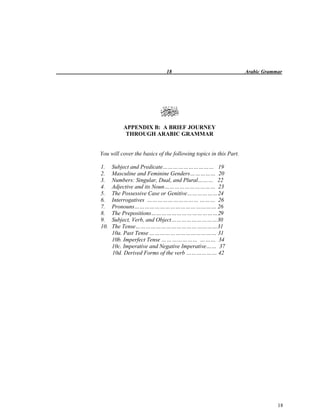
APPENDIX B: A BRIEF JOURNEY 
THROUGH ARABIC GRAMMAR 
You will cover the basics of the following topics in this Part. 
1. Subject and Predicate………………………… 19 
2. Masculine and Feminine Genders…………… 20 
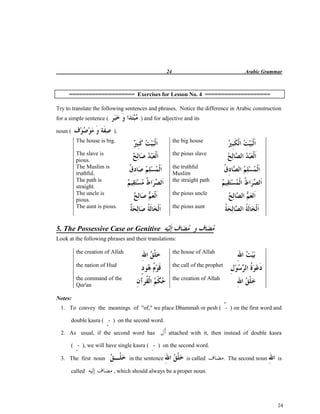
3. Numbers: Singular, Dual, and Plural……… 22 
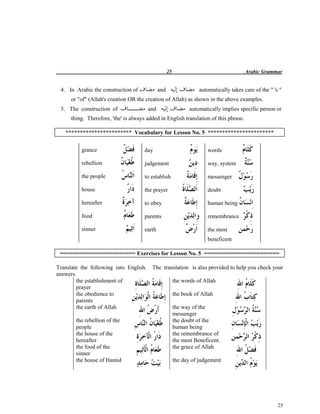
4. Adjective and its Noun………………………… 23 
5. The Possessive Case or Genitive………………24 
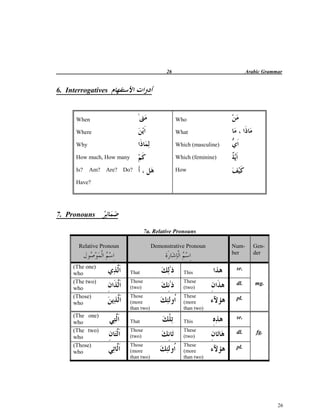
6. Interrogatives ………………………… ……… 26 
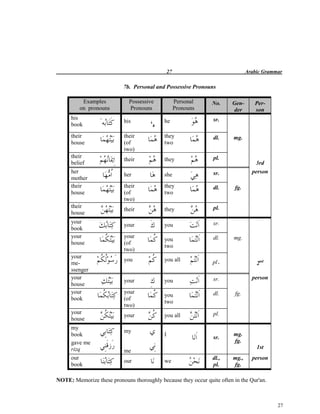
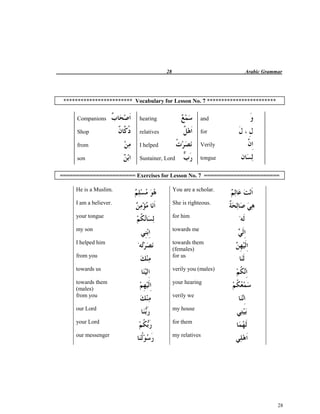
7. Pronouns………………………………………… 26 
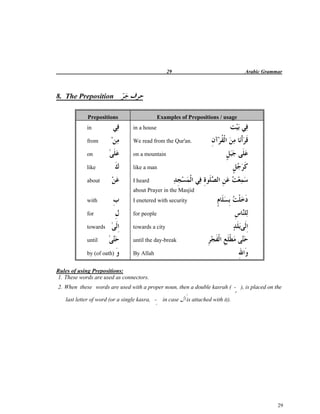
8. The Prepositions…………………………………29 
9. Subject, Verb, and Object………………………30 
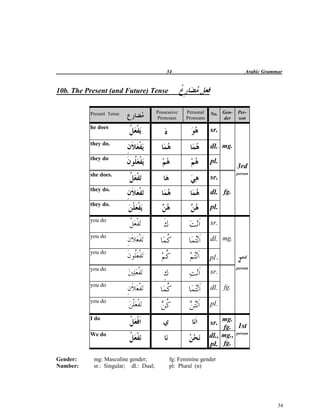
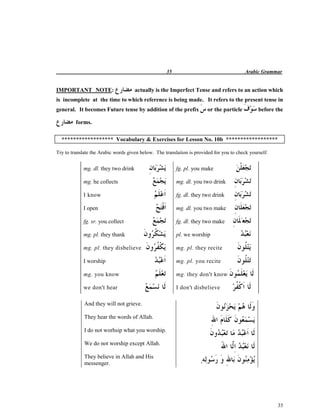
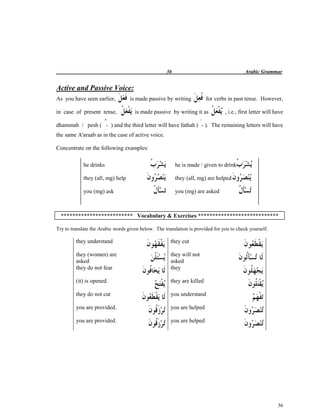
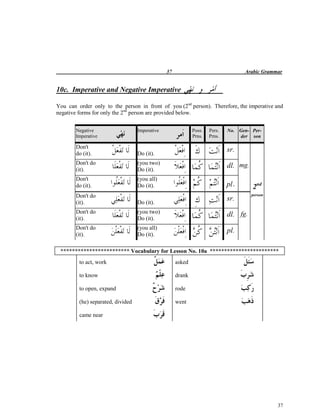
10. The Tense…………………………………………31 
10a. Past Tense ………………………………… 31 
10b. Imperfect Tense ………………… ……… 34 
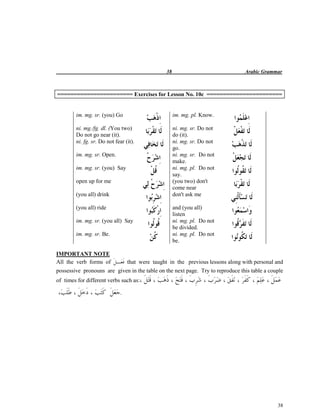
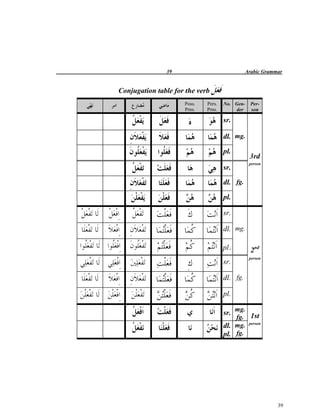
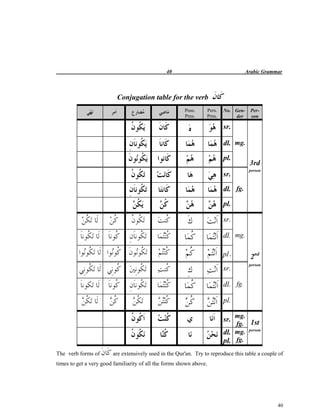
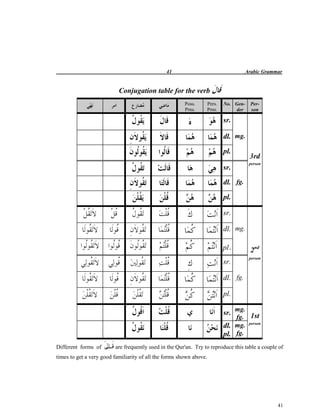
10c. Imperative and Negative Imperative…… 37 
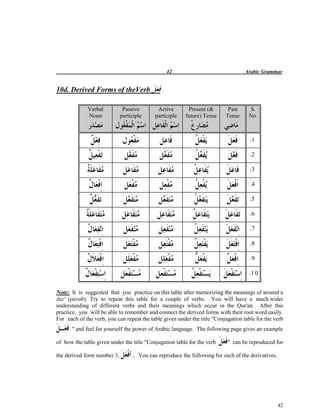
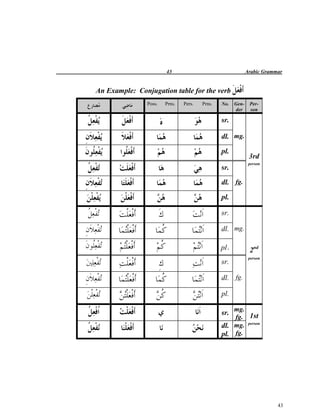
10d. Derived Forms of the verb ……………… 42
19 Arabic Grammar 
19 
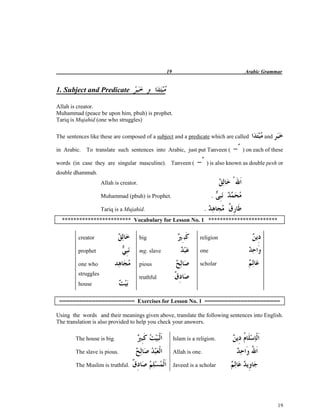
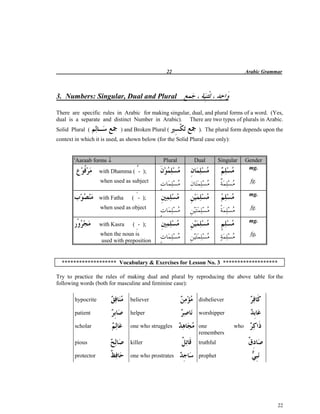
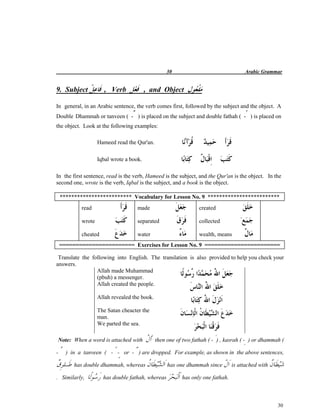
1. Subject and Predicate 	 
Allah is creator. 
Muhammad (peace be upon him, pbuh) is prophet. 
Tariq is Mujahid (one who struggles) 
The sentences like these are composed of a subject and a predicate which are called  and 	 
in Arabic. To translate such sentences into Arabic, just put Tanveen (  ) on each of these 
words (in case they are singular masculine). Tanveen (  ) is also known as double pesh or 
double dhammah. 
Allah is creator.
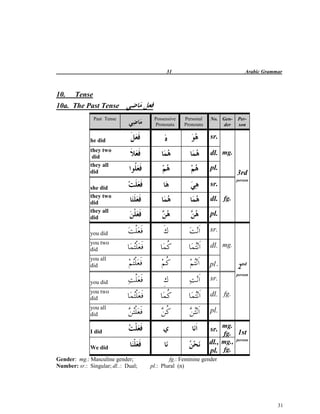
Muhammad (pbuh) is Prophet. 
 
Tariq is a Mujahid.
************************ Vocabulary for Lesson No. 1 ************************ 
creator
prophet  
one who
struggles 
house 
 
big 
 
mg. slave 
 
pious
truthful 	  
religion 
!	 
one  
scholar
======================= Exercises for Lesson No. 1 ======================= 
Using the words and their meanings given above, translate the following sentences into English. 
The translation is also provided to help you check your answers. 
The house is big. 
#
 
The slave is pious.
$#
 
The Muslim is truthful.
%#
 
Islam is a religion. 
!
%'
#
 
Allah is one.
(
 
Javeed is a scholar
)
20 Arabic Grammar 
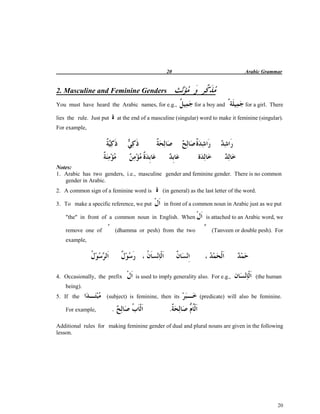
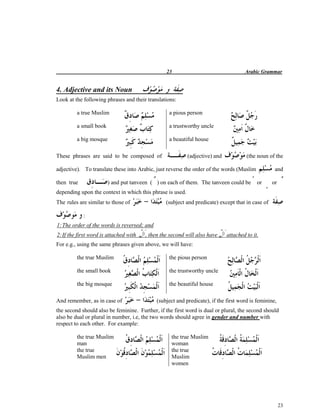
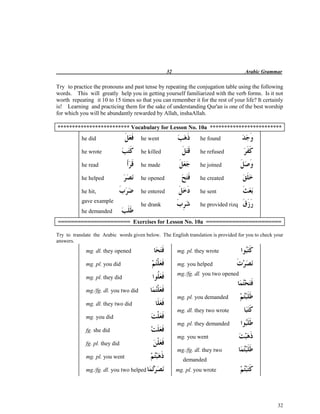
2. Masculine and Feminine Genders
You must have heard the Arabic names, for e.g., *+
) for a boy and *,%
) for a girl. There 
lies the rule. Just put  at the end of a masculine (singular) word to make it feminine (singular). 
For example, 
20 
 *,
*,
-
-
 
*,.
/ 
!
/
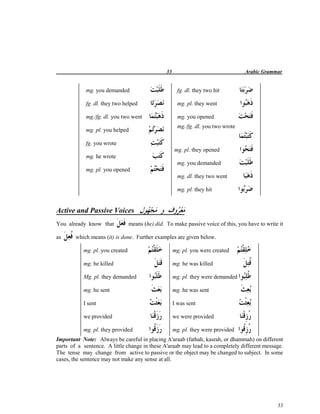
Notes: 
1. Arabic has two genders, i.e., masculine gender and feminine gender. There is no common 
gender in Arabic. 
2. A common sign of a feminine word is  (in general) as the last letter of the word. 
3. To make a specific reference, we put  in front of a common noun in Arabic just as we put 
the in front of a common noun in English. When  is attached to an Arabic word, we 
remove one of  (dhamma or pesh) from the two  (Tanveen or double pesh). For 
example, 
 '
 '
#
 	 #
 
( 
4. Occasionally, the prefix  is used to imply generality also. For e.g.,
#
 (the human 
being). 
5. If the  (subject) is feminine, then its 	 (predicate) will also be feminine. 
For example,
#
 *,
0

Grammer - Holy Quran

  • 1.
    18 Arabic Grammar 18 3 APPENDIX B: A BRIEF JOURNEY THROUGH ARABIC GRAMMAR You will cover the basics of the following topics in this Part. 1. Subject and Predicate………………………… 19 2. Masculine and Feminine Genders…………… 20 3. Numbers: Singular, Dual, and Plural……… 22 4. Adjective and its Noun………………………… 23 5. The Possessive Case or Genitive………………24 6. Interrogatives ………………………… ……… 26 7. Pronouns………………………………………… 26 8. The Prepositions…………………………………29 9. Subject, Verb, and Object………………………30 10. The Tense…………………………………………31 10a. Past Tense ………………………………… 31 10b. Imperfect Tense ………………… ……… 34 10c. Imperative and Negative Imperative…… 37 10d. Derived Forms of the verb ……………… 42
  • 2.
    19 Arabic Grammar 19 1. Subject and Predicate Allah is creator. Muhammad (peace be upon him, pbuh) is prophet. Tariq is Mujahid (one who struggles) The sentences like these are composed of a subject and a predicate which are called and in Arabic. To translate such sentences into Arabic, just put Tanveen ( ) on each of these words (in case they are singular masculine). Tanveen ( ) is also known as double pesh or double dhammah. Allah is creator.
  • 3.
    Muhammad (pbuh) isProphet. Tariq is a Mujahid.
  • 4.
    ************************ Vocabulary forLesson No. 1 ************************ creator
  • 5.
  • 6.
    struggles house big mg. slave pious
  • 7.
    truthful religion ! one scholar
  • 8.
    ======================= Exercises forLesson No. 1 ======================= Using the words and their meanings given above, translate the following sentences into English. The translation is also provided to help you check your answers. The house is big. # The slave is pious.
  • 9.
    $# The Muslimis truthful.
  • 10.
    %# Islam isa religion. !
  • 11.
  • 12.
  • 13.
    ( Javeed isa scholar
  • 14.
  • 15.
    20 Arabic Grammar 2. Masculine and Feminine Genders
  • 16.
    You must haveheard the Arabic names, for e.g., *+
  • 17.
    ) for aboy and *,%
  • 18.
    ) for agirl. There lies the rule. Just put at the end of a masculine (singular) word to make it feminine (singular). For example, 20 *,
  • 19.
  • 20.
  • 21.
  • 22.
  • 23.
  • 24.
    Notes: 1. Arabichas two genders, i.e., masculine gender and feminine gender. There is no common gender in Arabic. 2. A common sign of a feminine word is (in general) as the last letter of the word. 3. To make a specific reference, we put in front of a common noun in Arabic just as we put the in front of a common noun in English. When is attached to an Arabic word, we remove one of (dhamma or pesh) from the two (Tanveen or double pesh). For example, ' '
  • 25.
    # # ( 4. Occasionally, the prefix is used to imply generality also. For e.g.,
  • 26.
    # (the human being). 5. If the (subject) is feminine, then its (predicate) will also be feminine. For example,
  • 27.
  • 28.