• Intros
Why Invest in local Agriculture ?
Because every dollar spent at a
locally owned business generates
two-to-four times the economic
development impacts of a dollar
spent on an equivalent non-local
business.
– Forbes.com 2013
http://www.forbes.com/sites/ashoka/2013/04/03/investing-in-local-food-businesses-for-community-health-and-wealth/
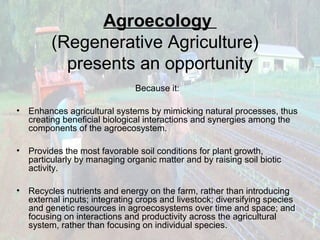
Agroecology
(Regenerative Agriculture)
presents an opportunity
Because it:
•

Enhances agricultural systems by mimicking natural processes, thus
creating beneficial biological interactions and synergies among the
components of the agroecosystem.

•

Provides the most favorable soil conditions for plant growth,
particularly by managing organic matter and by raising soil biotic
activity.

•

Recycles nutrients and energy on the farm, rather than introducing
external inputs; integrating crops and livestock; diversifying species
and genetic resources in agroecosystems over time and space; and
focusing on interactions and productivity across the agricultural
system, rather than focusing on individual species.
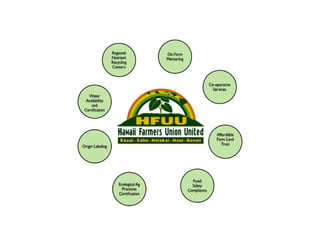
HFUU Legislative Agenda for 2014
• Grow farmers with on-farm mentoring centers
• Maximize use of locally available resources with Nutrient
Recycling Centers strategically placed state-wide
• Lower the cost of agricultural land for farmers
• Increase diversity of food distribution networks through
farmer cooperatives & reduce liability for farmers
• Establish a state-wide Good Agricultural Practices
baseline, and provide assistance for farm inspections
and regulatory compliance for new food safety regs.
• Protect the integrity of our products from abusive
blending of Hawaii origin products
• In general lower production cost while increasing
production of our locally grown food, fuel and fiber
`
Whole systems legislation for an
Agroecological solution
On Farm Mentoring Centers :
A way to grow our farmer work force
because it:
1. Brings school to the farm to allow people in remote
areas a chance to learn new ways to increase
productivity and lower cost of production using locally
available inputs.
2. Allows those not academically inclined a familiar
atmosphere to learn in.
3. HFUU would like to work with CTHAR on this project
Lowering cost of production - What
about those locally produced, low cost
inputs ?
Strategically Placed Nutrients Recycling Centers will
1. Help farmers decrease their nitrogen needs by up to 75% / acre by making
large quantities of organic matter available that they can apply to their fields
to prevent erosion and evaporation of nutrients
2. Help to increase many yields to levels comparable and sometimes above
conventional levels
3. Be a cost-effective way to mitigate poor soils on a large scale, because it
recycles inputs generated locally ie. Green waste, manure, food services
waste, IMO’s and slaughter offal.
4. Create animal feed out of food waste
In the U.S. alone, 40% of the food produced each year goes to waste. That's
$165 billion worth of uneaten and wasted food, according to a report
authored by the Natural Resources Defense Council. Lets turn that waste
into soil and animal feed !
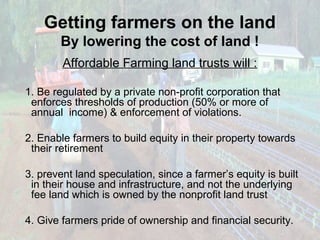
Getting farmers on the land
By lowering the cost of land !
Affordable Farming land trusts will :
1. Be regulated by a private non-profit corporation that
enforces thresholds of production (50% or more of
annual income) & enforcement of violations.
2. Enable farmers to build equity in their property towards
their retirement
3. prevent land speculation, since a farmer’s equity is built
in their house and infrastructure, and not the underlying
fee land which is owned by the nonprofit land trust
4. Give farmers pride of ownership and financial security.
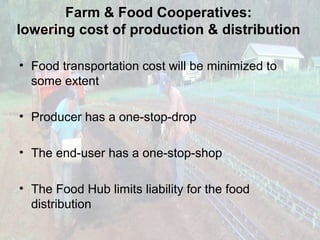
Farm & Food Cooperatives:
lowering cost of production & distribution
• Food transportation cost will be minimized to
some extent
• Producer has a one-stop-drop
• The end-user has a one-stop-shop
• The Food Hub limits liability for the food
distribution
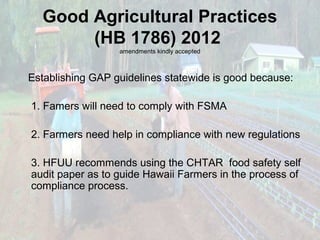
Good Agricultural Practices
(HB 1786) 2012
amendments kindly accepted

Establishing GAP guidelines statewide is good because:
1. Famers will need to comply with FSMA
2. Farmers need help in compliance with new regulations
3. HFUU recommends using the CHTAR food safety self
audit paper as to guide Hawaii Farmers in the process of
compliance process.
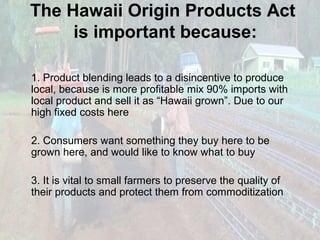
The Hawaii Origin Products Act
is important because:
1. Product blending leads to a disincentive to produce
local, because is more profitable mix 90% imports with
local product and sell it as “Hawaii grown”. Due to our
high fixed costs here
2. Consumers want something they buy here to be
grown here, and would like to know what to buy
3. It is vital to small farmers to preserve the quality of
their products and protect them from commoditization
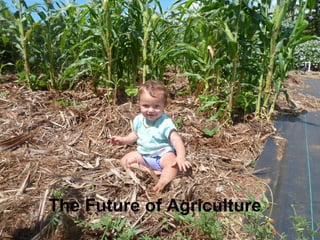
The Future of Agriculture

Lege.pppresentation

  • 2.
  • 3.
    Why Invest inlocal Agriculture ? Because every dollar spent at a locally owned business generates two-to-four times the economic development impacts of a dollar spent on an equivalent non-local business. – Forbes.com 2013 http://www.forbes.com/sites/ashoka/2013/04/03/investing-in-local-food-businesses-for-community-health-and-wealth/
  • 4.
    Agroecology (Regenerative Agriculture) presents anopportunity Because it: • Enhances agricultural systems by mimicking natural processes, thus creating beneficial biological interactions and synergies among the components of the agroecosystem. • Provides the most favorable soil conditions for plant growth, particularly by managing organic matter and by raising soil biotic activity. • Recycles nutrients and energy on the farm, rather than introducing external inputs; integrating crops and livestock; diversifying species and genetic resources in agroecosystems over time and space; and focusing on interactions and productivity across the agricultural system, rather than focusing on individual species.
  • 5.
    HFUU Legislative Agendafor 2014 • Grow farmers with on-farm mentoring centers • Maximize use of locally available resources with Nutrient Recycling Centers strategically placed state-wide • Lower the cost of agricultural land for farmers • Increase diversity of food distribution networks through farmer cooperatives & reduce liability for farmers • Establish a state-wide Good Agricultural Practices baseline, and provide assistance for farm inspections and regulatory compliance for new food safety regs. • Protect the integrity of our products from abusive blending of Hawaii origin products • In general lower production cost while increasing production of our locally grown food, fuel and fiber
  • 6.
  • 7.
    Whole systems legislationfor an Agroecological solution On Farm Mentoring Centers : A way to grow our farmer work force because it: 1. Brings school to the farm to allow people in remote areas a chance to learn new ways to increase productivity and lower cost of production using locally available inputs. 2. Allows those not academically inclined a familiar atmosphere to learn in. 3. HFUU would like to work with CTHAR on this project
  • 8.
    Lowering cost ofproduction - What about those locally produced, low cost inputs ? Strategically Placed Nutrients Recycling Centers will 1. Help farmers decrease their nitrogen needs by up to 75% / acre by making large quantities of organic matter available that they can apply to their fields to prevent erosion and evaporation of nutrients 2. Help to increase many yields to levels comparable and sometimes above conventional levels 3. Be a cost-effective way to mitigate poor soils on a large scale, because it recycles inputs generated locally ie. Green waste, manure, food services waste, IMO’s and slaughter offal. 4. Create animal feed out of food waste In the U.S. alone, 40% of the food produced each year goes to waste. That's $165 billion worth of uneaten and wasted food, according to a report authored by the Natural Resources Defense Council. Lets turn that waste into soil and animal feed !
  • 9.
    Getting farmers onthe land By lowering the cost of land ! Affordable Farming land trusts will : 1. Be regulated by a private non-profit corporation that enforces thresholds of production (50% or more of annual income) & enforcement of violations. 2. Enable farmers to build equity in their property towards their retirement 3. prevent land speculation, since a farmer’s equity is built in their house and infrastructure, and not the underlying fee land which is owned by the nonprofit land trust 4. Give farmers pride of ownership and financial security.
  • 10.
    Farm & FoodCooperatives: lowering cost of production & distribution • Food transportation cost will be minimized to some extent • Producer has a one-stop-drop • The end-user has a one-stop-shop • The Food Hub limits liability for the food distribution
  • 11.
    Good Agricultural Practices (HB1786) 2012 amendments kindly accepted Establishing GAP guidelines statewide is good because: 1. Famers will need to comply with FSMA 2. Farmers need help in compliance with new regulations 3. HFUU recommends using the CHTAR food safety self audit paper as to guide Hawaii Farmers in the process of compliance process.
  • 12.
    The Hawaii OriginProducts Act is important because: 1. Product blending leads to a disincentive to produce local, because is more profitable mix 90% imports with local product and sell it as “Hawaii grown”. Due to our high fixed costs here 2. Consumers want something they buy here to be grown here, and would like to know what to buy 3. It is vital to small farmers to preserve the quality of their products and protect them from commoditization
  • 13.
    The Future ofAgriculture