Optom
Askar.PK
AQUEOUS HUMOUR
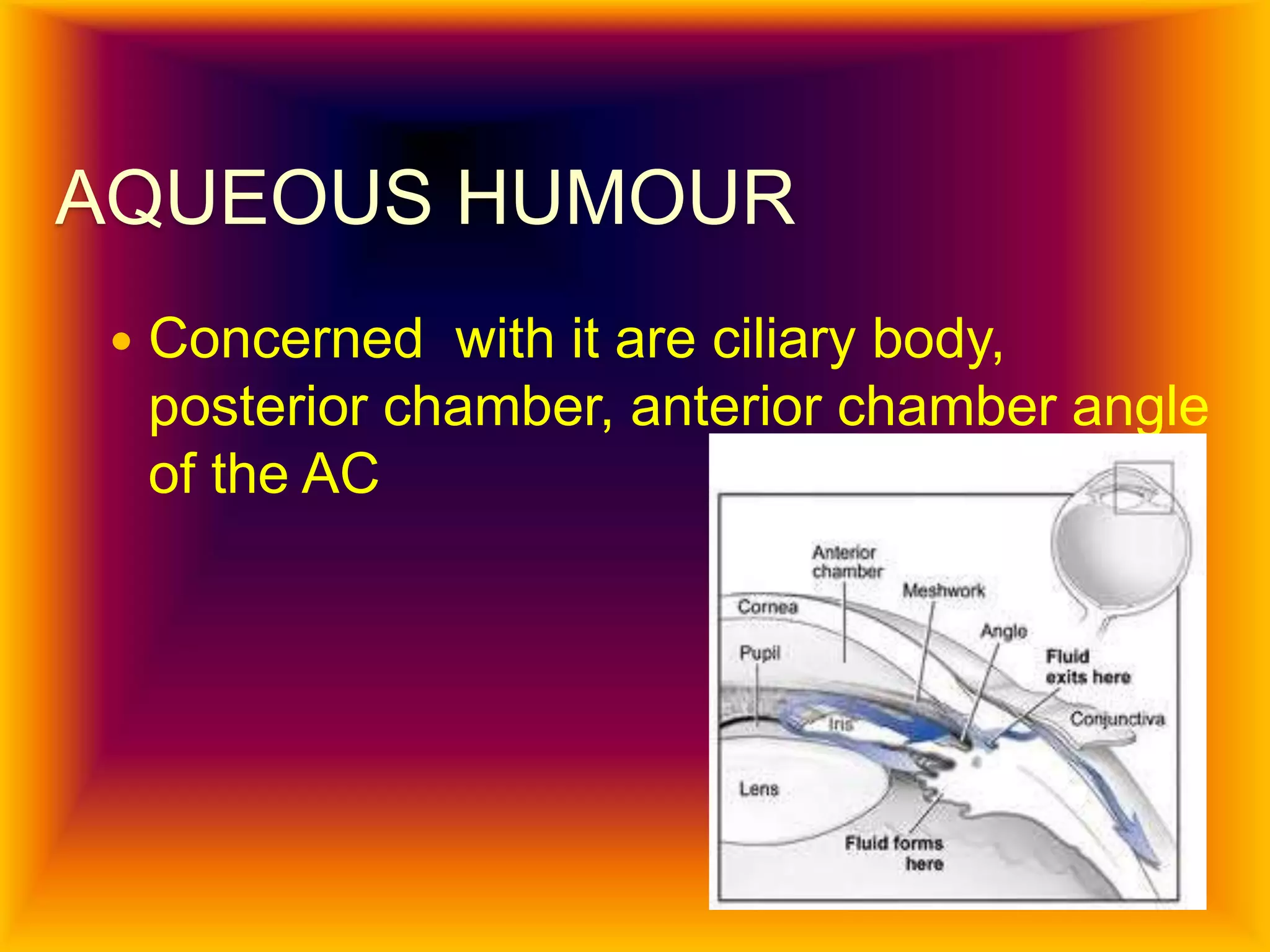
 Concerned with it are ciliary body,
posterior chamber, anterior chamber angle
of the AC
Ciliary body
 It is the site of aqueous production
Posterior chamber
 Triangular space containing about
0.06ml aqueous humour
 Anteriorly: by the posterior surface of
the iris & part of CB
Cont……
 Posteriorly : by the crystalline
lens & its zonules
 Laterally: by the CB
Anterior chamber
 Anterior: back of cornea
 Posterior: anterior surface of iris &
part of CB
 3mm deep in the centre in normal
adult
 Comparatively shallow in very young
children & old people
Cont……….
 0.25ml of the aqueous
 Through pupil communicates with the
posterior chamber
 Peripheral recess: angle of AC ,
mainly formed by trabicular meshwork
Angle of the AC
An important role in the
process of aqueous drainage
Cont………………
 Structures:
1. The ciliary band
2. Scleral spur
3. Trabicular meshwork
4. Schwalbe’s line
1. The ciliary band
 Most posterior landmark in
the angle recess.
 It is formed by the anterior
most part of the CB
 It appears as a grey or dark
brown band
1. Sceral spur
 Posterior portion of the scleral sulcus
 Prominent white line on gonioscopy
 Posteriorly : CB, anteriorly:
corneoscleral meshwork
1. Trabicular meshwork
 Seen as a band
 Just anterior to the scleral spur
 No pigment at birth & develops
pigments with increasing age
1. Schwalbe’s line
 Fine ridge seen just in front of the
trabicular meshwork
 It is formed by the prominent end of
the decsemet’s membrane
Aqueous outflow system
1. Trabicular meshwork
2. Schlemm’s canal
3. Collector channels
4. Episcleral veins
Trabicular meshwork
Sieve –like structure
Through which aqueous leaves the
eye
It is a complex connective tissue
Cont………..
1. Uveal meshwork
2. Corneoscleral meshwork
3. Justracanalicular meshwork
Uveal meshwork
 Innermost part of trabicular meshwork
 Extend from the iris root & CB to the
schwalbe’s line
Corneoscleral meshwork
 Large middle portion & extend from
the scleral spur to the lateral wall of
the sulcus
Jstracanalicular meshwork
 Form the outer most portion of the
trabicular meshwork
Schemm’s canal
 Endothelial lined oval channel
present circumferentially in the
scleral sulcus
 Endothelial cells of its inner
wall are irregular & spindle
shaped
 Collector channels
 Also called intrascleral aqueous
vessels
 About 25-35 in number & leave the
schlemm’s canal
 Episcleral veins
 Most of the aqueous vessels drain into
vein
 Episcleral vein ultimately drain into the
cavernous sinus
Physiological
consideration
Functions
 Clear, colourless, watery solution
 Continuously circulated from the
posterior chamber of the eye
throughout the anterior chamber
Cont…
1. Maintenance of intraocular pressure
2. Metabolic role
3. Optical function
4. Clearing function
Physiochemical properties
 Volume: 0.31ml
 RI : 1.336
 Density : slightly greater than that of
water
 Osmotic pressure: slightly
hyperosmotic to plasma (3-5 mOsm/l)
 pH: acidic (7.2)
 Rate of formation : 2.3 micro l /min
Aqueous humour dynamics
 Aqueous dynamics include aqueous
formation & drainage
 Aqueous production remain constant
till IOP is raised to 50 mmHg & over
 Aqueous humour flow from the
posterior chamber into the AC
through the pupil
 From AC aqueous is drained out by
two routes : uveoscleral outflow ,
trabicular out flow
Intraocular pressure
 The IOP refers to the pressure exerted
by intraocular contents on the coats
of the eyeball
 The normal level IOP is essentially
maintained by a dynamic equilibrium
b/w the aqueous humour formation
aqueous humour outflow & episcleral
pressure
Cont…
 IOP is distributed evenly throughout
the eye
 The IOP important in maintaining the
shape of the eyeball
 Normal IOP varies b/w 10.5 to 20.5
mmHg
Thank you

Aqueous humour