The anterior chamber
Dr. Ibrahim taha
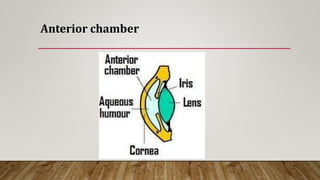
Anterior chamber (AC)
 Anterior chamber (AC) is an angular space.
It is the space formed:
 Anteriorly by the posterior surface of cornea
 Posteriorly by the lens, anterior surface of iris and a part of
cilary body
Anterior chamber
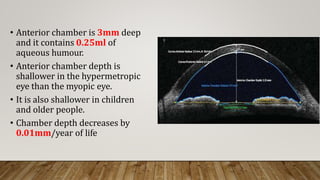
• Anterior chamber is 3mm deep
and it contains 0.25ml of
aqueous humour.
• Anterior chamber depth is
shallower in the hypermetropic
eye than the myopic eye.
• It is also shallower in children
and older people.
• Chamber depth decreases by
0.01mm/year of life
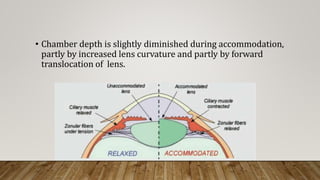
• Chamber depth is slightly diminished during accommodation,
partly by increased lens curvature and partly by forward
translocation of lens.
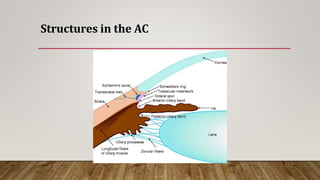
Structures in the AC angle
• Schwalbe’s line
• Trabecular Meshwork
• Schlemm’s canal
• Aqueous humour
• Scleral spur
• Anterior part of ciliary body
• Iris root
Structures in the AC
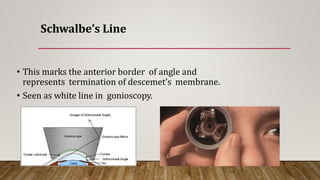
Schwalbe’s Line
• This marks the anterior border of angle and
represents termination of descemet’s membrane.
• Seen as white line in gonioscopy.
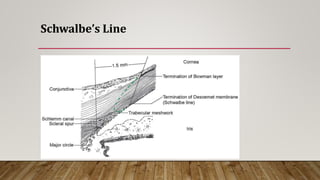
Schwalbe’s Line
• Schwalbe’s line marks transition from
Termination of the Decemet’s membrane.
Insertion of trabecular meshwork into corneal stroma.
Schwalbe’s Line
Schwalbe’s Line
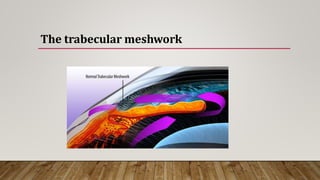
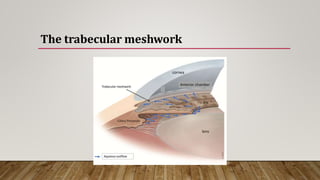
The trabecular meshwork
• It is a spongy like structure made
up of connective tissue lined by
trabeculocytes.
• Its main function is in drainage of
aqueous humour.
The trabecular meshwork
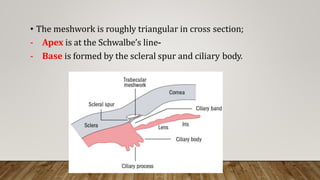
• The meshwork is roughly triangular in cross section;
- Apex is at the Schwalbe’s line-
- Base is formed by the scleral spur and ciliary body.
SCHLEMM’S CANAL
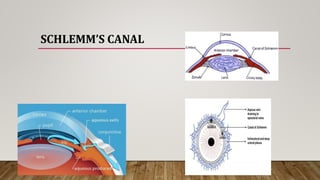
• Schlemm’s canal is a circular lymphatic
like vessel in the eye that collects
aqueous humour from the anterior
chamber and delivers it into the
episcleral blood vessels via aqueous
veins.
SCHLEMM’S CANAL, if blocked, what will happen?
• If the canal is blocked, the pressure in the eye can
increase, resulting in glaucoma. Glaucoma is a condition
that causes damage to the eye's optic nerve.
SCHLEMM’S CANAL
SCHLEMM’S CANAL
THE AQUEOUS HUMOUR
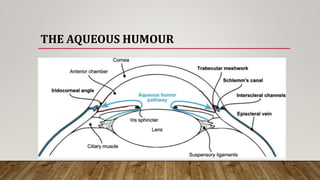
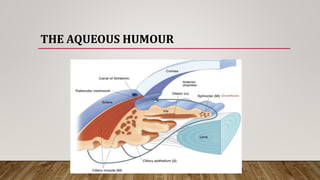
• The aqueous humour is a transparent water-like fluid similar
to plasma, but containing low protein concentrations.
• The ciliary body constantly produces a small amount of
aqueous humour while an equal amount flows out through the
trabecular meshwork in the drainage angle or the
uveoscleral outflow pathways.
• It fills both the anterior and the posterior chambers of the eye.
THE AQUEOUS HUMOUR
THE AQUEOUS HUMOUR
THE AQUEOUS HUMOUR
THE AQUEOUS HUMOUR
• The high aqueous humour pressure is related to elevated Intra-
ocular pressure (IOP) which could result to glaucoma

AC Anatomy- 1.pptx

  • 1.
  • 2.
    Anterior chamber (AC) Anterior chamber (AC) is an angular space. It is the space formed:  Anteriorly by the posterior surface of cornea  Posteriorly by the lens, anterior surface of iris and a part of cilary body
  • 3.
  • 4.
    • Anterior chamberis 3mm deep and it contains 0.25ml of aqueous humour. • Anterior chamber depth is shallower in the hypermetropic eye than the myopic eye. • It is also shallower in children and older people. • Chamber depth decreases by 0.01mm/year of life
  • 5.
    • Chamber depthis slightly diminished during accommodation, partly by increased lens curvature and partly by forward translocation of lens.
  • 6.
    Structures in theAC angle • Schwalbe’s line • Trabecular Meshwork • Schlemm’s canal • Aqueous humour • Scleral spur • Anterior part of ciliary body • Iris root
  • 7.
  • 8.
    Schwalbe’s Line • Thismarks the anterior border of angle and represents termination of descemet’s membrane. • Seen as white line in gonioscopy.
  • 9.
    Schwalbe’s Line • Schwalbe’sline marks transition from Termination of the Decemet’s membrane. Insertion of trabecular meshwork into corneal stroma.
  • 10.
  • 11.
  • 12.
    The trabecular meshwork •It is a spongy like structure made up of connective tissue lined by trabeculocytes. • Its main function is in drainage of aqueous humour.
  • 13.
  • 14.
  • 15.
    • The meshworkis roughly triangular in cross section; - Apex is at the Schwalbe’s line- - Base is formed by the scleral spur and ciliary body.
  • 16.
    SCHLEMM’S CANAL • Schlemm’scanal is a circular lymphatic like vessel in the eye that collects aqueous humour from the anterior chamber and delivers it into the episcleral blood vessels via aqueous veins.
  • 17.
    SCHLEMM’S CANAL, ifblocked, what will happen? • If the canal is blocked, the pressure in the eye can increase, resulting in glaucoma. Glaucoma is a condition that causes damage to the eye's optic nerve.
  • 18.
  • 19.
  • 20.
    THE AQUEOUS HUMOUR •The aqueous humour is a transparent water-like fluid similar to plasma, but containing low protein concentrations. • The ciliary body constantly produces a small amount of aqueous humour while an equal amount flows out through the trabecular meshwork in the drainage angle or the uveoscleral outflow pathways. • It fills both the anterior and the posterior chambers of the eye.
  • 21.
  • 22.
  • 23.
  • 24.
    THE AQUEOUS HUMOUR •The high aqueous humour pressure is related to elevated Intra- ocular pressure (IOP) which could result to glaucoma