The Aquaporin WaterThe Aquaporin Water
ChannelsChannels
OutlineOutline
2
What is an Aquaporin?
Specie Distribution
Structural Features
Mechanism of Action
Human Aquaporins
Medical Aspects of AQPs
Conclusion
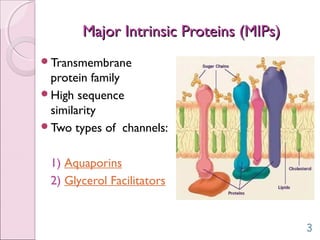
Major Intrinsic Proteins (MIPs)Major Intrinsic Proteins (MIPs)
Transmembrane
protein family
High sequence
similarity
Two types of channels:
1) Aquaporins
2) Glycerol Facilitators
3
What is an Aquaporin?What is an Aquaporin?
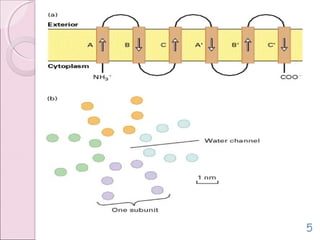
Six transmembrane helices joined together
Found in all life forms
Allow efficient permeation of water
High specificity for water
Highly conserved
4
5
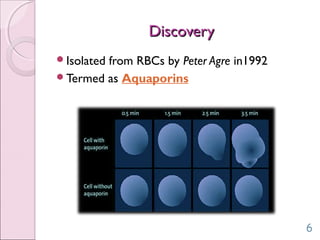
DiscoveryDiscovery
Isolated from RBCs by Peter Agre in1992
Termed as Aquaporins
6
Species DistributionSpecies Distribution
13 known types in Mammals
GlpF and AQPZ in E.coli
5 subfamilies in Plants (PIP,TIP, NIP, XIP, SIP)
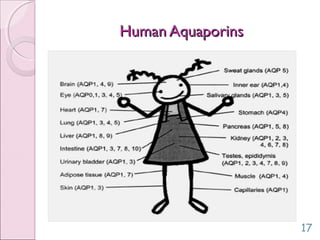
Human AQPs – 10 different genes
Aquaporin family: (AQPs) and (AQGPs)
7
Bacterial AquaporinsBacterial Aquaporins
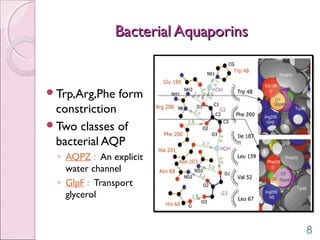
Trp,Arg,Phe form
constriction
Two classes of
bacterial AQP
◦ AQPZ : An explicit
water channel
◦ GlpF : Transport
glycerol
8
Structural Features of AquaporinsStructural Features of Aquaporins
9
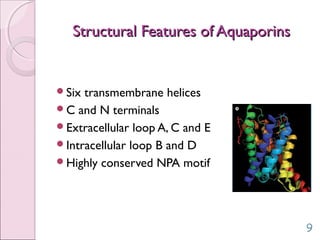
Six transmembrane helices
C and N terminals
Extracellular loop A, C and E
Intracellular loop B and D
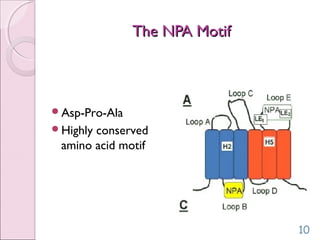
Highly conserved NPA motif
The NPA MotifThe NPA Motif
10
Asp-Pro-Ala
Highly conserved
amino acid motif
Hourglass FoldHourglass Fold
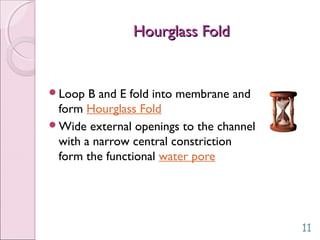
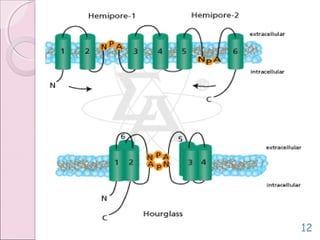
Loop B and E fold into membrane and
form Hourglass Fold
Wide external openings to the channel
with a narrow central constriction
form the functional water pore
11
12
Ar/R Selectivity FilterAr/R Selectivity Filter
Cluster of amino acids help bind to water
Prevent other molecules to enter
membrane
Tetrad:Two residues from helices 2 (H2)
and 5 (H5) and two residues from loop E
(LE1) and (LE2)
13
Role of AquaporinsRole of Aquaporins
Increase rate of water transport
Prevent other molecules to enter in
membrane
Symplastic movement of water in plants
Water transport in prokaryotes (AQPZ)
14
Mechanism of ActionMechanism of Action
15
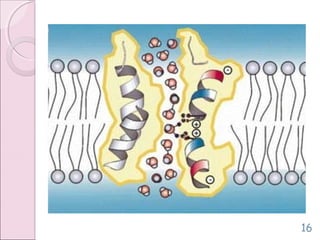
Water molecules orient themselves as
Single-File H bonded chain
Water interacts with NPA and rotated at
180˚
Fast flux is maintained
Low Activation energy needed
16
Human AquaporinsHuman Aquaporins
17
Aquaporins and DiseaseAquaporins and Disease
AQP-2 gene: Hereditary Nephrogenic
Diabetes Insipidus
AQP-4 gene: Devic's Disease
AQP-0 gene: Congenital Cataracts in mice
18
ConclusionConclusion
AQPs are:
• Highly conserved
• Of Supreme importance
• Plumbing system of cell
19
Future InsightsFuture Insights
Much to learn yet…
Design therapeutic models
More technology and research work
needed
20
ReferencesReferences
 http://www.aquaporins.org/
 http://www.wikidoc.org/index.php/Aquaporin_1
 http://en.allexperts.com/e/a/aq/aquaporin.htm
 http://www.pharmainfo.net/reviews/aquaporins-secret-highways-water-
transport
 http://www.danfoss-aquaz.com/aquaporins.asp
 http://www.bio.miami.edu/~cmallery/150/memb/water.channels.htm
21

Aquaporins