12/28/2022 1
Applying Problem
Solving
Techniques and Tools
for HEW students
By kidist A. (BSc, MPH)
Learning outcomes
 Identify and select theme/problem
 Grasp current status and set goal
 Establish activity plan
 Analyze causes of a problem
 Examine countermeasures and their
implementation
 Assess effectiveness of the solution
 Standardize and sustain operation
12/28/2022 2
Introduction cont ….
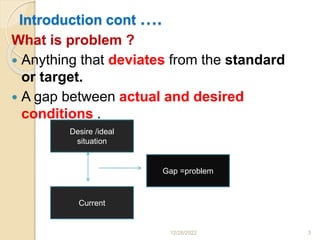
What is problem ?
 Anything that deviates from the standard
or target.
 A gap between actual and desired
conditions .
12/28/2022 3
Desire /ideal
situation
Current
Gap =problem
Introduction cont …
12/28/2022 4
What is Problem Solving
 Problem solving is a process to identify a
challenge or barrier to high quality care and
implement and evaluate measurable solutions
to the identified problem.
 It is a systematic way to break down complex
issues into tangible solutions.
Problem solving ….
 Problem solving is the act of
◦ defining a problem;
◦ determining the cause of the problem;
◦ identifying, prioritizing, and selecting
alternatives for a solution; and
◦ implementing a solution.
12/28/2022 5
12/28/2022 6
Define problem
 Differentiate fact from opinion
 Specify underlying causes
 Consult each faction involved for
information
 State the problem specifically
 Identify what standard or expectation is
violated
 Determine in which process the problem
lies
 Avoid trying to solve the problem without
12/28/2022 7
Generate alternative solutions
 Postpone evaluating alternatives initially
 Include all involved individuals in the
generating of alternatives
 Specify alternatives consistent with
organizational goals
 Specify short- and long-term alternatives
 Brainstorm on others' ideas
 Seek alternatives that may solve the
problem
12/28/2022 8
Evaluate and select an
alternative
 Evaluate alternatives relative to a target
standard
 Evaluate all alternatives without bias
 Evaluate alternatives relative to
established goals
 Evaluate both proven and possible
outcomes
 State the selected alternative explicitly
12/28/2022 9
Implement and follow up on the
solution
 Plan and implement a pilot test of the
chosen alternative
 Gather feedback from all affected
parties
 Seek acceptance or consensus by all
those affected
 Establish ongoing measures and
monitoring
 Evaluate long-term results based on
12/28/2022 10
Benefits of Structured Problem
Solving process
Remove time lost in debate
Identify weak points in processes
Discover systemic causes
Explain with reasons why an incident
occurred
Gives a real representation of the incident
Compare what actually happened against
what should have happened, at any point
during the incident.
12/28/2022 11
Importance of problem selection
Many problems happen everyday in
working place
All problems cannot be solved at once
Identification, prioritization and focus
is necessary
Resources are limited
12/28/2022 12
12/28/2022 13
12/28/2022 14
12/28/2022 15
12/28/2022 16
12/28/2022 17
12/28/2022 18
12/28/2022 19
12/28/2022 20
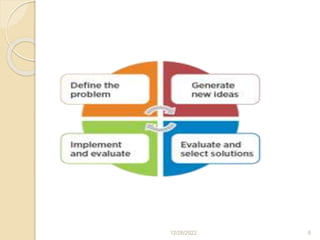
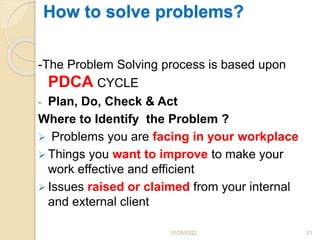
How to solve problems?
-The Problem Solving process is based upon
PDCA CYCLE
- Plan, Do, Check & Act
Where to Identify the Problem ?
 Problems you are facing in your workplace
 Things you want to improve to make your
work effective and efficient
 Issues raised or claimed from your internal
and external client
12/28/2022 21
Who should select theme?
Who knows what is happening on the ground?
 The staff working in the section.
Process for theme selection.
1.Staff meet to brainstorm about problems in
their current working place (Clarify problem
statement)
◦Issues and problems in their working
environment
◦Complicated work processes/procedures
◦Clams from internal and external clients
◦ Accident, errors often happening
12/28/2022 22
Process for theme selection conti…..
2. List up all raised issues and problems
Note :
- Do not seek contributing factors and causes
of the problems
- Do not blame and deny others’ opinions
3. Categorize listed issues and problems into
two
categories;
1) Possible to solve immediately
2) Impossible to solve immediately
12/28/2022 23
Process for theme selection cont…
4. Action should be taken immediately for the
issues Possible to solve immediately
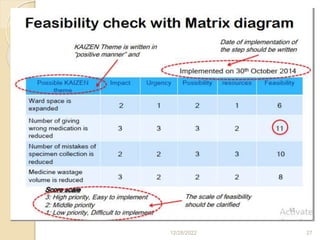
5. Check feasibility of all the problems for those
which are Impossible to be solved immediately
 Possible themes need to be checked its
feasibility by impact, urgency, possibility,
resource availability.
12/28/2022 24
Process for theme selection cont…
Impact
What is the impact, when it is
implemented?
Is it possible to get impact with little
inputs?
Urgency
Do we have to do it immediately?
Possibility
Is it possible to complete whole process
within 6 months?
Is it possible to carry out this process
within your department?
12/28/2022 25
Process for theme selection cont…
 Resources
Possible to implement with existing
resource?
Require involvement of many sections?
Is data and information available for
situation analysis?
 If not available, is it possible to
collect?
Who and how many staff are going be
involved?
12/28/2022 26
12/28/2022 27
Case 1: Overcrowding-Surgery ward
• Surgical Ward of Y hospital has 87 beds.
Staff complain to management that there is
overcrowding and that the 87 beds are
always occupied which forces them to use
beds from other wards.
• After receiving the complaint, hospital
management immediately decided to get
more beds for the surgical ward.
What would you do?
12/28/2022 28
Case 2: Long Waiting Time
• X health Center received complaint from
the community that there is long waiting
time at OPD.
• Health center management conducted a
meeting to review complaints and decided
to write a letter to the Woreda requesting
financial support to build two additional
consultation rooms to alleviate the problem
of long waiting time.
What would you do?
12/28/2022 29
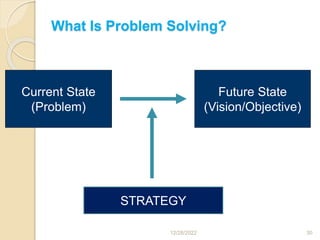
What Is Problem Solving?
12/28/2022 30
Current State
(Problem)
Future State
(Vision/Objective)
STRATEGY
Problem statement
 A problem statement is a statement of a current
issue or problem that requires timely action to
improve the situation.
 A problem statement is a concise description
of the issues that needs to be addressed
Good problem statement should:
1. Focus on a single problem
2. Do not state the cause or the solution; focus
on the problem
3. Be brief
4. Address problems that are feasibly solved
5. Ensure the problem is shared widely by key
12/28/2022 31
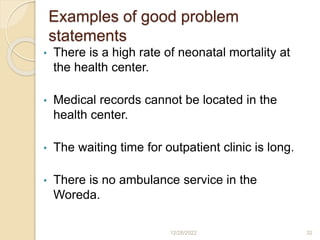
Examples of good problem
statements
• There is a high rate of neonatal mortality at
the health center.
• Medical records cannot be located in the
health center.
• The waiting time for outpatient clinic is long.
• There is no ambulance service in the
Woreda.
12/28/2022 32
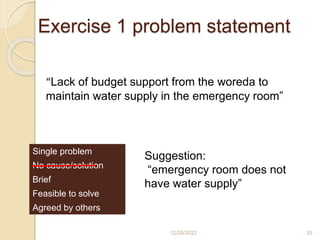
Exercise 1 problem statement
12/28/2022 33
“Lack of budget support from the woreda to
maintain water supply in the emergency room”
Single problem
No cause/solution
Brief
Feasible to solve
Agreed by others
Suggestion:
“emergency room does not
have water supply”
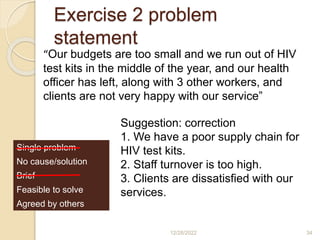
Exercise 2 problem
statement
12/28/2022 34
“Our budgets are too small and we run out of HIV
test kits in the middle of the year, and our health
officer has left, along with 3 other workers, and
clients are not very happy with our service”
Single problem
No cause/solution
Brief
Feasible to solve
Agreed by others
Suggestion: correction
1. We have a poor supply chain for
HIV test kits.
2. Staff turnover is too high.
3. Clients are dissatisfied with our
services.
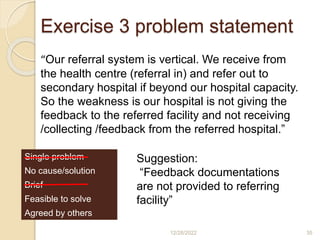
Exercise 3 problem statement
12/28/2022 35
“Our referral system is vertical. We receive from
the health centre (referral in) and refer out to
secondary hospital if beyond our hospital capacity.
So the weakness is our hospital is not giving the
feedback to the referred facility and not receiving
/collecting /feedback from the referred hospital.”
Single problem
No cause/solution
Brief
Feasible to solve
Agreed by others
Suggestion:
“Feedback documentations
are not provided to referring
facility”
Exercise 4 problem statement
12/28/2022 36
“HEWs are not motivated to work. We need
to increase supervision to improve the
number of graduating model households in
the woreda”
Single problem
No cause/solution
Brief
Feasible to solve
Agreed by others
Suggestion: the correct
“Low number of model
households graduating by
HEWs”
Exercise 5 problem statement
12/28/2022 37
“Spare parts are not available in Ethiopia, so a lot
of medical equipment at the health center are not
functioning”
Single problem
No cause/solution
Brief
Feasible to solve
Agreed by others
Suggestion:
“High rate of non functional
medical equipment in the health
center” or
“Broken medical equipment's in
the health center are not being
repaired”
Magnitude of the problem
Why we need to measure the magnitude?
1. To know if the problem is really a problem
2. To have baseline measure to set objective
12/28/2022 38
Measuring Magnitude
• There is a high rate of neonatal mortality
at the health center.
 What is the neonatal mortality rate?
• Medical records cannot be located in the
health center
 Percent of medical records not located?
• The waiting time for outpatient clinic is
long
 What is the waiting time at the outpatient clinic?
• There is low ANC coverage in the woreda
12/28/2022 39
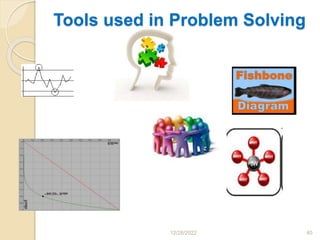
Tools used in Problem Solving
12/28/2022 40
Cont..
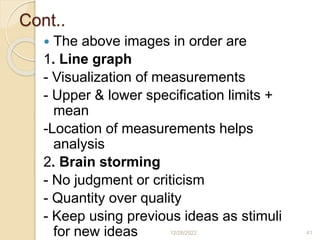
 The above images in order are
1. Line graph
- Visualization of measurements
- Upper & lower specification limits +
mean
-Location of measurements helps
analysis
2. Brain storming
- No judgment or criticism
- Quantity over quality
- Keep using previous ideas as stimuli
for new ideas 12/28/2022 41
ROOT CAUSE ANALYSIS
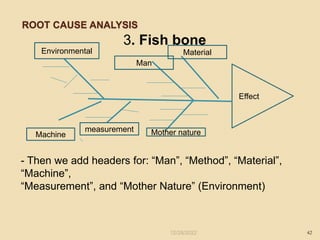
- Then we add headers for: “Man”, “Method”, “Material”,
“Machine”,
“Measurement”, and “Mother Nature” (Environment)
3. Fish bone
12/28/2022 42
Effect
Environmental
Man
measurement Mother nature
Material
Machine
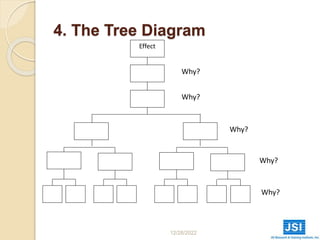
4. The Tree Diagram
12/28/2022 43
Effect
Why?
Why?
Why?
Why?
Why?
Why?
12/28/2022 44
Session –Two
Setting objectives
LO2.Grasp current status and set
goal:-
. Defining extent of problem
. Setting appropriate and achievable goal
12/28/2022 45
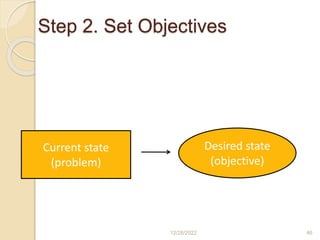
Step 2. Set Objectives
12/28/2022 46
Current state
(problem)
Desired state
(objective)
Cont..
 Once the problem has been clearly defined, the
problem statement can be translated into an
overall objective, or main goal.
 This is the goal that your team will focus all of
your efforts on, so it is important that it is clearly
defined.
 Good overall objectives
◦ Address the problem statement
◦ SMART
12/28/2022 47
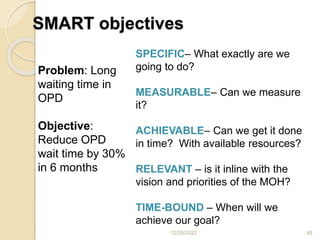
SMART objectives
12/28/2022 48
SPECIFIC– What exactly are we
going to do?
MEASURABLE– Can we measure
it?
ACHIEVABLE– Can we get it done
in time? With available resources?
RELEVANT – is it inline with the
vision and priorities of the MOH?
TIME-BOUND – When will we
achieve our goal?
Problem: Long
waiting time in
OPD
Objective:
Reduce OPD
wait time by 30%
in 6 months
Cont…
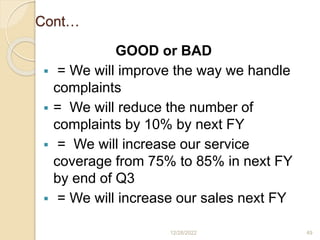
GOOD or BAD
 = We will improve the way we handle
complaints
 = We will reduce the number of
complaints by 10% by next FY
 = We will increase our service
coverage from 75% to 85% in next FY
by end of Q3
 = We will increase our sales next FY
12/28/2022 49
Exercise 2 – Objective Statement (30
minutes)
1. Review background information and
problem statements
2. Propose a SMART Objective
12/28/2022 50
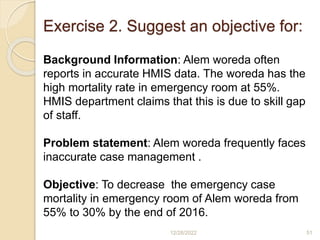
Exercise 2. Suggest an objective for:
12/28/2022 51
Background Information: Alem woreda often
reports in accurate HMIS data. The woreda has the
high mortality rate in emergency room at 55%.
HMIS department claims that this is due to skill gap
of staff.
Problem statement: Alem woreda frequently faces
inaccurate case management .
Objective: To decrease the emergency case
mortality in emergency room of Alem woreda from
55% to 30% by the end of 2016.
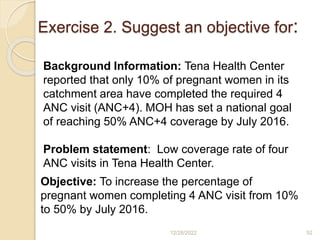
Exercise 2. Suggest an objective for:
12/28/2022 52
Background Information: Tena Health Center
reported that only 10% of pregnant women in its
catchment area have completed the required 4
ANC visit (ANC+4). MOH has set a national goal
of reaching 50% ANC+4 coverage by July 2016.
Problem statement: Low coverage rate of four
ANC visits in Tena Health Center.
Objective: To increase the percentage of
pregnant women completing 4 ANC visit from 10%
to 50% by July 2016.
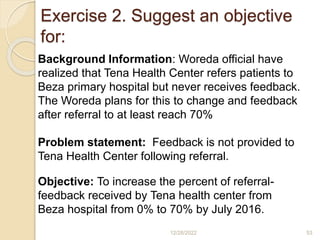
Exercise 2. Suggest an objective
for:
12/28/2022 53
Background Information: Woreda official have
realized that Tena Health Center refers patients to
Beza primary hospital but never receives feedback.
The Woreda plans for this to change and feedback
after referral to at least reach 70%
Problem statement: Feedback is not provided to
Tena Health Center following referral.
Objective: To increase the percent of referral-
feedback received by Tena health center from
Beza hospital from 0% to 70% by July 2016.
Session=THREE
Analyze causes of a problem
Objectives of the session :-
 Listing all possible causes of problem
 Analyzing cause relationships using4M1E
 Identifying causes of the problems
 Selecting root causes
 Listing all possible ways using creative
idea generation
 Testing and evaluating suggested
solutions
 Preparing detail summaries of the action
12/28/2022 54
Determine Root Cause
Why Root Cause Analysis?
 To solve problems on structural basis
 To ensure problems do not return
 To ensure sustainable improvements
12/28/2022 55
Step 3: Root Cause Analysis
12/28/2022 56
It is a step by step process that:
• answers the question, “why is this problem
happening?”
• finds the true origin of the problem
It is important to ensure we:
• solve the problem permanently
– treat more than just the symptoms of the
problem
What is a root cause analysis and why should
we conduct one?
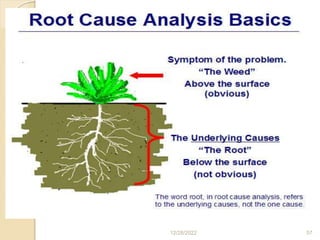
r
12/28/2022 57
Steps for successful RCA
1. Assemble a knowledgeable team
2. Start with a descriptive statement of the
incident/near miss
3. Use Root Cause Analysis techniques
4. Determine what conditions, events,
and/or factors might have caused the
incident
5.Prevent skipping levels or jumping to
conclusions
12/28/2022 58
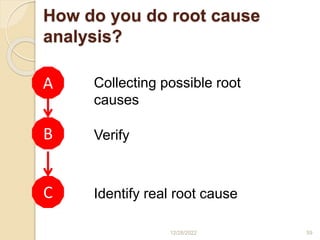
How do you do root cause
analysis?
12/28/2022 59
Collecting possible root
causes
A
Verify
B
Identify real root cause
C
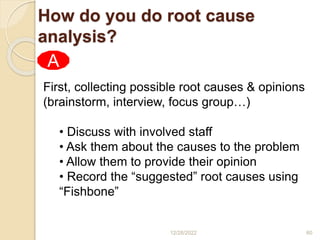
First, collecting possible root causes & opinions
(brainstorm, interview, focus group…)
• Discuss with involved staff
• Ask them about the causes to the problem
• Allow them to provide their opinion
• Record the “suggested” root causes using
“Fishbone”
A
How do you do root cause
analysis?
12/28/2022 60
Root……
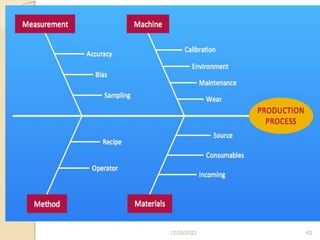
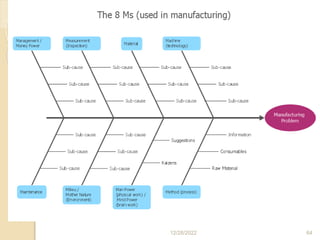
 Several tools could be used in the process
of root cause analysis, such as " 5 Ms &
E" the abbreviation stands for "Manpower,
Machine, Measurement, Material,
Methods and Environment“
 it is a technique where you ask questions
about the 5Ms & E till you find the root
cause of the problem
12/28/2022 61
12/28/2022 62
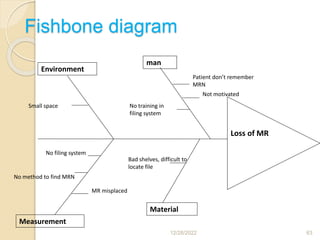
Environment
Measurement
Material
Not motivated
Small space
MR misplaced
No filing system
Loss of MR
man
Patient don’t remember
MRN
No training in
filing system
No method to find MRN
Bad shelves, difficult to
locate file
Fishbone diagram
12/28/2022 63
12/28/2022 64
12/28/2022 65
How do you do root cause analysis?
12/28/2022 66
-Next, verify each “suggested” root cause.
-Collecting evidence using different tools
Verify and prioritize
-This verification step is the most analytical
part of the root cause analysis. Which tools
should you use?
-A robust root cause analysis usually requires
the use of a few tools together.
B
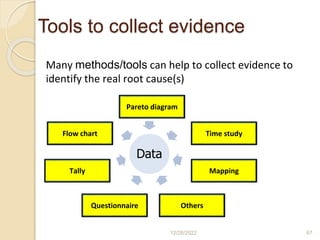
Tools to collect evidence
12/28/2022 67
Flow chart
Pareto diagram
Mapping
Time study
Questionnaire
Tally
Others
Many methods/tools can help to collect evidence to
identify the real root cause(s)
Data
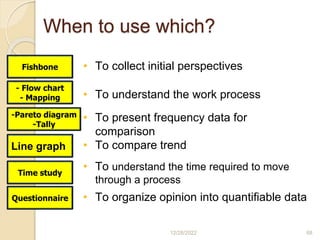
When to use which?
12/28/2022 68
• To collect initial perspectives
Fishbone
- Flow chart
- Mapping
-Pareto diagram
-Tally
Line graph
Time study
Questionnaire
• To understand the work process
• To present frequency data for
comparison
• To compare trend
• To understand the time required to move
through a process
• To organize opinion into quantifiable data
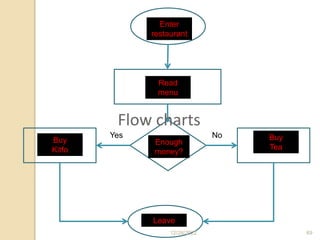
Begins
Process
Decision
Process Process
End
Yes No
Enter
restaurant
Read
menu
Enough
money?
Buy
Kitfo
Leave
Buy
Tea
12/28/2022 69
Flow charts
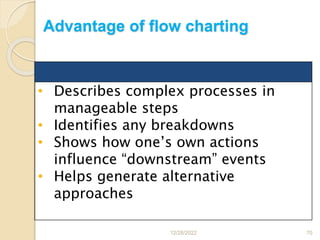
Advantage of flow charting
12/28/2022 70
• Describes complex processes in
manageable steps
• Identifies any breakdowns
• Shows how one’s own actions
influence “downstream” events
• Helps generate alternative
approaches
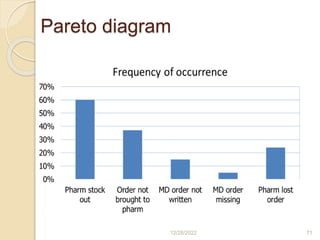
Pareto diagram
12/28/2022 71
Advantage of Pareto Diagram
12/28/2022 72
• Quantifies information
• Provides data so you can prioritize
 focus on biggest issues first
• Useful tool for showing progress
Advantage of mapping
12/28/2022 73
• Describe complex spatial
relationship in clear visual
manner
Time Study
Measure times of a process
Eg. Time study can be used to study waiting
time & process time of a given event
• Wait time
From time the patient arrived to the time
service was provided
• Process time
Time used to provide the service
12/28/2022 74
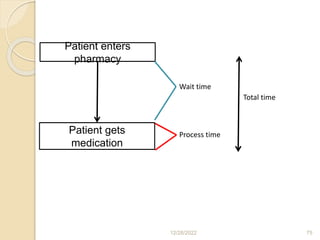
Patient enters
pharmacy
Patient gets
medication
Wait time
Process time
Total time
12/28/2022 75
Advantage of time study
12/28/2022 76
Value
• Provide quantified data
• Extremely useful in problems
related to “time”
• Useful tool for showing progress
Advantage Tally sheet
12/28/2022 77
• Quantifies information
• An easy, simple form used to “count”
occurrence
in real time for simple situations
Questionnaires
12/28/2022 78
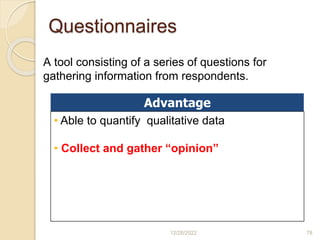
A tool consisting of a series of questions for
gathering information from respondents.
Advantage
• Able to quantify qualitative data
• Collect and gather “opinion”
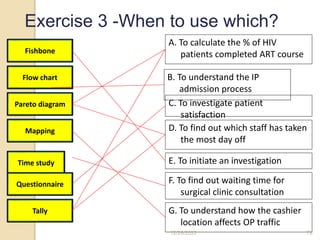
D. To find out which staff has taken
the most day off
Fishbone
Flow chart
Pareto diagram
Mapping
Time study
Questionnaire
Tally
B. To understand the IP
admission process
E. To initiate an investigation
G. To understand how the cashier
location affects OP traffic
F. To find out waiting time for
surgical clinic consultation
C. To investigate patient
satisfaction
A. To calculate the % of HIV
patients completed ART course
Exercise 3 -When to use which?
12/28/2022 79
Session -4.
Establish activity plan
Objectives of the session :-
 Develop different alternative interventions
 Compare each strategy standard .
 Select your best intervention
12/28/2022 80
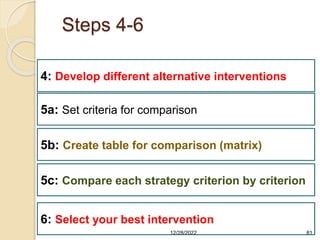
Steps 4-6
12/28/2022 81
4: Develop different alternative interventions
5a: Set criteria for comparison
5b: Create table for comparison (matrix)
5c: Compare each strategy criterion by criterion
6: Select your best intervention
List ALL the possible solutions you might
use to address the root cause(s)
Good interventions:
 Address the most important and feasible
root causes
 Use existing resources if possible
 Have some degree of flexibility
 Think about possible unintended
consequences
12/28/2022 82
4: Develop different alternative
interventions
- Avoid the temptation to do
everything
12/28/2022 83
The common criteria's are
Effectiveness (Impact): What is the probability
that it will work?
Time to effect: How long will it take to work?
Feasibility: Is there capacity and stakeholder
support?
Annual Cost: How expensive is it to carry out?
12/28/2022 84
5a: Set criteria for comparison
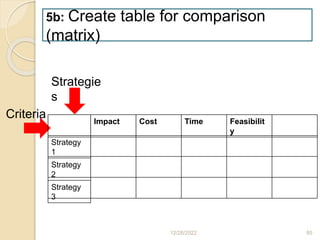
5b: Create table for comparison
(matrix)
Strategie
s
Criteria Impact Cost Time Feasibilit
y
Strategy
1
Strategy
2
Strategy
3
12/28/2022 85
12/28/2022 86
5c: Compare each strategy criterion
by criterion
Evaluate with qualitative and quantitative
data
Listen to reason and intuition
Impact Cost Time Feasibilit
y
Strategy
1
Strategy
2
Strategy
3
5- most ideal; 1 – least ideal
12/28/2022 87
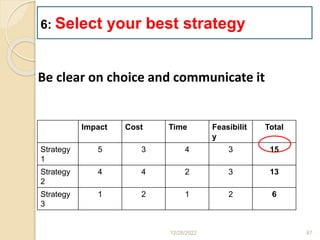
6: Select your best strategy
Impact Cost Time Feasibilit
y
Total
Strategy
1
5 3 4 3 15
Strategy
2
4 4 2 3 13
Strategy
3
1 2 1 2 6
Be clear on choice and communicate it
Short comings of decision matrix
 Estimates are not precise typically,
so judgment is required.
 The matrix gives guidance only.
 There is always uncertainty.
12/28/2022 88
Example
Problem: Toilets are always dirty
Objective: Ensure all toilets are always clean in the
coming 6 month.
Root cause: toilets are cleaned only 3 times a day and is
not sufficient for the high patient volume usage
Alternative Interventions
1. Increase # of cleaning staff
2. Increase frequency of cleaning
3. Lock toilet and supervisor keeps the key
4. Adjust frequency of cleaning according to
patient volume
5. Supervisor station in toilet to supervise usage
12/28/2022 89
Key Summary
 Create good interventions that address the most
important and feasible root causes
 Set clear criteria that are important to
implementation
 Create matrix to compare criteria by criteria
 Compare objectively as well as using common
sense
 Select and communicate the best strategy to
stakeholders 12/28/2022 90
Session .5.
Develop implementation plan and
implement
Objectives
 Implementing action plan
 Monitoring Implementation and
checking activities
12/28/2022 91
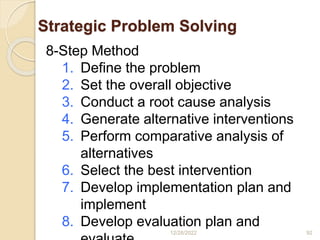
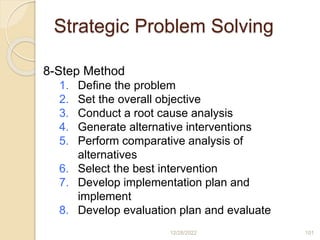
Strategic Problem Solving
12/28/2022 92
8-Step Method
1. Define the problem
2. Set the overall objective
3. Conduct a root cause analysis
4. Generate alternative interventions
5. Perform comparative analysis of
alternatives
6. Select the best intervention
7. Develop implementation plan and
implement
8. Develop evaluation plan and
Implementation Plan
 Why do we need an implementation
plan?
 What should be included in the plan?
 How do you communicate the plan to
other people?
 What if other people do not want to
engage (resist your proposed change)?
12/28/2022 93
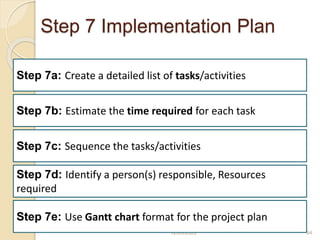
Step 7 Implementation Plan
12/28/2022 94
Step 7a: Create a detailed list of tasks/activities
Step 7b: Estimate the time required for each task
Step 7c: Sequence the tasks/activities
Step 7d: Identify a person(s) responsible, Resources
required
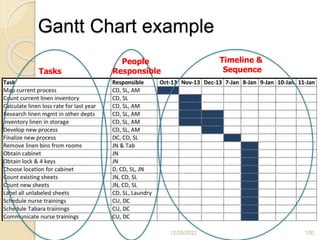
Step 7e: Use Gantt chart format for the project plan
Step 7 Implementation Plan
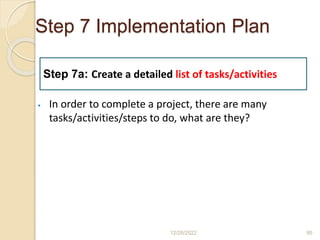
12/28/2022 95
 In order to complete a project, there are many
tasks/activities/steps to do, what are they?
Step 7a: Create a detailed list of tasks/activities
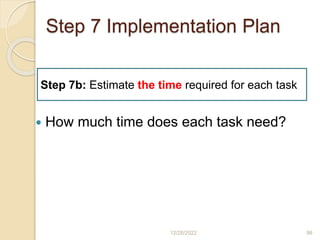
Step 7 Implementation Plan
 How much time does each task need?
12/28/2022 96
Step 7b: Estimate the time required for each task
Step 7 Implementation Plan
 Why is sequencing important?
◦ Some tasks need to be done before others can happen
12/28/2022 97
Step 7c: Sequence the tasks/activities
Step 7 Implementation Plan
 Who is the person responsible to do the
task
 Match the tasks and skills and
convenience
 Identify resource requirements
(materials, people budget)
12/28/2022 98
Step 7d: Identify a person(s) responsible,
resources required
Step 7 Implementation Plan
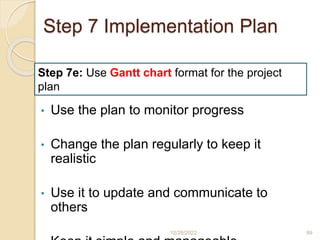
• Use the plan to monitor progress
• Change the plan regularly to keep it
realistic
• Use it to update and communicate to
others
12/28/2022 99
Step 7e: Use Gantt chart format for the project
plan
Gantt Chart example
12/28/2022 100
Tasks
People
Responsible
Timeline &
Sequence
Strategic Problem Solving
12/28/2022 101
8-Step Method
1. Define the problem
2. Set the overall objective
3. Conduct a root cause analysis
4. Generate alternative interventions
5. Perform comparative analysis of
alternatives
6. Select the best intervention
7. Develop implementation plan and
implement
8. Develop evaluation plan and evaluate
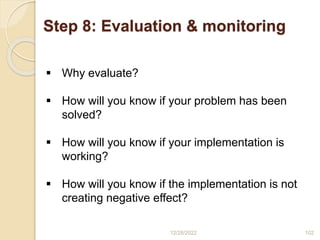
Step 8: Evaluation & monitoring
12/28/2022 102
 Why evaluate?
 How will you know if your problem has been
solved?
 How will you know if your implementation is
working?
 How will you know if the implementation is not
creating negative effect?
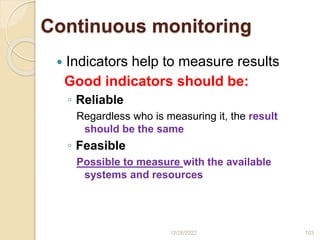
Continuous monitoring
 Indicators help to measure results
Good indicators should be:
◦ Reliable
Regardless who is measuring it, the result
should be the same
◦ Feasible
Possible to measure with the available
systems and resources
12/28/2022 103
Are these indicators appropriate?
12/28/2022 104
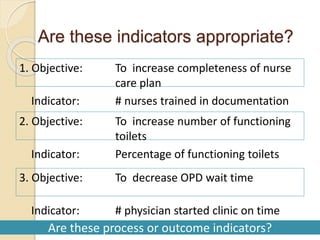
1. Objective: To increase completeness of nurse
care plan
Indicator: # nurses trained in documentation
2. Objective: To increase number of functioning
toilets
Indicator: Percentage of functioning toilets
3. Objective: To decrease OPD wait time
Indicator: # physician started clinic on time
Are these process or outcome indicators?
Example
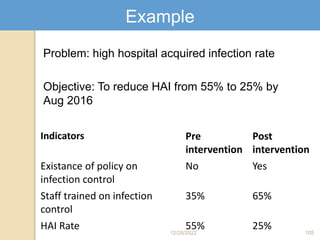
Problem: high hospital acquired infection rate
Objective: To reduce HAI from 55% to 25% by
Aug 2016
Indicators Pre
intervention
Post
intervention
Existance of policy on
infection control
No Yes
Staff trained on infection
control
35% 65%
HAI Rate 55% 25%
12/28/2022 105
12/28/2022 106
12/28/2022 107
12/28/2022 108
12/28/2022 109
12/28/2022 110
12/28/2022 111
12/28/2022 112
12/28/2022 113
12/28/2022 114
Thank You!
12/28/2022
115

aps ppt.pptx

  • 1.
    12/28/2022 1 Applying Problem Solving Techniquesand Tools for HEW students By kidist A. (BSc, MPH)
  • 2.
    Learning outcomes  Identifyand select theme/problem  Grasp current status and set goal  Establish activity plan  Analyze causes of a problem  Examine countermeasures and their implementation  Assess effectiveness of the solution  Standardize and sustain operation 12/28/2022 2
  • 3.
    Introduction cont …. Whatis problem ?  Anything that deviates from the standard or target.  A gap between actual and desired conditions . 12/28/2022 3 Desire /ideal situation Current Gap =problem
  • 4.
    Introduction cont … 12/28/20224 What is Problem Solving  Problem solving is a process to identify a challenge or barrier to high quality care and implement and evaluate measurable solutions to the identified problem.  It is a systematic way to break down complex issues into tangible solutions.
  • 5.
    Problem solving …. Problem solving is the act of ◦ defining a problem; ◦ determining the cause of the problem; ◦ identifying, prioritizing, and selecting alternatives for a solution; and ◦ implementing a solution. 12/28/2022 5
  • 6.
  • 7.
    Define problem  Differentiatefact from opinion  Specify underlying causes  Consult each faction involved for information  State the problem specifically  Identify what standard or expectation is violated  Determine in which process the problem lies  Avoid trying to solve the problem without 12/28/2022 7
  • 8.
    Generate alternative solutions Postpone evaluating alternatives initially  Include all involved individuals in the generating of alternatives  Specify alternatives consistent with organizational goals  Specify short- and long-term alternatives  Brainstorm on others' ideas  Seek alternatives that may solve the problem 12/28/2022 8
  • 9.
    Evaluate and selectan alternative  Evaluate alternatives relative to a target standard  Evaluate all alternatives without bias  Evaluate alternatives relative to established goals  Evaluate both proven and possible outcomes  State the selected alternative explicitly 12/28/2022 9
  • 10.
    Implement and followup on the solution  Plan and implement a pilot test of the chosen alternative  Gather feedback from all affected parties  Seek acceptance or consensus by all those affected  Establish ongoing measures and monitoring  Evaluate long-term results based on 12/28/2022 10
  • 11.
    Benefits of StructuredProblem Solving process Remove time lost in debate Identify weak points in processes Discover systemic causes Explain with reasons why an incident occurred Gives a real representation of the incident Compare what actually happened against what should have happened, at any point during the incident. 12/28/2022 11
  • 12.
    Importance of problemselection Many problems happen everyday in working place All problems cannot be solved at once Identification, prioritization and focus is necessary Resources are limited 12/28/2022 12
  • 13.
  • 14.
  • 15.
  • 16.
  • 17.
  • 18.
  • 19.
  • 20.
  • 21.
    How to solveproblems? -The Problem Solving process is based upon PDCA CYCLE - Plan, Do, Check & Act Where to Identify the Problem ?  Problems you are facing in your workplace  Things you want to improve to make your work effective and efficient  Issues raised or claimed from your internal and external client 12/28/2022 21
  • 22.
    Who should selecttheme? Who knows what is happening on the ground?  The staff working in the section. Process for theme selection. 1.Staff meet to brainstorm about problems in their current working place (Clarify problem statement) ◦Issues and problems in their working environment ◦Complicated work processes/procedures ◦Clams from internal and external clients ◦ Accident, errors often happening 12/28/2022 22
  • 23.
    Process for themeselection conti….. 2. List up all raised issues and problems Note : - Do not seek contributing factors and causes of the problems - Do not blame and deny others’ opinions 3. Categorize listed issues and problems into two categories; 1) Possible to solve immediately 2) Impossible to solve immediately 12/28/2022 23
  • 24.
    Process for themeselection cont… 4. Action should be taken immediately for the issues Possible to solve immediately 5. Check feasibility of all the problems for those which are Impossible to be solved immediately  Possible themes need to be checked its feasibility by impact, urgency, possibility, resource availability. 12/28/2022 24
  • 25.
    Process for themeselection cont… Impact What is the impact, when it is implemented? Is it possible to get impact with little inputs? Urgency Do we have to do it immediately? Possibility Is it possible to complete whole process within 6 months? Is it possible to carry out this process within your department? 12/28/2022 25
  • 26.
    Process for themeselection cont…  Resources Possible to implement with existing resource? Require involvement of many sections? Is data and information available for situation analysis?  If not available, is it possible to collect? Who and how many staff are going be involved? 12/28/2022 26
  • 27.
  • 28.
    Case 1: Overcrowding-Surgeryward • Surgical Ward of Y hospital has 87 beds. Staff complain to management that there is overcrowding and that the 87 beds are always occupied which forces them to use beds from other wards. • After receiving the complaint, hospital management immediately decided to get more beds for the surgical ward. What would you do? 12/28/2022 28
  • 29.
    Case 2: LongWaiting Time • X health Center received complaint from the community that there is long waiting time at OPD. • Health center management conducted a meeting to review complaints and decided to write a letter to the Woreda requesting financial support to build two additional consultation rooms to alleviate the problem of long waiting time. What would you do? 12/28/2022 29
  • 30.
    What Is ProblemSolving? 12/28/2022 30 Current State (Problem) Future State (Vision/Objective) STRATEGY
  • 31.
    Problem statement  Aproblem statement is a statement of a current issue or problem that requires timely action to improve the situation.  A problem statement is a concise description of the issues that needs to be addressed Good problem statement should: 1. Focus on a single problem 2. Do not state the cause or the solution; focus on the problem 3. Be brief 4. Address problems that are feasibly solved 5. Ensure the problem is shared widely by key 12/28/2022 31
  • 32.
    Examples of goodproblem statements • There is a high rate of neonatal mortality at the health center. • Medical records cannot be located in the health center. • The waiting time for outpatient clinic is long. • There is no ambulance service in the Woreda. 12/28/2022 32
  • 33.
    Exercise 1 problemstatement 12/28/2022 33 “Lack of budget support from the woreda to maintain water supply in the emergency room” Single problem No cause/solution Brief Feasible to solve Agreed by others Suggestion: “emergency room does not have water supply”
  • 34.
    Exercise 2 problem statement 12/28/202234 “Our budgets are too small and we run out of HIV test kits in the middle of the year, and our health officer has left, along with 3 other workers, and clients are not very happy with our service” Single problem No cause/solution Brief Feasible to solve Agreed by others Suggestion: correction 1. We have a poor supply chain for HIV test kits. 2. Staff turnover is too high. 3. Clients are dissatisfied with our services.
  • 35.
    Exercise 3 problemstatement 12/28/2022 35 “Our referral system is vertical. We receive from the health centre (referral in) and refer out to secondary hospital if beyond our hospital capacity. So the weakness is our hospital is not giving the feedback to the referred facility and not receiving /collecting /feedback from the referred hospital.” Single problem No cause/solution Brief Feasible to solve Agreed by others Suggestion: “Feedback documentations are not provided to referring facility”
  • 36.
    Exercise 4 problemstatement 12/28/2022 36 “HEWs are not motivated to work. We need to increase supervision to improve the number of graduating model households in the woreda” Single problem No cause/solution Brief Feasible to solve Agreed by others Suggestion: the correct “Low number of model households graduating by HEWs”
  • 37.
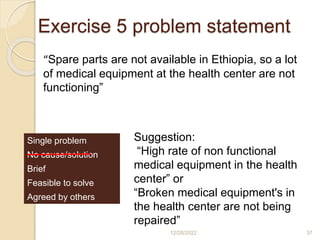
    Exercise 5 problemstatement 12/28/2022 37 “Spare parts are not available in Ethiopia, so a lot of medical equipment at the health center are not functioning” Single problem No cause/solution Brief Feasible to solve Agreed by others Suggestion: “High rate of non functional medical equipment in the health center” or “Broken medical equipment's in the health center are not being repaired”
  • 38.
    Magnitude of theproblem Why we need to measure the magnitude? 1. To know if the problem is really a problem 2. To have baseline measure to set objective 12/28/2022 38
  • 39.
    Measuring Magnitude • Thereis a high rate of neonatal mortality at the health center.  What is the neonatal mortality rate? • Medical records cannot be located in the health center  Percent of medical records not located? • The waiting time for outpatient clinic is long  What is the waiting time at the outpatient clinic? • There is low ANC coverage in the woreda 12/28/2022 39
  • 40.
    Tools used inProblem Solving 12/28/2022 40
  • 41.
    Cont..  The aboveimages in order are 1. Line graph - Visualization of measurements - Upper & lower specification limits + mean -Location of measurements helps analysis 2. Brain storming - No judgment or criticism - Quantity over quality - Keep using previous ideas as stimuli for new ideas 12/28/2022 41
  • 42.
    ROOT CAUSE ANALYSIS -Then we add headers for: “Man”, “Method”, “Material”, “Machine”, “Measurement”, and “Mother Nature” (Environment) 3. Fish bone 12/28/2022 42 Effect Environmental Man measurement Mother nature Material Machine
  • 43.
    4. The TreeDiagram 12/28/2022 43 Effect Why? Why? Why? Why? Why? Why?
  • 44.
  • 45.
    Session –Two Setting objectives LO2.Graspcurrent status and set goal:- . Defining extent of problem . Setting appropriate and achievable goal 12/28/2022 45
  • 46.
    Step 2. SetObjectives 12/28/2022 46 Current state (problem) Desired state (objective)
  • 47.
    Cont..  Once theproblem has been clearly defined, the problem statement can be translated into an overall objective, or main goal.  This is the goal that your team will focus all of your efforts on, so it is important that it is clearly defined.  Good overall objectives ◦ Address the problem statement ◦ SMART 12/28/2022 47
  • 48.
    SMART objectives 12/28/2022 48 SPECIFIC–What exactly are we going to do? MEASURABLE– Can we measure it? ACHIEVABLE– Can we get it done in time? With available resources? RELEVANT – is it inline with the vision and priorities of the MOH? TIME-BOUND – When will we achieve our goal? Problem: Long waiting time in OPD Objective: Reduce OPD wait time by 30% in 6 months
  • 49.
    Cont… GOOD or BAD = We will improve the way we handle complaints  = We will reduce the number of complaints by 10% by next FY  = We will increase our service coverage from 75% to 85% in next FY by end of Q3  = We will increase our sales next FY 12/28/2022 49
  • 50.
    Exercise 2 –Objective Statement (30 minutes) 1. Review background information and problem statements 2. Propose a SMART Objective 12/28/2022 50
  • 51.
    Exercise 2. Suggestan objective for: 12/28/2022 51 Background Information: Alem woreda often reports in accurate HMIS data. The woreda has the high mortality rate in emergency room at 55%. HMIS department claims that this is due to skill gap of staff. Problem statement: Alem woreda frequently faces inaccurate case management . Objective: To decrease the emergency case mortality in emergency room of Alem woreda from 55% to 30% by the end of 2016.
  • 52.
    Exercise 2. Suggestan objective for: 12/28/2022 52 Background Information: Tena Health Center reported that only 10% of pregnant women in its catchment area have completed the required 4 ANC visit (ANC+4). MOH has set a national goal of reaching 50% ANC+4 coverage by July 2016. Problem statement: Low coverage rate of four ANC visits in Tena Health Center. Objective: To increase the percentage of pregnant women completing 4 ANC visit from 10% to 50% by July 2016.
  • 53.
    Exercise 2. Suggestan objective for: 12/28/2022 53 Background Information: Woreda official have realized that Tena Health Center refers patients to Beza primary hospital but never receives feedback. The Woreda plans for this to change and feedback after referral to at least reach 70% Problem statement: Feedback is not provided to Tena Health Center following referral. Objective: To increase the percent of referral- feedback received by Tena health center from Beza hospital from 0% to 70% by July 2016.
  • 54.
    Session=THREE Analyze causes ofa problem Objectives of the session :-  Listing all possible causes of problem  Analyzing cause relationships using4M1E  Identifying causes of the problems  Selecting root causes  Listing all possible ways using creative idea generation  Testing and evaluating suggested solutions  Preparing detail summaries of the action 12/28/2022 54
  • 55.
    Determine Root Cause WhyRoot Cause Analysis?  To solve problems on structural basis  To ensure problems do not return  To ensure sustainable improvements 12/28/2022 55
  • 56.
    Step 3: RootCause Analysis 12/28/2022 56 It is a step by step process that: • answers the question, “why is this problem happening?” • finds the true origin of the problem It is important to ensure we: • solve the problem permanently – treat more than just the symptoms of the problem What is a root cause analysis and why should we conduct one?
  • 57.
  • 58.
    Steps for successfulRCA 1. Assemble a knowledgeable team 2. Start with a descriptive statement of the incident/near miss 3. Use Root Cause Analysis techniques 4. Determine what conditions, events, and/or factors might have caused the incident 5.Prevent skipping levels or jumping to conclusions 12/28/2022 58
  • 59.
    How do youdo root cause analysis? 12/28/2022 59 Collecting possible root causes A Verify B Identify real root cause C
  • 60.
    First, collecting possibleroot causes & opinions (brainstorm, interview, focus group…) • Discuss with involved staff • Ask them about the causes to the problem • Allow them to provide their opinion • Record the “suggested” root causes using “Fishbone” A How do you do root cause analysis? 12/28/2022 60
  • 61.
    Root……  Several toolscould be used in the process of root cause analysis, such as " 5 Ms & E" the abbreviation stands for "Manpower, Machine, Measurement, Material, Methods and Environment“  it is a technique where you ask questions about the 5Ms & E till you find the root cause of the problem 12/28/2022 61
  • 62.
  • 63.
    Environment Measurement Material Not motivated Small space MRmisplaced No filing system Loss of MR man Patient don’t remember MRN No training in filing system No method to find MRN Bad shelves, difficult to locate file Fishbone diagram 12/28/2022 63
  • 64.
  • 65.
  • 66.
    How do youdo root cause analysis? 12/28/2022 66 -Next, verify each “suggested” root cause. -Collecting evidence using different tools Verify and prioritize -This verification step is the most analytical part of the root cause analysis. Which tools should you use? -A robust root cause analysis usually requires the use of a few tools together. B
  • 67.
    Tools to collectevidence 12/28/2022 67 Flow chart Pareto diagram Mapping Time study Questionnaire Tally Others Many methods/tools can help to collect evidence to identify the real root cause(s) Data
  • 68.
    When to usewhich? 12/28/2022 68 • To collect initial perspectives Fishbone - Flow chart - Mapping -Pareto diagram -Tally Line graph Time study Questionnaire • To understand the work process • To present frequency data for comparison • To compare trend • To understand the time required to move through a process • To organize opinion into quantifiable data
  • 69.
  • 70.
    Advantage of flowcharting 12/28/2022 70 • Describes complex processes in manageable steps • Identifies any breakdowns • Shows how one’s own actions influence “downstream” events • Helps generate alternative approaches
  • 71.
  • 72.
    Advantage of ParetoDiagram 12/28/2022 72 • Quantifies information • Provides data so you can prioritize  focus on biggest issues first • Useful tool for showing progress
  • 73.
    Advantage of mapping 12/28/202273 • Describe complex spatial relationship in clear visual manner
  • 74.
    Time Study Measure timesof a process Eg. Time study can be used to study waiting time & process time of a given event • Wait time From time the patient arrived to the time service was provided • Process time Time used to provide the service 12/28/2022 74
  • 75.
    Patient enters pharmacy Patient gets medication Waittime Process time Total time 12/28/2022 75
  • 76.
    Advantage of timestudy 12/28/2022 76 Value • Provide quantified data • Extremely useful in problems related to “time” • Useful tool for showing progress
  • 77.
    Advantage Tally sheet 12/28/202277 • Quantifies information • An easy, simple form used to “count” occurrence in real time for simple situations
  • 78.
    Questionnaires 12/28/2022 78 A toolconsisting of a series of questions for gathering information from respondents. Advantage • Able to quantify qualitative data • Collect and gather “opinion”
  • 79.
    D. To findout which staff has taken the most day off Fishbone Flow chart Pareto diagram Mapping Time study Questionnaire Tally B. To understand the IP admission process E. To initiate an investigation G. To understand how the cashier location affects OP traffic F. To find out waiting time for surgical clinic consultation C. To investigate patient satisfaction A. To calculate the % of HIV patients completed ART course Exercise 3 -When to use which? 12/28/2022 79
  • 80.
    Session -4. Establish activityplan Objectives of the session :-  Develop different alternative interventions  Compare each strategy standard .  Select your best intervention 12/28/2022 80
  • 81.
    Steps 4-6 12/28/2022 81 4:Develop different alternative interventions 5a: Set criteria for comparison 5b: Create table for comparison (matrix) 5c: Compare each strategy criterion by criterion 6: Select your best intervention
  • 82.
    List ALL thepossible solutions you might use to address the root cause(s) Good interventions:  Address the most important and feasible root causes  Use existing resources if possible  Have some degree of flexibility  Think about possible unintended consequences 12/28/2022 82 4: Develop different alternative interventions
  • 83.
    - Avoid thetemptation to do everything 12/28/2022 83
  • 84.
    The common criteria'sare Effectiveness (Impact): What is the probability that it will work? Time to effect: How long will it take to work? Feasibility: Is there capacity and stakeholder support? Annual Cost: How expensive is it to carry out? 12/28/2022 84 5a: Set criteria for comparison
  • 85.
    5b: Create tablefor comparison (matrix) Strategie s Criteria Impact Cost Time Feasibilit y Strategy 1 Strategy 2 Strategy 3 12/28/2022 85
  • 86.
    12/28/2022 86 5c: Compareeach strategy criterion by criterion Evaluate with qualitative and quantitative data Listen to reason and intuition Impact Cost Time Feasibilit y Strategy 1 Strategy 2 Strategy 3 5- most ideal; 1 – least ideal
  • 87.
    12/28/2022 87 6: Selectyour best strategy Impact Cost Time Feasibilit y Total Strategy 1 5 3 4 3 15 Strategy 2 4 4 2 3 13 Strategy 3 1 2 1 2 6 Be clear on choice and communicate it
  • 88.
    Short comings ofdecision matrix  Estimates are not precise typically, so judgment is required.  The matrix gives guidance only.  There is always uncertainty. 12/28/2022 88
  • 89.
    Example Problem: Toilets arealways dirty Objective: Ensure all toilets are always clean in the coming 6 month. Root cause: toilets are cleaned only 3 times a day and is not sufficient for the high patient volume usage Alternative Interventions 1. Increase # of cleaning staff 2. Increase frequency of cleaning 3. Lock toilet and supervisor keeps the key 4. Adjust frequency of cleaning according to patient volume 5. Supervisor station in toilet to supervise usage 12/28/2022 89
  • 90.
    Key Summary  Creategood interventions that address the most important and feasible root causes  Set clear criteria that are important to implementation  Create matrix to compare criteria by criteria  Compare objectively as well as using common sense  Select and communicate the best strategy to stakeholders 12/28/2022 90
  • 91.
    Session .5. Develop implementationplan and implement Objectives  Implementing action plan  Monitoring Implementation and checking activities 12/28/2022 91
  • 92.
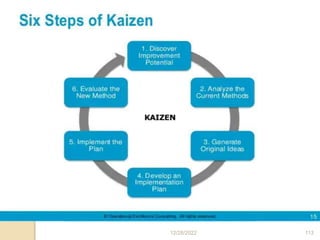
    Strategic Problem Solving 12/28/202292 8-Step Method 1. Define the problem 2. Set the overall objective 3. Conduct a root cause analysis 4. Generate alternative interventions 5. Perform comparative analysis of alternatives 6. Select the best intervention 7. Develop implementation plan and implement 8. Develop evaluation plan and
  • 93.
    Implementation Plan  Whydo we need an implementation plan?  What should be included in the plan?  How do you communicate the plan to other people?  What if other people do not want to engage (resist your proposed change)? 12/28/2022 93
  • 94.
    Step 7 ImplementationPlan 12/28/2022 94 Step 7a: Create a detailed list of tasks/activities Step 7b: Estimate the time required for each task Step 7c: Sequence the tasks/activities Step 7d: Identify a person(s) responsible, Resources required Step 7e: Use Gantt chart format for the project plan
  • 95.
    Step 7 ImplementationPlan 12/28/2022 95  In order to complete a project, there are many tasks/activities/steps to do, what are they? Step 7a: Create a detailed list of tasks/activities
  • 96.
    Step 7 ImplementationPlan  How much time does each task need? 12/28/2022 96 Step 7b: Estimate the time required for each task
  • 97.
    Step 7 ImplementationPlan  Why is sequencing important? ◦ Some tasks need to be done before others can happen 12/28/2022 97 Step 7c: Sequence the tasks/activities
  • 98.
    Step 7 ImplementationPlan  Who is the person responsible to do the task  Match the tasks and skills and convenience  Identify resource requirements (materials, people budget) 12/28/2022 98 Step 7d: Identify a person(s) responsible, resources required
  • 99.
    Step 7 ImplementationPlan • Use the plan to monitor progress • Change the plan regularly to keep it realistic • Use it to update and communicate to others 12/28/2022 99 Step 7e: Use Gantt chart format for the project plan
  • 100.
    Gantt Chart example 12/28/2022100 Tasks People Responsible Timeline & Sequence
  • 101.
    Strategic Problem Solving 12/28/2022101 8-Step Method 1. Define the problem 2. Set the overall objective 3. Conduct a root cause analysis 4. Generate alternative interventions 5. Perform comparative analysis of alternatives 6. Select the best intervention 7. Develop implementation plan and implement 8. Develop evaluation plan and evaluate
  • 102.
    Step 8: Evaluation& monitoring 12/28/2022 102  Why evaluate?  How will you know if your problem has been solved?  How will you know if your implementation is working?  How will you know if the implementation is not creating negative effect?
  • 103.
    Continuous monitoring  Indicatorshelp to measure results Good indicators should be: ◦ Reliable Regardless who is measuring it, the result should be the same ◦ Feasible Possible to measure with the available systems and resources 12/28/2022 103
  • 104.
    Are these indicatorsappropriate? 12/28/2022 104 1. Objective: To increase completeness of nurse care plan Indicator: # nurses trained in documentation 2. Objective: To increase number of functioning toilets Indicator: Percentage of functioning toilets 3. Objective: To decrease OPD wait time Indicator: # physician started clinic on time Are these process or outcome indicators?
  • 105.
    Example Problem: high hospitalacquired infection rate Objective: To reduce HAI from 55% to 25% by Aug 2016 Indicators Pre intervention Post intervention Existance of policy on infection control No Yes Staff trained on infection control 35% 65% HAI Rate 55% 25% 12/28/2022 105
  • 106.
  • 107.
  • 108.
  • 109.
  • 110.
  • 111.
  • 112.
  • 113.
  • 114.
  • 115.

Editor's Notes

  • #80  When is the use of each method most applicable? Fishbone Diagram is applicable for problems that are generally very complicated, and all the various root causes cannot be determined by one person. Flow Charting is more helpful in the case where there is a work process with many handoffs along the process Example: Ordering and attaining medication for a patient. This involves the physician ordering the medication, the order being taken to the pharmacy, the order being filled at the pharmacy, and the medication being brought back to the patient. It involves several staff members and several handoffs of responsibility.
  • #83 Address the most important and feasible root causes Take an ecological approach Use leverage already in the system to accomplish more with the existing resources (water flows downhill) Have some degree of flexibility and create safety nets for unintended consequences
  • #106 As a manager, you have a higher interest in process indicators than any other members of the staff.