Abebe Tolera (BSC, MPH in Epidemiology)
8/18/2022 1
 After completing this chapter, the student
should be able to:
Examine the cyclical nature of the development
of a research proposal
Describe the principles underlying whether a
problem situation is researchable.
List the criteria for selecting a research topic.
Identify and select his/her own topic (health
problem) for research based on certain
guidelines.
8/18/2022 2
 The development of a health project goes through a
number of stages.
 Before dealing the methodology issues consider:
 Prepared a brief description of the problem and its
importance
 Conducted a literature and information review to
determine what was already known about the problem
 Developed objectives which clearly state the purpose of
the study, what study results are expected, and how the
results will be used.
 Select a research topic
8/18/2022 3
 Formulation of the research proposal is the major
task in the process of developing a research project.
 The proposal draws on all the preparatory steps of
the research process
 It pulls them together in a document describing the
rationale and the methodology proposed for
research
8/18/2022 4
 The proposal is a basis for approval and funding.
 After approval, the proposal is used as a blueprint
during implementation of the project.
 It should be noted that development of a research
proposal is often a cyclical process.
 The process is not always linear.
 It is a usual practice to go up and down on the
developed proposal and make the necessary
revisions.
8/18/2022 5
 The following questions should be clearly
answered before trying to develop the research
proposal.
 Is there evidence to indicate that the research proposal
focuses on a problem of priority importance?
 Was the given health problem identified by relevant
groups of the health system?
 Was the problem adequately analyzed to include all
possible contributory factors from different sectors?
 Was it clearly stated?
8/18/2022 6
 A successful research project starts with a
good topic
 But how can you decide to pick good topic?
 The first thing is read your topics carefully.
 Thus, taking stance and supporting it with high
quality evidence.
8/18/2022 7
 Choosing a good research topic has two main
steps:
 Step 1: select a broad topic of interest
 Step 2: narrow it down to an effective research
topic once you have learnt a little more.
8/18/2022 8
Whether a problem situation requires
research depends on three conditions:
 There should be a perceived difference or discrepancy
between what exists and the ideal or planned situation
 The reason(s) for this difference should be unclear (so
that it makes sense to develop a research question); and
 There should be more than one possible answer to the
question or solution to the problem
8/18/2022 9
 Criteria for prioritizing problems for research/ topic
selection
 Each problem that is proposed for research has to be judged
according to certain guidelines or criteria.
 There may be several ideas to choose from.
 The selection and analysis of the problem for research should
involve those who are responsible for the health status of the
community.
 This would include managers in the health services, health-
care workers, and community leaders, as well as researchers.
8/18/2022 10
1) Relevance: How large or widespread is
the problem?
o Who is affected? How severe is the problem?
How widespread is the problem?
2) Avoidance of duplication needed
o Investigate whether the topic has been
researched.
3) Feasibility: complexity of the problem and the
resources required to carry out the study.
4) Political acceptability
8/18/2022 11
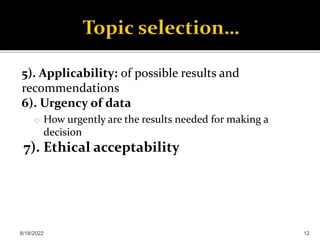
5). Applicability: of possible results and
recommendations
6). Urgency of data
o How urgently are the results needed for making a
decision
7). Ethical acceptability
8/18/2022 12
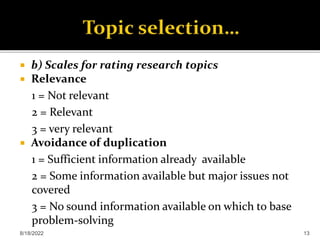
 b) Scales for rating research topics
 Relevance
1 = Not relevant
2 = Relevant
3 = very relevant
 Avoidance of duplication
1 = Sufficient information already available
2 = Some information available but major issues not
covered
3 = No sound information available on which to base
problem-solving
8/18/2022 13
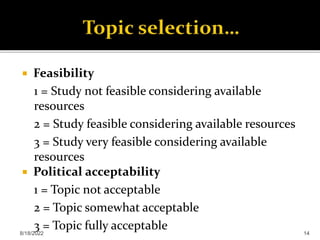
 Feasibility
1 = Study not feasible considering available
resources
2 = Study feasible considering available resources
3 = Study very feasible considering available
resources
 Political acceptability
1 = Topic not acceptable
2 = Topic somewhat acceptable
3 = Topic fully acceptable
8/18/2022 14
 Applicability
1 = No chance of recommendations being implemented
2 = Some chance of recommendations being
implemented
3 = Good chance of recommendations being
implemented
 Urgency
1 = Information not urgently needed
2 = Information could be used but a delay of some
months would be acceptable
3 = Data very urgently needed for decision-making
8/18/2022 15
 Ethical acceptability
1 = Major ethical problems
2 = Minor ethical problems
3 = No ethical problems
 N.B. The above rating should be based on the
existing data and not on mere assumptions.
8/18/2022 16
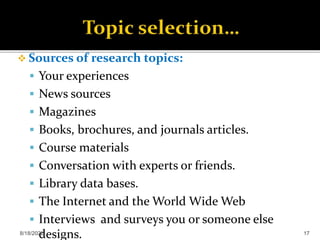
 Sources of research topics:
 Your experiences
 News sources
 Magazines
 Books, brochures, and journals articles.
 Course materials
 Conversation with experts or friends.
 Library data bases.
 The Internet and the World Wide Web
 Interviews and surveys you or someone else
designs.
8/18/2022 17
8/18/2022 18
8/18/2022 19
8/18/2022 20

Unit_2_Topic selection.ppt.pptx

  • 1.
    Abebe Tolera (BSC,MPH in Epidemiology) 8/18/2022 1
  • 2.
     After completingthis chapter, the student should be able to: Examine the cyclical nature of the development of a research proposal Describe the principles underlying whether a problem situation is researchable. List the criteria for selecting a research topic. Identify and select his/her own topic (health problem) for research based on certain guidelines. 8/18/2022 2
  • 3.
     The developmentof a health project goes through a number of stages.  Before dealing the methodology issues consider:  Prepared a brief description of the problem and its importance  Conducted a literature and information review to determine what was already known about the problem  Developed objectives which clearly state the purpose of the study, what study results are expected, and how the results will be used.  Select a research topic 8/18/2022 3
  • 4.
     Formulation ofthe research proposal is the major task in the process of developing a research project.  The proposal draws on all the preparatory steps of the research process  It pulls them together in a document describing the rationale and the methodology proposed for research 8/18/2022 4
  • 5.
     The proposalis a basis for approval and funding.  After approval, the proposal is used as a blueprint during implementation of the project.  It should be noted that development of a research proposal is often a cyclical process.  The process is not always linear.  It is a usual practice to go up and down on the developed proposal and make the necessary revisions. 8/18/2022 5
  • 6.
     The followingquestions should be clearly answered before trying to develop the research proposal.  Is there evidence to indicate that the research proposal focuses on a problem of priority importance?  Was the given health problem identified by relevant groups of the health system?  Was the problem adequately analyzed to include all possible contributory factors from different sectors?  Was it clearly stated? 8/18/2022 6
  • 7.
     A successfulresearch project starts with a good topic  But how can you decide to pick good topic?  The first thing is read your topics carefully.  Thus, taking stance and supporting it with high quality evidence. 8/18/2022 7
  • 8.
     Choosing agood research topic has two main steps:  Step 1: select a broad topic of interest  Step 2: narrow it down to an effective research topic once you have learnt a little more. 8/18/2022 8
  • 9.
    Whether a problemsituation requires research depends on three conditions:  There should be a perceived difference or discrepancy between what exists and the ideal or planned situation  The reason(s) for this difference should be unclear (so that it makes sense to develop a research question); and  There should be more than one possible answer to the question or solution to the problem 8/18/2022 9
  • 10.
     Criteria forprioritizing problems for research/ topic selection  Each problem that is proposed for research has to be judged according to certain guidelines or criteria.  There may be several ideas to choose from.  The selection and analysis of the problem for research should involve those who are responsible for the health status of the community.  This would include managers in the health services, health- care workers, and community leaders, as well as researchers. 8/18/2022 10
  • 11.
    1) Relevance: Howlarge or widespread is the problem? o Who is affected? How severe is the problem? How widespread is the problem? 2) Avoidance of duplication needed o Investigate whether the topic has been researched. 3) Feasibility: complexity of the problem and the resources required to carry out the study. 4) Political acceptability 8/18/2022 11
  • 12.
    5). Applicability: ofpossible results and recommendations 6). Urgency of data o How urgently are the results needed for making a decision 7). Ethical acceptability 8/18/2022 12
  • 13.
     b) Scalesfor rating research topics  Relevance 1 = Not relevant 2 = Relevant 3 = very relevant  Avoidance of duplication 1 = Sufficient information already available 2 = Some information available but major issues not covered 3 = No sound information available on which to base problem-solving 8/18/2022 13
  • 14.
     Feasibility 1 =Study not feasible considering available resources 2 = Study feasible considering available resources 3 = Study very feasible considering available resources  Political acceptability 1 = Topic not acceptable 2 = Topic somewhat acceptable 3 = Topic fully acceptable 8/18/2022 14
  • 15.
     Applicability 1 =No chance of recommendations being implemented 2 = Some chance of recommendations being implemented 3 = Good chance of recommendations being implemented  Urgency 1 = Information not urgently needed 2 = Information could be used but a delay of some months would be acceptable 3 = Data very urgently needed for decision-making 8/18/2022 15
  • 16.
     Ethical acceptability 1= Major ethical problems 2 = Minor ethical problems 3 = No ethical problems  N.B. The above rating should be based on the existing data and not on mere assumptions. 8/18/2022 16
  • 17.
     Sources ofresearch topics:  Your experiences  News sources  Magazines  Books, brochures, and journals articles.  Course materials  Conversation with experts or friends.  Library data bases.  The Internet and the World Wide Web  Interviews and surveys you or someone else designs. 8/18/2022 17
  • 18.
  • 19.
  • 20.