Today:
 STAR Math Update
 Alt.Khan Due Today
 Make Up Tests??
 Class Notes; ax2
+ bx + c trinomials,
Solving Quadratic Equations, Finding the
vertex and axis of symmetry
 Class Work
April
1
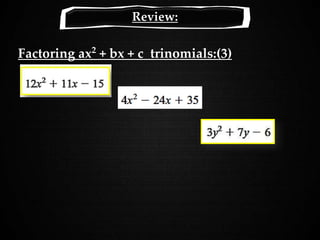
Factoring ax2
+ bx + c trinomials:(3)
Review:
1. If the highest degree of a quadratic equation is 2,
why are they called 'quadratic'?
Good Question, thanks for asking. Quadratic Equations
were used as early as 1500 b.c. by Egyptian farmers.
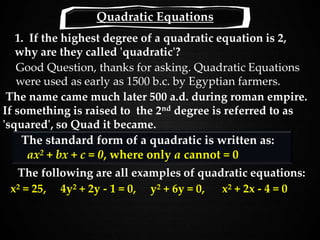
x2 = 25, 4y2 + 2y - 1 = 0, y2 + 6y = 0, x2 + 2x - 4 = 0
The standard form of a quadratic is written as:
ax2 + bx + c = 0, where only a cannot = 0
The name came much later 500 a.d. during roman empire.
If something is raised to the 2nd degree is referred to as
'squared', so Quad it became.
Quadratic Equations
The following are all examples of quadratic equations:
Quadratic Equations
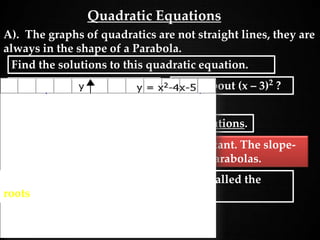
A). The graphs of quadratics are not straight lines, they are
always in the shape of a Parabola.
B) Parabolas ALWAYS
have two solutions.
C) The slope of a quadratic is not constant. The slope-
intercept formula will not work with parabolas.
What about (x – 3)2
?
These are referred to as repeated solutions.
Find the solutions to this quadratic equation.
D) The solutions of a equation are also called the
roots of the equation.
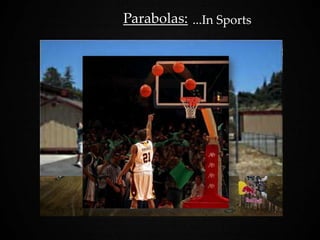
Parabolas: ...In Sports
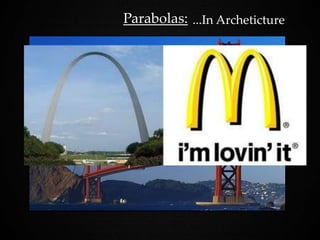
Parabolas: ...In Archeticture
Parabolas: ...In Nature
Parabolas: ...Everywhere
And, of course, the most important
Parabola of all
Solving Quadratic Equations by Factoring
Let's look at some of the different types of equations
you'll face and how to deal with each of them
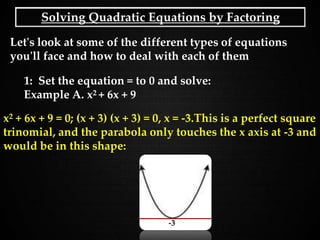
1: Set the equation = to 0 and solve:
Example A. x2 + 6x + 9
x2 + 6x + 9 = 0; (x + 3) (x + 3) = 0, x = -3.This is a perfect square
trinomial, and the parabola only touches the x axis at -3 and
would be in this shape:
-3
Solving Quadratic Equations by Factoring
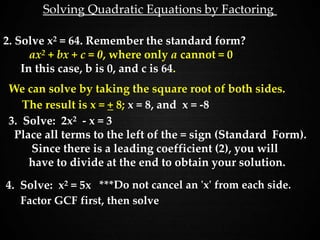
2. Solve x2 = 64. Remember the standard form?
ax2 + bx + c = 0, where only a cannot = 0
In this case, b is 0, and c is 64.
We can solve by taking the square root of both sides.
3. Solve: 2x2 - x = 3
Place all terms to the left of the = sign (Standard Form).
Since there is a leading coefficient (2), you will
have to divide at the end to obtain your solution.
The result is x = + 8; x = 8, and x = -8
4. Solve: x2 = 5x ***Do not cancel an 'x' from each side.
Factor GCF first, then solve
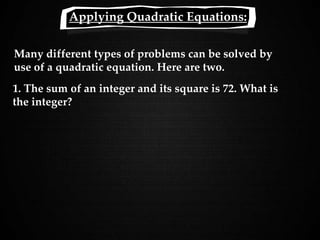
Applying Quadratic Equations:
Many different types of problems can be solved by
use of a quadratic equation. Here are two.
1. The sum of an integer and its square is 72. What is
the integer?
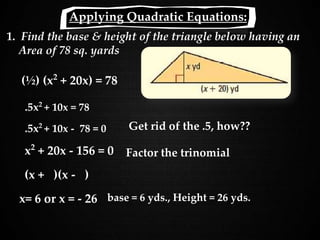
Applying Quadratic Equations:
(½) (x2
+ 20x) = 78
1. Find the base & height of the triangle below having an
Area of 78 sq. yards
.5x2
+ 10x = 78
x2
+ 20x - 156 = 0
Get rid of the .5, how??
x= 6 or x = - 26 base = 6 yds., Height = 26 yds.
.5x2
+ 10x - 78 = 0
Factor the trinomial
(x + )(x - )

April 1, 2014

  • 1.
    Today:  STAR MathUpdate  Alt.Khan Due Today  Make Up Tests??  Class Notes; ax2 + bx + c trinomials, Solving Quadratic Equations, Finding the vertex and axis of symmetry  Class Work April 1
  • 2.
    Factoring ax2 + bx+ c trinomials:(3) Review:
  • 3.
    1. If thehighest degree of a quadratic equation is 2, why are they called 'quadratic'? Good Question, thanks for asking. Quadratic Equations were used as early as 1500 b.c. by Egyptian farmers. x2 = 25, 4y2 + 2y - 1 = 0, y2 + 6y = 0, x2 + 2x - 4 = 0 The standard form of a quadratic is written as: ax2 + bx + c = 0, where only a cannot = 0 The name came much later 500 a.d. during roman empire. If something is raised to the 2nd degree is referred to as 'squared', so Quad it became. Quadratic Equations The following are all examples of quadratic equations:
  • 4.
    Quadratic Equations A). Thegraphs of quadratics are not straight lines, they are always in the shape of a Parabola. B) Parabolas ALWAYS have two solutions. C) The slope of a quadratic is not constant. The slope- intercept formula will not work with parabolas. What about (x – 3)2 ? These are referred to as repeated solutions. Find the solutions to this quadratic equation. D) The solutions of a equation are also called the roots of the equation.
  • 5.
  • 6.
  • 7.
  • 8.
    Parabolas: ...Everywhere And, ofcourse, the most important Parabola of all
  • 9.
    Solving Quadratic Equationsby Factoring Let's look at some of the different types of equations you'll face and how to deal with each of them 1: Set the equation = to 0 and solve: Example A. x2 + 6x + 9 x2 + 6x + 9 = 0; (x + 3) (x + 3) = 0, x = -3.This is a perfect square trinomial, and the parabola only touches the x axis at -3 and would be in this shape: -3
  • 10.
    Solving Quadratic Equationsby Factoring 2. Solve x2 = 64. Remember the standard form? ax2 + bx + c = 0, where only a cannot = 0 In this case, b is 0, and c is 64. We can solve by taking the square root of both sides. 3. Solve: 2x2 - x = 3 Place all terms to the left of the = sign (Standard Form). Since there is a leading coefficient (2), you will have to divide at the end to obtain your solution. The result is x = + 8; x = 8, and x = -8 4. Solve: x2 = 5x ***Do not cancel an 'x' from each side. Factor GCF first, then solve
  • 11.
    Applying Quadratic Equations: Manydifferent types of problems can be solved by use of a quadratic equation. Here are two. 1. The sum of an integer and its square is 72. What is the integer?
  • 12.
    Applying Quadratic Equations: (½)(x2 + 20x) = 78 1. Find the base & height of the triangle below having an Area of 78 sq. yards .5x2 + 10x = 78 x2 + 20x - 156 = 0 Get rid of the .5, how?? x= 6 or x = - 26 base = 6 yds., Height = 26 yds. .5x2 + 10x - 78 = 0 Factor the trinomial (x + )(x - )