Year 7 Rounding &
Approximation
Dr J Frost (jfrost@tiffin.kingston.sch.uk)
Last modified: 22nd July 2018
Objectives: Round a number to a given number of decimal places or
significant figures.
Approximate the value to a multiplication/division by rounding each
number to 1 significant figure.
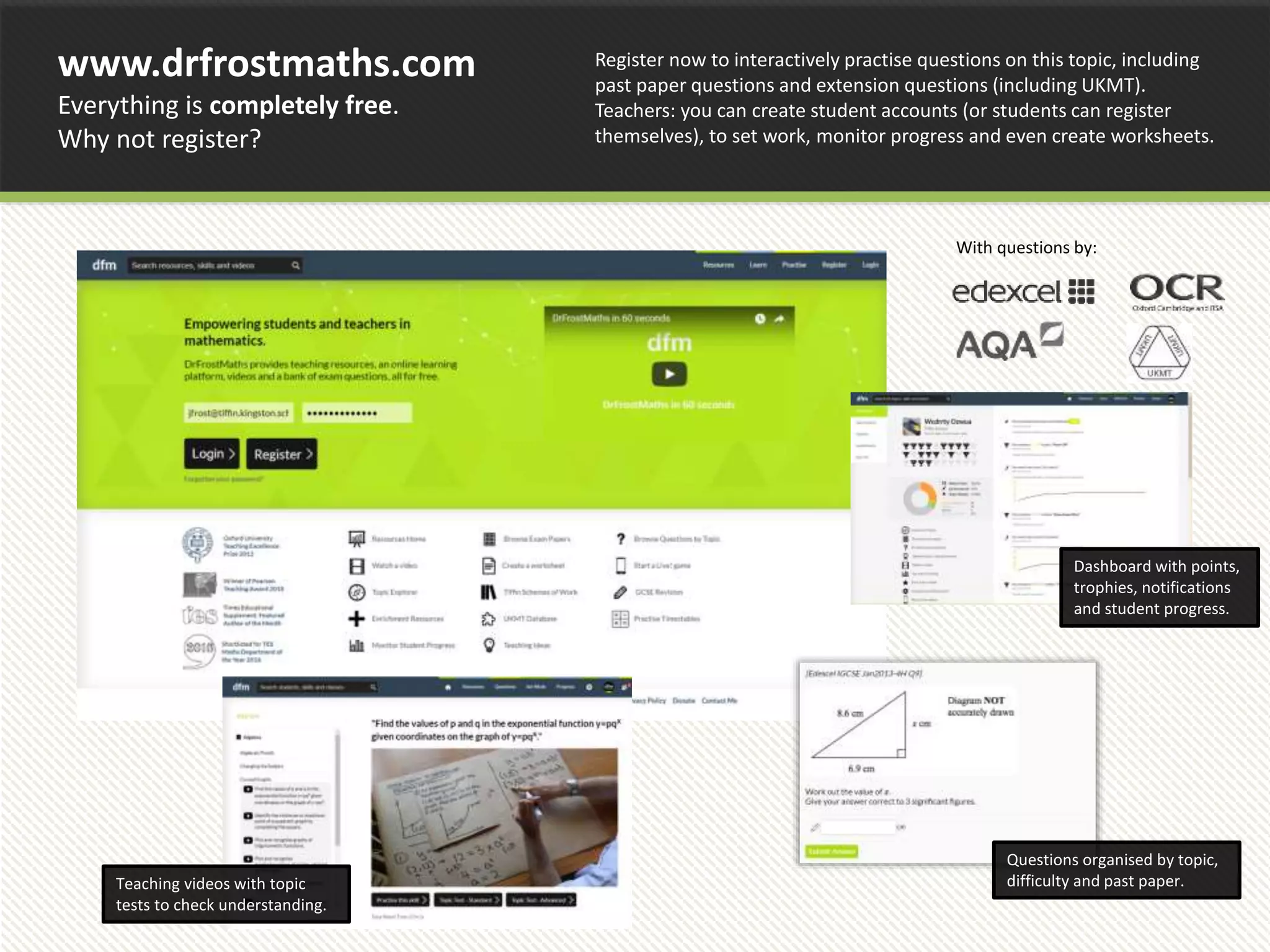
www.drfrostmaths.com
Everything is completely free.
Why not register?
Teaching videos with topic
tests to check understanding.
Register now to interactively practise questions on this topic, including
past paper questions and extension questions (including UKMT).
Teachers: you can create student accounts (or students can register
themselves), to set work, monitor progress and even create worksheets.
Questions organised by topic,
difficulty and past paper.
Dashboard with points,
trophies, notifications
and student progress.
With questions by:
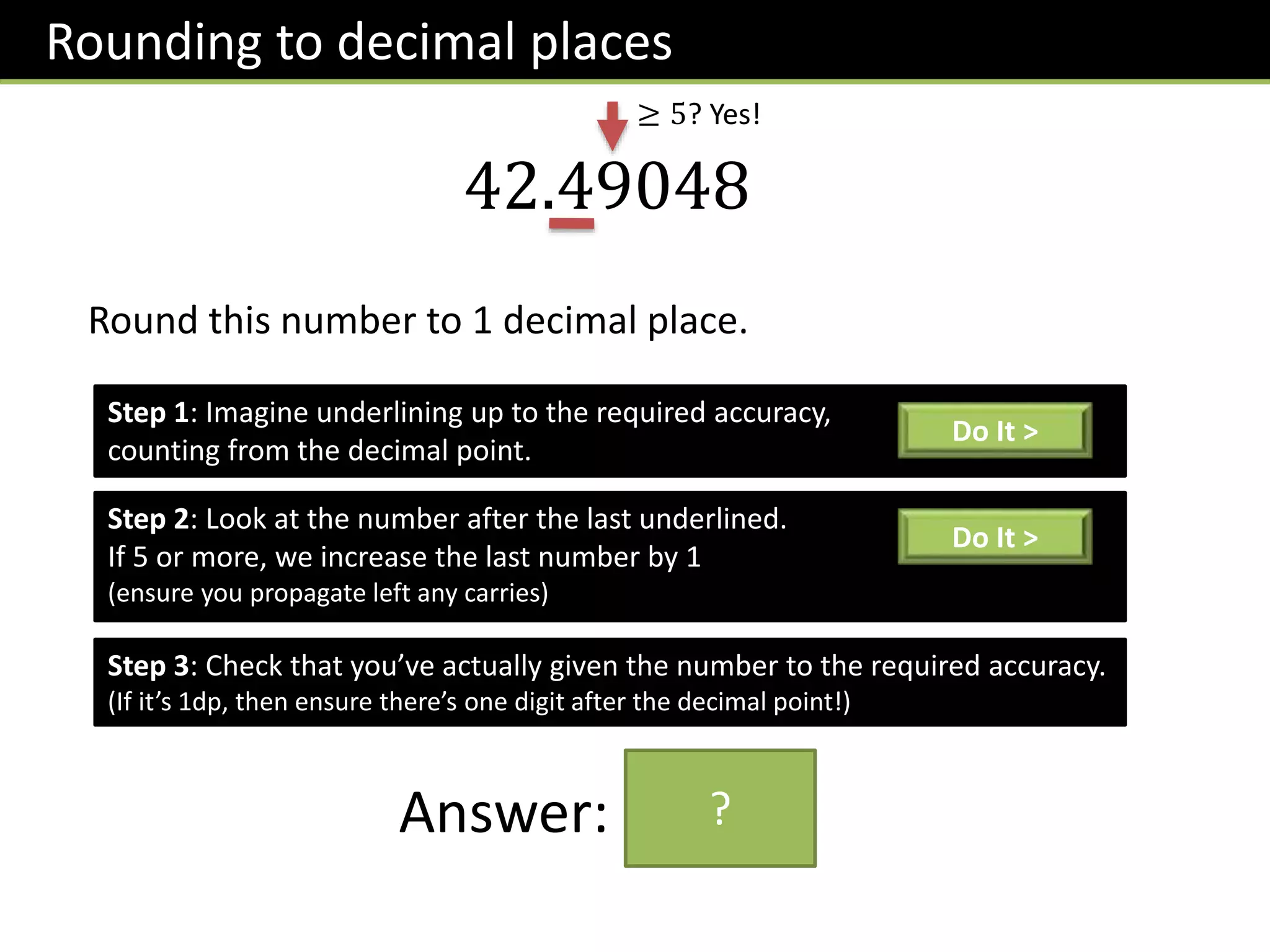
Rounding to decimal places
42.49048
Round this number to 1 decimal place.
Step 1: Imagine underlining up to the required accuracy,
counting from the decimal point.
Do It >
Step 2: Look at the number after the last underlined.
If 5 or more, we increase the last number by 1
(ensure you propagate left any carries)
Do It >
≥ 5? Yes!
Step 3: Check that you’ve actually given the number to the required accuracy.
(If it’s 1dp, then ensure there’s one digit after the decimal point!)
Answer: 42.5
?
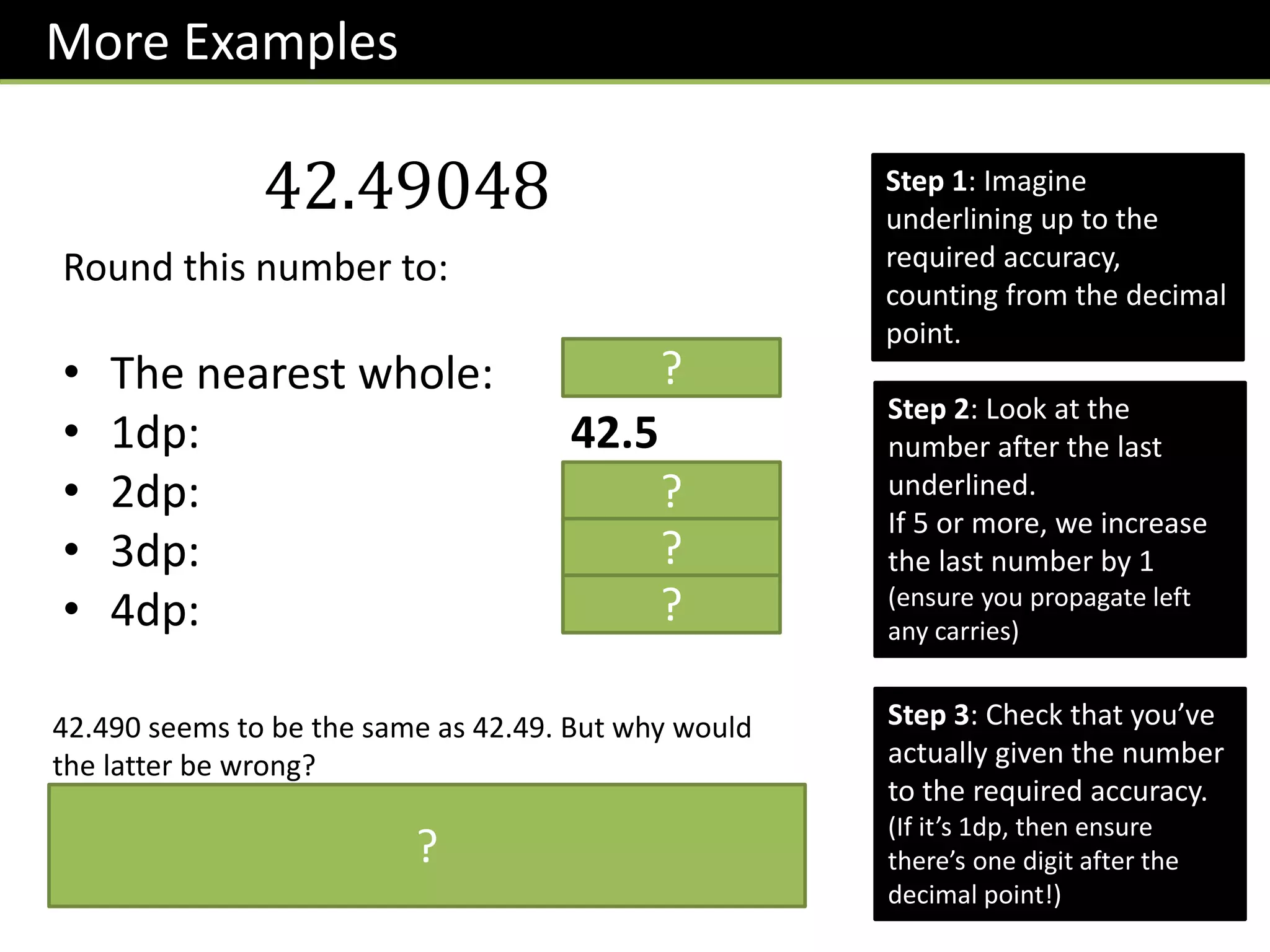
More Examples
42.49048
Round this number to:
• The nearest whole: 42
• 1dp: 42.5
• 2dp: 42.49
• 3dp: 42.490
• 4dp: 42.4905
Step 1: Imagine
underlining up to the
required accuracy,
counting from the decimal
point.
Step 2: Look at the
number after the last
underlined.
If 5 or more, we increase
the last number by 1
(ensure you propagate left
any carries)
Step 3: Check that you’ve
actually given the number
to the required accuracy.
(If it’s 1dp, then ensure
there’s one digit after the
decimal point!)
?
?
?
?
42.490 seems to be the same as 42.49. But why would
the latter be wrong?
The 0 at the end gives extra information. It’s telling us
that the thousandth’s digit is 0, whereas if we put 42.49,
we’re leaving the thousandths digit unspecified.
?
A Harder One…
Step 2: Look at the
number after the last
underlined.
If 5 or more, we increase
the last number by 1
(ensure you propagate left
any carries)
Step 3: Check that you’ve
actually given the number
to the required accuracy.
(If it’s 1dp, then ensure
there’s one digit after the
decimal point!)
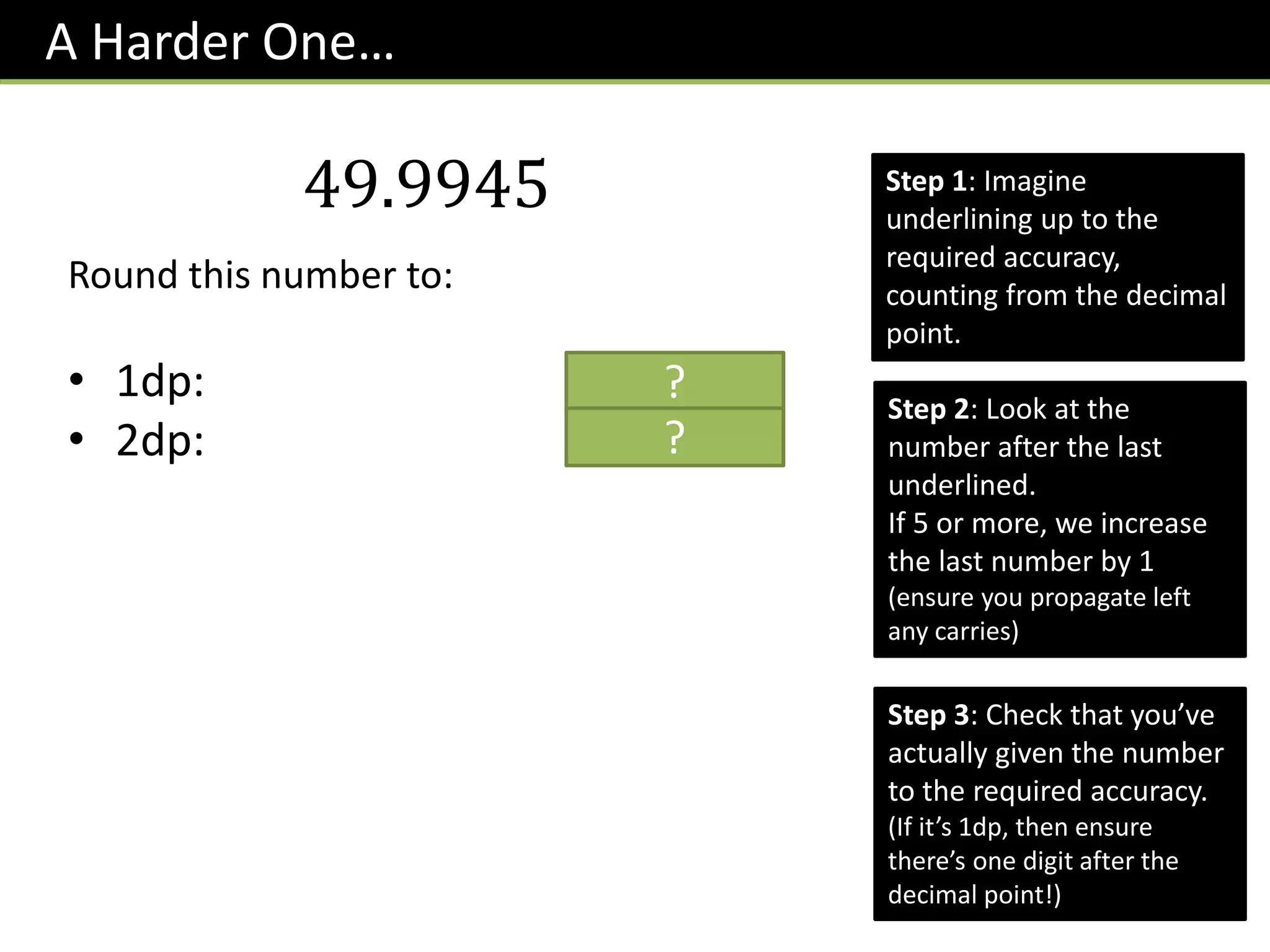
49.9945
Round this number to:
• 1dp: 50.0
• 2dp: 49.99
?
?
Step 1: Imagine
underlining up to the
required accuracy,
counting from the decimal
point.
Test Your Understanding
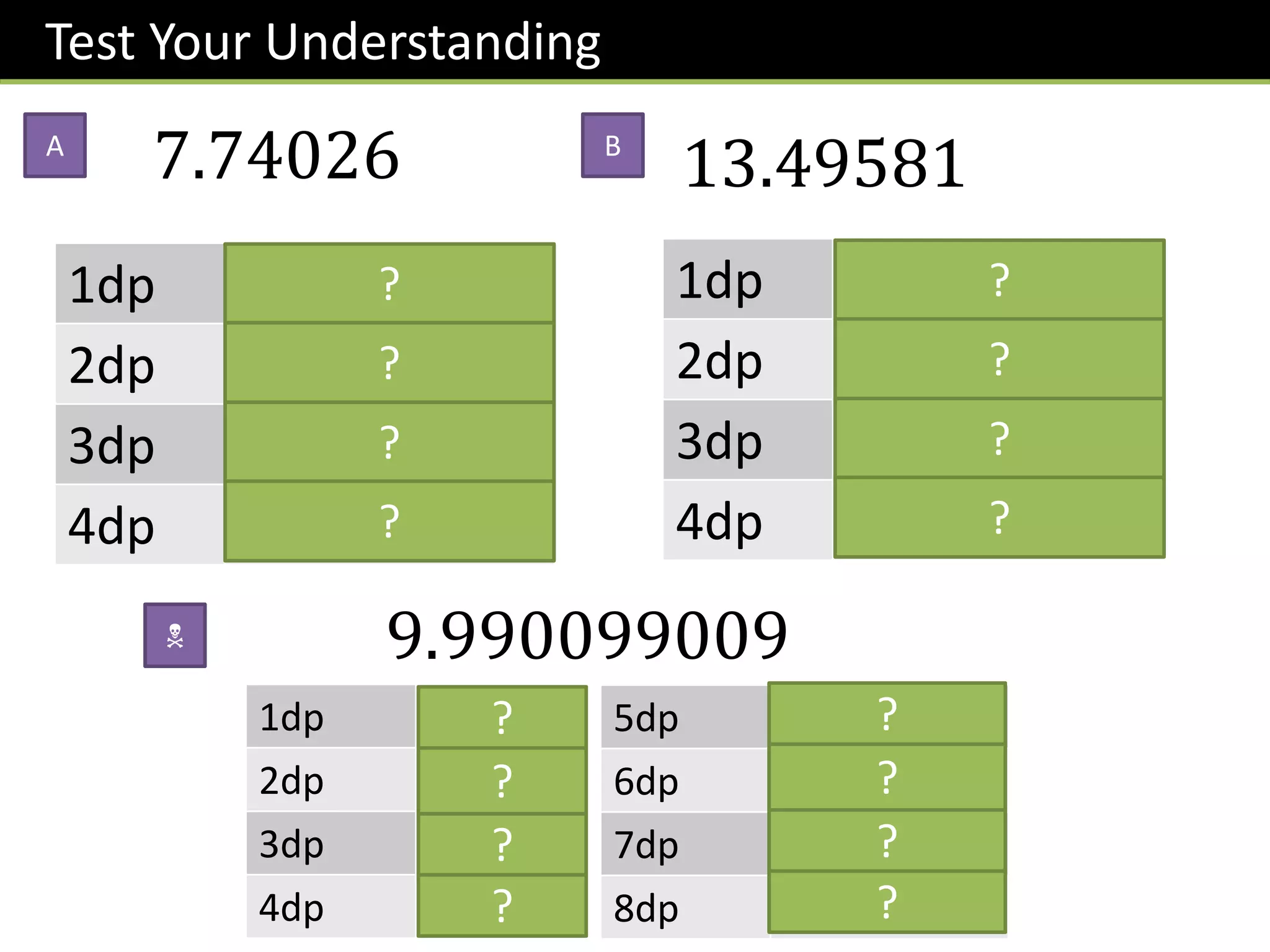
13.49581
7.74026
1dp 13.5
2dp 13.50
3dp 13.496
4dp 13.4958
1dp 7.7
2dp 7.74
3dp 7.740
4dp 7.7403
9.990099009
1dp 10.0
2dp 9.99
3dp 9.990
4dp 9.9901
5dp 9.99010
6dp 9.990099
7dp 9.9900990
8dp 9.99009901
A B
N
?
?
?
?
?
?
?
?
?
?
?
?
?
?
?
?
Significant Figures
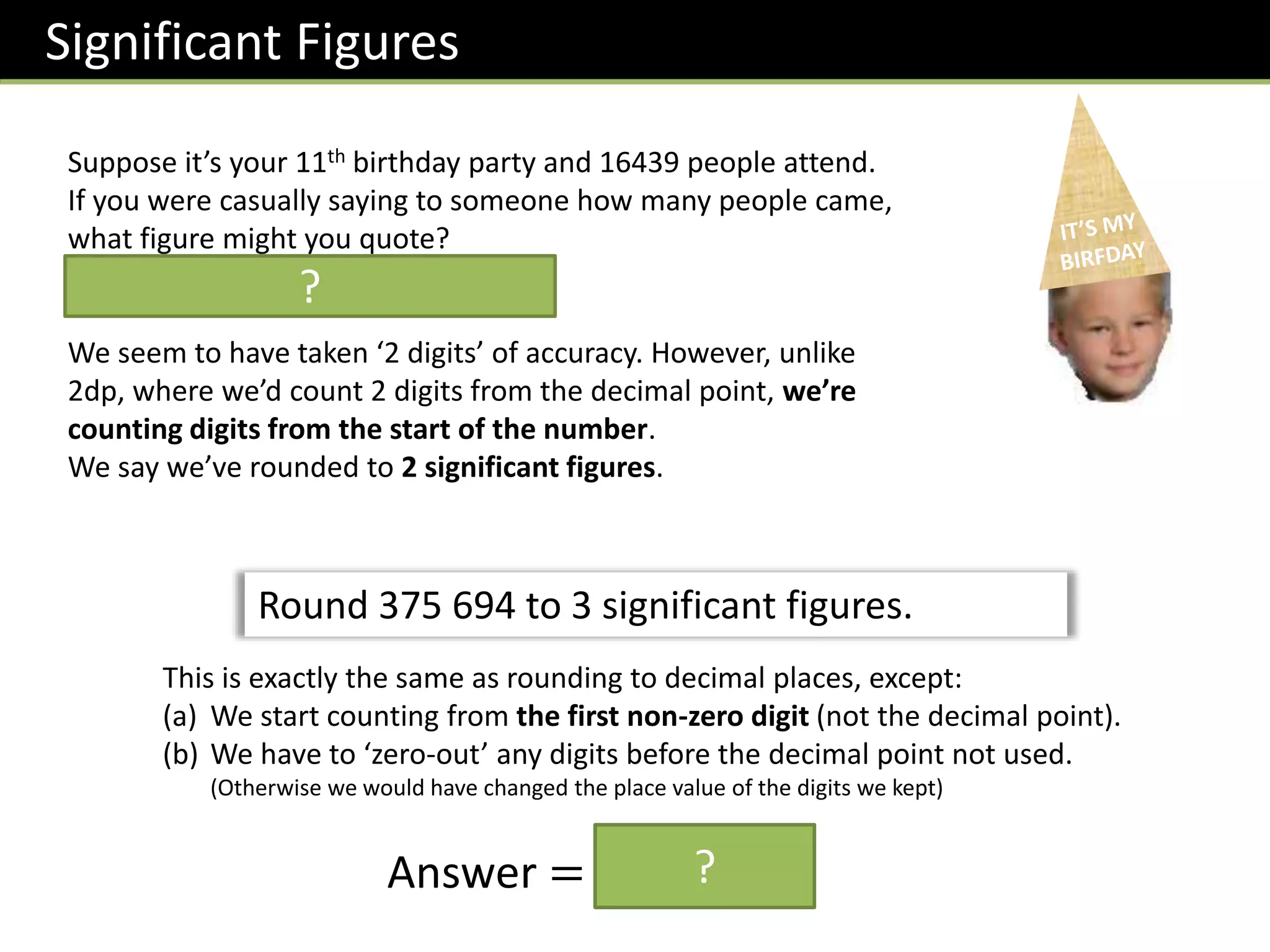
Suppose it’s your 11th birthday party and 16439 people attend.
If you were casually saying to someone how many people came,
what figure might you quote?
We might say 16000 people came.
We seem to have taken ‘2 digits’ of accuracy. However, unlike
2dp, where we’d count 2 digits from the decimal point, we’re
counting digits from the start of the number.
We say we’ve rounded to 2 significant figures.
Round 375 694 to 3 significant figures.
This is exactly the same as rounding to decimal places, except:
(a) We start counting from the first non-zero digit (not the decimal point).
(b) We have to ‘zero-out’ any digits before the decimal point not used.
(Otherwise we would have changed the place value of the digits we kept)
Answer = 376 000
?
?
Examples
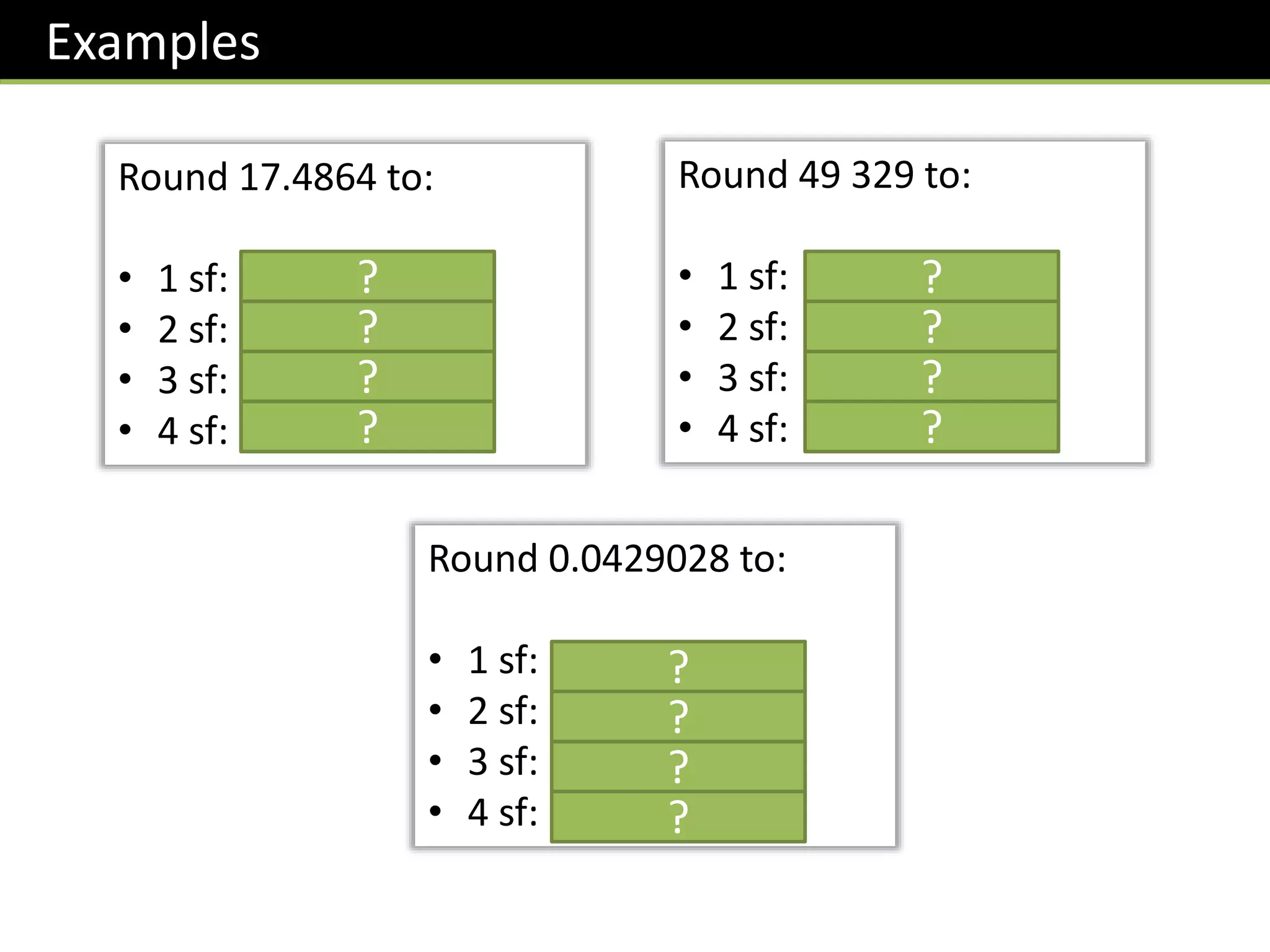
Round 17.4864 to:
• 1 sf: 20
• 2 sf: 17
• 3 sf: 17.5
• 4 sf: 17.49
Round 49 329 to:
• 1 sf: 50 000
• 2 sf: 49 000
• 3 sf: 49 300
• 4 sf: 49 330
Round 0.0429028 to:
• 1 sf: 0.04
• 2 sf: 0.043
• 3 sf: 0.0429
• 4 sf: 0.04290
?
?
?
?
?
?
?
?
?
?
?
?
𝐴 𝐵 𝐶 𝐷
Test Your
Understanding
Vote with the coloured cards in your diaries (use the
front for blue)
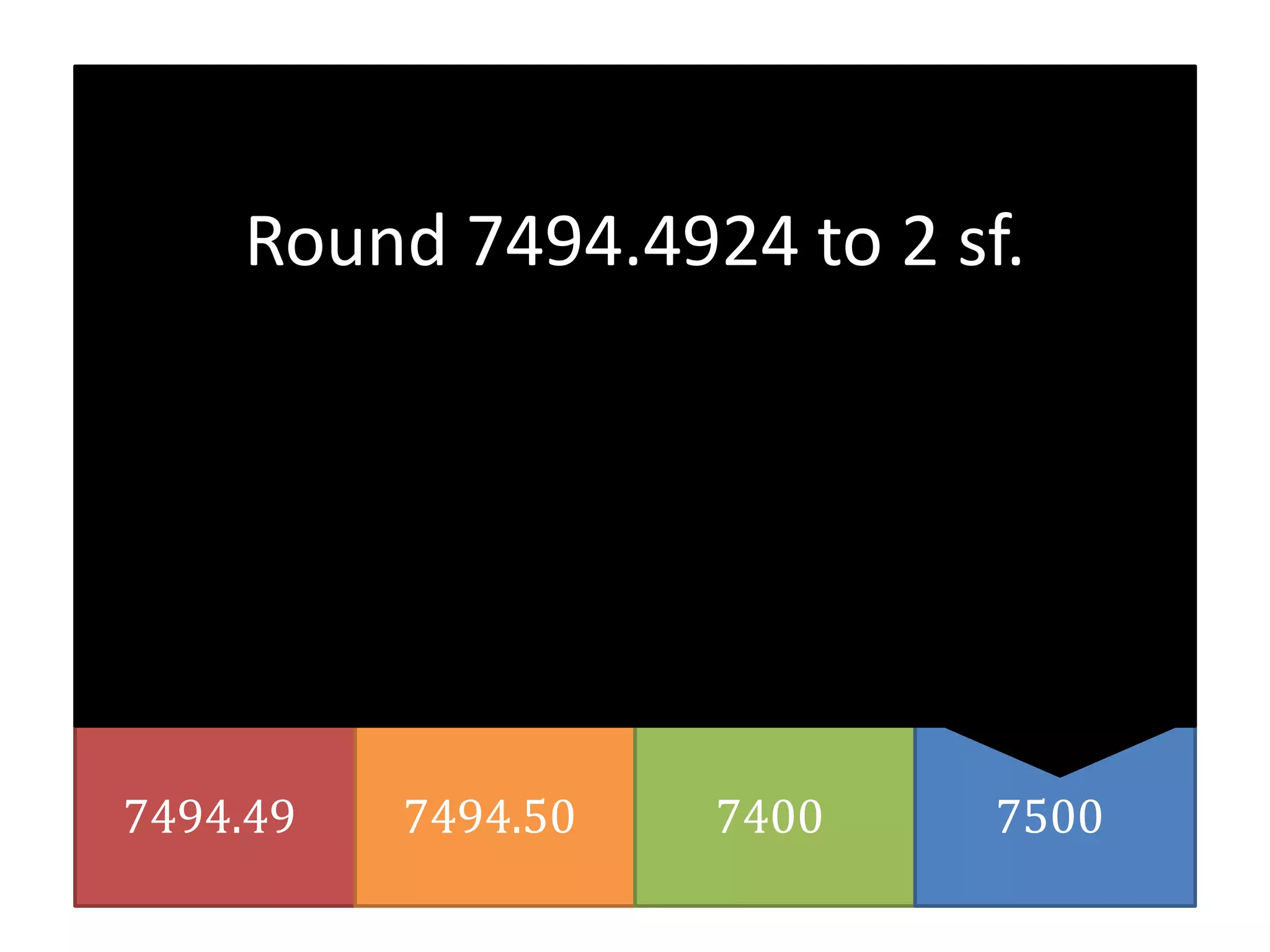
7494.49 7494.50 7400 7500
Round 7494.4924 to 2 sf.
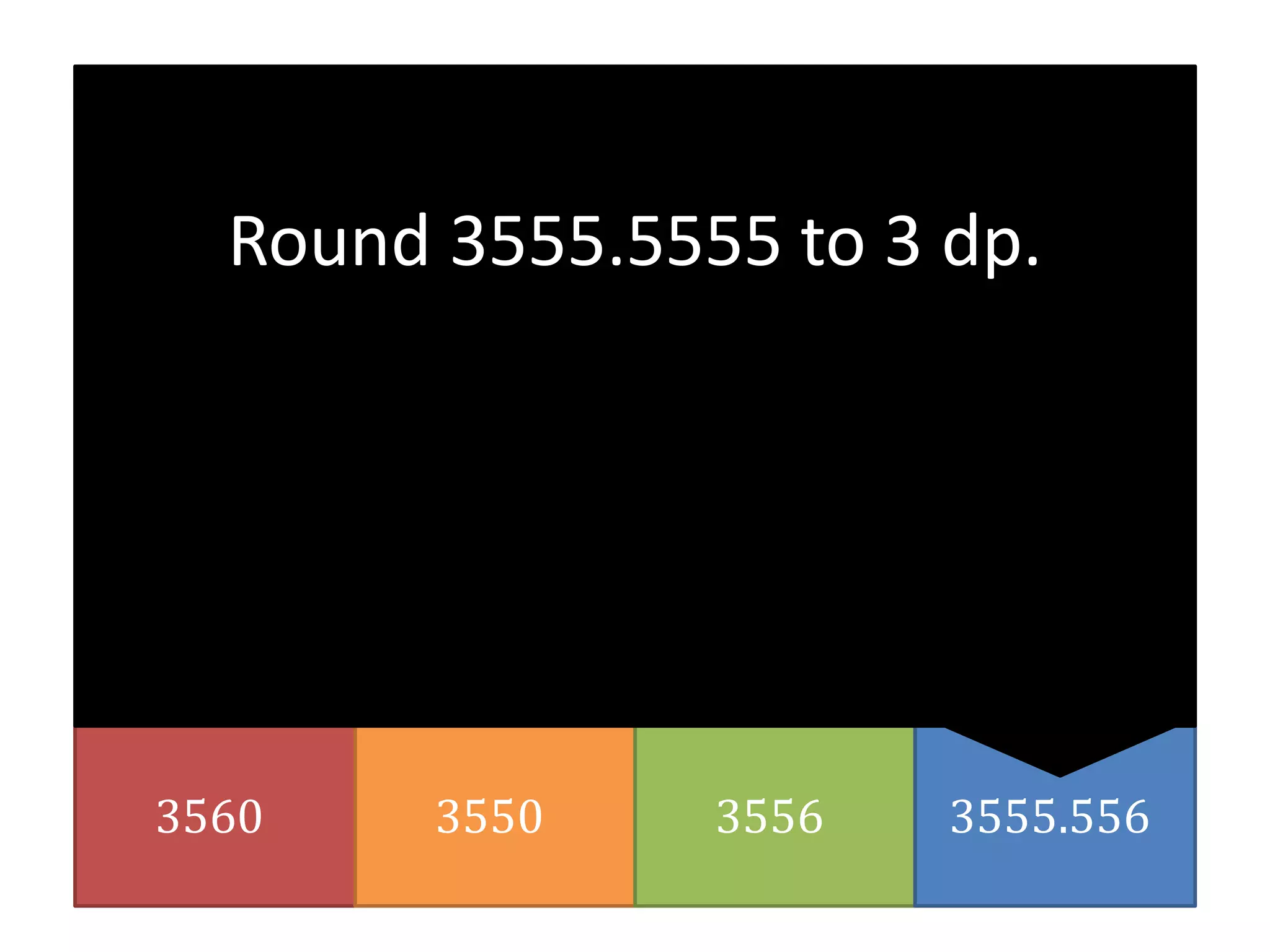
3560 3550 3556 3555.556
Round 3555.5555 to 3 dp.
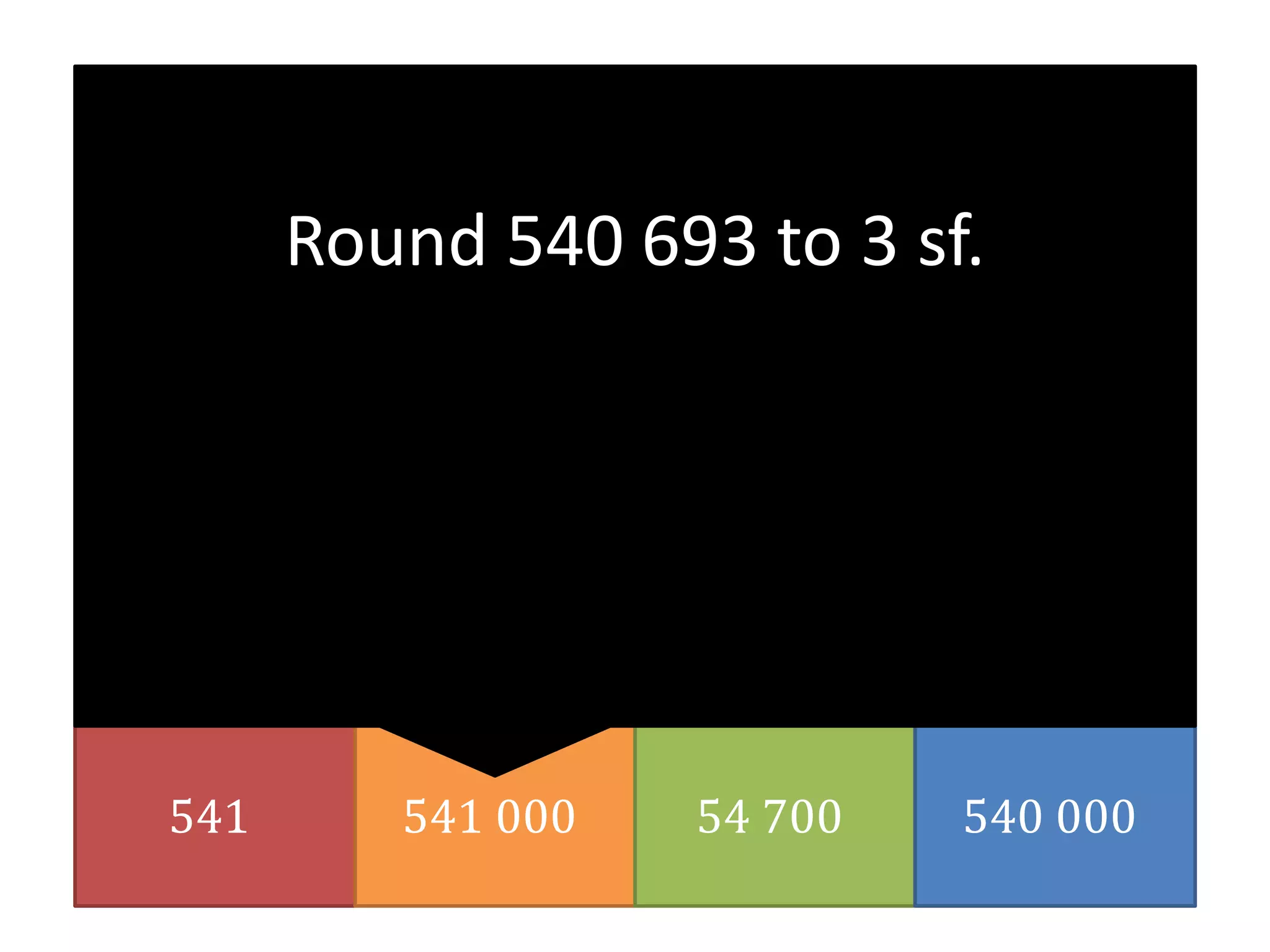
541 541 000 54 700 540 000
Round 540 693 to 3 sf.
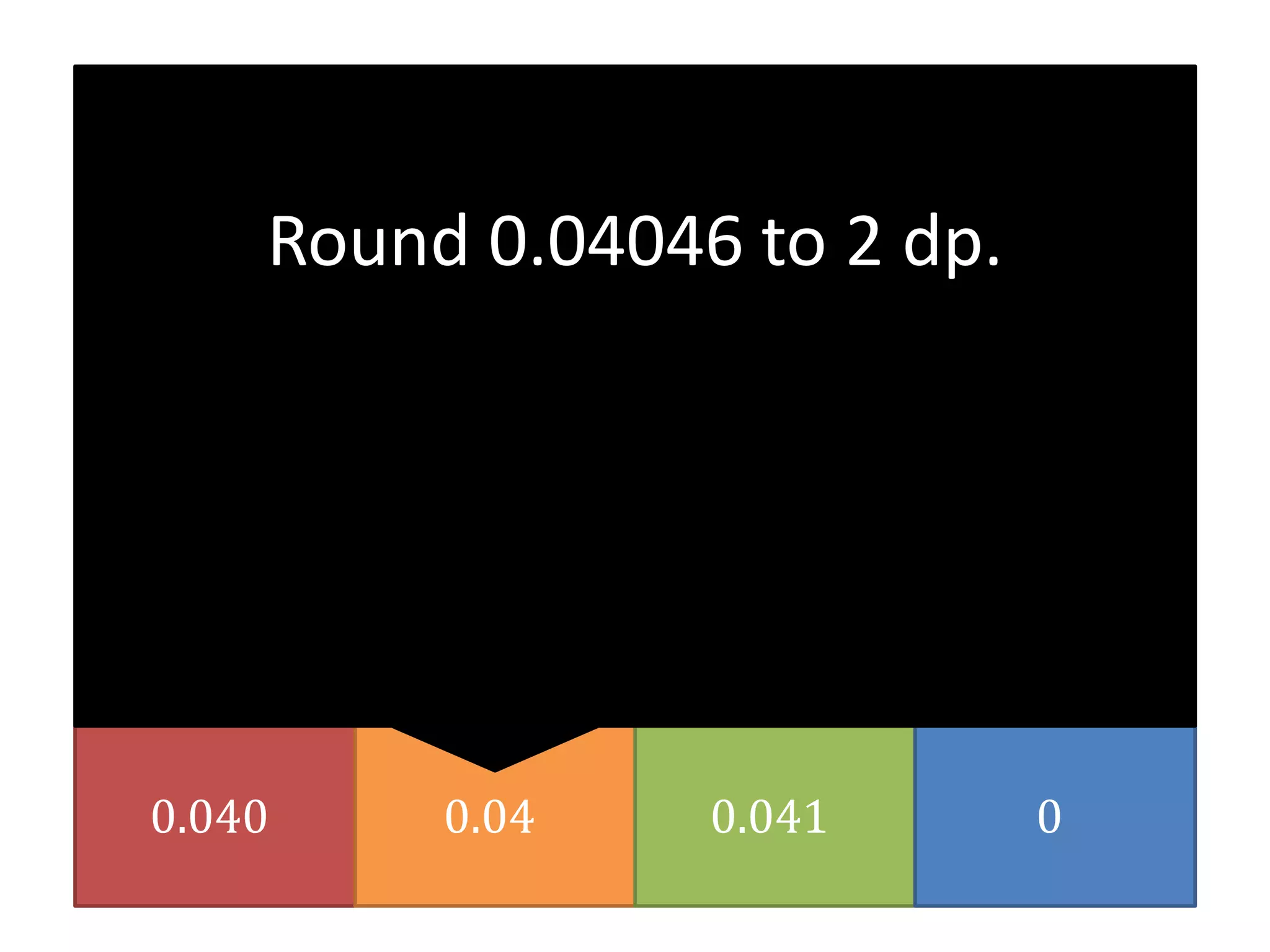
0.040 0.04 0.041 0
Round 0.04046 to 2 dp.
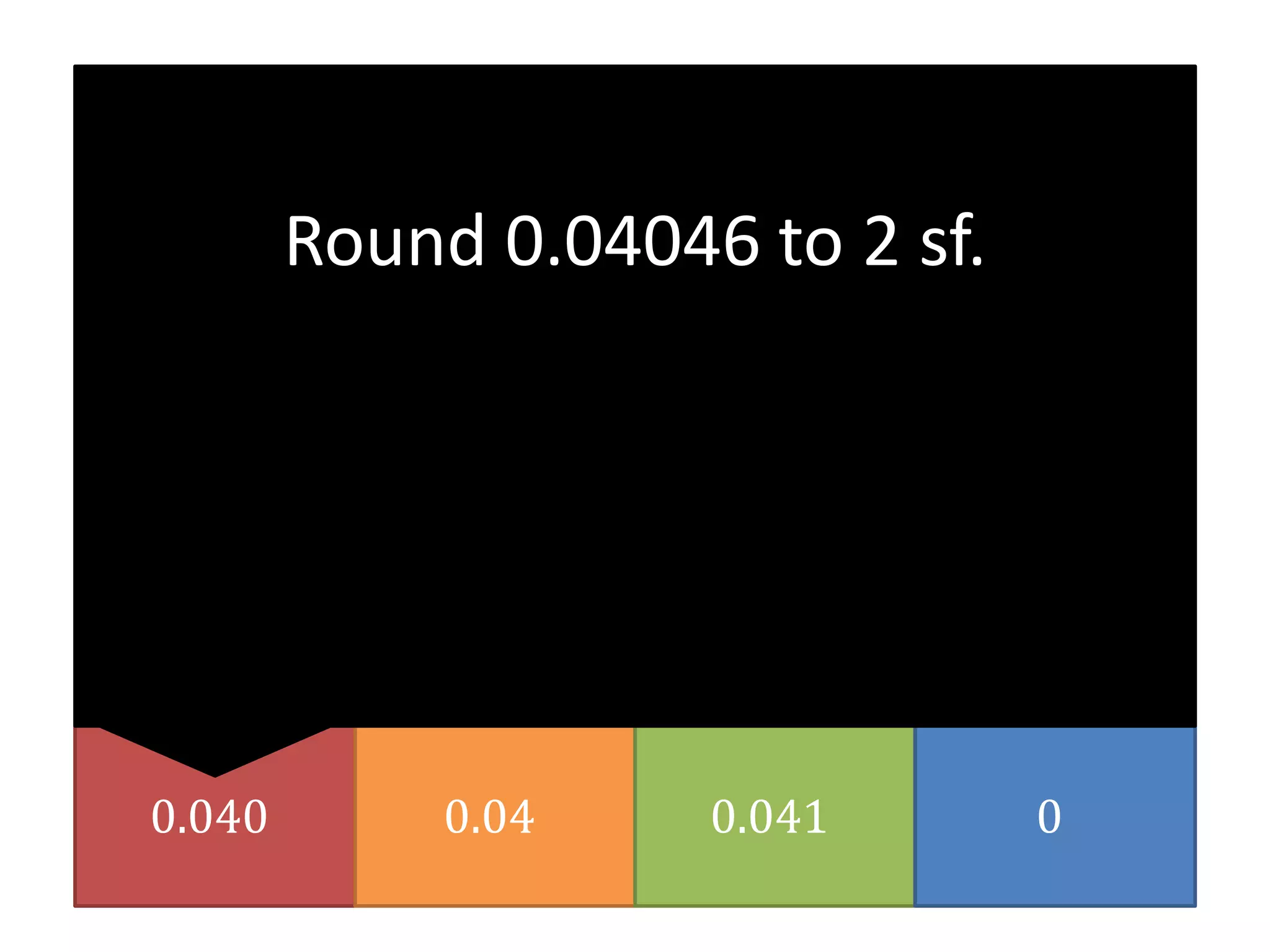
0.040 0.04 0.041 0
Round 0.04046 to 2 sf.
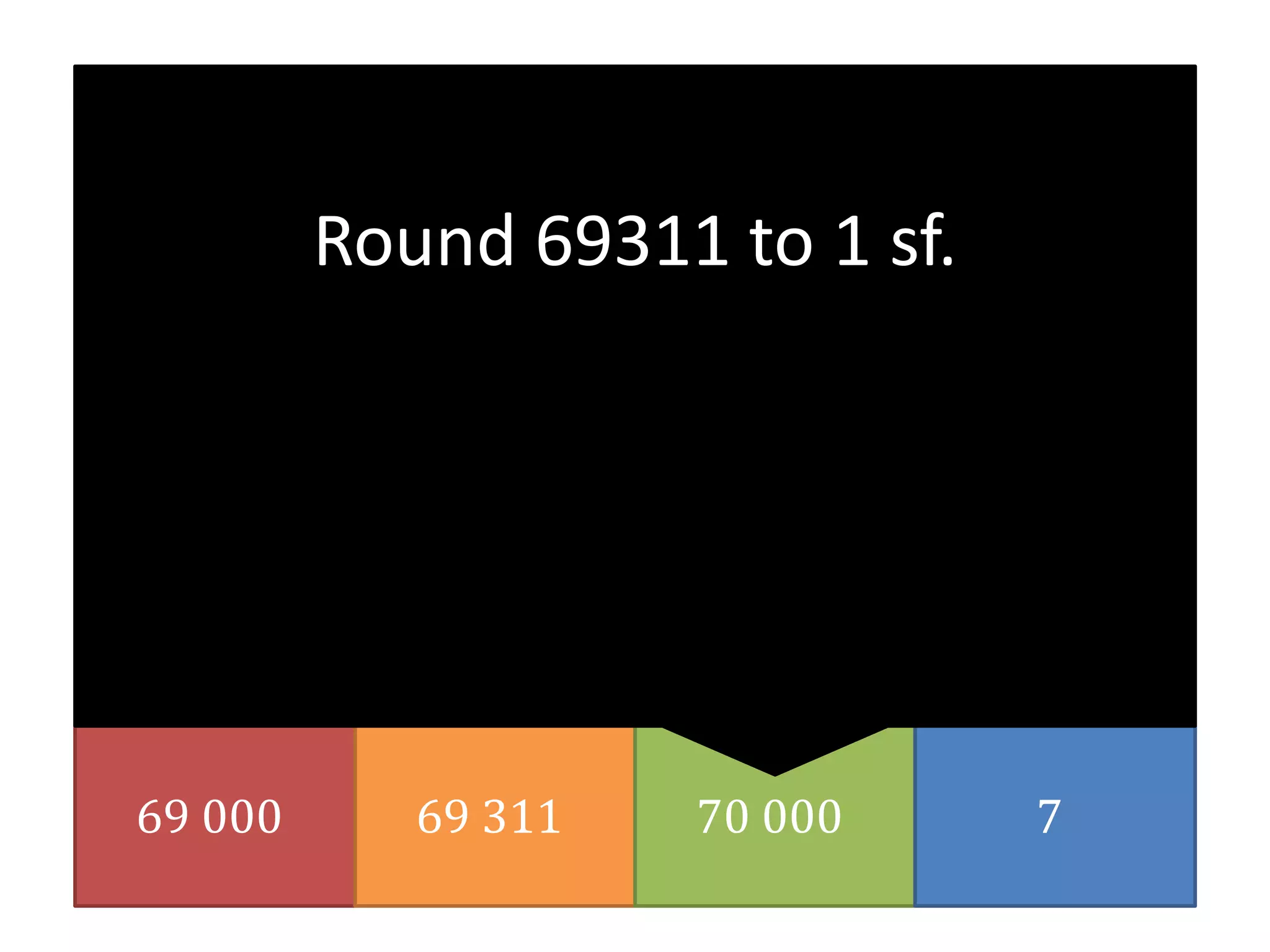
69 000 69 311 70 000 7
Round 69311 to 1 sf.
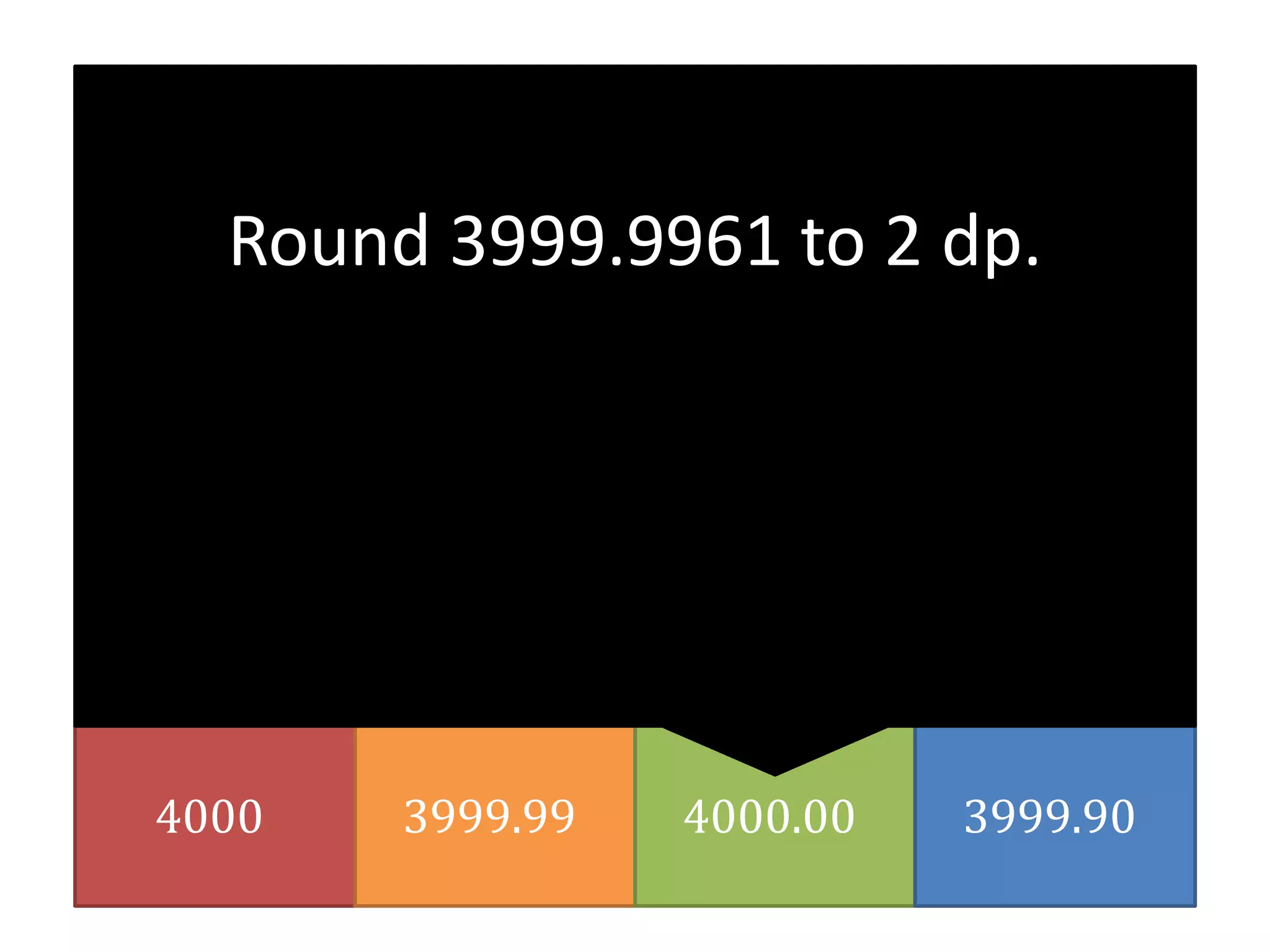
4000 3999.99 4000.00 3999.90
Round 3999.9961 to 2 dp.
Exercise 1
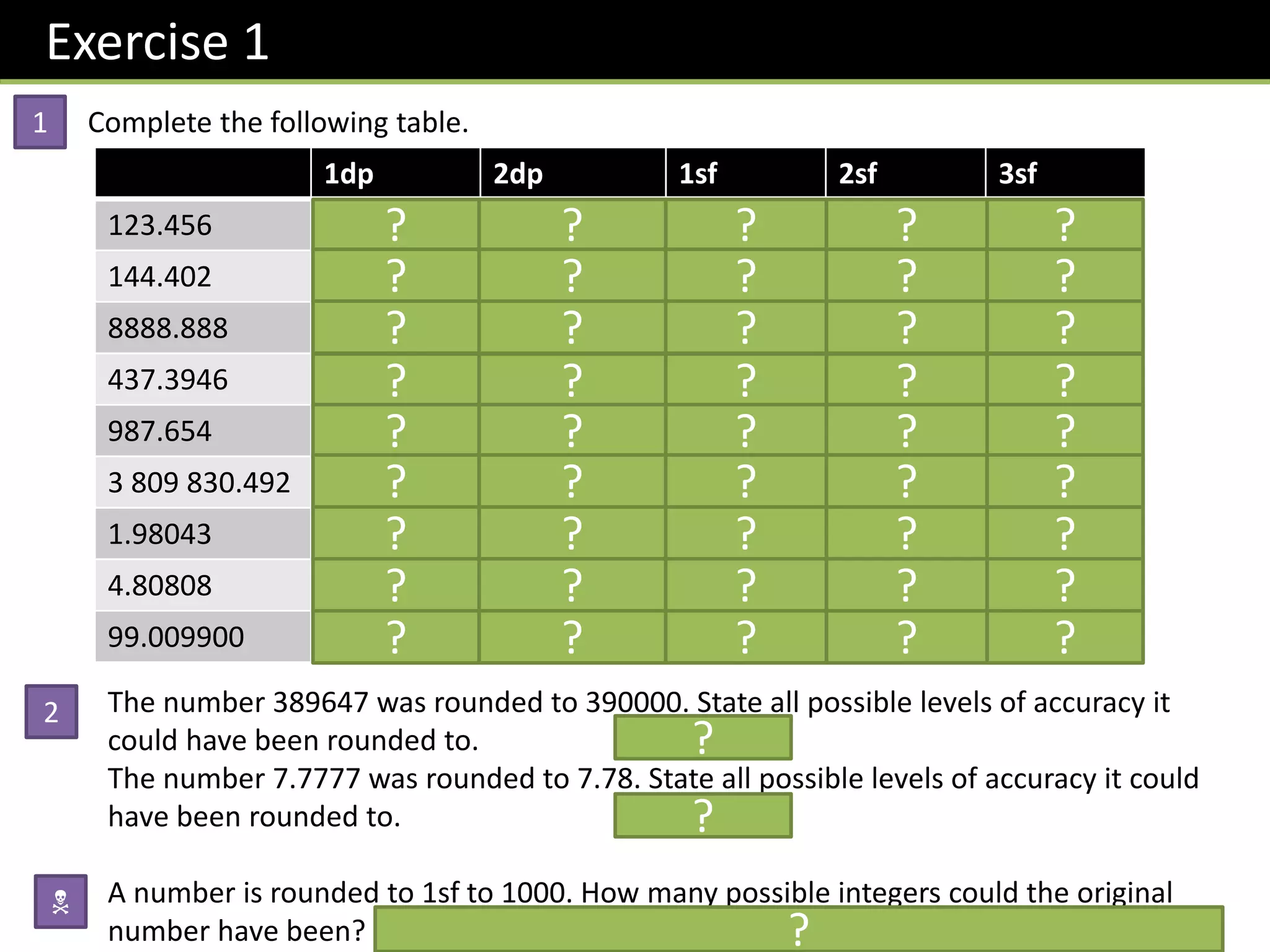
Complete the following table.
1
1dp 2dp 1sf 2sf 3sf
123.456 123.5 123.46 100 120 123
144.402 144.4 144.40 100 140 144
8888.888 8888.9 8888.89 9000 8900 8890
437.3946 437.4 437.39 400 440 437
987.654 987.7 987.65 1000 990 988
3 809 830.492 3809830.5 3809830.49 4 000 000 3 800 000 3 810 000
1.98043 2.0 1.98 2 2.0 1.98
4.80808 4.8 4.81 5 4.8 4.81
99.009900 99.0 99.01 100 99 99.0
The number 389647 was rounded to 390000. State all possible levels of accuracy it
could have been rounded to. 2sf or 3sf
The number 7.7777 was rounded to 7.78. State all possible levels of accuracy it could
have been rounded to. 2dp or 3sf.
A number is rounded to 1sf to 1000. How many possible integers could the original
number have been? All numbers from 950 to 1499. That’s 𝟏𝟒𝟗𝟗 − 𝟗𝟓𝟎 + 𝟏 = 𝟓𝟓𝟎.
2
N
? ? ? ? ?
? ? ? ? ?
? ? ? ? ?
? ? ? ? ?
? ? ? ? ?
? ? ? ? ?
? ? ? ? ?
? ? ? ? ?
? ? ? ? ?
?
?
?
STARTER :: Approximation
[JMC 2010 Q14] The Severn Bridge has carried just over 300 million vehicles since it was
opened in 1966. On average, roughly how many vehicles is this per day?
A 600 B 2 000 C 6 000 D 20 000 E 60 000
D
B C
A E
[JMC 2003 Q15] It was reported recently that, in an average lifetime of 70 years, each
human is likely to swallow about 8 spiders while sleeping. Supposing that the population of
the UK is around 60 million, what is the best estimate of the number of unfortunate spiders
consumed in this way in the UK each year?
A 50 000 B 600 000 C 7 000 000 D 80 000 000 E 900 000 000
C
B D
A E
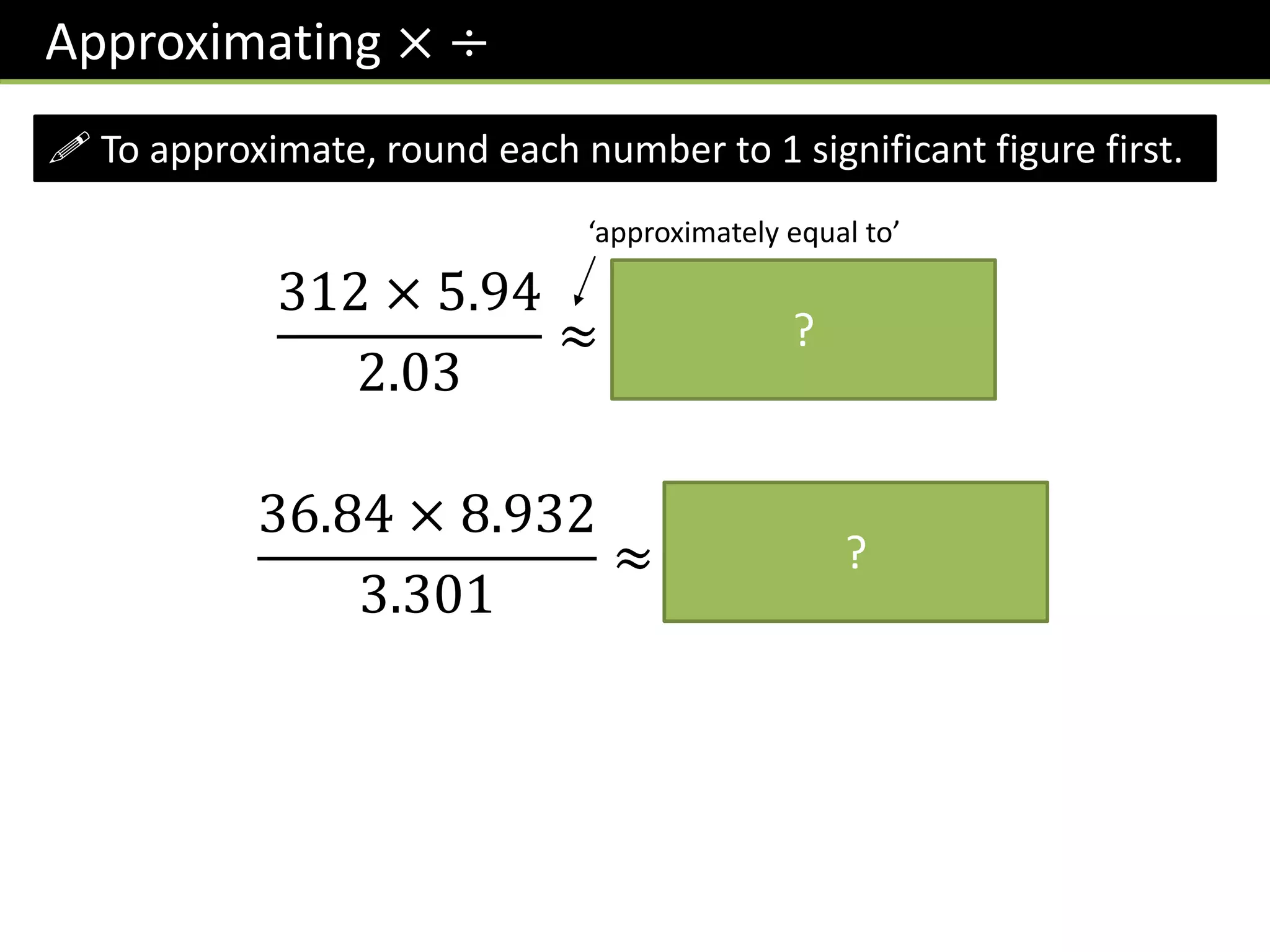
Approximating × ÷
! To approximate, round each number to 1 significant figure first.
312 × 5.94
2.03
≈
300 × 6
2
= 900
‘approximately equal to’
?
36.84 × 8.932
3.301
≈
40 × 9
3
= 120
?
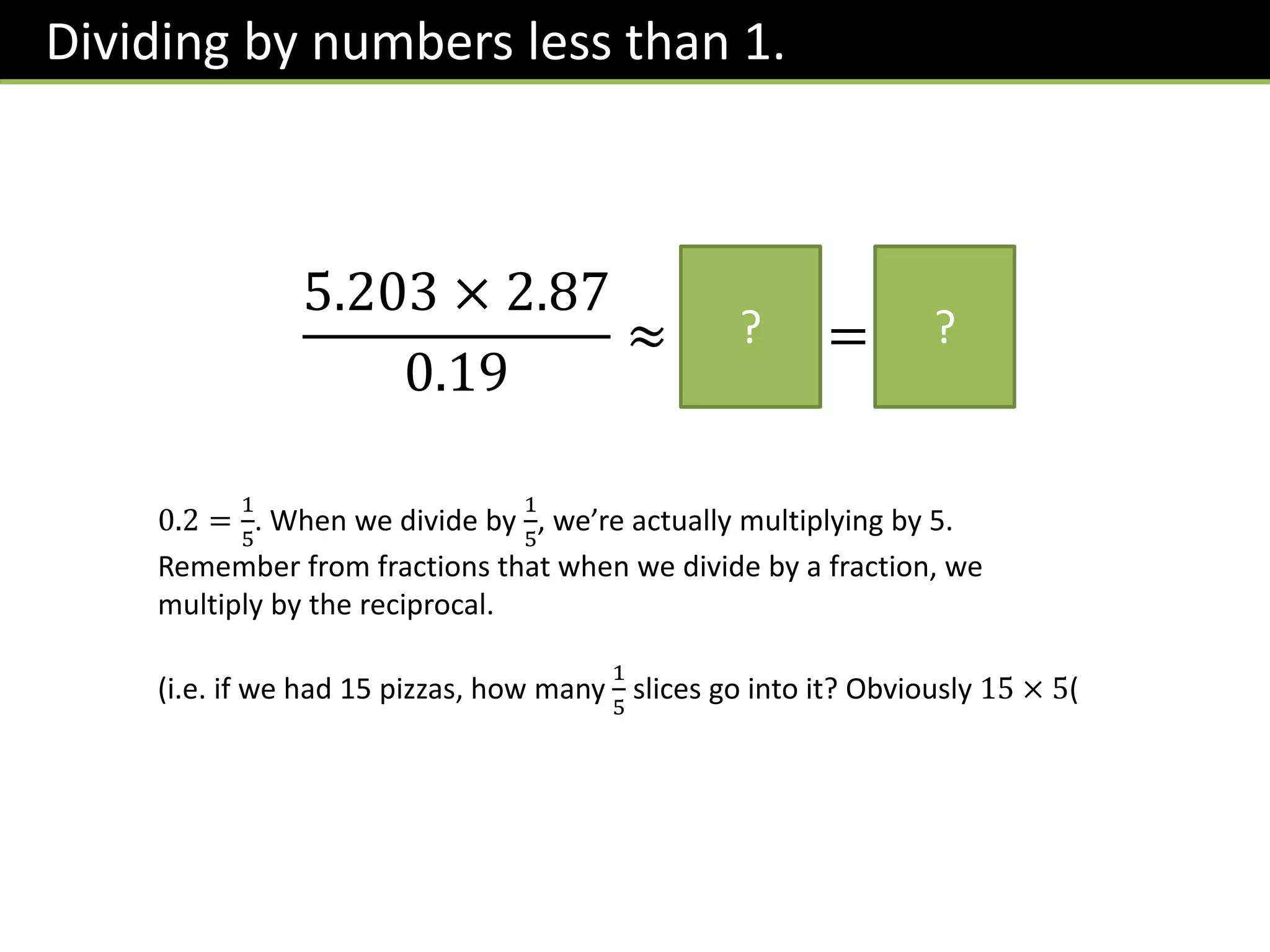
Dividing by numbers less than 1.
5.203 × 2.87
0.19
≈
5 × 3
0.2
= 75
? ?
0.2 =
1
5
. When we divide by
1
5
, we’re actually multiplying by 5.
Remember from fractions that when we divide by a fraction, we
multiply by the reciprocal.
(i.e. if we had 15 pizzas, how many
1
5
slices go into it? Obviously 15 × 5(
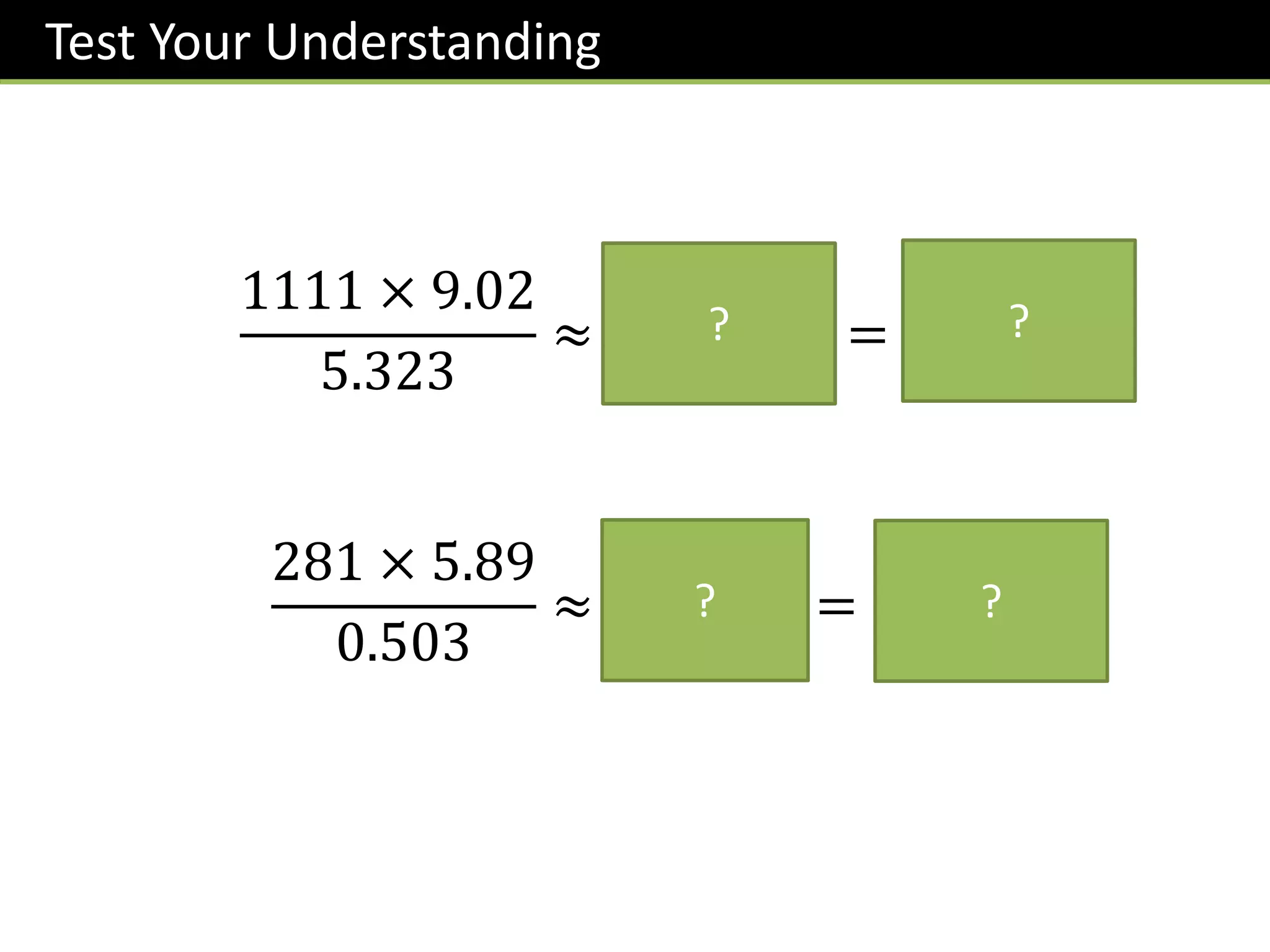
Test Your Understanding
281 × 5.89
0.503
≈
300 × 6
0.5
= 3600
1111 × 9.02
5.323
≈
1000 × 9
5
= 1800
? ?
? ?
Maths Challenge Strategies
For approximation questions, rather than round each number first, it’s often
helpful to combine numbers which would multiply to give a value close to 1sf.
e.g. 3 years is roughly: 1000 days. 333 × 24 ≈ 𝟖𝟎𝟎𝟎
Use an appropriate accuracy for each number. Rounding large numbers has less
impact on the result than rounding small numbers.
?
[JMC 2000 Q16] A book has 256 pages with, on average, 33 lines on each page and 9
words on each line. Which of the following is the best approximation to the number
of words in the book?
A 64 000 B 68 000 C 72 000
D 76 000 E 80 000
D
B C
A E
256 × 33 × 9
≈ 250 × 300 = 75000
Since 33 is (just about) a third of 100, 9 lots of it gives (just about) 300.
Reducing 256 to 250 has little effect because the number is already quite large.
?
[SMC 1999 Q5] In 1998 a newspaper reported that “The world record for
remembering the value of 𝜋 to the greatest number of decimal places is 40 000
places, which took the record holder 17 hours and 21 minutes to recite.”
What was the average number of decimal places recited per minute, approximately?
A 20 B 40 C 200
D 400 E 2000
B D
C
A E
Test Your Understanding
We can be very generous with rounding for this question because the
options are far apart!
Minutes:
17 × 60 + 21 ≈ 20 × 60 = 1200 ≈ 1000
So digits per minute:
40000
1000
= 40
Exercise 2
Estimate the following by rounding each
number to 1sf:
326 × 4.89 ≈ 1500
7809 ÷ 8.24 ≈ 1000
0.39 × 9.67 ≈ 4
201 ÷ 0.49 ≈ 400
489 × 0.31 ≈ 150
Estimate the following:
29 × 38.5
11.2
≈ 120
2.95 × 6.013
9.023
≈ 2
39 × 6.98
0.52
≈ 560
205 × 7.7
0.21
≈ 8000
4.904 × 31.2
0.0984
≈ 1500
7.523 × 89.4
0.14
a) Find an approximate value for this
expression. 7200
b) Using a calculator, calculate the %
error relative to the true value.
49.9%
c) Which of the three roundings caused
the largest error? 0.14
[JMC 2015 Q9] According to a newspaper report, “A 63-year-old man has
rowed around the world without leaving his living room.” He clocked up 25
048 miles on a rowing machine that he received for his 50th birthday.
Roughly how many miles per year has he rowed since he was given the
machine?
A 200 B 500 C 1000 D 2000 E 4000 Sol: D
[JMC 2011 Q17] Last year’s match at Wimbledon between John Isner and
Nicolas Mahut, which lasted 11 hours and 5 minutes, set a record for the
longest match in tennis history. The fifth set of the match lasted 8 hours
and 11 minutes. Approximately what fraction of the whole match was
taken up by the fifth set?
A
1
5
B
2
5
C
3
5
D
3
4
E
9
10
Sol: D
[JMC 2008 Q15] An active sphagnum bog deposits a depth of about 1
metre of peat per 1000 years. Roughly how many millimetres is that per
day? A 0.0003 B 0.003 C 0.03 D 0.3 E 3 Sol: B
[IMC 2001 Q9] Which of the following is the best estimate for the number
of seconds which have elapsed since the start of the year 2000? (note:
date was June 2001)
A 3 × 10⁴
B 3 × 10⁵
C 3 × 10⁶
D 3 × 10⁷
E 3 × 10⁸
Sol: D
[SMC 2003 Q10] Steve Fossett completed the first solo balloon
circumnavigation of the world after 13.5 days. Assuming the balloon
travelled along a circle of diameter 12 750 km, roughly what was the
average speed of the balloon in km/h?
A 12 B 40 C 75 D 120 E 300 Sol: D
1
2
3
a
b
c
d
e
a
b
c
d
e
4
5
6
7
8
?
?
?
?
?
?
?
?
?
?
?
?
?
?
?
?
?
?
[JMC 2006 Q19] Pinocchio’s nose is 5cm long. Each time he tells a lie his nose doubles in length.
After he has told nine lies, his nose will be roughly the same length as a:
A domino B tennis racquet C snooker table
D tennis court E football pitch
Solution: D
[JMC 1998 Q15] At the first ever World Worm-Charming Championship, held at Wollaston, Cheshire
in July 1980, Shufflebottom charmed a record 510 worms out of his 3m × 3m patch of ground in 30
minutes. If the worms, of average length 20cm, stopped wriggling and were laid out end to end
round the edge of his patch, approximately how many times round would they stretch?
A 8
1
2
B 9 C 20 D 30 E 510
Solution: A
[JMC 2003 Q15] It was reported recently that, in an average lifetime of 70 years, each human is
likely to swallow about 8 spiders while sleeping. Supposing that the population of the UK is around
60 million, what is the best estimate of the number of unfortunate spiders consumed in this way in
the UK each year?
A 50 000 B 600 000 C 7 000 000
D 80 000 000 E 900 000 000
Solution: C
Exercise 2
?
?
?
9
10
11

Yr7-RoundingApproximation.pptx

  • 1.
    Year 7 Rounding& Approximation Dr J Frost (jfrost@tiffin.kingston.sch.uk) Last modified: 22nd July 2018 Objectives: Round a number to a given number of decimal places or significant figures. Approximate the value to a multiplication/division by rounding each number to 1 significant figure.
  • 2.
    www.drfrostmaths.com Everything is completelyfree. Why not register? Teaching videos with topic tests to check understanding. Register now to interactively practise questions on this topic, including past paper questions and extension questions (including UKMT). Teachers: you can create student accounts (or students can register themselves), to set work, monitor progress and even create worksheets. Questions organised by topic, difficulty and past paper. Dashboard with points, trophies, notifications and student progress. With questions by:
  • 3.
    Rounding to decimalplaces 42.49048 Round this number to 1 decimal place. Step 1: Imagine underlining up to the required accuracy, counting from the decimal point. Do It > Step 2: Look at the number after the last underlined. If 5 or more, we increase the last number by 1 (ensure you propagate left any carries) Do It > ≥ 5? Yes! Step 3: Check that you’ve actually given the number to the required accuracy. (If it’s 1dp, then ensure there’s one digit after the decimal point!) Answer: 42.5 ?
  • 4.
    More Examples 42.49048 Round thisnumber to: • The nearest whole: 42 • 1dp: 42.5 • 2dp: 42.49 • 3dp: 42.490 • 4dp: 42.4905 Step 1: Imagine underlining up to the required accuracy, counting from the decimal point. Step 2: Look at the number after the last underlined. If 5 or more, we increase the last number by 1 (ensure you propagate left any carries) Step 3: Check that you’ve actually given the number to the required accuracy. (If it’s 1dp, then ensure there’s one digit after the decimal point!) ? ? ? ? 42.490 seems to be the same as 42.49. But why would the latter be wrong? The 0 at the end gives extra information. It’s telling us that the thousandth’s digit is 0, whereas if we put 42.49, we’re leaving the thousandths digit unspecified. ?
  • 5.
    A Harder One… Step2: Look at the number after the last underlined. If 5 or more, we increase the last number by 1 (ensure you propagate left any carries) Step 3: Check that you’ve actually given the number to the required accuracy. (If it’s 1dp, then ensure there’s one digit after the decimal point!) 49.9945 Round this number to: • 1dp: 50.0 • 2dp: 49.99 ? ? Step 1: Imagine underlining up to the required accuracy, counting from the decimal point.
  • 6.
    Test Your Understanding 13.49581 7.74026 1dp13.5 2dp 13.50 3dp 13.496 4dp 13.4958 1dp 7.7 2dp 7.74 3dp 7.740 4dp 7.7403 9.990099009 1dp 10.0 2dp 9.99 3dp 9.990 4dp 9.9901 5dp 9.99010 6dp 9.990099 7dp 9.9900990 8dp 9.99009901 A B N ? ? ? ? ? ? ? ? ? ? ? ? ? ? ? ?
  • 7.
    Significant Figures Suppose it’syour 11th birthday party and 16439 people attend. If you were casually saying to someone how many people came, what figure might you quote? We might say 16000 people came. We seem to have taken ‘2 digits’ of accuracy. However, unlike 2dp, where we’d count 2 digits from the decimal point, we’re counting digits from the start of the number. We say we’ve rounded to 2 significant figures. Round 375 694 to 3 significant figures. This is exactly the same as rounding to decimal places, except: (a) We start counting from the first non-zero digit (not the decimal point). (b) We have to ‘zero-out’ any digits before the decimal point not used. (Otherwise we would have changed the place value of the digits we kept) Answer = 376 000 ? ?
  • 8.
    Examples Round 17.4864 to: •1 sf: 20 • 2 sf: 17 • 3 sf: 17.5 • 4 sf: 17.49 Round 49 329 to: • 1 sf: 50 000 • 2 sf: 49 000 • 3 sf: 49 300 • 4 sf: 49 330 Round 0.0429028 to: • 1 sf: 0.04 • 2 sf: 0.043 • 3 sf: 0.0429 • 4 sf: 0.04290 ? ? ? ? ? ? ? ? ? ? ? ?
  • 9.
    𝐴 𝐵 𝐶𝐷 Test Your Understanding Vote with the coloured cards in your diaries (use the front for blue)
  • 10.
    7494.49 7494.50 74007500 Round 7494.4924 to 2 sf.
  • 11.
    3560 3550 35563555.556 Round 3555.5555 to 3 dp.
  • 12.
    541 541 00054 700 540 000 Round 540 693 to 3 sf.
  • 13.
    0.040 0.04 0.0410 Round 0.04046 to 2 dp.
  • 14.
    0.040 0.04 0.0410 Round 0.04046 to 2 sf.
  • 15.
    69 000 69311 70 000 7 Round 69311 to 1 sf.
  • 16.
    4000 3999.99 4000.003999.90 Round 3999.9961 to 2 dp.
  • 17.
    Exercise 1 Complete thefollowing table. 1 1dp 2dp 1sf 2sf 3sf 123.456 123.5 123.46 100 120 123 144.402 144.4 144.40 100 140 144 8888.888 8888.9 8888.89 9000 8900 8890 437.3946 437.4 437.39 400 440 437 987.654 987.7 987.65 1000 990 988 3 809 830.492 3809830.5 3809830.49 4 000 000 3 800 000 3 810 000 1.98043 2.0 1.98 2 2.0 1.98 4.80808 4.8 4.81 5 4.8 4.81 99.009900 99.0 99.01 100 99 99.0 The number 389647 was rounded to 390000. State all possible levels of accuracy it could have been rounded to. 2sf or 3sf The number 7.7777 was rounded to 7.78. State all possible levels of accuracy it could have been rounded to. 2dp or 3sf. A number is rounded to 1sf to 1000. How many possible integers could the original number have been? All numbers from 950 to 1499. That’s 𝟏𝟒𝟗𝟗 − 𝟗𝟓𝟎 + 𝟏 = 𝟓𝟓𝟎. 2 N ? ? ? ? ? ? ? ? ? ? ? ? ? ? ? ? ? ? ? ? ? ? ? ? ? ? ? ? ? ? ? ? ? ? ? ? ? ? ? ? ? ? ? ? ? ? ? ?
  • 18.
    STARTER :: Approximation [JMC2010 Q14] The Severn Bridge has carried just over 300 million vehicles since it was opened in 1966. On average, roughly how many vehicles is this per day? A 600 B 2 000 C 6 000 D 20 000 E 60 000 D B C A E [JMC 2003 Q15] It was reported recently that, in an average lifetime of 70 years, each human is likely to swallow about 8 spiders while sleeping. Supposing that the population of the UK is around 60 million, what is the best estimate of the number of unfortunate spiders consumed in this way in the UK each year? A 50 000 B 600 000 C 7 000 000 D 80 000 000 E 900 000 000 C B D A E
  • 19.
    Approximating × ÷ !To approximate, round each number to 1 significant figure first. 312 × 5.94 2.03 ≈ 300 × 6 2 = 900 ‘approximately equal to’ ? 36.84 × 8.932 3.301 ≈ 40 × 9 3 = 120 ?
  • 20.
    Dividing by numbersless than 1. 5.203 × 2.87 0.19 ≈ 5 × 3 0.2 = 75 ? ? 0.2 = 1 5 . When we divide by 1 5 , we’re actually multiplying by 5. Remember from fractions that when we divide by a fraction, we multiply by the reciprocal. (i.e. if we had 15 pizzas, how many 1 5 slices go into it? Obviously 15 × 5(
  • 21.
    Test Your Understanding 281× 5.89 0.503 ≈ 300 × 6 0.5 = 3600 1111 × 9.02 5.323 ≈ 1000 × 9 5 = 1800 ? ? ? ?
  • 22.
    Maths Challenge Strategies Forapproximation questions, rather than round each number first, it’s often helpful to combine numbers which would multiply to give a value close to 1sf. e.g. 3 years is roughly: 1000 days. 333 × 24 ≈ 𝟖𝟎𝟎𝟎 Use an appropriate accuracy for each number. Rounding large numbers has less impact on the result than rounding small numbers. ? [JMC 2000 Q16] A book has 256 pages with, on average, 33 lines on each page and 9 words on each line. Which of the following is the best approximation to the number of words in the book? A 64 000 B 68 000 C 72 000 D 76 000 E 80 000 D B C A E 256 × 33 × 9 ≈ 250 × 300 = 75000 Since 33 is (just about) a third of 100, 9 lots of it gives (just about) 300. Reducing 256 to 250 has little effect because the number is already quite large. ?
  • 23.
    [SMC 1999 Q5]In 1998 a newspaper reported that “The world record for remembering the value of 𝜋 to the greatest number of decimal places is 40 000 places, which took the record holder 17 hours and 21 minutes to recite.” What was the average number of decimal places recited per minute, approximately? A 20 B 40 C 200 D 400 E 2000 B D C A E Test Your Understanding We can be very generous with rounding for this question because the options are far apart! Minutes: 17 × 60 + 21 ≈ 20 × 60 = 1200 ≈ 1000 So digits per minute: 40000 1000 = 40
  • 24.
    Exercise 2 Estimate thefollowing by rounding each number to 1sf: 326 × 4.89 ≈ 1500 7809 ÷ 8.24 ≈ 1000 0.39 × 9.67 ≈ 4 201 ÷ 0.49 ≈ 400 489 × 0.31 ≈ 150 Estimate the following: 29 × 38.5 11.2 ≈ 120 2.95 × 6.013 9.023 ≈ 2 39 × 6.98 0.52 ≈ 560 205 × 7.7 0.21 ≈ 8000 4.904 × 31.2 0.0984 ≈ 1500 7.523 × 89.4 0.14 a) Find an approximate value for this expression. 7200 b) Using a calculator, calculate the % error relative to the true value. 49.9% c) Which of the three roundings caused the largest error? 0.14 [JMC 2015 Q9] According to a newspaper report, “A 63-year-old man has rowed around the world without leaving his living room.” He clocked up 25 048 miles on a rowing machine that he received for his 50th birthday. Roughly how many miles per year has he rowed since he was given the machine? A 200 B 500 C 1000 D 2000 E 4000 Sol: D [JMC 2011 Q17] Last year’s match at Wimbledon between John Isner and Nicolas Mahut, which lasted 11 hours and 5 minutes, set a record for the longest match in tennis history. The fifth set of the match lasted 8 hours and 11 minutes. Approximately what fraction of the whole match was taken up by the fifth set? A 1 5 B 2 5 C 3 5 D 3 4 E 9 10 Sol: D [JMC 2008 Q15] An active sphagnum bog deposits a depth of about 1 metre of peat per 1000 years. Roughly how many millimetres is that per day? A 0.0003 B 0.003 C 0.03 D 0.3 E 3 Sol: B [IMC 2001 Q9] Which of the following is the best estimate for the number of seconds which have elapsed since the start of the year 2000? (note: date was June 2001) A 3 × 10⁴ B 3 × 10⁵ C 3 × 10⁶ D 3 × 10⁷ E 3 × 10⁸ Sol: D [SMC 2003 Q10] Steve Fossett completed the first solo balloon circumnavigation of the world after 13.5 days. Assuming the balloon travelled along a circle of diameter 12 750 km, roughly what was the average speed of the balloon in km/h? A 12 B 40 C 75 D 120 E 300 Sol: D 1 2 3 a b c d e a b c d e 4 5 6 7 8 ? ? ? ? ? ? ? ? ? ? ? ? ? ? ? ? ? ?
  • 25.
    [JMC 2006 Q19]Pinocchio’s nose is 5cm long. Each time he tells a lie his nose doubles in length. After he has told nine lies, his nose will be roughly the same length as a: A domino B tennis racquet C snooker table D tennis court E football pitch Solution: D [JMC 1998 Q15] At the first ever World Worm-Charming Championship, held at Wollaston, Cheshire in July 1980, Shufflebottom charmed a record 510 worms out of his 3m × 3m patch of ground in 30 minutes. If the worms, of average length 20cm, stopped wriggling and were laid out end to end round the edge of his patch, approximately how many times round would they stretch? A 8 1 2 B 9 C 20 D 30 E 510 Solution: A [JMC 2003 Q15] It was reported recently that, in an average lifetime of 70 years, each human is likely to swallow about 8 spiders while sleeping. Supposing that the population of the UK is around 60 million, what is the best estimate of the number of unfortunate spiders consumed in this way in the UK each year? A 50 000 B 600 000 C 7 000 000 D 80 000 000 E 900 000 000 Solution: C Exercise 2 ? ? ? 9 10 11