Introduction to
Rounding Numbers
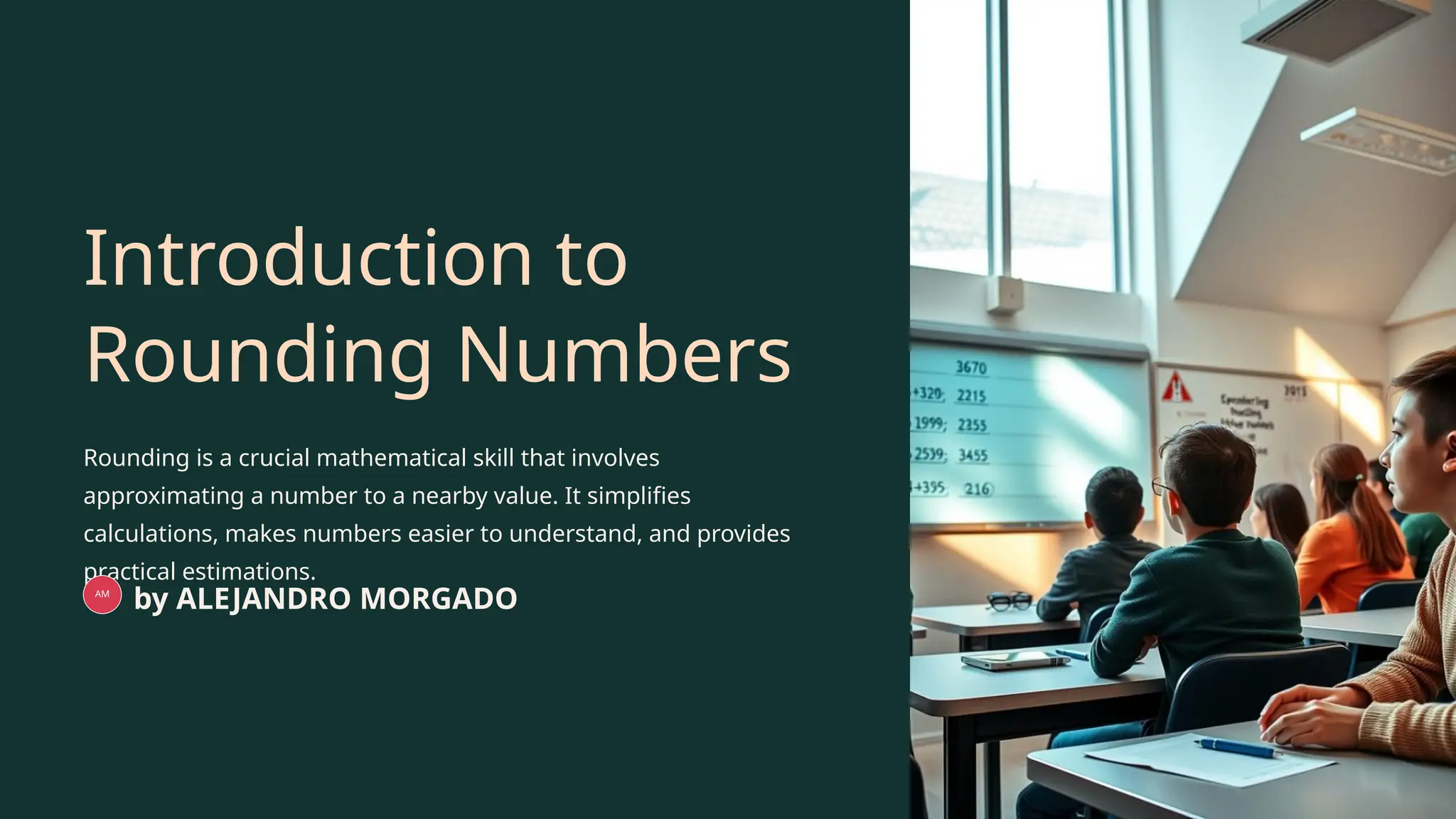
Roundingis a crucial mathematical skill that involves
approximating a number to a nearby value. It simplifies
calculations, makes numbers easier to understand, and provides
practical estimations.
AM
by ALEJANDRO MORGADO
2.
Importance of Rounding
Roundingis essential in various real-world scenarios, such as financial calculations,
scientific measurements, and everyday estimations. It helps simplify complex data, make
decisions based on approximate values, and communicate information effectively.
1 Simplified Calculations
Rounding makes calculations easier,
especially when working with large
numbers or decimals. It reduces the
complexity of operations, making
them more manageable.
2 Practical Estimations
Rounding provides quick and easy
estimations, which are useful for
making quick decisions or
understanding the general
magnitude of a value.
3 Data Presentation
Rounding helps present data in a
more concise and understandable
way. It removes unnecessary
precision and highlights the key
trends and patterns within the data.
4 Everyday Usage
Rounding is used in everyday
situations, such as when we
estimate the cost of groceries,
calculate tips, or measure
ingredients for recipes.
3.
Rounding to theNearest Whole
Number
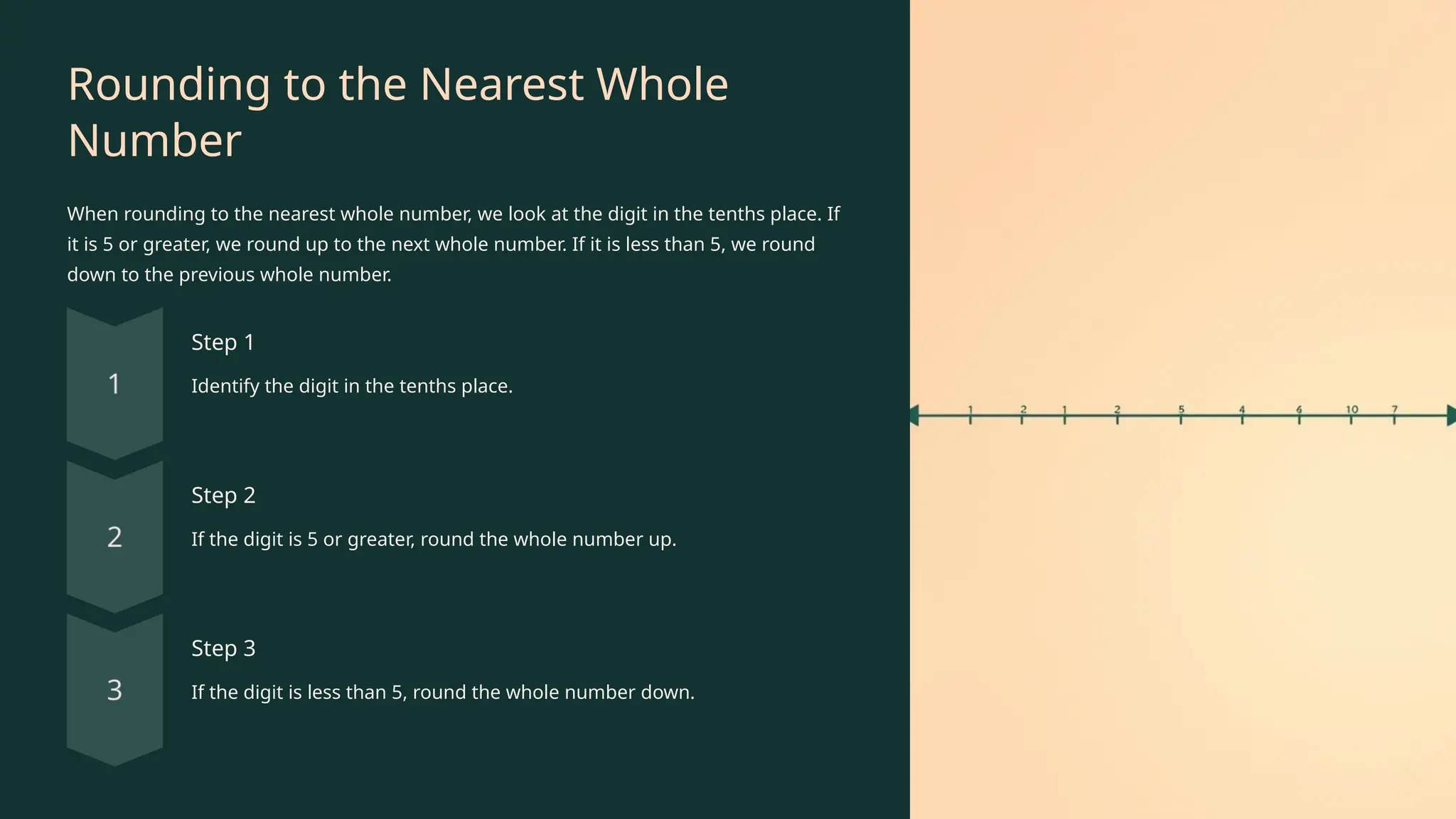
When rounding to the nearest whole number, we look at the digit in the tenths place. If
it is 5 or greater, we round up to the next whole number. If it is less than 5, we round
down to the previous whole number.
Step 1
Identify the digit in the tenths place.
Step 2
If the digit is 5 or greater, round the whole number up.
Step 3
If the digit is less than 5, round the whole number down.
4.
Rounding to aSpecific Place
Value
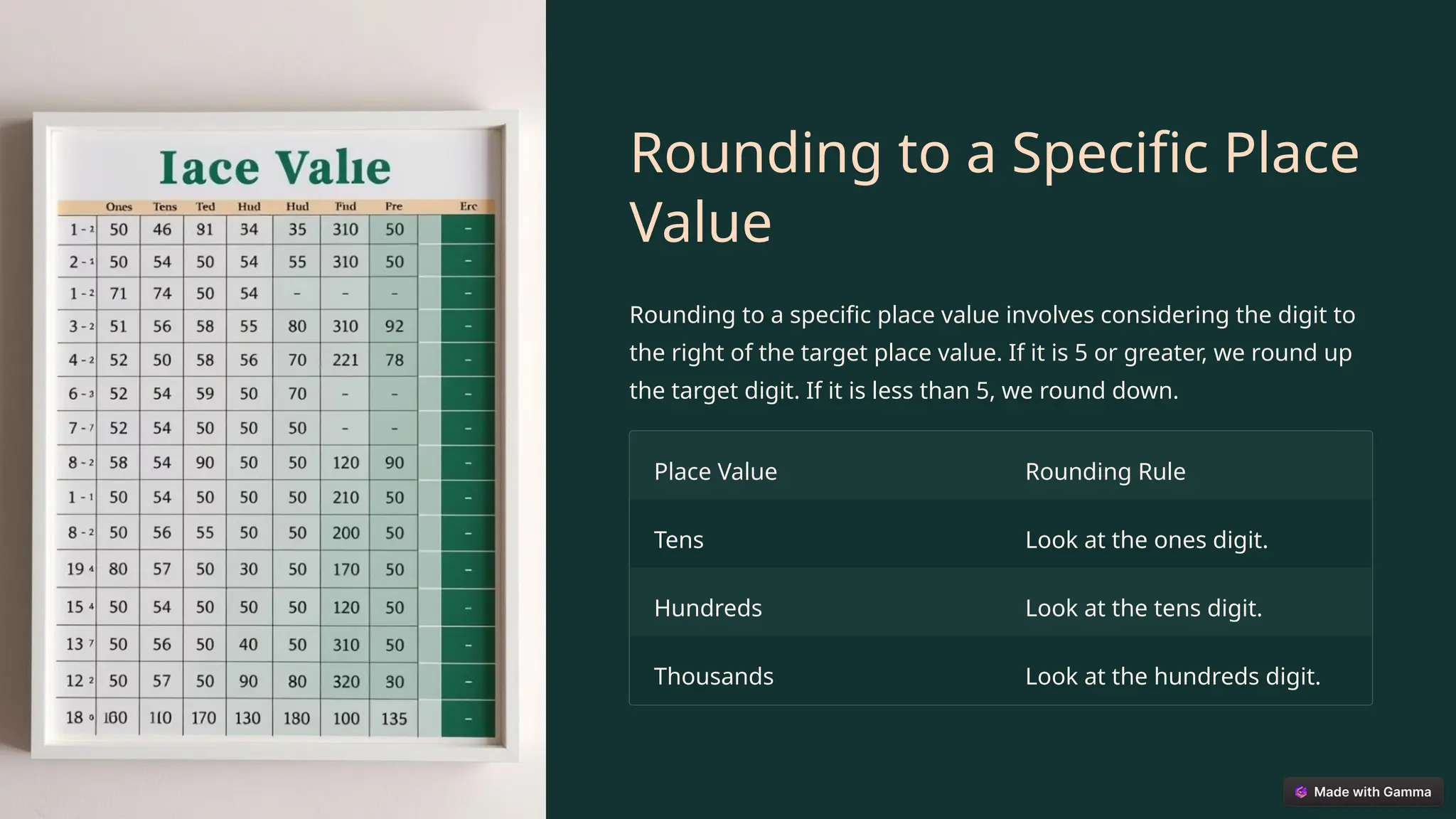
Rounding to a specific place value involves considering the digit to
the right of the target place value. If it is 5 or greater, we round up
the target digit. If it is less than 5, we round down.
Place Value Rounding Rule
Tens Look at the ones digit.
Hundreds Look at the tens digit.
Thousands Look at the hundreds digit.
5.
Rounding Decimals
Rounding decimalsfollows the same principles as rounding whole numbers. We consider the digit to the right of the
target place value and round up or down based on its value.
Rounding to the Nearest Tenth
Look at the digit in the hundredths
place.
Rounding to the Nearest
Hundredth
Look at the digit in the
thousandths place.
Rounding to the Nearest
Thousandth
Look at the digit in the ten-
thousandths place.
6.
Rounding for Estimation
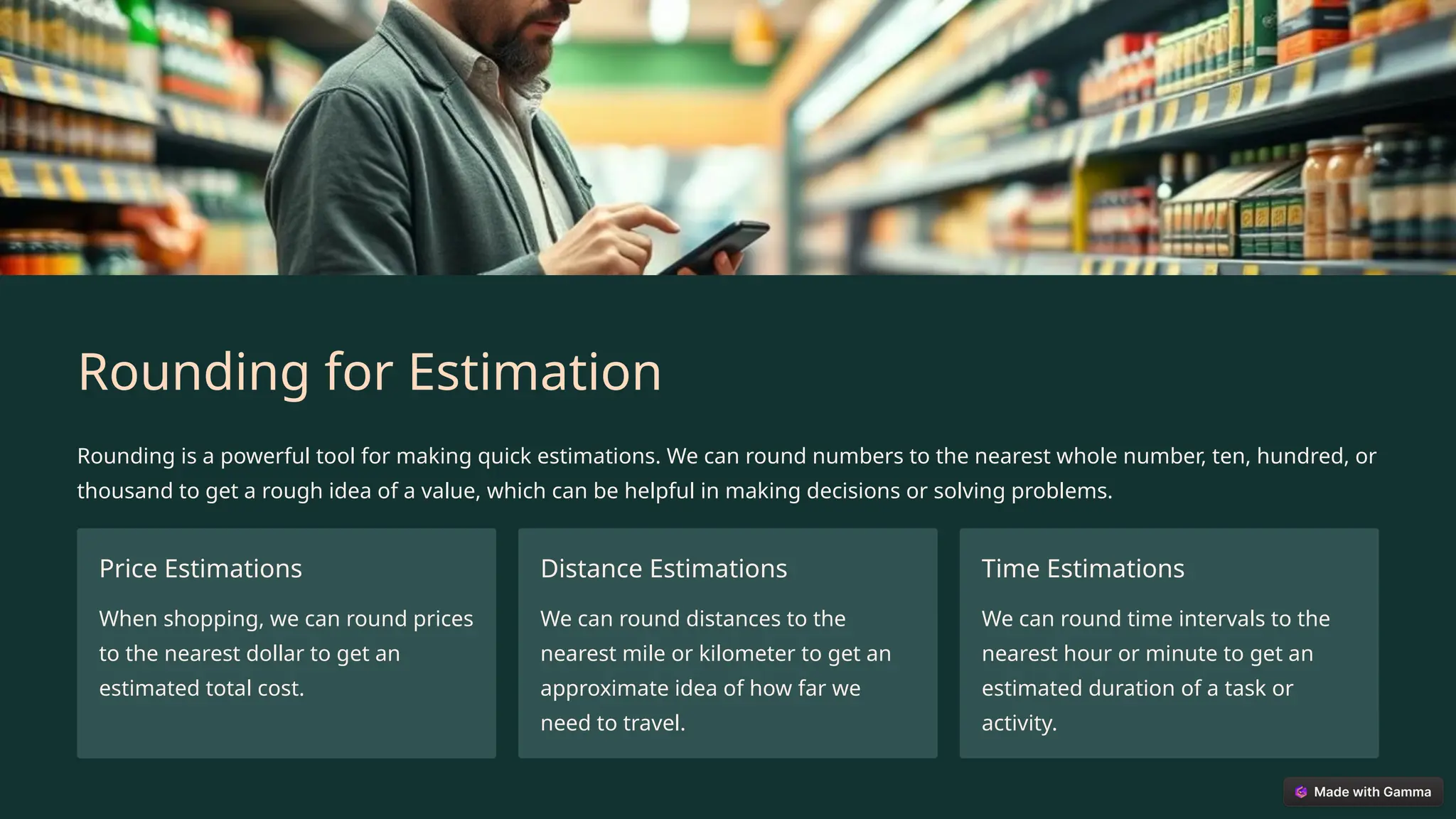
Roundingis a powerful tool for making quick estimations. We can round numbers to the nearest whole number, ten, hundred, or
thousand to get a rough idea of a value, which can be helpful in making decisions or solving problems.
Price Estimations
When shopping, we can round prices
to the nearest dollar to get an
estimated total cost.
Distance Estimations
We can round distances to the
nearest mile or kilometer to get an
approximate idea of how far we
need to travel.
Time Estimations
We can round time intervals to the
nearest hour or minute to get an
estimated duration of a task or
activity.
7.
Rounding in Real-WorldApplications
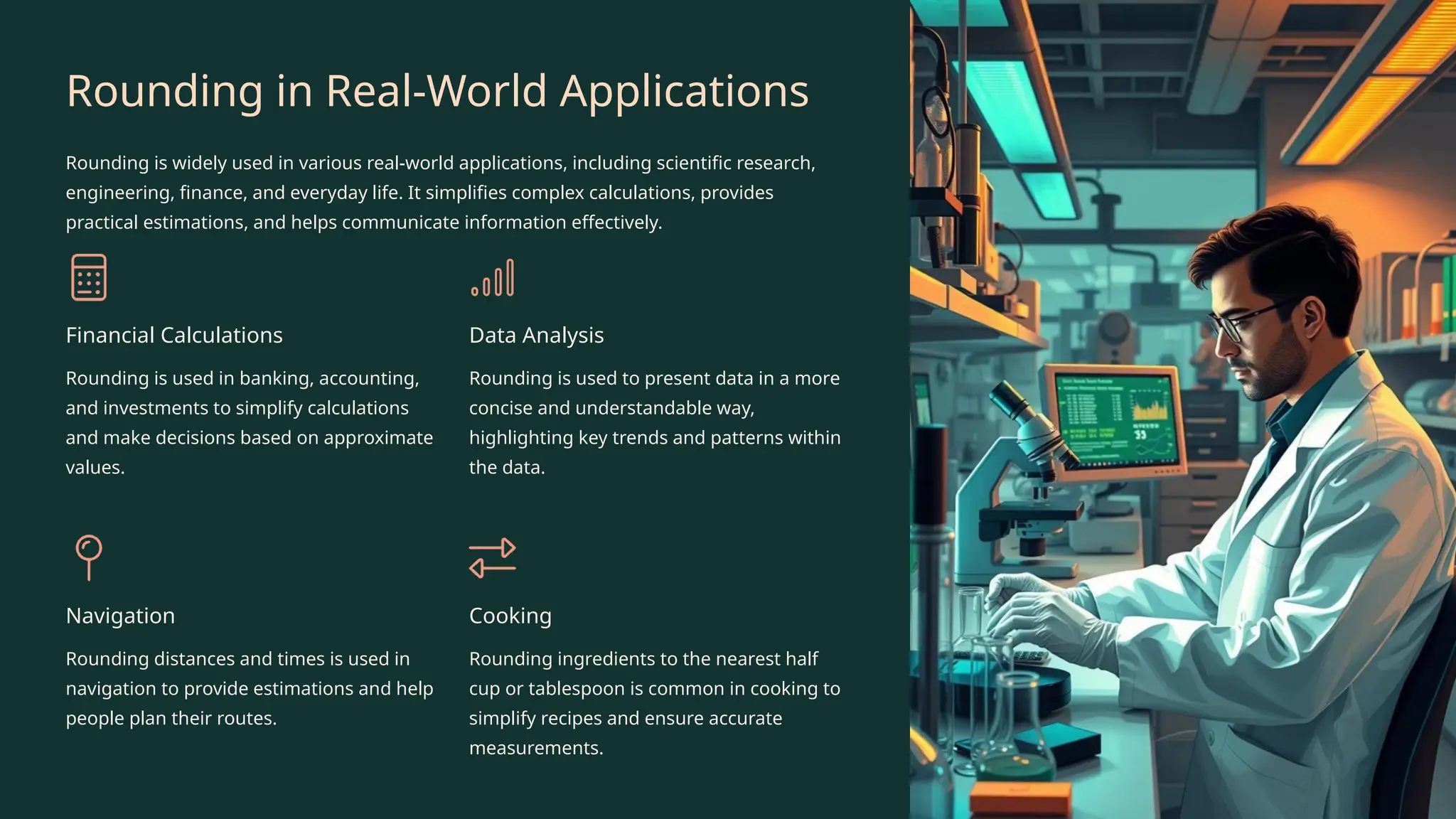
Rounding is widely used in various real-world applications, including scientific research,
engineering, finance, and everyday life. It simplifies complex calculations, provides
practical estimations, and helps communicate information effectively.
Financial Calculations
Rounding is used in banking, accounting,
and investments to simplify calculations
and make decisions based on approximate
values.
Data Analysis
Rounding is used to present data in a more
concise and understandable way,
highlighting key trends and patterns within
the data.
Navigation
Rounding distances and times is used in
navigation to provide estimations and help
people plan their routes.
Cooking
Rounding ingredients to the nearest half
cup or tablespoon is common in cooking to
simplify recipes and ensure accurate
measurements.
8.
Conclusion and KeyTakeaways
Rounding is an essential mathematical skill that simplifies calculations, provides practical estimations, and helps communicate information
effectively. It is widely used in various real-world applications and is a valuable tool for making quick decisions and understanding the general
magnitude of values.
1
Understand the Concept
Rounding involves approximating a
number to a nearby value, based on place
value and the digit to the right.
2
Apply Rounding Rules
Remember the rules for rounding based
on the target place value and the digit to
its right.
3
Recognize Real-World Applications
Rounding is essential for financial
calculations, data analysis, navigation,
cooking, and many other aspects of life.


![Are You On Targetstair[1]](https://cdn.slidesharecdn.com/ss_thumbnails/are-you-on-targetstair1-1214926814612364-8-thumbnail.jpg?width=640&height=640&fit=bounds)


