Approach to Extracorposcular Hemolytic
Anemia
Dr. Bikal Lamichhane
Internal medicine resident
Extracorpuscular defects
 those in which the RBCs are normal but are destroyed due to
 mechanical
 immunologic
 Infectious
 metabolic/oxidant damage.
These abnormalities are almost always acquired.
Exception is familial hemolytic-uremic syndrome (HUS; often referred
to as atypical HUS).
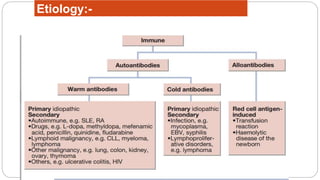
Etiology:-
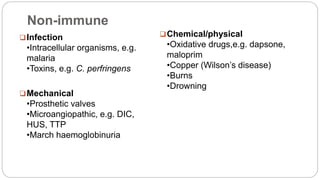
Non-immune
Infection
•Intracellular organisms, e.g.
malaria
•Toxins, e.g. C. perfringens
Mechanical
•Prosthetic valves
•Microangiopathic, e.g. DIC,
HUS, TTP
•March haemoglobinuria
Chemical/physical
•Oxidative drugs,e.g. dapsone,
maloprim
•Copper (Wilson’s disease)
•Burns
•Drowning
Immune Hemolytic Anemias
 can arise through at least two distinct mechanisms.
1.when an antibody directed against a certain molecule (e.g., a drug)
reacts with that molecule, red cells may get caught in the reaction (the
so-called innocent bystander mechanism)
2.a true auto-antibody is directed against a red cell antigen, i.e., a
molecule present on the surface of red cells .
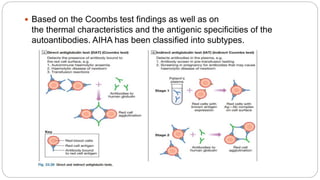
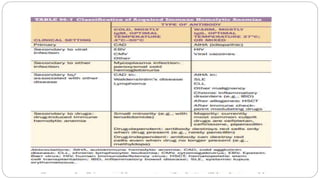
 Based on the Coombs test findings as well as on
the thermal characteristics and the antigenic specificities of the
autoantibodies. AIHA has been classified into subtypes.
 Warm Antibody AIHA
 more common type of AIHA.
 the auto-antibody reacts best at 37°C
 may be seen in isolation (and it is then called idiopathic) or as part of
a systemic auto-immune disorder such as systemic lupus
erythematosus (SLE)
 May be seen in chronic lymphocytic leukemia (CLL), after BMT; and
after solid organ transplantation entailing immuno-suppressive
treatment.
 As a side effect of the use of immune checkpoint inhibitors, such as
nivolumab, in patients with various types of cancer
 Once a red cell is coated by an autoantibody
 In most cases, the Fc portion of the antibody
will be recognized by the Fc receptor of macrophages, and this will
trigger erythrophagocytosis.
 Thus, destruction of red cells will take place wherever macrophages
are abundant, i.e., in the spleen, liver, and bone marrow.
 Spleen is the predominant site of red cell destruction.
 COLD AGGLUTININ DISEASE
 AIHA that usually affects the elderly.
 1. CAD is characteristically a chronic condition—in contrast to the abrupt
onset of warm antibody AIHA.
 Mediated by antibodies, usually IgM, which bind to the red cells at low
temperatures and cause them to agglutinate.
 May cause intravascular haemolysis if complement fixationoccurs.
 Can be chronic when the antibody is monoclonal,or acute or transient when
the antibody is polyclonal.
 The term cold refers to the fact that the autoantibody involved reacts with
red cells poorly or not at all at 37°C, whereas it reacts strongly at lower
temperatures.
 As a result, hemolysis is more prominent the more the body is exposed to
the cold.
 The antibody is usually IgM; usually it has
an anti-I specificity (the I antigen is present on the red cells of almost
everybody), and it may have a very high titer (1:100,000 or more has
been observed).
 The antibody is produced by an expanded B lymohocyte clone (a low-grade
mature B cell lymphoma) and sometimes the antibody concentration in the
serum is high enough to show up as a spike in plasma protein
electrophoresis, i.e., as a monoclonal gammopathy.

 Alloimmune haemolytic anaemia

Alloimmune haemolytic anaemia is caused by antibodies against
non-self red cells. It has two main causes, occurring after:

• unmatched blood transfusion.

• maternal sensitisation to paternal antigens on fetal cells
(haemolytic disease of the newbor).
 Non-immune haemolytic anaemia
• Mechanical heart valves. High flow through incompetent
valves or periprosthetic leaks through the suture ring
holding a valve in place result in shear stress damage.
• March haemoglobinuria. Vigorous exercise, such as
prolonged marching or marathon running, can cause red
cell damage in the capillaries in the feet.
• Thermal injury. Severe burns cause thermal damage to red
cells, characterised by fragmentation and the presence of
microspherocytes in the blood.
Microangiopathic haemolytic anaemia.
 Fibrin deposition in capillaries can cause severe red cell disruption.
 It may occur in a wide variety of conditions:
 Disseminated carcinomatosis,
 malignant or pregnancy-induced hypertension,
 haemolytic uraemic syndrome
 thrombotic thrombocytopenic purpura and
disseminated intravascular coagulation
Infection
 Plasmodium falciparum malaria .
 may be associated with intravascular haemolysis;
 Clostridium perfringens sepsis usually in the context of ascending
cholangitis or necrotising fasciitis, may cause severe intravascular
haemolysis with marked spherocytosis due to bacterial production
of a lecithinase that destroys the red cell membrane
 Chemicals or drugs
Dapsone and sulfasalazine cause haemolysis by oxidative
denaturation of haemoglobin.
 Denatured haemoglobin forms Heinz bodies in the red cells, visible
on supravital staining with brilliant cresyl blue.
 Arsenic gas, copper, chlorates, nitrites and nitrobenzene derivatives
may all cause haemolysis
Thank you

Approach to extracorpuscular hemolysis

  • 1.
    Approach to ExtracorposcularHemolytic Anemia Dr. Bikal Lamichhane Internal medicine resident
  • 2.
    Extracorpuscular defects  thosein which the RBCs are normal but are destroyed due to  mechanical  immunologic  Infectious  metabolic/oxidant damage. These abnormalities are almost always acquired. Exception is familial hemolytic-uremic syndrome (HUS; often referred to as atypical HUS).
  • 3.
  • 4.
    Non-immune Infection •Intracellular organisms, e.g. malaria •Toxins,e.g. C. perfringens Mechanical •Prosthetic valves •Microangiopathic, e.g. DIC, HUS, TTP •March haemoglobinuria Chemical/physical •Oxidative drugs,e.g. dapsone, maloprim •Copper (Wilson’s disease) •Burns •Drowning
  • 5.
    Immune Hemolytic Anemias can arise through at least two distinct mechanisms. 1.when an antibody directed against a certain molecule (e.g., a drug) reacts with that molecule, red cells may get caught in the reaction (the so-called innocent bystander mechanism) 2.a true auto-antibody is directed against a red cell antigen, i.e., a molecule present on the surface of red cells .
  • 6.
     Based onthe Coombs test findings as well as on the thermal characteristics and the antigenic specificities of the autoantibodies. AIHA has been classified into subtypes.
  • 7.
     Warm AntibodyAIHA  more common type of AIHA.  the auto-antibody reacts best at 37°C  may be seen in isolation (and it is then called idiopathic) or as part of a systemic auto-immune disorder such as systemic lupus erythematosus (SLE)  May be seen in chronic lymphocytic leukemia (CLL), after BMT; and after solid organ transplantation entailing immuno-suppressive treatment.  As a side effect of the use of immune checkpoint inhibitors, such as nivolumab, in patients with various types of cancer
  • 8.
     Once ared cell is coated by an autoantibody  In most cases, the Fc portion of the antibody will be recognized by the Fc receptor of macrophages, and this will trigger erythrophagocytosis.  Thus, destruction of red cells will take place wherever macrophages are abundant, i.e., in the spleen, liver, and bone marrow.  Spleen is the predominant site of red cell destruction.
  • 9.
     COLD AGGLUTININDISEASE  AIHA that usually affects the elderly.  1. CAD is characteristically a chronic condition—in contrast to the abrupt onset of warm antibody AIHA.  Mediated by antibodies, usually IgM, which bind to the red cells at low temperatures and cause them to agglutinate.  May cause intravascular haemolysis if complement fixationoccurs.  Can be chronic when the antibody is monoclonal,or acute or transient when the antibody is polyclonal.
  • 10.
     The termcold refers to the fact that the autoantibody involved reacts with red cells poorly or not at all at 37°C, whereas it reacts strongly at lower temperatures.  As a result, hemolysis is more prominent the more the body is exposed to the cold.  The antibody is usually IgM; usually it has an anti-I specificity (the I antigen is present on the red cells of almost everybody), and it may have a very high titer (1:100,000 or more has been observed).  The antibody is produced by an expanded B lymohocyte clone (a low-grade mature B cell lymphoma) and sometimes the antibody concentration in the serum is high enough to show up as a spike in plasma protein electrophoresis, i.e., as a monoclonal gammopathy.
  • 11.
  • 12.
     Alloimmune haemolyticanaemia  Alloimmune haemolytic anaemia is caused by antibodies against non-self red cells. It has two main causes, occurring after:  • unmatched blood transfusion.  • maternal sensitisation to paternal antigens on fetal cells (haemolytic disease of the newbor).
  • 13.
     Non-immune haemolyticanaemia • Mechanical heart valves. High flow through incompetent valves or periprosthetic leaks through the suture ring holding a valve in place result in shear stress damage. • March haemoglobinuria. Vigorous exercise, such as prolonged marching or marathon running, can cause red cell damage in the capillaries in the feet. • Thermal injury. Severe burns cause thermal damage to red cells, characterised by fragmentation and the presence of microspherocytes in the blood.
  • 14.
    Microangiopathic haemolytic anaemia. Fibrin deposition in capillaries can cause severe red cell disruption.  It may occur in a wide variety of conditions:  Disseminated carcinomatosis,  malignant or pregnancy-induced hypertension,  haemolytic uraemic syndrome  thrombotic thrombocytopenic purpura and disseminated intravascular coagulation
  • 15.
    Infection  Plasmodium falciparummalaria .  may be associated with intravascular haemolysis;  Clostridium perfringens sepsis usually in the context of ascending cholangitis or necrotising fasciitis, may cause severe intravascular haemolysis with marked spherocytosis due to bacterial production of a lecithinase that destroys the red cell membrane
  • 16.
     Chemicals ordrugs Dapsone and sulfasalazine cause haemolysis by oxidative denaturation of haemoglobin.  Denatured haemoglobin forms Heinz bodies in the red cells, visible on supravital staining with brilliant cresyl blue.  Arsenic gas, copper, chlorates, nitrites and nitrobenzene derivatives may all cause haemolysis
  • 17.