Evaluation of BleedingNormal or Abnormal Local or Systemic or mixed Primary (platelet, vessels) or Secondary (coagulation) hemostatic defect or mixed Inherited or Acquired or mixed
3.
History (1) Bleeding: age of onset, site, spontaneous, severity, duration, delayed, appropriate Previous trauma, tooth extraction, surgery, pregnancy Previous iron therapy, blood component transfusion, Vitamin K replacement Family history
4.
History (2) Generalhealth : disorder associated with a bleeding tendency (chronic liver or renal disease, connective tissue disorder, malabsorption syndrome, SLE, myeloproliferative disorder, leukemia, amyloidosis) Drugs (antiplatelet, warfarin, heparin, broad-spectrum antibiotics)
5.
History (3) Manynormal, healthy people consider their bleeding and bruising excessive. Miller et al (Blood 54 : 137, 1979) : 23% of the normal population had “positive” bleeding histories. Wahlberg et al (Methods Inf Med 19 : 194, 1980) : 65% of healthy women and 35% of healthy men answered “yes” to the question : “Do you suffer from a bleeding disorder ?”
6.
History (4) Noinformation unless specifically questioned (bleeding, medication) Mild to moderate abnormalities may not be recognized. Objective confirmation of subjective symptoms provides important data (e . g. Previous visiting to other physicians with laboratory data, previous blood component transfusion).
7.
Physical findings PetechiaeSigns of liver decompensation Telangiectasia in Osler-Weber-Rendu disease Petechiae around hair follicles in scurvy Hyperextensible joints and paper-thin scars in Ehlers-Danlos syndrome Skin plaques and scalloped tongue in amyloidosis Musculoskeletal defects in the hemophilias
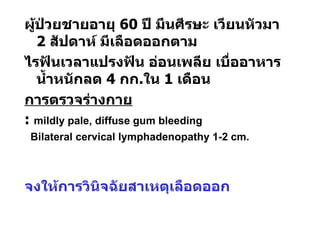
ผู้ป่วยชายอายุ 33 ปี มีไข้ต่ำๆ 2 สัปดาห์ ร่วมกับเหนื่อยง่าย ปัสสาวะสีเหลืองเข้มขึ้น ตรวจร่างกาย T 38 o c, BP 120/80 Drowsy, moderately pale, mild jaundice, no petechiae Liver & spleen not palpable NS - no focal neurological deficit CBC: Hb 5.5 g/dl,Hct 16%, Wbc 8000, Platelet 10,000/mm 3 จงให้การวินิจฉัยแยกโรค การส่งตรวจเพิ่มเติม
14.
Causes of Thrombocytopenia Pseudothrombocytopenia Decreased production Increased destruction Dilutional or distributional thrombocytopenia
15.
Pseudothrombocytopenia Normal totalplatelet mass Normal platelet number in circulation Causes Inadequate anticoagulated blood sample EDTA-induced platelet clumping Giant platelet Platelet satellitism
Hx & PEDiagnostic Clues of Thrombocytopenia Fever Septicemia(bacteremia, fungemia); viral inf.; malaria and other parasitic inf., HIV inf Lymphoma or other neoplasms Active rheumatic disorders TTP
22.
Night sweats orweight loss Lymphoma; HIV inf.; occult inf. Risk factors for HIV HIV-associated thrombocytopenia Hx & PE Diagnostic Clues of Thrombocytopenia
23.
Pregnancy gestational thrombocytopenia(incidentalthrombocytopenia) Preeclampsia DIC (abruptio placentae, amniotic fluid embolism, preeclampsia/eclampsia, chorioamnionitis, fetal death) ITP type 2B vWD Hx & PE Diagnostic Clues of Thrombocytopenia
24.
Thrombocytopenia : PHYSICALEXAM. General Severity of bleeding : eye ground , focal neurological deficit, wet purpura Clue to diagnosis : splenomegaly , lymphadenopathy , signs of chronic liver disease, SLE
Hyperviscosity Plasma componentMonoclonal gammopathy : IgM (Waldenstrom’s macroglobulinemia) , IgG (Multiple myeloma) Mucosal bleeding , neurologic , ocular symptoms The severity of the syndrome is not directly related to the serum viscosity Rx : Plasmapheresis, Chemotherapy Cellular component