Appreciative
inquiry coaching
Coaching training
Balance
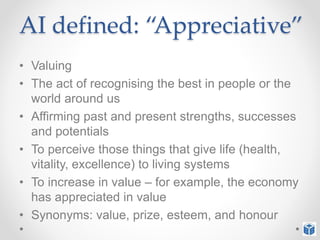
AI defined: “Appreciative”
• Valuing
• The act of recognising the best in people or the
world around us
• Affirming past and present strengths, successes
and potentials
• To perceive those things that give life (health,
vitality, excellence) to living systems
• To increase in value – for example, the economy
has appreciated in value
• Synonyms: value, prize, esteem, and honour
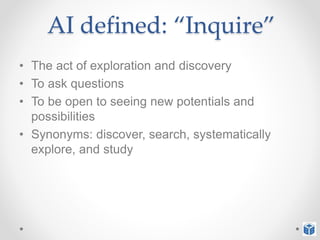
AI defined: “Inquire”
• The act of exploration and discovery
• To ask questions
• To be open to seeing new potentials and
possibilities
• Synonyms: discover, search, systematically
explore, and study
Core principles of AI
Constructionist
• Words create worlds
• Reality is constructed through language
Simultaneity
• Whatever we focus on, grows
• Focus on success we create more success
• Focus on problems we create more problems
Core principles of AI
Anticipatory
• Change begins the moment we ask questions
• Inquiry is intervention
• All questions are leading questions
Poetic
• Image inspires action
• Human systems move towards images of their
future
• Positive images create positive futures
Core principles of AI
Positive
• The Positive Core consists of strengths,
achievements, unexplored potentials, and
assets
• Building strengths is more effective than
correcting weaknesses
Emergent principles of AI
Wholeness
• Wholeness brings out the best
• We are part of a bigger ‘whole’ or an inter-
connected web of relationships
Enactment
• Just try it
• We must ‘be the change we want to see’
• Just try a new behaviour that aligns with what
you want, and build from there
Emergent principles of AI
Free Choice
• Free choice liberates power
• When free to choose people are more
committed to perform
• Free choice stimulates excellence and positive
change
Awareness
• Social and self-awareness
• Reflection on ‘automatic thinking’ is important
Emergent principles of AI
Narrative
• We construct stories about our lives
• Stories are transformative
• We can change our stories to help bring us more
of what we want
5 Core processes of AI
1. Choose the positive as the focus of inquiry
2. Inquire into stories of life-giving forces
3. Locate themes that appear in the stories and
select topics for further inquiry
4. Create shared images for a desired future
5. Find innovative ways to create that future
4 Key processes of AI
1. Discover…
• Mobilising the whole system by engaging all
parts of the system in telling the story of the
system’s strengths and potential
• Identify the best of what has been (past) or what
is (current)
• This part of the process focusses on the past
and present…
4 Key processes of AI
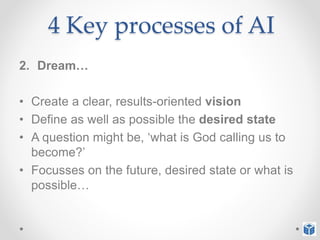
2. Dream…
• Create a clear, results-oriented vision
• Define as well as possible the desired state
• A question might be, ‘what is God calling us to
become?’
• Focusses on the future, desired state or what is
possible…
4 Key processes of AI
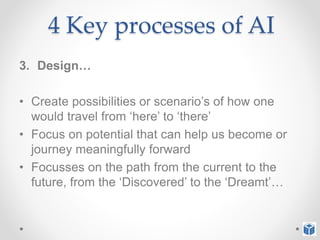
3. Design…
• Create possibilities or scenario’s of how one
would travel from ‘here’ to ‘there’
• Focus on potential that can help us become or
journey meaningfully forward
• Focusses on the path from the current to the
future, from the ‘Discovered’ to the ‘Dreamt’…
4 Key processes of AI
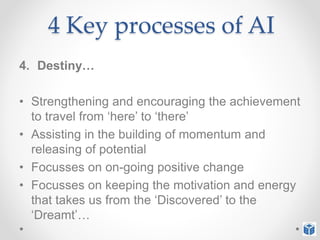
4. Destiny…
• Strengthening and encouraging the achievement
to travel from ‘here’ to ‘there’
• Assisting in the building of momentum and
releasing of potential
• Focusses on on-going positive change
• Focusses on keeping the motivation and energy
that takes us from the ‘Discovered’ to the
‘Dreamt’…
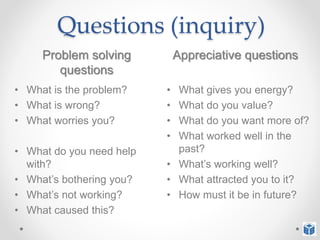
Problem solving
questions
Appreciative questions
• What is the problem?
• What is wrong?
• What worries you?
• What do you need help
with?
• What’s bothering you?
• What’s not working?
• What caused this?
• What gives you energy?
• What do you value?
• What do you want more of?
• What worked well in the
past?
• What’s working well?
• What attracted you to it?
• How must it be in future?
Questions (inquiry)

Appreciative inquiry ppt

  • 1.
  • 2.
    AI defined: “Appreciative” •Valuing • The act of recognising the best in people or the world around us • Affirming past and present strengths, successes and potentials • To perceive those things that give life (health, vitality, excellence) to living systems • To increase in value – for example, the economy has appreciated in value • Synonyms: value, prize, esteem, and honour
  • 3.
    AI defined: “Inquire” •The act of exploration and discovery • To ask questions • To be open to seeing new potentials and possibilities • Synonyms: discover, search, systematically explore, and study
  • 4.
    Core principles ofAI Constructionist • Words create worlds • Reality is constructed through language Simultaneity • Whatever we focus on, grows • Focus on success we create more success • Focus on problems we create more problems
  • 5.
    Core principles ofAI Anticipatory • Change begins the moment we ask questions • Inquiry is intervention • All questions are leading questions Poetic • Image inspires action • Human systems move towards images of their future • Positive images create positive futures
  • 6.
    Core principles ofAI Positive • The Positive Core consists of strengths, achievements, unexplored potentials, and assets • Building strengths is more effective than correcting weaknesses
  • 7.
    Emergent principles ofAI Wholeness • Wholeness brings out the best • We are part of a bigger ‘whole’ or an inter- connected web of relationships Enactment • Just try it • We must ‘be the change we want to see’ • Just try a new behaviour that aligns with what you want, and build from there
  • 8.
    Emergent principles ofAI Free Choice • Free choice liberates power • When free to choose people are more committed to perform • Free choice stimulates excellence and positive change Awareness • Social and self-awareness • Reflection on ‘automatic thinking’ is important
  • 9.
    Emergent principles ofAI Narrative • We construct stories about our lives • Stories are transformative • We can change our stories to help bring us more of what we want
  • 10.
    5 Core processesof AI 1. Choose the positive as the focus of inquiry 2. Inquire into stories of life-giving forces 3. Locate themes that appear in the stories and select topics for further inquiry 4. Create shared images for a desired future 5. Find innovative ways to create that future
  • 11.
    4 Key processesof AI 1. Discover… • Mobilising the whole system by engaging all parts of the system in telling the story of the system’s strengths and potential • Identify the best of what has been (past) or what is (current) • This part of the process focusses on the past and present…
  • 12.
    4 Key processesof AI 2. Dream… • Create a clear, results-oriented vision • Define as well as possible the desired state • A question might be, ‘what is God calling us to become?’ • Focusses on the future, desired state or what is possible…
  • 13.
    4 Key processesof AI 3. Design… • Create possibilities or scenario’s of how one would travel from ‘here’ to ‘there’ • Focus on potential that can help us become or journey meaningfully forward • Focusses on the path from the current to the future, from the ‘Discovered’ to the ‘Dreamt’…
  • 14.
    4 Key processesof AI 4. Destiny… • Strengthening and encouraging the achievement to travel from ‘here’ to ‘there’ • Assisting in the building of momentum and releasing of potential • Focusses on on-going positive change • Focusses on keeping the motivation and energy that takes us from the ‘Discovered’ to the ‘Dreamt’…
  • 15.
    Problem solving questions Appreciative questions •What is the problem? • What is wrong? • What worries you? • What do you need help with? • What’s bothering you? • What’s not working? • What caused this? • What gives you energy? • What do you value? • What do you want more of? • What worked well in the past? • What’s working well? • What attracted you to it? • How must it be in future? Questions (inquiry)