Finding informationApplied Science
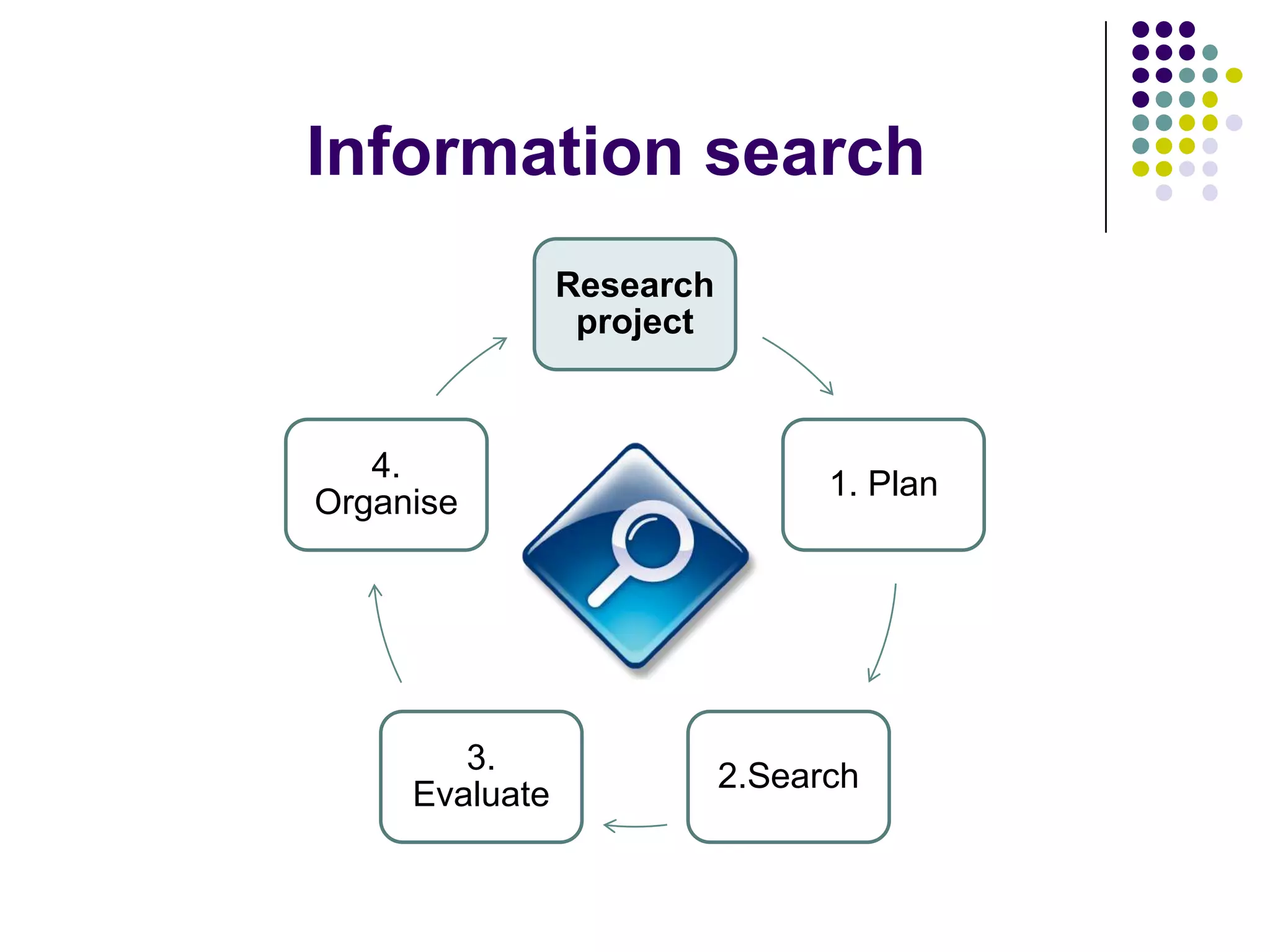
   Information search
		Stage 1. Plan Think of key concept.Define key elements, sub-topics.Identify key words, phrases, peopleList associated/alternative words, spellingsSet limits: time, place
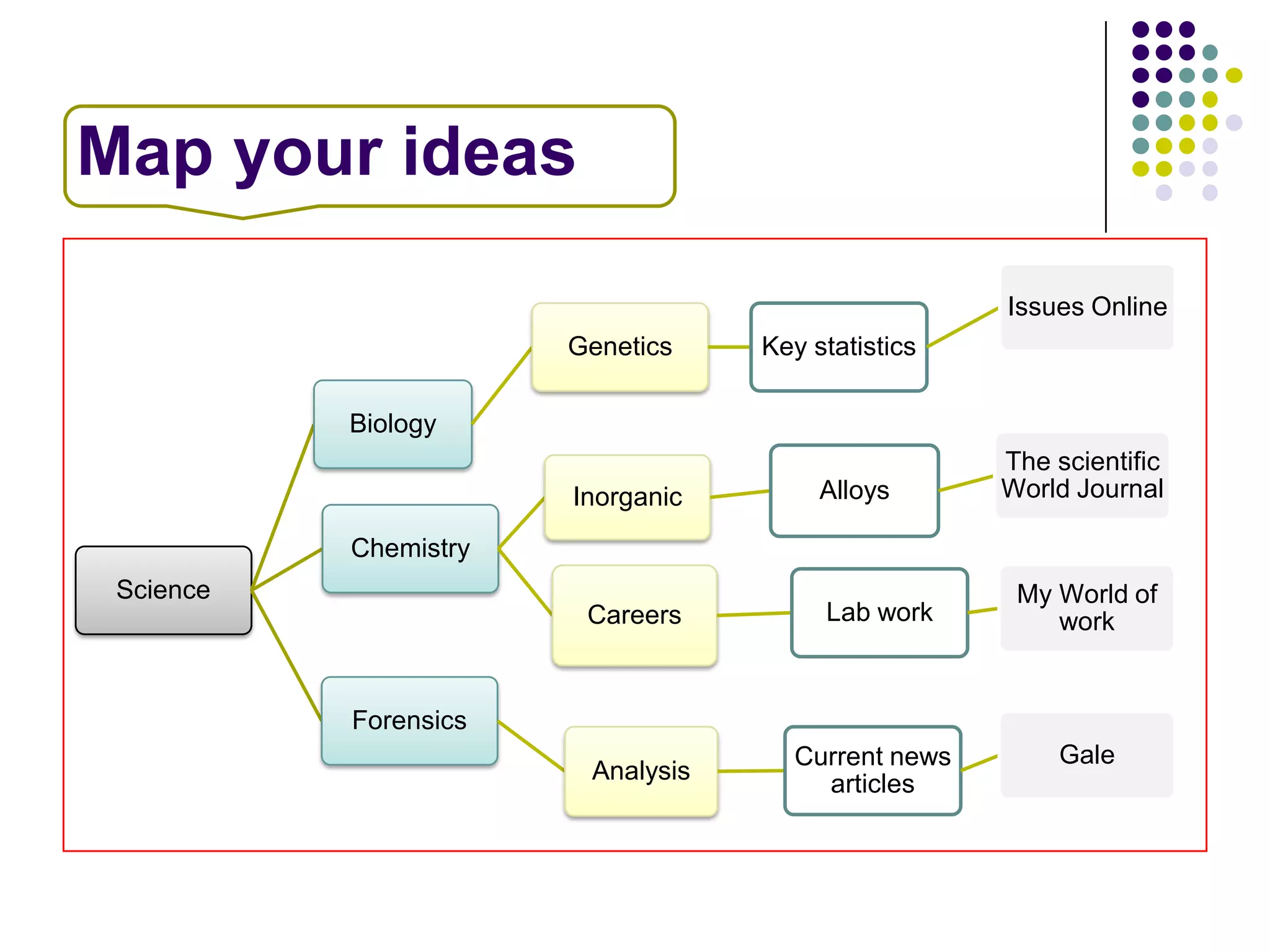
Map your ideas
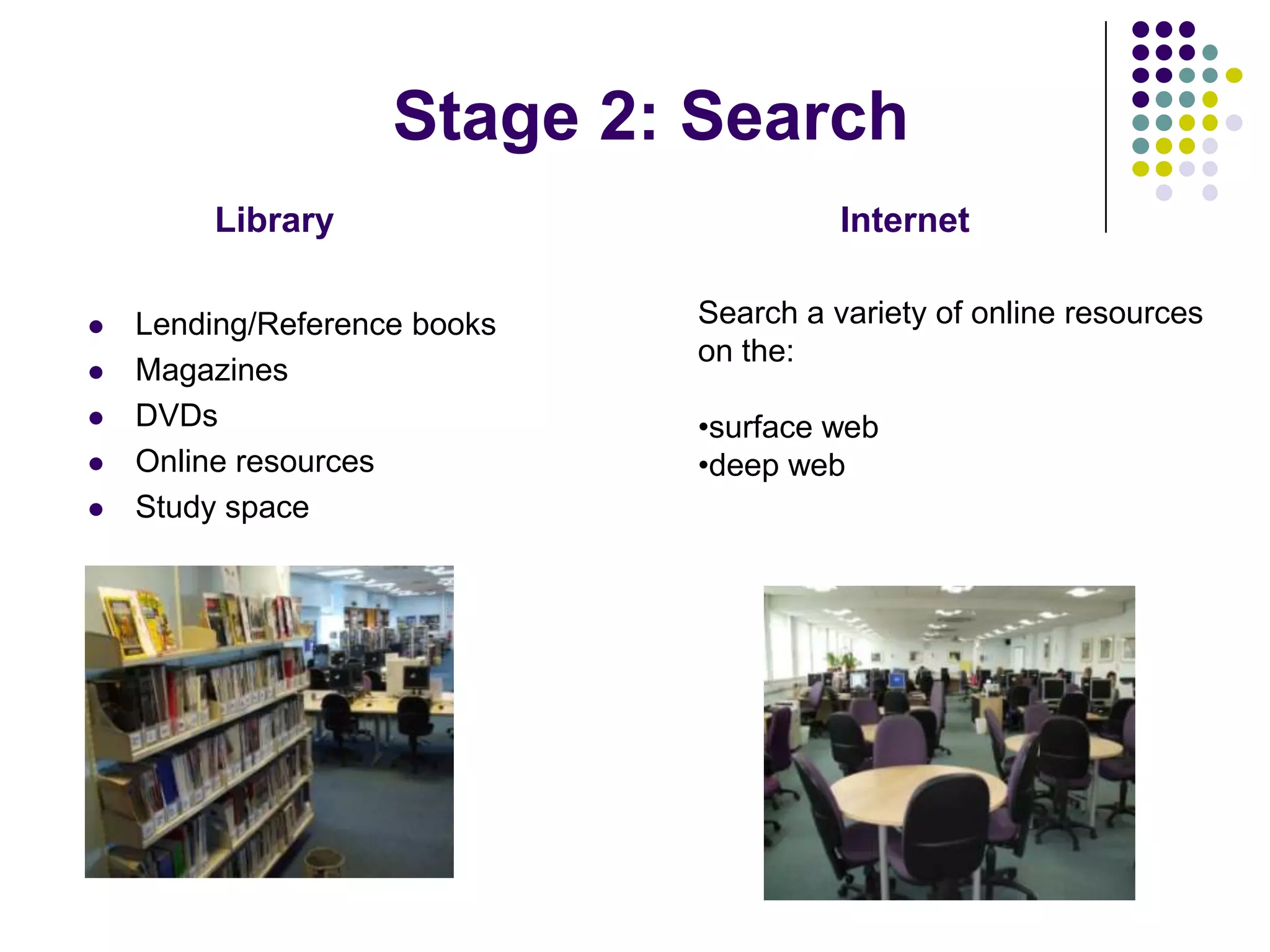
									Stage 2: Search Library				InternetLending/Reference booksMagazinesDVDsOnline resourcesStudy spaceSearch a variety of online resources on the:surface web
deep webSearching the webPopular search enginesBing		http://www.bing.comGoogle	http://www.google.comThe surface web may not present all the results you expect orrequire. Often information is hidden deeper and within specialDatabases.The deep web contains information that cannot easily be found or retrieved by search engines as the information is stored and contained within databases.
Access identificationOpen Athens / MyAthenshttp://www.openathens.netApply for an accountLogin to MyAthensEnter UsernameEnter passwordSelect resourcesSecure/remote access
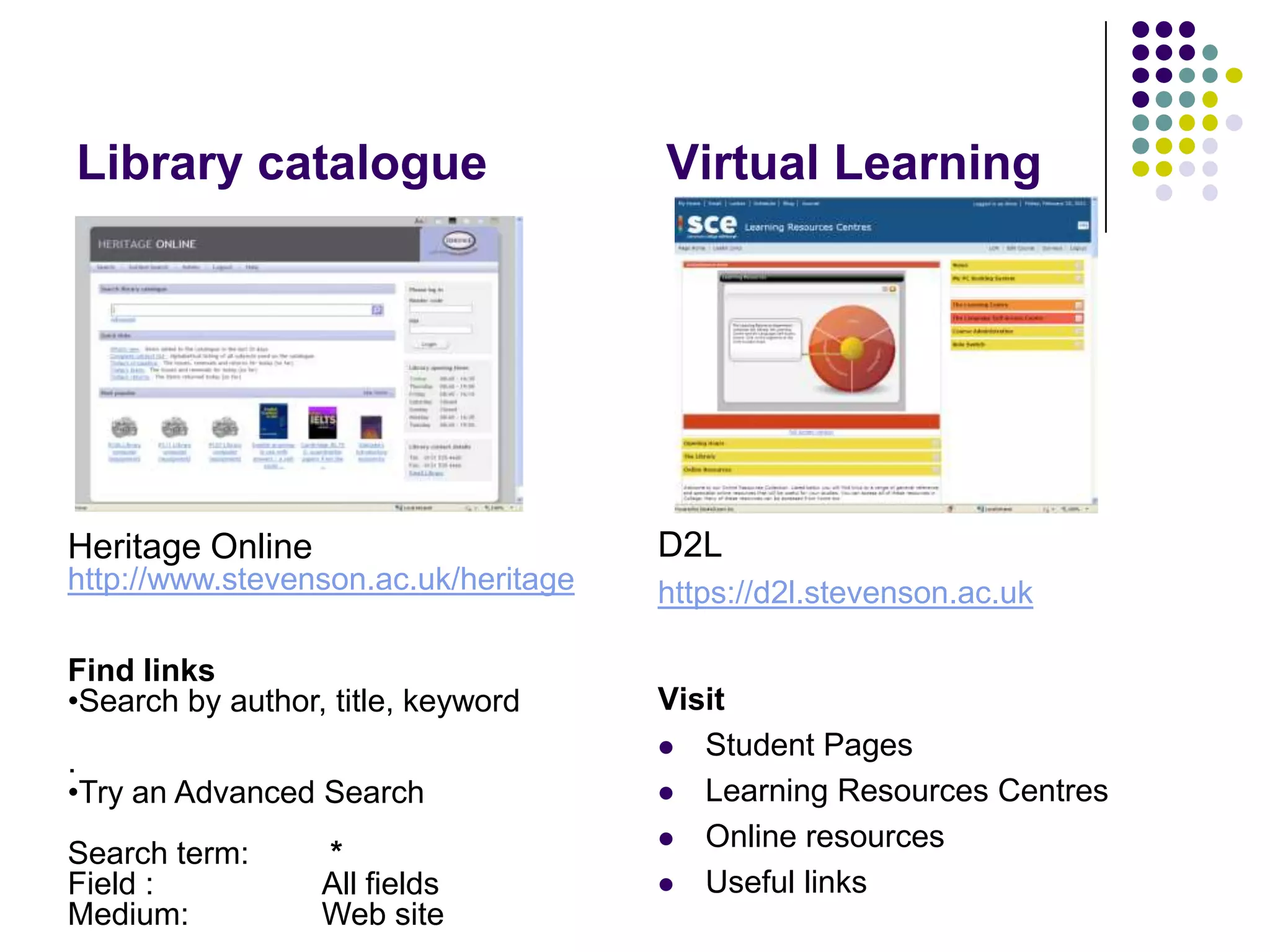
Library catalogue	      Virtual LearningD2Lhttps://d2l.stevenson.ac.ukVisit Student PagesLearning Resources CentresOnline resourcesUseful linksHeritage Onlinehttp://www.stevenson.ac.uk/heritageFind links Search by author, title, keyword.Try an Advanced SearchSearch term:	 *Field :		All fields Medium: 	Web site
DatabasesSearch some of the databases that follow.(All these databases are listed on the library catalogue).
Electronic BooksEbraryhttp://site.ebrary.com/lib/stevenson/home.actionSearch over 3000 titles: 	eg. astronomy, evolution, human biology, polymersBrowse – all subjects  	select a subject: eg.  Science	then select a sub-category:  physics	select a title & read text on screen	***Athens account required to access Bookshelf and highlighter pen**Watch the training video: http://www.ebrary.com/corp/collateral/flash/QuickStart/
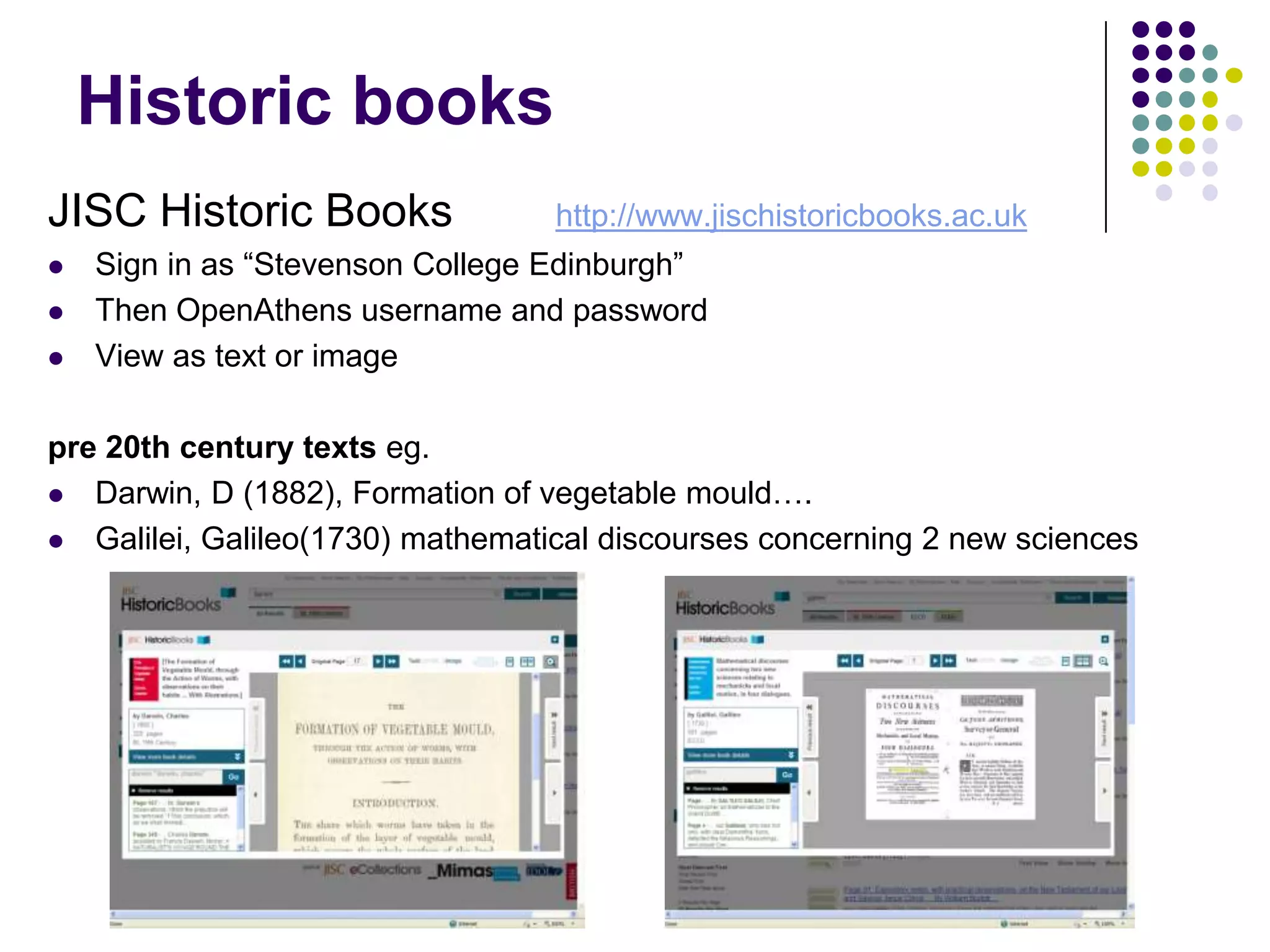
Historic booksJISC Historic Books	http://www.jischistoricbooks.ac.ukSign in as “Stevenson College Edinburgh”Then OpenAthens username and passwordView as text or imagepre 20th century texts eg.Darwin, D (1882), Formation of vegetable mould….Galilei, Galileo(1730) mathematical discourses concerning 2 new sciences
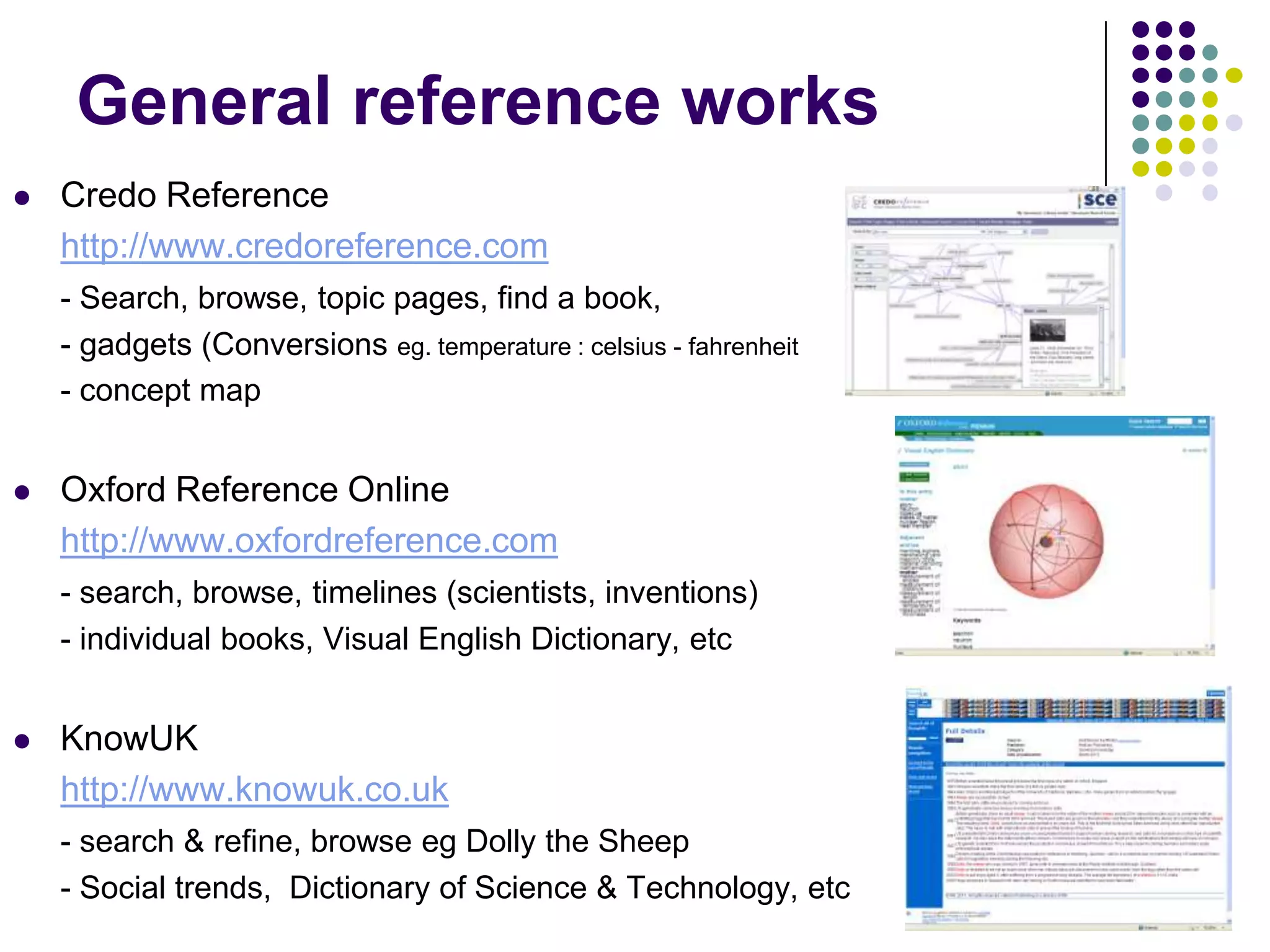
General reference worksCredo Referencehttp://www.credoreference.com- Search, browse, topic pages, find a book,	- gadgets (Conversions eg. temperature : celsius - fahrenheit	- concept map Oxford Reference Onlinehttp://www.oxfordreference.com- search, browse, timelines (scientists, inventions)	- individual books, Visual English Dictionary, etcKnowUKhttp://www.knowuk.co.uk- search & refine, browse eg Dolly the Sheep	- Social trends,  Dictionary of Science & Technology, etc
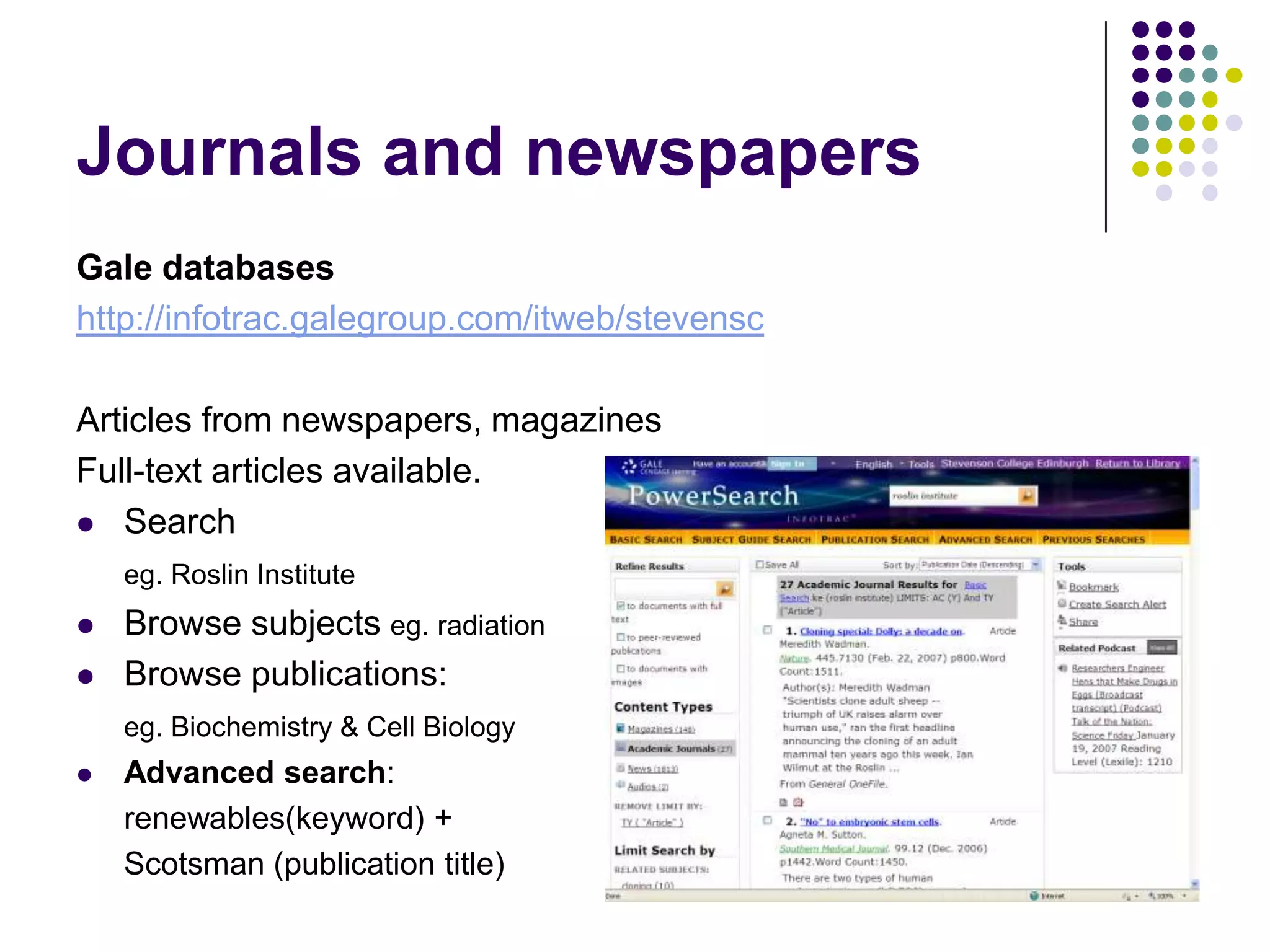
Journals and newspapersGale databaseshttp://infotrac.galegroup.com/itweb/stevenscArticles from newspapers, magazines Full-text articles available.Searcheg. Roslin InstituteBrowse subjects eg. radiationBrowse publications: eg. Biochemistry & Cell BiologyAdvanced search: 	renewables(keyword) +	Scotsman (publication title)
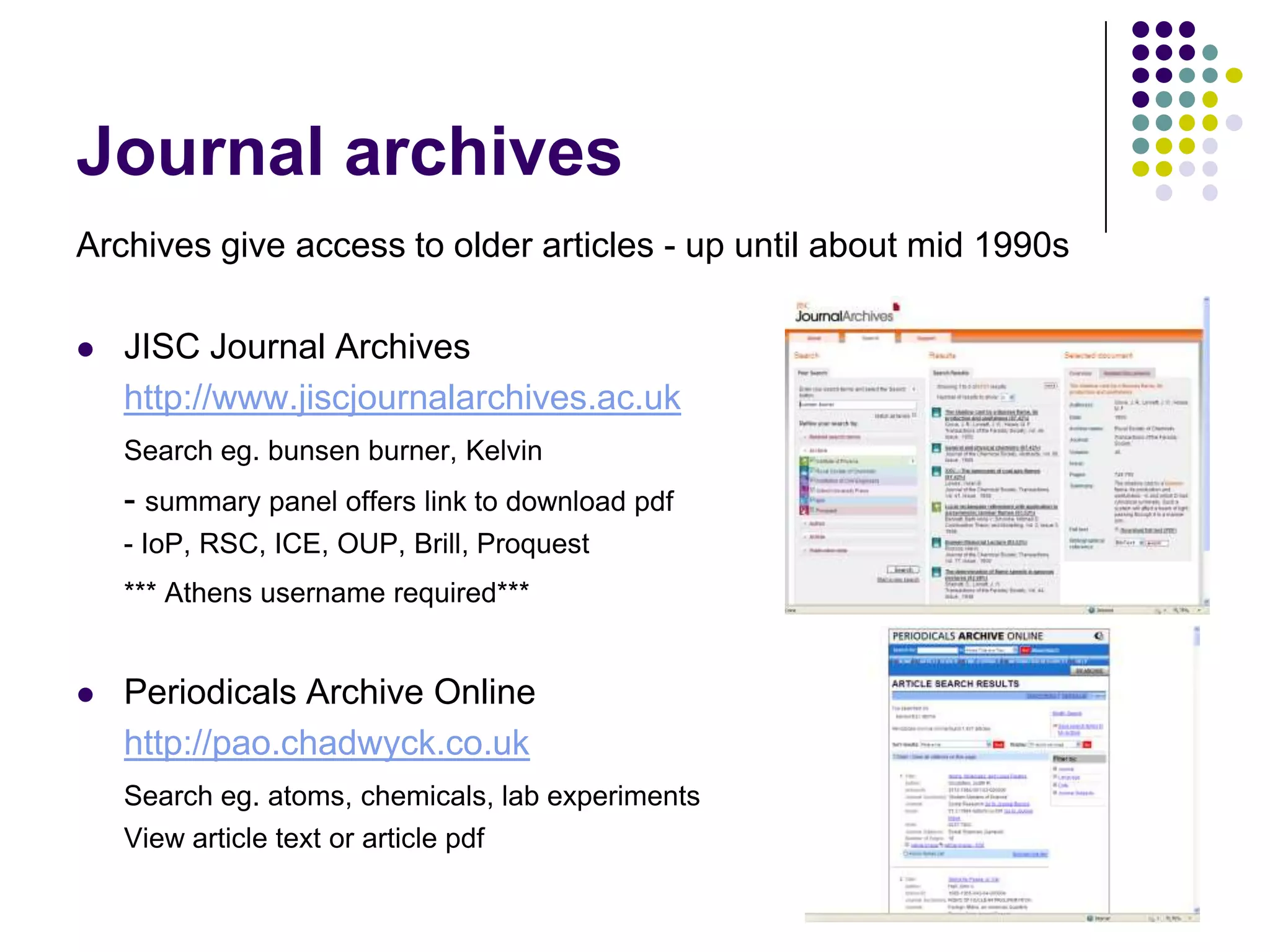
Journal archivesArchives give access to older articles - up until about mid 1990sJISC Journal Archiveshttp://www.jiscjournalarchives.ac.ukSearch eg. bunsen burner, Kelvin	- summary panel offers link to download pdf	- IoP, RSC, ICE, OUP, Brill, Proquest*** Athens username required***Periodicals Archive Onlinehttp://pao.chadwyck.co.ukSearch eg. atoms, chemicals, lab experiments	View article text or article pdf
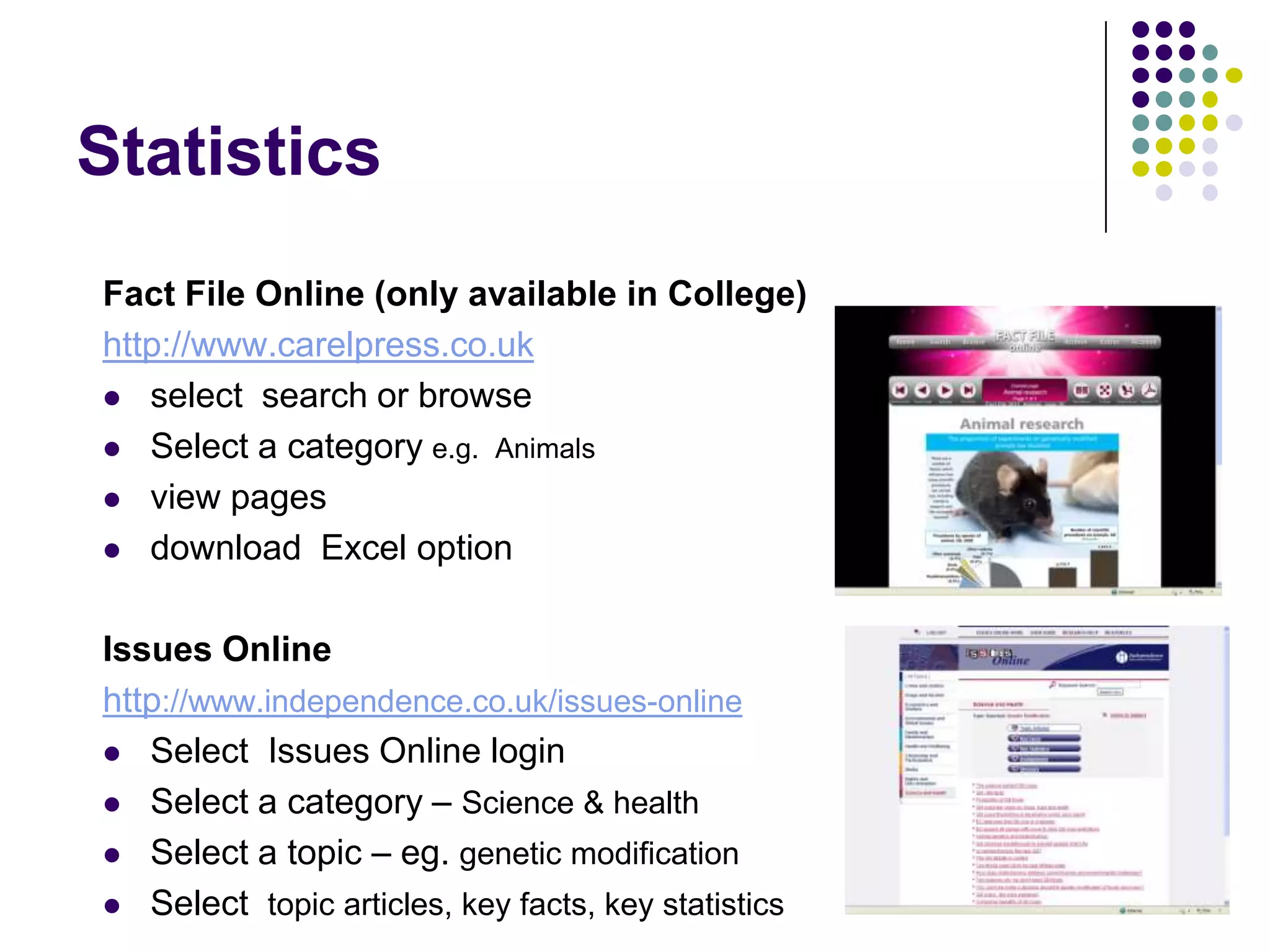
StatisticsFact File Online (only available in College)http://www.carelpress.co.ukselect  search or browseSelect a category e.g.  Animalsview pagesdownload  Excel optionIssues Onlinehttp://www.independence.co.uk/issues-onlineSelect  Issues Online loginSelect a category – Science & healthSelect a topic – eg. genetic modificationSelect  topic articles, key facts, key statistics
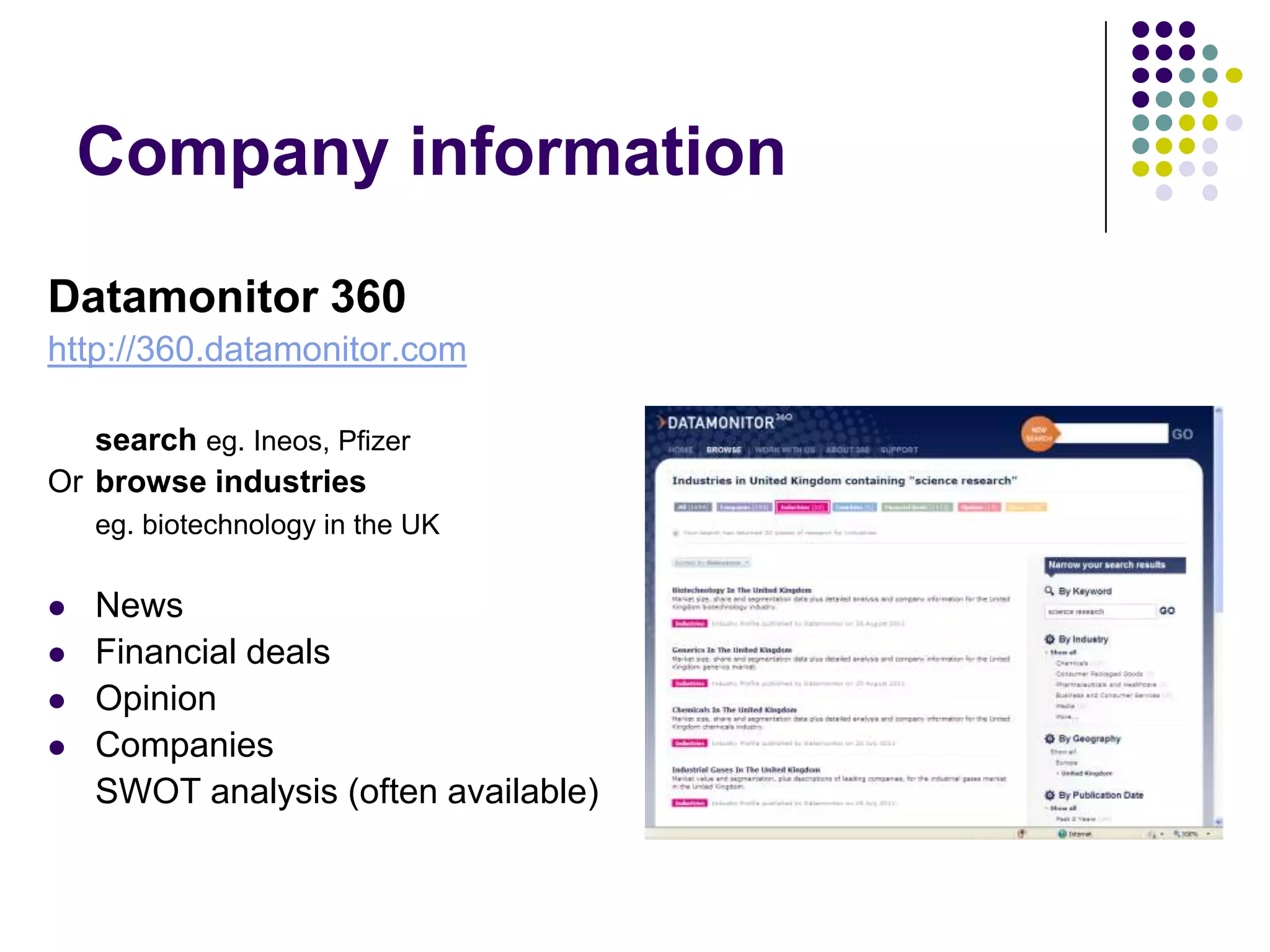
Company informationDatamonitor 360http://360.datamonitor.com	search eg. Ineos, PfizerOr 	browseindustrieseg. biotechnology in the UKNewsFinancial dealsOpinionCompanies	SWOT analysis (often available)
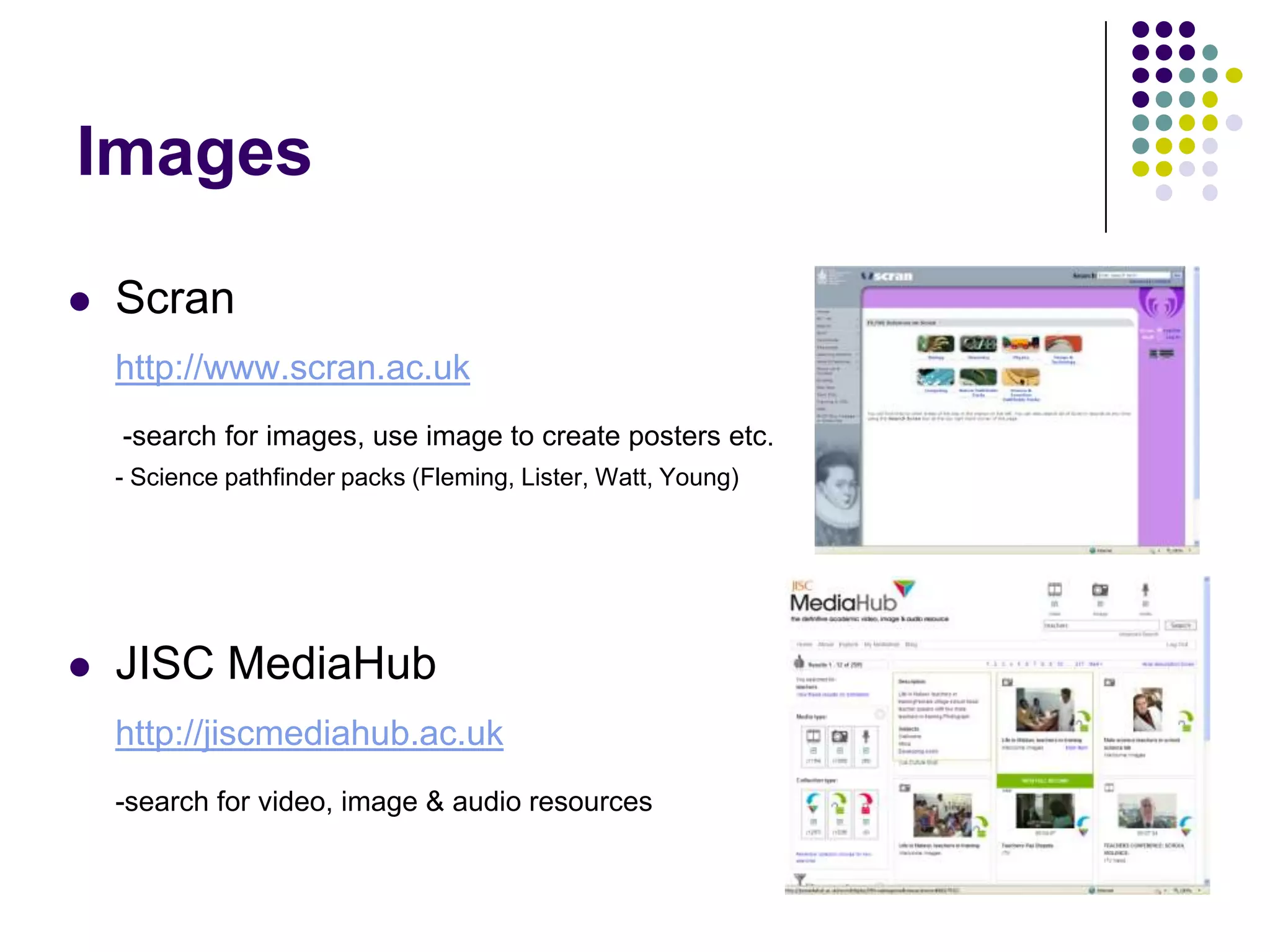
ImagesScranhttp://www.scran.ac.uk -search for images, use image to create posters etc.	- Science pathfinder packs (Fleming, Lister, Watt, Young)JISC MediaHubhttp://jiscmediahub.ac.uk-search for video, image & audio resources
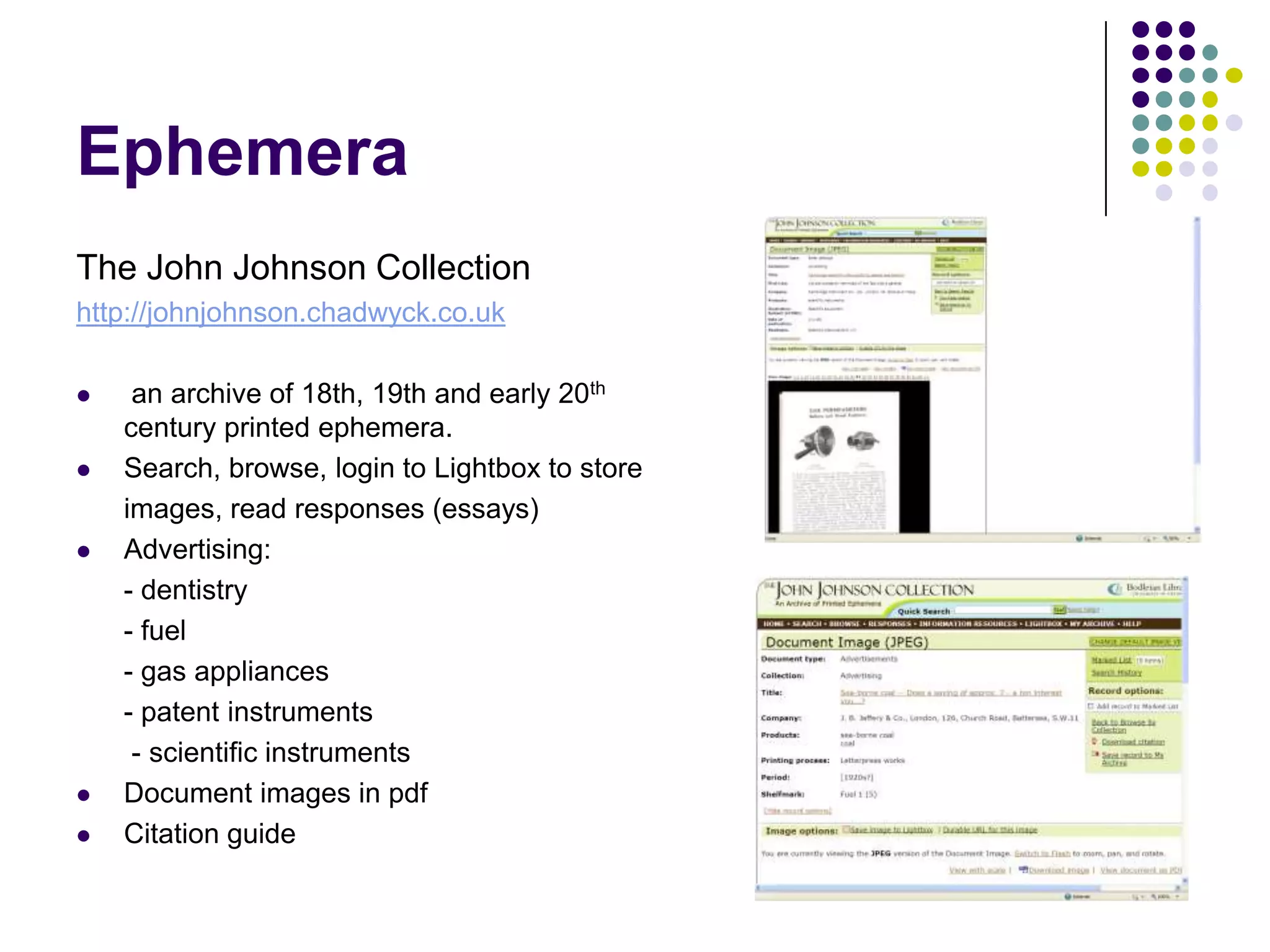
EphemeraThe John Johnson Collectionhttp://johnjohnson.chadwyck.co.uk an archive of 18th, 19th and early 20th century printed ephemera.Search, browse, login to Lightbox to store	images, read responses (essays)Advertising:	- dentistry	- fuel	- gas appliances	- patent instruments	 - scientific instrumentsDocument images in pdfCitation guide
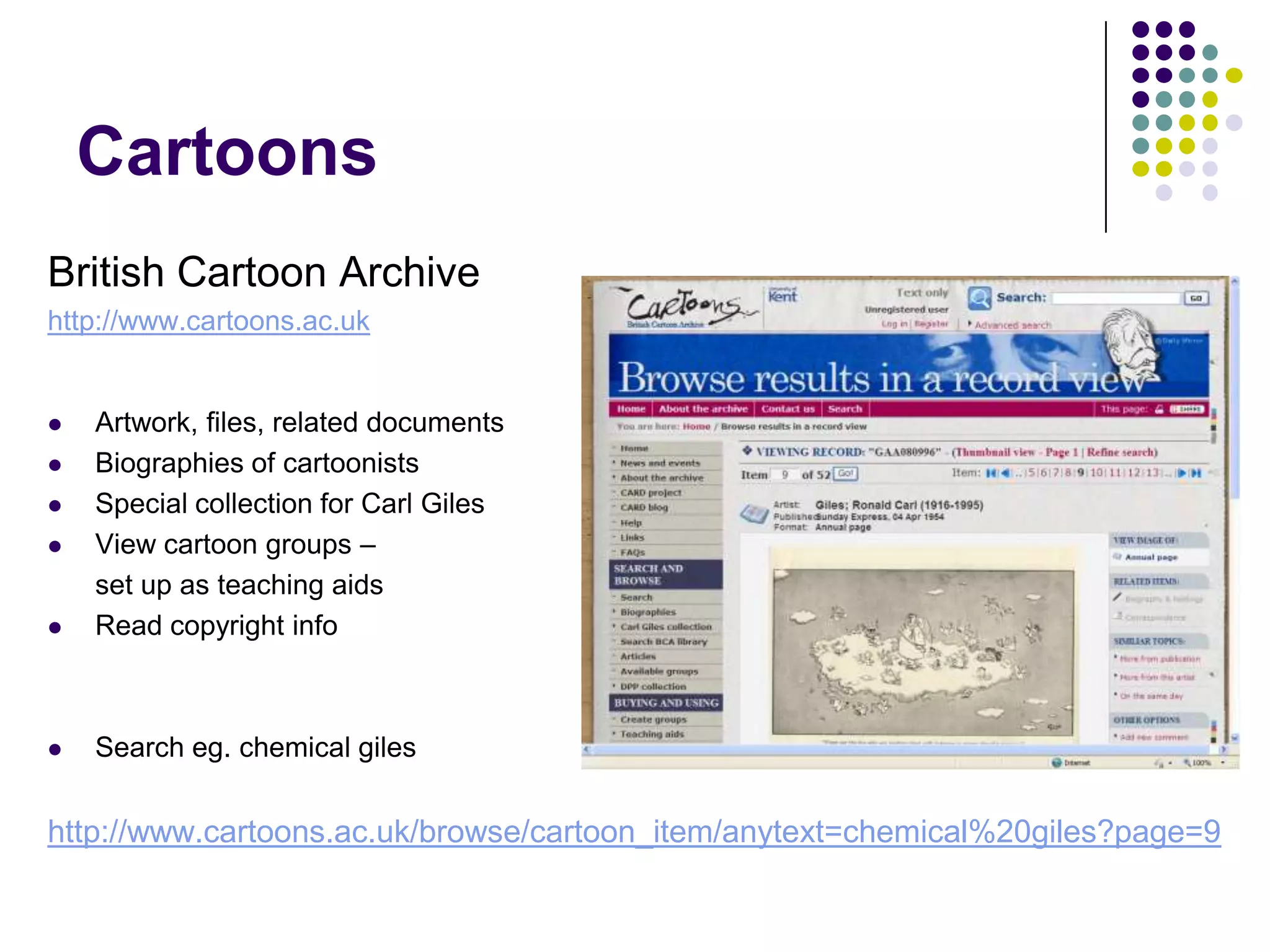
CartoonsBritish Cartoon Archivehttp://www.cartoons.ac.ukArtwork, files, related documentsBiographies of cartoonistsSpecial collection for Carl GilesView cartoon groups – 	set up as teaching aidsRead copyright infoSearch eg. chemical gileshttp://www.cartoons.ac.uk/browse/cartoon_item/anytext=chemical%20giles?page=9
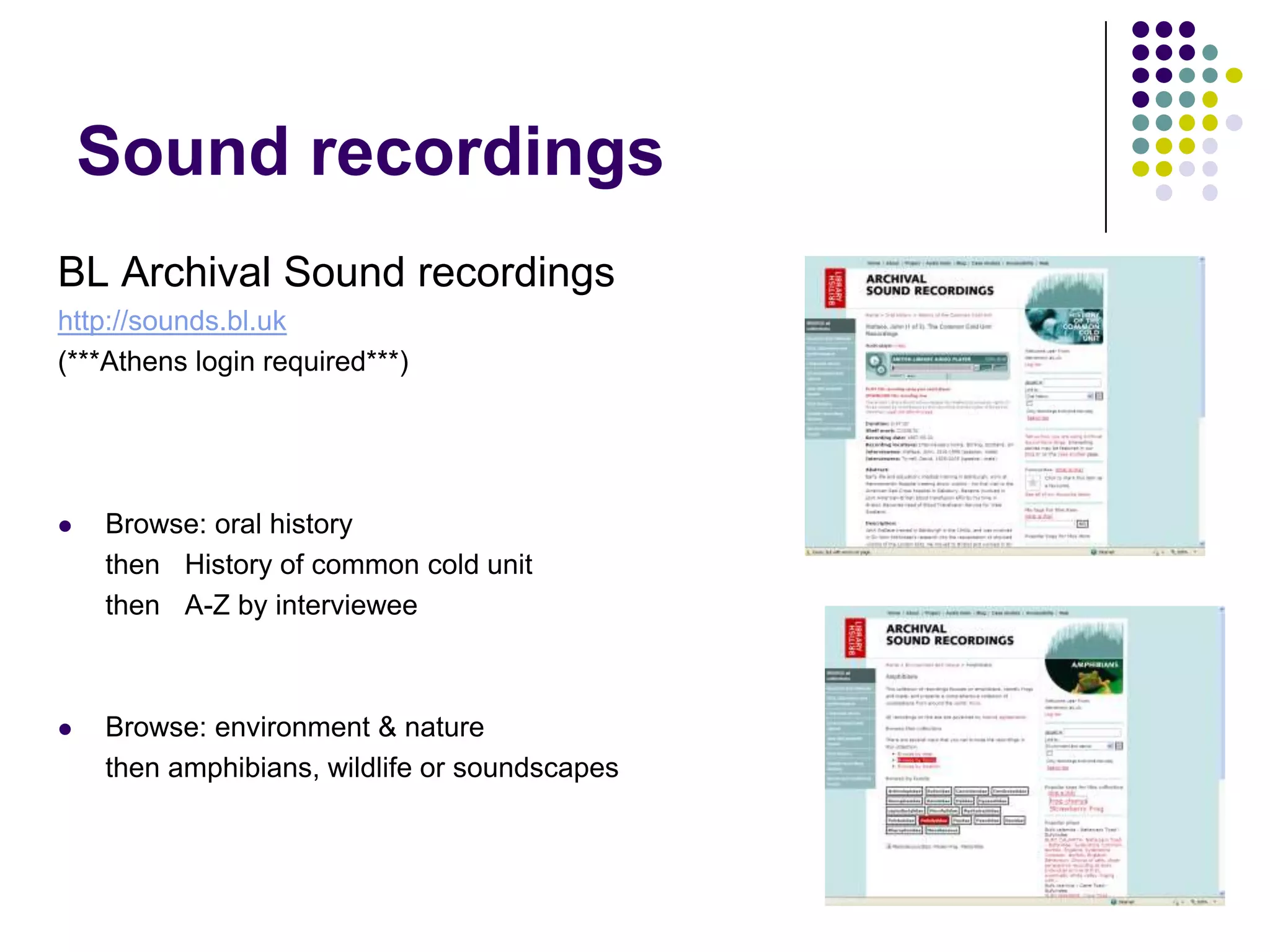
Sound recordingsBL Archival Sound recordingshttp://sounds.bl.uk(***Athens login required***)Browse: oral history	then	History of common cold unit	then 	A-Z by intervieweeBrowse: environment & nature	then amphibians, wildlife or soundscapes
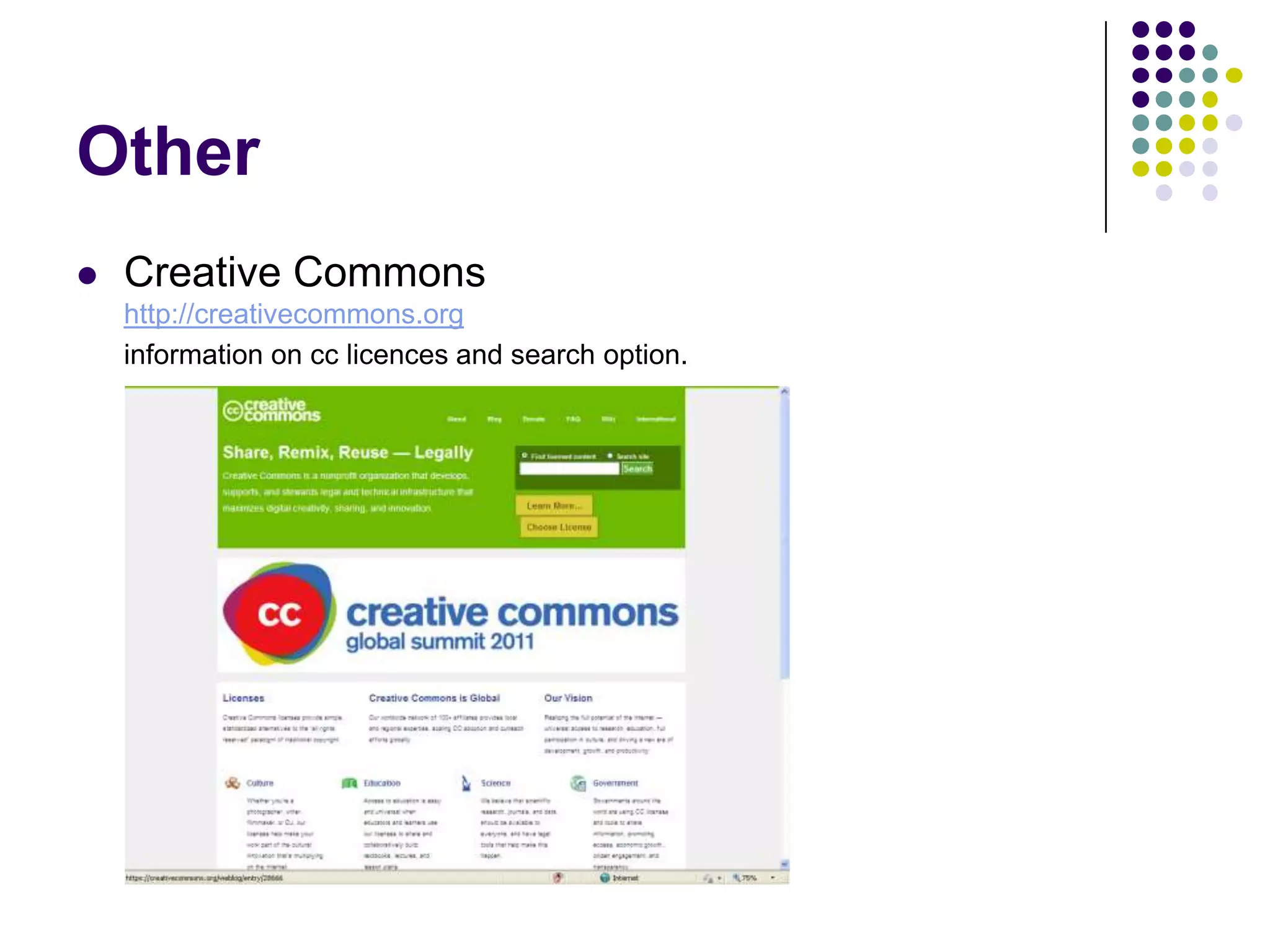
OtherCreative Commons	http://creativecommons.org	information on cc licences and search option.
Stage 3. Evaluate Think carefully about the information retrieved:Is information up-to-date, relevant, objective?Who supplied the information?Apply the PROMPT framework to assess information retrieved from your search.PresentationRelevanceObjectivityMethodProvenanceTimeliness
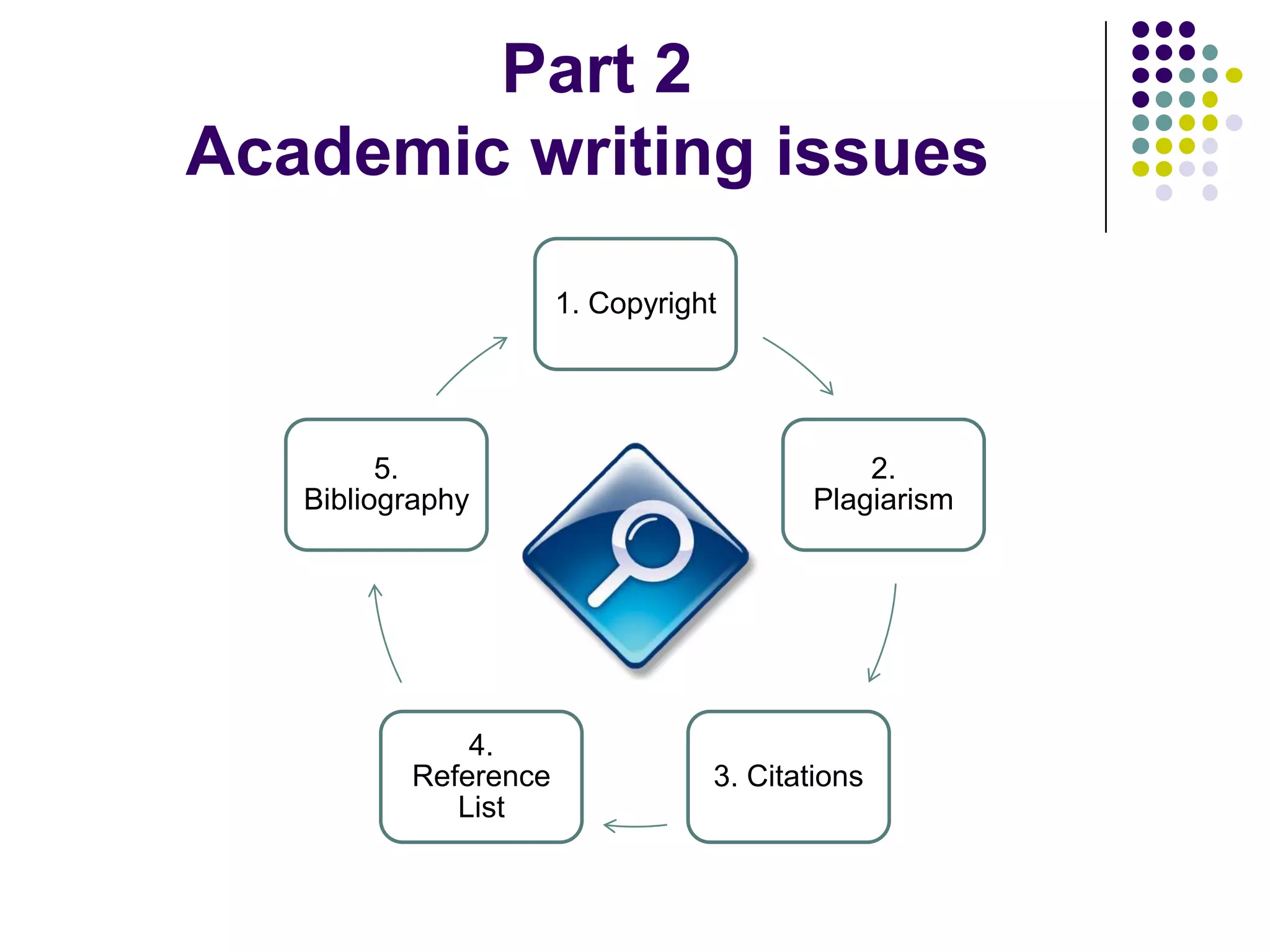
 Part 2Academic writing issues
Problems often arise from:Poor organisation of notes during research stageExcessive use of copy and paste (Ctrl-C, Ctrl-V) Non- acknowledgment, non attribution of sourcesLack of understanding of referencing systemsAs a result:Academic integrity weakenedAcademic misconduct occursDisciplinary procedures may be appliedResearch & academic writing
		 1. Copyright Legislationprotects the owner of the original creative workPermissionscheck or seek permission to re-use content in projectsReasons for copyingCommercial useNon commercial useEducational licenceSome materials are licensed especially for use in education.
2. PlagiarismWhat does plagiarism mean to you?Watch the following video to discover what some other students think.Plagiarism: student views [video & transcript]	Running time: approx. 5 min.http://www.heacademy.ac.uk/resources/audioandvideo/assessmentOr at: http://vimeo.com/channels/154640#9230505
Doing the right thingThere are several ways to avoid plagiarising the work of others.Quoteuseful to highlight main points, support arguments made in your workplace exact quote word for word in quotation marks and list source eg.“plagiarism is a notion specific to a particular culture and epoch” (Ashworth,  Freewood  and Macdonald, 2003)But - don’t use too many quotes in one piece of workParaphrase read quote and rephrase into your own words to give an overviewit is not enough to just change one word in the quoteRemember to attribute the broad ideas to the original author.SummarizeInstead of using multi quotes, take the main background ideas from each and present an overview of them all.
More information  on plagiarism is available from:PLATO: Plagiarism teaching online	available on D2Lhttps://d2l.stevenson.ac.uk/	Student pages – Learning & Study Skills – Avoiding plagiarism/how to reference	Student pages – Preparing for  University -  Study skills for university – PlagiarismLittle book of plagiarism (Leeds Metropolitan University)http://www.scotlandscolleges.ac.uk/research/publications/other-publications.htmlTurnitinPlagiarism – additional advice
3. CitationsWhy list citations?a record of the information you researched and consultedCitation stylesVarious styles including: APA,  Harvard, MLA, TurabianAdding citations to academic writingIn-text citations
End of text – list of references
Footnotes  (but these not always used with Harvard system)Type of resource cited include book, journal article, online resourcesElements recorded in citations may include author, year published, title, title of article/journal, page number
 type of electronic resource, web address, date/place accessedGuidelinesSome faculties may issue specific guidelines
Whatever system used, use consistentlyHow to make citationsHarvard Reference system tutorialPLATO: Plagiarism teaching online	available on D2Lhttps://d2l.stevenson.ac.uk/	Student pages 		Learning & Study Skills			Avoiding plagiarism/how to reference
4. Reference ListsFree tools to help you organise citations andreferences include:Citavi		http://www.citavi.comCite u Like		http://www.citeulike.orgConnetea		http://www.connotea.orgEasyBib		http://www.easybib.comMendeley		http://www.mendeley.comWorldCat		http://www.worldcat.orgZotero 		http://www.zotero.org

Applied science research methods

  • 1.
  • 2.
    Information search
  • 3.
    Stage 1. PlanThink of key concept.Define key elements, sub-topics.Identify key words, phrases, peopleList associated/alternative words, spellingsSet limits: time, place
  • 4.
  • 5.
    Stage 2: SearchLibrary InternetLending/Reference booksMagazinesDVDsOnline resourcesStudy spaceSearch a variety of online resources on the:surface web
  • 6.
    deep webSearching thewebPopular search enginesBing http://www.bing.comGoogle http://www.google.comThe surface web may not present all the results you expect orrequire. Often information is hidden deeper and within specialDatabases.The deep web contains information that cannot easily be found or retrieved by search engines as the information is stored and contained within databases.
  • 7.
    Access identificationOpen Athens/ MyAthenshttp://www.openathens.netApply for an accountLogin to MyAthensEnter UsernameEnter passwordSelect resourcesSecure/remote access
  • 8.
    Library catalogue Virtual LearningD2Lhttps://d2l.stevenson.ac.ukVisit Student PagesLearning Resources CentresOnline resourcesUseful linksHeritage Onlinehttp://www.stevenson.ac.uk/heritageFind links Search by author, title, keyword.Try an Advanced SearchSearch term: *Field : All fields Medium: Web site
  • 9.
    DatabasesSearch some ofthe databases that follow.(All these databases are listed on the library catalogue).
  • 10.
    Electronic BooksEbraryhttp://site.ebrary.com/lib/stevenson/home.actionSearch over3000 titles: eg. astronomy, evolution, human biology, polymersBrowse – all subjects select a subject: eg. Science then select a sub-category: physics select a title & read text on screen ***Athens account required to access Bookshelf and highlighter pen**Watch the training video: http://www.ebrary.com/corp/collateral/flash/QuickStart/
  • 11.
    Historic booksJISC HistoricBooks http://www.jischistoricbooks.ac.ukSign in as “Stevenson College Edinburgh”Then OpenAthens username and passwordView as text or imagepre 20th century texts eg.Darwin, D (1882), Formation of vegetable mould….Galilei, Galileo(1730) mathematical discourses concerning 2 new sciences
  • 12.
    General reference worksCredoReferencehttp://www.credoreference.com- Search, browse, topic pages, find a book, - gadgets (Conversions eg. temperature : celsius - fahrenheit - concept map Oxford Reference Onlinehttp://www.oxfordreference.com- search, browse, timelines (scientists, inventions) - individual books, Visual English Dictionary, etcKnowUKhttp://www.knowuk.co.uk- search & refine, browse eg Dolly the Sheep - Social trends, Dictionary of Science & Technology, etc
  • 13.
    Journals and newspapersGaledatabaseshttp://infotrac.galegroup.com/itweb/stevenscArticles from newspapers, magazines Full-text articles available.Searcheg. Roslin InstituteBrowse subjects eg. radiationBrowse publications: eg. Biochemistry & Cell BiologyAdvanced search: renewables(keyword) + Scotsman (publication title)
  • 14.
    Journal archivesArchives giveaccess to older articles - up until about mid 1990sJISC Journal Archiveshttp://www.jiscjournalarchives.ac.ukSearch eg. bunsen burner, Kelvin - summary panel offers link to download pdf - IoP, RSC, ICE, OUP, Brill, Proquest*** Athens username required***Periodicals Archive Onlinehttp://pao.chadwyck.co.ukSearch eg. atoms, chemicals, lab experiments View article text or article pdf
  • 15.
    StatisticsFact File Online(only available in College)http://www.carelpress.co.ukselect search or browseSelect a category e.g. Animalsview pagesdownload Excel optionIssues Onlinehttp://www.independence.co.uk/issues-onlineSelect Issues Online loginSelect a category – Science & healthSelect a topic – eg. genetic modificationSelect topic articles, key facts, key statistics
  • 16.
    Company informationDatamonitor 360http://360.datamonitor.com searcheg. Ineos, PfizerOr browseindustrieseg. biotechnology in the UKNewsFinancial dealsOpinionCompanies SWOT analysis (often available)
  • 17.
    ImagesScranhttp://www.scran.ac.uk -search forimages, use image to create posters etc. - Science pathfinder packs (Fleming, Lister, Watt, Young)JISC MediaHubhttp://jiscmediahub.ac.uk-search for video, image & audio resources
  • 18.
    EphemeraThe John JohnsonCollectionhttp://johnjohnson.chadwyck.co.uk an archive of 18th, 19th and early 20th century printed ephemera.Search, browse, login to Lightbox to store images, read responses (essays)Advertising: - dentistry - fuel - gas appliances - patent instruments - scientific instrumentsDocument images in pdfCitation guide
  • 19.
    CartoonsBritish Cartoon Archivehttp://www.cartoons.ac.ukArtwork,files, related documentsBiographies of cartoonistsSpecial collection for Carl GilesView cartoon groups – set up as teaching aidsRead copyright infoSearch eg. chemical gileshttp://www.cartoons.ac.uk/browse/cartoon_item/anytext=chemical%20giles?page=9
  • 20.
    Sound recordingsBL ArchivalSound recordingshttp://sounds.bl.uk(***Athens login required***)Browse: oral history then History of common cold unit then A-Z by intervieweeBrowse: environment & nature then amphibians, wildlife or soundscapes
  • 21.
  • 22.
    Stage 3. EvaluateThink carefully about the information retrieved:Is information up-to-date, relevant, objective?Who supplied the information?Apply the PROMPT framework to assess information retrieved from your search.PresentationRelevanceObjectivityMethodProvenanceTimeliness
  • 23.
    Part 2Academicwriting issues
  • 24.
    Problems often arisefrom:Poor organisation of notes during research stageExcessive use of copy and paste (Ctrl-C, Ctrl-V) Non- acknowledgment, non attribution of sourcesLack of understanding of referencing systemsAs a result:Academic integrity weakenedAcademic misconduct occursDisciplinary procedures may be appliedResearch & academic writing
  • 25.
    1. CopyrightLegislationprotects the owner of the original creative workPermissionscheck or seek permission to re-use content in projectsReasons for copyingCommercial useNon commercial useEducational licenceSome materials are licensed especially for use in education.
  • 26.
    2. PlagiarismWhat doesplagiarism mean to you?Watch the following video to discover what some other students think.Plagiarism: student views [video & transcript] Running time: approx. 5 min.http://www.heacademy.ac.uk/resources/audioandvideo/assessmentOr at: http://vimeo.com/channels/154640#9230505
  • 27.
    Doing the rightthingThere are several ways to avoid plagiarising the work of others.Quoteuseful to highlight main points, support arguments made in your workplace exact quote word for word in quotation marks and list source eg.“plagiarism is a notion specific to a particular culture and epoch” (Ashworth, Freewood and Macdonald, 2003)But - don’t use too many quotes in one piece of workParaphrase read quote and rephrase into your own words to give an overviewit is not enough to just change one word in the quoteRemember to attribute the broad ideas to the original author.SummarizeInstead of using multi quotes, take the main background ideas from each and present an overview of them all.
  • 28.
    More information on plagiarism is available from:PLATO: Plagiarism teaching online available on D2Lhttps://d2l.stevenson.ac.uk/ Student pages – Learning & Study Skills – Avoiding plagiarism/how to reference Student pages – Preparing for University - Study skills for university – PlagiarismLittle book of plagiarism (Leeds Metropolitan University)http://www.scotlandscolleges.ac.uk/research/publications/other-publications.htmlTurnitinPlagiarism – additional advice
  • 29.
    3. CitationsWhy listcitations?a record of the information you researched and consultedCitation stylesVarious styles including: APA, Harvard, MLA, TurabianAdding citations to academic writingIn-text citations
  • 30.
    End of text– list of references
  • 31.
    Footnotes (butthese not always used with Harvard system)Type of resource cited include book, journal article, online resourcesElements recorded in citations may include author, year published, title, title of article/journal, page number
  • 32.
    type ofelectronic resource, web address, date/place accessedGuidelinesSome faculties may issue specific guidelines
  • 33.
    Whatever system used,use consistentlyHow to make citationsHarvard Reference system tutorialPLATO: Plagiarism teaching online available on D2Lhttps://d2l.stevenson.ac.uk/ Student pages Learning & Study Skills Avoiding plagiarism/how to reference
  • 34.
    4. Reference ListsFreetools to help you organise citations andreferences include:Citavi http://www.citavi.comCite u Like http://www.citeulike.orgConnetea http://www.connotea.orgEasyBib http://www.easybib.comMendeley http://www.mendeley.comWorldCat http://www.worldcat.orgZotero http://www.zotero.org
  • 35.
    Reference ListWhat isa reference list?Found at end of assignmentA list of all sources referred to in the main body of the assignmentListed A-Z by author’s surnameWhat does it include?List of sources from which quotes have been takenList of sources which have been paraphrasedWhat does it not include?any resources used only for background reading
  • 36.
    5. BibliographyWhat isa bibliography?A complete list of all the resources consulted during research.Not just a reference list.Contains all items whether or not you referred to them in the final project
  • 37.
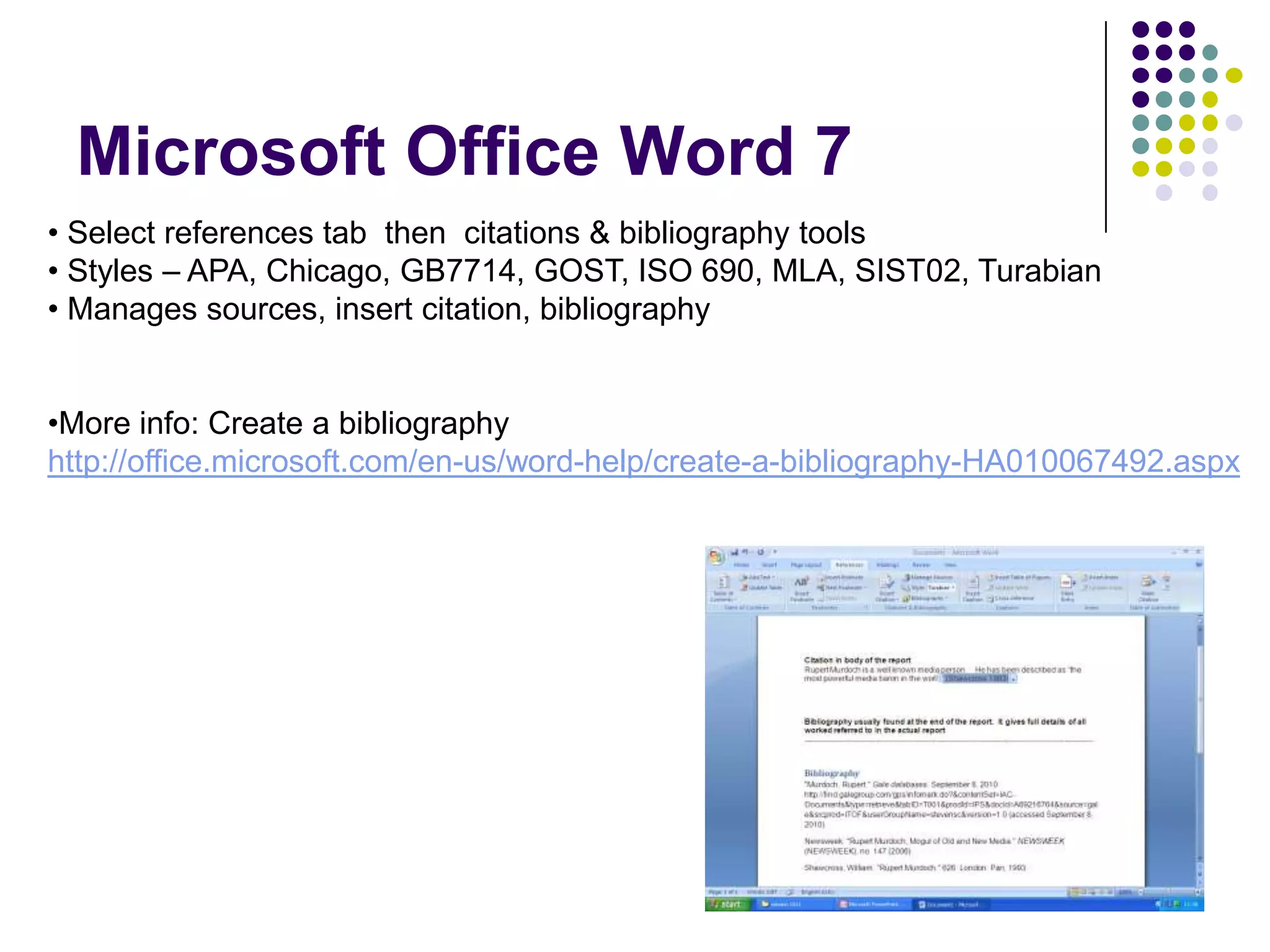
    Microsoft Office Word7 Select references tab then citations & bibliography tools
  • 38.
    Styles –APA, Chicago, GB7714, GOST, ISO 690, MLA, SIST02, Turabian
  • 39.
    Manages sources,insert citation, bibliography
  • 40.
    More info: Createa bibliographyhttp://office.microsoft.com/en-us/word-help/create-a-bibliography-HA010067492.aspx