Applications of the Reverse
Engineering Language REIL


   Hackers to Hackers Conference 2009, São Paulo

                  Sebastian Porst
                  zynamics GmbH
         (sebastian.porst@zynamics.com)
Talk Overview
• Necessity of new RE methods
• Solutions we developed
• Applications of our solutions
About zynamics
• Small German company
• Unhappy with the state of Reverse
  Engineering
• Needed: New RE tools and methods
  –BinDiff, BinNavi, VxClass
About me
•   Lead Developer of BinNavi
•   Many years of RE experience
•   Try to come up with new RE methods
•   Talk about it at conferences
What we are doing
• Build Reverse Engineering tools
• Try to automize binary file analysis
• Help people find vulnerabilities
Why we are doing this

Software Complexity

Architectural Diversity

Microsoft Security Budget
                            Good old days   Now
How we are doing this
• Develop new RE methods
  –Platform-Independent
  –Easy to use
• Integrate them into our tools
REIL
• Reverse Engineering Intermediate
  Language
• Platform-Independent
• Designed for Reverse Engineering
Design Principles
•   Very small instruction set
•   Very regular operand structure
•   Very simple operand types
•   No side-effects
Example
REIL Usage
Convert native code to
REIL

   Run REIL algorithm

      Port results back to
      original code
Advantages
• Easy to pick up and comprehend
• Reduces analysis complexity
• Write once; use everywhere
MonoREIL
• Monotone framework for REIL
• Simplifies analysis algorithm
  development
• Read the book
Advantages
• All algorithms have the same regular
  structure
• Simplifies algorithms
  –Trade-off: Runtime
Core Concepts
• Instruction Graph
• Lattice
• Monotone Transformations
Instruction Graph
                       1400: add t0, 15, t1


                        1401: bisz t1, , t2


                       1402: jcc t2, , 1405


  1403: str 8, , t3                           1405: str 16, , t3


1404: jcc t2, , 1406


                       1406: add t3, t3, t4


                       1407: jcc 1, , 1420
Lattice
  T


  B
Transformations
                       1400: add t0, 15, t1


                        1401: bisz t1, , t2


                       1402: jcc t2, , 1405


  1403: str 8, , t3                           1405: str 16, , t3


1404: jcc t2, , 1406


                       1406: add t3, t3, t4


                       1407: jcc 1, , 1420
Applications
Register Tracking: Helps Reverse Engineers follow data flow through code
(Never officially presented)


Index Underflow Detection: Automatically find negative array accesses
(CanSecWest 2009, Vancouver)


Automated Deobfuscation: Make obfuscated code more readable
(SOURCE Barcelona 2009, Barcelona)


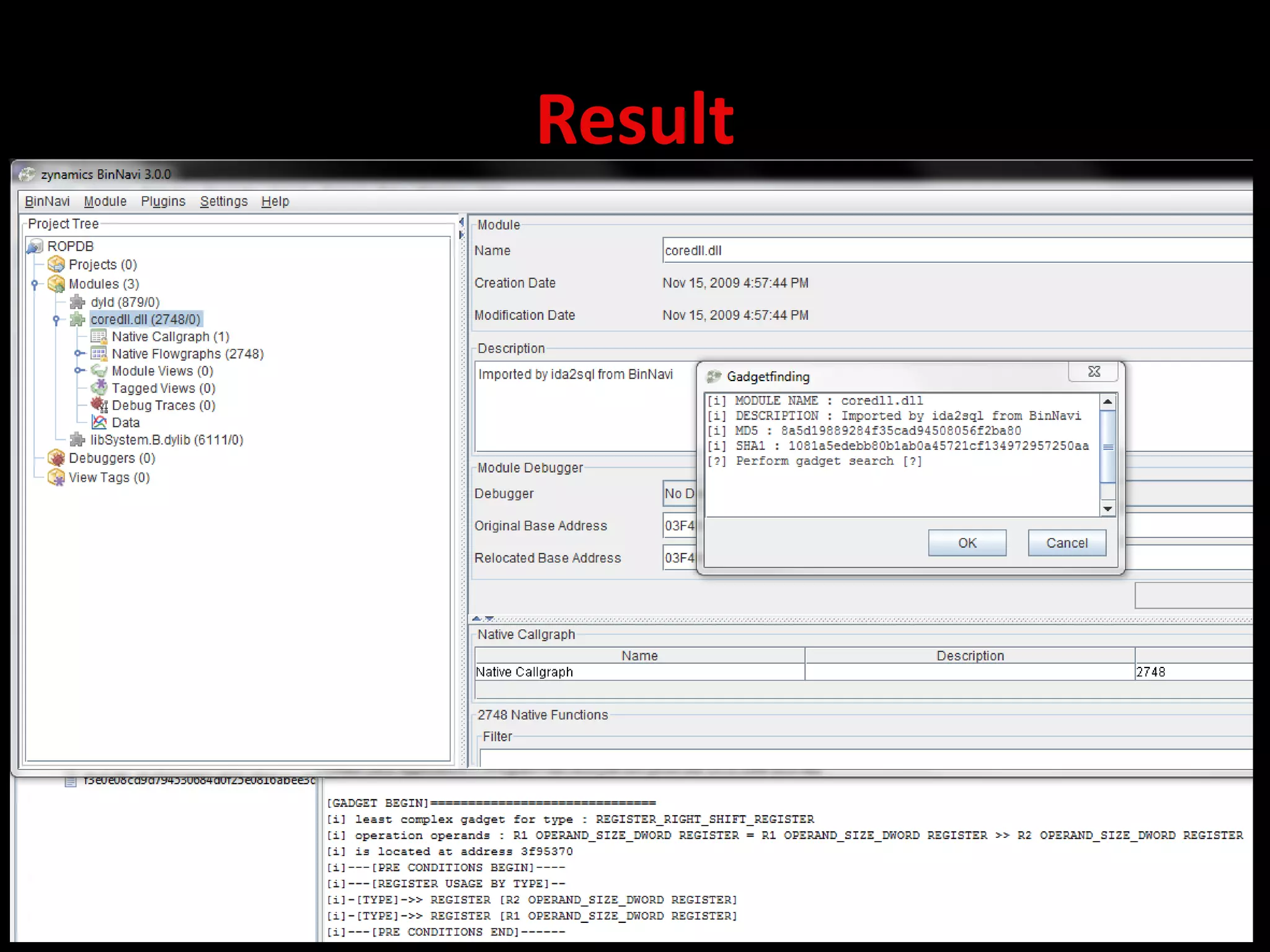
ROP Gadget Generator: Automatically generates return-oriented shellcode
(Work in progress; scheduled for Q1/2010)
Register Tracking
• Follows interesting register values
• Keeps track of dependent values
• Transitive closure of the effects of a
  register on the program state
Lattice
                              All


eax         eax         ebx         ecx
ebx         ecx         ecx         OF


      eax         ebx         ecx   OF


                                Ø
General Idea
• Start with the tracked register
• Follow the control flow
• Instruction uses register → Add
  modified registers to the tracked set
• Instruction clears register → Remove
  cleared register from the set
Example
{t0}
add t0, 4, t1
{t0, t1}
bisz t2, , CF
{t0, t1}
bisz t0, , ZF
{t0, t1, ZF}
add t2, 4, t1
{t0, ZF}
Result
Use
• Fully integrated into BinNavi
• Makes it very simple to follow values
• Helps the reverse engineer to
  concentrate on what is important
Range Tracking
• Tracks potential ranges for register
  values
• Useful to detect buffer underflows
  like MS08-67
• Intervals are used to cut down on
  complexity
Lattice
• Complicated to show in a picture
• Keep track of register values and
  pointer dereferences as a list of
  ranges
• eax [0 .. 4] [0 .. 10]
  – Add a value between 0 and 10 to [eax], [eax + 1],
    [eax + 2], [eax + 3], or [eax + 4]
General Idea
• Track register values relative to their
  first use
• Follow the control flow
• Calculate maximum range of effects
  each instruction has on a register
• If the range gets negative for
  memory accesses, mark the location
Use
• Helps bug hunters to find potential
  vulnerabilities
• Automated and effective
• Not yet fully proven to work
Deobfuscation
• Convert obfuscated code into
  something more readable
• Multi-process step with many lattices
  –Constant propagation
  –Dead code elimination
  –...
General Idea
• Take a piece of code
• Apply the deobfuscation algorithms
• Repeat until no further
  deobfuscation is possible
• Result: Deobfuscated Code
Result
Before            After
Problems
• Turns out that deobfuscation is tricky
  for many reasons
• Further requirements:
   –Function that determines the
    readability of code
   –Backend that produces executable
    code from REIL
ROP Gadget Generator
• Return-oriented shellcode generator
• REIL-based but not MonoREIL-based
• Originally for Windows Mobile but
  platform-independent
• To be presented in 2010
General Idea
• Automated analysis of instruction
  sequences
• Automated extraction of useful
  instruction sequences
• Combines gadgets to shellcode
• Helps the development of return-
  oriented shellcode
Result
Future Development
• BinAudit
  –Collection of algorithms for
   vulnerability research
• Type Reconstruction
  –Figuring out what higher level data
   types are stored in registers
Related Work
• ERESI Project
• BitBlaze
• Silvio Cesare
http://www.flickr.com/photos/marcobellucci/3534516458/

Applications of the Reverse Engineering Language REIL

  • 1.
    Applications of theReverse Engineering Language REIL Hackers to Hackers Conference 2009, São Paulo Sebastian Porst zynamics GmbH (sebastian.porst@zynamics.com)
  • 2.
    Talk Overview • Necessityof new RE methods • Solutions we developed • Applications of our solutions
  • 3.
    About zynamics • SmallGerman company • Unhappy with the state of Reverse Engineering • Needed: New RE tools and methods –BinDiff, BinNavi, VxClass
  • 4.
    About me • Lead Developer of BinNavi • Many years of RE experience • Try to come up with new RE methods • Talk about it at conferences
  • 5.
    What we aredoing • Build Reverse Engineering tools • Try to automize binary file analysis • Help people find vulnerabilities
  • 6.
    Why we aredoing this Software Complexity Architectural Diversity Microsoft Security Budget Good old days Now
  • 7.
    How we aredoing this • Develop new RE methods –Platform-Independent –Easy to use • Integrate them into our tools
  • 8.
    REIL • Reverse EngineeringIntermediate Language • Platform-Independent • Designed for Reverse Engineering
  • 9.
    Design Principles • Very small instruction set • Very regular operand structure • Very simple operand types • No side-effects
  • 10.
  • 11.
    REIL Usage Convert nativecode to REIL Run REIL algorithm Port results back to original code
  • 12.
    Advantages • Easy topick up and comprehend • Reduces analysis complexity • Write once; use everywhere
  • 13.
    MonoREIL • Monotone frameworkfor REIL • Simplifies analysis algorithm development • Read the book
  • 14.
    Advantages • All algorithmshave the same regular structure • Simplifies algorithms –Trade-off: Runtime
  • 15.
    Core Concepts • InstructionGraph • Lattice • Monotone Transformations
  • 16.
    Instruction Graph 1400: add t0, 15, t1 1401: bisz t1, , t2 1402: jcc t2, , 1405 1403: str 8, , t3 1405: str 16, , t3 1404: jcc t2, , 1406 1406: add t3, t3, t4 1407: jcc 1, , 1420
  • 17.
  • 18.
    Transformations 1400: add t0, 15, t1 1401: bisz t1, , t2 1402: jcc t2, , 1405 1403: str 8, , t3 1405: str 16, , t3 1404: jcc t2, , 1406 1406: add t3, t3, t4 1407: jcc 1, , 1420
  • 19.
    Applications Register Tracking: HelpsReverse Engineers follow data flow through code (Never officially presented) Index Underflow Detection: Automatically find negative array accesses (CanSecWest 2009, Vancouver) Automated Deobfuscation: Make obfuscated code more readable (SOURCE Barcelona 2009, Barcelona) ROP Gadget Generator: Automatically generates return-oriented shellcode (Work in progress; scheduled for Q1/2010)
  • 20.
    Register Tracking • Followsinteresting register values • Keeps track of dependent values • Transitive closure of the effects of a register on the program state
  • 21.
    Lattice All eax eax ebx ecx ebx ecx ecx OF eax ebx ecx OF Ø
  • 22.
    General Idea • Startwith the tracked register • Follow the control flow • Instruction uses register → Add modified registers to the tracked set • Instruction clears register → Remove cleared register from the set
  • 23.
    Example {t0} add t0, 4,t1 {t0, t1} bisz t2, , CF {t0, t1} bisz t0, , ZF {t0, t1, ZF} add t2, 4, t1 {t0, ZF}
  • 24.
  • 25.
    Use • Fully integratedinto BinNavi • Makes it very simple to follow values • Helps the reverse engineer to concentrate on what is important
  • 26.
    Range Tracking • Trackspotential ranges for register values • Useful to detect buffer underflows like MS08-67 • Intervals are used to cut down on complexity
  • 27.
    Lattice • Complicated toshow in a picture • Keep track of register values and pointer dereferences as a list of ranges • eax [0 .. 4] [0 .. 10] – Add a value between 0 and 10 to [eax], [eax + 1], [eax + 2], [eax + 3], or [eax + 4]
  • 28.
    General Idea • Trackregister values relative to their first use • Follow the control flow • Calculate maximum range of effects each instruction has on a register • If the range gets negative for memory accesses, mark the location
  • 29.
    Use • Helps bughunters to find potential vulnerabilities • Automated and effective • Not yet fully proven to work
  • 30.
    Deobfuscation • Convert obfuscatedcode into something more readable • Multi-process step with many lattices –Constant propagation –Dead code elimination –...
  • 31.
    General Idea • Takea piece of code • Apply the deobfuscation algorithms • Repeat until no further deobfuscation is possible • Result: Deobfuscated Code
  • 32.
  • 33.
    Problems • Turns outthat deobfuscation is tricky for many reasons • Further requirements: –Function that determines the readability of code –Backend that produces executable code from REIL
  • 34.
    ROP Gadget Generator •Return-oriented shellcode generator • REIL-based but not MonoREIL-based • Originally for Windows Mobile but platform-independent • To be presented in 2010
  • 35.
    General Idea • Automatedanalysis of instruction sequences • Automated extraction of useful instruction sequences • Combines gadgets to shellcode • Helps the development of return- oriented shellcode
  • 36.
  • 37.
    Future Development • BinAudit –Collection of algorithms for vulnerability research • Type Reconstruction –Figuring out what higher level data types are stored in registers
  • 38.
    Related Work • ERESIProject • BitBlaze • Silvio Cesare
  • 39.