Platform-independent static
binary code analysis using a meta-
        assembly language
    Thomas Dullien, Sebastian Porst
          zynamics GmbH


          CanSecWest 2009
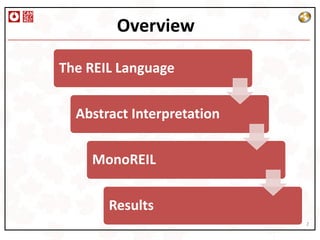
Overview

The REIL Language


  Abstract Interpretation


    MonoREIL


       Results
                            2
Motivation
• Bugs are getting harder to find
• Defensive side (most notably Microsoft) has
  invested a lot of money in a „bugocide“
• Concerted effort: Lots of manual code auditing
  aided by static analysis tools
• Phoenix RDK: Includes „lattice based“ analysis
  framework to allow pluggable abstract
  interpretation in the compiler

                                                   3
Motivation
• Offense needs automated tools if they want to
  avoid being sidelined
• Offensive static analysis: Depth vs. Breadth
• Offense has no source code, no Phoenix RDK,
  and should not depend on Microsoft
• We want a static analysis framework for
  offensive purposes


                                                  4
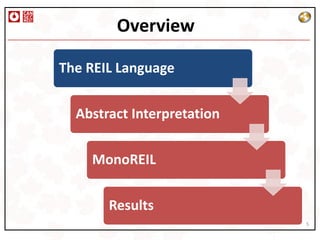
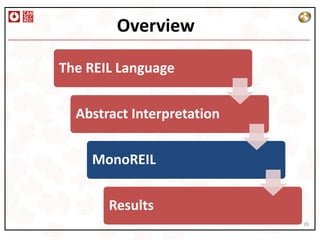
Overview

The REIL Language


  Abstract Interpretation


    MonoREIL


       Results
                            5
REIL
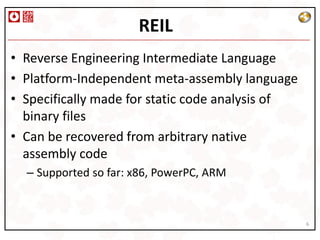
• Reverse Engineering Intermediate Language
• Platform-Independent meta-assembly language
• Specifically made for static code analysis of
  binary files
• Can be recovered from arbitrary native
  assembly code
  – Supported so far: x86, PowerPC, ARM


                                                  6
Advantages of REIL
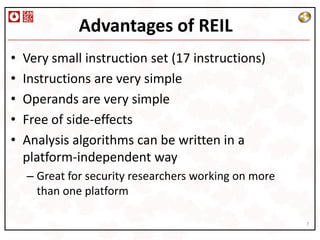
•   Very small instruction set (17 instructions)
•   Instructions are very simple
•   Operands are very simple
•   Free of side-effects
•   Analysis algorithms can be written in a
    platform-independent way
    – Great for security researchers working on more
      than one platform

                                                       7
Creation of REIL code
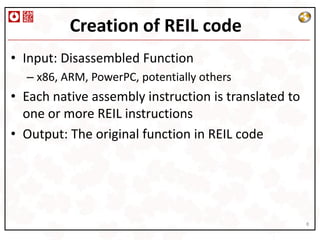
• Input: Disassembled Function
  – x86, ARM, PowerPC, potentially others
• Each native assembly instruction is translated to
  one or more REIL instructions
• Output: The original function in REIL code


                                                      8
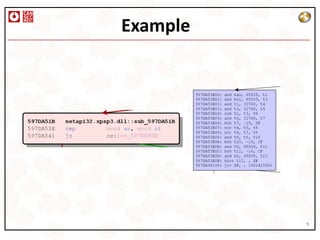
Example


          9
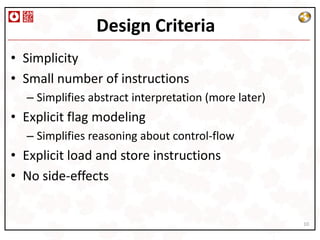
Design Criteria
• Simplicity
• Small number of instructions
  – Simplifies abstract interpretation (more later)
• Explicit flag modeling
  – Simplifies reasoning about control-flow
• Explicit load and store instructions
• No side-effects


                                                      10
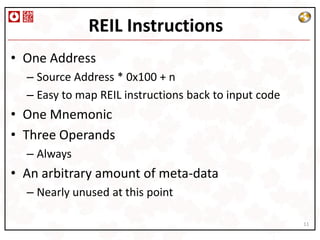
REIL Instructions
• One Address
  – Source Address * 0x100 + n
  – Easy to map REIL instructions back to input code
• One Mnemonic
• Three Operands
  – Always
• An arbitrary amount of meta-data
  – Nearly unused at this point

                                                       11
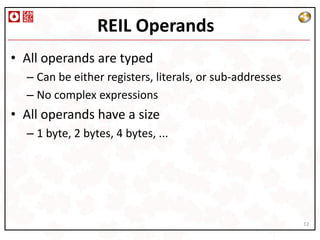
REIL Operands
• All operands are typed
  – Can be either registers, literals, or sub-addresses
  – No complex expressions
• All operands have a size
  – 1 byte, 2 bytes, 4 bytes, ...


                                                          12
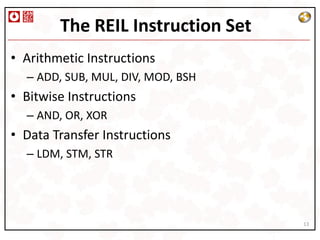
The REIL Instruction Set
• Arithmetic Instructions
  – ADD, SUB, MUL, DIV, MOD, BSH
• Bitwise Instructions
  – AND, OR, XOR
• Data Transfer Instructions
  – LDM, STM, STR


                                   13
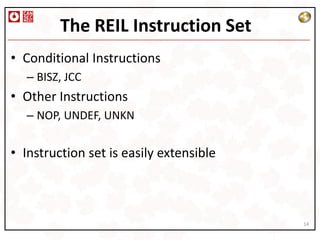
The REIL Instruction Set
• Conditional Instructions
  – BISZ, JCC
• Other Instructions
  – NOP, UNDEF, UNKN


• Instruction set is easily extensible


                                         14
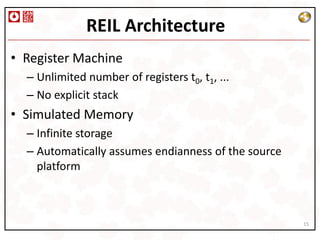
REIL Architecture
• Register Machine
  – Unlimited number of registers t0, t1, ...
  – No explicit stack
• Simulated Memory
  – Infinite storage
  – Automatically assumes endianness of the source
    platform


                                                     15
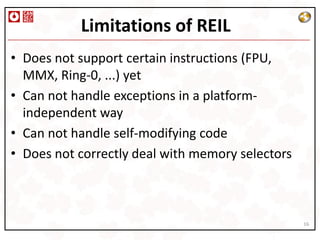
Limitations of REIL
• Does not support certain instructions (FPU,
  MMX, Ring-0, ...) yet
• Can not handle exceptions in a platform-
  independent way
• Can not handle self-modifying code
• Does not correctly deal with memory selectors


                                                  16
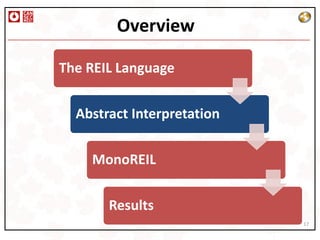
Overview

The REIL Language


  Abstract Interpretation


    MonoREIL


       Results
                            17
Abstract Interpretation
• Theoretical background for most code analysis
• Developed by Patrick and Rhadia Cousot around
  1975-1977
• Formalizes „static abstract reasoning about
  dynamic properties“
• Huh ?
• A lot of the literature is a bit dense for many
  security practitioners

                                                    18
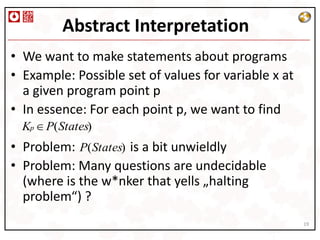
Abstract Interpretation
• We want to make statements about programs
• Example: Possible set of values for variable x at
  a given program point p
• In essence: For each point p, we want to find
  Kp P(States)
• Problem: P(States) is a bit unwieldly
• Problem: Many questions are undecidable
  (where is the w*nker that yells „halting
  problem“) ?
                                                      19
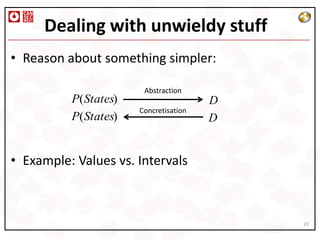
Dealing with unwieldy stuff
• Reason about something simpler:

                       Abstraction
          P(States)                    D
                      Concretisation
          P(States)                    D


• Example: Values vs. Intervals


                                           20
Lattices
• In order for this to work, D must be structurally
  similar to P(States)
• P(States) supports intersection and union
• You can check for inclusion (contains, does not
  contain)
• You have an empty set (bottom) and
  „everything“ (top)


                                                      21
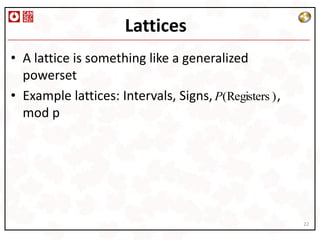
Lattices
• A lattice is something like a generalized
  powerset
• Example lattices: Intervals, Signs, P(Registers ) ,
  mod p


                                                        22
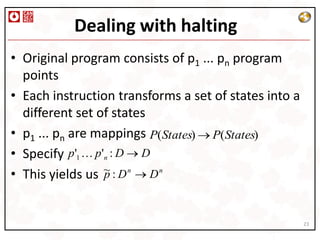
Dealing with halting
• Original program consists of p1 ... pn program
  points
• Each instruction transforms a set of states into a
  different set of states
• p1 ... pn are mappings P(States) P(States)
• Specify p'1  p'n : D D
• This yields us ~ : D n D n
                  p


                                                       23
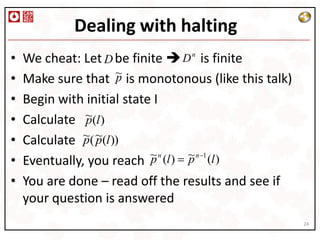
Dealing with halting
•   We cheat: Let D be finite  Dn      is finite
                    ~
•   Make sure that is monotonous (like this talk)
                    p
•   Begin with initial state I
•   Calculate ~(l )
               p
•   Calculate ~( ~(l ))
               p p
                            ~ n (l ) ~ n 1 (l )
•   Eventually, you reach p          p
•   You are done – read off the results and see if
    your question is answered
                                                     24
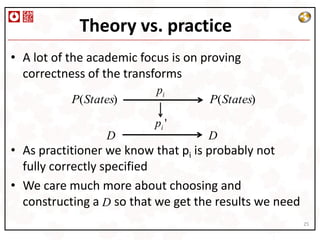
Theory vs. practice
• A lot of the academic focus is on proving
  correctness of the transforms
                           pi
           P(States)                 P(States)
                          pi '
                 D                  D
• As practitioner we know that pi is probably not
  fully correctly specified
• We care much more about choosing and
  constructing a D so that we get the results we need
                                                        25
Overview

The REIL Language


  Abstract Interpretation


    MonoREIL


       Results
                            26
MonoREIL
• You want to do static analysis
• You do not want to write a full abstract
  interpretation framework
• We provide one: MonoREIL
• A simple-to-use abstract interpretation
  framework based on REIL


                                             27
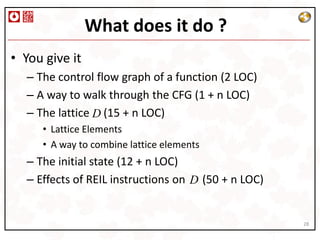
What does it do ?
• You give it
  – The control flow graph of a function (2 LOC)
  – A way to walk through the CFG (1 + n LOC)
  – The lattice D (15 + n LOC)
     • Lattice Elements
     • A way to combine lattice elements
  – The initial state (12 + n LOC)
  – Effects of REIL instructions on D (50 + n LOC)


                                                     28
How does it work?
• Fixed-point iteration until final state is found
• Interpretation of result
  – Map results back to original assembly code
• Implementation of MonoREIL already exists
• Usable from Java, ECMAScript, Python, Ruby


                                                     29
Overview

The REIL Language


  Abstract Interpretation


    MonoREIL


       Results
                            30
Register Tracking
• First Example: Simple
• Question: What are the effects of a register on
  other instructions?
• Useful for following register values


                                                    31
Register Tracking
• Demo


                             32
Register Tracking
• Lattice: For each instruction, set of influenced
  registers, combine with union
• Initial State
  – Empty (nearly) everywhere
  – Start instruction: { tracked register }
• Transformations for MNEM op1, op2, op3
  – If op1 or op2 are tracked  op3 is tracked too
  – Otherwise: op3 is removed from set

                                                     33
Negative indexing
• Second Example: More complicated
• Question: Is this function indexing into an array
  with a negative value ?
• This gets a bit more involved


                                                      34
Negative indexing
• Simple intervals alone do not help us much
• How would you model a situation where
  – A function gets a structure pointer as argument
  – The function retrieves a pointer to an array from an
    array of pointers in the structure
  – The function then indexes negatively into this array
• Uh. Ok.


                                                           35
Abstract locations
• For each instruction, what are the contents of the
  registers ? Let‘s slowly build complexity:
• If eax contains arg_4, how could this be modelled ?
   – eax = *(esp.in + 8)
• If eax contains arg_4 + 4 ?
   – eax = *(esp.in + 8) + 4
• If eax can contain arg_4+4, arg_4+8, arg_4+16,
  arg_4 + 20 ?
   – eax = *(esp.in + 8) + [4, 20]

                                                        36
Abstract locations
• If eax can contain arg_4+4, arg_8+16 ?
  – eax = *(esp.in + [8,12]) + [4,16]
• If eax can contain any element from
  – arg_4mem[0] to arg_4mem[10], incremented
    once, how do we model this ?
  – eax = *(*(esp.in + [8,8]) + [4, 44]) + [1,1]
• OK. An abstract location is a base value and a
  list of intervals, each denoting memory
  dereferences (except the last)
                                                   37
Range Tracking

eax.in + [a, b] + [0, 0]


                 eax.in + a   eax.in + b


                                           38
Range Tracking

             eax + [a, b] + [c, d] + [0, 0]

                        eax + a                   eax + b


[eax+a]+c   [eax+a]+d        [eax+a+4]+c      [eax+a+4]+d   [eax+b]+c   [eax+b]+d
                                                                                    39
Range Tracking
• Lattice: For each instruction, a map:
            Register  Aloc Aloc

• Initial State
  – Empty (nearly) everywhere
  – Start instruction: { reg -> reg.in + [0,0] }
• Transformations
  – Complicated. Next slide.


                                                   40
Range Tracking
• Transformations
  – ADD/SUB are simple: Operate on last intervals
  – STM op1, , op3
     • If op1 or op3 not in our input map M skip
     • Otherwise, M[ M[op3] ] = op1
  – LDM op1, , op3
     • If op1 or op3 is not in our input map M skip
     • M[ op3 ] = M[ op1 ]
  – Others: Case-specific hacks

                                                      41
Range Tracking
• Where is the meat ?
• Real world example: Find negative array
  indexing


                                            42
MS08-67
• Function takes in argument to a buffer
• Function performs complex pointer arithmetic
• Attacker can make this pointer arithmetic go
  bad
• The pointer to the target buffer of a wcscpy will
  be decremented beyond the beginning of the
  buffer


                                                      43
MS08-67
• Michael Howard‘s Blog:
  – “In my opinion, hand reviewing this code and
    successfully finding this bug would require a great deal
    of skill and luck. So what about tools? It's very difficult
    to design an algorithm which can analyze C or C++ code
    for these sorts of errors. The possible variable states
    grows very, very quickly. It's even more difficult to take
    such algorithms and scale them to non-trivial code
    bases. This is made more complex as the function
    accepts a highly variable argument, it's not like the
    argument is the value 1, 2 or 3! Our present toolset
    does not catch this bug.”

                                                                  44
MS08-67
• Michael is correct
  – He has to defend all of Windows
  – His „regular“ developers have to live with the
    results of the automated tools
  – His computational costs for an analysis are gigantic
  – His developers have low tolerance for false positives


                                                            45
MS08-67
• Attackers might have it easier
  – They usually have a much smaller target
  – They are highly motivated: I will tolerate 100 false
    positives for each „real“ bug
     • I can work through 20-50 a day
     • A week for a bug is still worth it
  – False positive reduction is nice, but if I have to read
    100 functions instead of 20000, I have already
    gained something

                                                              46
MS08-67
• Demo


                   47
Limitations and assumptions
• Limitations and assumptions
  – The presented analysis does not deal with aliasing
  – We make no claims about soundness
  – We do not use conditional control-flow information
  – We are still wrestling with calling convention issues
  – The important bit is not our analysis itself – the
    important part is MonoREIL
  – Analysis algorithms will improve over time – laying
    the foundations was the boring part

                                                            48
Status
• Abstract interpretation framework available in
  BinNavi
• Currently x86
• In April (two weeks !): PPC and ARM
  – Was only a matter of adding REIL translators
• Some example analyses:
  – Register tracking (lame, but useful !)
  – Negative array indexing (less lame, also useful !)

                                                         49
Outlook
• Deobfuscation through optimizing REIL
• More precise and better static analysis
• Register tracking etc. release in April (two
  weeks !)
• Negative array indexing etc. release in October
• Attempting to encourage others to build their
  own lattices


                                                    50
Related work ?
• Julien Vanegue / ERESI team (EKOPARTY)
• Tyler Durden‘s Phrack 64 article
• Principles of Program Analysis
  (Nielson/Nielson/Hankin)
• University of Wisconsin WISA project
• Possibly related: GrammaTech CodeSurfer x86


                                                51
Questions ?


 ( Good Bye, Canada )


                        52

Platform-independent static binary code analysis using a meta-assembly language

  • 1.
    Platform-independent static binary codeanalysis using a meta- assembly language Thomas Dullien, Sebastian Porst zynamics GmbH CanSecWest 2009
  • 2.
    Overview The REIL Language Abstract Interpretation MonoREIL Results 2
  • 3.
    Motivation • Bugs aregetting harder to find • Defensive side (most notably Microsoft) has invested a lot of money in a „bugocide“ • Concerted effort: Lots of manual code auditing aided by static analysis tools • Phoenix RDK: Includes „lattice based“ analysis framework to allow pluggable abstract interpretation in the compiler 3
  • 4.
    Motivation • Offense needsautomated tools if they want to avoid being sidelined • Offensive static analysis: Depth vs. Breadth • Offense has no source code, no Phoenix RDK, and should not depend on Microsoft • We want a static analysis framework for offensive purposes 4
  • 5.
    Overview The REIL Language Abstract Interpretation MonoREIL Results 5
  • 6.
    REIL • Reverse EngineeringIntermediate Language • Platform-Independent meta-assembly language • Specifically made for static code analysis of binary files • Can be recovered from arbitrary native assembly code – Supported so far: x86, PowerPC, ARM 6
  • 7.
    Advantages of REIL • Very small instruction set (17 instructions) • Instructions are very simple • Operands are very simple • Free of side-effects • Analysis algorithms can be written in a platform-independent way – Great for security researchers working on more than one platform 7
  • 8.
    Creation of REILcode • Input: Disassembled Function – x86, ARM, PowerPC, potentially others • Each native assembly instruction is translated to one or more REIL instructions • Output: The original function in REIL code 8
  • 9.
  • 10.
    Design Criteria • Simplicity •Small number of instructions – Simplifies abstract interpretation (more later) • Explicit flag modeling – Simplifies reasoning about control-flow • Explicit load and store instructions • No side-effects 10
  • 11.
    REIL Instructions • OneAddress – Source Address * 0x100 + n – Easy to map REIL instructions back to input code • One Mnemonic • Three Operands – Always • An arbitrary amount of meta-data – Nearly unused at this point 11
  • 12.
    REIL Operands • Alloperands are typed – Can be either registers, literals, or sub-addresses – No complex expressions • All operands have a size – 1 byte, 2 bytes, 4 bytes, ... 12
  • 13.
    The REIL InstructionSet • Arithmetic Instructions – ADD, SUB, MUL, DIV, MOD, BSH • Bitwise Instructions – AND, OR, XOR • Data Transfer Instructions – LDM, STM, STR 13
  • 14.
    The REIL InstructionSet • Conditional Instructions – BISZ, JCC • Other Instructions – NOP, UNDEF, UNKN • Instruction set is easily extensible 14
  • 15.
    REIL Architecture • RegisterMachine – Unlimited number of registers t0, t1, ... – No explicit stack • Simulated Memory – Infinite storage – Automatically assumes endianness of the source platform 15
  • 16.
    Limitations of REIL •Does not support certain instructions (FPU, MMX, Ring-0, ...) yet • Can not handle exceptions in a platform- independent way • Can not handle self-modifying code • Does not correctly deal with memory selectors 16
  • 17.
    Overview The REIL Language Abstract Interpretation MonoREIL Results 17
  • 18.
    Abstract Interpretation • Theoreticalbackground for most code analysis • Developed by Patrick and Rhadia Cousot around 1975-1977 • Formalizes „static abstract reasoning about dynamic properties“ • Huh ? • A lot of the literature is a bit dense for many security practitioners 18
  • 19.
    Abstract Interpretation • Wewant to make statements about programs • Example: Possible set of values for variable x at a given program point p • In essence: For each point p, we want to find Kp P(States) • Problem: P(States) is a bit unwieldly • Problem: Many questions are undecidable (where is the w*nker that yells „halting problem“) ? 19
  • 20.
    Dealing with unwieldystuff • Reason about something simpler: Abstraction P(States) D Concretisation P(States) D • Example: Values vs. Intervals 20
  • 21.
    Lattices • In orderfor this to work, D must be structurally similar to P(States) • P(States) supports intersection and union • You can check for inclusion (contains, does not contain) • You have an empty set (bottom) and „everything“ (top) 21
  • 22.
    Lattices • A latticeis something like a generalized powerset • Example lattices: Intervals, Signs, P(Registers ) , mod p 22
  • 23.
    Dealing with halting •Original program consists of p1 ... pn program points • Each instruction transforms a set of states into a different set of states • p1 ... pn are mappings P(States) P(States) • Specify p'1  p'n : D D • This yields us ~ : D n D n p 23
  • 24.
    Dealing with halting • We cheat: Let D be finite  Dn is finite ~ • Make sure that is monotonous (like this talk) p • Begin with initial state I • Calculate ~(l ) p • Calculate ~( ~(l )) p p ~ n (l ) ~ n 1 (l ) • Eventually, you reach p p • You are done – read off the results and see if your question is answered 24
  • 25.
    Theory vs. practice •A lot of the academic focus is on proving correctness of the transforms pi P(States) P(States) pi ' D D • As practitioner we know that pi is probably not fully correctly specified • We care much more about choosing and constructing a D so that we get the results we need 25
  • 26.
    Overview The REIL Language Abstract Interpretation MonoREIL Results 26
  • 27.
    MonoREIL • You wantto do static analysis • You do not want to write a full abstract interpretation framework • We provide one: MonoREIL • A simple-to-use abstract interpretation framework based on REIL 27
  • 28.
    What does itdo ? • You give it – The control flow graph of a function (2 LOC) – A way to walk through the CFG (1 + n LOC) – The lattice D (15 + n LOC) • Lattice Elements • A way to combine lattice elements – The initial state (12 + n LOC) – Effects of REIL instructions on D (50 + n LOC) 28
  • 29.
    How does itwork? • Fixed-point iteration until final state is found • Interpretation of result – Map results back to original assembly code • Implementation of MonoREIL already exists • Usable from Java, ECMAScript, Python, Ruby 29
  • 30.
    Overview The REIL Language Abstract Interpretation MonoREIL Results 30
  • 31.
    Register Tracking • FirstExample: Simple • Question: What are the effects of a register on other instructions? • Useful for following register values 31
  • 32.
  • 33.
    Register Tracking • Lattice:For each instruction, set of influenced registers, combine with union • Initial State – Empty (nearly) everywhere – Start instruction: { tracked register } • Transformations for MNEM op1, op2, op3 – If op1 or op2 are tracked  op3 is tracked too – Otherwise: op3 is removed from set 33
  • 34.
    Negative indexing • SecondExample: More complicated • Question: Is this function indexing into an array with a negative value ? • This gets a bit more involved 34
  • 35.
    Negative indexing • Simpleintervals alone do not help us much • How would you model a situation where – A function gets a structure pointer as argument – The function retrieves a pointer to an array from an array of pointers in the structure – The function then indexes negatively into this array • Uh. Ok. 35
  • 36.
    Abstract locations • Foreach instruction, what are the contents of the registers ? Let‘s slowly build complexity: • If eax contains arg_4, how could this be modelled ? – eax = *(esp.in + 8) • If eax contains arg_4 + 4 ? – eax = *(esp.in + 8) + 4 • If eax can contain arg_4+4, arg_4+8, arg_4+16, arg_4 + 20 ? – eax = *(esp.in + 8) + [4, 20] 36
  • 37.
    Abstract locations • Ifeax can contain arg_4+4, arg_8+16 ? – eax = *(esp.in + [8,12]) + [4,16] • If eax can contain any element from – arg_4mem[0] to arg_4mem[10], incremented once, how do we model this ? – eax = *(*(esp.in + [8,8]) + [4, 44]) + [1,1] • OK. An abstract location is a base value and a list of intervals, each denoting memory dereferences (except the last) 37
  • 38.
    Range Tracking eax.in +[a, b] + [0, 0] eax.in + a eax.in + b 38
  • 39.
    Range Tracking eax + [a, b] + [c, d] + [0, 0] eax + a eax + b [eax+a]+c [eax+a]+d [eax+a+4]+c [eax+a+4]+d [eax+b]+c [eax+b]+d 39
  • 40.
    Range Tracking • Lattice:For each instruction, a map: Register  Aloc Aloc • Initial State – Empty (nearly) everywhere – Start instruction: { reg -> reg.in + [0,0] } • Transformations – Complicated. Next slide. 40
  • 41.
    Range Tracking • Transformations – ADD/SUB are simple: Operate on last intervals – STM op1, , op3 • If op1 or op3 not in our input map M skip • Otherwise, M[ M[op3] ] = op1 – LDM op1, , op3 • If op1 or op3 is not in our input map M skip • M[ op3 ] = M[ op1 ] – Others: Case-specific hacks 41
  • 42.
    Range Tracking • Whereis the meat ? • Real world example: Find negative array indexing 42
  • 43.
    MS08-67 • Function takesin argument to a buffer • Function performs complex pointer arithmetic • Attacker can make this pointer arithmetic go bad • The pointer to the target buffer of a wcscpy will be decremented beyond the beginning of the buffer 43
  • 44.
    MS08-67 • Michael Howard‘sBlog: – “In my opinion, hand reviewing this code and successfully finding this bug would require a great deal of skill and luck. So what about tools? It's very difficult to design an algorithm which can analyze C or C++ code for these sorts of errors. The possible variable states grows very, very quickly. It's even more difficult to take such algorithms and scale them to non-trivial code bases. This is made more complex as the function accepts a highly variable argument, it's not like the argument is the value 1, 2 or 3! Our present toolset does not catch this bug.” 44
  • 45.
    MS08-67 • Michael iscorrect – He has to defend all of Windows – His „regular“ developers have to live with the results of the automated tools – His computational costs for an analysis are gigantic – His developers have low tolerance for false positives 45
  • 46.
    MS08-67 • Attackers mighthave it easier – They usually have a much smaller target – They are highly motivated: I will tolerate 100 false positives for each „real“ bug • I can work through 20-50 a day • A week for a bug is still worth it – False positive reduction is nice, but if I have to read 100 functions instead of 20000, I have already gained something 46
  • 47.
  • 48.
    Limitations and assumptions •Limitations and assumptions – The presented analysis does not deal with aliasing – We make no claims about soundness – We do not use conditional control-flow information – We are still wrestling with calling convention issues – The important bit is not our analysis itself – the important part is MonoREIL – Analysis algorithms will improve over time – laying the foundations was the boring part 48
  • 49.
    Status • Abstract interpretationframework available in BinNavi • Currently x86 • In April (two weeks !): PPC and ARM – Was only a matter of adding REIL translators • Some example analyses: – Register tracking (lame, but useful !) – Negative array indexing (less lame, also useful !) 49
  • 50.
    Outlook • Deobfuscation throughoptimizing REIL • More precise and better static analysis • Register tracking etc. release in April (two weeks !) • Negative array indexing etc. release in October • Attempting to encourage others to build their own lattices 50
  • 51.
    Related work ? •Julien Vanegue / ERESI team (EKOPARTY) • Tyler Durden‘s Phrack 64 article • Principles of Program Analysis (Nielson/Nielson/Hankin) • University of Wisconsin WISA project • Possibly related: GrammaTech CodeSurfer x86 51
  • 52.
    Questions ? (Good Bye, Canada ) 52