P. Raveena Lakshmi, M.Sc., M.Phil.,
Assistant Professor
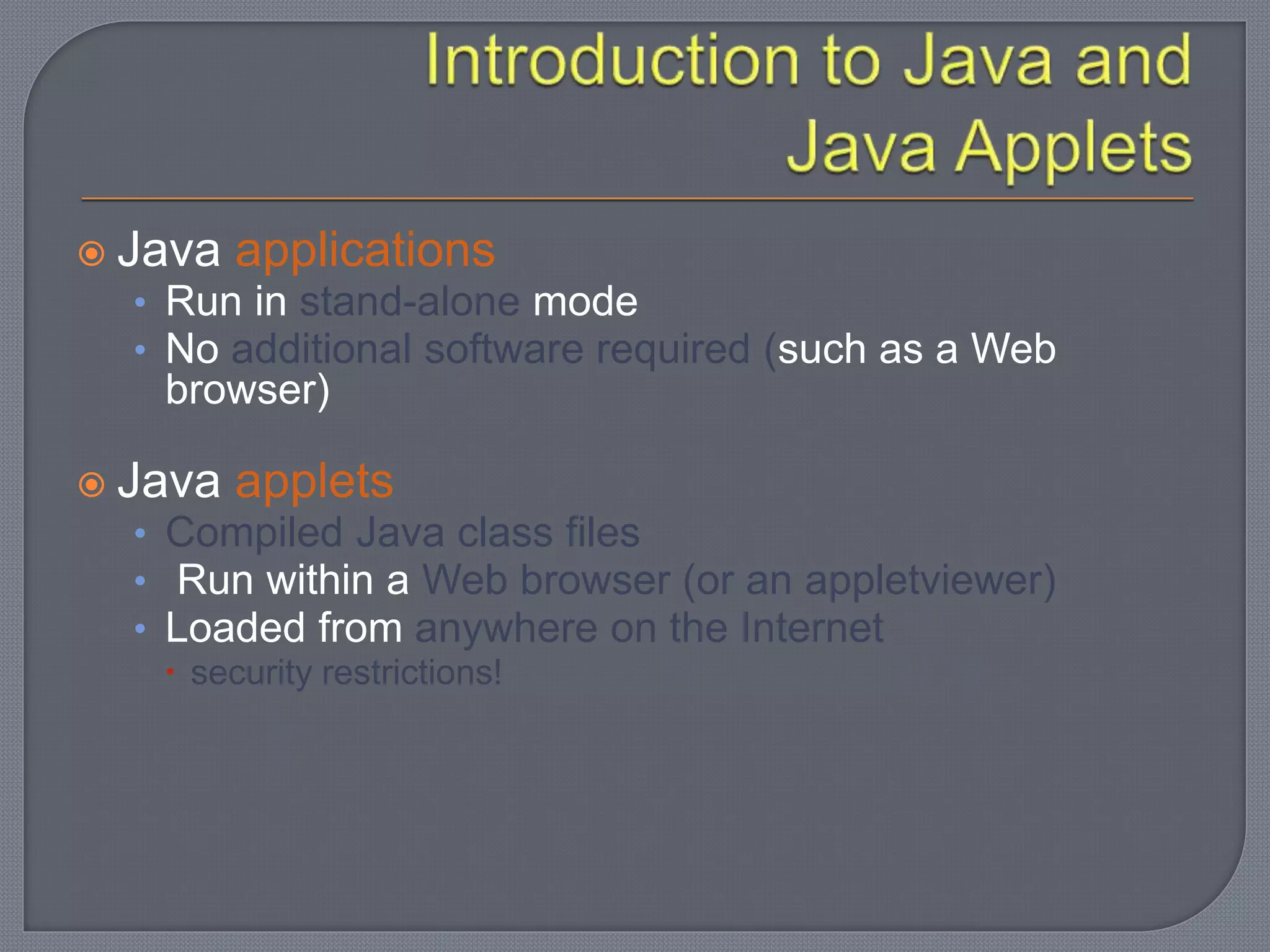
 Java applications
• Run in stand-alone mode
• No additional software required (such as a Web
browser)
 Java applets
• Compiled Java class files
• Run within a Web browser (or an appletviewer)
• Loaded from anywhere on the Internet
 security restrictions!
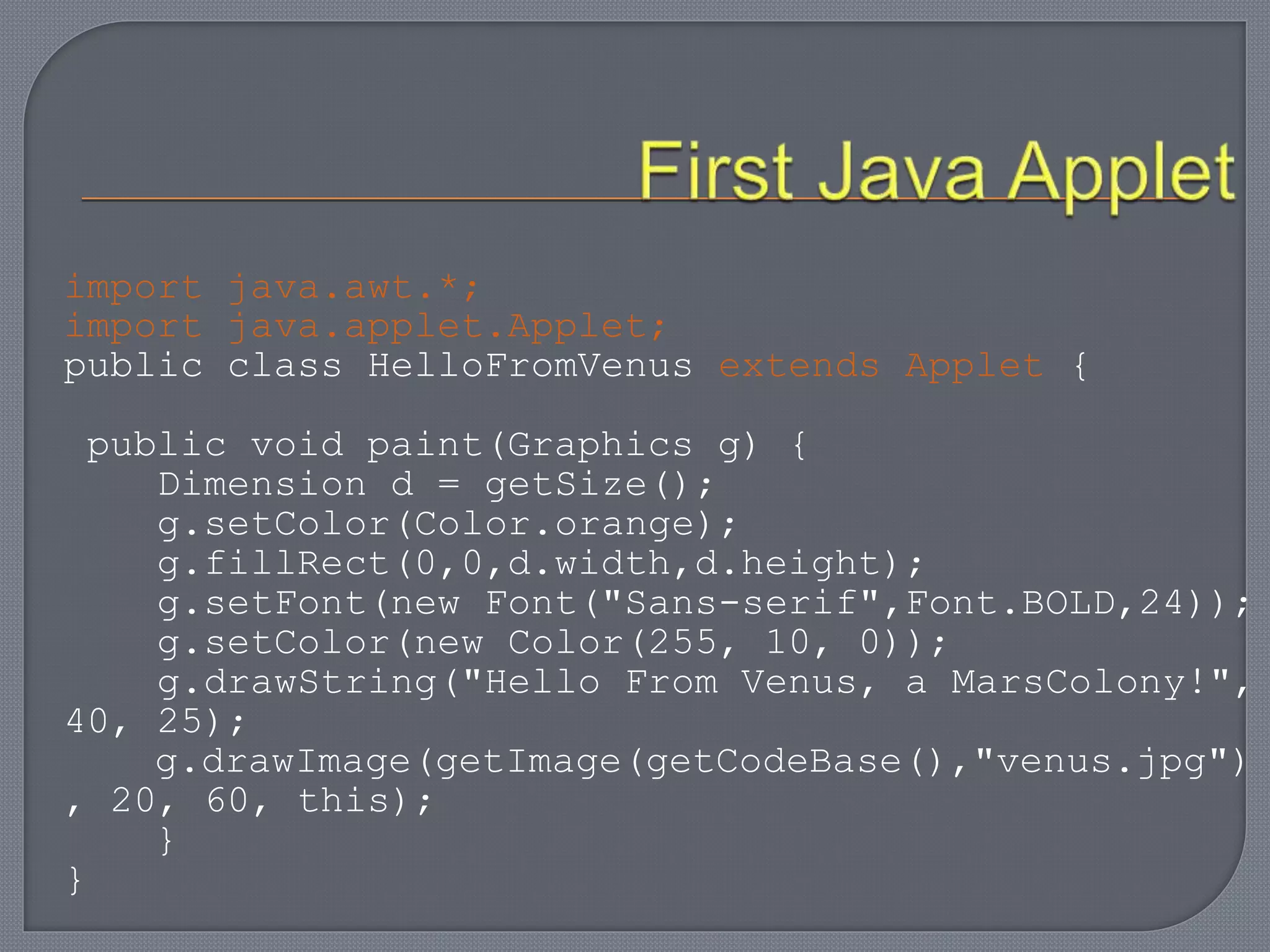
import java.awt.*;
import java.applet.Applet;
public class HelloFromVenus extends Applet {
public void paint(Graphics g) {
Dimension d = getSize();
g.setColor(Color.orange);
g.fillRect(0,0,d.width,d.height);
g.setFont(new Font("Sans-serif",Font.BOLD,24));
g.setColor(new Color(255, 10, 0));
g.drawString("Hello From Venus, a MarsColony!",
40, 25);
g.drawImage(getImage(getCodeBase(),"venus.jpg")
, 20, 60, this);
}
}
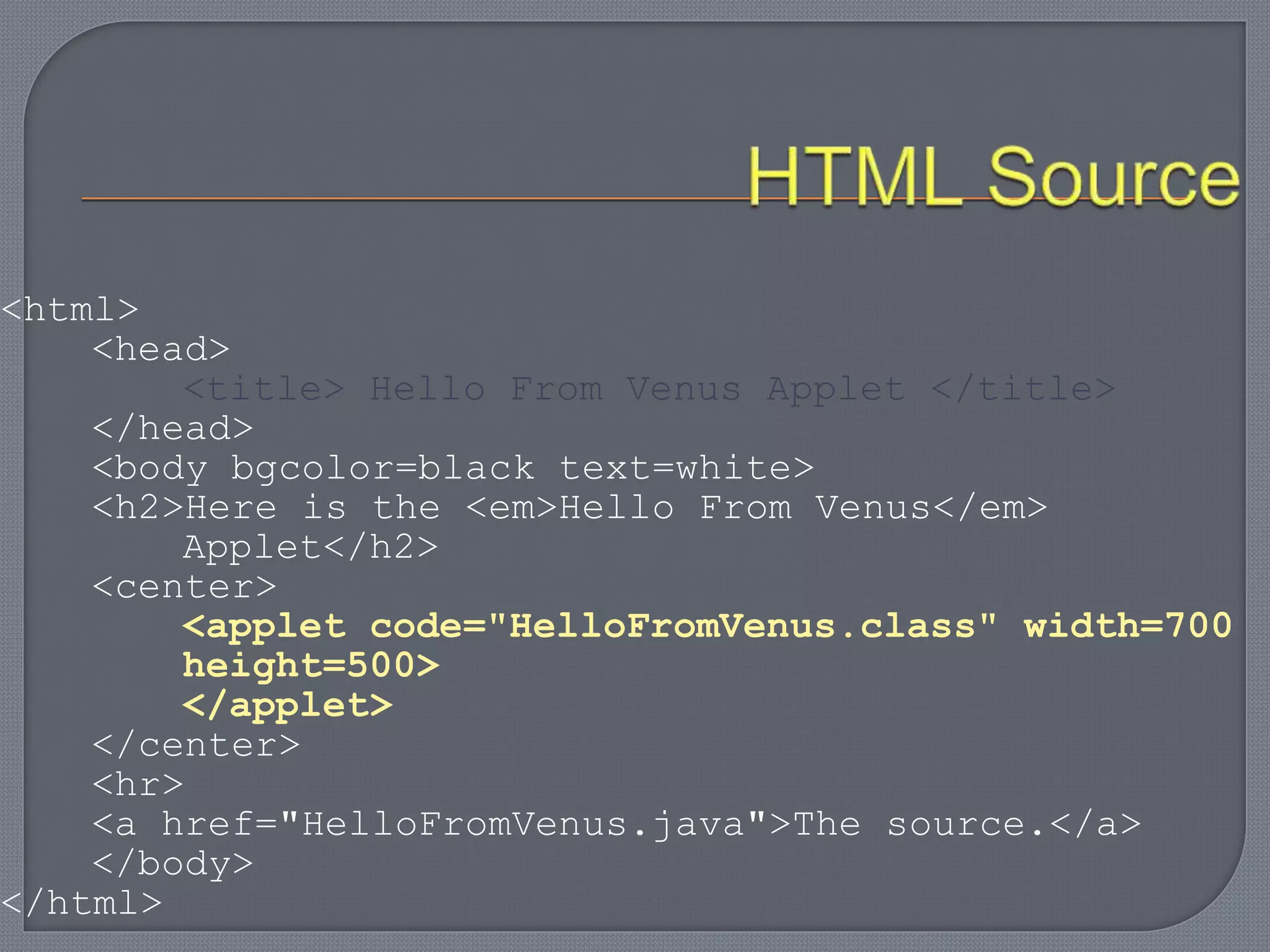
<html>
<head>
<title> Hello From Venus Applet </title>
</head>
<body bgcolor=black text=white>
<h2>Here is the <em>Hello From Venus</em>
Applet</h2>
<center>
<applet code="HelloFromVenus.class" width=700
height=500>
</applet>
</center>
<hr>
<a href="HelloFromVenus.java">The source.</a>
</body>
</html>
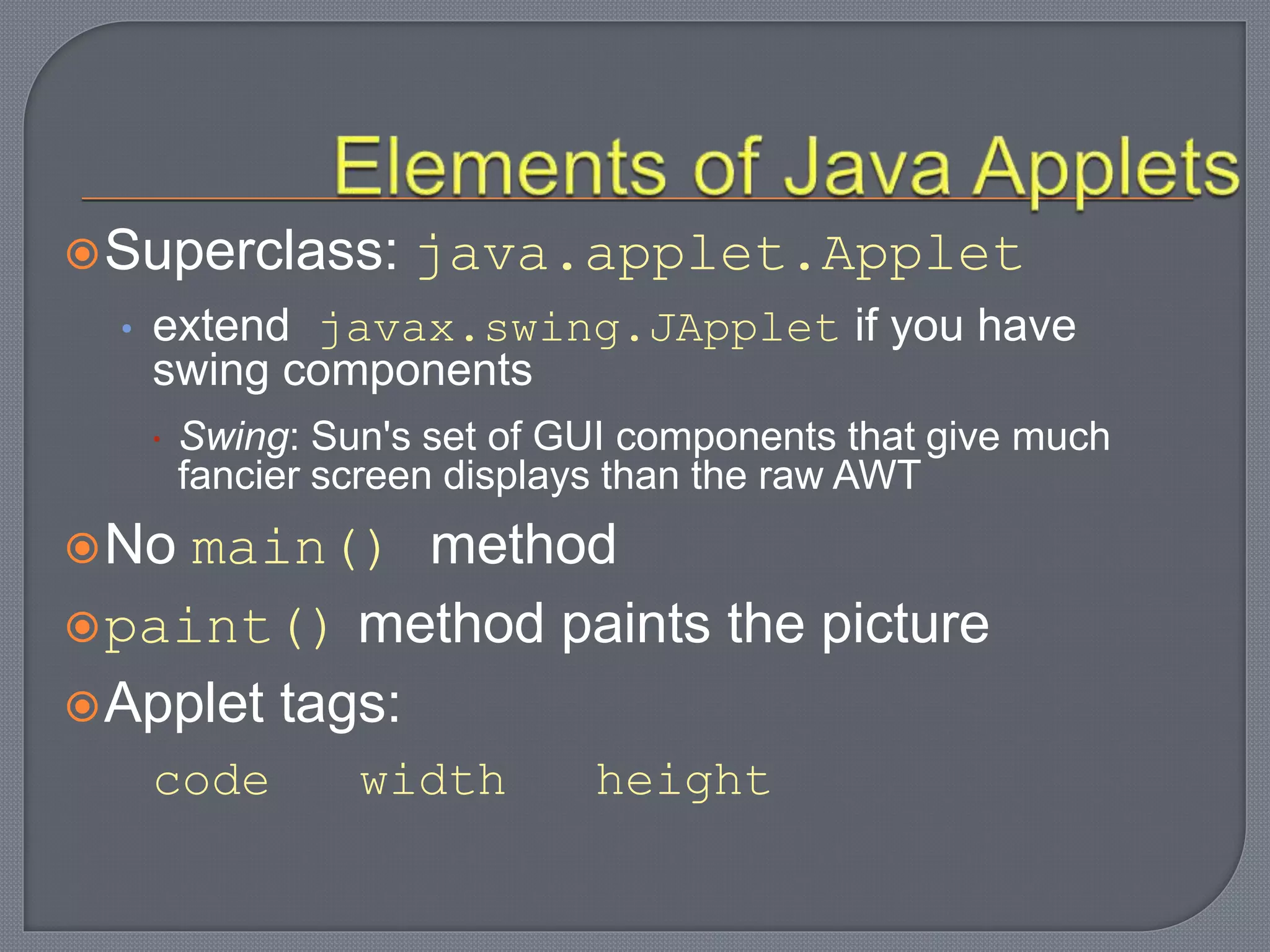
Superclass: java.applet.Applet
• extend javax.swing.JApplet if you have
swing components
 Swing: Sun's set of GUI components that give much
fancier screen displays than the raw AWT
No main() method
paint() method paints the picture
Applet tags:
code width height
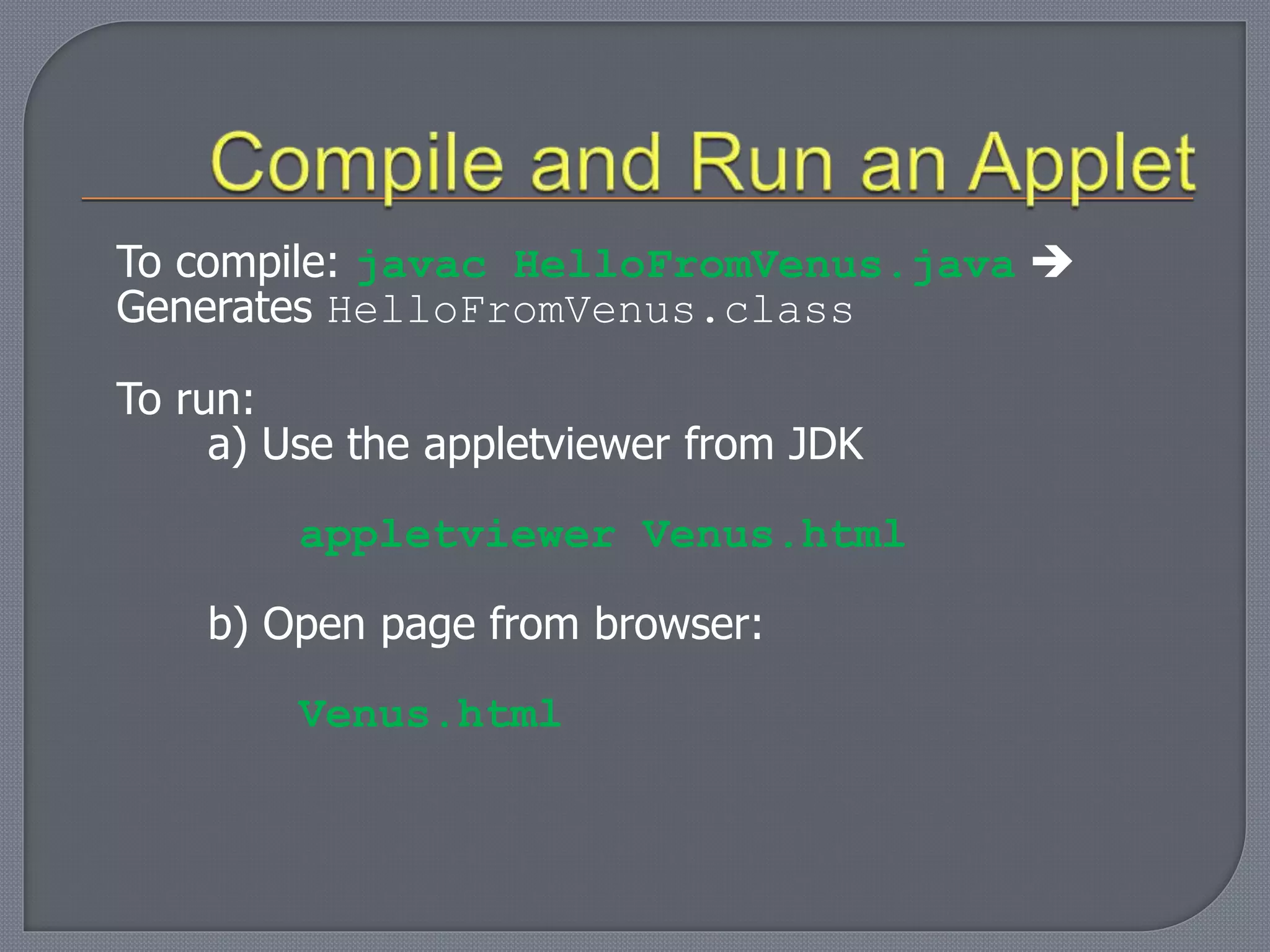
To compile: javac HelloFromVenus.java 
Generates HelloFromVenus.class
To run:
a) Use the appletviewer from JDK
appletviewer Venus.html
b) Open page from browser:
Venus.html
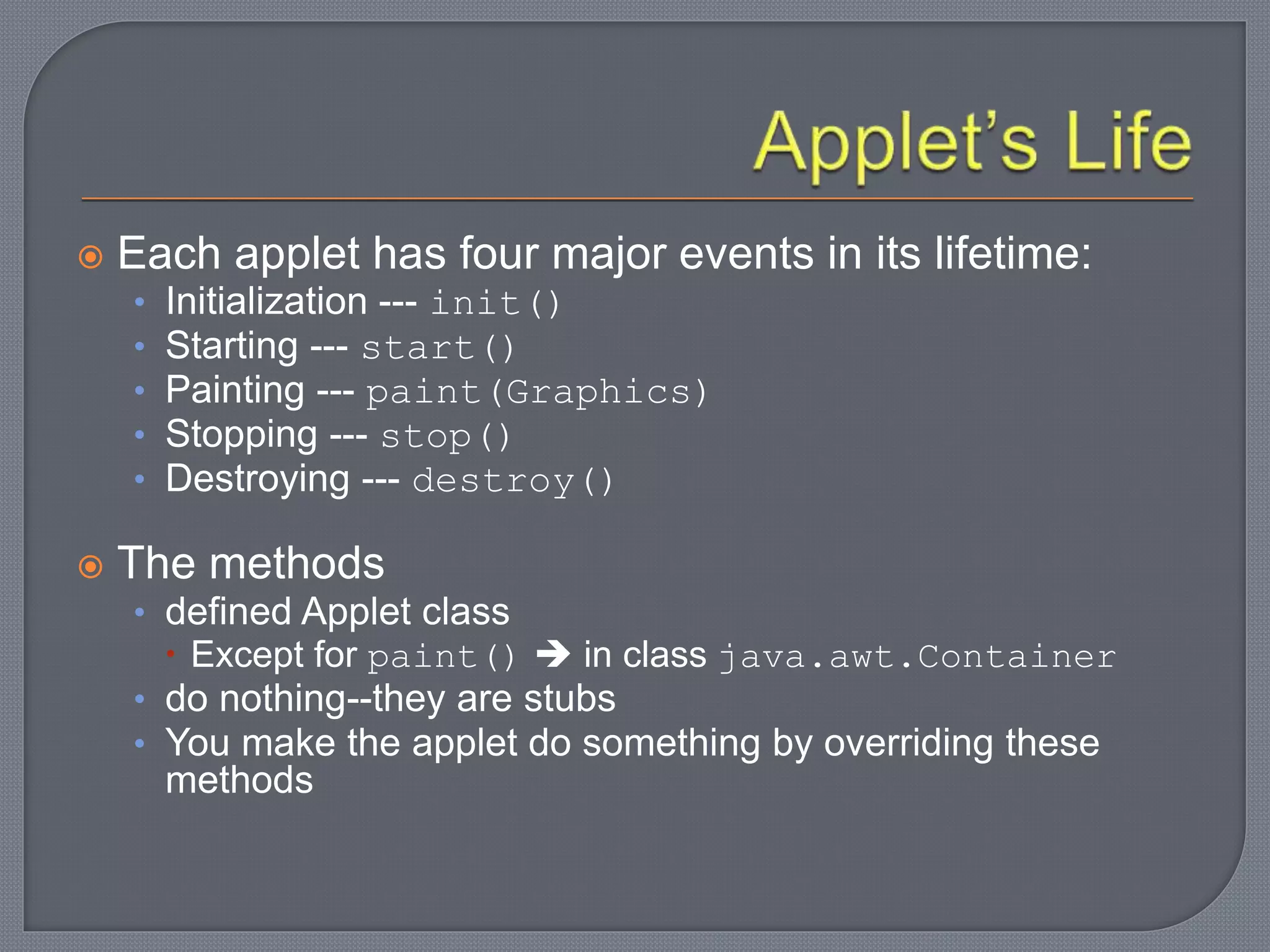
 Each applet has four major events in its lifetime:
• Initialization --- init()
• Starting --- start()
• Painting --- paint(Graphics)
• Stopping --- stop()
• Destroying --- destroy()
 The methods
• defined Applet class
 Except for paint()  in class java.awt.Container
• do nothing--they are stubs
• You make the applet do something by overriding these
methods
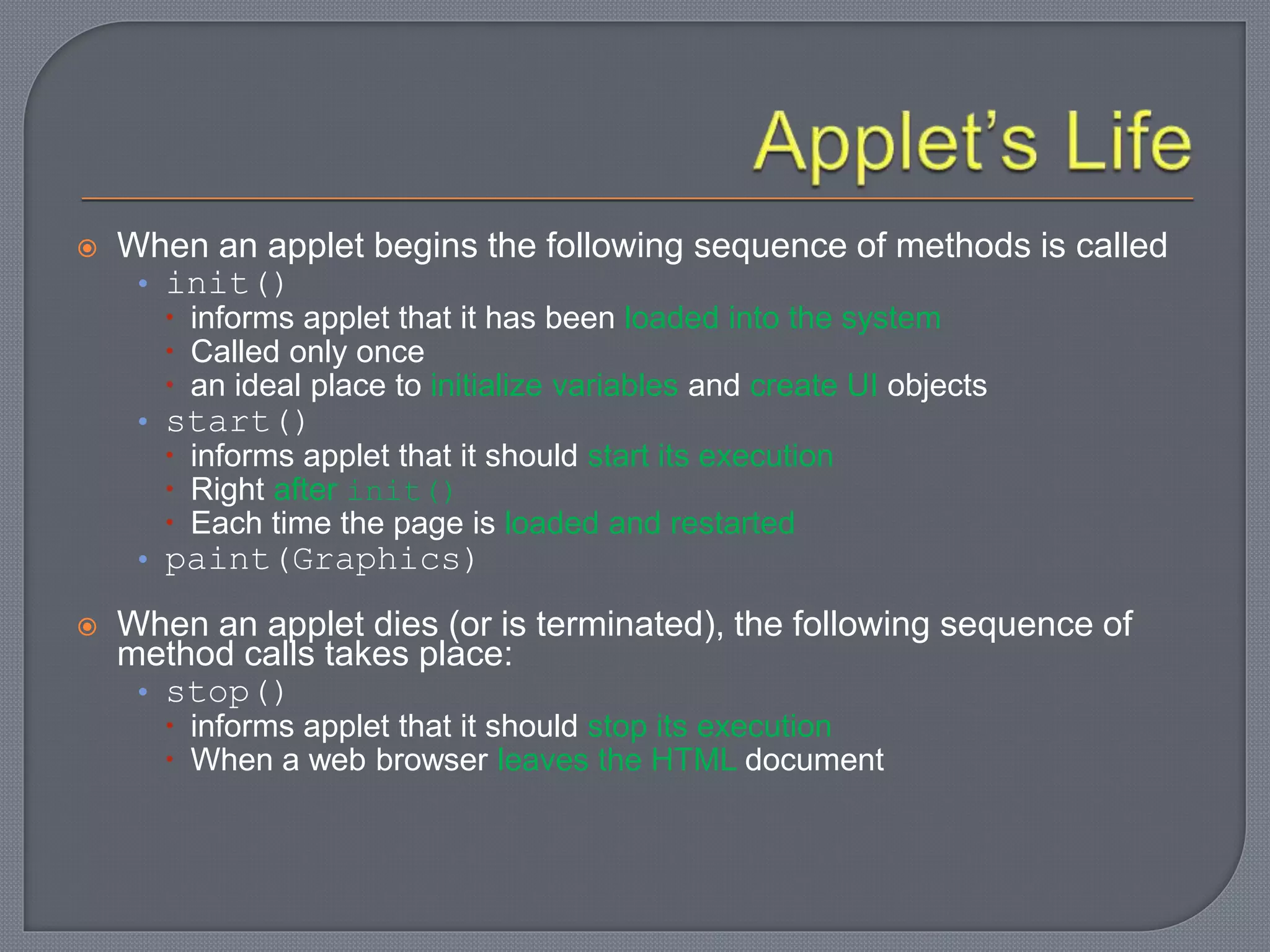
 When an applet begins the following sequence of methods is called
• init()
 informs applet that it has been loaded into the system
 Called only once
 an ideal place to initialize variables and create UI objects
• start()
 informs applet that it should start its execution
 Right after init()
 Each time the page is loaded and restarted
• paint(Graphics)
 When an applet dies (or is terminated), the following sequence of
method calls takes place:
• stop()
 informs applet that it should stop its execution
 When a web browser leaves the HTML document
• destroy()
 informs applet that it is being reclaimed and that it
should destroy any resources that it has allocated
 Use destroy() to explicitly release system resources
(like threads)
 Usually released automatically (Auto garbage collection)
 Called only once
 when the environment determines that your applet needs to be
removed completely from memory
 The stop() method is always called before destroy()
 no guarantee that this method will be completely executed
 The Java Virtual Machine might exit before a long destroy
method has completed
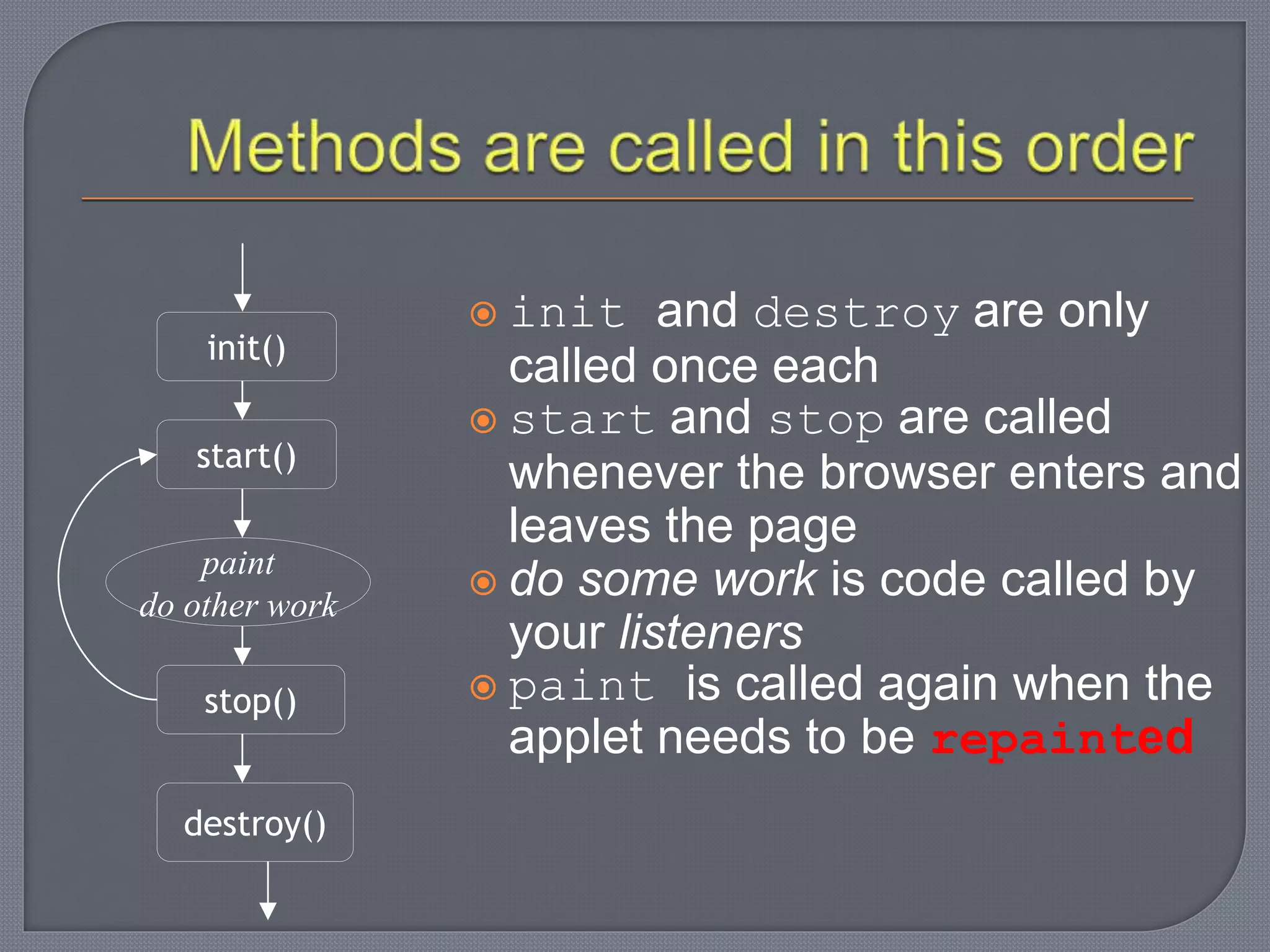
 init and destroy are only
called once each
 start and stop are called
whenever the browser enters and
leaves the page
 do some work is code called by
your listeners
 paint is called again when the
applet needs to be repainted
init()
start()
stop()
destroy()
paint
do other work
 Needed if you do any drawing or painting other than just using
standard GUI Components
 Any painting you want to do should be done here, or in a method you
call from here
 For painting done in other methods
• Never call paint(Graphics), always call repaint( )
 Life Cycle Applet via AppletViewer
 Automatically called when
• when the applet begins execution
• the window in which the applet is running may be overwritten by another
window and then uncovered
• the applet window is resized
 A Graphics is something you can paint on
g.drawRect(x, y, width, height);
g.fillRect(x, y, width, height);
g.drawOval(x, y, width, height);
g.fillOval(x, y, width, height);
g.setColor(Color.red);
g.drawString(“Hello”, 20, 20); Hello
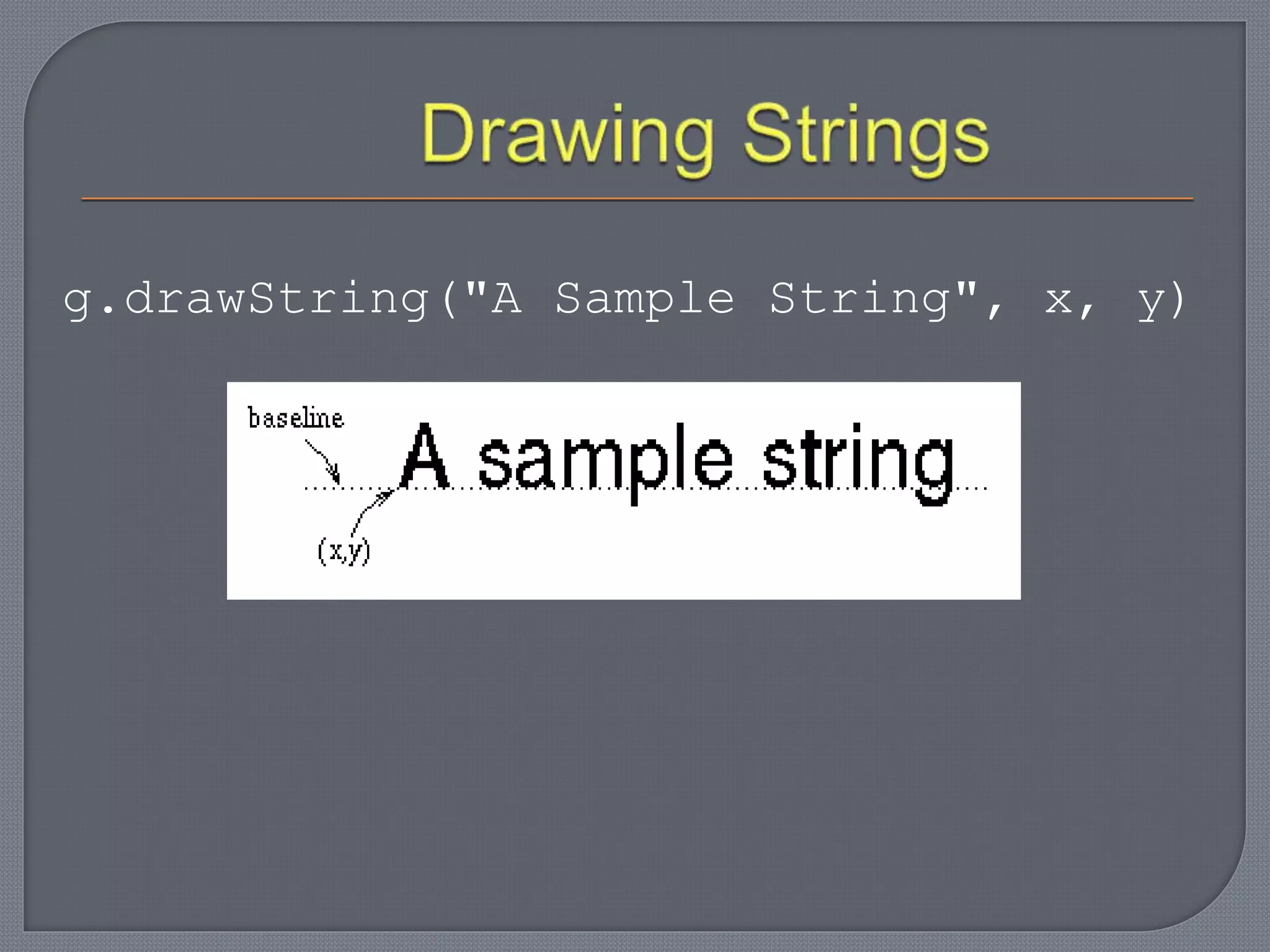
g.drawString("A Sample String", x, y)
Represent Graphics Context
A graphics context is an abstraction of various drawing
surfaces:
-screen
-printer
-off-screen image (an image stored in memory)
Provide a rich set of graphics methods
drawString() drawLine()
drawArc() fillArc()
drawOval() fillOval()
drawPolygon() fillPolygon()
drawRect() fillRect()
drawRoundRect() fillRoundRect()
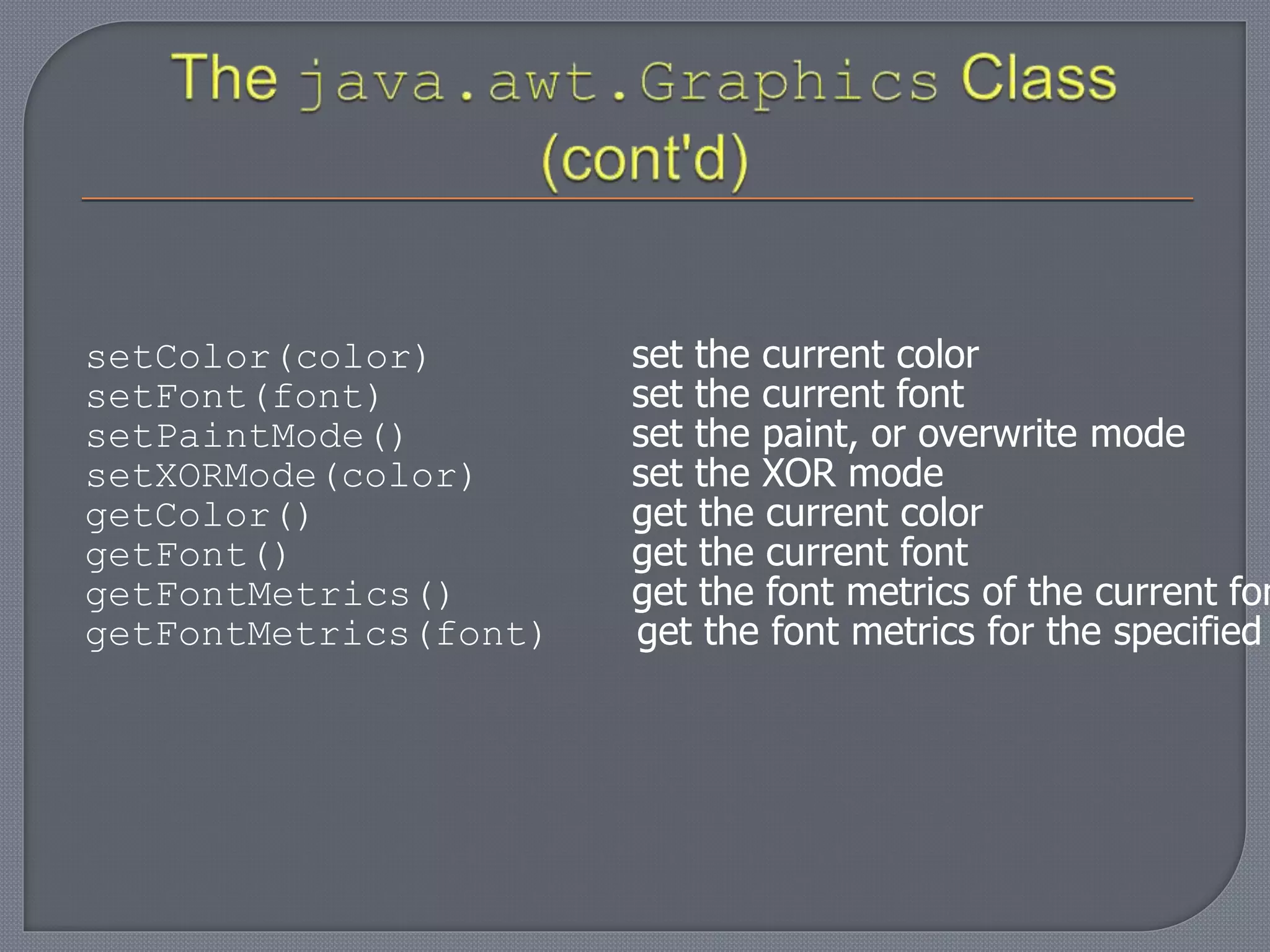
setColor(color) set the current color
setFont(font) set the current font
setPaintMode() set the paint, or overwrite mode
setXORMode(color) set the XOR mode
getColor() get the current color
getFont() get the current font
getFontMetrics() get the font metrics of the current fon
getFontMetrics(font) get the font metrics for the specified
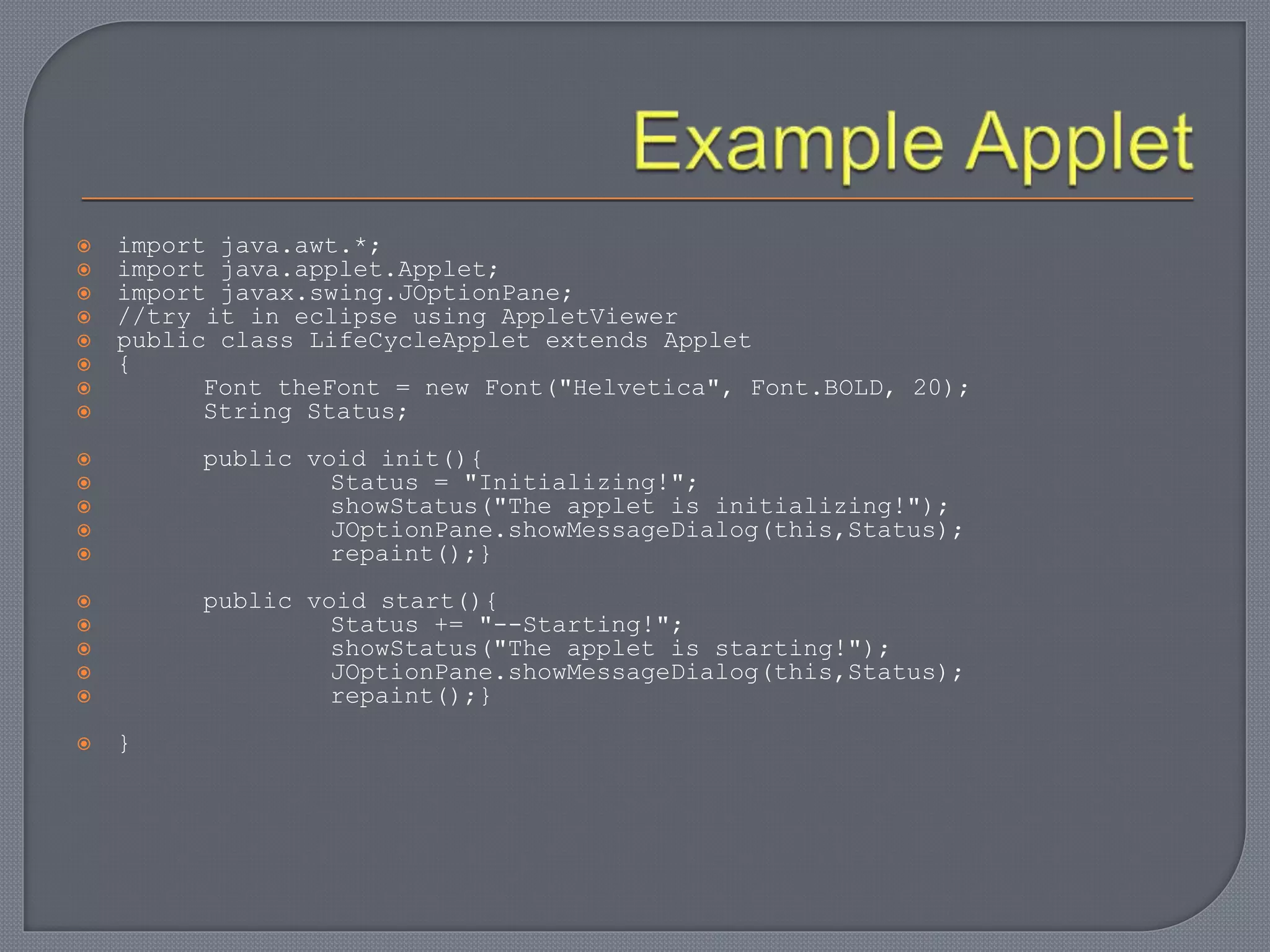
 import java.awt.*;
 import java.applet.Applet;
 import javax.swing.JOptionPane;
 //try it in eclipse using AppletViewer
 public class LifeCycleApplet extends Applet
 {
 Font theFont = new Font("Helvetica", Font.BOLD, 20);
 String Status;
 public void init(){
 Status = "Initializing!";
 showStatus("The applet is initializing!");
 JOptionPane.showMessageDialog(this,Status);
 repaint();}
 public void start(){
 Status += "--Starting!";
 showStatus("The applet is starting!");
 JOptionPane.showMessageDialog(this,Status);
 repaint();}
 }
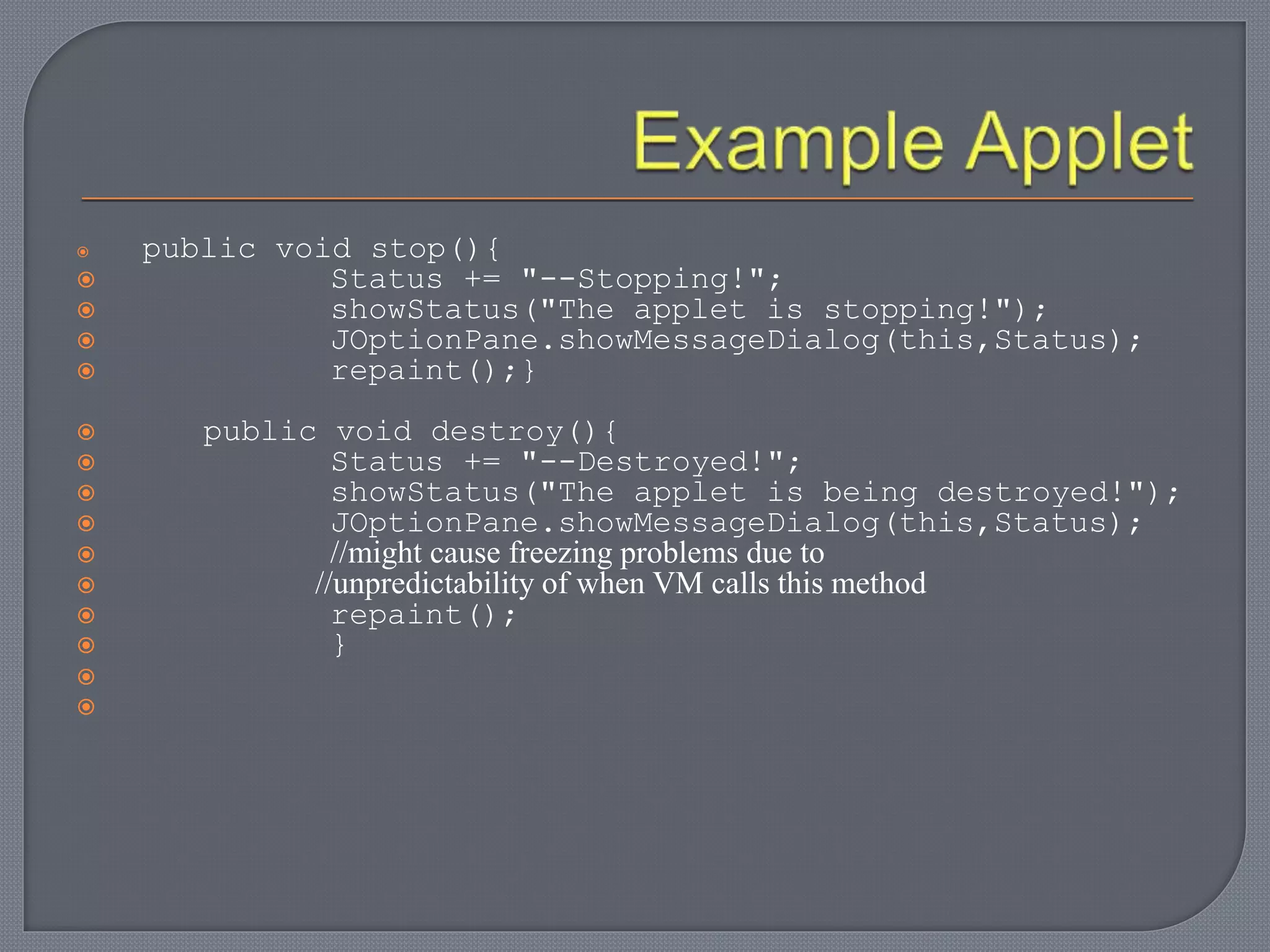
 public void stop(){
 Status += "--Stopping!";
 showStatus("The applet is stopping!");
 JOptionPane.showMessageDialog(this,Status);
 repaint();}
 public void destroy(){
 Status += "--Destroyed!";
 showStatus("The applet is being destroyed!");
 JOptionPane.showMessageDialog(this,Status);
 //might cause freezing problems due to
 //unpredictability of when VM calls this method
 repaint();
 }


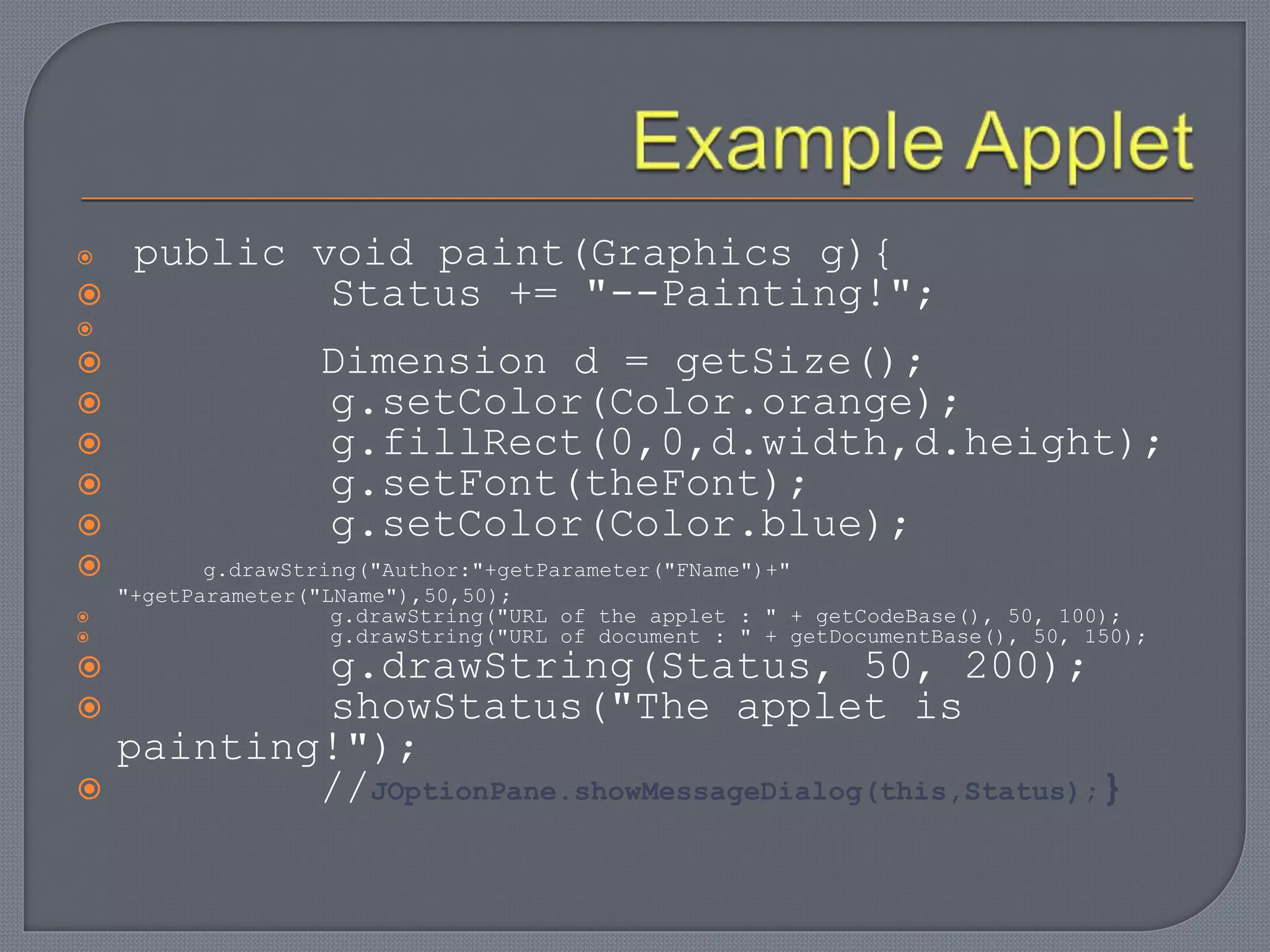
 public void paint(Graphics g){
 Status += "--Painting!";

 Dimension d = getSize();
 g.setColor(Color.orange);
 g.fillRect(0,0,d.width,d.height);
 g.setFont(theFont);
 g.setColor(Color.blue);
 g.drawString("Author:"+getParameter("FName")+"
"+getParameter("LName"),50,50);
 g.drawString("URL of the applet : " + getCodeBase(), 50, 100);
 g.drawString("URL of document : " + getDocumentBase(), 50, 150);
 g.drawString(Status, 50, 200);
 showStatus("The applet is
painting!");
 //JOptionPane.showMessageDialog(this,Status);}
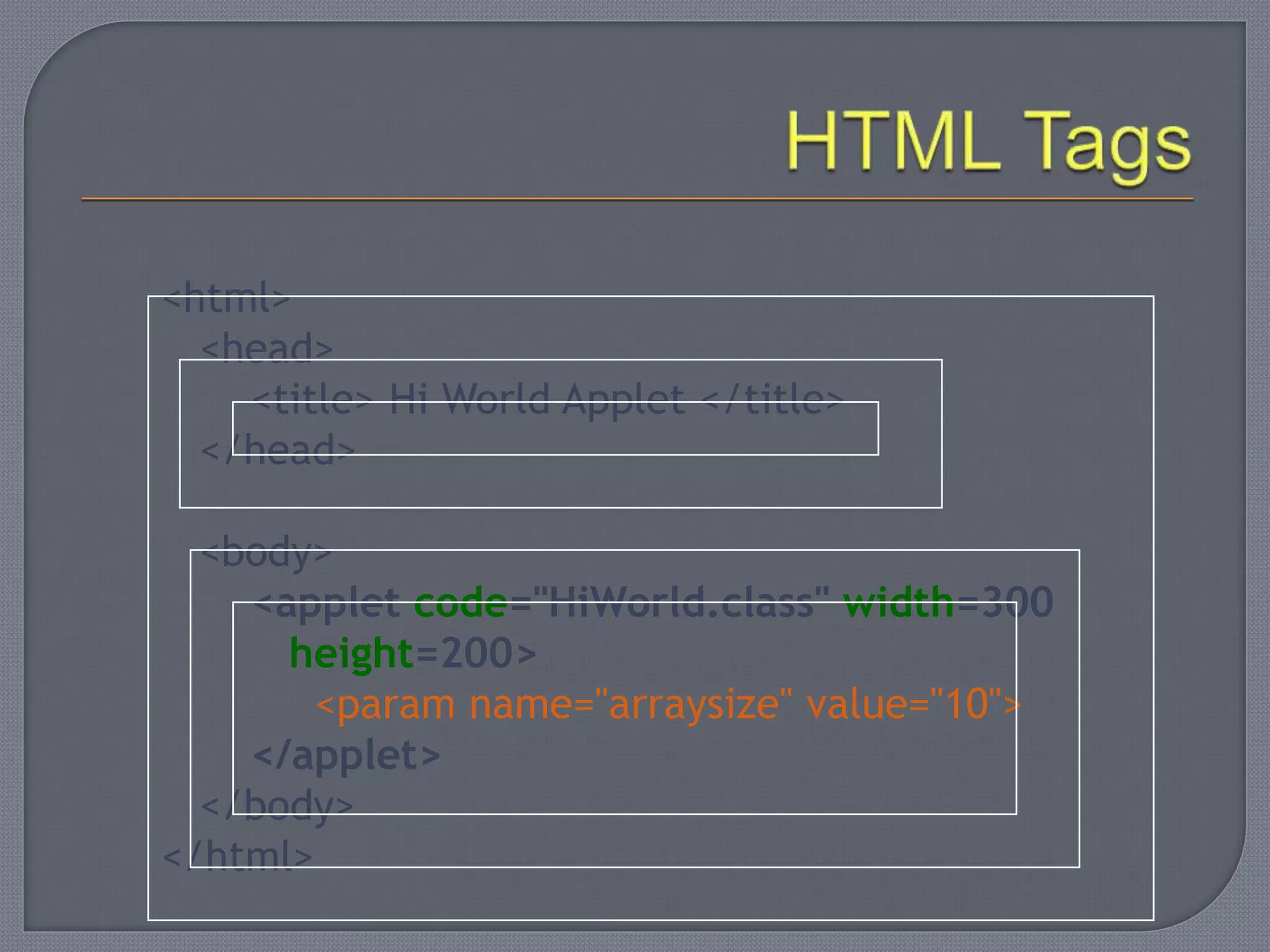
<html>
<head>
<title> Hi World Applet </title>
</head>
<body>
<applet code="HiWorld.class" width=300
height=200>
<param name="arraysize" value="10">
</applet>
</body>
</html>
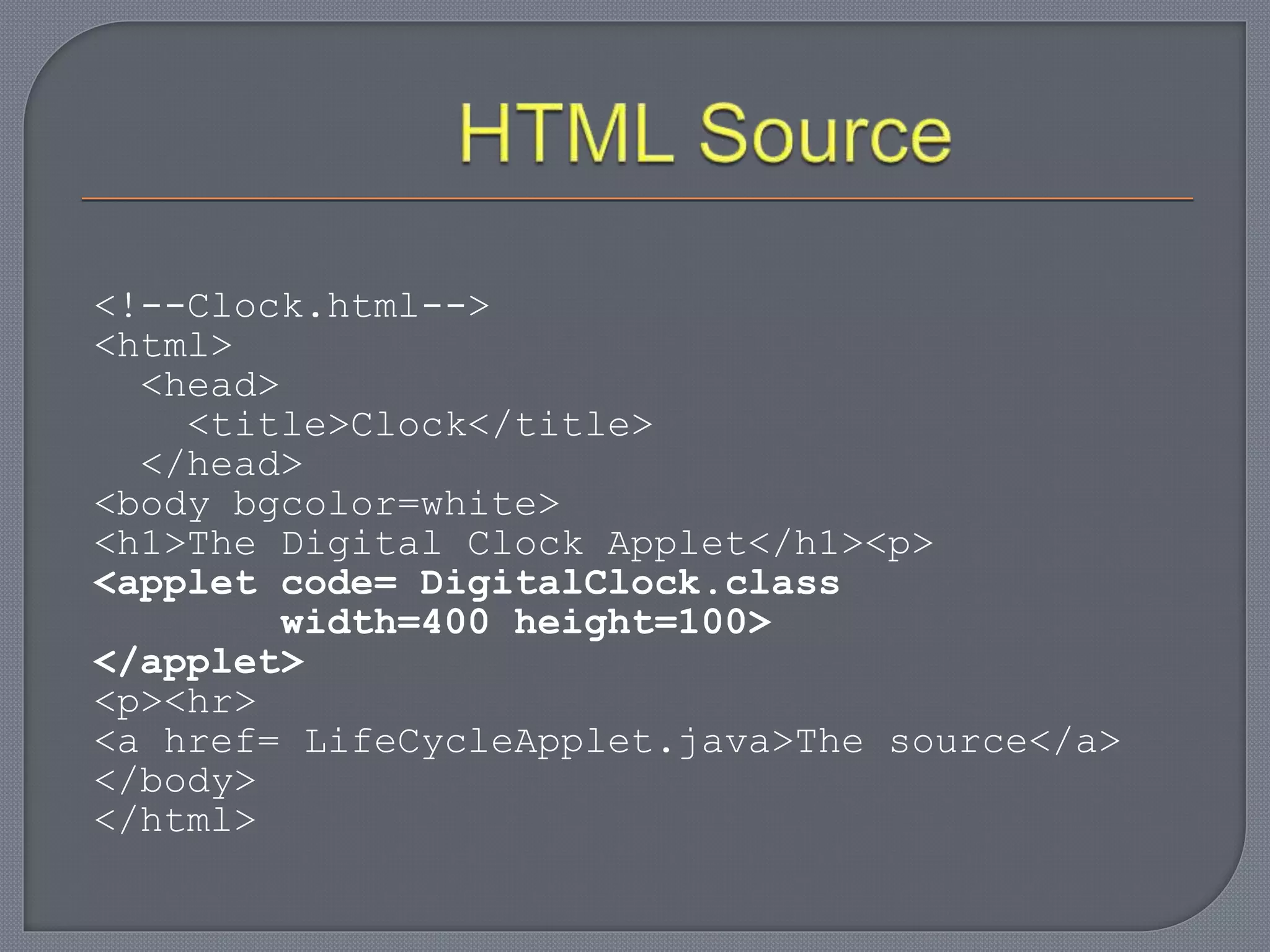
<!--Clock.html-->
<html>
<head>
<title>Clock</title>
</head>
<body bgcolor=white>
<h1>The Digital Clock Applet</h1><p>
<applet code= DigitalClock.class
width=400 height=100>
</applet>
<p><hr>
<a href= LifeCycleApplet.java>The source</a>
</body>
</html>
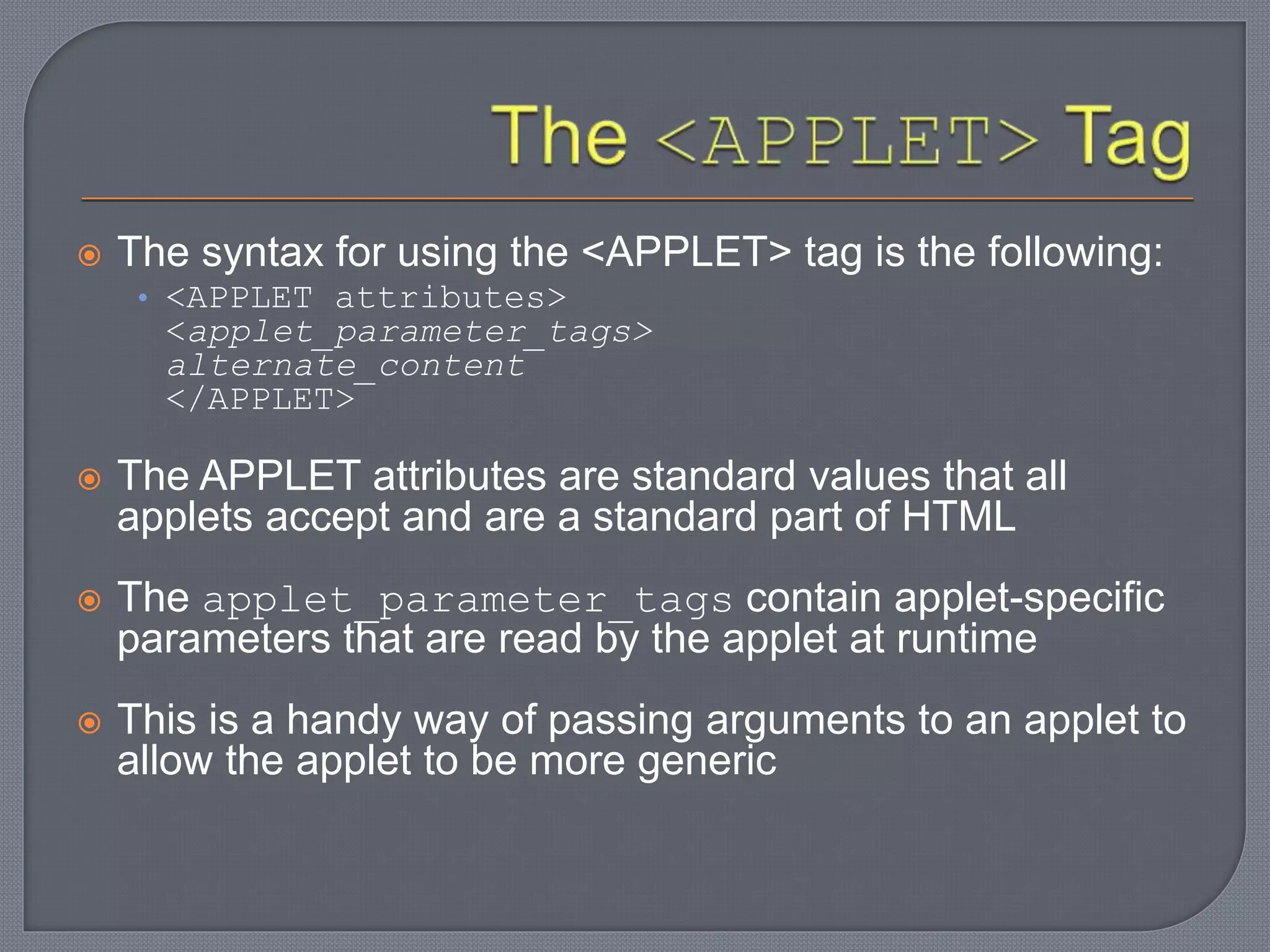
 The syntax for using the <APPLET> tag is the following:
• <APPLET attributes>
<applet_parameter_tags>
alternate_content
</APPLET>
 The APPLET attributes are standard values that all
applets accept and are a standard part of HTML
 The applet_parameter_tags contain applet-specific
parameters that are read by the applet at runtime
 This is a handy way of passing arguments to an applet to
allow the applet to be more generic
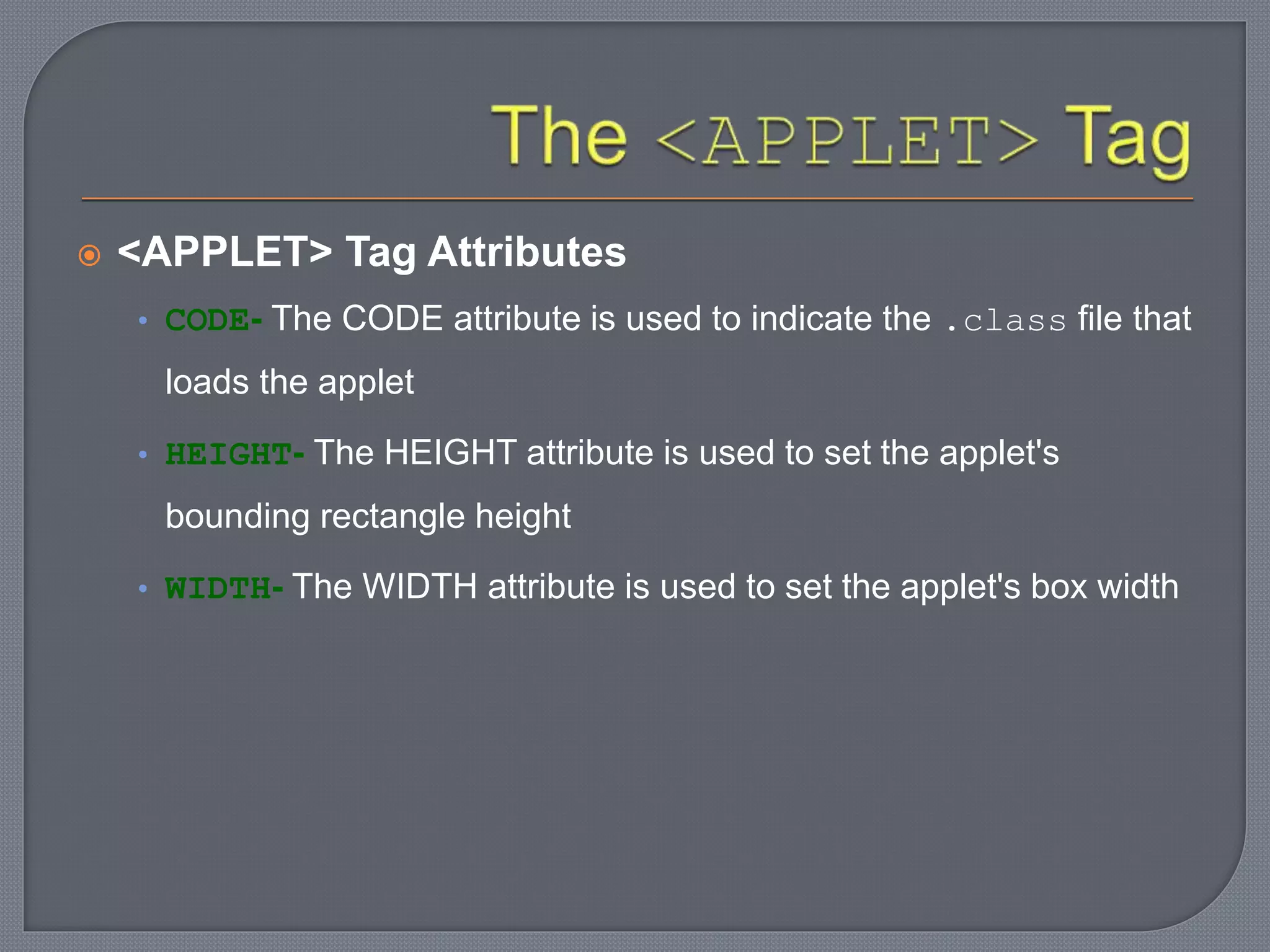
 <APPLET> Tag Attributes
• CODE- The CODE attribute is used to indicate the .class file that
loads the applet
• HEIGHT- The HEIGHT attribute is used to set the applet's
bounding rectangle height
• WIDTH- The WIDTH attribute is used to set the applet's box width
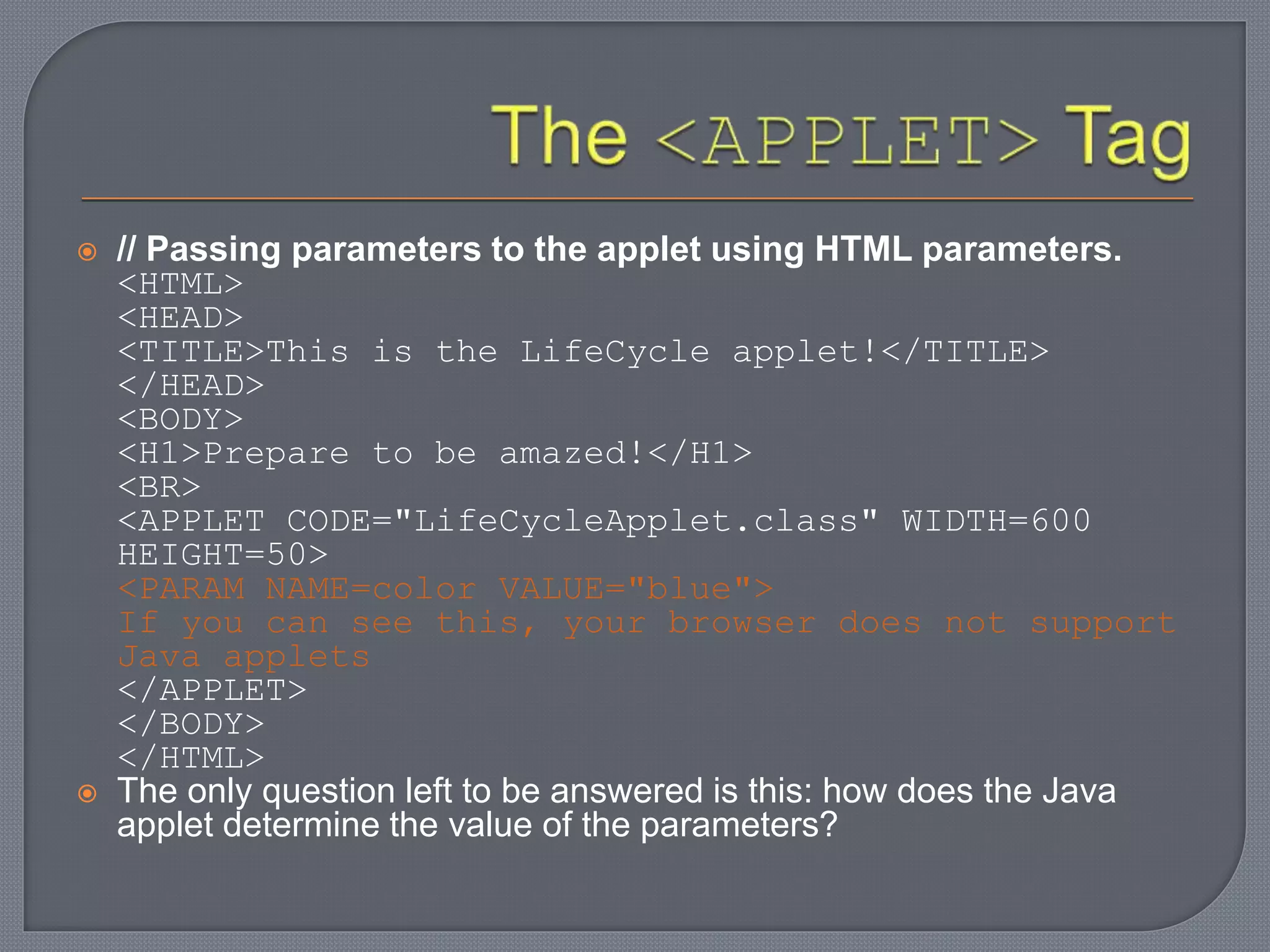
 // Passing parameters to the applet using HTML parameters.
<HTML>
<HEAD>
<TITLE>This is the LifeCycle applet!</TITLE>
</HEAD>
<BODY>
<H1>Prepare to be amazed!</H1>
<BR>
<APPLET CODE="LifeCycleApplet.class" WIDTH=600
HEIGHT=50>
<PARAM NAME=color VALUE="blue">
If you can see this, your browser does not support
Java applets
</APPLET>
</BODY>
</HTML>
 The only question left to be answered is this: how does the Java
applet determine the value of the parameters?

Applet life cycle

  • 1.
    P. Raveena Lakshmi,M.Sc., M.Phil., Assistant Professor
  • 2.
     Java applications •Run in stand-alone mode • No additional software required (such as a Web browser)  Java applets • Compiled Java class files • Run within a Web browser (or an appletviewer) • Loaded from anywhere on the Internet  security restrictions!
  • 3.
    import java.awt.*; import java.applet.Applet; publicclass HelloFromVenus extends Applet { public void paint(Graphics g) { Dimension d = getSize(); g.setColor(Color.orange); g.fillRect(0,0,d.width,d.height); g.setFont(new Font("Sans-serif",Font.BOLD,24)); g.setColor(new Color(255, 10, 0)); g.drawString("Hello From Venus, a MarsColony!", 40, 25); g.drawImage(getImage(getCodeBase(),"venus.jpg") , 20, 60, this); } }
  • 4.
    <html> <head> <title> Hello FromVenus Applet </title> </head> <body bgcolor=black text=white> <h2>Here is the <em>Hello From Venus</em> Applet</h2> <center> <applet code="HelloFromVenus.class" width=700 height=500> </applet> </center> <hr> <a href="HelloFromVenus.java">The source.</a> </body> </html>
  • 5.
    Superclass: java.applet.Applet • extendjavax.swing.JApplet if you have swing components  Swing: Sun's set of GUI components that give much fancier screen displays than the raw AWT No main() method paint() method paints the picture Applet tags: code width height
  • 6.
    To compile: javacHelloFromVenus.java  Generates HelloFromVenus.class To run: a) Use the appletviewer from JDK appletviewer Venus.html b) Open page from browser: Venus.html
  • 7.
     Each applethas four major events in its lifetime: • Initialization --- init() • Starting --- start() • Painting --- paint(Graphics) • Stopping --- stop() • Destroying --- destroy()  The methods • defined Applet class  Except for paint()  in class java.awt.Container • do nothing--they are stubs • You make the applet do something by overriding these methods
  • 8.
     When anapplet begins the following sequence of methods is called • init()  informs applet that it has been loaded into the system  Called only once  an ideal place to initialize variables and create UI objects • start()  informs applet that it should start its execution  Right after init()  Each time the page is loaded and restarted • paint(Graphics)  When an applet dies (or is terminated), the following sequence of method calls takes place: • stop()  informs applet that it should stop its execution  When a web browser leaves the HTML document
  • 9.
    • destroy()  informsapplet that it is being reclaimed and that it should destroy any resources that it has allocated  Use destroy() to explicitly release system resources (like threads)  Usually released automatically (Auto garbage collection)  Called only once  when the environment determines that your applet needs to be removed completely from memory  The stop() method is always called before destroy()  no guarantee that this method will be completely executed  The Java Virtual Machine might exit before a long destroy method has completed
  • 10.
     init anddestroy are only called once each  start and stop are called whenever the browser enters and leaves the page  do some work is code called by your listeners  paint is called again when the applet needs to be repainted init() start() stop() destroy() paint do other work
  • 11.
     Needed ifyou do any drawing or painting other than just using standard GUI Components  Any painting you want to do should be done here, or in a method you call from here  For painting done in other methods • Never call paint(Graphics), always call repaint( )  Life Cycle Applet via AppletViewer  Automatically called when • when the applet begins execution • the window in which the applet is running may be overwritten by another window and then uncovered • the applet window is resized
  • 12.
     A Graphicsis something you can paint on g.drawRect(x, y, width, height); g.fillRect(x, y, width, height); g.drawOval(x, y, width, height); g.fillOval(x, y, width, height); g.setColor(Color.red); g.drawString(“Hello”, 20, 20); Hello
  • 13.
  • 14.
    Represent Graphics Context Agraphics context is an abstraction of various drawing surfaces: -screen -printer -off-screen image (an image stored in memory) Provide a rich set of graphics methods drawString() drawLine() drawArc() fillArc() drawOval() fillOval() drawPolygon() fillPolygon() drawRect() fillRect() drawRoundRect() fillRoundRect()
  • 15.
    setColor(color) set thecurrent color setFont(font) set the current font setPaintMode() set the paint, or overwrite mode setXORMode(color) set the XOR mode getColor() get the current color getFont() get the current font getFontMetrics() get the font metrics of the current fon getFontMetrics(font) get the font metrics for the specified
  • 16.
     import java.awt.*; import java.applet.Applet;  import javax.swing.JOptionPane;  //try it in eclipse using AppletViewer  public class LifeCycleApplet extends Applet  {  Font theFont = new Font("Helvetica", Font.BOLD, 20);  String Status;  public void init(){  Status = "Initializing!";  showStatus("The applet is initializing!");  JOptionPane.showMessageDialog(this,Status);  repaint();}  public void start(){  Status += "--Starting!";  showStatus("The applet is starting!");  JOptionPane.showMessageDialog(this,Status);  repaint();}  }
  • 17.
     public voidstop(){  Status += "--Stopping!";  showStatus("The applet is stopping!");  JOptionPane.showMessageDialog(this,Status);  repaint();}  public void destroy(){  Status += "--Destroyed!";  showStatus("The applet is being destroyed!");  JOptionPane.showMessageDialog(this,Status);  //might cause freezing problems due to  //unpredictability of when VM calls this method  repaint();  }  
  • 18.
     public voidpaint(Graphics g){  Status += "--Painting!";   Dimension d = getSize();  g.setColor(Color.orange);  g.fillRect(0,0,d.width,d.height);  g.setFont(theFont);  g.setColor(Color.blue);  g.drawString("Author:"+getParameter("FName")+" "+getParameter("LName"),50,50);  g.drawString("URL of the applet : " + getCodeBase(), 50, 100);  g.drawString("URL of document : " + getDocumentBase(), 50, 150);  g.drawString(Status, 50, 200);  showStatus("The applet is painting!");  //JOptionPane.showMessageDialog(this,Status);}
  • 19.
    <html> <head> <title> Hi WorldApplet </title> </head> <body> <applet code="HiWorld.class" width=300 height=200> <param name="arraysize" value="10"> </applet> </body> </html>
  • 20.
    <!--Clock.html--> <html> <head> <title>Clock</title> </head> <body bgcolor=white> <h1>The DigitalClock Applet</h1><p> <applet code= DigitalClock.class width=400 height=100> </applet> <p><hr> <a href= LifeCycleApplet.java>The source</a> </body> </html>
  • 21.
     The syntaxfor using the <APPLET> tag is the following: • <APPLET attributes> <applet_parameter_tags> alternate_content </APPLET>  The APPLET attributes are standard values that all applets accept and are a standard part of HTML  The applet_parameter_tags contain applet-specific parameters that are read by the applet at runtime  This is a handy way of passing arguments to an applet to allow the applet to be more generic
  • 22.
     <APPLET> TagAttributes • CODE- The CODE attribute is used to indicate the .class file that loads the applet • HEIGHT- The HEIGHT attribute is used to set the applet's bounding rectangle height • WIDTH- The WIDTH attribute is used to set the applet's box width
  • 23.
     // Passingparameters to the applet using HTML parameters. <HTML> <HEAD> <TITLE>This is the LifeCycle applet!</TITLE> </HEAD> <BODY> <H1>Prepare to be amazed!</H1> <BR> <APPLET CODE="LifeCycleApplet.class" WIDTH=600 HEIGHT=50> <PARAM NAME=color VALUE="blue"> If you can see this, your browser does not support Java applets </APPLET> </BODY> </HTML>  The only question left to be answered is this: how does the Java applet determine the value of the parameters?