APHRODITE 
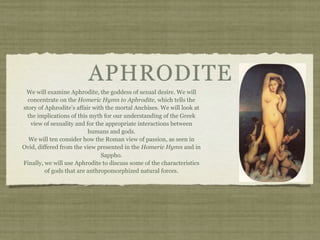
We will examine Aphrodite, the goddess of sexual desire. We will 
concentrate on the Homeric Hymn to Aphrodite, which tells the 
story of Aphrodite’s affair with the mortal Anchises. We will look at 
the implications of this myth for our understanding of the Greek 
view of sexuality and for the appropriate interactions between 
humans and gods. 
We will ten consider how the Roman view of passion, as seen in 
Ovid, differed from the view presented in the Homeric Hymn and in 
Sappho. 
Finally, we will use Aphrodite to discuss some of the characteristics 
of gods that are anthropomorphized natural forces.
OUR LAST KEY DEITY IS 
APHRODITE, THE GODDESS OF 
SEXUAL PASSION AND DESIRE. 
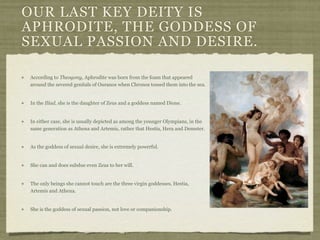
According to Theogony, Aphrodite was born from the foam that appeared 
around the severed genitals of Ouranos when Chronos tossed them into the sea. 
In the Iliad, she is the daughter of Zeus and a goddess named Dione. 
In either case, she is usually depicted as among the younger Olympians, in the 
same generation as Athena and Artemis, rather that Hestia, Hera and Demeter. 
As the goddess of sexual desire, she is extremely powerful. 
She can and does subdue even Zeus to her will. 
The only beings she cannot touch are the three virgin goddesses, Hestia, 
Artemis and Athena. 
She is the goddess of sexual passion, not love or companionship.
Aphrodite appears in many works of literature. However, 
for understanding of her essential nature, once again a 
Homeric Hymn is our starting point. 
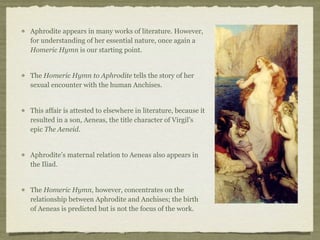
The Homeric Hymn to Aphrodite tells the story of her 
sexual encounter with the human Anchises. 
This affair is attested to elsewhere in literature, because it 
resulted in a son, Aeneas, the title character of Virgil’s 
epic The Aeneid. 
Aphrodite’s maternal relation to Aeneas also appears in 
the Iliad. 
The Homeric Hymn, however, concentrates on the 
relationship between Aphrodite and Anchises; the birth 
of Aeneas is predicted but is not the focus of the work.
The Homeric Hymn begins by stating that Zeus was angry at 
Aphrodite for causing him and other gods to become sexually 
involved with humans; therefore, he decided to give her a 
taste of her own medicine. 
Zeus’s reaction implies that sexual involvement with humans 
is beneath the gods’ dignity, something that they regret 
afterward. 
Another implication involves the separate spheres of influence 
of the gods and Zeus’s relationship to them. 
Usually, one god either cannot or does not trespass on 
another god’s sphere of influence. Aphrodite does not cause 
earthquakes; Poseidon does not inspire people with sexual 
passion, and so on. 
This respect for the boundaries of one another’s spheres 
probably stems from the fact that these gods embody the 
emotions and activities they govern. Aphrodite, in a sense, is 
sexual passion. 
However, Zeus is able to inflict Aphrodite with her own 
essence.
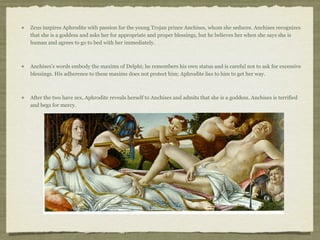
Zeus inspires Aphrodite with passion for the young Trojan prince Anchises, whom she seduces. Anchises recognizes 
that she is a goddess and asks her for appropriate and proper blessings, but he believes her when she says she is 
human and agrees to go to bed with her immediately. 
Anchises’s words embody the maxims of Delphi; he remembers his own status and is careful not to ask for excessive 
blessings. His adherence to these maxims does not protect him; Aphrodite lies to him to get her way. 
After the two have sex, Aphrodite reveals herself to Anchises and admits that she is a goddess. Anchises is terrified 
and begs for mercy.
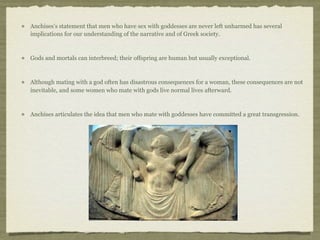
Anchises’s statement that men who have sex with goddesses are never left unharmed has several 
implications for our understanding of the narrative and of Greek society. 
Gods and mortals can interbreed; their offspring are human but usually exceptional. 
Although mating with a god often has disastrous consequences for a woman, these consequences are not 
inevitable, and some women who mate with gods live normal lives afterward. 
Anchises articulates the idea that men who mate with goddesses have committed a great transgression.
The reason for this imbalance has to do with views of sexuality and gender 
roles and with the nature of the relationship between gods and humans. 
Sex is seen in Greek culture as a process of domination. The male penetrator 
dominates his partner. 
Because Greek culture was strongly patriarchal and women were supposed to 
be subservient, this paradigm of sexuality was considered appropriate for 
male-female relationships. During sex, the man was dominant and the woman 
submissive, which was “how it should be.” 
When sex occurs between a god and human, the gender of each partner 
becomes very important. 
If a male god has sex with a mortal woman, there is no imbalance; a more 
powerful being (god, male) is dominating a less powerful one (human, female). 
When the male is human and the female is a goddess, the relationship is 
contradictory, because a less powerful human is dominating a more powerful 
goddess.
Furthermore, when a god or human mate, a child always 
results. 
Again, if the female is the human, this causes no discomfort to 
the gods. her child is still human but greater, more beautiful, 
more excellent than would otherwise have been the case. 
For a goddess to bear a human child to a mortal father is 
disgraceful, even (one senses form Aphrodite's words) 
disgusting. 
Aphrodite's attempt to reassure Anchises falls flat, because she 
tells him about Tithonos. 
Tithonos was the lover of the dawn goddess Eos, who wanted to 
keep him forever. 
Eos gave Tithonos eternal life but forgot eternal youth. 
Thus, Tithonos grows older forever, until finally Eos shuts him 
away into a room and only his voice is left. 
This story is a chilling example of a recurring theme in Greek 
myth--humans may desire immortality, but it is not appropriate 
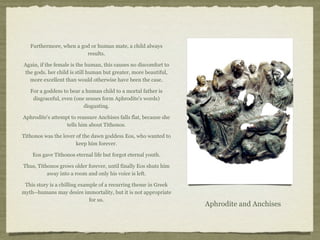
for us. Aphrodite and Anchises
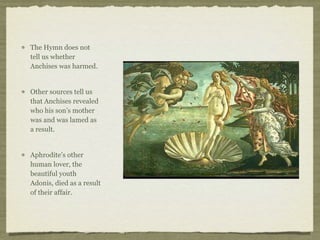
The Hymn does not 
tell us whether 
Anchises was harmed. 
Other sources tell us 
that Anchises revealed 
who his son’s mother 
was and was lamed as 
a result. 
Aphrodite’s other 
human lover, the 
beautiful youth 
Adonis, died as a result 
of their affair.
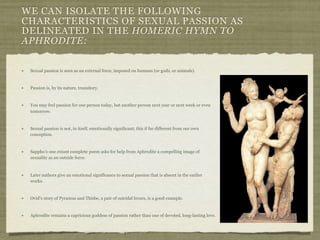
WE CAN ISOLATE THE FOLLOWING 
CHARACTERISTICS OF SEXUAL PASSION AS 
DELINEATED IN THE HOMERIC HYMN TO 
APHRODITE: 
Sexual passion is seen as an external force, imposed on humans (or gods, or animals). 
Passion is, by its nature, transitory. 
You may feel passion for one person today, but another person next year or next week or even 
tomorrow. 
Sexual passion is not, in itself, emotionally significant; this if far different from our own 
conception. 
Sappho’s one extant complete poem asks for help from Aphrodite a compelling image of 
sexuality as an outside force. 
Later authors give an emotional significance to sexual passion that is absent in the earlier 
works. 
Ovid’s story of Pyramus and Thisbe, a pair of suicidal lovers, is a good example. 
Aphrodite remains a capricious goddess of passion rather than one of devoted, long-lasting love.
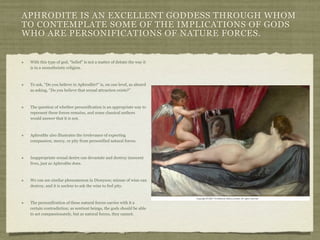
APHRODITE IS AN EXCELLENT GODDESS THROUGH WHOM 
TO CONTEMPLATE SOME OF THE IMPLICATIONS OF GODS 
WHO ARE PERSONIFICATIONS OF NATURE FORCES. 
With this type of god, “belief” is not a matter of debate the way it 
is in a monotheistic religion. 
To ask, “Do you believe in Aphrodite?” is, on one level, as absurd 
as asking, “Do you believe that sexual attraction exists?” 
The question of whether personification is an appropriate way to 
represent these forces remains, and some classical authors 
would answer that it is not. 
Aphrodite also illustrates the irrelevance of expecting 
compassion, mercy, or pity from personified natural forces. 
Inappropriate sexual desire can devastate and destroy innocent 
lives, just as Aphrodite does. 
We can see similar phenomenon in Dionysos; misuse of wine can 
destroy, and it is useless to ask the wine to feel pity. 
The personification of these natural forces carries with it a 
certain contradiction; as sentient beings, the gods should be able 
to act compassionately, but as natural forces, they cannot.

Aphrodite

  • 1.
    APHRODITE We willexamine Aphrodite, the goddess of sexual desire. We will concentrate on the Homeric Hymn to Aphrodite, which tells the story of Aphrodite’s affair with the mortal Anchises. We will look at the implications of this myth for our understanding of the Greek view of sexuality and for the appropriate interactions between humans and gods. We will ten consider how the Roman view of passion, as seen in Ovid, differed from the view presented in the Homeric Hymn and in Sappho. Finally, we will use Aphrodite to discuss some of the characteristics of gods that are anthropomorphized natural forces.
  • 2.
    OUR LAST KEYDEITY IS APHRODITE, THE GODDESS OF SEXUAL PASSION AND DESIRE. According to Theogony, Aphrodite was born from the foam that appeared around the severed genitals of Ouranos when Chronos tossed them into the sea. In the Iliad, she is the daughter of Zeus and a goddess named Dione. In either case, she is usually depicted as among the younger Olympians, in the same generation as Athena and Artemis, rather that Hestia, Hera and Demeter. As the goddess of sexual desire, she is extremely powerful. She can and does subdue even Zeus to her will. The only beings she cannot touch are the three virgin goddesses, Hestia, Artemis and Athena. She is the goddess of sexual passion, not love or companionship.
  • 3.
    Aphrodite appears inmany works of literature. However, for understanding of her essential nature, once again a Homeric Hymn is our starting point. The Homeric Hymn to Aphrodite tells the story of her sexual encounter with the human Anchises. This affair is attested to elsewhere in literature, because it resulted in a son, Aeneas, the title character of Virgil’s epic The Aeneid. Aphrodite’s maternal relation to Aeneas also appears in the Iliad. The Homeric Hymn, however, concentrates on the relationship between Aphrodite and Anchises; the birth of Aeneas is predicted but is not the focus of the work.
  • 4.
    The Homeric Hymnbegins by stating that Zeus was angry at Aphrodite for causing him and other gods to become sexually involved with humans; therefore, he decided to give her a taste of her own medicine. Zeus’s reaction implies that sexual involvement with humans is beneath the gods’ dignity, something that they regret afterward. Another implication involves the separate spheres of influence of the gods and Zeus’s relationship to them. Usually, one god either cannot or does not trespass on another god’s sphere of influence. Aphrodite does not cause earthquakes; Poseidon does not inspire people with sexual passion, and so on. This respect for the boundaries of one another’s spheres probably stems from the fact that these gods embody the emotions and activities they govern. Aphrodite, in a sense, is sexual passion. However, Zeus is able to inflict Aphrodite with her own essence.
  • 5.
    Zeus inspires Aphroditewith passion for the young Trojan prince Anchises, whom she seduces. Anchises recognizes that she is a goddess and asks her for appropriate and proper blessings, but he believes her when she says she is human and agrees to go to bed with her immediately. Anchises’s words embody the maxims of Delphi; he remembers his own status and is careful not to ask for excessive blessings. His adherence to these maxims does not protect him; Aphrodite lies to him to get her way. After the two have sex, Aphrodite reveals herself to Anchises and admits that she is a goddess. Anchises is terrified and begs for mercy.
  • 6.
    Anchises’s statement thatmen who have sex with goddesses are never left unharmed has several implications for our understanding of the narrative and of Greek society. Gods and mortals can interbreed; their offspring are human but usually exceptional. Although mating with a god often has disastrous consequences for a woman, these consequences are not inevitable, and some women who mate with gods live normal lives afterward. Anchises articulates the idea that men who mate with goddesses have committed a great transgression.
  • 7.
    The reason forthis imbalance has to do with views of sexuality and gender roles and with the nature of the relationship between gods and humans. Sex is seen in Greek culture as a process of domination. The male penetrator dominates his partner. Because Greek culture was strongly patriarchal and women were supposed to be subservient, this paradigm of sexuality was considered appropriate for male-female relationships. During sex, the man was dominant and the woman submissive, which was “how it should be.” When sex occurs between a god and human, the gender of each partner becomes very important. If a male god has sex with a mortal woman, there is no imbalance; a more powerful being (god, male) is dominating a less powerful one (human, female). When the male is human and the female is a goddess, the relationship is contradictory, because a less powerful human is dominating a more powerful goddess.
  • 8.
    Furthermore, when agod or human mate, a child always results. Again, if the female is the human, this causes no discomfort to the gods. her child is still human but greater, more beautiful, more excellent than would otherwise have been the case. For a goddess to bear a human child to a mortal father is disgraceful, even (one senses form Aphrodite's words) disgusting. Aphrodite's attempt to reassure Anchises falls flat, because she tells him about Tithonos. Tithonos was the lover of the dawn goddess Eos, who wanted to keep him forever. Eos gave Tithonos eternal life but forgot eternal youth. Thus, Tithonos grows older forever, until finally Eos shuts him away into a room and only his voice is left. This story is a chilling example of a recurring theme in Greek myth--humans may desire immortality, but it is not appropriate for us. Aphrodite and Anchises
  • 9.
    The Hymn doesnot tell us whether Anchises was harmed. Other sources tell us that Anchises revealed who his son’s mother was and was lamed as a result. Aphrodite’s other human lover, the beautiful youth Adonis, died as a result of their affair.
  • 10.
    WE CAN ISOLATETHE FOLLOWING CHARACTERISTICS OF SEXUAL PASSION AS DELINEATED IN THE HOMERIC HYMN TO APHRODITE: Sexual passion is seen as an external force, imposed on humans (or gods, or animals). Passion is, by its nature, transitory. You may feel passion for one person today, but another person next year or next week or even tomorrow. Sexual passion is not, in itself, emotionally significant; this if far different from our own conception. Sappho’s one extant complete poem asks for help from Aphrodite a compelling image of sexuality as an outside force. Later authors give an emotional significance to sexual passion that is absent in the earlier works. Ovid’s story of Pyramus and Thisbe, a pair of suicidal lovers, is a good example. Aphrodite remains a capricious goddess of passion rather than one of devoted, long-lasting love.
  • 11.
    APHRODITE IS ANEXCELLENT GODDESS THROUGH WHOM TO CONTEMPLATE SOME OF THE IMPLICATIONS OF GODS WHO ARE PERSONIFICATIONS OF NATURE FORCES. With this type of god, “belief” is not a matter of debate the way it is in a monotheistic religion. To ask, “Do you believe in Aphrodite?” is, on one level, as absurd as asking, “Do you believe that sexual attraction exists?” The question of whether personification is an appropriate way to represent these forces remains, and some classical authors would answer that it is not. Aphrodite also illustrates the irrelevance of expecting compassion, mercy, or pity from personified natural forces. Inappropriate sexual desire can devastate and destroy innocent lives, just as Aphrodite does. We can see similar phenomenon in Dionysos; misuse of wine can destroy, and it is useless to ask the wine to feel pity. The personification of these natural forces carries with it a certain contradiction; as sentient beings, the gods should be able to act compassionately, but as natural forces, they cannot.