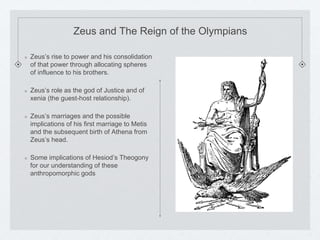
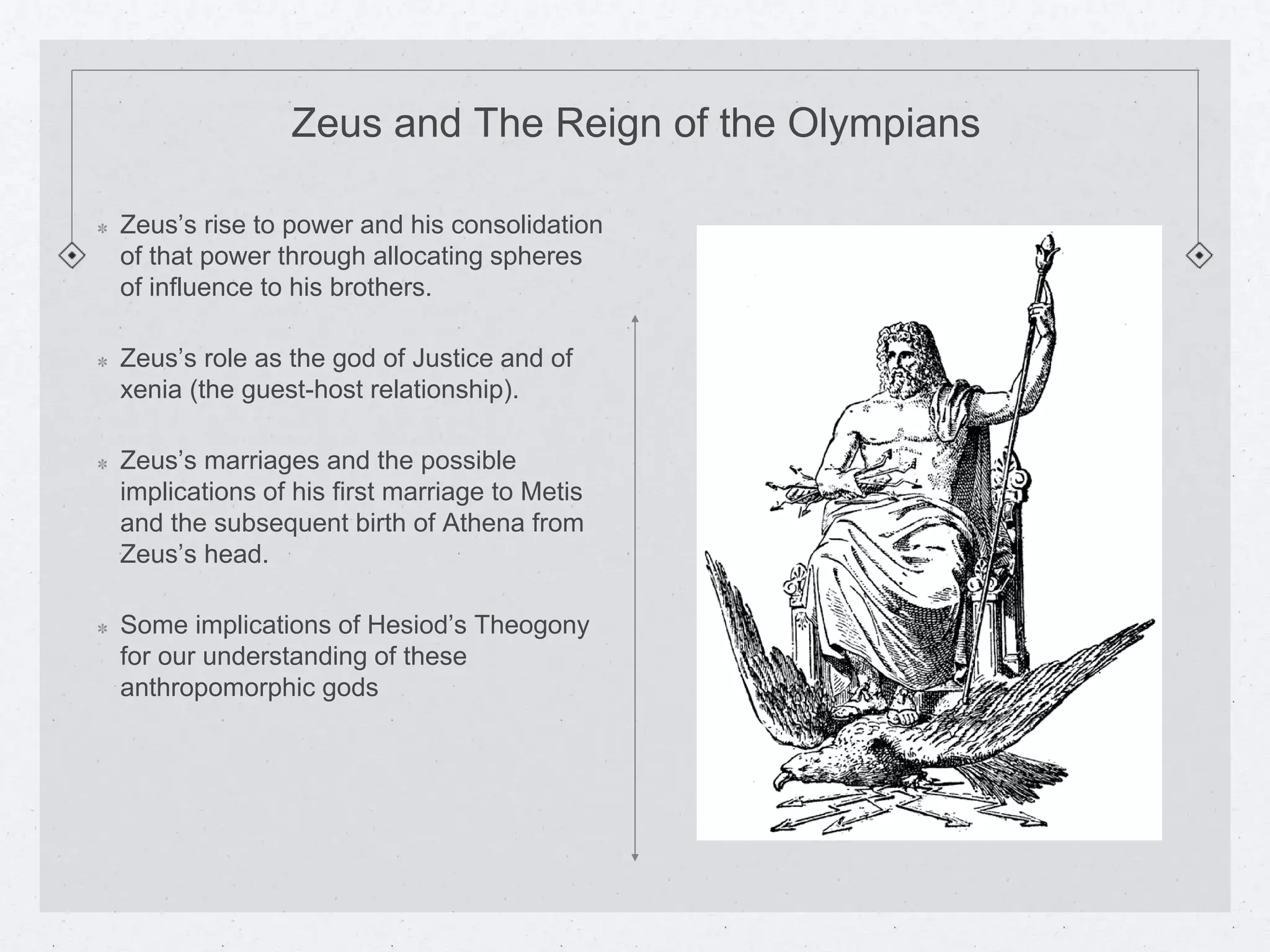
Zeus and The Reign of the Olympians 
Zeus’s rise to power and his consolidation 
of that power through allocating spheres 
of influence to his brothers. 
Zeus’s role as the god of Justice and of 
xenia (the guest-host relationship). 
Zeus’s marriages and the possible 
implications of his first marriage to Metis 
and the subsequent birth of Athena from 
Zeus’s head. 
Some implications of Hesiod’s Theogony 
for our understanding of these 
anthropomorphic gods
After overthrowing the Titans, Zeus consolidated his power and became the 
primary ruler of the gods, which he will continue to be for as long as the 
universe lasts. 
There will be no further struggles of sons to 
overthrow their fathers and no further shift of 
power down the generations. 
Hesiod does not explicitly state that the 
universe became fixed with Zeus’s 
ascendancy to power. This omission is 
justified by reasons that are important to 
remember throughout the study of myth. 
Hesiod and his audience assume the reality 
of Zeus and the other gods. 
“Everyone knows” that Zeus will remain in 
power and that the point of the whole story 
was Zeus’s rise to power. 
Narrative points that may seem arbitrary from 
outside the culture that created the myth 
seem necessary from inside the culture. 
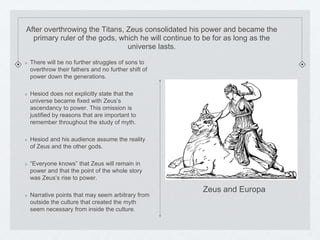
Zeus and Europa
Zeus divides power among himself and his brothers, in 
what is often called the “triple division.” 
Hades becomes the ruler of Tartaros and lord over 
the souls of the dead. 
Poseidon becomes the ruler of the sea and waters in 
general. 
Zeus becomes ruler of the sky. 
Theoretically, all three brothers have power over the 
earth. In practice, the earth too is Zeus’s domain, and 
the division of power is far from equal. 
Zeus’s sister also have their particular roles. 
Hera is the patron goddess of marriage. 
Hestia is the goddess of the hearth. 
Demeter is the goddess of grain and agriculture. 
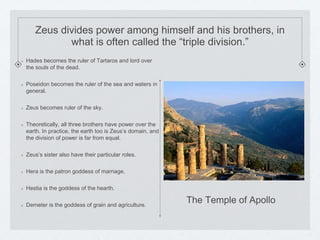
The Temple of Apollo
As ruler, Zeus not only gains physical control over the sky and the earth, 
but his domain also includes various abstract concepts that concern the 
orderly functioning of human society. 
Zeus oversees Justice; in this aspect, 
he is the patron of oaths and punishes 
oath-breakers. 
He also is the god of xenia, a very 
important concept usually translated as 
the “guest-host relationship.” 
He oversees prophecy, particularly at 
his shrine at Dodona. 
Zeus’s son Apollo is also a god of 
prophecy, but it is quite clear that 
Apollo derives his control of prophecy 
from Zeus. 
Zeus’s connection with prophecy 
emphasizes both his wisdom and his 
power; prophets often say that they 
foretell “the will of Zeus.” 
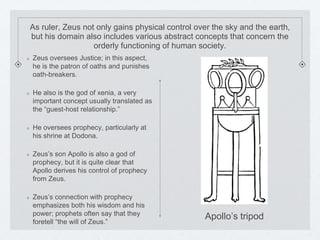
Apollo’s tripod
Once he is established as the ruler of the gods, Zeus marries his first wife, 
the minor goddess Metis. 
Metis is fated to bear a son who will 
overthrow his father, thus repeating the 
pattern seen in the earlier generations. 
On the advice of Gaia and Ouranos, Zeus 
prevents this by swallowing Metis. 
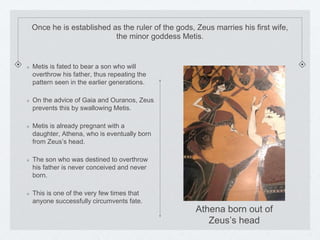
Metis is already pregnant with a 
daughter, Athena, who is eventually born 
from Zeus’s head. 
The son who was destined to overthrow 
his father is never conceived and never 
born. 
This is one of the very few times that 
anyone successfully circumvents fate. 
Athena born out of 
Zeus’s head
Like so much else in Theogony, the story of Metis and Athena 
offers several interesting interpretative points 
It highlights the concept of fate, which 
affects gods as well as humans. 
Fate, or destiny, plays a crucial role in 
many classical myths. 
Fate works independently of Zeus, a 
reminder that even Zeus is not 
omnipotent. 
Fate is sometimes personified as three 
goddesses, the Fates of Moirai. 
The swallowing of Metis can be seen as 
the moment at which the male gods 
assert final power over the goddesses; 
from now on, the dominance of male over 
female will be firmly established. 
This act is also important as the point at 
which Zeus matures. In this regard, an 
allegorical interpretation works particularly 
well. 
Zeus is a young ruler who has power and 
dominance; what does he need to rule 
well? 
He needs wisdom, which is what the 
Greek word metis means. 
When Zeus swallows Metis, he is literally 
incorporating wisdom. Hesiod and his 
contemporaries believed that thought took 
place in our torsos, not our heads. 
Despite the popular modern 
interpretation, the birth of Athena from 
Zeus’s head is not emblematic of wisdom, 
because the Greeks didn’t consider the 
head to be the seat of thought.
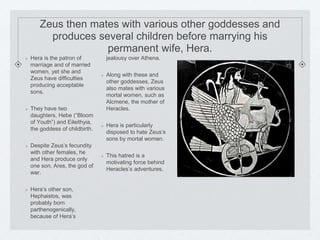
Zeus then mates with various other goddesses and 
produces several children before marrying his 
permanent wife, Hera. 
Hera is the patron of 
marriage and of married 
women, yet she and 
Zeus have difficulties 
producing acceptable 
sons. 
They have two 
daughters, Hebe (“Bloom 
of Youth”) and Eileithyia, 
the goddess of childbirth. 
Despite Zeus’s fecundity 
with other females, he 
and Hera produce only 
one son, Ares, the god of 
war. 
Hera’s other son, 
Hephaistos, was 
probably born 
parthenogenically, 
because of Hera’s 
jealousy over Athena. 
Along with these and 
other goddesses, Zeus 
also mates with various 
mortal women, such as 
Alcmene, the mother of 
Heracles. 
Hera is particularly 
disposed to hate Zeus’s 
sons by mortal women. 
This hatred is a 
motivating force behind 
Heracles’s adventures.
Zeus’s amatory exploits are not just a matter of a god 
behaving badly. 
Many of Zeus’s matings are 
with “conceptual” gods, such 
as Themis (“right order”), and 
produce offspring, such as 
Justice. These unions express 
his attributes as ruler. 
His multiple matings also 
repeat a pattern we saw in the 
earlier generations. 
Hesiod is describing the 
coming-into-existence of 
everything, including such 
abstractions as Justice, 
through the medium of 
anthropomorphic gods. 
It is reasonable in this context 
to describe the process 
through teh sexual matings of 
different gods. 
Because Zeus is such an 
important god, this will 
necessarily result in his mating 
with various females. 
Another explanation or Zeus’s 
frequent matings with minor 
goddesses and mortal women 
is that it reflects the synthesis 
of various local gods and 
traditions, or syncretism.
By the end of Theogony, several important characteristics 
of our picture of the gods are beginning to emerge: 
The gods are anthropomorphic, not 
theriomorphic or a combination of the two, 
sharing many of humanity’s characteristics. 
They have bodies, though it is taken as a 
given that in their “natural” state, the bodies 
of the gods are both much larger and much 
more beautiful than human bodies. 
They eat (ambrosia) and drink (nectar) and 
have a substance flowing through their 
veins (ichor). 
They share human emotions and passions, 
both good and bad. 
The gods are also very different from 
humans. 
They have the ability to move vast 
distances, more or less at will; they can 
appear before a human when they want to. 
Although their normal appearance is 
anthropomorphic, they can disguise 
themselves as other creature or even as 
inanimate objects (such as a shower of 
gold). 
The defining difference between gods and 
humans is that the gods are immortal. 
Humans must die, but gods cannot die. 
One of the most frequent terms used to 
describe the gods in Greek is athanatoi, the 
deathless ones. Humans, b contrast are 
thnetoi, those who are liable to death. 
An oath sworn on the River Styx was for the 
gods, the most telling incarnation of their 
immortality.

Zeusand the Olympians

  • 1.
    Zeus and TheReign of the Olympians Zeus’s rise to power and his consolidation of that power through allocating spheres of influence to his brothers. Zeus’s role as the god of Justice and of xenia (the guest-host relationship). Zeus’s marriages and the possible implications of his first marriage to Metis and the subsequent birth of Athena from Zeus’s head. Some implications of Hesiod’s Theogony for our understanding of these anthropomorphic gods
  • 2.
    After overthrowing theTitans, Zeus consolidated his power and became the primary ruler of the gods, which he will continue to be for as long as the universe lasts. There will be no further struggles of sons to overthrow their fathers and no further shift of power down the generations. Hesiod does not explicitly state that the universe became fixed with Zeus’s ascendancy to power. This omission is justified by reasons that are important to remember throughout the study of myth. Hesiod and his audience assume the reality of Zeus and the other gods. “Everyone knows” that Zeus will remain in power and that the point of the whole story was Zeus’s rise to power. Narrative points that may seem arbitrary from outside the culture that created the myth seem necessary from inside the culture. Zeus and Europa
  • 3.
    Zeus divides poweramong himself and his brothers, in what is often called the “triple division.” Hades becomes the ruler of Tartaros and lord over the souls of the dead. Poseidon becomes the ruler of the sea and waters in general. Zeus becomes ruler of the sky. Theoretically, all three brothers have power over the earth. In practice, the earth too is Zeus’s domain, and the division of power is far from equal. Zeus’s sister also have their particular roles. Hera is the patron goddess of marriage. Hestia is the goddess of the hearth. Demeter is the goddess of grain and agriculture. The Temple of Apollo
  • 4.
    As ruler, Zeusnot only gains physical control over the sky and the earth, but his domain also includes various abstract concepts that concern the orderly functioning of human society. Zeus oversees Justice; in this aspect, he is the patron of oaths and punishes oath-breakers. He also is the god of xenia, a very important concept usually translated as the “guest-host relationship.” He oversees prophecy, particularly at his shrine at Dodona. Zeus’s son Apollo is also a god of prophecy, but it is quite clear that Apollo derives his control of prophecy from Zeus. Zeus’s connection with prophecy emphasizes both his wisdom and his power; prophets often say that they foretell “the will of Zeus.” Apollo’s tripod
  • 5.
    Once he isestablished as the ruler of the gods, Zeus marries his first wife, the minor goddess Metis. Metis is fated to bear a son who will overthrow his father, thus repeating the pattern seen in the earlier generations. On the advice of Gaia and Ouranos, Zeus prevents this by swallowing Metis. Metis is already pregnant with a daughter, Athena, who is eventually born from Zeus’s head. The son who was destined to overthrow his father is never conceived and never born. This is one of the very few times that anyone successfully circumvents fate. Athena born out of Zeus’s head
  • 6.
    Like so muchelse in Theogony, the story of Metis and Athena offers several interesting interpretative points It highlights the concept of fate, which affects gods as well as humans. Fate, or destiny, plays a crucial role in many classical myths. Fate works independently of Zeus, a reminder that even Zeus is not omnipotent. Fate is sometimes personified as three goddesses, the Fates of Moirai. The swallowing of Metis can be seen as the moment at which the male gods assert final power over the goddesses; from now on, the dominance of male over female will be firmly established. This act is also important as the point at which Zeus matures. In this regard, an allegorical interpretation works particularly well. Zeus is a young ruler who has power and dominance; what does he need to rule well? He needs wisdom, which is what the Greek word metis means. When Zeus swallows Metis, he is literally incorporating wisdom. Hesiod and his contemporaries believed that thought took place in our torsos, not our heads. Despite the popular modern interpretation, the birth of Athena from Zeus’s head is not emblematic of wisdom, because the Greeks didn’t consider the head to be the seat of thought.
  • 7.
    Zeus then mateswith various other goddesses and produces several children before marrying his permanent wife, Hera. Hera is the patron of marriage and of married women, yet she and Zeus have difficulties producing acceptable sons. They have two daughters, Hebe (“Bloom of Youth”) and Eileithyia, the goddess of childbirth. Despite Zeus’s fecundity with other females, he and Hera produce only one son, Ares, the god of war. Hera’s other son, Hephaistos, was probably born parthenogenically, because of Hera’s jealousy over Athena. Along with these and other goddesses, Zeus also mates with various mortal women, such as Alcmene, the mother of Heracles. Hera is particularly disposed to hate Zeus’s sons by mortal women. This hatred is a motivating force behind Heracles’s adventures.
  • 8.
    Zeus’s amatory exploitsare not just a matter of a god behaving badly. Many of Zeus’s matings are with “conceptual” gods, such as Themis (“right order”), and produce offspring, such as Justice. These unions express his attributes as ruler. His multiple matings also repeat a pattern we saw in the earlier generations. Hesiod is describing the coming-into-existence of everything, including such abstractions as Justice, through the medium of anthropomorphic gods. It is reasonable in this context to describe the process through teh sexual matings of different gods. Because Zeus is such an important god, this will necessarily result in his mating with various females. Another explanation or Zeus’s frequent matings with minor goddesses and mortal women is that it reflects the synthesis of various local gods and traditions, or syncretism.
  • 9.
    By the endof Theogony, several important characteristics of our picture of the gods are beginning to emerge: The gods are anthropomorphic, not theriomorphic or a combination of the two, sharing many of humanity’s characteristics. They have bodies, though it is taken as a given that in their “natural” state, the bodies of the gods are both much larger and much more beautiful than human bodies. They eat (ambrosia) and drink (nectar) and have a substance flowing through their veins (ichor). They share human emotions and passions, both good and bad. The gods are also very different from humans. They have the ability to move vast distances, more or less at will; they can appear before a human when they want to. Although their normal appearance is anthropomorphic, they can disguise themselves as other creature or even as inanimate objects (such as a shower of gold). The defining difference between gods and humans is that the gods are immortal. Humans must die, but gods cannot die. One of the most frequent terms used to describe the gods in Greek is athanatoi, the deathless ones. Humans, b contrast are thnetoi, those who are liable to death. An oath sworn on the River Styx was for the gods, the most telling incarnation of their immortality.