Aphrodite

the Greek Goddess
   of Romance,
 Love and Beauty
The birth of Aphrodite

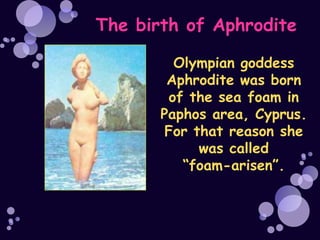
         Olympian goddess
        Aphrodite was born
        of the sea foam in
       Paphos area, Cyprus.
        For that reason she
             was called
          “foam-arisen”.
The birth of Aphrodite


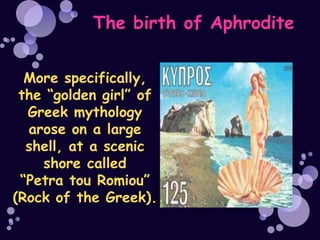
  More specifically,
 the “golden girl” of
  Greek mythology
  arose on a large
  shell, at a scenic
    shore called
 “Petra tou Romiou”
(Rock of the Greek).
The birth of Aphrodite


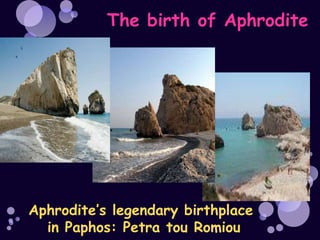
Aphrodite’s legendary birthplace
  in Paphos: Petra tou Romiou
The birth of Aphrodite


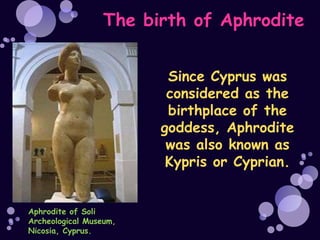
                         Since Cyprus was
                         considered as the
                         birthplace of the
                        goddess, Aphrodite
                         was also known as
                         Kypris or Cyprian.


Aphrodite of Soli
Archeological Museum,
Nicosia, Cyprus.
The origin of the
         goddess’ name

 The name “APHRODITE” is
strongly related with the legend
of goddess birth.

 It derives from the Greek
word “afros”, meaning foam in
English.
The origin of the
                           goddess’ name
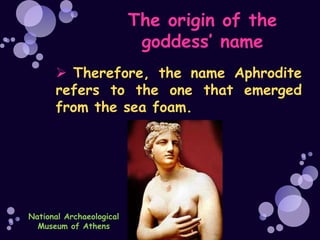
       Therefore, the name Aphrodite
      refers to the one that emerged
      from the sea foam.


National Archaeological
  Museum of Athens
Paphos: the birthplace
Pafos is entwined with Greek mythology,
and especially the legendary birth of
Aphrodite on her shores. Landmarks
associated with Aphrodite, apart from
"Petra tou Romiou” are:

 the sanctuary of Aphrodite
 the Baths of Aphrodite
 the Fountain of Love or
    Fontana Amorosa
Paphos: the birthplace
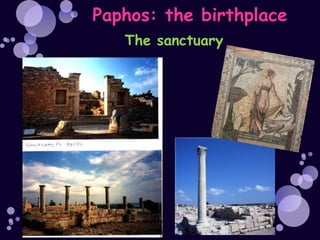
            The sanctuary
In the ancient Greek world, the
Temple of Aphrodite at Paphos was one
of the most famous religious centers.
Paphos: the birthplace
       The sanctuary
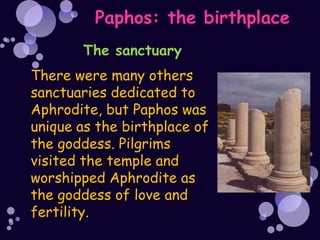
There were many others
sanctuaries dedicated to
Aphrodite, but Paphos was
unique as the birthplace of
the goddess. Pilgrims
visited the temple and
worshipped Aphrodite as
the goddess of love and
fertility.
Paphos: the birthplace
           The sanctuary
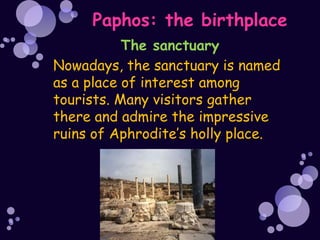
Nowadays, the sanctuary is named
as a place of interest among
tourists. Many visitors gather
there and admire the impressive
ruins of Aphrodite’s holly place.
Paphos: the birthplace
   The sanctuary
Paphos: the birthplace
    The Baths

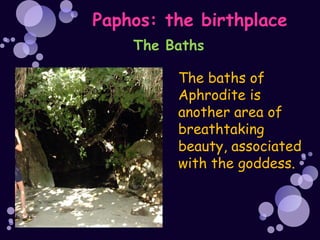
         The baths of
         Aphrodite is
         another area of
         breathtaking
         beauty, associated
         with the goddess.
Paphos: the birthplace
                 The Baths

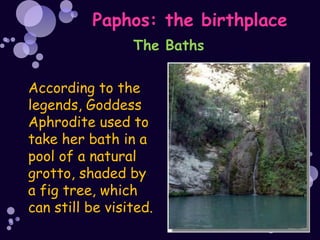
According to the
legends, Goddess
Aphrodite used to
take her bath in a
pool of a natural
grotto, shaded by
a fig tree, which
can still be visited.
Paphos: the birthplace
                The Baths
The waters here were
believed to have had
special rejuvenating
powers. Swimming here
would guarantee eternal
youth and beauty. So
now we know why
Aphrodite could make
any man fall in love with
her.
Paphos: the birthplace
        The Fountain of Love or
            Fontana Amorosa

Nearby the Baths is Fontana
Amorosa, or the fountain of love,
which is said to bubble with
Aphrodite's fabled love potion.
The fountain is very difficult to
access and can be reached only on
foot or with a four-wheel drive
vehicle.
Paphos: the birthplace
           The Fountain of Love or
                Fontana Amorosa
Fontana Amorosa can be reached by
walking along the Aphrodite Trail,
which is one of the highlights of the
area. Starting just above the Baths, it
follows the mythical route taken by
Aphrodite and her lover Adonis. This
walk is undoubtedly one of the most
beautiful hiking trails in Cyprus,
offering fascinating views across blue
lagoons.
The immense beauty of Aphrodite
has inspired many artists. In the
past, various sculptors tried to
create statues that represented
the perfect woman. In modern
art, famous painters, have
attempted to imagine and
attribute the figure of the
stunning goddess.
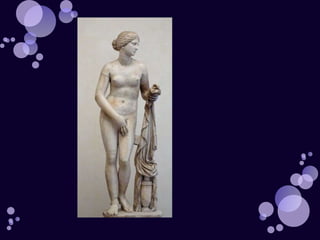
Aphrodite of Cnidus
Aphrodite of Cnidus was one of the
most famous works of the ancient
Greek sculptor Praxiteles of Athens.
It was carved for a temple of
Aphrodite on the Greek island of
Cnidus. The sculpture, that is now
lost, depicted the goddess Aphrodite
as she prepared for her ritual bath.
Aphrodite of Cnidus
The statue and its copies are
often referred to as the Venus
Pudica, which means the modest
Venus. The body of modest Venus
leans on a dolphin, which
represents one of Aphrodite’s
symbols of life.
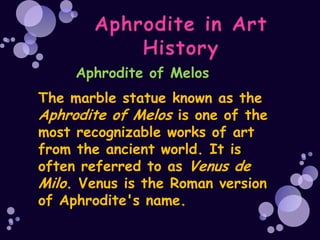
Aphrodite of Melos
The marble statue known as the
Aphrodite of Melos is one of the
most recognizable works of art
from the ancient world. It is
often referred to as Venus de
Milo. Venus is the Roman version
of Aphrodite's name.
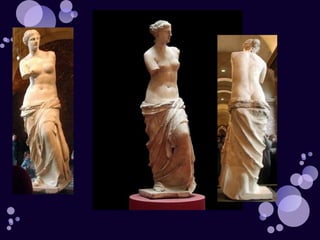
Aphrodite of Melos
This imposing image of the goddess has
caused admiration over the centuries.
The famous statue, with its elegantly
twisting pose and its memorable missing
arms, has become an icon of Western
art. Today, Aphrodite of Melos
continues to dazzle audiences with her
eternal beauty. It is. at present, on
display at the Louvre.
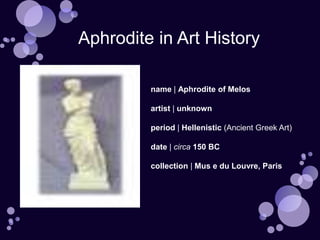
Aphrodite in Art History

         name | Aphrodite of Melos

         artist | unknown

         period | Hellenistic (Ancient Greek Art)

         date | circa 150 BC

         collection | Mus e du Louvre, Paris
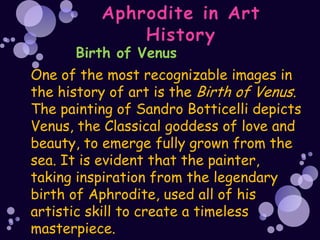
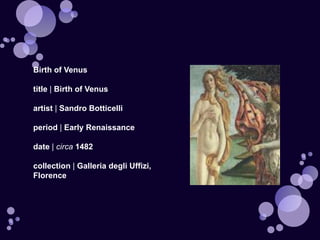
Birth of Venus
One of the most recognizable images in
the history of art is the Birth of Venus.
The painting of Sandro Botticelli depicts
Venus, the Classical goddess of love and
beauty, to emerge fully grown from the
sea. It is evident that the painter,
taking inspiration from the legendary
birth of Aphrodite, used all of his
artistic skill to create a timeless
masterpiece.
Birth of Venus

title | Birth of Venus

artist | Sandro Botticelli

period | Early Renaissance

date | circa 1482

collection | Galleria degli Uffizi,
Florence
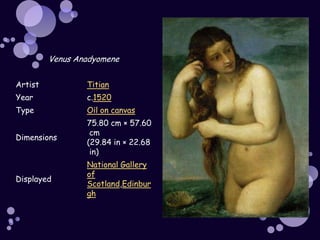
Aphrodite in Art History
          Venus Anadyomene

Venus Anadyomene , literally meaning
Venus rising from the sea, is a painting
by Titian. It depicts Venus, who was
said to have been born from a shell that
is identified at the bottom far left,
rising from the sea and wringing her
hair. The shell is smaller than the one
in Botticelli’s scenes of Aphrodite’s
birth.
Venus Anadyomene


Artist           Titian
Year             c.1520
Type             Oil on canvas
                 75.80 cm × 57.60
                  cm
Dimensions
                 (29.84 in × 22.68
                  in)
                 National Gallery
                 of
Displayed
                 Scotland,Edinbur
                 gh
Aphrodite in the
             planet system

As one of the brightest objects
in the sky, planet Venus has been
known and observed since
prehistoric times. The name of
the planet varied with regards to
historic age and culture.
Aphrodite in the
            planet system

The Romans would name the
planet Venus in honour of their
goddess of love. At the same
time Greeks used the name
Aphrodite which is equivalent to
Venus. These two names are
still used today in astronomy.

Aphrodite

  • 1.
    Aphrodite the Greek Goddess of Romance, Love and Beauty
  • 2.
    The birth ofAphrodite Olympian goddess Aphrodite was born of the sea foam in Paphos area, Cyprus. For that reason she was called “foam-arisen”.
  • 3.
    The birth ofAphrodite More specifically, the “golden girl” of Greek mythology arose on a large shell, at a scenic shore called “Petra tou Romiou” (Rock of the Greek).
  • 4.
    The birth ofAphrodite Aphrodite’s legendary birthplace in Paphos: Petra tou Romiou
  • 5.
    The birth ofAphrodite Since Cyprus was considered as the birthplace of the goddess, Aphrodite was also known as Kypris or Cyprian. Aphrodite of Soli Archeological Museum, Nicosia, Cyprus.
  • 6.
    The origin ofthe goddess’ name  The name “APHRODITE” is strongly related with the legend of goddess birth.  It derives from the Greek word “afros”, meaning foam in English.
  • 7.
    The origin ofthe goddess’ name  Therefore, the name Aphrodite refers to the one that emerged from the sea foam. National Archaeological Museum of Athens
  • 8.
    Paphos: the birthplace Pafosis entwined with Greek mythology, and especially the legendary birth of Aphrodite on her shores. Landmarks associated with Aphrodite, apart from "Petra tou Romiou” are:  the sanctuary of Aphrodite  the Baths of Aphrodite  the Fountain of Love or Fontana Amorosa
  • 9.
    Paphos: the birthplace The sanctuary In the ancient Greek world, the Temple of Aphrodite at Paphos was one of the most famous religious centers.
  • 10.
    Paphos: the birthplace The sanctuary There were many others sanctuaries dedicated to Aphrodite, but Paphos was unique as the birthplace of the goddess. Pilgrims visited the temple and worshipped Aphrodite as the goddess of love and fertility.
  • 11.
    Paphos: the birthplace The sanctuary Nowadays, the sanctuary is named as a place of interest among tourists. Many visitors gather there and admire the impressive ruins of Aphrodite’s holly place.
  • 12.
  • 13.
    Paphos: the birthplace The Baths The baths of Aphrodite is another area of breathtaking beauty, associated with the goddess.
  • 14.
    Paphos: the birthplace The Baths According to the legends, Goddess Aphrodite used to take her bath in a pool of a natural grotto, shaded by a fig tree, which can still be visited.
  • 15.
    Paphos: the birthplace The Baths The waters here were believed to have had special rejuvenating powers. Swimming here would guarantee eternal youth and beauty. So now we know why Aphrodite could make any man fall in love with her.
  • 16.
    Paphos: the birthplace The Fountain of Love or Fontana Amorosa Nearby the Baths is Fontana Amorosa, or the fountain of love, which is said to bubble with Aphrodite's fabled love potion. The fountain is very difficult to access and can be reached only on foot or with a four-wheel drive vehicle.
  • 17.
    Paphos: the birthplace The Fountain of Love or Fontana Amorosa Fontana Amorosa can be reached by walking along the Aphrodite Trail, which is one of the highlights of the area. Starting just above the Baths, it follows the mythical route taken by Aphrodite and her lover Adonis. This walk is undoubtedly one of the most beautiful hiking trails in Cyprus, offering fascinating views across blue lagoons.
  • 18.
    The immense beautyof Aphrodite has inspired many artists. In the past, various sculptors tried to create statues that represented the perfect woman. In modern art, famous painters, have attempted to imagine and attribute the figure of the stunning goddess.
  • 19.
    Aphrodite of Cnidus Aphroditeof Cnidus was one of the most famous works of the ancient Greek sculptor Praxiteles of Athens. It was carved for a temple of Aphrodite on the Greek island of Cnidus. The sculpture, that is now lost, depicted the goddess Aphrodite as she prepared for her ritual bath.
  • 20.
    Aphrodite of Cnidus Thestatue and its copies are often referred to as the Venus Pudica, which means the modest Venus. The body of modest Venus leans on a dolphin, which represents one of Aphrodite’s symbols of life.
  • 22.
    Aphrodite of Melos Themarble statue known as the Aphrodite of Melos is one of the most recognizable works of art from the ancient world. It is often referred to as Venus de Milo. Venus is the Roman version of Aphrodite's name.
  • 23.
    Aphrodite of Melos Thisimposing image of the goddess has caused admiration over the centuries. The famous statue, with its elegantly twisting pose and its memorable missing arms, has become an icon of Western art. Today, Aphrodite of Melos continues to dazzle audiences with her eternal beauty. It is. at present, on display at the Louvre.
  • 24.
    Aphrodite in ArtHistory name | Aphrodite of Melos artist | unknown period | Hellenistic (Ancient Greek Art) date | circa 150 BC collection | Mus e du Louvre, Paris
  • 26.
    Birth of Venus Oneof the most recognizable images in the history of art is the Birth of Venus. The painting of Sandro Botticelli depicts Venus, the Classical goddess of love and beauty, to emerge fully grown from the sea. It is evident that the painter, taking inspiration from the legendary birth of Aphrodite, used all of his artistic skill to create a timeless masterpiece.
  • 27.
    Birth of Venus title| Birth of Venus artist | Sandro Botticelli period | Early Renaissance date | circa 1482 collection | Galleria degli Uffizi, Florence
  • 28.
    Aphrodite in ArtHistory Venus Anadyomene Venus Anadyomene , literally meaning Venus rising from the sea, is a painting by Titian. It depicts Venus, who was said to have been born from a shell that is identified at the bottom far left, rising from the sea and wringing her hair. The shell is smaller than the one in Botticelli’s scenes of Aphrodite’s birth.
  • 29.
    Venus Anadyomene Artist Titian Year c.1520 Type Oil on canvas 75.80 cm × 57.60 cm Dimensions (29.84 in × 22.68 in) National Gallery of Displayed Scotland,Edinbur gh
  • 30.
    Aphrodite in the planet system As one of the brightest objects in the sky, planet Venus has been known and observed since prehistoric times. The name of the planet varied with regards to historic age and culture.
  • 31.
    Aphrodite in the planet system The Romans would name the planet Venus in honour of their goddess of love. At the same time Greeks used the name Aphrodite which is equivalent to Venus. These two names are still used today in astronomy.