ArgonPro
consulting
training
Cash flow based business
modeling and analysis
Case ”ICT Consulting Ltd”
Timo Nurminiemi
Argon Pro Ltd
18.1.2017
ArgonPro
consulting
training
2
Objectives of this report
• Introduce various advantages, benefits and possibilities of cash flow based
business modeling and analysis in start-ups and SMEs
Area/point of view Benefits and possibilities
Performance
measurement
Business modeling will detect key performance measures i.e. value drivers
effecting cash flow and value of the business
Cash flow Cash flow indicates the best and most trusted view about the financial situation
Financing Prepares cash flow and financing plan for own use and for investors/creditors
Rolling forecasting Key value drivers enables high-quality process for rolling forecasting
Strategy Various scenarios of the future supports strategy selection
Reporting Visualization of data eases decision-making and brings out inconsistencies
Analysis Analysis answers questions raised by reporting - QuickAnalysis as an option
Target setting Key value drivers perform as the core basis for target setting
Valuation Valuation and value management can be connected to business modeling
Business Plan Reporting and analysis serve as a finance section in Business Plan
Sensitivity analysis Sensitivity analysis produces basis for good and solid decisions
Benefits and possibilities
 Based on example of ”ICT Consulting Ltd” report will illustrate various
possibilities of reporting provided by Argon Pro Ltd
 Report has also training and education point of view. That is why this
example report has more extensive content with some extra edu-
cational slides
ArgonPro
consulting
training
3
Agenda
Cash flow based business modeling
and analysis
1.
2.
3.
4.
5.
6.
7.
8.
Objectives of this report
Case ”ICT Consulting Ltd”
Argon Pro Quick Analysis
Business modeling
Reporting
Analysis
Conclutions
Most essential formulas used
NextAgenda
ArgonPro
consulting
training
Case ”ICT Consulting Ltd”
ArgonPro
consulting
training
5
”ICT Consulting Ltd”
• In January 2011, Peter and Martin, two Aalto University
(Espoo, Finland) graduates founded an ICT services start-up
company called “ICT Consulting Ltd”.
”ICT Consulting Ltd” 2011 - 2015
• The company started and operated with a small amount of equity capital and
cash flow funding. Since the beginning, the company has performed positive
financial results. However, in 2012 free cash flow was negative and the
continuation of the operation required a short-term loan. The loan was paid off in
2014.
• The company grew quickly from “garage operation” to a
business with a revenue of about 2 million euros. At the end
of 2015 it already employed 12 people.
ArgonPro
consulting
training
6
Growth or profitability?
• The company is now 5 years old. Reaching subsequent steps for growth
requires new kind of decisions for risk-taking. Are efforts being made to grow "at
any price" - perhaps compromising margins and profitability - or, targeting
moderate growth and focus on ensuring profitability and positive cash flow?
• In order to find useful solutions Peter and Martin interviewed a number of
financial professionals they knew.
• This example illustrates the approach of Argon Pro Ltd.
”Plans are nothing - Planning is everything”
- General Dwight D. Eisenhower -
ArgonPro
consulting
training
7
Business modeling and analysis
• Argon Pro’s approach is business modeling, analysis and action plans based on
the analysis. Based on Argon Pro’s way of working, owners and operating
management also considered and prepared various scenarios for the future.
Scenarios to be used in this case were: Base scenario (Base Case), optimistic
(Best Case) and pessimistic (Worst Case) scenario.
• For a start-up company value creation
is also importat issue. Peter and
Martin has an idea to exit the com-
pany after a 10 years time. This is why
value and value creation potential was
also taken into acount in analysis.
• It is also essential to know weather
any of the scenarios requires any
external financing.
• Since the beginning Peter and Martin
have been looking for a simple and
useful financial indicator supporting
the operational management of the
company. Argon Pro promised to took
that also into account when procee-
ding with the analysis.
Base Case
Scenario expects
moderate growth in
revenue and some
improvement in
profitability
Worst Case
Revenue as well as
profitability would
remain (more or
less) at the current
level.
Best Case
Scenario expects
roughly 30% yearly
increase in revenue.
Profitability would be
lower than in Base
Case.
Scenarios
ArgonPro
consulting
training
Argon Pro Quick Analysis
ArgonPro
consulting
training
9
ArgonPro QuickAnalysis
• Argon Pro has built QuickAnalysis model by which first-stage (preliminary)
analysis can be obtained without more time-consuming business modeling.
• QuickAnalysis requires only 8 cash flow based variables. Using those variables
you will be able to receive first, but still preliminary, estimates about the cash flow
and value creation potetial of the business. In QuickAnalysis you can also utilize
various scenarios and sensitivity analysis. It will also give you first estimates
about the minimum operating profit level needed.
2.
Operating
profit
(eur)
Operating profit
of last fiscal year
1.
Revenue
(eur)
Revenue of
last fiscal year
3.
Revenue
growth
(%)
Forecasted growth
in revenue
4.
Operating
profit (%)
Forecasted
operating profit
margin
6.
Working
capital
(%)
Growth in revenue
increases need for
working capital
5.
Investments
(%)
Investments above
depreciations are
growth investments
7.
Taxes (%)
Calculatory
taxes on
operating profit
8.
Cost of
Capital (%)
Weighted average
cost of capital,
WACC
Variables used in QuickAnalysis 1]
1] Example of QuickAnalysis in next two pages
ArgonPro
consulting
training
10
ArgonPro QuickAnalysis - Case ”ICT Consulting Ltd”
ArgonPro QuickAnalysis (5 years) WORST BASE BEST
Last historical revenue (1.000 eur) 1 979 1 979 1 979
Last historical operating profit (1.000 eur) 281 281 281 143
Revenue growth rate (%) 2 % -87 % 15 % 100 % 30 % 97 %
Operating profit margin (%) 13 % -13 % 15 % -7 % 14 % 13 %
Incremental fixed capital investments (%) 7 % 40 % 5 % 20 % 6 % 5 %
Incremental working capital investments (%) 5 % 0 % 5 % 200 % 15 % 14 %
Taxes on operating profit (%) 20 % 0 % 20 % 0 % 20 %
Cost of Capital, WACC (%) 9 % 13 % 8 % -13 % 7 %
Pre-strategy value (pre net debt) 2 495 2 807 3 208
Cumulative present value of cash flows 828 -35 % 1 283 -9 % 1 171
Present value of residual value 1 641 -60 % 4 064 106 % 8 383
Present value of cash flows + Residual value 2 469 -54 % 5 347 79 % 9 553
Market value of cash 223,9 0 % 223,9 0 % 223,9
Market value of debt 0,0 0,0 0,0
SHAREHOLDER VALUE 2 693 -52 % 5 570 76 % 9 777
SHAREHOLDER VALUE ADDED (SVA) -26 -101 % 2 539 150 % 6 345
Incremental threshold margin 1,2 % 34 % 0,9 % 85 % 1,7 %
Threshold margin 13,9 % 12 % 12,5 % -9 % 11,3 %
Scenarios
History
Avg.
30 % 20 % 10 % 0 % -10 %
13 % 225 196 207 257 347
15 % 255 230 243 297 390
17 % 285 263 280 336 433
-5 % 5 % 15 % 25 % 35 %
One Year cash flow sensitivity
Operatingprofit(%)
Incr. fixed and working capital per euro of revenue
Revenue growth
3 scenarios
8 variables needed
Value
creation
Value +
change
Thresholds
for operating
margin
Base Case
Cash flow
sensitivity
1 euro growth in
revenue ties 0,15 euros
in working capital
1 euro growth in
revenue costs 0,06
euros as investments
1]
1] Cost of capital (WACC) is important part of performance
management and valuation. Definition of cost of capital requires
always detailed analysis. Due to simplification cost of capital in
this example is 8%.
ArgonPro
consulting
training
11
ArgonPro QuickAnalysis - Case ”ICT Consulting Ltd”
Incremental threshold margin
-10 % 0 % 10 % 20 % 30 %
6 % -0,7 % 0,0 % 0,7 % 1,4 % 2,1 %
8 % -0,9 % 0,0 % 0,9 % 1,9 % 2,8 %
10 % -1,1 % 0,0 % 1,1 % 2,3 % 3,4 %
WACC
Incr. fixed and working capital per euro of revenue
Threshold margin (Sensitivity)
5 % 10 % 15 % 20 % 25 %
20 % 13,6 % 13,1 % 12,6 % 12,1 % 11,7 %
10 % 13,6 % 13,0 % 12,5 % 12,0 % 11,5 %
0 % 13,5 % 12,9 % 12,3 % 11,8 % 11,3 %
Inv. to
growth (%)
Revenue growth
Shareholder Value Added, SVA (1.000 eur)
-5 % 5 % 15 % 25 % 35 %
12 % -863 86 1 439 3 316 5 863
15 % -386 820 2 539 4 926 8 162
18 % 91 1 554 3 640 6 535 10 461
Operating
profit (%)
Revenue growth
• Sensitivity in relation to incremental investments and cost of capital
• Increase in revenue requires at least 0,9% operating profit margin
• Sensitivity in relation to increase in revenue and incremental (growth) investments
• From value creation point of view high-enough operating profit margin is 12,5%
• Sensitivity in relation to growth in revenue and operating profit margin
• In Base Case scenario the value would increase 2.539 thousand euros
Base Case
ArgonPro
consulting
training
Business modeling
ArgonPro
consulting
training
13
Business modeling in practice
• Revenue, costs, working capital, investments and any other variable effecting
cash flow are connected to each other. Change in one variable will effect to the
result and outcome of the whole model.
No. of
employees
Revenue
per employee
X
Salary cost
per employee
X
Revenue=
Salary
costs
=
Other
expenses
% of
Trade
debtors
Days in
Trade
creditors
Days in
• Variables, components or ”building blocks” of business modeling are called
value drivers. Value drivers effecting most in cash flow and value of the
business are called Key Value Drivers.
Simplified example of business modeling
ArgonPro
consulting
training
14
Business modeling and value drivers - example
 Market size
 Market share
 Sales mix
 Retail price
 Staffung levels
 Wage rates
 Raw material prices
 Production costs
 Tax rate
 Tax-effective
structures
 Inventory turns
 Accounts receivable
 Accounts payable
 Contract terms
 Plant life
 Replacement
equipment
 Maintenance
 Scale of operations
 Cost of equity
 Cost of debt
 Leverage
Business
unit value
Taxes
Revenues
Operating
margin
Working
capital
Capital
expenditure
Investments
required to
support
operations
Cash
profit
Cash flow
from
operations
Cost of
capital
Discount
rate
Micro value
drivers
Macro value
drivers
Determinants of
value
Source: Alfred Rappaport; Creating Shareholder Value, The Free Press 1998
ArgonPro
consulting
training
15
Business modeling of ”ICT Consulting Ltd”
• Revenue of “ICT Consulting Ltd” consists mainly of the work
performed by billable personnel working in projects invoiced
on daily basis.
• Due to the nature of operations (consulting) significant
growth would occur by increasing the number of billable
personnell, that is, increasing resources and expanding
operations outside Finland.
• Billing rate (aka. utilization rate) is essential measure for project and consulting
business. It has increased from the level of 50% to the level of 87%. According
to preliminary estimates improving billing rate would also improve profitability.
• Since the beginning of the operation payment times of the customers have been
a challenge. Days in trade creditors have been at the level of 53 days. In Best
Case scenario the assumption is that due to rapid growth in international
operations there is very little to do to improve the payment times. In Base Case
scenario there would be special attention to payment times as well as
profitability.
• The ratio of billing and administration personnel has always been subject to
close supervision. At the moment ratio is at the level of 9%. In scenarios
prepared earlier ratio varies between 7,7% and 10,0%.
• Investments are mainly ICT machinery and equipment investments
related to the development of the number of employees.
ArgonPro
consulting
training
16
Illustration of value driver map - ”ICT Consulting Ltd”
Revenue
Avg. daily billing
rate
Weeks in
a year
Vacation
weeks
Salary cost
per employee
Number of
employees
Staff
expenses
Social security
expenses
Purchases
Billing/Utilization
rate
Operating
expenses
Cost of Capital,
WACC
External
services
Other operating
expenses
Billing
employees
Admin.
employees
Workdays in
a year
Workdays in
a week
Working weeks
in a year
Investments
Trade
debtors
Trade
creditors
Share of admin.
employees
Days in
Trade debtors
Days in
Trade creditors
Income
taxes
Income tax
rate
Investments
per employee
ArgonPro
consulting
training
Reporting
ArgonPro
consulting
training
18
Reporting raises questions - analysis answers them
• Reporting vs. Analysis - ”You can’t have one without other”
• Visualization with graphs and colors eases the task of a reader and decision-
maker to pic up the most relevant information and to ask well fitted questions
– Visualization also illustrates any inconsistencies of numbers
• Scenarios helps reader and decisionmaker to perceive and understand
various possible outcomes of the future
• Scenario is a description of possible future(s)
– Describes effects and possibilities
– Selected from various possible outcomes - what the future could be, or
what it should be?
• In business life scenarios are developed to support decision-making processes
A = A clear-enough future
(A single forecast precise enough for determining strategy)
B = Alternate futures
(A few discrete outcomes that define the future)
C = A range of futures
(A range of possible outcomes, but no natural scenarios)
D = True ambiquity
(No basis to forecast the future)
Source: Courtney, Kirkland, Viguerie; Strategy under uncertainty, Harward Business
Review, Nov-Dec 1997
Four levels of uncertainty
A B
C D
ArgonPro
consulting
training
19
1.000 EUR 2011 2012 2013 2014 2015 2016 2017 2018 2019 2020 2021 2022 2023 2024 2025
Revenue 165 494 1 020 1 595 1 979 2 325 2 731 3 208 3 726 4 328 5 027 5 839 6 782 7 877 9 149
Ch. in Revenue (%) - 201 % 106 % 56 % 24 % 17 % 17 % 17 % 16 % 16 % 16 % 16 % 16 % 16 % 16 %
Ch. in Stocks of finished and semifinished goods - - - - - - - - - - - - - - -
Manufacturing for enterprise's own use - - - - - - - - - - - - - - -
Other operating income - - - - - - - - - - - - - - -
Operating expenses total 127 475 871 1 301 1 659 1 963 2 303 2 671 3 083 3 584 4 138 4 807 5 588 6 459 7 467
OPERATING MARGIN (EBITDA) 38 19 149 293 320 363 428 537 643 743 889 1 032 1 194 1 418 1 682
Operating margin (%) 22,9 % 3,9 % 14,6 % 18,4 % 16,2 % 15,6 % 15,7 % 16,7 % 17,2 % 17,2 % 17,7 % 17,7 % 17,6 % 18,0 % 18,4 %
Depreciation and reduction in value 5 10 20 30 39 34 46 58 70 84 100 118 139 164 192
OPERATING PROFIT (EBIT) 33 9 129 263 281 328 382 479 572 659 789 914 1 055 1 254 1 490
Oparating profit (%) 19,9 % 1,9 % 12,7 % 16,5 % 14,2 % 14,1 % 14,0 % 14,9 % 15,4 % 15,2 % 15,7 % 15,7 % 15,6 % 15,9 % 16,3 %
Financial income and expenses 0 -2 -2 1 3 3 4 6 7 9 11 14 17 20 25
Taxes 7 2 26 53 57 66 77 97 116 134 160 186 214 255 303
Minority interest - - - - - - - - - - - - - - -
Profit of the financial year 26 6 102 211 227 265 309 388 463 535 640 742 858 1 020 1 211
11.12.2016 14:39
Purchases (% of Revenue) 22 % 19 % 18 % 18 % 18 % 18 % 18 % 17 % 17 % 17 % 16 % 16 % 15 % 15 % 15 %
External services (% of Revenue) 7 % 6 % 6 % 6 % 6 % 5 % 5 % 5 % 5 % 5 % 5 % 5 % 5 % 5 % 5 %
Other operating expenses (% of Revenue) 13 % 11 % 9 % 8 % 9 % 11 % 11 % 11 % 10 % 10 % 10 % 10 % 11 % 10 % 9 %
Number of employees 2 6 8 10 12 14 16 18 21 24 28 32 36 42 48
Ch. In number of employees (%) - 175 % 40 % 27 % 23 % 13 % 15 % 15 % 15 % 15 % 15 % 15 % 15 % 15 % 15 %
Revenue per employee 82 90 132 163 164 170 174 177 179 181 183 184 186 188 190
Ch. In Revenue per employee (%) - 9 % 47 % 23 % 1 % 4 % 2 % 2 % 1 % 1 % 1 % 1 % 1 % 1 % 1 %
Staff expenses per employee 30 54 69 81 84 85 87 89 90 92 93 95 96 98 100
Ch. in Staff expenses per employee (%) - 82 % 29 % 17 % 3 % 2 % 2 % 2 % 2 % 1 % 2 % 2 % 1 % 2 % 2 %
Income Statement
”ICT Consulting Ltd”
Base Case
ArgonPro
consulting
training
20
1.000 EUR 2011 2012 2013 2014 2015 2016 2017 2018 2019 2020 2021 2022 2023 2024 2025
Non-current assets 15 27 53 82 104 139 175 213 256 303 358 422 496 582 684
Current assets 28 102 220 374 583 723 870 1 056 1 279 1 540 1 850 2 211 2 630 3 123 3 709
Stocks - - - - - - - - - - - - - - -
Debtors 22 90 181 264 359 389 442 495 575 631 733 803 933 1 084 1 259
Short-term investments - - - - - - - - - - - - - - -
Cash in hand and at banks 6 12 39 111 224 335 428 561 705 909 1 117 1 408 1 697 2 040 2 450
ASSETS 43 129 273 456 686 863 1 045 1 270 1 535 1 843 2 208 2 633 3 126 3 706 4 393
Capital and reserves 29 35 137 348 575 708 862 1 056 1 288 1 555 1 875 2 246 2 675 3 185 3 790
Minority interests - - - - - - - - - - - - - - -
Provisions - 10 7 6 6 17 21 25 31 37 44 53 63 74 88
Creditors
Long-term creditors - 58 69 20 - - - - - - - - - - -
Long-term (interest-bearing) debt - 58 69 20 - - - - - - - - - - -
Deferred tax liability - - - - - - - - - - - - - - -
Other long-term debt - - - - - - - - - - - - - - -
Short-term creditors 14 26 60 82 106 138 162 188 216 251 289 334 388 447 514
EQUITY AND LIABILITIES 43 129 273 456 686 863 1 045 1 270 1 535 1 843 2 208 2 633 3 126 3 706 4 393
11.12.2016 14:39
Days in Trade debtors 44 55 55 48 53 49 47 45 45 43 43 40 40 40 40
Days in Trade creditors 22 20 22 18 20 21 21 21 21 21 21 21 21 21 21
Gearing (%) -21 % 131 % 22 % -26 % -39 % -47 % -50 % -53 % -55 % -58 % -60 % -63 % -63 % -64 % -65 %
Equity ratio (%) 67 % 27 % 50 % 76 % 84 % 82 % 83 % 83 % 84 % 84 % 85 % 85 % 86 % 86 % 86 %
Balance Sheet
”ICT Consulting Oy”
Base Case
ArgonPro
consulting
training
21
1.000 EUR 2012 2013 2014 2015 2016 2017 2018 2019 2020 2021 2022 2023 2024 2025
OPERATING PROFIT (EBIT) 9 129 263 281 328 382 479 572 659 789 914 1 055 1 254 1 490
- Taxes -2 -26 -53 -57 -66 -77 -97 -116 -134 -160 -186 -214 -255 -303
+/-Adjustments to Operating profit - - - - - - - - - - - - - -
Operating profit after taxes (NOPLAT) 8 104 211 224 262 305 382 456 525 629 728 841 999 1 187
+ Depreciation and reduction in value 10 20 30 39 34 46 58 70 84 100 118 139 164 192
+- Ch. in Working capital -56 -58 -60 -72 2 -29 -27 -52 -21 -64 -25 -76 -92 -107
+/-Other adjustments to cash flow - - - - - - - - - - - - - -
Cash flow from operations -28 63 179 191 310 325 418 480 595 672 830 914 1 082 1 285
- Investments in fixed assets 22 46 59 61 70 82 96 113 132 155 182 213 250 293
+ Sales of fixed assets - - - - - - - - - - - - - -
Net investments 22 46 59 61 70 82 96 113 132 155 182 213 250 293
FREE CASH FLOW -50 17 120 131 240 244 322 368 463 517 648 701 832 992
NPV of cash flows (cumulative) 231 448 714 994 1 322 1 660 2 053 2 446 2 879 3 357
NPV of residual value 2 887 2 713 3 319 3 512 4 091 4 232 4 910 4 917 5 409 5 968
Enterprise (Corporate) value (EV) 3 118 3 161 4 033 4 507 5 412 5 892 6 963 7 363 8 288 9 325
Net debt (per last closing date) -224 -224 -224 -224 -224 -224 -224 -224 -224 -224
Shareholder (Equity) value 3 342 3 385 4 256 4 731 5 636 6 116 7 187 7 587 8 512 9 549
11.12.2016 14:39
Pre-strategy value
(after net debt)
1 931
Pre-strategy value
(pre net debt)
1 707
Free Cash Flow
”ICT Consulting Oy”
Base Case
ArgonPro
consulting
training
22
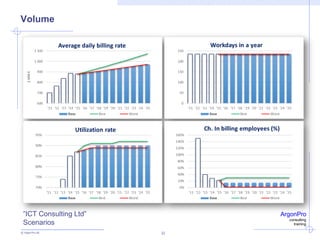
Volume
”ICT Consulting Ltd”
Scenarios
ArgonPro
consulting
training
23
Employees
”ICT Consulting Ltd”
Scenarios
ArgonPro
consulting
training
24
Revenue
”ICT Consulting Ltd”
Scenarios
ArgonPro
consulting
training
25
Expenses
”ICT Consulting Ltd”
Scenarios
ArgonPro
consulting
training
26
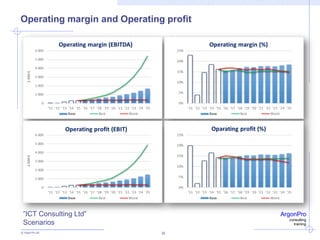
Operating margin and Operating profit
”ICT Consulting Ltd”
Scenarios
ArgonPro
consulting
training
27
Thresholds to Operating profit margin
”ICT Consulting Ltd”
Base Case
ArgonPro
consulting
training
28
Free cash flow
”ICT Consulting Ltd”
Scenarios
ArgonPro
consulting
training
29
Working capital
”ICT Consulting Ltd”
Scenarios
ArgonPro
consulting
training
30
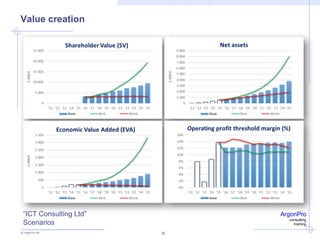
Value creation
”ICT Consulting Ltd”
Scenarios
ArgonPro
consulting
training
31
Equity ratio and Gearing
”ICT Consulting Ltd”
Scenarios
ArgonPro
consulting
training
Analysis
“Predicting the future is hard so every
investor is forced to analyze the present
while understanding the past”
ArgonPro
consulting
training
33
”ICT Consulting Ltd” - What went wrong in 2012?
• Business modeling and analysis highlighted also some issues
effecting poor financial result and negative cash flow in 2012.
• Growth in revenue in 2012 was 201% ja growth in number of emloyees was
175%. However, revenue per employee grew only 10%.
• Expenses (of revenue) grew 25%. Growth in number of emloyees and growth in
wages and salaries per employee (+80%) had huge impact in total expenses.
• Days in trade debtors grew 25% and other short-term debtors grew 233%
• Based on one individual year (2012) growth was not profitable growth.
+80%
+25%
+233%+25%
ArgonPro
consulting
training
34
Value gap
• Why might a value gap exist?
Current
Market
Value
Value
Gap
Strategy Gap
Expectations Gap
Value of firm to
stockholders
Value of firm if
managements
strategy is
implemented
Value of firm
under value
maximising
strategy
• The best way to close a valuation gap is to develop a deep
understanding of the value of the company well before the exit
– Determining and managing an accurate value gap is an
essential part of the exit planning process.
• Expectations Gap - often the result
of a failure in communications:
– Either investors are unaware of
the strategy, or
– Investors do not believe the
strategy will be realized because
they:
• Doubt the firm’s ability to
execute
• Believe the resulting cash
flows will be less in timing
and/or amount even if the
strategy is successful
Value Gap = Strategy Gap +
Expectations Gap
"If you don't know the values of the
components of Your business, you will
find yourself in the hands of someone
who does"
- An (unnamed) investment banker -
• Sometimes execution of value maximaising strategy is
possible only for totally new owner
ArgonPro
consulting
training
35
Value Creation and value gaps - ”ICT Consulting Ltd”
1] Pre-strategy value based on performance in history
2] 31.12.2015
Possibilities for value creation
(if/when scenario/strategy is
implemented)
 Value gaps should be
closed and eliminated with
a detailed and realistic plan
(exit plan)*]
*]
ArgonPro
consulting
training
36
Sensitivity Analysis - ”ICT Consulting Ltd”
The effect of percent or percent
unit change in Base Case value
1]
1] Cost of capital (WACC) is important part of performance management and valuation. Definition of cost of
capital requires always detailed analysis. Due to simplification cost of capital in this example is 8%
ArgonPro
consulting
training
37
Analysis - ”ICT Consulting Ltd”
Revenue
Annual increase in revenue has been (on average) 97%. In Base Case scenario annual growth assumption is 17%. Most of the growth is exected to materialize via
increase in number of billing employees (15% a year). Annual average billing rate is expected to increase 1%. Looking at the growth potential of this business, 17%
increase in revenue is still reasonable.
In Worst Case scenario increase in number of employees would be only marginal. This has direct effect to forecasted revelue levels (yearly growth only 2-3%). In
case positive trend in this business continues, annual growth of 30% (in Best Case scenario) may be quite realistic. However, in order to prepare for growth there
should be realistic plan available. The risk is how to find new skillful employees (in time) to fulfill growth plans.
Average billing rate is expected to increase 2% in Best Case scenario. Other scenarios has 1% growth expectation. Despite the fact that there is variation in the
number of working days in a year, it has assumed to be constant in all scenarios. Billing/utilization rate is expected to vary between 88% (Base/Worst) and 92% (Best
Case). As billing/utilization rate is already on reasonable level, substantial increas e in revenue requires more new billing employees. However, there is a challenge of
keeping billing/utilization level at sufficient level. Reaching the level of Baest Case requires quite substantial work load.
Expenses
High salary expenses (compared to revelue) in 2012 explains most of the non-profitable growth and negative cash flow in 2012. Consulting business is labour
dependent business and approximately 60% of expenses are employee costs. However, the ratio is expected to fall to the level of 55% by the end of forecast period.
Well timed recruiting of new employees as well as sufficient billing/utilization rates has essential effect when maintaining and improving profitability.
There is some variation in the amount of administration employees (Worst Case 7,7% vs. Best Case 10,0%). Maintaining the amount of administration employees at
competitive level is assisting and supporting profitability of the company. Number of administration employees effects also to revenue per employee ratio.
Second largest expense item is Raw materials and consumables (27% of total expenses). These expenses include normal raw material and services expenses as well
as external services. There are no special cost savings included in forecasted expenses. Gross expense are expected to increase in Best Case due to growth plans.
Margins and financial result
Operating profit margin is expected to be between 14 to 16% depending on the scenarion. Actual 5 year average margin is 13%. This includes one bad year (2012)
when margin was only 1,9%. Due to higher growth expectations Best Case scenario is expected to have lower profitability than Base Case.
The most efficient way to improve profitability is to improve revenue per employee ratio. However, as billing/utilization rate is already at reasonable high level it is not
that easy task to do.
Incremental threshold to growth is approximately 1,3%. This means that incremental growth in revenue (higher than Base Case) would require only 1,3%
profitability. Threshold for (value creating) operating profit margin would be 13% in Base Case. In operational target setting that means that operating profit target
should be higher han 13%.
All scenarios delivers positive financial result for all years in the forecasts. As noted in sensitivity analysis, billing/utilization rate, number of work days (in year), and
average billing rate have huge effect to financial result and cash flow. However, in number of work days the potetial to improve is quite small.
ArgonPro
consulting
training
38
Analysis - ”ICT Consulting Ltd”
Balance sheet
Assets in the balance sheet consists mainly of machines and equipment, trade debtors and cash and cash equivivalents. As the number of employees increases the
volume of investments also increases. In Base Case scenario days in trade debtors are expected to decrease from 55 days to 40 days. This is quite challenging task
and there should be specific/detaile plan prepared for it.
The company was founded with 2.500 euros share capital. Since 2014 theres has not been any need for external/loan capital. None of three scenarios requires long-
term debt. That is why solidity of the company is expected to be on excellent level. Days in trade creditors is expected to remain on reasonable level in 21 days.
During the first 5 years incremental working capital for growth has been approx. 14%. This means that 1 euro increase in revenue has tied ,14 euros in working
capital. In Base Case scenario incremental working capital is approximately 6%. This is quite tough target and it requires a special implementation plan.
Incremental fixed capital investments for growth have been approximately 5%. This means that 1 euro increase in revenue has required investments worth
approx. 0,05 euros. In Base Case scenario the assuption for incremental fixed capital investments is 8%.
Cash flow
Free cash flow is the amount of cash flow available for interest payments, loan instalments and possible dividends. In 2012 free cash flow was 50 ke negative. Since
that cash flow has been and is estimated to be positive. All scenarios have the assumption that in case free cash flow allows, 50% of the net result will be paid as
dividends to the owners. Strong cash flows in all scenarios makes it possible to pay dividends.
In most cases as the volume (revenue) of the operation increases also the amount of working capital (especially trade debtors) increases. That is why increase in
working capital decreases cash flow. Growth in working capital can be managed with effecting turns in working capital variables. The sooner money is in cashbox, the
better. In Best Case scenario the assumption is that due to growth plan there is very little that can be done to decrease working capital levels. In Base Case scenario
there is an assumption that working capital levels can be managed (e.g. days in Trade debtors from 55 days to 40 days)
Investments are connected to the number of employees. In Base Case scenario investments are increasing from 60 ke to 290 ke.
Other findings
The historical value, based on performance in history, is approx. 1,9 me (pre-strategy value). At the end of 2015 net bebt was -224 ke negative. Net sebt consisted
basically only cash and cash equivivalents. Negative net debt increases the value of the company. The approximated value of the company would be 6 me (with 5
year forecast period) and approx. 10,6 me (with 10 years forecast period). The increase of the value is mainly due to growth in revenue during whole forecast period.
All scenarios are increasing value. Although growth in Worst Case is only marginal. Difference compare to ArgonPro QuickAnalysis is explained mainly by the shorter
forecast (and growth) period.
Profitability, solidity and liquidity of the company are in excellent level in Base Case scenario.
ArgonPro
consulting
training
39
Key value drivers - ”ICT Consulting Ltd”
Revenue
Avg. daily billing
rate
Weeks in
a year
Vacation
weeks
Salary cost
per employee
Number of
employees
Staff
expenses
Social security
expenses
Purchases
Utilization
rate
Operating
expenses
Cost of Capital,
WACC
External
services
Other operating
expenses
Billing
employees
Admin.
employees
Workdays in
a year
Workdays in
a week
Working weeks
in a year
Investments
Trade
debtors
Trade
creditors
Share of admin.
employees
Days in
Trade debtors
Days in
Trade creditors
Income
taxes
Income tax
rate
Investments
per employee
ArgonPro
consulting
training
Conclusions
ArgonPro
consulting
training
41
What was achieved with business modelling?
• Analysis of the history and (short and long-term) forecasts for the future
– Business modeling (with graphs) highlited what has happened (in history)
– History is one part of estimating or forecasting the future (but it don’t guarantee it)
• Financing plan
– Valuable information while discussing with investors, banks and other
• Key value drivers
– For planning, reporting and management of the company
• Threshold margin(s) for operating profit
– For operational management and target setting
– Is there even need for something else?
• Scenarios for the future
– For evaluating strategies and options for the future
• Finance section of the business plan
– Provides clear revenue and business model of the business
• Valuation of the business (with scenarios)
• Basis for exit planning
• Visualization of data helps finding errors and mistakes
ArgonPro
consulting
training
42
Business modeling is a starting point for Value Management
• Value management, or tools
used in it can be utilized in
various operational and
strategic tasks, processes
and projects
• Business modeling is a
good start for value
management Analysis
ArgonPro
consulting
training
Most essential formulas used
ArgonPro
consulting
training
44
Most essential formulas used
Description and formula
Incremental sales € Sales (current period) - Sales (prior period)
Incremental fixed capital investment rate (%)
Capital expenditures - Depreciation expense
Incremental sales
Incremental working capital investment rate (%)
Change in working capital
Incremental sales
NOPLAT (also called NOPAT) € Operating profit - Taxes (on operating profit)
Initial invested capital (also called Net assets) € Non-current and current assets - Current liabilities - Provisions and other deferrals
Capital charge € Initial invested capital x Cost of capital (WACC)
Economic Profit, EP (also called EVA) € NOPLAT - Capital charge
Gross pre-strategy value (also called Gross
baseline value, or Economic Book Value, EBV)
€
NOPLAT (History average)
WACC
Net pre-strategy value (also called Net
baseline value, or Economic Book Value, EBV)
€
NOPLAT (History average)
WACC
Incremental threshold margin (%)
Incremental fixed and working capital investment rate x WACC
(1 + WACC) x (1- Income tax rate)
Threshold margin (%)
Prior period Operating profit - Incremental threshold margin - Incremental sales
Prior period sales + Incremental sales
Corporate value (also called Entity value) € Discounted free cash flows + Residual value
Shareholder value (also called Equity value) € Corporate value + Marketable securities - Debt and other obligations
- Net debt
@TimoNurminiemi
ArgonPro
consulting
training
@TimoNurminiemi@TimoNurminiemi
http://www.linkedin.com/in/timonurminiemi
Argon Pro Oy
Timo Nurminiemi
www.argonpro.com

APExampleAnalysis

  • 1.
    ArgonPro consulting training Cash flow basedbusiness modeling and analysis Case ”ICT Consulting Ltd” Timo Nurminiemi Argon Pro Ltd 18.1.2017
  • 2.
    ArgonPro consulting training 2 Objectives of thisreport • Introduce various advantages, benefits and possibilities of cash flow based business modeling and analysis in start-ups and SMEs Area/point of view Benefits and possibilities Performance measurement Business modeling will detect key performance measures i.e. value drivers effecting cash flow and value of the business Cash flow Cash flow indicates the best and most trusted view about the financial situation Financing Prepares cash flow and financing plan for own use and for investors/creditors Rolling forecasting Key value drivers enables high-quality process for rolling forecasting Strategy Various scenarios of the future supports strategy selection Reporting Visualization of data eases decision-making and brings out inconsistencies Analysis Analysis answers questions raised by reporting - QuickAnalysis as an option Target setting Key value drivers perform as the core basis for target setting Valuation Valuation and value management can be connected to business modeling Business Plan Reporting and analysis serve as a finance section in Business Plan Sensitivity analysis Sensitivity analysis produces basis for good and solid decisions Benefits and possibilities  Based on example of ”ICT Consulting Ltd” report will illustrate various possibilities of reporting provided by Argon Pro Ltd  Report has also training and education point of view. That is why this example report has more extensive content with some extra edu- cational slides
  • 3.
    ArgonPro consulting training 3 Agenda Cash flow basedbusiness modeling and analysis 1. 2. 3. 4. 5. 6. 7. 8. Objectives of this report Case ”ICT Consulting Ltd” Argon Pro Quick Analysis Business modeling Reporting Analysis Conclutions Most essential formulas used NextAgenda
  • 4.
  • 5.
    ArgonPro consulting training 5 ”ICT Consulting Ltd” •In January 2011, Peter and Martin, two Aalto University (Espoo, Finland) graduates founded an ICT services start-up company called “ICT Consulting Ltd”. ”ICT Consulting Ltd” 2011 - 2015 • The company started and operated with a small amount of equity capital and cash flow funding. Since the beginning, the company has performed positive financial results. However, in 2012 free cash flow was negative and the continuation of the operation required a short-term loan. The loan was paid off in 2014. • The company grew quickly from “garage operation” to a business with a revenue of about 2 million euros. At the end of 2015 it already employed 12 people.
  • 6.
    ArgonPro consulting training 6 Growth or profitability? •The company is now 5 years old. Reaching subsequent steps for growth requires new kind of decisions for risk-taking. Are efforts being made to grow "at any price" - perhaps compromising margins and profitability - or, targeting moderate growth and focus on ensuring profitability and positive cash flow? • In order to find useful solutions Peter and Martin interviewed a number of financial professionals they knew. • This example illustrates the approach of Argon Pro Ltd. ”Plans are nothing - Planning is everything” - General Dwight D. Eisenhower -
  • 7.
    ArgonPro consulting training 7 Business modeling andanalysis • Argon Pro’s approach is business modeling, analysis and action plans based on the analysis. Based on Argon Pro’s way of working, owners and operating management also considered and prepared various scenarios for the future. Scenarios to be used in this case were: Base scenario (Base Case), optimistic (Best Case) and pessimistic (Worst Case) scenario. • For a start-up company value creation is also importat issue. Peter and Martin has an idea to exit the com- pany after a 10 years time. This is why value and value creation potential was also taken into acount in analysis. • It is also essential to know weather any of the scenarios requires any external financing. • Since the beginning Peter and Martin have been looking for a simple and useful financial indicator supporting the operational management of the company. Argon Pro promised to took that also into account when procee- ding with the analysis. Base Case Scenario expects moderate growth in revenue and some improvement in profitability Worst Case Revenue as well as profitability would remain (more or less) at the current level. Best Case Scenario expects roughly 30% yearly increase in revenue. Profitability would be lower than in Base Case. Scenarios
  • 8.
  • 9.
    ArgonPro consulting training 9 ArgonPro QuickAnalysis • ArgonPro has built QuickAnalysis model by which first-stage (preliminary) analysis can be obtained without more time-consuming business modeling. • QuickAnalysis requires only 8 cash flow based variables. Using those variables you will be able to receive first, but still preliminary, estimates about the cash flow and value creation potetial of the business. In QuickAnalysis you can also utilize various scenarios and sensitivity analysis. It will also give you first estimates about the minimum operating profit level needed. 2. Operating profit (eur) Operating profit of last fiscal year 1. Revenue (eur) Revenue of last fiscal year 3. Revenue growth (%) Forecasted growth in revenue 4. Operating profit (%) Forecasted operating profit margin 6. Working capital (%) Growth in revenue increases need for working capital 5. Investments (%) Investments above depreciations are growth investments 7. Taxes (%) Calculatory taxes on operating profit 8. Cost of Capital (%) Weighted average cost of capital, WACC Variables used in QuickAnalysis 1] 1] Example of QuickAnalysis in next two pages
  • 10.
    ArgonPro consulting training 10 ArgonPro QuickAnalysis -Case ”ICT Consulting Ltd” ArgonPro QuickAnalysis (5 years) WORST BASE BEST Last historical revenue (1.000 eur) 1 979 1 979 1 979 Last historical operating profit (1.000 eur) 281 281 281 143 Revenue growth rate (%) 2 % -87 % 15 % 100 % 30 % 97 % Operating profit margin (%) 13 % -13 % 15 % -7 % 14 % 13 % Incremental fixed capital investments (%) 7 % 40 % 5 % 20 % 6 % 5 % Incremental working capital investments (%) 5 % 0 % 5 % 200 % 15 % 14 % Taxes on operating profit (%) 20 % 0 % 20 % 0 % 20 % Cost of Capital, WACC (%) 9 % 13 % 8 % -13 % 7 % Pre-strategy value (pre net debt) 2 495 2 807 3 208 Cumulative present value of cash flows 828 -35 % 1 283 -9 % 1 171 Present value of residual value 1 641 -60 % 4 064 106 % 8 383 Present value of cash flows + Residual value 2 469 -54 % 5 347 79 % 9 553 Market value of cash 223,9 0 % 223,9 0 % 223,9 Market value of debt 0,0 0,0 0,0 SHAREHOLDER VALUE 2 693 -52 % 5 570 76 % 9 777 SHAREHOLDER VALUE ADDED (SVA) -26 -101 % 2 539 150 % 6 345 Incremental threshold margin 1,2 % 34 % 0,9 % 85 % 1,7 % Threshold margin 13,9 % 12 % 12,5 % -9 % 11,3 % Scenarios History Avg. 30 % 20 % 10 % 0 % -10 % 13 % 225 196 207 257 347 15 % 255 230 243 297 390 17 % 285 263 280 336 433 -5 % 5 % 15 % 25 % 35 % One Year cash flow sensitivity Operatingprofit(%) Incr. fixed and working capital per euro of revenue Revenue growth 3 scenarios 8 variables needed Value creation Value + change Thresholds for operating margin Base Case Cash flow sensitivity 1 euro growth in revenue ties 0,15 euros in working capital 1 euro growth in revenue costs 0,06 euros as investments 1] 1] Cost of capital (WACC) is important part of performance management and valuation. Definition of cost of capital requires always detailed analysis. Due to simplification cost of capital in this example is 8%.
  • 11.
    ArgonPro consulting training 11 ArgonPro QuickAnalysis -Case ”ICT Consulting Ltd” Incremental threshold margin -10 % 0 % 10 % 20 % 30 % 6 % -0,7 % 0,0 % 0,7 % 1,4 % 2,1 % 8 % -0,9 % 0,0 % 0,9 % 1,9 % 2,8 % 10 % -1,1 % 0,0 % 1,1 % 2,3 % 3,4 % WACC Incr. fixed and working capital per euro of revenue Threshold margin (Sensitivity) 5 % 10 % 15 % 20 % 25 % 20 % 13,6 % 13,1 % 12,6 % 12,1 % 11,7 % 10 % 13,6 % 13,0 % 12,5 % 12,0 % 11,5 % 0 % 13,5 % 12,9 % 12,3 % 11,8 % 11,3 % Inv. to growth (%) Revenue growth Shareholder Value Added, SVA (1.000 eur) -5 % 5 % 15 % 25 % 35 % 12 % -863 86 1 439 3 316 5 863 15 % -386 820 2 539 4 926 8 162 18 % 91 1 554 3 640 6 535 10 461 Operating profit (%) Revenue growth • Sensitivity in relation to incremental investments and cost of capital • Increase in revenue requires at least 0,9% operating profit margin • Sensitivity in relation to increase in revenue and incremental (growth) investments • From value creation point of view high-enough operating profit margin is 12,5% • Sensitivity in relation to growth in revenue and operating profit margin • In Base Case scenario the value would increase 2.539 thousand euros Base Case
  • 12.
  • 13.
    ArgonPro consulting training 13 Business modeling inpractice • Revenue, costs, working capital, investments and any other variable effecting cash flow are connected to each other. Change in one variable will effect to the result and outcome of the whole model. No. of employees Revenue per employee X Salary cost per employee X Revenue= Salary costs = Other expenses % of Trade debtors Days in Trade creditors Days in • Variables, components or ”building blocks” of business modeling are called value drivers. Value drivers effecting most in cash flow and value of the business are called Key Value Drivers. Simplified example of business modeling
  • 14.
    ArgonPro consulting training 14 Business modeling andvalue drivers - example  Market size  Market share  Sales mix  Retail price  Staffung levels  Wage rates  Raw material prices  Production costs  Tax rate  Tax-effective structures  Inventory turns  Accounts receivable  Accounts payable  Contract terms  Plant life  Replacement equipment  Maintenance  Scale of operations  Cost of equity  Cost of debt  Leverage Business unit value Taxes Revenues Operating margin Working capital Capital expenditure Investments required to support operations Cash profit Cash flow from operations Cost of capital Discount rate Micro value drivers Macro value drivers Determinants of value Source: Alfred Rappaport; Creating Shareholder Value, The Free Press 1998
  • 15.
    ArgonPro consulting training 15 Business modeling of”ICT Consulting Ltd” • Revenue of “ICT Consulting Ltd” consists mainly of the work performed by billable personnel working in projects invoiced on daily basis. • Due to the nature of operations (consulting) significant growth would occur by increasing the number of billable personnell, that is, increasing resources and expanding operations outside Finland. • Billing rate (aka. utilization rate) is essential measure for project and consulting business. It has increased from the level of 50% to the level of 87%. According to preliminary estimates improving billing rate would also improve profitability. • Since the beginning of the operation payment times of the customers have been a challenge. Days in trade creditors have been at the level of 53 days. In Best Case scenario the assumption is that due to rapid growth in international operations there is very little to do to improve the payment times. In Base Case scenario there would be special attention to payment times as well as profitability. • The ratio of billing and administration personnel has always been subject to close supervision. At the moment ratio is at the level of 9%. In scenarios prepared earlier ratio varies between 7,7% and 10,0%. • Investments are mainly ICT machinery and equipment investments related to the development of the number of employees.
  • 16.
    ArgonPro consulting training 16 Illustration of valuedriver map - ”ICT Consulting Ltd” Revenue Avg. daily billing rate Weeks in a year Vacation weeks Salary cost per employee Number of employees Staff expenses Social security expenses Purchases Billing/Utilization rate Operating expenses Cost of Capital, WACC External services Other operating expenses Billing employees Admin. employees Workdays in a year Workdays in a week Working weeks in a year Investments Trade debtors Trade creditors Share of admin. employees Days in Trade debtors Days in Trade creditors Income taxes Income tax rate Investments per employee
  • 17.
  • 18.
    ArgonPro consulting training 18 Reporting raises questions- analysis answers them • Reporting vs. Analysis - ”You can’t have one without other” • Visualization with graphs and colors eases the task of a reader and decision- maker to pic up the most relevant information and to ask well fitted questions – Visualization also illustrates any inconsistencies of numbers • Scenarios helps reader and decisionmaker to perceive and understand various possible outcomes of the future • Scenario is a description of possible future(s) – Describes effects and possibilities – Selected from various possible outcomes - what the future could be, or what it should be? • In business life scenarios are developed to support decision-making processes A = A clear-enough future (A single forecast precise enough for determining strategy) B = Alternate futures (A few discrete outcomes that define the future) C = A range of futures (A range of possible outcomes, but no natural scenarios) D = True ambiquity (No basis to forecast the future) Source: Courtney, Kirkland, Viguerie; Strategy under uncertainty, Harward Business Review, Nov-Dec 1997 Four levels of uncertainty A B C D
  • 19.
    ArgonPro consulting training 19 1.000 EUR 20112012 2013 2014 2015 2016 2017 2018 2019 2020 2021 2022 2023 2024 2025 Revenue 165 494 1 020 1 595 1 979 2 325 2 731 3 208 3 726 4 328 5 027 5 839 6 782 7 877 9 149 Ch. in Revenue (%) - 201 % 106 % 56 % 24 % 17 % 17 % 17 % 16 % 16 % 16 % 16 % 16 % 16 % 16 % Ch. in Stocks of finished and semifinished goods - - - - - - - - - - - - - - - Manufacturing for enterprise's own use - - - - - - - - - - - - - - - Other operating income - - - - - - - - - - - - - - - Operating expenses total 127 475 871 1 301 1 659 1 963 2 303 2 671 3 083 3 584 4 138 4 807 5 588 6 459 7 467 OPERATING MARGIN (EBITDA) 38 19 149 293 320 363 428 537 643 743 889 1 032 1 194 1 418 1 682 Operating margin (%) 22,9 % 3,9 % 14,6 % 18,4 % 16,2 % 15,6 % 15,7 % 16,7 % 17,2 % 17,2 % 17,7 % 17,7 % 17,6 % 18,0 % 18,4 % Depreciation and reduction in value 5 10 20 30 39 34 46 58 70 84 100 118 139 164 192 OPERATING PROFIT (EBIT) 33 9 129 263 281 328 382 479 572 659 789 914 1 055 1 254 1 490 Oparating profit (%) 19,9 % 1,9 % 12,7 % 16,5 % 14,2 % 14,1 % 14,0 % 14,9 % 15,4 % 15,2 % 15,7 % 15,7 % 15,6 % 15,9 % 16,3 % Financial income and expenses 0 -2 -2 1 3 3 4 6 7 9 11 14 17 20 25 Taxes 7 2 26 53 57 66 77 97 116 134 160 186 214 255 303 Minority interest - - - - - - - - - - - - - - - Profit of the financial year 26 6 102 211 227 265 309 388 463 535 640 742 858 1 020 1 211 11.12.2016 14:39 Purchases (% of Revenue) 22 % 19 % 18 % 18 % 18 % 18 % 18 % 17 % 17 % 17 % 16 % 16 % 15 % 15 % 15 % External services (% of Revenue) 7 % 6 % 6 % 6 % 6 % 5 % 5 % 5 % 5 % 5 % 5 % 5 % 5 % 5 % 5 % Other operating expenses (% of Revenue) 13 % 11 % 9 % 8 % 9 % 11 % 11 % 11 % 10 % 10 % 10 % 10 % 11 % 10 % 9 % Number of employees 2 6 8 10 12 14 16 18 21 24 28 32 36 42 48 Ch. In number of employees (%) - 175 % 40 % 27 % 23 % 13 % 15 % 15 % 15 % 15 % 15 % 15 % 15 % 15 % 15 % Revenue per employee 82 90 132 163 164 170 174 177 179 181 183 184 186 188 190 Ch. In Revenue per employee (%) - 9 % 47 % 23 % 1 % 4 % 2 % 2 % 1 % 1 % 1 % 1 % 1 % 1 % 1 % Staff expenses per employee 30 54 69 81 84 85 87 89 90 92 93 95 96 98 100 Ch. in Staff expenses per employee (%) - 82 % 29 % 17 % 3 % 2 % 2 % 2 % 2 % 1 % 2 % 2 % 1 % 2 % 2 % Income Statement ”ICT Consulting Ltd” Base Case
  • 20.
    ArgonPro consulting training 20 1.000 EUR 20112012 2013 2014 2015 2016 2017 2018 2019 2020 2021 2022 2023 2024 2025 Non-current assets 15 27 53 82 104 139 175 213 256 303 358 422 496 582 684 Current assets 28 102 220 374 583 723 870 1 056 1 279 1 540 1 850 2 211 2 630 3 123 3 709 Stocks - - - - - - - - - - - - - - - Debtors 22 90 181 264 359 389 442 495 575 631 733 803 933 1 084 1 259 Short-term investments - - - - - - - - - - - - - - - Cash in hand and at banks 6 12 39 111 224 335 428 561 705 909 1 117 1 408 1 697 2 040 2 450 ASSETS 43 129 273 456 686 863 1 045 1 270 1 535 1 843 2 208 2 633 3 126 3 706 4 393 Capital and reserves 29 35 137 348 575 708 862 1 056 1 288 1 555 1 875 2 246 2 675 3 185 3 790 Minority interests - - - - - - - - - - - - - - - Provisions - 10 7 6 6 17 21 25 31 37 44 53 63 74 88 Creditors Long-term creditors - 58 69 20 - - - - - - - - - - - Long-term (interest-bearing) debt - 58 69 20 - - - - - - - - - - - Deferred tax liability - - - - - - - - - - - - - - - Other long-term debt - - - - - - - - - - - - - - - Short-term creditors 14 26 60 82 106 138 162 188 216 251 289 334 388 447 514 EQUITY AND LIABILITIES 43 129 273 456 686 863 1 045 1 270 1 535 1 843 2 208 2 633 3 126 3 706 4 393 11.12.2016 14:39 Days in Trade debtors 44 55 55 48 53 49 47 45 45 43 43 40 40 40 40 Days in Trade creditors 22 20 22 18 20 21 21 21 21 21 21 21 21 21 21 Gearing (%) -21 % 131 % 22 % -26 % -39 % -47 % -50 % -53 % -55 % -58 % -60 % -63 % -63 % -64 % -65 % Equity ratio (%) 67 % 27 % 50 % 76 % 84 % 82 % 83 % 83 % 84 % 84 % 85 % 85 % 86 % 86 % 86 % Balance Sheet ”ICT Consulting Oy” Base Case
  • 21.
    ArgonPro consulting training 21 1.000 EUR 20122013 2014 2015 2016 2017 2018 2019 2020 2021 2022 2023 2024 2025 OPERATING PROFIT (EBIT) 9 129 263 281 328 382 479 572 659 789 914 1 055 1 254 1 490 - Taxes -2 -26 -53 -57 -66 -77 -97 -116 -134 -160 -186 -214 -255 -303 +/-Adjustments to Operating profit - - - - - - - - - - - - - - Operating profit after taxes (NOPLAT) 8 104 211 224 262 305 382 456 525 629 728 841 999 1 187 + Depreciation and reduction in value 10 20 30 39 34 46 58 70 84 100 118 139 164 192 +- Ch. in Working capital -56 -58 -60 -72 2 -29 -27 -52 -21 -64 -25 -76 -92 -107 +/-Other adjustments to cash flow - - - - - - - - - - - - - - Cash flow from operations -28 63 179 191 310 325 418 480 595 672 830 914 1 082 1 285 - Investments in fixed assets 22 46 59 61 70 82 96 113 132 155 182 213 250 293 + Sales of fixed assets - - - - - - - - - - - - - - Net investments 22 46 59 61 70 82 96 113 132 155 182 213 250 293 FREE CASH FLOW -50 17 120 131 240 244 322 368 463 517 648 701 832 992 NPV of cash flows (cumulative) 231 448 714 994 1 322 1 660 2 053 2 446 2 879 3 357 NPV of residual value 2 887 2 713 3 319 3 512 4 091 4 232 4 910 4 917 5 409 5 968 Enterprise (Corporate) value (EV) 3 118 3 161 4 033 4 507 5 412 5 892 6 963 7 363 8 288 9 325 Net debt (per last closing date) -224 -224 -224 -224 -224 -224 -224 -224 -224 -224 Shareholder (Equity) value 3 342 3 385 4 256 4 731 5 636 6 116 7 187 7 587 8 512 9 549 11.12.2016 14:39 Pre-strategy value (after net debt) 1 931 Pre-strategy value (pre net debt) 1 707 Free Cash Flow ”ICT Consulting Oy” Base Case
  • 22.
  • 23.
  • 24.
  • 25.
  • 26.
    ArgonPro consulting training 26 Operating margin andOperating profit ”ICT Consulting Ltd” Scenarios
  • 27.
    ArgonPro consulting training 27 Thresholds to Operatingprofit margin ”ICT Consulting Ltd” Base Case
  • 28.
  • 29.
  • 30.
  • 31.
    ArgonPro consulting training 31 Equity ratio andGearing ”ICT Consulting Ltd” Scenarios
  • 32.
    ArgonPro consulting training Analysis “Predicting the futureis hard so every investor is forced to analyze the present while understanding the past”
  • 33.
    ArgonPro consulting training 33 ”ICT Consulting Ltd”- What went wrong in 2012? • Business modeling and analysis highlighted also some issues effecting poor financial result and negative cash flow in 2012. • Growth in revenue in 2012 was 201% ja growth in number of emloyees was 175%. However, revenue per employee grew only 10%. • Expenses (of revenue) grew 25%. Growth in number of emloyees and growth in wages and salaries per employee (+80%) had huge impact in total expenses. • Days in trade debtors grew 25% and other short-term debtors grew 233% • Based on one individual year (2012) growth was not profitable growth. +80% +25% +233%+25%
  • 34.
    ArgonPro consulting training 34 Value gap • Whymight a value gap exist? Current Market Value Value Gap Strategy Gap Expectations Gap Value of firm to stockholders Value of firm if managements strategy is implemented Value of firm under value maximising strategy • The best way to close a valuation gap is to develop a deep understanding of the value of the company well before the exit – Determining and managing an accurate value gap is an essential part of the exit planning process. • Expectations Gap - often the result of a failure in communications: – Either investors are unaware of the strategy, or – Investors do not believe the strategy will be realized because they: • Doubt the firm’s ability to execute • Believe the resulting cash flows will be less in timing and/or amount even if the strategy is successful Value Gap = Strategy Gap + Expectations Gap "If you don't know the values of the components of Your business, you will find yourself in the hands of someone who does" - An (unnamed) investment banker - • Sometimes execution of value maximaising strategy is possible only for totally new owner
  • 35.
    ArgonPro consulting training 35 Value Creation andvalue gaps - ”ICT Consulting Ltd” 1] Pre-strategy value based on performance in history 2] 31.12.2015 Possibilities for value creation (if/when scenario/strategy is implemented)  Value gaps should be closed and eliminated with a detailed and realistic plan (exit plan)*] *]
  • 36.
    ArgonPro consulting training 36 Sensitivity Analysis -”ICT Consulting Ltd” The effect of percent or percent unit change in Base Case value 1] 1] Cost of capital (WACC) is important part of performance management and valuation. Definition of cost of capital requires always detailed analysis. Due to simplification cost of capital in this example is 8%
  • 37.
    ArgonPro consulting training 37 Analysis - ”ICTConsulting Ltd” Revenue Annual increase in revenue has been (on average) 97%. In Base Case scenario annual growth assumption is 17%. Most of the growth is exected to materialize via increase in number of billing employees (15% a year). Annual average billing rate is expected to increase 1%. Looking at the growth potential of this business, 17% increase in revenue is still reasonable. In Worst Case scenario increase in number of employees would be only marginal. This has direct effect to forecasted revelue levels (yearly growth only 2-3%). In case positive trend in this business continues, annual growth of 30% (in Best Case scenario) may be quite realistic. However, in order to prepare for growth there should be realistic plan available. The risk is how to find new skillful employees (in time) to fulfill growth plans. Average billing rate is expected to increase 2% in Best Case scenario. Other scenarios has 1% growth expectation. Despite the fact that there is variation in the number of working days in a year, it has assumed to be constant in all scenarios. Billing/utilization rate is expected to vary between 88% (Base/Worst) and 92% (Best Case). As billing/utilization rate is already on reasonable level, substantial increas e in revenue requires more new billing employees. However, there is a challenge of keeping billing/utilization level at sufficient level. Reaching the level of Baest Case requires quite substantial work load. Expenses High salary expenses (compared to revelue) in 2012 explains most of the non-profitable growth and negative cash flow in 2012. Consulting business is labour dependent business and approximately 60% of expenses are employee costs. However, the ratio is expected to fall to the level of 55% by the end of forecast period. Well timed recruiting of new employees as well as sufficient billing/utilization rates has essential effect when maintaining and improving profitability. There is some variation in the amount of administration employees (Worst Case 7,7% vs. Best Case 10,0%). Maintaining the amount of administration employees at competitive level is assisting and supporting profitability of the company. Number of administration employees effects also to revenue per employee ratio. Second largest expense item is Raw materials and consumables (27% of total expenses). These expenses include normal raw material and services expenses as well as external services. There are no special cost savings included in forecasted expenses. Gross expense are expected to increase in Best Case due to growth plans. Margins and financial result Operating profit margin is expected to be between 14 to 16% depending on the scenarion. Actual 5 year average margin is 13%. This includes one bad year (2012) when margin was only 1,9%. Due to higher growth expectations Best Case scenario is expected to have lower profitability than Base Case. The most efficient way to improve profitability is to improve revenue per employee ratio. However, as billing/utilization rate is already at reasonable high level it is not that easy task to do. Incremental threshold to growth is approximately 1,3%. This means that incremental growth in revenue (higher than Base Case) would require only 1,3% profitability. Threshold for (value creating) operating profit margin would be 13% in Base Case. In operational target setting that means that operating profit target should be higher han 13%. All scenarios delivers positive financial result for all years in the forecasts. As noted in sensitivity analysis, billing/utilization rate, number of work days (in year), and average billing rate have huge effect to financial result and cash flow. However, in number of work days the potetial to improve is quite small.
  • 38.
    ArgonPro consulting training 38 Analysis - ”ICTConsulting Ltd” Balance sheet Assets in the balance sheet consists mainly of machines and equipment, trade debtors and cash and cash equivivalents. As the number of employees increases the volume of investments also increases. In Base Case scenario days in trade debtors are expected to decrease from 55 days to 40 days. This is quite challenging task and there should be specific/detaile plan prepared for it. The company was founded with 2.500 euros share capital. Since 2014 theres has not been any need for external/loan capital. None of three scenarios requires long- term debt. That is why solidity of the company is expected to be on excellent level. Days in trade creditors is expected to remain on reasonable level in 21 days. During the first 5 years incremental working capital for growth has been approx. 14%. This means that 1 euro increase in revenue has tied ,14 euros in working capital. In Base Case scenario incremental working capital is approximately 6%. This is quite tough target and it requires a special implementation plan. Incremental fixed capital investments for growth have been approximately 5%. This means that 1 euro increase in revenue has required investments worth approx. 0,05 euros. In Base Case scenario the assuption for incremental fixed capital investments is 8%. Cash flow Free cash flow is the amount of cash flow available for interest payments, loan instalments and possible dividends. In 2012 free cash flow was 50 ke negative. Since that cash flow has been and is estimated to be positive. All scenarios have the assumption that in case free cash flow allows, 50% of the net result will be paid as dividends to the owners. Strong cash flows in all scenarios makes it possible to pay dividends. In most cases as the volume (revenue) of the operation increases also the amount of working capital (especially trade debtors) increases. That is why increase in working capital decreases cash flow. Growth in working capital can be managed with effecting turns in working capital variables. The sooner money is in cashbox, the better. In Best Case scenario the assumption is that due to growth plan there is very little that can be done to decrease working capital levels. In Base Case scenario there is an assumption that working capital levels can be managed (e.g. days in Trade debtors from 55 days to 40 days) Investments are connected to the number of employees. In Base Case scenario investments are increasing from 60 ke to 290 ke. Other findings The historical value, based on performance in history, is approx. 1,9 me (pre-strategy value). At the end of 2015 net bebt was -224 ke negative. Net sebt consisted basically only cash and cash equivivalents. Negative net debt increases the value of the company. The approximated value of the company would be 6 me (with 5 year forecast period) and approx. 10,6 me (with 10 years forecast period). The increase of the value is mainly due to growth in revenue during whole forecast period. All scenarios are increasing value. Although growth in Worst Case is only marginal. Difference compare to ArgonPro QuickAnalysis is explained mainly by the shorter forecast (and growth) period. Profitability, solidity and liquidity of the company are in excellent level in Base Case scenario.
  • 39.
    ArgonPro consulting training 39 Key value drivers- ”ICT Consulting Ltd” Revenue Avg. daily billing rate Weeks in a year Vacation weeks Salary cost per employee Number of employees Staff expenses Social security expenses Purchases Utilization rate Operating expenses Cost of Capital, WACC External services Other operating expenses Billing employees Admin. employees Workdays in a year Workdays in a week Working weeks in a year Investments Trade debtors Trade creditors Share of admin. employees Days in Trade debtors Days in Trade creditors Income taxes Income tax rate Investments per employee
  • 40.
  • 41.
    ArgonPro consulting training 41 What was achievedwith business modelling? • Analysis of the history and (short and long-term) forecasts for the future – Business modeling (with graphs) highlited what has happened (in history) – History is one part of estimating or forecasting the future (but it don’t guarantee it) • Financing plan – Valuable information while discussing with investors, banks and other • Key value drivers – For planning, reporting and management of the company • Threshold margin(s) for operating profit – For operational management and target setting – Is there even need for something else? • Scenarios for the future – For evaluating strategies and options for the future • Finance section of the business plan – Provides clear revenue and business model of the business • Valuation of the business (with scenarios) • Basis for exit planning • Visualization of data helps finding errors and mistakes
  • 42.
    ArgonPro consulting training 42 Business modeling isa starting point for Value Management • Value management, or tools used in it can be utilized in various operational and strategic tasks, processes and projects • Business modeling is a good start for value management Analysis
  • 43.
  • 44.
    ArgonPro consulting training 44 Most essential formulasused Description and formula Incremental sales € Sales (current period) - Sales (prior period) Incremental fixed capital investment rate (%) Capital expenditures - Depreciation expense Incremental sales Incremental working capital investment rate (%) Change in working capital Incremental sales NOPLAT (also called NOPAT) € Operating profit - Taxes (on operating profit) Initial invested capital (also called Net assets) € Non-current and current assets - Current liabilities - Provisions and other deferrals Capital charge € Initial invested capital x Cost of capital (WACC) Economic Profit, EP (also called EVA) € NOPLAT - Capital charge Gross pre-strategy value (also called Gross baseline value, or Economic Book Value, EBV) € NOPLAT (History average) WACC Net pre-strategy value (also called Net baseline value, or Economic Book Value, EBV) € NOPLAT (History average) WACC Incremental threshold margin (%) Incremental fixed and working capital investment rate x WACC (1 + WACC) x (1- Income tax rate) Threshold margin (%) Prior period Operating profit - Incremental threshold margin - Incremental sales Prior period sales + Incremental sales Corporate value (also called Entity value) € Discounted free cash flows + Residual value Shareholder value (also called Equity value) € Corporate value + Marketable securities - Debt and other obligations - Net debt
  • 45.