









































































Copyright © 2018, Oracle and/or its affiliates. All rights reserved. |
Don't discombobulate your database
Connor McDonald
Developer Advocate
Copyright © 2018, Oracle and/or its affiliates. All rights reserved.
Connor McDonald
4
5
Copyright © 2018, Oracle and/or its affiliates. All rights reserved. |
Stuff
youtube bit.ly/youtube-connor
blog bit.ly/blog-connor
twitter bit.ly/twitter-connor
400+ posts mainly on database & development
250 technical videos, new uploads every week
rants and raves on tech and the world :-)
Copyright © 2018, Oracle and/or its affiliates. All rights reserved.
etc...
facebook bit.ly/facebook-connor
linkedin bit.ly/linkedin-connor
instagram bit.ly/instagram-connor
slideshare bit.ly/slideshare-connor
https://asktom.oracle.com
9https://asktom.oracle.com/officehours
100 hours of free access (so far)
10
11
discombobulate ?
12
really silly things
people do to their databases
13
why ?
14
15
1) the importance of failure
16
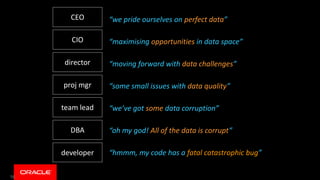
developer
team lead
DBA
proj mgr
director
CIO
CEO
“hmmm, my code has a fatal catastrophic bug”
“oh my god! All of the data is corrupt”
“we’ve got some data corruption”
“some small issues with data quality”
“moving forward with data challenges”
“maximising opportunities in data space”
“we pride ourselves on perfect data”
17
failure ≠ negligence
18
disasters
19
poor decision making
20
your changing role
21
22
decision making role
23
responsibility lies with us
2) ... some controversy ...
nowadays ...
... all performance problems are our fault
a little bit of history on servers ...
(not too) long ago
"front side bus"
30
~2007
machines are scary fast today
36
perf.sql
we can't blame the hardware anymore
37
this session ...
... common causes of slow
... common causes of wrong
41
caveat
42
43
https://tinyurl.com/be-nicer
44
let's set the scene
45
as bad as it gets...
46
PROCEDURE string_check (p_text_in varchar2,p_ret out number) is
char_list varchar2(255);
v_single_char varchar2(1);
v_in_string number;
cursor c1(m number) is
select substr(char_list,m,1) from dual;
cursor c2(v varchar2) is
select instr(p_text_in,v) from dual;
BEGIN
p_ret := 0;
for i in 1 .. 45 loop
char_list := char_list || chr(i);
end loop;
char_list := char_list || chr(47);
for i in 58 .. 255 loop
char_list := char_list || chr(i);
end loop;
for i in 1 .. length(char_list) loop
open c1(i);
fetch c1 into v_single_char;
close c1;
open c2(v_single_char);
fetch c2 into v_in_string;
close c2;
if v_in_string > 0 then
p_ret := 1;
end if;
end loop;
END;
47
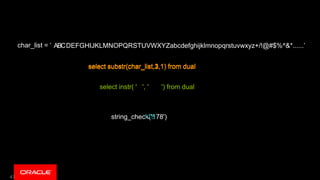
ABCDEFGHIJKLMNOPQRSTUVWXYZabcdefghijklmnopqrstuvwxyz+/!@#$%^&*......’
string_check('178')178
select substr(char_list,1,1) from dual
select instr( ' ', ' ') from dual
char_list = ‘
select substr(char_list,2,1) from dualselect substr(char_list,3,1) from dual
48
huh ?
49
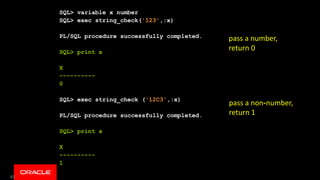
SQL> variable x number
SQL> exec string_check('123',:x)
PL/SQL procedure successfully completed.
SQL> print x
X
----------
0
SQL> exec string_check ('12C3',:x)
PL/SQL procedure successfully completed.
SQL> print x
X
----------
1
pass a number,
return 0
pass a non-number,
return 1
50
“check if numeric” function
51
used everywhere
52
External
System #1
External
System #2
External
System #3
numeric data expected
STRING_CHECK
Our
System
53
every execution
244 "select substr from dual"
244 "select instr from dual"
54
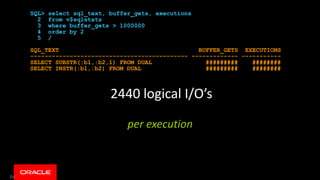
2440 logical I/O’s
per execution
SQL> select sql_text, buffer_gets, executions
2 from v$sqlstats
3 where buffer_gets > 1000000
4 order by 2
5 /
SQL_TEXT BUFFER_GETS EXECUTIONS
-------------------------------------------- ------------- -----------
SELECT SUBSTR(:b1,:b2,1) FROM DUAL ######### ########
SELECT INSTR(:b1,:b2) FROM DUAL ######### ########
55
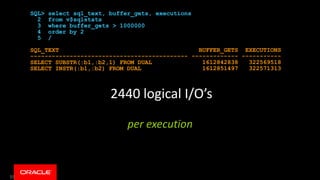
2440 logical I/O’s
per execution
SQL> select sql_text, buffer_gets, executions
2 from v$sqlstats
3 where buffer_gets > 1000000
4 order by 2
5 /
SQL_TEXT BUFFER_GETS EXECUTIONS
-------------------------------------------- ------------- -----------
SELECT SUBSTR(:b1,:b2,1) FROM DUAL ######### ########
SELECT INSTR(:b1,:b2) FROM DUAL ######### ########
BUFFER_GETS EXECUTIONS
------------- -----------
1612842838 322569518
1612851497 322571313
56
57
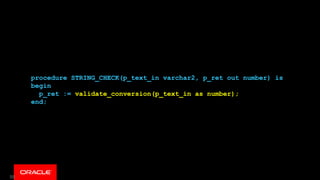
oracle has an “is_number”
58
12c
59
procedure STRING_CHECK(p_text_in varchar2, p_ret out number) is
begin
p_ret := validate_conversion(p_text_in as number);
end;
60
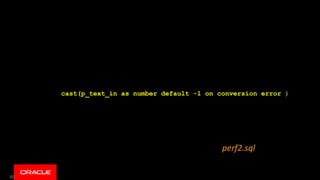
function CLEAN_NUMBER(p_text_in varchar2) return number is
begin
return cast(p_text_in as number default -1 on conversion error );
end;
perf2.sql
61
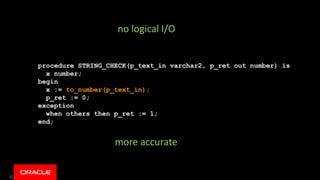
pre-12c
62
procedure STRING_CHECK(p_text_in varchar2, p_ret out number) is
x number;
begin
x := to_number(p_text_in);
p_ret := 0;
exception
when others then p_ret := 1;
end;
no logical I/O
more accurate
63
why ?
64
“I didn’t know about TO_NUMBER”
65
importance of load testing
single execution
100 executions
66
times anything =
67
I know what you're thinking ...
68
"LOL...
select from dual...
what....a......dufus"
69
“we would never do anything that stupid”
common mistake #1
70
hidden costs
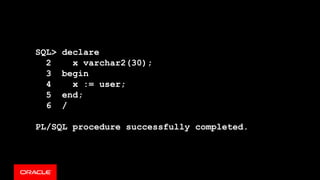
but perhaps you do this ?
71
SQL> declare
2 x varchar2(30);
3 begin
4 x := user;
5 end;
6 /
PL/SQL procedure successfully completed.
let's build it up
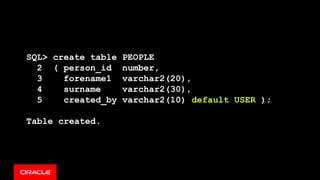
SQL> create table PEOPLE
2 ( person_id number,
3 forename1 varchar2(20),
4 surname varchar2(30),
5 created_by varchar2(10) default USER );
Table created.
75
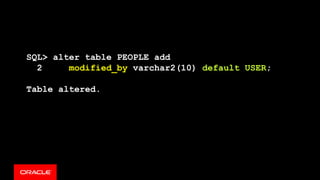
"what about when a person is modified?"
SQL> alter table PEOPLE add
2 modified_by varchar2(10) default USER;
Table altered.
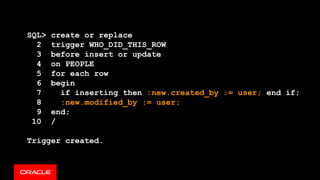
triggers
SQL> create or replace
2 trigger WHO_DID_THIS_ROW
3 before insert or update
4 on PEOPLE
5 for each row
6 begin
7 if inserting then :new.created_by := user; end if;
8 :new.modified_by := user;
9 end;
10 /
Trigger created.
importance of load testing
single execution
100 executions
insert into people
select rownum,'x','y',null,null
from dba_objects
call count cpu elapsed disk query current rows
------- ------ -------- ---------- ---------- ---------- ---------- ----------
Parse 1 0.03 0.02 0 0 0 0
Execute 1 8.53 8.61 0 26870 2685 78703
Fetch 0 0.00 0.00 0 0 0 0
------- ------ -------- ---------- ---------- ---------- ---------- ----------
total 2 8.56 8.63 0 26870 2685 78703
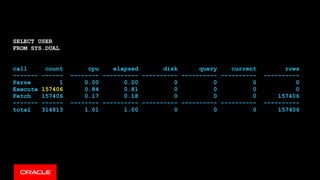
SELECT USER
FROM SYS.DUAL
call count cpu elapsed disk query current rows
------- ------ -------- ---------- ---------- ---------- ---------- ----------
Parse 1 0.00 0.00 0 0 0 0
Execute 157406 0.84 0.81 0 0 0 0
Fetch 157406 0.17 0.18 0 0 0 157406
------- ------ -------- ---------- ---------- ---------- ---------- ----------
total 314813 1.01 1.00 0 0 0 157406
SQL> create or replace
2 trigger WHO_DID_THIS_ROW
3 before insert or update
4 on PEOPLE
5 for each row
6 begin
7 if inserting then
8 :new.created_by := sys_context('USERENV','SESSION_USER');
9 end if;
10 :new.modified_by := sys_context('USERENV','SESSION_USER') ;
11 end;
12 /
Trigger created.
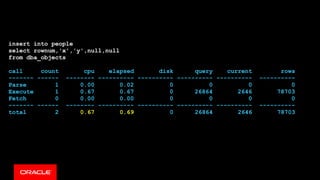
insert into people
select rownum,'x','y',null,null
from dba_objects
call count cpu elapsed disk query current rows
------- ------ -------- ---------- ---------- ---------- ---------- ----------
Parse 1 0.00 0.02 0 0 0 0
Execute 1 0.67 0.67 0 26864 2646 78703
Fetch 0 0.00 0.00 0 0 0 0
------- ------ -------- ---------- ---------- ---------- ---------- ----------
total 2 0.67 0.69 0 26864 2646 78703
uid
84
user
… and others
while we're talking triggers …
85
common mistake #2
86
silent data corruption
the best feature of Oracle
“Readers don’t block writers"
“Writers don't block readers"
Maximum concurrency…
… very few locking worries
lack of understanding
90
corrupt your database
quick revision
92
SQL> update EMP
2 set SAL = SAL * 1.10
3 /
14 rows updated.
SQL> rollback;
Rollback complete.
how ?
93
we remember stuff
94
SQL> update EMP
2 set SAL = SAL * 1.10
3 /
undo header
smith $1,0001
block 2754
jones $9002
brown $1,5003
wells $2,0004
wilson $1,0005
block 2754, row 1,
sal $1000
block 2754, row 2,
sal $900
block 2754, row 3,
sal $1500
block 2754, row 4,
sal $2000
uba 5
5
$1,100
$990
$1,650
$2,200
uba 5.1uba 5.2
95
SQL> rollback;
96
SQL> rollback;
undo header
smith $1,0001
block 2754
jones $9002
brown $1,5003
wells $2,0004
wilson $1,0005
block 2754, row 1,
sal $1000
block 2754, row 2,
sal $900
block 2754, row 3,
sal $1500
block 2754, row 4,
sal $2000
uba 5
5
$1,100
$990
$1,650
$2,200
uba 5.1uba 5.2
we can use this stuff for queries!
(Oracle version 4)
98
read consistency
99
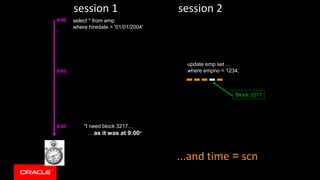
select * from emp
where hiredate > '01/01/2004'
update emp set …
where empno = 1234;
Block 3217
"I need block 3217…
… as it was at 9:00"
9:00
9:03
9:05
session 1 session 2
...and time = scn
System Change Number
(the block “timestamp”)
so what do we do ?
102
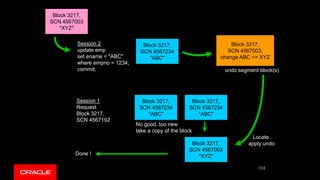
we apply undo
Session 1
Request
Block 3217,
SCN 4567192
Block 3217,
SCN 4567234
"ABC"
Block 3217,
SCN 4567003,
change ABC => XYZ
undo segment block(s)
No good..too new
take a copy of the block
Locate
apply undo
Block 3217,
SCN 4567234
"ABC"
Block 3217,
SCN 4567234
"ABC"
Block 3217,
SCN 4567003
"XYZ"
Block 3217,
SCN 4567003
"XYZ"
Session 2
update emp
set ename = "ABC"
where empno = 1234;
commit;
Done !
104
results are time consistent
“I’m a developer…
…who cares about all that?”
So many ways…
108
data integrity
... true story
109
110
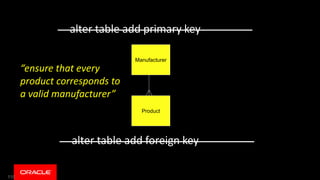
Manufacturer
Product
alter table add primary key
alter table add foreign key
“ensure that every
product corresponds to
a valid manufacturer”
111
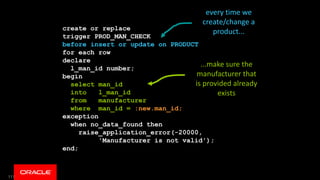
create or replace
trigger PROD_MAN_CHECK
before insert or update on PRODUCT
for each row
declare
l_man_id number;
begin
select man_id
into l_man_id
from manufacturer
where man_id = :new.man_id;
exception
when no_data_found then
raise_application_error(-20000,
'Manufacturer is not valid');
end;
every time we
create/change a
product...
...make sure the
manufacturer that
is provided already
exists
112
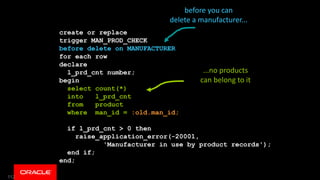
create or replace
trigger MAN_PROD_CHECK
before delete on MANUFACTURER
for each row
declare
l_prd_cnt number;
begin
select count(*)
into l_prd_cnt
from product
where man_id = :old.man_id;
if l_prd_cnt > 0 then
raise_application_error(-20001,
'Manufacturer in use by product records');
end if;
end;
before you can
delete a manufacturer...
...no products
can belong to it
113
testing “works”
114
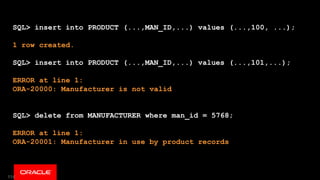
SQL> insert into PRODUCT (...,MAN_ID,...) values (...,100, ...);
1 row created.
SQL> insert into PRODUCT (...,MAN_ID,...) values (...,101,...);
ERROR at line 1:
ORA-20000: Manufacturer is not valid
SQL> delete from MANUFACTURER where man_id = 5768;
ERROR at line 1:
ORA-20001: Manufacturer in use by product records
115
one month later…
116
An unexpected error has
occurred. Manufacturer
record not found – orphan
product records!
117
SQL> select count(*)
2 from
3 ( select man_id from PRODUCT
4 minus
5 select man_id from MANUFACTURER )
6 /
COUNT(*)
----------
86
118
DIY integrity = no integrity
119
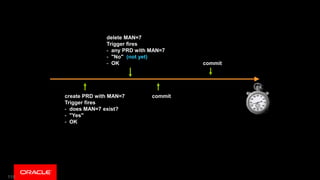
create PRD with MAN=7
Trigger fires
- does MAN=7 exist?
- "Yes"
- OK
delete MAN=7
Trigger fires
- any PRD with MAN=7
- "No" (not yet)
- OK
commit
commit
120
referential integrity seems simple…
“look up X before allowing Y”
121
referential integrity is complex
read consistency,
blocking / locking
122
I know what you're thinking ...
123
“we would never do anything that stupid”
124
it sneaks in everywhere
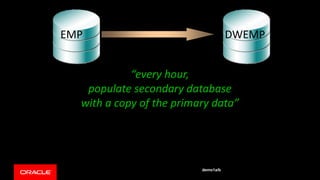
replicating data
“every hour,
populate secondary database
with a copy of the primary data”
EMP DWEMP
demo1a/b
127
“what percentage data integrity do we have?”
- project manager
128
concurrency testing vital
awesome for us as devs :-)
“All that integrity stuff is
a DBA issue, I just wanna
make sure my code runs fast”
demo3
130
solutions are ...
131
132
it's not just adding constraints
133
fix existing data
134
“pseudo” relationships
135
sequencing issues
consider deferred constraints
136
beware stealth integrity rules
137
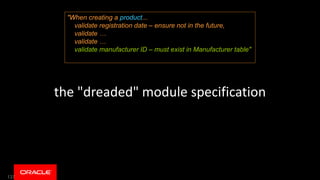
the "dreaded" module specification
"When creating a product...
validate registration date – ensure not in the future,
validate …
validate …
validate manufacturer ID – must exist in Manufacturer table"
Oracle consistency model is …
very very cool… and
very very complex !
140
hand coding inter-table checking is
hard to do right
hand coding intra-table checking is
hard to do right
142
let the database do it
143
while we're talking R.I …
144
common mistake #3
145
poor performance by ignorance
… it's not just for R.I
146
147
148
149
"talking" to your database
... makes it faster
150
example
151
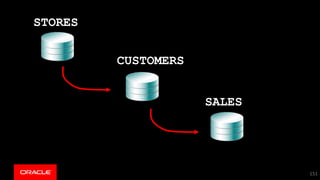
STORES
CUSTOMERS
SALES
select prod_id, max(amount)
from stores st,
customers c,
sales s
where s.cust_id = c.cust_id(+)
and c.store_id = st.store_id
and s.amount > 10
group by prod_id
152
hash outer join ? nested loop ?
STORES first ?
sort merge ?
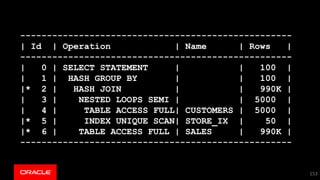
---------------------------------------------------
| Id | Operation | Name | Rows |
---------------------------------------------------
| 0 | SELECT STATEMENT | | 100 |
| 1 | HASH GROUP BY | | 100 |
|* 2 | HASH JOIN | | 990K |
| 3 | NESTED LOOPS SEMI | | 5000 |
| 4 | TABLE ACCESS FULL| CUSTOMERS | 5000 |
|* 5 | INDEX UNIQUE SCAN| STORE_IX | 50 |
|* 6 | TABLE ACCESS FULL | SALES | 990K |
---------------------------------------------------
153
154
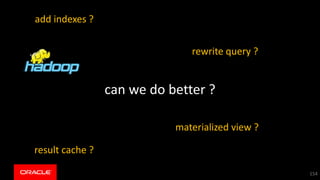
can we do better ?
add indexes ?
rewrite query ?
result cache ?
materialized view ?
155
share your knowledge with the db
oc04.sql
common mistake #4
156
they aren't rows
a quick primer on (Oracle) memory
memory access = controlled access
160
crappy metaphor
161
crappy metaphorcrap-py
164
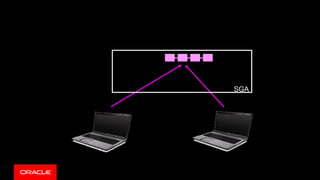
same with memory
SGA
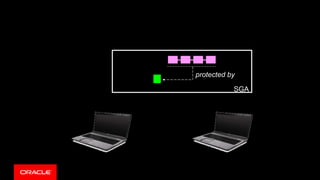
SGA
protected by
SGA
protected by
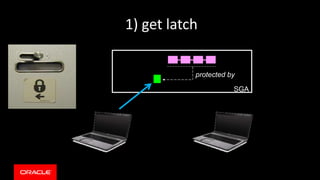
1) get latch
SGA
protected by
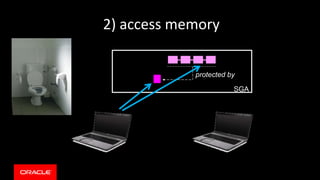
2) access memory
SGA
protected by
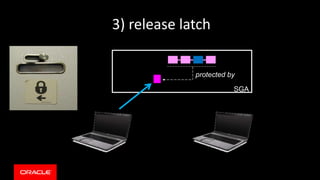
3) release latch
latch contention
SGA
protected by
someone must wait ...
active wait
spinning
can I have the latch ?
173
latch contention....
hurts CPU...
176
hurts concurrency
you ... get ... nothing ... done
nowadays...
yield
mutex
posting
Good reading: http://andreynikolaev.wordpress.com/
CAS
“But isn't that all internals
that are out of my control?”
querying data
fetching data
efficiently
rows are stored in blocks
to read data, you read blocks...
from disk
186
to memory
to you
SQL> select *
2 from EMP
3 where ...
/d01/ts/my_data1.dat
Buffer Cache
why ?
disks are s l o w
memory is fast
but memory access is complex
190
multi-process
cache coherency
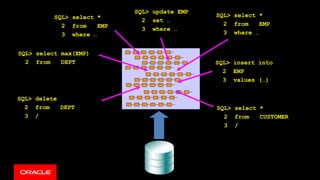
SQL> select *
2 from EMP
3 where …
SQL> update EMP
2 set …
3 where …
SQL> select *
2 from EMP
3 where …
SQL> insert into
2 EMP
3 values (…)
SQL> select *
2 from CUSTOMER
3 /
SQL> select max(EMP)
2 from DEPT
SQL> delete
2 from DEPT
3 /
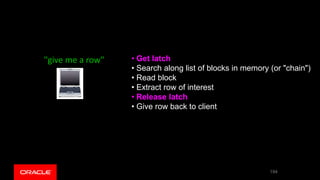
we have to latch !
• Get latch
• Search along list of blocks in memory (or "chain")
• Read block
• Extract row of interest
• Release latch
• Give row back to client
"give me a row"
194
lots of rows
lots of latching
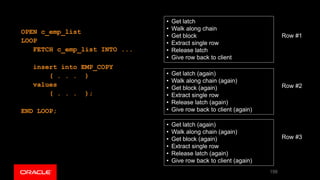
typical program
OPEN c_emp_list
LOOP
FETCH c_emp_list INTO ...
insert into EMP_COPY
( . . . )
values
( . . . );
END LOOP;
• Get latch
• Walk along chain
• Get block
• Extract single row
• Release latch
• Give row back to client
• Get latch (again)
• Walk along chain (again)
• Get block (again)
• Extract single row
• Release latch (again)
• Give row back to client (again)
Row #1
Row #2
• Get latch (again)
• Walk along chain (again)
• Get block (again)
• Extract single row
• Release latch (again)
• Give row back to client (again)
Row #3
198
a better strategy.... “pinning”
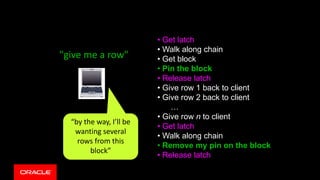
"give me a row"
• Get latch
• Walk along chain
• Get block
• Pin the block
• Release latch
• Give row 1 back to client
• Give row 2 back to client
…
• Give row n to client
• Get latch
• Walk along chain
• Remove my pin on the block
• Release latch
“by the way, I’ll be
wanting several
rows from this
block”
how to convey
“I may want many rows”
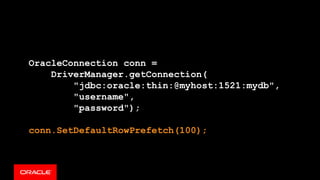
your client program
OracleConnection conn =
DriverManager.getConnection(
"jdbc:oracle:thin:@myhost:1521:mydb",
"username",
"password");
conn.SetDefaultRowPrefetch(100);
OracleCommand cmd = con.CreateCommand();
cmd.CommandText = "select * from employees";
OracleDataReader reader = cmd.ExecuteReader();
reader.FetchSize = cmd.RowSize * 100;
while (reader.Read())
;
reader.Dispose();
“relational”
not
“row-lational”
205
compare the performance
206
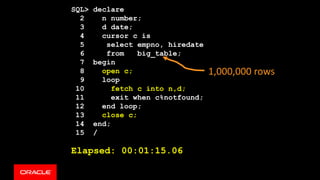
SQL> declare
2 n number;
3 d date;
4 cursor c is
5 select empno, hiredate
6 from big_table;
7 begin
8 open c;
9 loop
10 fetch c into n,d;
11 exit when c%notfound;
12 end loop;
13 close c;
14 end;
15 /
Elapsed: 00:01:15.06
1,000,000 rows
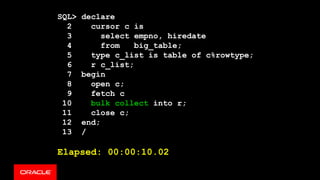
SQL> declare
2 cursor c is
3 select empno, hiredate
4 from big_table;
5 type c_list is table of c%rowtype;
6 r c_list;
7 begin
8 open c;
9 fetch c
10 bulk collect into r;
11 close c;
12 end;
13 /
Elapsed: 00:00:10.02
all that data goes somewhere
209
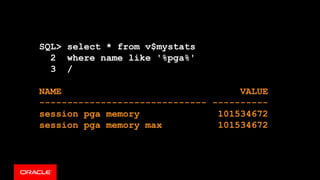
SQL> select * from v$mystats
2 where name like '%pga%'
3 /
NAME VALUE
------------------------------ ----------
session pga memory 101534672
session pga memory max 101534672
100m of memory !
get it in chunks
pin rows on a block (8k)
213
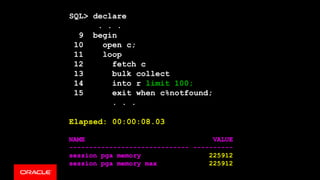
SQL> declare
. . .
9 begin
10 open c;
11 loop
12 fetch c
13 bulk collect
14 into r limit 100;
15 exit when c%notfound;
. . .
Elapsed: 00:00:08.03
NAME VALUE
------------------------------ ----------
session pga memory 225912
session pga memory max 225912
it works both ways
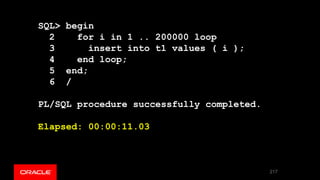
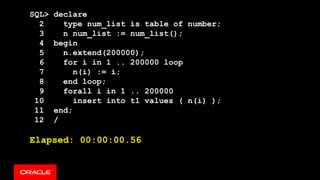
compare the performance
SQL> begin
2 for i in 1 .. 200000 loop
3 insert into t1 values ( i );
4 end loop;
5 end;
6 /
PL/SQL procedure successfully completed.
Elapsed: 00:00:11.03
217
SQL> declare
2 type num_list is table of number;
3 n num_list := num_list();
4 begin
5 n.extend(200000);
6 for i in 1 .. 200000 loop
7 n(i) := i;
8 end loop;
9 forall i in 1 .. 200000
10 insert into t1 values ( n(i) );
11 end;
12 /
Elapsed: 00:00:00.56
fetch data in sets not rows
220
wrap up
221
disasters are …
222
… rarely deliberate
223
"measure twice, cut once"
224
test, test, test, test
be brutal !
225
experts in hindsight
226
share the pain
at least internally
227
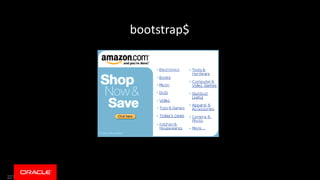
bootstrap$
I love your feedback!
Rate your trip with Connor
Follow and subscribe
youtube bit.ly/youtube-connor
blog bit.ly/blog-connor
twitter bit.ly/twitter-connor
400+ posts mainly on database & development
250 technical videos, new uploads every week
rants and raves on tech and the world :-)

OpenWorld 2018 - Common Application Developer Disasters