Poetry
Read the title and opening four lines of To Autumn
by John Keats. What themes , ideas or attitudes
are emerging?
To Autumn
by John Keats
Seasons of mist and mellow fruitfulness,
Close bosom-friend of the maturing sun:
Conspiring with him how to load and bless
With fruit the vines that round the thatch-eaves
run;
The title tells the reader that this poem is centered on
the season of Autumn. The opening stanza focuses on
and establishes aspects of nature during this season,
with references to mists, the sun, vines and the eaves
of a thatched cottage. This gives the impression that
the speaker very much admires this beautiful, rural,
autumnal scene.
Feedback
This response demonstrates the reader's understanding
of the poem being about nature and autumn and that
they form the central themes for the poem. It also
shows an understanding of the speaker’s attitude,
which is admiration of the season.
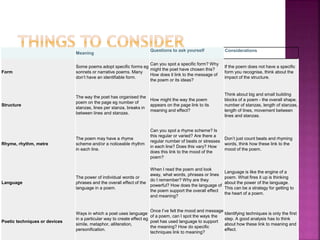
Meaning
Questions to ask yourself Considerations
Form
Some poems adopt specific forms eg
sonnets or narrative poems. Many
don’t have an identifiable form.
Can you spot a specific form? Why
might the poet have chosen this?
How does it link to the message of
the poem or its ideas?
If the poem does not have a specific
form you recognise, think about the
impact of the structure.
Structure
The way the poet has organised the
poem on the page eg number of
stanzas, lines per stanza, breaks in
between lines and stanzas.
How might the way the poem
appears on the page link to its
meaning and effect?
Think about big and small building
blocks of a poem - the overall shape,
number of stanzas, length of stanzas,
length of lines, movement between
lines and stanzas.
Rhyme, rhythm, metre
The poem may have a rhyme
scheme and/or a noticeable rhythm
in each line.
Can you spot a rhyme scheme? Is
this regular or varied? Are there a
regular number of beats or stresses
in each line? Does this vary? How
does this link to the mood of the
poem?
Don’t just count beats and rhyming
words, think how these link to the
mood of the poem.
Language
The power of individual words or
phrases and the overall effect of the
language in a poem.
When I read the poem and look
away, what words, phrases or lines
do I remember? Why are they
powerful? How does the language of
the poem support the overall effect
and meaning?
Language is like the engine of a
poem. What fires it up is thinking
about the power of the language.
This can be a strategy for getting to
the heart of a poem.
Poetic techniques or devices
Ways in which a poet uses language
in a particular way to create effect eg
simile, metaphor, alliteration,
personification.
Once I’ve felt the mood and message
of a poem, can I spot the ways the
poet has used language to support
the meaning? How do specific
techniques link to meaning?
Identifying techniques is only the first
step. A good analysis has to think
about how these link to meaning and
effect.
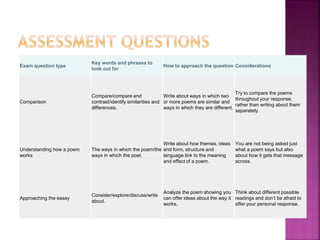
Exam question type
Key words and phrases to
look out for
How to approach the question Considerations
Comparison
Compare/compare and
contrast/identify similarities and
differences.
Write about ways in which two
or more poems are similar and
ways in which they are different.
Try to compare the poems
throughout your response,
rather than writing about them
separately.
Understanding how a poem
works
The ways in which the poem/the
ways in which the poet.
Write about how themes, ideas
and form, structure and
language link to the meaning
and effect of a poem.
You are not being asked just
what a poem says but also
about how it gets that message
across.
Approaching the essay
Consider/explore/discuss/write
about.
Analyze the poem showing you
can offer ideas about the way it
works.
Think about different possible
readings and don’t be afraid to
offer your personal response.
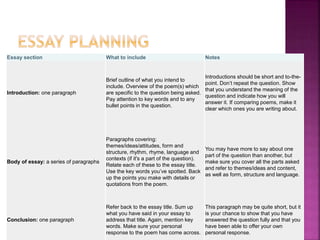
Essay section What to include Notes
Introduction: one paragraph
Brief outline of what you intend to
include. Overview of the poem(s) which
are specific to the question being asked.
Pay attention to key words and to any
bullet points in the question.
Introductions should be short and to-the-
point. Don’t repeat the question. Show
that you understand the meaning of the
question and indicate how you will
answer it. If comparing poems, make it
clear which ones you are writing about.
Body of essay: a series of paragraphs
Paragraphs covering:
themes/ideas/attitudes, form and
structure, rhythm, rhyme, language and
contexts (if it's a part of the question).
Relate each of these to the essay title.
Use the key words you’ve spotted. Back
up the points you make with details or
quotations from the poem.
You may have more to say about one
part of the question than another, but
make sure you cover all the parts asked
and refer to themes/ideas and content,
as well as form, structure and language.
Conclusion: one paragraph
Refer back to the essay title. Sum up
what you have said in your essay to
address that title. Again, mention key
words. Make sure your personal
response to the poem has come across.
This paragraph may be quite short, but it
is your chance to show that you have
answered the question fully and that you
have been able to offer your own
personal response.
Responding to literature-poetry

Responding to literature-poetry

  • 1.
  • 4.
    Read the titleand opening four lines of To Autumn by John Keats. What themes , ideas or attitudes are emerging? To Autumn by John Keats Seasons of mist and mellow fruitfulness, Close bosom-friend of the maturing sun: Conspiring with him how to load and bless With fruit the vines that round the thatch-eaves run;
  • 5.
    The title tellsthe reader that this poem is centered on the season of Autumn. The opening stanza focuses on and establishes aspects of nature during this season, with references to mists, the sun, vines and the eaves of a thatched cottage. This gives the impression that the speaker very much admires this beautiful, rural, autumnal scene. Feedback This response demonstrates the reader's understanding of the poem being about nature and autumn and that they form the central themes for the poem. It also shows an understanding of the speaker’s attitude, which is admiration of the season.
  • 6.
    Meaning Questions to askyourself Considerations Form Some poems adopt specific forms eg sonnets or narrative poems. Many don’t have an identifiable form. Can you spot a specific form? Why might the poet have chosen this? How does it link to the message of the poem or its ideas? If the poem does not have a specific form you recognise, think about the impact of the structure. Structure The way the poet has organised the poem on the page eg number of stanzas, lines per stanza, breaks in between lines and stanzas. How might the way the poem appears on the page link to its meaning and effect? Think about big and small building blocks of a poem - the overall shape, number of stanzas, length of stanzas, length of lines, movement between lines and stanzas. Rhyme, rhythm, metre The poem may have a rhyme scheme and/or a noticeable rhythm in each line. Can you spot a rhyme scheme? Is this regular or varied? Are there a regular number of beats or stresses in each line? Does this vary? How does this link to the mood of the poem? Don’t just count beats and rhyming words, think how these link to the mood of the poem. Language The power of individual words or phrases and the overall effect of the language in a poem. When I read the poem and look away, what words, phrases or lines do I remember? Why are they powerful? How does the language of the poem support the overall effect and meaning? Language is like the engine of a poem. What fires it up is thinking about the power of the language. This can be a strategy for getting to the heart of a poem. Poetic techniques or devices Ways in which a poet uses language in a particular way to create effect eg simile, metaphor, alliteration, personification. Once I’ve felt the mood and message of a poem, can I spot the ways the poet has used language to support the meaning? How do specific techniques link to meaning? Identifying techniques is only the first step. A good analysis has to think about how these link to meaning and effect.
  • 7.
    Exam question type Keywords and phrases to look out for How to approach the question Considerations Comparison Compare/compare and contrast/identify similarities and differences. Write about ways in which two or more poems are similar and ways in which they are different. Try to compare the poems throughout your response, rather than writing about them separately. Understanding how a poem works The ways in which the poem/the ways in which the poet. Write about how themes, ideas and form, structure and language link to the meaning and effect of a poem. You are not being asked just what a poem says but also about how it gets that message across. Approaching the essay Consider/explore/discuss/write about. Analyze the poem showing you can offer ideas about the way it works. Think about different possible readings and don’t be afraid to offer your personal response.
  • 8.
    Essay section Whatto include Notes Introduction: one paragraph Brief outline of what you intend to include. Overview of the poem(s) which are specific to the question being asked. Pay attention to key words and to any bullet points in the question. Introductions should be short and to-the- point. Don’t repeat the question. Show that you understand the meaning of the question and indicate how you will answer it. If comparing poems, make it clear which ones you are writing about. Body of essay: a series of paragraphs Paragraphs covering: themes/ideas/attitudes, form and structure, rhythm, rhyme, language and contexts (if it's a part of the question). Relate each of these to the essay title. Use the key words you’ve spotted. Back up the points you make with details or quotations from the poem. You may have more to say about one part of the question than another, but make sure you cover all the parts asked and refer to themes/ideas and content, as well as form, structure and language. Conclusion: one paragraph Refer back to the essay title. Sum up what you have said in your essay to address that title. Again, mention key words. Make sure your personal response to the poem has come across. This paragraph may be quite short, but it is your chance to show that you have answered the question fully and that you have been able to offer your own personal response.