AP® French Language and Culture  AP® German Language and Culture
Rationale: AP courses are regularly updated to stay abreast of developments within each academic discipline. AP regularly conducts College Curriculum Studies to ensure ongoing alignment with parallel college courses. Differences among the tasks and performance expectations across the current suite of AP world language exams are significant, which may lead to misunderstanding on the part of AP teachers as well as colleges with regard to AP standards. (cont’d) AP World Languages Course and Exam Review
Rationale  (cont’d) Currently, colleges and universities generally do not compensate students with credit or placement equivalent to the proficiency that students obtain as a result of their AP world language experience.  AP World Languages Course and Exam Review
AP World Languages Course and Exam Review Charge to Commissioners:  The AP Course and Exam Review is part of an ongoing and multi-year process of reform and revision of AP courses, exams, and professional development at the College Board to ensure that the AP world language courses:  Embody a coherent conceptual organization;  Effectively develop language proficiency across the three modes of communication (Interpersonal, Interpretive and Presentational);  Effectively integrate cultural competence, connections to other school disciplines, comparisons between the target language and culture and those of the learner, and foster the use of the language within the broader communities beyond the traditional school environment;  (cont’d)
Charge to Commissioners  (cont’d) Draw upon current scholarship in learning theory;  Align with the best practices of college and university teaching;  Maintain the continued validity of AP to colleges and universities; Advance the availability and access to AP world language courses for a diverse range of prepared students ; and Prepare students for success in subsequent college-level courses. AP World Languages Course and Exam Review
AP World Languages Course and Exam Review   Process Standards for Foreign Language Learning in the 21 st  Century  (the “5 C’s”) and the  ACTFL Performance Guidelines for K-12 Learners  served as the foundation for building a course framework. In late 2006, 48 commissioners representing college and university faculty, high school teachers, world language curriculum specialists and leaders of professional organizations were  appointed by the College Board. Courses reviewed: AP Chinese Language and Culture, AP French Language, AP German Language, AP Italian Language and Culture, AP Japanese Language and Culture, AP Spanish Language. (cont’d)
AP World Languages Course and Exam Review   Process  (cont’d) In spring 2007, a College Curriculum Study was conducted to examine recommended practices in parallel courses at the post-secondary level. During the 2007-08 academic year, Commissioners working across languages developed the new  AP World Language Curriculum Framework: Learning Objectives, Thematic Approach, and Achievement Level Descriptions . Draft  Curriculum Framework for World Languages and Cultures  underwent extensive professional review. (cont’d)
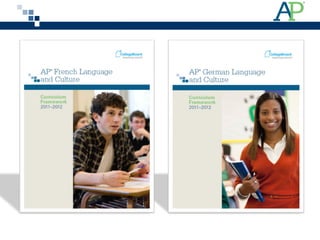
AP World Languages Course and Exam Review  Process  (cont’d) 2009 publication of Curriculum Framework for  AP French Language and Culture  and  AP German Language and Culture Changes for  AP French Language and Culture  and  AP German Language and Culture  will take effect in the 2011-12 academic year. Revisions to  AP Chinese Language and Culture ,  AP Japanese Language and Culture , and  AP Spanish Language and Culture  are planned for future years and will be announced at least two years before being implemented.
www. collegeboard . com/ap/coursechanges
 
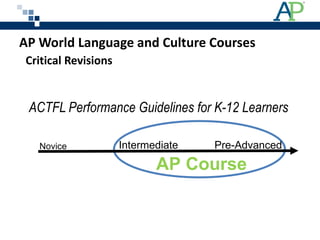
AP World Language and Culture Courses  Critical Revisions The focus of the course is the development of students’ proficiencies in  Interpersonal, Interpretive and Presentational  communication.   Student performance in the course is within a range of proficiency (Intermediate to Pre-Advanced) as described in the  ACTFL Performance Guidelines for K-12 Learners  instead of an assumed college course equivalency (third-year college course). The course has a thematic approach. The course includes a focus on culture as described in the  Standards : cultural products, practices, and perspectives.
AP World Language and Culture Courses    Critical Revisions    ACTFL Performance Guidelines for K-12 Learners AP Course Intermediate Pre-Advanced Novice
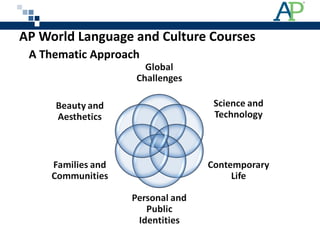
AP World Language and Culture Courses   A Thematic Approach
AP World Language and Culture Courses Overarching Premise  When  communicating , AP World Language students demonstrate an understanding of the  culture(s) , incorporate interdisciplinary topics ( Connections ), make comparisons between the native language and the target language and between cultures ( Comparisons ), and use the target language in real-life settings ( Communities ).
AP World Language and Culture  Communication Modes Interpersonal Communication active negotiation of meaning among individuals through conversation (face-to-face or telephonic); however, it can also be realized through reading and writing (e.g., exchange of personal letters, notes, summaries or e-mails) Interpretive Communication no active negotiation of meaning with another individual, although there is an active negotiation of meaning construction; includes the cultural interpretation of text, movies, radio, television and speeches Presentational Communication creation of spoken or written communication prepared for an audience and rehearsed, revised or edited before presentation; one-way communication that requires interpretation by others without negotiation of meaning
AP World Language and Culture Courses  Achievement Level Descriptions Represent a student’s progression along the second language learning trajectory Provide explicit descriptions of student performance at 5, 4, 3 and 2  Will allow for more detailed and meaningful reporting of student performance
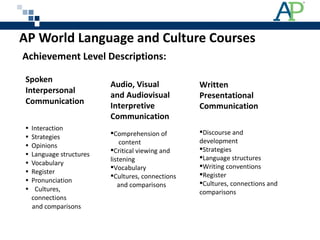
AP World Language and Culture Courses    Achievement Level Descriptions: Spoken  Interpersonal  Communication Interaction Strategies Opinions Language structures Vocabulary Register Pronunciation Cultures, connections  and comparisons Written Presentational Communication Discourse and development Strategies Language structures Writing conventions Register Cultures, connections and comparisons Audio, Visual  and Audiovisual Interpretive Communication Comprehension of  content Critical viewing and listening Vocabulary Cultures, connections  and comparisons
AP World Languages Course and Exam Review
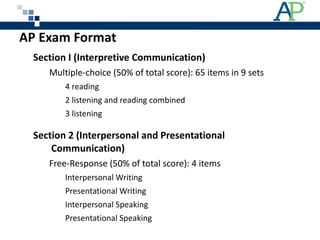
AP Exam Format Section I (Interpretive Communication) Multiple-choice (50% of total score): 65 items in 9 sets 4 reading 2 listening and reading combined 3 listening Section 2 (Interpersonal and Presentational Communication) Free-Response (50% of total score): 4 items Interpersonal Writing Presentational Writing Interpersonal Speaking Presentational Speaking
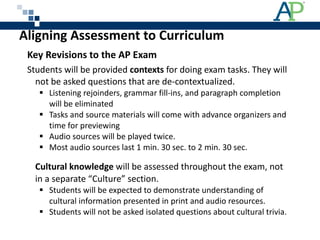
Aligning Assessment to Curriculum Key Revisions to the AP Exam  Students will be provided  contexts  for doing exam tasks. They will not be asked questions that are de-contextualized. Listening rejoinders, grammar fill-ins, and paragraph completion will be eliminated Tasks and source materials will come with advance organizers and time for previewing Audio sources will be played twice. Most audio sources last 1 min. 30 sec. to 2 min. 30 sec. Cultural knowledge  will be assessed throughout the exam, not in a separate “Culture” section. Students will be expected to demonstrate understanding of cultural information presented in print and audio resources. Students will not be asked isolated questions about cultural trivia.
Introduction   Thème du cours:  La famille et la communauté  Dans cette sélection il s’agit d’un conflit entre mère et fille. Le récit original intitulé « Pour empêcher un mariage » a été publié en 1955 au Canada par l’écrivaine canadienne Gabrielle Roy.   Au début du récit, la narratrice et sa mère roulent dans un train vers le Saskatchewan, pour aller empêcher le mariage de sa grande sœur. Sample Advance Organizer (French)    Print Source
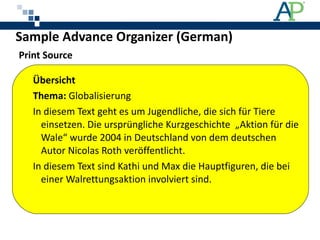
Übersicht Thema:  Globalisierung In diesem Text geht es um Jugendliche, die sich für Tiere einsetzen. Die ursprüngliche Kurzgeschichte  „Aktion für die Wale“ wurde 2004 in Deutschland von dem deutschen Autor  Nicolas Roth  veröffentlicht.   In diesem Text sind Kathi und Max die Hauptfiguren, die bei einer Walrettungsaktion involviert sind.  Sample Advance Organizer (German)    Print Source
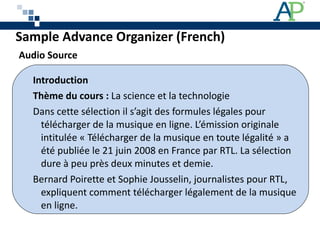
Introduction  Thème du cours :  La science et la technologie  Dans cette sélection il s’agit des formules légales pour télécharger de la musique en ligne. L’émission originale intitulée « Télécharger de la musique en toute légalité » a été publiée le 21 juin 2008 en France par RTL. La sélection dure à peu près deux minutes et demie.   Bernard Poirette et Sophie Jousselin, journalistes pour RTL, expliquent comment télécharger légalement de la musique en ligne. Sample Advance Organizer (French)    Audio Source
Übersicht Thema:  Schönheit und Ästhetik In diesem Hörtext geht es um  den Film „Friendship”.  Die ursprüngliche  Rezension  wurde am 14. Januar 2010 in  Deutschland  von dem Radiosender WDR unter dem Titel  Scala Kinotipp im WDR-5 Radio zum Mitnehmen  veröffentlicht. Der Moderator unterhält sich mit Filmkritikerin Siegrid Fischer. Der Hörtext ist ca. einundhalb Minuten lang. Sample Advance Organizer (German)   Audio Source
Aligning Assessment to Curriculum Key Revisions to the AP Exam  Students will work with a greater  variety of authentic materials , both print and audio, reflecting the  linguistic and cultural diversity  of the French-speaking or German-speaking world. Literary and journalistic texts  but also  announcements, advertisements, letters, maps and tables, etc. Scripted dialogues  but also  radio interviews, podcasts, public service announcements, brief presentations, etc. Criteria for selection are  comprehensibility  (accent, pace, minimal background noise/overlap) and  relevance  to a course theme and to a topic that could interest students. Materials will be reasonably chosen, but will also reflect a range of cultural perspectives and linguistic features.
Aligning Assessment to Curriculum Key Revisions to the AP Exam Multiple Choice items Mix of factual and interpretive questions Vocabulary  in context Purpose of the text, point of view of speaker/writer Audience of the text Inferences and conclusions Questions of  “cultural” or “interdisciplinary” nature that ask students to show understanding of information contained in the text
Aligning Assessment to Curriculum Key Revisions to the AP Exam New types of Multiple Choice items For texts that are interpersonal in nature (letters, interviews, promotional pieces):  What would an appropriate reply to X be?   How does what X says/writes relate to what something Y has said/written?  (agreement, contradiction, support, elaboration) For texts that are presentational in nature (brief lectures/presentations, print narratives):  How does the speaker/author organize the text?  What would be an appropriate summary statement of the text? For combined sets:  How does information in the print text relate to information in the audio text?  (general/specific, point/counterpoint)
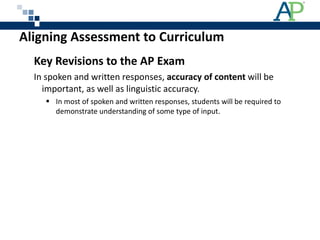
Aligning Assessment to Curriculum Key Revisions to the AP Exam  In spoken and written responses,  accuracy of content  will be important, as well as linguistic accuracy. In most of spoken and written responses, students will be required to demonstrate understanding of some type of input.
Free Response Item 1 E-mail Reply (Interpersonal Writing) Directions (in English and [French/German], printed side-by-side): You will write a reply to an e-mail message. You have 15 minutes to read the message and write your reply.  Your reply should include a greeting and a closing as well as respond to all the questions and requests in the message. In your reply, you should also ask for more details about something mentioned in the message.  Stimulus:  A formal e-mail message (i.e. from a business, organization, university) presented as an e-mail message window; contains a greeting and a closing; contains a request for clarification, elaboration, or explanation by the student; contains two questions that cannot be answered yes/no.
Free Response Item 2 Persuasive Essay (Presentational Writing) Directions (in English and [French/German], printed side-by-side): You will write a persuasive essay to submit to a [French/German]-language writing contest. The essay topic is based on three accompanying sources, which present different viewpoints on the topic and include both print and audio material. First, you will have 6 minutes to read the essay topic and the printed material. Afterward, you will hear the audio material twice; you should take notes while you listen. Then you will have 40 minutes to prepare and write your essay. In your persuasive essay, present the sources’ different viewpoints on the topic and also clearly indicate your own viewpoint and thoroughly defend it. Use information from all of the sources to support your essay. As you refer to the sources, identify them appropriately. Also, organize your essay into clear paragraphs.
Free Response Item 2 (cont’d) Persuasive Essay (Presentational Writing) Stimuli:  (1) A print source (journalistic article or literary text) that presents a clear opinion on the topic; opinion is different from that of the audio source (authentic source, may be excerpted). (2) A map with text, a chart or a table that presents information on the topic – this source doesn’t have to present an opinion (authentic source)  (3) An audio source (interview, report, or announcement) that presents a clear opinion on the topic that is different from the opinion in the print source (authentic source, may be excerpted).
Free Response Item 3 Conversation (Interpersonal Speaking) Directions (in English followed by [French/German]): You will participate in a conversation. First, you will have 1 minute to read a preview of the conversation, including an outline of each turn in the conversation. Afterward, the conversation will begin, following the outline. Each time it is your turn to speak, you will have 20 seconds to record your response. You should participate in the conversation as fully and appropriately as possible. Stimulus:  Outline of a conversation in French that contains a description of each of five utterances from the interlocutor (the recording) and each of five utterances from the student; descriptions in the outline focus on communicative functions (e.g. tell your friend what happened, make a suggestion, offer a solution, excuse yourself and say goodbye).
Free Response Item 4  Cultural Comparison (Presentational Speaking) Directions (in English followed by [French/German]): You will make an oral presentation to your class on a specific topic. You will have 3 minutes to read the topic and prepare your presentation. Then you will have 2 minutes to record your presentation. In your presentation, compare your own community to an area of the French-speaking world with which you are familiar. You should demonstrate your understanding of cultural features of the French-speaking world. You should also organize your presentation clearly. Stimulus:  There is  no stimulus , only a prompt. The goals of this task are for the students to speak first about themselves and their communities (using description or explanation) and then speak of an area of the [French/German]-speaking world about which they’ve learned something or have some personal experience (using comparison). Students are encouraged to cite examples from materials they’ve read, viewed, and listened to, personal experiences and observations.
Thank You

Ap 2012 french redesign

  • 1.
    AP® French Languageand Culture AP® German Language and Culture
  • 2.
    Rationale: AP coursesare regularly updated to stay abreast of developments within each academic discipline. AP regularly conducts College Curriculum Studies to ensure ongoing alignment with parallel college courses. Differences among the tasks and performance expectations across the current suite of AP world language exams are significant, which may lead to misunderstanding on the part of AP teachers as well as colleges with regard to AP standards. (cont’d) AP World Languages Course and Exam Review
  • 3.
    Rationale (cont’d)Currently, colleges and universities generally do not compensate students with credit or placement equivalent to the proficiency that students obtain as a result of their AP world language experience. AP World Languages Course and Exam Review
  • 4.
    AP World LanguagesCourse and Exam Review Charge to Commissioners: The AP Course and Exam Review is part of an ongoing and multi-year process of reform and revision of AP courses, exams, and professional development at the College Board to ensure that the AP world language courses: Embody a coherent conceptual organization; Effectively develop language proficiency across the three modes of communication (Interpersonal, Interpretive and Presentational); Effectively integrate cultural competence, connections to other school disciplines, comparisons between the target language and culture and those of the learner, and foster the use of the language within the broader communities beyond the traditional school environment; (cont’d)
  • 5.
    Charge to Commissioners (cont’d) Draw upon current scholarship in learning theory; Align with the best practices of college and university teaching; Maintain the continued validity of AP to colleges and universities; Advance the availability and access to AP world language courses for a diverse range of prepared students ; and Prepare students for success in subsequent college-level courses. AP World Languages Course and Exam Review
  • 6.
    AP World LanguagesCourse and Exam Review Process Standards for Foreign Language Learning in the 21 st Century (the “5 C’s”) and the ACTFL Performance Guidelines for K-12 Learners served as the foundation for building a course framework. In late 2006, 48 commissioners representing college and university faculty, high school teachers, world language curriculum specialists and leaders of professional organizations were appointed by the College Board. Courses reviewed: AP Chinese Language and Culture, AP French Language, AP German Language, AP Italian Language and Culture, AP Japanese Language and Culture, AP Spanish Language. (cont’d)
  • 7.
    AP World LanguagesCourse and Exam Review Process (cont’d) In spring 2007, a College Curriculum Study was conducted to examine recommended practices in parallel courses at the post-secondary level. During the 2007-08 academic year, Commissioners working across languages developed the new AP World Language Curriculum Framework: Learning Objectives, Thematic Approach, and Achievement Level Descriptions . Draft Curriculum Framework for World Languages and Cultures underwent extensive professional review. (cont’d)
  • 8.
    AP World LanguagesCourse and Exam Review Process (cont’d) 2009 publication of Curriculum Framework for AP French Language and Culture and AP German Language and Culture Changes for AP French Language and Culture and AP German Language and Culture will take effect in the 2011-12 academic year. Revisions to AP Chinese Language and Culture , AP Japanese Language and Culture , and AP Spanish Language and Culture are planned for future years and will be announced at least two years before being implemented.
  • 9.
    www. collegeboard .com/ap/coursechanges
  • 10.
  • 11.
    AP World Languageand Culture Courses Critical Revisions The focus of the course is the development of students’ proficiencies in Interpersonal, Interpretive and Presentational communication. Student performance in the course is within a range of proficiency (Intermediate to Pre-Advanced) as described in the ACTFL Performance Guidelines for K-12 Learners instead of an assumed college course equivalency (third-year college course). The course has a thematic approach. The course includes a focus on culture as described in the Standards : cultural products, practices, and perspectives.
  • 12.
    AP World Languageand Culture Courses Critical Revisions ACTFL Performance Guidelines for K-12 Learners AP Course Intermediate Pre-Advanced Novice
  • 13.
    AP World Languageand Culture Courses A Thematic Approach
  • 14.
    AP World Languageand Culture Courses Overarching Premise When communicating , AP World Language students demonstrate an understanding of the culture(s) , incorporate interdisciplinary topics ( Connections ), make comparisons between the native language and the target language and between cultures ( Comparisons ), and use the target language in real-life settings ( Communities ).
  • 15.
    AP World Languageand Culture Communication Modes Interpersonal Communication active negotiation of meaning among individuals through conversation (face-to-face or telephonic); however, it can also be realized through reading and writing (e.g., exchange of personal letters, notes, summaries or e-mails) Interpretive Communication no active negotiation of meaning with another individual, although there is an active negotiation of meaning construction; includes the cultural interpretation of text, movies, radio, television and speeches Presentational Communication creation of spoken or written communication prepared for an audience and rehearsed, revised or edited before presentation; one-way communication that requires interpretation by others without negotiation of meaning
  • 16.
    AP World Languageand Culture Courses Achievement Level Descriptions Represent a student’s progression along the second language learning trajectory Provide explicit descriptions of student performance at 5, 4, 3 and 2 Will allow for more detailed and meaningful reporting of student performance
  • 17.
    AP World Languageand Culture Courses Achievement Level Descriptions: Spoken Interpersonal Communication Interaction Strategies Opinions Language structures Vocabulary Register Pronunciation Cultures, connections and comparisons Written Presentational Communication Discourse and development Strategies Language structures Writing conventions Register Cultures, connections and comparisons Audio, Visual and Audiovisual Interpretive Communication Comprehension of content Critical viewing and listening Vocabulary Cultures, connections and comparisons
  • 18.
    AP World LanguagesCourse and Exam Review
  • 19.
    AP Exam FormatSection I (Interpretive Communication) Multiple-choice (50% of total score): 65 items in 9 sets 4 reading 2 listening and reading combined 3 listening Section 2 (Interpersonal and Presentational Communication) Free-Response (50% of total score): 4 items Interpersonal Writing Presentational Writing Interpersonal Speaking Presentational Speaking
  • 20.
    Aligning Assessment toCurriculum Key Revisions to the AP Exam Students will be provided contexts for doing exam tasks. They will not be asked questions that are de-contextualized. Listening rejoinders, grammar fill-ins, and paragraph completion will be eliminated Tasks and source materials will come with advance organizers and time for previewing Audio sources will be played twice. Most audio sources last 1 min. 30 sec. to 2 min. 30 sec. Cultural knowledge will be assessed throughout the exam, not in a separate “Culture” section. Students will be expected to demonstrate understanding of cultural information presented in print and audio resources. Students will not be asked isolated questions about cultural trivia.
  • 21.
    Introduction   Thèmedu cours: La famille et la communauté  Dans cette sélection il s’agit d’un conflit entre mère et fille. Le récit original intitulé « Pour empêcher un mariage » a été publié en 1955 au Canada par l’écrivaine canadienne Gabrielle Roy.   Au début du récit, la narratrice et sa mère roulent dans un train vers le Saskatchewan, pour aller empêcher le mariage de sa grande sœur. Sample Advance Organizer (French) Print Source
  • 22.
    Übersicht Thema: Globalisierung In diesem Text geht es um Jugendliche, die sich für Tiere einsetzen. Die ursprüngliche Kurzgeschichte „Aktion für die Wale“ wurde 2004 in Deutschland von dem deutschen Autor Nicolas Roth veröffentlicht. In diesem Text sind Kathi und Max die Hauptfiguren, die bei einer Walrettungsaktion involviert sind. Sample Advance Organizer (German) Print Source
  • 23.
    Introduction  Thème ducours : La science et la technologie  Dans cette sélection il s’agit des formules légales pour télécharger de la musique en ligne. L’émission originale intitulée « Télécharger de la musique en toute légalité » a été publiée le 21 juin 2008 en France par RTL. La sélection dure à peu près deux minutes et demie.   Bernard Poirette et Sophie Jousselin, journalistes pour RTL, expliquent comment télécharger légalement de la musique en ligne. Sample Advance Organizer (French) Audio Source
  • 24.
    Übersicht Thema: Schönheit und Ästhetik In diesem Hörtext geht es um den Film „Friendship”. Die ursprüngliche Rezension wurde am 14. Januar 2010 in Deutschland von dem Radiosender WDR unter dem Titel Scala Kinotipp im WDR-5 Radio zum Mitnehmen veröffentlicht. Der Moderator unterhält sich mit Filmkritikerin Siegrid Fischer. Der Hörtext ist ca. einundhalb Minuten lang. Sample Advance Organizer (German) Audio Source
  • 25.
    Aligning Assessment toCurriculum Key Revisions to the AP Exam Students will work with a greater variety of authentic materials , both print and audio, reflecting the linguistic and cultural diversity of the French-speaking or German-speaking world. Literary and journalistic texts but also announcements, advertisements, letters, maps and tables, etc. Scripted dialogues but also radio interviews, podcasts, public service announcements, brief presentations, etc. Criteria for selection are comprehensibility (accent, pace, minimal background noise/overlap) and relevance to a course theme and to a topic that could interest students. Materials will be reasonably chosen, but will also reflect a range of cultural perspectives and linguistic features.
  • 26.
    Aligning Assessment toCurriculum Key Revisions to the AP Exam Multiple Choice items Mix of factual and interpretive questions Vocabulary in context Purpose of the text, point of view of speaker/writer Audience of the text Inferences and conclusions Questions of “cultural” or “interdisciplinary” nature that ask students to show understanding of information contained in the text
  • 27.
    Aligning Assessment toCurriculum Key Revisions to the AP Exam New types of Multiple Choice items For texts that are interpersonal in nature (letters, interviews, promotional pieces): What would an appropriate reply to X be? How does what X says/writes relate to what something Y has said/written? (agreement, contradiction, support, elaboration) For texts that are presentational in nature (brief lectures/presentations, print narratives): How does the speaker/author organize the text? What would be an appropriate summary statement of the text? For combined sets: How does information in the print text relate to information in the audio text? (general/specific, point/counterpoint)
  • 28.
    Aligning Assessment toCurriculum Key Revisions to the AP Exam In spoken and written responses, accuracy of content will be important, as well as linguistic accuracy. In most of spoken and written responses, students will be required to demonstrate understanding of some type of input.
  • 29.
    Free Response Item1 E-mail Reply (Interpersonal Writing) Directions (in English and [French/German], printed side-by-side): You will write a reply to an e-mail message. You have 15 minutes to read the message and write your reply. Your reply should include a greeting and a closing as well as respond to all the questions and requests in the message. In your reply, you should also ask for more details about something mentioned in the message. Stimulus: A formal e-mail message (i.e. from a business, organization, university) presented as an e-mail message window; contains a greeting and a closing; contains a request for clarification, elaboration, or explanation by the student; contains two questions that cannot be answered yes/no.
  • 30.
    Free Response Item2 Persuasive Essay (Presentational Writing) Directions (in English and [French/German], printed side-by-side): You will write a persuasive essay to submit to a [French/German]-language writing contest. The essay topic is based on three accompanying sources, which present different viewpoints on the topic and include both print and audio material. First, you will have 6 minutes to read the essay topic and the printed material. Afterward, you will hear the audio material twice; you should take notes while you listen. Then you will have 40 minutes to prepare and write your essay. In your persuasive essay, present the sources’ different viewpoints on the topic and also clearly indicate your own viewpoint and thoroughly defend it. Use information from all of the sources to support your essay. As you refer to the sources, identify them appropriately. Also, organize your essay into clear paragraphs.
  • 31.
    Free Response Item2 (cont’d) Persuasive Essay (Presentational Writing) Stimuli: (1) A print source (journalistic article or literary text) that presents a clear opinion on the topic; opinion is different from that of the audio source (authentic source, may be excerpted). (2) A map with text, a chart or a table that presents information on the topic – this source doesn’t have to present an opinion (authentic source) (3) An audio source (interview, report, or announcement) that presents a clear opinion on the topic that is different from the opinion in the print source (authentic source, may be excerpted).
  • 32.
    Free Response Item3 Conversation (Interpersonal Speaking) Directions (in English followed by [French/German]): You will participate in a conversation. First, you will have 1 minute to read a preview of the conversation, including an outline of each turn in the conversation. Afterward, the conversation will begin, following the outline. Each time it is your turn to speak, you will have 20 seconds to record your response. You should participate in the conversation as fully and appropriately as possible. Stimulus: Outline of a conversation in French that contains a description of each of five utterances from the interlocutor (the recording) and each of five utterances from the student; descriptions in the outline focus on communicative functions (e.g. tell your friend what happened, make a suggestion, offer a solution, excuse yourself and say goodbye).
  • 33.
    Free Response Item4 Cultural Comparison (Presentational Speaking) Directions (in English followed by [French/German]): You will make an oral presentation to your class on a specific topic. You will have 3 minutes to read the topic and prepare your presentation. Then you will have 2 minutes to record your presentation. In your presentation, compare your own community to an area of the French-speaking world with which you are familiar. You should demonstrate your understanding of cultural features of the French-speaking world. You should also organize your presentation clearly. Stimulus: There is no stimulus , only a prompt. The goals of this task are for the students to speak first about themselves and their communities (using description or explanation) and then speak of an area of the [French/German]-speaking world about which they’ve learned something or have some personal experience (using comparison). Students are encouraged to cite examples from materials they’ve read, viewed, and listened to, personal experiences and observations.
  • 34.