1
ENGL100
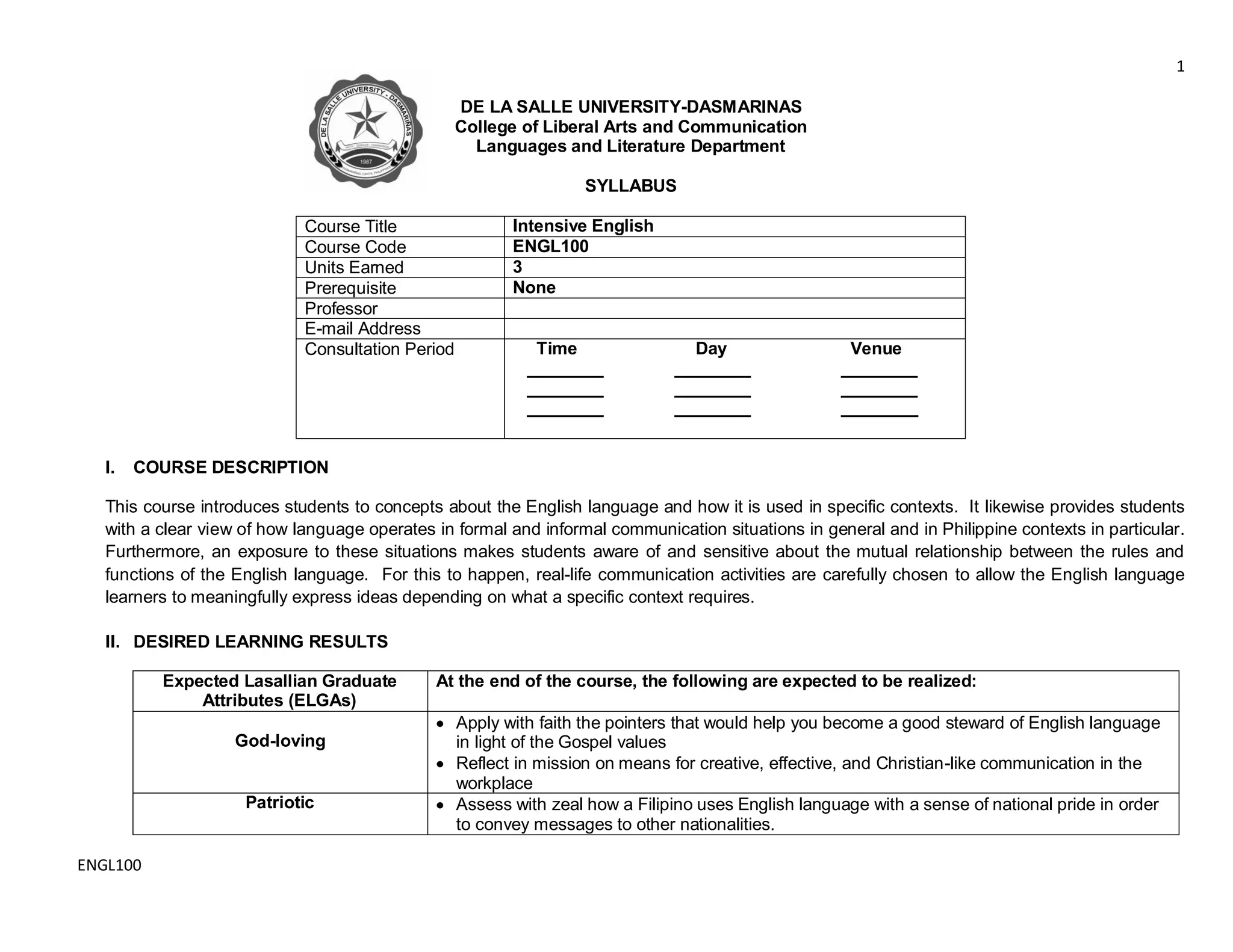
DE LA SALLE UNIVERSITY-DASMARINAS
College of Liberal Arts and Communication
Languages and Literature Department
SYLLABUS
Course Title Intensive English
Course Code ENGL100
Units Earned 3
Prerequisite None
Professor
E-mail Address
Consultation Period Time Day Venue
________ ________ ________
________ ________ ________
________ ________ ________
I. COURSE DESCRIPTION
This course introduces students to concepts about the English language and how it is used in specific contexts. It likewise provides students
with a clear view of how language operates in formal and informal communication situations in general and in Philippine contexts in particular.
Furthermore, an exposure to these situations makes students aware of and sensitive about the mutual relationship between the rules and
functions of the English language. For this to happen, real-life communication activities are carefully chosen to allow the English language
learners to meaningfully express ideas depending on what a specific context requires.
II. DESIRED LEARNING RESULTS
Expected Lasallian Graduate
Attributes (ELGAs)
At the end of the course, the following are expected to be realized:
God-loving
Apply with faith the pointers that would help you become a good steward of English language
in light of the Gospel values
Reflect in mission on means for creative, effective, and Christian-like communication in the
workplace
Patriotic Assess with zeal how a Filipino uses English language with a sense of national pride in order
to convey messages to other nationalities.
2
ENGL100
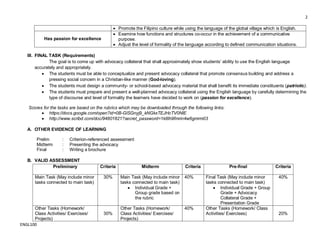
Promote the Filipino culture while using the language of the global village which is English.
Has passion for excellence
Examine how functions and structures co-occur in the achievement of a communicative
purpose.
Adjust the level of formality of the language according to defined communication situations.
III. FINAL TASK (Requirements)
The goal is to come up with advocacy collateral that shall approximately show students’ ability to use the English language
accurately and appropriately.
The students must be able to conceptualize and present advocacy collateral that promote consensus building and address a
pressing social concern in a Christian-like manner (God-loving).
The students must design a community- or school-based advocacy material that shall benefit its immediate constituents (patriotic).
The students must prepare and present a well-planned advocacy collateral using the English language by carefully determining the
type of discourse and level of formality the learners have decided to work on (passion for excellence).
Scores for the tasks are based on the rubrics which may be downloaded through the following links:
https://docs.google.com/open?id=0B-GlSGnyj9_kNGkxTEJHcTV0NlE
http://www.scribd.com/doc/94801821?secret_password=1k8lh9fmrin4w6gmrm03
A. OTHER EVIDENCE OF LEARNING
Prelim : Criterion-referenced assessment
Midterm : Presenting the advocacy
Final : Writing a brochure
B. VALID ASSESSMENT
Preliminary Criteria Midterm Criteria Pre-final Criteria
Main Task (May include minor
tasks connected to main task)
30% Main Task (May include minor
tasks connected to main task)
Individual Grade +
Group grade based on
the rubric
40% Final Task (May include minor
tasks connected to main task)
Individual Grade + Group
Grade + Advocacy
Collateral Grade +
Presentation Grade
40%
Other Tasks (Homework/
Class Activities/ Exercises/
Projects)
30%
Other Tasks (Homework/
Class Activities/ Exercises/
Projects)
40% Other Tasks (Homework/ Class
Activities/ Exercises) 20%
3
ENGL100
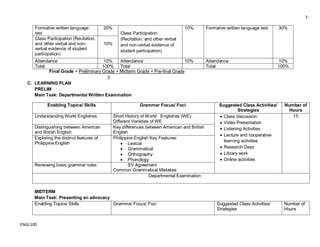
Formative written language
test
20%
Class Participation
(Recitation, and other verbal
and non-verbal evidence of
student participation)
10% Formative written language test 30%
Class Participation (Recitation,
and other verbal and non-
verbal evidence of student
participation)
10%
Attendance 10% Attendance 10% Attendance 10%
Total 100% Total Total 100%
Final Grade = Preliminary Grade + Midterm Grade + Pre-final Grade
3
C. LEARNING PLAN
PRELIM
Main Task: Departmental Written Examination
Enabling Topics/ Skills Grammar Focus/ Foci Suggested Class Activities/
Strategies
Number of
Hours
Understanding World Englishes Short History of World Englishes (WE)
Different Varieties of WE
Class discussion
Video Presentation
Listening Activities
Lecture and cooperative
learning activities
Research Days
Library work
Online activities
15
Distinguishing between American
and British English
Key differences between American and British
English
Exploring the distinct features of
Philippine English
Philippine English Key Features:
Lexical
Grammatical
Orthography
Phonology
Reviewing basic grammar rules SV Agreement
Common Grammatical Mistakes
Departmental Examination
MIDTERM
Main Task: Presenting an advocacy
Enabling Topics/ Skills Grammar Focus/ Foci Suggested Class Activities/
Strategies
Number of
Hours
4
ENGL100
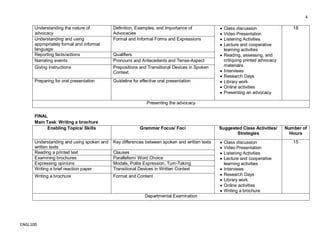
Understanding the nature of
advocacy
Definition, Examples, and Importance of
Advocacies
Class discussion
Video Presentation
Listening Activities
Lecture and cooperative
learning activities
Reading, assessing, and
critiquing printed advocacy
material/s
Interviews
Research Days
Library work
Online activities
Presenting an advocacy
18
Understanding and using
appropriately formal and informal
language
Formal and Informal Forms and Expressions
Reporting facts/actions Qualifiers
Narrating events Pronouns and Antecedents and Tense-Aspect
Giving instructions Prepositions and Transitional Devices in Spoken
Context
Preparing for oral presentation Guideline for effective oral presentation
Presenting the advocacy
FINAL
Main Task: Writing a brochure
Enabling Topics/ Skills Grammar Focus/ Foci Suggested Class Activities/
Strategies
Number of
Hours
Understanding and using spoken and
written texts
Key differences between spoken and written texts Class discussion
Video Presentation
Listening Activities
Lecture and cooperative
learning activities
Interviews
Research Days
Library work
Online activities
Writing a brochure
15
Reading a printed text Clauses
Examining brochures Parallelism/ Word Choice
Expressing opinions Modals, Polite Expression, Turn-Taking
Writing a brief reaction paper Transitional Devices in Written Context
Writing a brochure Format and Content
Departmental Examination
5
ENGL100
D. COURSE POLICIES
A. The use of mobile phones and other electronic gadgets is prohibited during class hours unless permission is sought and granted.
B. Academic honesty is expected at all times. Downloading and copying texts without proper acknowledgement of sources and claiming
such as one’s own is tantamount to cheating. Plagiarism shall automatically mean a grade of 0.00 for that specific output/ task.
C. All other policies (attendance, tardiness, decorum, grievance, etc) shall be subject to the provisions of the latest version of the Student
Handbook.
E. REFERENCES
Bautista, M.L.S. (2003). The New Englishes and the teaching of grammar. In J.E. James (Ed.), Grammar in the language classroom:
Changing approaches and practices (pp. 62-90). Anthology Series 43. Singapore: SEAMEO Regional Language Centre.
Bingculado,R., Gochuico, J. and Macapagal, K. (2011). Developmental language arts and skills for college students. Manila,
Philippines: Asia Congress for Media and Communication.
Cambridge advanced learner’s dictionary. (2008). Cambridge: Cambridge University Press.
Celce-Murcia, M. and Larsen-Freeman, D. (2008). The grammar book: An ESL/EFL teacher’s course. Second edition. Singapore:
Thomson Learning Asia.
Jenkins, J. (2003). World Englishes: a resource book for students. London, England: Routledge.
Jones, L. (2002). Communicative grammar practice. Cambridge: Cambridge University Press.
Matilla, R. M. (2009). Intensive English for college. Quezon City, Philippines: Rapids Lithographic.
http://www.bbc.co.uk/worldservice/learningenglish
http://www.merriam-webster.com
F. RESEARCH DAY/HOLDING OF ACTIVITY
3 hours per term
Prepared: Languages and Literature Department
School Year 2013-2014
Endorsed: Approved:
TERESITA P. PAREJA, PhD CHRISTIAN GEORGE C. FRANCISCO, PhD
Chair, Languages and Literature Department Dean, College of Liberal Arts and Communication

Engl100 (1)

  • 1.
    1 ENGL100 DE LA SALLEUNIVERSITY-DASMARINAS College of Liberal Arts and Communication Languages and Literature Department SYLLABUS Course Title Intensive English Course Code ENGL100 Units Earned 3 Prerequisite None Professor E-mail Address Consultation Period Time Day Venue ________ ________ ________ ________ ________ ________ ________ ________ ________ I. COURSE DESCRIPTION This course introduces students to concepts about the English language and how it is used in specific contexts. It likewise provides students with a clear view of how language operates in formal and informal communication situations in general and in Philippine contexts in particular. Furthermore, an exposure to these situations makes students aware of and sensitive about the mutual relationship between the rules and functions of the English language. For this to happen, real-life communication activities are carefully chosen to allow the English language learners to meaningfully express ideas depending on what a specific context requires. II. DESIRED LEARNING RESULTS Expected Lasallian Graduate Attributes (ELGAs) At the end of the course, the following are expected to be realized: God-loving Apply with faith the pointers that would help you become a good steward of English language in light of the Gospel values Reflect in mission on means for creative, effective, and Christian-like communication in the workplace Patriotic Assess with zeal how a Filipino uses English language with a sense of national pride in order to convey messages to other nationalities.
  • 2.
    2 ENGL100 Promote the Filipinoculture while using the language of the global village which is English. Has passion for excellence Examine how functions and structures co-occur in the achievement of a communicative purpose. Adjust the level of formality of the language according to defined communication situations. III. FINAL TASK (Requirements) The goal is to come up with advocacy collateral that shall approximately show students’ ability to use the English language accurately and appropriately. The students must be able to conceptualize and present advocacy collateral that promote consensus building and address a pressing social concern in a Christian-like manner (God-loving). The students must design a community- or school-based advocacy material that shall benefit its immediate constituents (patriotic). The students must prepare and present a well-planned advocacy collateral using the English language by carefully determining the type of discourse and level of formality the learners have decided to work on (passion for excellence). Scores for the tasks are based on the rubrics which may be downloaded through the following links: https://docs.google.com/open?id=0B-GlSGnyj9_kNGkxTEJHcTV0NlE http://www.scribd.com/doc/94801821?secret_password=1k8lh9fmrin4w6gmrm03 A. OTHER EVIDENCE OF LEARNING Prelim : Criterion-referenced assessment Midterm : Presenting the advocacy Final : Writing a brochure B. VALID ASSESSMENT Preliminary Criteria Midterm Criteria Pre-final Criteria Main Task (May include minor tasks connected to main task) 30% Main Task (May include minor tasks connected to main task) Individual Grade + Group grade based on the rubric 40% Final Task (May include minor tasks connected to main task) Individual Grade + Group Grade + Advocacy Collateral Grade + Presentation Grade 40% Other Tasks (Homework/ Class Activities/ Exercises/ Projects) 30% Other Tasks (Homework/ Class Activities/ Exercises/ Projects) 40% Other Tasks (Homework/ Class Activities/ Exercises) 20%
  • 3.
    3 ENGL100 Formative written language test 20% ClassParticipation (Recitation, and other verbal and non-verbal evidence of student participation) 10% Formative written language test 30% Class Participation (Recitation, and other verbal and non- verbal evidence of student participation) 10% Attendance 10% Attendance 10% Attendance 10% Total 100% Total Total 100% Final Grade = Preliminary Grade + Midterm Grade + Pre-final Grade 3 C. LEARNING PLAN PRELIM Main Task: Departmental Written Examination Enabling Topics/ Skills Grammar Focus/ Foci Suggested Class Activities/ Strategies Number of Hours Understanding World Englishes Short History of World Englishes (WE) Different Varieties of WE Class discussion Video Presentation Listening Activities Lecture and cooperative learning activities Research Days Library work Online activities 15 Distinguishing between American and British English Key differences between American and British English Exploring the distinct features of Philippine English Philippine English Key Features: Lexical Grammatical Orthography Phonology Reviewing basic grammar rules SV Agreement Common Grammatical Mistakes Departmental Examination MIDTERM Main Task: Presenting an advocacy Enabling Topics/ Skills Grammar Focus/ Foci Suggested Class Activities/ Strategies Number of Hours
  • 4.
    4 ENGL100 Understanding the natureof advocacy Definition, Examples, and Importance of Advocacies Class discussion Video Presentation Listening Activities Lecture and cooperative learning activities Reading, assessing, and critiquing printed advocacy material/s Interviews Research Days Library work Online activities Presenting an advocacy 18 Understanding and using appropriately formal and informal language Formal and Informal Forms and Expressions Reporting facts/actions Qualifiers Narrating events Pronouns and Antecedents and Tense-Aspect Giving instructions Prepositions and Transitional Devices in Spoken Context Preparing for oral presentation Guideline for effective oral presentation Presenting the advocacy FINAL Main Task: Writing a brochure Enabling Topics/ Skills Grammar Focus/ Foci Suggested Class Activities/ Strategies Number of Hours Understanding and using spoken and written texts Key differences between spoken and written texts Class discussion Video Presentation Listening Activities Lecture and cooperative learning activities Interviews Research Days Library work Online activities Writing a brochure 15 Reading a printed text Clauses Examining brochures Parallelism/ Word Choice Expressing opinions Modals, Polite Expression, Turn-Taking Writing a brief reaction paper Transitional Devices in Written Context Writing a brochure Format and Content Departmental Examination
  • 5.
    5 ENGL100 D. COURSE POLICIES A.The use of mobile phones and other electronic gadgets is prohibited during class hours unless permission is sought and granted. B. Academic honesty is expected at all times. Downloading and copying texts without proper acknowledgement of sources and claiming such as one’s own is tantamount to cheating. Plagiarism shall automatically mean a grade of 0.00 for that specific output/ task. C. All other policies (attendance, tardiness, decorum, grievance, etc) shall be subject to the provisions of the latest version of the Student Handbook. E. REFERENCES Bautista, M.L.S. (2003). The New Englishes and the teaching of grammar. In J.E. James (Ed.), Grammar in the language classroom: Changing approaches and practices (pp. 62-90). Anthology Series 43. Singapore: SEAMEO Regional Language Centre. Bingculado,R., Gochuico, J. and Macapagal, K. (2011). Developmental language arts and skills for college students. Manila, Philippines: Asia Congress for Media and Communication. Cambridge advanced learner’s dictionary. (2008). Cambridge: Cambridge University Press. Celce-Murcia, M. and Larsen-Freeman, D. (2008). The grammar book: An ESL/EFL teacher’s course. Second edition. Singapore: Thomson Learning Asia. Jenkins, J. (2003). World Englishes: a resource book for students. London, England: Routledge. Jones, L. (2002). Communicative grammar practice. Cambridge: Cambridge University Press. Matilla, R. M. (2009). Intensive English for college. Quezon City, Philippines: Rapids Lithographic. http://www.bbc.co.uk/worldservice/learningenglish http://www.merriam-webster.com F. RESEARCH DAY/HOLDING OF ACTIVITY 3 hours per term Prepared: Languages and Literature Department School Year 2013-2014 Endorsed: Approved: TERESITA P. PAREJA, PhD CHRISTIAN GEORGE C. FRANCISCO, PhD Chair, Languages and Literature Department Dean, College of Liberal Arts and Communication