7 March 2013
This Presentation:
Counting                                      Mapping Imaginary Space
    - Dot-row Counting                        The Platonic Solids
    - Pyramid Counting                        Number Crystals
    - Triangular Numbers                      Quantum Number
Derivation of the Number Field                Marko Rodin's Vortex Math
    -the Copy-Down Method
    -the Coat-hanger Method                   The Spoke, Cylinder, Disc System of Counting
    -the Algebraic Method                     The Three Number Highest Dies Game
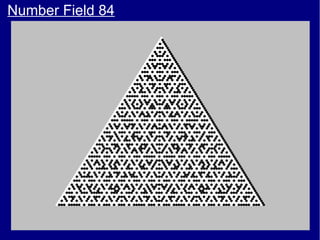
Number Field 84 (Raw)
Novelty
Numbers as Strings
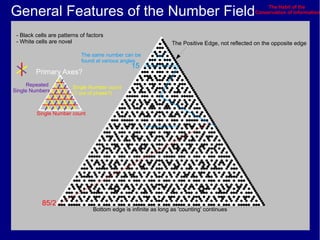
General Features of the Number Field
    -the Habit of Conservation of Information
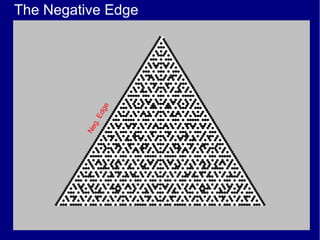
    -Introducing the Negative Edge (necessity?)
Number Field 84 (Complete?)
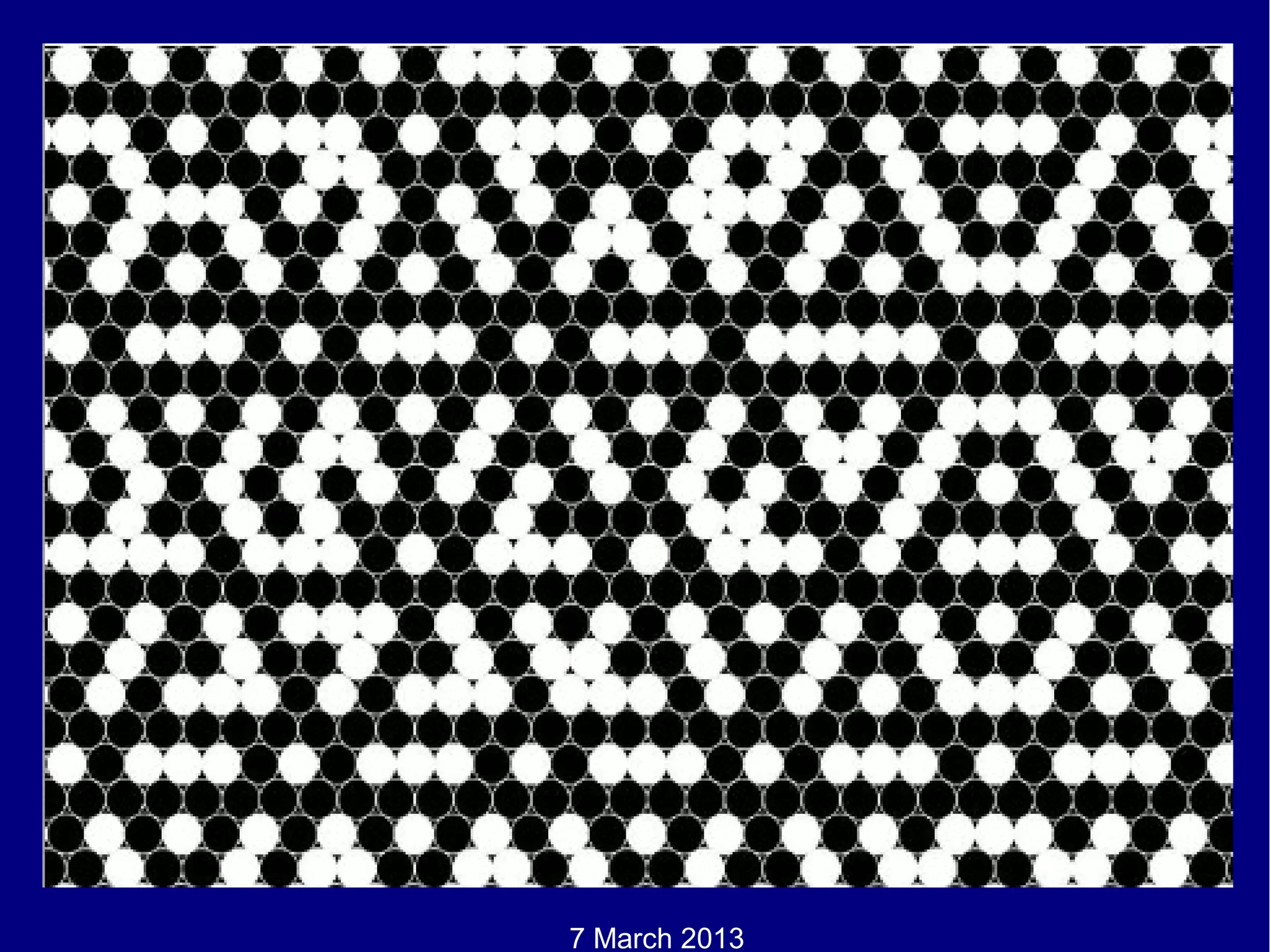
What is the Number Field?
What are the Applications?
Counting
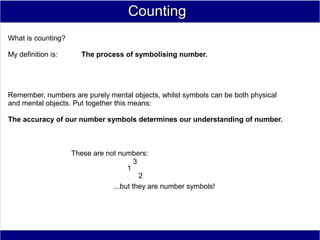
What is counting?

My definition is:      The process of symbolising number.


Remember, numbers are purely mental objects, whilst symbols can be both physical
and mental objects. Put together this means:

The accuracy of our number symbols determines our understanding of number.


                    These are not numbers:
                                        3
                                     1
                                          2
                                ...but they are number symbols!
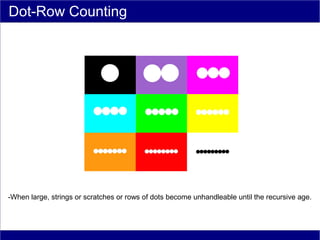
Dot-Row Counting


-When large, strings or scratches or rows of dots become unhandleable until the recursive age.
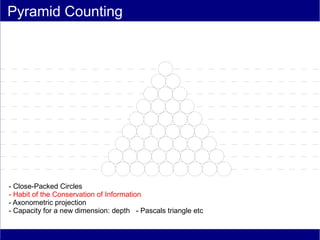
Pyramid Counting


- Close-Packed Circles
- Habit of the Conservation of Information
- Axonometric projection
- Capacity for a new dimension: depth - Pascals triangle etc
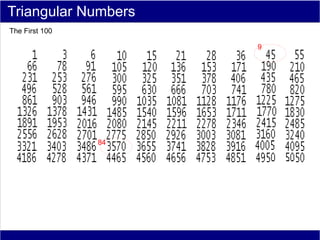
Triangular Numbers
The First 100

                     9


                84
Derivation of the Number Field:

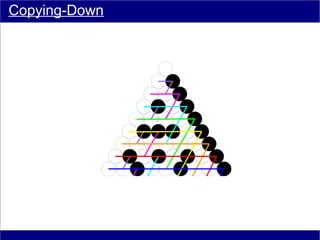
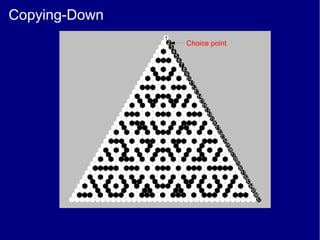
       -Copying-Down

       -Coat-hanger

       -Algebraic?

       -Axial?
Copying-Down
Copying-Down
               1
                2
                 3
                        Choice point
                  4
                   5
                    6
                     7
                      8
                       9
                        10
                         11
                          12
                           13
                            14
                             15
                              16
                               17
                                18
                                 19
                                  20
                                   21
                                    22
                                     23
                                      24
                                       25
                                        26
                                         27
                                          28
                                           29
                                            30
                                             31
                                              32
                                               33
                                                34
                                                 35
                                                  36
                                                   37
The Coat-hanger


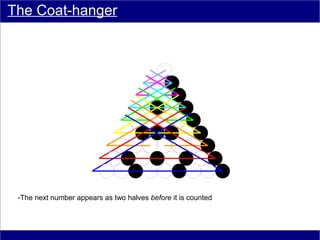
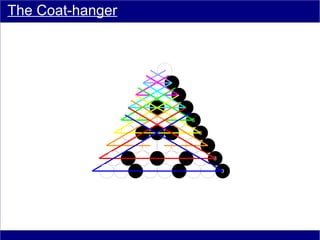
 -The next number appears as two halves before it is counted
The Coat-hanger


                  5

                      6


                          8

                              9
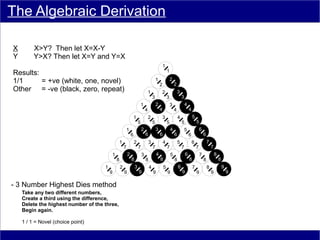
The Algebraic Derivation

X        X>Y? Then let X=X-Y
Y        Y>X? Then let X=Y and Y=X
                                                                                                     1
                                                                                                         1
Results:
1/1      = +ve (white, one, novel)                                                           1
                                                                                                 2
                                                                                                         2
                                                                                                                 2
Other = -ve (black, zero, repeat)                                                    1           2                   3
                                                                                         3               3               3
                                                                             1               2               3               4
                                                                                 4               4               4               4
                                                                     1               2               3               4               5
                                                                         5               5               5               5               5
                                                             1               2               3               4               5            6
                                                                 6               6               6               6               6               6
                                                     1               2               3               4               5               6               7
                                                         7               7               7               7               7               7               7
                                             1               2               3               4               5               6               7               8
                                                 8               8               8               8               8               8               8               8
                                     1               2               3               4               5               6               7               8               9
                                         9               9               9               9               9               9               9               9               9

- 3 Number Highest Dies method
    Take any two different numbers,
    Create a third using the difference,
    Delete the highest number of the three,
    Begin again.

    1 / 1 = Novel (choice point)
Number Field 84
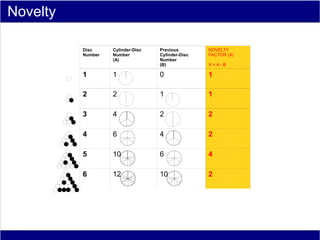
Novelty

          Disc     Cylinder-Disc   Previous        NOVELTY
          Number   Number          Cylinder-Disc   FACTOR (X)
                   (A)             Number
                                   (B)             X =A-B

          1        1               0               1

          2        2               1               1

          3        4               2               2

          4        6               4               2

          5        10              6               4

          6        12              10              2
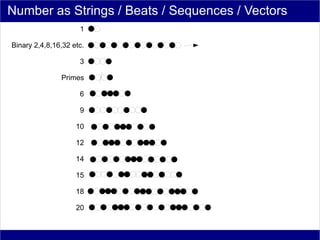
Number as Strings / Beats / Sequences / Vectors
                     1

Binary 2,4,8,16,32 etc.

                     3

               Primes

                     6

                     9

                    10

                    12

                    14

                    15

                    18

                    20
General Features of the Number Field                                                                 The Habit of the
                                                                                                 Conservation of Information


 - Black cells are patterns of factors
 - White cells are novel                                         The Positive Edge, not reflected on the opposite edge

                            The same number can be
                            found at various angles
                                                15
         Primary Axes?
      Repeated          Single Number count
Single Numbers          (1 out of phase?)


         Single Number count


           85/2
                                 Bottom edge is infinite as long as 'counting' continues
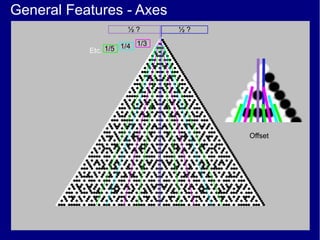
General Features - Axes
                     ½?       ½?
                        1/3
           Etc. 1/5 1/4


                                   Offset
The Negative Edge


              e
            dgE
           g.
         Ne
What is the Number Field? Applications?
-Universal Imaginary Shape?

-the same in all cultures, all places,, all
times?

-the 'hard-copy' or static version of the
process
of counting?

-a teaching aid ?

-A FRACTAL?

- COUNTING
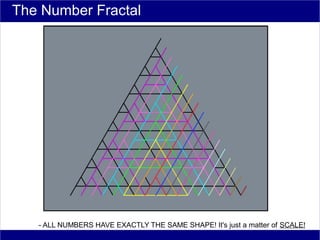
The Number Fractal


   - ALL NUMBERS HAVE EXACTLY THE SAME SHAPE! It's just a matter of SCALE!
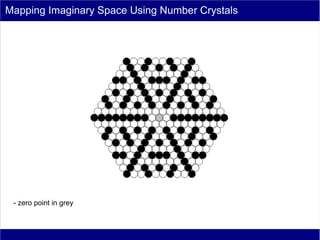
Mapping Imaginary Space Using Number Crystals


 - zero point in grey
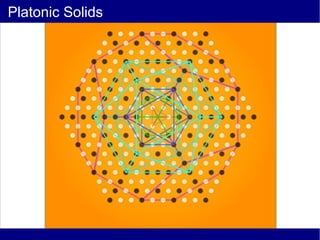
Platonic Solids
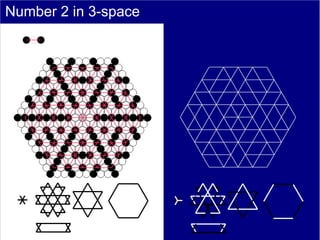
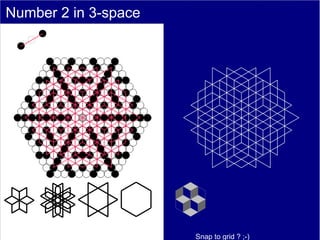
Number 2 in 3-space
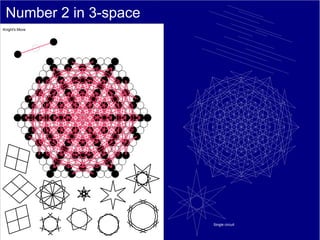
Number 2 in 3-space


                      Snap to grid ? ;-)
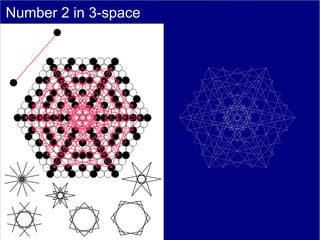
Number 2 in 3-space
Knight's Move


                       Single circuit
Number 2 in 3-space
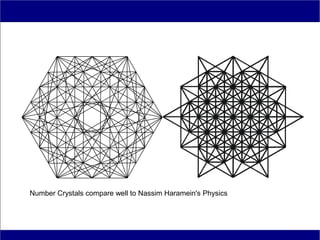
Number Crystals compare well to Nassim Haramein's Physics
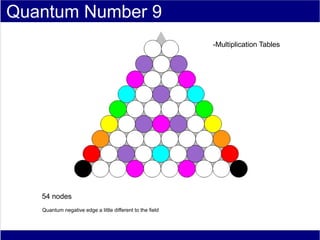
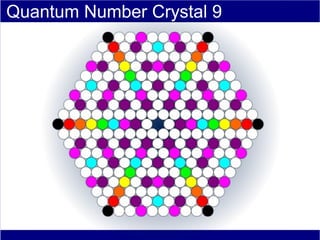
Quantum Number 9
                                                           -Multiplication Tables


   54 nodes
   Quantum negative edge a little different to the field
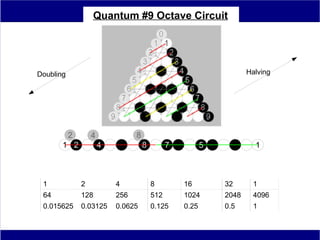
Quantum #9 Octave Circuit


Doubling                                                             Halving


           2       4             8
       1 2             4             8         7          5            1


 1             2           4             8         16         32       1
 64            128         256           512       1024       2048     4096
 0.015625      0.03125     0.0625        0.125     0.25       0.5      1
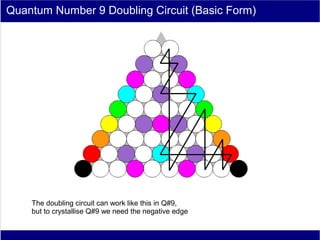
Quantum Number 9 Doubling Circuit (Basic Form)


    The doubling circuit can work like this in Q#9,
    but to crystallise Q#9 we need the negative edge
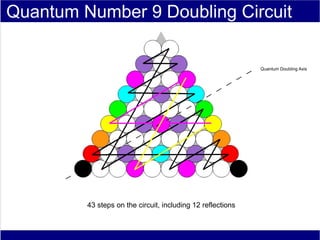
Quantum Number 9 Doubling Circuit

                                                             Quantum Doubling Axis


         43 steps on the circuit, including 12 reflections
Quantum Number Crystal 9
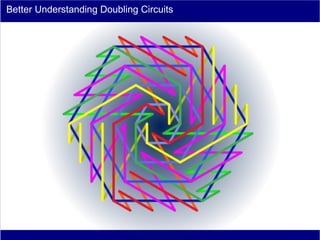
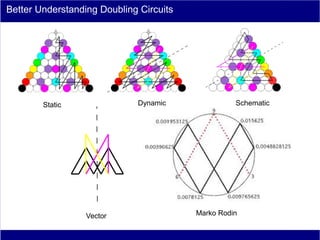
Better Understanding Doubling Circuits


        Static               Dynamic               Schematic


                  Vector                 Marko Rodin
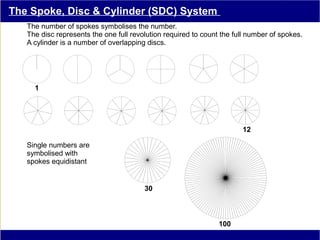
The Spoke, Disc & Cylinder (SDC) System
   The number of spokes symbolises the number.
   The disc represents the one full revolution required to count the full number of spokes.
   A cylinder is a number of overlapping discs.


     1


                                                                       12

   Single numbers are
   symbolised with
   spokes equidistant


                                        30


                                                                100
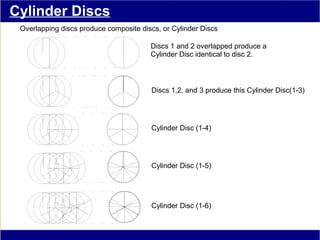
Cylinder Discs
 Overlapping discs produce composite discs, or Cylinder Discs

                                        Discs 1 and 2 overlapped produce a
                                        Cylinder Disc identical to disc 2.


                                        Discs 1,2, and 3 produce this Cylinder Disc(1-3)


                                        Cylinder Disc (1-4)


                                        Cylinder Disc (1-5)


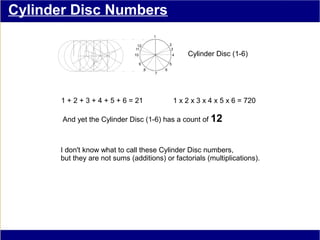
                                        Cylinder Disc (1-6)
Cylinder Disc Numbers
                                           1

                               12                  2
                              11                    3
                              10                       4    Cylinder Disc (1-6)
                                   9               5
                                       8       6
                                           7


      1 + 2 + 3 + 4 + 5 + 6 = 21                        1 x 2 x 3 x 4 x 5 x 6 = 720

       And yet the Cylinder Disc (1-6) has a count of 12


      I don't know what to call these Cylinder Disc numbers,
      but they are not sums (additions) or factorials (multiplications).
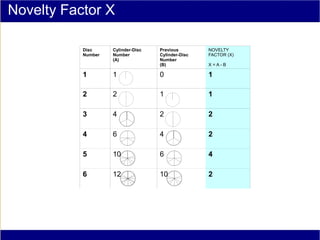
Novelty Factor X

           Disc     Cylinder-Disc   Previous        NOVELTY
           Number   Number          Cylinder-Disc   FACTOR (X)
                    (A)             Number
                                    (B)             X =A-B

           1        1               0               1

           2        2               1               1

           3        4               2               2

           4        6               4               2

           5        10              6               4

           6        12              10              2
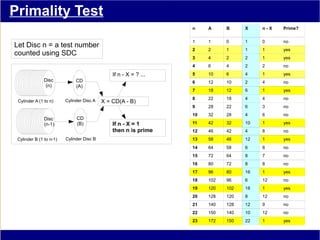
Primality Test
                                                                  n    A     B     X    n-X   Prime?

                                                                  1    1     0     1    0     no
Let Disc n = a test number
                                                                  2    2     1     1    1     yes
counted using SDC
                                                                  3    4     2     2    1     yes
                                                                  4    6     4     2    2     no

                                               If n - X = ? ...   5    10    6     4    1     yes
               Disc           CD                                  6    12    10    2    4     no
                (n)           (A)
                                                                  7    18    12    6    1     yes

                         Cylinder Disc A                          8    22    18    4    4     no
 Cylinder A (1 to n)                       X = CD(A - B)
                                                                  9    28    22    6    3     no
                                                                  10   32    28    4    6     no
               Disc           CD
               (n-1)          (B)              If n - X = 1       11   42    32    10   1     yes
                                               then n is prime    12   46    42    4    8     no
 Cylinder B (1 to n-1)   Cylinder Disc B                          13   58    46    12   1     yes
                                                                  14   64    58    6    8     no
                                                                  15   72    64    8    7     no
                                                                  16   80    72    8    8     no
                                                                  17   96    80    16   1     yes
                                                                  18   102   96    6    12    no
                                                                  19   120   102   18   1     yes
                                                                  20   128   120   8    12    no
                                                                  21   140   128   12   9     no
                                                                  22   150   140   10   12    no
                                                                  23   172   150   22   1     yes
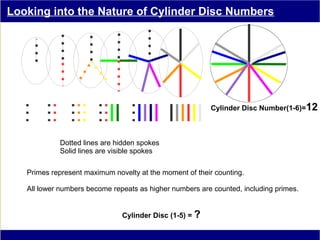
Looking into the Nature of Cylinder Disc Numbers


                                                          Cylinder Disc Number(1-6)=12


            Dotted lines are hidden spokes
            Solid lines are visible spokes

   Primes represent maximum novelty at the moment of their counting.

   All lower numbers become repeats as higher numbers are counted, including primes.


                               Cylinder Disc (1-5) = ?
Conclusions

 1. There seems to be such a thing (object) as the Number Field

 2. This object evolves from counting correctly

 3. Counting Correctly will involve information about which parts of number are novel
 and which are repeated

 4. Basic Exploration of the above concepts yields...


                                          END

The number field 17

  • 1.
  • 2.
    This Presentation: Counting Mapping Imaginary Space - Dot-row Counting The Platonic Solids - Pyramid Counting Number Crystals - Triangular Numbers Quantum Number Derivation of the Number Field Marko Rodin's Vortex Math -the Copy-Down Method -the Coat-hanger Method The Spoke, Cylinder, Disc System of Counting -the Algebraic Method The Three Number Highest Dies Game Number Field 84 (Raw) Novelty Numbers as Strings General Features of the Number Field -the Habit of Conservation of Information -Introducing the Negative Edge (necessity?) Number Field 84 (Complete?) What is the Number Field? What are the Applications?
  • 3.
    Counting What is counting? Mydefinition is: The process of symbolising number. Remember, numbers are purely mental objects, whilst symbols can be both physical and mental objects. Put together this means: The accuracy of our number symbols determines our understanding of number. These are not numbers: 3 1 2 ...but they are number symbols!
  • 4.
    Dot-Row Counting -When large,strings or scratches or rows of dots become unhandleable until the recursive age.
  • 5.
    Pyramid Counting - Close-PackedCircles - Habit of the Conservation of Information - Axonometric projection - Capacity for a new dimension: depth - Pascals triangle etc
  • 6.
  • 7.
    Derivation of theNumber Field: -Copying-Down -Coat-hanger -Algebraic? -Axial?
  • 8.
  • 9.
    Copying-Down 1 2 3 Choice point 4 5 6 7 8 9 10 11 12 13 14 15 16 17 18 19 20 21 22 23 24 25 26 27 28 29 30 31 32 33 34 35 36 37
  • 10.
    The Coat-hanger -Thenext number appears as two halves before it is counted
  • 11.
  • 12.
    The Algebraic Derivation X X>Y? Then let X=X-Y Y Y>X? Then let X=Y and Y=X 1 1 Results: 1/1 = +ve (white, one, novel) 1 2 2 2 Other = -ve (black, zero, repeat) 1 2 3 3 3 3 1 2 3 4 4 4 4 4 1 2 3 4 5 5 5 5 5 5 1 2 3 4 5 6 6 6 6 6 6 6 1 2 3 4 5 6 7 7 7 7 7 7 7 7 1 2 3 4 5 6 7 8 8 8 8 8 8 8 8 8 1 2 3 4 5 6 7 8 9 9 9 9 9 9 9 9 9 9 - 3 Number Highest Dies method Take any two different numbers, Create a third using the difference, Delete the highest number of the three, Begin again. 1 / 1 = Novel (choice point)
  • 13.
  • 14.
    Novelty Disc Cylinder-Disc Previous NOVELTY Number Number Cylinder-Disc FACTOR (X) (A) Number (B) X =A-B 1 1 0 1 2 2 1 1 3 4 2 2 4 6 4 2 5 10 6 4 6 12 10 2
  • 15.
    Number as Strings/ Beats / Sequences / Vectors 1 Binary 2,4,8,16,32 etc. 3 Primes 6 9 10 12 14 15 18 20
  • 16.
    General Features ofthe Number Field The Habit of the Conservation of Information - Black cells are patterns of factors - White cells are novel The Positive Edge, not reflected on the opposite edge The same number can be found at various angles 15 Primary Axes? Repeated Single Number count Single Numbers (1 out of phase?) Single Number count 85/2 Bottom edge is infinite as long as 'counting' continues
  • 17.
    General Features -Axes ½? ½? 1/3 Etc. 1/5 1/4 Offset
  • 18.
    The Negative Edge e dgE g. Ne
  • 19.
    What is theNumber Field? Applications? -Universal Imaginary Shape? -the same in all cultures, all places,, all times? -the 'hard-copy' or static version of the process of counting? -a teaching aid ? -A FRACTAL? - COUNTING
  • 20.
    The Number Fractal - ALL NUMBERS HAVE EXACTLY THE SAME SHAPE! It's just a matter of SCALE!
  • 21.
    Mapping Imaginary SpaceUsing Number Crystals - zero point in grey
  • 22.
  • 23.
    Number 2 in3-space
  • 24.
    Number 2 in3-space Snap to grid ? ;-)
  • 25.
    Number 2 in3-space Knight's Move Single circuit
  • 26.
    Number 2 in3-space
  • 27.
    Number Crystals comparewell to Nassim Haramein's Physics
  • 28.
    Quantum Number 9 -Multiplication Tables 54 nodes Quantum negative edge a little different to the field
  • 29.
    Quantum #9 OctaveCircuit Doubling Halving 2 4 8 1 2 4 8 7 5 1 1 2 4 8 16 32 1 64 128 256 512 1024 2048 4096 0.015625 0.03125 0.0625 0.125 0.25 0.5 1
  • 30.
    Quantum Number 9Doubling Circuit (Basic Form) The doubling circuit can work like this in Q#9, but to crystallise Q#9 we need the negative edge
  • 31.
    Quantum Number 9Doubling Circuit Quantum Doubling Axis 43 steps on the circuit, including 12 reflections
  • 32.
  • 33.
  • 34.
    Better Understanding DoublingCircuits Static Dynamic Schematic Vector Marko Rodin
  • 35.
    The Spoke, Disc& Cylinder (SDC) System The number of spokes symbolises the number. The disc represents the one full revolution required to count the full number of spokes. A cylinder is a number of overlapping discs. 1 12 Single numbers are symbolised with spokes equidistant 30 100
  • 36.
    Cylinder Discs Overlappingdiscs produce composite discs, or Cylinder Discs Discs 1 and 2 overlapped produce a Cylinder Disc identical to disc 2. Discs 1,2, and 3 produce this Cylinder Disc(1-3) Cylinder Disc (1-4) Cylinder Disc (1-5) Cylinder Disc (1-6)
  • 37.
    Cylinder Disc Numbers 1 12 2 11 3 10 4 Cylinder Disc (1-6) 9 5 8 6 7 1 + 2 + 3 + 4 + 5 + 6 = 21 1 x 2 x 3 x 4 x 5 x 6 = 720 And yet the Cylinder Disc (1-6) has a count of 12 I don't know what to call these Cylinder Disc numbers, but they are not sums (additions) or factorials (multiplications).
  • 38.
    Novelty Factor X Disc Cylinder-Disc Previous NOVELTY Number Number Cylinder-Disc FACTOR (X) (A) Number (B) X =A-B 1 1 0 1 2 2 1 1 3 4 2 2 4 6 4 2 5 10 6 4 6 12 10 2
  • 39.
    Primality Test n A B X n-X Prime? 1 1 0 1 0 no Let Disc n = a test number 2 2 1 1 1 yes counted using SDC 3 4 2 2 1 yes 4 6 4 2 2 no If n - X = ? ... 5 10 6 4 1 yes Disc CD 6 12 10 2 4 no (n) (A) 7 18 12 6 1 yes Cylinder Disc A 8 22 18 4 4 no Cylinder A (1 to n) X = CD(A - B) 9 28 22 6 3 no 10 32 28 4 6 no Disc CD (n-1) (B) If n - X = 1 11 42 32 10 1 yes then n is prime 12 46 42 4 8 no Cylinder B (1 to n-1) Cylinder Disc B 13 58 46 12 1 yes 14 64 58 6 8 no 15 72 64 8 7 no 16 80 72 8 8 no 17 96 80 16 1 yes 18 102 96 6 12 no 19 120 102 18 1 yes 20 128 120 8 12 no 21 140 128 12 9 no 22 150 140 10 12 no 23 172 150 22 1 yes
  • 40.
    Looking into theNature of Cylinder Disc Numbers Cylinder Disc Number(1-6)=12 Dotted lines are hidden spokes Solid lines are visible spokes Primes represent maximum novelty at the moment of their counting. All lower numbers become repeats as higher numbers are counted, including primes. Cylinder Disc (1-5) = ?
  • 41.
    Conclusions 1. Thereseems to be such a thing (object) as the Number Field 2. This object evolves from counting correctly 3. Counting Correctly will involve information about which parts of number are novel and which are repeated 4. Basic Exploration of the above concepts yields... END