Any Space Can Be An Inspirational
Learning Space (with a little imagination
and a lot of hard work)
Janine Timms TechnicalTeamLeaderinHealth
Sharyn Edwards SeniorLecturerinParamedicPractice
Dip HE Paramedic Practice
• Currently commissions from East Midlands Ambulance
Service and Yorkshire Ambulance Service
• 2 Intakes per year of a total of 160 students / year
• Students time split between University and practice
placement
Course Delivery
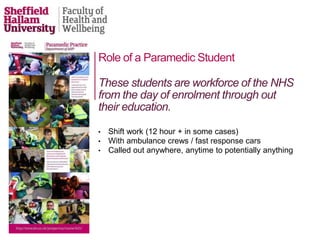
Role of a Paramedic Student
• Shift work (12 hour + in some cases)
• With ambulance crews / fast response cars
• Called out anywhere, anytime to potentially anything
These students are workforce of the NHS
from the day of enrolment through out
their education.
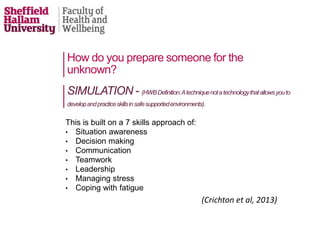
This is built on a 7 skills approach of:
• Situation awareness
• Decision making
• Communication
• Teamwork
• Leadership
• Managing stress
• Coping with fatigue
(Crichton et al, 2013)
SIMULATION - (HWBDefinition:Atechniquenotatechnologythatallowsyouto
developandpracticeskillsinsafesupportedenvironments).
How do you prepare someone for the
unknown?
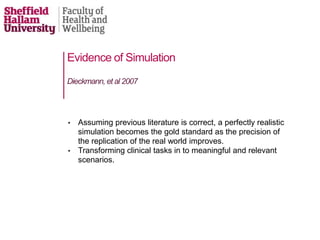
• Assuming previous literature is correct, a perfectly realistic
simulation becomes the gold standard as the precision of
the replication of the real world improves.
• Transforming clinical tasks in to meaningful and relevant
scenarios.
Dieckmann, et al 2007
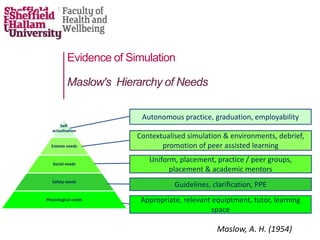
Evidence of Simulation
Maslow's Hierarchy of Needs
Self-
actualisation
Esteem needs
Social needs
Safety needs
Physiological needs
Autonomous practice, graduation, employability
Contextualised simulation & environments, debrief,
promotion of peer assisted learning
Uniform, placement, practice / peer groups,
placement & academic mentors
Guidelines, clarification, PPE
Appropriate, relevant equiptment, tutor, learning
space
Maslow, A. H. (1954)
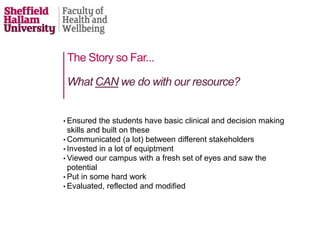
The Story so Far...
• Ensured the students have basic clinical and decision making
skills and built on these
• Communicated (a lot) between different stakeholders
• Invested in a lot of equiptment
• Viewed our campus with a fresh set of eyes and saw the
potential
• Put in some hard work
• Evaluated, reflected and modified
What CAN we do with our resource?
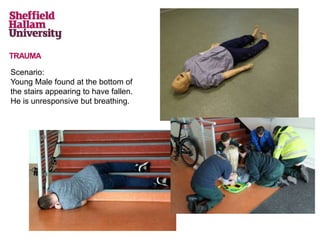
TRAUMA
Scenario:
Young Male found at the bottom of
the stairs appearing to have fallen.
He is unresponsive but breathing.
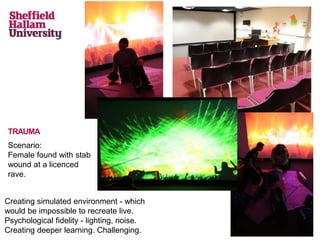
TRAUMA
Scenario:
Female found with stab
wound at a licenced
rave.
Creating simulated environment - which
would be impossible to recreate live.
Psychological fidelity - lighting, noise.
Creating deeper learning. Challenging.
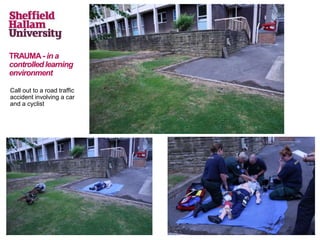
TRAUMA- in a
controlledlearning
environment
Call out to a road traffic
accident involving a car
and a cyclist
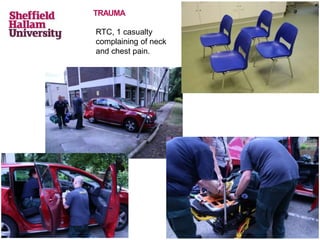
TRAUMA
RTC, 1 casualty
complaining of neck
and chest pain.
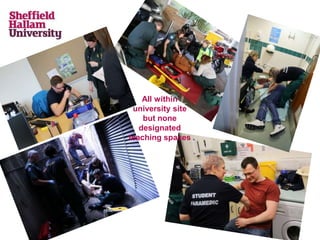
All within
university site
but none
designated
teaching spaces
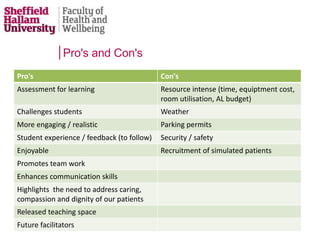
Pro's and Con's
Pro's Con's
Assessment for learning Resource intense (time, equiptment cost,
room utilisation, AL budget)
Challenges students Weather
More engaging / realistic Parking permits
Student experience / feedback (to follow) Security / safety
Enjoyable Recruitment of simulated patients
Promotes team work
Enhances communication skills
Highlights the need to address caring,
compassion and dignity of our patients
Released teaching space
Future facilitators
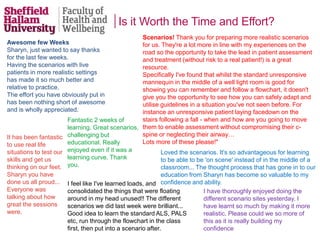
Is it Worth the Time and Effort?
Awesome few Weeks
Sharyn, just wanted to say thanks
for the last few weeks.
Having the scenarios with live
patients in more realistic settings
has made it so much better and
relative to practice.
The effort you have obviously put in
has been nothing short of awesome
and is wholly appreciated.
Scenarios! Thank you for preparing more realistic scenarios
for us. They're a lot more in line with my experiences on the
road so the opportunity to take the lead in patient assessment
and treatment (without risk to a real patient!) is a great
resource.
Specifically I've found that whilst the standard unresponsive
mannequin in the middle of a well light room is good for
showing you can remember and follow a flowchart, it doesn't
give you the opportunity to see how you can safely adapt and
utilise guidelines in a situation you've not seen before. For
instance an unresponsive patient laying facedown on the
stairs following a fall - when and how are you going to move
them to enable assessment without compromising their c-
spine or neglecting their airway…
Lots more of these please!"
Fantastic 2 weeks of
learning. Great scenarios,
challenging but
educational. Really
enjoyed even if it was a
learning curve. Thank
you.
Loved the scenarios. It's so advantageous for learning
to be able to be 'on scene' instead of in the middle of a
classroom... The thought process that has gone in to our
education from Sharyn has become so valuable to my
confidence and ability.
It has been fantastic
to use real life
situations to test our
skills and get us
thinking on our feet.
Sharyn you have
done us all proud...
Everyone was
talking about how
great the sessions
were.
I feel like I've learned loads, and
consolidated the things that were floating
around in my head unused!! The different
scenarios we did last week were brilliant...
Good idea to learn the standard ALS, PALS
etc, run through the flowchart in the class
first, then put into a scenario after.
I have thoroughly enjoyed doing the
different scenario sites yesterday. I
have learnt so much by making it more
realistic. Please could we so more of
this as it is really building my
confidence
What next?
In the real world:
• Continue to create suitable scenarios in suitable locations
• Evaluate further with our students ideas / cases they have attended which they
would like to reflect on
• Work with our service providers to access additional facilitators
• Investigate other "locations"
• Investigate the possibility of an ambulance cab / virtual ambulance
In the virtual world:
• Currently piloting 360 filming of an incident before the paramedic arrives on
scene which can be utilised for gathering information, including the paramedics
journey to scene
• Developed a 360 interactive Ambulance cab accessed on the web to help new
students orientate themselves around their workplace
More hard work!
Thank you for your time.
Any Questions?
Janine Timms
j.timms@shu.ac.uk
Sharyn Edwards
sharyn.edwards@shu.ac.uk
CRICHTON, M, O'CONNOR, P and FLIN, R, (2013). Safety at the Sharp End: A Guide to Non-Technical Skills. Farnham,
Ashgate Publishing Limited.
DIECKMANN , P, GABA, D, RALL, M, (2007). Deeping the Theoretical Foundations of Patient Simulation as Social Practice.
Simulation in Healthcare, Vol 2, No. 3, Fall 2007.
MASLOW, A. H. (1954). Motivation and personality. New York: Harper and Row.
References
Is it Worth the Time and Effort?
Awesome few Weeks
Sharyn, just wanted to say thanks
for the last few weeks.
Having the scenarios with live
patients in more realistic settings
has made it so much better and
relative to practice.
The effort you have obviously put in
has been nothing short of awesome
and is wholly appreciated.
Scenarios! Thank you for preparing more realistic scenarios
for us. They're a lot more in line with my experiences on the
road so the opportunity to take the lead in patient assessment
and treatment (without risk to a real patient!) is a great
resource.
Specifically I've found that whilst the standard unresponsive
mannequin in the middle of a well light room is good for
showing you can remember and follow a flowchart, it doesn't
give you the opportunity to see how you can safely adapt and
utilise guidelines in a situation you've not seen before. For
instance an unresponsive patient laying facedown on the
stairs following a fall - when and how are you going to move
them to enable assessment without compromising their c-
spine or neglecting their airway…
Lots more of these please!"
Fantastic 2 weeks of
learning. Great scenarios,
challenging but
educational. Really
enjoyed even if it was a
learning curve. Thank
you.
Loved the scenarios. It's so advantageous for learning
to be able to be 'on scene' instead of in the middle of a
classroom... The thought process that has gone in to our
education from Sharyn has become so valuable to my
confidence and ability.
It has been fantastic
to use real life
situations to test our
skills and get us
thinking on our feet.
Sharyn you have
done us all proud...
Everyone was
talking about how
great the sessions
were.
I feel like I've learned loads, and
consolidated the things that were floating
around in my head unused!! The different
scenarios we did last week were brilliant...
Good idea to learn the standard ALS, PALS
etc, run through the flowchart in the class
first, then put into a scenario after.
I have thoroughly enjoyed doing the
different scenario sites yesterday. I
have learnt so much by making it more
realistic. Please could we so more of
this as it is really building my
confidence

Any space can be an inspirational

  • 1.
    Any Space CanBe An Inspirational Learning Space (with a little imagination and a lot of hard work) Janine Timms TechnicalTeamLeaderinHealth Sharyn Edwards SeniorLecturerinParamedicPractice
  • 2.
    Dip HE ParamedicPractice • Currently commissions from East Midlands Ambulance Service and Yorkshire Ambulance Service • 2 Intakes per year of a total of 160 students / year • Students time split between University and practice placement Course Delivery
  • 3.
    Role of aParamedic Student • Shift work (12 hour + in some cases) • With ambulance crews / fast response cars • Called out anywhere, anytime to potentially anything These students are workforce of the NHS from the day of enrolment through out their education.
  • 4.
    This is builton a 7 skills approach of: • Situation awareness • Decision making • Communication • Teamwork • Leadership • Managing stress • Coping with fatigue (Crichton et al, 2013) SIMULATION - (HWBDefinition:Atechniquenotatechnologythatallowsyouto developandpracticeskillsinsafesupportedenvironments). How do you prepare someone for the unknown?
  • 5.
    • Assuming previousliterature is correct, a perfectly realistic simulation becomes the gold standard as the precision of the replication of the real world improves. • Transforming clinical tasks in to meaningful and relevant scenarios. Dieckmann, et al 2007 Evidence of Simulation
  • 6.
    Evidence of Simulation Maslow'sHierarchy of Needs Self- actualisation Esteem needs Social needs Safety needs Physiological needs Autonomous practice, graduation, employability Contextualised simulation & environments, debrief, promotion of peer assisted learning Uniform, placement, practice / peer groups, placement & academic mentors Guidelines, clarification, PPE Appropriate, relevant equiptment, tutor, learning space Maslow, A. H. (1954)
  • 7.
    The Story soFar... • Ensured the students have basic clinical and decision making skills and built on these • Communicated (a lot) between different stakeholders • Invested in a lot of equiptment • Viewed our campus with a fresh set of eyes and saw the potential • Put in some hard work • Evaluated, reflected and modified What CAN we do with our resource?
  • 8.
    TRAUMA Scenario: Young Male foundat the bottom of the stairs appearing to have fallen. He is unresponsive but breathing.
  • 9.
    TRAUMA Scenario: Female found withstab wound at a licenced rave. Creating simulated environment - which would be impossible to recreate live. Psychological fidelity - lighting, noise. Creating deeper learning. Challenging.
  • 10.
    TRAUMA- in a controlledlearning environment Callout to a road traffic accident involving a car and a cyclist
  • 11.
    TRAUMA RTC, 1 casualty complainingof neck and chest pain.
  • 12.
    All within university site butnone designated teaching spaces
  • 13.
    Pro's and Con's Pro'sCon's Assessment for learning Resource intense (time, equiptment cost, room utilisation, AL budget) Challenges students Weather More engaging / realistic Parking permits Student experience / feedback (to follow) Security / safety Enjoyable Recruitment of simulated patients Promotes team work Enhances communication skills Highlights the need to address caring, compassion and dignity of our patients Released teaching space Future facilitators
  • 14.
    Is it Worththe Time and Effort? Awesome few Weeks Sharyn, just wanted to say thanks for the last few weeks. Having the scenarios with live patients in more realistic settings has made it so much better and relative to practice. The effort you have obviously put in has been nothing short of awesome and is wholly appreciated. Scenarios! Thank you for preparing more realistic scenarios for us. They're a lot more in line with my experiences on the road so the opportunity to take the lead in patient assessment and treatment (without risk to a real patient!) is a great resource. Specifically I've found that whilst the standard unresponsive mannequin in the middle of a well light room is good for showing you can remember and follow a flowchart, it doesn't give you the opportunity to see how you can safely adapt and utilise guidelines in a situation you've not seen before. For instance an unresponsive patient laying facedown on the stairs following a fall - when and how are you going to move them to enable assessment without compromising their c- spine or neglecting their airway… Lots more of these please!" Fantastic 2 weeks of learning. Great scenarios, challenging but educational. Really enjoyed even if it was a learning curve. Thank you. Loved the scenarios. It's so advantageous for learning to be able to be 'on scene' instead of in the middle of a classroom... The thought process that has gone in to our education from Sharyn has become so valuable to my confidence and ability. It has been fantastic to use real life situations to test our skills and get us thinking on our feet. Sharyn you have done us all proud... Everyone was talking about how great the sessions were. I feel like I've learned loads, and consolidated the things that were floating around in my head unused!! The different scenarios we did last week were brilliant... Good idea to learn the standard ALS, PALS etc, run through the flowchart in the class first, then put into a scenario after. I have thoroughly enjoyed doing the different scenario sites yesterday. I have learnt so much by making it more realistic. Please could we so more of this as it is really building my confidence
  • 15.
    What next? In thereal world: • Continue to create suitable scenarios in suitable locations • Evaluate further with our students ideas / cases they have attended which they would like to reflect on • Work with our service providers to access additional facilitators • Investigate other "locations" • Investigate the possibility of an ambulance cab / virtual ambulance In the virtual world: • Currently piloting 360 filming of an incident before the paramedic arrives on scene which can be utilised for gathering information, including the paramedics journey to scene • Developed a 360 interactive Ambulance cab accessed on the web to help new students orientate themselves around their workplace More hard work!
  • 16.
    Thank you foryour time. Any Questions? Janine Timms j.timms@shu.ac.uk Sharyn Edwards sharyn.edwards@shu.ac.uk CRICHTON, M, O'CONNOR, P and FLIN, R, (2013). Safety at the Sharp End: A Guide to Non-Technical Skills. Farnham, Ashgate Publishing Limited. DIECKMANN , P, GABA, D, RALL, M, (2007). Deeping the Theoretical Foundations of Patient Simulation as Social Practice. Simulation in Healthcare, Vol 2, No. 3, Fall 2007. MASLOW, A. H. (1954). Motivation and personality. New York: Harper and Row. References
  • 17.
    Is it Worththe Time and Effort? Awesome few Weeks Sharyn, just wanted to say thanks for the last few weeks. Having the scenarios with live patients in more realistic settings has made it so much better and relative to practice. The effort you have obviously put in has been nothing short of awesome and is wholly appreciated. Scenarios! Thank you for preparing more realistic scenarios for us. They're a lot more in line with my experiences on the road so the opportunity to take the lead in patient assessment and treatment (without risk to a real patient!) is a great resource. Specifically I've found that whilst the standard unresponsive mannequin in the middle of a well light room is good for showing you can remember and follow a flowchart, it doesn't give you the opportunity to see how you can safely adapt and utilise guidelines in a situation you've not seen before. For instance an unresponsive patient laying facedown on the stairs following a fall - when and how are you going to move them to enable assessment without compromising their c- spine or neglecting their airway… Lots more of these please!" Fantastic 2 weeks of learning. Great scenarios, challenging but educational. Really enjoyed even if it was a learning curve. Thank you. Loved the scenarios. It's so advantageous for learning to be able to be 'on scene' instead of in the middle of a classroom... The thought process that has gone in to our education from Sharyn has become so valuable to my confidence and ability. It has been fantastic to use real life situations to test our skills and get us thinking on our feet. Sharyn you have done us all proud... Everyone was talking about how great the sessions were. I feel like I've learned loads, and consolidated the things that were floating around in my head unused!! The different scenarios we did last week were brilliant... Good idea to learn the standard ALS, PALS etc, run through the flowchart in the class first, then put into a scenario after. I have thoroughly enjoyed doing the different scenario sites yesterday. I have learnt so much by making it more realistic. Please could we so more of this as it is really building my confidence

Editor's Notes

  • #3 SE: Quick into to the course (1 min)
  • #4 SE: Quick intro into the role of a Paramedic student (1 min)
  • #5 JT: Expand on technical and non-technical skills. Pre-brief and de-brief (2 min)
  • #6 JT: Why simulation. (1.5 min) Lit review by Issenberg looked at 34 years history of medical simulation and concluded that: Provide feedback during the learning experience with the simulator. Learners should repetitively practice skills on the simulator. Integrate simulators into the overall curriculum. Learners should practice with increasing levels of difficulty (if available). Adapt the simulator to complement multiple learning strategies. Ensure the simulator provides for clinical variation (if available). Learning on the simulator should occur in a controlled environment. Provide individualized (in addition to team) learning on the simulator. Clearly define outcomes and benchmarks for the learners to achieve using the simulator. Ensure the simulator is a valid learning tool.
  • #8 JT; Expand on clinical skills incorporated within our "specialist rooms", but these rooms for paramedics are largely standard classrooms without tables but access to specialist equiptment. How seeing our accommodation differently has allowed us to incorporate simulation. (2 min)
  • #9 SE: Expand on other scenarios, falls, simple moving and handling techniques (30 sec)
  • #10 SE: Expand on other scenarios (football, house fire) (30 sec)
  • #11 SE: Amputation / bad bleed (30 seconds)
  • #12 SE: Extraction from car (30 sec)
  • #13 SE: Other locations: Working office in RWB Car park outside RWB Accessible bathroom in RWB Store room in RWB External steps down into Woodville Accommodation block cellar. (20 sec)
  • #14 The Pros far outweigh the cons however financial outlay is a huge consideration. In a time where we are being asked to justify our spending, incorporating simulation in our real environments, increases the costs. However to prepare our future Paramedics to deal with the increasing number of variation and complex call outs we need to be investing in their future for the safety of us all. (3 min)
  • #15 SE: Notes from the padlet wall after 2 weeks of simulation based teaching (2 min)
  • #18 SE: Notes from the padlet wall after 2 weeks of simulation based teaching (2 min) Go back to this slide whilst taking questions so people can read more of the feedback.