ANTITHYROID DRUGS
                                    Thyroid


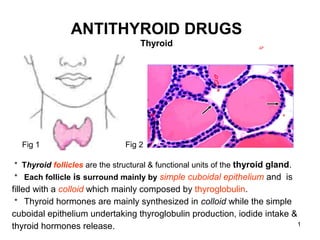
  Fig 1                         Fig 2

* Thyroid follicles are the structural & functional units of the thyroid gland.
* Each follicle is surround mainly by simple cuboidal epithelium and is
filled with a colloid which mainly composed by thyroglobulin.
* Thyroid hormones are mainly synthesized in colloid while the simple
cuboidal epithelium undertaking thyroglobulin production, iodide intake &
thyroid hormones release.                                                 1
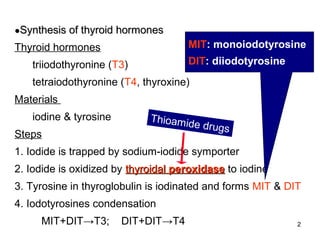
●Synthesis of thyroid hormones
Thyroid hormones                     MIT: monoiodotyrosine
   triiodothyronine (T3)             DIT: diiodotyrosine
   tetraiodothyronine (T4, thyroxine)
Materials
   iodine & tyrosine         Thioamid
                                     e drugs
Steps
1. Iodide is trapped by sodium-iodide symporter
2. Iodide is oxidized by thyroidal peroxidase to iodine
3. Tyrosine in thyroglobulin is iodinated and forms MIT & DIT
4. Iodotyrosines condensation
     MIT+DIT→T3;       DIT+DIT→T4                           2
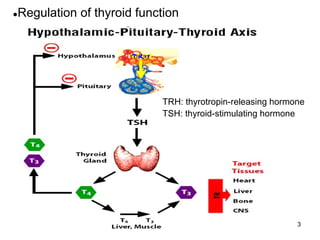
●Regulation   of thyroid function


                             TRH: thyrotropin-releasing hormone
                             TSH: thyroid-stimulating hormone


                                                             3
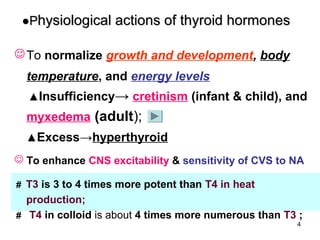
●Physiological actions of thyroid hormones

 To normalize growth and development, body
  temperature, and energy levels
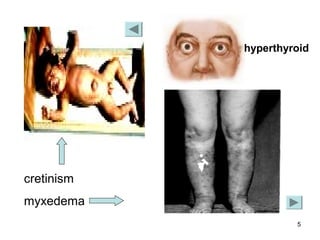
  ▲Insufficiency→ cretinism (infant & child), and
  myxedema (adult);
  ▲Excess→hyperthyroid

 To enhance CNS excitability & sensitivity of CVS to NA

# T3 is 3 to 4 times more potent than T4 in heat
  production;
# T4 in colloid is about 4 times more numerous than T3 ;
                                                      4
hyperthyroid


cretinism
myxedema
                     5
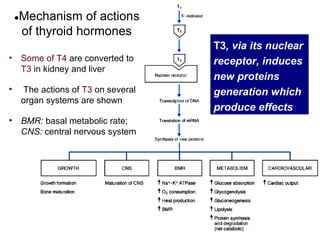
●Mechanism   of actions
     of thyroid hormones
                                   T3, via its nuclear
•   Some of T4 are converted to    receptor, induces
    T3 in kidney and liver
                                   new proteins
•   The actions of T3 on several   generation which
    organ systems are shown
                                   produce effects
•   BMR: basal metabolic rate;
    CNS: central nervous system


                                                    6
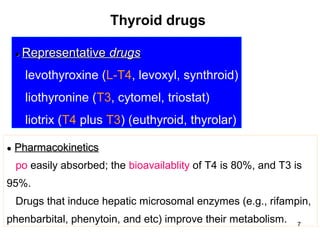
Thyroid drugs

    ● Representative    drugs
      levothyroxine (L-T4, levoxyl, synthroid)
      liothyronine (T3, cytomel, triostat)
      liotrix (T4 plus T3) (euthyroid, thyrolar)

●   Pharmacokinetics
    po easily absorbed; the bioavailablity of T4 is 80%, and T3 is
95%.
    Drugs that induce hepatic microsomal enzymes (e.g., rifampin,
phenbarbital, phenytoin, and etc) improve their metabolism.      7
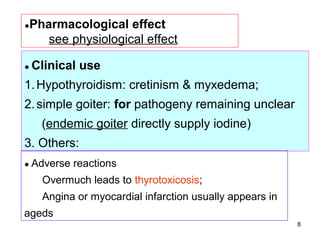
●Pharmacological   effect
    see physiological effect

● Clinical   use
1. Hypothyroidism: cretinism & myxedema;
2. simple goiter: for pathogeny remaining unclear
   (endemic goiter directly supply iodine)
3. Others:
● Adverse   reactions
   Overmuch leads to thyrotoxicosis;
   Angina or myocardial infarction usually appears in
ageds
                                                        8
Antithyroid drugs
● Drugs

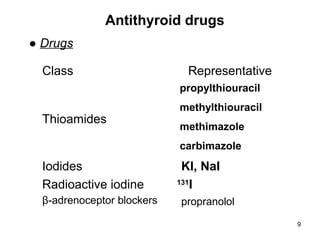
  Class                       Representative
                            propylthiouracil
                            methylthiouracil
  Thioamides
                            methimazole
                            carbimazole
  Iodides                    KI, NaI
  Radioactive iodine        131
                                I
  β-adrenoceptor blockers   propranolol

                                               9
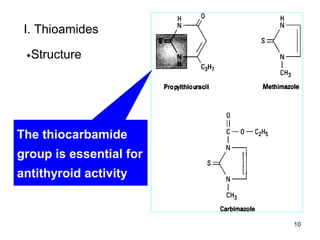
І. Thioamides

 ◆Structure


The thiocarbamide
group is essential for
antithyroid activity


                         10
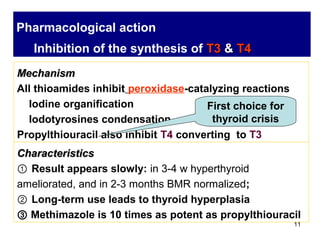
Pharmacological action
   Inhibition of the synthesis of T3 & T4
Mechanism
All thioamides inhibit peroxidase-catalyzing reactions
  Iodine organification               First choice for
  Iodotyrosines condensation           thyroid crisis
Propylthiouracil also inhibit T4 converting to T3
Characteristics
① Result appears slowly: in 3-4 w hyperthyroid
ameliorated, and in 2-3 months BMR normalized;
② Long-term use leads to thyroid hyperplasia
③ Methimazole is 10 times as potent as propylthiouracil
                                                         11
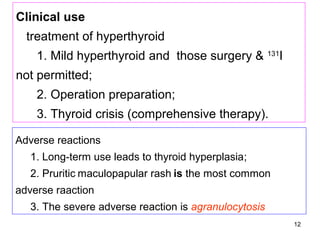
Clinical use
  treatment of hyperthyroid
    1. Mild hyperthyroid and those surgery & 131I
not permitted;
    2. Operation preparation;
    3. Thyroid crisis (comprehensive therapy).

Adverse reactions
   1. Long-term use leads to thyroid hyperplasia;
   2. Pruritic maculopapular rash is the most common
adverse raaction
   3. The severe adverse reaction is agranulocytosis
                                                       12
Iodides (NaI, KI)
Pharmacological action
   Inhibition of T3 & T4 release and synthesis
   Decrease of size & vascularity of the hyperplastic gland

Clinical use
  Ministrant treatment of hyperthyroid
   1. Operation preparation;
   2. Thyroid crisis.

Adverse reactions
  1. Acneiform rash (similar to that of bromism);
   2. Swollen salivary glands, mucous membrane ulcerations, and etc.
                                                                   13
Radioactive iodine (131I)

131
   I is the only isotope for treatment of thyrotoxicosis.
Its therapeutic effect depends on emission of β rays with an
effective half-life of 5 days & a penetration range of 0.4-2 mm.
Woman in pregnancy or lactation is forbidden!

                 β-adrenoceptor blockers

βblockers are effective in treatment of thyrotoxicosis.
Propranolol is the most widely studied and used.

                                                             14

Antithyroid drugs

  • 1.
    ANTITHYROID DRUGS Thyroid Fig 1 Fig 2 * Thyroid follicles are the structural & functional units of the thyroid gland. * Each follicle is surround mainly by simple cuboidal epithelium and is filled with a colloid which mainly composed by thyroglobulin. * Thyroid hormones are mainly synthesized in colloid while the simple cuboidal epithelium undertaking thyroglobulin production, iodide intake & thyroid hormones release. 1
  • 2.
    ●Synthesis of thyroidhormones Thyroid hormones MIT: monoiodotyrosine triiodothyronine (T3) DIT: diiodotyrosine tetraiodothyronine (T4, thyroxine) Materials iodine & tyrosine Thioamid e drugs Steps 1. Iodide is trapped by sodium-iodide symporter 2. Iodide is oxidized by thyroidal peroxidase to iodine 3. Tyrosine in thyroglobulin is iodinated and forms MIT & DIT 4. Iodotyrosines condensation MIT+DIT→T3; DIT+DIT→T4 2
  • 3.
    ●Regulation of thyroid function TRH: thyrotropin-releasing hormone TSH: thyroid-stimulating hormone 3
  • 4.
    ●Physiological actions ofthyroid hormones  To normalize growth and development, body temperature, and energy levels ▲Insufficiency→ cretinism (infant & child), and myxedema (adult); ▲Excess→hyperthyroid  To enhance CNS excitability & sensitivity of CVS to NA # T3 is 3 to 4 times more potent than T4 in heat production; # T4 in colloid is about 4 times more numerous than T3 ; 4
  • 5.
  • 6.
    ●Mechanism of actions of thyroid hormones T3, via its nuclear • Some of T4 are converted to receptor, induces T3 in kidney and liver new proteins • The actions of T3 on several generation which organ systems are shown produce effects • BMR: basal metabolic rate; CNS: central nervous system 6
  • 7.
    Thyroid drugs ● Representative drugs levothyroxine (L-T4, levoxyl, synthroid) liothyronine (T3, cytomel, triostat) liotrix (T4 plus T3) (euthyroid, thyrolar) ● Pharmacokinetics po easily absorbed; the bioavailablity of T4 is 80%, and T3 is 95%. Drugs that induce hepatic microsomal enzymes (e.g., rifampin, phenbarbital, phenytoin, and etc) improve their metabolism. 7
  • 8.
    ●Pharmacological effect see physiological effect ● Clinical use 1. Hypothyroidism: cretinism & myxedema; 2. simple goiter: for pathogeny remaining unclear (endemic goiter directly supply iodine) 3. Others: ● Adverse reactions Overmuch leads to thyrotoxicosis; Angina or myocardial infarction usually appears in ageds 8
  • 9.
    Antithyroid drugs ● Drugs Class Representative propylthiouracil methylthiouracil Thioamides methimazole carbimazole Iodides KI, NaI Radioactive iodine 131 I β-adrenoceptor blockers propranolol 9
  • 10.
    І. Thioamides ◆Structure Thethiocarbamide group is essential for antithyroid activity 10
  • 11.
    Pharmacological action Inhibition of the synthesis of T3 & T4 Mechanism All thioamides inhibit peroxidase-catalyzing reactions Iodine organification First choice for Iodotyrosines condensation thyroid crisis Propylthiouracil also inhibit T4 converting to T3 Characteristics ① Result appears slowly: in 3-4 w hyperthyroid ameliorated, and in 2-3 months BMR normalized; ② Long-term use leads to thyroid hyperplasia ③ Methimazole is 10 times as potent as propylthiouracil 11
  • 12.
    Clinical use treatment of hyperthyroid 1. Mild hyperthyroid and those surgery & 131I not permitted; 2. Operation preparation; 3. Thyroid crisis (comprehensive therapy). Adverse reactions 1. Long-term use leads to thyroid hyperplasia; 2. Pruritic maculopapular rash is the most common adverse raaction 3. The severe adverse reaction is agranulocytosis 12
  • 13.
    Iodides (NaI, KI) Pharmacologicalaction Inhibition of T3 & T4 release and synthesis Decrease of size & vascularity of the hyperplastic gland Clinical use Ministrant treatment of hyperthyroid 1. Operation preparation; 2. Thyroid crisis. Adverse reactions 1. Acneiform rash (similar to that of bromism); 2. Swollen salivary glands, mucous membrane ulcerations, and etc. 13
  • 14.
    Radioactive iodine (131I) 131 I is the only isotope for treatment of thyrotoxicosis. Its therapeutic effect depends on emission of β rays with an effective half-life of 5 days & a penetration range of 0.4-2 mm. Woman in pregnancy or lactation is forbidden! β-adrenoceptor blockers βblockers are effective in treatment of thyrotoxicosis. Propranolol is the most widely studied and used. 14