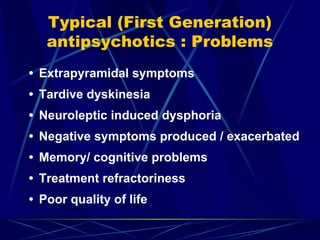
Typical (First Generation)
antipsychotics : Problems
• Extrapyramidal symptoms
• Tardive dyskinesia
• Neuroleptic induced dysphoria
• Negative symptoms produced / exacerbated
• Memory/ cognitive problems
• Treatment refractoriness
• Poor quality of life
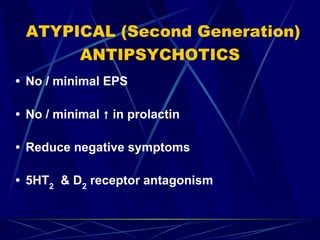
ATYPICAL (Second Generation)
ANTIPSYCHOTICS
• No / minimal EPS
• No / minimal ↑ in prolactin
• Reduce negative symptoms
• 5HT2
& D2
receptor antagonism
ATYPICAL ANTIPSYCHOTICS :
Mechanism of Action
• Antipsychotic efficacy : 60-80% D2
receptor
blockade (clozapine/ quetiapine-different)
• Fast-off theory (Loose binding, fast release)
Low EPS/ TD/ ↑ prolactin
• EPS avoided : ? 5-HT blockade
CLOZAPINE
• Pharmacokinetics
➢ Peak : 2 hours
➢ t½ (elimination) : 12 hours
➢ Extensive first pass metabolism
• Plasma monitoring useful
Adverse Effects
• Sialorrhea
• Anticholinergic effects
• CVS effects
• Weight gain / hyperglycemia
• Urogenital effects
• NMS
• EPS
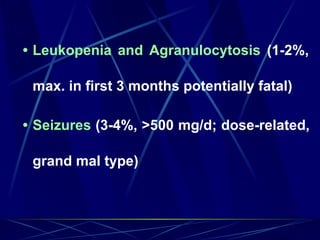
• Leukopenia and Agranulocytosis (1-2%,
max. in first 3 months potentially fatal)
• Seizures (3-4%, >500 mg/d; dose-related,
grand mal type)
Uses
a) Schizophrenia
- Treatment resistant
- Treatment intolerant (severe EPS/TD)
- Negative symptoms
- Cognitive symptoms (verbal fluency,
not executive functioning)
- Suicidality
- Childhood onset
b) Schizoaffective disorder (esp. manic
features)
c) Aggression (psychosis, dementia)
d) Affective disorder (treatment resistant mania,
psychotic depression)
e) Parkinsonism (Dopaminomimetic psychosis,
tremors)
f) ‘Dual diagnosis’ patients
Risperidone
Pharmacokinetics
• Peak : 3 hours
• Hepatic metabolism
• Metabolite similar to parent compound
• t½ = 22 hours
Adverse effects
• EPS (dose dependent, <haloperidol)
• Hyperprolactinemia
• Weight gain
• NMS
• O-C symptom emergence/exacerbation
• CVS (QTc prolongation, bradycardia)
• Urogenital effects
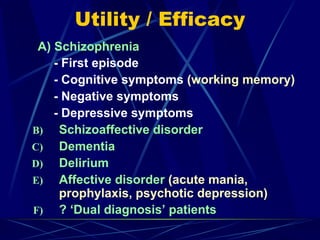
Utility / Efficacy
A) Schizophrenia
- First episode
- Cognitive symptoms (working memory)
- Negative symptoms
- Depressive symptoms
B) Schizoaffective disorder
C) Dementia
D) Delirium
E) Affective disorder (acute mania,
prophylaxis, psychotic depression)
F) ? ‘Dual diagnosis’ patients
Olanzapine
Pharmacokinetics
• Peak : 5 hours
• t½ = 31 hours
• High protein binding
• Weak hepatic enzyme effect
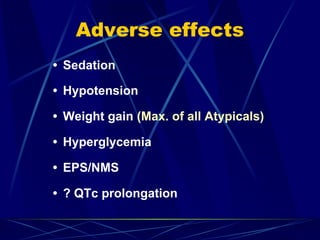
Adverse effects
• Sedation
• Hypotension
• Weight gain (Max. of all Atypicals)
• Hyperglycemia
• EPS/NMS
• ? QTc prolongation
Utility / Efficacy
a) Schizophrenia - Negative symptoms
- Depressive symptoms
- COS
- Cognitive symptoms
b) First episode psychosis
c) Parkinsonism
d) Dementia
e) Affective disorders
Ziprasidone
• Pharmacokinetics
- Peak = 2-6 hrs
- t½ = 3-10 hrs
- extensive hepatic metabolism
• Low affinity for H1
receptors
• Inhibits 5-HT & NE uptake
Adverse Effects
• Somnolence
• Dizziness
• QTc prolongation
• Nausea
Utility / Efficacy
a) Schizophrenia - Positive symptoms
- Negative symptoms
- Depressive symptoms
b) Schizoaffective disorder
Quetiapine
Pharmacokinetics
• Rapid absorption
• t½ = 6 hrs (steady state ~ 2 days)
• CYP3A4 metabolism
• Linear pharmacokinetics
• Reduced clearance in renal / hepatic
dysfunction and elderly
Pharmacodynamics
• D2
receptor occupancy = 30-41% (lower for
striatum)
• 5-HT2A
receptor occupancy = 57-74%
32% (striatum)
• D2
/D3
receptor occupancy
60% (temporal cortex)
Adverse effects
• Commonest – headache, somnolence,
dizziness
• Lenticular opacities (rare, 6-12 mths of
treatment)
• Thyroid : ↑ TSH
• Liver Functions: ↑ AST (reversible,
transient, first 3 weeks)
• Seizures : 0.8% prevalence
• Orthostatic hypotension / tachycardia
• EPS : minimal; no dose – dependent
increase
• Hyperprolactinemia : absent
• Weight gain : minimal
• Hyperglycemia / DM : minimal
• QTc prolongation : absent / minimal
Utility / Efficacy
a) Schizophrenia :
- Positive symptoms (at higher doses; c.f. HPL)
- Negative symptoms (c.f. HPL)
- Cognitive symptoms (significant, memory/ attention/
executive functions)
- Depressive symptoms
- Aggressive symptoms (±)
- Late onset schizophrenia
- Childhood onset schizophrenia
b) Dementia (aggression > psychosis, better functional
status, especially Alzheimer’s/ Lewy Body)
c) Mood disorders
- Mania/ Bipolar disorders (including RCAD)
- Psychotic depression (?)
- Unipolar depression/ dysthymia
(adjunct with SSRI)
d) OCD (treatment refractory, augmentor)
e) PTSD
f) Autism
g) Personality disorders (ASPD/BPD, for
aggression)
h) Delirium
i) Parkinsonism (dopaminomimetic psychosis)
j) ‘Dual diagnosis’ patients (stimulants / alcohol)
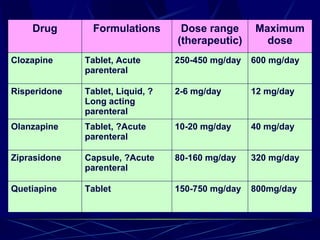
Drug Formulations Dose range
(therapeutic)
Maximum
dose
Clozapine Tablet, Acute
parenteral
250-450 mg/day 600 mg/day
Risperidone Tablet, Liquid, ?
Long acting
parenteral
2-6 mg/day 12 mg/day
Olanzapine Tablet, ?Acute
parenteral
10-20 mg/day 40 mg/day
Ziprasidone Capsule, ?Acute
parenteral
80-160 mg/day 320 mg/day
Quetiapine Tablet 150-750 mg/day 800mg/day
ATYPICAL (THIRD GENERATION)
ANTIPSYCHOTIC
• Most recent addition to the
class of ‘Atypical
antipsychotics’
• Quinilinone derivative
ARIPIPRAZOLE
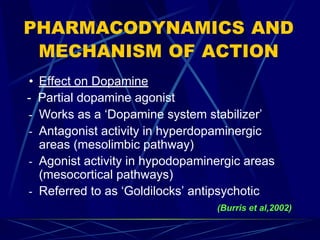
PHARMACODYNAMICS AND
MECHANISM OF ACTION
• Effect on Dopamine
- Partial dopamine agonist
- Works as a ‘Dopamine system stabilizer’
- Antagonist activity in hyperdopaminergic
areas (mesolimbic pathway)
- Agonist activity in hypodopaminergic areas
(mesocortical pathways)
- Referred to as ‘Goldilocks’ antipsychotic
(Burris et al,2002)
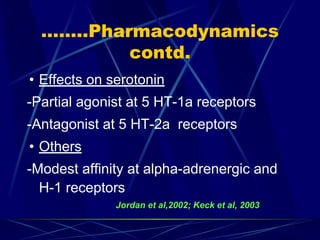
……..Pharmacodynamics
contd.
• Effects on serotonin
-Partial agonist at 5 HT-1a receptors
-Antagonist at 5 HT-2a receptors
• Others
-Modest affinity at alpha-adrenergic and
H-1 receptors
Jordan et al,2002; Keck et al, 2003
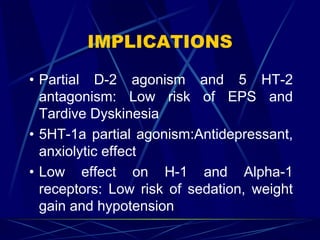
IMPLICATIONS
• Partial D-2 agonism and 5 HT-2
antagonism: Low risk of EPS and
Tardive Dyskinesia
• 5HT-1a partial agonism:Antidepressant,
anxiolytic effect
• Low effect on H-1 and Alpha-1
receptors: Low risk of sedation, weight
gain and hypotension
PHARMACOKINETICS
• Bioavailability: 87%
• Mean Tmax: 3 hrs; Mean T1/2: 75 hrs
• Protien-binding: 99%
• Metabolism: CYP 2D6, CYP 3A4
• Active metabolite: Dehydroaripiprazole
• Administration of food: Delays T max by 3
hrs, no effect on absorption
Mallikarjun et al, 2000
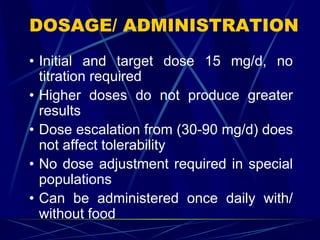
DOSAGE/ ADMINISTRATION
• Initial and target dose 15 mg/d, no
titration required
• Higher doses do not produce greater
results
• Dose escalation from (30-90 mg/d) does
not affect tolerability
• No dose adjustment required in special
populations
• Can be administered once daily with/
without food
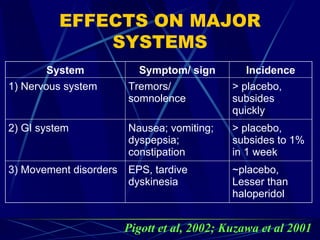
EFFECTS ON MAJOR
SYSTEMS
System Symptom/ sign Incidence
1) Nervous system Tremors/
somnolence
> placebo,
subsides
quickly
2) GI system Nausea; vomiting;
dyspepsia;
constipation
> placebo,
subsides to 1%
in 1 week
3) Movement disorders EPS, tardive
dyskinesia
~placebo,
Lesser than
haloperidol
Pigott et al, 2002; Kuzawa et al 2001
2nd
Generation Antipsychotic
Medication- SGAMs
New Drugs:
• Dopamine receptor partial agonist:
Iloperidone, apomorphine, preclamol
• Serotonin-receptor modulators:
● Pipamerone: selective 5HT2
/ dopamine
antagonist
● MDL 100, 907 pure 5HT2A
antagonist
● ORG 5222: 5HT2A
5HT 2c,
5HT 6, 7,
antagonist and 5HT1d
agonist
2nd
Generation Antipsychotic
Medication- SGAMs
New Drugs:
NMDA Receptors agonists:
• High dose of glycine: improvement in
–ve
• d-serine: improvement in –ve,
psychosis and cognitive functioning
• D-cycloserine: improvement in –ve
when added to conventional
antipsychotic
• CX516: improves attention, memory
2nd
Generation Antipsychotic
Medication- SGAMs
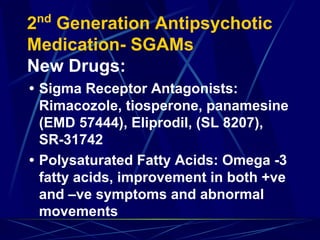
New Drugs:
• Sigma Receptor Antagonists:
Rimacozole, tiosperone, panamesine
(EMD 57444), Eliprodil, (SL 8207),
SR-31742
• Polysaturated Fatty Acids: Omega -3
fatty acids, improvement in both +ve
and –ve symptoms and abnormal
movements
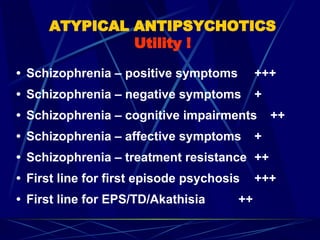
ATYPICAL ANTIPSYCHOTICS
Utility !
• Schizophrenia – positive symptoms +++
• Schizophrenia – negative symptoms +
• Schizophrenia – cognitive impairments ++
• Schizophrenia – affective symptoms +
• Schizophrenia – treatment resistance ++
• First line for first episode psychosis +++
• First line for EPS/TD/Akathisia ++
ATYPICAL ANTIPSYCHOTICS
Utility !
• First line for Parkinsonism and
psychosis +++
• Elderly with psychotic disorders +
• Children
• Delirium +
• Mood disorders +
• Dementia (aggression) ++
• Cost effectiveness
• Quality of Life
• Compliance
• EPS
ATYPICAL ANTIPSYCHOTICS
Utility ?
ATYPICAL ANTIPSYCHOTICS
Harm !
• Weight gain
• Hyperglycemia
• Hyperlipidemia
• QTc prolongation
• Seizures
• Agranulocytosis
• Controlled trials : few
• Long term trials : minimal
• Across culture trials : absent
• Head to head comparison with first
generation antipsychotics : few
• Head to head comparison between second
generation antipsychotics : few
• Trials with ‘at risk’ (elderly, children, women
in reproductive age group) population :
minimal
ATYPICAL ANTIPSYCHOTICS
Problems !

Antipsychotics

  • 1.
    Typical (First Generation) antipsychotics: Problems • Extrapyramidal symptoms • Tardive dyskinesia • Neuroleptic induced dysphoria • Negative symptoms produced / exacerbated • Memory/ cognitive problems • Treatment refractoriness • Poor quality of life
  • 8.
    ATYPICAL (Second Generation) ANTIPSYCHOTICS •No / minimal EPS • No / minimal ↑ in prolactin • Reduce negative symptoms • 5HT2 & D2 receptor antagonism
  • 9.
    ATYPICAL ANTIPSYCHOTICS : Mechanismof Action • Antipsychotic efficacy : 60-80% D2 receptor blockade (clozapine/ quetiapine-different) • Fast-off theory (Loose binding, fast release) Low EPS/ TD/ ↑ prolactin • EPS avoided : ? 5-HT blockade
  • 10.
  • 11.
    • Pharmacokinetics ➢ Peak: 2 hours ➢ t½ (elimination) : 12 hours ➢ Extensive first pass metabolism • Plasma monitoring useful
  • 12.
    Adverse Effects • Sialorrhea •Anticholinergic effects • CVS effects • Weight gain / hyperglycemia • Urogenital effects • NMS • EPS
  • 13.
    • Leukopenia andAgranulocytosis (1-2%, max. in first 3 months potentially fatal) • Seizures (3-4%, >500 mg/d; dose-related, grand mal type)
  • 14.
    Uses a) Schizophrenia - Treatmentresistant - Treatment intolerant (severe EPS/TD) - Negative symptoms - Cognitive symptoms (verbal fluency, not executive functioning) - Suicidality - Childhood onset
  • 15.
    b) Schizoaffective disorder(esp. manic features) c) Aggression (psychosis, dementia) d) Affective disorder (treatment resistant mania, psychotic depression) e) Parkinsonism (Dopaminomimetic psychosis, tremors) f) ‘Dual diagnosis’ patients
  • 16.
  • 17.
    Pharmacokinetics • Peak :3 hours • Hepatic metabolism • Metabolite similar to parent compound • t½ = 22 hours
  • 18.
    Adverse effects • EPS(dose dependent, <haloperidol) • Hyperprolactinemia • Weight gain • NMS • O-C symptom emergence/exacerbation • CVS (QTc prolongation, bradycardia) • Urogenital effects
  • 19.
    Utility / Efficacy A)Schizophrenia - First episode - Cognitive symptoms (working memory) - Negative symptoms - Depressive symptoms B) Schizoaffective disorder C) Dementia D) Delirium E) Affective disorder (acute mania, prophylaxis, psychotic depression) F) ? ‘Dual diagnosis’ patients
  • 20.
  • 21.
    Pharmacokinetics • Peak :5 hours • t½ = 31 hours • High protein binding • Weak hepatic enzyme effect
  • 22.
    Adverse effects • Sedation •Hypotension • Weight gain (Max. of all Atypicals) • Hyperglycemia • EPS/NMS • ? QTc prolongation
  • 23.
    Utility / Efficacy a)Schizophrenia - Negative symptoms - Depressive symptoms - COS - Cognitive symptoms b) First episode psychosis c) Parkinsonism d) Dementia e) Affective disorders
  • 24.
  • 25.
    • Pharmacokinetics - Peak= 2-6 hrs - t½ = 3-10 hrs - extensive hepatic metabolism • Low affinity for H1 receptors • Inhibits 5-HT & NE uptake
  • 26.
    Adverse Effects • Somnolence •Dizziness • QTc prolongation • Nausea
  • 27.
    Utility / Efficacy a)Schizophrenia - Positive symptoms - Negative symptoms - Depressive symptoms b) Schizoaffective disorder
  • 28.
  • 29.
    Pharmacokinetics • Rapid absorption •t½ = 6 hrs (steady state ~ 2 days) • CYP3A4 metabolism • Linear pharmacokinetics • Reduced clearance in renal / hepatic dysfunction and elderly
  • 30.
    Pharmacodynamics • D2 receptor occupancy= 30-41% (lower for striatum) • 5-HT2A receptor occupancy = 57-74% 32% (striatum) • D2 /D3 receptor occupancy 60% (temporal cortex)
  • 31.
    Adverse effects • Commonest– headache, somnolence, dizziness • Lenticular opacities (rare, 6-12 mths of treatment) • Thyroid : ↑ TSH • Liver Functions: ↑ AST (reversible, transient, first 3 weeks) • Seizures : 0.8% prevalence • Orthostatic hypotension / tachycardia
  • 32.
    • EPS :minimal; no dose – dependent increase • Hyperprolactinemia : absent • Weight gain : minimal • Hyperglycemia / DM : minimal • QTc prolongation : absent / minimal
  • 33.
    Utility / Efficacy a)Schizophrenia : - Positive symptoms (at higher doses; c.f. HPL) - Negative symptoms (c.f. HPL) - Cognitive symptoms (significant, memory/ attention/ executive functions) - Depressive symptoms - Aggressive symptoms (±) - Late onset schizophrenia - Childhood onset schizophrenia b) Dementia (aggression > psychosis, better functional status, especially Alzheimer’s/ Lewy Body)
  • 34.
    c) Mood disorders -Mania/ Bipolar disorders (including RCAD) - Psychotic depression (?) - Unipolar depression/ dysthymia (adjunct with SSRI) d) OCD (treatment refractory, augmentor) e) PTSD f) Autism g) Personality disorders (ASPD/BPD, for aggression) h) Delirium i) Parkinsonism (dopaminomimetic psychosis) j) ‘Dual diagnosis’ patients (stimulants / alcohol)
  • 35.
    Drug Formulations Doserange (therapeutic) Maximum dose Clozapine Tablet, Acute parenteral 250-450 mg/day 600 mg/day Risperidone Tablet, Liquid, ? Long acting parenteral 2-6 mg/day 12 mg/day Olanzapine Tablet, ?Acute parenteral 10-20 mg/day 40 mg/day Ziprasidone Capsule, ?Acute parenteral 80-160 mg/day 320 mg/day Quetiapine Tablet 150-750 mg/day 800mg/day
  • 36.
    ATYPICAL (THIRD GENERATION) ANTIPSYCHOTIC •Most recent addition to the class of ‘Atypical antipsychotics’ • Quinilinone derivative ARIPIPRAZOLE
  • 37.
    PHARMACODYNAMICS AND MECHANISM OFACTION • Effect on Dopamine - Partial dopamine agonist - Works as a ‘Dopamine system stabilizer’ - Antagonist activity in hyperdopaminergic areas (mesolimbic pathway) - Agonist activity in hypodopaminergic areas (mesocortical pathways) - Referred to as ‘Goldilocks’ antipsychotic (Burris et al,2002)
  • 38.
    ……..Pharmacodynamics contd. • Effects onserotonin -Partial agonist at 5 HT-1a receptors -Antagonist at 5 HT-2a receptors • Others -Modest affinity at alpha-adrenergic and H-1 receptors Jordan et al,2002; Keck et al, 2003
  • 39.
    IMPLICATIONS • Partial D-2agonism and 5 HT-2 antagonism: Low risk of EPS and Tardive Dyskinesia • 5HT-1a partial agonism:Antidepressant, anxiolytic effect • Low effect on H-1 and Alpha-1 receptors: Low risk of sedation, weight gain and hypotension
  • 40.
    PHARMACOKINETICS • Bioavailability: 87% •Mean Tmax: 3 hrs; Mean T1/2: 75 hrs • Protien-binding: 99% • Metabolism: CYP 2D6, CYP 3A4 • Active metabolite: Dehydroaripiprazole • Administration of food: Delays T max by 3 hrs, no effect on absorption Mallikarjun et al, 2000
  • 41.
    DOSAGE/ ADMINISTRATION • Initialand target dose 15 mg/d, no titration required • Higher doses do not produce greater results • Dose escalation from (30-90 mg/d) does not affect tolerability • No dose adjustment required in special populations • Can be administered once daily with/ without food
  • 42.
    EFFECTS ON MAJOR SYSTEMS SystemSymptom/ sign Incidence 1) Nervous system Tremors/ somnolence > placebo, subsides quickly 2) GI system Nausea; vomiting; dyspepsia; constipation > placebo, subsides to 1% in 1 week 3) Movement disorders EPS, tardive dyskinesia ~placebo, Lesser than haloperidol Pigott et al, 2002; Kuzawa et al 2001
  • 43.
    2nd Generation Antipsychotic Medication- SGAMs NewDrugs: • Dopamine receptor partial agonist: Iloperidone, apomorphine, preclamol • Serotonin-receptor modulators: ● Pipamerone: selective 5HT2 / dopamine antagonist ● MDL 100, 907 pure 5HT2A antagonist ● ORG 5222: 5HT2A 5HT 2c, 5HT 6, 7, antagonist and 5HT1d agonist
  • 44.
    2nd Generation Antipsychotic Medication- SGAMs NewDrugs: NMDA Receptors agonists: • High dose of glycine: improvement in –ve • d-serine: improvement in –ve, psychosis and cognitive functioning • D-cycloserine: improvement in –ve when added to conventional antipsychotic • CX516: improves attention, memory
  • 45.
    2nd Generation Antipsychotic Medication- SGAMs NewDrugs: • Sigma Receptor Antagonists: Rimacozole, tiosperone, panamesine (EMD 57444), Eliprodil, (SL 8207), SR-31742 • Polysaturated Fatty Acids: Omega -3 fatty acids, improvement in both +ve and –ve symptoms and abnormal movements
  • 46.
    ATYPICAL ANTIPSYCHOTICS Utility ! •Schizophrenia – positive symptoms +++ • Schizophrenia – negative symptoms + • Schizophrenia – cognitive impairments ++ • Schizophrenia – affective symptoms + • Schizophrenia – treatment resistance ++ • First line for first episode psychosis +++ • First line for EPS/TD/Akathisia ++
  • 47.
    ATYPICAL ANTIPSYCHOTICS Utility ! •First line for Parkinsonism and psychosis +++ • Elderly with psychotic disorders + • Children • Delirium + • Mood disorders + • Dementia (aggression) ++
  • 48.
    • Cost effectiveness •Quality of Life • Compliance • EPS ATYPICAL ANTIPSYCHOTICS Utility ?
  • 49.
    ATYPICAL ANTIPSYCHOTICS Harm ! •Weight gain • Hyperglycemia • Hyperlipidemia • QTc prolongation • Seizures • Agranulocytosis
  • 50.
    • Controlled trials: few • Long term trials : minimal • Across culture trials : absent • Head to head comparison with first generation antipsychotics : few • Head to head comparison between second generation antipsychotics : few • Trials with ‘at risk’ (elderly, children, women in reproductive age group) population : minimal ATYPICAL ANTIPSYCHOTICS Problems !