
ANTIMICROBIAL PROPHYLAXIS IN SURGERY
ARWA M. AMIN MOSTAFA
PHD & M.PHARM CLINICAL PHARMCY, DIPMGT, B.PHARM.
ARWA M. AMIN
WHAT WE WILL DISCUSS TODAY?
•What is Antimicrobial prophylaxis in Surgery (APS)? What is the goal of APS?
•What is surgical site infections (SSIs)?
•What is the impact of SSIs on health care system?
•What is the Classification of SSIs?
•What are the risk factors for SSIs?
•What are the sources of SSIs pathogens?
•What are the most common pathogens of SSIs?
•What are the clinical signs and symptoms of SSIs?
•What is the Classification of Surgical wounds?
•What are the main Principles of antimicrobial prophylaxis in surgery?
•What are the factors that affect the choice of Antimicrobial agent for APS?
•What are the general approach and the recommendation for specific types of surgeries?
•What are the effective institutional strategies for appropriate APS?
ARWA M. AMIN
ANTIMICROBIAL PROPHYLAXIS IN SURGERY
Antimicrobial prophylactic therapy in surgery (APS) is the
providing of antimicrobial therapy before the contamination
of previously sterile tissue or fluids (before
surgery/Procedure) due to the expected risk of infection.
Goal of Antimicrobial Prophylaxis in Surgery (APS):
To prevent & reduce the incidence of surgical site infections
(SSIs) in high-risk patients or procedure.
Surgical site infections (SSIs): an infection that occurs after
surgery in the part of the body where the surgery took place
within 30 days post procedure or one year (if there is
prosthetic implant).
ARWA M. AMIN
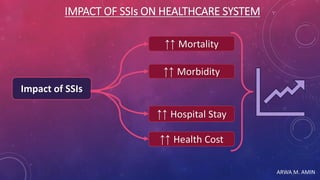
IMPACT OF SSIs ON HEALTHCARE SYSTEM
Impact of SSIs
↑↑ Mortality
↑↑ Morbidity
↑↑ Health Cost
↑↑ Hospital Stay
ARWA M. AMIN
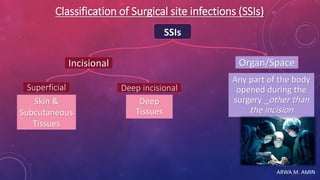
Classification of Surgical site infections (SSIs)
Any part of the body
opened during the
surgery _other than
the incision
Superficial
SSIs
Organ/SpaceIncisional
Deep incisional
Skin &
Subcutaneous
Tissues
Deep
Tissues
ARWA M. AMIN
Classifications of Surgical site infections (SSIs)
SSIs
Incisional
Superficial
Deep incisional
Organ/Space
Figure Source: Horan TC et al (1992). CDC Definitions of Nosocomial Surgical Site Infections, 1992: A
Modification of CDC Definitions of Surgical Wound Infections, Infect Control HospEpidemiology
ARWA M. AMIN
Risk Factors of SSIs
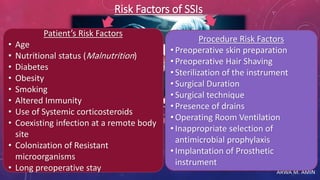
Patient’s Risk Factors
• Age
• Nutritional status (Malnutrition)
• Diabetes
• Obesity
• Smoking
• Altered Immunity
• Use of Systemic corticosteroids
• Coexisting infection at a remote body
site
• Colonization of Resistant
microorganisms
• Long preoperative stay
Procedure Risk Factors
• Preoperative skin preparation
• Preoperative Hair Shaving
• Sterilization of the instrument
• Surgical Duration
• Surgical technique
• Presence of drains
• Operating Room Ventilation
• Inappropriate selection of
antimicrobial prophylaxis
• Implantation of Prosthetic
instrument
ARWA M. AMIN
SOURCES OF SSI PATHOGENS
OR: Operation Room (Operation Theater)
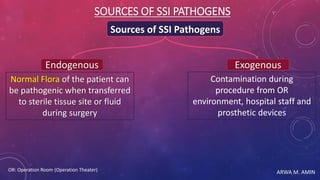
Sources of SSI Pathogens
Endogenous Exogenous
Normal Flora of the patient can
be pathogenic when transferred
to sterile tissue site or fluid
during surgery
Contamination during
procedure from OR
environment, hospital staff and
prosthetic devices
ARWA M. AMINPseudomonas aeruginosa
Common Pathogens in SSIs
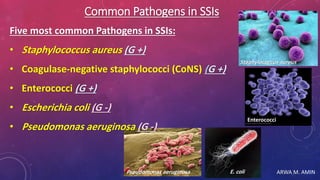
Five most common Pathogens in SSIs:
• Staphylococcus aureus (G +)
• Coagulase-negative staphylococci (CoNS) (G +)
• Enterococci (G +)
• Escherichia coli (G -)
• Pseudomonas aeruginosa (G -)
Staphylococcus aureus
Enterococci
E. coli
ARWA M. AMIN
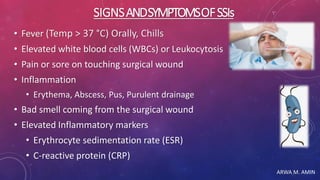
SIGNSANDSYMPTOMSOFSSIs
• Fever (Temp > 37 °C) Orally, Chills
• Elevated white blood cells (WBCs) or Leukocytosis
• Pain or sore on touching surgical wound
• Inflammation
• Erythema, Abscess, Pus, Purulent drainage
• Bad smell coming from the surgical wound
• Elevated Inflammatory markers
• Erythrocyte sedimentation rate (ESR)
• C-reactive protein (CRP)
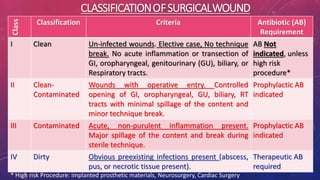
CLASSIFICATIONOFSURGICALWOUND
Antibiotic (AB)
Requirement
CriteriaClassification
Class
AB Not
indicated, unless
high risk
procedure*
Un-infected wounds. Elective case, No technique
break. No acute inflammation or transection of
GI, oropharyngeal, genitourinary (GU), biliary, or
Respiratory tracts.
CleanI
Prophylactic AB
indicated
Wounds with operative entry. Controlled
opening of GI, oropharyngeal, GU, biliary, RT
tracts with minimal spillage of the content and
minor technique break.
Clean-
Contaminated
II
Prophylactic AB
indicated
Acute, non-purulent inflammation present.
Major spillage of the content and break during
sterile technique.
ContaminatedIII
Therapeutic AB
required
Obvious preexisting infections present (abscess,
pus, or necrotic tissue present).
DirtyIV
* High risk Procedure: implanted prosthetic materials, Neurosurgery, Cardiac Surgery
ARWA M. AMIN
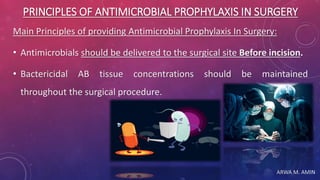
PRINCIPLES OF ANTIMICROBIAL PROPHYLAXIS IN SURGERY
Main Principles of providing Antimicrobial Prophylaxis In Surgery:
• Antimicrobials should be delivered to the surgical site Before incision.
• Bactericidal AB tissue concentrations should be maintained
throughout the surgical procedure.
ARWA M. AMIN
CHARACTERISTICS OF OPTIMAL AB FOR PROPHYLAXIS IN SURGERY
• Effective against Suspected Pathogens
• High tissue penetration
• Minimum Side-effects
• Long half-life
• Does not induce Bacterial Resistance
• Cost effective
ARWA M. AMIN
CHOOSING ANTIMICROBIAL AGENT FOR SURGICAL PROPHYLAXIS
•Type of Surgery
•Commonly Identified Pathogens (Anticipated organisms)
•Safety and Efficacy of Antimicrobial agent
•Resistance Pattern
•Literature evidence supporting the use of Antimicrobial
agent
•Cost Effectiveness
The Choice of Antimicrobial agent for surgical prophylaxis depends on the
following factors:
ARWA M. AMIN
GENERAL APPROACH FOR AB PROPHYLACTIC THERAPY
• First Line is 1st generation Cephalosporins (Cefazolin 1-2 g, IV), Why?
• Antimicrobial Spectrum (G + > G -)
• Safety (↓↓ Side-effects)
• Cost effective
• 2nd generation Cephalosporins (Cefoxitin 2 g, IV & Cefotetan 1-2g, IV), if:
• Broad-spectrum anaerobic and G (-) coverage is desired.
• Vancomycin 1 g (15mg/Kg)*, Only if:
• Patient with history of life-threatening β-lactam hypersensitivity
• Incidence of methicillin resistant staphylococcus aureus (MRSA) is
documented or highly suspected.
* Dose should be adjusted for patients with renal function impairment
ARWA M. AMIN
GENERAL APPROACH FOR AB PROPHYLACTIC THERAPY
Dose and Frequency
• High dose of the AB
• IV: Cefazolin 1-2 g,
• Cefoxitin 2 g, Cefotetan 1-2g
• Single Dose of AB prophylaxis should be given for most of the procedures.
• Re-dosing for AB with short half-life (e.g. Cefazolin) if:
• Prolonged Surgery (> 3 hours or > 2.5 of AB half-life)
• Contamination during procedure
• Large Blood Loss
Route
• Parenteral AB administration is preferred, why?
• Because of its reliability in achieving suitable tissue concentrations.
ARWA M. AMIN
GENERAL APPROACH FOR AB PROPHYLACTIC THERAPY
Timing:
• Administration Time:
• AB for prophylactic therapy should be administered Before Incision
(within 1 hour Before the surgery), why?
• To ensure sufficient drug levels at the surgical site before the
surgery
• Duration
• 24 hours Maximum
ARWA M. AMIN
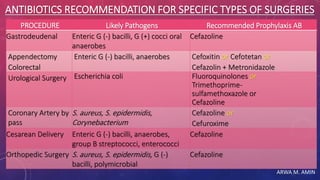
PROCEDURE Likely Pathogens Recommended Prophylaxis AB
Gastrodeudenal Enteric G (-) bacilli, G (+) cocci oral
anaerobes
Cefazoline
Appendectomy
Colorectal
Enteric G (-) bacilli, anaerobes Cefoxitin or Cefotetan or
Cefazolin + Metronidazole
Urological Surgery Escherichia coli Fluoroquinolones or
Trimethoprime-
sulfamethoxazole or
Cefazoline
Coronary Artery by
pass
S. aureus, S. epidermidis,
Corynebacterium
Cefazoline or
Cefuroxime
Cesarean Delivery Enteric G (-) bacilli, anaerobes,
group B streptococci, enterococci
Cefazoline
Orthopedic Surgery S. aureus, S. epidermidis, G (-)
bacilli, polymicrobial
Cefazoline
ANTIBIOTICS RECOMMENDATION FOR SPECIFIC TYPES OF SURGERIES
ARWA M. AMIN
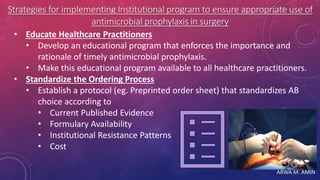
Strategies for implementing Institutional program to ensure appropriate use of
antimicrobial prophylaxis in surgery
• Educate Healthcare Practitioners
• Develop an educational program that enforces the importance and
rationale of timely antimicrobial prophylaxis.
• Make this educational program available to all healthcare practitioners.
• Standardize the Ordering Process
• Establish a protocol (eg. Preprinted order sheet) that standardizes AB
choice according to
• Current Published Evidence
• Formulary Availability
• Institutional Resistance Patterns
• Cost
ARWA M. AMIN
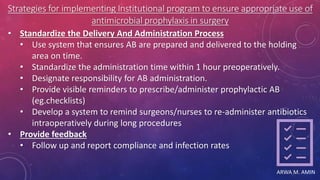
Strategies for implementing Institutional program to ensure appropriate use of
antimicrobial prophylaxis in surgery
• Standardize the Delivery And Administration Process
• Use system that ensures AB are prepared and delivered to the holding
area on time.
• Standardize the administration time within 1 hour preoperatively.
• Designate responsibility for AB administration.
• Provide visible reminders to prescribe/administer prophylactic AB
(eg.checklists)
• Develop a system to remind surgeons/nurses to re-administer antibiotics
intraoperatively during long procedures
• Provide feedback
• Follow up and report compliance and infection rates
ARWA M. AMIN

Antimicrobial Prophylaxis in Surgery

  • 1.
    ANTIMICROBIAL PROPHYLAXIS INSURGERY ARWA M. AMIN MOSTAFA PHD & M.PHARM CLINICAL PHARMCY, DIPMGT, B.PHARM.
  • 2.
    ARWA M. AMIN WHATWE WILL DISCUSS TODAY? •What is Antimicrobial prophylaxis in Surgery (APS)? What is the goal of APS? •What is surgical site infections (SSIs)? •What is the impact of SSIs on health care system? •What is the Classification of SSIs? •What are the risk factors for SSIs? •What are the sources of SSIs pathogens? •What are the most common pathogens of SSIs? •What are the clinical signs and symptoms of SSIs? •What is the Classification of Surgical wounds? •What are the main Principles of antimicrobial prophylaxis in surgery? •What are the factors that affect the choice of Antimicrobial agent for APS? •What are the general approach and the recommendation for specific types of surgeries? •What are the effective institutional strategies for appropriate APS?
  • 3.
    ARWA M. AMIN ANTIMICROBIALPROPHYLAXIS IN SURGERY Antimicrobial prophylactic therapy in surgery (APS) is the providing of antimicrobial therapy before the contamination of previously sterile tissue or fluids (before surgery/Procedure) due to the expected risk of infection. Goal of Antimicrobial Prophylaxis in Surgery (APS): To prevent & reduce the incidence of surgical site infections (SSIs) in high-risk patients or procedure. Surgical site infections (SSIs): an infection that occurs after surgery in the part of the body where the surgery took place within 30 days post procedure or one year (if there is prosthetic implant).
  • 4.
    ARWA M. AMIN IMPACTOF SSIs ON HEALTHCARE SYSTEM Impact of SSIs ↑↑ Mortality ↑↑ Morbidity ↑↑ Health Cost ↑↑ Hospital Stay
  • 5.
    ARWA M. AMIN Classificationof Surgical site infections (SSIs) Any part of the body opened during the surgery _other than the incision Superficial SSIs Organ/SpaceIncisional Deep incisional Skin & Subcutaneous Tissues Deep Tissues
  • 6.
    ARWA M. AMIN Classificationsof Surgical site infections (SSIs) SSIs Incisional Superficial Deep incisional Organ/Space Figure Source: Horan TC et al (1992). CDC Definitions of Nosocomial Surgical Site Infections, 1992: A Modification of CDC Definitions of Surgical Wound Infections, Infect Control HospEpidemiology
  • 7.
    ARWA M. AMIN RiskFactors of SSIs Patient’s Risk Factors • Age • Nutritional status (Malnutrition) • Diabetes • Obesity • Smoking • Altered Immunity • Use of Systemic corticosteroids • Coexisting infection at a remote body site • Colonization of Resistant microorganisms • Long preoperative stay Procedure Risk Factors • Preoperative skin preparation • Preoperative Hair Shaving • Sterilization of the instrument • Surgical Duration • Surgical technique • Presence of drains • Operating Room Ventilation • Inappropriate selection of antimicrobial prophylaxis • Implantation of Prosthetic instrument
  • 8.
    ARWA M. AMIN SOURCESOF SSI PATHOGENS OR: Operation Room (Operation Theater) Sources of SSI Pathogens Endogenous Exogenous Normal Flora of the patient can be pathogenic when transferred to sterile tissue site or fluid during surgery Contamination during procedure from OR environment, hospital staff and prosthetic devices
  • 9.
    ARWA M. AMINPseudomonasaeruginosa Common Pathogens in SSIs Five most common Pathogens in SSIs: • Staphylococcus aureus (G +) • Coagulase-negative staphylococci (CoNS) (G +) • Enterococci (G +) • Escherichia coli (G -) • Pseudomonas aeruginosa (G -) Staphylococcus aureus Enterococci E. coli
  • 10.
    ARWA M. AMIN SIGNSANDSYMPTOMSOFSSIs •Fever (Temp > 37 °C) Orally, Chills • Elevated white blood cells (WBCs) or Leukocytosis • Pain or sore on touching surgical wound • Inflammation • Erythema, Abscess, Pus, Purulent drainage • Bad smell coming from the surgical wound • Elevated Inflammatory markers • Erythrocyte sedimentation rate (ESR) • C-reactive protein (CRP)
  • 11.
    CLASSIFICATIONOFSURGICALWOUND Antibiotic (AB) Requirement CriteriaClassification Class AB Not indicated,unless high risk procedure* Un-infected wounds. Elective case, No technique break. No acute inflammation or transection of GI, oropharyngeal, genitourinary (GU), biliary, or Respiratory tracts. CleanI Prophylactic AB indicated Wounds with operative entry. Controlled opening of GI, oropharyngeal, GU, biliary, RT tracts with minimal spillage of the content and minor technique break. Clean- Contaminated II Prophylactic AB indicated Acute, non-purulent inflammation present. Major spillage of the content and break during sterile technique. ContaminatedIII Therapeutic AB required Obvious preexisting infections present (abscess, pus, or necrotic tissue present). DirtyIV * High risk Procedure: implanted prosthetic materials, Neurosurgery, Cardiac Surgery
  • 12.
    ARWA M. AMIN PRINCIPLESOF ANTIMICROBIAL PROPHYLAXIS IN SURGERY Main Principles of providing Antimicrobial Prophylaxis In Surgery: • Antimicrobials should be delivered to the surgical site Before incision. • Bactericidal AB tissue concentrations should be maintained throughout the surgical procedure.
  • 13.
    ARWA M. AMIN CHARACTERISTICSOF OPTIMAL AB FOR PROPHYLAXIS IN SURGERY • Effective against Suspected Pathogens • High tissue penetration • Minimum Side-effects • Long half-life • Does not induce Bacterial Resistance • Cost effective
  • 14.
    ARWA M. AMIN CHOOSINGANTIMICROBIAL AGENT FOR SURGICAL PROPHYLAXIS •Type of Surgery •Commonly Identified Pathogens (Anticipated organisms) •Safety and Efficacy of Antimicrobial agent •Resistance Pattern •Literature evidence supporting the use of Antimicrobial agent •Cost Effectiveness The Choice of Antimicrobial agent for surgical prophylaxis depends on the following factors:
  • 15.
    ARWA M. AMIN GENERALAPPROACH FOR AB PROPHYLACTIC THERAPY • First Line is 1st generation Cephalosporins (Cefazolin 1-2 g, IV), Why? • Antimicrobial Spectrum (G + > G -) • Safety (↓↓ Side-effects) • Cost effective • 2nd generation Cephalosporins (Cefoxitin 2 g, IV & Cefotetan 1-2g, IV), if: • Broad-spectrum anaerobic and G (-) coverage is desired. • Vancomycin 1 g (15mg/Kg)*, Only if: • Patient with history of life-threatening β-lactam hypersensitivity • Incidence of methicillin resistant staphylococcus aureus (MRSA) is documented or highly suspected. * Dose should be adjusted for patients with renal function impairment
  • 16.
    ARWA M. AMIN GENERALAPPROACH FOR AB PROPHYLACTIC THERAPY Dose and Frequency • High dose of the AB • IV: Cefazolin 1-2 g, • Cefoxitin 2 g, Cefotetan 1-2g • Single Dose of AB prophylaxis should be given for most of the procedures. • Re-dosing for AB with short half-life (e.g. Cefazolin) if: • Prolonged Surgery (> 3 hours or > 2.5 of AB half-life) • Contamination during procedure • Large Blood Loss Route • Parenteral AB administration is preferred, why? • Because of its reliability in achieving suitable tissue concentrations.
  • 17.
    ARWA M. AMIN GENERALAPPROACH FOR AB PROPHYLACTIC THERAPY Timing: • Administration Time: • AB for prophylactic therapy should be administered Before Incision (within 1 hour Before the surgery), why? • To ensure sufficient drug levels at the surgical site before the surgery • Duration • 24 hours Maximum
  • 18.
    ARWA M. AMIN PROCEDURELikely Pathogens Recommended Prophylaxis AB Gastrodeudenal Enteric G (-) bacilli, G (+) cocci oral anaerobes Cefazoline Appendectomy Colorectal Enteric G (-) bacilli, anaerobes Cefoxitin or Cefotetan or Cefazolin + Metronidazole Urological Surgery Escherichia coli Fluoroquinolones or Trimethoprime- sulfamethoxazole or Cefazoline Coronary Artery by pass S. aureus, S. epidermidis, Corynebacterium Cefazoline or Cefuroxime Cesarean Delivery Enteric G (-) bacilli, anaerobes, group B streptococci, enterococci Cefazoline Orthopedic Surgery S. aureus, S. epidermidis, G (-) bacilli, polymicrobial Cefazoline ANTIBIOTICS RECOMMENDATION FOR SPECIFIC TYPES OF SURGERIES
  • 19.
    ARWA M. AMIN Strategiesfor implementing Institutional program to ensure appropriate use of antimicrobial prophylaxis in surgery • Educate Healthcare Practitioners • Develop an educational program that enforces the importance and rationale of timely antimicrobial prophylaxis. • Make this educational program available to all healthcare practitioners. • Standardize the Ordering Process • Establish a protocol (eg. Preprinted order sheet) that standardizes AB choice according to • Current Published Evidence • Formulary Availability • Institutional Resistance Patterns • Cost
  • 20.
    ARWA M. AMIN Strategiesfor implementing Institutional program to ensure appropriate use of antimicrobial prophylaxis in surgery • Standardize the Delivery And Administration Process • Use system that ensures AB are prepared and delivered to the holding area on time. • Standardize the administration time within 1 hour preoperatively. • Designate responsibility for AB administration. • Provide visible reminders to prescribe/administer prophylactic AB (eg.checklists) • Develop a system to remind surgeons/nurses to re-administer antibiotics intraoperatively during long procedures • Provide feedback • Follow up and report compliance and infection rates
  • 21.