ANTIMICROBIALS
PRESENTED BY : SAMEEMA KIRAN
1
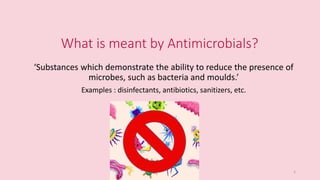
What is meant by Antimicrobials?
‘Substances which demonstrate the ability to reduce the presence of
microbes, such as bacteria and moulds.’
Examples : disinfectants, antibiotics, sanitizers, etc.
2
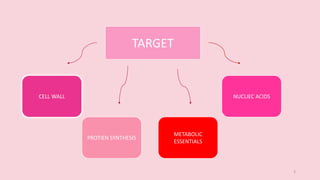
TARGET
CELL WALL
METABOLIC
ESSENTIALS
PROTIEN SYNTHESIS
NUCLIEC ACIDS
3
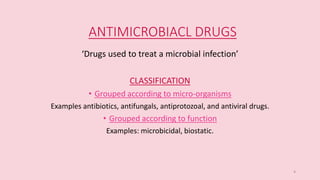
ANTIMICROBIACL DRUGS
‘Drugs used to treat a microbial infection’
CLASSIFICATION
• Grouped according to micro-organisms
Examples antibiotics, antifungals, antiprotozoal, and antiviral drugs.
• Grouped according to function
Examples: microbicidal, biostatic.
4
5
BROAD SPECTRUM ANTIMICROBIAL DRUGS
NARROW SPECTRUM ANTIMICROBIAL DRUGS
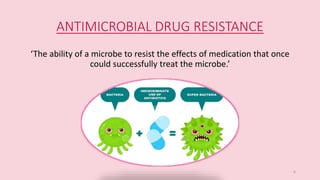
ANTIMICROBIAL DRUG RESISTANCE
‘The ability of a microbe to resist the effects of medication that once
could successfully treat the microbe.’
6
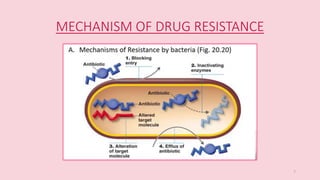
MECHANISM OF DRUG RESISTANCE
7
8
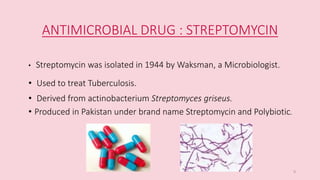
ANTIMICROBIAL DRUG : STREPTOMYCIN
• Streptomycin was isolated in 1944 by Waksman, a Microbiologist.
• Used to treat Tuberculosis.
• Derived from actinobacterium Streptomyces griseus.
• Produced in Pakistan under brand name Streptomycin and Polybiotic.
9
MODE OF ACTION
Inhibits protein synthesis and causes the death
of microbial cells.
10
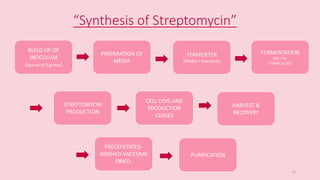
“Synthesis of Streptomycin”
BUILD UP OF
INOCULUM
(Spores of S.gireus)
FERMENTATION
(PH:7-8)
(TEMP:25-30)
FERMENTER
(Media + Inoculum)
CELL LYSIS AND
PRODUCTION
CEASES
HARVEST &
RECOVERY
PRECEPETATED-
WASHED-VACCUME
DRIED.
STREPTOMYCIN
PRODUCTION
PREPARATION OF
MEDIA
PURIFICATION
11
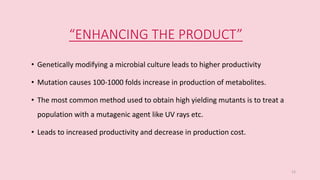
“ENHANCING THE PRODUCT”
• Genetically modifying a microbial culture leads to higher productivity
• Mutation causes 100-1000 folds increase in production of metabolites.
• The most common method used to obtain high yielding mutants is to treat a
population with a mutagenic agent like UV rays etc.
• Leads to increased productivity and decrease in production cost.
12
Streptomycin Resistance
• Dihydrostreptomycin is being produced due to ready development of
resistance against streptomycin
• Is a derivative of streptomycin
• Semisynthetic antibiotic
• Used in the treatment of tuberculosis.
13
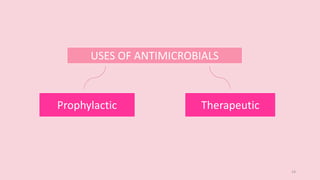
Prophylactic Therapeutic
USES OF ANTIMICROBIALS
14
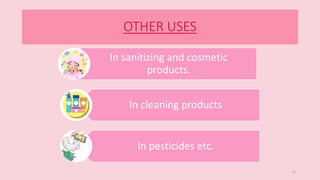
OTHER USES
15
In sanitizing and cosmetic
products.
In cleaning products
In pesticides etc.
CONCLUSION
Antimicrobial agents are a great and useful way in eliminating
infectious or harmful micro organisms and diseases caused by them but
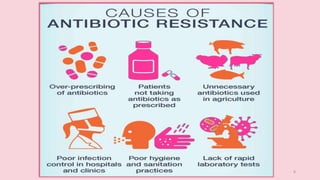
their improper and constant use can cause resistance in microbes
which is becoming a global issue at an alarming rate.
16
REFRENCES
•
Antimicrobial Agent - an overview | ScienceDirect Topicswww.sciencedirect.com
• http://ijpsr.com/bft-article/antibiotic-production-by-microbes-isolated-from-soil/?view=fulltext
• https://www.microbiologyresearch.org/content/journal/micro/10.1099/00221287-1-3-
335;jsessionid=QgLck4OyXG0E2fyB7hAT0NmS.mbslive-10-240-10-184
• http://www.biotechnologynotes.com/antibiotics/streptomycin/streptomycin-structure-
biosynthesis-process-and-uses-of-streptomycin-biotechnology/13848
• https://pubchem.ncbi.nlm.nih.gov/compound/Dihydrostreptomycin#section=Synonyms
17
18

Antimicrobial Drugs

  • 1.
  • 2.
    What is meantby Antimicrobials? ‘Substances which demonstrate the ability to reduce the presence of microbes, such as bacteria and moulds.’ Examples : disinfectants, antibiotics, sanitizers, etc. 2
  • 3.
  • 4.
    ANTIMICROBIACL DRUGS ‘Drugs usedto treat a microbial infection’ CLASSIFICATION • Grouped according to micro-organisms Examples antibiotics, antifungals, antiprotozoal, and antiviral drugs. • Grouped according to function Examples: microbicidal, biostatic. 4
  • 5.
    5 BROAD SPECTRUM ANTIMICROBIALDRUGS NARROW SPECTRUM ANTIMICROBIAL DRUGS
  • 6.
    ANTIMICROBIAL DRUG RESISTANCE ‘Theability of a microbe to resist the effects of medication that once could successfully treat the microbe.’ 6
  • 7.
    MECHANISM OF DRUGRESISTANCE 7
  • 8.
  • 9.
    ANTIMICROBIAL DRUG :STREPTOMYCIN • Streptomycin was isolated in 1944 by Waksman, a Microbiologist. • Used to treat Tuberculosis. • Derived from actinobacterium Streptomyces griseus. • Produced in Pakistan under brand name Streptomycin and Polybiotic. 9
  • 10.
    MODE OF ACTION Inhibitsprotein synthesis and causes the death of microbial cells. 10
  • 11.
    “Synthesis of Streptomycin” BUILDUP OF INOCULUM (Spores of S.gireus) FERMENTATION (PH:7-8) (TEMP:25-30) FERMENTER (Media + Inoculum) CELL LYSIS AND PRODUCTION CEASES HARVEST & RECOVERY PRECEPETATED- WASHED-VACCUME DRIED. STREPTOMYCIN PRODUCTION PREPARATION OF MEDIA PURIFICATION 11
  • 12.
    “ENHANCING THE PRODUCT” •Genetically modifying a microbial culture leads to higher productivity • Mutation causes 100-1000 folds increase in production of metabolites. • The most common method used to obtain high yielding mutants is to treat a population with a mutagenic agent like UV rays etc. • Leads to increased productivity and decrease in production cost. 12
  • 13.
    Streptomycin Resistance • Dihydrostreptomycinis being produced due to ready development of resistance against streptomycin • Is a derivative of streptomycin • Semisynthetic antibiotic • Used in the treatment of tuberculosis. 13
  • 14.
  • 15.
    OTHER USES 15 In sanitizingand cosmetic products. In cleaning products In pesticides etc.
  • 16.
    CONCLUSION Antimicrobial agents area great and useful way in eliminating infectious or harmful micro organisms and diseases caused by them but their improper and constant use can cause resistance in microbes which is becoming a global issue at an alarming rate. 16
  • 17.
    REFRENCES • Antimicrobial Agent -an overview | ScienceDirect Topicswww.sciencedirect.com • http://ijpsr.com/bft-article/antibiotic-production-by-microbes-isolated-from-soil/?view=fulltext • https://www.microbiologyresearch.org/content/journal/micro/10.1099/00221287-1-3- 335;jsessionid=QgLck4OyXG0E2fyB7hAT0NmS.mbslive-10-240-10-184 • http://www.biotechnologynotes.com/antibiotics/streptomycin/streptomycin-structure- biosynthesis-process-and-uses-of-streptomycin-biotechnology/13848 • https://pubchem.ncbi.nlm.nih.gov/compound/Dihydrostreptomycin#section=Synonyms 17
  • 18.

Editor's Notes

  • #14  It is used mostly in conjunction with para aminosalicyclic acid or isoniazid (isonicotinic acid hydrazide) which minimizes resistance build up in sensitive microorganisms.