Anticoagulation For Valvular
Heart Disease
Zeinab Noormonavar
Pharm D candidate
30/3/2022
1
2
3
Outline
At the end of presentation we’ll be able to:
• Approach to choose appropriate anticoagulant in patients with VHD.
• Identify the classification and pharmacological treatment modalities.
• Learn the different drugs used.
Valvular heart disease (VHD) is a condition in which any one of the four heart valves is
damaged or defective, resulting in improper blood flow throughout the heart.
Valvular heart disease (VHD) is a common contributor to cardiac morbidity and
mortality.
Chronic VHD can significantly decrease a patient’s quality of life and result in
distressing symptoms, such as exertional dyspnea or angina.
Most patients with VHD require surgery to repair or replace the valve and subsequent
antithrombotic therapy to prevent clotting.
4
Introduction
Caroline Sun, P. D. C. 2021 C. U. S. of P. I. (2021, February 12). Antithrombotic therapy in patients with valvular heart disease. U.S. Pharmacist – The Leading Journal in
Pharmacy. Retrieved March 30, 2022, from https://www.uspharmacist.com/article/antithrombotic-therapy-in-patients-with-valvular-heart-disease
Introduction (Cont’d)
Pathophysiology
VHD can be a
consequence of genetic
defects or acquired
etiology
calcific aortic valve
disease, which can range
from mild valve thickening
to severe calcification and
impairment of valve
movement.
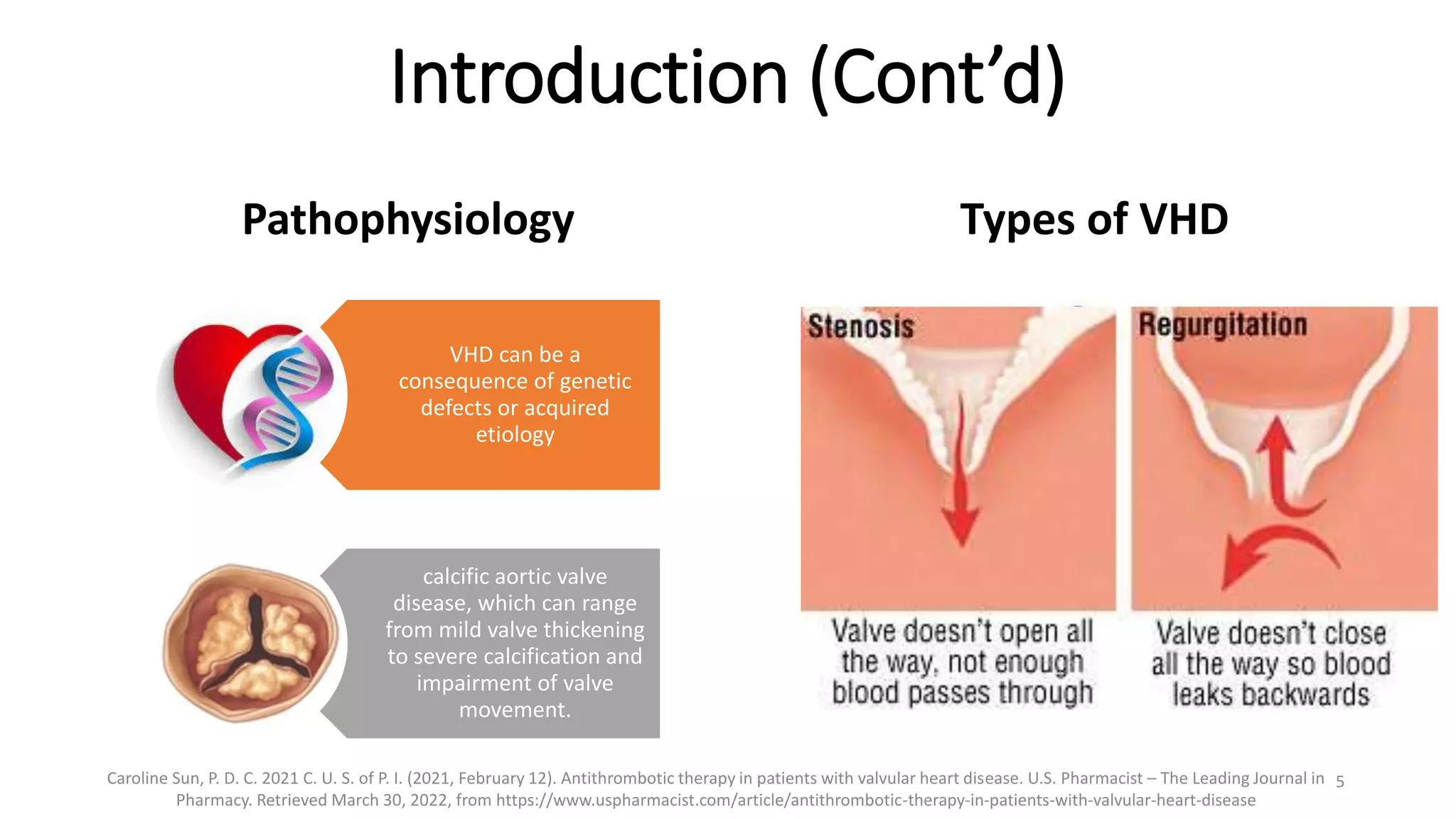
Types of VHD
1. Aortic Stenosis
2. Aortic Regurgitation
3. Mitral Stenosis
4. Mitral Regurgitation
5. Tricuspid Regurgitation
5
Caroline Sun, P. D. C. 2021 C. U. S. of P. I. (2021, February 12). Antithrombotic therapy in patients with valvular heart disease. U.S. Pharmacist – The Leading Journal in
Pharmacy. Retrieved March 30, 2022, from https://www.uspharmacist.com/article/antithrombotic-therapy-in-patients-with-valvular-heart-disease
Risk Factors
6
Advanced age Male gender Tobacco use Dyslipidemia
Rheumatic
Heart Disease
Hypertension
Caroline Sun, P. D. C. 2021 C. U. S. of P. I. (2021, February 12). Antithrombotic therapy in patients with valvular heart disease. U.S. Pharmacist – The Leading Journal in
Pharmacy. Retrieved March 30, 2022, from https://www.uspharmacist.com/article/antithrombotic-therapy-in-patients-with-valvular-heart-disease
Stages & Symptoms
• Stages of VHD range from stage A, where factors for developing VHD are identified, to
stage D, where a patient is experiencing more advanced symptoms.
7
Stages Definition Symptoms
A At risk of VHD None
B Progressive VHD None
C
Asymptomatic Severe VHD
None
(Exercise testing is reasonable)
C1
C2
Asymptomatic severe VHD with LV
systolic dysfunction
D
Symptomatic severe high-gradient
Dyspnea, decreased exercise
tolerance, angina, HF, syncope or
presyncope
D1
D2
Symptomatic severe low-flow,
low-gradient with reduced LVEF
HF, Angina, Syncope or presyncope
D3
Symptomatic severe low-gradient
AS with normal LVEF
Otto, C. M., Catherine M. Otto Search for more papers by this author, Nishimura, R. A., Rick A. Nishimura Search for more papers by this author, Bonow, R. O., Robert O. Bonow Search for more papers by this author, Carabello, B. A., Blase A. Carabello Search for more papers by
this author, III, J. P. E., John P. Erwin III Search for more papers by this author, Gentile, F., Federico Gentile Search for more papers by this author, Jneid, H., Hani Jneid Search for more papers by this author, Krieger, E. V., Eric V. Krieger Search for more papers by this author,
Mack, M., Michael Mack Search for more papers by this author, McLeod, C., … Al., E. (2020, December 17). 2020 ACC/AHA guideline for the management of patients with valvular heart disease: A report of the american college of cardiology/american heart association joint
committee on clinical practice guidelines. Circulation. Retrieved March 31, 2022, from https://www.ahajournals.org/doi/10.1161/CIR.0000000000000923#d1e4306
Caroline Sun, P. D. C. 2021 C. U. S. of P. I. (2021, February 12). Antithrombotic therapy in patients with valvular heart disease. U.S. Pharmacist – The Leading Journal in
Pharmacy. Retrieved March 30, 2022, from https://www.uspharmacist.com/article/antithrombotic-therapy-in-patients-with-valvular-heart-disease
Treatment Approach
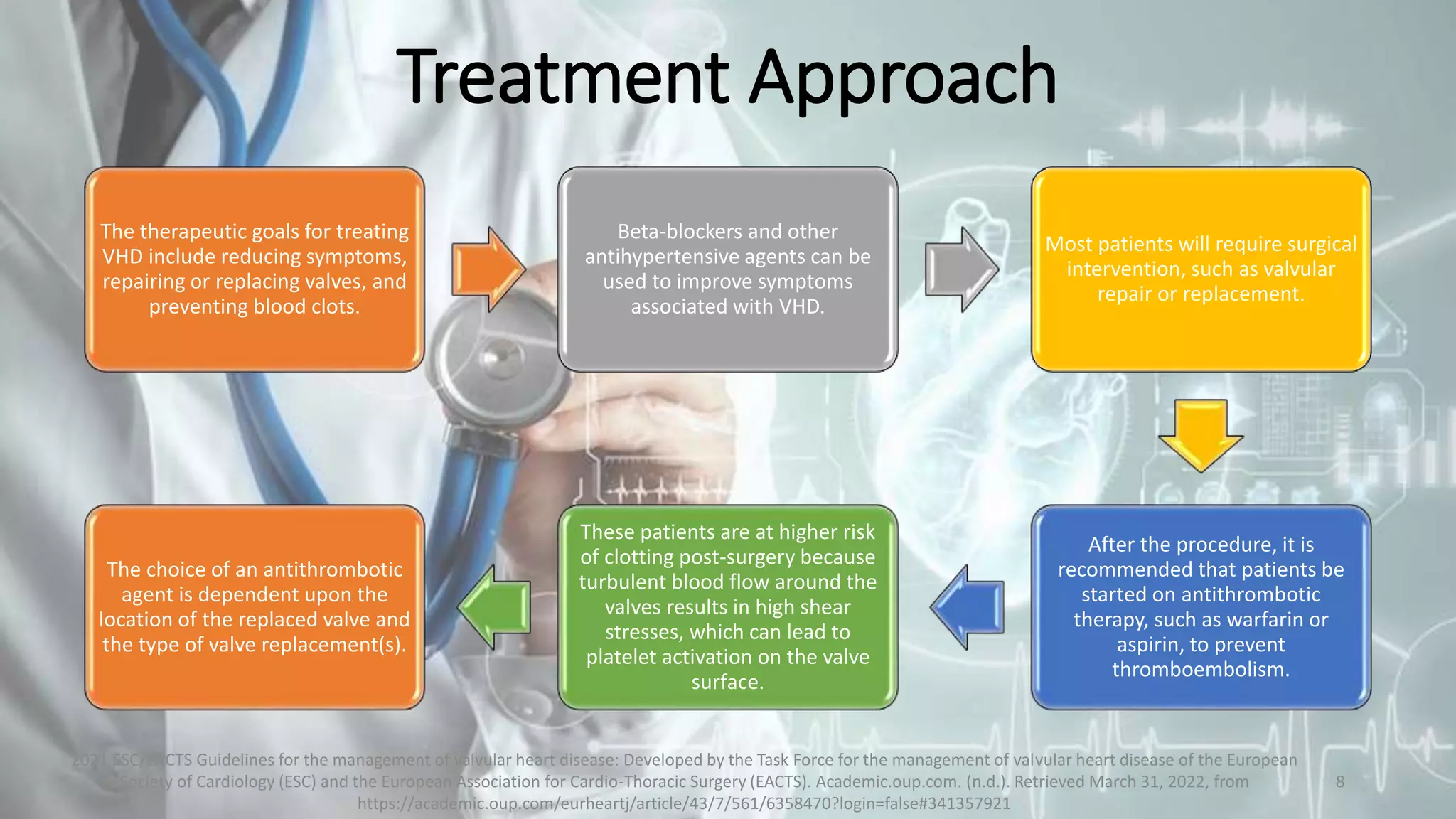
The therapeutic goals for treating
VHD include reducing symptoms,
repairing or replacing valves, and
preventing blood clots.
Beta-blockers and other
antihypertensive agents can be
used to improve symptoms
associated with VHD.
Most patients will require surgical
intervention, such as valvular
repair or replacement.
After the procedure, it is
recommended that patients be
started on antithrombotic
therapy, such as warfarin or
aspirin, to prevent
thromboembolism.
These patients are at higher risk
of clotting post-surgery because
turbulent blood flow around the
valves results in high shear
stresses, which can lead to
platelet activation on the valve
surface.
The choice of an antithrombotic
agent is dependent upon the
location of the replaced valve and
the type of valve replacement(s).
8
2021 ESC/EACTS Guidelines for the management of valvular heart disease: Developed by the Task Force for the management of valvular heart disease of the European
Society of Cardiology (ESC) and the European Association for Cardio-Thoracic Surgery (EACTS). Academic.oup.com. (n.d.). Retrieved March 31, 2022, from
https://academic.oup.com/eurheartj/article/43/7/561/6358470?login=false#341357921
Types Of Valve Replacement
• The type of valve replacement a patient receives is dependent on several factors,
including but not limited to:
9
Risk of
anticoagulation
complication
Life expectancy
Age
Patient
preference
Caroline Sun, P. D. C. 2021 C. U. S. of P. I. (2021, February 12). Antithrombotic therapy in patients with valvular heart disease. U.S. Pharmacist – The Leading Journal in
Pharmacy. Retrieved March 30, 2022, from https://www.uspharmacist.com/article/antithrombotic-therapy-in-patients-with-valvular-heart-disease
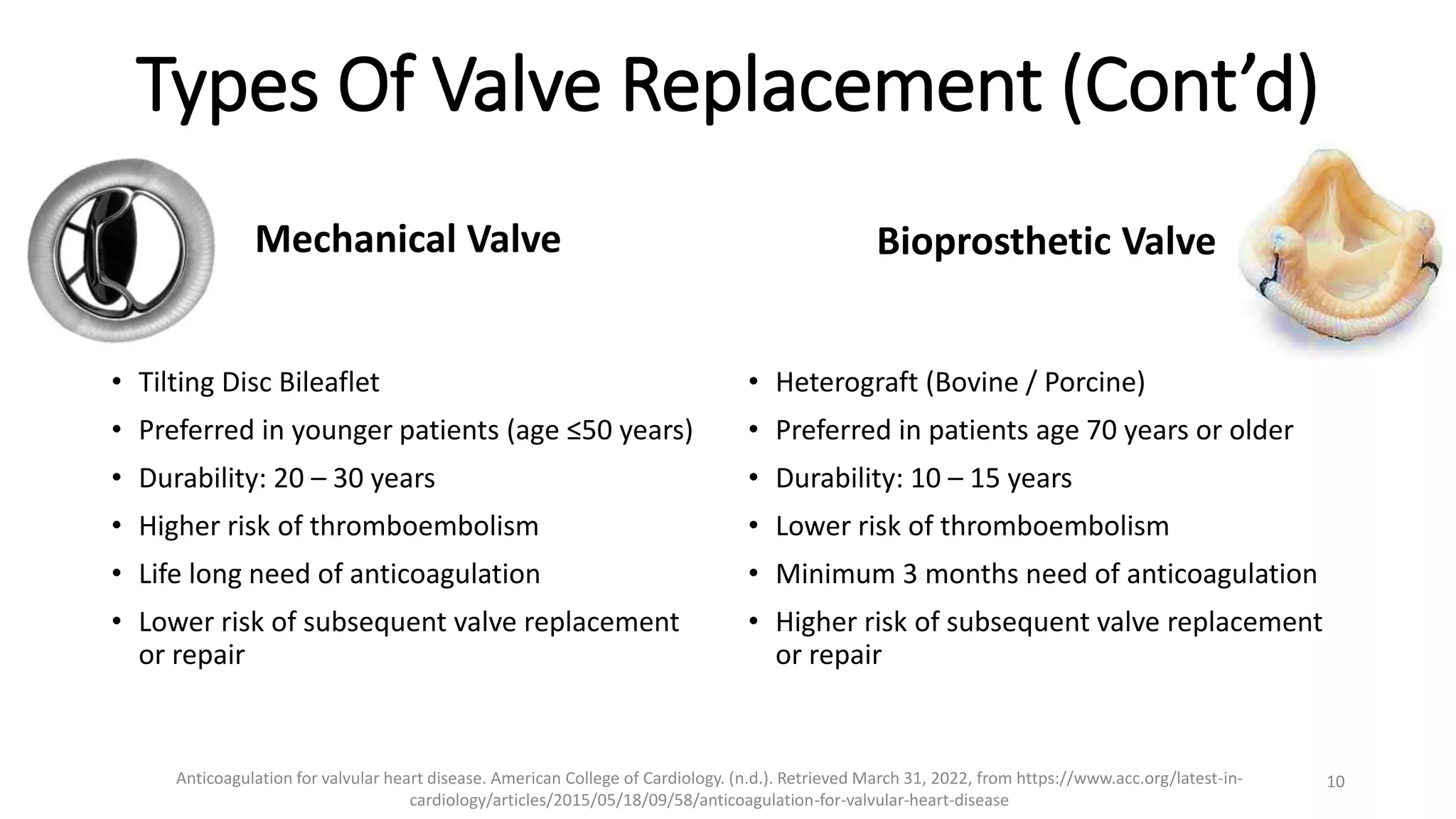
Mechanical Valve
• Tilting Disc Bileaflet
• Preferred in younger patients (age ≤50 years)
• Durability: 20 – 30 years
• Higher risk of thromboembolism
• Life long need of anticoagulation
• Lower risk of subsequent valve replacement
or repair
Bioprosthetic Valve
• Heterograft (Bovine / Porcine)
• Preferred in patients age 70 years or older
• Durability: 10 – 15 years
• Lower risk of thromboembolism
• Minimum 3 months need of anticoagulation
• Higher risk of subsequent valve replacement
or repair
10
Types Of Valve Replacement (Cont’d)
Anticoagulation for valvular heart disease. American College of Cardiology. (n.d.). Retrieved March 31, 2022, from https://www.acc.org/latest-in-
cardiology/articles/2015/05/18/09/58/anticoagulation-for-valvular-heart-disease
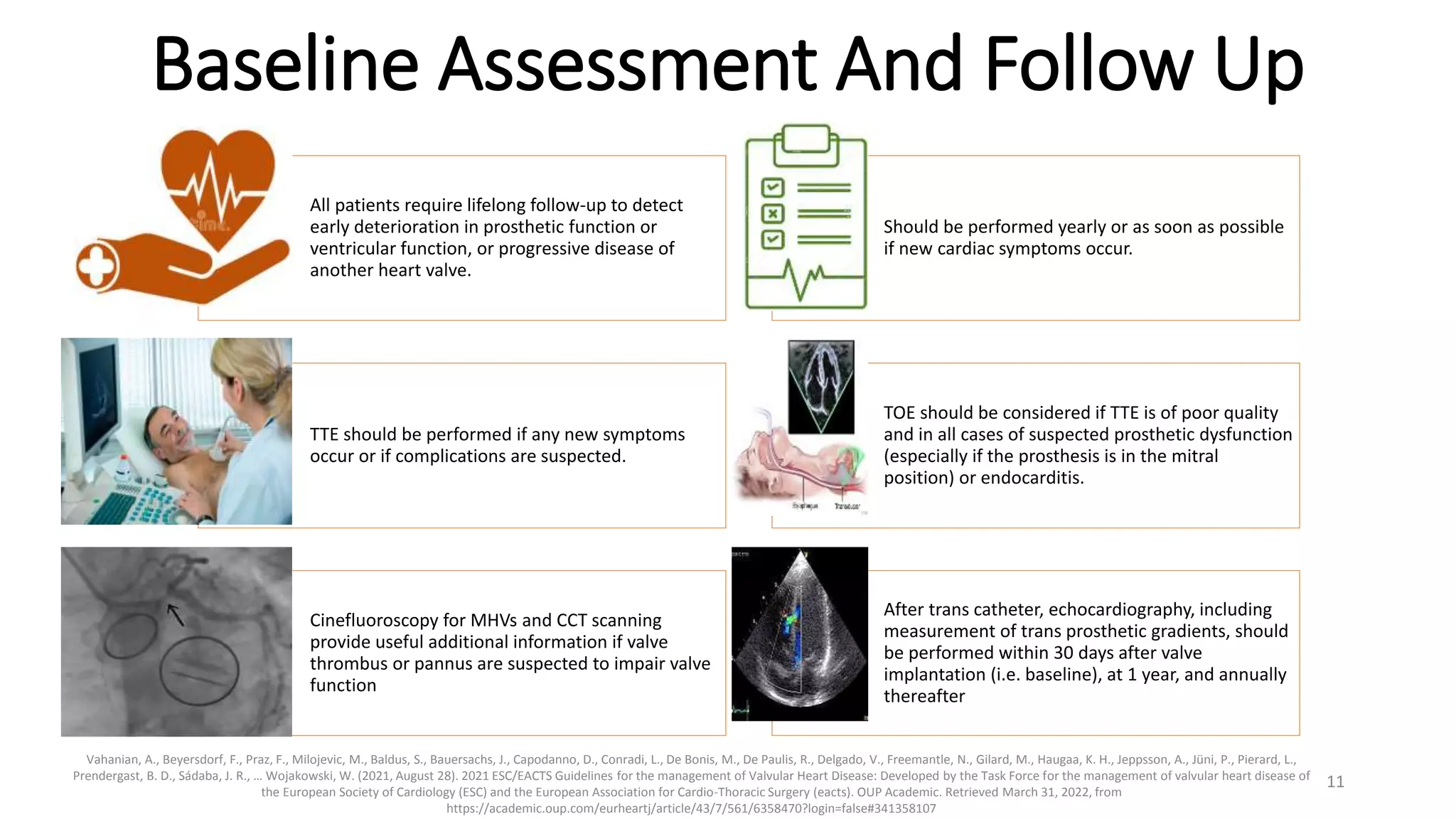
All patients require lifelong follow-up to detect
early deterioration in prosthetic function or
ventricular function, or progressive disease of
another heart valve.
Should be performed yearly or as soon as possible
if new cardiac symptoms occur.
TTE should be performed if any new symptoms
occur or if complications are suspected.
TOE should be considered if TTE is of poor quality
and in all cases of suspected prosthetic dysfunction
(especially if the prosthesis is in the mitral
position) or endocarditis.
Cinefluoroscopy for MHVs and CCT scanning
provide useful additional information if valve
thrombus or pannus are suspected to impair valve
function
After trans catheter, echocardiography, including
measurement of trans prosthetic gradients, should
be performed within 30 days after valve
implantation (i.e. baseline), at 1 year, and annually
thereafter
11
Baseline Assessment And Follow Up
Vahanian, A., Beyersdorf, F., Praz, F., Milojevic, M., Baldus, S., Bauersachs, J., Capodanno, D., Conradi, L., De Bonis, M., De Paulis, R., Delgado, V., Freemantle, N., Gilard, M., Haugaa, K. H., Jeppsson, A., Jüni, P., Pierard, L.,
Prendergast, B. D., Sádaba, J. R., … Wojakowski, W. (2021, August 28). 2021 ESC/EACTS Guidelines for the management of Valvular Heart Disease: Developed by the Task Force for the management of valvular heart disease of
the European Society of Cardiology (ESC) and the European Association for Cardio-Thoracic Surgery (eacts). OUP Academic. Retrieved March 31, 2022, from
https://academic.oup.com/eurheartj/article/43/7/561/6358470?login=false#341358107
1) Mechanical prostheses
Postoperative anticoagulation management:
• Require lifelong treatment with VKA guided by the INR.
• NOACs currently have no role in patients with MHVs.
• VKA should be started on the first postoperative day in combination with bridging
therapy either UFH or off-label use of LMWH until therapeutic INR is achieved.
• Once a stable therapeutic INR is reached for ≥24 h, bridging can be discontinued.
• The postoperative risk of thromboembolism peaks about 1 month after implantation,
but risks are substantially increased up to 6 months.
12
Pharmacological Therapy
Vahanian, A., Beyersdorf, F., Praz, F., Milojevic, M., Baldus, S., Bauersachs, J., Capodanno, D., Conradi, L., De Bonis, M., De Paulis, R., Delgado, V., Freemantle, N., Gilard, M., Haugaa, K. H., Jeppsson, A., Jüni, P., Pierard, L.,
Prendergast, B. D., Sádaba, J. R., … Wojakowski, W. (2021, August 28). 2021 ESC/EACTS Guidelines for the management of Valvular Heart Disease: Developed by the Task Force for the management of valvular heart disease of
the European Society of Cardiology (ESC) and the European Association for Cardio-Thoracic Surgery (eacts). OUP Academic. Retrieved March 31, 2022, from
https://academic.oup.com/eurheartj/article/43/7/561/6358470?login=false#341358107
13
Pharmacological Therapy (Cont’d)
Anticoagulation for valvular heart disease. American College of Cardiology. (n.d.). Retrieved March 31, 2022, from https://www.acc.org/latest-in-
cardiology/articles/2015/05/18/09/58/anticoagulation-for-valvular-heart-disease
2) Bioposthesis
Postoperative anticoagulation management
• The optimal antithrombotic regimen and duration after placement of a bioprosthetic device is
less clear.
• Bioprosthetic devices do confer an increased risk for thrombotic complications during the first
three months after surgery
• The ACCP currently recommends VKA therapy with target INR 2.5 (range 2.0 to 3.0) for the first
three months after bioprosthetic mitral valve replacement.
• For aortic valve replacement with a bioprosthetic device, the ACCP recommends aspirin (50 to
100 mg/day) over VKA therapy for the first three months after surgery, for patients in whom
there is no other indication for anticoagulation.
• If the patient remains without a definitive indication for anticoagulation, the ACCP recommends
the continuation of aspirin therapy without VKA therapy beyond the initial three-month
postoperative period.
14
Pharmacological Therapy (Cont’d)
Anticoagulation for valvular heart disease. American College of Cardiology. (n.d.). Retrieved March 31, 2022, from https://www.acc.org/latest-in-
cardiology/articles/2015/05/18/09/58/anticoagulation-for-valvular-heart-disease
15
Pharmacological Therapy (Cont’d)
Anticoagulation for valvular heart disease. American College of Cardiology. (n.d.). Retrieved March 31, 2022, from https://www.acc.org/latest-in-
cardiology/articles/2015/05/18/09/58/anticoagulation-for-valvular-heart-disease
Combination of oral anticoagulation (OAC) with antiplatelet drugs
16
Pharmacological Therapy (Cont’d)
The addition of low-dose (75–100
mg) ASA to VKA may reduce the
incidence of thromboembolism at
the cost of bleeding
Therefore, addition of antiplatelet to
VKAs should be reserved for
patients at very high risk of
thromboembolism where
advantages clearly outweigh the
risks
In patients with thromboembolism
despite adequate INR, low dose (75–
100 mg) ASA should be added to
VKAs.
Vahanian, A., Beyersdorf, F., Praz, F., Milojevic, M., Baldus, S., Bauersachs, J., Capodanno, D., Conradi, L., De Bonis, M., De Paulis, R., Delgado, V., Freemantle, N., Gilard, M., Haugaa, K. H., Jeppsson, A., Jüni, P., Pierard, L.,
Prendergast, B. D., Sádaba, J. R., … Wojakowski, W. (2021, August 28). 2021 ESC/EACTS Guidelines for the management of Valvular Heart Disease: Developed by the Task Force for the management of valvular heart disease of
the European Society of Cardiology (ESC) and the European Association for Cardio-Thoracic Surgery (eacts). OUP Academic. Retrieved March 31, 2022, from
https://academic.oup.com/eurheartj/article/43/7/561/6358470?login=false#341358107
Interruption of anticoagulant therapy for planned invasive procedures
17
Pharmacological Therapy (Cont’d)
preoperative bridging with
UFH or LMWH before surgery
imposes a risk of
perioperative bleeding while
interrupting anticoagulation
results in an increased risk of
thromboembolism
Therefore, anticoagulation in
patients with MHVs
undergoing elective NCS
requires careful management
by multidisciplinary
consensus
For minor surgical procedures
(e.g. dental, cataract, skin
incision) in which blood loss is
usually small and easily
controlled, it is recommended
that OAC is not interrupted
Major surgeries require
temporary interruption and
therapeutic bridging with
either UFH or LMWH, aiming
for an INR <1.5
Vahanian, A., Beyersdorf, F., Praz, F., Milojevic, M., Baldus, S., Bauersachs, J., Capodanno, D., Conradi, L., De Bonis, M., De Paulis, R., Delgado, V., Freemantle, N., Gilard, M., Haugaa, K. H., Jeppsson, A., Jüni, P., Pierard, L.,
Prendergast, B. D., Sádaba, J. R., … Wojakowski, W. (2021, August 28). 2021 ESC/EACTS Guidelines for the management of Valvular Heart Disease: Developed by the Task Force for the management of valvular heart disease of
the European Society of Cardiology (ESC) and the European Association for Cardio-Thoracic Surgery (eacts). OUP Academic. Retrieved March 31, 2022, from
https://academic.oup.com/eurheartj/article/43/7/561/6358470?login=false#341358107
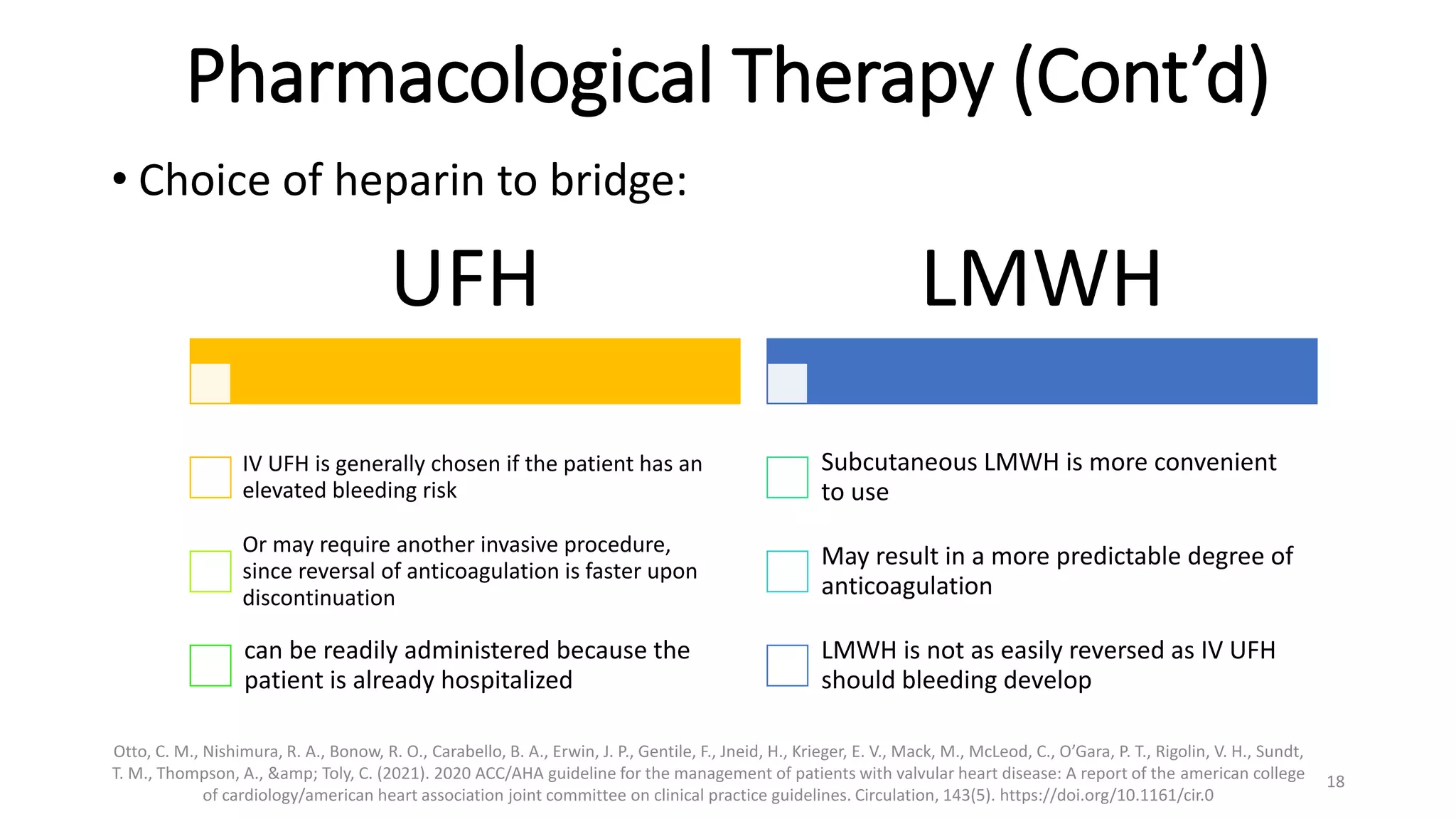
• Choice of heparin to bridge:
18
Pharmacological Therapy (Cont’d)
UFH
IV UFH is generally chosen if the patient has an
elevated bleeding risk
Or may require another invasive procedure,
since reversal of anticoagulation is faster upon
discontinuation
can be readily administered because the
patient is already hospitalized
LMWH
Subcutaneous LMWH is more convenient
to use
May result in a more predictable degree of
anticoagulation
LMWH is not as easily reversed as IV UFH
should bleeding develop
Otto, C. M., Nishimura, R. A., Bonow, R. O., Carabello, B. A., Erwin, J. P., Gentile, F., Jneid, H., Krieger, E. V., Mack, M., McLeod, C., O’Gara, P. T., Rigolin, V. H., Sundt,
T. M., Thompson, A., &amp; Toly, C. (2021). 2020 ACC/AHA guideline for the management of patients with valvular heart disease: A report of the american college
of cardiology/american heart association joint committee on clinical practice guidelines. Circulation, 143(5). https://doi.org/10.1161/cir.0
• How to bridge:
One of the following agents is started 12 to 24 hours after valve surgery, unless there is a
contraindication such as active bleeding.
i. IV UFH (a starting dose of 18 units/kg/hour; no bolus) adjusted to achieve an activated partial
thromboplastin time (aPTT) 2 times control
ii. SC therapeutic weight-adjusted, BID LMWH (eg, enoxaparin 1.0 mg/kg every 12 hours). If
monitored, the target anti-factor Xa level is generally 0.5 to 1.0 IU/mL 4-6 hours after injection.
If a patient is ready for discharge when the INR is not yet therapeutic, the patient
may be switched from UFH to LMWH to facilitate outpatient management.
19
Pharmacological Therapy (Cont’d)
Otto, C. M., Nishimura, R. A., Bonow, R. O., Carabello, B. A., Erwin, J. P., Gentile, F., Jneid, H., Krieger, E. V., Mack, M., McLeod, C., O’Gara, P. T., Rigolin, V. H., Sundt,
T. M., Thompson, A., &amp; Toly, C. (2021). 2020 ACC/AHA guideline for the management of patients with valvular heart disease: A report of the american college
of cardiology/american heart association joint committee on clinical practice guidelines. Circulation, 143(5). https://doi.org/10.1161/cir.0
20
Pharmacological Therapy (Cont’d)
Heparin - unfractionated heparin (UFH) vs low-molecular-weight ... GrepMed. (2021, January 16). Retrieved April 1, 2022, from
https://www.grepmed.com/images/12396/lmwh-unfractionated-heparin-ufh-comparison
21
22
Caroline Sun, P. D. C. 2021 C. U. S. of P. I. (2021, February 12). Antithrombotic therapy in patients with valvular heart disease. U.S. Pharmacist – The Leading Journal in
Pharmacy. Retrieved March 30, 2022, from https://www.uspharmacist.com/article/antithrombotic-therapy-in-patients-with-valvular-heart-disease
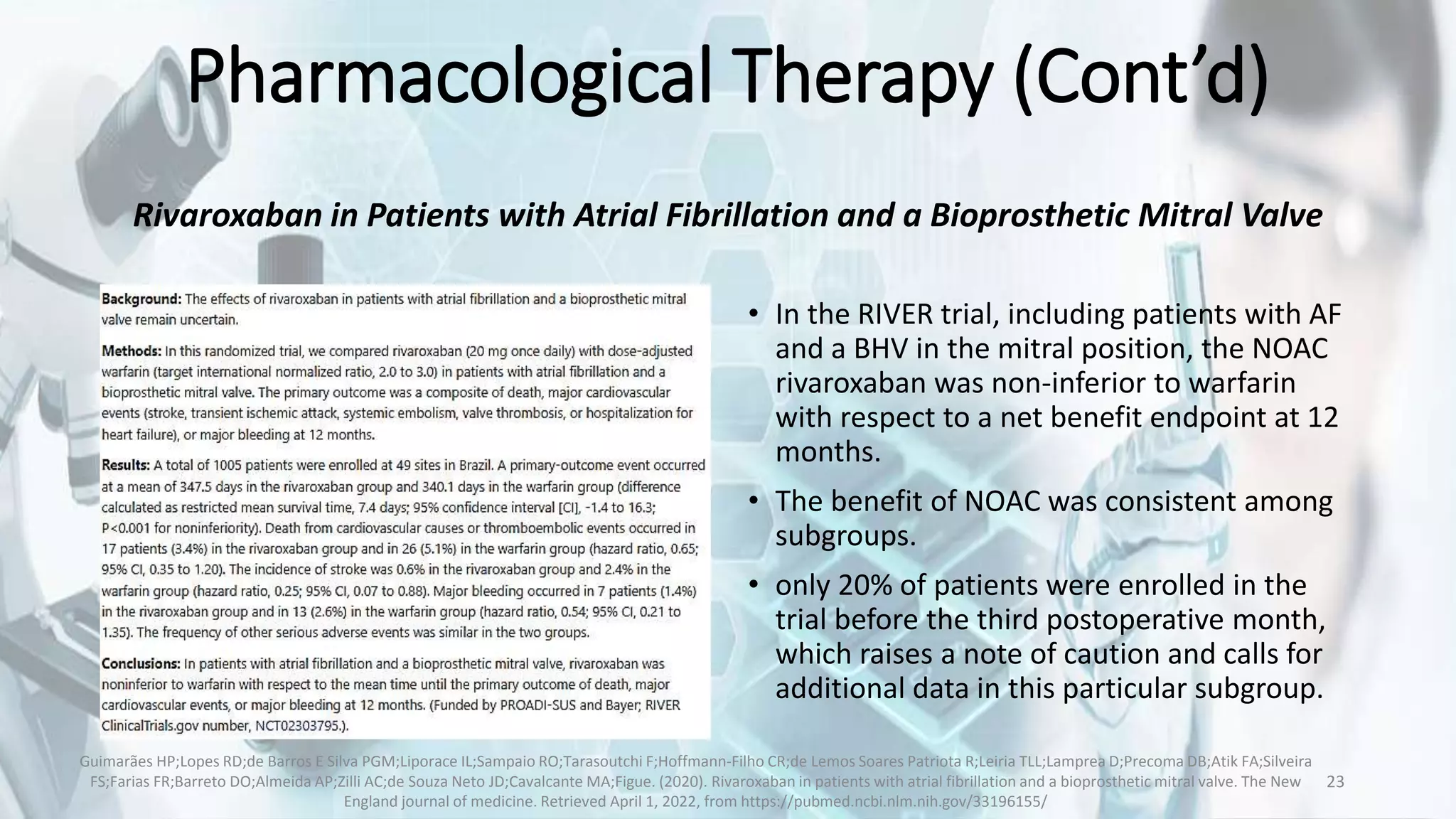
Rivaroxaban in Patients with Atrial Fibrillation and a Bioprosthetic Mitral Valve
• In the RIVER trial, including patients with AF
and a BHV in the mitral position, the NOAC
rivaroxaban was non-inferior to warfarin
with respect to a net benefit endpoint at 12
months.
• The benefit of NOAC was consistent among
subgroups.
• only 20% of patients were enrolled in the
trial before the third postoperative month,
which raises a note of caution and calls for
additional data in this particular subgroup.
23
Pharmacological Therapy (Cont’d)
Guimarães HP;Lopes RD;de Barros E Silva PGM;Liporace IL;Sampaio RO;Tarasoutchi F;Hoffmann-Filho CR;de Lemos Soares Patriota R;Leiria TLL;Lamprea D;Precoma DB;Atik FA;Silveira
FS;Farias FR;Barreto DO;Almeida AP;Zilli AC;de Souza Neto JD;Cavalcante MA;Figue. (2020). Rivaroxaban in patients with atrial fibrillation and a bioprosthetic mitral valve. The New
England journal of medicine. Retrieved April 1, 2022, from https://pubmed.ncbi.nlm.nih.gov/33196155/
24
Drugs MOA Dose Adjustment SE Baseline C/I
Warfarin
Competitively
inhibits the
vitamin K
epoxide
reductase
complex 1
(VKORC1)
1.25 – 2.5 mg
No dose
adjustment
needed in hepatic
or renal
impairment
Hemorrhage
Purple toe sy
Abd pain
Alopecia
Hepatitis
AKI
INR
CBC
Renal & hepatic
function
AKI
Hypersensitivity
Major Bleeding
GI Bleeding
CNS bleeding
Endocarditis
Recent surgery
Pharmacological Therapy (Cont’d)
UpToDate. (n.d.). Retrieved April 1, 2022, from https://www.uptodate.com/contents/warfarin-drug-
information?search=&amp;source=panel_search_result&amp;selectedTitle=1~148&amp;usage_type=panel&amp;kp_tab=drug_general&amp;display_rank=1#F234881
25
Pharmacological Therapy (Cont’d)
Drugs MOA Dose Adjustment SE Baseline C/I
UFH
inactivates
thrombin
prevents
fibrinogen →
fibrin
12 to 18
units/kg/hour
(no bolus)
No dose
adjustment
needed in hepatic
or renal
impairment
Vasospasm
Hyperkalemia
↖ LFTs
Osteoporosis
PT
INR
Aptt
CBC
Pregnancy test
Renal & hepatic
function
AKI
Hypersensitivity
Major Bleeding
Calciphylaxis
UpToDate. (n.d.). Retrieved April 1, 2022, from https://www.uptodate.com/contents/warfarin-drug-
information?search=&amp;source=panel_search_result&amp;selectedTitle=1~148&amp;usage_type=panel&amp;kp_tab=drug_general&amp;display_rank=1#F234881
26
Pharmacological Therapy (Cont’d)
Drugs MOA Dose Adjustment SE Baseline C/I
Enoxaparin
inhibition of
factor Xa.
1 mg/kg
every 12
hours
Crcl: <30: 30 mg
once daily
no dosage
adjustments in
hepatic
impairment
Major bleeding
Spinal hematoma
Thrombocytopenia
Ptt
Hmg/htc
Anti Factor Xa
Srcr
Heparin
induced
thrombocutope
nia
Endocarditis
Uncontrolled
HTN
Urticaria
UpToDate. (n.d.). Retrieved April 1, 2022, from https://www.uptodate.com/contents/warfarin-drug-
information?search=&amp;source=panel_search_result&amp;selectedTitle=1~148&amp;usage_type=panel&amp;kp_tab=drug_general&amp;display_rank=1#F234881
27
Pharmacological Therapy (Cont’d)
Management of vitamin K antagonist (VKA) overdose and bleeding
•INR >4.5 → Bleeding
•the VKA should be discontinued
•10 mg vitamin K by slow IV infusion
•prothrombin complex concentration (PCC) and/or fresh
frozen plasma (FFP)
•re-check of INR at 30 min and every 4–6 h until
normalization
With
Bleeding
• PCC and/or FFP therapy is not recommended
• In asymptomatic patients with INR >10, the VKA must
be stopped and oral vitamin K (2.5–5 mg) prescribed
• asymptomatic patients with INR <4.5 require careful
down-titration and/or skipping one or more doses
No bleeding
Vahanian, A., Beyersdorf, F., Praz, F., Milojevic, M., Baldus, S., Bauersachs, J., Capodanno, D., Conradi, L., De Bonis, M., De Paulis, R., Delgado, V., Freemantle, N., Gilard, M., Haugaa, K. H., Jeppsson, A., Jüni, P., Pierard, L.,
Prendergast, B. D., Sádaba, J. R., … Wojakowski, W. (2021, August 28). 2021 ESC/EACTS Guidelines for the management of Valvular Heart Disease: Developed by the Task Force for the management of valvular heart disease of
the European Society of Cardiology (ESC) and the European Association for Cardio-Thoracic Surgery (eacts). OUP Academic. Retrieved March 31, 2022, from
https://academic.oup.com/eurheartj/article/43/7/561/6358470?login=false#341358107
Role of pharmacist
As warfarin is a high-risk medication,
pharmacists can take additional
precautions to counsel on the
following:
• Frequent INR monitoring
• Minor and major bleeding signs
• Potential drug-drug interactions
• Consuming a consistent amount of
dietary vitamin K
Common medications that interact with
warfarin include:
• NSAIDs
• Antiplatelet agent
• SSRIs/SNRIs
• Amiodarone
• azole antifungals
• Metronidazole
• TMP-SMX
as they may increase INR
28
Caroline Sun, P. D. C. 2021 C. U. S. of P. I. (2021, February 12). Antithrombotic therapy in patients with valvular heart disease. U.S. Pharmacist – The Leading Journal in
Pharmacy. Retrieved March 30, 2022, from https://www.uspharmacist.com/article/antithrombotic-therapy-in-patients-with-valvular-heart-disease
Early postoperative bridging anticoagulation after mechanical heart valve
replacement: a systematic review and meta-analysis
• A lower thromboembolic rate was observed
in the group of patients receiving bridging
therapy (VKA plus UFH or LMWH) than in
patients receiving VKA with no bridging
therapy (1.1 versus 2.1 percent).
• A higher rate of bleeding was observed with
patients receiving VKA plus LMWH (5.5
percent) than in patients treated with VKA
plus UFH (2.2 percent) or VKA alone (1.8
percent).
29
Pharmacological Therapy (Cont’d)
Passaglia LG;de Barros GM;de Sousa MR; (n.d.). Early postoperative bridging anticoagulation after Mechanical Heart Valve Replacement: A systematic review and
meta-analysis. Journal of thrombosis and haemostasis : JTH. Retrieved April 1, 2022, from https://pubmed.ncbi.nlm.nih.gov/26178802/
30
For further information don’t hesitate to
contact me by Zeinab.nm1163@gmail.com

Anticoagulation in Valvular Heart Disease.pptx

  • 1.
    Anticoagulation For Valvular HeartDisease Zeinab Noormonavar Pharm D candidate 30/3/2022 1
  • 2.
  • 3.
    3 Outline At the endof presentation we’ll be able to: • Approach to choose appropriate anticoagulant in patients with VHD. • Identify the classification and pharmacological treatment modalities. • Learn the different drugs used.
  • 4.
    Valvular heart disease(VHD) is a condition in which any one of the four heart valves is damaged or defective, resulting in improper blood flow throughout the heart. Valvular heart disease (VHD) is a common contributor to cardiac morbidity and mortality. Chronic VHD can significantly decrease a patient’s quality of life and result in distressing symptoms, such as exertional dyspnea or angina. Most patients with VHD require surgery to repair or replace the valve and subsequent antithrombotic therapy to prevent clotting. 4 Introduction Caroline Sun, P. D. C. 2021 C. U. S. of P. I. (2021, February 12). Antithrombotic therapy in patients with valvular heart disease. U.S. Pharmacist – The Leading Journal in Pharmacy. Retrieved March 30, 2022, from https://www.uspharmacist.com/article/antithrombotic-therapy-in-patients-with-valvular-heart-disease
  • 5.
    Introduction (Cont’d) Pathophysiology VHD canbe a consequence of genetic defects or acquired etiology calcific aortic valve disease, which can range from mild valve thickening to severe calcification and impairment of valve movement. Types of VHD 1. Aortic Stenosis 2. Aortic Regurgitation 3. Mitral Stenosis 4. Mitral Regurgitation 5. Tricuspid Regurgitation 5 Caroline Sun, P. D. C. 2021 C. U. S. of P. I. (2021, February 12). Antithrombotic therapy in patients with valvular heart disease. U.S. Pharmacist – The Leading Journal in Pharmacy. Retrieved March 30, 2022, from https://www.uspharmacist.com/article/antithrombotic-therapy-in-patients-with-valvular-heart-disease
  • 6.
    Risk Factors 6 Advanced ageMale gender Tobacco use Dyslipidemia Rheumatic Heart Disease Hypertension Caroline Sun, P. D. C. 2021 C. U. S. of P. I. (2021, February 12). Antithrombotic therapy in patients with valvular heart disease. U.S. Pharmacist – The Leading Journal in Pharmacy. Retrieved March 30, 2022, from https://www.uspharmacist.com/article/antithrombotic-therapy-in-patients-with-valvular-heart-disease
  • 7.
    Stages & Symptoms •Stages of VHD range from stage A, where factors for developing VHD are identified, to stage D, where a patient is experiencing more advanced symptoms. 7 Stages Definition Symptoms A At risk of VHD None B Progressive VHD None C Asymptomatic Severe VHD None (Exercise testing is reasonable) C1 C2 Asymptomatic severe VHD with LV systolic dysfunction D Symptomatic severe high-gradient Dyspnea, decreased exercise tolerance, angina, HF, syncope or presyncope D1 D2 Symptomatic severe low-flow, low-gradient with reduced LVEF HF, Angina, Syncope or presyncope HF, Angina, Syncope or presyncope D3 Symptomatic severe low-gradient AS with normal LVEF Otto, C. M., Catherine M. Otto Search for more papers by this author, Nishimura, R. A., Rick A. Nishimura Search for more papers by this author, Bonow, R. O., Robert O. Bonow Search for more papers by this author, Carabello, B. A., Blase A. Carabello Search for more papers by this author, III, J. P. E., John P. Erwin III Search for more papers by this author, Gentile, F., Federico Gentile Search for more papers by this author, Jneid, H., Hani Jneid Search for more papers by this author, Krieger, E. V., Eric V. Krieger Search for more papers by this author, Mack, M., Michael Mack Search for more papers by this author, McLeod, C., … Al., E. (2020, December 17). 2020 ACC/AHA guideline for the management of patients with valvular heart disease: A report of the american college of cardiology/american heart association joint committee on clinical practice guidelines. Circulation. Retrieved March 31, 2022, from https://www.ahajournals.org/doi/10.1161/CIR.0000000000000923#d1e4306 Caroline Sun, P. D. C. 2021 C. U. S. of P. I. (2021, February 12). Antithrombotic therapy in patients with valvular heart disease. U.S. Pharmacist – The Leading Journal in Pharmacy. Retrieved March 30, 2022, from https://www.uspharmacist.com/article/antithrombotic-therapy-in-patients-with-valvular-heart-disease
  • 8.
    Treatment Approach The therapeuticgoals for treating VHD include reducing symptoms, repairing or replacing valves, and preventing blood clots. Beta-blockers and other antihypertensive agents can be used to improve symptoms associated with VHD. Most patients will require surgical intervention, such as valvular repair or replacement. After the procedure, it is recommended that patients be started on antithrombotic therapy, such as warfarin or aspirin, to prevent thromboembolism. These patients are at higher risk of clotting post-surgery because turbulent blood flow around the valves results in high shear stresses, which can lead to platelet activation on the valve surface. The choice of an antithrombotic agent is dependent upon the location of the replaced valve and the type of valve replacement(s). 8 2021 ESC/EACTS Guidelines for the management of valvular heart disease: Developed by the Task Force for the management of valvular heart disease of the European Society of Cardiology (ESC) and the European Association for Cardio-Thoracic Surgery (EACTS). Academic.oup.com. (n.d.). Retrieved March 31, 2022, from https://academic.oup.com/eurheartj/article/43/7/561/6358470?login=false#341357921
  • 9.
    Types Of ValveReplacement • The type of valve replacement a patient receives is dependent on several factors, including but not limited to: 9 Risk of anticoagulation complication Life expectancy Age Patient preference Caroline Sun, P. D. C. 2021 C. U. S. of P. I. (2021, February 12). Antithrombotic therapy in patients with valvular heart disease. U.S. Pharmacist – The Leading Journal in Pharmacy. Retrieved March 30, 2022, from https://www.uspharmacist.com/article/antithrombotic-therapy-in-patients-with-valvular-heart-disease
  • 10.
    Mechanical Valve • TiltingDisc Bileaflet • Preferred in younger patients (age ≤50 years) • Durability: 20 – 30 years • Higher risk of thromboembolism • Life long need of anticoagulation • Lower risk of subsequent valve replacement or repair Bioprosthetic Valve • Heterograft (Bovine / Porcine) • Preferred in patients age 70 years or older • Durability: 10 – 15 years • Lower risk of thromboembolism • Minimum 3 months need of anticoagulation • Higher risk of subsequent valve replacement or repair 10 Types Of Valve Replacement (Cont’d) Anticoagulation for valvular heart disease. American College of Cardiology. (n.d.). Retrieved March 31, 2022, from https://www.acc.org/latest-in- cardiology/articles/2015/05/18/09/58/anticoagulation-for-valvular-heart-disease
  • 11.
    All patients requirelifelong follow-up to detect early deterioration in prosthetic function or ventricular function, or progressive disease of another heart valve. Should be performed yearly or as soon as possible if new cardiac symptoms occur. TTE should be performed if any new symptoms occur or if complications are suspected. TOE should be considered if TTE is of poor quality and in all cases of suspected prosthetic dysfunction (especially if the prosthesis is in the mitral position) or endocarditis. Cinefluoroscopy for MHVs and CCT scanning provide useful additional information if valve thrombus or pannus are suspected to impair valve function After trans catheter, echocardiography, including measurement of trans prosthetic gradients, should be performed within 30 days after valve implantation (i.e. baseline), at 1 year, and annually thereafter 11 Baseline Assessment And Follow Up Vahanian, A., Beyersdorf, F., Praz, F., Milojevic, M., Baldus, S., Bauersachs, J., Capodanno, D., Conradi, L., De Bonis, M., De Paulis, R., Delgado, V., Freemantle, N., Gilard, M., Haugaa, K. H., Jeppsson, A., Jüni, P., Pierard, L., Prendergast, B. D., Sádaba, J. R., … Wojakowski, W. (2021, August 28). 2021 ESC/EACTS Guidelines for the management of Valvular Heart Disease: Developed by the Task Force for the management of valvular heart disease of the European Society of Cardiology (ESC) and the European Association for Cardio-Thoracic Surgery (eacts). OUP Academic. Retrieved March 31, 2022, from https://academic.oup.com/eurheartj/article/43/7/561/6358470?login=false#341358107
  • 12.
    1) Mechanical prostheses Postoperativeanticoagulation management: • Require lifelong treatment with VKA guided by the INR. • NOACs currently have no role in patients with MHVs. • VKA should be started on the first postoperative day in combination with bridging therapy either UFH or off-label use of LMWH until therapeutic INR is achieved. • Once a stable therapeutic INR is reached for ≥24 h, bridging can be discontinued. • The postoperative risk of thromboembolism peaks about 1 month after implantation, but risks are substantially increased up to 6 months. 12 Pharmacological Therapy Vahanian, A., Beyersdorf, F., Praz, F., Milojevic, M., Baldus, S., Bauersachs, J., Capodanno, D., Conradi, L., De Bonis, M., De Paulis, R., Delgado, V., Freemantle, N., Gilard, M., Haugaa, K. H., Jeppsson, A., Jüni, P., Pierard, L., Prendergast, B. D., Sádaba, J. R., … Wojakowski, W. (2021, August 28). 2021 ESC/EACTS Guidelines for the management of Valvular Heart Disease: Developed by the Task Force for the management of valvular heart disease of the European Society of Cardiology (ESC) and the European Association for Cardio-Thoracic Surgery (eacts). OUP Academic. Retrieved March 31, 2022, from https://academic.oup.com/eurheartj/article/43/7/561/6358470?login=false#341358107
  • 13.
    13 Pharmacological Therapy (Cont’d) Anticoagulationfor valvular heart disease. American College of Cardiology. (n.d.). Retrieved March 31, 2022, from https://www.acc.org/latest-in- cardiology/articles/2015/05/18/09/58/anticoagulation-for-valvular-heart-disease
  • 14.
    2) Bioposthesis Postoperative anticoagulationmanagement • The optimal antithrombotic regimen and duration after placement of a bioprosthetic device is less clear. • Bioprosthetic devices do confer an increased risk for thrombotic complications during the first three months after surgery • The ACCP currently recommends VKA therapy with target INR 2.5 (range 2.0 to 3.0) for the first three months after bioprosthetic mitral valve replacement. • For aortic valve replacement with a bioprosthetic device, the ACCP recommends aspirin (50 to 100 mg/day) over VKA therapy for the first three months after surgery, for patients in whom there is no other indication for anticoagulation. • If the patient remains without a definitive indication for anticoagulation, the ACCP recommends the continuation of aspirin therapy without VKA therapy beyond the initial three-month postoperative period. 14 Pharmacological Therapy (Cont’d) Anticoagulation for valvular heart disease. American College of Cardiology. (n.d.). Retrieved March 31, 2022, from https://www.acc.org/latest-in- cardiology/articles/2015/05/18/09/58/anticoagulation-for-valvular-heart-disease
  • 15.
    15 Pharmacological Therapy (Cont’d) Anticoagulationfor valvular heart disease. American College of Cardiology. (n.d.). Retrieved March 31, 2022, from https://www.acc.org/latest-in- cardiology/articles/2015/05/18/09/58/anticoagulation-for-valvular-heart-disease
  • 16.
    Combination of oralanticoagulation (OAC) with antiplatelet drugs 16 Pharmacological Therapy (Cont’d) The addition of low-dose (75–100 mg) ASA to VKA may reduce the incidence of thromboembolism at the cost of bleeding Therefore, addition of antiplatelet to VKAs should be reserved for patients at very high risk of thromboembolism where advantages clearly outweigh the risks In patients with thromboembolism despite adequate INR, low dose (75– 100 mg) ASA should be added to VKAs. Vahanian, A., Beyersdorf, F., Praz, F., Milojevic, M., Baldus, S., Bauersachs, J., Capodanno, D., Conradi, L., De Bonis, M., De Paulis, R., Delgado, V., Freemantle, N., Gilard, M., Haugaa, K. H., Jeppsson, A., Jüni, P., Pierard, L., Prendergast, B. D., Sádaba, J. R., … Wojakowski, W. (2021, August 28). 2021 ESC/EACTS Guidelines for the management of Valvular Heart Disease: Developed by the Task Force for the management of valvular heart disease of the European Society of Cardiology (ESC) and the European Association for Cardio-Thoracic Surgery (eacts). OUP Academic. Retrieved March 31, 2022, from https://academic.oup.com/eurheartj/article/43/7/561/6358470?login=false#341358107
  • 17.
    Interruption of anticoagulanttherapy for planned invasive procedures 17 Pharmacological Therapy (Cont’d) preoperative bridging with UFH or LMWH before surgery imposes a risk of perioperative bleeding while interrupting anticoagulation results in an increased risk of thromboembolism Therefore, anticoagulation in patients with MHVs undergoing elective NCS requires careful management by multidisciplinary consensus For minor surgical procedures (e.g. dental, cataract, skin incision) in which blood loss is usually small and easily controlled, it is recommended that OAC is not interrupted Major surgeries require temporary interruption and therapeutic bridging with either UFH or LMWH, aiming for an INR <1.5 Vahanian, A., Beyersdorf, F., Praz, F., Milojevic, M., Baldus, S., Bauersachs, J., Capodanno, D., Conradi, L., De Bonis, M., De Paulis, R., Delgado, V., Freemantle, N., Gilard, M., Haugaa, K. H., Jeppsson, A., Jüni, P., Pierard, L., Prendergast, B. D., Sádaba, J. R., … Wojakowski, W. (2021, August 28). 2021 ESC/EACTS Guidelines for the management of Valvular Heart Disease: Developed by the Task Force for the management of valvular heart disease of the European Society of Cardiology (ESC) and the European Association for Cardio-Thoracic Surgery (eacts). OUP Academic. Retrieved March 31, 2022, from https://academic.oup.com/eurheartj/article/43/7/561/6358470?login=false#341358107
  • 18.
    • Choice ofheparin to bridge: 18 Pharmacological Therapy (Cont’d) UFH IV UFH is generally chosen if the patient has an elevated bleeding risk Or may require another invasive procedure, since reversal of anticoagulation is faster upon discontinuation can be readily administered because the patient is already hospitalized LMWH Subcutaneous LMWH is more convenient to use May result in a more predictable degree of anticoagulation LMWH is not as easily reversed as IV UFH should bleeding develop Otto, C. M., Nishimura, R. A., Bonow, R. O., Carabello, B. A., Erwin, J. P., Gentile, F., Jneid, H., Krieger, E. V., Mack, M., McLeod, C., O’Gara, P. T., Rigolin, V. H., Sundt, T. M., Thompson, A., &amp; Toly, C. (2021). 2020 ACC/AHA guideline for the management of patients with valvular heart disease: A report of the american college of cardiology/american heart association joint committee on clinical practice guidelines. Circulation, 143(5). https://doi.org/10.1161/cir.0
  • 19.
    • How tobridge: One of the following agents is started 12 to 24 hours after valve surgery, unless there is a contraindication such as active bleeding. i. IV UFH (a starting dose of 18 units/kg/hour; no bolus) adjusted to achieve an activated partial thromboplastin time (aPTT) 2 times control ii. SC therapeutic weight-adjusted, BID LMWH (eg, enoxaparin 1.0 mg/kg every 12 hours). If monitored, the target anti-factor Xa level is generally 0.5 to 1.0 IU/mL 4-6 hours after injection. If a patient is ready for discharge when the INR is not yet therapeutic, the patient may be switched from UFH to LMWH to facilitate outpatient management. 19 Pharmacological Therapy (Cont’d) Otto, C. M., Nishimura, R. A., Bonow, R. O., Carabello, B. A., Erwin, J. P., Gentile, F., Jneid, H., Krieger, E. V., Mack, M., McLeod, C., O’Gara, P. T., Rigolin, V. H., Sundt, T. M., Thompson, A., &amp; Toly, C. (2021). 2020 ACC/AHA guideline for the management of patients with valvular heart disease: A report of the american college of cardiology/american heart association joint committee on clinical practice guidelines. Circulation, 143(5). https://doi.org/10.1161/cir.0
  • 20.
    20 Pharmacological Therapy (Cont’d) Heparin- unfractionated heparin (UFH) vs low-molecular-weight ... GrepMed. (2021, January 16). Retrieved April 1, 2022, from https://www.grepmed.com/images/12396/lmwh-unfractionated-heparin-ufh-comparison
  • 21.
  • 22.
    22 Caroline Sun, P.D. C. 2021 C. U. S. of P. I. (2021, February 12). Antithrombotic therapy in patients with valvular heart disease. U.S. Pharmacist – The Leading Journal in Pharmacy. Retrieved March 30, 2022, from https://www.uspharmacist.com/article/antithrombotic-therapy-in-patients-with-valvular-heart-disease
  • 23.
    Rivaroxaban in Patientswith Atrial Fibrillation and a Bioprosthetic Mitral Valve • In the RIVER trial, including patients with AF and a BHV in the mitral position, the NOAC rivaroxaban was non-inferior to warfarin with respect to a net benefit endpoint at 12 months. • The benefit of NOAC was consistent among subgroups. • only 20% of patients were enrolled in the trial before the third postoperative month, which raises a note of caution and calls for additional data in this particular subgroup. 23 Pharmacological Therapy (Cont’d) Guimarães HP;Lopes RD;de Barros E Silva PGM;Liporace IL;Sampaio RO;Tarasoutchi F;Hoffmann-Filho CR;de Lemos Soares Patriota R;Leiria TLL;Lamprea D;Precoma DB;Atik FA;Silveira FS;Farias FR;Barreto DO;Almeida AP;Zilli AC;de Souza Neto JD;Cavalcante MA;Figue. (2020). Rivaroxaban in patients with atrial fibrillation and a bioprosthetic mitral valve. The New England journal of medicine. Retrieved April 1, 2022, from https://pubmed.ncbi.nlm.nih.gov/33196155/
  • 24.
    24 Drugs MOA DoseAdjustment SE Baseline C/I Warfarin Competitively inhibits the vitamin K epoxide reductase complex 1 (VKORC1) 1.25 – 2.5 mg No dose adjustment needed in hepatic or renal impairment Hemorrhage Purple toe sy Abd pain Alopecia Hepatitis AKI INR CBC Renal & hepatic function AKI Hypersensitivity Major Bleeding GI Bleeding CNS bleeding Endocarditis Recent surgery Pharmacological Therapy (Cont’d) UpToDate. (n.d.). Retrieved April 1, 2022, from https://www.uptodate.com/contents/warfarin-drug- information?search=&amp;source=panel_search_result&amp;selectedTitle=1~148&amp;usage_type=panel&amp;kp_tab=drug_general&amp;display_rank=1#F234881
  • 25.
    25 Pharmacological Therapy (Cont’d) DrugsMOA Dose Adjustment SE Baseline C/I UFH inactivates thrombin prevents fibrinogen → fibrin 12 to 18 units/kg/hour (no bolus) No dose adjustment needed in hepatic or renal impairment Vasospasm Hyperkalemia ↖ LFTs Osteoporosis PT INR Aptt CBC Pregnancy test Renal & hepatic function AKI Hypersensitivity Major Bleeding Calciphylaxis UpToDate. (n.d.). Retrieved April 1, 2022, from https://www.uptodate.com/contents/warfarin-drug- information?search=&amp;source=panel_search_result&amp;selectedTitle=1~148&amp;usage_type=panel&amp;kp_tab=drug_general&amp;display_rank=1#F234881
  • 26.
    26 Pharmacological Therapy (Cont’d) DrugsMOA Dose Adjustment SE Baseline C/I Enoxaparin inhibition of factor Xa. 1 mg/kg every 12 hours Crcl: <30: 30 mg once daily no dosage adjustments in hepatic impairment Major bleeding Spinal hematoma Thrombocytopenia Ptt Hmg/htc Anti Factor Xa Srcr Heparin induced thrombocutope nia Endocarditis Uncontrolled HTN Urticaria UpToDate. (n.d.). Retrieved April 1, 2022, from https://www.uptodate.com/contents/warfarin-drug- information?search=&amp;source=panel_search_result&amp;selectedTitle=1~148&amp;usage_type=panel&amp;kp_tab=drug_general&amp;display_rank=1#F234881
  • 27.
    27 Pharmacological Therapy (Cont’d) Managementof vitamin K antagonist (VKA) overdose and bleeding •INR >4.5 → Bleeding •the VKA should be discontinued •10 mg vitamin K by slow IV infusion •prothrombin complex concentration (PCC) and/or fresh frozen plasma (FFP) •re-check of INR at 30 min and every 4–6 h until normalization With Bleeding • PCC and/or FFP therapy is not recommended • In asymptomatic patients with INR >10, the VKA must be stopped and oral vitamin K (2.5–5 mg) prescribed • asymptomatic patients with INR <4.5 require careful down-titration and/or skipping one or more doses No bleeding Vahanian, A., Beyersdorf, F., Praz, F., Milojevic, M., Baldus, S., Bauersachs, J., Capodanno, D., Conradi, L., De Bonis, M., De Paulis, R., Delgado, V., Freemantle, N., Gilard, M., Haugaa, K. H., Jeppsson, A., Jüni, P., Pierard, L., Prendergast, B. D., Sádaba, J. R., … Wojakowski, W. (2021, August 28). 2021 ESC/EACTS Guidelines for the management of Valvular Heart Disease: Developed by the Task Force for the management of valvular heart disease of the European Society of Cardiology (ESC) and the European Association for Cardio-Thoracic Surgery (eacts). OUP Academic. Retrieved March 31, 2022, from https://academic.oup.com/eurheartj/article/43/7/561/6358470?login=false#341358107
  • 28.
    Role of pharmacist Aswarfarin is a high-risk medication, pharmacists can take additional precautions to counsel on the following: • Frequent INR monitoring • Minor and major bleeding signs • Potential drug-drug interactions • Consuming a consistent amount of dietary vitamin K Common medications that interact with warfarin include: • NSAIDs • Antiplatelet agent • SSRIs/SNRIs • Amiodarone • azole antifungals • Metronidazole • TMP-SMX as they may increase INR 28 Caroline Sun, P. D. C. 2021 C. U. S. of P. I. (2021, February 12). Antithrombotic therapy in patients with valvular heart disease. U.S. Pharmacist – The Leading Journal in Pharmacy. Retrieved March 30, 2022, from https://www.uspharmacist.com/article/antithrombotic-therapy-in-patients-with-valvular-heart-disease
  • 29.
    Early postoperative bridginganticoagulation after mechanical heart valve replacement: a systematic review and meta-analysis • A lower thromboembolic rate was observed in the group of patients receiving bridging therapy (VKA plus UFH or LMWH) than in patients receiving VKA with no bridging therapy (1.1 versus 2.1 percent). • A higher rate of bleeding was observed with patients receiving VKA plus LMWH (5.5 percent) than in patients treated with VKA plus UFH (2.2 percent) or VKA alone (1.8 percent). 29 Pharmacological Therapy (Cont’d) Passaglia LG;de Barros GM;de Sousa MR; (n.d.). Early postoperative bridging anticoagulation after Mechanical Heart Valve Replacement: A systematic review and meta-analysis. Journal of thrombosis and haemostasis : JTH. Retrieved April 1, 2022, from https://pubmed.ncbi.nlm.nih.gov/26178802/
  • 30.
    30 For further informationdon’t hesitate to contact me by Zeinab.nm1163@gmail.com