Anticholinergic drugs
 Antimuscarinic agents, Atropinic,
Parasympatholytic
 Neuromuscular blockers and Ganglion blockers
STUDENT, Dr. RKGMC Hamirpur
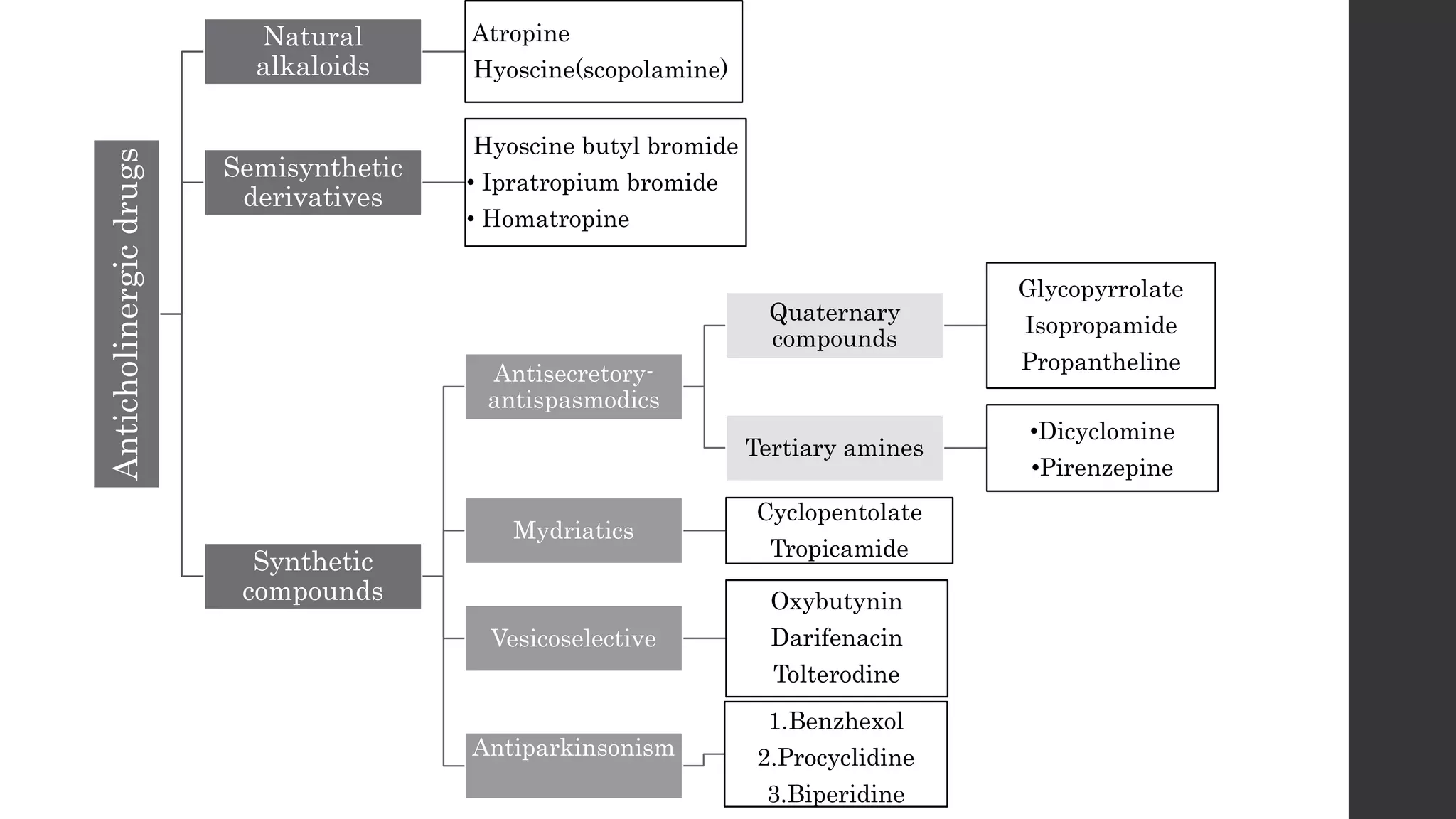
Anticholinergicdrugs
Natural
alkaloids
Atropine
Hyoscine(scopolamine)
Semisynthetic
derivatives
Hyoscine butyl bromide
• Ipratropium bromide
• Homatropine
Synthetic
compounds
Antisecretory-
antispasmodics
Quaternary
compounds
Glycopyrrolate
Isopropamide
Propantheline
Tertiary amines
•Dicyclomine
•Pirenzepine
Mydriatics
Cyclopentolate
Tropicamide
Vesicoselective
Oxybutynin
Darifenacin
Tolterodine
Antiparkinsonism
1.Benzhexol
2.Procyclidine
3.Biperidine
Pharmacokinetics
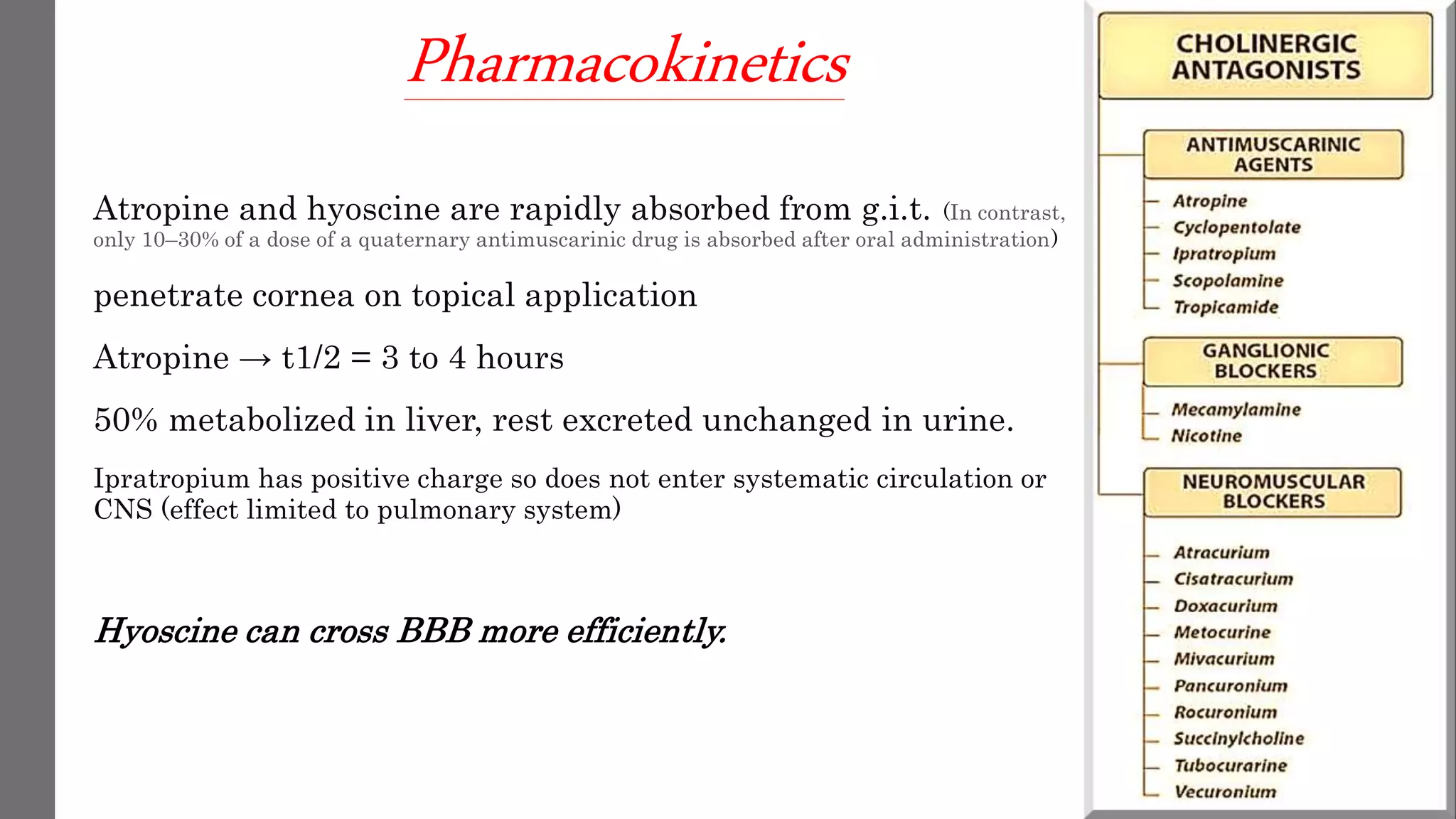
Atropine and hyoscine are rapidly absorbed from g.i.t. (In contrast,
only 10–30% of a dose of a quaternary antimuscarinic drug is absorbed after oral administration)
penetrate cornea on topical application
Atropine → t1/2 = 3 to 4 hours
50% metabolized in liver, rest excreted unchanged in urine.
Ipratropium has positive charge so does not enter systematic circulation or
CNS (effect limited to pulmonary system)
Hyoscine can cross BBB more efficiently.
Pharmacological Action - antimuscarinic agents (atropine as
prototype)
all anticholinergics are competitive antagonists
CNS CVS Eye Smooth muscles Glands Body Temp.
minimal
stimulant
action(vagal,
respiratory,
vasomotor
center)
Depresses
vestibular
excitation-
antimotion
sickness
Block cholinergic
overactivity in
basal ganglia-
suppresses
tremors and
rigidity in
parkinsonism
Tachycardia (M2
block)
Initial
bradycardia due
to M2 auto
receptors block on
vagal nerve
ending
no marked effect
on bp
Topical appl.-
Mydriasis,
Cycloplegia
(M3 block),
Abolition of light
reflex
Decreased
lacrimal secretions
(dry or sandy
eyes)
visceral smooth
muscle Relaxation
(M3 block)
Bronchodilatation
Relaxant action on
ureter and urinary
bladder
Decreases sweat,
salivary,
tracheobronchial
and lacrimal
secretions
(M3 block)
Decreased secretion
of acid, pepsin and
mucus in stomach.
Bicarbonate
secretion is also
reduced
Rise in body
temperature
(high doses) –
Inhibition of
sweating,
Stimulation of
hypothalamus
Antisecretory Antispasmodic Respiratory
disorders
Ophthalmologic
al
CVS Central action Poisoning
Preanesthetic
medication
(Atropine,
hyoscine,
glycopyrrolate)
Pulmonary
embolism
Peptic ulcer
selective M1
blockers
(Pirenzepine,
Telenzepine)
Intestinal and
renal colic ,
abdominal
cramps
Nervous,
functional and
drug induced
diarrhea
Relieve urinary
frequency and
urgency,
Enuresis in
children.
M3 selective
blockers –
Oxybutynin,
Tolterodine
Ipratropium
bromide – in
asthmatic
bronchitis and
COPD
Tiotropium
bromide –
longer acting
(Atropine
depresses
mucociliary
clearance by
bronchial
epithelium,
Ipratropium does
not)
Diagnostic -
Testing errors
of refraction-
Tropicamide
and
phenylephrine
are used in
adults
Atropine in
children
Therapeutic –
Atropine in
iritis,
iridocyclitis,
corneal ulcer
counteract
bradycardia
and partial
heart
block in
patients with
increased vagal
tone .
Digitalis
toxicity
Parkinsonism
As adjuvant to
L-dopa
Motion
sickness –
Hyoscine,
Dicyclomine
(prophylactics)
Hyoscine as lie
detector
(amnesic and
depressant)
Atropine is
specific
antidote for
antiChE and
early
mushroom
poisoning.
Atropine and
Glycopyrrolate
blocks the
effects of
excess Ach
resulting
from
cholinesterase
inhibitors
(neostigmine,
physostigmine
)
Therapeutic uses
Adverse effects
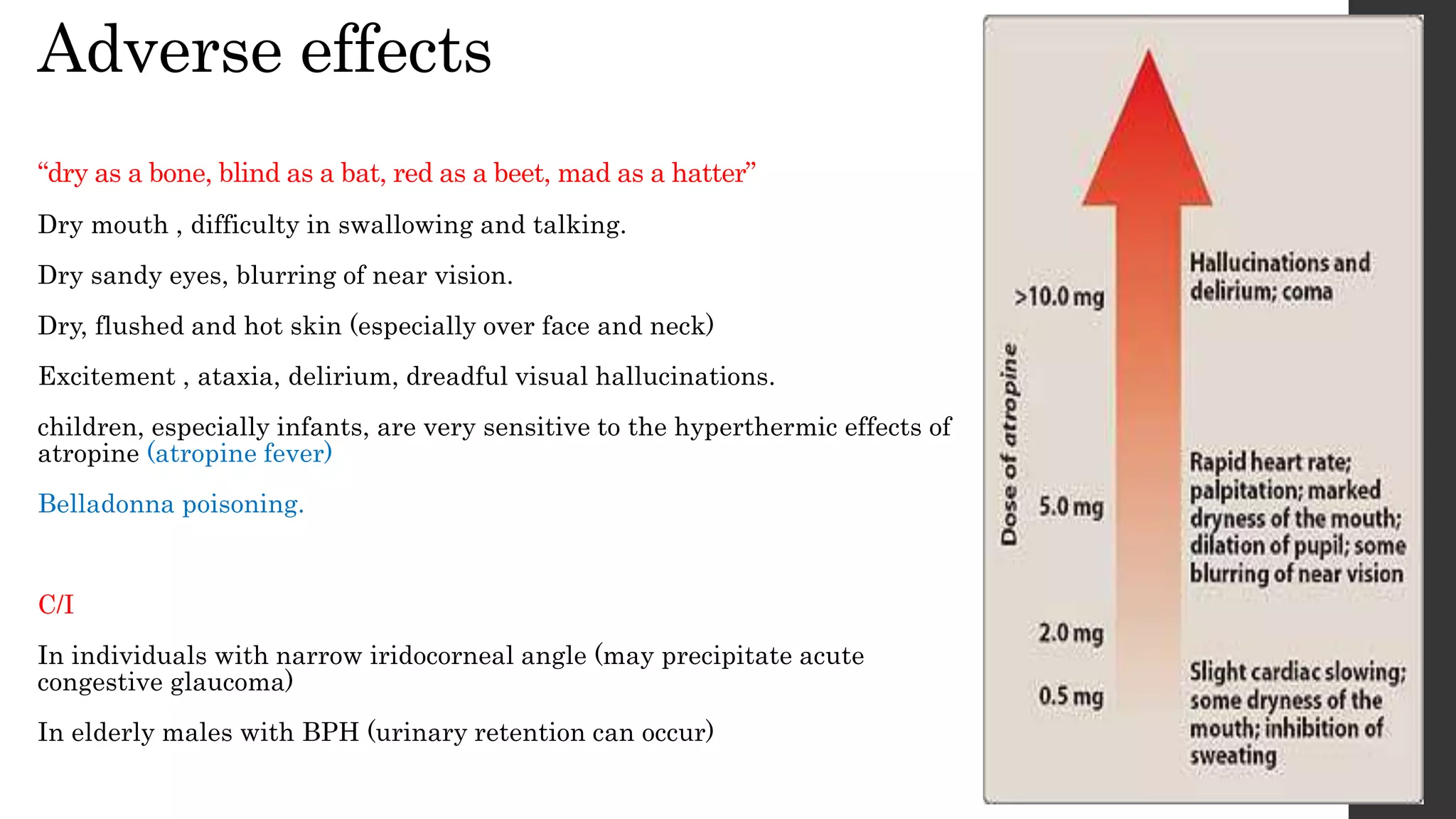
“dry as a bone, blind as a bat, red as a beet, mad as a hatter”
Dry mouth , difficulty in swallowing and talking.
Dry sandy eyes, blurring of near vision.
Dry, flushed and hot skin (especially over face and neck)
Excitement , ataxia, delirium, dreadful visual hallucinations.
children, especially infants, are very sensitive to the hyperthermic effects of
atropine (atropine fever)
Belladonna poisoning.
C/I
In individuals with narrow iridocorneal angle (may precipitate acute
congestive glaucoma)
In elderly males with BPH (urinary retention can occur)
Neuromuscular blockers
(blocks NM receptors)
• Tubocurarine
• Atracurium
• Mivacurium
• Pancuronium
• Vecuronium
• Rocuronium
Non-
depolarizing
• Succinylcholine
• Decamethonium
Depolarising
• used therapeutically as adjuvant drugs in
anesthesia during surgery to relax skeletal
muscle.
• also used to facilitate intubation as well as
during orthopedic surgery.
Succinylcholine initially produces short-lasting
muscle fasciculations, followed within a few
minutes by paralysis.
Use- succinylcholine is useful when rapid
endotracheal intubation is required during the
induction of anesthesia.
Adverse effects- apnea, hyperthermia,
hyperkalemia
Ganglion blockers (NN blockers)
•Quaternary ammonium compounds
•Hexamethonium
•Pentolinium
•Amines
•Mecamylamine
•Monosulfonium compounds
•Trimethaphan
Competitive
blockers
•Nicotine
•Anticholinesterases
Persistent
depolarizing
blockers
Large doses
Wide range of
relative
sympathetic and
parasympathetic
effects (no clinical
relevance)

Anticholinergic drugs

  • 1.
    Anticholinergic drugs  Antimuscarinicagents, Atropinic, Parasympatholytic  Neuromuscular blockers and Ganglion blockers STUDENT, Dr. RKGMC Hamirpur
  • 2.
    Anticholinergicdrugs Natural alkaloids Atropine Hyoscine(scopolamine) Semisynthetic derivatives Hyoscine butyl bromide •Ipratropium bromide • Homatropine Synthetic compounds Antisecretory- antispasmodics Quaternary compounds Glycopyrrolate Isopropamide Propantheline Tertiary amines •Dicyclomine •Pirenzepine Mydriatics Cyclopentolate Tropicamide Vesicoselective Oxybutynin Darifenacin Tolterodine Antiparkinsonism 1.Benzhexol 2.Procyclidine 3.Biperidine
  • 3.
    Pharmacokinetics Atropine and hyoscineare rapidly absorbed from g.i.t. (In contrast, only 10–30% of a dose of a quaternary antimuscarinic drug is absorbed after oral administration) penetrate cornea on topical application Atropine → t1/2 = 3 to 4 hours 50% metabolized in liver, rest excreted unchanged in urine. Ipratropium has positive charge so does not enter systematic circulation or CNS (effect limited to pulmonary system) Hyoscine can cross BBB more efficiently.
  • 4.
    Pharmacological Action -antimuscarinic agents (atropine as prototype) all anticholinergics are competitive antagonists CNS CVS Eye Smooth muscles Glands Body Temp. minimal stimulant action(vagal, respiratory, vasomotor center) Depresses vestibular excitation- antimotion sickness Block cholinergic overactivity in basal ganglia- suppresses tremors and rigidity in parkinsonism Tachycardia (M2 block) Initial bradycardia due to M2 auto receptors block on vagal nerve ending no marked effect on bp Topical appl.- Mydriasis, Cycloplegia (M3 block), Abolition of light reflex Decreased lacrimal secretions (dry or sandy eyes) visceral smooth muscle Relaxation (M3 block) Bronchodilatation Relaxant action on ureter and urinary bladder Decreases sweat, salivary, tracheobronchial and lacrimal secretions (M3 block) Decreased secretion of acid, pepsin and mucus in stomach. Bicarbonate secretion is also reduced Rise in body temperature (high doses) – Inhibition of sweating, Stimulation of hypothalamus
  • 5.
    Antisecretory Antispasmodic Respiratory disorders Ophthalmologic al CVSCentral action Poisoning Preanesthetic medication (Atropine, hyoscine, glycopyrrolate) Pulmonary embolism Peptic ulcer selective M1 blockers (Pirenzepine, Telenzepine) Intestinal and renal colic , abdominal cramps Nervous, functional and drug induced diarrhea Relieve urinary frequency and urgency, Enuresis in children. M3 selective blockers – Oxybutynin, Tolterodine Ipratropium bromide – in asthmatic bronchitis and COPD Tiotropium bromide – longer acting (Atropine depresses mucociliary clearance by bronchial epithelium, Ipratropium does not) Diagnostic - Testing errors of refraction- Tropicamide and phenylephrine are used in adults Atropine in children Therapeutic – Atropine in iritis, iridocyclitis, corneal ulcer counteract bradycardia and partial heart block in patients with increased vagal tone . Digitalis toxicity Parkinsonism As adjuvant to L-dopa Motion sickness – Hyoscine, Dicyclomine (prophylactics) Hyoscine as lie detector (amnesic and depressant) Atropine is specific antidote for antiChE and early mushroom poisoning. Atropine and Glycopyrrolate blocks the effects of excess Ach resulting from cholinesterase inhibitors (neostigmine, physostigmine ) Therapeutic uses
  • 6.
    Adverse effects “dry asa bone, blind as a bat, red as a beet, mad as a hatter” Dry mouth , difficulty in swallowing and talking. Dry sandy eyes, blurring of near vision. Dry, flushed and hot skin (especially over face and neck) Excitement , ataxia, delirium, dreadful visual hallucinations. children, especially infants, are very sensitive to the hyperthermic effects of atropine (atropine fever) Belladonna poisoning. C/I In individuals with narrow iridocorneal angle (may precipitate acute congestive glaucoma) In elderly males with BPH (urinary retention can occur)
  • 7.
    Neuromuscular blockers (blocks NMreceptors) • Tubocurarine • Atracurium • Mivacurium • Pancuronium • Vecuronium • Rocuronium Non- depolarizing • Succinylcholine • Decamethonium Depolarising • used therapeutically as adjuvant drugs in anesthesia during surgery to relax skeletal muscle. • also used to facilitate intubation as well as during orthopedic surgery. Succinylcholine initially produces short-lasting muscle fasciculations, followed within a few minutes by paralysis. Use- succinylcholine is useful when rapid endotracheal intubation is required during the induction of anesthesia. Adverse effects- apnea, hyperthermia, hyperkalemia
  • 8.
    Ganglion blockers (NNblockers) •Quaternary ammonium compounds •Hexamethonium •Pentolinium •Amines •Mecamylamine •Monosulfonium compounds •Trimethaphan Competitive blockers •Nicotine •Anticholinesterases Persistent depolarizing blockers Large doses Wide range of relative sympathetic and parasympathetic effects (no clinical relevance)

Editor's Notes

  • #2 Commonly known as antimuscarinics, these agents (for example, atropine and scopolamine) block muscarinic receptors causing inhibition of all muscarinic functions. In addition, these drugs block the few exceptional sympathetic neurons that are cholinergic, such as those innervating salivary and sweat glands.
  • #3 Hyoscyamys niger Atropa belladonna and Datura stramonium (hyoscyamine) Dicyclomine – antispasmodic Pirenzepine , telenzepine – peptic disease Propantheline- gastritis, peptic ulcers Hyoscine butyl bromide – antispasmodic Tolterodine – selective m3 , cyp3a4 (dose reduced with inhibitors like ketoconazole and erythromycin) Overactive bladder , urinary incontinence and urgency and frequency
  • #5 Lage doses atropine cns effects – hallucinations delirium restlessness
  • #6 atrial flutter and fibrillation = cvs use