ANTI-HISTAMINICS
By
Shaikh Matin
Assist. Professor
H R Patel Institute of Pharmaceutical Education
and Research,Shirpur
HISTAMINE
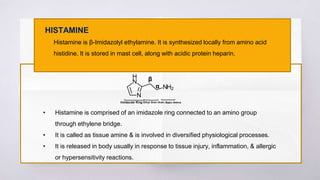
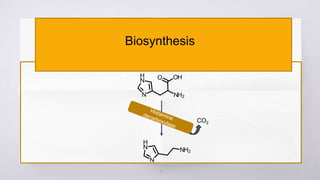
Histamine is β-Imidazolyl ethylamine. It is synthesized locally from amino acid
histidine. It is stored in mast cell, along with acidic protein heparin.
• Histamine is comprised of an imidazole ring connected to an amino group
through ethylene bridge.
• It is called as tissue amine & is involved in diversified physiological processes.
• It is released in body usually in response to tissue injury, inflammation, & allergic
or hypersensitivity reactions.
3
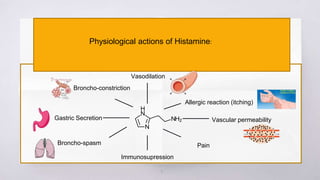
Physiological actions of Histamine:
Vasodilation
Immunosupression
Allergic reaction (itching)
Vascular permeability
Pain
Gastric Secretion
Broncho-constriction
Broncho-spasm
4
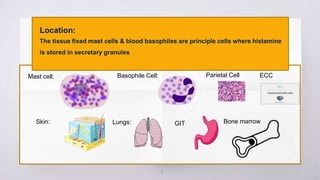
Location:
The tissue fixed mast cells & blood basophiles are principle cells where histamine
is stored in secretary granules
Skin: Lungs: GIT Bone marrow
Mast cell: Basophile Cell: Parietal Cell ECC
5
CO2
Biosynthesis
6
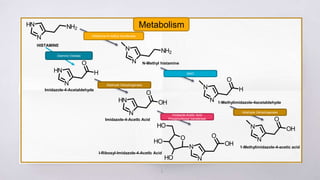
Histamine-N-methyl transferase
HISTAMINE
N-Methyl histamine
MAO
1-Methylimidazole-4acetaldehyde
Aldehyde Dehydrogenase
1-Methylimidazole-4-acetic acid
Diamine Oxidase
Imidazole-4-Acetaldehyde
Aldehyde Dehydrogenase
Imidazole-4-AcetIc Acid
Imidazole-Acetic Acid
Phosphoribosyl transferase
I-Ribosyl-Imidazole-4-AcetIc Acid
Metabolism
7
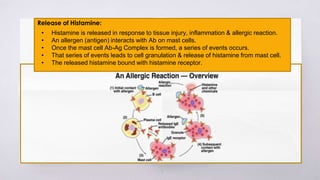
Release of Histamine:
• Histamine is released in response to tissue injury, inflammation & allergic reaction.
• An allergen (antigen) interacts with Ab on mast cells.
• Once the mast cell Ab-Ag Complex is formed, a series of events occurs.
• That series of events leads to cell granulation & release of histamine from mast cell.
• The released histamine bound with histamine receptor.
8
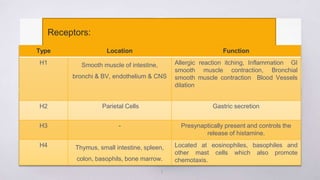
Receptors:
Type Location Function
H1 Smooth muscle of intestine,
bronchi & BV, endothelium & CNS
Allergic reaction itching, Inflammation GI
smooth muscle contraction, Bronchial
smooth muscle contraction Blood Vessels
dilation
H2 Parietal Cells Gastric secretion
H3 - Presynaptically present and controls the
release of histamine.
H4 Thymus, small intestine, spleen,
colon, basophils, bone marrow.
Located at eosinophiles, basophiles and
other mast cells which also promote
chemotaxis.
9
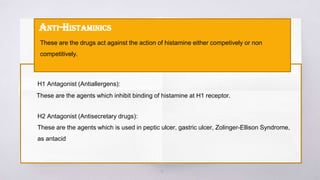
ANTI-HISTAMINICS
These are the drugs act against the action of histamine either competively or non
competitively.
H1 Antagonist (Antiallergens):
These are the agents which inhibit binding of histamine at H1 receptor.
H2 Antagonist (Antisecretary drugs):
These are the agents which is used in peptic ulcer, gastric ulcer, Zolinger-Ellison Syndrome,
as antacid
10
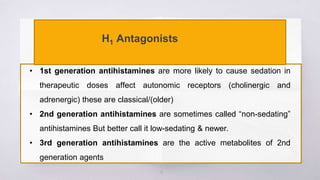
H1 Antagonists
• 1st generation antihistamines are more likely to cause sedation in
therapeutic doses affect autonomic receptors (cholinergic and
adrenergic) these are classical/(older)
• 2nd generation antihistamines are sometimes called “non-sedating”
antihistamines But better call it low-sedating & newer.
• 3rd generation antihistamines are the active metabolites of 2nd
generation agents
11
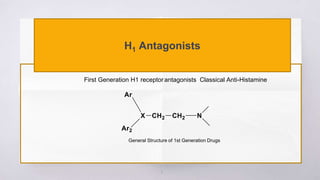
H1 Antagonists
First Generation H1 receptorantagonists Classical Anti-Histamine
General Structure of 1st Generation Drugs
12
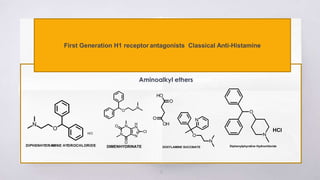
First Generation H1 receptor antagonists Classical Anti-Histamine
Aminoalkyl ethers ethers
13
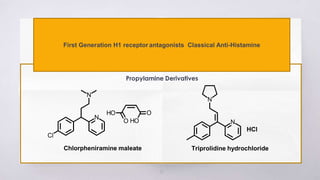
First Generation H1 receptor antagonists Classical Anti-Histamine
Propylamine Derivatives
Chlorpheniramine maleate Triprolidine hydrochloride
14
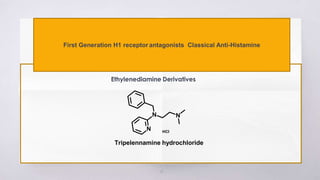
First Generation H1 receptor antagonists Classical Anti-Histamine
Ethylenediamine Derivatives
Tripelennamine hydrochloride
15
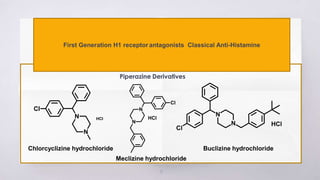
First Generation H1 receptor antagonists Classical Anti-Histamine
Piperazine Derivatives
Chlorcyclizine hydrochloride
Meclizine hydrochloride
Buclizine hydrochloride
16
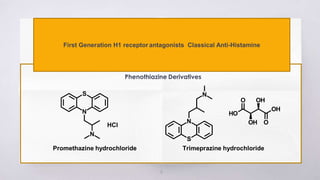
First Generation H1 receptor antagonists Classical Anti-Histamine
Phenothiazine Derivatives
Promethazine hydrochloride Trimeprazine hydrochloride
17
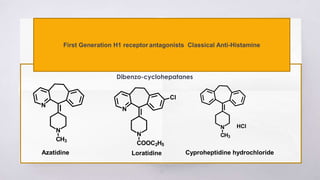
First Generation H1 receptor antagonists Classical Anti-Histamine
Dibenzo-cyclohepatanes
Azatidine Cyproheptidine hydrochloride
Loratidine
18
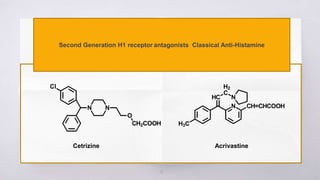
Second Generation H1 receptor antagonists Classical Anti-Histamine
Cetrizine Acrivastine
19
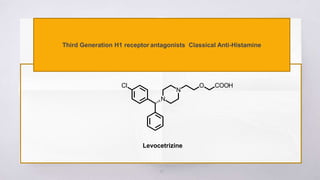
Third Generation H1 receptor antagonists Classical Anti-Histamine
Levocetrizine
20
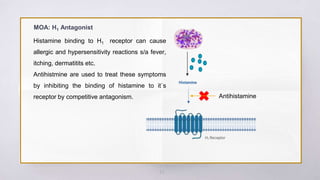
MOA: H1 Antagonist
Antihistamine
Histamine binding to H1 receptor can cause
allergic and hypersensitivity reactions s/a fever,
itching, dermatitits etc.
Antihistmine are used to treat these symptoms
by inhibiting the binding of histamine to it`s
receptor by competitive antagonism.
21
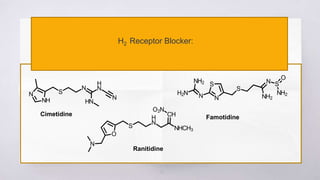
H2 Receptor Blocker:
Cimetidine Famotidine
Ranitidine
22
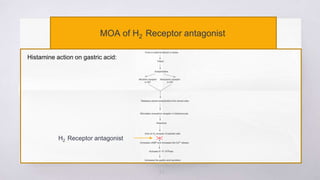
MOA of H2 Receptor antagonist
Histamine action on gastric acid:
H2 Receptor antagonist
23
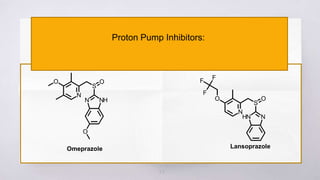
Omeprazole
Proton Pump Inhibitors:
Lansoprazole
24
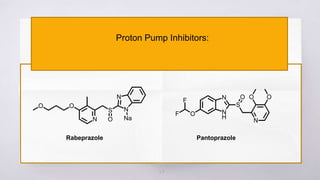
Rabeprazole
Proton Pump Inhibitors:
Pantoprazole
25
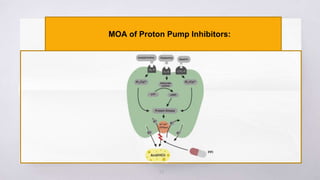
MOA of Proton Pump Inhibitors:
26

Antihistamine

  • 1.
    ANTI-HISTAMINICS By Shaikh Matin Assist. Professor HR Patel Institute of Pharmaceutical Education and Research,Shirpur
  • 2.
    HISTAMINE Histamine is β-Imidazolylethylamine. It is synthesized locally from amino acid histidine. It is stored in mast cell, along with acidic protein heparin. • Histamine is comprised of an imidazole ring connected to an amino group through ethylene bridge. • It is called as tissue amine & is involved in diversified physiological processes. • It is released in body usually in response to tissue injury, inflammation, & allergic or hypersensitivity reactions.
  • 3.
    3 Physiological actions ofHistamine: Vasodilation Immunosupression Allergic reaction (itching) Vascular permeability Pain Gastric Secretion Broncho-constriction Broncho-spasm
  • 4.
    4 Location: The tissue fixedmast cells & blood basophiles are principle cells where histamine is stored in secretary granules Skin: Lungs: GIT Bone marrow Mast cell: Basophile Cell: Parietal Cell ECC
  • 5.
  • 6.
    6 Histamine-N-methyl transferase HISTAMINE N-Methyl histamine MAO 1-Methylimidazole-4acetaldehyde AldehydeDehydrogenase 1-Methylimidazole-4-acetic acid Diamine Oxidase Imidazole-4-Acetaldehyde Aldehyde Dehydrogenase Imidazole-4-AcetIc Acid Imidazole-Acetic Acid Phosphoribosyl transferase I-Ribosyl-Imidazole-4-AcetIc Acid Metabolism
  • 7.
    7 Release of Histamine: •Histamine is released in response to tissue injury, inflammation & allergic reaction. • An allergen (antigen) interacts with Ab on mast cells. • Once the mast cell Ab-Ag Complex is formed, a series of events occurs. • That series of events leads to cell granulation & release of histamine from mast cell. • The released histamine bound with histamine receptor.
  • 8.
    8 Receptors: Type Location Function H1Smooth muscle of intestine, bronchi & BV, endothelium & CNS Allergic reaction itching, Inflammation GI smooth muscle contraction, Bronchial smooth muscle contraction Blood Vessels dilation H2 Parietal Cells Gastric secretion H3 - Presynaptically present and controls the release of histamine. H4 Thymus, small intestine, spleen, colon, basophils, bone marrow. Located at eosinophiles, basophiles and other mast cells which also promote chemotaxis.
  • 9.
    9 ANTI-HISTAMINICS These are thedrugs act against the action of histamine either competively or non competitively. H1 Antagonist (Antiallergens): These are the agents which inhibit binding of histamine at H1 receptor. H2 Antagonist (Antisecretary drugs): These are the agents which is used in peptic ulcer, gastric ulcer, Zolinger-Ellison Syndrome, as antacid
  • 10.
    10 H1 Antagonists • 1stgeneration antihistamines are more likely to cause sedation in therapeutic doses affect autonomic receptors (cholinergic and adrenergic) these are classical/(older) • 2nd generation antihistamines are sometimes called “non-sedating” antihistamines But better call it low-sedating & newer. • 3rd generation antihistamines are the active metabolites of 2nd generation agents
  • 11.
    11 H1 Antagonists First GenerationH1 receptorantagonists Classical Anti-Histamine General Structure of 1st Generation Drugs
  • 12.
    12 First Generation H1receptor antagonists Classical Anti-Histamine Aminoalkyl ethers ethers
  • 13.
    13 First Generation H1receptor antagonists Classical Anti-Histamine Propylamine Derivatives Chlorpheniramine maleate Triprolidine hydrochloride
  • 14.
    14 First Generation H1receptor antagonists Classical Anti-Histamine Ethylenediamine Derivatives Tripelennamine hydrochloride
  • 15.
    15 First Generation H1receptor antagonists Classical Anti-Histamine Piperazine Derivatives Chlorcyclizine hydrochloride Meclizine hydrochloride Buclizine hydrochloride
  • 16.
    16 First Generation H1receptor antagonists Classical Anti-Histamine Phenothiazine Derivatives Promethazine hydrochloride Trimeprazine hydrochloride
  • 17.
    17 First Generation H1receptor antagonists Classical Anti-Histamine Dibenzo-cyclohepatanes Azatidine Cyproheptidine hydrochloride Loratidine
  • 18.
    18 Second Generation H1receptor antagonists Classical Anti-Histamine Cetrizine Acrivastine
  • 19.
    19 Third Generation H1receptor antagonists Classical Anti-Histamine Levocetrizine
  • 20.
    20 MOA: H1 Antagonist Antihistamine Histaminebinding to H1 receptor can cause allergic and hypersensitivity reactions s/a fever, itching, dermatitits etc. Antihistmine are used to treat these symptoms by inhibiting the binding of histamine to it`s receptor by competitive antagonism.
  • 21.
  • 22.
    22 MOA of H2Receptor antagonist Histamine action on gastric acid: H2 Receptor antagonist
  • 23.
  • 24.
  • 25.
    25 MOA of ProtonPump Inhibitors:
  • 26.