Thomas Morgan
Jennifer Wood
Thomas Morgan (What is natural selection)
Thomas Hunt Morgan:
(1866-1945)
Discovered that genes are carried within chromosomes while
conducting his famous fruit fly experiment. This led to the discovery
that hereditary material is then duplicated in a thing called cell
division. His discoveries in his experiment gave way to the discovery
of mutations, gene flow, and genetic
Drift. (Larsen, 43)
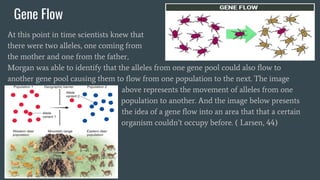
At this point in time scientists knew that
there were two alleles, one coming from
the mother and one from the father,
Morgan was able to identify that the alleles from one gene pool could also flow to
another gene pool causing them to flow from one population to the next. The image
abo above represents the movement of alleles from one
a population to another. And the image below presents
he the idea of a gene flow into an area that that a certain
g organism couldn’t occupy before. ( Larsen, 44)
b
Gene Flow
Genetic Drift
Genetic drift was able to be discovered
when studying populations and their ability
to be affected especially within a smaller
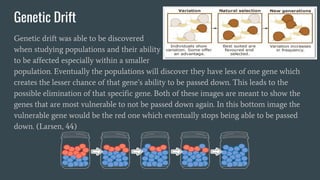
population. Eventually the populations will discover they have less of one gene which
creates the lesser chance of that gene’s ability to be passed down. This leads to the
possible elimination of that specific gene. Both of these images are meant to show the
genes that are most vulnerable to not be passed down again. In this bottom image the
vulnerable gene would be the red one which eventually stops being able to be passed
down. (Larsen, 44)
DNA
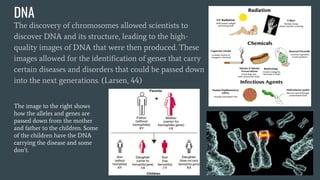
The discovery of chromosomes allowed scientists to
discover DNA and its structure, leading to the high-
quality images of DNA that were then produced. These
images allowed for the identification of genes that carry
certain diseases and disorders that could be passed down
into the next generations. (Larsen, 44)
The image to the right shows
how the alleles and genes are
passed down from the mother
and father to the children. Some
of the children have the DNA
carrying the disease and some
don’t.
Mutations
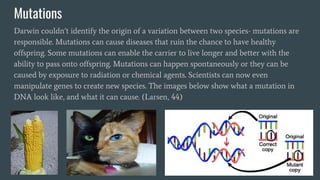
Darwin couldn’t identify the origin of a variation between two species- mutations are
responsible. Mutations can cause diseases that ruin the chance to have healthy
offspring. Some mutations can enable the carrier to live longer and better with the
ability to pass onto offspring. Mutations can happen spontaneously or they can be
caused by exposure to radiation or chemical agents. Scientists can now even
manipulate genes to create new species. The images below show what a mutation in
DNA look like, and what it can cause. (Larsen, 44)
Sources
Larsen, C. S. (2008). Discovering Physical Anthropology; Our Origins. New York , New
York : W. W Norton & Company, Inc.

Anthropology presentation

  • 1.
  • 2.
    Thomas Morgan (Whatis natural selection) Thomas Hunt Morgan: (1866-1945) Discovered that genes are carried within chromosomes while conducting his famous fruit fly experiment. This led to the discovery that hereditary material is then duplicated in a thing called cell division. His discoveries in his experiment gave way to the discovery of mutations, gene flow, and genetic Drift. (Larsen, 43)
  • 3.
    At this pointin time scientists knew that there were two alleles, one coming from the mother and one from the father, Morgan was able to identify that the alleles from one gene pool could also flow to another gene pool causing them to flow from one population to the next. The image abo above represents the movement of alleles from one a population to another. And the image below presents he the idea of a gene flow into an area that that a certain g organism couldn’t occupy before. ( Larsen, 44) b Gene Flow
  • 4.
    Genetic Drift Genetic driftwas able to be discovered when studying populations and their ability to be affected especially within a smaller population. Eventually the populations will discover they have less of one gene which creates the lesser chance of that gene’s ability to be passed down. This leads to the possible elimination of that specific gene. Both of these images are meant to show the genes that are most vulnerable to not be passed down again. In this bottom image the vulnerable gene would be the red one which eventually stops being able to be passed down. (Larsen, 44)
  • 5.
    DNA The discovery ofchromosomes allowed scientists to discover DNA and its structure, leading to the high- quality images of DNA that were then produced. These images allowed for the identification of genes that carry certain diseases and disorders that could be passed down into the next generations. (Larsen, 44) The image to the right shows how the alleles and genes are passed down from the mother and father to the children. Some of the children have the DNA carrying the disease and some don’t.
  • 6.
    Mutations Darwin couldn’t identifythe origin of a variation between two species- mutations are responsible. Mutations can cause diseases that ruin the chance to have healthy offspring. Some mutations can enable the carrier to live longer and better with the ability to pass onto offspring. Mutations can happen spontaneously or they can be caused by exposure to radiation or chemical agents. Scientists can now even manipulate genes to create new species. The images below show what a mutation in DNA look like, and what it can cause. (Larsen, 44)
  • 7.
    Sources Larsen, C. S.(2008). Discovering Physical Anthropology; Our Origins. New York , New York : W. W Norton & Company, Inc.