Drugs Acting on
Para-Sympathetic Nervous System
&
Sympathetic Nervous System
By: Dr. Baqir Raza Naqvi
AutonomicNervousSystem
1
Organization of ANS
(Autonomic Nervous System)
its subdivisions and
innervations
2
Nervous system
1. Peripheral
Nervous system
2. Central
Nervous
system
Brain
Spinal cord
Consists of nerves which lie outside
of the brain and spinal cord
3
4
5
6
A. Somatic Nervous System
Consists of single myelinated neuron, which originating
from CNS and terminates directly into skeletal Muscles
without mediation of ganglia.
It is voluntary system
Whereas autonomic is in-voluntary
7
B. Autonomic Nervous System
 Controls and regulates normal daily vital body
functions
 Involuntary and Consists of ;
Sympathetic N.S
Parasympathetic N.S
Enteric N.S
8
9
10
11
General comparison b/w SNS & PSNS
12
General comparison b/w SNS & PSNS
1. Sympathetic N.S
Preganglionic neurons comes from thoracic
and lumber region of spinal cord
Preganglionic neurons are short as compare
to postganglionic fibers
It involves in fight and flight
Neurotransmitters include adrenaline and
nor adrenaline (Catecholamine's)
13
2. Parasympathetic N.S
Parasympathetic preganglionic fibers arise from
cranium (cranial nerves III, VII, IX and X) and from
sacral nerves in spinal cord
Involved in maintenance homeostasis
Preganglionic fibers are longer as compared to post
ganglionic fibers
Acetylcholine is principal neurotransmitter
14
Functions of Parasympathetic Nervous
System
Eye: Contraction of Iris sphincter muscle
(pupil contract) Contract of ciliary muscle
(lens accommodate for near vision)
Trachea & Bronchioles: Constriction,
increased secretions
Ureters & Bladder: Contraction of
detrusor; relaxation of trigon sphincters
Genitalia (Male): Stimulate erection
Lacrimal Glands: Stimulate tears
Salivary glands: Copious, watery
secretion
Eye: Contract of Iris radial muscle (Pupil
dilates)
Trachea & Bronchioles: Dilation
Adrenal Medulla: Secrete epinepherine
& norepinephrine
Kidney: secrete renin
Ureters & Bladder: Relaxation of
detrusor
Contract Trigone & Sphincter
Genitalia: Stimulate ejaculation
Functions of Sympathetic Nervous
System
15
16
General comparison b/w SNS & PSNS
3. Enteric Nervous System
It is collection of nerve fibers that innervate the
GI tract, pancreas, & gallbladder
It is also known as "Brain of the gut”
It functions independently of CNS
It controls the motility, exocrine and endocrine
secretions and microcirculation of gastrointestinal tract.
17
Various Neurotransmitters
18
19
Drugs Acting on
Para - Sympathetic
Nervous System
20
Synthesis of Acetylcholine
(Neurotransmitter of Parasympathetic N.S)
• Choline enters the cholinergic neuron by carrier-
mediated transport, where it reacts with acetyl-
CoA with the help of choline acetyltransferase
(ChAT) to form ACh.
• The ACh is then stored in storage vesicles.
• It is released into the synaptic cleft, when an
action potential reaches the nerve terminals.
• Released ACh interacts with cholinergic
receptors on effector cell and activates them.
• In the synaptic cleft, the ACh is rapidly
hydrolyzed by acetyl cholinesterase (AChE)
enzyme. 21
22
Synthesis of Acetylcholine
(Neurotransmitter of Parasympathetic N.S)
Cholinergic Receptors in Body
(Muscarinic & Nicotinic Receptors)
1. Muscarinic
23
2. Nicotinic
24
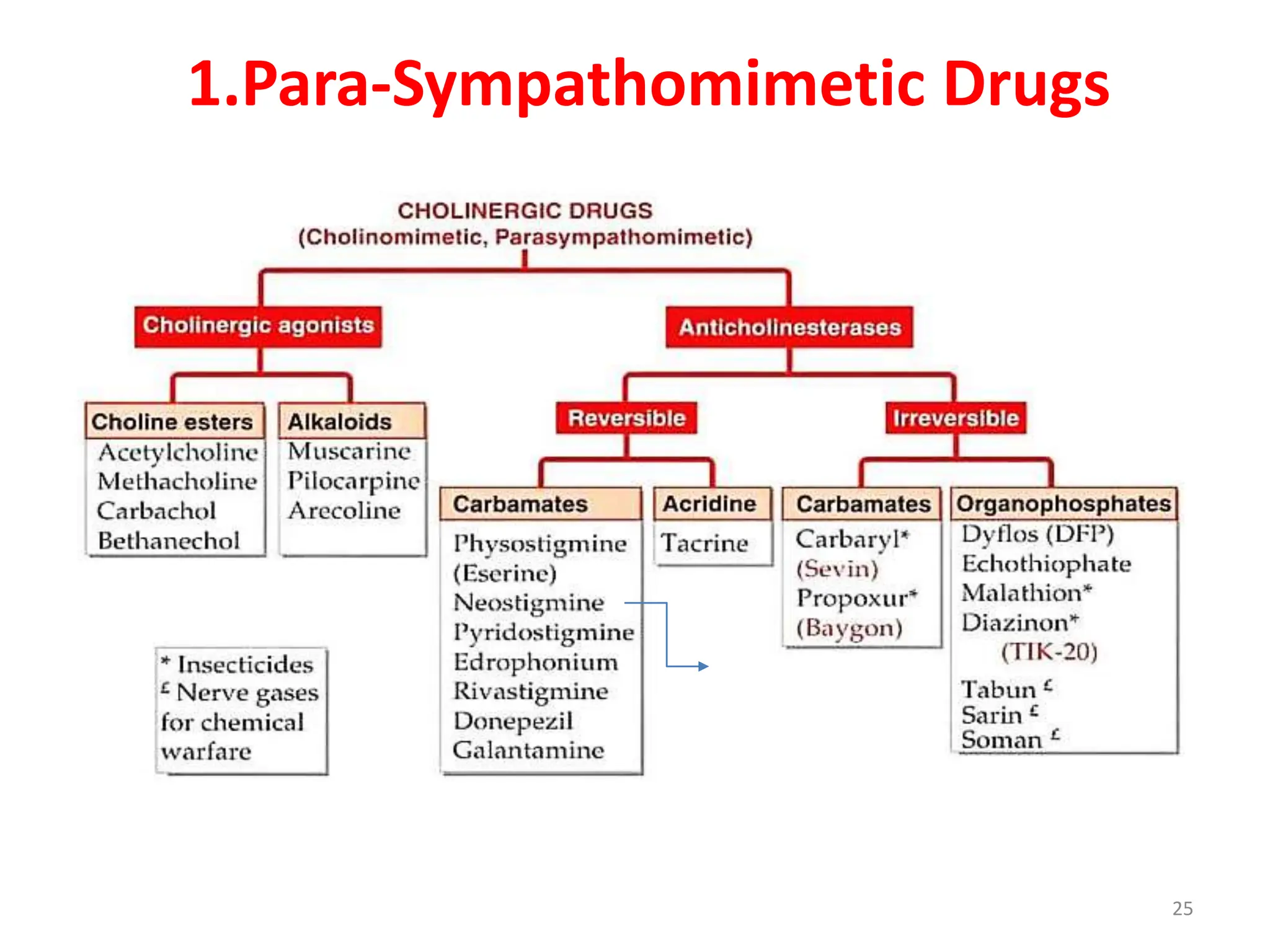
1.Para-Sympathomimetic Drugs
25
Therapeutic Uses of Cholinergic Drugs
26
27
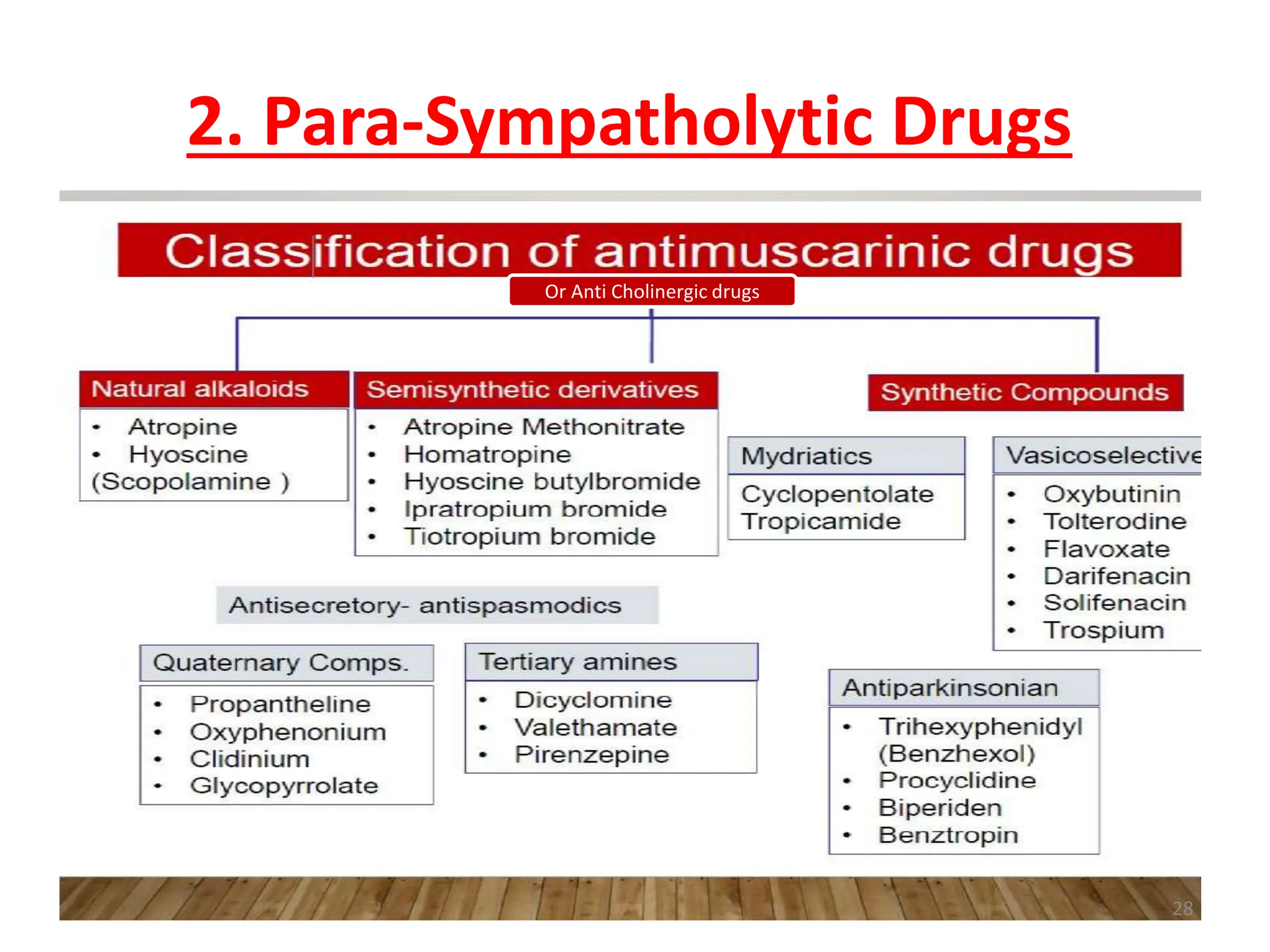
2. Para-Sympatholytic Drugs
Or Anti Cholinergic drugs
28
Therapeutic Uses of Anti- Cholinergic Drugs
29
30
Drugs Acting on
Sympathetic
Nervous System
31
Synthesis of Catecholamine's (NA)
Neurotransmitter of Sympathetic N.S)
• It begins with the amino acid tyrosine,
which is transported into the adrenergic
neuron by active transport.
• In the neuronal cytosol, tyrosine is
converted to DOPA by tyrosine hydroxylase
and DOPA to dopamine (DA) by DOPA
decarboxylase.
• Dopamine enters the storage vesicles of the
nerve terminal by active transport, where it
is converted to NA (Norepinephrine) by the
enzyme dopamine hydroxylase the NA
formed gets stored in the vesicles.
• In the adrenal medulla, NA is further
converted to adrenaline by N-
methyltransferase.
• Small quantities of NA are released
continuously into the synaptic cleft and
large quantities during nerve stimulation.
32
33
Synthesis of Catecholamine's (NA)
Neurotransmitter of Sympathetic N.S)
34
Adrenergic Receptors in Body
(Alpha & Beta Receptors)
35
36
37
38
(dilation of pupil)
39
1. Sympathomimetic Drugs
40
Sympathomimetic Drugs (Cont.)
41
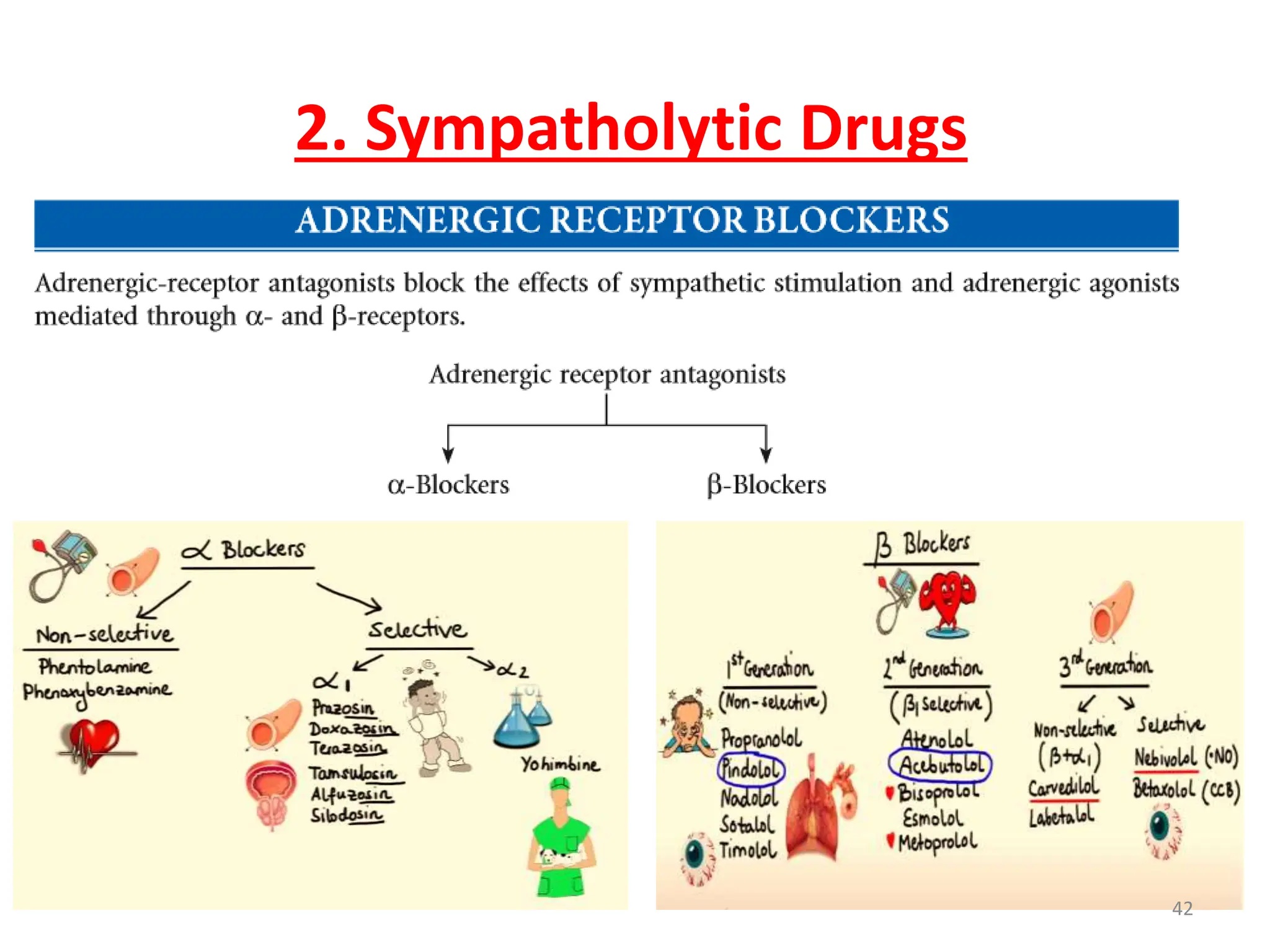
2. Sympatholytic Drugs
42
1.
43
2.
44
Thank you !
45

ANS (Sympathetic & Para-Sympathetic Drugs) By; Baqir Naqvi.pptx

  • 1.
    Drugs Acting on Para-SympatheticNervous System & Sympathetic Nervous System By: Dr. Baqir Raza Naqvi AutonomicNervousSystem 1
  • 2.
    Organization of ANS (AutonomicNervous System) its subdivisions and innervations 2
  • 3.
    Nervous system 1. Peripheral Nervoussystem 2. Central Nervous system Brain Spinal cord Consists of nerves which lie outside of the brain and spinal cord 3
  • 4.
  • 5.
  • 6.
  • 7.
    A. Somatic NervousSystem Consists of single myelinated neuron, which originating from CNS and terminates directly into skeletal Muscles without mediation of ganglia. It is voluntary system Whereas autonomic is in-voluntary 7
  • 8.
    B. Autonomic NervousSystem  Controls and regulates normal daily vital body functions  Involuntary and Consists of ; Sympathetic N.S Parasympathetic N.S Enteric N.S 8
  • 9.
  • 10.
  • 11.
  • 12.
  • 13.
    1. Sympathetic N.S Preganglionicneurons comes from thoracic and lumber region of spinal cord Preganglionic neurons are short as compare to postganglionic fibers It involves in fight and flight Neurotransmitters include adrenaline and nor adrenaline (Catecholamine's) 13
  • 14.
    2. Parasympathetic N.S Parasympatheticpreganglionic fibers arise from cranium (cranial nerves III, VII, IX and X) and from sacral nerves in spinal cord Involved in maintenance homeostasis Preganglionic fibers are longer as compared to post ganglionic fibers Acetylcholine is principal neurotransmitter 14
  • 15.
    Functions of ParasympatheticNervous System Eye: Contraction of Iris sphincter muscle (pupil contract) Contract of ciliary muscle (lens accommodate for near vision) Trachea & Bronchioles: Constriction, increased secretions Ureters & Bladder: Contraction of detrusor; relaxation of trigon sphincters Genitalia (Male): Stimulate erection Lacrimal Glands: Stimulate tears Salivary glands: Copious, watery secretion Eye: Contract of Iris radial muscle (Pupil dilates) Trachea & Bronchioles: Dilation Adrenal Medulla: Secrete epinepherine & norepinephrine Kidney: secrete renin Ureters & Bladder: Relaxation of detrusor Contract Trigone & Sphincter Genitalia: Stimulate ejaculation Functions of Sympathetic Nervous System 15
  • 16.
  • 17.
    3. Enteric NervousSystem It is collection of nerve fibers that innervate the GI tract, pancreas, & gallbladder It is also known as "Brain of the gut” It functions independently of CNS It controls the motility, exocrine and endocrine secretions and microcirculation of gastrointestinal tract. 17
  • 18.
  • 19.
  • 20.
    Drugs Acting on Para- Sympathetic Nervous System 20
  • 21.
    Synthesis of Acetylcholine (Neurotransmitterof Parasympathetic N.S) • Choline enters the cholinergic neuron by carrier- mediated transport, where it reacts with acetyl- CoA with the help of choline acetyltransferase (ChAT) to form ACh. • The ACh is then stored in storage vesicles. • It is released into the synaptic cleft, when an action potential reaches the nerve terminals. • Released ACh interacts with cholinergic receptors on effector cell and activates them. • In the synaptic cleft, the ACh is rapidly hydrolyzed by acetyl cholinesterase (AChE) enzyme. 21
  • 22.
  • 23.
    Cholinergic Receptors inBody (Muscarinic & Nicotinic Receptors) 1. Muscarinic 23
  • 24.
  • 25.
  • 26.
    Therapeutic Uses ofCholinergic Drugs 26
  • 27.
  • 28.
    2. Para-Sympatholytic Drugs OrAnti Cholinergic drugs 28
  • 29.
    Therapeutic Uses ofAnti- Cholinergic Drugs 29
  • 30.
  • 31.
  • 32.
    Synthesis of Catecholamine's(NA) Neurotransmitter of Sympathetic N.S) • It begins with the amino acid tyrosine, which is transported into the adrenergic neuron by active transport. • In the neuronal cytosol, tyrosine is converted to DOPA by tyrosine hydroxylase and DOPA to dopamine (DA) by DOPA decarboxylase. • Dopamine enters the storage vesicles of the nerve terminal by active transport, where it is converted to NA (Norepinephrine) by the enzyme dopamine hydroxylase the NA formed gets stored in the vesicles. • In the adrenal medulla, NA is further converted to adrenaline by N- methyltransferase. • Small quantities of NA are released continuously into the synaptic cleft and large quantities during nerve stimulation. 32
  • 33.
    33 Synthesis of Catecholamine's(NA) Neurotransmitter of Sympathetic N.S)
  • 34.
  • 35.
    Adrenergic Receptors inBody (Alpha & Beta Receptors) 35
  • 36.
  • 37.
  • 38.
  • 39.
  • 40.
  • 41.
  • 42.
  • 43.
  • 44.
  • 45.