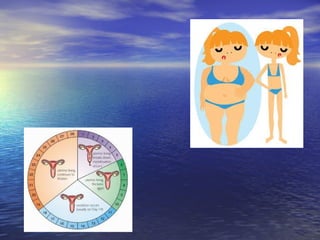
NATURALNATURAL SCIENCESSCIENCES
PROYECTPROYECT
HOWHOW ANOREXIAANOREXIA ANDAND
BULIMIABULIMIA AFFECTAFFECT ININ THETHE
MENSTRUALMENSTRUAL CYCLECYCLE
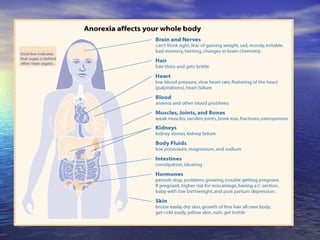
ANOREXIAANOREXIA
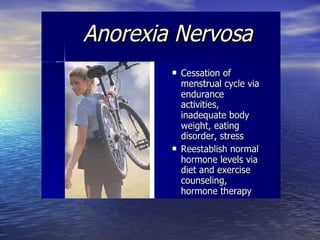
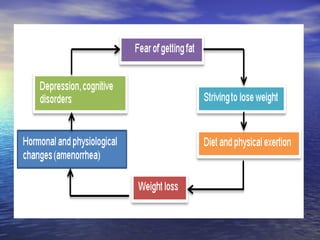
• Weight loss causes loss of menstrual function (amenorrhea) andWeight loss causes loss of menstrual function (amenorrhea) and
weight gain restores menstrual cycles. A minimal weight for heightweight gain restores menstrual cycles. A minimal weight for height
necessary for the onset of or the restoration of menstrual cycles innecessary for the onset of or the restoration of menstrual cycles in
cases of primary or secondary amenorrhea due to undernutrition iscases of primary or secondary amenorrhea due to undernutrition is
indicated by an index of fatness of normal girls at menarche and atindicated by an index of fatness of normal girls at menarche and at
age 18 years, respectively. Amenorrheic patients of ages 16 yearsage 18 years, respectively. Amenorrheic patients of ages 16 years
and over resume menstrual cycles after weight gain at a heavierand over resume menstrual cycles after weight gain at a heavier
weight for a particular height than is found at menarche. Girlsweight for a particular height than is found at menarche. Girls
become relatively and absolutely fatter from menarche to age 18become relatively and absolutely fatter from menarche to age 18
years. The data suggest that a minimum level of stored, easilyyears. The data suggest that a minimum level of stored, easily
mobilized energy is necessary for ovulation and menstrual cycles inmobilized energy is necessary for ovulation and menstrual cycles in
the human female.the human female.
• What is Anorexia Nervosa?What is Anorexia Nervosa?
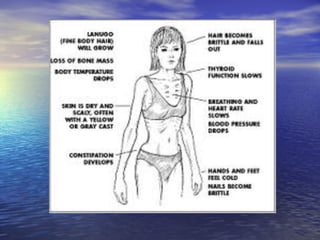
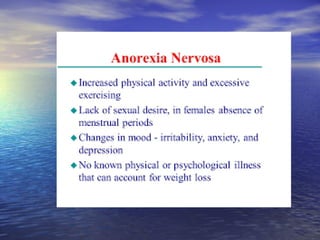
• Anorexia nervosa is an eating disorder in which a person intentionally limits the intake of food orAnorexia nervosa is an eating disorder in which a person intentionally limits the intake of food or
beverage because of a strong drive for thinness and an intense fear of gaining weight. This canbeverage because of a strong drive for thinness and an intense fear of gaining weight. This can
happen even if a person is already thin. The perception of body weight and shape is distortedhappen even if a person is already thin. The perception of body weight and shape is distorted
and has an unduly strong influence on a person’s self-concept. The resulting weight loss andand has an unduly strong influence on a person’s self-concept. The resulting weight loss and
nutritional imbalance can lead to serious complications, including death.nutritional imbalance can lead to serious complications, including death.
• Obsessions and anxiety about food and weight may cause monotonous eating rituals, includingObsessions and anxiety about food and weight may cause monotonous eating rituals, including
reluctance to be seen eating by others. It is not uncommon for people with anorexia nervosa toreluctance to be seen eating by others. It is not uncommon for people with anorexia nervosa to
collect recipes and prepare food for family and friends, but not partake in the food that theycollect recipes and prepare food for family and friends, but not partake in the food that they
prepared. They may also adhere to strict, intensive exercise routines to lose or keep off weight.prepared. They may also adhere to strict, intensive exercise routines to lose or keep off weight.
• What Causes Anorexia Nervosa?What Causes Anorexia Nervosa?
• Anorexia nervosa does not have a single cause, but is related to many different factors. TheseAnorexia nervosa does not have a single cause, but is related to many different factors. These
factors are sometimes divided into predisposing, precipitating, and perpetuating factors, thatfactors are sometimes divided into predisposing, precipitating, and perpetuating factors, that
make a person vulnerable to develop, trigger the onset, and maintain the eating disorder,make a person vulnerable to develop, trigger the onset, and maintain the eating disorder,
respectively.  Anorexia nervosa often begins as simple dieting to "get in shape" or to "eatrespectively.  Anorexia nervosa often begins as simple dieting to "get in shape" or to "eat
healthier" but progresses to extreme and unhealthy weight loss. Social attitudes toward bodyhealthier" but progresses to extreme and unhealthy weight loss. Social attitudes toward body
appearance, family influences, genetics, and neurochemical and developmental factors mayappearance, family influences, genetics, and neurochemical and developmental factors may
contribute to the development and maintenance of anorexia nervosa. A personal or family historycontribute to the development and maintenance of anorexia nervosa. A personal or family history
of anxiety, depression or obsessive-compulsive habits is common. Although families in whichof anxiety, depression or obsessive-compulsive habits is common. Although families in which
anorexia nervosa occurs were once labeled as having difficulties with conflict resolution, rigidity,anorexia nervosa occurs were once labeled as having difficulties with conflict resolution, rigidity,
intrusiveness, and over-protectiveness, it is now clear that parents dointrusiveness, and over-protectiveness, it is now clear that parents do notnot cause eating disorders.cause eating disorders.
Research suggests that certain areas of the brain function different with an active eating disorderResearch suggests that certain areas of the brain function different with an active eating disorder
BULIMIABULIMIA
• Bulimia NervosaBulimia Nervosa
• What is Bulimia Nervosa?What is Bulimia Nervosa?
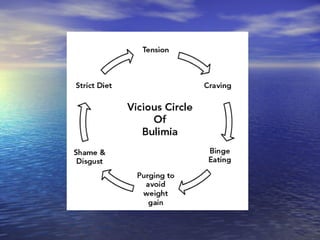
• Bulimia nervosa is an eating disorder in which a person engages in uncontrollable episodes ofBulimia nervosa is an eating disorder in which a person engages in uncontrollable episodes of
overeating (bingeing) usually followed by intentionally vomiting (sometimes called purging),overeating (bingeing) usually followed by intentionally vomiting (sometimes called purging),
misuse of laxatives, enemas, fasting, or excessive exercise to control weight. Bingeing, in thismisuse of laxatives, enemas, fasting, or excessive exercise to control weight. Bingeing, in this
situation, is defined as eating much larger amounts of food than would normally be consumedsituation, is defined as eating much larger amounts of food than would normally be consumed
within a short period of time (usually less than two hours). Eating binges may occur as often aswithin a short period of time (usually less than two hours). Eating binges may occur as often as
several times a day but are most common in the evening and night hours. Due to the shame, guiltseveral times a day but are most common in the evening and night hours. Due to the shame, guilt
and disgust a person with bulimia nervosa often feels, bingeing and purging behaviors are oftenand disgust a person with bulimia nervosa often feels, bingeing and purging behaviors are often
done in secret and the evidence of these behaviors may be hidden for months.done in secret and the evidence of these behaviors may be hidden for months.
• What Causes Bulimia Nervosa?What Causes Bulimia Nervosa?
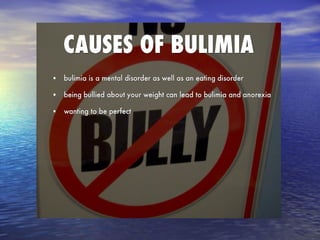
• Bulimia Nervosa does not have a single cause. Rather, various factors culminate in to make anBulimia Nervosa does not have a single cause. Rather, various factors culminate in to make an
individual vulnerable to develop and maintain the eating disorder. Social attitudes toward bodyindividual vulnerable to develop and maintain the eating disorder. Social attitudes toward body
appearance, family influences, genetics, past traumatic experiences, and neurochemical andappearance, family influences, genetics, past traumatic experiences, and neurochemical and
developmental factors may contribute to the development and maintenance of bulimia nervosa.developmental factors may contribute to the development and maintenance of bulimia nervosa.
Moreover, recent research suggests that certain areas of the brain function differently with anMoreover, recent research suggests that certain areas of the brain function differently with an
active eating disorder. A personal or family history of substance abuse, anxiety, depression oractive eating disorder. A personal or family history of substance abuse, anxiety, depression or
suicide is common. It is now clear thatsuicide is common. It is now clear that
• Bulimia NervosaBulimia Nervosa
• What is Bulimia Nervosa?What is Bulimia Nervosa?
• Bulimia nervosa is an eating disorder in which a person engages in uncontrollable episodes ofBulimia nervosa is an eating disorder in which a person engages in uncontrollable episodes of
overeating (bingeing) usually followed by intentionally vomiting (sometimes called purging),overeating (bingeing) usually followed by intentionally vomiting (sometimes called purging),
misuse of laxatives, enemas, fasting, or excessive exercise to control weight. Bingeing, in thismisuse of laxatives, enemas, fasting, or excessive exercise to control weight. Bingeing, in this
situation, is defined as eating much larger amounts of food than would normally be consumedsituation, is defined as eating much larger amounts of food than would normally be consumed
within a short period of time (usually less than two hours). Eating binges may occur as often aswithin a short period of time (usually less than two hours). Eating binges may occur as often as
several times a day but are most common in the evening and night hours. Due to the shame, guiltseveral times a day but are most common in the evening and night hours. Due to the shame, guilt
and disgust a person with bulimia nervosa often feels, bingeing and purging behaviors are oftenand disgust a person with bulimia nervosa often feels, bingeing and purging behaviors are often
done in secret and the evidence of these behaviors may be hidden for months.done in secret and the evidence of these behaviors may be hidden for months.
• What Causes Bulimia Nervosa?What Causes Bulimia Nervosa?
• Bulimia Nervosa does not have a single cause. Rather, various factors culminate in to make anBulimia Nervosa does not have a single cause. Rather, various factors culminate in to make an
individual vulnerable to develop and maintain the eating disorder. Social attitudes toward bodyindividual vulnerable to develop and maintain the eating disorder. Social attitudes toward body
appearance, family influences, genetics, past traumatic experiences, and neurochemical andappearance, family influences, genetics, past traumatic experiences, and neurochemical and
developmental factors may contribute to the development and maintenance of bulimia nervosa.developmental factors may contribute to the development and maintenance of bulimia nervosa.
Moreover, recent research suggests that certain areas of the brain function differently with anMoreover, recent research suggests that certain areas of the brain function differently with an
active eating disorder. A personal or family history of substance abuse, anxiety, depression oractive eating disorder. A personal or family history of substance abuse, anxiety, depression or
suicide is common. It is now clear that parents dosuicide is common. It is now clear that parents do notnot cause eating disorders but family support iscause eating disorders but family support is
essential for recovery.essential for recovery.
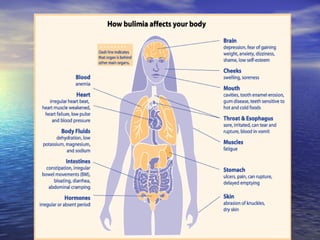
• Problems that anorexia and bulimia can cause inProblems that anorexia and bulimia can cause in
menstrual cyclemenstrual cycle
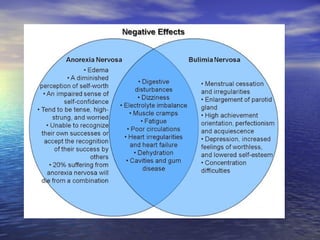
• Eating disorders profoundly impact an individual's qualityEating disorders profoundly impact an individual's quality
of life. Self-image, relationships, physical well-being andof life. Self-image, relationships, physical well-being and
day to day living are often adversely affected. Eatingday to day living are often adversely affected. Eating
disorders are also often associated with mood disorders,disorders are also often associated with mood disorders,
anxiety disorders, and personality disorders. Bulimiaanxiety disorders, and personality disorders. Bulimia
nervosa may be particularly associated with substancenervosa may be particularly associated with substance
abuse problems. Anorexia nervosa is often associatedabuse problems. Anorexia nervosa is often associated
with obsessive-compulsive symptoms.  The scope ofwith obsessive-compulsive symptoms.  The scope of
related problems associated with eating disordersrelated problems associated with eating disorders
highlights the need for prompt treatment and intervention.highlights the need for prompt treatment and intervention.
What causes anorexia nervosa?
The cause of anorexia nervosa is not known. Anorexia nervosa usually can begin
as innocent dieting or increased exercising for health or fitness, but then
progresses to extreme and unhealthy weight loss. Genetic factors may play a role
in increasing the risk for anorexia nervosa. Other mental health problems, such as
anxiety disorders or affective disorders, are commonly found in teens with
anorexia nervosa.
Anorexia & menstrual cycle

Anorexia & menstrual cycle

  • 1.
    NATURALNATURAL SCIENCESSCIENCES PROYECTPROYECT HOWHOW ANOREXIAANOREXIAANDAND BULIMIABULIMIA AFFECTAFFECT ININ THETHE MENSTRUALMENSTRUAL CYCLECYCLE
  • 2.
    ANOREXIAANOREXIA • Weight losscauses loss of menstrual function (amenorrhea) andWeight loss causes loss of menstrual function (amenorrhea) and weight gain restores menstrual cycles. A minimal weight for heightweight gain restores menstrual cycles. A minimal weight for height necessary for the onset of or the restoration of menstrual cycles innecessary for the onset of or the restoration of menstrual cycles in cases of primary or secondary amenorrhea due to undernutrition iscases of primary or secondary amenorrhea due to undernutrition is indicated by an index of fatness of normal girls at menarche and atindicated by an index of fatness of normal girls at menarche and at age 18 years, respectively. Amenorrheic patients of ages 16 yearsage 18 years, respectively. Amenorrheic patients of ages 16 years and over resume menstrual cycles after weight gain at a heavierand over resume menstrual cycles after weight gain at a heavier weight for a particular height than is found at menarche. Girlsweight for a particular height than is found at menarche. Girls become relatively and absolutely fatter from menarche to age 18become relatively and absolutely fatter from menarche to age 18 years. The data suggest that a minimum level of stored, easilyyears. The data suggest that a minimum level of stored, easily mobilized energy is necessary for ovulation and menstrual cycles inmobilized energy is necessary for ovulation and menstrual cycles in the human female.the human female.
  • 6.
    • What isAnorexia Nervosa?What is Anorexia Nervosa? • Anorexia nervosa is an eating disorder in which a person intentionally limits the intake of food orAnorexia nervosa is an eating disorder in which a person intentionally limits the intake of food or beverage because of a strong drive for thinness and an intense fear of gaining weight. This canbeverage because of a strong drive for thinness and an intense fear of gaining weight. This can happen even if a person is already thin. The perception of body weight and shape is distortedhappen even if a person is already thin. The perception of body weight and shape is distorted and has an unduly strong influence on a person’s self-concept. The resulting weight loss andand has an unduly strong influence on a person’s self-concept. The resulting weight loss and nutritional imbalance can lead to serious complications, including death.nutritional imbalance can lead to serious complications, including death. • Obsessions and anxiety about food and weight may cause monotonous eating rituals, includingObsessions and anxiety about food and weight may cause monotonous eating rituals, including reluctance to be seen eating by others. It is not uncommon for people with anorexia nervosa toreluctance to be seen eating by others. It is not uncommon for people with anorexia nervosa to collect recipes and prepare food for family and friends, but not partake in the food that theycollect recipes and prepare food for family and friends, but not partake in the food that they prepared. They may also adhere to strict, intensive exercise routines to lose or keep off weight.prepared. They may also adhere to strict, intensive exercise routines to lose or keep off weight. • What Causes Anorexia Nervosa?What Causes Anorexia Nervosa? • Anorexia nervosa does not have a single cause, but is related to many different factors. TheseAnorexia nervosa does not have a single cause, but is related to many different factors. These factors are sometimes divided into predisposing, precipitating, and perpetuating factors, thatfactors are sometimes divided into predisposing, precipitating, and perpetuating factors, that make a person vulnerable to develop, trigger the onset, and maintain the eating disorder,make a person vulnerable to develop, trigger the onset, and maintain the eating disorder, respectively.  Anorexia nervosa often begins as simple dieting to "get in shape" or to "eatrespectively.  Anorexia nervosa often begins as simple dieting to "get in shape" or to "eat healthier" but progresses to extreme and unhealthy weight loss. Social attitudes toward bodyhealthier" but progresses to extreme and unhealthy weight loss. Social attitudes toward body appearance, family influences, genetics, and neurochemical and developmental factors mayappearance, family influences, genetics, and neurochemical and developmental factors may contribute to the development and maintenance of anorexia nervosa. A personal or family historycontribute to the development and maintenance of anorexia nervosa. A personal or family history of anxiety, depression or obsessive-compulsive habits is common. Although families in whichof anxiety, depression or obsessive-compulsive habits is common. Although families in which anorexia nervosa occurs were once labeled as having difficulties with conflict resolution, rigidity,anorexia nervosa occurs were once labeled as having difficulties with conflict resolution, rigidity, intrusiveness, and over-protectiveness, it is now clear that parents dointrusiveness, and over-protectiveness, it is now clear that parents do notnot cause eating disorders.cause eating disorders. Research suggests that certain areas of the brain function different with an active eating disorderResearch suggests that certain areas of the brain function different with an active eating disorder
  • 8.
    BULIMIABULIMIA • Bulimia NervosaBulimiaNervosa • What is Bulimia Nervosa?What is Bulimia Nervosa? • Bulimia nervosa is an eating disorder in which a person engages in uncontrollable episodes ofBulimia nervosa is an eating disorder in which a person engages in uncontrollable episodes of overeating (bingeing) usually followed by intentionally vomiting (sometimes called purging),overeating (bingeing) usually followed by intentionally vomiting (sometimes called purging), misuse of laxatives, enemas, fasting, or excessive exercise to control weight. Bingeing, in thismisuse of laxatives, enemas, fasting, or excessive exercise to control weight. Bingeing, in this situation, is defined as eating much larger amounts of food than would normally be consumedsituation, is defined as eating much larger amounts of food than would normally be consumed within a short period of time (usually less than two hours). Eating binges may occur as often aswithin a short period of time (usually less than two hours). Eating binges may occur as often as several times a day but are most common in the evening and night hours. Due to the shame, guiltseveral times a day but are most common in the evening and night hours. Due to the shame, guilt and disgust a person with bulimia nervosa often feels, bingeing and purging behaviors are oftenand disgust a person with bulimia nervosa often feels, bingeing and purging behaviors are often done in secret and the evidence of these behaviors may be hidden for months.done in secret and the evidence of these behaviors may be hidden for months. • What Causes Bulimia Nervosa?What Causes Bulimia Nervosa? • Bulimia Nervosa does not have a single cause. Rather, various factors culminate in to make anBulimia Nervosa does not have a single cause. Rather, various factors culminate in to make an individual vulnerable to develop and maintain the eating disorder. Social attitudes toward bodyindividual vulnerable to develop and maintain the eating disorder. Social attitudes toward body appearance, family influences, genetics, past traumatic experiences, and neurochemical andappearance, family influences, genetics, past traumatic experiences, and neurochemical and developmental factors may contribute to the development and maintenance of bulimia nervosa.developmental factors may contribute to the development and maintenance of bulimia nervosa. Moreover, recent research suggests that certain areas of the brain function differently with anMoreover, recent research suggests that certain areas of the brain function differently with an active eating disorder. A personal or family history of substance abuse, anxiety, depression oractive eating disorder. A personal or family history of substance abuse, anxiety, depression or suicide is common. It is now clear thatsuicide is common. It is now clear that
  • 10.
    • Bulimia NervosaBulimiaNervosa • What is Bulimia Nervosa?What is Bulimia Nervosa? • Bulimia nervosa is an eating disorder in which a person engages in uncontrollable episodes ofBulimia nervosa is an eating disorder in which a person engages in uncontrollable episodes of overeating (bingeing) usually followed by intentionally vomiting (sometimes called purging),overeating (bingeing) usually followed by intentionally vomiting (sometimes called purging), misuse of laxatives, enemas, fasting, or excessive exercise to control weight. Bingeing, in thismisuse of laxatives, enemas, fasting, or excessive exercise to control weight. Bingeing, in this situation, is defined as eating much larger amounts of food than would normally be consumedsituation, is defined as eating much larger amounts of food than would normally be consumed within a short period of time (usually less than two hours). Eating binges may occur as often aswithin a short period of time (usually less than two hours). Eating binges may occur as often as several times a day but are most common in the evening and night hours. Due to the shame, guiltseveral times a day but are most common in the evening and night hours. Due to the shame, guilt and disgust a person with bulimia nervosa often feels, bingeing and purging behaviors are oftenand disgust a person with bulimia nervosa often feels, bingeing and purging behaviors are often done in secret and the evidence of these behaviors may be hidden for months.done in secret and the evidence of these behaviors may be hidden for months. • What Causes Bulimia Nervosa?What Causes Bulimia Nervosa? • Bulimia Nervosa does not have a single cause. Rather, various factors culminate in to make anBulimia Nervosa does not have a single cause. Rather, various factors culminate in to make an individual vulnerable to develop and maintain the eating disorder. Social attitudes toward bodyindividual vulnerable to develop and maintain the eating disorder. Social attitudes toward body appearance, family influences, genetics, past traumatic experiences, and neurochemical andappearance, family influences, genetics, past traumatic experiences, and neurochemical and developmental factors may contribute to the development and maintenance of bulimia nervosa.developmental factors may contribute to the development and maintenance of bulimia nervosa. Moreover, recent research suggests that certain areas of the brain function differently with anMoreover, recent research suggests that certain areas of the brain function differently with an active eating disorder. A personal or family history of substance abuse, anxiety, depression oractive eating disorder. A personal or family history of substance abuse, anxiety, depression or suicide is common. It is now clear that parents dosuicide is common. It is now clear that parents do notnot cause eating disorders but family support iscause eating disorders but family support is essential for recovery.essential for recovery.
  • 14.
    • Problems thatanorexia and bulimia can cause inProblems that anorexia and bulimia can cause in menstrual cyclemenstrual cycle • Eating disorders profoundly impact an individual's qualityEating disorders profoundly impact an individual's quality of life. Self-image, relationships, physical well-being andof life. Self-image, relationships, physical well-being and day to day living are often adversely affected. Eatingday to day living are often adversely affected. Eating disorders are also often associated with mood disorders,disorders are also often associated with mood disorders, anxiety disorders, and personality disorders. Bulimiaanxiety disorders, and personality disorders. Bulimia nervosa may be particularly associated with substancenervosa may be particularly associated with substance abuse problems. Anorexia nervosa is often associatedabuse problems. Anorexia nervosa is often associated with obsessive-compulsive symptoms.  The scope ofwith obsessive-compulsive symptoms.  The scope of related problems associated with eating disordersrelated problems associated with eating disorders highlights the need for prompt treatment and intervention.highlights the need for prompt treatment and intervention.
  • 16.
    What causes anorexianervosa? The cause of anorexia nervosa is not known. Anorexia nervosa usually can begin as innocent dieting or increased exercising for health or fitness, but then progresses to extreme and unhealthy weight loss. Genetic factors may play a role in increasing the risk for anorexia nervosa. Other mental health problems, such as anxiety disorders or affective disorders, are commonly found in teens with anorexia nervosa.