A survey based analysis on
training opportunities
Dr. Jūratė Kuprienė
Framing the digital curation curriculum
International Conference
Florence, Italy
6 - 7 May 2013
www.digcur-education.org
What we planned?
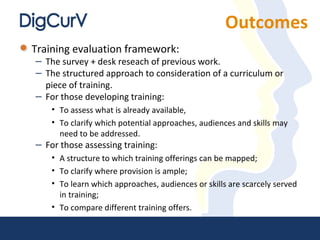
To identify, document and analyze the training
courses, curriculum, resources, good practice
instances that are currently available.
To profile the existing training opportunities.
To establish a framework for the evaluation of the
training curriculum.
What we did?
Questionnaire on training opportunities:
– Institutions and organizations with interest or involvement in
digital curation and preservation training activity.
– Focus on issues related to:
• Training content
• Metchodologies
• Delivery options
• Assessment
• Certification
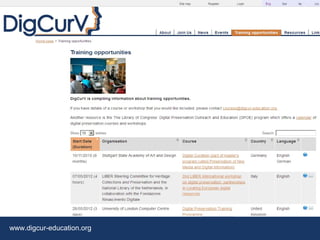
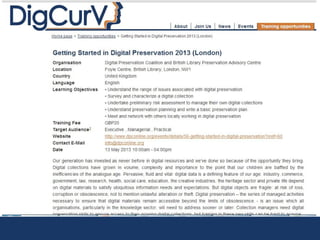
Registry of training opportunities
Training evaluation framework
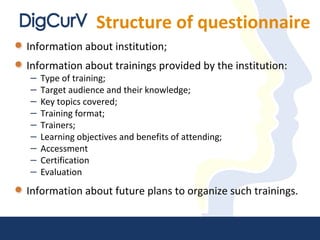
Structure of questionnaire
Information about institution;
Information about trainings provided by the institution:
– Type of training;
– Target audience and their knowledge;
– Key topics covered;
– Training format;
– Trainers;
– Learning objectives and benefits of attending;
– Accessment
– Certification
– Evaluation
Information about future plans to organize such trainings.
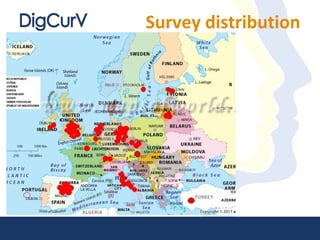
Survey distribution
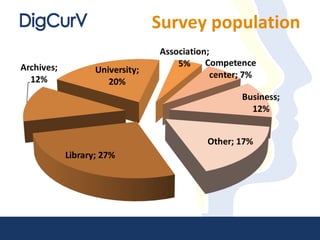
Survey population
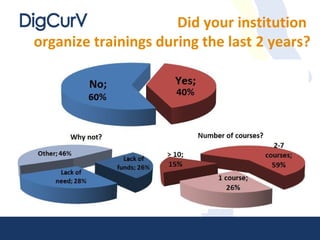
Did your institution
organize trainings during the last 2 years?
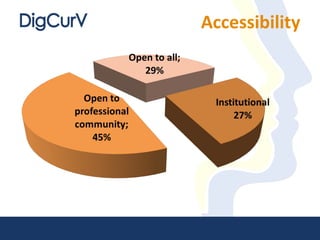
Accessibility
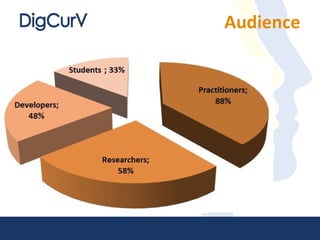
Audience
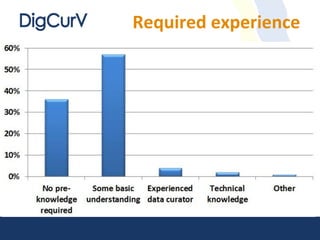
Required experience
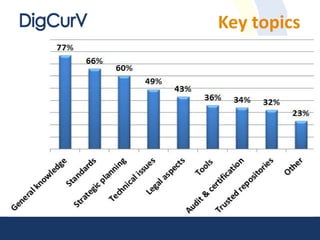
Key topics
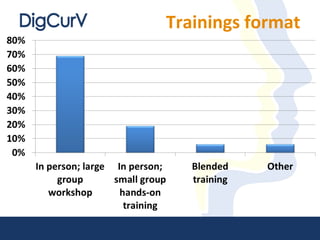
Trainings format
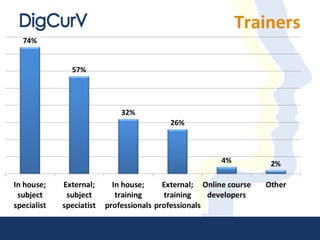
Trainers
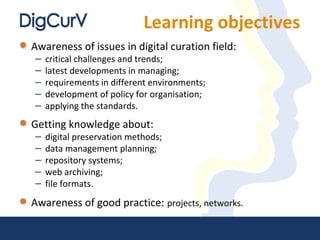
Learning objectives
Awareness of issues in digital curation field:
– critical challenges and trends;
– latest developments in managing;
– requirements in different environments;
– development of policy for organisation;
– applying the standards.
Getting knowledge about:
– digital preservation methods;
– data management planning;
– repository systems;
– web archiving;
– file formats.
Awareness of good practice: projects, networks.
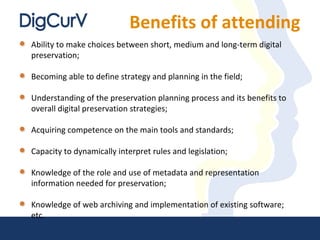
Benefits of attending
Ability to make choices between short, medium and long-term digital
preservation;
Becoming able to define strategy and planning in the field;
Understanding of the preservation planning process and its benefits to
overall digital preservation strategies;
Acquiring competence on the main tools and standards;
Capacity to dynamically interpret rules and legislation;
Knowledge of the role and use of metadata and representation
information needed for preservation;
Knowledge of web archiving and implementation of existing software;
etc.
Assessment,
certification, credits
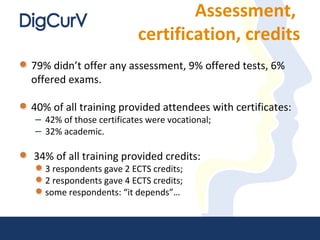
79% didn’t offer any assessment, 9% offered tests, 6%
offered exams.
40% of all training provided attendees with certificates:
– 42% of those certificates were vocational;
– 32% academic.
34% of all training provided credits:
3 respondents gave 2 ECTS credits;
2 respondents gave 4 ECTS credits;
some respondents: “it depends”…
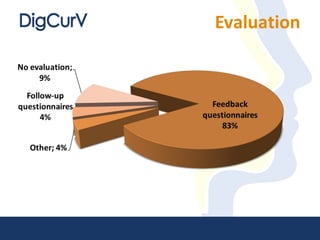
Evaluation
Future plans
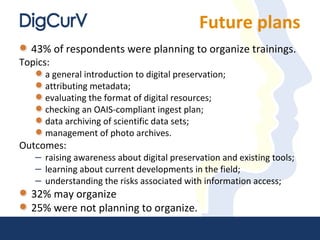
43% of respondents were planning to organize trainings.
Topics:
a general introduction to digital preservation;
attributing metadata;
evaluating the format of digital resources;
checking an OAIS-compliant ingest plan;
data archiving of scientific data sets;
management of photo archives.
Outcomes:
– raising awareness about digital preservation and existing tools;
– learning about current developments in the field;
– understanding the risks associated with information access;
32% may organize
25% were not planning to organize.
Conclusions
The differing levels of awareness of the field;
The variety of institutions ;
The dynamic rate of development of the digital
preservation field;
Closer interaction between practice and theory;
The awareness raising of why successful digital curation
action is important to undertake in the first place;
The flexibility in vocational training requires
collaboration between organizers of relevant courses
and the ongoing exchange of teaching ideas, methods
and techniques.
Outcomes
Training evaluation framework:
– The survey + desk reseach of previous work.
– The structured approach to consideration of a curriculum or
piece of training.
– For those developing training:
• To assess what is already available,
• To clarify which potential approaches, audiences and skills may
need to be addressed.
– For those assessing training:
• A structure to which training offerings can be mapped;
• To clarify where provision is ample;
• To learn which approaches, audiences or skills are scarcely served
in training;
• To compare different training offers.
www.digcur-education.org
A survey is available on
http://www.digcur-education.org/eng/Resources
jurate.kupriene@mb.vu.lt
Vilnius University Library

A survey-based analysis on training opportunities

  • 1.
    A survey basedanalysis on training opportunities Dr. Jūratė Kuprienė Framing the digital curation curriculum International Conference Florence, Italy 6 - 7 May 2013 www.digcur-education.org
  • 2.
    What we planned? Toidentify, document and analyze the training courses, curriculum, resources, good practice instances that are currently available. To profile the existing training opportunities. To establish a framework for the evaluation of the training curriculum.
  • 3.
    What we did? Questionnaireon training opportunities: – Institutions and organizations with interest or involvement in digital curation and preservation training activity. – Focus on issues related to: • Training content • Metchodologies • Delivery options • Assessment • Certification Registry of training opportunities Training evaluation framework
  • 4.
    Structure of questionnaire Informationabout institution; Information about trainings provided by the institution: – Type of training; – Target audience and their knowledge; – Key topics covered; – Training format; – Trainers; – Learning objectives and benefits of attending; – Accessment – Certification – Evaluation Information about future plans to organize such trainings.
  • 5.
  • 6.
  • 7.
    Did your institution organizetrainings during the last 2 years?
  • 8.
  • 9.
  • 10.
  • 11.
  • 12.
  • 13.
  • 14.
    Learning objectives Awareness ofissues in digital curation field: – critical challenges and trends; – latest developments in managing; – requirements in different environments; – development of policy for organisation; – applying the standards. Getting knowledge about: – digital preservation methods; – data management planning; – repository systems; – web archiving; – file formats. Awareness of good practice: projects, networks.
  • 15.
    Benefits of attending Abilityto make choices between short, medium and long-term digital preservation; Becoming able to define strategy and planning in the field; Understanding of the preservation planning process and its benefits to overall digital preservation strategies; Acquiring competence on the main tools and standards; Capacity to dynamically interpret rules and legislation; Knowledge of the role and use of metadata and representation information needed for preservation; Knowledge of web archiving and implementation of existing software; etc.
  • 16.
    Assessment, certification, credits 79% didn’toffer any assessment, 9% offered tests, 6% offered exams. 40% of all training provided attendees with certificates: – 42% of those certificates were vocational; – 32% academic. 34% of all training provided credits: 3 respondents gave 2 ECTS credits; 2 respondents gave 4 ECTS credits; some respondents: “it depends”…
  • 17.
  • 18.
    Future plans 43% ofrespondents were planning to organize trainings. Topics: a general introduction to digital preservation; attributing metadata; evaluating the format of digital resources; checking an OAIS-compliant ingest plan; data archiving of scientific data sets; management of photo archives. Outcomes: – raising awareness about digital preservation and existing tools; – learning about current developments in the field; – understanding the risks associated with information access; 32% may organize 25% were not planning to organize.
  • 19.
    Conclusions The differing levelsof awareness of the field; The variety of institutions ; The dynamic rate of development of the digital preservation field; Closer interaction between practice and theory; The awareness raising of why successful digital curation action is important to undertake in the first place; The flexibility in vocational training requires collaboration between organizers of relevant courses and the ongoing exchange of teaching ideas, methods and techniques.
  • 20.
    Outcomes Training evaluation framework: –The survey + desk reseach of previous work. – The structured approach to consideration of a curriculum or piece of training. – For those developing training: • To assess what is already available, • To clarify which potential approaches, audiences and skills may need to be addressed. – For those assessing training: • A structure to which training offerings can be mapped; • To clarify where provision is ample; • To learn which approaches, audiences or skills are scarcely served in training; • To compare different training offers.
  • 21.
  • 23.
    A survey isavailable on http://www.digcur-education.org/eng/Resources jurate.kupriene@mb.vu.lt Vilnius University Library

Editor's Notes

  • #22 Imagine that you have unlimited funding or enormous budgets – what would best suit you? The staff in your organisation?