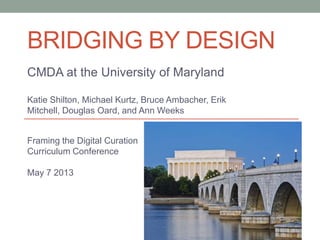
BRIDGING BY DESIGN
CMDA at the University of Maryland
Katie Shilton, Michael Kurtz, Bruce Ambacher, Erik
Mitchell, Douglas Oard, and Ann Weeks
Framing the Digital Curation
Curriculum Conference
May 7 2013
Curation & Management of Digital Assets
• Creation
• Management
• Use
• Long-term preservation
• Current and future access
A specialization with a focus on the:
Of digital assets in a variety of disciplines and
sectors of the economy.
Bridging Two Programs
Open to students in two master’s degree programs:
• Master’s in Information Management (MIM)
• focus on strategic deployment of information technology, especially in
corporate settings;
• Master’s in Library Science (MLS)
• focus on professional information services, especially in non-profits and
cultural heritage institutions.
First joint specialization
• An opportunity… and a challenge
Why Start this Program?
• By 2018, US will have a shortage of 140,000-190,000 with
skills needed to manage digital assets
• Estimated that 1.5 million managers will need to use
digital assets in strategic decision-making
• Washington DC area needs:
• Not-for-profits & advocacy groups, cultural heritage
institutions, research institutions, federal agencies, defense and
intelligence agencies.
• Ideal challenge for an iSchool
• Curation requires technology, policy, and management skills
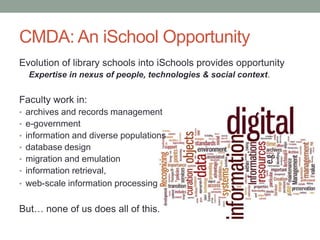
CMDA: An iSchool Opportunity
Evolution of library schools into iSchools provides opportunity
Expertise in nexus of people, technologies & social context.
Faculty work in:
• archives and records management
• e-government
• information and diverse populations
• database design
• migration and emulation
• information retrieval,
• web-scale information processing
But… none of us does all of this.
Managing the Challenge
Planned curriculum: orient and then specialize.
Balance technology, management & policy
3 required courses
• Principles of Digital Curation
• Implementing Digital Curation
• Policy Issues in Digital
Curation
2 elective courses
• Personal Digital Curation
• Curation in Cultural Institutions
• Database Design
• Information Retrieval Systems
• Information Architecture
• Principles of Records &
Information Management
• Electronic Records
Required field study
Combining Students
• Students from both degree programs will take classes
together & share their skills.
• Challenge: diversity of student preparation for the
social, organizational & technical aspects of the program.
• Opportunity: peer learning
• Those trained in information practices such as
reference, preservation alongside those with strong technical
backgrounds.
• Help students build trust in those with different
experience, expertise.
Combining Faculty
• We need to teach socio-technical skills
• Challenge:
• Integrating broad intellectual content that underpins CDMA
Divergent expertise, skill sets among professors
• Opportunity: co-teaching
• Logistics of credit, course loads unresolved
• Isn’t this what iSchools are for?
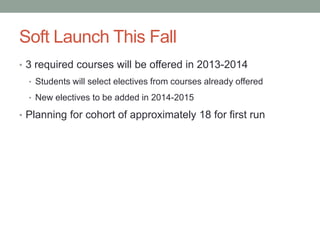
Soft Launch This Fall
• 3 required courses will be offered in 2013-2014
• Students will select electives from courses already offered
• New electives to be added in 2014-2015
• Planning for cohort of approximately 18 for first run
Thanks!
Katie Shilton
kshilton@umd.edu
CMDA @ UMD
http://ischool.umd.edu/content/curation-and-management-
digital-assets

Bridging By Design: The Curation and Management of Digital Assets Specialization at the University of Maryland

  • 1.
    BRIDGING BY DESIGN CMDAat the University of Maryland Katie Shilton, Michael Kurtz, Bruce Ambacher, Erik Mitchell, Douglas Oard, and Ann Weeks Framing the Digital Curation Curriculum Conference May 7 2013
  • 2.
    Curation & Managementof Digital Assets • Creation • Management • Use • Long-term preservation • Current and future access A specialization with a focus on the: Of digital assets in a variety of disciplines and sectors of the economy.
  • 3.
    Bridging Two Programs Opento students in two master’s degree programs: • Master’s in Information Management (MIM) • focus on strategic deployment of information technology, especially in corporate settings; • Master’s in Library Science (MLS) • focus on professional information services, especially in non-profits and cultural heritage institutions. First joint specialization • An opportunity… and a challenge
  • 4.
    Why Start thisProgram? • By 2018, US will have a shortage of 140,000-190,000 with skills needed to manage digital assets • Estimated that 1.5 million managers will need to use digital assets in strategic decision-making • Washington DC area needs: • Not-for-profits & advocacy groups, cultural heritage institutions, research institutions, federal agencies, defense and intelligence agencies. • Ideal challenge for an iSchool • Curation requires technology, policy, and management skills
  • 5.
    CMDA: An iSchoolOpportunity Evolution of library schools into iSchools provides opportunity Expertise in nexus of people, technologies & social context. Faculty work in: • archives and records management • e-government • information and diverse populations • database design • migration and emulation • information retrieval, • web-scale information processing But… none of us does all of this.
  • 6.
    Managing the Challenge Plannedcurriculum: orient and then specialize. Balance technology, management & policy 3 required courses • Principles of Digital Curation • Implementing Digital Curation • Policy Issues in Digital Curation 2 elective courses • Personal Digital Curation • Curation in Cultural Institutions • Database Design • Information Retrieval Systems • Information Architecture • Principles of Records & Information Management • Electronic Records Required field study
  • 7.
    Combining Students • Studentsfrom both degree programs will take classes together & share their skills. • Challenge: diversity of student preparation for the social, organizational & technical aspects of the program. • Opportunity: peer learning • Those trained in information practices such as reference, preservation alongside those with strong technical backgrounds. • Help students build trust in those with different experience, expertise.
  • 8.
    Combining Faculty • Weneed to teach socio-technical skills • Challenge: • Integrating broad intellectual content that underpins CDMA Divergent expertise, skill sets among professors • Opportunity: co-teaching • Logistics of credit, course loads unresolved • Isn’t this what iSchools are for?
  • 9.
    Soft Launch ThisFall • 3 required courses will be offered in 2013-2014 • Students will select electives from courses already offered • New electives to be added in 2014-2015 • Planning for cohort of approximately 18 for first run
  • 10.
    Thanks! Katie Shilton kshilton@umd.edu CMDA @UMD http://ischool.umd.edu/content/curation-and-management- digital-assets