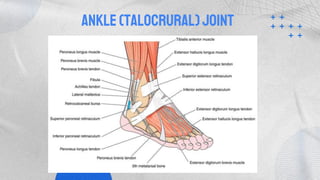
FOOTJOINT
Ankle(talocrural)joint
Theankle joint(or
talocruraljoint)isa
synovialjoint locatedin
thelowerlimb. Itisformed
bythebones oftheleg
(tibiaandfibula) andthe
foot(talus).
03
01 02
ArticulatingSurfaces
tibia
The tibia is the main bone of the lower
leg. It is considered to be the second
largest bone in the body and it plays an
important role in weight bearing.
fibula
The fibula is the slender long bone that
is attached next to and a little below the
tibia. The fibula provides lateral stability
for the lower leg and acts as a tie rod to
increase the range of motion for the
ankle.
talus
The talus is the bone at the top of the
foot that serves as a perch for the tibia
and holds the weight of the entire body.
Ligamentsfoundintheankle
Therearetwo mainsetsofligaments, whichoriginate fromeachmalleolus.
01 02
Medial Ligament Lateral Ligament
The medial ligament (or deltoid
ligament) is attached to the medial
malleolus (a bony prominence
projecting from the medial aspect of
thedistal tibia).
Itresists over-inversionofthe foot,andiscomprised
ofthree distinctandseparate ligaments: Anterior
talofibular, Posteriortalofibular, Calcaneofibular
medialcollateralligament
is a triangular band that attaches to the medial
malleolus proximally and to the calcaneus, talus and
navicular bones distally.
Theligament consistsoffourmain groupsoffibres:
● Thetibionavicular fibres (anterior segment)
● Thetibiocalcaneal fibres (intermediate segment)
● Theanterior tibiotalar fibres(deep segment)
● Theposterior tibiotalar fibres (posterior segment)
Lateralcollateralligament
The lateral collateral ligament consists of three
separate ligaments:
➔ The anterior talofibular ligament-the anterior
talofibular ligament connects the talus with
the lateral malleolus of the fibula.
➔ The posterior talofibular ligament-runs
horizontally from the distal aspect of the
fibular malleolus to the lateral tubercle of
the posterior process of the talus.
➔ The calcaneofibular ligament-is a long cord
that runs from a depression anterior to the
fibular malleolus to a tubercle on the lateral
aspect of the calcaneus.
Theanklejoint isuniaxialandallowsboth
dorsiflexionand plantarflexion.The
rangeof dorsiflexion is 10degrees when
thekneeisstraightandcanincrease to
approximately 30degrees whenthekneeis
flexed.Thenormalrange ofplantar
flexionisabout30degrees.
Jointsofthefoot
Inferior(distal)tibiofibularjoint
The inferior, or distal, tibiofibular joint is a
syndesmosis, a slightly mobile, fibrous joint
joined together with connective tissue.
Ligaments
It consists of three separate ligaments:
The anterior tibiofibular ligament-is a flat band that descends
between the tibia and fibula anterior to the syndesmosis.
The posterior tibiofibular ligament-descends posteriorly to the
syndesmosis between the tibia and fibula. The distal part of this
ligament, the inferior transverse ligament, is a yellow band that
connects the medial and lateral malleoli.
The interosseus tibiofibular ligament-is a continuation of the
interosseus membrane and is the strongest of the three
ligaments.
THANKYOU

Foot Joint

  • 1.
  • 2.
  • 3.
    Theankle joint(or talocruraljoint)isa synovialjoint locatedin thelowerlimb.Itisformed bythebones oftheleg (tibiaandfibula) andthe foot(talus).
  • 4.
    03 01 02 ArticulatingSurfaces tibia The tibiais the main bone of the lower leg. It is considered to be the second largest bone in the body and it plays an important role in weight bearing. fibula The fibula is the slender long bone that is attached next to and a little below the tibia. The fibula provides lateral stability for the lower leg and acts as a tie rod to increase the range of motion for the ankle. talus The talus is the bone at the top of the foot that serves as a perch for the tibia and holds the weight of the entire body.
  • 5.
    Ligamentsfoundintheankle Therearetwo mainsetsofligaments, whichoriginatefromeachmalleolus. 01 02 Medial Ligament Lateral Ligament The medial ligament (or deltoid ligament) is attached to the medial malleolus (a bony prominence projecting from the medial aspect of thedistal tibia). Itresists over-inversionofthe foot,andiscomprised ofthree distinctandseparate ligaments: Anterior talofibular, Posteriortalofibular, Calcaneofibular
  • 6.
    medialcollateralligament is a triangularband that attaches to the medial malleolus proximally and to the calcaneus, talus and navicular bones distally. Theligament consistsoffourmain groupsoffibres: ● Thetibionavicular fibres (anterior segment) ● Thetibiocalcaneal fibres (intermediate segment) ● Theanterior tibiotalar fibres(deep segment) ● Theposterior tibiotalar fibres (posterior segment)
  • 7.
    Lateralcollateralligament The lateral collateralligament consists of three separate ligaments: ➔ The anterior talofibular ligament-the anterior talofibular ligament connects the talus with the lateral malleolus of the fibula. ➔ The posterior talofibular ligament-runs horizontally from the distal aspect of the fibular malleolus to the lateral tubercle of the posterior process of the talus. ➔ The calcaneofibular ligament-is a long cord that runs from a depression anterior to the fibular malleolus to a tubercle on the lateral aspect of the calcaneus.
  • 8.
    Theanklejoint isuniaxialandallowsboth dorsiflexionand plantarflexion.The rangeofdorsiflexion is 10degrees when thekneeisstraightandcanincrease to approximately 30degrees whenthekneeis flexed.Thenormalrange ofplantar flexionisabout30degrees.
  • 9.
    Jointsofthefoot Inferior(distal)tibiofibularjoint The inferior, ordistal, tibiofibular joint is a syndesmosis, a slightly mobile, fibrous joint joined together with connective tissue.
  • 10.
    Ligaments It consists ofthree separate ligaments: The anterior tibiofibular ligament-is a flat band that descends between the tibia and fibula anterior to the syndesmosis. The posterior tibiofibular ligament-descends posteriorly to the syndesmosis between the tibia and fibula. The distal part of this ligament, the inferior transverse ligament, is a yellow band that connects the medial and lateral malleoli. The interosseus tibiofibular ligament-is a continuation of the interosseus membrane and is the strongest of the three ligaments.
  • 11.