Synthesis of a well-defined alternating copolymer
of 1,1-diphenylethylene and tert-
butyldimethylsilyloxymethyl substituted styrene
by anionic copolymerization: toward tailored
graft copolymers with controlled side chain
densities
1
Raita Goseki, Fan Zhang, Kazuki Takahata, Satoshi Uchida and Takashi Ishizone; Polym. Chem.; 2019
CH 601-Coursework Presentation
Subham Sahoo & Rohit Kumar
1921CH01 & 1921CH09
Department of Chemistry
Indian Institute Of Technology Patna
Contents
1. Introduction
2. Synthesis
3. Characterization
4. Conclusion
2
Introduction
◦ Living anionic alternating copolymerization of 1,1-
diphenylethylene and styrene derivatives
◦ Suppressed the formation of a defect structure comprising
consecutive styrene–styrene repeating
◦ Synthesis of side-chain-density-controlled graft copolymers
by using both “grafting from” and “grafting onto”
methodologies.
3
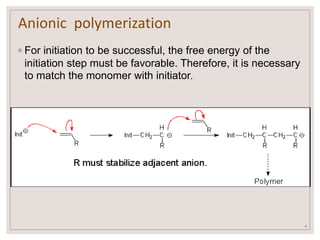
Anionic polymerization
◦ For initiation to be successful, the free energy of the
initiation step must be favorable. Therefore, it is necessary
to match the monomer with initiator.
4
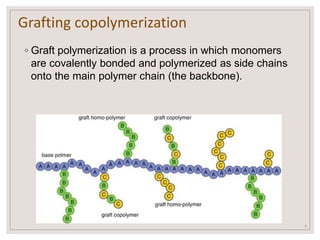
Grafting copolymerization
◦ Graft polymerization is a process in which monomers
are covalently bonded and polymerized as side chains
onto the main polymer chain (the backbone).
5
Grafting types
◦ Grafting onto- attaching a pre-synthesized polymer to a
polymer backbone
◦ Grafting from- growing polymers from a polymer backbone
bearing pendant functionality
6
Synthesis
7
• Synthesis of monomer
• Main reaction
Characterization
8
9
MALDI-TOF-MS
MALDI-TOF-MS
10
Deprotection determined by SEC
11
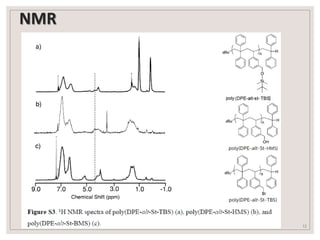
NMR
12
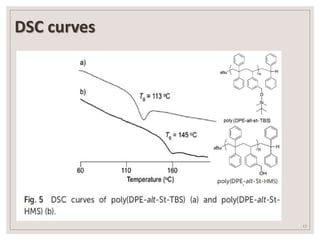
DSC curves
13
Scheme for poly(DPE-alt-St-BMS)-g-PS by
grafting onto
14
Scheme for poly(DPE-alt-HBS)-g-PCL
by grafting from
15
DSC
16
Conclusion
◦ Successful synthesis controlled alternating copolymers
◦ The temperature and monomer ratio of [DPE]/[St-TBS] are
important factors for controlling the resulting structure.
◦ The bulky TBS functionality efficiently suppressed the
formation of St–St homopolymerization.
◦ With the help of Grafting the group synthesize a wide
variety of side-chain-density-controlled graft copolymers
as model compounds.
17
Thank You
18
Supporting data
◦ St-TBS = meta-Tertbutyldimethylsilyloxymethylstyrene
◦ DPE = 1,1-Diphenylethylene
◦ -HMS = Hydroymethylstyrene
◦ -BMS = Bromomethylstyrene
◦ -g-PS = grafting with polystyrene
◦ -g-PCL = grafting with polycaprolactam
◦ -g-PMMA = grafting with polymethylmethacrylate
◦ MALDI-TOF-MS = Matrix-Assisted Laser Desorption-Time Of Flight- Mass Spectroscopy
◦ SEC = Size Exclusion Chromatography
◦ DSC = Differential Scanning Calorimetry
19

Anionic alternating graft copolymerization

  • 1.
    Synthesis of awell-defined alternating copolymer of 1,1-diphenylethylene and tert- butyldimethylsilyloxymethyl substituted styrene by anionic copolymerization: toward tailored graft copolymers with controlled side chain densities 1 Raita Goseki, Fan Zhang, Kazuki Takahata, Satoshi Uchida and Takashi Ishizone; Polym. Chem.; 2019 CH 601-Coursework Presentation Subham Sahoo & Rohit Kumar 1921CH01 & 1921CH09 Department of Chemistry Indian Institute Of Technology Patna
  • 2.
    Contents 1. Introduction 2. Synthesis 3.Characterization 4. Conclusion 2
  • 3.
    Introduction ◦ Living anionicalternating copolymerization of 1,1- diphenylethylene and styrene derivatives ◦ Suppressed the formation of a defect structure comprising consecutive styrene–styrene repeating ◦ Synthesis of side-chain-density-controlled graft copolymers by using both “grafting from” and “grafting onto” methodologies. 3
  • 4.
    Anionic polymerization ◦ Forinitiation to be successful, the free energy of the initiation step must be favorable. Therefore, it is necessary to match the monomer with initiator. 4
  • 5.
    Grafting copolymerization ◦ Graftpolymerization is a process in which monomers are covalently bonded and polymerized as side chains onto the main polymer chain (the backbone). 5
  • 6.
    Grafting types ◦ Graftingonto- attaching a pre-synthesized polymer to a polymer backbone ◦ Grafting from- growing polymers from a polymer backbone bearing pendant functionality 6
  • 7.
    Synthesis 7 • Synthesis ofmonomer • Main reaction
  • 8.
  • 9.
  • 10.
  • 11.
  • 12.
  • 13.
  • 14.
  • 15.
  • 16.
  • 17.
    Conclusion ◦ Successful synthesiscontrolled alternating copolymers ◦ The temperature and monomer ratio of [DPE]/[St-TBS] are important factors for controlling the resulting structure. ◦ The bulky TBS functionality efficiently suppressed the formation of St–St homopolymerization. ◦ With the help of Grafting the group synthesize a wide variety of side-chain-density-controlled graft copolymers as model compounds. 17
  • 18.
  • 19.
    Supporting data ◦ St-TBS= meta-Tertbutyldimethylsilyloxymethylstyrene ◦ DPE = 1,1-Diphenylethylene ◦ -HMS = Hydroymethylstyrene ◦ -BMS = Bromomethylstyrene ◦ -g-PS = grafting with polystyrene ◦ -g-PCL = grafting with polycaprolactam ◦ -g-PMMA = grafting with polymethylmethacrylate ◦ MALDI-TOF-MS = Matrix-Assisted Laser Desorption-Time Of Flight- Mass Spectroscopy ◦ SEC = Size Exclusion Chromatography ◦ DSC = Differential Scanning Calorimetry 19