ANIMAL ABUSE
INTRODUCTION
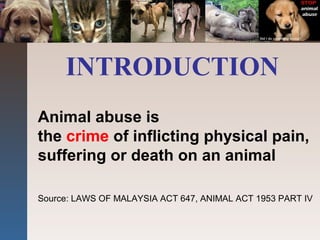
Animal abuse is
the crime of inflicting physical pain,
suffering or death on an animal
Source: LAWS OF MALAYSIA ACT 647, ANIMAL ACT 1953 PART IV
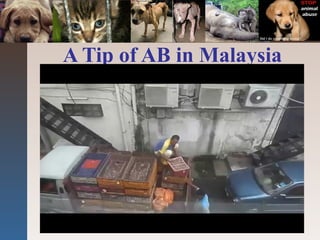
A Tip of AB in Malaysia
By JOSEPHINE LEE
BI12110059
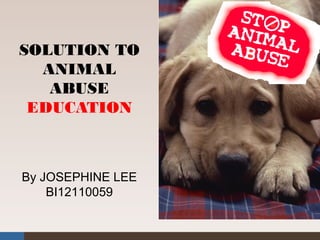
SOLUTION TO
ANIMAL
ABUSE
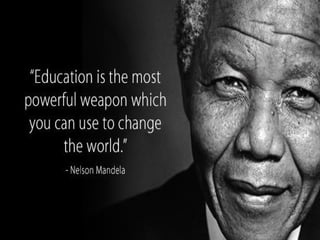
EDUCATION
Definition:-
Any process, eitherformal orinformal, that
shapes the potential of a maturing organism
(Dictionary.com)
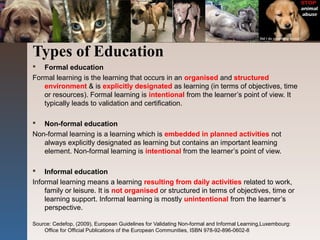
Types of Education
 Formal education
Formal learning is the learning that occurs in an organised and structured
environment & is explicitly designated as learning (in terms of objectives, time
or resources). Formal learning is intentional from the learner’s point of view. It
typically leads to validation and certification.
 Non-formal education
Non-formal learning is a learning which is embedded in planned activities not
always explicitly designated as learning but contains an important learning
element. Non-formal learning is intentional from the learner’s point of view.
 Informal education
Informal learning means a learning resulting from daily activities related to work,
family or leisure. It is not organised or structured in terms of objectives, time or
learning support. Informal learning is mostly unintentional from the learner’s
perspective.
Source: Cedefop, (2009), European Guidelines for Validating Non-formal and Informal Learning,Luxembourg:
Office for Official Publications of the European Communities, ISBN 978-92-896-0602-8
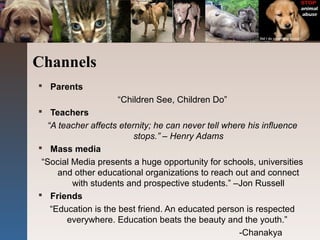
Channels
 Parents
“Children See, Children Do”
 Teachers
“A teacher affects eternity; he can never tell where his influence
stops.” – Henry Adams
 Mass media
“Social Media presents a huge opportunity for schools, universities
and other educational organizations to reach out and connect
with students and prospective students.” –Jon Russell
 Friends
“Education is the best friend. An educated person is respected
everywhere. Education beats the beauty and the youth.”
-Chanakya
“Children See, Children Do”
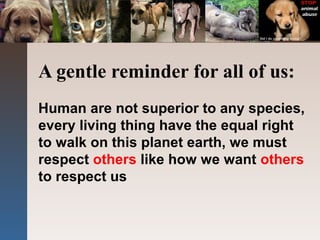
A gentle reminder for all of us:
Human are not superior to any species,
every living thing have the equal right
to walk on this planet earth, we must
respect others like how we want others
to respect us
By AMANDA JENKINS
BG12110015
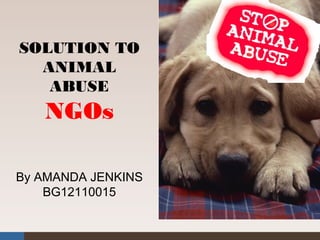
SOLUTION TO
ANIMAL
ABUSE
NGOs
Non-Profit Organizations
(NGOs)
 Define as a group organized for purposes
other than generating profit.
 Promote animal welfare – care and
promotion.
 Relies on corporate sponsorship,
fundraising events and voluntary donations
for its income.
Types of NGOs in Malaysia :
 Save A Stray
 MIAR
 SPCA
 MDDB
 ANIMAL RESCUE CHASE
 PAWS
 HOPE
 SCRATCH
Mission Statement
 The Animal Centre is dedicated to promoting
balanced, respectful and enriched relations
between people and pets through graduate
and post-graduate programs for aspiring
animal behaviorists; continuing behavioral
education for shelter personnel, trainers,
veterinarians, and other animal professionals
and the provision of practical, humane advice
on pet behavior for owners.
- SPCA -
How can NGOs help ?
 Animal Inspectorate
- work closely with police and courts as
well as the Department of Veterinary
Services in prosecution of those who
abuse or neglect animals.
 Humane Education Programme
- initiate to visit students, give
presentation, educational packs on
animal abuse,tour around animal
centre,etc.
 Mission help
- volunteering
By LIM YEE FANG
BI12160239
SOLUTION TO
ANIMAL
ABUSE
MASS MEDIA
Mass Media
 The means of communication that reaches large
numbers of people in a short time (mass
communication)
- (Harper Collins, 2003).
Three common types of media technologies:
1) Broadcast media
2) Print media
3) Web media
Roles of Mass Media
 To entertain, educate, enlighten and inspire
audiences
 To reach out to the people and equip them
with information
 Promote greater social awareness on
animal abuse (eg. Animal Planet)
 Should be properly filtered before being
broadcasting to avoid the transmission of
wrong perception or message
Roles of Mass Media (continue)
 Lifestyle development
 Now, everything is easily accessible via the
internet without the limitation of
geographical boundary
 Social networking site and the usage of
smart phones help the widespread of social
awareness
Video to Promote Social Awareness on Animal Abuse
By CHONG YEW HONG
BI12110026
SOLUTION TO
ANIMAL
ABUSE
LAW
Why Animal Law Protection
 Ancient civilization showed a large interest
in wild animals and displayed them as
symbols of power, strength leads to the
animal abuse.
 Mankind taken the lives of these poor
helpless and voiceless animals for granted.
 For example : ivory, antlers, leather, shark
fin.
Law Definition and Types
Law is the principles and regulations establish in a
community by some authority and applicable to its
people, whether in the form of legislation or of
custom and policies recognized and enforced by
judicial decision.
Law - Written Law (Animal Act 1953, Animal Welfare
Bill 2012 in Malaysia)
- Unwritten Law
Written Law
Written laws are laws which have been enacted in
the constitution or in legislation.
Any person who:
Overworks, tortures, torments, deprives of necessary
food, drink, or shelter, cruelly beats, mutilates, or
cruelly kills an animal is guilty of a misdemeanor or
felony.
For example: People forced animals to fight to the
death and some cultures violent practices, such as
Spain’s Bullfighting, became traditions that still take
place today.
Unwritten Law
Unwritten laws are laws which are not contained in
any statutes and can be found in case decisions.
This is known as the common law or case law.
For example: A neighbour keeps his dog on a
cable day and night in the backyard.
As long as the dog has food, water, and shelter,
this does not fall within the legal definition of
cruelty.
Unwritten Law
Unwritten laws are laws which are not contained in
any statutes and can be found in case decisions.
This is known as the common law or case law.
For example: A neighbour keeps his dog on a
cable day and night in the backyard.
As long as the dog has food, water, and shelter,
this does not fall within the legal definition of
cruelty.
“Law Teasers”
• The horse in the neighboring field stands in the
wind and rain all day.
– As long as the horse has food, water, and a
place to stand up, and can turn around and lie
down in an area not covered in water, this does
not fall within the legal definition of cruelty.
• A neighbor is shooting cats with a pellet gun.
– This is at least a misdemeanor and may be
charged as a felony.
 If a situation is unhealthy for an animal, but does
not fall within the legal definition of animal
abuse, approach the owner and suggest
different approaches to how they treat their pet.
 Report details so that Animal Control can
investigate.
 Ask other witnesses to also report.
 Do not wait until an animal's life is in danger.
 If you suspect abuse, document it and report it
to law enforcement(JPHN – Jabatan
Perkhidmatan Haiwan Negeri).
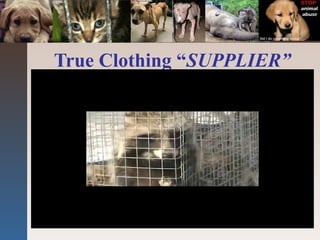
True Clothing “SUPPLIER”
IT’S TIME FOR A
CHANGE
Heart-to-Heart Session
“Questions &
Answers”

ANIMAL ABUSE

  • 1.
  • 2.
    INTRODUCTION Animal abuse is thecrime of inflicting physical pain, suffering or death on an animal Source: LAWS OF MALAYSIA ACT 647, ANIMAL ACT 1953 PART IV
  • 3.
    A Tip ofAB in Malaysia
  • 4.
    By JOSEPHINE LEE BI12110059 SOLUTIONTO ANIMAL ABUSE EDUCATION
  • 6.
    Definition:- Any process, eitherformalorinformal, that shapes the potential of a maturing organism (Dictionary.com)
  • 7.
    Types of Education Formal education Formal learning is the learning that occurs in an organised and structured environment & is explicitly designated as learning (in terms of objectives, time or resources). Formal learning is intentional from the learner’s point of view. It typically leads to validation and certification.  Non-formal education Non-formal learning is a learning which is embedded in planned activities not always explicitly designated as learning but contains an important learning element. Non-formal learning is intentional from the learner’s point of view.  Informal education Informal learning means a learning resulting from daily activities related to work, family or leisure. It is not organised or structured in terms of objectives, time or learning support. Informal learning is mostly unintentional from the learner’s perspective. Source: Cedefop, (2009), European Guidelines for Validating Non-formal and Informal Learning,Luxembourg: Office for Official Publications of the European Communities, ISBN 978-92-896-0602-8
  • 8.
    Channels  Parents “Children See,Children Do”  Teachers “A teacher affects eternity; he can never tell where his influence stops.” – Henry Adams  Mass media “Social Media presents a huge opportunity for schools, universities and other educational organizations to reach out and connect with students and prospective students.” –Jon Russell  Friends “Education is the best friend. An educated person is respected everywhere. Education beats the beauty and the youth.” -Chanakya
  • 9.
  • 10.
    A gentle reminderfor all of us: Human are not superior to any species, every living thing have the equal right to walk on this planet earth, we must respect others like how we want others to respect us
  • 11.
  • 12.
    Non-Profit Organizations (NGOs)  Defineas a group organized for purposes other than generating profit.  Promote animal welfare – care and promotion.  Relies on corporate sponsorship, fundraising events and voluntary donations for its income.
  • 13.
    Types of NGOsin Malaysia :  Save A Stray  MIAR  SPCA  MDDB  ANIMAL RESCUE CHASE  PAWS  HOPE  SCRATCH
  • 14.
    Mission Statement  TheAnimal Centre is dedicated to promoting balanced, respectful and enriched relations between people and pets through graduate and post-graduate programs for aspiring animal behaviorists; continuing behavioral education for shelter personnel, trainers, veterinarians, and other animal professionals and the provision of practical, humane advice on pet behavior for owners. - SPCA -
  • 15.
    How can NGOshelp ?  Animal Inspectorate - work closely with police and courts as well as the Department of Veterinary Services in prosecution of those who abuse or neglect animals.
  • 16.
     Humane EducationProgramme - initiate to visit students, give presentation, educational packs on animal abuse,tour around animal centre,etc.  Mission help - volunteering
  • 17.
    By LIM YEEFANG BI12160239 SOLUTION TO ANIMAL ABUSE MASS MEDIA
  • 18.
    Mass Media  Themeans of communication that reaches large numbers of people in a short time (mass communication) - (Harper Collins, 2003). Three common types of media technologies: 1) Broadcast media 2) Print media 3) Web media
  • 19.
    Roles of MassMedia  To entertain, educate, enlighten and inspire audiences  To reach out to the people and equip them with information  Promote greater social awareness on animal abuse (eg. Animal Planet)  Should be properly filtered before being broadcasting to avoid the transmission of wrong perception or message
  • 20.
    Roles of MassMedia (continue)  Lifestyle development  Now, everything is easily accessible via the internet without the limitation of geographical boundary  Social networking site and the usage of smart phones help the widespread of social awareness
  • 21.
    Video to PromoteSocial Awareness on Animal Abuse
  • 22.
    By CHONG YEWHONG BI12110026 SOLUTION TO ANIMAL ABUSE LAW
  • 23.
    Why Animal LawProtection  Ancient civilization showed a large interest in wild animals and displayed them as symbols of power, strength leads to the animal abuse.  Mankind taken the lives of these poor helpless and voiceless animals for granted.  For example : ivory, antlers, leather, shark fin.
  • 24.
    Law Definition andTypes Law is the principles and regulations establish in a community by some authority and applicable to its people, whether in the form of legislation or of custom and policies recognized and enforced by judicial decision. Law - Written Law (Animal Act 1953, Animal Welfare Bill 2012 in Malaysia) - Unwritten Law
  • 25.
    Written Law Written lawsare laws which have been enacted in the constitution or in legislation. Any person who: Overworks, tortures, torments, deprives of necessary food, drink, or shelter, cruelly beats, mutilates, or cruelly kills an animal is guilty of a misdemeanor or felony. For example: People forced animals to fight to the death and some cultures violent practices, such as Spain’s Bullfighting, became traditions that still take place today.
  • 26.
    Unwritten Law Unwritten lawsare laws which are not contained in any statutes and can be found in case decisions. This is known as the common law or case law. For example: A neighbour keeps his dog on a cable day and night in the backyard. As long as the dog has food, water, and shelter, this does not fall within the legal definition of cruelty.
  • 27.
    Unwritten Law Unwritten lawsare laws which are not contained in any statutes and can be found in case decisions. This is known as the common law or case law. For example: A neighbour keeps his dog on a cable day and night in the backyard. As long as the dog has food, water, and shelter, this does not fall within the legal definition of cruelty.
  • 28.
    “Law Teasers” • Thehorse in the neighboring field stands in the wind and rain all day. – As long as the horse has food, water, and a place to stand up, and can turn around and lie down in an area not covered in water, this does not fall within the legal definition of cruelty. • A neighbor is shooting cats with a pellet gun. – This is at least a misdemeanor and may be charged as a felony.
  • 29.
     If asituation is unhealthy for an animal, but does not fall within the legal definition of animal abuse, approach the owner and suggest different approaches to how they treat their pet.  Report details so that Animal Control can investigate.  Ask other witnesses to also report.  Do not wait until an animal's life is in danger.  If you suspect abuse, document it and report it to law enforcement(JPHN – Jabatan Perkhidmatan Haiwan Negeri).
  • 30.
  • 31.
  • 32.

Editor's Notes