Mrs. Tully’s Class presents:
The First Annual Video Conference
on
Animal Habitats, Adaptations and
Migrations
Host Speakers: Mrs. Tully’s Class
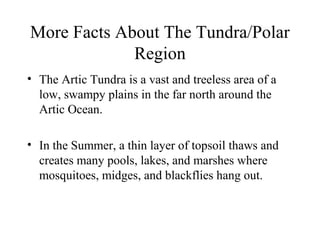
Animal Habitats and Biomes
FACTS ABOUT THE
TUNDRA/POLAR REGION
• The Tundra is very cold and has a lot of ice
• The Tundra includes the northern lands of Europe,
Asia, and North America
• The Tundra is the Earth’s coldest biome
More Facts About The Tundra/Polar
Region
• The Artic Tundra is a vast and treeless area of a
low, swampy plains in the far north around the
Artic Ocean.
• In the Summer, a thin layer of topsoil thaws and
creates many pools, lakes, and marshes where
mosquitoes, midges, and blackflies hang out.
Some Facts You Should Know
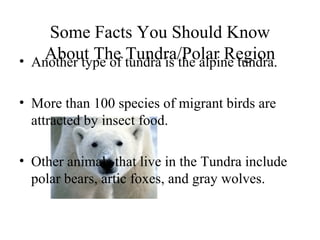
About The Tundra/Polar Region• Another type of tundra is the alpine tundra.
• More than 100 species of migrant birds are
attracted by insect food.
• Other animals that live in the Tundra include
polar bears, artic foxes, and gray wolves.
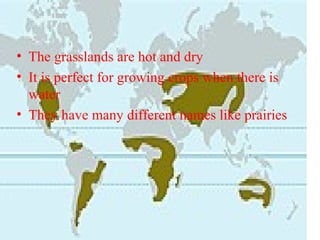
• The grasslands are hot and dry
• It is perfect for growing crops when there is
water
• They have many different names like prairies
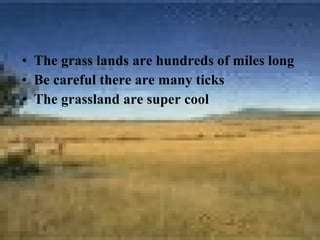
• The grass lands are hundreds of miles long
• Be careful there are many ticks
• The grassland are super cool
Deciduous Forests
• Deciduous trees loose their leaves in the fall
• The natural rot of the fallen leaves on the
ground enriches the soil and supports all
kinds of plants and animal life
• The forests has so much life
Deciduous Forests
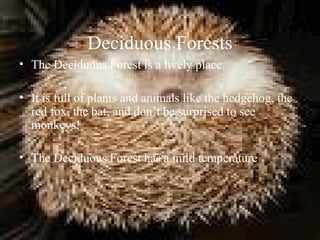
• The Deciduous Forest is a lively place
• It is full of plants and animals like the hedgehog, the
red fox, the bat, and don’t be surprised to see
monkeys!
• The Deciduous Forest has a mild temperature
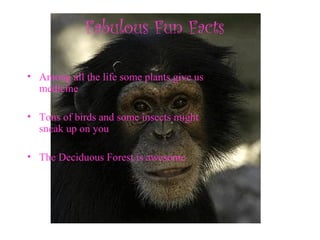
Fabulous Fun Facts
• Among all the life some plants give us
medicine
• Tons of birds and some insects might
sneak up on you
• The Deciduous Forest is awesome
Facts about the rainforest
• Tropical rainforests are found in Asia,
Africa, South America, Central America,
and on many Pacific islands
• They get more than 70 inches of rain each
year
Cool Facts you should know
• It has more plants than any other biome
• It is a perfect biome for over 15 million
plants and animals.
• The rain forest is made up of evergreen
trees
Awesome Facts
• Many plants for medicine are in the rain
forest
• The trees in the rain forest grow between
100 and 200 feet tall
• Rain forests is an endangered biome
because people have cut trees and sold it as
fire wood.
Water Biome
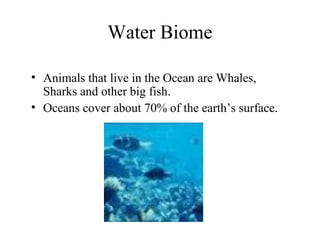
• Animals that live in the Ocean are Whales,
Sharks and other big fish.
• Oceans cover about 70% of the earth’s surface.
Water Biome
• Includes wetlands, lakes, rivers and oceans
Water Biome
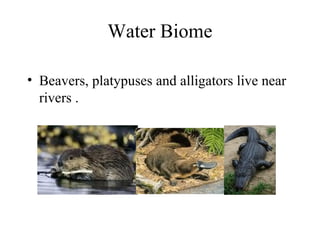
• Beavers, platypuses and alligators live near
rivers .
Desert Biome
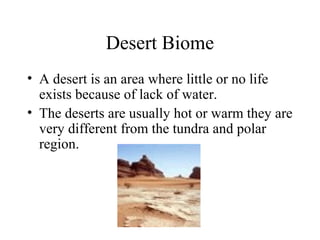
• A desert is an area where little or no life
exists because of lack of water.
• The deserts are usually hot or warm they are
very different from the tundra and polar
region.
Deserts
• Some locations of deserts are the Sahara desert,
north Africa and Australia.
• The climate of the desert is 10 inches of water
each year.
• There is not much seasonal changes all there is it
changes to spring to summer.
• Average temperatures during the day and night
the day is 100 degrees and at night it is 40-50
degrees.
Deserts
• Typical weather is sunny, warm, dry and humid.
• The soil is sandy and rocky.
• Some of the plants that are in the desert are
saguaro cactus, barrel cactus, old man cactus,
prickly pear cactus.
• Some animals that are in the desert are the camel
the addax the cactus wren and the fat sand rat.
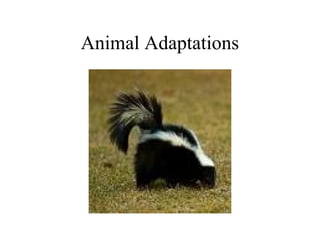
Animal Adaptations
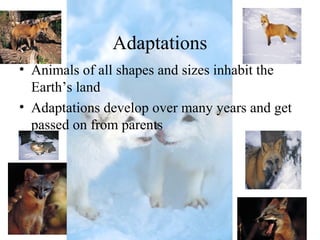
Adaptations
• Animals of all shapes and sizes inhabit the
Earth’s land
• Adaptations develop over many years and get
passed on from parents
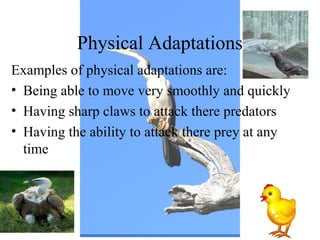
Physical Adaptations
Examples of physical adaptations are:
• Being able to move very smoothly and quickly
• Having sharp claws to attack there predators
• Having the ability to attack there prey at any
time
Behavioral Adaptations
• Having the ability to camouflage with their
surroundings
• Having a special appearance when they
approach there predators
• Moving to new places to live
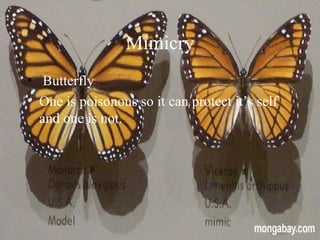
Mimicry
• Butterfly
• One is poisonous so it can protect it’s self
and one is not.
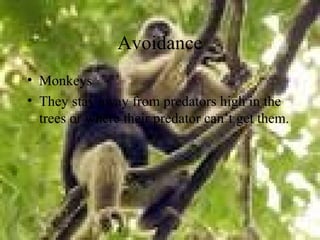
Avoidance
• Monkeys
• They stay away from predators high in the
trees or where their predator can’t get them.
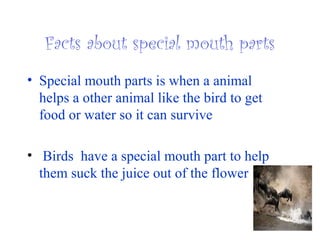
Facts about special mouth parts
• Special mouth parts is when a animal
helps a other animal like the bird to get
food or water so it can survive
• Birds have a special mouth part to help
them suck the juice out of the flower
More information about special
mouth parts
• Special mouth parts can be found on a
bee or some types of birds
• Bee’s need special mouth parts to get
their honey back to their hive
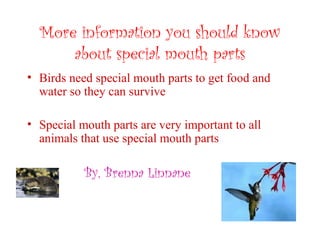
More information you should know
about special mouth parts
• Birds need special mouth parts to get food and
water so they can survive
• Special mouth parts are very important to all
animals that use special mouth parts
By, Brenna Linnane
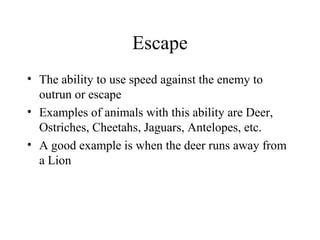
Escape
• The ability to use speed against the enemy to
outrun or escape
• Examples of animals with this ability are Deer,
Ostriches, Cheetahs, Jaguars, Antelopes, etc.
• A good example is when the deer runs away from
a Lion
Protective Coloration
• An animal uses camouflage with it’s
surroundings so the enemy won’t notice them
• Examples of animals with this ability are the
arctic hare, chameleon, seals, etc.
• A good example is when the chameleon
changes color to match its surroundings
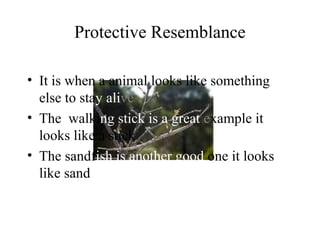
Protective Resemblance
• It is when a animal looks like something
else to stay alive
• The walking stick is a great example it
looks like a stick
• The sandfish is another good one it looks
like sand
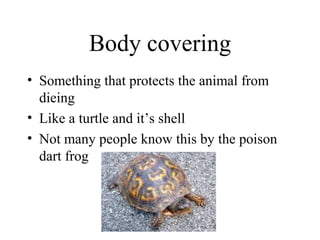
Body covering
• Something that protects the animal from
dieing
• Like a turtle and it’s shell
• Not many people know this by the poison
dart frog
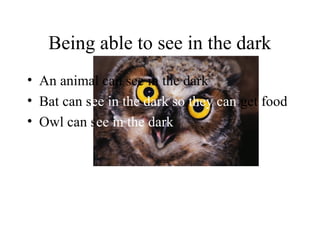
Being able to see in the dark
• An animal can see in the dark
• Bat can see in the dark so they can get food
• Owl can see in the dark
Special Weapons
Lots of different animals use special
weapons
Special weapons come in all shapes and
sizes
Some animals have sharp points that hurt
their predators
Mostly smaller animals use special
weapons
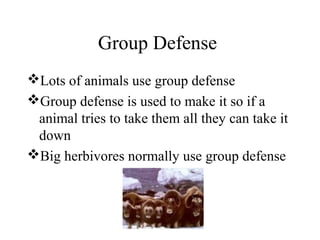
Group Defense
Lots of animals use group defense
Group defense is used to make it so if a
animal tries to take them all they can take it
down
Big herbivores normally use group defense
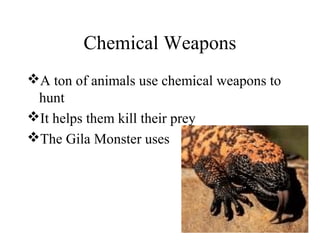
Chemical Weapons
A ton of animals use chemical weapons to
hunt
It helps them kill their prey
The Gila Monster uses
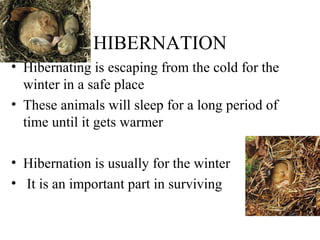
HIBERNATION
• Hibernating is escaping from the cold for the
winter in a safe place
• These animals will sleep for a long period of
time until it gets warmer
• Hibernation is usually for the winter
• It is an important part in surviving
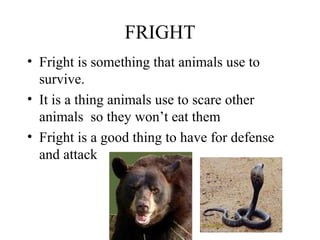
FRIGHT
• Fright is something that animals use to
survive.
• It is a thing animals use to scare other
animals so they won’t eat them
• Fright is a good thing to have for defense
and attack
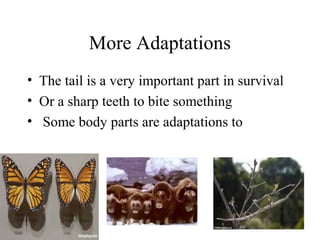
More Adaptations
• The tail is a very important part in survival
• Or a sharp teeth to bite something
• Some body parts are adaptations to
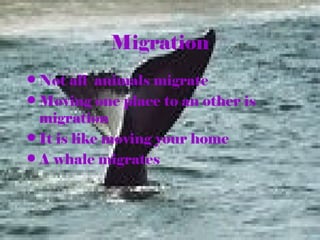
Migration
• Not all animals migrate
• Moving one place to an other is
migration
• It is like moving your home
• A whale migrates
Playing Dead
• Some animals play dead to trick a
predator
• A animal does that so it won’t be
eaten
• Most rodents play dead
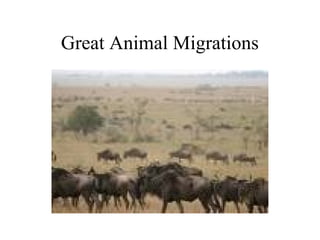
Great Animal Migrations
Migration
• Migration is a move that can be caused by
food scarce or climate change
• Most of the time an animal moves
somewhere for a period of time then returns
• Sometimes migration takes a lifetime to
complete
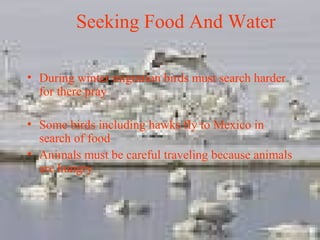
Seeking Food And Water
• During winter migration birds must search harder
for there pray
• Some birds including hawks fly to Mexico in
search of food
• Animals must be careful traveling because animals
are hungry
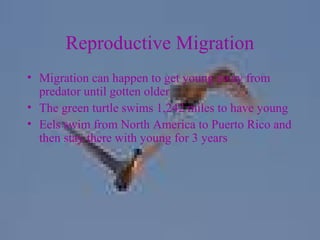
Reproductive Migration
• Migration can happen to get young away from
predator until gotten older
• The green turtle swims 1,242 miles to have young
• Eels swim from North America to Puerto Rico and
then stay there with young for 3 years
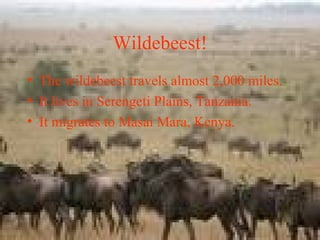
Wildebeest!
• The wildebeest travels almost 2,000 miles.
• It lives in Serengeti Plains, Tanzania.
• It migrates to Masai Mara, Kenya.
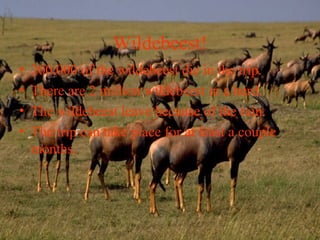
Wildebeest!
• 200,000 of the wildebeest die in the trip.
• There are 2 million wildebeest in a herd.
• The wildebeest leave because of the rain.
• The trip can take place for at least a couple
months.
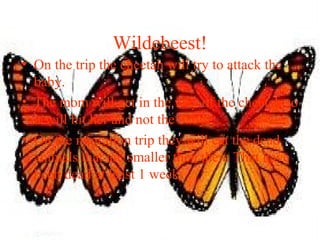
Wildebeest!
• On the trip the cheetah will try to attack the
baby.
• The mom will get in the way of the cheetah so
it will hit her and not the baby.
• On the migration trip they will eat the dead
animals that are smaller then them That have
been dead at least 1 week.
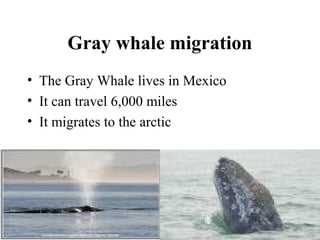
Gray whale migration
• The Gray Whale lives in Mexico
• It can travel 6,000 miles
• It migrates to the arctic
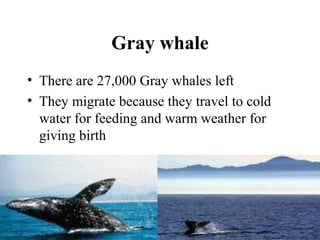
Gray whale
• There are 27,000 Gray whales left
• They migrate because they travel to cold
water for feeding and warm weather for
giving birth
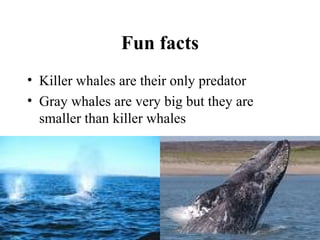
Fun facts
• Killer whales are their only predator
• Gray whales are very big but they are
smaller than killer whales
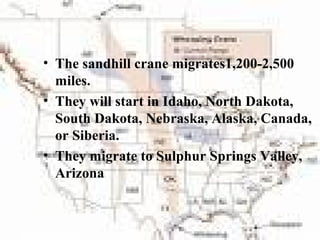
• The sandhill crane migrates1,200-2,500
miles.
• They will start in Idaho, North Dakota,
South Dakota, Nebraska, Alaska, Canada,
or Siberia.
• They migrate to Sulphur Springs Valley,
Arizona
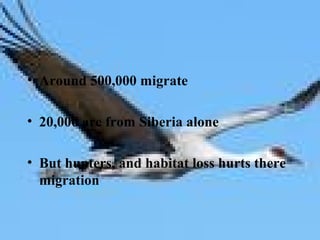
• Around 500,000 migrate
• 20,000 are from Siberia alone
• But hunters, and habitat loss hurts there
migration
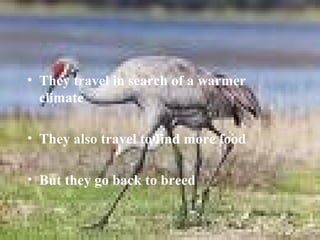
• They travel in search of a warmer
climate
• They also travel to find more food
• But they go back to breed
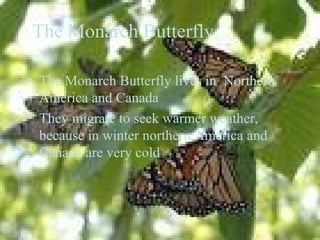
The Monarch Butterfly
• The Monarch Butterfly lives in Northern
America and Canada
• They migrate to seek warmer weather,
because in winter northern America and
Canada are very cold
Monarch’s Difficulties
• The Monarch butterfly’s journey to Mexico
is tough because they’re so delicate
• If a rain storm falls the weight of the rain
cold kill them
• Logging makes the migration tough too
because it ruins their habitat environment
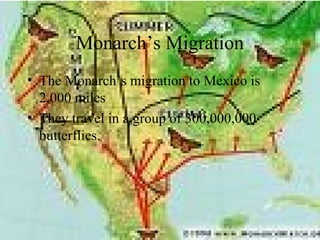
Monarch’s Migration
• The Monarch’s migration to Mexico is
2,000 miles
• They travel in a group of 300,000,000
butterflies.
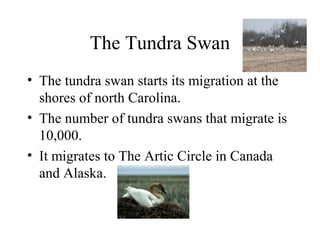
The Tundra Swan
• The tundra swan starts its migration at the
shores of north Carolina.
• The number of tundra swans that migrate is
10,000.
• It migrates to The Artic Circle in Canada
and Alaska.
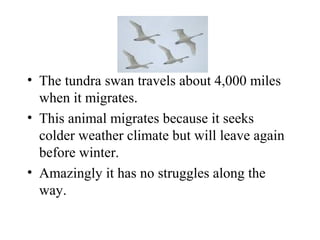
• The tundra swan travels about 4,000 miles
when it migrates.
• This animal migrates because it seeks
colder weather climate but will leave again
before winter.
• Amazingly it has no struggles along the
way.
Questions or comments?
Thank you for your participation
in our project.

Final Animal Presentation

  • 1.
    Mrs. Tully’s Classpresents: The First Annual Video Conference on Animal Habitats, Adaptations and Migrations Host Speakers: Mrs. Tully’s Class
  • 2.
  • 3.
    FACTS ABOUT THE TUNDRA/POLARREGION • The Tundra is very cold and has a lot of ice • The Tundra includes the northern lands of Europe, Asia, and North America • The Tundra is the Earth’s coldest biome
  • 4.
    More Facts AboutThe Tundra/Polar Region • The Artic Tundra is a vast and treeless area of a low, swampy plains in the far north around the Artic Ocean. • In the Summer, a thin layer of topsoil thaws and creates many pools, lakes, and marshes where mosquitoes, midges, and blackflies hang out.
  • 5.
    Some Facts YouShould Know About The Tundra/Polar Region• Another type of tundra is the alpine tundra. • More than 100 species of migrant birds are attracted by insect food. • Other animals that live in the Tundra include polar bears, artic foxes, and gray wolves.
  • 6.
    • The grasslandsare hot and dry • It is perfect for growing crops when there is water • They have many different names like prairies
  • 7.
    • The grasslands are hundreds of miles long • Be careful there are many ticks • The grassland are super cool
  • 8.
    Deciduous Forests • Deciduoustrees loose their leaves in the fall • The natural rot of the fallen leaves on the ground enriches the soil and supports all kinds of plants and animal life • The forests has so much life
  • 9.
    Deciduous Forests • TheDeciduous Forest is a lively place • It is full of plants and animals like the hedgehog, the red fox, the bat, and don’t be surprised to see monkeys! • The Deciduous Forest has a mild temperature
  • 10.
    Fabulous Fun Facts •Among all the life some plants give us medicine • Tons of birds and some insects might sneak up on you • The Deciduous Forest is awesome
  • 11.
    Facts about therainforest • Tropical rainforests are found in Asia, Africa, South America, Central America, and on many Pacific islands • They get more than 70 inches of rain each year
  • 12.
    Cool Facts youshould know • It has more plants than any other biome • It is a perfect biome for over 15 million plants and animals. • The rain forest is made up of evergreen trees
  • 13.
    Awesome Facts • Manyplants for medicine are in the rain forest • The trees in the rain forest grow between 100 and 200 feet tall • Rain forests is an endangered biome because people have cut trees and sold it as fire wood.
  • 14.
    Water Biome • Animalsthat live in the Ocean are Whales, Sharks and other big fish. • Oceans cover about 70% of the earth’s surface.
  • 15.
    Water Biome • Includeswetlands, lakes, rivers and oceans
  • 16.
    Water Biome • Beavers,platypuses and alligators live near rivers .
  • 17.
    Desert Biome • Adesert is an area where little or no life exists because of lack of water. • The deserts are usually hot or warm they are very different from the tundra and polar region.
  • 18.
    Deserts • Some locationsof deserts are the Sahara desert, north Africa and Australia. • The climate of the desert is 10 inches of water each year. • There is not much seasonal changes all there is it changes to spring to summer. • Average temperatures during the day and night the day is 100 degrees and at night it is 40-50 degrees.
  • 19.
    Deserts • Typical weatheris sunny, warm, dry and humid. • The soil is sandy and rocky. • Some of the plants that are in the desert are saguaro cactus, barrel cactus, old man cactus, prickly pear cactus. • Some animals that are in the desert are the camel the addax the cactus wren and the fat sand rat.
  • 20.
  • 21.
    Adaptations • Animals ofall shapes and sizes inhabit the Earth’s land • Adaptations develop over many years and get passed on from parents
  • 22.
    Physical Adaptations Examples ofphysical adaptations are: • Being able to move very smoothly and quickly • Having sharp claws to attack there predators • Having the ability to attack there prey at any time
  • 23.
    Behavioral Adaptations • Havingthe ability to camouflage with their surroundings • Having a special appearance when they approach there predators • Moving to new places to live
  • 24.
    Mimicry • Butterfly • Oneis poisonous so it can protect it’s self and one is not.
  • 25.
    Avoidance • Monkeys • Theystay away from predators high in the trees or where their predator can’t get them.
  • 26.
    Facts about specialmouth parts • Special mouth parts is when a animal helps a other animal like the bird to get food or water so it can survive • Birds have a special mouth part to help them suck the juice out of the flower
  • 27.
    More information aboutspecial mouth parts • Special mouth parts can be found on a bee or some types of birds • Bee’s need special mouth parts to get their honey back to their hive
  • 28.
    More information youshould know about special mouth parts • Birds need special mouth parts to get food and water so they can survive • Special mouth parts are very important to all animals that use special mouth parts By, Brenna Linnane
  • 29.
    Escape • The abilityto use speed against the enemy to outrun or escape • Examples of animals with this ability are Deer, Ostriches, Cheetahs, Jaguars, Antelopes, etc. • A good example is when the deer runs away from a Lion
  • 30.
    Protective Coloration • Ananimal uses camouflage with it’s surroundings so the enemy won’t notice them • Examples of animals with this ability are the arctic hare, chameleon, seals, etc. • A good example is when the chameleon changes color to match its surroundings
  • 31.
    Protective Resemblance • Itis when a animal looks like something else to stay alive • The walking stick is a great example it looks like a stick • The sandfish is another good one it looks like sand
  • 32.
    Body covering • Somethingthat protects the animal from dieing • Like a turtle and it’s shell • Not many people know this by the poison dart frog
  • 33.
    Being able tosee in the dark • An animal can see in the dark • Bat can see in the dark so they can get food • Owl can see in the dark
  • 34.
    Special Weapons Lots ofdifferent animals use special weapons Special weapons come in all shapes and sizes Some animals have sharp points that hurt their predators Mostly smaller animals use special weapons
  • 35.
    Group Defense Lots ofanimals use group defense Group defense is used to make it so if a animal tries to take them all they can take it down Big herbivores normally use group defense
  • 36.
    Chemical Weapons A tonof animals use chemical weapons to hunt It helps them kill their prey The Gila Monster uses
  • 37.
    HIBERNATION • Hibernating isescaping from the cold for the winter in a safe place • These animals will sleep for a long period of time until it gets warmer • Hibernation is usually for the winter • It is an important part in surviving
  • 38.
    FRIGHT • Fright issomething that animals use to survive. • It is a thing animals use to scare other animals so they won’t eat them • Fright is a good thing to have for defense and attack
  • 39.
    More Adaptations • Thetail is a very important part in survival • Or a sharp teeth to bite something • Some body parts are adaptations to
  • 40.
    Migration • Not allanimals migrate • Moving one place to an other is migration • It is like moving your home • A whale migrates
  • 41.
    Playing Dead • Someanimals play dead to trick a predator • A animal does that so it won’t be eaten • Most rodents play dead
  • 42.
  • 43.
    Migration • Migration isa move that can be caused by food scarce or climate change • Most of the time an animal moves somewhere for a period of time then returns • Sometimes migration takes a lifetime to complete
  • 44.
    Seeking Food AndWater • During winter migration birds must search harder for there pray • Some birds including hawks fly to Mexico in search of food • Animals must be careful traveling because animals are hungry
  • 45.
    Reproductive Migration • Migrationcan happen to get young away from predator until gotten older • The green turtle swims 1,242 miles to have young • Eels swim from North America to Puerto Rico and then stay there with young for 3 years
  • 46.
    Wildebeest! • The wildebeesttravels almost 2,000 miles. • It lives in Serengeti Plains, Tanzania. • It migrates to Masai Mara, Kenya.
  • 47.
    Wildebeest! • 200,000 ofthe wildebeest die in the trip. • There are 2 million wildebeest in a herd. • The wildebeest leave because of the rain. • The trip can take place for at least a couple months.
  • 48.
    Wildebeest! • On thetrip the cheetah will try to attack the baby. • The mom will get in the way of the cheetah so it will hit her and not the baby. • On the migration trip they will eat the dead animals that are smaller then them That have been dead at least 1 week.
  • 49.
    Gray whale migration •The Gray Whale lives in Mexico • It can travel 6,000 miles • It migrates to the arctic
  • 50.
    Gray whale • Thereare 27,000 Gray whales left • They migrate because they travel to cold water for feeding and warm weather for giving birth
  • 51.
    Fun facts • Killerwhales are their only predator • Gray whales are very big but they are smaller than killer whales
  • 52.
    • The sandhillcrane migrates1,200-2,500 miles. • They will start in Idaho, North Dakota, South Dakota, Nebraska, Alaska, Canada, or Siberia. • They migrate to Sulphur Springs Valley, Arizona
  • 53.
    • Around 500,000migrate • 20,000 are from Siberia alone • But hunters, and habitat loss hurts there migration
  • 54.
    • They travelin search of a warmer climate • They also travel to find more food • But they go back to breed
  • 55.
    The Monarch Butterfly •The Monarch Butterfly lives in Northern America and Canada • They migrate to seek warmer weather, because in winter northern America and Canada are very cold
  • 56.
    Monarch’s Difficulties • TheMonarch butterfly’s journey to Mexico is tough because they’re so delicate • If a rain storm falls the weight of the rain cold kill them • Logging makes the migration tough too because it ruins their habitat environment
  • 57.
    Monarch’s Migration • TheMonarch’s migration to Mexico is 2,000 miles • They travel in a group of 300,000,000 butterflies.
  • 58.
    The Tundra Swan •The tundra swan starts its migration at the shores of north Carolina. • The number of tundra swans that migrate is 10,000. • It migrates to The Artic Circle in Canada and Alaska.
  • 59.
    • The tundraswan travels about 4,000 miles when it migrates. • This animal migrates because it seeks colder weather climate but will leave again before winter. • Amazingly it has no struggles along the way.
  • 60.
    Questions or comments? Thankyou for your participation in our project.