Angles www.mstfdemirdag.com
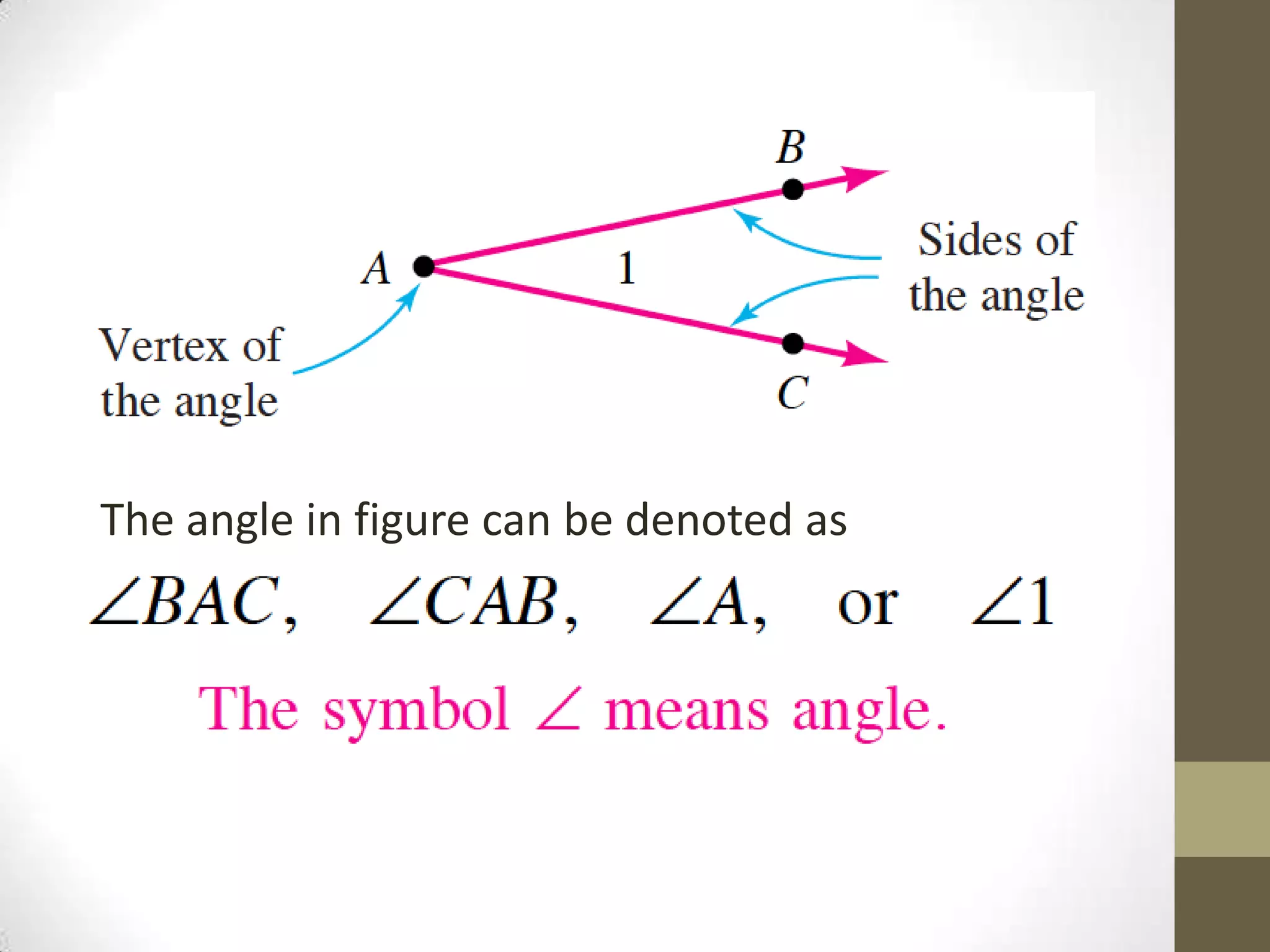
Angle:An angle is a figure formed by two lines with a common point.The commonpoint is called the vertex, and the lines are called sides.
The angle in figurecan be denoted as
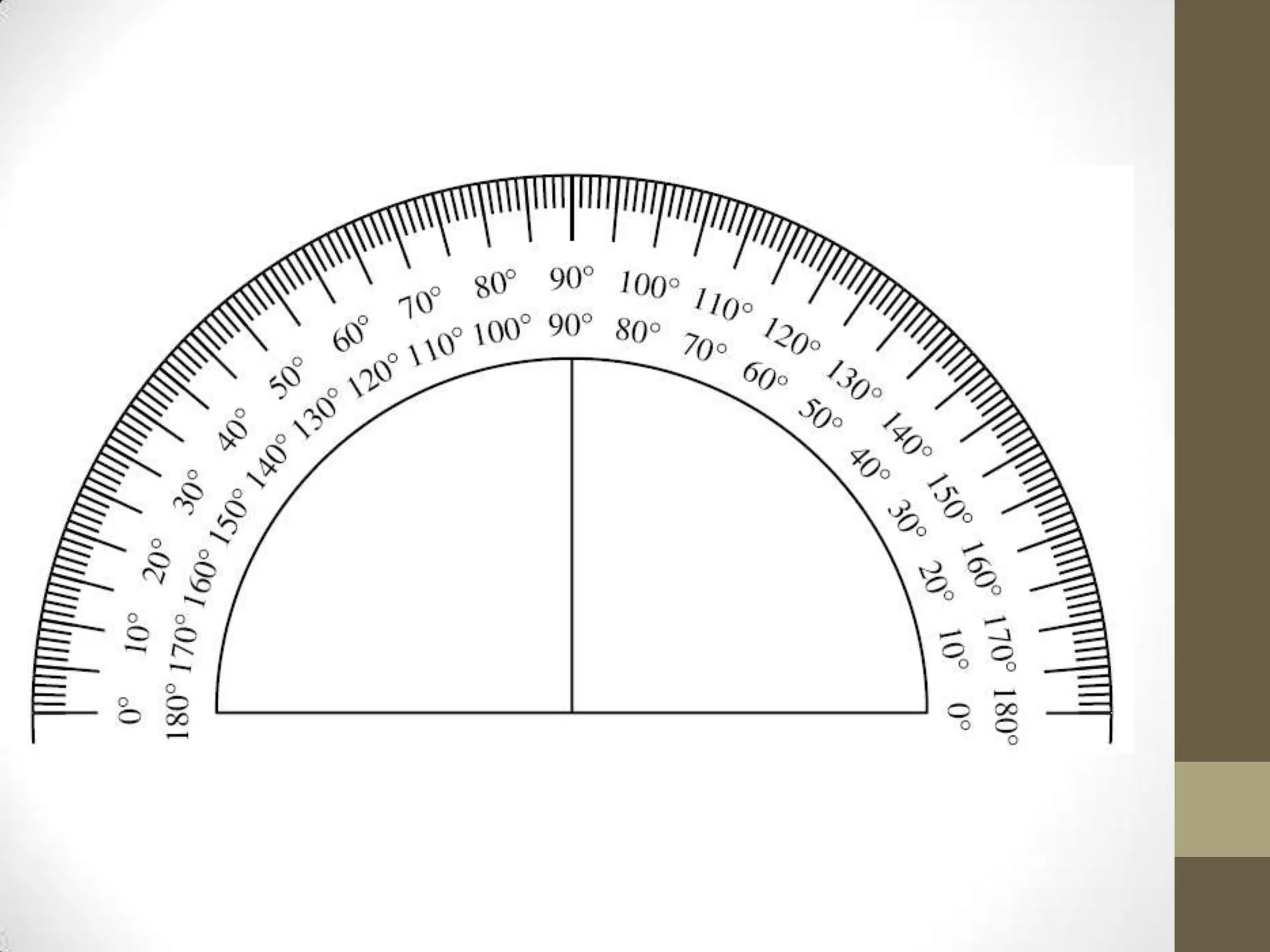
The unit of measurement of an angle is the degree. Degree is shown by  ˚  .Degree is 1/360 of a full revolution.We can use a protractor to measure angles in degrees.
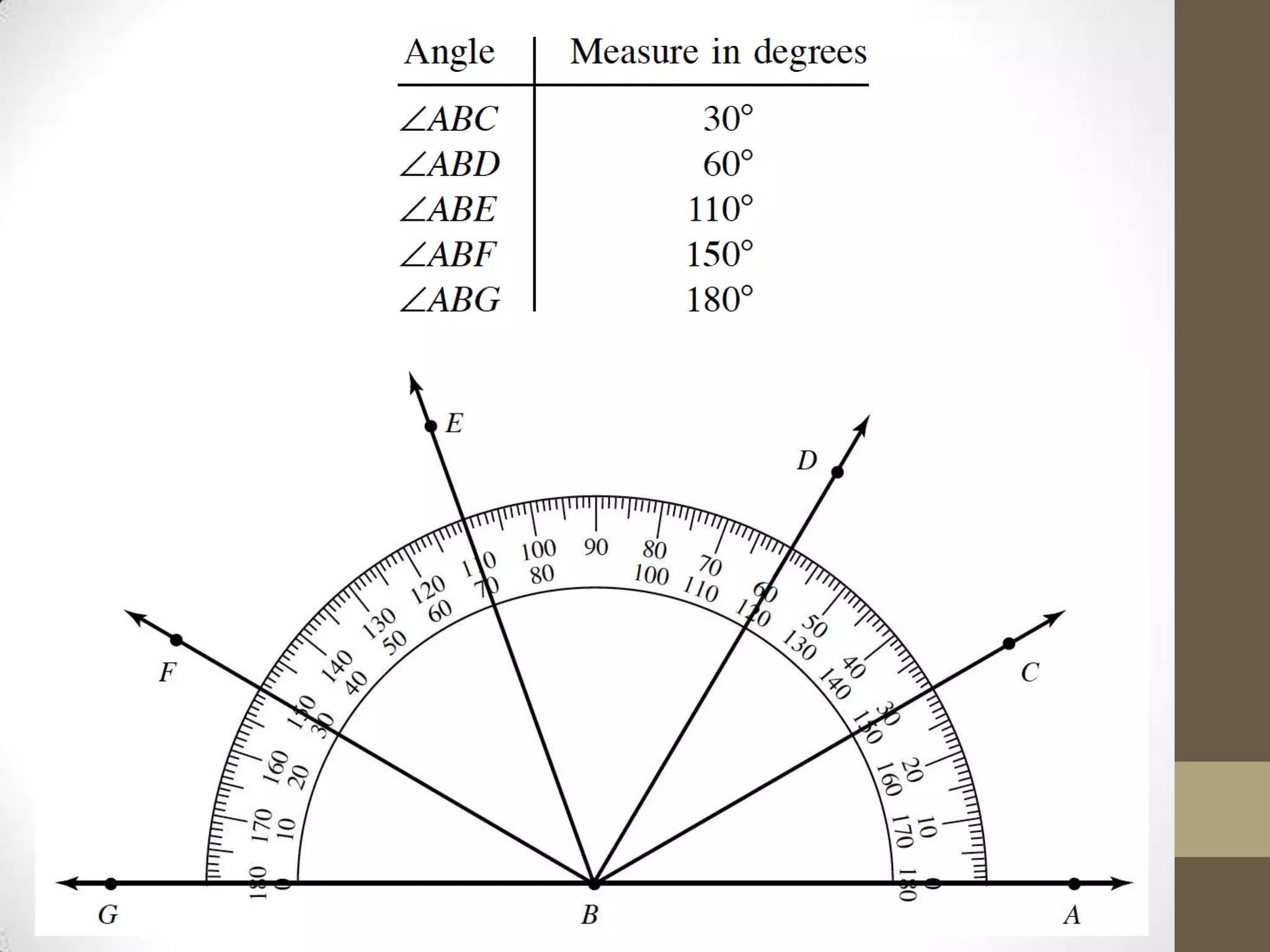
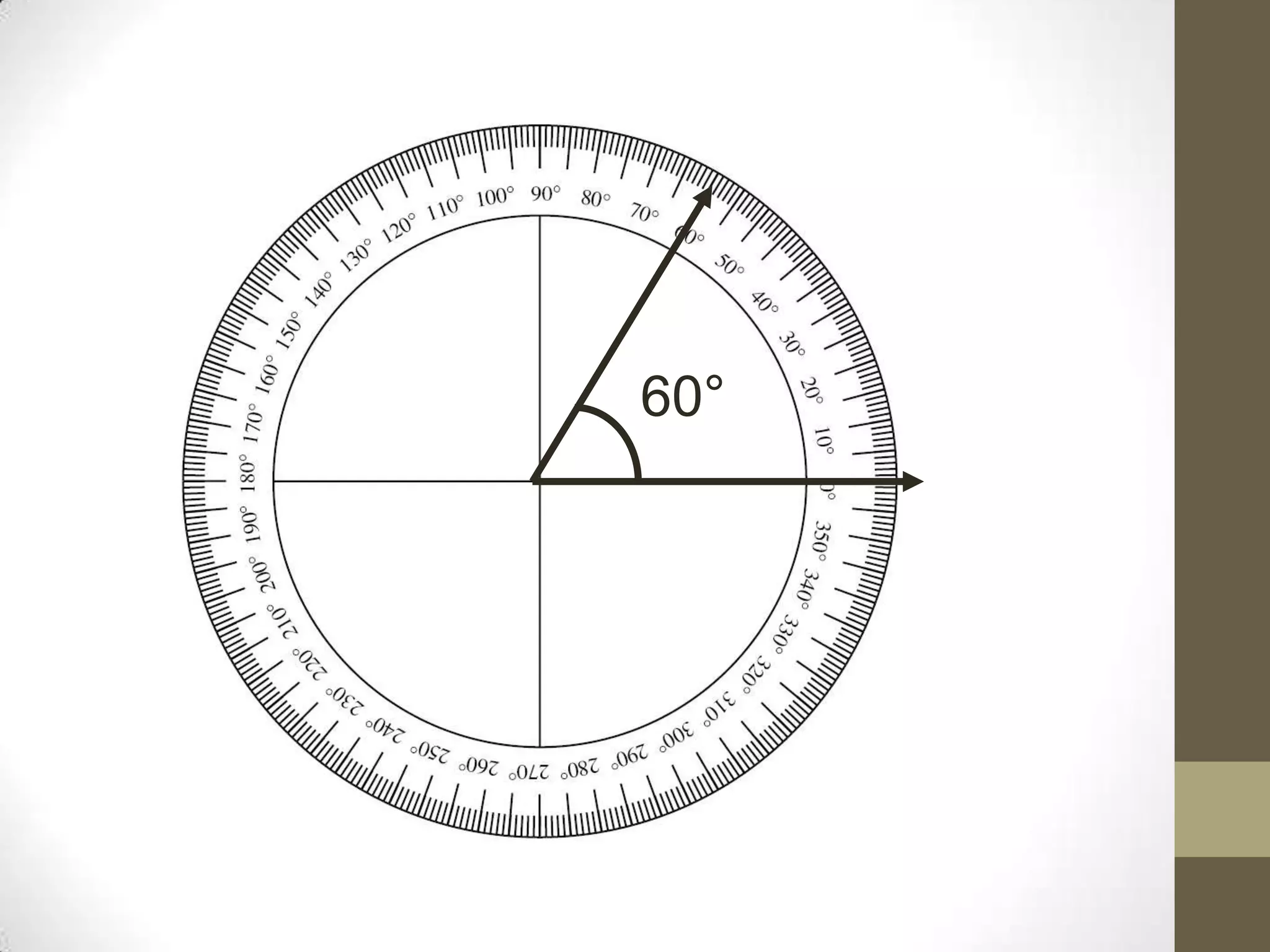
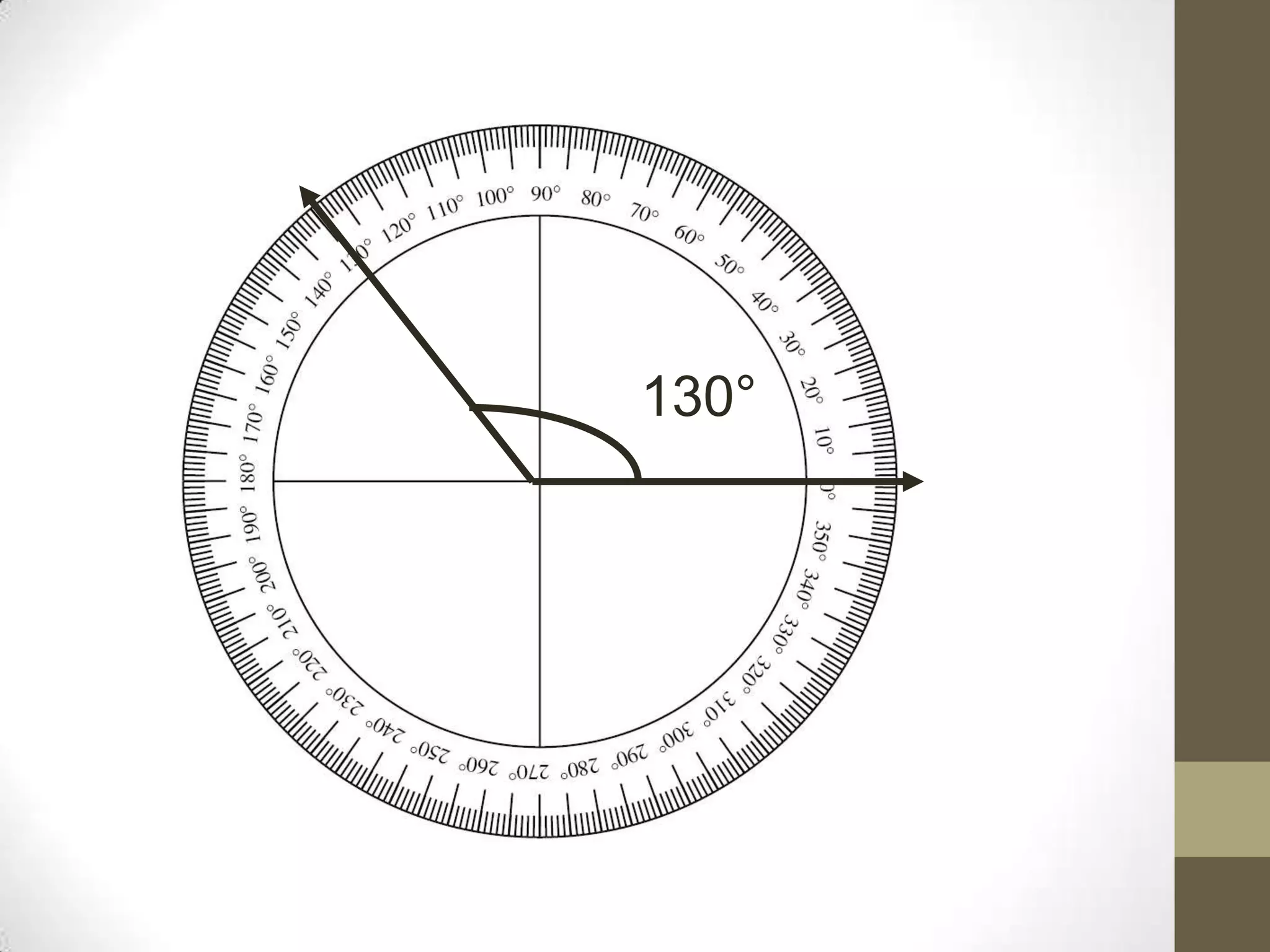
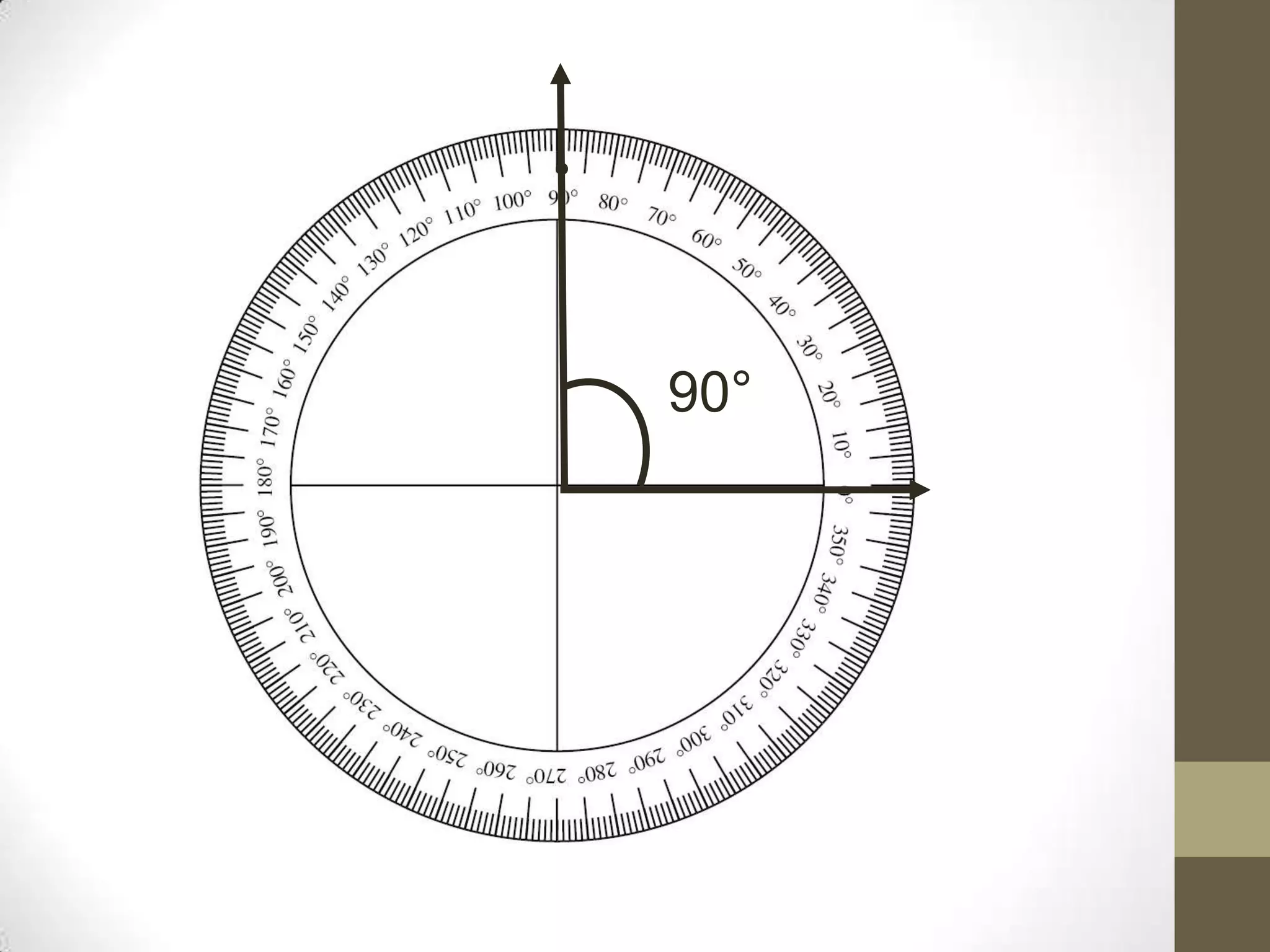
How to measure an angle using protractor?Place the centre of the protractor on the vertex of the angleMatch the 0° horizontal centre line with one of the arms of the angleRead the size of the angle, indicated by the other arm.
60°
130°
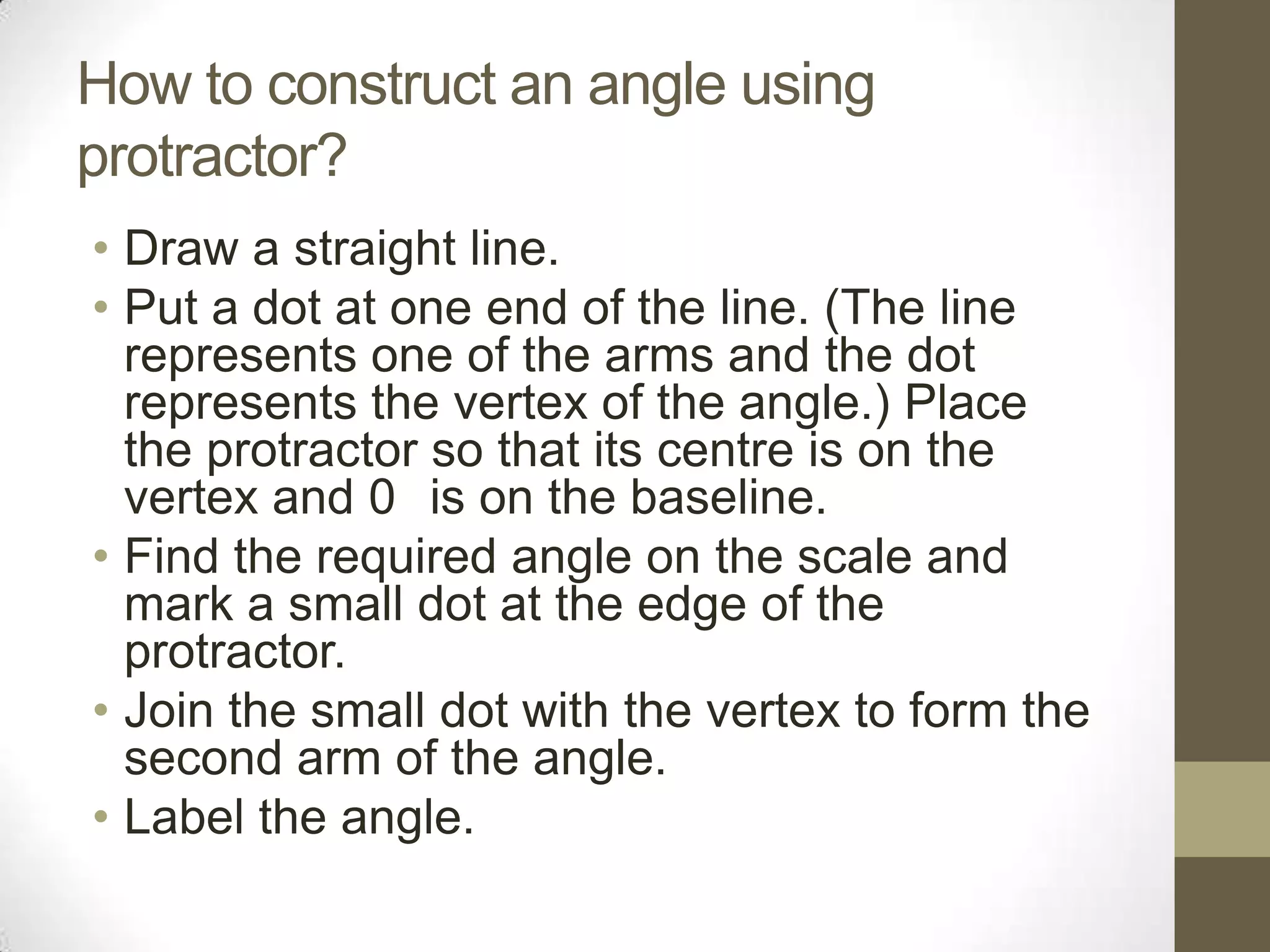
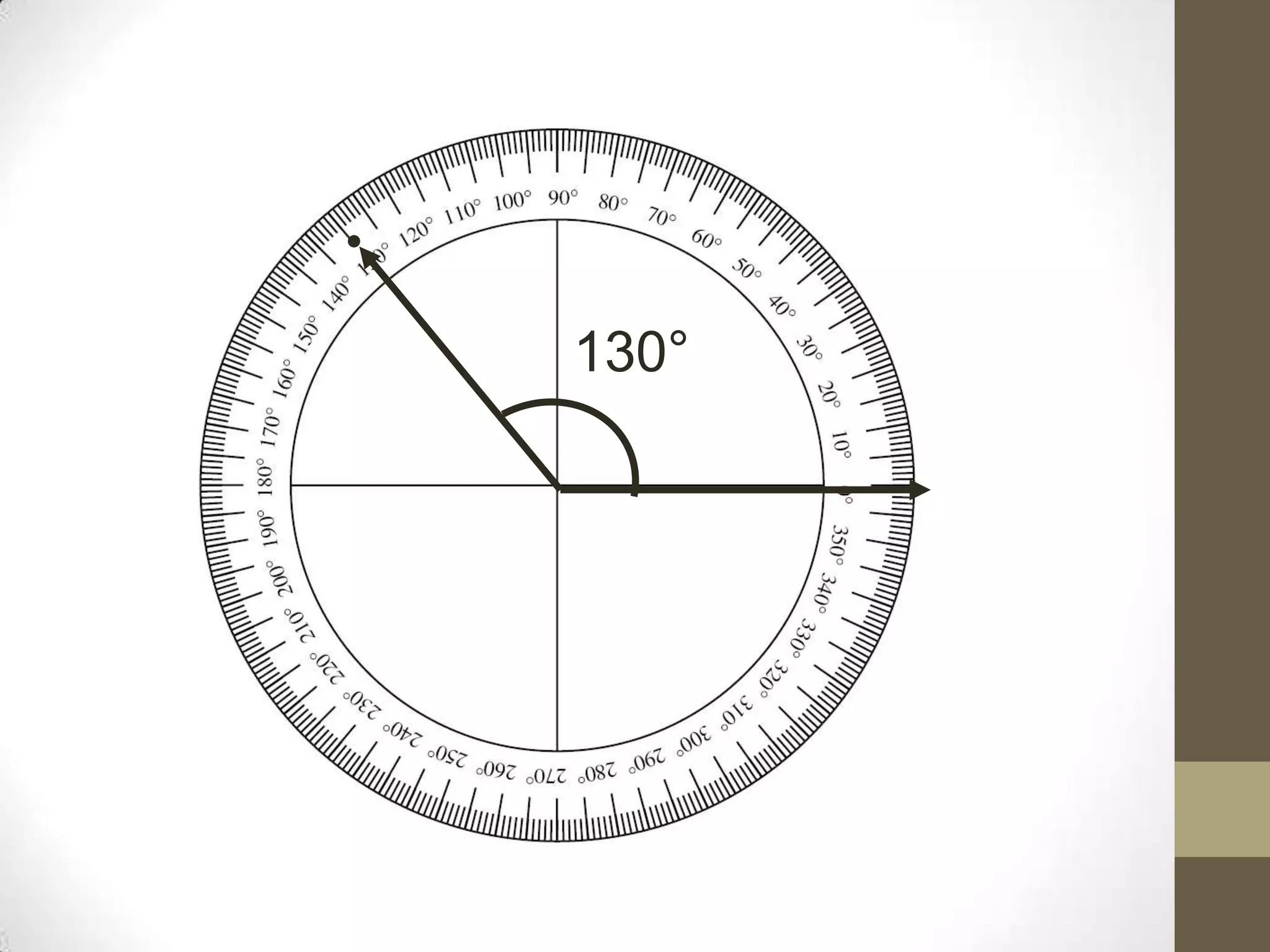
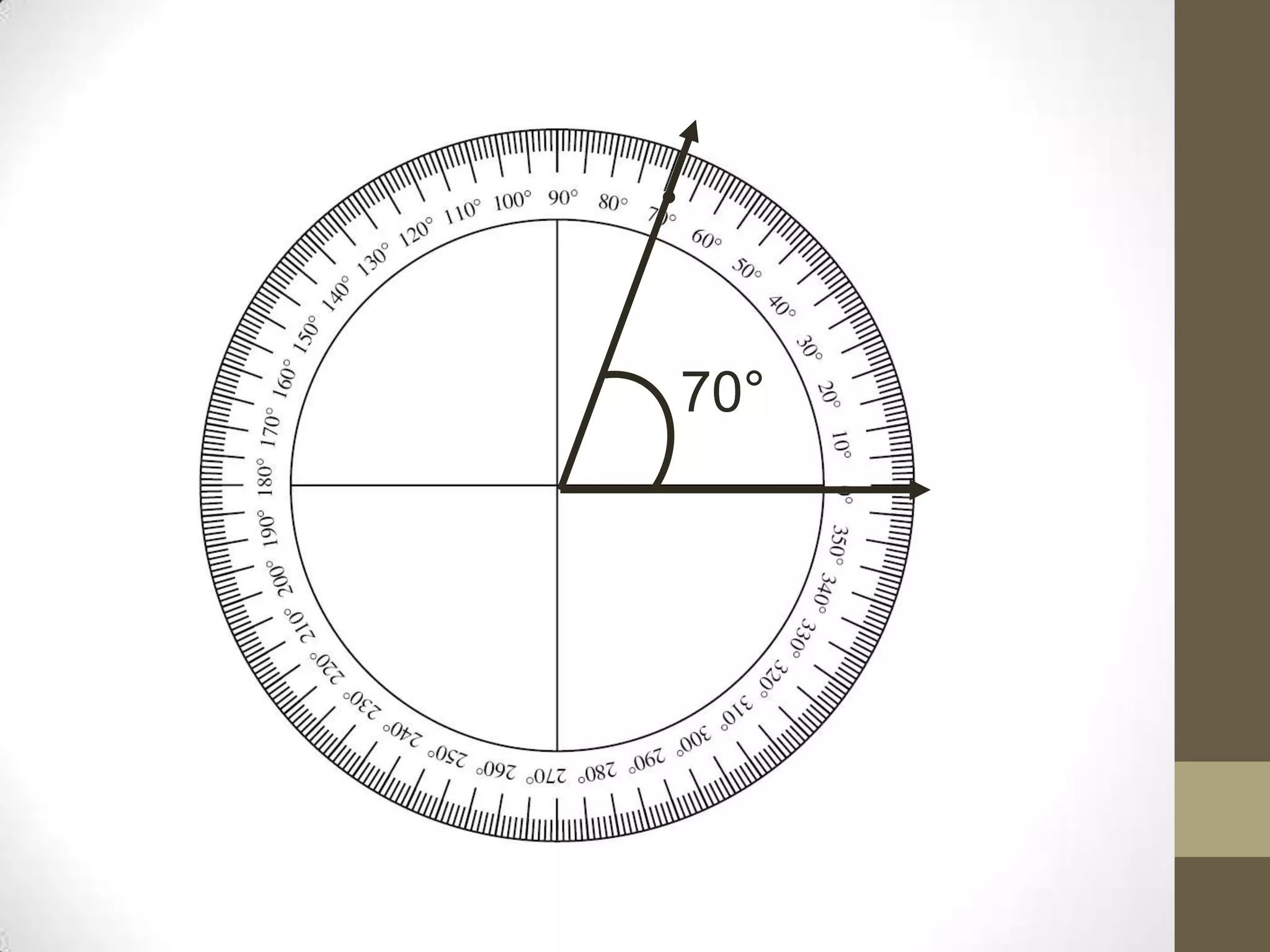
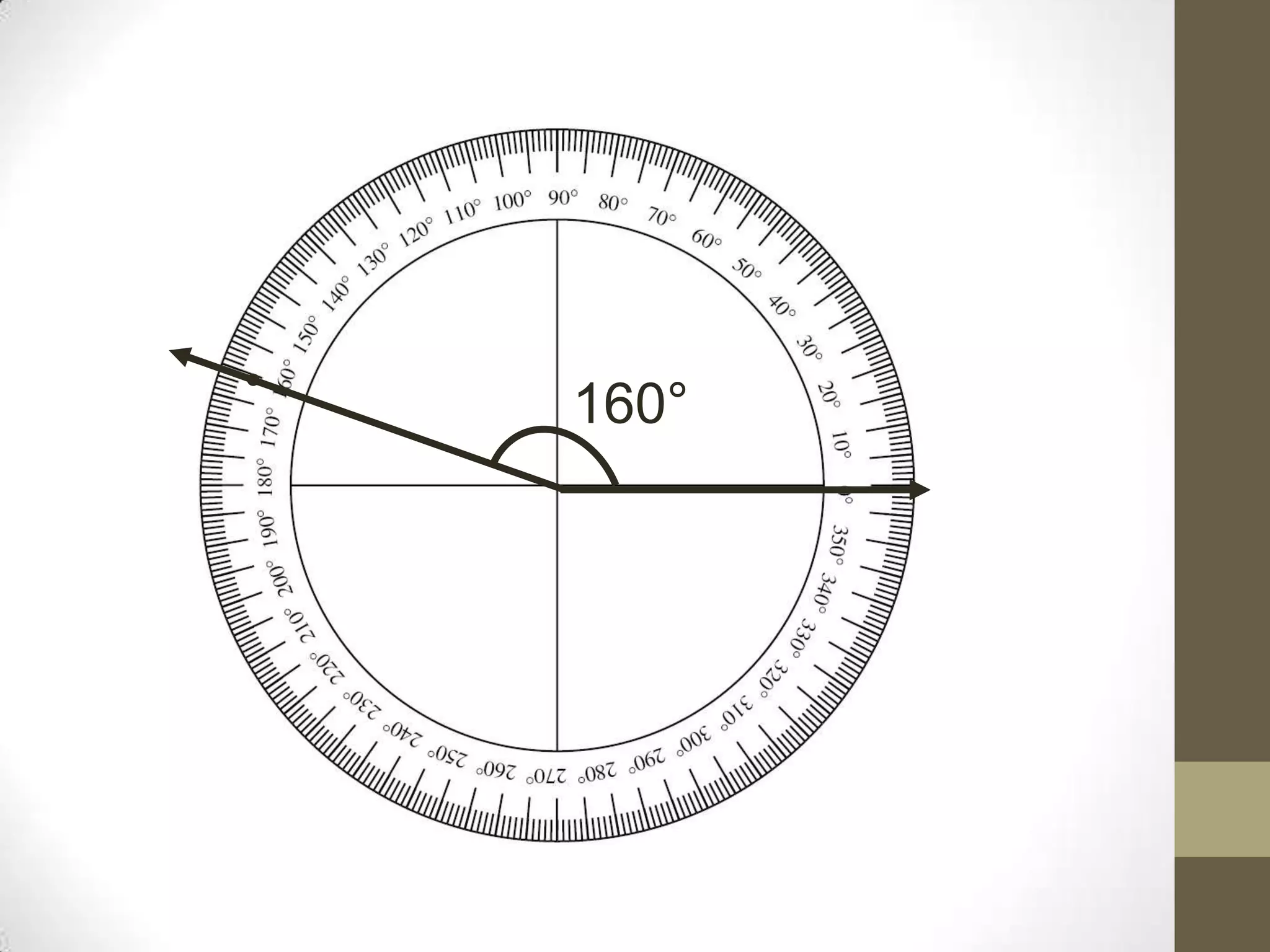
How to construct an angle using protractor?Draw a straight line.Put a dot at one end of the line. (The line represents one of the arms and the dot represents the vertex of the angle.) Place the protractor so that its centre is on the vertex and 0° is on the baseline.Find the required angle on the scale and mark a small dot at the edge of the protractor.Join the small dot with the vertex to form the second arm of the angle.Label the angle.
130°
70°
90°
160°
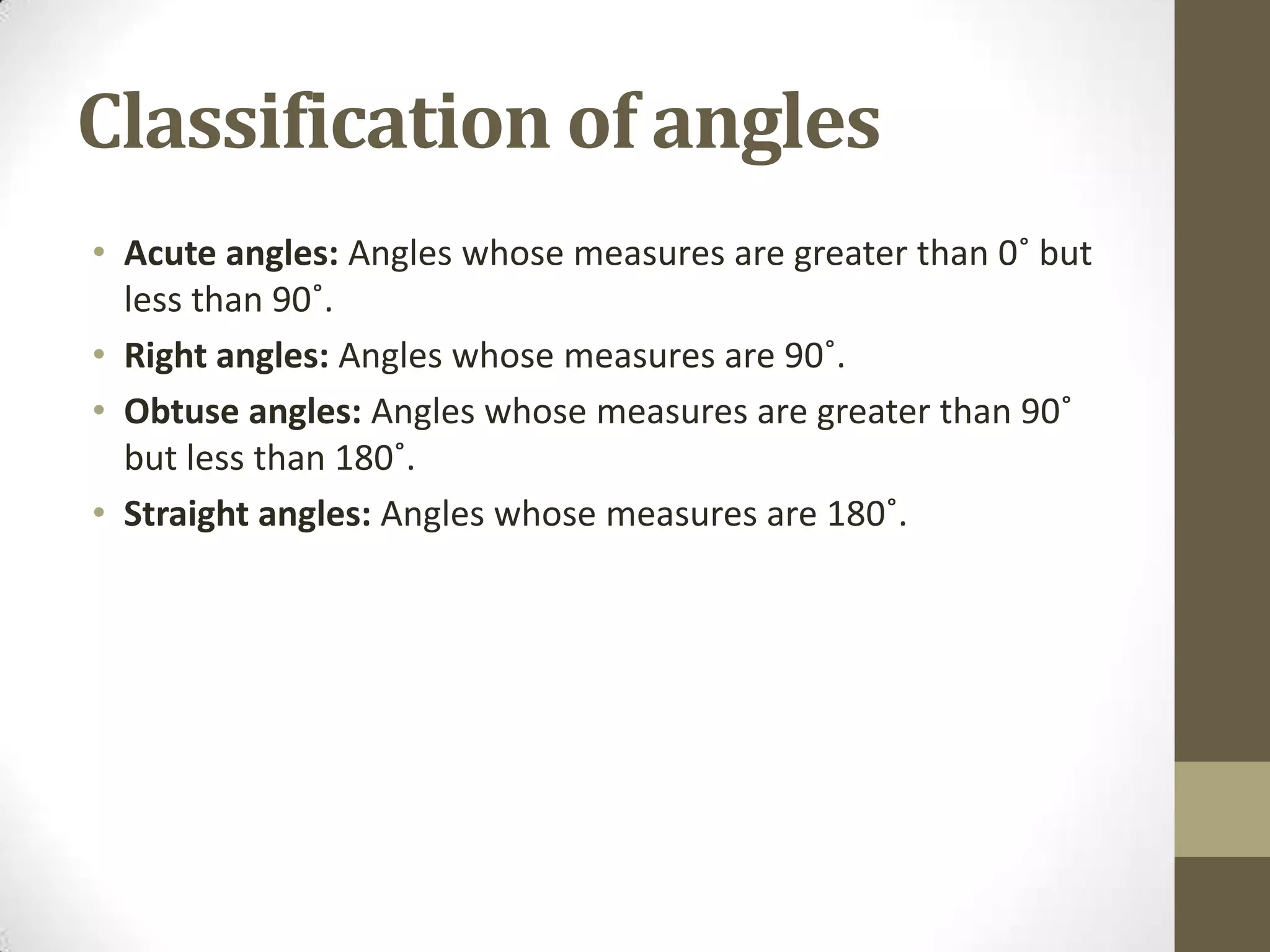
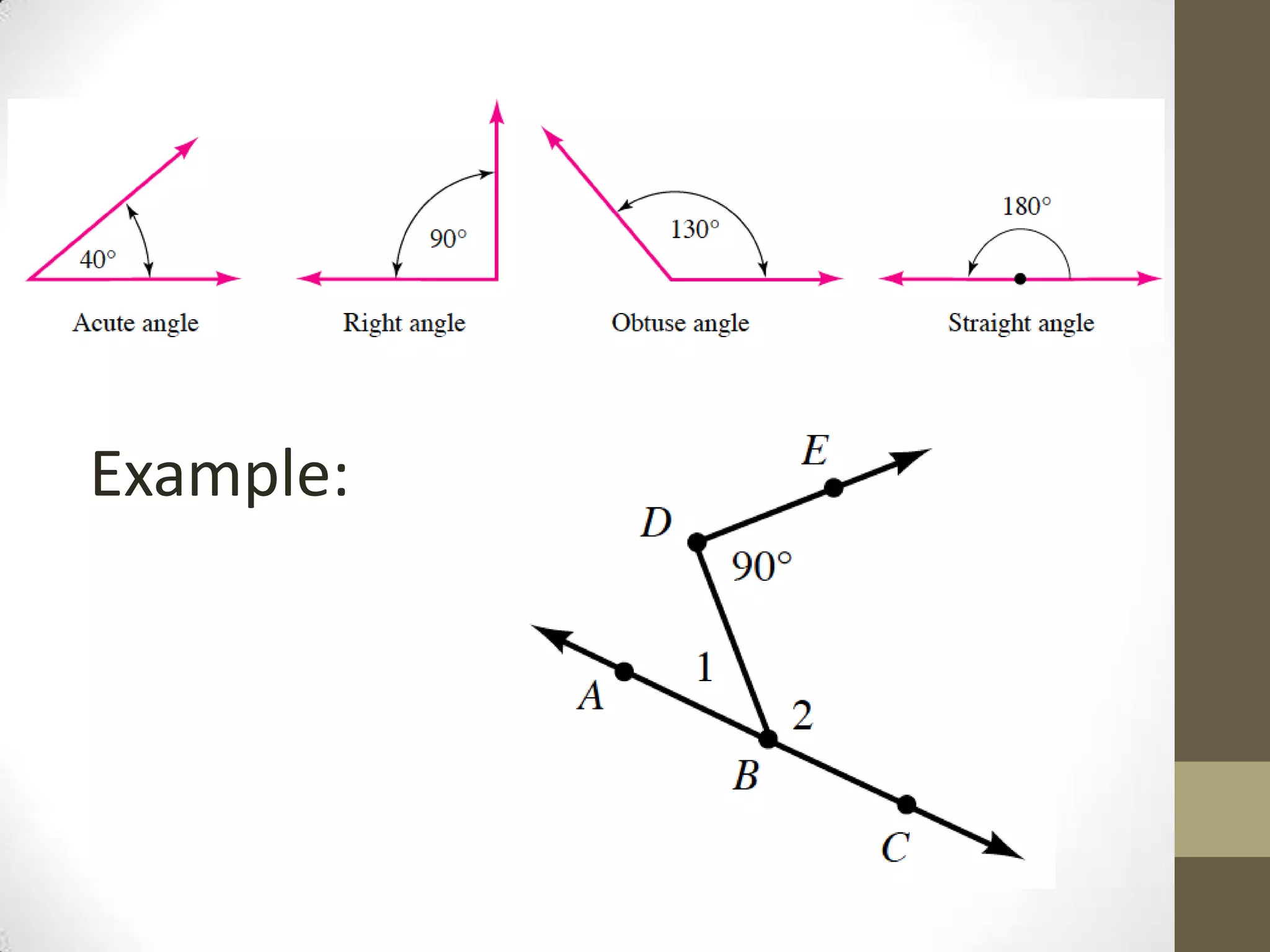
Classification of anglesAcute angles: Angles whose measures are greater than 0˚ but less than 90˚.Right angles: Angles whose measures are 90˚.Obtuse angles: Angles whose measures are greater than 90˚ but less than 180˚.Straight angles: Angles whose measures are 180˚.
Example:
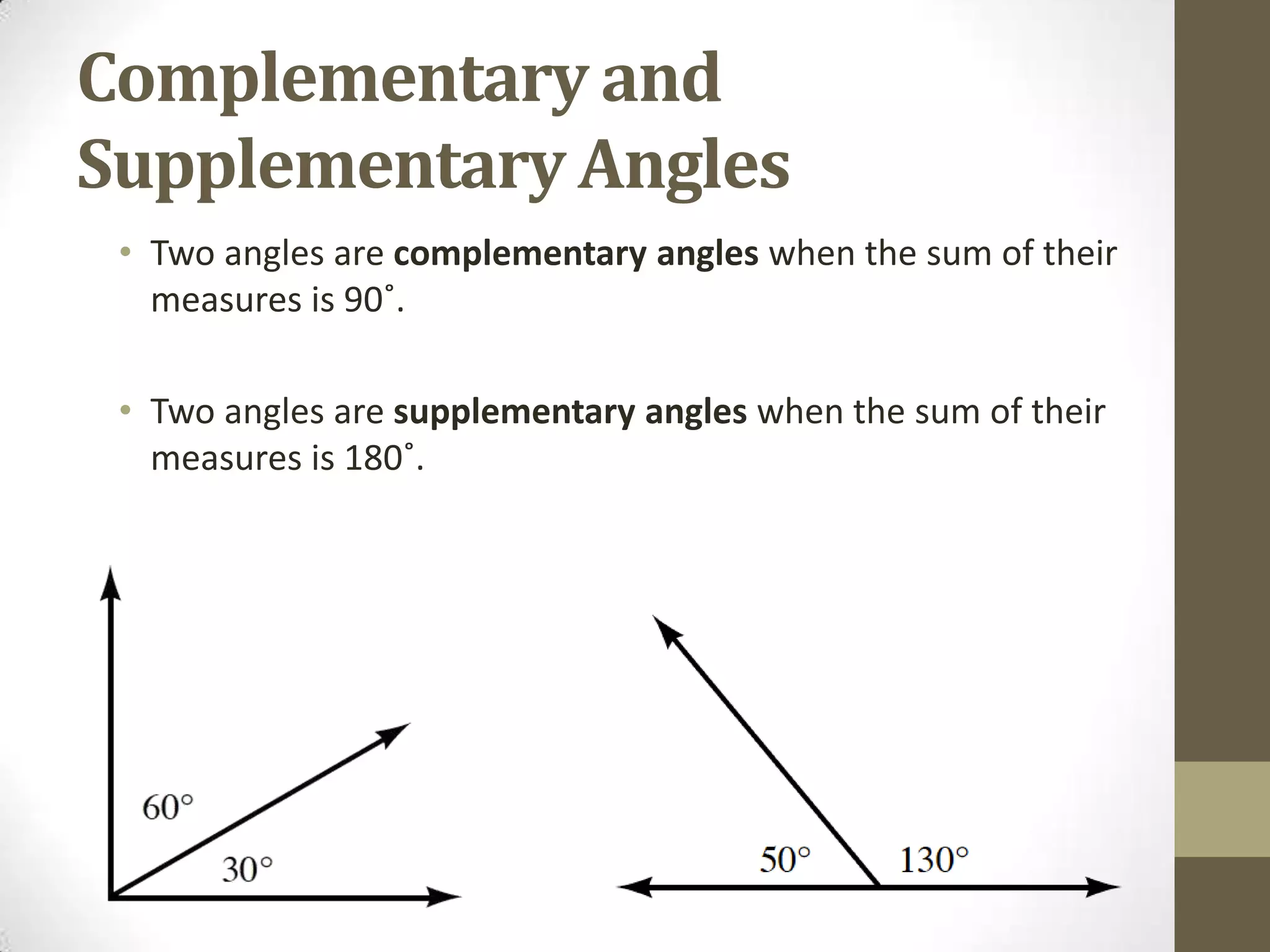
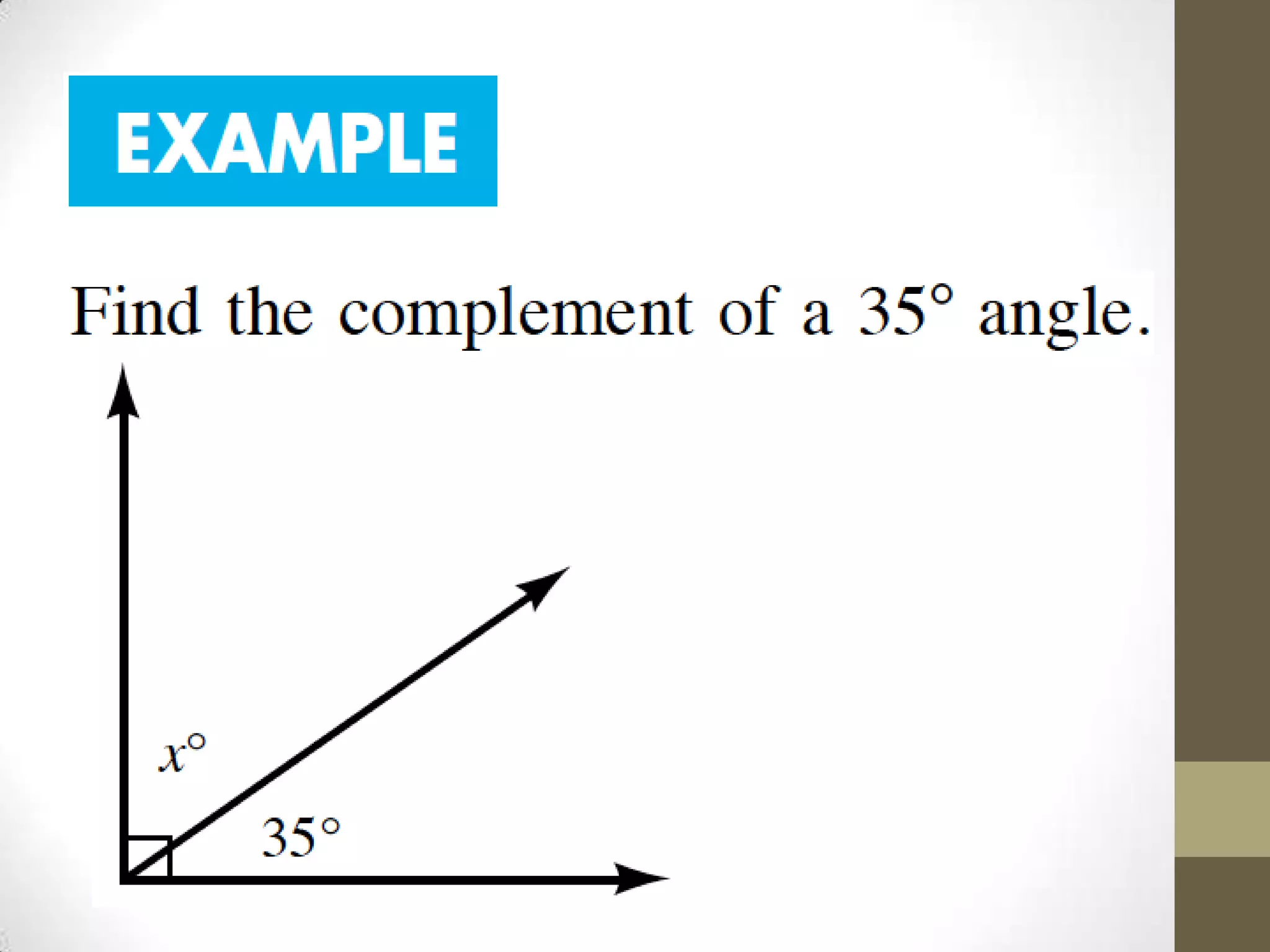
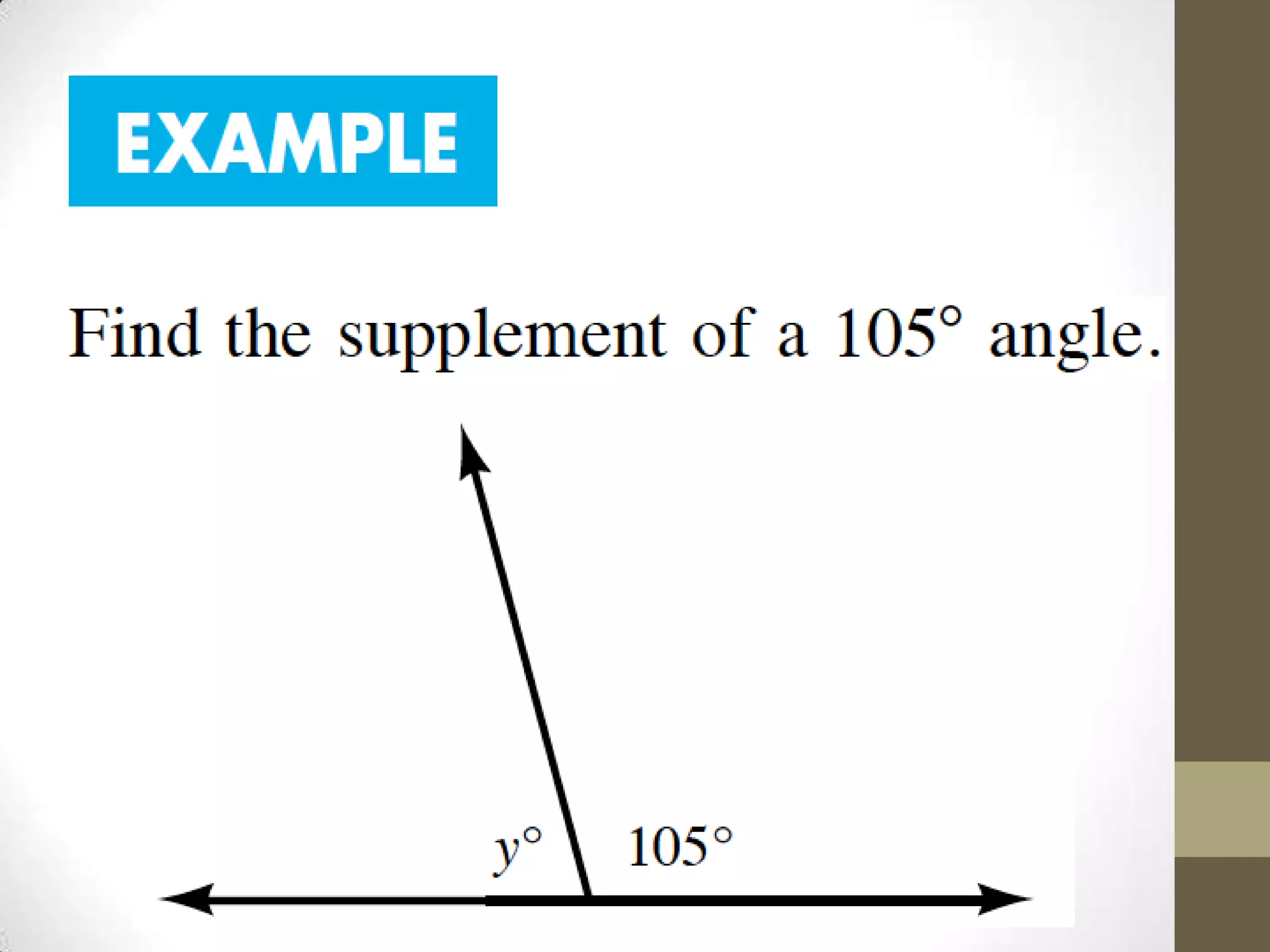
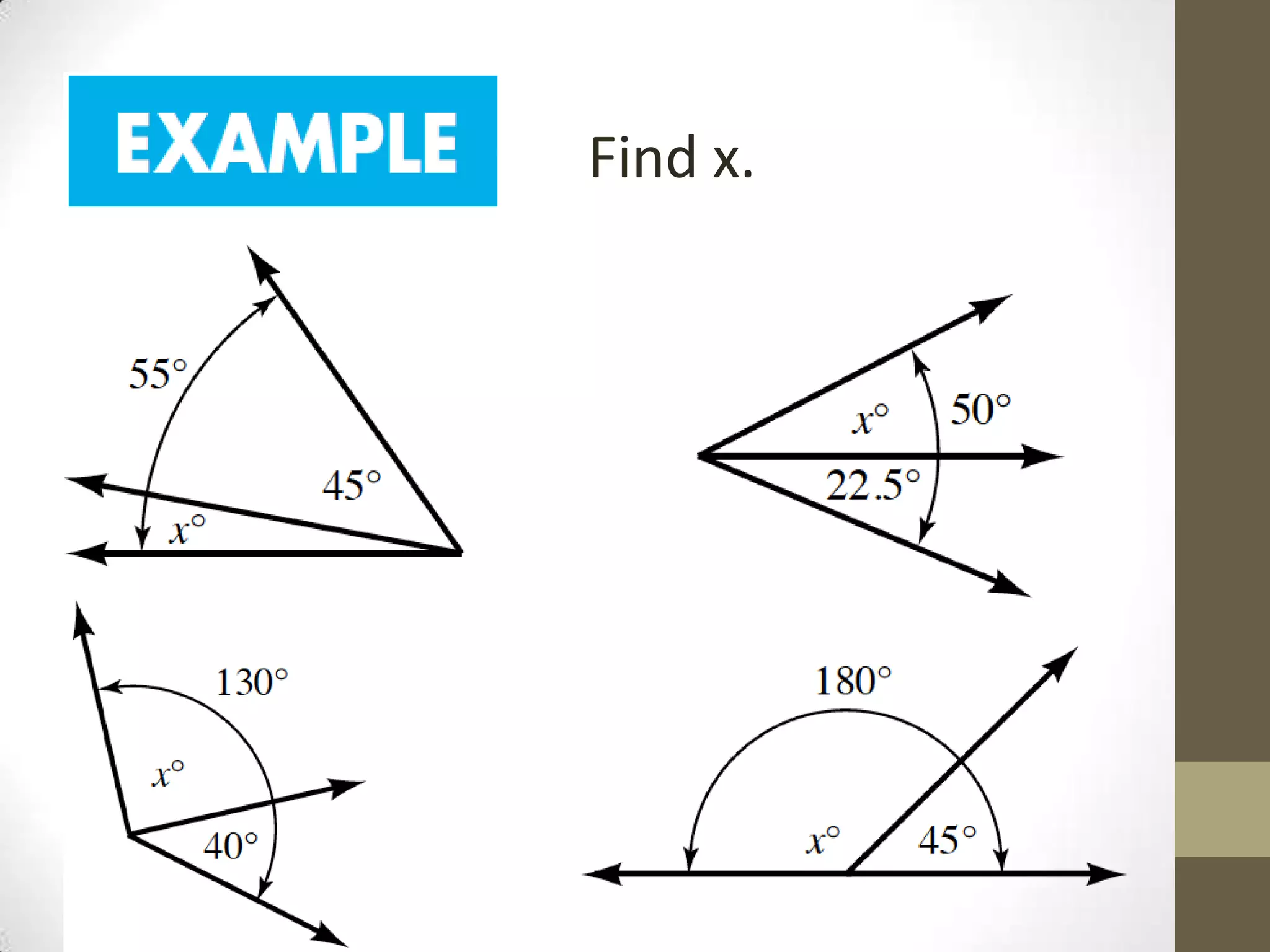
Complementary and Supplementary AnglesTwo angles are complementary angles when the sum of their measures is 90˚.Two angles are supplementary angles when the sum of their measures is 180˚.
Find x.
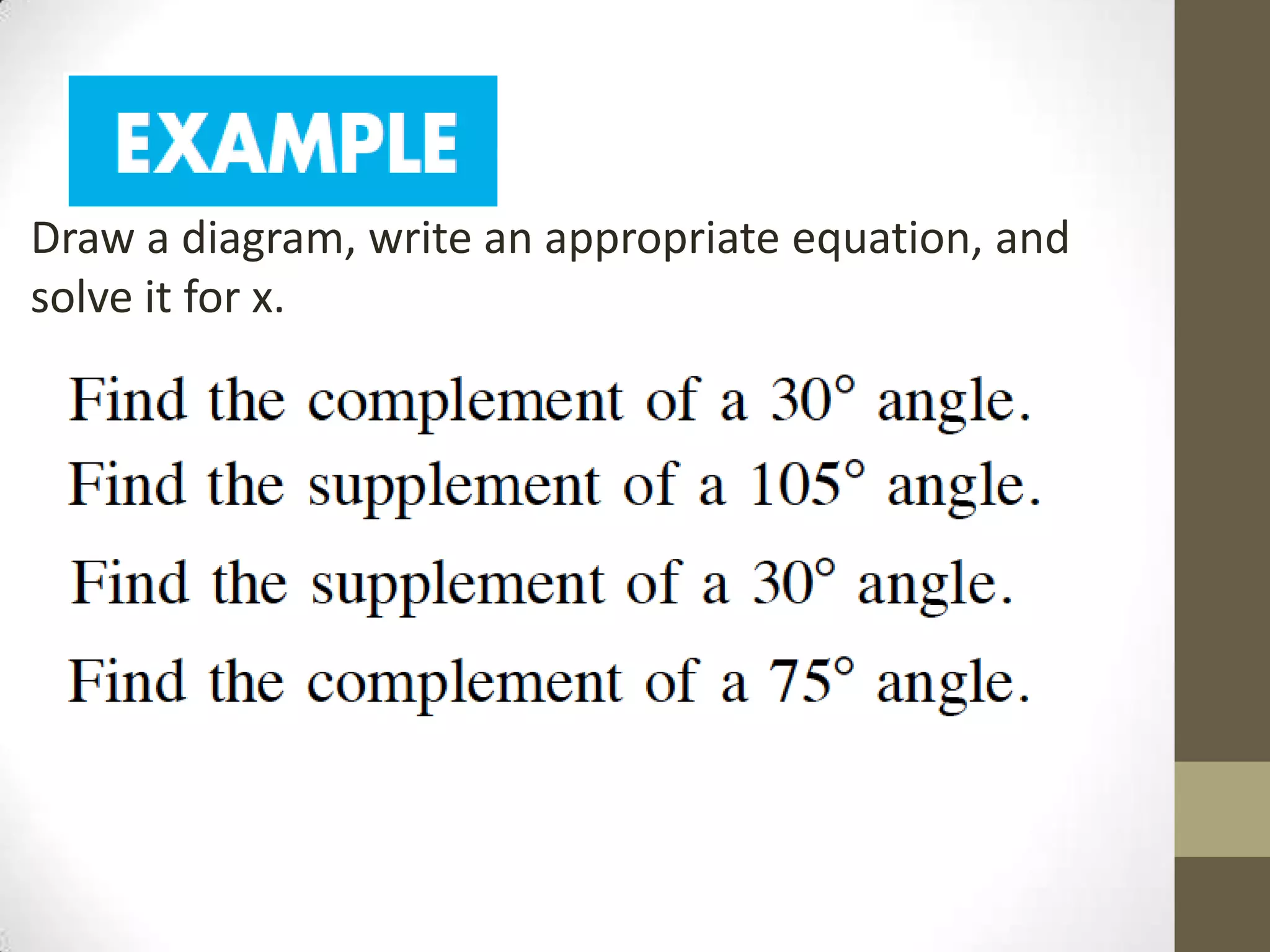
Draw a diagram, write an appropriate equation, and solve it for x.

Angles g7

  • 1.
  • 2.
    Angle:An angle isa figure formed by two lines with a common point.The commonpoint is called the vertex, and the lines are called sides.
  • 3.
    The angle infigurecan be denoted as
  • 4.
    The unit ofmeasurement of an angle is the degree. Degree is shown by ˚ .Degree is 1/360 of a full revolution.We can use a protractor to measure angles in degrees.
  • 7.
    How to measurean angle using protractor?Place the centre of the protractor on the vertex of the angleMatch the 0° horizontal centre line with one of the arms of the angleRead the size of the angle, indicated by the other arm.
  • 8.
  • 9.
  • 10.
    How to constructan angle using protractor?Draw a straight line.Put a dot at one end of the line. (The line represents one of the arms and the dot represents the vertex of the angle.) Place the protractor so that its centre is on the vertex and 0° is on the baseline.Find the required angle on the scale and mark a small dot at the edge of the protractor.Join the small dot with the vertex to form the second arm of the angle.Label the angle.
  • 11.
  • 12.
  • 13.
  • 14.
  • 15.
    Classification of anglesAcuteangles: Angles whose measures are greater than 0˚ but less than 90˚.Right angles: Angles whose measures are 90˚.Obtuse angles: Angles whose measures are greater than 90˚ but less than 180˚.Straight angles: Angles whose measures are 180˚.
  • 16.
  • 17.
    Complementary and SupplementaryAnglesTwo angles are complementary angles when the sum of their measures is 90˚.Two angles are supplementary angles when the sum of their measures is 180˚.
  • 21.
  • 22.
    Draw a diagram,write an appropriate equation, and solve it for x.

Editor's Notes

  • #22 ----- Meeting Notes (3/28/11 10:06) -----