Angles and Triangles
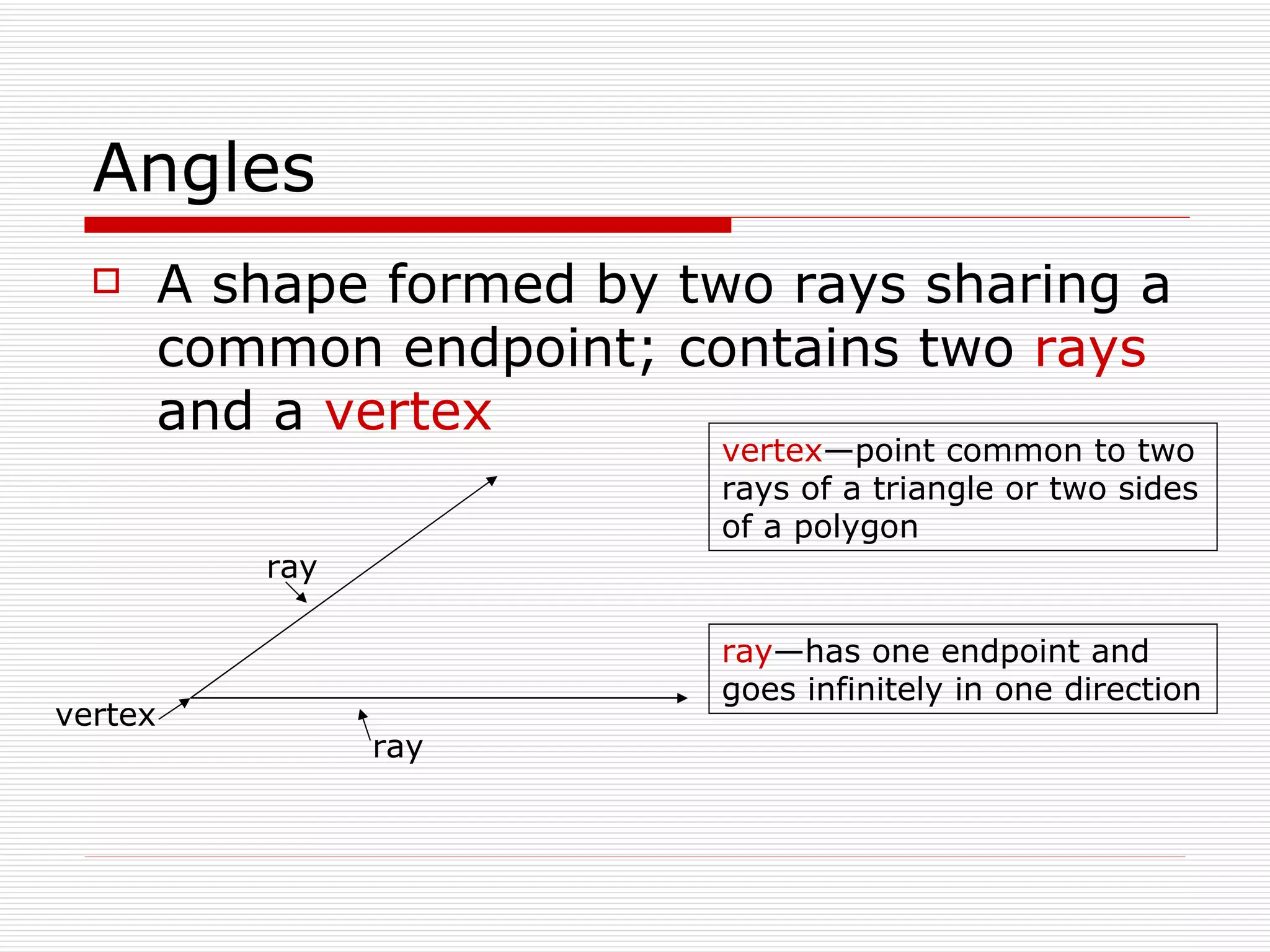
Angles A shape formed by two rays sharing a common endpoint; contains two  rays  and a  vertex ray —has one endpoint and goes infinitely in one direction vertex —point common to two rays of a triangle or two sides of a polygon  ray ray vertex
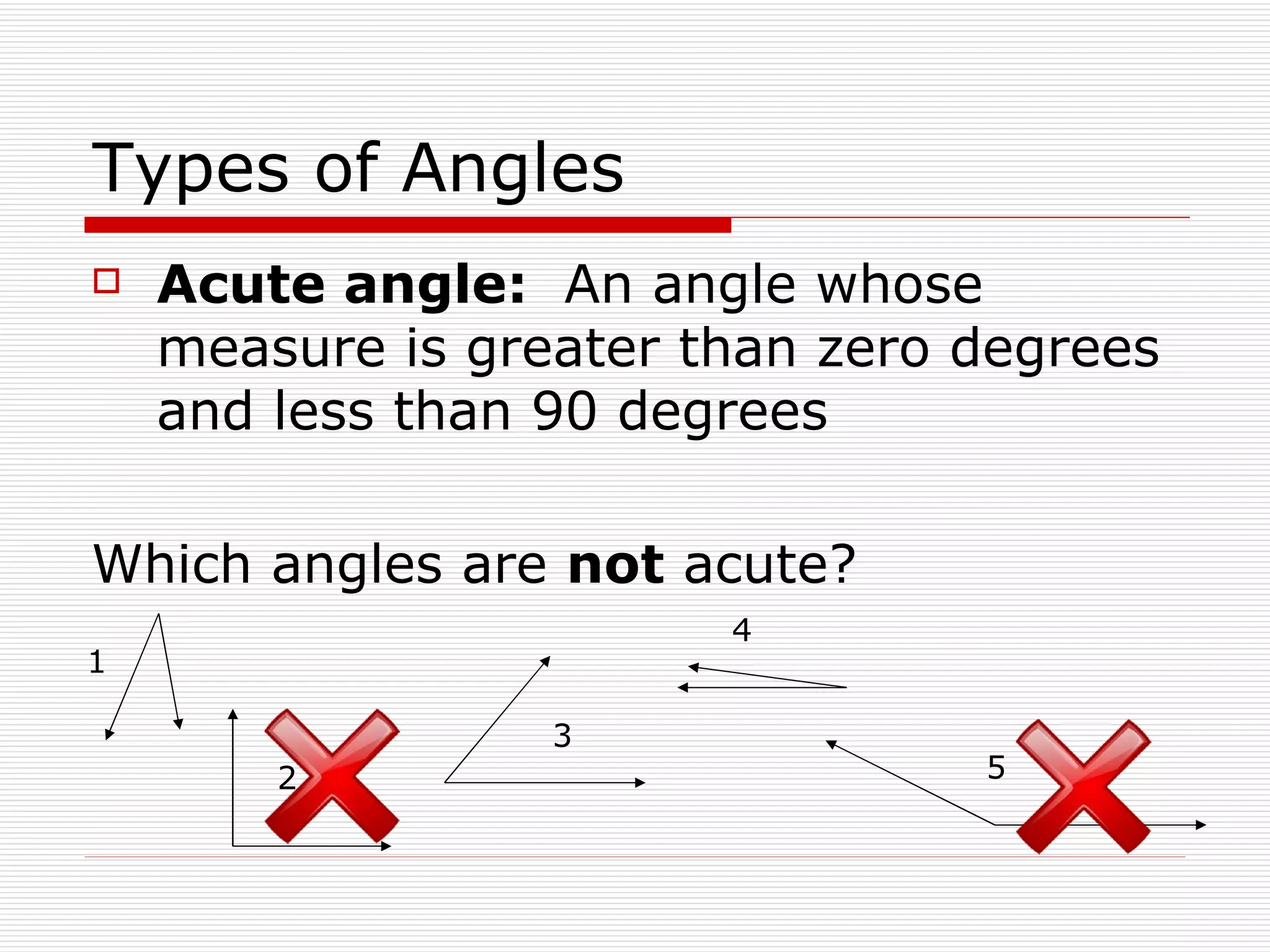
Types of Angles Acute angle:  An angle whose measure is greater than zero degrees and less than 90 degrees Which angles are  not  acute? 1 2 3 4 5
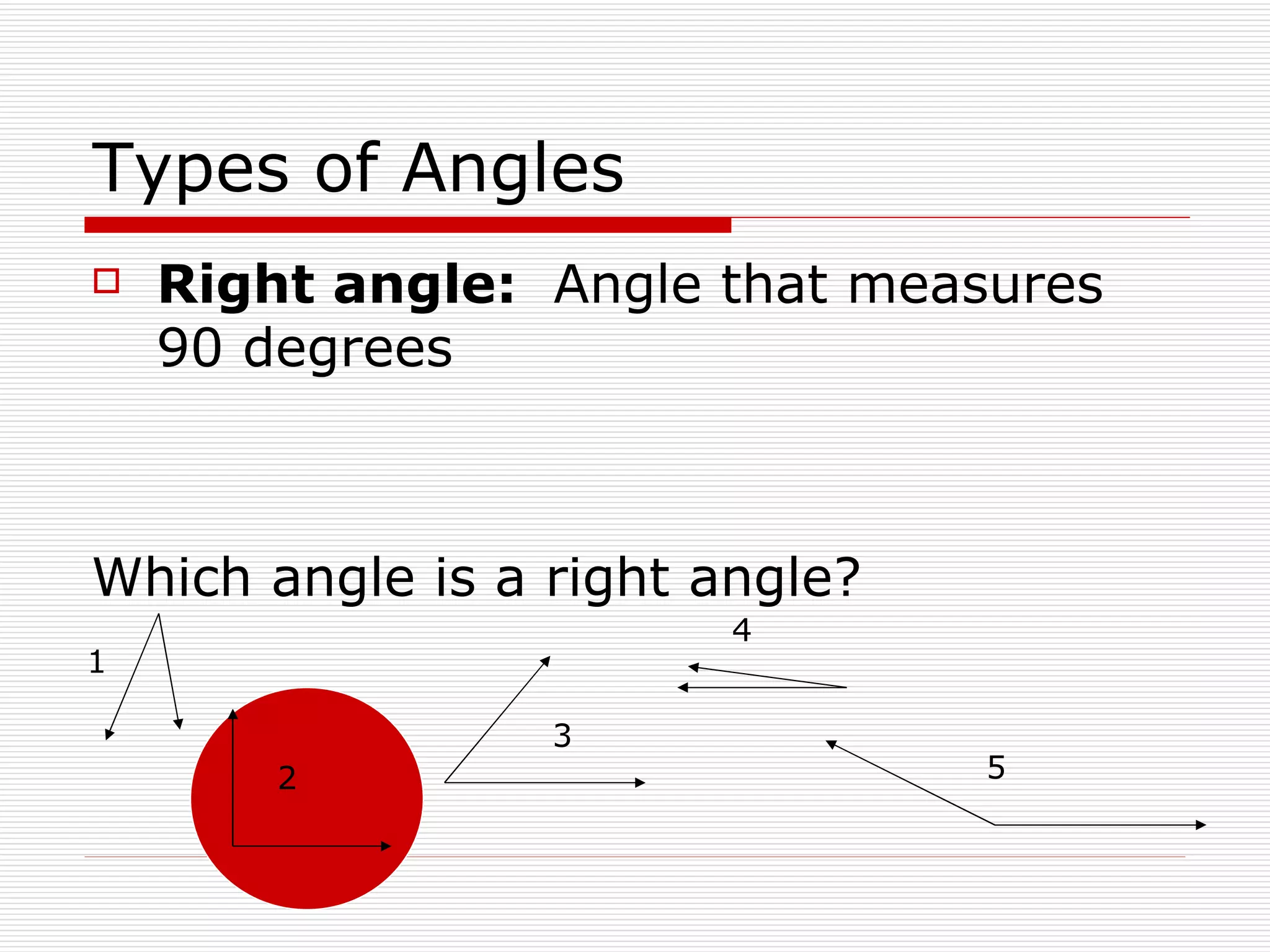
Types of Angles Right angle:  Angle that measures  9 0 degrees Which angle is a right angle? 1 2 3 4 5
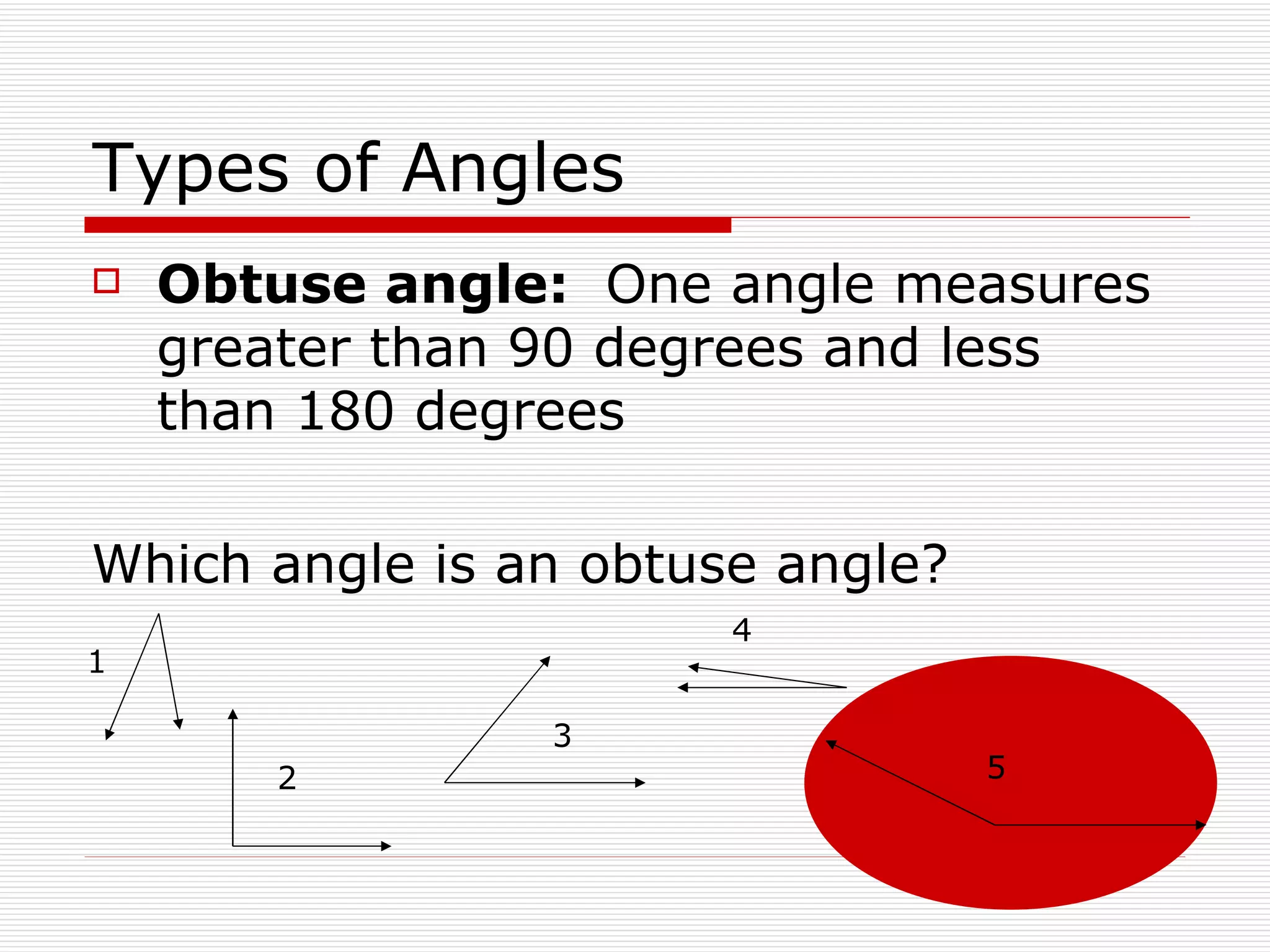
Types of Angles Obtuse angle:  One angle measures greater than 9 0 degrees and less than 180 degrees Which angle is an obtuse angle? 1 2 3 4 5
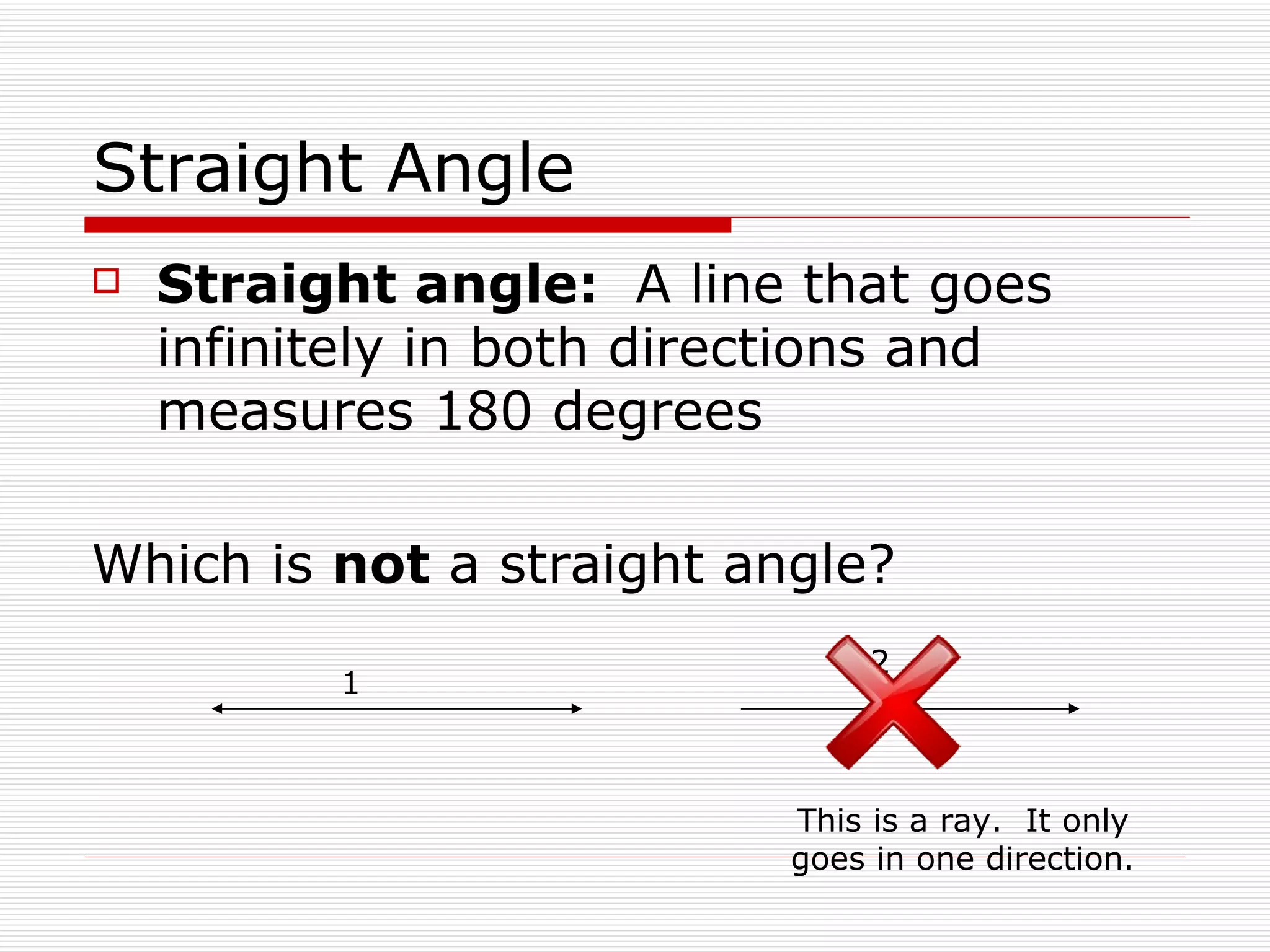
Straight Angle Straight angle:  A line that goes infinitely in both directions and measures 180 degrees   Which is  not  a straight angle? 1 2 This is a ray.  It only goes in one direction.
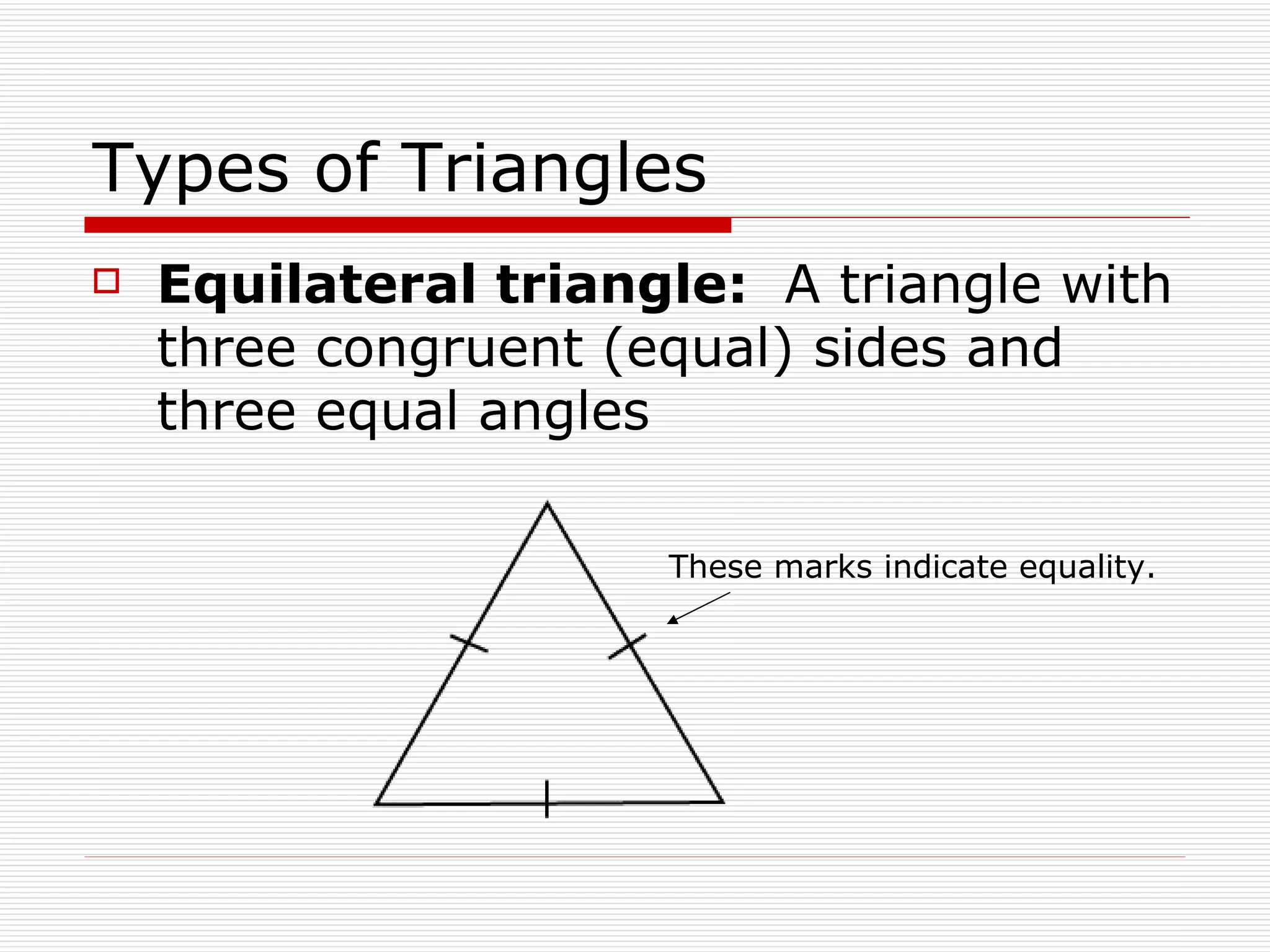
Types of Triangles Equilateral triangle:  A triangle with three congruent (equal) sides and three equal angles These marks indicate equality.
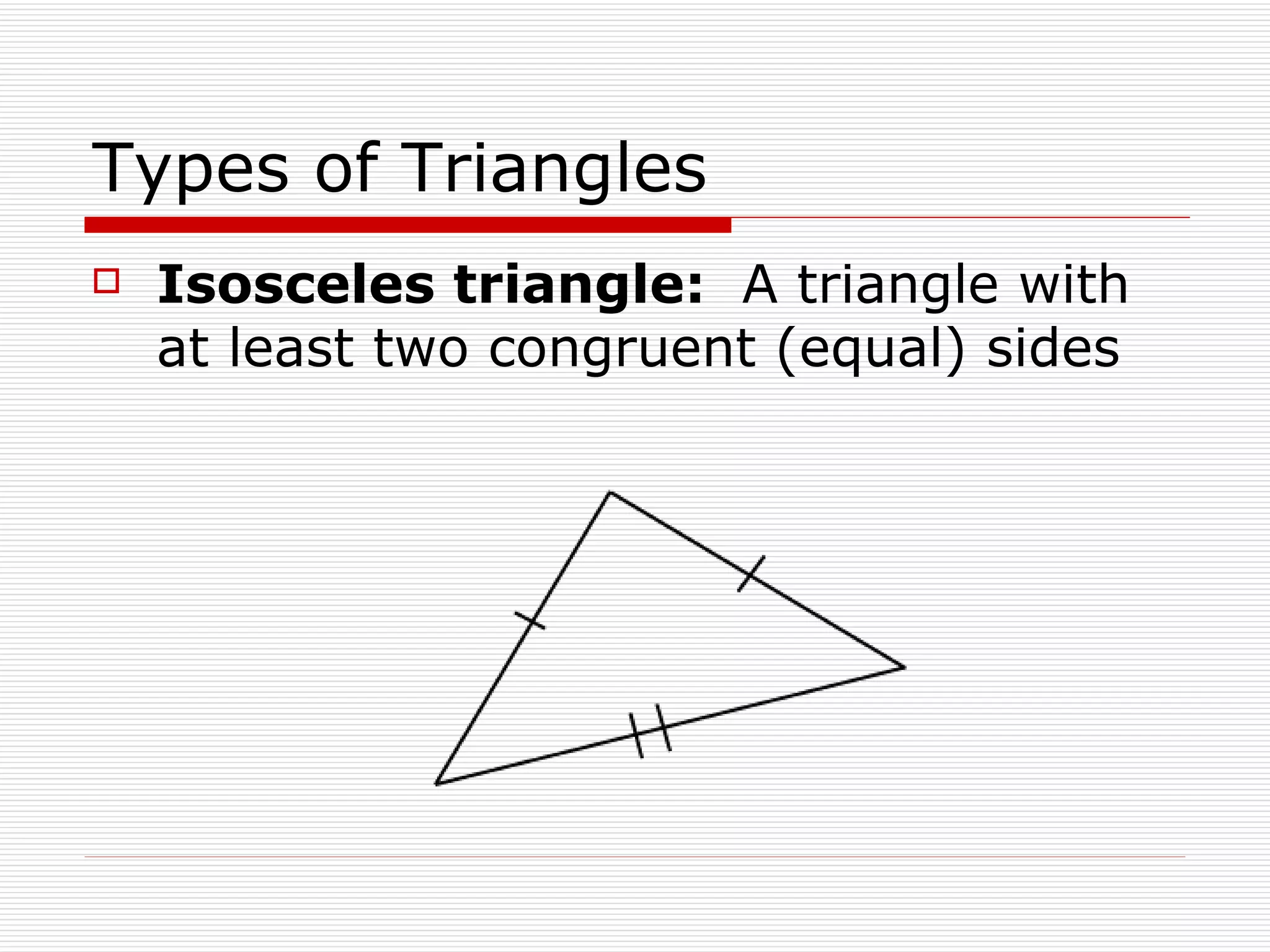
Types of Triangles Isosceles triangle:  A triangle with at least two congruent (equal) sides
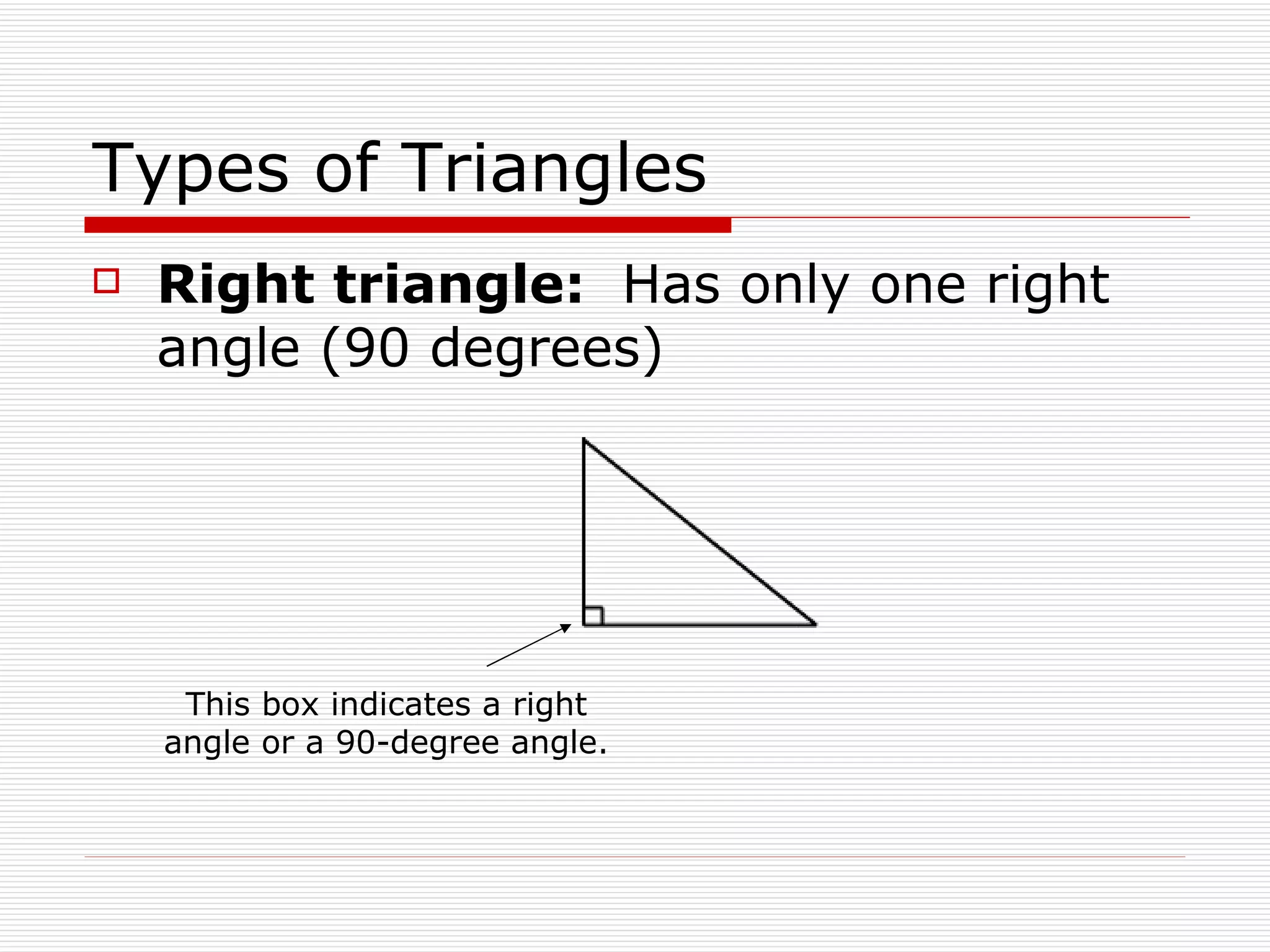
Types of Triangles Right triangle:  Has only one right angle ( 9 0 degrees)  This box indicates a right angle or a 90-degree angle.
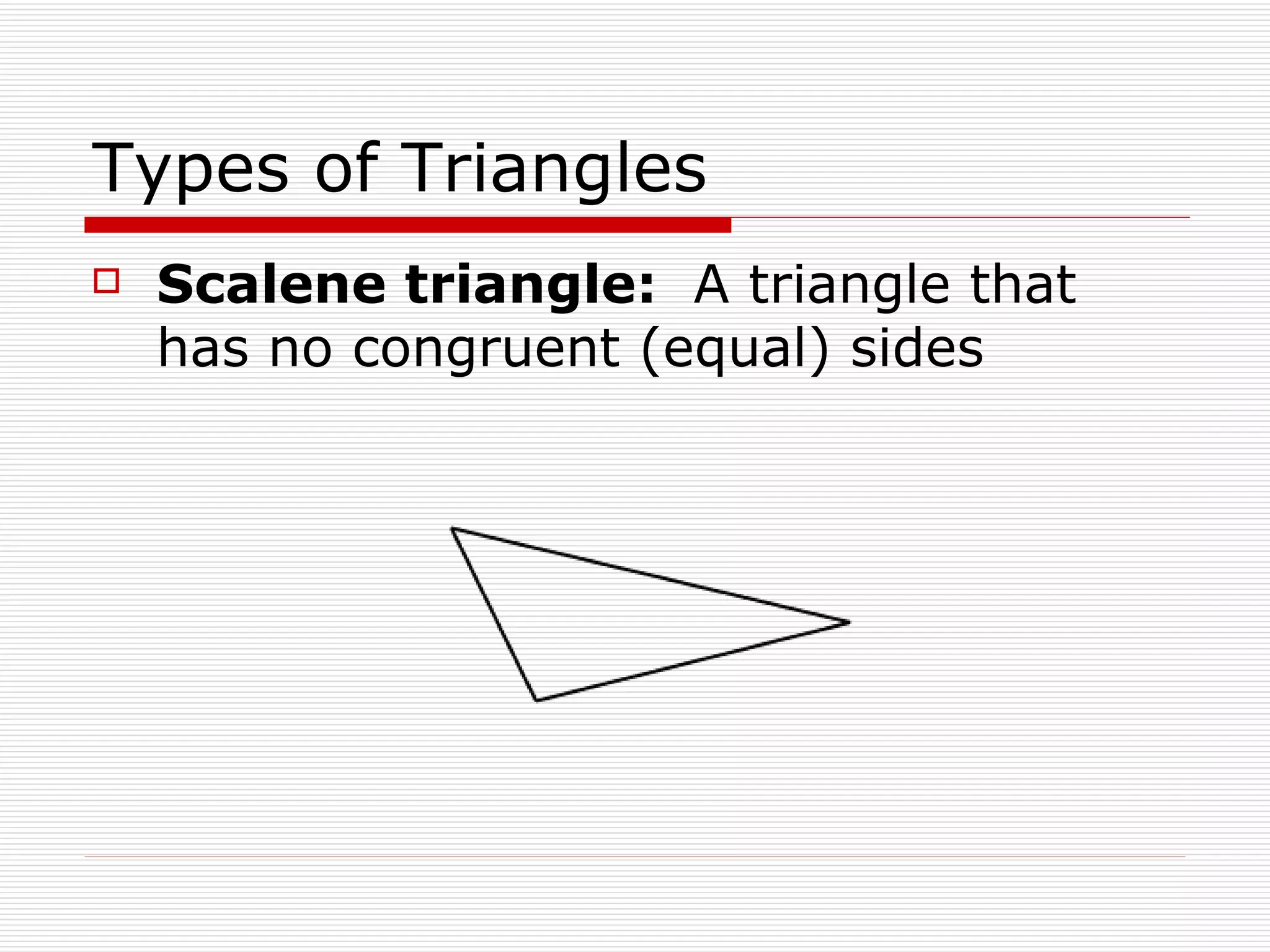
Types of Triangles Scalene triangle:  A triangle that has no congruent (equal) sides
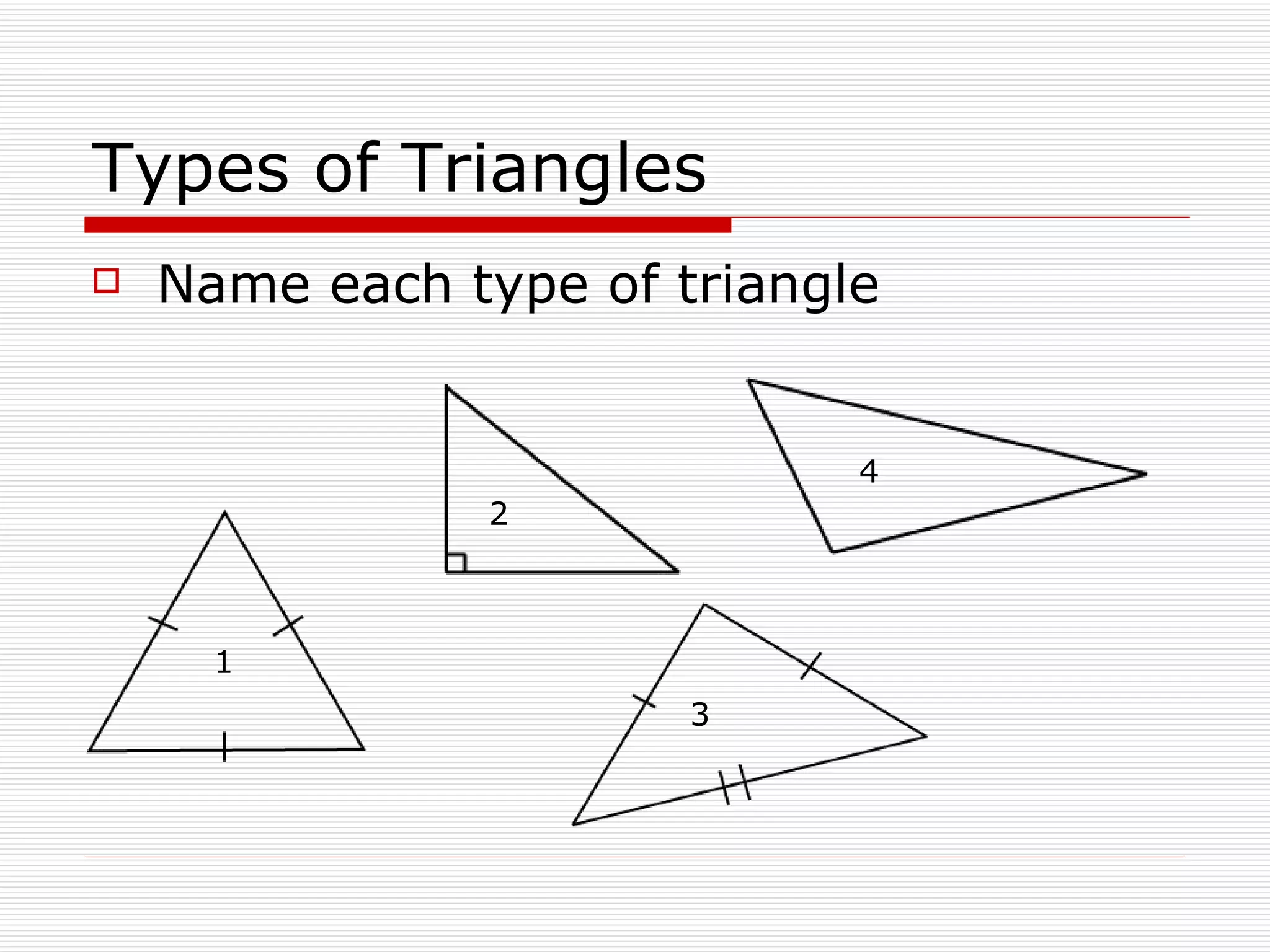
Types of Triangles Name each type of triangle 1 2 3 4
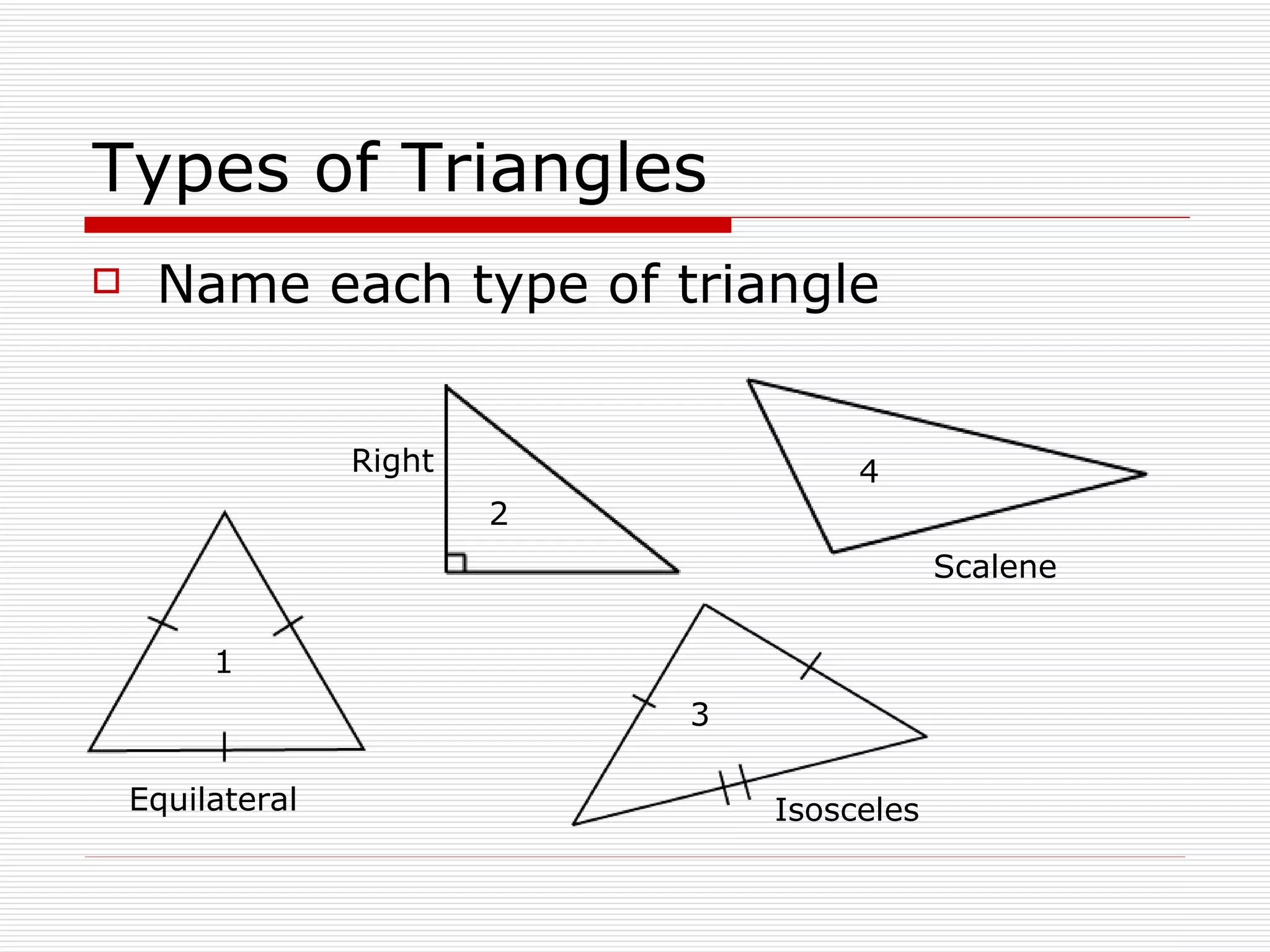
Types of Triangles Name each type of triangle Equilateral Right Isosceles Scalene 1 2 3 4
Interior Angles Interior angles:   An  interior angle  (or  internal angle ) is an angle formed by two sides of a simple polygon that share an endpoint  Interior angles of a triangle always equal 180 degrees.
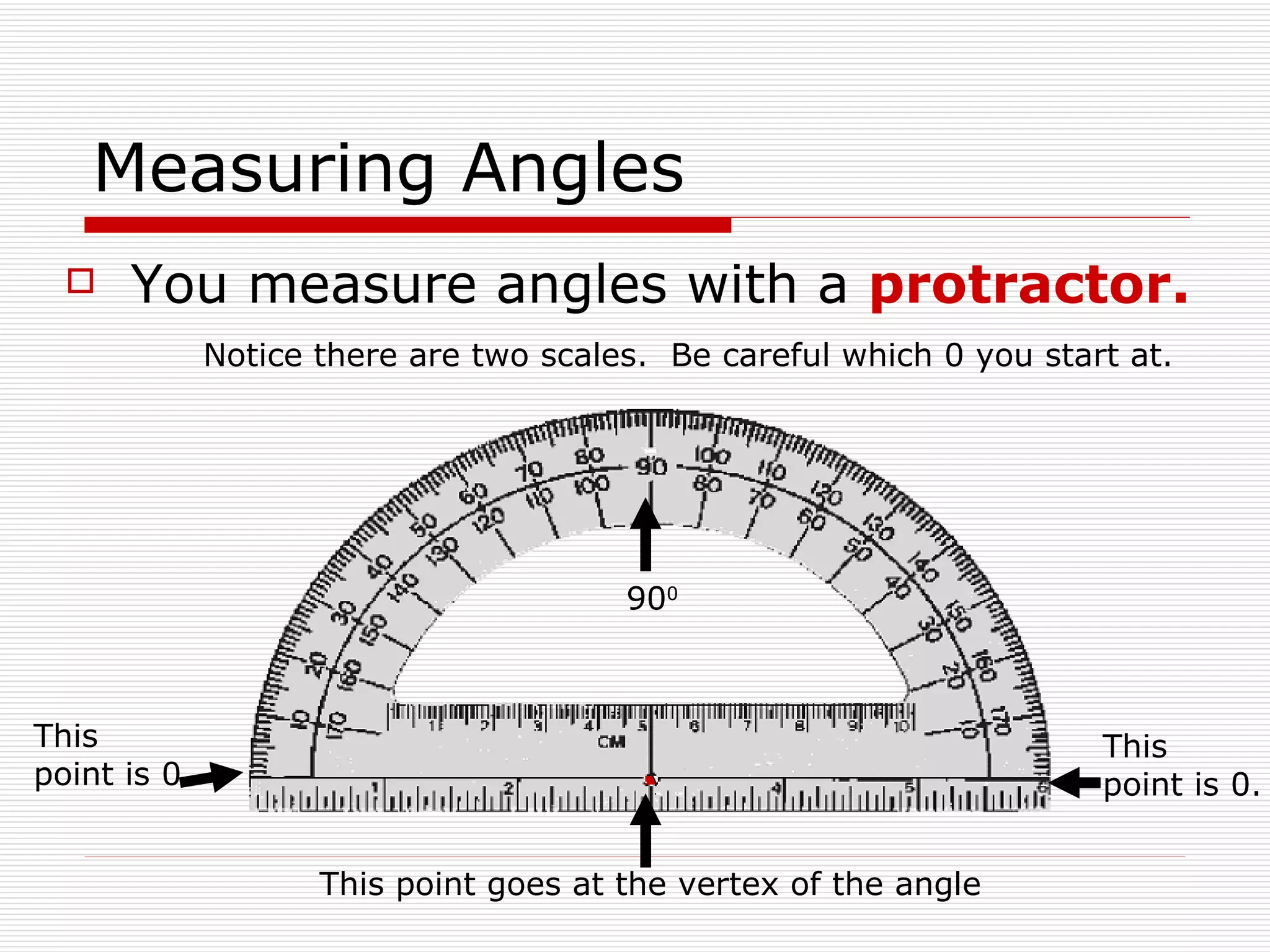
Measuring Angles You measure angles with a  protractor. Notice there are two scales.  Be careful which 0 you start at. 90 0 This point goes at the vertex of the angle This point is 0 This  point is 0.

Angles and triangles

  • 1.
  • 2.
    Angles A shapeformed by two rays sharing a common endpoint; contains two rays and a vertex ray —has one endpoint and goes infinitely in one direction vertex —point common to two rays of a triangle or two sides of a polygon ray ray vertex
  • 3.
    Types of AnglesAcute angle: An angle whose measure is greater than zero degrees and less than 90 degrees Which angles are not acute? 1 2 3 4 5
  • 4.
    Types of AnglesRight angle: Angle that measures 9 0 degrees Which angle is a right angle? 1 2 3 4 5
  • 5.
    Types of AnglesObtuse angle: One angle measures greater than 9 0 degrees and less than 180 degrees Which angle is an obtuse angle? 1 2 3 4 5
  • 6.
    Straight Angle Straightangle: A line that goes infinitely in both directions and measures 180 degrees Which is not a straight angle? 1 2 This is a ray. It only goes in one direction.
  • 7.
    Types of TrianglesEquilateral triangle: A triangle with three congruent (equal) sides and three equal angles These marks indicate equality.
  • 8.
    Types of TrianglesIsosceles triangle: A triangle with at least two congruent (equal) sides
  • 9.
    Types of TrianglesRight triangle: Has only one right angle ( 9 0 degrees) This box indicates a right angle or a 90-degree angle.
  • 10.
    Types of TrianglesScalene triangle: A triangle that has no congruent (equal) sides
  • 11.
    Types of TrianglesName each type of triangle 1 2 3 4
  • 12.
    Types of TrianglesName each type of triangle Equilateral Right Isosceles Scalene 1 2 3 4
  • 13.
    Interior Angles Interiorangles: An interior angle (or internal angle ) is an angle formed by two sides of a simple polygon that share an endpoint Interior angles of a triangle always equal 180 degrees.
  • 14.
    Measuring Angles Youmeasure angles with a protractor. Notice there are two scales. Be careful which 0 you start at. 90 0 This point goes at the vertex of the angle This point is 0 This point is 0.