Grade 10 Mathematics
Euclidean Geometry
Triangles
Presented by Y Fihlani
Introduction
 Welcome, Grade 10 learners, to our mathematics lesson on Euclidean
Geometry, focusing on triangles. Today, we’ll explore the fundamental
properties of triangles, a crucial aspect of geometry that forms the basis for
many other mathematical concepts. Whether you are already familiar with
the basics or encountering these ideas for the first time, this lesson will help
deepen your understanding of the different types of triangles and their
properties.
Definition of a
triangle
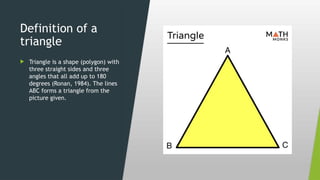
 Triangle is a shape (polygon) with
three straight sides and three
angles that all add up to 180
degrees (Ronan, 1984). The lines
ABC forms a triangle from the
picture given.
Types of triangles
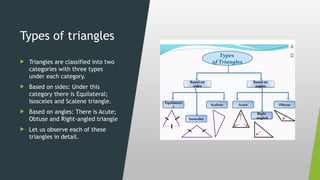
 Triangles are classified into two
categories with three types
under each category.
 Based on sides: Under this
category there is Equilateral;
Isosceles and Scalene triangle.
 Based on angles: There is Acute;
Obtuse and Right-angled triangle
 Let us observe each of these
triangles in detail.
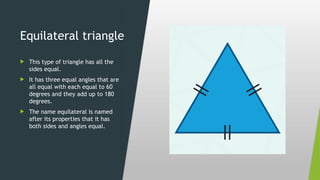
Equilateral triangle
 This type of triangle has all the
sides equal.
 It has three equal angles that are
all equal with each equal to 60
degrees and they add up to 180
degrees.
 The name equilateral is named
after its properties that it has
both sides and angles equal.
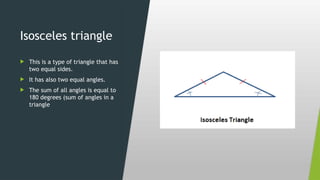
Isosceles triangle
 This is a type of triangle that has
two equal sides.
 It has also two equal angles.
 The sum of all angles is equal to
180 degrees (sum of angles in a
triangle
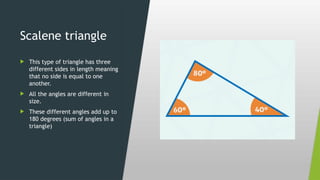
Scalene triangle
 This type of triangle has three
different sides in length meaning
that no side is equal to one
another.
 All the angles are different in
size.
 These different angles add up to
180 degrees (sum of angles in a
triangle)
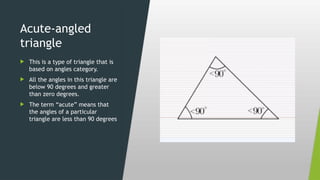
Acute-angled
triangle
 This is a type of triangle that is
based on angles category.
 All the angles in this triangle are
below 90 degrees and greater
than zero degrees.
 The term “acute” means that
the angles of a particular
triangle are less than 90 degrees
Right-angled
triangle
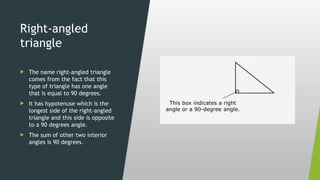
 The name right-angled triangle
comes from the fact that this
type of triangle has one angle
that is equal to 90 degrees.
 It has hypotenuse which is the
longest side of the right-angled
triangle and this side is opposite
to a 90 degrees angle.
 The sum of other two interior
angles is 90 degrees.
Obtuse-angled
triangle
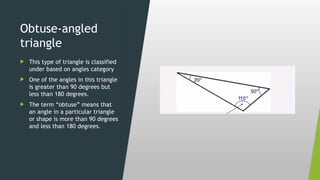
 This type of triangle is classified
under based on angles category
 One of the angles in this triangle
is greater than 90 degrees but
less than 180 degrees.
 The term “obtuse” means that
an angle in a particular triangle
or shape is more than 90 degrees
and less than 180 degrees.
Summary
 Equilateral Triangle: All three sides and angles are equal, with each angle
measuring 60 degrees. Isosceles Triangle: Two sides are of equal length, and
the angles opposite these sides are equal. Scalene Triangle: All three sides
and angles are different from one another. Right Triangle: One of the angles is
a right angle (90 degrees).Acute Triangle: All three angles are less than 90
degrees. Obtuse Triangle: One of the angles is greater than 90 degrees. These
classifications are based on the length of sides (Equilateral, Isosceles,
Scalene) and the measure of angles (Right, Acute, Obtuse)
Reference list
Chilton Primary School. (n.d.). Types of triangles. Available from Power point at
https://www.chiltonprimary.co.uk/attachments/download.asp?file=5060&type=pptx (Accessed on 19
August 2024)
Grangeton Academy. (2020). Types of triangles. Available from Power point at
https://www.grangeton.uk/wp-content/uploads/2020/05/Types-of-Triangle-PowerPoint.pdf (Assessed on
19 August 2024)
Ronan, M. A. (1984). Triangle geometries. Journal of Combinatorial Theory, Series A, 37(3), 294-319.
SlideShare. (n.d.). Triangles: What are the properties of an isosceles triangle? Available from SlideShare at
https://www.slideshare.net/slideshow/triangles-what-are-the-properties-of-an-isosceles-trianglepdf/251
927211?from_search=16
(Assessed on 21 August 2024)
SlideShare. (n.d.). Triangles. Available from SlideShare at
https://www.slideshare.net/slideshow/triangles-249853916/249853916?from_search=4 (Accessed on 18
August 2024)
SlideShare. (n.d.). Triangles. Available from SlideShare at
https://www.slideshare.net/slideshow/triangles-class-roompresentation-22374757/22374757?from_search
=6
(Accessed from 20 August 2024)
SlideShare. (n.d.). Types of triangles. Available from SlideShare at
https://www.slideshare.net/slideshow/types-of-triangles-119301102/119301102?from_search=0#6
(Accessed on 19 August)
Vishnu. (n.d.). Triangles Available from SlideShare at
https://www.slideshare.net/slideshow/vishnu-1-39419142/39419142?from_search=1 (Assessed on 19
August 2024)

Grade 10 Mathematics Euclidean Geometry.pptx

  • 1.
    Grade 10 Mathematics EuclideanGeometry Triangles Presented by Y Fihlani
  • 2.
    Introduction  Welcome, Grade10 learners, to our mathematics lesson on Euclidean Geometry, focusing on triangles. Today, we’ll explore the fundamental properties of triangles, a crucial aspect of geometry that forms the basis for many other mathematical concepts. Whether you are already familiar with the basics or encountering these ideas for the first time, this lesson will help deepen your understanding of the different types of triangles and their properties.
  • 3.
    Definition of a triangle Triangle is a shape (polygon) with three straight sides and three angles that all add up to 180 degrees (Ronan, 1984). The lines ABC forms a triangle from the picture given.
  • 4.
    Types of triangles Triangles are classified into two categories with three types under each category.  Based on sides: Under this category there is Equilateral; Isosceles and Scalene triangle.  Based on angles: There is Acute; Obtuse and Right-angled triangle  Let us observe each of these triangles in detail.
  • 5.
    Equilateral triangle  Thistype of triangle has all the sides equal.  It has three equal angles that are all equal with each equal to 60 degrees and they add up to 180 degrees.  The name equilateral is named after its properties that it has both sides and angles equal.
  • 6.
    Isosceles triangle  Thisis a type of triangle that has two equal sides.  It has also two equal angles.  The sum of all angles is equal to 180 degrees (sum of angles in a triangle
  • 7.
    Scalene triangle  Thistype of triangle has three different sides in length meaning that no side is equal to one another.  All the angles are different in size.  These different angles add up to 180 degrees (sum of angles in a triangle)
  • 8.
    Acute-angled triangle  This isa type of triangle that is based on angles category.  All the angles in this triangle are below 90 degrees and greater than zero degrees.  The term “acute” means that the angles of a particular triangle are less than 90 degrees
  • 9.
    Right-angled triangle  The nameright-angled triangle comes from the fact that this type of triangle has one angle that is equal to 90 degrees.  It has hypotenuse which is the longest side of the right-angled triangle and this side is opposite to a 90 degrees angle.  The sum of other two interior angles is 90 degrees.
  • 10.
    Obtuse-angled triangle  This typeof triangle is classified under based on angles category  One of the angles in this triangle is greater than 90 degrees but less than 180 degrees.  The term “obtuse” means that an angle in a particular triangle or shape is more than 90 degrees and less than 180 degrees.
  • 11.
    Summary  Equilateral Triangle:All three sides and angles are equal, with each angle measuring 60 degrees. Isosceles Triangle: Two sides are of equal length, and the angles opposite these sides are equal. Scalene Triangle: All three sides and angles are different from one another. Right Triangle: One of the angles is a right angle (90 degrees).Acute Triangle: All three angles are less than 90 degrees. Obtuse Triangle: One of the angles is greater than 90 degrees. These classifications are based on the length of sides (Equilateral, Isosceles, Scalene) and the measure of angles (Right, Acute, Obtuse)
  • 12.
    Reference list Chilton PrimarySchool. (n.d.). Types of triangles. Available from Power point at https://www.chiltonprimary.co.uk/attachments/download.asp?file=5060&type=pptx (Accessed on 19 August 2024) Grangeton Academy. (2020). Types of triangles. Available from Power point at https://www.grangeton.uk/wp-content/uploads/2020/05/Types-of-Triangle-PowerPoint.pdf (Assessed on 19 August 2024) Ronan, M. A. (1984). Triangle geometries. Journal of Combinatorial Theory, Series A, 37(3), 294-319. SlideShare. (n.d.). Triangles: What are the properties of an isosceles triangle? Available from SlideShare at https://www.slideshare.net/slideshow/triangles-what-are-the-properties-of-an-isosceles-trianglepdf/251 927211?from_search=16 (Assessed on 21 August 2024) SlideShare. (n.d.). Triangles. Available from SlideShare at https://www.slideshare.net/slideshow/triangles-249853916/249853916?from_search=4 (Accessed on 18 August 2024) SlideShare. (n.d.). Triangles. Available from SlideShare at https://www.slideshare.net/slideshow/triangles-class-roompresentation-22374757/22374757?from_search =6 (Accessed from 20 August 2024) SlideShare. (n.d.). Types of triangles. Available from SlideShare at https://www.slideshare.net/slideshow/types-of-triangles-119301102/119301102?from_search=0#6 (Accessed on 19 August) Vishnu. (n.d.). Triangles Available from SlideShare at https://www.slideshare.net/slideshow/vishnu-1-39419142/39419142?from_search=1 (Assessed on 19 August 2024)